Thursday, 19 April 2018

Who knows what's going on in Syria?


 Robin Yassin-Kassab:

 'Truth is always contested, especially in a war zone. That’s why people like Eliot Higgins are indispensable. He (and his Bellingcat organisation) geo-locate videos, cross-reference on the ground reports, and so on, in order to verify what’s happening. Within Syria, groups like the Violations Documentation Centre and the Syrian Network for Human Rights do very careful fact-checking. So the SNHCR’s statistics on civilian deaths in the conflict (finding 94% were caused by Assad and his allies up to October 2017) include only named and documented cases. The OPCW, UN bodies, and human rights organisations have released many reports finding Assad and his backers responsible for war crimes and crimes against humanity.

 So while truth is difficult to discern, it is still possible to discern it most of the time, and this is being done, those who pretend that it isn’t, or that no clear pattern emerges from the various reports, are therefore clouding the truth, whether deliberately or unwittingly.

 From the start of the revolution in 2011 I aimed to inform and comment on actual events in Syria. Then it became more important to amplify Syrian voices and perspectives, because the English-language media in general was ignoring them. I didn’t pay much attention at first to the more extreme and blatant atrocity denial and propaganda. That was a mistake. The Assad regime, and Russia and Iran, have won the information or narrative war as surely as they’ve defeated the Syrian rebels. The aim of the Kremlin-Assad-Iran propaganda machine is not to create simply one alternative version of reality – because that version is a fiction, holes will inevitably be found in it – but many, so as to cloud the public sphere, so that nobody can be sure what’s happening. That’s why the Russian envoy to the UN claimed in the same speech that 1. there was no chemical atrocity in Douma, and 2. that the (non-existent?) atrocity was perpetrated by the rebels with help from western powers. Such stories are fed by the Kremlin onto western conspiracy theory websites, get picked up by alt-leftists and rightists, then by ignorant and lazy mainstream journalists, then become part of the accepted reality. So now, in order to discuss the latest Russian targeting of the White Helmets first responders, it’s necessary first to dispute endless conspiracy theories that the White Helmets are an al-Qaida front or a tool of western imperialism. Which is very convenient for the war criminals.


 Reporters and authors should focus on actual facts first, then on human realities. Not on orientalist assumptions. They shouldn’t start with a narrative (like jihadis vs secularists, or Sunnis vs Shia, or ‘a re-run of Iraq’) and select or interpret facts to fit that narrative. Rather they should start with facts, then voices from people on the ground, and try to understand events on those terms. We as readers should stop relying on famous white correspondents who don’t speak local languages and who travel everywhere with regime minders. Newspapers and websites should take their fact-checking responsibilities far more seriously, and should publicly correct and apologise when their writers are proved wrong.

 After seven years of repression and war, with the intervention of numerous foreign states and organisations, the geo-political aspect of the war dominates. In many respects the fate of Syria is now out of Syrian hands (including Assad’s). Yet the fundamental problem in Syria remains that millions of Syrians find the continuation of Assad rule intolerable, and Assad in turn finds the continuation of these opponents’ very existence in Syria intolerable. It was Assad’s original war on the people which birthed a series of regional and international conflicts. Without engaging with this reality, there will be no solution to the Syrian conflict. The remains of Syria will continue to throw out people, to inspire terrorism, and to provoke super-power sparring.

 On some Fridays in 2011 and 2012 millions of Syrians went onto the streets to protest, even though they knew they would be shot at or arrested and tortured in the sweeps afterwards. They didn’t risk their lives, as some imagine, because they were incited or paid by the CIA, Mossad, or Saudi prince Bandar, but because they were immediately concerned by the failures of dictatorship. To see Syria only as a proxy war is to rob Syrians of their agency, and therefore points to a racist habit of thought.

 Similar overgeneralisations lead to Idlib being described as ‘al-Qaida controlled’. Al-Qaida (or Nusra) is certainly present. So are various other Islamist and Free Army militias. So are local councils, women’s centres, free newspapers, trades unions, and people who regularly protest against Nusra.

 Diane Abbott describes the Syrian revolution (which includes Christians) as mere “rag-tag jihadis”, and entirely ignores hundreds of democratic self-organised councils. Again, it’s the failure to see people, or even to want to see them. Only states and terrorists matter.


 Islamophobic and racist overgeneralisations are as prominent on the left as on the right. in a nonsensical and reactionary binarism, ‘progressives’ are more likely to express solidarity with states – even fascist or imperialist states – than with people. As a result there is increasing red-brown convergence.

 Analysis and engagement have been sacrificed in favour of (inaccurate) grand narratives and conspiracy theories. This way of seeing the world ends up in demonology. So for instance the triumvirate of evil – Israel, Saudi Arabia and the US – must be blamed for everything from the Arab Spring to ‘inventing ISIS’. (Nobody needs to make stuff up to criticise these states. They certainly commit terrible crimes. But this overgeneralisation leads to a picture of the world which is entirely false. Saudi Arabia, for instance, is scared of ISIS, has been repeatedly attacked by ISIS, funded mainly the Free Army in Syria – but also Jaish al-Islam which, while Salafist, ruthlessly eliminate ISIS and al-Qaeda cells in its area of control. Indeed Saudi Arabia is currently pursuing a fiercely anti-Islamist policy in the Arab world. It underwrote General Sisi’s coup against the Muslim Brotherhood government in Egypt).

 The problem goes beyond the left. Brexit and Trump as well as Corbynism are symptoms of a larger cultural slide involving populism, conspiracism and the dominance of powerful fictions. A rigorous analysis of the phenomenon would have to take on board the role of social media and the growth of a ‘post-literate’ society in which people are simultaneously atomised (working at home, for instance, not meeting fellow workers every day) and strangely connected (to an international internet clique of similar opinion or interest). It may have to do with the collapse of traditional religion, then of its replacements (belief in progress, for instance), and therefore of the basic human need to fit ourselves into big stories.


 We started the decade with grassroots revolutions. We’re heading to the end of the decade with these movements crushed on the ground and in the ideological sphere. Two pregnant quotes for our times:

 Walter Benjamin – “Behind every rise of fascism is a failed revolution.”

 Hannah Arendt – “The ideal subject of totalitarian rule is not the convinced Nazi or the convinced Communist, but people for whom the distinction between fact and fiction and the distinction between true and false (i.e., the standards of thought) no longer exist.” '

The Families Who Sacrificed Everything for Assad


 'Many Alawites believe Douma’s main insurgent group Jaysh al-Islam, or the Army of Islam, has been holding up to 7,500 Alawite prisoners in and around the city—including army generals, soldiers, and civilians—kidnapped or taken captive by rebels over the years to try to extract concessions from the regime. Though the Alawites represent a small proportion of the country overall, they hold key regime positions, dominate the police, and supply the main fighting forces who have been defending the regime since 2011. Many of their families are missing loved ones whom Assad can’t seem to get free, even as he tells them he wants still more of their sons to fight.

 Assad’s ability to get them back is vital to preserving his legitimacy in the eyes of this important constituency, a fact that Iran and Russia, his patrons, also recognize. “We won’t give up on any missing or kidnapped person and we are going to do whatever it takes to free him if he’s still alive,” Assad said during a meeting with Alawite families on Tuesday. For Assad, demonstrating solidarity with his own community may be a bigger concern than any fallout from his use of chemical weapons. Given the West’s uneven track record in responding to previous such attacks, his allies’ determination to protect him, and his own willingness to justify any atrocity or lie about it with impunity, there’s a brutal logic to his thinking—his regime seems built to last, especially as confusion grows about what if anything the American response will be. Yet, in the lead-up to the suspected Douma chemical-weapons attack, it became clear that Assad needed to demonstrate to his own war-weary community how far he was willing to go to free their prisoners. This is a dictator who instinctively understands how quickly things could collapse if the Alawites turn on him.

 Over the course of Syria’s seven-year war, I’ve spoken with many Alawites who feel they have sacrificed everything to preserve nearly five decades of Assad family rule. Virtually every house in Alawite strongholds in western Syria has been affected by the war, which many members of the community believe is as much about saving Assad as it is about preserving their very existence. The regime’s narrative claims that the Sunni Muslim majority, from which the rebellion draws, wants to eradicate their community. And as the rank-and-file of the army crumbled because of defections, Alawites rushed to join newly created sectarian militias. But Assad always seemed to care more about Iran’s Shiite militiamen, including Hezbollah fighters, who also flooded the battleground to save him.


 The recent offensive in Eastern Ghouta, which has involved nearly two months of a Russian-backed scorched-earth campaign against the rebels, seemed destined to change that, particularly as Iran and its militias appeared to be taking a backseat. Alawites and many inside the regime called for Assad to inflict maximum pain on the opposition to secure the release of prisoners.

 Throughout March, tens of thousands of rebel fighters and civilians emerged from Eastern Ghouta and received safe passage to Idlib, an opposition-dominated province in the north. Their release had been arranged in negotiations between the Russians and armed groups. As the Alawites watched them leave, they grew anxious and angry: They had yet to receive much information on their brethren still held by the Army of Islam. But then the Russian-led negotiations with the group collapsed, with the fate of the Alawite prisoners still unresolved. And Assad apparently decided it was time for extreme action. On Friday, the Syrian regime resumed its massive bombardment of Douma, and issued an ultimatum to the rebels: Death and mayhem on an unprecedented scale unless all Alawite prisoners were accounted for or released. Then came Saturday’s suspected chemical weapons attack on Douma, involving a possible mix of nerve agents and chlorine. The Army of Islam soon returned to the negotiating table to discuss Douma’s surrender, with the fate of the Alawite prisoners and missing persons the first item on the agenda—a development that provided momentary satisfaction to the families.


 Soon after, anguished Alawite mothers, wives, and parents rushed to Damascus from their towns and villages in western Syria expecting to be reunited with their loved ones. But hope quickly gave way to anger and frustration when, by Monday evening, only about 200 Alawite prisoners emerged from Douma. Emotions boiled over when the regime’s official media announced that 200 was the final number of prisoners coming out alive from Douma. That 7,500 figure was “fake news,” they said, disseminated in an attempt to extort money from the despairing families.

 In a rare and incredible scene, hundreds of furious Alawites staged an impromptu protest in central Damascus on Monday, marching from an auditorium next to the Russian Embassy that had been turned into a waiting area for the families to one of the capital’s busiest traffic intersections. Nervous regime security forces immediately cordoned off the entire area and sent in state media representatives to console people and allow them to vent. All other media was kept out, one independent Damascus-based reporter who witnessed the scene told me.

 “I brought my son these pants so he could wear them when he was freed,” a bespectacled woman in black shouted as she waved a pair of jeans before the cameras. Her son, a soldier who had been missing for six years, had not showed up. “I used to trust you [state media] but no more!” Jaafar Younis, a state television correspondent and a fellow Alawite, tried to comfort her. “Please calm down auntie, we are dealing with a terrorist armed group”—a reference to the Army of Islam— “that cannot be trusted to keep its word. And all of you saw the pressure the Syrian army put on them when they tried to renege on the deal,” he said. Another correspondent, also an Alawite, conceded there were still possibly thousands of kidnapped and missing Alawites all over Syria but said they were no longer in Ghouta. “We want lists with the names of the kidnapped, dead or alive. … We want our voice to reach his excellency President Bashar al-Assad, only him,” one man insisted.


 By nightfall on Monday, the Alawite families were persuaded to leave the streets after bringing traffic to a standstill. They returned to the auditorium, but their rage did not subside. “The [regime] officers are bastards. The media are bastards too and they never tell the truth. We want to know the fate of our children! How much did you sell them for? How much did you get for the martyrs’ blood? How much?” one tearful mother screamed.

 I heard such sentiments from Alawites numerous times during a two-week trip through the Hama countryside and the coastal western provinces of Latakia and Tartous in the summer of 2014. Tearful mothers and wives told me they knew their loved ones were being held by rebels in Douma, and wanted Assad to do more to get them out. For them, Assad seemed too laid back and preoccupied with his image as a president for all Syrians and not as the leader of the Alawites. Mohammad Jaber, one militia leader close to Assad’s shadowy and ruthless brother Maher, told me in early 2013 that Assad was not as decisive as his late father, who ruled Syria for three decades and faced a similar insurrection in the 1980s. Bashar, Jaber said, should “exterminate” rebels and their families—especially those around Damascus, in places like Eastern Ghouta. This was months before the first major chemical-weapons attack on Ghouta in the summer of 2013 that killed almost 1,400.

 Even though Assad has reclaimed much of the territory that regime forces lost to the rebels, the war is hardly over. Over time, it has empowered many Alawite militia leaders and warlords who demand more toughness from Assad. At least for now, he needs these people, and knows that any major rift within his Alawite community could cost him power in the parts of the country he does control, even with the full support of Iran and Russia.

 Still, Assad is obsessed with projecting himself as a nonsectarian leader for all Syrians who sees the big picture and broader implications of the war. “The battle is bigger than Syria, you are now fighting the war of the world, the global struggle, with each bullet you are firing at a terrorist you are changing the world’s balance of power and every tank driver advancing for a meter is changing the world’s geopolitical map,” a clean-shaven Assad dressed in well-pressed slacks and a blazer told soldiers and militiamen during a visit to the Eastern Ghouta front lines last month to flaunt victory.

 But what do balance of power and geopolitical maps mean for Alawite families who gave their children to keep Assad in power? It is ironic that after a seven-year war that killed more than half a million people, displaced millions and saw the rise and fall of ISIS and involvement of foreign and regional powers, the greatest threat to Assad’s hold on power could still come from his own Alawite community.'

The Syrian football star caught up in revolution


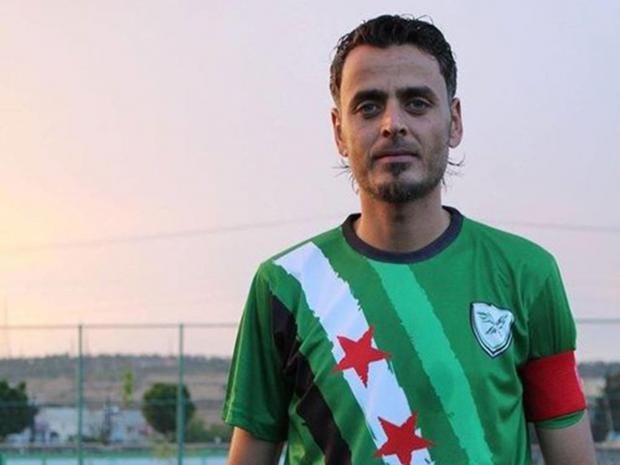
 'When the revolution broke out in 2011, Firas al-Ali was playing in Damascus for Al Shorta, and for the Syrian national team. “Society treated me like a superstar,” he told me. “When I went to the shop it would take me four hours to deal with the attention from fans!”

 With his previous club – Al-Taliya of Hama – Firas won the Syrian Cup twice and reached the quarter-finals of the Asian Football Confederation Cup (AFC), Asia’s version of the Europa League. Firas is a winger and a free-kick specialist whose left foot would impress Gareth Bale. Al-Taliya’s fans recorded a song for him, which sounds better in Arabic, but goes something like: “When you run on the pitch, the fans boil over, your crosses are so beautiful, Firas al-Aaaaliii!”


 As a footballer, Firas witnessed some of the nepotism and corruption of Bashar al-Assad’s dictatorship first-hand – players who were picked because of their connections with the regime rather than their talent. Firas had felt critical of Assad, but he had kept quiet, as did most under the terror of Assad’s mukhabarat, the secret police.

 But when the revolution broke out, Firas joined the protests, covering his face to hide his identity. He got into arguments with teammates who had continued to support Assad, even as the dictator’s security forces bore down on peaceful protesters with extreme violence, brutality that soon ensnared his family. His 19-year-old cousin was killed at a protest – the bullet entered his eye and came out of his head. His niece was killed – completely vaporised when a barrel bomb fell directly on her house.

 As months went by, the protests continued and the repression intensified, giving way to an increasingly complex, factionalised civil war as the opposition took up arms. Firas’s hometown of Kafr Zeita, near Hama, became associated with the rebel Free Syrian Army (FSA). Despite being a police officer, Firas’s brother was arrested because of his connections to the rebellious town. Meanwhile, Firas remained in Damascus, where he would hear gunfire during training. The stadium was converted into a military base for the regime.

 While on a training camp with the national team he watched from the window of his hotel as smoke rose from shelling across Damascus. One day he found out that another of his cousins, just 13, had been killed by the security forces. Half an hour later he joined the rest of the team for dinner – one teammate mocked the protesters and Firas lost it: he had to be pulled off him. Firas couldn’t take it anymore; it was time to defect.


 At dawn the next day, he sneaked away from the training camp, from the city, from his career, and set out for Kafr Zeita, some 300 kilometres north of Damascus, but the national team – preparing visas for a tournament in India – had his passport and military service documents. “At every police checkpoint there was a risk that I would be detained and taken for military service,” said Firas. “The thing that saved me was that the soldiers at the checkpoints were football fans – they knew me and I didn’t have to show my ID, otherwise they would have taken me.”

 Firas spent around seven months in Kafr Zeita, while the war raged and his money dwindled. “The roof of my house made me a footballer!” Firas told me, while describing his hometown. As a child he’d set up a small table on the roof and would fire endless shots and passes at the target each day, until he could hit it almost every time, and had practically destroyed everything else on the roof in the meantime. When he broke something, his dad would get angry and twist his ear, but the next day would buy him a new football or pair of shoes. Firas played on rough, sandy ground and was forever going through balls and shoes. “My family’s financial situation was not great,” said Firas, “but my father had the feeling that I would become something special.”

 Kafr Zeita was subject to heavy bombardment by Assad’s forces. It started with shelling around six times a day. Then the shelling increased and they started to drop bombs from helicopters. It wasn’t safe to hide in the house; they had to flee to nearby farms and fields, returning when the helicopters left. They had a radio that alerted them before an incoming attack, but they had very little time. “If [my brother] didn’t have a car we would have stayed in our house and died,” said Firas.


 Rockets destroyed his family’s houses, life became unliveable, and Firas went from unemployed footballer to refugee, taking his wife and three kids, and his parents, and crossing into Turkey. It was 2013 at the time, and the Turkish government was still maintaining its open-door policy to Syrian refugees.

 While his family went to Karkamis refugee camp, Firas wrangled over a contract with the Jordanian Super League team Al-Hussein. He spent a successful season there but being away from his family for a year proved hard and he returned to Turkey to collect them and bring them over to Jordan. While he was in Turkey, the Jordanian government changed the visa requirements for Syrians. Firas and his family were turned away at the airport and returned to the camp. “I surrendered to bad luck,” said Firas.


 The days of receiving daily adoration and an annual salary of over $100,000 – a fortune for most people in Syria – seemed unimaginably distant. “I moved from a five-star environment to one with no stars. The camp and being a refugee, how can I talk about it? Everything is difficult, from the simplest thing. Even leaving the camp is difficult.”

 There are seven of them in a three-by-three-metre tent, sleeping next to each other on mattresses on the floor. The bathroom is the length of a football pitch away, and feels much further at night. Only when his family sleeps can Firas have some time alone for his thoughts. By the last three or four days of the month, the money they’ve been given by the camp has usually run out.


 Firas and his immediate family were relatively safe, but when Firas prepared to talk about his arrested brother he sighed and swallowed and looked down at the table. When he looked up again, the blue in his eyes had faded.

 Three years after his arrest, they received news. A government officer had leaked 750 photographs of dead prisoners, and Firas’s brother was among them. In the photo, his neck was covered in bandages. “Maybe they cut his throat,” said Firas. All they knew for certain was that he had been killed 45 days after being arrested.

 Firas had been fortunate to avoid his brother’s fate. His fame as a footballer had got him through regime checkpoints, but many footballers and other celebrities who spoke out against Assad’s regime became targets. Dozens of players and coaches have been arrested and killed in a war that has claimed hundreds of thousands of lives.

 Amid the privations of Firas’s life, football still keeps him going. He runs a football academy in the camp for around 200 kids. The pitch is bare, rocky ground. They have one football and use stones for training cones. “But when I see the kids are happy I forget that I am a professional player with a lost career,” he said with a smile.

 Firas is also involved in a struggle to set up an alternative Syrian national team in Turkey that can rival and displace the official Syrian national team run by Assad’s regime and recognised by FIFA. “I can’t fight with a gun, so I will fight with football and the talent that God gave me.” '

kafr-zeita.jpg

Tuesday, 17 April 2018

Valley Doctor Reacts to Airstrikes in Syria


 'A valley doctor says he can never go back to his home country, he is exiled by his political views.

 Tensions continue in Syria after this weekend’s joint airstrikes by the U.S., UK and France.

 Fact-finding teams sent to access the site are not being allowed in.The airstrikes hit close to heart for a Rio Grande Valley doctor who called Syria home.

 "What happened this weekend is really, really a very good thing,” says Dr. Ghanem Daghestani.


 Dr. Daghestani has helped cancer patients in the Valley for 10 years. He says the airstrikes are a message to stop the chemical warfare in Syria.

 "We hope that this will completely take away the capability Assad to use any chemical weapons against the population," he says.

 Dr. Daghestani says some of his family members could be part of the society attacked previously by the Syrian government.

 "We have family members that we don't know of their whereabouts of," he says. "I have cousins I don't know where they are, maybe under the rubble somewhere."

 He wears a bracelet as representation. "It is against keeping Assad in power. This is in support of the Syrian revolution and it has not left my arm for probably seven years now," he tells us.

 Dr. Daghestani says he hopes one day to take the band off. He wants the situation in Syria to improve before more missiles become a destructive voice of change.'


Note 30/7/25, link broken.

For Survivors of Aleppo, the News Is Especially Painful


 'As the government siege of a rebel-held Syrian suburb has unfolded, one group of Syrian exiles has felt especially tormented.

 They are opposition leaders and activists from Aleppo who survived the devastating government chokehold of their own city.

 Fourteen months after they were forced to evacuate the last neighborhoods of Aleppo, they are reliving their trauma from southern Turkey, where they have been spending hours online encouraging activists and rebels in the Eastern Ghouta region outside Damascus, the Syrian capital, and helping to disseminate videos and news from the latest siege.

 “The period that we witnessed and lived in Aleppo was a real hell,” said Hisham al-Skeif, one of the civilian leaders of the Aleppo protests now living in the southeastern Turkish city of Gaziantep. “Now what is happening in Eastern Ghouta is bringing it all back.

 “The hardest thing is to see despair in people’s faces,” he added, clenching his fists and screwing up his face at the memories and at one point breaking into tears. “They think they are going to die and no one cares.”


 A writer and Arabic teacher from an old Aleppo trading family, Mr. Skeif became one of the most outspoken civilian leaders opposed to President Bashar al-Assad and his father, Hafez al-Assad, who was president before him.

 Mr. Skeif’s baby son was asphyxiated by the dust of a bombardment. The father made a last, ferocious denunciation of the Syrian government on video just before the evacuation of Aleppo in December 2016. That placed him on top of the government’s wanted list.

 “This regime does not fear weapons. It fears words,” he said. “We had to keep going in our revolution because if we went back, our children would have to live under a third generation of Assads.”

 In exile, many of the Aleppo protesters have dispersed or taken a break, exhausted and depressed at the defeat of their dream of freedom from dictatorship. Yet they feel compelled to share their experience, even if they think the outside world only tunes in after the ghastliest horrors, like the April 7 attack that witnesses and medical workers say used chemical weapons to kill scores of Syrians in Douma, a town in Eastern Ghouta.


 The United States, Britain and France joined in airstrikes last Saturday to punish the Assad government for the attack; Syria, and its backers Russia and Iran, has denied being behind the attack.

 Monther Etaki, a former design student who was one of the last media activists to document the Aleppo siege to the end, said of the act of bearing witness: “It’s worthless, but it’s a duty to do it.”

 A former fine arts student, Mr. Etaki, 28, struggles to support his extended family with freelance media and design work.

 “I lost my job,” he joked, referring to his activism in Aleppo. “For people who were relying on me for information, I am no longer useful.”

 But he continues to blog and post on social media about the war in Syria and to help those still resisting inside.

 “I am just talking to friends in Ghouta and giving advice how to survive because I have some experience,” he said. “I am telling them to save their equipment and not be worried, be calm, that everything will be solved in the end.”

 Fearful for his family — his son was born on July 10, 2016, just before the siege of Aleppo began — he said he lost control at times toward the end.

 “Once I cried,” he recalled. “Once I burned my car. I forgot to take my things.”


 Many of the opposition members set fire to their cars and belongings to prevent them falling into the hands of the pro-government militias that were encroaching into the rebel neighborhoods. In the end, the last to leave were allowed to drive their cars out since there was a lack of buses and in the snow and freezing night, the soldiers stopped checking all those evacuating.

 Mr. Etaki even left the gas on in his home, hoping to destroy it so the pro-government militias could not use it.

 “I was thinking it would burn, but then we did not evacuate that day and I had to go back,” he laughed. There was still just enough gas in the bottle to keep warm that night, he said.

 When he did leave, he said Russian soldiers stole his computers, and his cameras and other equipment were taken as well.


 Dr. Hamza al-Khatib, who became known for his work running the last functioning medical center in Aleppo, Al Quds hospital, warned a friend in Ghouta how the siege would play out.

 “The beginning was a complete besiegement, not allowing anything in or out,” he said. “Then there were a lot of rumors, people coming who wanted to negotiate. That takes about three months. Then heavy shelling, barrel bombs and gas attacks.”

 Dr. Khatib urged his colleague to stay safe somewhere and wait for the organized evacuation.

 “I am telling him just not to lose faith in life,” he said. “You and your wife will live and don’t listen to the rumors. We heard that a lot in Aleppo, that everyone is a traitor.”

 Many who went over to the government side were arrested, and others who chose to stay in their homes were killed by the pro-government militias who took control after the evacuation, Mr. Skeif said.


 For those who did evacuate, the transition to a normal life has been hard in a different way. Molham Ekaidi, 29, an architecture student who became a rebel commander, spent the first four months in Turkey sitting inside his parents’ home, staring at the walls.

 “For years, you only live for the moment. You do not think of the future and you do not think about the previous days,” he said, describing his years as a fighter. “I had to think how to make my living, how to raise my children. It was very hard to start thinking. It took four months before I spoke about architecture.”

 When Turkey opened its universities to Syrian undergraduates to complete their degrees, he joined the final year in the architecture degree course.

 “I didn’t remember anything,” he said.

 His fellow students are 10 years younger than he is, and, he said, they know little about the Syrian revolution.

 “It is hard to connect with them,” he went on. “They don’t know anything of my life.”

 He avoids watching video footage from Syria, but has not ruled out returning to fight if circumstances were to change. Like other survivors, he describes restarting with smaller dreams.

 “I do not have the big dream to have a free country,” he said, “just an aim to make a better life.”


 Mr. Skeif said he was lost.

 “There is no plan for my life,” he said. But then he rallies and talks of a new political project for Syrian youth. “I have a dream for girls like my daughters to have political awareness,” he said, “so they never have an Assad in the future.”

 Dr. Khatib, 31, seems the most positive and confident of the survivors. He works for a relief organization, supplying medical relief to hospitals inside Syria and is planning with his wife to further his education.

 “Now we think is a dead time,” he said. “So we thought we can use this time.”

 But he is also devastatingly realistic about returning to Syria.

 “Maybe my daughter will grow up and by the age of 20 will never have been to her country,” he said.'

Sunday, 15 April 2018

A Syrian activist’s message for Trump


 'My name is Abdalaziz Alhamza and I am a 26-year-old Syrian refugee from Raqqa, the former capital of the so-called ISIS caliphate. I want to personally say thank you for joining with France and Britain to launch air strikes against Syria following chemical weapons attacks on Syrian citizens. You let Syria’s President Bashar Assad know that red lines drawn by the U.S. are no joke.

 I pray you will continue to hit Assad hard and put smiles on the faces of all the mothers who lost their children. Your strikes give hope to all the children who lost their parents.

 Mr. Trump, I urge you to push the international community to support civil society organizations, build schools and hospitals. People will appreciate this more than anything else, and you will go down in the annals of history as the greatest champion of humanitarian action in a world where international governing bodies are willfully impotent and paralyzed.


 Looking back to my childhood in Syria, I can recall being made to watch the news with my father all the time. I was a kid, so I just couldn’t get what was so interesting about people talking for hours on end!

 We would often watch news reports from Afghanistan, and I distinctly remember the fateful day of September 11, 2001 when I heard the name “Al Qaeda” for the first time. I was 9-years-old. I understood nothing. But then, the Iraq War happened. I quickly became versed in the lingo because virtually every Syrian television was tuned into footage of the war in Iraq.

 When I got older, I opted out of getting involved in politics. The main reason I stayed away relates to our neighbor who was arrested under suspicious circumstances. People on the street would make cryptic comments like, “he’ll never see the light of day.” It frightened me and I didn’t question that feeling.


 Later, like many of my Syrian compatriots, I joined the protests in our iteration of the Arab Spring early on, demanding freedom. I’ll never forget my first demonstration. Though I was among the throngs for maybe only 40 seconds, to me, it felt like an eternity.

 Despite my conviction to the cause, I was still absolutely terrified of what could happen if I was identified by anyone affiliated with the government. So after those 40 seconds, I ran. I ran for 15 minutes straight, hopped in a taxi for a good distance, loitered at a small café for about a half hour, and then took another taxi home.

 From that moment onward, I started to research what was going on in my country and the world. I started questioning everything I thought I knew. I started to probe the far reaches of my imagination: How could we effect real change in the country with these protests?

 But before long, the Assad regime started arresting, torturing, and killing protesters. I was personally arrested three times, so these were no empty anecdotes; joining the protests posed a real threat to my life.

 I nonetheless found myself addicted to demonstrating. I felt a sense of obligation to those protesters who had been disappeared or killed. It was during this time that we insisted on dismantling the Assad regime; the number of the protesters grew and demonstrations were popping up nearly everywhere in the country. A revolution was born in Syria.

 Day after day, we faced off Assad’s armed forces with our peaceful demonstrations to prove that all their violence would be unable to kill the spirit of the Syrian Revolution. We responded to gunshots with cameras and told all the world our story. A new generation of activists, journalists, artists, and civil society organizations began to thrive.

 At first, we were convinced the regime would eventually abandon this bloody campaign – how long could it possibly go on killing its own people? But we were eventually forced to recognize a horrible reality: we were dealing with a regime that had controlled the country with an iron fist for more than 40 years. This regime’s brutality knew no limits, no humanity, no mercy.


 At the end of 2011, the Assad regime strategically released from its prisons the extremists who had returned to Syria following the Iraq War. The regime knew full well that these people were not interested in building schools or planting community gardens. These people were released into the country by the Assad regime to sow seeds of chaos and terror among the peaceful people demanding freedom from his tyrannical regime.

 In the midst of our peaceful protests, we didn’t ask for foreign intervention; the Assad regime brought Iran and Hezbollah to fight for it. In time, we could no longer stand by and watch our people being massacred, so only then did we call for help from the international community. We pleaded that outside powers stop Assad by finding a political solution.

 We asked that Assad be held accountable for his actions in a court of law, but all we got from the international community were speeches rich with hot air, and promises that were never be kept. And then ISIS emerged.

 Mr. Trump, Syria’s people have been killed in so many ways – some you can imagine and others you cannot. Assad has killed us with bullets, bombs, snipers, starvation, and various forms of horrific torture techniques I could personally attest to.

 I remember in 2013, when Assad deployed a chemical weapon that killed an unfathomable amount of Syrians in a matter of minutes. I cried more at that horror than any other – seeing all those dead bodies – free from any blood stains and perfectly intact apart from the yellow hue that shrouded their faces frozen in terror. All they had done to ensure their own deaths was to breathe.

 Yes, Mr. President, they dared to breathe after your predecessor declared that any use of chemical weapons constituted crossing a red line. We took this to heart; we thought that this atrocity would finally elicit meaningful action from the U.S. and the international community to finally eradicate this 21st century monster.

 Unfortunately, Mr. President Trump, the red line turned out to be drawn in blood, and we collectively lost all trust in the U.S. and international community. The world’s inaction taught Assad that no one would stop him, so he continued to use chemical weapons with impunity.


 In 2015, Assad brought the Russians in to fight alongside his armed forces and this decision, by far, turned the military table in his favor. The relatively weak Assad army was now empowered to slaughter even more Syrians.

 This so-called civil war was no longer a family affair – we were being killed by non-Syrian actors – countries and militias that had nothing to do with us. The Syrian conflict turned into a proxy war. Then, and only then, the U.S.-led international coalition decided to join the war by targeting ISIS, and leaving Assad to act as he pleased.

 My friends and I founded “Raqqa is Being Slaughtered Silently” – the first organization to report from inside ISIS territories. We wanted to fight terror with truth, and because of this, everyone affiliated with the organization became targeted by ISIS for extermination.

 But while it’s true that I suffered more at the hands of ISIS than any other group, I need to tell you something very important: Assad’s regime is far more brutal than ISIS.

 Mr. President, some 95 percent of the Syrians who have been killed in Syria were killed by Assad; his warplanes, his missiles, his chemical weapons. Not ISIS. ISIS was a nightmare for the Syrian people – this is beyond debate. But you, the world – you all decided to fight ISIS and forgot about Assad.

 In 2014, I was forced to leave Raqqa and flee to Turkey after ISIS came to my house to arrest me. After that, I moved to Germany and began to travel the world trying to bring attention to my country and my cause.

 I pray that you will continue working with France and Great Britain and the rest of the free world until Assad is finally defeated once and for all.'

Friday, 13 April 2018

Syrian refugee demands response to Assad attacks


 'A Syrian refugee who fled to the UK has called for British intervention in the Middle East as global tensions reached fever pitch.

 Hassan Akkad, whose journey from Damascus to London was documented and broadcast by the BBC in 2016, has called for a "surgical strike" against Bashar Al-Assad's regime.

 A secondary school teacher, Mr Akkad took part in the first anti-government protests in 2011 - during the Arab Spring - and was imprisoned twice, where he was tortured, resulting in both wrists and one leg being broken.

 He now lives in Brixton but hopes to one day return to Syria.

 "Attacking Assad is different to bombing Syria. This is going to be a strike on the regime - not the victims. This needs to be a specific, surgical strike to deter him from using chemical weapons again in the future. If we do not intervene we could be witnessing a genocide. We didn't intervene in 2013 and the problems have just continued."


 Asked his thoughts on MPs such as Jeremy Corbyn and Sir Vince Cable's calls for a Commons vote on intervention, he denied a strike would constitute a "rush to war".

 "Of course it's not a rush to war - the war's been going on since 2011. By definition, the UK has not rushed in to help. I am tired of people - on the Right and the Left - saying they know what is best for Syria. We started this revolution in 2011."

 Comparing the deaths of Syrian civilians to the poisoning of Sergei and Yulia Skripal in Salisbury earlier this year, he said: "I know a lot of Syrians who are now just beginning to feel like their lives are worthless. We saw two Russians poisoned in Salisbury and it sent shockwaves around the entire world - but thousands of Syrians have suffered for nearly a decade and nothing. Our suffering has become old news. This really is the last straw." '

Tuesday, 10 April 2018

Gas attack survivor to world: Shame on you


 Kassem Eid:

 "My message to the international community is that you should be ashamed. You are as guilty as Assad, and Putin, and Iran, for the atrocities in Syria, for more than seven years. More than 700,000 people got killed, and millions displaced. It's not just about the chemical weapons. I lived for two years under siege and bombardment. I used to eat from the trash cans, alongside the other civilians under siege; just like the people in Douma in Eastern Ghouta, who have been enduring siege for many years.

 I would tell the international community: you should do something, right now, to save whoever's left in Douma. People are forced to flee, women will be detained and raped, men will be slaughtered, children will be killed, just as they do each and every time. Because it happened in my town. I survived it.

 I ask Ambassador Nikki Haley to resign. Because two months ago, I went to her office in New York, and I told her assistants that my friends on the ground are telling me that the Assad régime is planning on a large-scale chemical weapons attack. All that they did was ignore me."

Supporting Countries repudiating support to Syria's people


 'The "supporting countries" are interested in keeping the Syrian factions weak and scattered "in order to make it easy to drive them and ensure their loyalty," Dr. Abdel Moneim Zinedine, General Co-ordinator of Revolutionary factions said.

 "They were able to use the support card to unite them, but they used it to disperse them, and it was not enough for them. They are using to take the factions distinction to justify avoiding their duty to support the Syrian people," Zinedine said.

 "The Syrian people would have appreciated the countries' greatest support they would have had if they had prevented Iran, its militias, Russia and its forces backing the Assad regime , and let the people fight against the Assad gang that surely would not have survived if these countries had provided an air defense system to protect their children and women from massacres. Simply, if they had stopped the secret support and given up protecting this very regime. "

 States supporting the Syrian factions continue to refrain from supplying them with anti-aircraft weapons. In late 2017, the United States suspended its support program for military factions, under which it provided anti-tank missiles (TOW).

 Saudi Crown Prince Mohammed bin Salman, who spoke about the necessity of "Assad being strong and not a puppet of Iran," recently received widespread discontent in the Syrian circles, considering that Saudi Arabia was one of the countries that adopted the demand to overthrow the Assad regime. In 2011.'

Saturday, 7 April 2018

What Americans forget about the War on ISIS

Image result for What Americans forget about the War on ISIS msnbc janine di giovanni

 Janine di Giovanni:

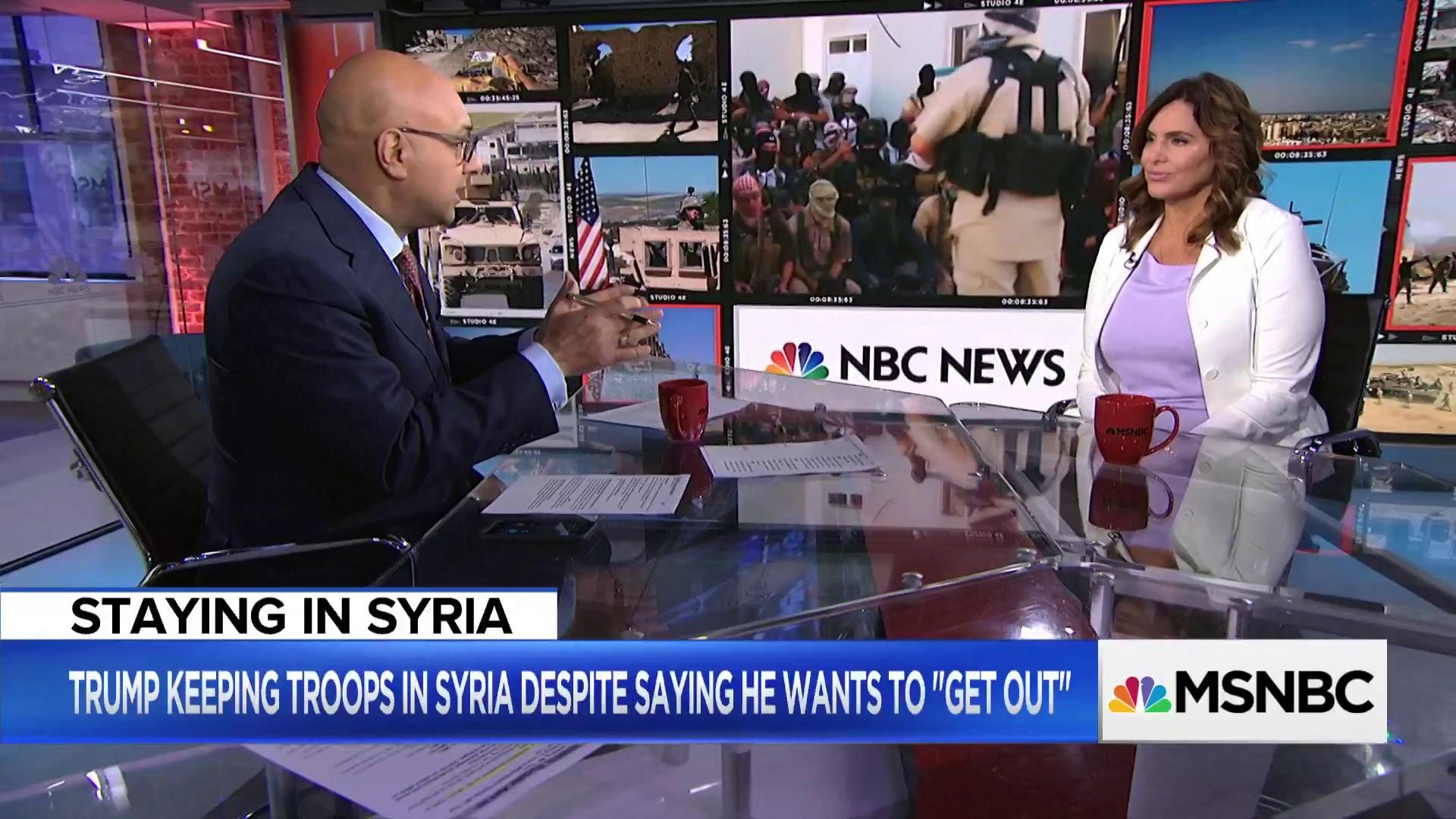
 'I think that what people forget in this war on ISIS, and president Trump's policies on it, is there is a war going on in Syria, that involves Syrian people; it involves people that are being starved, besieged, burned out of their homes, raped, tortured, in a horrific way, for eight years. That's a terribly long time for a conflict to go on, when you think about it. The five million refugees that are outside the country, kids who have been born, kids under the age of eight, who know nothing but living in a refugee camp outside of Syria. People who are still inside, their day-to-day existence is horrific. So I get very frustrated when we focus so intently on ISIS, when there is still a war between the opposition and Bashar al-Assad.

 I think we have to remember there are still people living a day-to-day life, or trying to eke out a day-to-day existence in Syria. I remember in 2012, which was the beginning of the war, when Homs was being obliterated by Assad's troops, sitting in Damascus, which was in Assad controlled territory, and seeing people trying to live their lives, going to parties, going to the opera, going to museums. So I think that, while ISIS is important, the other issue is, is ISIS eradicated? I'm not so sure, because I don't think you can kill an ideology. You can bomb Raqqa into a parking lot, and you will still have people who will maintain what ISIS stands for, the creed of ISIS.


 There will be a vacuum of authority. When the American troops do pull out, we are going to leave an open space for Russia and Iran, who have vested interests there, both of whom support Bashar al-Assad, to take root there. It will be more space for jihadist groups to develop. Also, I think it is sending a signal, that the US is not going to be involved in the Middle East, and we're leaving it to traditional allies, like Saudi, like Israel, to clean up this mess.

 Had Assad not fired on his own people, and later chemically gassed his own people, this wouldn't have happened. Or if we had sent a very early warning sign to him, and said, "You will not get away with this, you will not get away with this level [of brutality],"...

 Instead, we have sent a message that you can get away with stuff. That you can act with impunity, that you can torture, you can imprison, you can kill 500,000 people. Eight years of war. It's an extraordinary amount. I've covered war for more than 30 years now, This is one of the worst.


 For régime change, Putin does hold the power there. If he said to Assad, he has to go, he would go. For now he is too intent, and the Iranians are too intent, on building up their little fiefdoms inside Syria. To me, what success would look like is peace, and for the refugees to be able to go home. In all the years I've worked with refugees, I have never known one who said I don't want to go home. You cannot go home until it's safe. Syria is still a place that is as far from safe as you can get. Eastern Ghouta fell recently. Those people have been corralled to Idlib. Idlib is now a festering place, where basically everyone has been dumped, bussed, and deported.

 We have to think of the restoration. Yesterday in Turkey, the Turks, the Russians, and the Iranians met, to discuss the future of Syria. Where are the Syrians? What is the country going to look like? Is it going to be a a mutation of an even larger proxy war? There's a lot of issues to look at, rather than just yanking out the troops.'

Image result for What Americans forget about the War on ISIS msnbc janine di giovanni

Thursday, 5 April 2018

A survivor from Assad's dark prisons tells it all

Hijazi shared a  damp,  bug-filled 6 square-meter cell with seven women for 30 days. She was tortured every day, electroshocked, stripped naked and abused.

 Nur Alhuda Hijazi:

 'We were collecting aid for war victims in Syria. We were communicating through social media. Assad's soldiers hacked our friend's account and wrote us on his behalf, saying there are reliable people that will help us, they are expecting us in that place. We thought it was our friend and went with another man and woman to that address. We thought maybe they are from the intelligence, and laughed. Then, we dropped the guy from the car so that he would tell our families where we were in case we got caught. We saw the red car they mentioned and moved forward. Fifteen soldiers came and began to beat us, swearing. Ten minutes later, we saw our other friend caught as well.

 They took us to an intelligence building. They blindfolded us with our headscarves so that we would not see anything. They kept insulting and beating us. They started to touch our bodies, harassing us. They took three of us to separate rooms. They asked me for Facebook, Skype addresses and passwords we used for aid. Their purpose was to reach out to other humanitarian helpers, to block aid and to learn the location of drug stores and other supplies.

 They kept beating me for not talking. Then I gave them a Skype account that I had opened two days ago. I did not give them my personal account, but they asked me the address for my username. They talked to my friends through my account. A friend of mine wrote that he wanted to know where the drug stores in Damascus were. I made him understand that I did not write under normal circumstances when I wrote to him. The officer was angry that he could not get anything.


 They started hitting me. Meanwhile, my phone started ringing. My friends were worried and kept calling us. They started asking me who they were. They kept torturing me to tell them. Then I realized there was someone next to me. When I spoke quietly, I realized it was the girl I came with. We were blindfolded and handcuffed. We talked quickly about what to say.

 We did not know who was there with us. Then they took us to another room separately. In that room, they stripped me from head to toe. I was naked and so ashamed. This was inhuman. They inspected my body by hand. I felt terrible.

 They took us to a cell at midnight. We were in a 6-square-meter room. There were seven other women of different ages there and a 13-year-old girl. We realized that they were constantly raping her. Over time her belly began to grow.

 They claimed that she helped the soldiers. She was constantly raped. She was in a terrible situation. She was just a little girl.


 Our first question I asked was if they were being tortured. We relaxed when they said that they do not do it in this building. Then we noticed that they opened the heater core and talked to the people in the next cell. There were male inmates in there imprisoned for five years. "Will the war end, will the world help us?" they asked us. "Hopefully, you will be all released, the war will end, all Muslims will help us," I told them, not wanting to disappoint.

 They were pleased. Some of them were hafizes and imams. They started reciting the Quran. I remember crying my heart out.

 There were some blankets on the floor and two little openings where we could breathe. The cell smelled musty. They were constantly giving us hard, cold potatoes. Every day we had indigestion from eating the potatoes. They allowed us to go to the toilet three times in 24 hours. There were only 6 minutes for nine women to use the toilet. The soldiers waited for us, and when we exceeded the time limit, they forced the doors open to take us out. They only allowed us to wash ourselves after our periods. So, we could have a bath once a month.


 I was afraid whenever I heard the sound of the iron door because I knew they were taking me to be tortured. One day they called my name and blindfolded and handcuffed me. They took me to the interrogation room. "Give us the names of the opponents, where are they?" they started to ask. They kept hitting me when I said I didn't know. Then they gave me electric shocks. I jumped up from where I sat with each shock. It was very violent. The soldiers laughed as I screamed in pain. They tortured me for seven hours without stopping. But I did not give up a name.

 On the third day, they left me in a corridor with my eyes blindfolded and hands tied since I still had not given up a name. Those coming and going started hitting me and swearing. On the seventh day they gave me seven white papers. "You will write what we say," they said. When I refused, they took me to a room. There were four beds and soldiers on it. "If you do not speak, these soldiers will rape you," they said. I could not endure this torture any longer. I wrote what they said on paper. I had no other choice.

 They made me write that I helped the soldiers, that I worked for soldiers instead of civilians through social media. They made me read what I wrote in front of a camera. They broadcasted that video on official Syrian television. "We imprison them, but they are traitors, not victims; they are helping the soldiers," they said on the news.

 They were bringing young people to the cells every day. They were torturing them with both electric shocks and pressurized water. They were screaming in pain. Our mental health had collapsed from hearing those sounds. We were praying and waiting for the voices to stop.


 On the 17th day, the warden called me and my friend and said, "You will not make any noise, you will take your things and come here." We returned to the cell and everyone thought we were going to be released. They wrote the phone numbers of their families on tiny papers and sanitary pads and hid them in the seams of our pants and coats. We hoped to deliver a message to them.

 We thought we were going to be released, but they took us and imprisoned us in a 2-square-meter cell, and nobody came for days. We were very scared. There were only cells with male prisoners around us. We waited for five days.

 On the 27th day, they blindfolded us and took us downstairs. They first put us in an automobile and an hour later in a bus. We heard other men and women in there with us. We got out of the intelligence building. I was trying to see the roads by looking down. I realized we were in Damascus. Then we entered a tunnel. At that moment I said oh my God. I had heard that Assad had underground dungeons made just for women. I said they were taking us there for sure, and there was no longer a way of salvation, we were going to a horrible place.

 I was very scared at the moment. A soldier put me directly in an elevator. I smelled perfume in the elevator. The floor was sparkling clean. Then I realized this was not an underground dungeon. They took us to an elegant office. There were two women and three men in the room. We sat in front of them. A general came and said, "Now two Turks will come and meet with you, and you will say 'all is well' for everything they ask." We agreed.


 Those sitting in front of us were İHH Humanitarian Relief Foundation President Bülent Yıldırım and İzzet Åžahin. "We came from Turkey. Hopefully we will get you out," they said. They had swapped us. We returned to the cell, and two days later we were released with the help of the İHH. They swapped us for Iranian soldiers. We were the first swap. In the second swap, there were 2,350 people like us, including 180 women.

 Bülent Yıldırım said we could call our families and come with them to Turkey immediately if we want. My family told me to go right away. But we wanted to stay and give humanitarian aid to those hurt by Assad's persecution. I worked as a nurse after jail. I opened an orphanage. We started with 250 children who were orphaned in the war. Before coming here in 2015, there were 2,200 orphan children. I got out of jail in October and never saw my family until 2015. I missed them very much. I decided to go and see my father in Belgium. I came to Turkey to go to Europe by sea.

 I opened Google Drive on my new phone while I was at Atatürk Airport. I saw İzzet Åžahin's number on my screen without knowing how. A total coincidence. I called to thank him. "Nur, wait there, we will come and get you with Bülent Yıldırım," he said. "It is very dangerous to go to Europe by sea, you can die, we do not accept it, and if you work with us, you will prepare documents and go to your father legally." I have been working for the İHH since that day. I applied to do a master's degree on Islamic Economy. I miss my homeland very much. I think about why this happened and why so many people die all the time. But I still have hope. Freedom is a blessing; nobody knows its value. I pray that I am free." '


A survivor from Assad's dark prisons tells it all

Tuesday, 3 April 2018

Opposition pledges to continue anti-Assad revolution


 'The Syrian opposition on Monday pledged to continue the revolution against President Bashar Assad as pro-regime forces drew closer to taking full control of the besieged enclave of Eastern Ghouta.

 “What’s happening in Syria isn’t a matter of geography,” said opposition spokesman Yahya Al-Aridi. “The uprising in Syria is in the hearts and minds of people who reject the brutal dictatorship (of Assad). We’ll never stop.”

 Backed by Russia, pro-regime forces have scored a series of victories over the opposition in recent years, often through sieges, aerial bombardment and ground offensives that have drawn widespread international condemnation.


 “These aren’t Assad victories. This is an occupation achieved with horrible military power against civilians,” said Al-Aridi. “This is the propaganda of the regime and Iran when they talk about victory. It’s immoral.”

 Al-Aridi said: “It’s the start of the revolution all over again — reorganizing and learning from mistakes made… and organizing forces at the political and other levels. We’ll rebuild our efforts on different levels.”

 He added: “Our uprising has been peaceful from the very beginning. We didn’t select to carry weapons. We just tried to defend ourselves.”

 He said: “The regime created all sorts of pretexts, including terrorism, militias, Daesh and Al-Nusra Front. And it internationalized the Syrian case so it could sideline the people’s main request for freedom.”


 US Republican Sen. Lindsey Graham, a member of the Senate Armed Services Committee, warned President Donald Trump on Sunday against pulling American troops out of Syria, saying it would lead to a resurgence of Daesh and increased Iranian sway in the country.

 Al-Aridi said: “The main beneficiary of Daesh is the Syrian regime and those who support it. Iran and Russia used Daesh as a pretext to rescue a falling regime.

 He added: “The revival of Daesh, if there is one, will be used again to oppress and suppress and kill people. Daesh is a tool in the hands of dictators.”

 He said: “There are different narratives of the deal struck between the people of Douma and Russia. The opposition says the wounded will be taken away for treatment but the people will remain there.

 “Russia’s story is different. It wants everybody removed. No final deal has been achieved yet. This is the last thing we heard from our people.”


 A Russian-brokered deal had been reported on Sunday for fighters with Jaish Al-Islam, the largest opposition group still in Eastern Ghouta, to leave Douma. But the fighters have not yet confirmed the agreement, amid reports of divisions within the group as hard-liners refuse to abandon their posts.

 In the past few weeks, such deals have seen more than 46,000 people — fighters and civilians — board buses with scant belongings to be driven to the northwest province of Idlib, which is largely outside regime control.

 “It isn’t the Syrian regime that has occupied Eastern Ghouta or has full control over it. It’s an Iranian and Russian occupation,” said Al-Aridi.

 He condemned “the Iranians with their militias on the ground and their vicious plan, and the Russians with their deadly jets bombing everything in a scorched-earth strategy like what they did in Grozny,” the capital of Chechnya.

 “People from the very beginning didn’t select to carry weapons. They chanted for freedom, but the regime resisted with firepower and killed them.” '

Sunday, 1 April 2018

Extracts from Jonathan Littell's 2012 Syrian Notebooks


 'When I returned from Homs, in early 2012, I was invited to brief the then French foreign minister, Alan Juppé. I outlined my most important observations. The main revolutionary forces still believed in a non-sectarian democratic Syria. The régime was doing its utmost to provoke cycles of sectarian violence while the Free Syrian Army was frantically trying to contain them. The revolution was struggling to contain its negative forces; if al-Assad was not overthrown soon - something that would only be possible with strong Western support, including the provision of sophisticated weaponry and possibly a no-fly zone over Syria - worse forces would emerge.

 Juppé completely shared this analysis; but alone, he added, without the participation of its American and British allies, France could do nothing. Inaction is always easy, but it is rarely a wise course of action. We have seen the results.'
[Introduction to the Verso edition, pp14-15]


 'The revolutionary coordination committees are collecting proof that Gilles Jacquier was killed by the régime. The shabbiha running rampant in Homs; it's very hard for people from the opposition to enter these places. The university, to the west, is a military zone. Finally Syrian television mentioned mortar shells: D. affirms that the FSA does not have any mortars.'
[Monday, January 16th, p25]


 'The public hospital in al-Qusayr, near the cemetery, is occupied by the security forces. There are snipers on the roof.

 A visit to a clandestine medical unit set up inside a house. The doctor who had been in charge, 'Abd ar-Rahim Amir, was killed in Rastan two months ago. He was cornered in a health centre by the military mukhabarat and executed.'
[Tuesday, January 17th, p33]

 'Demonstration in the street, in front of the neighbourhood mosque, protected by the FSA and lit up by spotlights. 300 people? There's one every day. Opposition flags, drums, chanting and dancing, all of it very beautiful and joyful.

 M: "The demonstration is a dhikr [mystic Sufi ceremony]." But there were Christians as well. he introduces me to one, a thirty-four-year-old man, pro-opposition, who proudly shows me the cross he wars around his neck,. He says, "We've lived together for over a hundred years. It's Bashar, when he came to power, who stirred up problems between us. So that France and other countries would say, 'The Christians must be protected.' " '
[pp36-37]


 'One man: "People are very afraid, they fear the Army." For him, the presence of the FSA makes not only our visit possible, but also the demonstrations, the burials. Previously, the security forces patrolled, entered houses, arrested people.'
[Wednesday, January 18th, p42]

 'Arrival of an FSA officer, Abu Hayder. A friend of his had been wounded, by some shabbiha, during a peaceful demonstration in which he took part. He brought the friend to the emergency ward, but he died. At that time the hospital was still functioning. At the hospital, his dead friend was filmed, then shown on Dunya TV [private TV network of Assad's cousin Rami Makhlouf], and presented as an innocent demonstrator killed by terrorists. This lie revolted Abu Hayder and was the trigger for his desertion. At that time, there was no FSA in town.'
[p43]


 'A soldier enters, wearing a balaclava, with a scarf knitted with the colours of a free Syria. He deserted three hours ago, he explains. He's a mulazim [lieutenant], based in Damascus., who came here on leave. He is still in uniform, a camouflage jacket. His brother, a mulazim as well, is in prison for refusing to shoot at demonstrators. He's afraid for his brother, and that's why he's wearing a balaclava. He wants to join the FSA. Quickly he shows his face, so we can see it corresponds to his card.

 Two friends told this officer what happens in the military prisons in the suburbs of Damascus, al-Qabun and Azzara. Officers are imprisoned there, for speaking out against the régime, or for refusing to shoot. They are separated by faith, and there is no intermingling. All faiths are represented, Druze, Alawite, Christian, etc.

 He comes from the Air Force, he was based at the military airport in Dumayr, a Damascus suburb. He confirms that helicopters were used against demonstrators, in az-Zabadani, with a 7.62 mm machine gun mounted in the door. At first it was just to frighten people, but later they fired for real.'
[Thursday, January 19th, pp53-54]

 'The word Salafist means two things. The Muslims of the land of Sham [Syria] follow the path of moderation. To live well, they follow the example of pious ancestors, of a pious man from long ago who lived justly in Islam. That is the original meaning of Salafist. The other meaning, the Takfirist, jihadist, terrorist version, is a creation of the Americans and Israelis. It has nothing to do with us.'
[pp54-55]

 'Ibn Pedro says the FSA has prisons in Baba 'Amr, where they hold some shabbiha. They put them on trial in "good due form. Those who have killed children are condemned to death." '
[p55]

 'I am reading Plutarch [Greek Roman writer of the 1st Century CE], the only book I brought with me. "These things and others like them will, I venture, please readers more for their novelty and curiosity, than they will offend them for their falsity." '
[p56]


 'Abu 'Abdallah was an electrical engineer, he studied for six years at the engineering university. He was fired from his job at the Homs refinery in the 1990s, because he refused to collude in corrupt practices. Now he helps the FSA with logistics.

 "I belong to the people who had no political consciousness. When I took to the streets, I didn't want to get rid of Bashar al-Assad. We just wanted a dignified life, to eat and be respected. But even practising my religion is a problem. If you meet people at the mosque, you'll be seen as an opponent.

 The Syrian people are raised like chickens in a hen house. There's no room for thought. You live under the régime of the Ba'ath and Bashar al-Assad is our president for eternity. You can't imagine any alternative."

 At first, Abu 'Abdallah was ready to accept anything to get rid of the régime. In the first months, seeing the massacres, he would have accepted a foreign intervention. Today he doesn't want to replace one evil with another.

 He thinks that France, the United States, the West let the repression continue without intervening in order to keep Syria weak and protect Israeli interests. They don't want a strong, democratic Syria, with a powerful Army.'
[Thursday, January 19th, pp57-59]

 'Visit to the underground clinic in Baba 'Amr. I talk with a doctor, Dr. Abu 'Abdu. He refuses to be photographed: if he is identified by Security, his family would be threatened.

 He shows me a video, found on Youtube apparently, in which we see two young men - one from al-Khalidiya, the other from Baba 'Amr - caught in al-Zahra by some shabbiha and decapitated alive, with a knife. Ultra-graphic film, a huge gush of blood when the knife slices. The killers put both heads on the ground and plant the knife next to them. The second head, on the ground, is still quivering. "You see this? How can we stop when they do this?" '

 "The government says ther is a problem between faiths, but it's the government that created this problem. Alawites come to the centre of town, they kidnap women, they fuck our daughters, and they film it. They put the videos on the web to say: 'See, we fuck Sunni girls.' For us this is very heavy, as Arab and Muslim people." '
[pp65-67]

 'Bassam is from the countryside around Aleppo. Seeing the régime's crimes - the rapes, murders, etc. - he decided a month ago to come to Baba 'Amr to join the FSA.

 "In Baba 'Amr, it's the safest place in Syria. The people go out at night, they're not afraid of snipers. Al-Assad's tanks will pass over our bodies before they get to you. We fight for our religion, for our women, for our land, and lastly to save our skin. As for them, they only fighting to save their skin.

 We don't kill any human being on the basis of religion. 'He who kills a soul not in legitimate self-defence, it's as if he killed all of humanity,' says the Qur'an."

 The men come from the Army, where they're ready to kill anyone. The Military Councilis trying to change these habits, so that FSA soldiers have good relations with civilians.

 In the hallway, the soldiers are cleaning their weapons. Purchases, bought from Lebanon. They teach me a phrase: Ash sha'ab yurid isqat an-nizam, "The people want the fall of the régime." Before we go to bed, one of the young men runs a vacuum cleaner through the room. Touching thoughtfulness.'
[pp72-73]


 'Friday demonstration. It begins at the neighbourhood mosque. At the intersections, FSA soldiers keep watch. Some slogans are in English ("WE WANT INTERNATIONAL PROTECTION").

 We join the other processions of Baba 'Amr for a monster demonstration. Signs in English addressed to the Arab League. All along one side the women stay grouped. They applaud with enthusiasm, shout, yodel, and also chant slogans. Men wave their shoes. A level of joyful and desperate energy I have never seen before.

 G., a sympathetic Franco-Syrian gentleman: "If they didn't shoot at the demonstrators, all of Homs would be out on the streets."

 Volleys on the main street, just as people are leaving. The shots come from the east, from a bridge that leads to the Alawite quarter.'
[Friday, January 20th, pp77-79]

 ' 'Abd ar-Razzaq Tlass mentions several massacres of demonstrators, including one on February 24th in Sanzamin. He says he never believed the régime's propaganda.

 "The Army should be neutral. We saw the opposite. The checkpoints shot at people. Dara'a was devastated."

 He wants a NATO military intervention. "If there's no NATO intervention, we'll call for jihad across the Muslim world." Abd ar-Razzaq Tlass explains that the idea is to put pressure on the West, so that the West will intervene before it becomes a regional war.'
[pp80-84]

 'When someone is kidnapped or arrested, they pay to find out where he is, and sometimes to recover the body.'
[p87]


 'A young soldier from the checkpoint, Fadi, is an Alawite. Fadi is from Jiblaya, a village near Tartus. He joined the FSA in July or August, in Homs. Because he saw the Army killing civilians, he said to himself, "I am not with them, I am with the people. It is not: Iam Alawi, so I am with Alawi. No. If they do wrong, I try to do right."

 Here in Baba 'Amr, there are five or six Alawites in the FSA. He has no problem. "I never heard: We want to kill Alawis. Only specific people who have committed crimes."

 Alawites take women hostage, and that makes him sick.'
[Saturday, January 21st, pp92-93]

 'Visit with Imad to a neighbourhood next to the railroad.Twenty days ago, there were three very deadly days: the first day, eighteen dead, the second, nine dead, the third, seven dead. Shooting at the funerals caused many wounded.'
[pp93-94]

 'The officers know girls who have been abused, raped, but the social rules mean the families will never let us talk to them. The shame is too great.'
[p96]

 'Abu Ibrahim comes in, a nurse who was imprisoned in September. He worked at the National Hospital. Denounced for treating revolutionaries and arrested. He was whipped with a thick rubber cable and given electric shocks. Says his treatment was relatively OK: they didn't break his bones.'
[pp98-99]

 'Abu Salim was a doctor with the military mukhabarat for the past two years.

 "What is the first mission of a mukhabarat doctor? To keep people subjected to torture alive so they can be tortured for as long as possible." '
[p99]

 'Long story of Abu Salim. In Damascus, in the Regional Section, there are Arabs detained since 1985. Lebanese, two Jordanians, and one Algerian. They are incarcerated in the harshest conditions.

 One day Abu Salim was handcuffed to one of them, returning from the hospital, and found him briefly alone with him: "What's the problem with you?" - "I had a problem with the big boss" (Hafez al-Assad).'
[p101]

 'Before, wearing a beard was in itself motive for indictment: "Ah, you're part of bin Laden's gang." Now they arrest a student: "What are you studying?" - "French literature." - "Ah, you're part of the Sarkozy gang, jama'at Sarkozy!" It's a true story: "You can meet the student." He was kept in prison for twenty-one days, three months ago.'

 Abu Salim affirms that even children are under surveillance. They asked his son which channels his parents watch. The parents of children who replied al-Jazeera, al-Arabiya, France 24, BBC, etc. were summoned.'
[p103]

 ' 'Ali, another doctor, shows us his torso, crisscrossed with scars. He caught several bullets on October 28th. Some shabbiha, four men armed with Kalashnikovs and a machine gun, in a black KIA, entered the neighbourhood, greeting the FSA people in a friendly way, and then machine-gunned the demonstration.'
[p104]


 'At the military hospital, Z and his brother's son 'Ali, were handed over to the men in charge of the cells, tied to beds, and tortured right on the beds, for over eight hours. Hit on the body and head with food trays. 'Ali died under the torture. An hour after 'Ali's death, he was finally operated on, an attempt to re-attach the still partly connected leg. From lack of care, his leg got infected; six days after his arrest, a military doctor decided they had to cut it off. He was already handicapped, his right leg was 17cm shorter than his left leg. Now it's the only one left.

 Muhammad Z. says, "He's the only person from here we know who left the military hospital alive."

 I return to the question of the torture. Z. explains. The torturers didn't ask any questions, just mouthed insults. "Ah, you want freedom, here's your freedom!" They also insulted their wives. During the torture, his face was covered with a blanket, and he couldn't see the people who were beating them.

 The torturers signalled their entrance in the room by rattling the door handle, and all the prisoners had to cover their faces with their blankets, under penalty of being executed.'
[Sunday January 22nd, pp108-110]

 'Around 2pm, in the centre of the suburb, a protest demonstrating against the report of the Arab League. They want the issue to be transferred to the Security Council.

 An officer is lifted on to people's shoulders and carried with his AK as the people chant "Long live the FSA!" He's a naqib who has just deserted. They also chant: "The people want international protection," "The people want a no-fly zone," "The people want the proclamation of jihad." '
[p111]

 'Muhammad's two wives were captured at the end of December by the shabbiha, in the orchards. Muhammad is wanted. The shabbiha didn't find him at his country home, and took the two women hostage so he would give himself up. They were held for six days, freed when the Arab League observers arrived.

 Muhammad's wives were mistreated, says Muhannad, badly mistreated. No more details. Too many people in the room to insist.
[pp115-116]

 'Abu Slimane: "Our parents submitted through fear. We broke down the wall of fear. Either we will win, or we will die." Makes a V sign with his fingers. Photo session, they all pose making Vs - but only for their cameras, not mine.'
[p120]


 'A young soldier nicknamed The Cat leads us on foot to the home of some other activists. These guys are violently against the declaration of jihad: "Our revolution is not a religious revolution, it's a revolution for freedom. Declaring jihad would completely change the scope of the message of the Syrian revolution. Yes, people have chanted the slogan during demonstrations. But they're simple people, they don't undrstand."

 Our host, Abu 'Adnan, is a Communist lawyer who defends political prisoners. "Please tell the world we are not islamists." - "I am a Communist and I hate islamists."
[Monday, January 23rd, pp130-131]

 'Gunfire broke out between the checkpoint soldiers and the FSA; the soldiers bound the civilian and used him as a human shield. He wasn't hit, but was executed afterwards.'
[Tuesday, January 24th, pp132-133]

 'Ahmad: "I've travelled a lot, Russia, Romania, greece, Turkey, Saudi Arabia, and I've never seen a government like this." His pharmacy was looted three times by soldiers.

 He talks about his uncle, a pilot. Air Force officers are closely watched. Several colleagues of his uncle wanted to desert, they were caught and killed. The uncle managed to flee, he fought a little with the FSA, now he is hiding in the village.'
[pp134-135]

 'First visible difference between al-Khaidiya and Baba 'Amr: the presence of women. In baba 'Amr, other than during demonstrations, they're almost invisible, whereas here they're everywhere, mingling with the men. It's from details like this you realise how conservative a neighbourhood Baba 'Amr is.
[pp137-138]

 'A wounded man arrives in a car. Probably paralysed. Isn't bleeding much, the bullet is lodged inside. Hit the spinal column.

 Abu 'Abdu has seen this type of case often, 150 to 200 at least. Thinks the snipers aim for the spinal column. They're little bullets, sniper bullets, not Kalashnikov bullets. Has also seen many people wounded by what he calls explosive bullets, maybe dum-dums.'
[p139]

 'Big rectangular square. On one side, a large banner: "No to the imaginary opposition, a creation of al-Assad's gangs. The SNC unites us, factions disperse us." Clear allegiance to the Syrian National Council.

 A kid begins singing in an artificial, rasping voice, and the dances in rows begin.
The leader: "We are not rebelling against the Alawites or the Christians. The people are one!"
Everyone: "The people, the people, the people are one!"
Leader: "We count only on God, not on the Arab League, not on the observers, not on NATO!"
Everyone: "We count only on Allah!" (x3)'
[pp142-143]


 'Abu Bilal explains that the funerals are no longer the way they used to be, they no longer turn into demonstrations: the cemetery is completely exposed, and the snipers on the Homs citadel shoot if there's a crowd. So they bury in small groups, quickly.

 Thus everything is hard to verify. This is what explains the difference between the numbers provided by the Syrian Observatory for Human Rights(SOHR) and those we hear about here. For yesterday the SOHR says one dead in Homs. But our friends insist that in Bab Tadmur there were dozens. One building, targetted by the shelling, collapsed, and they're still pulling corpses out of the rubble.'
[Wednesday, January 25th, p147]

 'A woman in a niqab: "In this street, in every house there is a martyr. Soon it will be a year this has gone on. When is it going to stop. We can't even walk in the street safely anymore. We're people who work, but we can't even feed ourselves. Let our voices be heard!" '
[p150]

 'Visit to the private hospital of Bab as-Sba'a. Three months ago they arrested a member of the staff who does blood tests, and accused him of doing analyses on FSA soldiers. They kept him for a month, and tortured him with electricity, pouring water on his body.'
[pp150-151]

 'Muhammed is fourteen. His brother Iyad,twenty-four, was killed last week. He was walking with his family near the cemetery, the Army was advancing to enter the neighbourhood, and they began shooting. There was no FSA there.

 There is also his little brother Amir, four years old. Muhammed to his brother: "What do the people want?" - Amir, in his tiny voice,: "The people want the fall of the régime!"

 Muhammed hasn't gone to school for four months. Soldiers and shabbiha came and took four children away. At the time the children from the schools were going out to demonstrate; these four must have been denounced for having taken part.'
[pp153-154]

 'Evening demonstration in Safsafi. Small, about a hundred people maybe on a little square, but the same intense energy as everywhere else. Everyone shows me his scars, bullet or truncheon injuries. Same slogan as every day: "No-fly zone, international protection." '
[pp158-159]

 'One of the men calls himself Abu Mout, the father of death. His three brothers are dead, and his mother took a vow to cook every day for the FSA soldiers, until the end of the revolution.'
[p162]


 'This sniper also entertains himself by killing cats. He has already killed eight. There are about ninety soldiers in the school. The sniper is safe.

 Another kid shows us his hand, two fingers cut off by a bomb, and his belly, starred with little black dots, scars from one of the infamous nail bombs. He is thirteen.

 Yet another kid, also thirteen, with nail bomb scars on his legs.'
[Thursday, January 26th, p166]

 'The doctor is actually a nurse practioner, a musa 'id fani.The doctors fled because of the systematic arrests. "Doctors have been targetted since the beginning of the events," he explains, like all his colleagues.'
[p170]

 'Hysterical crowd. They're finished lynching a shabbiha they caught. We stop. A black pickup arrives with two FSA soldiers standing in the back, above a corpse, obviously the lynched shabbiha. It looks as if his head was smashed in with rifle butts. All around people are howling "Allahu Akbar!" '
[pp172 -173]


 'The mukhabarat and the shabbiha penetrated the neighbourhood, entering houses and arresting people. They attack by shooting indiscriminately, then advance with BTRs, the FSA can't withstand them. They entered a house and shot an entire family, twelve people.

 Three of the children had their throats slit, the others were executed point blank with a bullet in the head. Two children survived: 'Ali, a three-year-old boy, and Ghazal, a little four-month-old girl, wounded by a bullet. Two adults from the family also survived, they were at work when it happened.

 When Ra'id arrived there, the baby was babbling, but the three-year-old boy was in tears, terrorised, no one could calm him down. I saw it later on YouTube, it's even worse than the deaths. In any case it's always worse for the survivors than the dead, the dead don't feel anything anymore.'
[Thursday, January 26th, pp176-178]


 'The imam talks about all the blood that's been shed in the neighbourhood:
"It's our blood, all those souls killed are our children. But even so, we say to all our oppressors, all our tyrants, to all those who have succumbed to hubris: Whatever you do, victory will be ours." '
[Friday, January 27th,p182]

 'Passage behind the demonstration of a dozen FSA soldiers. Immediately the crowd start chanting "Long Live the Free Syrian Army!" The kids run after them and swarm around them. A kid shouts to his father, "it's them, it's them, it's the Free Army!" Slowly they head toward the demonstration, and enter the crowd to the shouts of "Allah grant long life to the Free Army!" '
[p184]


 'The funeral processions I've seen here don't express mourning or contemplation, but rage and the live pain of loss.'
[Saturday, January 28th, p193]

 'Mazhar Tayara, twenty-four years old. A young, friendly Syria. He was killed, coming to the aid of the wounded, during the great bombing of Khalidiya on the night of February 3rd.'
[p195]

 'There's an old Hajj sitting in a chair, smoking in the company of a friend, who tells us how he was tortured for twenty-one days by the mukhabarat, beaten, electrocuted, accused of complicity with terrorism, him, a sick old man.'
[p199]


 'Abu Hamza, surgeon, worked at the military hospital since 2010. At first he heard strange things in the emergency room. When they brought in wounded demonstrators, their hands were tied and their eyes blindfolded. The first time he saw it, it was April [2011]. The wounded, without any medication, were beaten with cables by military policemen and nurses. The victims were all men, sometimes fourteen- or fifteen-year-old boys. Several doctors took part in the tortures.

 I filmed wounds, traces of beatings with cables. There were two torture tools: an electric cable and strips of reinforced rubber.

 Another case he witnessed: some Air Force mukhabarat had confiscated two ambulances, and put two of their agents in each ambulance armed with Kalashnikovs. They went to the Homs cemetery. The Army began shooting at the people bringing the bodies to the funeral. Then the mukhabarat arrived with the ambulances, pretending to come for the wounded, took in the wounded and brought them to the military hospital. There, they took them to the prison. Abu Hamza saw the ambulances return, and recognised the Air Force mukhabarat by their special uniform and white sneakers.'
[Sunday, January 29th, pp204-210]


 'Two women completely in black come to see us. Their house was burned down and they wanted to testify. Where they live, they are surrounded by Alawites on one side, Shiites on the other.Some men came around 2am, shot at the house, threw a grenade against the door, then a can of gas which they shot at, setting fire to the house. Half the house was burned down before they managed to put out the fire. They didn't see the men, but they were yelling: "We'll get all of you out of here, you Sunnis!" Think they were Alawites supported by Security. Their neighbours' house was also attacked. There were seven Sunni families in the street, all have left except these two.'
[Monday, January 30th, pp217-218]

 'We call Imad. Baba 'Amr is being shelled by twelve T-72s. Yesterday there were eight tanks, the FSA destroyed four of them. We call Hassan. He says twenty tanks since yesterday, and that they're completely powerless.'
[p219]


 'It's only after I left Syria, that things in Homs really went haywire. On the night of February 3rd, several shells fell in Khalidiya, very close to the Square of the Free men. Al, struck more or less the same place, the people who rushed to help the victims were killed or grievously wounded in turn. On Saturday 4th, the Army intensified its shelling of Baba 'Amr. The pounding of the neighbourhoods was intensifying every day, and the number of civilian victims kept increasing.A modern army , equipped with assault tanks,, Grad rockets, and mortars of calibres up to 240mm, pounded Baba 'Amr street by street, house by house, in an orderly systematic way, for twenty-seven full days. British photographer Paul Conroy: "They're living in bombed-out wrecks, children six to a bed, rooms full of people waiting to die."

 The offensive of Bashar al-Assad's forces had begun, the day after a vote by the UN Security Council on a rather weak resolution, nonetheless firmly vetoed by Russia and China. American and European diplomats were bogging themselves down in rather ridiculous discussions about "humanitarian corridors" or some such proposition. The Qataris and Saudis were beginning to murmur that a more forceful intervention might be imaginable, notably through weapon deliveries to the FSA, but no one was listening.

 Of many I've named here, by their first name, an initial, or a name they chose for themselves, there will probably remain nothing beyond these notes, and their memory in the minds of those who knew and loved them: all these young guys in Homs, smiling and full of life and courage, for whom death, or an atrocious wound, or ruin, failure, and torture were nothing compared to the incredible joy of having cast off the dead weight crushing, for forty years, the shoulders of their fathers.'
[Epilogue, pp241-246]