Friday, 19 December 2014

Syrian refugee children find their voice through theatre in Jordan


 ' "We have been arrested, destroyed and our childhood has been destroyed."

 Some scenes in the play depicted what happens at Syrian government checkpoints and other scenes showed Syrian girls who have become responsible for their families after the death of both parents.

 Ten-year-old Salam Hussein said, "I am here to raise my voice to the world and tell them what has happened to us in Syria and the suffering we are living." '

A Dictator’s Best Friend

AP

 It doesn't help that the truth about Assad is mixed up with a lot of garbage about Cuba, but it is true nonetheless.

 'In the late summer of 2013 Bashar Assad was caught using chemical weapons against his own people. The president and his secretary of state decried this violation of international norms and pledged, in televised addresses, to punish the Syrian tyrant for wanton slaughter and the proliferation of weapons of mass destruction. The application of deadly force against Assad’s air force and military installations would cripple the regime and hasten the end of a civil war that has taken the lives of some 200,000 Syrians. But suddenly Obama reversed course. He signed on to a Russian proposal to prevent a military strike in exchange for Assad’s “giving up” his barbaric tools.

 Today Bashar Assad remains in power, his opposition is divided, he has entered into an alliance of convenience with the medieval Islamic State that governs from Raqaa to Mosul. The weapons? Earlier this month the U.S. government—Barack Obama’s government—accused Syria of ongoing “systematic use” of chemical arms. I repeat: ongoing.

 Not only has Obama failed to achieve his stated aims of removing Assad and ending the WMD threat. The situation is more dangerous than it was a year ago because the Islamic State’s menagerie of Saddam loyalists and itinerant holy warriors is securing ground from which to launch attacks on targets throughout the world. Baathist dictators, chemical agents, refugees, Islamic armies are the consequence of this president’s curious mixture of false promises and aggrieved passivity.

 Barack Obama threw the Castros a lifeline, rescued Assad.'

Should We Oppose the Intervention Against ISIS?


 Rime Allaf:

 'Let’s be very clear that for the longest time, the Syrian opposition was not asking for a “boots on the ground”-style intervention, or even for a bombing campaign led by the U.S. What was being requested early on was the establishment of humanitarian corridors with the help of a “no-fly-zone” and/or weapons for the FSA to defend liberated areas from the relentless barrel bombing campaign of the regime. Since none of this happened, it was to be expected that these Islamist groups have been able to gain so much ground and find themselves with a weakened opponent in the FSA. Now the Assad regime doesn’t even need to worry about ISIS because it’s got the U.S. fighting [ISIS].'

Syria: where modern and medieval warfare combines

Syrian children in the Bab al-Salama refugee camp on the border with Turkey

 'It must be made clear to those who target or indiscriminately attack civilians and civilian infrastructure that such crimes cannot be committed with impunity. The recent rise in attacks on schools – once places of learning, safety and fraternity – is illustrative of the depths to which Syria’s belligerents will sink if left unchecked, and a stark reminder that an entire generation of Syrian children is being lost to this conflict.'

 The FSA doesn't target schools, none of the Syrian rebel groups do. The overwhelming majority of attacks on civilians have been by Assad's forces, with ISIS a distant second, and the Syrian rebel groups nowhere. Jabhat al-Nusra has occasionally shelled government controlled areas without caring too much about civilian casualties. And that's about it. One bloke last year chopped out the liver of a rapist and murderer, and there was no other image of horror from Syria for months.

 People like Miliband know that the Assad government is virtually the sole perpetrator here. But his business is working with the realpolitik of international diplomacy, so tries to put things in an even-handed way, in the hope that if nobody feels threatened, some good can be done. It isn't going to work, as Assad's survival strategy is based on delivering unimaginable horror on his people. As for the UN representative de Mistura's plan to freeze the struggle of Syrians against Assad while everyone fights ISIS which the writers praise, as Robin Yassin-Kassab puts it, it's like a plan to cool the ovens at Auschwitz.

 But we can expect a lot more of this even-handed blaming of both sides by world powers and their media, while Syrians are tortured and killed by Assad's forces every day.

Thursday, 18 December 2014

Rights Group: 215,000 Detained in Syria Since Uprising

FILE - Syrian detainees, who were arrested for participating in protests against Syrian President Bashar al-Assad's regime, are seen at a detention facility in Damascus.

 ' “I heard the sound of children and women screaming and men being tortured all the time.”

 Much of the report is focused on a secret detention center at Der Shmiel, which the authors say is run by up to 1,500 shabiha drawn from surrounding villages. The camp is located in the countryside 20 kilometers from the town of Misyaf. A former prisoner's testimony suggests the camp has two functions - to inflict torture on dissidents and their families and anyone suspected of disloyalty held at the camp, and to trade prisoners for cash.

 According to the former prisoner, who was held for three months at Der Shmiel, about 2,500 detainees are at the camp - 250 children and 400 women among them. Local residents told SNHR researchers they had seen bodies dumped from the camp bearing signs of beatings and torture. The detainee said he was regularly lashed with one of his hands tied to the ceiling, and without his feet being able to touch the ground."

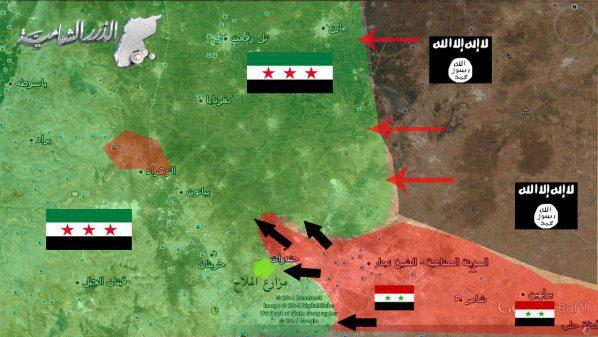
Map for situation in North Aleppo

Embedded image permalink

 Assad and ISIS forces both attacking Syrian rebels, not attacking each other.

Assad Is Running Out Of Soldiers


 'U.S. airstrikes, concentrated in areas with a heavy Islamic State presence, have allowed Assad to reallocate some resources, but his army is facing a huge problem: It's running out of soldiers. Ground forces have shrunk from 315,000 to roughly 150,000 troops since the beginning of the civil war in 2011.

 To fill the gaps, Assad has to lean on “irregular forces,” made up of the National Defense Force (NDF) militias, regime-armed local militias and a largely Sunni reservist group, experts said. Regime forces also include Lebanese Hezbollah and Iranian forces.

 “You don’t see very many pure Syrian army formations anymore,” according to Jeff White, a defense fellow at the Washington Institute for Near East Policy. “This is what basically kept the regime in the war.”

 U.S. president Obama announced Tuesday that he was set to sign legislation that would impose sanctions on Russian companies involved in supporting Syria. This would further cripple Russia’s already steeply devalued ruble, and decrease its ability to support the Syrian regime.'

FSA North’s New Vids Show US TOWs Still Arriving

image

 It might be added that if Jabhat al-Nusra used the TOW's they seized to drive Assad's forces out of most of Idlib province, that's a bit of a win too.

 '1. Don’t jump the gun. The CIA-run TOWs program is nominally a covert operation. They don’t do daily press briefings about it at the Pentagon or at Central Command. Operational decisions — who to arm, who not to arm, why and why not — are not discussed publicly, so we’re stuck with sorting through almost purely circumstantial evidence if we want to figure out what is really going on. And sometimes it takes time for circumstantial evidence to emerge — days, or weeks even.

 2. It should be no surprise to anyone if the FSA doesn’t get paid on time every time or if weapons shipments are delayed. The U.S. isn’t paying people via direct deposit and getting weapons from Turkey (or Jordan) to the front lines in Syria is a perilous process given how many factions there are, their shifting/unclear alignments and allegiances, and just the general the fog of war.

 3. FSA’s SRF in northern Syria is pretty much dead after getting its clock cleaned by Jabhat al-Nusra and its Islamist allies earlier this year. What is going on with the non-SRF FSA is less clear and southern SRF is still alive and kicking judging by the mutual defense pact they co-signed.

 4. The CIA’s TOWs program has been a success. Even if it is true that 6 TOWs fell into the hands of Al-Qaeda affiliate Jabhat al-Nusra, something like 300 TOWs were shipped by the U.S. to FSA groups through 2014 which means roughly 98% of the weapons given to moderate rebels were used by moderate rebels.'

Wednesday, 17 December 2014

Life after Guantanamo


 Moazzem Begg:

 'It's really important we note this, when the West-led airstrikes were carried out against ISIS, they didn't just strike ISIS. They struck at Jabhat al-Nusra, the al-Nusra Front, they struck Ahrar al-Sham, which is part of the Islamic Front, the largest Islamic front which is fighting Assad as well as ISIS, and they struck all of these groups.

 The only conclusion you can reach is one of two: either they are extremely uninformed, which I doubt; or it was done on purpose, and if that's the case, it was to drive those who were fighting ISIS into ISIS' lap. Now, that sort of ridiculous and unthoughtful campaign has turned the entire Syrian population, the population of the Syrian opposition, against any American intervention. In fact they say, we've been killed in the numbers of 200,000, we've been killed by chemical weapons, we went to war with Iraq because there might have been chemical weapons, yet when they were used, nothing was done, the red lines that President Obama said if they were crossed, the West would do something about it; nothing was done, and in fact now, Britain, America, are on the same side as the Iraqi government, the Iranian government, as Hezbollah, and the PKK, the last two banned terrorist organisations.'

The Russians will not let go of Assad and neither will we


 'Moscow is behind the extension of the Syrian humanitarian tragedy, a tragedy which the region has not hitherto seen the likes of. They are with Assad as long as he’s alive and in the presidential palace in Damascus. The opposition’s option is to organize its ranks and place its bets on the ground military option. It is the only way the Russians and the Americans will listen. The Russian and American governments, caught between besieged Assad and brutal terrorism, have no other choice but to deal with the opposition.'

Two Years of Siege in Yarmouk

Talal Alyan Headshot

 'At least 135 Palestinians have died directly from the siege. It was the cruelty of starvation that initially haunted the camp. However, the protruding misery in Yarmouk today is a result of a drought manufactured by the Syrian regime since June 2014. It has aggravated the already extensive suffering of the 18,000 or so Palestinians that remain trapped inside the camp. Yarmouk has been without water for over 90 days.

 The siege on Yarmouk, the issue of who is at fault, boils down to one essential point: the practice of collective punishment. Either one opposes this cruel practice, whether in Gaza or Yarmouk, or they don't. Neither the complexities of Yarmouk nor the crimes of the opposition, of which there have been many, alter that basic point.'

Massacre in Kafranbel


 Raed Fares:

 "Idlib: Massacre in Kafranbel : 13 civlians were killed after the Assad regime bombed the Orient hospital in Kafranbel today. Death toll rising."

 The BBC announced earlier, "we have an update on the death toll," but that wasn't about Syria, because whenever the news is about Syria, it's never about Assad.

 Raed Fares is that nice man who comes up with the revolutionary slogans, like "We Stand In Solidarity With The Oppressed Who Cannot Breathe ‪#‎blacklivesmatter‬". I don't think it is too much to ask for him to expect some solidarity in return.

Tuesday, 16 December 2014

An Empty, Token Gesture


 'Syrians will continue to resist whether they are trained or not, or armed or not, because war is not a matter of choice today and it cannot be put on hold while Syrians wait for a political solution or until the military training program is completed. There are nine million displaced Syrians inside and outside Syria, and they cannot accept the simple provision of blankets and bread and continue to sleep in the open every winter. This is why the war will continue. Many Syrians are fighting dressed in rags and using simple weapons. Even those who are tired of this cannot go home except through force. This is their only hope. The next two years may pass with the regime staying in Damascus while still depending on the support of its Iranian ally. However, the war will not stop without seeing the end of the regime, whether by war or through a political solution.

 We all know that if the moderate opposition possessed advanced weapons, the regime wouldn’t have survived, and the losses of the regime’s allies would’ve exceeded their capability to continue in this bloodbath until today. There is no shortage in the number of volunteers willing to fight the Assad regime. Their number in the south alone is over 30,000, although they are poorly equipped and their arms are limited to simple weapons. It’s neither the US nor the European countries that back the FSA who are training the opposition fighting on the ground. Most of them received limited training from Turkey and the Arab countries who are supporting and helping them.'

ISIS Abhorent To Islam Followers


 'The Assad government is using the fear of ISIS to stay in power, Awad said. The current policy of attacking ISIS will fail unless it also comes to include bringing down Assad, he said.

 "The Assad regime is kept alive by ISIS," Awad said. "If you ask the Syrian people, they will tell you ISIS and the regime are the threat." '

Monday, 15 December 2014

U.S. Says Europeans Tortured by Assad's Death Machine


 That's how Pinochet was nearly brought to justice; torture and kill enough people and eventually they'll be some Europeans among them. Of course Dr Abbas Khan is one of them, but the British government doesn't seem that interested in Syria if it can avoid it.

From BBC Arabic's first film and documentary festival


 Robin Yassin-Kassab:

 'In Syria, there is so much going on culturally. Again, this is a story which isn't being told, so as well as the films we're going to see this afternoon, we've got free newspapers, free radio stations; these are being set up even in places that are being starved and bombed every day. So, despite the horror of the Assad régime, and the horror of ISIS and the extremist jihadist groups and so on, in the middle of that, there are still people doing their best in awful circumstances to express themselves, to develop culture, to develop ideas, and that's one hopeful thing in this big mess.'

 The rest of his answers:

 'I think it's really significant because we hear all kinds of political discourses about the Arab world, the Middle East, we hear about the wars, and the Islamism, and the sectarianism, and the international intervention, and the proxy wars and so on;but we hear very little actual human stories, what's actually happening to people on the ground, and I think therefore we in the West don't have the material to understand what's happening on a human level, why people have been revolting against their régimes, why in some countries it has all collapsed in a horrible way, what's the background to this, what's going on in people's heads, so we need a lot more of this kind of stuff.

 I fear that this kind of thing is drowned out by the stereotypical images of peple with guns and beards, and so on, by the big news events.But we hope, and we keep going, there is as well as all the chaos and nastiness in the Arab world at the moment, there is also a bottom-up cultural revolution, and I think that will inevitably become more and more visible as time goes on. I think the Arabs themselves will demand to be heard, they are demanding to be heard, and I think eventually they will be heard much more than they are now.So thanks to the BBC for doing this, it's a great thing, and I hope it gets some notice.


 I think there should be a huge London audience for this kind of thing. Firstly because we have lots of communities in London from all over the world, we've got lots of Arab communities, we've got lots of people who maybe for religious, or political reasons, or just because of their personal interest, people want to know what's going on in the world. So, someone may have a purely English background, but they want to understand this turmoil not far away, in the Southern and eastern Mediterranean. So, I think there is an audience, I think we've got quite a sophisticated cultural audience in London, and I hope it gets bigger and bigger, for this kind of thing in particular.

 Some people suggested about some Iranian films, some aspects of Iranian cinema, that after Iranian cinema got a lot of international recognition, some people suggested that there were directors making films primarily with the Cannes Film Festival in mind, the foreign audience in mind, rather than people in Iran. I don't know enough about it to comment whether that is true or not, but I don't think that is going to happen with the Arab cinema, because there are so many urgent social issues, and I think that Arab directors, or Middle Eastern directors of all kinds of backgrounds, at the moment, want to address their people. They want to take part in very real debates which are happening in those countries. So I think inevitably the cinema from the Middle East will develop, and change, and diversify. I don't think that process is going to be governed by the reception of these films abroad, I think it's going to be governed by realities inside those countries.

 I think it would be great if people could understand that the Middle East is made up of human beings, complicated human beings, self-contradictory human beings, all kinds of ideas are bubbling up, all kinds of strange events are happening. it's impossible to reduce or simplify this without losing the reality of the story. That's what the media does in general, it reduces and simplifies, perhaps necessarily, and in some ways not at all necessarily. I think that cultural artifacts like this can convey the human reality, and that's what everyone should be engaging with. I think we could all forget our grand narratives of what's happening in the world, and just engage with human beings and cultural products from this part of the world, and learn a lot more lessons.'

Forty-four Months and Forty-four Years

image

 Yassin al-Haj Saleh:

 'While the Assad state cuts off those lesser Syrians internally, the approach adopted by the Western and international media sources is based generally on the isolation and infantilizing of the Syrians, and is not concerned with knowing anything behind the wall. On the contrary, they repay the regime for its isolation of its citizens by ignoring them. The Western ‘experts’ on Syria very rarely know anything of value about it, but give prominence to the ‘upper’ discourse of world capitals, great conflicts, and the names of rulers. They know little, and sense even less.

 That one of us should strongly oppose Bashar’s regime, as well as Abu Bakr al-Baghdadi, without being a ‘local informer’ dreaming of nothing but life in the West, seems impossible.

 Yet it is by no means impossible. We do exist, and we are visible to whoever wants to see. We are many, both women and men, joined in a fight on multiple fronts, on behalf of justice and freedom in our country and in the world. We confront hegemony on the global level without reactionary gestures rooted in identity, and we confront the isolating positions of identity without abandoning our positions in the struggle, here and now, on behalf of freedom, justice, and dignity.'

Southern Syria a different story from the media narrative

 'The leadership of the Southern Front believes the regime of Bashar al-Assad will collapse at some point. There are various reasons for this.

 The first is the duration of this terrible war which has sapped a lot of energy out of the Syrian military in terms of manpower. Both sides of this conflict are tired after four years of fighting, but the areas loyal to the Assad regime are becoming uncomfortable at how many of their men are being lost in this war while Assad sits comfortably in his palace in Damascus.

 The second reason is economic and is closely linked to the price of oil. War is hugely expensive and the Assad regime is dependent on both Iran and Russia. Iran for funding and Russia for weapons. As the price of oil has collapsed over the last few months it becomes increasingly difficult for Iran to fund Bashar al-Assad so he can buy weapons from Russia. Russia cannot afford to simply give weapons away, as it has its own financial problems also due to the price of oil and the effect of sanctions. If oil prices stay low well into 2015 then it will become extremely difficult for the Syrian regime to hold on to power.

 The Southern Front senses this and is preparing for Bashar al-Assad to lose his grip on power. The biggest challenge when this happens will be to stop Damascus descending into chaos and allowing the extremists an opportunity to try and fill the vacuum.'

Raw reporting from the Syrian civil war


 Magalie Laguerre-Wilkinson: Tell me about the evolution of Basset. We see him starting out as a pretty secular person, well-known. But he's evolved into a relatively militant character. He wasn't interested in an Islamic state, which is what ISIS is interested in. He wanted to get rid of Assad. Now he's angry at the West because he hasn't gotten the help that he's asked for.

 Bob Simon: He's been angry at the West for some time. It's not only at the governments that he's angry at, he's angry at all of us. The media gave him a lot of play in the early days, but now he's in Syria. We were at the Turkish/Syrian border. And while we had all the apparatus, phones and Skype and all that, to make contact with him, he didn't wanna have anything to do with us.

 Magalie Laguerre-Wilkinson: The West had let him down.

 Bob Simon: The West had let him down entirely.

Moazzam Begg, in his own words


 "They came [to Syria] for a benign reason, which was to fight against the Assad regime. But our government can't see the difference. It says everyone is the same. And thus, it feeds into the ISIS argument.

 Whether it's James Foley, whether it’s Alan Henning, whether it's Steven Sotloff, whoever it was, I'm convinced that every single one of these people was assisting Syrians in the way that few others could. If you take James Foley for example, he was serving in Libya, getting out pictures of crimes committed by the Gaddafi regime. He was doing the same thing in Syria and he was a vital lifeline for the people in terms of what was happening there. Alan Henning, goodness. He'd been to Syria several times. A simple man, but one who cared so much that he was prepared to place himself in danger to help people. Peter Kessig, he became a Muslim.

 People on the ground are more disgusted than the West is because they have seen their own compatriots killed by these people. They have more reason to be disgusted by the West, but not at the expense of their revolution."

The Southern Front - Human Rights Are Our Goal


 With English subtitles.

 "Human rights are the main aim of the Southern Front. No one shall be subject to torture, or to cruel, inhuman or degrading treatment or punishment."

Sunday, 14 December 2014

Humanitarian aid won’t stop the war


 'I couldn’t care less what the US establishment or its opponents think about Syria. The uprising is not about them. It’s about people who are being starved, murdered and besieged simply for wanting to be free from a cowardly and murderous tyrant. And at the end of the day, I’d rather show solidarity with them than fake "anti-imperialists" sitting in the West.'

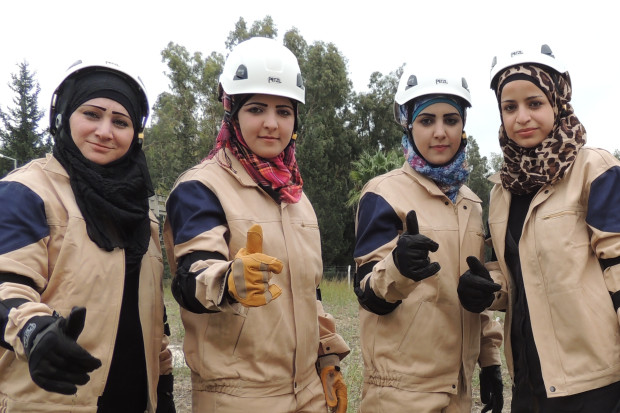
Support the women saving Syria from the bombs

Kaxk8vhtsyrbt0zgzvbj

 'To make matter worse, air attacks from the regime have significantly increased in some areas since the US-led strikes began.'

Obama says no change in Syria policy, Assad still not priority


 This is actually the policy that people like Noam Chomsky say they want him to follow, and the policy that has made the disaster in Syria go from bad to worse.

 “The people of Syria and the various players involved, as well as the regional players -- Turkey, Iran, Assad's patrons like Russia -- are going to have to engage in a political conversation.”

UN still struggling to move aid into Syria

bus aid syria.jpg

 'Millions of families have been torn apart, pushed out of ancestral homes and forced to flee unspeakable horrors in search of safety and dignity.

 The Assad regime has waged a cruel and unrelenting campaign of bloodshed and starvation against its own people for almost four years.'

An alliance of convenience against Assad


 'In Syria those who win victories, gain legitimacy. The FSA has made military gains in the latest battles. Although Nusra took part in these battles, the victories are not restricted to Nusra and therefore the FSA has regained its popularity.'

Saturday, 13 December 2014

‪#‎BlackLivesMatter‬ says Kafranbel!

Islamic State adopts Assad's methods of torture


 I think it's 55,000 photos showing 11,000 deaths, but those are only the ones Caesar witnessed personally.

 'The astonishing cruelty of Syrian prisons has been recorded again and again over the years, long before the revolution, along with the diversity and imagination of the tortures available. "They have made an art form out of torture," said Samir.

 In the "flying carpet", the victim is strapped down to a hinged board, with the ends brought towards each other, bending the spine. With the relatively mundane "falaqa", the victim is beaten on the soles of the feet.

 Obviously, there are also the usual add-ons – male rape, sometimes with kebab skewers, and starvation. The defector known as "Caesar", a police photographer, earlier this year revealed graphic evidence of the deaths of 55,000 people in regime cells since the start of the uprising.'

Noam Chomsky on America: ‘This is a very racist society’

Screenshot from youtube.com video

 Noam Chomsky talks complete shit on Syria. A sad day. The major force fighting ISIS has been the Free Syrian Army, which Patrick Cockburn has spent several years pretending does not exist. Turkey has not been attacking the PKK's allies in Syria. Iran's sectarian gangs which have massacred Sunni Muslims in both Iraq and Syria have driven people into the arms of ISIS. Co-operation with Iran has not been ruled out, the US has been doing its best to get de facto co-operation in Iraq, while leaving the Iranians to do their own thing in Syria.

 Chomsky goes on to say that people are angry about the American bombing, ignoring the major reason that they are angry is that Syrian rebel groups rather than Assad are being bombed. And what to do about Assad is not complex, give the Syrian people the means to get rid of him, and the attraction of ISIS as an alternative will fade like the stars at dawn. But the Syrians fighting Assad appear only as a proxy for American intervention to Chomsky, so when he cites a report from the New York Times showing that American interventions don't work, it doesn't occur that because those were terrorist interventions against popular movements, they have no bearing on whether support for a popular movement against state terrorism would be effective.

 'The correspondent who's followed this most closely, and has been right all along, Patrick Cockburn, simply describes it as an Alice in Wonderland strategy. The major ground forces who are fighting ISIS, are apparently the PKK, and its allies in Syria, a similar group, they're barred because we call them a terrorist group. So they're under attack, our ally Turkey attacks them, and we bar them support. They're apparently the ones who saved the Yazidi, and blocked the ISIS attack on Iraqi Kurdistan. So they're out. The major regional force, state, that could confront ISIS, is Iran. In fact, they could probably wipe them out, and they are influential in Iraq, in fact they were the victors of the Iraq war. They're out, for ideological reasons. A more complex case, that Dr. Cockburn's talked about, is what to do about Assad, and that has all sorts of complexities, anyway, they're out.'

The Salafist and the human rights activist


 'Wherever the regime has been driven out, the people breathe freedom. Curriculums are rewritten, town councillors are elected, newspapers are published and cultural centres are set up – all developments that the West favours, but does not support, even though the huge bombing raids on residential areas of Homs in February 2012 leave no one in any doubt that Assad will use any weapons at his disposal to stay in power.

 The argument that in 2012, it was not clear who was fighting whom in Syria is just a lame excuse. At this time, Syrian Islamists like Alloush were just starting to get organised, and there were only very isolated pockets of foreign jihadists in the country. Instead of giving the many different local rebel groups the money, training and weapons they needed to create an alternative Syrian army, they were left to fight amongst themselves over supplies.'

Friday, 12 December 2014

A weapon of social destruction


 'Since the beginning of the uprising, the Syrian government has gradually engaged in campaigns of arbitrary detention of women, particularly peaceful protestors, activists, dissidents, journalists and aid workers. Although many were released shortly after, some were kept longer to exert pressure on their families or to deter their relatives from joining anti-government protests. State media publicly denounced these women as "terrorists", "saboteurs" and even "sex slaves" for "terrorist groups".

 As the war intensified, security forces began conducting widespread systematic raids on opposition strongholds and used checkpoints to randomly arrest women, detaining them for lengthy periods before releasing them; usually following the payment of a bribe or as part of prisoner swap with opposition groups."

Canada considers prioritizing religious minorities in Syria refugee resettlement


 "We will prioritize persecuted ethnic and religious minorities."

 The truth is that the main victims of Assad have been from the Sunni Muslim majority. But the media that has portrayed the Syrian revolution against genocide as a civil war with victims on all sides, and the racists who have painted it all as an Islamic jihad, have helped to create the ignorance that makes such racist policy on refugees seem a reasonable option.

Tortured logic


 'Some 200,000 people are estimated to have been killed; war crimes and crimes against humanity are daily occurrences; there is a great deal of documentary evidence to impart responsibility, not least for the murder of some 11, 000 people under torture in regime prisons; and 3.2 million Syrians are refugees in the countries neighboring Syria, while another 7.6 million have been internally displaced, according to the UN Population Fund.

 With numbers of such magnitude genocide becomes merely a semantic distinction. Particularly disturbing is that the United States is already involved in Syria, leading a bombing campaign against ISIS. Presumably, Washington went back on its refusal to intervene in Syria because of the viciousness of ISIS. And yet Washington still refuses to do anything about the greater viciousness of the Syrian regime. The logic is difficult to comprehend, but there you have it.

 So, congratulations to America for having the courage to peel back the covering over its own crimes. But it should spare us the bits about moral authority and the early saints. One must bear a responsibility for crimes that he or she has the ability to stop but, instead, does nothing to prevent.'

We have to cut the head of the snake

Rami Aldalati.

 'We have to be frank and differentiate between al-Nusrah and ISIS, although both have ties with al-Qaeda. But ISIS is a criminal organization that has no popular support among the majority of Syrian people.

 The al-Nusrah Front has a different story. All members of this front are Syrians. They are to some extent popular. And people have recognized them in part. We do not approve of everything they do. But we cannot deny them either. They have an impact and we have some coordination.

 At the same time, the US army is at war with ISIS. But it has not fought al-Nusrah. Washington knows that there is some level of cooperation between us and the Nusrah Front, but turns a blind eye. Regarding the recent escalations between Nusrah and the rebels, I should say that the rebels made some errors of judgment and embraced some indecent military commanders. We really did not wish to see an armed conflict between us and wanted the dispute to be resolved through a military court. But al-Nusrah unilaterally made the decision and overran a military base of the Syrian rebels.'

Syrian military and ISIS have been ‘ignoring’ each other


 'These figures suggest that the Islamic State and Assad’s security forces have embraced the clever strategy of ignoring each other while focusing on attacking more moderate opposition groups.

 Assad is trying to downplay the Syrian revolution narrative and instead portray it as an Islamist insurgency against his government. This way, he can crack down on it with the indirect support of the West.

 The Islamic State is looking to engineer a scenario where it is just them against Assad. Therefore, right now the group’s focus in on marginalising moderate groups to the point where these groups’ fighters are "asked" to join the Islamic State.

 The lose-lose situation that the West could be heading for is the Islamic State vs Assad.'

Syria detainees endure `nightmare` underworld


 ' "Nothing, no amount of reading or listening to other people`s stories could have prepared me for the horror of detention," adds Samaan, who now lives in Beirut.

 Speaking quietly as he pulls on a cigarette, Samaan says he was jailed twice for activism against Assad`s regime, enduring physical and psychological torture on both occasions.

 An interrogator at one of Damascus`s feared security branches told him: "We torture people because we are sadists. We enjoy torturing people."

 "He electrocuted me and told me to write down everything I knew. He tried all he could to break me. I have never been so terrified in all my life," the brown-haired Samaan says.Masri, 36, says he also endured psychological torture.

 "They would insult my wife, and they would tell me they would go to the house and rape her," he recalls.'

Syrian Girl Recovers Memory Only to Learn of Tragedy

Image: Aya points at drawings, depicting violent scenes, she made recently, about life in Aleppo, Syria.

 ' "I was one of those who was holding up signs during the Syrian revolution telling people to stay moderate and be careful not to turn to extremism", Mohamed says. But now he says he is sympathizing with Syrian rebel groups that the U.S. views as terrorists.

 "They are not terrorists", he says. "They are protecting us." '

Thursday, 11 December 2014

1 in 8 Injured Face Amputation


 'The campaign, reports the pro-opposition news agency al-Souria, is called‪#‎BigPrison‬, and documents the human rights violations of the 850,000 civilians still trapped in the Damascus suburbs.

 The blockade means nothing and no one can go in or out of Ghouta, including those injured and needing urgent medical care. The few doctors left in the rebel-held suburbs are left to their own devices in treating patients.'

Al Jazeera correspondent dies in Syria


 Assad kills journalists, nobody gives a shit.

 'According to his family members, Mahran died on Wednesday while taking cover from government fire as his car hit the vehicle of rebel fighters after he turned off his headlights to avoid being targeted.

 This is the same area where three other journalists from the Orient Network were targeted and killed three days ago.'

Wednesday, 10 December 2014

The Most Dangerous Job in the World


 ' "It's one of the most important things we can do to increase the effectiveness and legitimacy of civil authorities in liberated areas of Syria," says Mark Ward, a senior State Department official leading the U.S. government's Syria assistance team. "It enables Syrian civilians to do something tangible in the face of the regime's atrocities. There's nothing that brings a community together more than efforts to rescue people." '

How Isis hijacked the revolution


 Not a great headline, suggesting that ISIS are part of the Syrian revolution, rather than antithetical to it, and that the revolution against Assad is ISIS now, rather than the only way to end support for ISIS. But the tagline looks like it's worth reading.

 'Martin Fletcher meets the British doctor who refuses to give up the fight against Bashar al-Assad.'

Torture Archipelago


 This is from July 2012, you have to understand that things have got much worse since then.

 ' "The guards hung me by my wrists from the ceiling for eight days. After a few days of hanging, being denied sleep, it felt like my brain stopped working. I was imagining things. My feet got swollen on the third day. I felt pain that I have never felt in my entire life. It was excruciating. I screamed that I needed to go to a hospital, but the guards just laughed at me."

 —Elias describing how he was tortured in Branch 285 of the Department of General Intelligence in Damascus.

 Since the beginning of anti-government protests in March 2011, Syrian authorities have subjected tens of thousands of people to arbitrary arrests, unlawful detentions, enforced disappearances, ill-treatment, and torture using an extensive network of detention facilities, an archipelago of torture centers, scattered throughout Syria.'

56% of #ISIS clashes are with Syrian revolutionaries


 '56% of #ISIS clashes are with Syrian revolutionaries, 29% Kurds, only 12% against #Assad. What more needs to be said?'

 Perhaps that 55% of all clashes were between Syrian rebels and the régime, suggests that is the main dynamic, rather than there being at least five different wars as propounded by followers of Patrick Cockburn. And 0% of clashes were between Syrian rebels and Kurds. So why does the world love the latter and disdain the former?

In Darayya, tunnels hide a war playing out underground


 'The regime uses civilians and children to dig tunnels. We know that because a child’s body was found in a regime-made tunnel in Damascus last month.

 The regime forces civilians and children to use primitive equipment to dig the tunnels. In some cases, we discover the tunnels after civilians and detainees flee. Five people escaped through tunnels and they told us about them.'

The sad echo of CIA practices in Syrian regime’s prisons


 There are a number of awful things about the CIA's torture programme. The sheer inhumanity of coercion through pain, the blowback from the outrage it engenders, the way it undermines the universal prohibition against torture, allowing other repressive governments to justify their own brutality. This last isn't helped by all those who will profess outrage at the Americans' actions, but have nothing to say about the systematic terror in Syria, because it's not important, because the main enemy is at home, because it's all just another hoax enabling régime change in the Middle East. Whatever the excuses, when Assad is gone, and the truth is plain to see, there will be a backlash against the Left for failing to show solidarity with the victims, in which the few who have sided consistently with the oppressed will not stop the wave of contempt brought about by those who have ignored Syria, stood on the wrong side, or thought it was just a part-time interest while they got on with their real political concerns.

 'On the same day that the U.S. Senate made available to the public a redacted version of its report on the CIA's program of secret overseas interrogation sites, a Syrian activist group released its own documenting of abuses taking place under the watch of Syrian President Bashar al-Assad.

 The report, compiled by the Syrian Commission for Transitional Justice, a Syrian opposition group based in Istanbul, points to systematic violations of human rights in the Assad regime's jails. According to former U.N. envoy Lakhdar Brahimi, the regime has jailed about 50,000 to 100,000 amid Syria's brutal civil war. An untold number have experienced torture and other abuse.'

Tuesday, 9 December 2014

Syrians Will See CIA Report Proof U.S. And Assad Allies


 'After years of ignoring calls to do more to help the U.S.–backed opposition topple Assad, the Obama administration instead sent warplanes to bomb the extremist militants of ISIS and Jabhat al-Nusra, the Syrian branch of al-Qaeda. The regime, meanwhile, has continued using its aircraft to punish rebels and civilians alike.

 The U.S. has denied coordinating with the regime — but Syrians often ask how that can be so as planes from both sides patrol overhead.'

 Once again, 'U.S.-backed' not the most useful phrase.

Syria refugee recalls 'beatings, whippings, electric shocks'

Badly damaged buildings in Homs, Syria

 ' "When things started in Homs," she explained, "they opened fire on peaceful demonstrations. I saw the army, they had their weapons, they opened fire and they forced their way into the areas where we lived with their tanks and machinery. They bombarded our homes and fired on people directly. I saw massacres and I helped save a large number of injured casualties."

 She fled the city but was eventually picked up by the regime's security police.

 "I was subjected to torture, atrocities, insults… They were focusing on the psychological element - insults, humiliation - as a punishment because of what I had done."

 But the scale of her treatment, she says, went much further.

 "I was subjected to beatings, whippings, electric shocks. I was detained in a single cell, it was a horrible place under the ground. There were three floors - and I was kept there for one and half months." '

Southern rebels see US as key to success

FSA fighters in Damascus (file photo)

 'So the southern front is even more crucial for any short-term Western strategy in Syria.'

 Why is this about Western strategy? Isn't the important thing whether it is crucial for Syrians' chances of success? Making this all about what the US wants, rather than what Syrians want, is one way that the mainstream media has marginalised and rendered invisible the Syrian opposition, while Assad, with his foreign support and foreign proxy armies, is presented as indigenous.

Moscow turns its attention to Damascus


 'Moscow is taking advantage of the United States’ weakness in terms of Syria and the Obama administration’s generally confused politics, the writer observed. The Syrian opposition’s lack of organisation also presents Russia with an opportunity for manipulation.

 “What’s threatening in this scenario is that Moscow’s actions and plans don’t take into consideration the interests of the Syrian people, nor do they serve Syria’s future,” the writer observed.

 “These actions are based on careful strategic planning that guarantees Russia’s continued presence in the Mediterranean and keeps Syria under its control lest it becomes a passageway for Gulf gas and oil pipelines to Europe.” '

Monday, 8 December 2014

No one safe in Syria's sniper war


 'A report released by the Syrian Network for Human Rights (SNHR) in October 2014 entitled "hunting humans", said that 5,307 civilians had been killed by snipers belonging to the Syrian regime and its allied militias during the conflict.

 In Deir Ezzor, a sniper based atop a police station shot at locals as they crossed a nearby bridge.

 "We would only ever cross at night. We covered our car in sand and turned off the lights. We would drive as fast as possible, knowing we could die," said Aboud Saleh, an activist from the town.

 "Once a family tried to cross. A sniper killed the father, then the mother, then the three children. The Free Syrian Army later took control of the area, and took their revenge [on the shooter]." '

A death to shame all of Europe


 'They had waited for three years, almost all of Reemi's life, to be rescued from a government that had cut off the gas, water and electricity, and was daily lighting the Syrian sky with bombs that would fall on anyone who lived in areas that no longer supported it.

 They had waited for the international community to declare a no-fly zone, but it did not come. They waited for the west to arm the opposition, but that did not happen. They were forced to eat grass and stray cats as they faced starvation. They waited for aid, and it did not come. They waited until all their hope was gone and all they had was a boat ride to anywhere in Europe.

 There was no hope left in Syria. In many parts like Homs, and Aleppo, there was no one left to hope. Some 500,000 civilians had been injured and 200,000 killed by the government for daring to wish for freedom.

 And so, Reemi and her mother prepared for the boat to freedom.'

Familiarize Yourself With The Branches Of "Air Force Intelligence"


 'I did not want to give them what they wanted at the first [finger]nail, but after being tortured and hanged from the ceiling, the investigator said, "I will send you to the head of Airforce Intelligence." '

 Not actually too graphic. Someone who thinks of themselves as a supporter of the Syrian revolution said to me the other day, "Assad is no worse than other dictators." Something no Syrian would say; noone who has been following the suffering in Syria would say, "Could be worse." But I didn't bother to argue the point, because it is usual in such cases for the other party to get offended, and to assume that you are arguing that Syria is so exceptional, there is nothing that could be done that would be worse. So I must be in favour of an American invasion, because thinking something has to be done must mean that anything is better than nothing. Never mind that an American invasion was never going to happen and was a red herring conjured by those who wanted nothing to be done about Assad. I used to find such illogic annoying when it was pointed at Communists, with the claim that if you think the ends justify the means, you must think any means is a good one, even those that lead directly away from the liberty you seek.

 If Assad could ever win, it would not be tens of thousands who would be tortured and killed, but hundreds of thousands. It isn't just that he and his Russian and Iranian backers are war criminals on a grand scale, but that those who support them, even sideways by proclaiming their love of Hezbollah, are scum too, and utterly beyond the pale for anyone who wants to see a better world.

 Assad can't win though, because there are so many Syrians who have gone too far for liberty ever to countenance the torture of living under him again. That is why the death throes of his régime is so destabilising, they have cast millions of refugees into neighbouring countries, forced Assad to drag other countries into the conflict. Maybe sometime the voices calling for the rebels to be armed and the rightness of such a course will force the Americans to allow it to happen, because that is the only way Syria can escape from an ever deepening catastrophe. People who agree with that may disagree with details, but I'm glad they are all in the same camp.

'I want to go home'

Book art

 "I made you a drawing of how when we were home we were attacked in an air strike."

Also here.
[https://www.washingtontimes.com/news/2014/dec/8/letter-exchange-brings-hope-to-students-near-far/]

Sunday, 7 December 2014

No Moral Nation Can Ally With Assad

James Snell Headshot

 'Caught between the twin perils of IS and Assad, and denied all but the most vacillatory international support, rebel groups like the Free Syrian Army have suffered. Of course they have; and so have the Syrian people.

 Assad's forces have committed atrocities, both with and without the aid of weapons of mass destruction. More than 11,000 people have been tortured to death in regime prisons, according to the Senate testimony of a Syrian defector. And the state is poised, it seems, to inflict the same grisly fate on many more. This particular fact becomes tired in reiteration - but not less true.

 It is also true that international inaction - be it in failing to intervene in the aftermath of chemical war crimes, insufficiently equipping moderate rebel groups to fight against trained soldiers from Assad's army and that of Iran, and not providing the sort of diplomatic recognition that could have put pressure on an embattled tyrant - has helped to create the current terrible situation.

 But being complicit in the creation of a scenario in which the theocrat and the fascist can thrive should not mean embracing that most terrible of eventualities. On the contrary, it only doubles the moral obligation of those who - for whatever reason - allowed Assad and IS to ascend to their duel positions of power; rather than shrinking away from confronting this evil, we must fight it - and in any form it may take.'

Beware Of The Leopard


 'President Barack Obama is exploring ways to clarify his Syria policy, senior administration officials said, including how to reconcile his opposition to both the Assad regime and the Sunni militants that are its chief foe.

 The discussions are taking place amid growing pressure from U.S. allies in the Middle East for the administration to more pointedly confront the regime of Bashar al-Assad. Another prompt is Senate confirmation hearings for Mr. Obama’s pick to lead the Defense Department, Ashton Carter, who...'