Friday, 1 June 2018

Raqqa in the eye of the storm again


 'Raqqa is witnessing developments not previously observed since it was declared controlled by YPG militia-dominated Syria's Democratic Forces (SDF) militias in 2017. As the popular demands for exiting the city increased, clashes broke out between the rebel and Kurdish protection militia (YPG) that the US-led International Coalition forces failed to stop such clashes. This comes in conjunction with preparing Saudi Arabia-backed Arabic forces to manage the region.

 Kurdish protection militia YPG-dominated Syria's Democratic militias seized in October 2017 complete control over Raqqa after months of fighting against ISIS that ended with the complete destruction of the city, the displacement of most of its population and the killing and wounding of thousands of civilians. The YPG have imposed its laws, which led to compulsory recruitment and the resettlement of Kurds, and this is what the Syrian Arabs considered an attempt to change the region's demographics.


 Public protests in the city of Raqqa have been going on for more than a week, demanding the end of the arbitrary arrests and forced recruitment implemented by Kurdish protection militias.

 "Such demonstrations were caused by the militias' practices of theft and confiscation of civilian property, raids and random arrests, and the imposition of forced conscription, as well as the issuance of decisions and judgments and the administration of the city to suit their plans," media activist, Mohamed Othman, said.

 Almost every day, evening demonstrations take place in the areas of al-Sakia Street, Dawar al-Barazi and al-Mashbal district. Although they are met with violence and repression, the protesters insist on their demands for the militia to withdraw and hand over the city to civilian bodies. Recently, a demonstration erupted in "Rumaila" street was attacked nearby the "al-Batani" square and the protesters were met with shooting, which resulted in the injury of some demonstrators lightly injured and the arrest of four of them.

 In response to the popular movement in the city, the militias blocked cars with food aid from entering the Rumaila neighborhood, in a move described by the people of the city as "collective punishment."


 Clashes broke out last Sunday between the Al-Raqqa Revolution Brigade and Kurdish protection militias near the roundabout of al-Barazi, where the latter targeted civilian houses with heavy machine guns, coinciding with the roll-out of military reinforcements towards the district of Maslab to storm the area.

 Osman explained that the protection militias represented by the forces of Asayish and its military police tried to arrest one of the military commanders of the Brigades of Raqqa in his home in the neighborhood of Rumaila and got a quarrel and loud voices before a number of elements of the brigade managed to assist the commander and then patrols withdrew towards the district's outskirts and called for support from the elements of "Syria's Democratic Forces" in conjunction with the deployment of the brigade's fighters at the entrances of the neighborhood.

 He added: "Then the militias fired at the neighborhood, which led the brigade to respond in the same manner. Meanwhile, the civilians came out in dozens and then developed the situation until they became hundreds of protesters from the neighborhoods of Rumaila and al-Mashlab to demand the exit of Kurdish protection militia from Raqqa.

 On the other hand, the leader of the brigade, "Abu Ismail al-Askari" declared that "Syria's Democratic Forces" are trying to pressure the brigade to dismantle and prove their selves the only force on the ground, stressing their willingness to resort to similar operations against them in the event of continued violations.


 Despite the intervention of the international coalition more than once to calm the situation and force the militias to withdraw to the outskirts of Rumaila, but they have returned the attack.

 "Syria's Democratic Forces" has been trying to get rid of any military entities that have Arab forces majority, where the village of Abu Hamam in the eastern suburb of Deir al-Zour witnessed earlier military confrontations between Syria's Democratic militias and the "Elite forces" of the al-Ghad Movement headed by Ahmad al-Jarba, before the American President's envoy to the International Coalition "Bret Magork" interfered to resolve the conflict.

 The Arab Council of the Jazira and the Euphrates region, which is close to the al-Ghad Movement said that the Kurdish protection militias that control the decision in "Syria's Democratic Forces" reject the presence of any Arab faction in the region, because it poses a threat, especially in light of the refusal of members of the Arab tribes to join them.

 The Council expressed its fear of an Arab-Kurdish sedition that foreshadows more Syrian bloodshed, and the region of the al-Jazira and the Euphrates remains open to all possibilities.


 After the announcement of the representative of the Democratic Union Party (PYD) that the city of Raqqa after the expulsion of ISIS from the city will join its federal system, and a member of the Political Bureau of the Kurdish Democratic Party, "Azad Brazi" revealed the existence of the idea of establishing a federation of Manbij and Raqqa, Deir al-Zour after the entry of Arab forces backed by Saudi Arabia, pointing out that is now being discussed by the Syrian Democratic Council which is the political front of the SDF militia.

 A delegation from Arab countries met with officials from the Syria's Democratic militias to form a nucleus of a new Arab force in northern and eastern Syria. According to the sources, the meeting was held between the leaders of the Sanadid forces, the Elite forces, the brigades of Raqqa and other Arab factions in Syria with officials of the Saudi Arabia, UAE and Jordan defense ministries, at the American-run base "Esh Kharabak" in the countryside of Ain Al Arab.

 According to PassNews website, the Arab forces will be stationed initially only in the areas of Raqqa from which Washington withdraw its troops, which pressed the YPG to accept that step.

 The source adds that the sheikh of the clan of Shammer "Hamidi Dahham Al Hadi" made an offer to participate in this force through the grouping of the Arab tribes and the formation of a Sunni tribal force with its capital (Raqqa) and under the supervision and support of Saudi Arabia.'

Wednesday, 30 May 2018

Daraa responds to the regime's psychological warfare


 'The Daraa revolutionaries responded to the psychological warfare waged by the Syrian regime against them by promoting reports of the imminent attack on the liberated areas, and the publication of leaflets from the helicopters calling for the people of the province to surrender.

 The revolutionary factions in the operations room of "al-Bunyan al-Marsous" used drones to drop leaflets on the areas under the control of the Syrian regime forces in Daraa province, in which they called on the people to revolt against Assad because he has killed thousands and caused the displacement of millions of Syrians.

 Numerous reports issued by media outlets close to the regime talked about preparing for a battle against free Daraa areas and about crowds in the region. However, military sources denied that there were any reinforcements or field changes.'

Monday, 28 May 2018

Residents in Hasakah Protest PYD, Reject Conscription


 'Local sources and some social media accounts have been reporting that the Democratic Union Party (PYD), which controls certain cities in Syria, was forcing civilians into full submission. Besides for using taxation and other ways of collecting money, the PYD has a major problem with its conscription activities.

 The PKK-affiliated group has been employing youth in its attacks against Turkey and opposition groups. It has been reported that the residents of the Syrian city Hasakah, in the country's north, have gathered to protest the PYD.

 In fact, at the beginning of the civil war Hasakah residents were totally siding with opposition groups. However, due to the city's strategic position the regime forces did not abandon the city center. Instead, when it became clear that the regime would not maintain its rule, the PYD somehow ascended to power. The regime and the PYD refuse to admit that they are allies, but it is a fact that the two sides have allied several times and avoid confronting each other. The regime has never considered the PYD a threat, for instance, when its militants captured large swathes in Syria's north or Aleppo's northern neighborhoods.

 One of the first things that the PYD did was to silence other Kurdish groups. There were certain Kurdish groups, who were supporting the opposition, willing to fight the regime and not intended to be associated with terror activities.

 However, an implicit alliance between the PYD and the regime, and U.S. support has led the emergence of the PYD as the sole power in that area.

 According to the Syrian sources in Istanbul, it is not possible for the civilians to raise their voices against PYD rule. They need to launch another revolution attempt as they did against the regime. Yet, people seem to be fed up with the unjustified acts and harsh measures imposed by the PYD since they, in the protest in Hasakah, exclaimed that they were not going to give their sons to the so-called PYD army. The PYD and its main backers, including the U.S., claim that their struggle is focused against Daesh. Indeed, the U.S. has benefited from using Kurdish people as manpower against the terror group. Yet, the civilians, according to the claims on social media, say that their sons do not want to be conscripted.

 News agencies reported that a large number of armed PYD members were mobilized last week into the country's south. A new wave of fights against Daesh would be possible. Therefore Hasakah residents along with the residents of other cities, which have fallen under the PYD control, were worried.The conscription issue seems like a problem for the residents. Another problem, mentioned by rights groups, is that the PYD patrols are free to arrest anyone. The Syrian Network for Human Rights reported that a few people are arrested almost every week and taken to an unknown destination.'


 'Anti-SDF protest in Rumialah neighborhood after clashes erupted between predominantly Arab rebel group Liwa Thuwar ar-Raqqa & the Kurdish-led #SDF. "Raqqa is free. Kurds go out!" '
[https://twitter.com/twitter/statuses/1000889286919639041]


 Note 31/7/25, Twitter link broken.

A woman’s place in the resistance


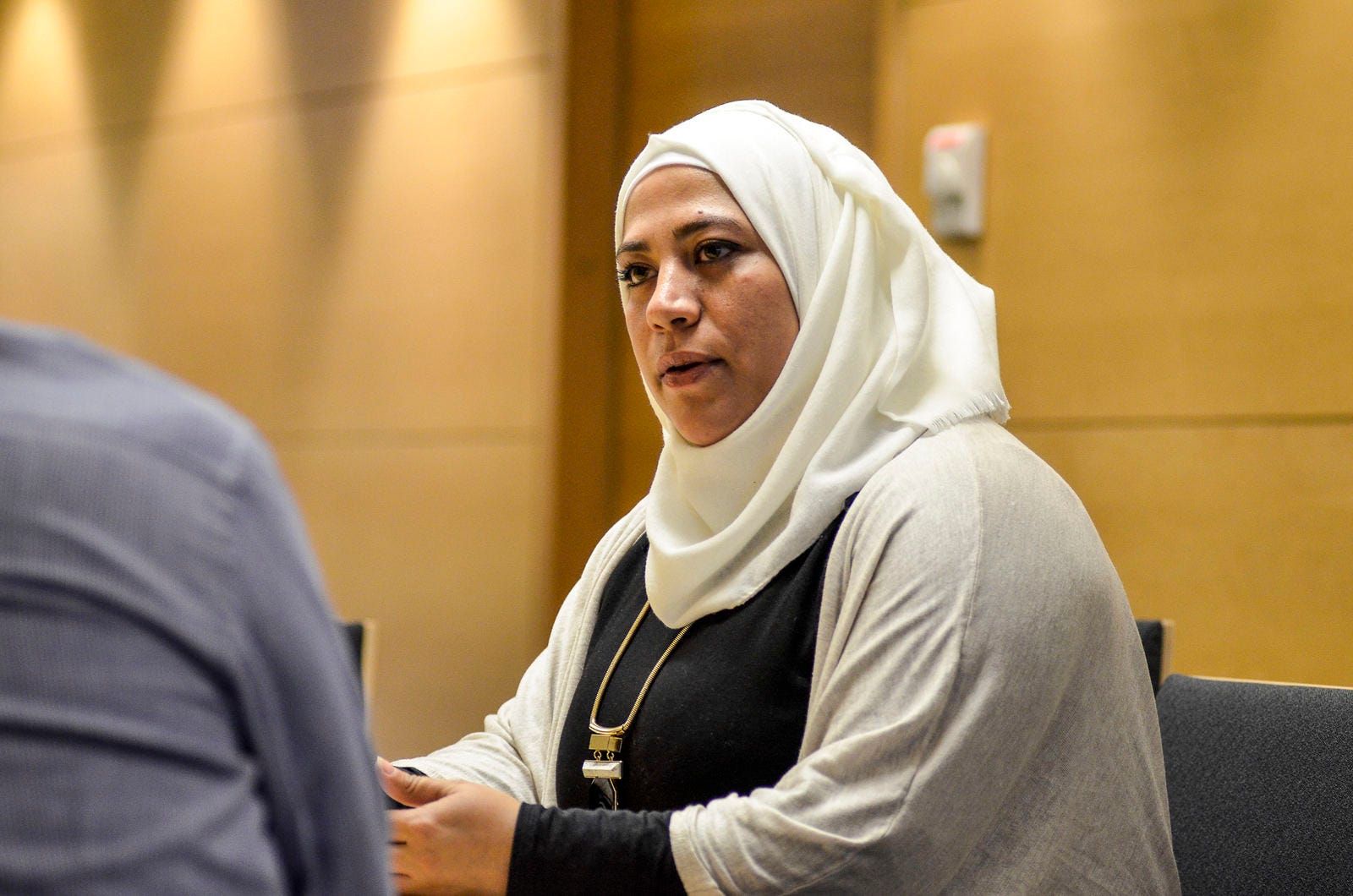
 'Syrian journalist Kholoud Helmi has paid a heavy price for her fight for the truth. Since co-founding a newspaper in 2011 she has watched her hometown come under siege and lost friends and family at the hands of President Assad’s brutal regime. But her pursuit for the freedom and dignity of Syrian citizens is one she will never give up.

 Born in 1984, as a child growing up in Darayya, a suburb outside Damascus, Helmi was unaware of the atrocities the ruling government was capable of. Everything they knew was fed to them by the ruling Ba’ath regime, and nobody dared to speak against the government. It was these memories of growing up under state control that led Helmi to join the Arab Spring protests, and the injustices she witnessed shaped the course of her life as she found herself reporting from the frontline.

 “We had one channel for TV, which was state-owned media. We watched all the same programmes. There’s something funny where all Syrians have all the same collective memory, as if we were all brought up in the same house where nothing could change,” she says.


 Helmi’s transition from Syrian child to activist and journalist was gradual, informed by whispers of information she heard. When she was 11 a schoolfriend told her about her father, who had left Syria after he was accused of being affiliated to the Muslim Brotherhood. At the time Helmi did not know anything about the group, or about the massacre in 1982, when government forces, under the orders of the country’s then president, Hafez al-Assad – father of the current leader – besieged the town of Hama for 27 days to quell an anti-government uprising.

 The attack has been described as one of “the single deadliest acts by any Arab government against its own people in the modern Middle East” but, growing up just a decade later, Helmi had no idea of the atrocities that had taken place.

 But by 2011 Helmi had learned enough about the ruling regime to know she wanted change. Inspired by protesters in Tunisia, Egypt and Yemen and Libya, she attended a demonstration in Damascus.

 “I will never forget that day,” she says. “Demonstrations were so dangerous, so we relied on the trust groups. We would go to the neighbourhood and then we would receive another sign to direct us to a point, then when we got closer and the numbers were there, people would gather together and then we would start the demonstration for one minute.

 “The first time we were just chanting. We chanted for freedom of expression and change. I will never forget what I was feeling. I felt like I was floating, not walking. Demanding something that we were not allowed to – speaking up – it was like I was flying. What I remember is that I was so happy to the extent that I was shedding tears the whole time, for no reason. I have never felt free, but that time I did.”

 Protesters handed bottles of water to soldiers. Others gave them roses as a sign of peace, but it wasn’t long before soldiers then reacted with violence.

 “We believed we were all brothers and sisters of the same nation, but it turned out that they arrested people anyway,” says Helmi, whose friend Islam Dabbas, a civil engineering student, handed soldiers water and roses and was arrested. Seven years on, Helmi does not know what has happened to him.

 “You could mention thousands of names of people who have disappeared because they were peacefully protesting in the streets.”


 The state-run media was keen to brush over the truth. TV cameras would turn up hours after the demonstrations had finished, denying that anything had happened.

 “They would cover things that told people nothing was happening in the streets of Syria, but [meanwhile] my friends were arrested, killed, taken to prison, and the security forces were breaking into houses, arresting people, harassing women.”

 Helmi and a group of friends decided to take matters into their own hands. In December 2011 they founded a newspaper.

 “We had to tell the people why we protested and what we had been facing,” she says. “Darayya is 20 minutes from Damascus, but most of the people in Damascus didn’t know what was going on. We also wanted to reach the international media.”


 In January 2012 the first issue of Enab Baladi was published. Helmi and colleagues knew they were risking their lives, so they had to devise a meticulous method of distributing the newspaper. They would gather the news, write it at home and send it to the designer. It was printed by another colleague, who would fold the newspapers and put them in bin bags outside his home. The group communicated through a secret Facebook group, and once the newspapers were ready people were assigned to go and collect them.

 “People would come to my house and collect their editions,” says Helmi. “The people who came to me didn’t know that I worked for the newspaper. My own family didn’t know that I was a journalist and writing for the newspaper. They only discovered later on when I started to have huge loads of the newspaper in the house.

 “I was afraid but the dream was so huge, to the point that we forgot that we were under danger. What we were aspiring for, freedom, freedom of expression, change, democracy – the dream was big and we had belief in the international community at that point.”

 To distribute Enab Baladi as far as Damascus, Helmi would smuggle copies underneath her clothes and pass through army checkpoints.

 “We had big dreams at that time and it really conquered our fear, but to tell you the truth many times I was really terrified. I would write the news or contact people and I knew for certain that security forces could break into my house or kill my parents.”


 In May 2012 Helmi’s worst fears came true. Security forces broke into her home and arrested her brother Ahmad. She has never seen or heard from him since. Three months later the regime arrived in Darayya and massacred over 1,000 people in 15 nights.

 “We were besieged and bombarded,” says Helmi. “The army left the town and left it on fire.

 “We stopped issuing the newspaper for two weeks, but we had to keep up the work, so Enab Baladi was issued and we told the world what happened during the massacre: the raping of the women, the killing of the men and women, the suffocating of kids, everything.”


 At the beginning of 2013 Helmi decided to leave Syria for Lebanon. Meanwhile, some of her colleagues on the newspaper were incarcerated.

 “Some were arrested for 10 months and released, so they started to tell the stories of what the prison was like and how they had been tortured in prison and all these horrible stories. The bad things that happened added to the diversity of the newspaper. When I went to Lebanon I started to report on how life was for Syrians in Lebanon while others moved to Amman, so they started to write about how life was for Syrians in Amman. We started to be the voice of Syrians in diaspora, not only inside Syria.

 “We were so fragile in the hosting communities. No one knew who we were. It was so dangerous to continue so we stopped printing the newspaper when we left, but it was online instead.


 In the following months, four of Helmi’s colleagues were killed.

 “The first one we lost was the CEO, Mohammad Quraitem. He took the decision to stay in my hometown after we left and he was killed by a missile that hit his home. Then we lost a reporter from Darayya one month later. Then within the period of two or three months we lost the managing editor, Ahmad Shihadeh. Then in 2015 one of our co-founders, Nabil Shurbaji, was killed under torture in prison after he was arrested in February 2012. He was the only journalist among us. The rest of us were amateurs.

 “We only learned that he had been killed two years later. Other people are still in prison. We paid a very heavy price.”


 In 2014 Turkish authorities granted them a licence to open an office and the newspaper returned to print soon after. As its readership grew, so did its team of reporters. It now has anonymous citizen journalists based throughout Syria, including in Raqqa, a former Isis stronghold. The newspaper is considered one of the most prominent Syrian media organisations and publishes 7,000 print copies a week.

 In 2015 Helmi was awarded the Anna Politkovskaya Award for her services to journalism. The prize honours female human rights defenders from war and conflict zones. Helmi believes her role as a female journalist gave her a unique advantage in leading the resistance, as she was able to reach areas her male colleagues couldn’t.

 “Women have a unique role in leading the resistance in Syria,” says Helmi. “First of all because of the culture in Syria the army were afraid to trespass the cultural norms at the very beginning of the Syrian revolution where it was taboo to touch a woman or to take her to jail, but shortly afterwards they stopped abiding by anything.

 “The other thing is that being a woman I was able to tell the stories of other women. I could speak to ordinary Syrian women and see how they were suffering, whereas it would be more difficult for men to enter a house and interview women and ask them what’s going on.

 “During the massacre in August 2012 they raped women. One of my colleagues went to the houses and she created that trust circle with a number of these girls. She listened to their testimony and wrote an article and it went viral.

 “We had access to many places, we could easily interview women, we could deal with delicate stories of kids who had been burned or suffering. It was easier for us women to deal with these stories than men.”


 Has the global community failed Syrians. “Yes,” she says sadly. “Unfortunately. I mentioned before that we used to have big dreams and big expectations, but these expectations only remained until 2013. We kept those high expectations until the minute Assad used chemical weapons against people in Eastern Ghouta. To wake up in the morning, open your eyes, go on Facebook and to see all the images of the kids who had been killed just because they were breathing, it literally suffocated me. I thought: ‘I am breathing and I am alive, but these kids had been breathing to die.’

 “I was so naïve. I thought that the whole universe was going to shake. But nothing happened. Since then we lost all our belief and all our faith in the international community.”

 In response to the UK’s recent air strikes against Assad, Helmi says it is too little, too late.

 “It would have meant fewer casualties and less forced eviction if such an action, but a real serious one, happened in 2012, or 2013 when the first chemical attacks occurred. I know it did nothing, Assad is still there, still bombarding people and forcing them to leave their homes and towns. The attacks resulted in nothing serious.”

 Helmi is now studying for a masters degree in the UK. When she graduates she plans to reunite with her parents, but for now, she wants to continue the work of her Enab Baladi comrades.

 She says: “I am not arrested yet, but my friends are. And I am not dead, but my friends are. I think I have to carry the burden of their messages to tell the world what is going on.” '

Image result for A woman’s place in the resistance Kholoud Helmi

Sunday, 27 May 2018

Assad uses development law to carry out ethnic cleansing


 'The Assad régime in Syria was accused on Saturday of using a new law on urban development to rid the country of all political opposition.

 The so-called “Law 10” allows the regime to acquire previously private property to create zoned developments, and to compensate the owners with shares in the new projects.

 However property rights are in a state of confusion after a seven-year war that has created more than 5 million refugees and 6 million internally displaced people. Many of the displaced have lost the necessary paperwork, are struggling financially or not aware of the legal requirements in time.


 The Assad regime is using the confusion to create a suitable environment for demographic change, Syrian opposition spokesman Yahya Al-Aridi said.

 “The régime has a two-fold goal,” he said. “First, terrorize the opposition and supporters of the Syrian revolution so that they lose the right to their properties.

 “Second, there is talk of reconstruction in Syria now. This law sends out a message to investors that their interests lie with the regime. It is an attempt to tempt companies and business people to support the regime, because the regime is the only party that approves bids and gives grants and contracts. All this merely adds to the Syrians’ plight and misery.”

 Al-Aridi said the attempted land grab was being resisted by European countries, especially France and Germany. “The Syrian Negotiating Committee is also exerting a very important effort so that such an evil act will not happen,” he said.


 Also on Saturday, the US warned Damascus it would take “firm action” if the regime violates a cease-fire deal, after Syrian aircraft dropped leaflets on a southern province in advance of an expected offensive.

 Al-Aridi said any such offensive would be a breach of agreements between Russia and the US on de-escalation zones, and he warned the regime and Iran against “playing games” with the US. “Such threats are part of a response to the two unanswered Israeli attacks on Iran’s military positions in Syria,” he said.

 “They area also meant to divert attention from the American-Israeli intent to kick Iranian militias and forces out of Syria.”

 He said the regime and Iran could do nothing without Russian support. “We don’t think the Russians are willing to provide such support, or to mess with the US or Israel. Parallel to such threats, Assad is trying to make certain reconciliation agreements with what they call ‘Syrians in liberated areas.’ We believe that they cannot do anything of the sort.” '

Friday, 25 May 2018

Russia will do anything to keep Syria’s Assad in power


 'Russia appears to be ready to pay any price to keep the Assad regime in power and maintain the Kremlin’s semi-colonial domination, Syrian journalist Ammar Hamou writes in his 2016 book “Russia and the Syrian Revolution: Politics, Deception and Military Aggression.”

 “Russia’s opposition to the Syrian people’s revolution does not come from a place of love for Bashar al-Assad,” the author states in his rare study of the Kremlin’s intervention. “It is rather a position of unambiguous greed and self-interest.”

 “Russia did not want improved Syrian relations with the West, and Israel in particular, fearing it would lead to the introduction of Western competition in the Syrian market,” Hamou wrote. “Moscow worried that a Western presence in the Russian sphere of influence could potentially lead to the arrival of a Sunni regime in Damascus, threatening decades of exclusive investments and privileges that Russia had cultivated with the Assad regime.”


 What is even more important is the Kremlin’s desire to retain its control over a naval depot in Tartus on the Mediterranean Sea, the only Russian military outpost beyond the post-Soviet area.

 Besides, Assad’s dependence on Russia enabled the Kremlin to win profitable nationwide contracts in Syria long before the war.

 “Russia set its crosshairs on Syrian energy and oil, receiving plum deals and economic privileges, including rights to construct Syrian railroad lines and energy deals from the Euphrates dam,” the journalist writes.

 Moreover, he adds, in 2005 Putin agreed to write off 73 percent of Syria’s $13.4 billion debt to Russia, and also pumped in $3.5 billion in direct investment. Even after war broke out, Damascus and Moscow agreed to establish in 2013 a joint company for offshore oil and gas drilling and oil refining.

 “The amount that Russia stands to lose in the event of regime collapse is fully evident,” Hamou writes.


 Now in 2018, with the Assad regime much more confident of its future in post-war Syria, Russian construction firms with close links to the Kremlin are already claiming exclusive contracts with the Damascus government to rebuild the ruined country.

 On Feb. 26, the Russian Trade Chamber’s vice president, Vladimir Padalko, asserted that Moscow expects “the biggest gains from building, energy, the restoration of heat power grids, and machinery, including the supply and production of engineering and agriculture hardware.”

 Moscow is thus doing all it can to save its puppet regime in Syria — with an overt military intervention, as well as the deployment of its clandestine mercenary armies such as the Wagner Group, which also fought in Ukraine, and vocal diplomatic protection of the Syrian regime in the United Nations Security Council.


 In his book, Hamou notes that Russia and China vetoed at least four Western and Arab peace proposals.

 “Even in the aftermath of Assad’s use of chemical weapons against his own people, Russia fought tooth and nail to ensure that a U.S. military strike would not occur,” the journalist writes.

 As of today, Russia has blocked 12 Security Council resolutions on Syria, the latest on April 10, following a deadly chemical attack on civilians in Douma, allegedly carried out by the Assad regime.

 In a bid to justify its own airstrikes, Russia tells outright lies, claiming that it is fighting against Islamic State forces and other jihadists.

 But instead, Hamou writes, evidence shows Russia is attacking the secular Free Syrian Army, delivering airstrikes on locations 150–200 kilometers away from the nearest Islamic State strongholds.

 Moreover, Russia’s reckless war against Assad’s adversaries has resulted in unprecedented massacres of the civilian population all across Syria, he writes.

 In his 2016 study, statistics from the Syrian Human Rights Committee show that at least 1,690 civilians have been killed by indiscriminate Russian airstrikes between Sept. 30 and Dec. 31, 2015 alone.

 In the further course of the devastating war, the Russian airstrike campaign has continued to take a heavy toll on Syrians, especially during the horrific battle of Aleppo in 2016.

 On May 22, the Syrian Network for Human Rights, a British-based watchdog, issued a report in which it accused Russia of killing at least 6,113 civilians in Syria.


 Moscow, despite twice claiming it would withdraw its forces, keeps fueling the war to preserve its neocolonial privileges at any price.

 “As Syria crumbles, Russia’s strategy looks ever more like an occupation, one predicated upon Russian national interests,” Hamou concludes. “Russia’s relationship with the Assad family spans 45 years. It is a relationship built upon shared interests, ones that are fundamentally at odds with the Syrian people.” '


Sunday, 20 May 2018

Syria’s war is not over

Image result for american interest eisenstadt Has the Assad Regime “Won” Syria’s Civil War?

 'Bashar al-Assad has said about Syria's bloody civil war that "things now are moving in the right direction" and that "the worst is behind us." Senior officials from Russia, Iran, Hezbollah, and the UN and former U.S. diplomats have gone even further, proclaiming Assad the victor and urging rebel groups and the U.S. government to reconcile with this unpalatable "reality." An analysis of regional conflict dynamics, however, reveals a more complicated picture, which indicates that Syria's agony may be far from over and that its military gains may be more tenuous than they appear.

 Pro-regime forces now control more than 50 percent of Syria's territory and between one-half and two-thirds of its population. Yet the regime's hold on many areas remains uncertain due to a lack of loyal and competent troops and institutional capacity. While pro-regime forces have been able to "clear" many areas they have retaken, they are overstretched, so it remains to be seen whether they can "hold" them. (Indeed, ISIS has recently mounted stinging attacks in areas—like Palmyra and Deir al-Zor—that have been repeatedly "cleared" by pro-regime forces.) The transfer of rebel fighters and their families from recaptured areas to Idlib or Deraa provinces—as part of so-called reconciliation agreements that are in fact anything but—will facilitate this clearing task, but pro-regime forces could still face renewed armed resistance in these areas from a new generation of oppositionists. And as long as U.S. forces remain in and over northeastern Syria, they can veto the regime's reconquest of that part of the country—which includes some of its most productive oil-producing and agricultural regions.

 The Syrian Army has perhaps 10,000-20,000 troops available for offensive operations throughout the country. These are drawn mainly from the 4th Armored Division, the Republican Guard, the Tiger Force, and elements of the National Defense Forces (NDF). The rest of the Syrian Army—including the remnants of several regular Army divisions, most of the NDF, the recently formed IVth and Vth Corps, the Local Defense Forces (consisting of various pro-regime militias), and the regime's intelligence services—totals perhaps 100,000-150,000 men under arms. Many are poorly trained conscripts and volunteers of all ages, as well as militia auxiliaries responsible for local security in regime-controlled areas. They cannot be relied on for operations outside their home regions.

 Much of the regime's offensive combat power is provided by fighters from the Lebanese Hezbollah (6,000-8,000 fighters), Iran (2,000 fighters), Shia fighters from Iraq, Afghanistan, and Pakistan (10,000-20,000 fighters), and a relatively small Russian ground and air contingent. Pro-regime forces have been able to tap large reserves of Shia foreign fighters to support their efforts—while the flow of anti-regime Sunni foreign fighters has been reduced to a trickle as the result of tighter border controls and ISIS's battlefield defeats. Moreover, many areas are currently controlled by foreign pro-regime forces, as well as "reconciled" rebel groups and tribes whose loyalty to the regime is conditional. Should these foreign pro-regime forces and fighters need to return to their places of origin, or should reconciled rebel groups and tribes switch sides once again, the regime would be hard pressed to hold on to many of the areas it currently controls. Moreover, Lebanese Hezbollah must balance its desire to draw down its presence in Syria and return its fighters to Lebanon with the ongoing need for them to remain in Syria.

 A rule of thumb used by military planners states that 20 troops per 1,000 civilians are required for stability operations. This would equate to a force of 200,000-240,000 for the regime to dominate the 10-12 million people now reportedly living in areas it more or less controls. That is considerably more than pro-regime forces currently have at their disposal. But after seven years of war, rebel forces are depleted and exhausted too—and about as divided among themselves as ever. Indeed in most places, they may no longer be capable of sustained resistance.


 It is not clear whether the Assad regime can achieve an outright victory; rebel enclaves remain in Idlib and Deraa provinces and in Kurdish-controlled areas in the country's northeast, and some of these areas are protected by foreign powers. Moreover, it is not clear whether the regime's victories will bring about a period of prolonged quiet, as occurred after the scorched-earth victories scored by Syria in Hama (1982) and Russia in Grozny (1999-2000), or whether it will resemble Iraq's unconsummated victory over al-Qaeda in Iraq (AQI) from 2007-11, which paved the way for its return as ISIS in 2013-14 in response to heavy-handed regime policies.

 The outcome in Syria, as elsewhere, will depend in part on the degree to which the Syrian people are exhausted and accept defeat, and on the effectiveness of the regime's internal security apparatus. Even in areas controlled by the regime, its "victory" may be incomplete; while some areas may be quiescent, others may remain troublesome. Moreover, the Turkish government's use of elements of the anti-regime Free Syrian Army in its fight against the Syrian Kurdish Democratic Union Party (PYD) in northwest Syria ensures the survival of at least part of the anti-Assad opposition.

 The potential for conflict is further increased by the newfound confidence of the Assad regime and its Hezbollah and Iranian allies. Syria is likely to once again use chemical weapons, perhaps prompting new U.S. strikes to enforce its red line. And just as the defeat of the Soviets by the Afghan mujaheddin spawned a generation of Sunni jihadis in search of additional victories, the victories of the Shia jihadists of the "Axis of Resistance" in Lebanon (2000), Iraq (2011), and Syria (2015-present) may lead Hezbollah and Iran—intent on transforming Syria into a platform for projecting power in the Levant, and for continuing the struggle against Israel—to overreach in their interactions with Israel or the United States. Finally, in a part of the world that is 75 percent Sunni Arab, it is hard to believe that this expanded Iranian role will be accepted forever; rather, it is a formula for enduring instability.


 Believing that the worst of Syria's civil war is behind them, tensions and divisions within the regime could also come to the fore. The civil war has created new regime security counter-elites in the Tiger Force, the National Defense Forces, and the Local Defense Forces, and commanders in these organizations may demand a greater share of the spoils of war and of governing what is left of Syria. The ever-present potential for internecine violence among the regime's thuggish security elite could intensify—especially if Assad and Iran drag Syria into a ruinous war with Israel that results in heavy losses to pro-regime forces.

 Syria's security elite has closed ranks and generally avoided self-destructive violence throughout the civil war, though this group has always been riven by personal, family, tribal, and regional tensions and rivalries. Perhaps the most relevant precedent was the crisis that followed Syria's previous civil war, which occurred after former Syrian President Hafez al-Assad suffered a heart attack in late 1983. Fearing a coup by the President's younger brother Rifaat, who commanded the regime's premier praetorian unit—which had played a central role in suppressing the 1976-82 insurrection—key army officers ordered their units to occupy blocking positions in and around Damascus to thwart a power grab. The resulting military standoff was defused only when the elder Assad recovered, leading to Rifaat's exile and the disbanding of the military units and militias under his command.


 Overstretched pro-regime forces reliant on exposed lines of communication that run through majority-Sunni regions are vulnerable to a covert, cost-imposing strategy using guerilla proxies to prevent the Assad regime from consolidating its gains. And now that Tehran's entanglement in Syria has become a political issue in Iran, it is a source of Iranian regime vulnerability—especially if the costs of its intervention were to rise, and if a deteriorating economic situation back home were to force Tehran to cut back on the billions of dollars in annual economic aid that helps keep the Assad regime afloat.

 Such a strategy might also tie down pro-regime forces in Syria, limiting their ability to threaten areas that remain outside of regime control, to produce new destabilizing mass refugee flows, and to make trouble elsewhere in the region.'

Tuesday, 15 May 2018

Excerpt from ‘My Country: A Syrian Memoir’


 Kassem Eid:

 '21 August 2013, 4.45am–6.30 am My eyes were burning, my head was throbbing and my throat was rasping for air. I was suffocating. I tried my best to inhale – once, twice, three times. All I heard was that same horrible scraping sound as my throat blocked. The drumming pain in my head became unbearable. The world began to blur.

 Suddenly my windpipe opened again. The air ripped through my throat and pierced my lungs. Invisible needles stabbed my eyes. A searing pain clawed at my stomach. I doubled over and shouted to my roommates, “Wake up! It’s a chemical attack!”

 Abu Abdo, my high school writing partner; Ahmad, a friend from middle school; and Alm Dar, a Free Syrian Army field commander, scrambled out of their beds in panic. I rushed to the bathroom and slapped water all over my face. I heard a din outside – screams from my neighbours. My friends were also fighting for breath and coughing with all their force. We staggered around the room, panting and retching as we tried to put on our clothes as quickly as possible. Even before we could finish, we heard rapid and urgent bangs at the door. Ahmad ran to open it. It was our neighbour, Um Khaled. “Help, please, they’re dying,” she gasped. She was carrying her children, four and six, one under each arm. Both were unconscious. Their faces were blue and yellow and they were vomiting an ugly white froth from their mouths.


 Alm Dar ran downstairs to get his old white truck. Ahmad and Abu Abdo picked up the children and followed. I raced through the building to make sure no one else was hurt. I hurried downstairs to the street, rushing past blasted-out windows, crumbling walls, pockmarked floors and piles of rubble. When I reached the front door and looked outside, I stopped short and stared in terror. Dozens of men, women and children were writhing in pain on the ground. Other people were shouting for doctors, praying and calling to Allah in the heavens, pleading for their fallen loved ones to start breathing again.

 Out of the corner of my eye, I noticed a large lump lying in the dirt about fifty metres to my left. As I moved closer, I realised that it was a small boy with his face to the ground. I ran to turn him over. The sight of his face made me forget every horror I had seen in the past three years: the burned and rotting corpses after massacres, the woman and children shredded to pieces by shelling, the cried of my friends as they lay wounded from combat – I forgot them all. All I could focus on was the innocent face of this boy stained with grotesque shades of red, yellow and blue. His eyes returned an empty, glassy stare. White vomit oozed from his mouth, and a grating sound rasped from his throat as he struggled to breathe. I took off his shirt and tried to blow air into his mouth. I pressed his chest and tried to pump the white poison from his lungs. I screamed for help, begged Allah for mercy. None of it helped.

 After two or three minutes Alm Dar pulled up in a truck overflowing with injured women and children. He stared blankly at the boy, turned to his overflowing truck, turned back to me. I sat in the back with the boy. He was struggling to breathe, that horrible grating sound still coming from his throat. I held him and cried. When we pulled into the field hospital, I lifted the boy down. He seemed heavier than before. I could barely keep my balance and had to use all my strength to lay him on the ground. Then the world began to shimmer and turn grey, and the ground rose up to meet me.


 I woke to find a man holding me and yelling that I was alive. He had a long wet black beard and red-brown eyes. I knew him: Ahmad. My friend, my housemate, Ahmad. I looked around. I was in a building – no, a basement, with only small high windows to the outside. There was no electrical power, only a few candles, flashlights and dim rays of sunlight creeping in through the windows. All around me people were crying, wailing, throwing water on bodies, giving injections and pumping chests. The floor was wet and cold and covered with blood. Three men approached, two carrying buckets of water and one holding a syringe. The two men splashed water across my body as the doctor injected me with a clear liquid. I was in great pain, but as the liquid coursed through me, I began to feel stronger. I tried to push the men back when they bent down to pick me up. “Let’s go upstairs,” they told me. “The air is starting to get poisoned in here.” They helped me up a set of broken, rusty stairs into the open air. I shielded my face as a red ray of sunlight hit my eyes. It was morning, and the sun was rising. All around me people were crying, trying to revive their friends and relatives.

 I took a few steps to a burned-out bus in the middle of the street. The bus seemed familiar; I had a clear memory of seeing it on fire. I stopped and looked around. I knew this place. I’d been here before. This was the field hospital in Moadamiya. People ran over and hugged me. ‘Praise Allah, you’re alive! Kassem, you’re alive!’

 I began to recognise my friends and neighbours. Here was Mouawia, my next-door neighbour; here was Ahmad, Abu Abdo and Abu Malek, my football buddy since seventh grade. The people I had grown up with, what seemed like aeons ago. But I still couldn’t understand what had happened to me. Why did I feel so cold? I looked down at my body and realised I was wearing only my boxer shorts. “Where are my clothes?” I asked. “We can’t bring you your clothes, brother,” they said. “They’re covered in water and sarin. Assad hit us with sarin gas” He left me to get something to wear. The past few hours came flooding back to me. I remembered gasping for air, inhaling the most painful breath of my life. I recalled running to the street, seeing bodies everywhere. And the horrible, glassy stare of that little boy.'

Monday, 14 May 2018

Assad Is Desperate for Soldiers

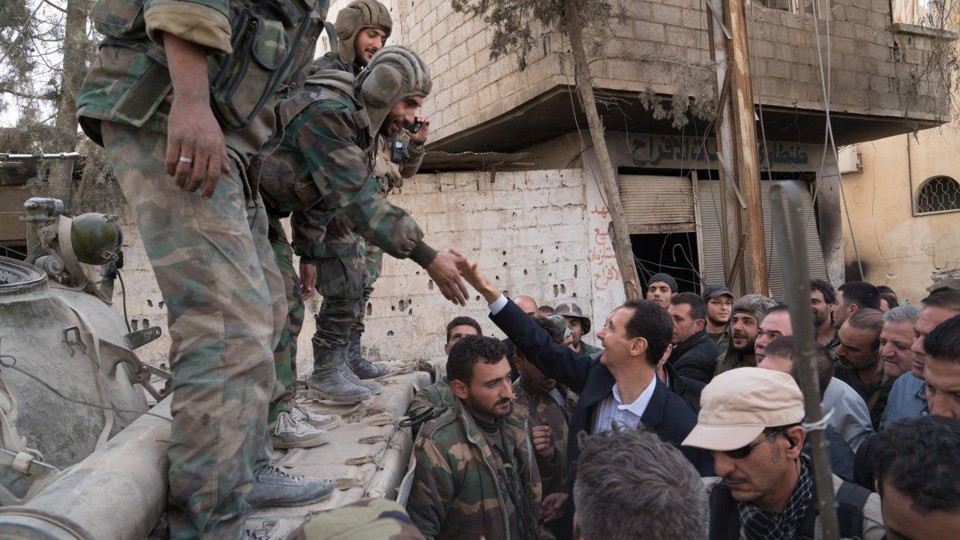
A soldier reaching down to shake President Assad's hand

 'In late March, the Assad régime released a propaganda video aimed at the young men of Syria. In the video, titled “Braids of Fire,” Asma al-Assad, the wife of Bashar al-Assad, the president of Syria, stands before a squad of female army volunteers dressed in camouflage and army boots. “You are far stronger and more courageous than many men because when the going got tough, you were on the front lines, and they were the ones running away or hiding,” she declares. Her words are intercut with images of the women volunteers in combat training, as well as testimonials from the women and their mothers. The underlying message: Shame on you men for fleeing military service—a “sacred duty” enumerated in Syria’s constitution.

 When protests against the Assad regime began in 2011, the Syrian army numbered about 250,000. But tens of thousands of defections, desertions, and mass casualties over more than seven years of conflict have gutted the military. While its current size is unknown, one thing is clear: Assad is now going to great lengths to reconstitute his forces. The problem is that few Syrians want to fight for him.


 The week that the Assad regime released “Braids of Fire,” I met a Christian man in his 40s from Aleppo, once Syria’s largest city, at a cafe in the Lebanese port city of Tripoli. Assad and many in his regime’s inner circle are Alawite, a religious minority linked to Shia Islam. Christians are also a minority in Syria; many of them regard Assad as their protector from a rebellion led mostly by Sunni Muslims. Yet, despite that perceived partiality to the regime, several months ago the man from Aleppo whisked his 22-year-old son out of Syria. He was desperate to save him from conscription: Under Syrian law, it is compulsory for Syrian men between the ages of 18 to 42 to serve in the military. Those who evade service face imprisonment and forcible conscription. Since 2011, most conscripts have been kept in the army indefinitely. (Some exemptions for work or study are available.) Army service for women, meanwhile, remains voluntary.

 At present, the man’s wife and other son, who is 16, remain in Syria. He plans to bring his younger son to Lebanon before he turns 18, unless the family can find a way to migrate to the West. In Syria, “nobody knows the endgame. … If my son goes to the army and is killed it would be for nothing,” he told me.

 Millions of Syrians—both those in the country and elsewhere, pro- and anti-Assad alike—do not believe the war will end anytime soon, despite the regime’s insistence otherwise. So they take huge risks to save their fathers, husbands, sons, and brothers from conscription, especially as the regime has grown more desperate to fill the army’s ranks.


 Assad’s need for soldiers began to mount not long after the anti-regime protests of 2011 turned into civil war. Defections and desertions from an army already plagued by decades of corruption, sectarianism, and a lack of resources rose as the confrontation turned more brutal. Iran and its militias intervened to avert regime collapse starting in late 2012; in 2014, Assad activated mandatory army reserve duty as desertions grew. In the fall of 2015, Russia intervened directly on his behalf, and provided crash training and funding for new paramilitary units.

 Assad now wants to show his own people and the world that he is once again a sovereign leader whose survival does not hinge on Iran and Russia. Both want Syria to shoulder more of the burden, and soon. But that can’t happen if Syrians refuse to fight for Assad. To pressure and influence people, the Assads, state media, and pro-regime religious leaders have all portrayed those serving in the army and their families as the most honorable Syrians, while casting deserters as unpatriotic and unworthy.

 While the United Nations High Commissioner for Refugees (UNHCR) said it does not track the number of Syrian men who have fled conscription, there has been a marked increase in the number of draft dodgers arriving in Lebanon since the start of the year. The lack of manpower could become a critical issue for Assad if Israel continues to target Iran and its main regional proxy Hezbollah inside Syria. The Russians, meanwhile, have minimized their ground-troop presence in Syria.


 In Damascus, many men now hide in their homes to avoid arrest at security checkpoints, or to steer clear of the conscription offices the regime has opened on university campuses. But this won’t keep them safe for long. Authorities raid neighborhoods and homes, hunting for wanted conscripts and reservists. They have also cracked down on networks allowing people to pay bribes of up to $12,000 to remove their names from the army-reserve roll call. These days, it can cost twice as much to leave. But it can mean the difference between life or death.

 This is the sentiment I heard from nearly all of the two dozen Syrian men I have met in Lebanon since the start of the year. The majority of them live in Beirut, Tripoli, and in towns and villages in the region known as Mount Lebanon. I verified their stories by speaking to Lebanese people who knew their circumstances. Most did not want to be identified by their full names, or asked me to mask certain personal details. They feared family members in Syria could be targeted by the regime.

 Rustum, a 29-year-old Alawite man from western Syria, said he paid bribes to get out of prison and come to Lebanon earlier this year after he was arrested in Syria for evading army service. Alawites like him have shouldered most of the burden of defending Assad. “We have given our all. There are hardly any men left,” he said.

 Another man named Ribal, a Druze, fled conscription and settled in Beirut at the end of 2017. (Assad has pressured the Druze, a minority group of fewer than 1 million people, to do something about their more than 30,000 draft dodgers.) He told me he left Damascus and hid in his family’s home village in southern Syria for three months. Fearing arrest, he stayed up all night with a shotgun at his side and slept during the day when his parents were awake. Eventually, he left Syria via a dangerous smuggling route passing through the rugged mountains that straddle the border between Israel, Lebanon, and Syria. After making it to Lebanon, he learned through Facebook that 15 of his countrymen froze to death trying to get out of Syria using the same route he did. He now does menial work in hopes of raising enough money to pay a smuggler to get him to Norway, where his relatives received asylum.


 Despite the uncertainty in Syria, others still hope to return one day. Riad, a 23-year-old Arab from Raqqa, the former capital of the Islamic State, lives with about 40 other Syrians in an encampment of UNHCR-provided tents at the foot of Mount Sannine. He said he wanted to go home, but feared conscription by both the Assad regime and Kurdish militias: The regime controls all roads to Raqqa from Lebanon. “Bashar is there to stay and I do not want to be made to kill my countrymen,” he said.

 The longer the war in Syria drags on, the greater pressure refugees will face to leave countries they’ve gone to. Lebanon, an unstable country of more than 4 million, hosts more than 1 million Syrians, the world’s highest per capita refugee population. Most Syrians, including those fleeing conscription, are in the country illegally: In 2015, Lebanon banned the UNHCR from registering them as refugees, in an attempt to discourage new arrivals. At a press conference in March in Lebanon, the UNHCR’s chief Filippo Grandi flagged one of the main obstacles to repatriation. “Many people are afraid to be conscripted in the army and having to fight. So we need to negotiate amnesties and exemptions,” he said.

The Syrian presence in Lebanon was a hot-button issue in the country’s parliamentary elections on May 6. Many Christians feared that the longer the mostly Muslim Syrian refugees stayed, the bigger threat they would pose to their already weak position in the country’s sectarian system of governance.

Gebran Bassil, Lebanon’s Christian foreign minister, has fanned such fears, making xenophobic statements linking Syrian refugees to terrorism. His powerful party is allied with the political arm of Hezbollah, whose militia has been fighting in Syria to prop up Assad. He and his party have done their best to chase outSyrians, especially military-age men, Human Rights Watch researchers in Lebanon told me.

Bassil, who was reelected this month, has warned of an “international conspiracy” to keep Syrians in Lebanon. He has demanded that the EU and UN rescind a joint statement they issued in April calling both for any return of Syrian refugees to be “voluntary and in safety and dignity,” and for greater protection for Syrians in places like Lebanon. Repatriation of Syrians must begin now, Bassil has said; most of Syria, according to him, is safe.

For now, as long as these Syrian men remain in Lebanon, there will be low-wage and mostly illegal work for them in construction, agriculture, and waste collection. Mohammed, a 24-year-old, and his 19-year-old brother are among the estimated 300 young Syrian men working illegally in the sprawling wholesale fruit and vegetable market of Bab al-Tabbaneh, a densely populated and impoverished working-class neighborhood in Tripoli. They told me they and most of the Syrian men in the market are wanted by the Assad regime for military service. Like the vast majority of Tripoli’s local population, they are all Sunni.

Mohammed married last year and now has a three-month-old baby boy. He lives in a slum in Tripoli. “The revolution may have ended militarily but it’s still in our hearts. Bashar al-Assad can try to impose his rule over us, but it won’t work. You have a whole generation now nurtured on hating him,” he said.'

Wednesday, 9 May 2018

Win or lose the war, Syrians gained their freedom in 2011


 Mohammed Hosam Hafez:

 'Earlier this year, author Nikolaos van Dam gave a lecture at the Bruno Kreisky Forum for International Dialogue in Vienna, titled: “Foreign intervention in Syria: Isn’t it time to admit that the war against the Syrian regime is lost?”

 What was striking about van Dam’s logic, was the presumption that after suffering a severe loss of lives, along with damage to infrastructure and property, the opposition had to admit the end of the revolution. The assumption was that if the opposition had been more modest in its demands, the regime would have acted reputably and eschewed bloody, revenge-driven policies.


 This logic overlooks the fact tens of thousands of Syrians are being subjected to torture and agonising death in President Bashar al-Assad’s detention centres. If this is not enough to highlight what awaits the "surrendered revolutionaries", one could have a look at the Caesar files, which reveal the scale and scope of these policies. In addition, countless Syrians who fled the war and the regime are pursued for arrest or execution by Syrian regime forces.

 I agree with van Dam that on any meaningful level, it was nearly impossible for the revolutionaries to achieve victory with their modest military means when they were up against regime firepower reinforced daily by Iran and Russia.

 But even if the demands for regime change had halted at any point over the last seven years in an attempt to stop or to reduce casualties on the opposition side, Assad and his allies would never have allowed for any meaningful political solution. Assad, with the enormous support he is receiving from his allies, has had no reason to engage in negotiations, neither with international players nor with Syrians.

 In addition, the regime was, and is, not being challenged internationally by any powerful player, particularly after US President Barack Obama’s red line was breached with impunity. For the regime’s policymakers, any meaningful negotiations would have exposed their own wrongdoings before their supporters and the international community.

 Most revolutionaries had to choose whether to die fighting or surrender to a filthy detention cell with dozens of other prisoners of conscience, where they would fade away under savage torture and starvation.


 Was the opposition genuinely ready to start serious talks? In fact, the opposition walked into negotiations in different stages with an open mind and high hopes. I know this because I was there. Unfortunately, the regime delegations turned these negotiations into a circus.

 There's no question that the opposition made many political mistakes, but none of these justify the regime’s bloody policies. It’s possible that if the opposition had been wiser, some international players might have acted differently vis-a-vis the Syrian conflict - but I do not believe that halting the revolution’s demands would have stopped the global community from turning a blind eye towards Assad’s unspeakable massacres.

 Many, including myself, believe that the decisive moment of the revolution occurred in 2011, when the people of Syria took to the streets all around the country, chanting slogans of freedom and dignity.

 At that moment, Syrians had won their freedom. Who would have imagined, a decade ago, that Damascenes would march spontaneously in the city’s commercial heart, calling for freedom and integrity? Who would have dared to think that residents of longtime Baathist zones would rise up against the regime’s injustice and cruelty?

 The victory that the Syrian revolution achieved was a moral triumph. The image of the regime being the guardian of the state fell when it lost the battle of respect and decency, and when it was no longer in control of the minds of the Syrian people.


 So what is the point of revolting against a bloody dictatorship if you do not necessarily have the means to win? What is the point of rising up when it causes the country’s human rights situation to deteriorate even further?

 It is important to note that the Syrian revolution cannot be measured by a normal political yardstick. It is a truly exceptional manifestation of a moral stance against evil tyranny.

 While the Assad government was tolerated between 2000 and 2011, the truth is that most people, Syrians and non-Syrians alike, have had no idea what this regime is made of. Many Syrians and outsiders thought that Assad would be different from his father, and that the regime would eventually adhere to the voice of truth, justice and reason. Part of this optimism was likely derived from the fact that many younger Syrians had no memory of Hafez al Assad’s Hama massacre.

 But once the Syrian people started to cut loose from the regime’s grip, all hell broke loose.


 The uprising has changed Syrians forever, replacing their indifference with awareness and the search for a better future. To lecture them now, saying that the game is over and the axis of evil has won the battle, is to simply preach against the nature of history and against all moral and ethical principles.

 It is important to remember that the regime and the Russians are relying heavily on psychological warfare, seeking to weaken Syrians, especially in besieged areas. The poorly equipped revolutionary institutions lack the experience and the means to mount organised campaigns, particularly in the media and on social media.

 But at the academic level, and despite the fact that many writers are influenced by the regime’s and its allies’ arguments about fighting terrorism, this is still an open battle. In the end, it is highly unlikely that the regime will win.'

Sunday, 6 May 2018

Assad's forces suffer losses in rebel-held southern Syria


 'At least five Syrian régime forces were killed and others injured at dawn on Friday as they attempted to advance into rebel-held terrritory in Daraa, southern Syria. Meanwhile, the rebel Free Syrian Army announced it had begun a campaign of arrests in the Quneitra countryside targeting what they said were "Hizballah sleeper cells" - allied to the Syrian regime - near the Lebanese border.

 Local sources said a group of regime troops attempted to advance into Daraa late on Friday but were repelled by rebel gunfire which killed at least five soldiers.

 Several factions in Daraa have vowed to confront the regime if they abandon the "de-escalation zone" agreement in the southern region. Russia however has been hinting the agreement is temporary, and the region, like other rebel pockets, must be returned to regime control eventually.

 Although the southern region has officially been a "de-escalation zone" since July 2017, activists have documented around 1,900 violations of the agreement by regime forces against rebel-held areas in Daraa and Quneitra provinces.

 Rebel fighters in Syria's Daraa have been reinforcing defensive posts for weeks, as they fear a fierce regime assault following successive offensives on other rebel pockets.

 Opposition forces still hold more than two-thirds of the surrounding 3,730-square-kilometre province which borders Jordan.

 A victory for the regime in Daraa city would carry symbolic weight as it was the cradle of Syria's seven-year uprising against Assad's rule.'

Friday, 4 May 2018

Idlib offers uncertain sanctuary to Syria’s defeated rebels


 'Abdullah al-Hafi endured a years-long siege and months of intense bombardment in the Damascus suburb of Eastern Ghouta before boarding a bus with his family to join thousands of others in an exodus to Idlib. ”Your choice was die in Ghouta, or leave for Idlib,” said the 35-year-old from his new home in a village in the province about 300km north-west of Syria’s capital. “Our house was destroyed. We lived in the basement without food or clean water. Before we left for Idlib we lived in hell,” he added. “It was difficult to leave our lands. But it’s a new life.”

 A supporter of the opposition that rose up against President Bashar al-Assad in 2011, Mr Hafi feared retribution from the government as regime forces closed in and took control of Eastern Ghouta following fighting in which at least 1,500 were killed, according the UK-based Syrian Observatory for Human rights. He is one of more than 70,000 rebels and civilians who made a similar calculation, fleeing the besieged enclave — the last rebel holdout near the capital — with the few belongings they could carry.

 Their departure was part of an evacuation deal that fitted a pattern repeated numerous times over the past two years as Mr Assad, backed by Russia and Iran, has steadily reclaimed control of much of the country through the tactics of siege and bombardment. The vast majority of the evacuees have ended up in Idlib, which has become a dumping ground for defeated rebels, their families and supporters. Many are stuck in tents in sprawling, crowded camps near the Turkish border where residents complain of lawlessness, crime and lack of services. “After the terrible scenes in Eastern Ghouta, many Syrians in Idlib are asking themselves ‘Are we next?’” said Mark Schnellbaecher, Middle East director at the International Rescue Committee.


 Idlib’s population has swelled from about 1.5m before the war to 2.6m, making it the largest populous area controlled by rebels. The province is regularly hit by Syrian and Russian air strikes, and bombs have struck hospitals, further degrading the poor medical care available. But for many in Idlib, with their country torn apart by war, there are few other options. “They know that if the situation deteriorates [further] then there is nowhere else for them to run,” says Mr Schnellbaecher.

 Rajaai Ibrahim, a teacher, arrived in Idlib from the town of Madaya in western Syria where a government siege pushed many to the brink of starvation. “Poverty is everywhere in Idlib,” said Mr Ibrahim. He was happy to leave behind the appalling conditions in Madaya, where images of undernourished children and reports of besieged families living on grass and weeds drew the world’s attention in 2016. But now he is considering packing up again and heading for Afrin, a border town seized this year by Turkish-backed Syrian rebels, where he believes he will be safer.

 Three of the armed groups operating in Idlib recently announced a pact to stop the infighting that has often prevented the delivery and distribution of much-needed aid. But previous deals have collapsed. “Instead of protecting people, they’re killing each other,” said Mr Ibrahim. Highlighting the unstable situation in Idlib, the IRC said two of its employees had been killed in a car-bomb attack in Dana on Thursday — including a security guard who had sought refuge in the province with his family. Mr Hafi holds out hope that a deal can be struck for Turkey to take control of Idlib and at least stall a government offensive. Ankara has co-operated with Russia and Iran in brokering peace and has a base in one corner of Idlib as part of the de-escalation monitoring process. But Mr Assad has been clear that he wants to retake all of Syria. “Our country is like a game of chess. Everyone has their move,” says Mr Hafi. “Other countries make every decision in Syria.'

Saturday, 28 April 2018

Digital safety in the world’s most dangerous war zone


 'In Syria, the contents of one’s phone mean the difference between life and death. “My phone is my lifeline,” Umm Hassan told us, one of the more than 150,000 Syrian citizens fleeing the destruction of Eastern Ghouta last month, as regime forces moved in. “But, please help me. How do I delete everything on it?”


 For many Syrians fleeing the destruction and takeover of their homes, phones have become a dangerous liability. Treasured information — a photo of a levelled homestead, a social media account, personal messages with family, friends and colleagues — is of great interest to occupying forces. Phones are taken. Passwords are extracted. ‘Inappropriate’ phone content can lead to detainment, imprisonment, torture, and even summary execution.

 Digital safety is more important than ever in today’s battlefields. A Canadian-run initiative, SalamaTech, has provided front-line digital support to relief and human rights groups for the past six years. In the process, it has collected countless testimonies about how Syrians have suffered because of seemingly harmless information left on their phones or social media profiles.

 Syrian civilians have been tortured for their Facebook and other online passwords. Take the case of Ahmad, who together with a group of other young men his age, was arrested because of the contents of their mobile phones. They were stopped at a checkpoint, their phones were seized and their Facebook accounts checked. When soldiers saw something inappropriate – “liking” a wrong page, for example – they were arrested.

 Or consider Salweh, another former detainee, who explained to us that most of the 22 women and girls in her cell where interred because of their suspected online activities after their phones were seized. As Salweh explains: “The Syrian security officers blame the revolution on Facebook, and how Syrians misused it. They are obsessed with this idea that anyone who carries a mobile phone is suspect.”


 As regime forces bombarded Eastern Ghouta last month, SalamaTech delivered targeted assistance to help Syrian civilians erase their digital tracks. Three SalamaTech digital safety responders spent most of March helping local residents erase data from their computers, phones, social media profiles and servers. For citizens who were already detained, they worked around the clock to disable their social media accounts – in the hopes that this could at least protect their friends and loved ones.​

 Many women left behind in Ghouta, separated from their husbands and sons, are especially fearful. They simply cannot abandon their phones. Yet they are terrified that the phone’s contents might, arbitrarily, be considered rebellious by the occupying regime. And while they are active users of mobile phones, many of them simply do not know how to delete photos, erase messages or disable their social media accounts.

 Women awaiting transfer to shelters in Damascus, the heart of the regime, were terrified. Many of them chose this option – to stay close to areas they knew rather then to be bussed to areas unknown. But what to do with their phones? Again a Canadian — this time living in Ottawa — came to the rescue. The SalamaTech coordinator connected online with women like Umm Hassan and others, guiding them, step-by-step, to clean their phones.


 While slipping out of the headlines, Syria’s war is not over. The regime continues to advance, generating horrific civilian casualties in its wake. As the citizens in vanquished areas flee or remain, their phones continue to serve as life-lines and death traps.'

Tuesday, 24 April 2018

'Words are my only weapons'


 'From dusty Syria to the crowded Belgian university town of Louvain-la-Neuve. Yahia Hakoum's life has changed so much since 2011, the year he joined protests against Bashar al-Assad's regime.

 He was picked up and jailed for 45 days, spending some time in the notorious Saydnaya prison, where he says he was tortured and lost 31 kilos.

 Now living in Belgium, that trauma still haunts Yahia. He recalls how his jail experience left him.


 "When I was released, I was just skin and bones. People were scared of me. Torture was systematic, to make a real physical change," he said. Discouraging people from joining demonstrations is the point he's making.

 After prison, Yahia decided to get out of Syria. Through an Italian priest, he was able to get a student visa for Belgium - where he now studies political science, alongside activism.

 He explained; "I preferred to leave the country because I didn't want to kill someone just because they didn't share my political views. Words are the only weapons I have. I don't have anything else. I have no influence, so now what I do is testify about what happened and what is happening today."


 Looking to the future, Yahia is in no doubt: peace will not come from talks between Iran, Russia and Turkey, nor from a Europe standing still without active mediation.

 He said: "The EU has accepted to play the role of a big NGO that delivers humanitarian aid, that pays money. It's able to play a bigger role through economic sanctions, but even those sanctions are not now respected," referring to member states.

 In Yahia's view, as long as the international community supports a so-called official opposition that represents the interests of other countries, there'll be no end to the Syrian conflict.

 "They have never listened to people inside the country. So far, there isn’t any real Syrian representation that comes from the heart of the revolution or that is able to represent the revolution," he commented.

 "This revolution doesn’t belong to old people, it doesn’t belong to the historical opposition of Assad: this is the revolution of the youth and this youth has never had the chance to speak out at political level."

 Yahia hopes to one day be back in Syria to re-join what's left of his family, the conflict has claimed the lives of many of his siblings.'

Image result for 'Words are my only weapons' - Syrian activist's push for peace

Sunday, 22 April 2018

In one sense, you can say the revolution never dies


 Robin Yassin-Kassab:

  'It's really distressing that the very people in Western societies who one would have expected to be the first to show solidarity with the Syrian people and their revolution from 2011; it's very often those sections of society that have just been relaying Russia and Assad's propaganda. I think we have to ask what is going on here. A lot of it is a West-centrism, in which people imagine everything that happens in the world is about us. If there's a problem in Syria, we don't need to ask Syrians about it, we don't need to study Syrian history and politics, and we don't need to look at the machinations of other imperialist states. We just need to focus on what our state is doing, and in fact we don't even do that. What we often do, is just assume our state is doing certain things.

 So, from the very beginning, some people on the left assumed that the Syrian Revolution was just a régime change plot, dreamed up in Washington or Tel Aviv, or maybe in Saudi Arabia, and they started treating the thing as if it was that from the start. Which is shameful, really. It's actually racist I would argue, because it robs the agency of Syrian people. It says these people are just pawns in our arguments with our own government.

 If you actually look at what happened, you'll see that in 2011, on some Fridays, there were millions of people on the streets, protesting for democracy, not for an Islamic state, but for democracy, freedom, and social justice, and against corruption and torture and oppressive policing, and all the rest of it. They didn't go out into the streets because the Americans or the Israelis told them to, or bribed them to. These are Syrians who don't like Israeli or American imperialism. They know more about it than people in the West do. They've suffered it. So they don't go out and do things because distant foreign governments they don't like tell them to do so. They certainly don't go out and risk their lives, knowing they are going to get shot at, that they may be arrested afterwards and tortured to death, because some foreign imperialist tells them to. They went out because they were immediately concerned.

And what happened then was the régime declared war on them, and out of this war came a whole series of other wars. Regional, international, sectarian, ethnic. All kind of different states jumped in. All of them, of course, because that's how states behave, for their own reasons in their own interests, not in the interests of the Syrian people. But the biggest imperialist input into this war has been Russian and Iranian. I said this to a Scottish lady here yesterday, and she said, "Is Russia imperialist?"

 Now, if you're in the West, maybe the distinction between Russian imperialism and our imperialisms, seem very important. But if you're an Afghan, for example, your country has been occupied and destroyed, first by the Russians, and then by the Americans. If you're in Central Asia, or the Caucasus, or Eastern Europe for that matter, you know all about Russian occupations, imperialisms, and genocide.

 So it is such a narrow-minded, myopic, self-absorbed, Western idea, that the only way we can respond to this enormous tragedy in Syria, is by making the same old points that we make every time our governments say anything. It's not actually just about us. And also, if we look at what our government has been doing, why do people get so upset at the three strikes the other day on three empty chemical weapons bases? But they didn't get upset, I didn't see any huge angry demonstrations all the rest of the time since 2014 when the United States has been bombing Syria. It's been bombing for years, and killing thousands of civilians, and destroying cities. But that's in the name of the War on Terror, so we don't actually notice.


 Why would the United States drop nuclear bombs on Hiroshima and Nagasaki, when they already knew that the Japanese were considering surrender? There are lots of parallels we could look at. The actual strategic reason why Assad used chemical weapons this time was, as people who follow will know, in the last few months, he's been cleaning out, ethnically cleansing, or sectarian cleansing, the suburbs east of Damascus, the Eastern Ghouta. And one by one, the towns that were liberated, the revolutionary towns in those areas, were defeated, the signed surrender agreements; and the militias, and the activists, and their families, were bussed off to refugee camps in northern Syria. Many other people were detained by the régime. The town of Douma was the biggest thorn in his side, because he couldn't get the main militia there to surrender.

 They were in surrender negotiations, and Jaish al-Islam, the militia there, said that they wanted their soldiers to stay in the area, to guard the local civilians from the régime, and they would become a kind of police force, and they would stop fighting. The régime and the Russians didn't accept this, and broke off negotiations, restarted bombing, and in the middle of the bombing came the chemical attack, which created such a panic among the civilians - this is the thing about chemical attacks, most people of course have been killed by other means - that under popular pressure, Jaish al-Islam said immediately, within a few hours, that they would surrender.

 What this means is that Assad saved thousands of loyalist militiamen, his own ones. Because if he had had to fight his way into Douma, he would have lost thousands more men, and he's got very few of his own men left. Most of his men on the ground are now Iranian-backed transnational Shia jihadis.


 In 2017, about a year ago, when Assad used sarin gas in Khan Sheikhoun, and Trump wanted to show he was a tough guy unlike Obama, so he went and bombed the airbase from where that attack had been launched. He cratered the airfield, and I think he destroyed one or two planes. But he called up Putin beforehand, a couple of hours before, and told him what he was going to bomb. Putin called Assad, and they moved their important stuff out of that base. And the same thing happened this time. The régime had several days, and it was actually for the Syrian people, or the revolutionary Syrian people in the areas being bombed every day by Assad and Russia, the few days running up to the strike were incredibly peaceful, because Assad was busy hiding his equipment and his planes, and he wasn't flying them and bombing people very much. So he had time to empty out the chemical sites, the three empty sites that were hit. This was a gesture.

 About the Russian response, there are two things here. The first thing, we shouldn't believe Russian rhetoric. If we follow closely, we will see that a couple of months ago a group of pro-Assad forces attacked the Americans' Kurdish allies in Eastern Syria. The Americans responded by putting a plane in the air, and bombing all of the vehicles in this column that was approaching. They killed about 200 people, I reckon. And it later emerged, that dozens of those 200 were actually Russians. A mixture of mercenaries, their equivalent of Blackwater and so on, but also some Russian soldiers. Putin said not a word. It leaked out into the Russian media, but no issue was made of it. Because, of course, Putin knows that if it comes to a military escalation, he will immediately be humiliated, and American weaponry will be shown to be superior to his. He is not going to go into a big escalation with people who are stronger than him, for the sake of the point he is making in Syria.

 The second thing is, more importantly, when people think there is about to be a superpower conflict over this, I don't think they realise that a more intelligent analysis of what's happening in Syria, suggests that it is international collaboration against the Syrian Revolution. It's not the case that the Russians are trying to keep Assad in, and the Americans are trying to get Assad out. If the Americans had wanted to get Assad out, in 2011-12-13, it would have been remarkably easy. They didn't want to. They chose not to. They have sometimes armed some Free Army groups, usually in the context of the war against ISIS. never in a serious way. And the Americans have always vetoed anyone else giving the Free Syrian Army the anti-aircraft weapons, which they really needed to stop the aerial campaign against their schools and hospitals and markets.

 So the West hasn't helped the Syrian. It has sometimes, not often, been more or less on the same page. Obama, who did his nuclear deal with Iran, which I'm not against in itself; in order to get the deal with Iran, he allowed Iran to send tens of thousands of foreign Shia jihadist militiamen, to fight on the dictator's behalf in Syria, which is much more destabilising. So the idea that America and Russia are facing off over this, I think is very inaccurate.


When Putin came in, there was an independence movement in Chechnya. He absolutely destroyed Chechnya, and razed the capital city Grozny to the ground. Then strangled the government in Georgia. Then he went to Ukraine and took the Crimea. Whatever you think of the background there, and I'm sure there is historical resentment and problems; and the West, NATO and EU have some responsibility for the situation; nevertheless, he's gone to one place after the other after the other. And nothing's been done about it. There's a hot war in Europe. More people have died in Ukraine in the last few years than in Libya. Everybody ignores that for some reason. I don't quite understand why.


 Robert Fisk says that he met a doctor, who speaks very good English. Which is necessary, because Fisk doesn't speak Arabic, although he pretends to but he can't, and you can see that from the fairly continuous mistranslations in his journalism. So he met a doctor. The doctor himself said he wasn't in Douma at the time of the attack. But he spoke very good English. And strangely he came up and introduced himself to Mr. Fisk, and started giving his theory, which was that a dust storm had caused the pictures we saw of people dying with white froth around their mouths, and tiny pupils, the kind of stuff that can only be caused by chemical weapons.

 This part of Syria, the Ghouta, has been bombed continuously for five or six years, and it's strange that suddenly, for the first time ever, a combination of panic and dust creates a phenomenon in which dozens of people die with foam around their mouths. it's not a serious story, and people are leaping on it, because they want to believe this narrative.

 Fisk has got form on this. He's done this before. In 2012, he went, embedded with the Syrian Army, to the site of an enormous massacre of civilians in Daraya, that had just been committed by the Syrian Army. Then he reported on it, and gave a story that it was the community that had done that to their own people. The local people complained about it, the Local Co-ordination Committees, the revolutionary bodies in that area, complained about it, and they were ignored in the Western media.

 I ask again. Why is it that we, especially supposedly progressive people, put all of our faith in old white men, who don't speak the local language, who don't go anywhere in these countries without régime minders explaining everything to them, and introducing certain people to them? Why do we put all of our faith in this, and at the same time we totally ignore the reports that are coming from the ground, from Syrians? From leftist Syrians, and Islamic Syrians, and jihadist Syrians; and men, and women, and Christians, and Muslims. We ignore them all because they are brown people who can't be trusted, and lie, I presume.


 In one sense, you can say the revolution never dies. Because it is a set of ideas. And because so many millions of people have burned all their bridges, and it is impossible to turn back to 2011, before their family members were killed, before they were tortured or raped, before they were expelled from their homes. It s not going away, that wherever there are Syrians, you will find people committed to the revolution.

 Having said that, inside Syria, now entering the eighth year of this disaster, the revolutionary civic society is very much on the defensive. The revolution has lost much of its urban strongholds. Over a year ago, when Aleppo fell, everybody in the West, progressive people, alternative media and the mainstream media, were all coming out with this narrative that jihadists are holding Aleppo, and Assad and the Russians are taking it back. It was a reversal of reality. Inside Aleppo, probably 1 or 2% of the fighters were al-Qaeda linked. Most of them were Free Army or moderate Islamist militias.

 More to the point, inside Aleppo, inside the Ghouta, inside all these areas, as well as the rebel militias, who are very often authoritarian and criminal and opportunistic and indisciplined, although they killed far, far, fewer civilians than Assad's side; as well as the rebel forces, you've got democratic local councils, self-organised councils. You had women's centres. You had Free newspapers. You had underground schools, all kinds of civic organisation, revolutionary debate. And that needs urban areas inside Syria in which to survive. And when they drove the revolution out of Aleppo, out of the western Damascus suburbs, out of the eastern Damascus suburbs, out of Homs years ago, this is what they are really targetting.

 So the rebellion against Assad, and the possibility of democracy and freedom and social justice and self-determination for Syrians, seems to be further away than it has ever been . It's an absolutely desperate situation. And Assad with superpower help, remember before the Russians began bombing, he only controlled about a fifth of the territory of the country. Now he's got over half it. So yes, with superpower help, he's kept his throne. However, while his throne exists, the Syrian state doesn't really exist any more. The country has been split into Russian and Iranian zones, an American zone, and a Turkish zone. These different powers, and I think an Israeli-Iranian war in Syria is very likely at some point quite soon, we have a Kurdish-Turkish war in Syria now, the War on Terror is being pursued in Syria. Large parts of eastern Syria are now occupied by Iranian organised foreign Shia jihadists, which almost guarantees that ISIS is going to come back in force at some point before too long.

 So Assad is no longer in danger, at least for now, but the war, or the wars, are by no means over. And certainly the refugee flow is not over. remember, half the Syrian population is displaced from their homes, and every day more people are leaving the country because it is impossible for them to live there.


 Assad's run out of his own fighting men. His own Syrian Arab Army doesn't really exist any more. There are a couple of brigades that are staffed by people from Assad's sect, the Alawi sect. There are sectarian militias, and then there are Iranian ground forces. And Russian bombers in the sky. So the Iranian ground forces have been absolutely essential to Assad getting control back, and driving out rebellious populations.

 The Israelis have sat and watched the Iranians build up. It hasn't bothered them to see the Iranians crushing the Syrian Revolution. It hasn't bothered them to see Shia miltiamen settling in areas that have been cleansed of Sunni Muslims. Because that just means in the decades to come, Muslims will be fighting each other rather than fighting anybody else.

 But now that the opposition seems to have been crushed, that the revolution seems to have any hope at all of actually taking power, Israel's understandably getting very worried. Suddenly at its border, its most important enemy has military bases all around it. We've already seen some rounds between Iranians and Israelis inside Syria. I would expect that there would be more of this, If the Israelis think a new balance of power is being forged in the region, they will want to get in there and upset it in their interests.

 I also think it's quite likely in the future that Israel will probably move into a strip, a buffer zone, in southern Syria. In order to have an effect on what goes on on the ground, and a security zone there. i don't think they'll try to colonise it with settlers, I don't they would be so stupid. I expect they will try and get some proxy militias working for them in that area as a buffer against Iran.

 It's a bit hard for Syrians to take lessons on anti-Zionism and anti-imperialism from so=called Western progressives who will tell us that of course the Syrians will be traitors if they don't support Iran in that war. But Syrians, or the vast majority of Syrians, are perfectly well aware that if this was a war in order to liberate Palestine, in order to restore Palestinian rights and self-determination, they would accept making sacrifices. They know perfectly well that the Palestinian-Israel conflict is an excuse for the Iranian ruling class, very unpopular at home now, to expand its regional territorial control over key parts of the Arab world. Which in itself is a huge generator of Sunni extremism as a backlash.'