Thursday, 17 September 2015

The massacre will not be hashtagged


 'Creating Facebook pages demanding the release of detainees was common during the first two years of the uprising. Their creation in itself illustrated a remarkable change in a country where political detentions before the uprising used to be cloaked with the utmost secrecy and censorship. But it was also a testament to the lengths that Syrians had come and of the various cracks they managed to break in the regime’s previously impenetrable wall of fear.
But the Facebook page created following Imad’s second arrest, this time with six of his friends, was quickly removed at the request of the detainees’ families. This time around, they said, they did not want any noise or publicity. A seemingly small detail, one illustrating a new shift taking place in Syria.

 As the revolt eventually gave way to civil war, the initial sparks of hope and buoyancy were quashed and transmuted into utter despair. The cracks that Syrians had made in that impenetrable wall had all but faded, giving way to even greater fear: fear of the mere mention that a son or daughter had been detained; fear of demanding their release; fear of merely uttering their names.

 In Syria, the forced disappearance apparatus doesn’t only seek to conceal evidence, exonerate perpetrators, and intimidate the survivors. It also operates to subsidize the Syrian regime’s prison industrial complex. The numerous security and intelligence services use the information they withhold as a bargaining chip, misleading families and exploiting their need, powerlessness and vulnerability, eventually forcing them to pay millions of SYPs for the evidence that will never come.

 Fear, silence, exploitation and intimidation become essential to the perpetuation of forced disappearance as an effective weapon in the state’s arsenal against the people, against the “unwanted” disposable class. It becomes more than just a punitive measure for caging dissidents and squelching dissent. It carries a far more destructive and collective impact, constantly hovering over entire communities.

 A thought has to be spared to those whenever we write down a hashtag that includes the names of prisoners. Because in Syria, the hundreds of thousands of forcibly disappeared will never be hashtagged, and neither will be their tragedies. In Assad’s Syria, families are tired of hoping that their loved ones will be free; all they can say, after an estimated 20,000 had been killed under torture is, “Save the rest!” They already know that no one will listen to their shattered voices and pleas.'


Wednesday, 16 September 2015

Student activists organize for a free Syria

 'When you ask the refugees what they think, they want to be back in Syria. Their main concern is the threat that they’ve been feeling, especially from the regime, especially from the barrel bombs that have been falling on many civilian-populated areas.'

Tuesday, 15 September 2015

How The Assad Regime Pushes Syrians Out

NPR logo

 'The regime has not relented on its crackdown of anyone suspected of being opposed to Mr. Assad. They're still detaining people, torturing people, according to the reports we're getting. They're still besieging opposition areas, starving them of food, denying them medicine and also bombing them almost on a daily basis. And then there's also the constant threat of being drafted into the army. A lot of families are opting to leave instead of having, you know, their sons go into the Army.'

 There is a ridiculous piece by Ian Black¹ in today's Guardian, where he tells us,

 'In places such as nearby Douma and other parts of the eastern Ghouta region – ruled by what the authorities call “terrorists” and by the UN, “armed opposition groups” (AOGs) – schools do operate, and the staff are still paid by the central government, on paper at least. But that is the limit of its involvement.'

 They are also involved by bombing² all the schools. And, 'teachers in liberated areas of the southern province of Daraa risk being arrested because they have to visit the regime’s intelligence services before receiving payment from the Directorate of Education.'³ That Ian Black gives more than equal coverage to the lies of the régime supporters is a poor reflection on his journalistic standards, as well as a result of only reporting from the government side. Just as Jeremy Bowen⁴ is doing, also from Damascus, advising us that Assad's army is professional and disciplined and can fight indefinitely.

 1. [http://www.theguardian.com/world/2015/sep/15/first-day-school-damascus-syria-aggression-common-education-war]
 2. [http://notris.blogspot.co.uk/2015/03/east-ghouta-changes-school-hours-to.html]
 3. [https://syrianobserver.com/uncategorized/teachers_daraa_risk_regime_interrogation_get_monthly_paychecks.html]
 4. [http://www.bbc.co.uk/news/world-middle-east-34244430]

Russia’s Smart-Dumb Move into Syria’s Civil War


 'The risk for Moscow is that Syria becomes its second Afghanistan or, more accurately, a Russian Vietnam. The Vietnam analogy is better than the Afghan one because the Soviet Union suddenly and fully invaded Afghanistan, as opposed to the US in Vietnam which escalated and dithered until it found itself in a full-blown war.

 The amount of power necessary to reorder Syria is staggering. The price tag on the refugee crisis alone can’t yet be calculated. To bring regime power back to all of Syria’s provinces would require a commitment of troops and power that could well cripple Russian efforts to carry out any of its basic defense needs, including holding Ukraine and keeping a lid on Chechnya.

 Even to carve out an Assad enclave will be terribly expensive and dangerous. No faction is content with such a slice of the pie: everyone is fighting to the death. To convince the FSA, Jabhat al-Nusra and the Islamic State to leave the Alawite homeland alone will require an open-ended commitment of troops and equipment that Russia can ill-afford.

 Worse, if Russian troops are killed in some headline-grabbing attack, Putin may face pressure to either escalate, as he did in Chechnya, or pull out. He can’t manage Syria as he does Ukraine where he holds the leash to the Donbas rebels’ collar.'

Monday, 14 September 2015

Assad's 'war' against the Islamic State group in Syria


 'So has the Syrian regime actually fought IS? Undoubtedly, there have been confrontations between regime forces and IS, but a closer look would reveal that those battles were to help the regime in areas its forces were surrounded, such as the Meng and al-Tabqa airbases, or because IS needed weapons.

 Since the establishment of the IS group, its main battles have been against the armed opposition forces that drove the group out of northern Syria, the Damascus and Homs countryside, in addition to Deir Ezzor. The main battles fought against IS were fought by opposition forces that saw the group as a saboteur used by the regime against the revolution, and those opposition forces continue to fight IS in areas such as Mari and Jarabulus.
A recent study on the conflict in Syria revealed that 63 percent of the IS group's fighting was against the armed Syrian opposition, while only 13 percent of the group's battles were against the regime. The rest of the battles were against the Kurds and other fundamentalist groups such as al-Nusra Front and Jaish al-Islam.

 This clarifies that role played by the IS group and how it intersects with the regime as a force assisting it against the revolution - and not a force opposing it. Perhaps the only people who believe there is a clash between the regime and IS are those who want to justify the death, destruction and displacement committed by the regime as a necessity to confront IS.'

Military Intensification And Futile Negotiations

Image result for ‫عزمي بشارة‬‎

 'Following intense diplomatic machinations over the past few weeks, the parties to the Syrian conflict are now back at square one. All sides have returned to their original positions, with the only difference being the intensity of the Syrian regime’s attacks on the country’s civilian population, once the Zabadani ceasefire had expired without an agreement between Iran and Syrian resistance forces operating in the border town. Russian Foreign Minister Sergei Lavrov thus put paid to any hopes – however remote – that Moscow’s policies towards Syria were at a turning point.

 Lavrov contradicted recent comments by Khaled Khoja, President of the National Coalition for Syrian Revolutionary and Opposition Forces, who, during a visit to Moscow in August, claimed that Russia’s commitment to the permanence of Bashar al Assad as president in the context of a peace settlement was beginning to shake. In fact, Lavrov insisted: “While some of our partners believe that it is necessary to agree in advance that at the end of the transitional period the president will leave his post, this position is unacceptable for Russia.”

 Recent gains by the armed Syrian opposition, together with a Turkish policy of creating a security corridor along its Syrian frontier, gave the Assad regime’s allies the impetus they needed to begin frenetic diplomatic maneuvers on behalf of their partner in Damascus. With armed opposition forces, and in particular ISIL, approaching the Syrian regime’s strongholds along the coastline, Russian and Iranian anxieties about the impact of these advances have been felt more keenly. This compounds the impression given by recent fighting in areas such as Jisr al Shughoor and Ariha that the regime’s forces are losing morale, with the victory long promised to them by their leaders nowhere to be seen. Sensing the danger, and wishing to take advantage of a change of leadership in Saudi Arabia, Moscow led a new diplomatic initiative.

 The Syrian regime’s response indicated its reliance on Iran, which has now shown itself to be effectively in charge of Damascus. In a speech delivered in late July, President Assad attacked Saudi Arabia and thanked Iran for its support. Assad used the occasion to legitimize the activities of, and express support for, Hezbollah and other foreign militia that were bolstering his rule, helping the regime make up for a deficiency in morale and manpower within the ranks of the regular army and across the Syrian population more broadly. Indeed, Assad did away with the last remaining fig leaf not only of the regime’s lip-service to pan-Arab nationalism but also of any specifically Syrian patriotism, when he claimed that “Syria belongs to those who defend, not those who [merely] are its nationals”. Coming from an individual who presents himself as “President of Syria”, this was tantamount to a declaration of intent to carry out a population transfer of those Syrians not sufficiently loyal to the Assad government.'

Barrel bombs and oppression


 Amr Salahi:

 'Increasingly, the conflict in Syria is being portrayed as one between the regime of President Bashar al-Assad and the Daesh militant group, with the former being portrayed as the lesser of two evils. The civil society organisations which still work on the ground overtly in areas held by moderate opposition forces and covertly in areas held by the Assad regime and Daesh, have been largely ignored by the media and the voices of refugees have not been heard.

 Oqba Fayyad, a Syrian journalist from the town of Qusair in Homs Province says he was forced to flee his hometown in May 2013, just before it was overrun by Syrian regime forces and their Hezbollah allies. He says that in the month before it fell to the regime, hundreds of people in this town of 5,000 were killed in the regime's aerial and ground attacks, which he says, included "barrel bombs, cluster bombs, and napalm… just before they stormed the town, they used vacuum bombs which can suck out the oxygen of any building, turning it into dust in seconds". He had no choice but to flee.

 He says "For three days, we travelled in the forests with no food or water, carrying the injured on our backs, with their wounds festering. We managed to reach the [opposition-held] towns in the Qalamoun area". However, they did not receive a warm welcome there. The inhabitants had seen the brutality of the assault on Qusair and now feared that if they took in the refugees, a similar fate would befall them. Clashes broke out and they fled once again to Arsal in Lebanon where they were subjected to a harsh regime by the local authorities, including a curfew after 6 pm. He eventually managed to contact the Swedish consulate in Lebanon, and was able to gain asylum in Sweden.

 However, Syrians are not only fleeing regime bombardment of opposition-held areas. Sometimes, when an area is captured by opposition forces, some of the inhabitants flee to areas still controlled by the regime. Usually they fear what the regime will do to the areas held by rebels, which includes bombardment similar to the one described by Fayyad or, in areas surrounded by regime controlled territory, prolonged sieges which lead to the starvation of inhabitants.

 Mohamad Manla is a Syrian opposition activist who has been a refugee in Germany for nearly three years. He fled from the Salah al-Din area of Aleppo when it captured by rebels from Syrian regime forces in July 2012, to western Aleppo, which stayed in regime hands. Salah al-Din later became one of the most dangerous places in the world as the Syrian regime pounded it and other rebel-held areas of Aleppo with barrel bombs.

 However, rather than finding safety in regime territory, whenever Manla went out, he was stopped at security checkpoints, and threatened by regime soldiers and agents who accused him of loyalty to the rebels, simply because his ID card said he was from an opposition-held area. Two months later, he fled once again, to Egypt, and from there to Germany.'

Syrian refugees find a haven in North Jersey


 ' “My family and I did not have the basics of life. We had lost everything,” Alroustom said in Arabic through an interpreter. “For me to come to the United States, I was willing because there was nothing for me to lose.”


 Homs, a city in west central Syria, was one of the first places to join the rebellion against the regime of President Bashar al-Assad, and it was commonly the site of mass anti-government demonstrations. As passive protest was replaced by armed revolt and the country descended into civil war, Homs became a priority target for government forces as a determined Assad held onto power. Destruction in the city became widespread as Assad’s forces took aim at rebel strongholds there with deadly implements of war.

 Alroustom lived there before the war with his wife, Suha Shaaban, his autistic son, Wesam, and his daughter, Maaesa. He said he ran a supermarket in the city and had relatives nearby. Like many people in the city in the early days of the Syrian revolution, he had hoped that the protest movement would bring reform to a regime viewed as corrupt and repressive. But as Assad cracked down, rebel-held areas in Homs came under hellish bombardment.

 Returning home after bombings, Alroustom said they would find shattered windows and blasted walls, until the toll was so great they decided to leave. They stayed with relatives in two other places, but those neighborhoods also came under fire.


 Shaaban recalled a time when her son, now 7, was standing near a window and a bullet whizzed by, just missing him. Another time, the bombing was so heavy the boy fell to the ground and struck his head.

 “Imagine those heavy barrel bombs,” Shaaban said, about the infamous and deadly explosive devices filled with shrapnel and oil and dropped by plane or helicopter.

 “Every time, he gets so scared. Even now, we have Fourth of July fireworks and he’ll go crazy,” Shaaban said, describing how her son closes his eyes, grabs her and cries.'

Syrian refugees tell their harrowing stories


 'They would randomly call out people and tie them up with their arms and legs spread out on the wall, and beat them. There was so much blood. When they came to interrogate me, they took my shoes and all my clothes and kept me blindfolded. They beat me while they questioned me about why I’m against the regime. I stayed there for about one week.

 Before I was released, a lieutenant told me: “You’re a doctor and you want democracy but we taught you — and then you fight us? We will let you live, but go back home and tell the people that we let you live. We were merciful to you and if we want we can take you back at any time.”

 If I could go back to Syria safely, I would. But I can’t. Not with the Assad regime. It hurts us so much that people around the world are looking at us, and letting him kill us.'


 'One of doctors at the hospital where I volunteer, a man who is related to Bashar Assad, supervises the nurses. Several times he told me, “you should not help the wounded, never, because they are terrorists” — even though most of the patients were children and women.
I thought I would be safer than others because the medical profession is the cleanest profession in the world, and should be there to help everyone no matter what his community, race or religion. But a few months later, the doctor had me arrested. For six days I was tortured.

 Then my father paid a large amount to the Syrian army and they released me.'


 'I was studying with my cousin when the soldiers came and arrested about a thousand men randomly.

 Of course I was punched and I was tortured. In the bus, they were humiliating and insulting us and hitting us as though we were animals.

 They told me that I was a terrorist, that I took money from Israel and United States and Qatar and Saudi Arabia. I remember that when I reached the prison I was full of blood and black and blue in my face.

 I live in Jordan now as a refugee, but my family is not with me. I don’t have a job. I never was able to finish my school, so I can do nothing.'


 'My name is Basil Mohammed Alriabi. I’m 10 years old.

 My father died by a barrel bomb dropped from the sky. Then I was separated from my mother and my brother when I was hurt by a land mine while we were trying to leave Syria.'


 'When we were living in Daraa, the Shabiha men broke down our door and came to our home. They accused my husband of being part of the opposition. He wasn’t.

 The men tied our hands and feet and they started to beat my husband. They made us watch while they each raped him. Then, they used their sticks on him. When they were tired of beating him, they forced us all to the window of our home and made us watch as they threw my husband out of it. He died.

 They kept us tied up and pushed us to the ground. One of the men brought a big pot of boiling water from the kitchen and threw it on my boys.'


 'My name is Dr. Rida Harah and I’m a refugee in Jordan. If I go back, I’m dead. I want to go home, but I don’t want to die. What do I do?'

‘Son of Syrian revolution’ scoops photojournalism award


 'Now in Paris for the prize, Halabi said, he’s keen to return to Syria, a country that refugees are desperately fleeing. He wants to continue to live in Syria to be with his family, but moreover, he said that if everyone leaves, only the Islamic State group and the regime would remain.

 "I want to return to Syria to continue the revolution," he said.'

Friday, 11 September 2015

The man who was kicked by a Hungarian reporter


 'Osama Abdel-Mohsen Al-Ghadab, who was a coach and former official in the Foutowa club in Deir Al-Zour in Syria, tried to evade the Hungarian border guards, carrying his child Zeid, in an attempt to reach safety; however, the scene of his obstruction and fall quickly spread like fire. Osama, who suffered a lot in the prisons of the Syrian regime after his defection and support for the revolution, was forced to leave Deir Al-Zour, escaping the violations of ISIS.'

Thursday, 10 September 2015

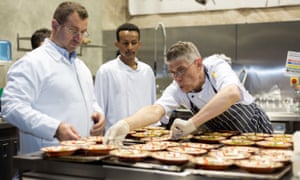
London's conflict cafe serves up Syria on a plate

Serving up some typical Damascene dishes.

 'Yassin, still in his chef’s apron, said the west should arm Syrians to get rid of Assad and Islamic State. “They need equipment. The west and the gulf states give them only enough weapons to survive,” he said. “We need anti-aircraft weapons to bring down the planes and helicopters which are dropping explosives, destroying the people. Isis, we’ll take care of them.” '

Hezbollah supports ethnic cleansing

 Karam Nachar:

 'The newspaper of Hezbollah, also known as al-akhbar, published today a column stating the following:

 "We can say that the majority of Syrian refugees outside their country hail from those segments of society that are incapable of appreciating diversity and Syria's "special civilizational model". Therefore, losing them is not demographically significant. The real loss is that of the urban patriotic segments".

 I dedicate this paragraph to all the idiots of the global Stalinist left who continue to support the Assad regime and its allies. Ethnic cleansing based on "civilizational" worth is right up your alley, it seems.'


 Note 14/5/25, link broken.

Wednesday, 9 September 2015

Machine Guns and Barrel Bombs


 'Daraa is where Syria's revolution began four years ago. Now it's the scene of a forgotten war, in which largely secular Free Syrian Army (FSA) rebels — marginalized elsewhere in Syria — continue to lead the struggle against Bashar al-Assad's regime.

 The FSA are fighting a bitterly hard battle under a virtual media blackout to change the course of Syria's civil war. If they can take Daraa, they will stand at the beginning of the road to Damascus, the seat of Assad's government.

 VICE News follows the Fallujah Horan brigade of the FSA and their charismatic commander Abu Hadi Aboud as they fight to push the regime out of Daraa's eastern suburbs.

 In part one of a two-part series, Abu Hadi shows VICE News how his men take the fight to the regime on the front lines east of Daraa, and we also meet the volunteers trying to save locals from the barrel bombs that rain down daily on the city.'

Tuesday, 8 September 2015

A message from a Syrian refugee in Germany


 "Recently, I have heard in the media, that the Syrians are immigrating to Europe, because of ISIS or Jabhat al-Nusra. This is not correct. We leave Syria because there is no safety there, because the Assad régime keeps hurting us."

People look to the skies expecting an airstrike any time


 Yasmine Nahlawi:

 "They are there because they have no other option. They've fled a war zone, at least speaking about the Syrians that are there; they have fled a situation where people look to the skies expecting an airstrike at any time, they look to the skies expecting chemical weapons to be dropped on them. They are there because they have no other option, and we see these images, we saw the image of the little boy washed up on the Turkish shore, and people would not put themselves or their children at risk unless there was something very powerful they were fleeing.

 We'd obviously like the government to take in more refugees, to step up to its responsibility and take in more refugees; but more importantly, I think, we'd also like to see more concerted action on the international level to address the underlying root cause of the conflict in Syria. We've had a régime that's been massacring our people for the past four years, and until that stops there are going to be more refugees. We want people to be safe in their homes, but if they are not, and obviously if the international community doesn't take action then we want them to welcome more refugees."

Syrian kids find peace at last after horrors of war


 'Lilas, 5, still has a scar above her left eye where she was hit by a fragment of a bomb that killed her neighbour while she was playing outside in 2012.

 Their home city of Douma, near Damascus, has been bombed by the regime of Syrian President Bashar al-Assad since war broke out between the regime and the Free Syrian Army in the city in January 2011. It is now besieged by the regime, shutting out food and other supplies. Ms Alfuoal's brother, 27, is sometimes reduced to eating grass.

 Mr Slik, a pastry chef, was beaten up by soldiers several times just "because I am from Douma, because Douma started the revolution very early".

 The family fled in March 2013 to Egypt, where the elected President Mohamed Morsi welcomed Syrian refugees at the time. They received US$70 ($112) a month from the United Nations High Commissioner for Refugees for the first five months. But then the funding stopped "because of finances". Morsi was toppled by a coup and the military regime now makes life a misery for the 100,000 Syrian refugees there.'

Our children are slaughtered and our homes rubble


 "The last thing Syria needs are more bombs. Syrian people need airplanes stopped from killing them. If there were no airplanes, there would be no bombing. Our problem was in one person – Assad. If the UN or a big power demanded Assad leave the it would be over. Assad and ISIS are the same. Assad and ISIS are on one side – the people of Syria are on the other. If people want to help, then solve the root of the problem."

Saturday, 5 September 2015

CAIR Joins Call for No-Fly Zone


 'Earlier this month, air strikes by the Assad regime killed more than 100 people shopping at a market in Douma. That massacre was just one of countless others carried out by this brutal dictatorship since 2011, when the Syrian people began their peaceful fight for freedom.

 The destruction of Syria and the death and displacement of its people are of great concern to the American Muslim community, and should be of concern to the entire world community.

 In one of the earliest revelations in the Quran, Islam’s revealed text, God condemned the withholding of humanitarian assistance by condemning those who refuse to share the necessities of life. (Chapter 107, The Holy Quran)

 The world can no longer ignore the suffering of the Syrian people or its obligation to assist those who are being daily displaced, tortured, starved, raped, and killed. The unwillingness to protect civilians and ensure the delivery of humanitarian aid in Syria is creating conditions that facilitate the rise of extremist and terrorist groups such as ISIS and al-Qaeda. If left unaddressed, extremism and terrorism will only grow.

 We urge American Muslims and all people of conscience to contact their elected representatives and the Obama administration to push for the United States to work with key allies to immediately establish and enforce one or more no-fly zones in Syria.

 These zones would be an effective way to protect civilians from attack, provide essential protection for displaced Syrian civilians and offer a safe transit route for desperately needed humanitarian supplies. They would also allow many refugees to return to Syria and thereby relieve pressure on neighboring countries struggling to cope with an unrelenting exodus.'

I've Decided to Return Home

Sheriff and author John Lubbock in Istanbul. PHOTO: John Lubbock

 'I joined the Syrian Revolution right from the first events and demonstrations, so I couldn’t go back to university because I was wanted by the regime. I returned to Amouda as the war slowly destroyed all of Syria.

 I wanted to stop the kids in my area from losing an opportunity to get an education, so I began teaching high school students for free to help them in their examinations.

 In 2013 I took part in a hunger strike to protest the arrest of local political activists by the Kurdish political party, the PYD, who were asserting control over the Rojava region. On 27 July 2013 the PYD's militia, the YPG, attacked our peaceful protest and killed six civilians, injured more than 30 and arrested more than 90. They broke into my house three times… thankfully I wasn’t there. So I left for Turkey.'

Friday, 4 September 2015

Alawite Youth Screaming 'We Will Leave!'


 It might be noted that they are facing death as part of Assad's collapsing army, not the direct attacks by the régime that have forced most to flee, and if they can keep their documents are more likely to be able to use safer emigration routes, rather than risk death in the Mediterranean. Still, it is still horrible to be part of a sect tied to mass murder, and it restores faith in humanity that they revolt against that.

 “We now live in a gigantic prison and our names are already on the death list at recruitment centers. Our families encourage us to leave before we turn into mere numbers on coffins that return to the coastal cities every day.”

 “People organized several sit-ins in Tartous to implore the regime to save their sons, after which they realized that the regime does not care about the lives of the soldiers. It is only natural that Alawite youths are looking for chances to survive. Against the odds that await them on the emigration routes, they have made their choice: do not get embroiled in the Syrian massacre.”

Wednesday, 2 September 2015

Why?


 Dani Qappani:

لماذا تحرك عشرات الآلاف في أوروبا لحض حكوماتهم على استقبال اللاجئين الهاربين من براميل الموت و لم يتحركوا لدحض السرطان المسبب" بشار الاسد " و حض حكوماتهم على التوقف عن دعمه و مساعدته في تهجيرهم؟!

 "Why have thousands demonstrated in Europe to exhort their governments to allow the refugees in, who were forced to leave their houses out of fear of barrel bombs, but haven't demonstrated against the reason behind it and the cancer; Bashar ‪al-Assad‬, to exhort their governments to stop their support for Assad and helping him out with the displacement of ‪Syria?"


 Kenan Rahmani:

 'The ultimate injustice one can commit to Aylan Kurdi and his family is to omit the parts of his story which explain why he ended up dead on the beach. The details matter:

 1) Abdullah Kurdi, the father, was detained for 5 months in Air Force Intelligence in Damascus. While in detention, he was tortured and his teeth were pulled out. He had to sell his shop in Damascus in order to bribe the officers to let him out. This cost him 5,000,000 Syrian Liras (around $25,000)

 2) After he bribed his way out of jail, Abdullah fled to Aleppo with his wife and sons, Alyan and Ghalib. The situation in Aleppo became dangerous due to the constant aerial bombardment, so he fled again to Kobani, his hometown.

 3) When ISIS attacked Kobani last year, the family could no longer live in their hometown, so they fled to Turkey. Once in Turkey, the Turkish government did not provide them with assistance, so they paid almost $6,000 to secure 4 spots on a rubber dingy to the Greek island of Kos.

 4) While on the boat, rough waters caused the boat to flip. The lifejackets they were given were fake. His sons and wife all drowned in front of his eyes, in his arms.

 5) Kurdi had applied in June for refuge to Canada, but was rejected. After Aylan's photo became a media story, he was reportedly offered citizenship to Canada. But he doesn't want to go to Canada or Europe anymore. He says he will go bury his family in Kobani and stay there to fight against ISIS, because everything has been taken away from him and he has "nothing to live for."

 So if the world wants no more Aylans on the beach, someone needs to do some combination of the following based on above: (1) stop torture and arbitrary detention by the Assad regime, (2) stop the regime's aerial bombardment, (3) stop ISIS, (4) make traveling to Europe safe, (5) get Canada and the USA to accept more refugees.'

The Orchid


 'My name is Mohamed and I’m from Dera’a, Syria. My family, friends and neighbours know me as "Abul Ward," Arabic for "father of the roses." I got this name since I was known for my garden filled with flowers, and because I loved to give everyone a flower that passed by my house.

 In early 2011, I had been a fire fighter for the Syrian government for 13 years. When my neighbours’ kids were caught, tortured, and thrown into a prison for writing ‘anti-government’ slogans on the walls of their school, I defected. How could I stand to support a system that supports torturing innocent children? I was the first to leave my team, but soon after, most of my squad defected behind me.

 A couple weeks after I defected I was stopped at a checkpoint by the regime. They took me to a state prison for two months. My experiences of torture in a sweltering pitch-black confined room with over 100 people are memories that will scar my past but empower my future. For every moldy piece of bread I was forced to eat, for every kick and punch I got, and for my fellow inmates who didn’t make it out alive, I am living my life more fully for it.

 From the time I was hung by hands for four days straight, to when my heart stopped for three minutes before I was revived, all the suffering I experienced made me stronger and more resilient. Now I am a White Helmet volunteer. After I left prison, I heard about these men and women who were rescuing people from under the rubble, and were also fighting fire. I knew this was the place for me.


 For the past year we have been saving lives and pulling people from under the destruction of their homes and buildings, but we can’t save everyone. Destruction, pain and heartbreak can last for a lifetime, but beautiful things may appear in the wake of tragedy. Once, we buried a few young men killed by barrel bombs. We buried the men a day after their murder; when our team and family returned to the gravesite a few weeks later, we were surprised to find no foul stench and the most beautiful flowers growing there.

 When I think about the Syrian struggle, I can’t help but think of my favourite flower, the orchid. The orchid is a symbol of the Syrian people, for regardless of what season it is, the flower is able to survive. This flower demonstrates strength, resilience and beauty, just like those Syrians who are still struggling for freedom peacefully despite all the obstacles.

 My dream for my beloved Syria is for it not to be covered with barrel bombs, destruction, war and blood, but with flowers, from my city of Dera’a all the way to the north of Syria and the border of Turkey. Every flower will represent our brothers and sisters for their strength, resilience and beautiful memories for reaching a better tomorrow.'

Tuesday, 1 September 2015

Koenders urges release of Syrian human rights activists


 'On Sunday, the UN International Day of the Victims of Enforced Disappearances, Dutch foreign minister Bert Koenders called for the immediate release of ‘the Douma Four’, a group of Syrian human rights defenders that had been active since the start of the peaceful uprising against the regime of President Assad in 2011.

 "There is a chilling silence surrounding the mass murders and other crimes committed by the Assad regime," Mr Koenders remarked. "Our commitment to fighting ISIS should not lead to when it comes to massive human rights violations perpetrated by Assad." The minister went on to call the Douma Four "heroes of our time".

 Razan Zeitouneh, Samira al-Khalil, Wael Hamade and Nazem Hammadi are four Syrians who have been taking a stand for human rights at risk to their own lives. Through the Violations Documentation Centre, an NGO, the four worked to record human rights violations committed against the Syrian people, until the day they were abducted from their offices in Douma by armed men. Since then, nothing has been heard from them.'

Monday, 31 August 2015

Why Americans must change the conversation about Syria

 'Syrians know that the US is not at war with Syria just by looking up at the sky, which is filled with a criss-cross of Assad régime aircraft and US-led coalition aircraft that never skirmish. They see US support of the opposition forces as consistently inadequate, and indicative of a "bleeding out" policy. When Americans position the US as a primary aggressor in the Syrian conflict, and frame the coversation exclusively within the logic of US imperialism and the War on Terror, they're proliferating a narrative that doesn't apply to the Syrian civilian. This framing is dangerous, erasing the Syrian context by homogenizing its conflict with the illegal US invasions of Iraq and Afghanistan and drone strikes in Yemen and Pakistan. This leaves little room to consider the anti-dictatorship movement that gave rise to the conflict.

 To understand the structures of violence operating in Syria today, the conversation should place the Syrian civil society activist at its center and map out culpable parties based on their responsibility to safeguard the inherent dignity of the civilian. This “civilian-centered approach” immediately places the Syrian regime as the primary actor culpable in creating and perpetuating violence within the state. All other actors, therefore, commit violence in Syria in relation to the Syrian regime. The goal of the Syrian régime wasn't to wholeheartedly brainwash citizens, but rather to coerce them into behaving as if they believed in the régime, making them aware of their submission through regurgitated illusions.

 No international state has directly challenged the Syrian régime militarily. This is because the original conflict is between the Syrian régime and Syrian civilians, and all other state and non-state actors commit violence within the country in relation to the Syrian régime.

 Iran is directly complicit with the actions of the Syrian régime, providing financial and military support that is responsible for propping up Assad. The Obama régime has been consistent in publicly condemning the régime, and avoiding any action to check their power.

 The repercussions of failing to center our conversation around civilians can already be seen in the mainstream conversations about Syria: the "Hands Off Syria" movement, refugees fleeing to Europe are simply labelled as migrants, and daily casualties from régime bombing have yet to stoke mass public outrage.'

The Dissolution of Past and Present

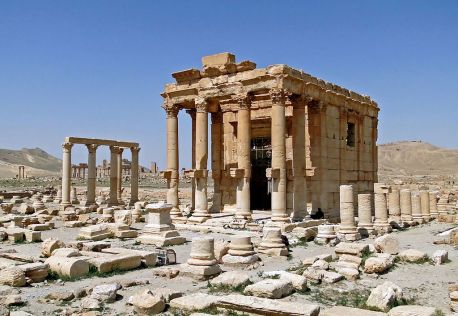
Baal-Shamin,Palmyra

 Robin Yassin-Kassab:

 'When Daesh destroys Baal’s temple, when the regime destroys the Zabadani mosque (or Aleppo’s Umawi mosque, or Deraa’s Omari mosque), it’s as if fascist forces have destroyed Stonehenge, Westminster Abbey or the Tower of London, as if the British Library and British Museum have burnt. It declares a total rupture with the past.

 All borders are acts of the imagination, and the Sykes-Picot borders are more artificial than most. They were drawn by foreign imperialists – either clumsily or maliciously, according to your reading – and manifested an order in which minorities wielded power over majorities.

 The dissolution of these false borders would of course be welcome if it implied a dissolution of repressive state structures (and foreign interference), and a corresponding empowerment of individuals and communities. It would be welcome if it ended the political exploitation of sect. But both Assad and Daesh offer the opposite, and neither of their projects can provide stability. At once a perverse reincarnation of Baathist tyranny and a homeland for international fantasists, the Daesh state is a temporary phenomenon, a parasite feeding on Assad’s war. And Assad’s shrinking state is an Iranian puppet; running low on Syrian manpower, it implements a foreign agenda.

 This has never been clearer than today. When negotiations were held over Zabadani, the Islamist militia Ahrar al-Sham spoke on behalf of the rebels. Its interlocutor was not the Syrian regime, but the Islamic Republic of Iran. Ahrar hoped to win a mutual ceasefire from the negotiations – that Hizbullah stop attacking Zabadani, and the rebels in return stop attacking Fu’ah and Kafraya, pro-regime Shia towns in Idlib province. But Ahrar broke off talks when the Iranians demanded instead a population exchange – that Sunni residents leave Zabadani, and Shia residents leave Fu’ah and Kafraya.


 Having failed to hold most of Syria, Assad and the Iranians aim now to retrench in an area stretching from the coast through Homs along the Lebanese border to Damascus. This is their version of what the French occupiers called ‘la Syrie utile’. The sectarian cleansing of strategic zones in this area began in 2013 (especially around Homs), and continues with the current assault on Zabadani and the increased aerial bombardment of the Ghouta suburbs of Damascus, already subjected to sarin gas, artillery barrages and two years of starvation siege. On August 16th, for example, barrel bombs murdered over a hundred people in a Douma marketplace.

 It goes on day by day – Syria’s present, past and future dissolve, and the world participates in the tragedy. Britain reopens its embassy in Tehran. The UN sups with Assad. The US, long retreated from its anti-regime threats, bombs moderate Islamist opposition groups like Jaish al-Sunna as well as Daesh. Worse, it seems the Americans are using their involvement in the multinational operations centre in Jordan to hold back the Free Army’s Southern Front from victory in Deraa.'

Sunday, 30 August 2015

The Syrians defying bombs to build a library


 'Syrians in the rebel-held town of Darayya have faced sniper fire, napalm bombing and indiscriminate killing at the hands of the Assad regime.

 But among the destruction, one group of young men managed to create a place of sanctuary - a library.

 After residents of the besieged town fled, the students rescued books from their abandoned private libraries. In some cases, the buildings were still burning.

 Darayya, on the outskirts of Damascus, was a rallying point for protestors calling for an end to the Assad regime in 2011.

 When the conflict turned violent, Syrian rebels made the town a stronghold. But in 2012, the Syrian army entered the town and massacred hundreds of residents.

 After rebels regained the town, the Assad regime responded by besieging the residents using weapons banned by the UN.'


 It was after the 2012 massacre that Robert Fisk rode in with Assad's army, and claimed it was the FSA that had done it.
[https://www.opendemocracy.net/yassin-al-haj-saleh-rime-allaf/syria-dispatches-robert-fisks-independence]

David Cameron lacked 'balls' to head off the rise of Isis

David Cameron

 'Lord Richards reportedly told author Sir Anthony Seldon that the prime minister had in 2012 rejected a “coherent military strategy” to take on the regime of Syria’s president, Bashar al-Assad, which would in his view have seen the Islamic extremists “squeezed out of existence”.'

 He's certainly had the cojones to claim he's doing what he can to get Assad to go. Idiots claim he tried to drag us into a war in Syria in 2013.

Iran seeking to expel 200,000 Sunnis from Damascus


 'Iran is working with the Syrian regime to clear hundreds of thousands of Sunni Muslim residents from Damascus in an effort to alter the demographic makeup of the city, according to the London-based Al-Quds Al-Arabi newspaper.

 According to the report, the overwhelmingly Shiite Iran is helping the regime to raze homes in the relatively plush Mezzeh neighborhood of Damascus, pushing out the Sunni residents in an effort to cement local support for the regime.

 Hundreds of families living in the area were given just a few hours to evacuate their homes, the report said.

 The report said that Iran and the Assad regime are seeking population transfers in order to strengthen the government’s control over key areas linking the Syrian capital with the Mediterranean coast, the heartland of the Alawite community, the Shiite sect to which President Bashar Assad belongs.'

A bigger refugee crisis looms in the Middle East


 ' “It is a tragedy without parallel in the recent past.”

 The crisis has gone on so long that some children have forgotten where they are from. Rashid Hamadi, 9, remembers his house, with bedrooms for himself and his siblings and a garden where roses grew. He remembers tanks and bullets and running in fear from bombs. But he hesitated when asked the name of his home town. “I don’t remember,” he said.

 In Turkey, the only country in the region that has made a point of welcoming the refugees, some Syrians are allowed to work, attend school and receive medical care. The Turkish government has already warned Turks to prepare for the eventuality that the presence of 1.9 million Syrians in their country of 75 million may be permanent.


 The Lebanese government has refused to allow the construction of camps for the Syrians, so the refugees are left to fend for themselves. “It’s like being in prison,” said Nour Msaitef, 25, who fled Idlib province three years ago and dares not leave his camp, on the outskirts of the Bekaa Valley town of Zahle, even in daylight for fear of being detained by Lebanese authorities or beaten up by local residents.

 Some fled the excesses of the Islamic State, others government ­forces. Many now find their home towns on the wrong side of front lines that are unlikely to budge.

 Fitnah al-Ali’s nephew returned last year to the family’s home in Homs, an epicenter of the anti-government revolt in 2011 that led to the civil war. The city is now under government control. He was detained and has not been heard from. “Just because you fled, they will say you were with the revolution,” said her son, Abdullah, who dares not go back.


 Watfa Assad Saleh and her family have added a wooden roof, walls and little shelves decorated with china dogs to the shack they inhabit just across the border from Syria, within earshot of the daily airstrikes pounding their home town of Zabadani, another early focus of the revolt. Their house there has been leveled, neighbors have told them, and she questions whether they will ever go back.

 “We say, ‘God willing,’ ” she sighed. “But I don’t believe we will ever return.” '

War for Decades to Come?

 
 Amy Goodman asks Patrick Cockburn about Idrees Ahmad's criticism and receives waffle:

 AMY GOODMAN: 'Patrick, last month The Daily Beast featured an article criticizing your Syria reporting. The author, Muhammad Idrees Ahmad alleges you discount any Syrian nationalist opposition to the al-Assad regime and that your position is, "Bashar al-Assad is at war with jihadi terrorism; the West has erred in supporting his opponents; and to support the opposition is to support ISIS." Ahmad goes on to say, "For Cockburn, the situation in Syria is stark: you are with the regime or you are with the terrorists. He is an enthusiast for the war on terror—Bashar al-Assad’s war on terror. He criticizes the U.S. for excluding from its anti-ISIS coalition 'almost all those actually fighting ISIS, including Iran, the Syrian army, the Syrian Kurds and the Shia militias in Iraq.'" Ahmad later accuses you of "turning a blind eye to the regime’s ongoing slaughter of civilians." He says, "He is helped in this by the obtrusive barbarism of ISIS, which uses spectacle in the place of scale to force media attention. ISIS has been a godsend for the regime. It has helped divert attention from its crimes — and regime-friendly journalists have obliged in the deflection." Patrick Cockburn, your response?'

 PATRICK COCKBURN: 'Oh, I get a lot of this. Anybody who’s gonna report the Syrian civil war, or the Iraqi civil war is going to be accused by one side or the other of being partisan. And what happens in the Middle East has always happened, but is happening worse now, is when you analyze something and you say this is the situation, that I don’t think Assad is going to go down, both sides are incredibly brutal in this Civil War, then people think you’re justifying it. They mistake analysis for justification. I have had that, really, since 2011. I remember a rather nice Syrian I knew in Lebanon. I had just been in Syria and I had reported that Assad, for various reasons, was not going to collapse as a lot of media was saying. And as I came back into Syria, I switched on my telephone and there was the same guy shouting at me, shouting, shame on The Independent, shame on you. It was just that I had reported the situation as I saw it. Objectively. But he sort of wished that reality was different, and that’s why he was shouting at me. And this is the same sort of stuff. I can understand the passions involved, that both sides commit appalling atrocities using maximum violence, whatever they have against civilians. This is true of the Assad government dropping barrel bombs on civilians. It’s true of the Islamic State; 500, 600 members of another tribe in Syria were massacred. So I can understand how people feel like that. It’s part of the war, so I get attacked like that. I’m sure I will be attacked again. And there’s nothing much I can really do about that.'

The cleansing of Zabadani


 ' “The displacement of the people of Zabadani to Madaya means that they will be confined to a narrow and very densely populated geographic area already populated by a large number of displaced civilians and will be again besieged in an area which is being continuously targeted with barrel bombs by Assad’s warplanes and with heavy artillery bombardment by regime ground forces. The area is also surrounded by regime checkpoints where regime troops are already hunting civilians (men, women and children) from Zabadani, as well as warning them to prepare for a massacre and long-term siege. These threats against the people of Zabadani are the start of the regime’s and its accomplices’ planned ‘demographic change’ which we have warned repeatedly of. This threat to the people is not limited to Sunni Muslims but also includes the town’s Christian and other population, with all the town’s people being driven out in order to ‘cleanse’ the area and prepare for it to be resettled by foreign occupiers.”

 Beyond immediate military value, forced population transfers give rise to the fear that there’s a plan to divide Syria on sectarian lines, to redraw the borders with Alawites and Shia, Sunnis and Kurds all taking their own sections of the country. Far from being a prelude to peace, such a plan would precipitate an ethnic cleansing on a scale not yet seen in the country. Syria’s diverse ethnic and religious groups do not fit neatly into geographical areas and are spread across all regions. Even in the coastal region, the regime’s Alawite stronghold and presumably a key part of any future Assadist state, the two main cities – Lattakia and Tartous- contain major Sunni populations.

 Zabadani’s people once took to the streets chanting the anti-sectarian revolutionary slogan “The Syrian People are One”. Now they are being expelled from their homes for the sake of what looks like an Iranian-sectarian partition.'

Saturday, 29 August 2015

A Syrian Photographer Shows His Country's Destruction


 'Aleppo has "completely changed," he says. "The city's neighborhoods are devastated because of daily shelling and the use of barrel bombs by the Assad regime." Amid the horror of the war, Basha also focused on the White Helmets, a group of volunteer rescuers who tunnel into bombed-out buildings to save the people trapped inside. He also turned his lens to children, who "have lost all kinds of fun and happiness in childhood" but still have "big dreams after the end of the war." '

Refugee crisis grows


 'Here’s one factoid from that most recent horror in Austria to contemplate: Some of the dead carried Syrian travel documents. They were fleeing the violence and the turmoil, which our own nation and the international community have done nothing to curtail — not after President Obama’s “red line,” not after the proof of sarin gas attacks, not after pleas by rebels for something more lethal than meals-ready-to-eat.

 European governments are arresting the human traffickers who prey off the fear and the misery of these refugees. But they cannot stop this tide. Only regime change in Syria can do that — but our own nation and the world seem to have given up on that.'

Wednesday, 26 August 2015

Dream On

 From a Syrian on Facebook today:

 "What we need now is only 20-30 anti-aircraft missiles, and I can assure you that we can force a no-fly zone over all Syria."

Assad Puts Blame on Israel in TV Interview


 Two things we might want to note about this. Firstly, the Assad régime and its friends in Russia and Iran are the main source of the conspiracy theories that Israel is behind the Syrian rebels. When you see the same being propagated by conspiracy theorists or self-styled leftists, it's not some counter-narrative to imperialism, but a concoction of the imperialism that is destroying Syria.

 Secondly, when Assad says things will go back to the way they were, he isn't going to accept any partition of the country, but will kill every Syrian if he gets the chance in the vain attempt to hold onto the whole country.

 'Today, the main Israeli tool that is more important than that aggression are the terrorists in Syria, meaning that what they do is much more dangerous than what Israel does from time to time to support them. They are the basis of the problem.

 So, if we want to confront Israel, first we have to face its tools within Syria. You cannot confront an external enemy when you have an internal enemy. This matter must be resolved within Syria, and then things will be back to the way they were, and no-one would dare act against Syria; not Israel nor anyone else.'

Monday, 24 August 2015

Syrians in Turkey keep revolution alive

Leila and Mustafa in Antakya

 'The decisive event for the FSA brigade's relationship with IS came in June 2013, when the Islamist group shot their commander, Kamal Hamami, also known as Abu Basir, the man who had so readily welcomed Leila into the brigade.

 "It was a turning point in the history of the revolution. Before that we couldn't see that IS was a serious threat to the Syrian revolution. After this we took a decision to fight them."
Aboud, Mustafa and Leila reminisce together about the early days of the revolution - the hope and euphoria. That doesn't mean the future Syria they envision the same. Mustafa is a committed Salafist, while Aboud is clear that he wants a secular state. But there is much they all share.

 "Mustafa and I have had very different points of view," Leila says. "But in the end we don't want all of Syria to think the same way. This is the point of the revolution. I can have my opinion and he can have his. If you're a socialist, a liberalist, an Islamist, it's okay so long as you're not hurting anybody. That's my hope since the beginning and still is now. For everyone to have the right to express their views."

 "If you want to get back on track to fight for what we initially fight for, you have to take away IS," Leila says. "It's as simple as that. We haven't forgotten what we are fighting for. We cannot forget. But let's be honest. We cannot fight Assad only." '

 Maybe Robert Fisk should talk to these people, instead of writing bullshit like, 'We can – we must – spend far more time investigating the links between Isis and their Islamist and rebel friends (Nusrah, Jaish al-Islam, even the near-non-existent Free Syria Army) and the Saudis and Qataris and Turks, and indeed the degree to which US weapons have been sent across the border of Syria almost directly into Isis hands.'
[http://www.independent.co.uk/voices/comment/isis-blinds-journalists-with-its-barbarity-but-we-must-continue-to-report-10468294.html]

Faction Guide of the Syrian war

 'Many Syrian soldiers deserted to join the FSA. By June 2013, the estimated number of soldiers who had defected to the FSA was about 40,000, but the manpower increased to 80,000 because many civilians also decided to pick up arms and join the FSA. Later in late 2013 many fighters defected FSA to join other opposition armed groups and Jihadist groups for ideological and military reasons which decreased the manpower of the FSA to 45,000 fighters.

 FSA operates throughout Syria, both in urban areas and in the suburbs, they are present in the northwest (Idlib, Aleppo), the central region (Hama, and Rastan), in the coast (around Latakia suburbs) and in the south (Daraa and Houran). They get external support from MOC [Military Operation Co-operation] it’s a military operation room that’s was created in 2013 by “Friends of Syria” countries like USA, UK, Saudi Arabia, Turkey and Jordan. The objective of this military operation room is to train the Syrian opposition fighters and to support them constantly in their fronts. This operation room is headquartered in Amman, Jordan.'

 Three things might be added. Many of those who defected at the end of 2013 did so because, the world, specifically President Obama, promised to do something if Assad used chemical weapons, and did nothing when he did exactly that. It's a lie, when those like Patrick Cockburn tell us the FSA doesn't exist. The"Friends of Syria" give a minimal amount of support to the FSA (though not in the deluded imagination of many leftists, al-Qaida or ISIS), in order to be able to restrict its advances:

 'A local translator of US-rebel talks is claiming that the Americans have put restrictions on the rebel offensive to take Daraa city, near the Jordanian border in southern Syria.

The translator, who has been reliable in the past, says three conditions have been set on the Southern Front rebel coalition: 1) it cannot move in the al-Mahata area of Daraa; 2) it cannot advance north to the key town of Sasa; 3) rebels cannot link up to units in the West Ghouta area near Damascus.

Daraa, where the uprising against the Assad regime began in March 2011, has been split between the rebels and Syrian military for years.

The translator did not give a reason for the restrictions, but other EA sources have said that the Americans fear a sudden collapse of Assad forces — and a “vacuum” in power — if the rebels advance through Daraa city and province.'
[http://eaworldview.com/2015/08/syria-daily-regime-carries-out-another-mass-killing-in-douma/]


Note 13/5/25, original link broken.

Sectarian Re-Engineering Followed by Cease-Fire


 I think this is overly pessimistic. What remains of the Assadist ideology besides the death cult and fear of torture if you step out of line, is the idea that is a unifying factor that pulls all Syrians together. Once areas of Syria are accepted as permanently lost, the mask covering its reduction to an instrument to keep Assad in place and Iranian interests protected falls away even further (thus I also have my doubts about the Iranian ability to dump the Assads, but I might be proved wrong on that). Assad and Iran have lost ground when they had the legitimacy of sovereignty and the opposition did not, that isn't likely to get better for them if they lower their ambitions to holding what they have, in fact is likely to convince those trapped under the régime that its future is limited.

 So rather than the opposition having no strategy, its commitment to resist partition has become easier to keep to with recent advances. There was distrust around the negotiations over Zabadani, but it quickly became obvious that Ahrar al-Sham weren't backing the Iranian proposal. Confusion at first may have led other groups to thinking they were selling out Zabadani, which may have been what led to the early renewal of hostilities. There may be a problem with warlordism among opposition groups, but I don't see evidence for it being the problem here.

 But I don't have any doubt that the rate of Iranian/Assadist massacres will increase, for the reasons set out. This is what happens when a people are abandoned in the face of a desperate tyranny, and told that no amount of bombing is a more serious threat than the chimera that the Americans are trying to overthrow Assad.


 'The recent intensity of attacks by Assad forces and their backers in Iran’s Revolutionary Guards and Hezbollah in Syria reveals what could be expected to follow soon. We will witness two consecutive phases in the next few months:

 1- Ruthless military attacks by IRGC, Syrian army and Hezbollah to cleanse selected areas – deemed strategic and unnegotiable – of the opposition or the Sunnis or both. This will be done under a barrage of soft talks about diplomacy and political solutions, but no serious moves other than the funny Russian initative. All the while, Moscow will keep the diplomatic road opened and oiled with its right hand, and continue giving Assad military hardware with its left hand.

 2 – At one point, and after controlling all the strategic areas required, Iran will say that is ready to go as far as convincing Assad to leave Damascus. International calls for “immediate” cease fire will become louder, pressures on relevant parties will intensify and the trilateral alliance will suddenly assume the role of the dove. This will be introduced by this alliance to the world as a genuine love for peace and sincere feelings for the suffering of Syria’s civilians. But in return, the trio will want to institutionalize the status quo, that is to make its areas recognized by the new regime constitutionally the same way the situation in the South of Lebanon is institutionalized as the land of Hezbollah. Tehran is already building the Syrian Hezbollah under the command of the former prisoner in Israel Samir Al Qentar.

 The whole Syrian war would have ended with the expansion of Hezbollah and Iran on a larger stretch of territory than what they control already in the south of Lebanon and in addition to keeping the coastal west of Syria. Not bad. Not bad at all. What is the counter-plan of the opposition? None. it is not obvious that the Syrian opposition has a unified parallel plan, either to abort the trilateral partitioning intentions or to wage a meaningful counter-attack.

 For example, during the Istanbul talks between the Iranians and Ahrar Al Sham, and while the cease fire around Kafraya and Foua’a was enacted, some opposition groups around the two Shia villages deliberately broke the cease fire to embarrass Ahrar Al Sham.

 It is a structural problem in the Syrian opposition that we find warlordism mixed with legitimate political opposition groups. While it is possible to overcome political differences between legitimate opposition groups by reaching a joint political platform, warlordism is not political to start with.'

Sunday, 23 August 2015

How Barack Obama betrayed the Syrian people

How Barack Obama betrayed the Syrian people

 'In late July, the Syrian president gave his first public speech in a year and acknowledged that his regime was depleted and had ceded territory to "the terrorists" - referring to anyone who has joined the insurgency. Assad's public concessions came at a time when both United States President Barack Obama and Russian President Vladimir Putin were worrying about the Assad regime's possible collapse.

 Since the beginning of the Syrian uprising in 2011, the Obama administration has publicly called for Assad to step aside, while doing everything in private to foreclose that possibility, and in effect, tacitly endorsing the Assad regime.

 Obama said that the opposition was "disorganised, ill-equipped, ill-trained". He stated that the moderate opposition was made up of "farmers or dentists", among others, who all lacked fighting experience, and that it was "magical thinking" to believe that an earlier US involvement could have led to a peaceful transition. All of these points contain partial truths, but they also contain self-serving myths. The Syrian opposition was disorganised and ill-equipped because it was not externally supported the way al-Qaeda was. Much of the moderate opposition consisted of civilians firing guns for the first time, but it also included thousands of Syrian army defectors and civilians who had once been conscripted.

 Obama's refusal to confront Assad and support the opposition allowed the Syrian president to set in place a motion of events that gave rise to ISIL. Assad released Islamist militants from prison to flood the opposition with battle-hardened religious fanatics. His sectarian militia, the shabiha, openly cleansed Sunnis from their villages, driving them into the arms of jihadist groups for protection. Assad reportedly bought oil from ISIL, ignored them on the battlefield, and was even accused by the US state department of being ISIL's air force. The conditions that gave rise to ISIL's terrorist state were, therefore, supplied by Assad's military strategy and Obama's lack of one.

 History will not be kind to those whose actions and inaction led to the Syrian people's ruin. And while this generation may be lost to the squalor of the refugee camp and terror of daily bombardment, a future generation will remember what was done as their fathers and mothers met the most undignified of ends.'

Saturday, 22 August 2015

'You are all responsible for our death'


 'There is a deep sense of grievance amongst many Syrians that the West seems to have abandoned them by focusing so singularly on fighting the Islamic State even as the regime continues its brutality.'

Syria, Etc.


 'Now, the everyday violence and death Syrians witness is no longer recorded in full force unless events surpass the daily “acceptable” quota of death—like it did on August 16 in Douma, after more than 100 people were killed by a regime aerial attack on a crowded marketplace. These kinds of mass tragedies, like the chemical weapons attack in 2013 and the Daraya massacre in 2012, capture the world’s attention—headlines, outrage, condemnation—for a few moments before Syria’s suffering once again fades to white noise. When the country has been reduced to smoldering ashes and its people have been forced into a mass exodus to new countries and new homes, our capacity to document—to speak or write and chant—dwindles. History collapses into a simple etcetera.

 At the beginning of the revolution, documentation existed in the present tense, serving to expose what was happening in real time, and breaking Syria’s history of oppression by finally speaking and showing truth. But now, the urgency to be noble and fearless witnesses has faded. There is no humane “world” that exists to plea to for help. Syrians once believed that uploading hundreds of videos of barrel bombs dropping from regime helicopters on civilian areas would be enough to declare a “no-fly zone”—because what world would watch a government indiscriminately bomb its people and stay silent? People believed that documenting repeated chemical weapons attacks would eventually end them. Instead, Obama’s “red line” became a green light for the Assad regime to continue using chemical weapons, including chlorine-laden bombs, even after a United Nations Security Council resolution to ban them. People believed that more than 55,000 smuggled images of tortured, skeleton-like corpses in Assad’s prisons would create an international outrage that would finally send Assad and his regime where they belonged—a trial at The Hague. Instead, Syrians were left alone to battle Assad, Al-Qaida and ISIS.'

Friday, 21 August 2015

Noam Chomsky, Rogue States and Nuclear Dangers


 'Whatever one thinks of Hezbollah, Hamas, or other beneficiaries of Iranian support, Iran hardly ranks high in support of terror worldwide.'

 Try telling that shit to the people of Zabadani. Chomsky once again, shows he hasn't got a clue what Iran and Hezbollah are doing to Syria.

Reading into the Douma market massacre


 'The Douma market massacre is the inevitable result of the failure of the international community to support the freedom of the Syrian people and is a natural product of talking about the inevitability of a “consensual” political solution that grants the head of the Syrian regime immunity against any legal prosecution.

 When the Russian Foreign Minister Sergei Lavrov, who is a supporter of President Bashar Al-Assad, makes a statement hours after the Douma massacre shamelessly saying: “We support the legitimate president of the Syrian Republic,” the result is more massacres awaiting Syrian cities.

 We can say that the Douma market massacre and Al-Zoubi’s statement in Tehran are messages to the international community and the local community that Assad’s regime will not step down regardless of the cost. It is also a message that pressuring the regime, rejecting its proposals, or presenting proposals that include the elimination of the regime will inevitably result in more incidents like the Douma market massacre.

 How can anyone imagine that the people of Douma, or the people of any other city or town in Syria, will co-exist with the person who killed them, displaced them and did to them what no other invader in history had done?


 The shameful and ironic part of this is that the commander of Jaysh Al-Islam is exploiting this massacre by using it to prove that Zahran Alloush’s approach is the right approach. This approach includes refusing to engage in any battle with the regime in the heart of Damascus, which other opposition forces consider to be Alloush’s failure to provide support to the other nearby fronts in eastern Qalamoun.

 Today, everyone is asking one question: Does Douma need an uprising similar to that of Idlib against Jamal Maarouf, leader of the Syria Revolutionaries Front. This uprising opened the door to strategic victories and has become an example of revolutionary achievements.
In this I am not referring to Alloush personally, but in his capacity as commander of Jaysh Al-Islam and their military strength. Their only concern has become pleasing America, even if that means giving up their own banner and raising the flag of the Syrian revolution, and marketing itself as the most moderate and organised Islamic faction and the most capable of replacing Al-Assad in the event that his regime falls.'

Thursday, 20 August 2015

A Day in the Life


Come to a march from Trafalgar Square at 2pm to Downing Street on Saturday to remember those massacred in Syria two years ago tomorrow with chemical weapons by the Assad régime. Bring some flowers. Fuck's sake.


 Primo Levi, who survived the concentration camp at Auschwitz, says at the start of one his books that when they told the guards that they would pay one day for their crimes, they were jeered at and told nobody would ever believe them. That's what has happened to Assad's victims, lied about the world over, told they might just as well be perpetrating these attacks on themselves to gain the world's sympathy. It's the greatest lie of recent years, that those Assad is bombing and torturing, shelling and sniping, torturing and starving, are no better than he is.

 And other lies go to support it. If people call for outside help, as the people of Kafranbel or the refugees of Zaatari, the largest refugee camp in the world, did, you are a stooge of America, and want them to invade Syria the way they did Iraq. Any argument that the Syrian people should be allowed to defend themselves against this illegal war, is lost in the charge that you are pro-imperialism.


 It is an illegal war. It's a crime to target civilians, it's a crime to use weapons of mass destruction. If America really were trying to intervene to overthrow Assad, survivors like Qusai Zakarya would have been all over the news non-stop. But instead you have to search yourself, to bother to search yourself, to get any knowledge of what's going on. As someone remarked the other day, one attack on a market in Sarajevo provoked international intervention, Assad does that every day, and nobody lifts a finger.

 In fact for the Americans it is a win-win if the conflict goes on. Iran and Hezbollah get weaker, and any time they want an excuse to intervene, they can point to the inaction of the Security Council over Syria, most notably Russian and Chinese vetoes, as the reason they should be allowed to proceed with whatever future actions with a humanitarian cover they propose.

 Conversely, if there were any truth to the genocide-deniers story, someone would have been found to point the finger at the rebels.

 So come along Saturday, and say, never again. Because it's the right thing you do. Because if you don't, Syrians, and anyone who cares about mass murder, will think it is only American interventionists who care about life at all.
[https://www.facebook.com/events/1452769868362630/]