Tuesday, 28 August 2018

White Helmets rescuers start over in northern Syria


 'Syrian rescue worker Samir Salim found his mother's body under their collapsed house, but there was no time for a funeral.

 "We buried her and went back to work. There were a lot of people under the rubble," he said. Months later, he can no longer even visit her grave.


 When Syrian government forces clawed back his eastern Ghouta hometown, near the capital Damascus, Salim followed hundreds of thousands of others who had fled to the northwest under rebel surrender deals.

 Now, he and "White Helmet" workers driven from different parts of Syria have come together in the rebel-controlled town of Azaz to try to rebuild their lives near the Turkish border.

 Their work has changed drastically: with no warplanes cruising overhead, they help the opposition authorities put out fires, clean the streets, and plant trees.
Azaz falls within a de facto buffer zone which Turkey has carved out since 2016. The northwest corner remains Syria's last major insurgent stronghold and is now in President Bashar al-Assad's crosshairs.

 The White Helmets have often said they worried about reprisals as government forces defeated rebel enclaves with Russian and Iranian help.

 The civil defense service, which receives funding from Western governments, pulls people from the rubble of air strikes in rebel territory. Assad has accused it of being a Western-sponsored front for al Qaeda's branch in Syria.


 Salim said many comrades stayed behind in eastern Ghouta.

 Before leaving, he helped burn down the emergency center he had once helped establish in his town, where his three brothers also worked.

 As buses shuttled evacuees out through government territory, including Salim's wife, five children, and relatives, some people cursed and threw stones at them, he added.

 "We arrived with great misery," said Salim, 45. "Our peers gave us an exceptional welcome."

 Azaz is worlds apart from Ghouta, which lived through years of bitter siege and air strikes - far from the Turkish influence of the northwest.


 Salim recalled a sarin gas attack that killed hundreds of people in 2013 in the rebel enclave. "People were running down the streets screaming 'chemicals' and there were a lot of civilians lying in the streets foaming at the mouth."

 He said he injured his spleen during an air strike on a market in 2016 and had part of his intestines removed.

 The White Helmet first responders say Damascus has specifically targeted them during the more than seven-year conflict. The government says it only targets militants.

 "We fear building a new life in a foreign place and then having to leave once again," Salim said. "I fear northern Syria will face what we did in Ghouta."


 His family now lives in the nearby Afrin region, where a Turkish assault earlier this year ousted Syrian Kurdish fighters. Those forces have accused Turkey of expelling Afrin's residents to resettle other people, which Ankara denies.

 Salim's new team includes Ahmed Rashid, 30, who was bussed out of eastern Aleppo two years ago after fighter jets leveled entire districts.

 The bloody battle for Aleppo in northern Syria marked a turning point in the war as pro-government forces swept through the insurgent half of the city. Rashid said 12 friends from his center in Aleppo were killed.

 "Nobody expected me to persevere, especially since my parents are in Turkey. But I cannot leave the civil defense," the former shoe designer said.

 "In Aleppo, the bombing was so heavy we couldn't sleep. "Here (in Azaz), there is no such pressure."

 Nayef al-Aboud, also part of the same team, said they largely work on services like helping with car accidents.

 "Today, our center has workers from the displaced populations," said Aboud, 22, who is from Azaz. "Our strength has grown because they are here, we learn from their experiences, they lived through harsher times." '

Monday, 27 August 2018

Assad’s Syria recorded its own atrocities

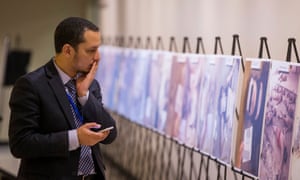
The ‘Caesar’ photographs of people killed in detention in Syria on display at the UN headquarters in New York, 2015

 'Imagine your son or daughter was arrested. And you heard nothing about them for years. Until one day, thousands of photographs of dead bodies were published – corpses of people who had died in custody. You start looking through them one by one, sick to your stomach wondering if the next photograph you click on is of your loved one. But as you go through them, you realise many of the corpses are so severely emaciated, mutilated, some with their eyes missing, that you’d find it hard to recognise even yourself in that state.

 Hundreds, if not thousands, of Syrian families have done just that – looked through the so-called Caesar photographs – images of over 11,000 people who apparently died in Syrian regime custody. A defector, codenamed Caesar, claimed he smuggled the photographs out of Syria and, astonishingly, that they had been taken by the regime itself as part of its record-keeping. Chillingly, each corpse has a number, alongside the number of a regime detention facility. No names, just numbers.

 In May 2014, in part motivated by these images, the UN security council debated a draft resolution to refer Syria to the international criminal court. Thirteen of its 15 members voted for the resolution, but it was vetoed by Russia and China. The Syrian president, Bashar al-Assad, has consistently questioned the authenticity of the photographs, and when confronted with one of the horrific images by reporter Michael Isikoff in a Yahoo News interview last year, the president referred to them as “fake news”, and asked: “Who verified the pictures?”


 New evidence suggests his own regime verified the pictures. War crimes investigators have recently uncovered documents they say provide corroboration of the Caesar photographs by the regime itself. Investigators at the Commission for International Justice and Accountability (many of them veterans of the international criminal court and the tribunal for the former Yugoslavia) discovered the evidence among hundreds of thousands of records abandoned by the Syrian regime when it lost control of areas to opposition forces.

 The key documents are from the head of detention facility 227 to one of the regime’s senior intelligence chiefs, the head of military intelligence, informing him of the arrest, interrogation and deaths of detainees, and crucially, referring to their dead bodies with a number. When the investigators cross-checked these body numbers in the regime documents, with the corpse numbers and detention facility numbers displayed on bodies in the Caesar photographs, they matched. So not only do we have the Caesar photographs of thousands of corpses bearing marks of torture and starvation, we now have documents which appear to link the Syrian regime to some of the people in the photographs, and to their deaths. The photographs captured one moment in time, depicting the state of the detainees’ bodies. But the documents name the detainees, and talk about them from the time they were arrested, to the details gleaned from their interrogation, to the day they died, and finally, to what should be done with their bodies – confirming all of it happened in regime custody.

 For example, among the Caesar photographs, corpse 2668, detention facility 227, is an emaciated man who appears to have had one eye gouged out. In the documents, he has a name, a village where he came from, the date he was arrested, what he confessed to during his interrogation, his death, and the cause given: “his heart and breathing stopping”. Somewhere he has a family, but the head of detention facility 227 didn’t recommend returning his body to them.


 There are likely to be more of these documents because the records show the head of military intelligence asked to be informed of every single detainee death, and be consulted on what to do with the corpses. This is a man who, at the time the Caesar photographs were taken, held one of the most senior intelligence roles within Syria’s security structures, which report to President Assad.

 Records reveal the regime knew detainees were being tortured and that deaths had risen considerably. A haunting new detail in the documents is the reference to detainees’ bodies being buried in a “known place”. Known to the regime, but as yet unknown to detainees’ families who are denied that information – an ongoing source of pain and anguish for them.


 Why does all this evidence matter now? Because you only have to look at the calls from some quarters to lift sanctions on the Syrian regime, and at reports the Greek government, for instance, has already started importing phosphates from them, to know that steps are afoot to normalise this regime.

 If that’s what people want, then they should own it. And they should understand exactly what they’re owning. Look at the Caesar photographs – just as families trying to identify their loved ones do – and ask whether it’s acceptable to normalise this.'

Monday, 20 August 2018

Syrians in Idlib brace for final showdown


 'Locals in the village of Urem Kubra gesture to a man standing surrounded by rubble.
"He can't talk much. He's in shock," the village elder said, referring to 33-year-old Ibrahim Abu Naif.

 On the wreckage of what used to be his house, Ibrahim set aside a neat pile of children's clothing he had dug out of the debris. He lifted a blue jacket with "sports" emblazoned on the back, and brought it to his face, taking in a whiff as he did so.

 "This, this was Nayef's. He's gone," Ibrahim said of his 3-year-old son.

 He pulled out more clothing: a red and white knit cardigan, a pair of tights with a Christmas pattern and a striped t-shirt. The clothes belonged to four of his children who were killed in last week's airstrikes.

 He has one surviving child.

 "Hatice. Hatice is alive and living at her grandparents. She has a head wound," Ibrahim said, holding one of her pink sweaters.


 When Syrian régime war planes struck Urem Kubra, a rebel-held village just outside Idlib province on Friday night, most of the women in the village were home with children, preparing dinner. The planes hovered in the air for around 10 minutes before the first strikes, witnesses said. The jets then swung back around, hitting the town two more times. More than 40 people were killed in 30 minutes, the majority of them women and children.

 Ten-year-old Ibrahim Dervish wandered aimlessly around the Urem Kubra town square, a few meters from the ice cream shop where he and his friends used to play.

 "I miss Mohammad Hasan, Mays and Omar," he said, listing his friends' names. They were all killed in the strike.

 The ice cream shop was reduced to a heap of rubble. Dervish said he used to get vanilla and cherry flavored ice cream in a cone for 100 Syrian pounds ($1). The shop owner, he said, often gave them freebies.


 "I'm sad that we don't have the shop anymore and that my friends are dead," Dervish said.
It is a scene that has played out across Syria for more than seven years. Idlib is one of several de-escalation zones agreed on by some of the war's main international actors, Russia, Turkey and Iran. Yet it has been repeatedly bombed, with airstrikes targeting alleged rebel posts, medical facilities and residential neighborhoods.

 United Nations estimates put the population here at more than 3 million. Most live in camps along the border with Turkey, which already has taken in 3.5 million Syrian refugees since the start of the war. But the Turkish border is now effectively closed, with Ankara choosing to prevent another wave of refugees from crossing by building a border wall and bolstering aid to Idlib.

 "We have sent in a lot of humanitarian aid, set up military observation points and have taken on diplomatic efforts to sustain this area," said a senior Turkish official, who asked not to be named.


 Earlier this month, Syrian government planes dropped leaflets on the city of Jisr Al Shugur in Idlib.

 "Your cooperation with the Syrian Arab Army will get rid of the armed terrorists among you and will keep you and your families safe," the leaflet read.

 For those who'd previously fled other opposition areas, this is an ominous sign. One activist, who was relocated to Idlib from Eastern Ghouta following a brutal government incursion there, said the leaflets were identical to ones he saw in Eastern Ghouta before a Russian and Syrian government assault overran the rebels there.

 "I'm afraid the same thing will happen in Idlib," he said, asking for his name not to be quoted. People in Idlib know the violence is closing in on them, but no one sees an escape route.

 An assault on Idlib would mean high casualties. The province is more tightly packed and more densely populated than other areas in the country.


 Along the Turkish border, the white tents of the refugee camps have grayed with time. As residents build up concrete block walls and cement floors, the camps have taken on an air of permanence and transformed into sprawling slums. Shops selling wedding dresses, restaurants, and pharmacies have popped up.

 For now, an uneasy calm has taken over.

 Some of the first internally displaced people to move to Idlib's tent cities live in a makeshift district called the Rahme Cluster.

 Hishan Hadar, 48, originally from the adjacent Hama, has been here for five years.
"This area started out as tents, but then over time people managed to build it up," he said.
He said the possibility of a Syrian régime operation leaves people in Idlib only one choice. "We have nothing to do but to defend. Either we die with honor, or we die with honor -- there is no other choice," he said.

 Others are even more resigned.

 "There is no hope," says Sara Shahin who, along with her five children, has been in Rahme for six years. Her children may never see their native Kafra Buda in the countryside of the northeastern province of Hama. Her eldest son hopes to be married soon.

 "He might marry here... my kids will grow up here... I have a feeling we will be here till we die," she said.


 Around the corner, in what has been transformed into the town's main street, Abdulkadir Halit, 25, has opened a barber shop after airstrikes destroyed his old shop in his native town of Hama.

 "I would go back tomorrow if I could, and God willing, maybe I will," he said.


A few doors down, smoke from a tiny restaurant wafts into the street. Hasan Ali is turning skewers of chicken and tomatoes over slow-burning coal. The 38-year-old cook says he has no sense of what will become of him and his family, but the thought of never returning to his hometown in Hama is unfathomable.

 "Pain. That's what we feel. We left our home. What can we feel but pain?" he said while fanning the grill.


 On the hills above the Rahme Cluster, children fly kites, old men reflect in a somber silence, and others revel in the open space. Vaciha Turki-Al Omar comes to the edge of a cliff and points out roughly where her tent is. Since the beginning of the war, this mother of eight has lost too many family members and loved ones to count.

 The war brought with it a relentless move northward.

 "We left because of airstrikes. Our home is gone, destroyed," she said. "This place is our last hope." '

Saturday, 18 August 2018

We direct a message to the faction leaders to unite


 Hadi al-Abdullah:


"Many mistakes have happened in the Syrian revolution, and it is difficult to sum them up in an sentence or two. This is first time the Syrian people have carried out a popular revolution. The Syrian situation is different from other countries' revolutions, due to the support of the Great Powers for the Assad régime. Perhaps the most important and notable errors: Disunity without the presence of any unified military, political or even media leadership, and the Syrian revolution is still making this mistake to this day. The second is dependency on the exterior, compared to 2012 and 2013 when the decision was Syrian only, and what led to our arrival at this stage recently from following the exterior which caused a great loss to the people and revolution. One of the mistakes as well was the confidence in the leaders of the factions, the Syrians have relied on them because there was no other solution to resort to.

 There are various ways to confront the promoters of reconciliation or "frogs": The Syrians must adhere to the principles of the Syrian revolution for which we have sacrificed much. Second, through awareness campaigns for the popular incubator urging adherence to the revolutionary principles and clarifying the danger of reconciliation with the Assad régime and his betrayal, he and his Russian ally who promote a false narrative regarding returning to the fold of al-Assad. We observe that he in a number of areas has expelled the revolutionaries and civilians from it and there are cases of arrest by Russia and the Assad forces on a daily basis, including in the Homs countryside, Eastern Ghouta, and the areas of Daraa. There needs to be pressure on the factions not to carry out any reconciliation with the Assad regime, in addition to dealing firmly with those who promote reconciliation in the north of Syria, and this is what the factions started with recently.


 We all know that Idlib turned into a mini-Syrian state inhabited by most of the Syrians displaced by the Assad régime from the rest of the country. It is the last refuge for them after they refused to reconcile with the régime. The fate of the city of Idlib is different from the other regions because it has observation points for protection, and we do not expect Turkey to forsake the province and its countryside, because it will reflect negatively on them, and there will be hundreds of thousands of displaced people on the Turkish border, and it is not easy to forsake them under these circumstances. Everyone in Idlib knows that it is the last point or bastion of the Syrian revolution today. If the régime would launch a war on Idlib there will be a strong response in defense of it and it could be the start for retaking control of the areas occupied by the régime and its allies. And there are efforts that have recently begun to form a unified force in Idlib to confront the regime composed of several large factions, except for HTS and others.

 The restoration of political or military autonomy under the current circumstances is almost impossible. Most military or political leaders became dependent on the exterior and the restoration of political autonomy needs raising awareness, through citizens carrying out popular initiatives to return the spirit of the Syrian revolution and hope to the souls of the civilians. Restoring political autonomy is very difficult and not easy.


 There have been many bad moments for me from seven years ago until now, from threats, targeting, bombing, to assassination attempts. Among the most difficult was the year 2016 in Aleppo when Khaled al-Issa was martyred, in addition to the loss of the people we love. And the most difficult is trying to traverse the situations of sadness.

 There is no doubt that the conditions experienced by the Syrians today are difficult and most of them suffer from all kinds of pressure, but there is no solution other than resistance against the Assad régime, especially since the régime has not changed. For those who are in the interior; sticking to the land and for all outside Syria; sticking to the cause. Despite the setbacks and betrayals that we are facing, we will remain steadfast upon the principles of the revolution and its martyrs and detainees. We direct a message to the faction leaders to unite and form a unified body and a united leadership different from what we have seen before."


 Note 5/8/25, link broken.

Tuesday, 14 August 2018

I ran from the Syrian regime’s bombs once


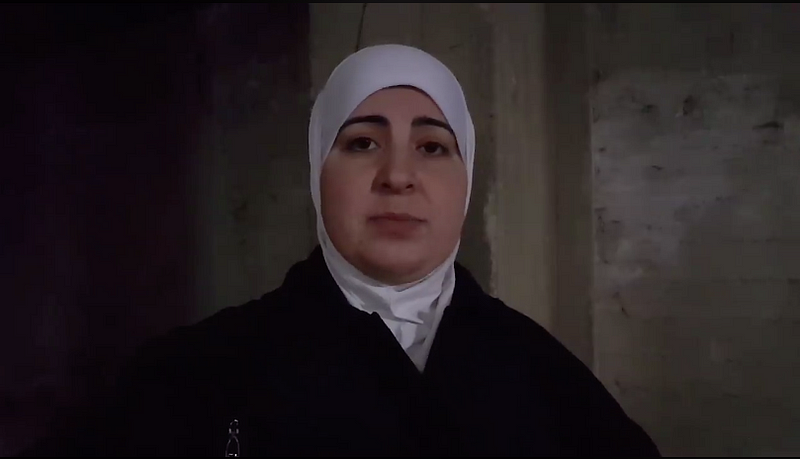
 'I am a forcibly displaced woman from eastern Ghouta, an area on the edge of the Syrian capital of Damascus. I lived there with my family throughout the revolution until March of this year, when the Assad regime escalated its attacks on Ghouta and eventually recaptured it. The regime’s soldiers forced us to choose between living under Assad’s control, or fleeing to the opposition-held north-west of the country, currently home to more than 1.3 million displaced Syrians.

 I live today in the Aleppo countryside, which is the largest area of Syria, along with Idlib province, outside regime control. The countryside is controlled by various factions. Turkey runs our health and education sectors while local councils, run by civilians, handle all other services. Armed opposition groups also exert military control. With me is my husband, a physician, and my two children, who are finally back at school.

 In 2011, I joined the Syrian revolution. Up until then, I had spent my whole life under the control of Hafez Assad and his son, Bashar Assad. I didn’t want to spend the rest of my life with my children and grandchildren living under the control of Assad’s son, also named Hafez. I wanted to live and enjoy my rights as a citizen in my country, and not as if I were a foreigner with no rights at all. The corruption of the Assad family and their allies was taking away everything from us. I joined the revolution to exercise my right to freedom of speech and the freedom to have an opinion.


 I currently work as a member of the women’s department of Aleppo Local Council, which is governed by the opposition Syrian Interim Government. I run projects to support and empower Syrian women socially and politically to play more significant roles in their communities and take part in political decision-making. During the revolution, I watched Syrian women joining men and calling for freedom against Assad. They suffered and endured just like the men and so they deserve to have the same rights and a voice.

 Just few days ago, I helped organise a women’s conference in north-western Syria, which more than 150 Syrian women of different backgrounds attended. We all have hope that tomorrow might be better than today, and we all are working to achieve that.

 I want to see a Syria that looks like us, all of us – diverse. A Syria that can accommodate all of us, protect all of us, keep us safe and make us feel stable, and one which we can all build together.


 But that dream looks a long way off, and in my new home in the north-west, we are facing an all too familiar situation, one that is similar to what happened in the final days of Ghouta, when fighting killed more than 1,400 people and the regime used chemical weapons to take back the area. We hear reports that Russia and the Assad regime are planning an escalation attack against the north-west, in a final attempt to take it over. If this happens, we might be displaced again, but where to? North-western Syria is the last fortress.

 If I am honest with myself, I cannot be sure Idlib would withstand an attack. I once believed that Daraya, Homs, the city of Aleppo, Ghouta and Daraa would withstand the regime. One by one, they all fell.

 I ask myself, what will happen to the tens of thousands of people living in displacement camps? Already, some of them are suffering from sickness and a lack of food and water. How will they cope if Assad and Russia begin bombing the north-west? It’s a humanitarian crisis waiting to happen.

 As activists, too, we are greatly afraid. The regime knows that those who refused to live under its control are gathered in the north-west, and we know that the regime considers peaceful activists and those who don’t support it as enemies and potential targets.


 In recent weeks, the regime has been releasing names of detainees who died in its prisons. They were civilian activists arrested after the 2011 revolution, whom we had long suspected were likely to be tortured and executed. The list of names proves that the regime believes peaceful activists must be targeted and killed. If north-western Syria falls, will we be similarly detained and disappeared? We know that the regime has the support of governments of powerful countries, and that the world has largely remained silent about Assad’s abuses.

 In March 2018, I testified before the UN Security Council, talking about the violations the regime was committing against the civilians of Ghouta. I called upon the members who attended that session to take action to stop the bombing and prevent our displacement, but nobody did anything and we were displaced anyway.

 I don’t think we can rely on the international community to save us, if Assad comes for the north-west. Our only hope would be that Turkey would open its borders and allow us to flee, but there is no guarantee of that.

 The displaced people of north-western Syria, my family included, abandoned our beloved homes and towns to live in freedom from the regime. As much as I long to go home, it is far better to live here than under Assad’s control. Despite everything, we still have hope to get rid of the war criminal, to give life the meaning it deserves and to give humanity its meaning back. If Assad does take the north-west, at least we can say, we did all that we could.'

Monday, 13 August 2018

Reunited post-Aleppo battle, Syria medics mete out 'hope'


 'Her scarred hands wrapped in gloves, Malakeh Harbaliyya lifted an infant out of an incubator at a hospital in Syria's rural north, holding him gently as he guzzled milk from a bottle.

 Nearly two years ago, the nurse and her brave colleagues were scrambling to save premature babies from heavy regime bombardment of Aleppo city, before ultimately being forced to quit the facility altogether.

 Now the same team of doctors has reunited to open Hope Hospital in northern parts of the province still outside regime control.

 "I think of the children first before thinking of myself, because their lives are in our hands," said 31-year-old Harbaliyya at the facility in rebel-held Al-Ghandura.

 "Their tiny souls didn't do anything to deserve this war."


 In November 2016, Harbaliyya was working in the only children's hospital still operating in rebel parts of Aleppo city when an air strike slammed into the building.

 In footage of the aftermath, Harbaliyya is seen scooping up a baby in a light pink blanket, then suddenly bursting into loud sobs.

 Barely eight months later, after evacuating the city, a car bomb sent Harbaliyya herself into intensive care in neighbouring Turkey.

 But she has pulled through, and the severe burns on her hands have today healed into a swirl of scars.

 Her hair covered by a pink-coloured scarf and dressed in a top that reads "Girls for the Future," Harbaliyya beamed as she lovingly pinched a frail infant's cheeks.

 "My colleagues at the Hope Hospital - the staff with me here - gave me the will to live," she said.


 In blue scrubs, Dr Hatem greeted his colleagues at the door before heading in to examine a girl squirming on a consultation bed from stomach pain.

 The hallway features a large portrait of Mohammad Wassim Maaz, a beloved children's doctor who died in an air strike on Aleppo city in April 2016.

 Later that year, after the city's Children's Hospital was knocked out of action and as a regime victory loomed, Hatem and his colleagues formulated a plan.

 With government troops closing in, the staff knew they would soon be evacuated from Aleppo and wanted to stay together, said the 32-year-old doctor, also the hospital's director.

 "Wherever we went, we wanted to set up a children's hospital," said Hatem, preferring not to give his surname.


 In under a month, a crowd-funding campaign by the Turkey-based Independent Doctors Association and Britain's CanDo charity gathered enough donations from around the world to rehabilitate and run a new hospital for a whole year.

 "We would never have imagined that we could find the whole amount in just three weeks," Hatem said.

 With equipment brought from Britain via neighbouring Turkey, they opened the Hope Hospital in April 2017 in the previously underserved Al-Ghandura district.

 "There was not a single dispensary or anything to do with medicine in the whole area," said Hatem, who criss-crossed parts of the province still under rebel control looking for a good location.

 Slowly, the facility grew into a fully-fledged children's hospital complete with nine baby incubators, a malnutrition clinic, a well-equipped lab and emergency services.


 After having to refer many women to another hospital, they added an obstetrics and gynaecology section too.

 "The team is mostly the same as the one in Aleppo but, because of the bigger workload here and the higher turnout, we had to increase staff," said Hatem.

 As the only specialised facility for miles, his clinic set amidst tall pine trees receives 8,500 to 9,500 cases a month.

 "The Hope Hospital really is a point of hope," he said.

 "It allowed the staff from Aleppo to feel that there is still humanity left in the world," Hatem said of the donations that brought the facility to life.

 But funds have started to run out and another crowd-funding campaign failed to meet its target.

 Now, staff hope to sign a contract with the UN's children agency (UNICEF) to help run the facility for six more months.


 Hospital manager Riyadh Najjar, 31, said the hospital is providing services to many in need.

 "It's anguishing to leave your city, but here you have the opportunity to serve people," he said, dressed in trousers and a white t-shirt.

 Beyond the district's original inhabitants, Najjar said the hospital also serves many Syrians displaced from other parts of the country by the seven-year war.

 Like the hospital staff, patients come from Aleppo city, but also the central province of Homs and northern province of Raqqa.

 "It's something extraordinary to be able to offer them medical services and help them," said Najjar.'

Rebel groups help fighters earn high school diplomas


 'Some young adults who left home to fight the Assad régime are getting a second chance at a "normal" life.

 Al-Jabha al-Shamiya (Levant Front), which is affiliated with the Free Syrian Army (FSA), honored some of its fighters Aug. 3 for obtaining their high school diplomas (baccalaureate certificates) this year. The front held a special ceremony in Azaz, about 20 miles north of Aleppo.

 Levant Front military leaders, along with fighters who passed the exams and their families, attended the ceremony. Speakers addressed the importance of fighters returning to school after having dropped out because of the war.


 Mohammad Saleh, a Levant Front leader, said that 77 of the 120 fighters from the front who sat for the exams in June obtained their diplomas. "This percentage is excellent, given that they had been out of the game for a while," he said.

 “The Levant Front offered the fighters support by building them a special institute to learn all the material of public schools. Contracts were signed with teachers of all courses. The institute opened in November in Azaz. … For seven months, the students who were fighters were taught and prepared for the baccalaureate exams," Saleh said.

 "The fighters were highly interactive during the school year. They had the desire to return to school, which they had dropped out of to carry arms and join the FSA. The fighters who received the baccalaureate certificate will pursue their university education" in Aleppo province, where there are several colleges. "They can major in any discipline. The Levant Front will repeat this experience next year and support other fighters to return to school,” he added.

 The Levant Front fighters who obtained their degrees are 20-26 years old. Some have fought since mid-2012 against the Syrian regime and the Islamic State (IS). Many will take this opportunity to leave the fighting for good and continue their education in college, and some will remain in the Levant Front to make money to pursue university studies later. The front pays each fighter in its ranks 530 Turkish liras (about $83) per month.


 The FSA is currently fighting the régime on the frontlines from Tel Rifaat to Tadef, north of al-Bab. Tadef is controlled by the régime, and al-Bab is controlled by the FSA. FSA fighters are also deployed with the Kurdish People’s Protection Units in Manbij in northern Aleppo province, though there are no battles currently.

 Mohammad Derbas, a 22-year-old from northern Aleppo, scored 180 out of 220 points on his high school exam. He said, “I couldn't believe that after all these years of being away from school, I have returned and received the baccalaureate certificate. I can now pursue my [university] studies. I want to study economics at the International Sham University near Azaz."

 Derbas dropped out of school when he was 18 due to ongoing displacement and school closings as a result of the régime shelling. He joined Liwaa al-Fateh, a Levant Front affiliate, in early 2015 and fought alongside his friends against IS in northern Aleppo province.


 Abdel Rahman Hadaba, 25, from Tell Rifaat in northern Aleppo, is a member of the Levant Front. He received his diploma after working hard for it despite his big responsibilities: He is married with two children and, displaced from his hometown, lives in a camp near Azaz. Still, he managed to get the certificate against all odds, and his family encouraged him.

 “When the Syrian revolution broke out in 2011, I was a student at the public school. I couldn't continue my studies because I was participating in the protests against the régime. I carried weapons and joined the FSA ranks in 2012. I participated in the first battles against the régime that year, and I'm still fighting with the FSA," he said.

 “I kept dreaming of returning to school all these past years. [Some of] my peers had continued their studies, and I was stagnating. I want to get a job and fulfill my ambition. I want to raise my income. The Levant Front supported us to get the baccalaureate, and I hope other FSA factions in the north would do the same and support fighters dreaming of returning to school.”


 Thousands of Syrian youths left school and joined the revolution against the régime in 2011. Many of them carried arms and fought alongside the FSA after the peaceful protests turned into armed militancy against the regime in 2012. They could not return to school because most schools were destroyed under the shelling. The schools that remained weren't safe. Most teachers migrated to safer areas or to neighboring Turkey in the north.

 These young Syrians wanted more than anything to provide for their families and shelter them from the shelling. IS took control of large areas in opposition-held land in northern Syria in early 2014 and banned education, turning schools into military centers.

 Perhaps the initiative of the Levant Front to support its militants in pursuing their education is a good start for young Syrians who felt their future was slipping away due to the war, displacement and the damaged educational sector.'

Sunday, 12 August 2018

Syrian rebels build an army with Turkish help


 'A “National Army” being set up by Syrian rebels with Turkey’s help could become a long-term obstacle to President Bashar al-Assad’s recovery of the northwest - if they can end factional rivalries that have long blighted the opposition.

 The effort is at the heart of plans by the Turkish-backed opposition to secure and govern a strip of territory that forms part of the last big rebel stronghold in Syria.

 The presence of Turkish forces on the ground has helped to shield it from government attack.


 Assad, backed by Russia and Iran, has vowed to recover “every inch” of Syria, and though he has now won back most of the country, the Turkish presence will complicate any government offensive in the northwest.

 Turkey’s role has gone beyond supporting allied Syrian forces to rebuilding schools and hospitals. At least five branches of the Turkish post office have opened in the area.

 Colonel Haitham Afisi, head of the National Army, says setting up the force has been no easy task over the last year.

 “We are at the beginning. We face many difficulties but we are working to overcome them,” said Afisi in an interview in the town of Azaz near the Turkish border.


 Recently, he had to issue an order instructing fighters to stop “randomly opening fire”, wear uniforms and cooperate with a newly established military police that represents “the force of law and justice and not a rival to any other faction”.

 Factions have also been banned from operating their own jails and courts and from carrying out extra-judicial arrests.

 The project has also faced attack: a number of recruits were wounded on Aug. 5 when their graduation ceremony in the city of al-Bab was shelled. Afisi said it was the work of an “enemy of the revolution, be they internal or external”. The perpetrator had been identified, but he declined to say it who was.


 The National Army compromises some 35,000 fighters from some of the biggest factions in the war that has killed hundreds of thousands of people and forced some 11 million people from their homes over the last seven years.

 Many previous efforts to unite the rebels have failed, obstructed by local rivalries and at times by the competing agendas of foreign states that once backed many of the rebels in the Syrian war.

 The National Army could be different because of Turkey’s presence on the ground.

 The Turkish military pushed into the northwest in two campaigns. The first, “Euphrates Shield”, which got underway in 2016, drove ISIS from territory between Azaz and Jarablus. The second, “Olive Branch”, captured the adjoining Afrin region from the Kurdish YPG militia earlier this year.


 The area is important to Turkey because of what it views as the national security threat posed by the YPG, which it sees as an extension of the Kurdistan Workers Party (PKK), which has waged a three-decade insurgency in Turkey.

 Assad says Turkey is illegally occupying Syrian land.

 “All the support for the National Army is from Turkey, there are no other states partnering in this matter,” Afisi said.


 Turkish support includes fighters’ wages, logistical support “and weapons if necessary”. He listed three enemies: Assad, the PKK and ISIS.

 Turkey has also set up 12 military posts in Idlib province and adjoining areas which are located southwest of Afrin, under an agreement with Russia and Iran. The stated aim is to observe a “de-escalation” agreement in the Idlib area.

 Assad has indicated Idlib could be his next target.

 Afisi said the National Army could be quickly merged with Turkish-backed rebels in Idlib if necessary.

 The situation in Idlib is complicated by the presence of well-armed jihadists that have fought with the other groups.

 “We are ready and extend our hand to all groups that represent the goals of the revolution,” he said.'

Tuesday, 7 August 2018

Syria’s Women Prisoners, by an Artist Who Was One


 'This is Hiam, a 65-year-old woman smoking a cigarette and sipping matteh, a warm herbal drink popular in Syria. It is a moment of solitude in a soul-crushing place; the bed is a prison bed. Hiam spent two and a half years in prison, most likely for the simple reason that she came from an area that rebelled against President Bashar al-Assad’s government.

 The artist who drew her, Azza Abo Rebieh, was one of 30 women sharing a cell with Hiam in the Adra prison in Damascus. Then 36, Ms. Abo Rebieh was on her own surreal journey through the Syrian security system, detained because of her art and her activism.

 Ms. Abo Rebieh’s artwork, from the start of Syria’s uprising in 2011, held up a mirror to a society in turmoil. Risking arrest, she painted graffiti murals about the protest movement. After security forces cracked down and some in the opposition took up arms, she helped smuggle food and medicine to people displaced by fighting.


 In September 2015, Ms. Abo Rebieh got a call from an activist friend asking her to meet at a cafe. It was a trap: When she arrived, security was waiting.

 Ms. Abo Rebieh, a member of the educated middle class, found herself imprisoned with women who were barely literate, and mostly arrested at random. She became a kind of spokeswoman and sounding board, conveying their needs and requests to guards and helping them talk through experiences.

 Her art then became a mirror for fellow prisoners who had none: She drew them so they could see themselves. She drew them all in shaded black and white, their grimacing faces and thin limbs influenced by one of her favorite artists, Goya.

 Ms. Abo Rebieh was released in 2016, but her case was still open. She fled to Lebanon, where she is stuck because she is still wanted in Syria. Last year, she won an art residency in Spain, to study Goya and paint Syria’s ghosts as an echo of his. But the Spanish government denied her a visa.

 She has continued to create art about the women she met in detention.

 “I want to draw them so they are not forgotten,” Ms. Abo Rebieh said in her small living room, where her prison art hangs on the wall, along with string dolls she made in prison from olive pits and yarn from worn blankets. “This is the message. I keep remembering that I am out and they are in.”


 After her arrest, Ms. Abo Rebieh spent 70 days in the detention cells of one of Syria’s feared security agencies, crammed into a small, filthy cell with 15 other women. The prisoners had lice in their hair and moths in their blankets. They could visit a toilet, littered with excrement and cockroaches, for a few strictly timed minutes each day. Tens of thousands of people have disappeared into such places, their families unable to learn their fates.

 While there, Ms. Abo Rebieh got to draw only once. Her interrogator knew she was an artist and had a special request for her: Draw hatred.

 “He gave me a pencil and a paper and forced me to draw,” she recalled. She had been blindfolded so she could not see who was interrogating her, but her blindfold was lifted to let her draw. “I sat there with my hands trembling.”

 She drew a toothless old man with an evil look, squeezing a bird in his hands.

 “Wow,” the interrogator said, as the others crowded around, impressed. “This is us. We do this.”

 Afraid, the artist demurred, saying, “This is not you, this is someone else.”

 “No, no,” he replied. “This is what we do. We know it, we are happy with it.”

 “And this,” he said, pointing to the crushed bird, “is you.”


 Conditions improved when Ms. Abo Rebieh was moved to Adra, an official prison, where she was finally able to persuade guards to bring her paper and pencils, and she began drawing the people she was confined with:

 “There were no mirrors inside the prison, so the drawings I made of the women made them see how they look. They are even more beautiful than the way I draw them. There is nothing to do, so you make up your face, your hair; some girls ask their parents to buy them makeup. They are very young. They dance at night, and compete over who dances better. Sometimes they cry when they dance.

 On New Year’s Eve, the guards let us have a party. I drew on the girls’ faces, one a cat, one a butterfly. The guards agreed to allow it for one night only. So we wrote them a card, saying ‘The ladies of Cell Number 4 congratulate you on the New Year.’

 When the guards saw that we called ourselves ‘ladies,’ they went crazy. They said, ‘You are terrorists, not ladies.’ ”


 “Rama al-Eid wanted every woman in the prison to be her mother. She was young and we nicknamed her Chocolate. She is a very beautiful girl with big eyes. She had been a national champion in badminton. Rama is from Daraa, where the uprising first began. She was imprisoned while she was still a teenager and accused of activism against the regime. When she turned 18, the judge sentenced her to six years and eight months in prison.”


 “This is Raeefeh. She is from Homs. She spent, like, four years in jail. She is a very lovely girl. She worked in the prison as a waitress in the cafe. They let the girls work to have an income. Simply because she is from Homs she is seen as a criminal. She was accused of giving news to the media about what’s happening in Homs. She sleeps with her teddy bear.”

 Tal El Mlouhi is a blogger who had been in detention since 2009, when she was 19.

 “She acts like a princess. Inside, she must have lost her mind. When the guards come and count us, she has to be in very good form and put on a perfume so when the counting starts she appears in perfect form. You look at her and you pity her.”
 “Hiam didn’t know how to read or write, but she asked me to teach her drawing. She loves rabbits, I taught her to draw them. Then she started to draw her home and the flowers around it.

 When I left prison, she sent me a letter — someone wrote it for her — saying: ‘I don’t need to learn how to read and write. You taught me how to draw, and drawing is the best expression for me. I can draw a home now and I can draw my dreams.’

 Hiam was delightful, and never made you feel miserable inside the prison. At 65, the mother of five was accused of jihad al-nikah [‘sex jihad’, or providing sex to jihadists, which Syrian officials claim, without proof, is a rampant practice.]. There was no real evidence. When you ask her, ‘Why you are in prison?’, she would jump and say joyfully, ‘Jihad al-nikah!’ She spent two and a half years in prison. No one could visit her, as she was from rural Homs and it was hard for any of her family members to reach her because they could be arrested at checkpoints on the way.”

 Maryam haunted the artist perhaps more than any other inmate. A mother of six, she spent months in a secret government jail in Aleppo. She was interrogated about the whereabouts of her sons in a rebel neighborhood, and then sent to Damascus to be tried for terrorism. She was lucky enough to come before a sympathetic judge, who instantly realized that she had lost her mind and ordered her released.

 But things are not so simple in Syria. One branch of the intelligence services can release you, only for another to arrest you again; with little coordination between branches, names can linger indefinitely on the wanted list. That is what happened to Maryam. Before the bewildered, illiterate woman could find her way home, she was thrown in another jail in Damascus.

 Ms. Abo Rebieh drew her from memory after her release. Maryam’s pale, aging face is drawn in charcoal, the eyes wide open, their expression scared and wondering. The woman’s hands lie on her lap, palms up in supplication or disbelief. This is how she always sat with Ms. Abo Rebieh, repeating the same question over and over: “Why am I here?”

 After a while, Ms. Abo Rebieh lost her temper:

 “I lost my mind as she kept asking me every four minutes. I used to look after her, wash her hair, feed her. But she kept asking, and I lost it. I shouted and told her don’t ask me any more, and then I burst into tears.”

 
 Ms. Abo Rebieh drew and painted Zeina after her release.

 “This is Zeina when she asked to breathe. We were arrested in September and had summer clothes on. By wintertime, we got so cold with no warm clothes on us. They had confiscated our money and refused to give us any clothes. They brought us blankets full of moths and she had asthma and couldn’t breathe. She knocked on the door and asked the guard to breathe for a minute. She sat there to take a deep breath and broke into tears. A scene I can’t forget.”

 On a cold day in January 2016, five thin, tired women arrived from the town of Madaya. Ms. Abo Rebieh was not aware of what was happening outside the prison walls. She did not know that Madaya had been besieged, with several children dying of malnutrition. When the food came — just a few pieces of potato — the women devoured it as if, she said, they were eating lamb chops.

 “They explained: ‘We are from Madaya. We spent six months under siege and we didn’t eat anything except water and spices.’ One added, ‘When my child cried to eat I would beat him until he went to sleep and then I beat myself till I fell asleep next to my child every single day.’”

 Not long after, Ms. Abo Rebieh was released. But she still faced more prison time because of the open case. She bribed her way out of Syria and escaped to Beirut.

 “I felt guilty that I left and they are still there,” she said. “I was eating walking and sleeping with the security in my mind outside the prison.” She saw a psychologist, who urged her to draw everything: “He wanted me to believe that I am out of prison.”

 At first, Ms. Abo Rebieh felt blocked and depressed, but then, the work began to flood out: a series of more developed etchings of her prison experience.

 This is the military security detention cell. Like tens, perhaps hundreds of thousands of other missing people, the prisoners were being held incommunicado. Their families had no idea where they were.

 They went on a hunger strike, demanding only that their families be told their whereabouts. Some refused medicines, risking death from heart conditions and epilepsy.

 When a guard shouted at them, Ms. Abo Rebieh said, she yelled back: “What would you do if your daughter disappeared and you knew nothing about her for 60 days?”

 “After I did all this work, I felt relieved. Like I was holding these things inside me, and now they are out,” Ms. Abo Rebieh said.

 “We should keep telling the story of prisoners,” she said. “My art is dedicated to that.” '

Sunday, 5 August 2018

They said no to this killing régime


 "There is no doubt that the régime has lost legitimacy. We demand the release of our living detainees, and the bodies of those who were killed. We say that these killers in the Assad régime have to be put on trial. We, in the town of Hass in the Idlib countryside, show solidarity with the detainees' relatives. At the same time, we express the deepest condolences to them."

 "Syrians who were imprisoned in 2102, 2013 & 2014 are the real detainees. They were the first demonstrators that took to the streets. They said no to this killing régime. We must know where the detainees are after all these years of oppression."

Thursday, 2 August 2018

The bigger shock was watching the world doing nothing


 'Syrian refugee Kassem Eid, who survived the Ghouta sarin gas attack in 2013, says only a "miracle" can end Syria's conflict that is now in its eighth year.

 Mr Eid was living in Damascus when the city was bombed with the nerve agent on August 21, 2013, which killed 1,429 people —including 426 children .

 The victim-turned-fighter and activist has documented his story in a new book My Country: A Syrian Memoir, where he recounts his memories of the deadly attack and efforts to rally worldwide support.

 But after "dealing with disappointment for seven years", Mr Eid conceded the country needed a "miracle" for the conflict to end.

 "This is as honest as I can be because I've been trying to lobby the US Government, the EU, the United Nations — anyone who wants hear it — to just stop the war crimes in Syria and nobody's doing anything about it," he said. "I can no longer lie to myself and lie to whoever's listening to me and tell them that help is coming. I don't think any kind of help is coming, I think we just need to wait for a miracle."


 Mr Eid, who remembers the day of the sarin gas attack in 2013 as "judgement day", said he would never forget the "terrifying atrocities" committed against innocent civilians in Syria.

 "We never thought that we would actually wake up one day and see our own Government aeroplanes bombing us — our own tanks, our own troops who are supposed to protect us, to see them attacking us with everything they have," he said. "But after two years, when we were just starting to somehow try to accept that brutal reality, the Assad regime launched that chemical massacre against us. And we were just as shocked as anyone else in the world because we didn't think that he would take it that far."

 However, Mr Eid said the bigger shock was "watching the world doing nothing to stop Assad or hold him accountable".


 While former US president Barack Obama said in a 2012 press conference that the use of chemical weapons in Syria would be "a red line" and change his "calculus", Mr Eid said Mr Obama broke his promise and let Mr Assad walk away without punishment.

 "It was a greenlight given to him by the international community to keep killing and bombing as many civilians as he wants with no questions," he said.

 After the chemical attack, Mr Eid followed fighters of the Free Syrian Army to the front line and was "looking for some kind of justice".

 "Those monsters … gassed innocent civilians right in front of me … kept bombing us and starving us for years," he said. "I just try to stop them from invading our town, and butchering children with knives like they did before and raping women like they always do every time they invade our town. And I'm very proud that I was able to somehow help stop those monsters from committing more atrocities."


 The 32-year-old said he believes Syrian ally Russia has played "a very evil role" by supporting Mr Assad and giving him military, political and financial aid.

 While Syria said it would commit to eradicate its chemical weapons under a US-Russian deal by mid-2014, suspected chemical attacks in Syria made international headlines in 2017 and again — but this time confirmed — this April.

 "We can never trust Russia, we can never trust [Vladimir] Putin who attacked even people inside the UK with chemical weapons," Mr Eid said. "This man is the top dictator in this world and we should never trust him."


 Mr Eid, born a Palestinian refugee in Syria, is now a refugee three times over after escaping to the US before eventually applying for asylum in Germany where he now lives.

 As the number of casualties and massacres in Syria continue to climb, Mr Eid says he is finding hope not with policymakers but everyday people he meets while travelling the world.

 "When I see someone in the United States or Europe … who doesn't know anything about what's going on, but with a simple conversation, they really feel responsible and they really want to help," he said.

 "Those kinds of people, these kinds of small interactions are the only thing that actually keep hope in me." '

Thursday, 26 July 2018

Rojava is Omelas, Not the Ones Who Walk Away

Image result for ones walk away omelas pdf

 "They all know it is there, all the people of Omelas. Some of them have come to see it, others are content merely to know it is there. They all know that it has to be there. Some of them understand why, and some do not, but they all understand that their happiness, the beauty of their city, the tenderness of their friendships, the health of their children, the wisdom of their scholars, the skill of their makers, even the abundance of their harvest and the kindly weathers of their skies, depend wholly on this child's abominable misery."

 In 1973 the anarchist science fiction writer Ursula Le Guin wrote a story called The Ones Who Walk Away From Omelas, about the dilemma of the liberal conscience; how do we accept our happiness and prosperity when it is based on the suffering of others? She describes as anarchists those who reject this bargain and walk away.

 Today it seems that those who embrace the "Rojava Revolution", the rule of the Kurdistan Workers Party (PKK) over northern Syria, have accepted this bargain, based as it it is, not on the suffering of one child, but of the torture of millions under the PKK's ally, the Assad régime. I think this defines the PKK, and all its offshoots, as a force that is everywhere the enemy of democracy and freedom.

***************************

 It wasn't until the summer of 2015 that I begin to reach this conclusion. In compiling my blog, News of the Revolution in Syria, it mostly seemed up to that point easier to ignore the Kurdish question, and its flipside the Turkish question, up until then. It was hard to find commentary in English that talked about the relationship of the PYD to the Syrian revolution at all. I can recall at the first (perhaps only) Syrian Solidarity Conference in the UK in London in early 2014, Robin Yassin-Kassab having a sharp exchange with a PYD supporter from the panel explaining that the PYD had acted as quite an authoritarian organisation in its own right. But still the overwhelming message getting to the British left were that the YPG were the good guys, fighting for feminism and gay liberation, with none of the complications of Islamism and supporting Western intervention which were the left's bugbears about the actual Syrian revolution.

 In the summer of 2015, the world had united around the defence of Kobane (rarely being reminded that it also had an Arabic name too, because everything Kurdish was liberatory, and everything Turkish or Arab oppressive), and indeed Free Syrian Army brigades went to fight alongside the YPG against ISIS. And within weeks, there were clashes between the YPG and the FSA, while the FSA was also fight the régime, while the YPG was not fighting the régime at all.

 There were people in Syrian Revolution discussion groups who would present the YPG as the victim in all this. There were good FSA, like Jaish al-Thuwar, who were fighting alongside the YPG. The other side weren't really FSA any more, but were corrupt Islamists. For some reason, some of the worst were not the officially Islamist groups like Jabhat al-Nusra and Ahrar al-Sham, but Turkish affiliated groups like the Sultan Murad brigade. Maybe there were some bad statements by the PYD about co-operating with Assad, but that was forced on them by the attacks from Islamists and Turkey. And the YPG wasn't just the PYD, there was a multi-party military council that ran the YPG.

 People would challenge these assertions. This military council never operated, as other news reports showed. It was Jaish al-Thuwar who were in fact the mercenaries. And the alleged violations covered for the elephant in the room. The YPG accepted régime presences in Hasakeh and Qamishli, and although they had occasional clashes, they worked hand in hand to expel any FSA presence. The PYD area in Aleppo increasingly co-operated with the régime againbst Free Aleppo, culminating in them storming Free areas and butchering rebels and civilians with the Iranian militia the following year. Along with expelling the people of Tel Rifaat in an attack from Afrin with massive Russian bombing, and going on to attack Mare' at the same time the régime was attacking from the south and ISIS from the east. Yesterday a PYD leader announced they are ready to take part in an operation to reassert régime control over Idlib, and they have been in discussions to return régime control to eastern Syria. By now it should be clear to anyone who cares to see that the alliance with the Assad régime is not an aberration, but a fundamental part of what the PYD is about.

***************************

 By August 11th, 2015, Turkey had indicated it wished to set up a safe zone in Northern Syria which Assad would not be allowed to bomb, and all the revolutionary factions in Syria had at least gone along with it. The YPG, by contrast, announced that the Turkish Army had attacked both it and civilians. No follow up to these attacks ever occurred, which finally convinced me that the YPG was a continuous lie factory. This continued through to the Afrin conflict, where the YPG and its supporters claimed Turkey was deliberately attacking civilians, belied by a YPG commander interviewed by RT in Afrin, who said his soldiers dressed as civilians so that Turkey wouldn't attack them. It was claimed the TAF destroyed the Maydanki Dam to stop the water supply to Afrin City, yet pictures seem to support the Turkish claim that the retreating YPG sabotaged the dam, and it was repaired as soon as possible (and no mention was ever made by anti-Turkish commenters about the 6 years the YPG had diverted the water from the city of Azaz). It seemed to me that such a level of propaganda was necessary because there is no other way to cover for allying with such extreme evil as Assad.

 And the same thing was going on on the Turkish side of the border. The PKK abrogated a peace agreement with the Turkish government, and went back to war, while claiming it was the Turkish government that had attack it. Yet the Turkish state had every reason to want to keep peace in Turkey and any conflict on the Syrian side of the border. The PKK on the other hand, see Turkey's difficulty as Kurdistan's opportunity, thinking, especially with Russian and US help, that it could carve out a state for itself from Iraq to the Mediterranean, now that it had US and Russian help in addition to its alliance with Assad. And that Turkey would be forced to come to a deal the more it was destabilised. The more chaos the better. The more misery the better.

 There were suicide bomb attacks, in Ankara and Istanbul, in early 2016, the second entirely against civilians. At first no claim of responsibility was made, but when the bombers' PKK or YPG identity was revealed, the TAK or Kurdish Freedom Hawks came forward to claim responsibility. As if this wasn't already an obvious deflection, the Istanbul bomber's funeral was attended by the entire local leadership of the HDP, the supposedly independent Kurdish leftist political party. At the point it seemed clear to me that those saying the PKK,PYD, YPG, YPJ, SDF, TAK and HDP were all part of one Ocalan cult, directed from the PKK hideouts in the Qandil Mountains of Iraq, were correct. This was strengthened for me when I searched for comments about the peace process with Turkey from the HDP leader, Selhattin Demirtas, and discovered he had said, "It's up to Ocalan." Not the Kurdish people, the HDP, or even the PKK, but just the leader. It's a cult based on support for its leader, as far from anarchism as you can get.

***************************

 Some people present the PKK as the defender of the Kurdish people. Or even if they want to claim they are critical of the PKK's authoritarianism, that it is the Turkish threat of genocide against Kurds that was the real problem dividing Arabs and Kurds. The unreality of this analysis is felt most obviously by the Arabs whose land is occupied (we could also say the division into Arab and Kurdish areas is due to the PYD and régime racialising the struggle), and are then told they most be broken away from their tribal mentality, as one Italian YPG supporter proudly told me. There is the hidden crisis of those Kurds not willing to serve as child soldiers for the YPG, or those, including all other Kurdish political parties, who face frequent arrest and imprisonment in PYD areas, even when they support the PYD line of opposing the Turkish/FSA forces.

 When the YPG was expelled from Afrin, tens of thousands of civilians did flee. Maybe they believed the scare stories of what the Turks would do. Maybe they just worried that bombs would drop on them in a war zone. In any case, when the guns stopped (though not the YPG's IEDs which continue to maim civilians in Afrin), most of the displaced wanted to go back, only to be told by the PYD that they couldn't until they had re-liberated Afrin, as they see it. I can't see it as anything other than a cancer on the Kurdish people as well as other Turks and Syrians. It demands war on the hovels, and peace to the palaces of torture.

 There may have been a time when the PKK was a legitimate national liberation movement. There was historically a real amount of oppression, continuing into the late 20th Century, such as the denial of language rights. But to keep Turkey at peace, the AKP government has offered the best deal to Kurds of any Turkish administration. And as a result, between 25 and 50% of Kurds in Turkey vote for the AKP. It again seems improbable in the extreme that several million Kurds would vote for someone who wanted to massacre other Kurds.

 So I think the PKK is a cancer. Because it has made its raison d'être trying to dismantle the Turkish state in south-east Turkey, and has found an ally in genocide for the purpose. Because the Turkish government knows that the destabilisation it experiences won't stop as long as Assad in power, so that however much it wants others like the United States to act to bring it about, it want to have a peace to which Syrian refugees can return, and knows that won't happen under Assad. So the PKK allies with Assad, knowing that what strengthens him weakens them.

***************************

 There are people who say of the PKK, "We can notably talk of positive policies regarding women’s rights and secularism." You cannot divorce these things from the context in which it occurs, an alliance with a régime that rapes women on a mass scale and tortures Muslims until they declare there is no God but Bashar. You cannot force secularism and communism on people. A half century of Communism in Eastern Europe, after which people want to join NATO to protect themselves from Russian invasion, should be a salutary lesson (instead the left blames the crisis in Ukraine on Russian expansion).

 We are told the PKK has evolved from Marxism or Maoism to anarchism, because Abdullah Ocalan read Murray Bookchin in prison, and so all his followers decided to do so. A group becomes anarchist because the leader tells them to? That's not like any anarchists I've ever heard of.

 The pinkwashing of Israeli occupation by pointing to their record on gay rights as better than in Arab countries would be objected to by all leftists, but it seems to be accepted when it comes to the YPG. Democratic confederalism doesn't seem to amount to any more than the one-party elections that would occur in Communist Cuba or China (and the Cultural Revolution in China is another moment at which many outside leftists mistook Communist fervour for freedom). When there is no freedom at the top, and in this case an alliance with genocide to boot, local elections are a sham democracy.

***************************

 That's my opinion of the PKK. It's an anti-democratic force wherever it goes, including Europe where its supporters responded to the Afrin conflict by burning mosques. Other people have a different point of view. That's fine by me. I'm not one of those who say you have to think in the exact same way as me about every conflict, or you are guilty of selective solidarity. I think if there was going to one conflict to be selective about right now, it would be the one against the Assad régime. Not because there is something intrinsically special about Syria, but because the Assad genocide is the most destabilising event in the world today, and the single greatest cause of lies to be introduced into political debate, particularly that of the left. So, if I am for anything first, like Michael Weiss, it is for Syria First. I would judge all politicians first by what they have to say about Syria.

 But for many people it is the opposite, if you support Erdogan, you are as bad as those who support Assad (even by some perverse logic, you support Assad too). I don't support Erdogan. For eleven years when I was a child we had a Prime Minister in the UK, a Conservative called Margaret Thatcher, who I've seen compared to President Erdogan. And we hated her. She shut down the Greater London Council, wouldn't let us here the voices of Sinn Féin MPs, seemed like she was destroying our public services. Yet she did have millions of supporters, and she peacefully gave up power, and her party was voted out. And she wasn't facing a genocide in a neighbouring country, and responding much better than any other political leader.

 I know the Turks have shot Syrian refugees. I know they arrested eleven members of the Turkish Medical Board before releasing them the next day. I know they arrested many journalists, most famously Ahmet Sik, who is now an opposition MP. No they are not perfect, but they have offered refuge to millions of Syrians (and an infinitely more welcoming environment than Lebanon or Jordan, currently trying to throw them out as they Turkish opposition would wish). And have offered free medical treatment to hundreds of thousands of civilians and fighters without which Free Syria would not have survived. There is no justification here for any equivocation about the PKK.

 There are reasons to wish that outside influence was unnecessary for the Assad régime to be defeated. But as the régime threatens to attack Idlib, and the PYD offers to assist, many of those who live in the still liberated area hope Turkey will defend them. It seems wrong for outsiders to attack the FSA as mercenaries, and the SNC as racists, for supporting the liberation of Afrin from Assad's ally. If someone has a strategy for liberating Syria that involves no Turks and no Islamists, let's hear it. If they are saying the military defence of lives and communities against Assad was a mistake, and we should support an ally of that genocide instead, I think that is hopelessly muddle headed.

Image result for ones walk away omelas prisoner

Tuesday, 24 July 2018

Armed opposition groups believe the revolution lives on


 'Seven years after Syrians took to the streets, first demanding political change and later the resignation of the regime, the Assad regime has managed to regain control over much of Syria.

 With the intervention of the Russians, a period of constant military wins for the regime began in 2015.

 The regime took back Aleppo, Ghouta, and Rastan in northern Homs and is now gaining ground in Daraa towards the Jordanian border.

 Many consider the armed opposition defeated and the Syrian uprising dead. However, opposition groups are keeping faith in what they call "the Syrian revolution".


 Izzeddin Salam, a member of the political office of Festaqem Kema Umirt - an Aleppo-based rebel brigade - rejected the idea that the revolution was dead.

 "The revolution is an idea and the idea won't die until the people die. The revolution is continuing but in another way. We have huge judicial files against the regime and Iran over their support of terrorism like Islamic State and al-Qaeda."

 Izzeddin Salam sees the armed opposition's military losses in Ghouta and Damascus as the result of an international decision to leave the rebels isolated and accept Assad's ongoing rule.

 Fathi Hassoun, the leader of Harakat Tahrir Watan, formally known as Tahrir Homs, a brigade formerly based in the Rastan pocket in northern Homs, agrees with Salam and says the revolution is at a "critical stage". He too denies it is dead.

 "[The revolution] is continuous and its effects are witnessed before our eyes, including the inability of the regime to manage the areas it has recently controlled," he said.

 Hassoun says the ongoing fighting in southwest Syria is proof the uprising still lives:

 "The resistance shown by the factions of the south who preferred death to recognising the regime is evidence the revolution is alive."


 A former senior member of the Ahrar al-Sham faction, who asked to remain anonymous for his security, also agreed.

 The opposition is in a difficult situation, he says, but he points out that the opposition has had many such difficult moments.

 "It's now been seven years since the revolution started. The Assad regime is a criminal regime supported by Iranian militias and the Russian killing machine," he said.

 It has been the regime's targeting of families and infrastructure that has set back the opposition, he argued.

 "Many rebels were in places under siege. They resisted for a long time, but the Russians and Iranians targeted civilians and facilities, forcing the rebels to surrender. Russia, Iran and the regime targeted civilians and facilities in revenge for any operation by rebels. This led to a humanitarian crisis which affected rebels."

 Abu Berra, the leader of the northern sector of Jaysh al-Islam, a formerly Ghouta-based faction, sees Russia's massive attacks alongside Assad's war crimes and use of chemical weapons as the principal setbacks for the armed opposition.

 "The Syrian revolution is not 'areas of control' - the revolution is values and principles which can't be killed by weapons. The Syrian revolution is alive in the hearts of its sons. The murderer can't be victorious, and the oppressor can't continue to oppress the people. Justice will triumph over injustice."


 Salam hopes the recent electoral victory of Turkish President Erdogan will secure the rebels' presence in northern Syria.

 "The victory of the Justice and Development party opens the way to fight in the north in the face of a possible regime assault after the end of its operations in southwest Syria. Russians and Iranians made promises for northwest Syria, but they are liars," said the Festaqem Kema Umirt member.

 Dr Muhammed Vecih Cuma is the President of the Syrian-Turkmen Assembly, which represents Syrian Turkmen.

 "In many regards, the fate of the Syrian revolution is connected to Turkey. Turkey is the only state which seeks the stability and safety of Syria and works for it through political means. Turkey protects its own national security and takes steps for the safety of the Syrian people. Turkey is also the biggest provider of humanitarian assistance for Syrians. The Turkish and Syrian people share common values. Turkey is the only state in the Middle East which doesn't fear a democratic Syria."


 While the remaining rebel presence in southwest Syria are under attack by the regime and Russian air force, all other rebel presences in Syria are either under direct Turkish control as in Afrin and northern Aleppo, or under Turkish influence as in Idlib where Turkey established 12 "observation points" to ensure the de-escalation zone in Idlib agreed within the Astana process.

 The unnamed former senior member of Ahrar al Sham also referred to these key areas:

 "Rebels still have a presence in Aleppo, Afrin, Idlib and Daraa. The situation in Deraa now is really bad. Russians are primarily targeting civilians. Therefore the situation is difficult, but rebels strike back causing huge causalities to the enemy."

 Fatih Hassoun, leader of Harakat Tahrir Watan, blames the international community for the situation in which the armed opposition now finds itself.

 "This is due primarily to the failure of the international community and to its focus on the half-cup of terrorism and confronting it. Its vision was limited to fighting terrorism by extremist organisations like IS, excluding the regime's militias and allies despite all the crimes committed by them. Which enabled the regime to implement and achieve its goal."

 The Ahrar al-Sham ex-member agrees, saying that while Russia and Iran invested huge resources into the regime, other foreign actors hadn't supported the rebels and limited themselves to only "condemning" crimes committed by the regime.

 "No real support was given to rebels, but the regime bought foreign fighters and got huge foreign support to such an extent that Russia and Iran colonised Syria. The regime is only a puppet. Russians and Iranians do whatever they want. They make deals and agreements in the name of the regime. Rebels on the other hand are neither a state nor an established militia like Hizballah. If rebels were strong, no foreign power could withhold them from toppling the regime. Rebels have the capability to change everything in Syria."


 The former senior Ahrar al-Sham member also thinks that the situation in Syria could change if foreign powers were to change their attitude towards the rebels.

 "The revolution isn't dead," he said. "All deals could be cancelled like the Iranian nuclear agreement which was cancelled by US President Donald Trump.

 "Rebels maintained their presence without a real foreign support. If rebels get support, everything in Syria would change immediately." '