Wednesday, 25 May 2022

Release of ex-soldier triggers protests in al-Bab


 'Syrian protesters ended a week of tense anti-corruption rallies on Monday in opposition-held areas, after reaching an agreement with local authorities.

 Residents of the northwestern city of al-Bab had taken to the streets last week, denouncing the release of a former soldier with Bashar al-Assad's army from custody.

 The soldier, who they accuse of committing various war crimes, was released by the military police of the Turkish-backed rebel Syrian National Army (SNA).

 The soldier was arrested about five months ago after he moved to al-Bab following the end of his compulsory service with the Syrian régime army.


 For the past 10 years, he served in the Fourth Division, an elite military unit led by Maher al-Assad, the brother of Syrian President Bashar al-Assad. The period of compulsory service is between 18 to 21 months, but can be extended in an emergency and those whose service has ended can be called back into service again in case of war.

 The Fourth Division is under western sanctions for its alleged role in human rights abuses against peaceful protesters.

 The soldier was released by the SNA's military police chief within 24 hours of his arrest after a $1,500 bail was paid by a relative rebel leader.

 The police re-arrested the soldier on Wednesday in response to the protests that erupted after documents were shared online, dated 10 May, containing the soldier's confessions.

 "Our demands were really clear which are re-arresting the criminal, holding those involved accountable for his release, and dismissing the military police chief," Ahmed Nassar, an organiser of the protest, saif.

 "In the beginning, they did not pay attention to the demands, and after the protests began, they formed a committee to follow up on the issue and promised us to refer the demands to the minister of defence in the [opposition] interim government and resolve it within 72 hours," he added.


 The protests in al-Bab reached their peak on Sunday when an ultimatum set by demonstrators was ignored.

 Activists had asked for those involved in the soldier's release to be held accountable, including the chief of military police Colonel Abdul Latif Khalid al-Ahmad.

 In a meeting with protesters, the minister of defence of the Turkish-backed interim government, Hassan Hamada, said he was not obliged to meet the demands of every protest that erupts in the city, which fuelled anger.

 On Sunday afternoon, protesters surrounded and stormed the military police headquarters, while officers were inside, including Hamada.

 They also set tyres ablaze to block off the entrances to the city.


 The escalation prompted another meeting between authorities and protesters around midnight, where an agreement was reached that demonstrations satisfied their demands.

 Shortly after, the interim government issued a statement dismissing the military police chief Colonel al-Ahmad and "referring all those involved in the case to justice".

 On Monday morning, the SNA's Sultan Murad Division issued a statement saying it referred one of its leaders involved in the case to a military court.

 "We have conveyed the message that we can confront corruption, and we have received support from the rest of the areas who have protested in front of the Ministry of Defence headquarters in Azaz city," Nassar said.


 The SNA is a coalition of rebel groups, some of which were founded by officers who defected from the Syrian army following the 2011 mass protests in which security forces killed, detained and tortured thousands of peaceful protesters.

 With Turkish support, the military police - made up of members from each faction within the SNA - were formed in mid-2018.

 One of the main purposes of the force was to stop crime such as the smuggling of goods, drugs and other unauthorised crossings between régime and opposition-held areas.

 However, residents have been growing frustrated with it over allegations of arbitrary detentions and abuse against civilians, local police and charities.

 In early May, the military police detained an activist for a week after he published information claiming that one of the rebel factions that make up the SNA was facilitating the entry into al-Bab of former régime soldiers.


 "The people consider the military police to be a revolutionary institution, but unfortunately some of its members are acting in accordance with their supporters' interest not the interest of the region," an internally displaced Syrian from the city of Hama said.

 "It can be reformed as an institution that serves the region by employing honest people," he added.

 Turkey has controlled al-Bab city since it launched operation Euphrates Shield in late 2016 to drive out the Islamic State from its southern border.

 The city is a stronghold of activists displaced from prominent opposition towns such as Aleppo, Daraa and Maarat al-Numan - which are now controlled by régime forces.'


Thursday, 28 April 2022

Syrians in Idlib fear history is repeating itself


 'Ahmed Abu Hajar, President, Idlib University:

 "Of course there is one criminal, whether in Russia, Ukraine or Syria, and that is Putin. It was Putin himself that targeted hospitals and schools, infrastructure and educational buildings in Syria and in Ukraine."


 Abdel Kafi Al-Hamdo, English Teacher:

"The world was ignoring what's happening in Syria, and this is repeated in Ukraine. And this will be repeated everywhere."


 Ahmed Al-Khalif, Internally Displaced Person:

 "To this day we live in camps because of the bombings by the Russian planes. This is our reality now, snow, bitter cold. We just want to go home."


 Abdul Salam Yusuf, Internally Displaced Person:

 "We wish to stand in solidarity with the Ukrainian people, who share the same sad fate as us because of this criminal.

 But at the beginning of the Russian war against Ukraine, we got a sense of some of the attitudes of world leaders. They call Ukrainians Ukrainian citizens, while Syrian migrants are called beggars and refugees."


 Aziz Al-Azmar, Artist:

 "With the Russian invasion of Ukraine, we have felt that this scene is very similar to what happened to us in Syria. We also saw Ukrainian children and Ukrainian citizens fleeing from their villages and homes, just like what happened in Syria.

 If we don't put a stop to this, Russia will go further and invade all the weaker states it can. This is why we have come to paint on the walls of our destroyed homes pictures of Russian jets, a Russian bear invading Ukraine, to send a message to the world that this killer is uniting us in Syria and now in Ukraine." '

Friday, 8 April 2022

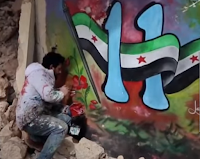
Putting paintbrush to ruins


 'Bombed homes, schools and buildings take up most of internationally renowned artist Aziz Al-Asmar’s view, no matter what direction he is looking in. So, he decided to make them his canvas, on which he continues to touch the world with his creative statements, as he depicts the sorrows of Syria’s war, and stands in solidarity with the world’s deepest devastations.

 The 50-year-old Syrian artist was living in Beirut, Lebanon when the ongoing Syrian uprising began in 2011, and President Bashar al-Assad’s régime violently cracked down on peaceful pro-democracy protesters.

 Yet at a time when most people inside Syria were trying to flee for their safety, the creative father of three made the difficult decision to return to his country in 2015, to serve it with his talent.

 “The decision to return to Syria was fraught with risks, but life is about principles and I considered that what I am doing is a human and moral duty,” Aziz said.


 He said his goal was to “tell stories of the revolution and Assad’s crimes” from inside Syria, including the régime's unlawful arrests, torturing and killing of civilians. The first mural he painted was 30-metres long and bared the names of 600 martyrs who were killed in bombings in his village of Binnish. His most recent was a mural marking the 11th anniversary of the Syrian revolution, which citizens across Idlib commemorated in March.

Aziz says his creative process includes meeting with a group of painters, doctors, journalists, teachers and language specialists in a studio almost every day to discuss the situation in Syria and exchange ideas for paintings. The artist also participates in discussions on global events to inspire his artwork, as he produces murals in solidarity with various social justice cases around the globe.

These include his famous murals of George Floyd – a Black American man killed in 2020 by a US police officer – and of former German Chancellor Angela Merkel, who he thanked, following her resignation from politics, for welcoming Syrian refugees into her homeland with open arms. The artist has also painted in solidarity with Ukraine during Russia's brutal invasion of the country which began on 24 February.

“Painting possesses a humanity that makes us search amid the rubble of our broken hearts and burning dreams for a space of feeling and solidarity, with all the grievances of people of different races, languages and religions,” Aziz said. For it is an unfortunate and deep understanding of pain – gathered through “horrendous scenes” the artist has witnessed in Syria – that allow him to relate to the suffering of others’ so fervently.


 For Aziz, connecting with humanity through art has extended to providing local Syrian children with a momentary escape “out of war and sadness, by allowing them to draw and colour their wishes and dreams” with him. The artist says this has been his greatest reward throughout the conflict, as he has painted with children in schools, displacement camps and other areas bombed by the Syrian régime and Russia, with an aim to boost morale and provide hope.

 However, Aziz's contribution to his community doesn’t stop at art. The artist told of many occasions where he has volunteered with the Syrian Civil Defence – otherwise known as the White Helmets – who provide humanitarian assistance to civilians across the war-torn country.

“A human heart doesn’t let you sit still, you want to see who’s hurt, who has been killed, and try to help,” he says.

 “I have wiped away the tears of many orphaned children who lost their fathers and mothers… you would never be able to imagine the extent of the atrocities we have lived. I witnessed many massacres and I helped to collect civilian body parts laying around to bury, out of respect for the dead,” he reveals, explaining that bombs would physically tear their victims apart.


 Despite Aziz living out what he believes to be his duty, his decision comes at the troubling cost of knowing tragedy could strike at any second. “Sometimes when my children would sleep, I would sit next to their mattress and ask them to forgive me for bringing them to a place that has war, bombing and displacement… but I didn’t have a choice, my heart and conscience could only be at ease on the side of the vulnerable civilians,” he says, sharing that he regularly prays for the safety and future of his children.

 However, Aziz believes his “pure intention to do good” is what opened more doors for his talent to be seen than ever before. This extends to his children – who he describes as “geniuses whom God has endowed with many talents.” This includes his 13-year-old second-born son Muhammed, who was nominated for an International Child Peace Prize award for delivering messages of Syrian children’s suffering to the world.

“In Beirut, our talents weren’t shown, in Syria despite everything, our talents have a voice globally… and that’s thanks to God because we’re doing our duty,” Aziz says.

 The artist vowed to continue to draw attention to humanitarian cases and "share the world's joys and sorrows" using his colours, with a strong conviction that “painting is a universal language understood by all".

 However, he says his hopes for a peaceful Syria require international help to be actualised. "International communities must work to help stop the war in Syria and wars everywhere," Aziz says, demanding that they "put an end to the crimes of tyrants, and turn their prisons into schools, hospitals, and institutions that serve humanity." '


Wednesday, 16 March 2022

March in Idlib to mark revolution's 11th anniversary


  'Syrians filled the streets of Idlib as they marched to commemorate the 11th anniversary of the Syrian revolution on Tuesday.

 Syrians reflected on the "very difficult" times they've lived through over the past decade but joined forces in a display of hope demanding an end to régime rule.

 "The demonstration today was one of the most beautiful demonstrations because thousands of people gathered yet shared one heart, all calling for the overthrow of the Syrian régime and demanding to return to their homes," Idlib-based journalist Izzedin Kasim said.

 "Personally, I lost my country and my house was destroyed, and I live in a rented place and the humanitarian conditions are very difficult," Kassim added.

 He insists that despite the effects of the war on him, his work as a journalist has given him a strong sense of duty and purpose.


 Many still hold that the years of struggle were necessary, including Idlib-based photojournalist Yousef Gharibi.

 "The past 11 years were difficult and brought many tragedies, but they were necessary in the path of reaching the Syria we dream of... a free Syria without a tyrannical régime without corruption and criminality," Gharibi said.

 Idlib and parts of Aleppo province remain the only areas in Syria to be held by the Syrian opposition.

 Fadel Abdul Ghany, the chairman of the Syrian Network for Human Rights, believes there will be more developments in the revolution in the years to come and despite the military failures of the rebels, the uprising has achieved success in other ways.

 "I don't think the revolution has been defeated... there will be other waves... we succeeded in other aspects like in the human rights and media aspect like [achieving] international condemnation of the régime," he said.'

Saturday, 5 March 2022

The West must first change its views on Turkey


Jamil al-Omar:

 'Frightened faces, corpses on the streets and fireballs equating to an inferno. The masses of refugee waves do not break off. Images to which one should have become accustomed. At least when it comes to Syria.

 This time however, the threat of Russia has arrived at Europe’s doorstep: Ukraine. Many believe that if they succeed in their invasion of Ukraine, the Baltic states and Scandinavian region could be their next target. Russia’s will to expand over the past decade, both militarily and politically, cannot be denied anymore. After their military campaigns in Syria and Libya, their presence in the Middle East has become a fact.

 Through the Hmeimim airbase, on the Syrian coast and the naval port in Tartus, they attained their only real access to the Mediterranean Sea which endangers the southern flank of Europe. Furthermore, it “poses a serious threat to Lebanon, Turkey and Israel in the long term,” warns Levent Kamal, a Turkey-based Middle East researcher. A deal was signed in 2019 which allows Russia to use the naval facility free of charge for 49 years and gives the Kremlin sovereign jurisdiction over the base. The agreement also allows Russia to keep a dozen warships — including nuclear-powered vessels — at Tartus, the only navy facility the Kremlin possesses outside the former Soviet Union.

 Additionally, “the presence of Iran-backed Shiite terrorist organizations, which Russia uses as a ground force in Syria, is a regional risk,” he adds. “The Russian Airbase in Kheimimim is used as a platform for Russian ops abroad, especially in Africa. They are already replacing Western support in several countries like Libya (done) or Mali (ongoing)”, notes the Twitter account Qaalat Madiq, a military analyst specializing in Syria.


 The question arises as to how this could have happened and why no one has already tried to stop Putin’s quest for power in Syria. “It should be noted that the Syrian issue was not seen as a NATO issue”, states Levent Kemal. The final nail in the coffin was when the “NATO withdrew the Patriot systems in Turkey when the Turkish army shot down the Russian warplane. Thus, the most favorable environment for Russia was created.” This attitude was, nevertheless, not without consequences. “Russia took advantage of the power vacuum that was created when the US openly signaled its lack of interest in playing a more assertive role in Syria,” explains Dareen Khalifa, a Senior Syria Analyst at the Brussels-based International Crisis Group.

 Analysts claim that the only real obstacle for further expansion for Russia in the ME is Turkey and its allies in Syria. They add that Turkey has proved that they are the only one who can be a game changer on the ground in the long term. “So far Turkey has been quite successful in deterring further régime advance in Idlib post 2020”, according to Dareen Khalifa.

 To bring about real change, it takes more. Because although Turkey “does not hesitate to take a practical-military stance actively against Russia and Iran”, it seems that “the Western world continues to act as a Christian club as the Ukraine crisis has shown”, claims Levent Kamal. “The West must first change its views on the Turkish government.” As long as this attitude does not change there seems to be little hope of change either.”I do not think that support for Turkey will come true, even if it is against Russia and Iran” is Mr Kamal’s pessimistic assessment.

 It seems that this assessment is not a groundless one. The war in Ukraine gave the lie to NATO’s supposed incompetence. The West hasn’t spared any effort towards supporting the Ukrainians in defending themselves by funding and supplying them mainly with weapons, including anti-tank and anti-air missiles.


 Consequently, according to many, the right time for the West to support Turkey and its allies in Syria politically, economically and militarily is now. The Syrian Interim Government already released an official statement requesting the West to support them militarily to counter Russia in Syria. They reiterated that they stand in solidarity with the Ukrainians and that they are the most aware of the crimes and brutality that the Russians are capable of causing. The statement added that the international powers must rectify their mistake of neglecting Russia’s expansion in Syria and that their revolution is inseparable from humanitarian values ​​and interests.

 What could such support look like? “This should be support that includes military, political and economic elements.” Else “it would be unreasonable for Turkey to enter such a risky process without receiving economic, political and military guarantees,” clarifies the Middle East researcher Levent Kamal. Dareen Khalifa can only agree: “Ankara could benefit from its allies’ military and diplomatic support to push against Russian ongoing pressures that are straining the truce.” Because one thing is certain. NATO’s refusal to stand by its partner Turkey against Russia is already being paid for in Ukraine. And the conflict could have even more far-reaching consequences if there is no early awakening: “New waves of conflict in Syria will come at a grave human cost and will have implications that go far beyond Turkey. It’s unfortunate that other NATO members are yet to take these threats seriously,” warns the analyst.'

Thursday, 3 March 2022

Rebels seek passage to Europe for revenge against Putin


 'Foreign fighters from various countries have begun making their way to Ukraine in response to Kyiv’s call for help fighting the Russian invasion – but for Syrian rebels seeking passage to eastern Europe, the battle is intensely personal.

 Several Syrian fighters in northern Syria and Turkey said they were trying to travel and take up arms against Russia.


 Since 2015, Moscow has been waging war in Syria on behalf of President Bashar al-Assad, and while Russian warplanes stage occasional air strikes, the front between opposition-held and Damascus-controlled territory has cooled in recent years.

 The opportunity to take revenge on Russia elsewhere has been too good to miss for some rebels. Particularly, some say, as foreign-brokered ceasefire agreements have restricted them from launching attacks on Russian forces in Syria.

 So far, the most prominent rebel to announce his intention to fight for Ukraine is Suheil Hammoud, a man commonly known by his honorific nickname Abu TOW, a nod to his prolific record using anti-tank missiles.

 Hammoud has reportedly destroyed 145 targets using TOW missiles, including modern Russian tanks. But his biggest scalps were two Russian MiG-23 fighter jets, which he says he hit at Aleppo military airport.

 “I am in touch with several sides to get out of Syria and reach Ukraine, to confront Russian forces along with my Ukrainian brothers,” Hammoud said from Syria’s northwestern opposition enclave of Idlib.

 “I am trying to go in person in any way. I don't plan on going with my entire team, for their safety.”


 Russia massed nearly 200,000 troops on Ukraine’s border before beginning its attack on Thursday. It is believed more than a third of those forces are now in Ukraine.

 The Ukrainians have defended well so far. During the first 24 hours of the invasion, the Russian army incurred more losses than during the eight years in the Syrian war, according to the Economist. But already Russian bombing is become fiercer and more indiscriminate.

 “It's definitely a tough and fierce battle, yet I'm ready to fight until the last Russian soldier in Ukraine, or until the fighting returns in Syria,” Hammoud said.

 “The fronts are inactive here in Idlib. Russia is unable to launch an attack in Syria in parallel with the Ukraine attack and Syrian forces are not capable of launching an attack on their own.”


 Now five days into the Ukraine war, observers are looking to Syria to draw conclusions about what might happen next. The portents are not good.

 Russian forces have been involved in killing about 7,000 civilians in Syria, according to the Paris-based Syrian Network for Human Rights. They also targeted around 1,300 vital facilities in rebel-controlled areas, including several hospitals.

 Moscow’s intervention decisively swung the conflict Assad’s way, after initially facing difficulties. Already, banned cluster weapons used by Russia in Syria have been seen deployed in Ukraine.


 Alaa Qatarmez was a sergeant in the Syrian army until 2012, when he defected to the opposition. He said that he too plans to go to Ukraine.

 “I left the rebels two years ago and now work as a vendor in Idlib because of the lack of battles,” said Qatarmez, using a pseudonym for security reasons.

 “We have innocent civilians, including children, who were killed by the attacks of Russian forces, so Russia must be fought anywhere in the world.”

 Like many other rebels and former fighters, Qatarmez has sought help travelling to Ukraine on Facebook groups.

 “I'm trying to get in touch with a Ukrainian embassy to go, or at least fighters there. I'd like to give them some of the experience we got during the war,” he said.

 “We have old vengeance against Russia, which history cannot erase. I eagerly await the day when Russia will collapse.”


 Any expectations that Syrian rebel forces might use Russia’s distraction in Ukraine as a chance to launch an offensive and regain some of the territory it lost after Moscow’s intervention should be dampened.

 Though on opposing sides in both Syria and Ukraine, rebel-backer Turkey and Russia have a pragmatic relationship that has held Syria’s northwest in a quasi-stalemate. Ankara, a member of Nato and ally of Kyiv, is proving a forceful critic of Russia and has provided material support – most notably Bayraktar TB2 combat drones.

 But it is also treading a careful line, unwilling to provoke major escalation. There is little chance it would allow Syrian rebel groups it backs to attack Russian forces, or even Assad’s.

 That hasn’t stopped some of the nearly four million Syrian refugees in Turkey from hoping for a fightback.

 “We are tired of our status as refugees. I have relatives held in Assad's prisons, and others who have been killed by Russian attacks must be avenged,” one said, speaking anonymously due to security concerns.

 “I hope that an organised attack against Russia will begin in Syria, to fight in my country,” he added.

 “But we have no leaders or an organised army, it is just sporadic factions, some of which are Islamist, which raises the concerns of the local population and western supporters.”


 The contrast between Ukraine’s potent resistance over the past few days and the collapse of the Syrian opposition cause in recent years has been galling for the refugee.

 “Ukraine has an organised army that wants to fight. Even Ukrainian politicians have taken up arms to fight the Russians, while our ineffective politicians were the first to flee Syria, 11 years ago,” they said.

 Though the Turkish-backed Syrian National Army (SNA) rebel grouping on Tuesday denied it was unable to attack pro-Assad forces because of the ceasefire, fighters who have broken the truce previously have been punished.

 Last month, the release of one rebel leader, who had been expelled from the SNA and imprisoned for nearly two years for violating the truce and launching an attack on a government-controlled area, was met with celebrations by many rebels.


 The lack of room to fight in Syria likely only increases the will to wage war in Ukraine.

 “There are hundreds of fighters who would like to go to Ukraine, but it is up to our Turkish ally. Will it open the borders?” said Abu Amin, who monitors Russian and Syrian warplanes under the name Observatory 80.

 “There are young men who may go as volunteers because it is a great opportunity to take revenge on the Russian forces when they cannot launch an attack here.”

 Perhaps, he suggests wishfully, a Russian defeat in Ukraine could also turn the tables in Syria.

 “If the Russian forces in Ukraine are defeated, they will withdraw from Syria, and this means that the rebels will reach Assad's palace within weeks, ending the suffering of the Syrians forever,” Abu Amin said.'


Sunday, 6 February 2022

Assad's rehabilitation at the expense of the Syrian people


 Bente Scheller:

 'The circumstances that caused Syria's membership in the Arab League to be suspended in 2011 have not changed. At that time, the régime was urged to release all prisoners, withdraw its tanks from the cities and launch negotiations with the opposition. Assad agreed to these requirements, but did not even pretend to go about meeting them.

 In the intervening years, hundreds of thousands of people have been killed in Syrian and Russian air raids and over half of the country's population has been displaced. Tens of thousands of additional citizens have "vanished" over the years, many of them presumed killed, in most cases by the Syrian régime. The massive human rights violations have led to a series of for the most part targeted sanctions by EU member states. Two years ago, the USA expanded its range of instruments through the Caesar Act (Caesar Syria Civilian Protection), which also imposes indirect sanctions on third countries if they maintain relations with the régime or support reconstruction in Syria.

 Instead of punishing the régime's transgressions, however, some Arab League member states reason that normalisation will serve to create "step by step" incentives for the régime to change its ways. While this may well work in other contexts, the assumption runs counter to everything that past experience in Syria has taught us.


 First of all, it is not as though the régime has been running on empty for the last few years. Despite targeted European sanctions against the highest-ranking government representatives in Damascus, they have always found ways to enrich themselves. Syrian passports are among the most expensive in the world. And thanks to predetermined exchange rates, more than half of every dollar in humanitarian aid goes straight into the pockets of the Assad clan. Relatives of those who have been arrested or disappeared are extorted at all levels of the judicial and security apparatus. Many of them have paid exorbitant sums to learn about the fate of their loved ones.

 But even in this cynical business, the régime has never felt obligated to provide any real quid pro quo. Most of those affected have been fobbed off with lies and contradictory information. And hardly any prisoners have been released; instead, prison conditions are becoming increasingly desolate.

 The régime has shown interest only in its own political survival – under conditions that should be as comfortable as possible. The plight of the general population appears on the other hand to be a matter of no concern, with any improvement even deemed undesirable. The more difficult it is for people to go about their daily lives, the more dependent they are on reconciling themselves to the present régime and the less freedom they have for political engagement. The economy and commerce are controlled by a tiny elite close to the régime – the same people who stand to benefit from normalisation.


 The idea of incentives is not new. The humanitarian aid organisations have made repeated attempts to apply the "more for more" formula, but with little success. While the régime laid siege to millions of its own people between 2012 and 2018, it could not be swayed even by offers of more aid in territories under its control to grant better supplies for opposition regions.

 The Chatham House think tank estimates that a resumption of Syria's trade relations with Arab states would bring $2.41 billion into the country over the next four years, $2.17 billion of which would go to pro-régime forces. And British experts predict that, even of the remaining $240 million, a quarter would remain in government coffers in the form of taxes, fees and bribes, while living conditions for the general population would continue to deteriorate.

 Stability is in fact the key requirement if the standard of living is to improve – but that is exactly what the régime wants to avoid, seeing as it thrives on sowing fear and insecurity. In the meantime, it is questionable whether the present régime would even be able to create a sense of security again, because many army units and militias have long since gone rogue and divided up spheres of influence and business sectors amongst themselves. And without security, no outside investments will be forthcoming that might revive the labour market. Not to mention that those governments that now desire "normalisation" are certainly not acting out of altruistic motives. The social realities in Syria were not an issue in any of the pronouncements made by the United Arab Emirates or Bahrain on the steps to be taken toward normalisation.

 This kind of "step by step" normalisation would in fact only fuel social tensions in Syria further, serving as even more of an incentive for the régime to continue its repressive policies in order to benefit from the large profit margins in trade. According to UN Secretary-General Antonio Guterres, 90 percent of the Syrian population was already living below the poverty line by March 2021.

 The states in the region should know better than to hope that their offers will change anything. The last time they launched advances for normalisation, before the Arab League summit in Tunis in 2017, Assad showed neither remorse nor gratitude for their cautiously extended hand. He was still waiting for an apology from the organisation, diplomats from the region said at the time.


 The Syrian régime's policies were the only reason why the so-called Islamic State could become so strong, and Assad simply let it have its way. For neighbouring states, this was and is still a menacing, destabilising situation, even after the formal end of the caliphate in 2019.

 Before the war, Syria was known as a producer of generic drugs, and now it is synthetic drugs that are being smuggled out of Syria. But Assad's policies also pose less obvious risks to the region. Polio, officially eradicated in Syria in 1999, reappeared more frequently there after 2011 and spread to neighbouring states – because Assad refused to fight the disease, supported by the World Health Organization (WHO), which has always shown itself to be pro-régime.

 With targeted bombing, the Syrian and Russian air forces have destroyed around 40 percent of Syria's hospitals, and others have sustained serious damage. Only one-third of the physicians and nurses in the country before the war are still there. The intelligence services have set up separate departments to deal with employees in the health-care sector and have criminalised the provision of care to those deemed disloyal to the régime. This policy, designed to target the most vulnerable, violates all international norms and ethical standards. And it obviously also prevents the coronavirus pandemic from being contained, which in turn affects neighbouring countries.


 Whatever the expectations harboured by advocates of normalisation in the United Arab Emirates and Bahrain, they will not be met, even if Assad were to make commitments as he did in 2013, which is unlikely. At that time, the Syrian régime narrowly escaped US intervention after using chemical weapons to kill about 1,000 people. It joined the international chemical weapons convention and declared its arsenal destroyed in 2014. But even today, eight years later, it has still not answered 20 of the 24 questions that were still open at the time. Experts at the Organisation for the Prohibition of Chemical Weapons (OPCW) believe that Syria's sarin stockpile was never completely destroyed. If anything, attacks with chlorine gas increased. When Assad absolutely has to, he delivers, but only half-heartedly and incompletely.

 A key goal of the countries surrounding Syria as well as some of the European states hosting refugees is that those who have fled should be able to return to Syria. But this will never happen under Assad's régime. There is no lack of lip service from Damascus about "welcoming" them back. However, even the Lebanese government, which maintains good relations with Damascus, confirms in its statistics that Syria's security apparatus has accepted only 20 percent of those willing to return from Lebanon. The recurring fighting in Daraa on the border with Jordan and the ongoing threat to Idlib in north-western Syria are likely to lead to even more Syrians trying to leave the country rather than to anyone returning in the long term.

 Frustration in the neighbouring states that have taken in many Syrian refugees could result in violence against refugees or even forceful attempts at repatriation. Outside the region as well, anti-asylum governments like Denmark's will surely also cite a desire for normalisation as evidence that the situation in Syria has improved. But with this form of normalisation, the Syrian population only stands to lose.'


Monday, 31 January 2022

Survivor of Assad's Chemical Attack on Ghouta


 Ali Zawawi:

 'Before the revolution, I was an English teacher. I was continuing my studies at the University of Damascus. I was married, and lived in Damascus. During my time in Damascus, I always dreamed of leaving Syria, and travel abroad somewhere where I could be more free, and have more freedom. Because in our country, people are not treated like a human. They are treated like anything but a human. You can't talk about politics, you can't talk about religion, you can't talk about the economy. You can't talk about anything related to the régime.

 It was a taboo to talk about these subjects. People didn't feel comfortable living in Damascus, or in Syria in general. You are always under threat of being taken if you talk about any of these topics, or if you touch anything that's related to the régime. I felt that I have to move, but I had to finish my studies first, and in Syria, military service is obligatory, so I had to go to it. I didn't know how to run away from it.

 As long as you are studying, you can avoid it, until a certain age, which was 26 or 27, my age at the time, when it's mandatory, you have to go through this service. It doesn't go through anyone's mind that you're serving the country; actually you're serving the officers, you're serving this sectarian  régime that's controlling Syria.


                                *****************************************************


 The revolution was at its very beginning as I was due to go for military service. At that moment, I decided to go to Ghouta, which was seemingly liberated. I wanted to join people who were resisting the régime at that time. I wanted to help them in any means. So I took my family and moved to Ghouta.

 There were so many who wanted to go from the régime to the liberated areas, but they didn't know how. Alhamdulillah I had some friends in Ghouta, who told me how to get inside, because the routes almost all had checkpoints or were blocked, so I had to go through different routes. So I took my family. It was very dangerous to go inside Ghouta, because there was so much bombing, airstrikes. I had never been in this situation, my family with me, my wife and my child at that time. I had only one child at that time.

 Prisons in Syria were already full before the revolution. There are taboos you can't talk about. So whenever someone talks about Islam, you practice it in the correct way, they don't like it. So you are taken to prison, where you might spend years and years. If you talk about the economy of the country, if you talk about the politics of the country, if you talk about the régime, they might take you to jail and spend years and years there, or you might be killed inside the prison. It's the main reason, not just for me, but for many people, and for the guys who got involved in the revolution.

 
                                *****************************************************


 In the beginning, Ghouta was half way besieged. There were two roads open with checkpoints. Nothing large could enter, for example big amounts of food or fuel couldn't go inside unless they were smuggled, inside cars or under the cars. After two years there was a complete siege, and they blocked all the roads, and it became a military area. 

 There were 400,000 people inside Ghouta, and all of them were besieged. You can imagine how difficult it was. Life became so primitive. There was no electricity. There was no fuel to run cars, to run generators. We didn't have any access to food supplies, even to clean water.

 So life was very difficult for everybody. Three or four months after the siege started, you could look at people in the street as if they had gone through a severe diet. They became very skinny and pale. 

 Some of my friends lost their lives trying to get some plastic. Plastic had a very high price in there, because they would melt it down in a special way, and turn it into gas, diesel and gasoline. So at the end, Ghouta became free of plastic. You could see no plastic at all. So the guys had to go between us and the army, in places where the army could see you sometimes, to take a plastic tank or something like that. One of my friends lost his hand, he got a sniper shot in his hand under the shoulder, and other people died, just trying to get some plastic.


                                *****************************************************

 At the beginning, it was only the Syrian army, but as soon as the Syrian army got very weak, because some of the soldiers started to run away from the army coming inside Ghouta, or to go to other towns to join the revolution, Hezbollah came in from Lebanon, and started fighting for the régime. Also, just after a few months, we heard people coming from Pakistan. Shia people coming from Pakistan and other areas. After that, Russia started coming in and helping the régime with airstrikes. 

 Damascus is the heart of Syria, and it really threatened the régime if it was taken, the régime would fall right away. We were just two kilometres away from the heart of Damascus. So if they couldn't get rid of the rebels inside Ghouta, it would have been a big problem for them.


                                *****************************************************

 The chemical attack in 2013 was the biggest one, and I was in the area where we received this chemical attack first. I was in Zamalka city, and I can remember it was a very awful day. It was 2 o'clock in the morning, and I was sleeping, and it was very quiet at the beginning. Suddenly I heard someone running in the alley, and he was shouting, and I could hear that he couldn't breathe very well. I was shouting that there was a chemical attack. Until that moment, I was waking up, and I couldn't comprehend what he was saying exactly, I couldn't comprehend what was going on.

 Just a few seconds later, I felt that I was out of breath; and my wife next to me woke up, and she had the same symptoms, she couldn't breathe well. So I understood there was a real chemical attack. I asked to run away upstairs to the roof. She didn't know why, but suddenly they started throwing more missiles, these are chemical missiles. So I told her to go upstairs right away, and I carried my son upstairs to the roof. She shouted at me to go downstairs, because this is what usually happens when there is a bombing. I shouted at her, look this is a chemical attack, and we have to go upstairs. This is the first measure we were told if we were hit by a chemical attack, because the gas usually goes down.

 It's true to some extent, as when we went upstairs, after just five minutes, I felt I was going to faint. I couldn't breathe well. My two children also couldn't breathe well. I had a very small child, just one year old at that time. I tried to put a mask on him, but he couldn't take it, he doesn't know how to deal with it.

 So I decided to leave the neighbourhood, alhamdulillah I had a car at that time. It was destroyed later by an airstrike.So I took my family and some of my friends in my car. We went north to a town seven kilometres away from Zamalka city. We stayed there for eleven hours. I couldn't breathe well at that time. I had very strange symptoms. My pupils were very, very small. All the people who were around you had small pupils. We had problem breathing, our bodies were very weak.

 The first thing I went to a far area just to get rid of the gas that was around us. I went to a clinic there, but the clinic was full of people, and the symptoms like the ones that I had were mild in comparison, and they didn't treat me. Usually they give you an injection that helps you to breathe better. So I didn't get an injection, I just went back to my friends house. Subhanallah the symptoms we had very very mild, but when we came back home after twelve or thirteen hours, it was a disaster.

 The next alley in the neighbourhood where I used to live, the families all were dead. Some of them were dead in bed, some were dead out in the street trying to get help. Some of the medics were also out in the street dead, they were trying to help other people. Some families were dead, and they couldn't find them after three or four days, because they didn't know how to react, so they went inside the bathroom and closed the doors to keep the gas outside, but sarin got inside and killed all the families.

 There are some very sad stories. I have one of my friend. He was was newly married. He died with his wife and his mother-in-law, in the same house, very close to my house.


                                 *****************************************************


 I think it is a much bigger number of dead than the UN confirmed. Medics would say there were about two thousand people who died at that time, and really you could see the hospitals, the clinics; they were full of children, of women, of different ages; they were dead. They choked, they couldn't breathe.

 We had some remarkable stories of people who were considered to be dead, this sarin gas stops their heart, and after two hours the heart is beating, but very faintly, so the doctors think the person was dead. So they said that some people were buried alive. I'm not sure of this story, but it's what I heard, and we saw some people who were between the dead people, ready to be taken to the graveyard to be buried, but somehow they made a movement, and some people realised they were moving, and picked them up from among the dead people.


                                  *****************************************************

 From the very beginning, the Assad régime started to be very weak. They tried to get help from Shia groups and militias from Lebanon, from Pakistan, from other countries, but it was useless. Even though the fighters who were fighting the régime didn't have big experience in fighting, but they had a cause.


Subhanallah we had a cause to defend. And at the same time, the feeling that we had after moving from the authority of the régime to a different authority of Allah, even though we were bombed with airstrikes with tainted barrels, with all these types of weapons that we never thought we would be bombarded with, we felt happy. We felt free. We wanted to defend that feeling. We wanted to have our freedom.


They used chemical weapons because they wanted to take Ghouta on that day. They were planning to take Ghouta, and they thought by throwing these chemical weapons, and killing massive numbers of people, we would be weak. And this is exactly what happened. When they bombed us with the chemical weapons, after three hours they began a huge military offensive on Jobar, Zamalka and Ein Tarma. These are three big frontlines, but subhanallah they were not successful, and many tanks of the régime were hit, and some the soldiers left the tanks working and ran away. Hundreds of soldiers were killed at that time. So basically they wanted to take Ghouta, they wanted to finish this issue.


                                 *****************************************************


 The main attack was this one in Zamalka and Ein Terma where two thousand people died, but the régime continued using chemical weapons, more than a hundred or two hundred times. We didn't have ISIS inside Ghouta, so it was all coming from the Assad régime. They used different types of gases, but the worst one was sarin. They used chlorine gases too, too much actually. They used it on a daily basis when there was a military offensive. 

 Of course, there is no accountability, and this is what we were shocked by. How the international world is not reacting to these kind of attacks. And not only that, the reaction that they gave and showed wasn't up to the level. Killing two thousand people in one day, this is horrible. It's a horrible thing.

 The other thing that shocked us is they only talked about the chemical attack. They didn't talk about other things. There were about twenty people death toll every day from different kinds of weapons. What about these people? Is it permissible to kill people with tainted barrels? Is it permissible to kill people with airstrikes? So we don't understand how the international world acts.

 People here on the ground, Syrian rebels and civilians, they actually know what's happening, and they understand how the international community is acting, and why they are acting like that.


                                 *****************************************************


 One day, there's a highway between us and the régime. We had ribaat over there, and some of the guys had ribaat on the frontline. So the régime, suddenly sends a woman, and she was naked. They sent her to cut the highway, to come to the liberated area. The guys are looking at her, and are shocked at how she is coming in. There are régime snipers, and suddenly they shot her in the leg or somewhere, and she passed away. The guys tried to reach out to her, with ropes, with metals, to grab her, but it was very difficult. So they decided to send one of the brothers there. He ran very quickly to her, but he received another bullet, and he died just next to her.

 Then another brother ran to her to cover her body, but he also got killed. Then they sent a brother with a rope around his waist, and he ran over there to grab the woman. The brothers told me that he died later on, but they could drag the woman inside our area, and they buried her. It turned out she was one of the sisters in prison, and they wanted to humiliate us with her, by sending her naked to our areas.

 During this revolution, the régime killed about 1.5 million people, and displaced more than 14 million others inside and outside Syria. This is not new, this régime did the same thing in 1982. They killed more than 40,000 people in Hama. There was an uprising that year, and they killed them in only seven days. So this régime has been like that, not just recently, but for a very long time. 

 It's true that Assad has taken these areas, and they are not in the grip of the rebels any more, but the situation is not very clear in the media. They say it has settled down for the régime in these areas, for example, in Ghouta, in Homs, Hama, different parts of Syria especially Daraa, but the situation is different. Every now and then there are assassinations of high-ranking officers. Soldiers are very afraid to go inside Ghouta. Every now and then you hear there is a checkpoint attacked by rebels who were left behind.

 So it's not settled any more, and even people who are inside are fed up with this régime. They thought that maybe the people who were left behind there, they thought at the beginning they might have a better lifestyle when the régime comes back after they break the siege, but it turned out to be so much different. Now they are regretting the days of the siege, and want the rebels to come back to their areas, but unfortunately it's not happening now. 


                                 *****************************************************


 We are still working, and here in Idlib people, displaced people and even the people of Idlib, are helping us, and we are working together, inshallah, to go back to Ghouta, to Daraa, to Homs, to Hama, to all these cities that were with us before. Inshallah we will get rid of this régime very soon.'

Saturday, 29 January 2022

Normalizing Assad Is Dangerous Not Just for Syrians


 Marwan Safar Jalani:

 'Less than 10 years ago, the United Arab Emirates’ foreign minister, Abdullah Bin Zayed, spoke up against the régime of President Bashar al-Assad of Syria for massacring civilians.

 In November, he hugged him.

 The embrace — on the first visit of an Emirati official to Damascus since the outbreak of the Syrian Revolution — felt like a blessing of the al-Assad régime’s atrocities and a stab in the back for those of us who suffered war and displacement.

 Though many of us Syrians watched the hug with a sense of betrayal, we were not surprised: It’s just the latest in a wave of international moves to rehabilitate relations with the al-Assad régime.

 In June, the World Health Organization appointed Syria to its executive board. Interpol readmitted Syria to its network in October. Algeria and Egypt have pushed to reinvite Syria to Arab League membership, and other Arab nations have gestured toward a rapprochement with Mr. al-Assad. And throughout, Mr. al-Assad’s relationships with Iran and Russia appear to have deepened.


 These international bodies and nations appear to have either forgiven, forgotten or chosen to ignore the reasons Syria was cast out from their community. But in doing so, they normalize the atrocities committed by or on behalf of Mr. al-Assad’s régime and risk emboldening other leaders to act without fear of major censure or retribution — as we are seeing with the case of the Rohingya in Myanmar and the Uighurs in Xinjiang.

 By dangerously conferring legitimacy back to a régime that the United Nations in 2013 linked to war crimes and crimes against humanity against its own people, the international community is shattering the norms and customs that hold our world together. Western and Arab powers must keep the al-Assad régime in isolation and pressure any nations and organizations wavering on that commitment to do the same.

 We are a long way from where this started. For at least a short period, the world had seemed to be on our side.

 I was 13 when protests erupted in our eastern Damascus neighborhood of Al-Qaboun, back in 2011. I remember feeling hopeful watching Syrians call for a country free of the al-Assad family, which had ruled us for 40 years. When the régime violently cracked down on protesters, countries severed ties with Mr. al-Assad and froze his régime’s assets abroad. The Arab League suspended Syria from its membership.

 But it soon became clear that Mr. al-Assad was willing to do anything to stay in power. Little was done to stop him beyond imposing sanctions and selectively arming rebels.


 My neighborhood, Al-Qaboun, experienced heavy fighting between rebel forces and government troops in mid-2012. Government helicopters dropped bombs nearby, reducing buildings and our reality to rubble. We feared our house would be next.

 After surviving a two-month-long siege, my family and I left the country. We packed our memories in suitcases, dragging them on the broken asphalt past the fresh bullet holes on the walls of our neighborhood. A year later, the government was reportedly dropping rockets containing chemical warheads on suburbs of Damascus, including Jobar — just a few miles from our home.

 Back then, I felt betrayed by the al-Assad family, who we’d long been told was Syria’s protector. Now, nine years after fleeing my home, I feel betrayed by an international community that is inviting Mr. al-Assad back into its fold.

 Normalization, though, has implications far beyond the borders of Syria. It reshapes and rewrites international standards of how state actors may treat their citizens.

 Accountability mechanisms like special courts and norms around punishing crimes against humanity were ushered in after World War II through the 1945 signing of the London Charter, the Nuremberg Trials and the special tribunals of Rwanda and Yugoslavia. They were put in place to prevent another mass murder of civilians, to show dictators and war criminals that they cannot get away with atrocities or use state armies to lethally and systematically suppress dissent.

 Yet what has happened in Syria exposed the deep contradictions and flaws within the international human rights system.

 There is ample evidence that the al-Assad régime committed egregious crimes, most notably the use of chemical weapons. That act alone requires the international community to intervene, following the United Nations’ principle of the responsibility to protect. But Russia’s and China’s veto powers on the United Nations Security Council have prevented the U.N. from intervening to save Syrians under bombardment or end the bloodshed in Syria.


 The recent moves by the U.A.E. and others to normalize relations with Syria go even further. They show that with the passage of time, dictators will be embraced again if it suits countries’ national interests.

 Arab nations might be embracing Mr. al-Assad for a number of reasons. It could be an attempt to counter Iran’s economic and political influence in the region. Or they see him as a lesser evil when faced with Islamist militant groups like ISIS. Or U.S. hesitance to unequivocally support its authoritarian allies is pushing Gulf countries to seek common ground with other powers like pro-Assad Russia. Or they’ve decided the potential economic opportunities — like investing in Syria’s reconstruction projects — are too great to forgo.

 But the costs of legitimizing an accused war criminal are much higher than any far-fetched economic or political benefits.

 A régime that has been known to bomb hospitals cannot be a member of the Executive Board of the World Health Organization. A régime that tortures and tracks its dissidents at home and abroad through intelligence services must not regain access to Interpol’s databases.

 Mr. al-Assad’s régime has not shown a willingness to change. This month, in the world’s first trial prosecuting state-sponsored torture in Syria, a German court convicted a former Syrian intelligence officer of crimes against humanity. The régime continues to be accused of human rights violations — including against Syrians returning to the country.

 International bodies must not give Mr. al-Assad something for nothing. They must pressure him to stop human rights abuses. They must develop and apply mechanisms, like the principle of “universal jurisdiction” — as Germany recently did in the landmark case — to seek some measure of justice.

 The United States, France and Britain stress that they are against normalizing Mr. al-Assad, but shy away from urging allies and international organizations not to do so. This issue should be high on — if not at the top — of their foreign policy agenda, because the rehabilitation of Mr. al-Assad poses a direct threat to the post-World War II order — which already faces challenges on other fronts, like with recent Russia-Ukraine tensions. This issue is an easy one to take a stand on. Syria is not a nuclear power or the regional power it once was. Nor is it a major energy supplier. Standing firm against his rehabilitation does not cost much.


 If governments and international organizations normalize relations with the al-Assad régime, Syria’s story risks replicating elsewhere and the ruins of Al-Qaboun risk becoming our new norm.'

Friday, 28 January 2022

Assad the head of captagon trafficking in the Middle East


 Jean-Pierre Filiu:

 'Crimes against humanity, war crimes, organized massacres, systematic rapes, campaigns of enforced disappearances, expulsion of entire populations, the list is long of the crimes already attributed to Bashar al-Assad. Convinced of his impunity, the Syrian dictator has now added the offence of massive production and aggressive marketing of narcotics. The Syrian territory under the control of the Assad régime has indeed become the main production area for captagon, an amphetamine for which Saudi Arabia is the world's largest market. It is then the networks affiliated with the Assad régime which, especially from Lebanon, are responsible for transporting shipments of this drug to the Arabian Peninsula.

 When Hafez al-Assad sent his army to occupy a good part of Lebanon in 1976, he wasted no time in taking his tithe on the already flourishing hashish in the Lebanese plain of Bekaa, then he encouraged the development of poppy cultivation there. Laboratories for transforming locally produced opium into heroin are set up under the control of the occupying Syrian army. The barons of the Assad régime who manage this traffic with great profit recruit for this purpose in Syria bands of gangsters, nicknamed shabbiha, the "ghosts". General Ali Douba, head of military intelligence, is at the head of this de facto cartel, before being marginalized by Bashar al-Assad, who succeeded his father Hafez, in 2000, as absolute master of Syria. The withdrawal of the Syrian contingent from Lebanon in 2005, under popular pressure, completed the closure of this first mafia cycle of the Syrian dictatorship.

 A second cycle began a few years ago, this time in Syrian territory under the control of the Assad régime. The supply has in this case adjusted to the very strong demand for captagon in Saudi Arabia, where the popularity of this amphetamine is undeniable. This synthetic dopant, initially based on fenetylline, is referred to as the “Father of the Two Crescents” ( Abou al-hilâlayn ), because of the two crossed Cs which constitute its trademark. The descent into Syria's militia hell was accompanied by the flowering of local captagon manufacturing workshops, first to supply the fighters with artificial stimulants, then to ensure a source of foreign currency for the local forces. It is in this context that Daesh jihadists have developed their own manufacture of captagon, smuggled either to Turkey or to pro-Assad areas. But the territorial reconquest of the Assad régime, with the major help of the Russian air force and, on the ground, of the pro-Iranian militias, poses it today as the undisputed leader of the captagon on a regional scale.


 The international sanctions affecting the Assad régime have pushed it to a proactive policy of production and marketing of captagon. Operational responsibility lies with the president's younger brother, General Maher al-Assad, head of the Fourth Division, the régime's praetorian guard, already involved in numerous killings and abuses. The captagon production workshops are protected by Syrian soldiers in uniform, even installed in a military zone with restricted access. The tight network of Fourth Division roadblocks throughout the territory under the control of the Assad régime allows the smooth circulation of cargoes of amphetamine. An investigation published last month by the “New York Times”designates two notorious war profiteers as the main “civilian” relays of such trafficking: one, Amer Khiti, was rewarded for his loyal services with a seat as a deputy during the legislative “elections” of July 2020; the other, Khodr Taher, has, in the same spirit, been decorated by President Assad with the Order of Merit.

 This mafia reconversion has enabled Bashar al-Assad, firmly supported by his brother Maher, to manage the tensions which have recently shaken the ruling circle, with the ambitions displayed by the "first lady", Asma al-Assad, and the unprecedented revolt of Ibrahim Makhlouf , cousin of the Head of State. The already close ties between the Syrian dictatorship and the Lebanese Hezbollah have been further strengthened by the need to export captagon from Lebanon to Saudi Arabia. The latter, exasperated by the growing number of seizures of amphetamine, camouflaged in fruits and vegetables from Lebanon, decided, last April, an embargo on agricultural imports from this country. The Syrian régime then fell back on the Jordanian border which, as soon as it reopened in August 2021, was the scene of attempts to infiltrate major captagon shipments. A drone loaded with amphetamines was even shot down as it left Syrian territory. And, last Sunday, a Jordanian officer was killed in a clash with Syrian traffickers. Jordanian authorities estimate that a fifth of the drugs destined for Saudi Arabia could be consumed in Jordan during transit, a catastrophic prospect for a country hitherto spared from narcotics.

 It would obviously take more to dissuade the Assad régime from pursuing, or even intensifying, such a lucrative traffic. The Syrian despot can in any case boast of having transformed his country into the first narco-state worthy of the name in the Middle East.
'

Wednesday, 26 January 2022

The exiled sculptor of 'all that is no longer there' in Syria


 'A Syrian neighbourhood targeted by régime bombing lies in ruins, with bodies and broken toys poking out of the rubble; tall, grey buildings are reduced to crumbling, empty shells, their walls blown away or pockmarked by the blast.

 The scene, captured in devastating detail, has been created by artist Khaled Dawwa, a Syrian exile and prison survivor who now works in France.

 In his colossal work entitled "Here is my heart!", Dawwa is still battling oppression, urging viewers "not to forget the revolution by the Syrian people and all their sacrifices".

 "When I'm working on this piece in my studio, I'm in Damascus. I do everything I can here, while not being there...," the 36-year-old says.

Deeply scarred by the years of repressive rule and violent crackdowns and the loss of friends killed, missing or imprisoned, Dawwa's work is both an act of revolt and memory, targeting "the international community's inaction against dictatorial régimes" in Syria and elsewhere.


 "In the face of the disaster that is happening in Syria, I feel a responsibility because I have the tools to express myself," he says.

 Among several of his massive installations -- including one in bronze -- being exhibited for the first time this year in France, "Here is my heart!" has been on display in Paris and soon transfers to a big national museum.

 Dawwa began the piece in 2018, as régime forces retook the rebel bastion of Eastern Ghouta, on Damascus' outskirts.

 At nearly six metres (nearly 20 feet) long and more than two metres high, it is imposing.

 Using polystyrene, earth, glue and wood, covered in clay, he details the destruction inside and out -- the shattered doors, blown-away balconies, right down to the overturned chairs.

 In the debris, crunched-up bicycles and the wreckage of a bus can be seen -- but also the bodies of a child lying next to his ball and of an old woman.


 "My battle was to not abandon the project, otherwise it was as if we were giving up hope," he says.

 It was during that period he came to understand the impact his sculptures could have.

 Posting a photo of his work on Facebook, he was surprised to see it shared hundreds of times.

 Although risky, he continued to create and post pictures, but then destroyed the sculptures "in order to leave no trace", he says.

 Then, in May 2013, he was seriously wounded in his studio by shrapnel and, on leaving hospital, jailed, spending two months in various prisons.

 "There were thousands of people. Every day, at least 10 would die," he says. "Their bodies would stay for two days next to us, no one removed them from the cell... on purpose."

 Of the horror of the experience which still gives him nightmares, he says: "They broke the memories in my head."

 After his release, he was forced into the army but escaped beforehand, fleeing to Lebanon, then to France in 2014 where he was granted refugee status.


 His street-scene artwork, he says, is an attempt to convey "all that is no longer there; families, memories".

 The Syria conflict, which broke out in 2011, has killed close to half a million people and spurred the largest conflict-induced displacement since World War II.

 Veronique Pieyre de Mandiargues, a founding member of France's Portes Ouvertes Sur l'Art association, which supports artists in exile, said Dawwa "wanted to create a fixed image of what was happening in Syria so that it remains in our memories".

 Lifting her hand to her heart, Syrian psychoanalyst Rana Alssayah, 54, also a France-based refugee, expresses her emotions on first seeing the piece.

 "The magnitude of the destruction that Khaled has recreated, it's so real... I couldn't look at all the details inside the buildings, it was too hard."

 Through this work, "he is saying the sorrow and pain that we can't talk about, he has rebuilt our history." '

Monday, 17 January 2022

January reminds us the torch of freedom is still burning


 Dr Amira Abo el-Fetouh:

 'As soon as the month of January comes upon us, the memories of the Arab Spring are revived, despite all the painful blows that followed as the collective conscience of the Arab people was confined. Nevertheless, the memories remain, and the revolution is part of our history.

 The uprisings that spread in 2011 led to the fall of Hosni Mubarak in Egypt, Zine El Abidine Ben Ali in Tunisia, Muammar Gaddafi in Libya and Ali Abdullah Saleh in Yemen. Some others would have fallen but for outside intervention, such as the butcher of Syria, Bashar Al-Assad, who was close to being overthrown before the Russians saved him. He preferred Syria being occupied by Russia rather than following his predecessors out of Damascus.

 Assad was not the only one who trembled; the kings and emirs in other Arab countries did too. They feared that their people would also want freedom, dignity and democracy and they would lose their thrones. They found a new ally in Israel, which also worried about the Arab Spring uprisings, especially in neighbouring Egypt and Syria. The counter-revolutionaries based themselves in the UAE, and turned spring into a bloody autumn, not least in Syria, Libya and Yemen. They wanted to intimidate anyone tempted to organise a demonstration or even think about demanding freedom, democracy and a decent life.

 Saudi Arabia and the UAE stood against the will of the people and supported the tyrants, including Assad. The revolution in Syria is the greatest of all the Arab revolutions. It is unprecedented in that the country and people have made so many sacrifices while being menaced by regional and international states, each seeking a share of the spoils. The Syrians paid for this with their blood. Even the self-styled "friends of Syria" abandoned them.


 The Syrian revolution started in Daraa in the south west, when a number of children wrote graffiti on their school walls, with slogans popularised in other countries, such as "Leave, Bashar" and "The people want to overthrow the régime". The régime responded by arresting the children, none of whom was more than 13 years old. They were abused and tortured; fingers and genitals were cut off. Eleven years after being displaced from Daraa, these children were men defending Idlib, the only liberated part of Syria, and protecting it from the brutality of the régime and the Russian occupation.

 When their families asked about the youngsters, they were insulted, humiliated and kicked out by security officials who told them to forget these children and have some more. Protests followed, with hundreds and then thousands of Daraa residents joining in. The brutal régime responded with live ammunition and killed dozens. The people grew angrier and the city of Daraa was besieged. The residents of local towns and villages protested in solidarity with Daraa.

 Hundreds were arrested, including Hamza al-Khatib, 13, whose body was handed back to his family with signs of torture; his neck was broken and his genitals had been cut off. Pictures were shared on social media and shocked millions of Syrians, so they too took to the streets in most of Syria's cities. Hamza al-Khatib became the icon of the Syrian revolution.


 Statues of the killer Assad and his father were toppled, and his pictures were torn down, trampled on and burned. The security forces were unable to disperse the protests so the army stepped in. Thousands were killed.

 This changed the course of the peaceful protests, which became an armed revolution to protect the people. The Syrian authorities were responsible for this, leaving weapons lying around and releasing Islamists from prison so that Damascus could claim to be fighting a "war on terror" against armed terrorist groups. The régime thus turned the revolution into a civil war, in which it was supported by Lebanon's Hezbollah militia and some of the Shia militias from Iraq and Afghanistan. When it could not bury the revolution, Iran's Islamic Revolutionary Guard Corps appeared led by the criminal Qasem Soleimani. Entire villages were destroyed and thousands of Syrians were killed; thousands more were displaced, most of them Sunni Muslims. He turned it into a Sunni-Shia war, but was still unable to kill the revolution. The Assad régime would have fallen without Russia's military intervention that shifted the balance of power with its aircraft and missiles that reminded us of its war in Chechnya and the scorched-earth policy that was also implemented in Syria. The criminal régime used chemical weapons and explosive barrels dropped on the heads of people and they died under the rubble of their homes.


 With the entry of Russia, the balance tilted towards the régime, and the liberated cities began to fall, one after the other. After controlling just twenty per cent of the country, the régime now controls eighty per cent; only Idlib remains for the revolutionaries. They are pouring in from other cities after international interventions and the understanding between Russia and Turkey. Idlib is not yet rid of the crimes of Assad's military and the ongoing attacks by Russian forces, despite agreements.

 This is the story of the Syrian revolution in a nutshell, the story of the struggle of a great people who seek freedom and dignity and have sacrificed what is most precious to them only to be betrayed. However, the story has not ended. Revolutions, like wars, have battles and various rounds until matters are decided, the winner is declared, and the curtain falls. The revolutionary embers still glow in the heart of free Syrians waiting for their moment to come again.

 That is what I am reminded of every January. The torch of freedom is still burning, and we should not forget it.'