'It must be remembered that before 2011, Syrian civil society did not exist, whether it was activism or real involvement in life in Syria. The few NGOs that there were were all controlled by the régime, like that of First Lady Asma al-Assad, the Syria Trust for Development, founded in 2001. This was very carefully presented to the public and to donors who wanted to believe that after 30 years of Hafez al-Assad's reign, there would be a movement conducive to reforming the system. When the uprising began, in the light of the revolutions in Tunisia and Egypt, the Syrians felt their time had come. Of course, we had the Damascus Spring in 2000, when Bashar al-Assad came to power. The difference between the “two Springs” was that the first one emerged with the voice of intellectuals, like Riad Seif, Riad al-Turk and Aref Dalila. Literary salons have emerged; this moment was limited and limited in time. After 30 years of dictatorship, they hoped that Bashar would be a little different.
Spring 2011 was made up of a whole new generation of activists. I personally focused on the 10 years leading up to the revolution. It didn't come out of nowhere, it happened because these people were frustrated with their miserable living conditions. They saw that their patience was going nowhere. You have to put the pieces of the puzzle together to understand why civil society has exploded with rage: ten years of failure, despair, deterioration of the economic situation, etc. The spark that led to the Syrian revolution occurred in Daraa. It was a burst of indignation, the Syrian youth mobilized as a whole and understood that it was a turning point, a question of life or death. It is important to note that this revolution was a success, it enabled a real movement of activism to begin in the first years of the conflict, even during the régime's military assaults which immediately followed. The generation of 2011 was inspired by the ideas supported by the intellectuals of the 2000s. An important point to underline is that civil society discovered itself, by bringing down the walls of oppression. Local coordination committees have sprung up across the country.
The smear campaign against the White Helmets, psychological warfare during the Siege of Aleppo and revisionism after the chemical attack on Ghouta, are some of the most unfortunate consequences of what I call "selective anti-imperialism". From day one, the régime's speech was to tell the world that it was the victim of a plot by the West, Israel, NATO and the Gulf countries. It is a speech that Damascus used from the start. A defense system sewn with white thread, but which has been surprisingly popularized. We assumed that many western journalists and movements would understand the Syrian revolution as they did the Egyptian revolution, the Tunisian revolution, the militants in Bahrain, etc. Instead, they started talking about "civil war" from the start. Even though they did not speak exactly like the régime, the situation was described as "complicated", "We don't know what is really going on", they said. It was scandalous. When the chemical attack occurred in August 2013, it was immediately realized that there were people who were so imbued with ideology that they would never let sincere Syrian revolutionaries speak, but that they would give credit to the counter-speech, which was de facto defending the régime, even if they claim they did not. We have many documented examples: Robert Fisk, Patrick Cockburn, Vanessa Beeley and many more. Robert Fisk had an image of respectability, thanks to his long career as a correspondent in the Middle East. He was the reliable, independent journalist that the Western public could count on. In fact, as early as August 2012, he wrote an article after the Daraya massacre. It was a tissue of lies and denials of war crimes, a real horror. When someone claims to be a freelance journalist and gives exactly what the régime wants to read, it means that he is subservient to it.
Thus, we clearly observe that even before the chemical attack, there was an ambiguous tendency towards the régime among some journalists. It wasn't until the chemical massacre happened that this reality came to light. It was a blatant bias, which had not happened so clearly in other revolutions. Important news organizations claimed that this information "had not been independently verified", that it was "presumed". They did not use these terms when it came to régime claims or government-controlled areas. It would have taken a lot of research to bring all of these sources together.
As a result, the public who were not ideologically inclined to understand the situation began to form their thoughts: "It's sad, there is a civil war, nothing can be done about it". The very idea of "extremists" also arose early on, presented as the main opposition to Assad. In fact, there was a very mixed combination of rebels who started fighting the head of state. We also quickly forgot the Free Syrian Army, which was made up of soldiers who defected and were immediately joined by civilians. The whole situation was blurred, also with the arrival of the al-Nusra Front and later the Islamic State group. In the end, the 2016 siege of Aleppo was presented as an equal battle between "two camps", which was not true. A whole hostile rhetoric against the Syrian opposition had taken hold.
Documentation and archiving is the most important work to be done nowadays, due to an explicit revisionism. We live in a time when even the United Nations has retracted its old positions and is now giving the régime a new opportunity. Many people will tell you that this is the most documented conflict in history, not all of the other atrocities in Bosnia or Rwanda were on YouTube, Facebook or Twitter. And yet, we still have to do some groundwork on the subject. The Collective Memory of the Syrian Revolution group has worked for years to document these things, as has The Day After, a civil society group of which I am a part. The Museum of Activism is not just about Syria. The mission of MOA is to show how activists, peaceful in essence, share the same goals: a life made up of dignity, equality, justice. And what the MOA shows is that the Syrian activists are the same as those of Black Lives Matters, Occupy Hong Kong, etc.
Syrian militants have been fundamentally abandoned by other militant movements as well. On the other hand, we see that the Palestinian cause is supported by a number of activists from different sides. For example, when Israel bombed Gaza in May, everyone spoke out in favor of Palestine and Palestinian civilians. The Syrians did the same: they continued to defend the Palestinian cause. But the reverse has unfortunately not happened for the Syrians. When George Floyd's murder took place, Idlib activists painted a mural with the words “I can't breathe,” without this image being popularized, unlike the same type of mural drawn in Gaza that it does. , had gone viral.
I believe that Syrian activism changed the world because first of all it brought about the emergence of a Syrian society, it changed the way a new generation thought about its life, its potential future and made it possible to say : "We deserve the same rights". It changed the way the people we talked about before - the selective “anti-imperialists” - proceeded, as they were exposed as being people who followed certain ideologies and did not follow the fundamentals of journalism. These activists refused to back down and this Syrian activism had a domino effect. I would like to add a point: we often hear now that the Syrian people are divided between people of the opposition and those who are favorable to the régime. Anyone who lives under the régime is considered pro-régime. It is nonsense to me. Residents of areas controlled by the régime are hostages of the régime as much as residents of the Idlib region. They know there is no point in trying to do anything because the world has looked away for several years. The suffering is collective.
The current fiasco is is a direct consequence of the story that says: “Assad won, the war is over. Syria is now safe, so you can go back there ”. This analysis was propagated by elements of the extreme right in Europe. They are gaining ground and also influencing the Danish government and other European governments. Some countries have started to reopen embassies in Damascus or are considering doing so. Consequently, a person recognized as a refugee and who has applied for asylum no longer has this justification. The discourse is now focused on reconstruction and the return of the displaced. This is why the narrative and revisionism have had such a terrible impact on the Syrian people. Demonstrations are no longer enough, we need a much stronger system and an army of lawyers fighting for human rights; we must work to bring Syrian war criminals to justice, as was the case in Germany. It's just a drop in the ocean. In Denmark, the popular photo of Asma al-Natour is very revealing: either you leave Denmark immediately or you are condemned to live in a detention camp. After World War II and the “never again” it leaves a bitter taste. To the physical suffering of the refugees is now added the psychological trauma, a collective trauma that is still alive. The story of these refugees threatened to live again under the terror of the Assad régime tells us that we cannot give up the fight.'
"If you were presented with the opportunity to save an innocent life, without risking your own, would you do it? Most people would. Ladies and gentlemen, the opportunity is presenting itself today. It presented itself yesterday, and every day since march 15th 2011. That is 3,912 missed opportunities to save innocent lives in Syria. In that time, more than 350,000 people have been killed by the Syrian régime, according to the United Nations. I could have been one of those 350,000 people who were killed. As a child, I was detained by the Syrian régime. For three years I was detained. I was starved, tortured within an inch of my life. Instead, today I am standing before you as an example of an innocent life being saved.
My mother saved my life. Her name is Hala, and I want you to remember that name. Despite her husband, my father, and her sons, my brothers, being slaughtered in front of her eyes, during a massacre in my village, al-Bayda, where the Assad régime and its Iranian allies, murdered every man. Every woman. Every child. Even the elderly, the trees, the animals. Very few people survived. Among them was my mother. She led hundreds to safety, and in doing so, she had the courage to stand up to the brutal dictatorship that held me captive for three years.
Instead of complaining about her limitations, she found a way to take actions. And despite many failed attempts to get me out of prison, she kept trying again and again. She persisted until I was freed. Her actions may seem like an isolated event, but I believe that by saving me from prison, my mother set an example of how we must all act to stop the Syrian régime from ta\king more lives, and hold its leaders accountable for the countless lives it has already taken. It does not require a miracle. It just requires courage, action and persistence.
During my time in detention, specifically in Branch 215, I was tasked with numbering the dead human beings, including those of my own family members, in a room where they collected all the dead bodies. During the horrible years of my life in Assad prisons, there was a single month - one single month - where it was different. There was less torture, I even numbered fewer dead bodies. We get more food. I was surprised, but after I was released out of prison, I went back to the media, to check what happened that month. This action, the stopping of torture and allowing the food to enter, was after the public release of evidence, called the Caesar File. The guards feared that they will actually be held accountable.
Unfortunately, the world turned away, and the machinery of death continued. It was only one month. I have had the honour of meeting with Caesar, a brave, humble man, who in two and a half years, in Damascus alone, documented almost 55,000 photos of women, children, and elderly, who'd been tortured to death. Today we have the photos, the documents, the command responsibility, the camera and the flash drives. We have stronger evidence today than what we had against the Nazis at Nuremberg. But still: no international court, and no end to the ongoing slaughter of civilians in Syria.
Recognising the effect of the régime's actions on their own interests, some countries, like Germany, have already taken legal action against key members of the Syrian régime. In doing so, they have challenged the limitations of the international system, using the power of their national courts, to uphold basic principles of human rights and international law.
However, these efforts are simply not enough. I understand there are barriers to action, but I also believe in the international system, in the United Nations and the principles they were founded upon. Ladies and gentlemen, today more than half of the Syrian population are displaced. Inside and outside the country. Well over 350,000 people have been killed, and hundreds of thousands remain in Assad's political prisons.
Earlier today, I spoke on the phone, to another individual. Another Syrian individual, who I'm honoured to call actually a friend of mine by now. Who. from 2011 to 2017, was tasked by the Assad régime intelligence services to bury civilians murdered, from Damascus and around Damascus. Every single week, he buried hundreds and hundreds of innocent victims of Assad's machinery of death. His testimony is proof that what Caesar documented, and what I numbered, continues to this day. We even know where the mass graves are located.
There are countless Syrians who are willing to bear witness to our never again moment. The United nations, I think, should support organisations like the Syrian Emergency Task Force, and other organisations that have been working and documenting war crimes in Syria, and work to support the prosecutions. The United Nations should support mechanisms like the IIM that document the most brutal actions of the Assad régime. As long as the international community is not an option for their pursuit of justice and accountability, these organisations need to be supported, and we should support the establish of a court that can serve the same purpose. Because the people I numbered, including my best friends, and my cousins who died with me in prison; the people Caesar photographed and the gravedigger buried, they're all gone.
My family, my father, and my brothers, were massacred. They are gone. It's too late to save them. The victims of the many chemical weapons attacks that happened in Syria by the Syrian régime, they are gone. We can't save them. It's too late to save them. But there are millions, there are millions, there are millions, who can still be saved. And that is my biggest ask to you, that you save them. That you stop the ongoing crimes. That you stop the killing in Syria.
So, when you wake up tomorrow, before you check your phone or do anything else, I invite you to ask yourself the question: if you were presented with the opportunity to save an innocent life, without risking your own, would you do it? Because most people would."
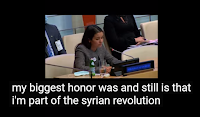
"I am expected to start this session today by telling you: how it's an honor to be here, but I can't. Not if I want to be genuine to the suffering of my people. My biggest honour was and still is that I am part of the Syrian revolution. Which made me hold onto hope with my fellow Syrians, chanting in the streets, daring to dream of dignity, freedom and the state of law.
I'm known as Waad al-Khatib, which is not my name, but a name I chose, to hide my name from the security forces. The same mukhabarat that Omar just talked about, who arrested and tortured him. Omar, who survives today, and gave us so much courage and hope.
I talk to you today as an activist, who protested, who was beaten, who was shot at, demanding democracy for my country. I talk to you as a mother, who gave birth to my first child in a makeshift hospital in East Aleppo, where I was living with my husband Hamza. Hamza is here today. He was an emergency doctor, managing the last remaining hospital [in Aleppo], which was deliberately targetted by the Syrian régime supported by Russia.
I'm talking to you as a refugee who was forcibly displaced after the besiegement of Aleppo in 2016. And now, I'm hearing from so many of your countries' officials and media, talking about how safe it is for us to be returned to Syria. Syria is not safe as long as Assad is still ruling.
And I talk to you as a film-maker, who thought that my mission would be just to deliver the injustice I documented to the world. I, and many Syrians, used to have faith that the world won't let us down. That you, the Security Council, would do everything to stop the war crimes and their genocide in Syria.
One of the women I found, while we were in besieged Aleppo, shouted to deliver this to you. She said, with a six month old baby, 'Film, film, let the whole world see this!' At that moment, I was worried that I would let her down. That I won't be able to survive, and her message will die with me. However, the major disappointment came after I shared her shouting out to the world, and to you. You refused to acknowledge, and this Council refused to act.
I talk to you today, as one of millions of Syrian witnesses and survivors. Of what are defined as war crimes, and crimes against humanity, by laws that you states have created. But where is the outrage when new laws are broken? Where is the action? This Council remains a spectator of the Syrian people. And if you think I am angry, yes, for sure you are right. You have let us down. Your Council held countless meetings through all these events of my life. There are 42 reports by the UN Commission of Inquiry alone, and this does not include Amnesty, Physicians for Human Rights, the OPCW or reports from tens of Syrian organisations.
All of this, and some of you are now discussing renewing diplomatic relations with the Syrian régime. And granting lucrative contracts to warlords, to reconstruct the Assad régime, and what he has destroyed in our country. Because this Council has failed to hold those responsible to account, we Syrians, along with states and international lawyers, have been exploring alternative ways to do so ourselves. For example, with the legal team at Guernica 37, we are working to hold Russia accountable for its targetting of hospitals and medical workers, before the European Court of Human Rights. A court stemming out of a treaty that Russia agreed to. The Russian state, the Russian judicial authorities, have done nothing to investigate and prosecute such conduct that violates the international laws of life. So we must now seek to hold the state accountable for its failures, and we will do so.
We are also working with some states present here, to establish collective international action against individuals responsible for the use of chemical weapons in Syria. The evidence is there, the perpetrators are known; all that remains is the will. It's essential that there is a credible international process to investigate and prosecute the use of chemical, biological, and other forbidden weapons in Syria, and we have identified ways to do so. I'm here to ask you, how are you going to be part of the accountability effort?
We are here today to seek accountability, not only to heal the past, but also to protect the political hope for the future. One day, Syrians will go out into the streets. They will shout again, 'Ash sha'ab yurid isqat an-nizam.' ['The people demand the fall of the régime.'] It is our responsibility today, to make sure they won't face war crimes. It's your responsibility, in your power, to prevent genocide, not only in Syria, but in the whole world.
What messages are you sending to us, to your people, and to your children? What will the next conflict look like if impunity persists? It's OK to torture people? It's OK to kill children? It's OK to bomb hospitals? What sort of legacy are you leaving behind for the next generation?
Today, as we speak, there are over three million civilians living in Idlib, facing the daily threat of their schools and their hospitals being targetted. Their villages of being bombed. We don't want one of them to be sitting in my place next year, briefing you about what happened in the next year. We want all of you to do your part to save them all. You have to save them all.
Sama, my six-year-old daughter, asked me before I came here, why I have to go to New York City. I said, 'Do you remember the kids in Idlib, who the monster just killed? I have to go to speak about them.' She sadly said, 'But they are already dead. Why do you need to go?' For a second, I didn't know what to say. Then I told her, 'I'm trying. I'm trying to do my part, so other children won't be killed.'
So I leave you today with this question. And adding another to what Omar asked. If your children ask you the same thing, will you be able to look them in the eyes, and say that you as state members of the Security Council, are able to do your part?"
"Prior to joining Guernica 37 as a lawyer, growing up as a Syrian, I never ever thought I'll be a witness to the mass historic injustices that I once read about in textbooks. Today the world still holds a chance to hold perpetrators to account, as we have not yet become long distant history. We are very much in the present. This present depends on what the world does today. And by world, I mean states, and by states, I mean individuals here with us in this room today.
In the past we may have had the excuse that we did not know about those crimes. But today we heard over and over about the amount of evidence that is available. The IIIM [International, Impartial and Independent Mechanism], the Commission of Inquiry with 1270 pages of reports, thousands of interviews. And that's just the commission of inquiry, let alone the OPCW, the Joint Investigative Mechanism, and enormous evidence with the IIIM.
All the presented evidence demonstrates how the Assad régime is the main, but not only perpetrator of atrocity crimes that you states present here today agreed for them to be crimes. And so when the Assad régime breaches those laws, it's not a message to us Syrians. It's a message to every signatory state to that treaty, that I can break those laws, and I can get away with it.
Yet somehow, through deliberate disinformation tactics, Syria became a war. Where death is somehow inevitable. As if refugees fled war, not persecution by a brutal régime. Syria is not a war zone. It's a crime scene. And whilst wars may end, crimes linger on. With the crime scene known, the evidence widely available, and perpetrators clearly identified and named, why has this Council not acted?
We are grateful to some of the countries present here with us today, who acted in their individual capacity. Netherlands and Canada using the torture convention which may end up in front of the International Court of Justice. A process which we at Guernica are proud to assist. Germany and France with the numerous arrest warrants we've heard about today. And the UK, with investigation through its Metropolitan Police into high-level individuals, and its Foreign Office looking into collective ways of holding individual perpetrators to account for the use of chemical weapons.
But why have I only mentioned Western states? Why have I not mentioned the Syrian state, as some member states today have mentioned? Well, with all that evidence, not a single prosecution in Syria, and continuous vetoes blocking referral to the International Criminal Court.
We are grateful to Estonia and all the co-member states for hosting the event here today, and the Council must keep accountability on the table. The Council must not shy away from naming perpetrators, starting with the Syrian régime, but not ending with it. Crimes are not committed by themselves, nor by states and abstracts. They are committed by people, and these people must be held to account.
In response to the states that talked about sanctions, fourteen Syrian NGOs and victim groups have called upon Assad to end sanctions. Yes Assad. His crimes attracted sanctions to Syria. And if he were to submit to justice, and to the UN agreed political solution, they will end. We call upon Assad's ally to get him to end sanctions on Syria.
It has been said, that if you torture one person, you may end up in prison. But if you torture hundreds of thousands, use chemical weapons, forcibly displace, you end up in a peace conference. We Syrians will fight to prove this saying wrong, and change the course of history. We hope that you will all join us."
"From here, the term veto, which I heard several times now, might seem like a mere technicality. However, it wasn't. On the 5th December, 2016, Russia and China voted for a Security Council resolution for a seven days truce in Aleppo . Seven days only for safety, and allowing aid for me, my family, and for the people back in Aleppo. I join the member states asking for the limiting of the veto power regarding mass human rights atrocities, so seven days peace won't be such a difficult task to achieve.
Second point, according to a Physicians For Human Rights report, more than 90% of the attacks on hospitals in Syria are the responsibility of the Syrian régime and its allies; Russia and Iran. Those who are demanding accountability, we are demanding it for all attacks. We are not the ones blocking international justice to 90% of these attacks.
Finally, Syria was not a civil war, it is not a civil war, so please stop referring to this in your statements. It was a peaceful demonstration, the whole world witnessed this, and it will always be. We are not the ones who are protecting criminals, and one day, as I see you all here, I am sure that we, the survivors of Syria, will be joining these meetings as a free country, as people who respect human rights, who respect the future of all of us, and we will not be protecting criminals."
"To members who contributed and acted to help the Syrian people in the struggle against dictatorship, and help them during this crisis, I want to say thank-you. And members who limited their actions to statements - statements sometimes helpful, but most of the time they cannot limit the scream when they pull out your fingernails - you need to take action.
And to the member states that helped the Assad régime kill its own people, like the Russians, and the Chinese, the Iranians if they were here, and the disappointing statement from the Indians: I will tell you, let's assume your scenario that the Syrian régime is fighting terrorism. And that you are helping the Syrian régime in fighting terrorism. Let's assume that. How could a régime be respected fighting terrorism after displacing half of its population? How could a régime stay in power when they actually have allowed the displacement of more than fourteen million people? How could they still be in power when they detained me and there's proof that I was detained and tortured and my fingernails were pulled out? There is proof.
I challenge you to get proof from the Assad régime showing that I did any crime. I challenge you to prove that I did any crime when I was detained. As a minor. As a child.
So many survivors try to tell their stories. When you tell your story, you risk your life. So many countries have taken these refugees in, but failed to provide them with the protection. I was called by the intelligence services. I was called by the guard who tortured me for one year and nine months in Syrian prisons. And he threatened me on the phone. And when I talked to the police, I had an answer saying take care, be careful. That's not enough. I learned that from the war, from years in the war, I know, I should be careful. So that's not enough.
We need more help. Some people have fought for so long time. It's just tiresome to see fewer and fewer helping us. So I want to encourage you to take a step. The first step could be just talk to this survivor. Don't listen to them on the phone, come and shake their hands, talk to them. Be present, be close. That's how you take responsibility.
And responding to the sovereignty of the Syrian régfime, what sovereignty are we talking about? This régime has allowed the Russians to lead in Syria, the Iranians to kill in Syria. In Damascus, there are prisons where the Iranians have more power than the Syrian régime. That obliged the Russians in different locations in Syria. What sovereignty are we talking about?
Again, I want to be grateful for the countries that gave me an opportunity to survive. I want to be grateful to Sweden that gave me a home. I'm a refugee in Sweden. I'm grateful. I want to be grateful to Norway, where I found my first love after being in a hateful place in prison. And I also want to be grateful to the US, where Georgetown is my new home, my new place, my new school.
The world, despite all pain, despite all darkness, has hope. And I live for hope. I eat on this hope. And I see that we have potential. If I survived three years of torture on a daily basis, starvation, and psychological torture every day, you can change. You can take action."
'UAE Foreign Minister Sheikh Abdullah bin Zayed Al-Nahyan visited Bashar Assad in Damascus last week, in a further sign that some Arab countries hope the Syrian dictator may change his behavior.
The visit was part of the UAE’s effort to embrace Syria and reconcile with the Assad régime. However, the belief that Assad can change his behavior flies in the face of the proven fact that he is neither willing nor able to do so; a change of behavior would mean his end. No attempt to persuade him otherwise has succeeded, and none will, for the simple reason that his methods of ruling — authoritarian, centralized and brutal, exactly like those of his father Hafez — are the only way he can survive. Assad cannot share power, because sharing power would mean losing it.
Arab attitudes to Syria are divided. While the UAE is normalizing, with the declared aim of helping the Syrians and containing Iran, Qatar has categorically rejected any such approach, and its foreign minister has said that Assad should be held accountable for his régime’s crimes. The Saudi Foreign Minister, Prince Faisal bin Farhan, said the Kingdom was not considering engagement with the régime, although it “understands” the effort by other countries to try to push a certain political process and break the unacceptable status quo. Jordan, meanwhile, feels the need to humor the brutal neighbor on its doorstep after the régime deployed troops in the southwest. It also poses a great danger to the Hashemite kingdom with the smuggling of weapons and drugs. Jordan refers to Assad as a “fact” — but the “fact” is that because Assad’s behavior will never change, there will be no peace, neither now nor later.
The Emiratis speak of bringing Assad into the Arab fold and creating a rift between him and Iran, but their assessment is based more on wishful thinking than on reality. The Russians have had a relationship with the Assad régime from the start, they have had bases in Syria since the early 1970s, and they saved Assad in 2015 when he was on the brink of defeat in the civil war. If they could not drive a wedge between Damascus and Tehran, will the Arabs — in whom Assad has no trust — be able to do so? I very much doubt it.
The Israelis, on the other hand, have a realistic approach to Assad. They say their problem is not with him, but rather with Iran. At the end of the day, however, it is Assad who is allowing Iran to use Syria as transit territory for weaponry to reach Hezbollah. Israel knows that after one week of fighting in 2006, 80 percent of Hezbollah’s arsenal had been destroyed, and it was only after Assad opened the border and supplies started to flow that Hezbollah could continue to fight. Israel’s nightmare now is Hezbollah’s “precision project” to equip some of its 150,000 missiles with sophisticated GPS and render them accurate to within 5 to 10 meters — bringing airports, desalination plants, power stations and other vital Israeli infrastructure within target range.
Hitting targets in Lebanon, or even Hezbollah positions in Syria, will not stop the stream of weapons as long as they can transit through Syria. And no matter how effective or precise the intelligence the Israelis have, it cannot detect every arms shipment. Moreover, Israel cannot act unilaterally against Syria without the blessing of the Russians, and Israel understands Syria’s importance to Russia — at least its previous prime minister did. This is why Benjamin Netanyahu had such a smooth relationship with Vladimir Putin, which Netanyahu’s successor Naftali Bennett hopes to maintain.
Assad is now seeking to open channels with Israel, but the latter has not been taking the Syrian dictator seriously. As far as the Israelis are concerned, “Assad has cried wolf too many times”, one US official told me. In 2007, Turkey tried to broker Syrian normalization with Israel, but Assad had cold feet at the last minute. The Israelis know Assad will not change his behavior, so they will not waste their time in futile discussions.
The Emirati plan is for a step-by-step normalization, meaning that for every concession Assad offers they will reciprocate, and vice versa. But Assad will simply obtain what he needs from them, and then find an excuse to stall the process. This tactic is already visible in the behavior of his delegation at Syria’s constitutional committee; they keep finding reasons to stall the negotiations and not commit to anything. At the same time, they want to give the impression that they are negotiating, when in fact they have no intention of compromising on anything, and have no goodwill.
Previous Arab overtures produced no results. The Emiratis reopened their embassy in 2018, and have lent a helping hand to the regime, but their support resulted in zero change in behavior. Doing the same thing over and over again and expecting different results is a popular definition of insanity. Overtures to Assad in hopes of a change in behavior appear to fall into that category.'
'It was an ordinary day for the Khodr family, working in a poultry house on Bourma Farms in northern Idlib province.
“We went inside the poultry farm’s hangar, and suddenly I saw a bright light and passed out,” Ali Khodr says of the incident a week ago. “I woke up covered in dirt, dusted myself off, and saw my brother Yehya. He wouldn’t answer me. He was dead.”
Russian air raids had hit the farm. Khodr lost not only his brother but also his six-year-old son Hassan, who was picking olives in the yard. Yehya’s wife, Sidra, and their two other children – two-year-old Assaad, and one-year-old Marwa – were killed as well.
“The missile landed just 20 metres or so away from where Hassan was standing,” Khodr said. “Hassan wasn’t going to school then because it was a bit too far, but he did like school.”
Khodr was surprisingly poised, even after having to bury five members of his family.
They had fled the Aleppo countryside because of the conflict and were trying to make ends meet in Idlib.
Khodr suffered head trauma, facial burns, bruises, and a mild eye injury in the attack on the farm. But he dismisses his physical wounds when he thinks about Hassan.
“The Russians say they are targeting armed people. Are these children criminals?” he says. “Let Russia, Turkey, or the United Nations come to the area and see if they can find a hunting rifle, but all they will find is the poultry farm where we raised chickens and chicks.”
At least 60 children in Idlib have been killed in some 700 air raids and shelling in Idlib over the past five months, Syrian Civil Defence spokesperson Moussa al-Zaidan told Al Jazeera.
A truce reached in March last year has been repeatedly violated.
The ceasefire, negotiated between Syrian opposition supporter Turkey and Russia – the Assad régime’s main international backer – ended a régime offensive on northwestern Syria.
Idlib, besieged by the Assad régime which is determined to retake it, relies on a border crossing with neighbouring Turkey, a UN-designated aid delivery corridor allowing aid into Idlib without going through the government in Damascus.
Aid groups and hospitals say it is the last lifeline for about 4.4 million Syrians. About half of them are internally displaced people. Most are women and children.
Ahmad al-Jomaa, 10, survived an air raid that hit near his family’s home in the Aleppo countryside a few years ago. “I remember when the missile hit us, I was right outside our home,” al-Jomaa said. “I remember my mother running over and picking me up.” Three neighbours next door were killed.
His father Zakaria says Ahmad’s pelvis was fractured and he suffered internal lacerations in his stomach and intestines. “Ahmad had to undergo two surgeries and have a mesh installed,” he explains. “He spent 20 or 25 days in the hospital, struggling to eat or drink.”
The 10-year-old has a large scar across his stomach, which does not seem to bother him all that much. He cannot go to school any more, though he says he misses it.
“I would like to study to become a doctor so I can help people,” Ahmad says. “And I would like to go back to school and be with other students, but I have to help Dad because our situation is terrible.”
Instead of going to school in the morning, he and his father work at a local garbage dump from 7am until 3pm. “We make just enough to pay for food and some other expenses. It’s not enough, but this is the work that’s available for us,” Zakaria says. “I do worry about him [Ahmad], but we need him to help us put food on the table.”
Amin says for children in northwestern Syria, it is an endless run to escape one danger after another.
“If they are able to escape the conflict and violence, they often wake up to the destruction of their homes, schools and streets. When displaced, finding a roof or a shelter to protect them is a daily pursuit, as well as finding access to safe water, electricity and sanitation,” says Amin.
What Ahmad seems to miss most is being able to play with children, the way he used to before the air raid. “It’s hard to play with them like before because they like to wrestle and fool around,” he says. “But I can’t because of my surgery.”
His father says Ahmad spends a lot of time playing with a mobile phone after work and does not like to go out. “He just goes to work at the dump and comes back home,” Zakaria says. “He’s just really horrified, and he refuses to leave, even if I suggest we go out together.”
Ahmad says he is afraid an air raid could hurt him and his family again.
Ahmad’s situation is not unique.
In fact, it has become the norm for many children who only know one life, in a displacement camp.
Aziza Ziyada is just five years old, but she has survived several air raids that hit her home and school.
“One time, Russian air raids destroyed our home, but thank God the Civil Defence saved us and pulled us from under the rubble,” her father Abbas tells Al Jazeera. “Once an air raid hit close to her and her brother when they were at kindergarten.”
The family, who come from southern Idlib, fled to a displacement camp further north. Aziza finished the first grade, but cannot continue going to school because of the family’s financial situation.
In the meantime, she plays outside among the olive trees with her brother and the neighbour’s kids. But whenever she hears an aircraft, they run home to their father. “When they hear the sound of a plane, she just runs home in a flash, and she yells ‘Dad, the plane is going to attack us!” Abbas explains. “But I just try to keep them calm. That’s really all I can do.”
Amin says the impact of the “constant barrage of threats” for children will last for years to come.
“Even if they manage to escape physically unscathed, they are traumatised by the violence and the suffering they witness,” Amin says. “A vicious cycle has taken hold of their past, present and unfortunately, now, of their futures.” '
'The life story of Yassin al-Haj Saleh, one of Syria's most important writers, tells a lot about the ongoing tragedy in his homeland. He almost died this year in Paris. He was invited to a podium discussion on the occasion of the tenth anniversary of the Syrian Revolution, and to read from his books in which he explains why there is much more raging in his homeland than just war.
The morning before the return flight from Paris, al-Haj Saleh received a positive corona test result. He was left alone in a friend's apartment. And got very sick. It was difficult for him to breathe, he was in unimaginable pain, but he didn't call for help, just lay there. Three days long. Until the friend worried that al-Haj Saleh wouldn't answer the phone. In the intensive care unit, the oxygen level in the blood was only 86 percent. It was very close, so says al-Haj Saleh. The doctor asked: How did you endure it? Why are you only coming now?
A few weeks later, in June, he says softly, but firmly, in English: "I endured the pain in Paris because I longed deeply to punish myself."
In the face of death he realized again that he was unable to convince himself that it was only a mistake from today's perspective to leave Samira behind in Douma near Damascus, eight years ago. About the fact that they had no choice and couldn't know. At that time, Al-Haj Saleh wanted to go north, to his family in Raqqa, the city he came from, just captured by the rebels, and help build something there. Artists gathered, a new newspaper was published. But the only way out of Douma, controlled by the radical Salafist militia Jaish al-Islam and besieged by government troops, a good 400 kilometres in total, many on foot, would - everyone said - too dangerous for his wife, the human rights activist Samira Khalil. In addition, she did important work for the Violations Documentation Center in Syria (VDC) in Douma, with which she later documented the attack on the Eastern Ghouta, with the nerve gas sarin by the Syrian Air Force in August 2013, in which, according to US data, 1,400 people are said to have died. But Khalil also documented the attacks by opposition members. She would follow al-Haj as soon as it was safer.
Yassin al-Haj Saleh arrived in Raqqa after 19 days, but in the meantime his two brothers who lived there had been abducted by ISIS. Al-Haj Saleh went into hiding with his sister-in-law and her young son. After two months he managed to flee to Turkey, to Istanbul. He and Samira discussed on Skype how their departure would also be possible, the situation changed every hour. The conversations grew shakier. There was hardly any electricity left in the Duma. His great love only appeared blurred on the screen, as if they were getting further and further apart.
On December 9, 2013, Samira Khalil, who despite threats still did not cover her hair when she took to the streets, was found together with prominent activist Razan Zaitouneh and her colleagues Nazem Hamadi and Wa'el Hamada by armed men from Jaish al -Islam kidnapped from the office of their NGO. Since then she has disappeared without a trace. And the author Yassin al-Haj Saleh, whom some call "Syria's voice of conscience" and others the "doctor of the revolution", feels, besides the grief, this extreme guilt for which he believes he has to atone - which is another injustice in its history, rich in injustices.
Yassin al-Haj Saleh was born in 1961 in a village near Raqqa, not far from the border with Turkey, the fourth of nine children, the mother being everything. In the village, he says, everyone was related to one another. They had sheep, chickens, dogs, a donkey - and one day even a school, thanks to the now ruling Arab socialist Ba'ath party. Al-Haj Saleh was an even better student than his eldest brother. When he was eleven years old, he moved with him, just 16, and the second oldest, 14, to the city, Raqqa had hundreds of thousands of residents, in a small room that his father rented so that they could all go to secondary school.
Al-Haj Saleh describes this event as trauma, he was still a child and for the first time and forever without his mother. He started reading a lot of books. The Metamorphosis of Kafka became the most important thing for him. Not only did he himself wake up every morning feeling different from the boy he had just been, the country was also changing: in 1970 Hafiz al-Assad, the general secretary of the Ba'ath party, from the minority Alawite community, became Prime Minister and, with the support of the military and the secret service, began to shape Syria into a left-wing nationalist dictatorship that was oriented towards the Soviet Union. In 1971 al-Assad became president, which he remained until his death in 2000, followed by his second eldest son: Bashar al-Assad.
Yassin al-Haj Saleh no longer knows when he became political. He wonders today if he was political at all before becoming a political prisoner. In any case, when he went to Aleppo to study medicine, like the eldest brother, he joined one of the then two communist parties in Syria. Those who were critical of Moscow. The goals: democracy, real socialism, unity of the Arab states. Above all, he says, Marxism made him feel that he was one of the good guys and that there was a future for his country beyond the ubiquitous propaganda of the al-Assad family. At the meetings of his party group, Muslims came together with secularists, Sunnis with Shiites. On one of these evenings, on the 7th December 1980 at one o'clock in the morning, what Yassin al-Haj Saleh calls "the arrest" happened, the police took him and some comrades away. But it was more of a kidnapping: Al-Haj Saleh was imprisoned for 16 years and 14 days from then on. He was 19 when he got to jail and 35 when he left in 1996. The charge: membership in a prohibited association. Yassin al-Haj Saleh was only on trial after twelve years, and he never saw a lawyer. After him, his brothers were also imprisoned for five and six years. Their mother, sick with grief, died while the sons were locked away.
The worst, says al-Haj Saleh, was not the humiliation, the beatings, the insults. It's time. She was the enemy. The torture. You just stopped your life. After a year and a half, at least books were allowed. He learned English. Noam Chomsky. Hannah Arendt. Anna Seghers. After eight years, the prisoners went on hunger strike to get pens. He wrote letters and small notes, but when you are inside, he says, you can't look at it yet. In time, says al-Haj Saleh, time became his friend. He felt that he was developing, even though he was not moving. An inner journey as he only knew it from the Koran, which had always remained alien to him. "It was an emancipation from all the circumstances that surrounded me," he says. "I became free from the challenges of freedom out there." In 1992, in court, he was offered a deal: If he cooperated with the régime, he would be set free. "Freedom only existed at the expense of dignity," says al-Haj Saleh. So he stayed trapped and yet free, as he found out. He was transferred to Tadmur prison in the desert near Palmyra, notorious for torture and murder. All others who were arrested with him in 1980 accepted the régime's offer, he learned. Al-Haj Saleh was among 300 prisoners who were crammed into 90-square-meter cells in Tadmur.
Yassin al-Haj Saleh completed his medical degree in Aleppo, although he knew that he never wanted to be a doctor. He dissected other people's bodies in the university, but had realized that it was inside himself that he wanted to research. This place, to which he had been able to retreat behind bars, remained his protection even in the overwhelming and abundance of the open world. And writing down his thoughts gave him the security he missed, absurd as it sounds, now that the prison walls were no longer around him. "The prison made me a writer," says al-Haj Saleh. At first he hired himself as a translator, his first assignment: a book by Noam Chomsky. From the year 2000, at almost 40, he published his first texts, in various newspapers and magazines, political analyzes on Syrian society and the Arab states. And yet, says Yassin al-Haj Saleh, he would never have found his place without Samira. They met in 1999 over a meal from former political prisoners. Samira Khalil, an Alevi from Homs, was also imprisoned for membership in a Communist Party from 1987 to 1991. They both knew what they were talking about. Samira, says al-Haj Saleh, also had eight siblings like him. And yet, above all, she was different. So direct. Their laughter filled the streets. Your courage every room. After her release from custody, she ran a publishing house in Damascus. She didn't care that people whispered because she lived alone. Yassin al-Haj Saleh had hoped that he would get to know love, even though he was a man without youth. But he hadn't expected that.
They married on September 5th, 2002, in their favorite restaurant. They found a 35-square-meter apartment in the suburbs of Damascus. The second and short life of Yassin al-Haj Saleh began. A very good one, he says. Of course: he still lived in a prison, now in one called Syria. He never received a passport. But his desk was enough for him to go exploring. Every week he wrote his column for the London newspaper al-Hayat. He knew that he couldn't write everything, and yet he wrote everything, called for reforms, justice and the end of corruption, yes: the free Republic of Syria - but he did that by talking about himself and his everyday life, from the little things the great, out of the cell into the world. There is writing about politics, says al-Haj Saleh, and there is politics about writing. A friend joked that Assad's censors just didn't understand his literary style. And yet they called him in regularly. Al-Haj Saleh sometimes got the feeling that they were only doing this to justify their snooping positions, they had to prove something to their superiors. They always let him go. He was immune, says al-Haj Saleh. How else could they break him?
Soon he was one of the most famous commentators in Syria. He made good money. And more importantly: Samira and he made many friends, especially young ones, from the university, who gathered in their living room to debate. They no longer felt childless. Did you feel free? Maybe. Together they had come further than expected, every new morning with Samira was a revolution.
So it was almost a shock for Yassin al-Haj Saleh when the Arab Spring erupted in late 2010. The mass demonstrations in Tunisia and Egypt. The deposition of those in power, Zine el-Abidine Ben Ali and Husni Mubarak, after a few weeks. Then the first protests in Syrian cities. Al-Haj Saleh wanted to protest, but his friends advised against it. Nobody is that immune. If there was one thing Bashar al-Assad had no use, it was a symbol against him. So al-Haj Saleh stayed at home. At first he believed that the change of power would take as long as pregnancy. The country would be ripe in nine months. But he saw how the army acted against the demonstrators. Heard of the dead. From the Free Syrian Army that formed. And decided he had to get out. He had waited for this all his life. That's what he'd sat for all his life.
For Yassin al-Haj Saleh, going underground meant that he moved into the apartment of a friend who only he and Samira knew about. This is how his third life began. Al-Haj Saleh says that the solidarity during this time was unique. He even wrote about it for the New York Times. There was nothing left to lose. When her niece's husband was arrested and questioned about her, Samira Khalil was also forced to go into hiding. They fled to Duma, where many tried to bring order in the midst of the chaos. These people had been liberated by Islamists. Everyone recognizes the mistake in this sentence, says Yassin al-Haj Saleh.
The frightening normality in which Yassin al-Haj Saleh and Samira Khalil lived in Douma can be traced in the documentary Our Terrible Country, which was released in 2014. The young filmmakers Ziad Homsi and Mohammad Ali Atassi accompanied al-Haj Saleh in 2013 on his excruciatingly long journey to Raqqa, into a supposed future, with a group of intellectuals and deserters. Al-Haj Saleh is worn down from the heat and the pain of separation, and yet he seems fearless and euphoric. What makes Our Terrible Country so depressing is that Ziad Homsi captures the moment of disillusionment with his camera. On the way, Yassin al-Haj Saleh learns of his brother's disappearance. And in Raqqa he comes across a bizarre scene in which street art activists design walls while next to them warriors of God reprimand passers-by with machine guns. Evil slowly seeped through the city, says Yassin al-Haj Saleh. But it didn't take him long to understand that it wasn't just the struggle of the people for the liberation of their country being waged here. But that the country became the scene of completely different fights and the people remained hostages.
Al-Haj Saleh's father died shortly before the war began, which to date has killed more than half a million Syrians and from which around 13 million people have fled. His friends and relatives are scattered over Europe, France, Spain, England. The brothers who escaped ISIS live with their families in the Netherlands and Norway. He's not lonely, he hasn't been lonely since prison. He writes every day. But Yassin al-Haj Saleh is angrier than ever, even if you rarely notice it.
It is not just Germany, but "the so-called West". that ticked off the conflict in Syria as "complicated". And ignore the fact that there are many "complicators" who support the various hostile groups - Russia and the USA, Turkey and Iran, plus Israel. "If something is complicated, you should really take a look," says al-Haj Saleh. “Then you would see two wars: that of a people against its dictator. And then the geopolitical, the occupying powers on the back of this people."
The western world, however, had decided that the greatest danger in Syria came from terrorists and that Bashar al-Assad was, so to speak, the lesser evil, "probably because, viewed from here, a studied mass murderer in a tie appears more bearable than a praying mass murderer with a lint beard." Yassin al-Haj Saleh is not someone who would downplay Islamists; they took his wife away from him. And yet, on a walk, he points out that only about five percent of the dead in the Syrian war can be blamed on ISIS, while the vast majority of deaths can be attributed to the ruler Bashar al-Assad. "We are dealing with a genocidal régime," says al-Haj Saleh. "In Germany I often hear that Syria is a kind of GDR, but no: Syria is more of a brutal Stalinist state."
He would like to ask Noam Chomsky, says al-Haj Saleh, why he is defending Bashar al-Assad. To see an attempt to overthrow Assad instigated by the USA out of dated anti-imperialism in the fight against Assad insults him, says al-Haj Saleh, and all his fellow campaigners who have sacrificed so much.
“But we Syrians are not just victims,” says Yassin al-Haj Saleh, “that's why I don't want us to get used to this status. We have a long history in the struggle for freedom, and it is not over yet. In Germany, it is only becoming increasingly clear to him that many Western societies have not had to fight for their freedom for so long that they are busy fighting over their own identities. That is why there is a lack of empathy for the Syrian cause in this country. "It's not about compassion," says al-Haj Saleh, "but about understanding that Syria is the country that currently best symbolizes human suffering in this world." And maybe Yassin al-Haj Saleh is the human being, who best symbolizes this country.
"Your husband is still the same writer who only has the word as a weapon," says one of the letters to Samira that Yassin al-Haj Saleh has been writing regularly since 2017. In it he tells his wife what has happened in Syria since she disappeared. From big politics. And the dead friends. They are love letters and editorials at the same time.
Does he have Samira in mind when he writes to her? “I always have Samira in front of my eyes. When I think of Syria, I think of Samira. And when I think of Samira, I think of Syria.” She lives, he says, until he knows she is dead. He hardly has any hope left, but he clings to it. He doesn't want to accept that this is his fourth life without her. A friend from Damascus claims to have heard that the militia handed her over to the régime at the time. How cruel is it that a Syrian prison would be the best thing that could have happened to her? The 16 years in prison, says Yassin al-Haj Saleh, are the reason why he is not desperate. The prison vaccinated him against desperation.
Is he happy that he survived the Covid infection, even though he wanted to punish himself for three days, in April, in Paris? Yassin al-Haj Saleh nods. But he smiles his mocking smile at it. He doesn't have to say it. It wouldn't be a punishment if it passed.
'The Assad régime controls humanitarian aid efforts for political gains, appropriating aid meant for those in need, humanitarian workers say.
Mousa, a manager who worked as procurement and logistics manager in the humanitarian sector in Syria, called it quits six months ago. He couldn’t cope with the pressure mounted by the Syrian régime.
Mousa was “pressured on a regular basis” through those who hired him. He gave the account of his ordeal to the Syrian Association for Citizens Dignity (SACD), a civil rights movement established by Syrians, explaining why he quit his job.
Eight years ago, when he got a job at the United Nations through some contacts, he said he wasn’t aware about the menacing reach the Syrian régime had in the organisation.
“I didn’t imagine that there would be interference in all financial details, employees’ salaries, names of beneficiaries and even the organisation’s funding,” he said.
Mousa was among the 45 humanitarian workers from 29 international and local Syrian organisations in the régime-held areas who were interviewed for a report published on Thursday by the organisation.
The report found that the Syrian régime was directly influencing aid organisations to weaponize humanitarian assistance for political gains, as well as appropriating the aid meant for those in need. It also found an unspoken agreement between the régime and aid organisations operating in the régime-controlled areas.
In practice, it means the régime determines who benefits from aid assistance and who does not; and appoints staff, hires employees, directs help and benefits only to its supporters, the aid workers say.
They also blame the régime for setting up “independent” framed Civil Society Organisations to appear in political negotiations as representatives of “civil society” as well as collecting international funds.
More than 50 per cent of aid workers who spoke to SACD said the Syrian military directly or unofficially intervened in their work.
“The acceptance of such interference permeates all aid organisations, international and Syrian; there is now a dangerous symbiosis between these organisations and the régime’s institutions,” SACD has warned.
That’s a sentiment that Ibrahim Olabi, a lawyer at Guernica 37, Int Justice Chambers and founder of Syrian Legal Development Programme shares.
“The problem is not the régime on its own. The UN agencies and states funding those NGOs are allowing this to happen, saying that ‘we don’t want to politicise aid’,” Olabi said.
“The régime needs these organisations and their aid to be able to feed the people they control,’ Olabi said, noting that the international organisations and donors behind them need to exercise more leverage.
“In my opinion it’s not politicising. On the other hand the régime is politicising the aid and it’s eventually harming more people.”
Olabi said that by international law, and the UN peace-keeping parameters, “the government or the parties in armed conflict must facilitate aid, not intervene with it.” But the real question, he argues, is where the aid is going, and if it’s going to finance more crimes or abuses.
Around 44 per cent of interviewees said they believe that the Syrian régime military and militias was seizing more than 25 per cent of the humanitarian aid that was aimed at being distributed to régime-controlled areas. But 16 per cent of the aid workers said it was much higher, up to 75 per cent of the aid.
Over 4 million people, meanwhile, fear a final showdown by the Syrian military and allies in Idlib, the last major opposition stronghold that is also largely isolated from the world.
The majority of current Idlib residents reside in the camps and are in need of urgent access to basic humanitarian assistance amid isolation.
The Syrian régime on the other hand has been insisting on the delivery of international aid through Damascus instead of border gates from neighbouring Turkey -- what human rights organisations see as a method of forcing Idlib into submission.
Most recently in July, the régime’s ally Russia used its veto power at the UN Security Council to reduce the number of border crossings into Syria.
SACD spokesperson Haya Atassi said that the information the aid workers gave deciphered the Syrian régime’s method of manipulating aid to deliberately starve opposition-held areas.
The Syrian régime is “leading to the forced displacement of entire populations, not to mention blackmailing UN agencies and other organizations, to control the aid and use it to serve its own political and military interests,” Atassi said.
One aid worker still tied with the UN, Meera said “all staff were in fear of being called for interrogation if they showed any objection to the interference.”
Over ten years into the Syrian war, the majority of the international community is still hesitant to repair political relations with the country’s régime leader Bashar al Assad.
They blame the régime leader Bashar al Assad for cracking down on the widespread protest in 2011 --- what turned into a full-blown war that killed 400,000 people and created an unprecedented refugee crisis by displacing more than 50 per cent of the population.
As the European Union and the United States stand behind their sanctions against the régime, a trend of warming ties with the régime seems to be slowly taking over the Gulf.
The United Arab Emirates has recently sent two planes of humanitarian aid directly to Damascus.
Atassi said, “there must be an independent, objective audit of how their funds are being used by the UN agencies and international and Syrian organizations working on the ground to prevent aid manipulation and interference by the Syrian régime in furtherance of its repressive, criminal agenda.” '
"Regarding the possibility that the régime and the Russians will start a new campaign, this is a valid possibility. During the 10 years that have passed of the Syrian revolution, our experience with the régime and the Russians: they are not true to their word.
This is a battle that will not end except with the victory of one of the two sides. Either the régime is victorious, may Allah forbid, and of course we have great trust in Allah that the victory will be ours, and the revolutionaries and the mujahideen who put forth their blood and sacrificed, during those long years with their blood, houses, villages and their cities.
We have the utmost certainty that there is a battle nearing. Not just a possibility, but an assurance that there is an upcoming operation. And we are constantly preparing ourselves for it, us and the other mujahideen factions. Whether it is preparing ourselves on the frontlines in terms of stabilisation, weaponry, equipment, we are constantly preparing ourselves. And by the will of Allah, we will not be surprised or unprepared if the régime decides to attack.
We and the mujahideen factions are all preparing ourselves. And truth on this issue, something we are hearing a lot in the media is that the liberated areas will be taken by the régime and the Russians. In reality they will not take anything. This is fake news that is spread by supporters of the régime. And these rumours help the régime, whether intentionally or not. There are people who trust the régime, and listen to the rumours spread on social media. These false rumours are constantly trying to distort the image of the liberated areas. But in reality, all the mujahideen, all revolutionaries, all the youth who are present in the liberated areas, are preparing themselves and their weapons to defend and preserve the land. We are not satisfied with just the liberated areas. We must prepare ourselves for complete liberation, as we and our people in the camps, the detained brothers and the detained sisters; they are all waiting. To liberate the areas and open the areas.
There is something we must think about, not just think about the campaign against the régime. We must think about how to liberate our land, how to take back our areas, how to take back our country completely. And disgrace the Russian occupier and the Iranian occupier. And get rid of the criminal Bashar al-Assad.
At the same time we don't want to fall into previous errors. Like the false media and media directed towards the treason of the factions or the treachery of our men. On the contrary, we must stand with our men and the factions. Our men have lost thousands of martyrs in the battles of the Hama countryside. During the battles for Maarat al-Numan and Saraqib, the factions lost thousands of martyrs and thousands of injured. Until we lost the area completely.
Now, of course, we are fighting countries who have determination. We are fighting Russia.This issue is not resolve by a publication, or by treason that exists on social media. This issue is resolved by the enlistment of our men. All those in the camps, villages and cities, even the Syrians who are outside the country; they should ready themselves, in order to resist this régime, until we liberate our country. It is through you.
We all claim that we do not want to repeat the old mistakes. By Allah, our men did not prepare correctly for the enemies. We prepare our weapons and ammunition, we must prepare our men in the right way. We encourage all people to join the mujahideen factions and be ready. Not only to defend the liberated areas. They must prepare themselves to liberate all the areas under the control of the Russian and Iranian occupiers, and the criminal régime of Assad. During our experiences in the last battle, in the battles of the Hama countryside, we saw the barbarism of the bombing by the régime. We saw the régime's heavy bombardment in which aircraft and artillery were used. To be honest, it caused big losses to the mujahideen factions. So the preparation, engineering, and fortifications were better. And we are continuing to improve the trench engineering. The work and improvement on the frontlines never finishes. That is why this improvement is the most important thing that has been done. Until we know how to deal with the barbaric tactics that they use, especially with the high military presence of the Russians and the régime."
'On October 22, the UN concluded the sixth round of the Syrian Constitutional Committee in Geneva. UN Special Envoy for Syria Geir Pederson, the fourth diplomat to occupy this position after the first three resigned in frustration, called the outcome of the talks a “big disappointment” and lamented the inability of the participants to find common grounds.
Consisting of 150 members and 45 drafters, whose delegates are distributed equally across the régime of Syria's Bashar al Assad, the Syrian Negotiations Committee representing the opposition, and pre-approved civil society members, the committee, which is designed in principle to provide a platform for the parties to jointly reform and amend the Syrian charter, constitutes the framework through which the Syrian peace process currently exists.
Theoretically, the talks comply with UN Resolution 2254, which among other things, calls for a political transition that culminates in free and fair elections, held under UN supervision “to the highest international standards of transparency and accountability.” Syrian state diplomats have expressed their support for this initiative.
Since its inaugural session in October 2019, however, the Constitutional Committee has amounted to little more than a diplomatic avenue through which the Assad régime can secure its position as the sole benefactor of the negotiating process. It represents merely the latest political tool at the disposal of the Assad régime, which has for years managed to exploit diplomatic bodies to resist change while endlessly stalling under the guise of negotiating surrounding Syria’s political future.
For two years, the régime has paid lip service to the notion of engaging in legitimate talks within the framework of the Constitutional Committee. Yet, during this time, its forces, supported by Iran (and at times Russia), have crystallized a pattern of hard power engagement within Syria in which limited provocations-turned-military-assaults are periodically followed by ceasefires intended to consolidate control over newly recaptured pockets of territory.
On the Idlib front, these limited offensives have often culminated in de-escalation agreements brokered by Moscow and negotiated with its Turkish counterparts, permitting the former to redefine demarcation lines in service of the régime with each additional truce. At times, this is made possible by bombing campaigns specifically intended to induce population displacement towards the Turkish border, exploiting Ankara’s apprehensions over further refugee flows as political leverage.
In Daraa, Iran-aligned forces within the Syrian military, such as the Fourth Armoured Division commanded by Maher al-Assad, the president’s brother, have, alongside Hezbollah and other pro-government militias, long sought to undermine Russian-sponsored hybrid security configurations to secure uncontested authority across the province. Over the summer, the latest round of fighting between this camp and opposition pockets in Daraa al-Balad, during which residential neighbourhoods were subjected to a siege and indiscriminate shelling by the former, resulted in a deal brokered by Moscow that saw the submission of rebels and an expansion of régime power in the south.
Though northern and southern Syria's political and security dynamics vary significantly, the end goal is ultimately the same: the complete reacquisition of Syrian territory (although in reality, the régime and its sponsors currently lack the resources to do so).
In light of the pro-Assad camp’s inability to make sweeping gains, these offensives have enabled Damascus to gradually broaden its reach against the backdrop of negotiations, which it intentionally undermines in order to delay the talks and thus obstruct the possibility that the committee will make genuine progress regarding Syria’s political future.
Assad’s presidency, having been primarily responsible for uprooting half of the country’s population, would surely not survive the political outcome of the process – democratic elections that are free, fair, and transparent – if allowed, without obstructionism, to run its course.
To the pro-Assad axis, the peace process is therefore intended neither to provide a just peace nor be a meaningful process. It represents the latest chapter of the Oslofication of Syria’s peace talks, deliberately meant to alter the material reality within the country to one that leaves the other parties void of any leverage to use in furthering their positions – all while new ‘facts on the ground’ effectively transform negotiations into an exercise in political futility.
Moreover, it forces the other parties to accept the framework set by the régime as a prerequisite for its official involvement. One need not look beyond the main tenets of the proposed draft – combating “terrorism and extremism,” preserving “Syrian sovereignty, independence, and territorial integrity,” the coercive forces, and the “rule of law” – to ascertain that its focus has been superimposed on the committee by the régime, which wishes to securitize the framing of the peace settlement in hope of returning to a rebranded form of Syria’s oppressive pre-2011 status quo. The drafting of elements of the constitution related to so-called terrorism and extremism, notably, is to be composed by governmental delegates, who are sure to insist on a definition formulated by the security apparatus – one broad enough to constitute the basis of a legal justification for its ongoing repression of all forms of dissent.
The régime, therefore, has everything to gain and nothing to lose by indefinitely prolonging the talks. This is especially true given its gradual reassertion of military control over the majority of the country, the increasingly precarious position of US-backed, Kurdish-led forces (who control swathes of territory in the north and northeast), and Assad’s accelerating rehabilitation into the region’s Arab bloc. Simply put, the régime has no incentive to act in good faith or act productively.
While the one arguable exception to this may be the desire to see sanctions under the Caesar Act lifted, the Joe Biden administration’s recent approval of the Egypt-Jordan gas deal – which signalled the US’ willingness to loosen stipulations attached to the sanction’s framework – has likely been interpreted by Damascus as an indication that its Arab neighbours can lobby Washington to ease even more restrictions as its isolation becomes less and less tenable. However, for a number of reasons, including their desire to lure Assad away from his Iranian allies, Arab states have re-engaged Damascus and are unlikely to re-embrace the opposition in any impactful way.
The proverbial writing is on the wall: the international community is broadly uninterested in Syrian peace talks. Many of the leaders once publicly resolute in their demand that Assad depart have reversed course, thereby relinquishing the need for an opposition through which they can exert pressure on Assad, as well as lay a stake to the outcome of the negotiating process. By partaking in the Constitutional Committee, both the opposition and the (non-aligned) civil society delegates are ultimately, if unwittingly, serving the interests of the régime in Damascus.
However, should they boycott the process, the decision would surely be decried by their backers, in addition to being framed by the pro-régime camp as evidence of their reluctance to commit to peace. They have the unenviable task of being forced to negotiate with a party that is unconcerned with peace and to operate within parameters defined by regional and international players that champion their cause only when it suits them.'
'When Jordanian King Abdullah II spoke with Syrian president, Bashar al-Assad, on the phone earlier this month, it set a precedent that thawed a decade of ice between the two. A week prior to that, Amman had fully re-opened its main border crossing with Damascus, and the intelligence chiefs of both countries met and agreed on cooperation.
It was a stark contrast to Abdullah's initial stance in 2011, when he condemned the Assad régime's brutal crackdown on peaceful protestors at the start of the Syrian revolution, making Jordan the first regional country to cut ties with Syria and support the opposition.
Jordan is not the only country which has implemented a supportive stance on Assad. Two weeks ago, Egypt's foreign minister also met with his Syrian counterpart and vowed to help return Syria to the Arab League and restore its position in the Arab world. All these,, of course, came after the normalisation processes initiated by Gulf states such as the UAE, Oman and, partially, Saudi Arabia.
The flurry of efforts to restore and normalise ties with the Assad régime is, in many ways, understandable. As was the case with Arab states joining the international community in normalising ties with the likes of Israel, to do so with Assad is simply an extension of that recognition of geopolitical reality.
After a decade of war and the involvement of numerous foreign actors in the country, the relative territorial victory of Assad—thanks largely to his Russian and Iranian allies, of course—has compelled his neighbours to accept him back into the fold. Whether it is proof of 'might is right' or just the fact that the régime is there to stay and they may as well put up with it, is not important: they simply see that dealing with Assad is the only and best practical solution.
Of course, the best time to ensure a transition of government in Syria has long passed. That opportunity presented itself in the early years of the revolution, when the opposition was still largely unified and gathering velocity in its fight against the régime. Back then, when the opposition was requesting arms and military assistance from the US and Western nations, however, all it was given were supplies of food packs.
In the current situation and the efforts to restore diplomatic ties, everything that the Syrian military forces did is dropped and forgotten. This includes the countless and indescribable war crimes, the disappearance and torturing to death of tens of thousands, the dropping of barrel bombs on civilian areas and their populations, the (disputed, apparently) chemical weapons attacks on civilians and opposition alike, and the régime's vast and nightmarish prison system which is still very much intact.
What governments in the region fail to realise, however, is that they are most at risk of the crimes of the Syrian régime than even its enemies. While Assad does provide a measure of stability and security, albeit in a way that labels any form of dissent as 'terrorism,' that is only a short-term stability.
Firstly, there is the obvious social and political instability caused by unrestrained human rights violations, as suppressed dissatisfaction amongst the population has a way of resurfacing in later years, if left unresolved. We witnessed that fact with the Syrian revolution itself, which was built upon decades of repression and massacres such as that in Hama in 1982.
Aside from that, there is also the major obstacle of the narcotics trade that has emerged from Syria over the course of the conflict. The production and smuggling of drugs such as captagon and hashish—especially the former—have been a nightmare for customs and border officers throughout the region, with neighbouring states, including Saudi Arabia and Jordan, having busted numerous shipments of narcotics, as well as states as far away as Libya and Greece.
Those narcotics smuggling operations have had their source in Syria, and not under militias like Daesh, as many initially thought, but under the Assad régime and its overwhelming amount of manufacturing sites which it runs throughout its territory. If states in the region and beyond allow the Syrian régime to reign unhindered, they will be making themselves vulnerable to the ever-growing transnational narcotics trade coming from the 'narco state' at their doorstep.
One surprising phenomenon throughout the normalisation process has been the silence of the US. Under the former Trump administration, despite all of its many faults, there was an active effort to check the Syrian régime and its allies. From Trump's revelation that he considered assassinating Assad, to the implementation of the major Caesar sanctions on Damascus and its affiliates, that administration had a distinctive policy on Syria and a force behind its words.
Under the current administration of President Joe Biden, however, there are no distinctive goals in Syria and Washington's policy is notably unclear. Apart from assurances that the US does not plan to restore ties with Assad and its urging of its regional partners to cease their normalisation efforts, no serious steps have yet been taken.
Even the Caesar sanctions —those hard-hitting measures implemented in 2019 against the Syrian government and any individuals, companies, or states that dealt with it—seem to have been forgotten. According to that landmark act, sanctions should have hit numerous entities dealing with Assad by now.
There are cases where exceptions are understandably granted, such as the US's assurance to Lebanon that it can import from, and export to, Syria during Beirut's ongoing economic crisis and lack of essential goods, including fuel. Other states in the region, however, are not in such desperate straits.
The fading of the Caesar sanctions shows both the US's allies and adversaries in the region—and certainly around the world—that it may not enforce what it rules. In fairness, though, many have attributed that lack of a clear Syria policy to Biden's own health concerns, which have also fuelled theories that he is not truly at the helm of the US government and that he does not even occupy the White House's oval office.
The entire debacle also, ultimately, proves to states that sanctions can be outmanoeuvred and overcome, especially with the right geopolitical allies, a booming drug trade, and an international network of businessmen and front companies.
States in the region and beyond who intend to normalise relations with the Syrian government should know that such a régime is not conducive to long-term stability and prosperity. Normalisation will come back to haunt them.'