Saturday, 20 June 2020

Syrians are rising against the régime ‘no matter what’


 Zouhir al-Shimale:

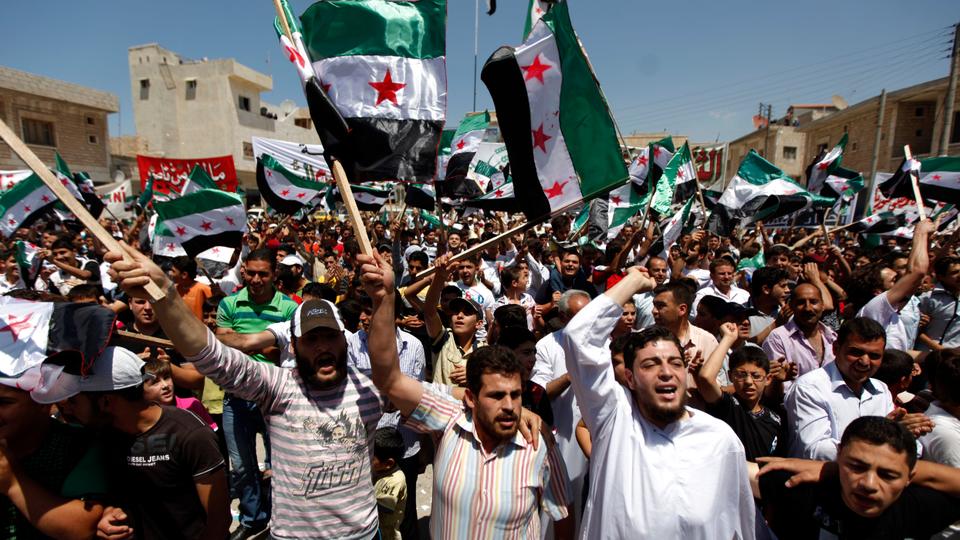
 'On June 7, just outside the Syrian intelligence offices in Suweida, about 100 people gathered in the streets on the first day of a growing movement to denounce President Bashar Al Assad.

 Their numbers grew as the protests gathered pace in the Druze-majority province in south-west Syria, an area traditionally seen as loyal to the régime.

 Many were youth – students and teenagers – wielding banners and calling for change as the country plunges deeper into economic uncertainty.

 Their peaceful demands echoed the pro-democracy demonstrations of 2011 before the régime unleashed violent crackdowns on the uprising, plunging the country into a brutal war.


 Many of the hundreds massing in Suweida’s central squares grew up knowing little else, their childhoods framed by violence that has laid waste to the country over almost a decade of conflict.

 But that has not stopped them from rising against the régime and voicing their discontent, even after security forces attacked and arrested demonstrators this week.

 "Despite the overwhelming perils, such as abduction and gunning by masked militants, people are persisting with carrying on their peaceful movement," said Rayan Marouf, a reporter for Al Sweida News 24.


 Echoing tactics it deployed in the early days of the 2011 uprising, the régime attempted to counter the demonstrations with a pro-Assad rally on June 10. A voice note shared on social media and circulated among students threatened expulsion if they failed to attend.

 At an anti-Assad sit-in on the same day, protesters held up images of political prisoners held in régime jails.

 On June 15, the protesters gathered in Suweida’s central squares to call for democratic change, the overthrow of Mr Al Assad and the removal of foreign militias from the country were joined by pro-régime protesters who started to attack them.

 Security forces then began to disperse the demonstrations using violence. “After the protest was attacked, the police and Mukhabarat started brutally beating up the participants and arrested many,” Mr Marouf said.


 State and regional media outlets are describing the demonstrations as “economically driven” and a response to the currency collapse after the Syrian pound plummeted to about 2,700 to the US dollar last week on the black market.

 But protesters are demanding a wider change, calling for the removal of Assad with chants of “Bashar, leave” and signs advocating an “inclusive civilian secular state”.

 “People in Suweida demand a holistic, transformative change in the country ... [they] would not risk their lives and protest out of economic hardship [alone]. People want freedom, equality and the end of oppression,” said a protester called Jamal.

 Another protester, who gave his name as Khaled, said that “hegemonic powers are inflicting more poverty, destruction and chaos in the country; their departure from Syria is a key element of the movement”.

 People in Syria are tired, he continued. “They are waiting for real change that relieves their suffering.” However, fear of retaliation by the régime makes them “negative” about the prospects for a positive outcome, he said.

 There is little cause for hope in Syria as the country sinks into a deepening economic crisis, with some experts warning that famine could be on the horizon.


 Two-thirds of the population already lives in severe poverty, according the UN, and fears over the impact of new Caesar Act sanctions has sent prices skyrocketing, leaving many Syrians unable to afford basic necessities like bread.

 However, there are critical dynamics in the current movement that could yield a different outcome to previous protests.

 In the past, the Suweida’s support for the Alawite-dominated régime – as a fellow minority area – has seen some Druze residents back security forces against protest movements.

 The Sheikh Alakil Druze administration, a local body headed by Druze religious figures, has always been supportive of the state and was the first to renew its vow of loyalty to Mr Assad during protests in 2011 and 2015, but its silence now is telling, Mr Marouf said.

 “Their support and loyalty to Assad seemingly is relinquishing; otherwise we would have seen them by now racing to renew their ultimate support.”

 The population fears the régime will take advantage of high unemployment in the city to enlist local armed groups to squash dissent.

 In 2015, small demonstrations were followed a few days later by car bombings that killed 46 civilians including Sheikh Al Balous, a well-known local Druze leader.

 “It is nerve-wrenching thinking of those days. This is a criminal régime which is ready to orchestrate [similar attacks] once again,” Mr Marouf said.

 “Nonetheless people so far remain, albeit with some division, united for their case, and to using peaceful means until they achieve their aims.”


 Nawras Zain Al Deen, who has been participating in the protests, sees the movement as a continuation of the 2011 revolt – and the violent response it was met with.

 At the demonstration on June 16, he saw between 600 and 700 intelligence and police forces gathered at the planned protest site. “I went to warn people as the protest was postponed because there were ongoing negotiations being held to free the detainees,” he said.

 “The policemen spotted us and starting running behind us. I made it, but my friend, who tried to distract them to help me escape, got arrested.”

 Mr Al Deen said the régime wants protesters to reduce their demands and stop calling for the overthrow of Mr Al Assad.

 “The uprising is going to continue no matter what. People have had enough from this régime and will no longer be silent in spite of their fake rallies. We will continue our protest until this régime changes and Syrians have their freedom.”


 Syrian writer and human rights activist Rima Flihan pointed to the clear distinction between peaceful calls for change that marked the early days of the 2011 uprising, and the war that followed.

 “What is happening now is a twin revolution of 2011, one with the same desire for change,” she said.

 “People in Syria need to breathe; that will never happen until we enter a transitional phase led by honourable people, preparing for a constitution, elections, reconstruction, and revival of the Syrian economy. Syrians have the right to this, and it is not difficult if the will exists; people want democracy, dignity, and freedom.” '

The reluctant refugee: Majeda's story

Majeda Khouri pictured for Migrateful during UK Refugee Week 2020 | Source: Twitter Migrateful

 'Majeda Khouri was detained in Syria for peacefully protesting the Assad régime. After her release, raids on her house prompted her to leave -- first for Lebanon and eventually the UK, where she was granted refugee status. In London, she has founded her own catering business and helps other Syrian refugee women from poorer backgrounds use their own cooking skills to earn a living in London.

 Majeda Khouri bridles slightly when she is introduced as a refugee. "I like to introduce myself as a feminist and human rights activist," she says firmly, "because that is what I am." Being a refugee in the UK is something she has been "forced" to become. "It is not a choice."

 "When I came here [to the UK] I was so depressed," says Khouri. "I wanted to be with my family. I had left my children for two years." At the time, her two sons were just 13 and 15. Khouri said she had done everything not to leave Syria, even after being detained for four months.


 Eventually though Khouri was forced to leave for Lebanon where she continued her activism. She worked in refugee and migrant camps, trying to support the activists she had left behind in Syria. But in Lebanon she had no right to remain, and so when she was invited to speak at an academic forum in Edinburgh in 2017, it became impossible for her to return. "I had no choice but to seek asylum in the UK," says Khouri sadly.

 Since arriving in the UK, she has built up her English by listening to the radio "24 hours a day," Khouri explains. She says she even kept it on while she slept, "to perfect my accent. I wanted to speak, so that gave me the power." Soon she was using those skills to speak at seminars, events and cooking classes, become a chef, give cooking classes via the organization Migrateful, and set up her own catering business "Syrian Sunflower."

 The sunflower represents her in more ways than one, Khouri explains. She used the image of a sunflower on her Facebook page when working as an activist in Syria. "I love the sun," she enthuses, her voice warming up, "I have a special relationship with it," then she adds wryly, "perhaps that is why I find the UK so difficult to live in." When her friends were campaigning for her release from detention, they all grew sunflowers and wrote her messages on her Facebook page saying "we are waiting for you, Syrian sunflower." So, says Khouri, "it means a lot to me."

 For Khouri, food is a way to tell her story and that of her country. "When you sit down to eat, you exchange something; you share something emotional, when you talk, people listen and they hear what you say," she says. That was how the idea for cooking Syrian food in London came about. Through the dishes, Khouri explains to people what is happening in Syria. "I needed to communicate to them that the war in Syria was not about Assad versus Isis, that it was more complicated than that."


 At one of the first events she catered, she didn't serve up the middle eastern delights that people might have been expecting, but a thin watery gruel. It was the only dish that people could eat when their city (Ghouta) was under siege, she told the BBC at the time. The trick worked, Khouri says, remembering the evening. "We were campaigning to break this siege," says Khouri. "I thought that if people shared this food, [this experience] they would listen more."

 While they were tentatively sipping their soup, Khouri passed around a letter she had written to British parliamentarians, trying to get attention focused on what the Assad régime was doing in Syria. Coming into contact with a small taste of the realities that people were facing, many who attended the event duly wrote a letter to their MP too. "A few months later, I met one of the MPs involved in the Syrian case and he told me had received over 40 of my emails and letters from people who attended the event. I was very pleased," concludes Khouri.


 Khouri had long been dissatisfied with the régime, but she could not do much about it because her family was constantly monitored.

 "My uncle had been tortured to death about 40 years ago and the security services would come to my house all these years, they came and turned our house upside down. Not just my family, most families, that was how it was. It was a security régime," says Khouri.

 In 2011, when the peaceful revolution began in Syria, Khouri saw her chance to work for change. She began to use her status as a Christian Syrian -- generally seen as being favorable to the régime -- to smuggle bread to people, who were already experiencing food shortages, across checkpoints.

 For a while, the ruse worked, says Khouri. But the régime cottoned on and in 2013, she was detained for four months. "We were only allowed out to the toilet once every 24 hours, at 3 am in the morning." This was because, explains Khouri, they were torturing people the rest of the time "between our space and the bathroom." Sometimes, when the women got to the bathroom, there would be dead bodies lying there. "They didn’t care," says Khouri about the régime. "They wanted us to see what they were doing."


 Sometimes, Khouri knew the people or recognized the voices of those being tortured. Once, in her cell, she heard the voice of a child. "He was just 13," she remembers. "I knew his mother and when he said he was 13 years old, immediately my son came to my mind." The boy, she says, was being forced to stand on a chair with a rope around his neck. They were threatening him that if he didn't admit to killing someone, they would first hang his mother and then him. "The boy was pleading with them not to kill his mother," Khouri remembers sadly. "He said, kill me, but please don't kill my mother."

 On hearing this, Khouri begged the guards to let her talk to the boy, telling them she would get the information they wanted. "It was very hard for me to hear that," she said. "I wanted to do this just to hug him and tell him 'don’t worry about your mother.' This is a small part of the horrible things the régime did," says Khouri.

 She was eventually allowed a few minutes with him, and she tried to tell him that she would get a message to his mother and that she would be safe. But the attempt doesn't have a particularly happy ending. "Since then the boy has not been found," says Khouri baldly, without speculating about what might have happened. The subject is quietly closed.

 Despite her experiences, on being released, Khouri was determined to stay in Syria and keep fighting for the country she wanted it to become. "Assad must go," she says determinedly. "It is time." But after frequent raids on their home, and periods in hiding, in 2016 Khouri was forced to use a smuggler and begin an 18 hour "dangerous" journey to get her over the border to Lebanon.


 You can hear Khouri smiling slightly down the telephone when asked if she thinks she defies people's expectations of what a refugee 'should' be. "Yes, yes," she says, eagerly recounting a story about being on a panel discussion with the mayor of London soon after she arrived in the UK. Khouri had also catered the event at which she was giving a speech. When the food arrived and it was made clear that she was the cook behind it, the mayor of London turned to her surprised and asked: "Did you make this food too?" Khouri laughed and answered him simply: "Yes, I can talk AND I can cook!"

 Khouri's capable strength and leadership skills shine through. "I am a leader," she agrees. "I am good at communicating and I can lead a team of people."

 Despite hoping to return to Syria one day, Khouri has filled her life in London. She has been busy helping other Syrian refugee women, who come from poorer backgrounds, use their own cooking skills to earn a living in London. As well as her catering business, she works as an online researcher for the Open University, contacting people in the camps in Lebanon and Jordan.


 Once she had refugee status, Khouri's sons were able to join her in the UK through the family reunification program. They are about to start studying at university but do not want to hear about her activism. "When I am talking to you here on the phone, they go in another room," she says. "It was difficult for them. When I was detained they didn't know where I was. They knew that the reégime killed people. I can understand, it was very hard for them, they don't want to hear about politics. They refuse to talk about it or get involved," she says quietly.

 Nevertheless, Khouri remains undeterred. "I believe I have a responsibility as a human rights activist. It is on the same level of importance as my family," she says. "That's why I have to do as much as I can. […] That's why I have this passion and this power inside to clarify things for people."

 "In 2011 when we started our revolution we said, yes, we have a dream and it will come true. Until now, we haven't achieved it but we will, I hope we can. 60% of Syrians were living in poverty. I had a good life, my children went to a good school but I could see things were not fair. People didn't have opportunities and the régime was taking everything into their own pockets."

 The régime wants us to leave, says Khouri. "Now there are 10 million people living outside Syria. ... But I will keep fighting until we have the country we dreamed of. What we need is the first step of change. If Assad goes, people will see there is the possibility of change." '

The destroyed hospital of Kafr Nabl, Idlib's countryside, in Syria | Photo: ARCHIVE/EPA/YAHYA NEMAH

Friday, 19 June 2020

Can Syrian sexual violence survivors get justice?

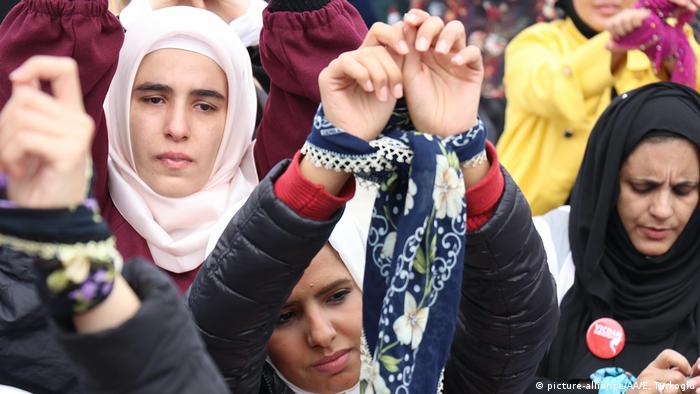
Women in Hatay, Turkey, take part in a protest to draw attention to women languishing in Syrian prisons in 2018

 'For most women, the horror starts at the moment of arrest. First, the male soldiers touch them inappropriately. On arrival at the prison, they are forced to strip naked. The invasion of their bodies often begins with an aggressive, intimate search by a male guard.

 For thousands of female detainees in régime prisons this marks the start of a journey to hell — one that very often ends with them being broken and then ostracized from their families and communities.

 Sexual, gender-based violence is one of the most widespread crimes in Syria's government detention facilities, according to international law expert, Alexandra Lily Kather. Yet, it is also one of the most underreported.

 "We know about air strikes, we know about weapons, we know about torture, we know about [the Islamic State]," says Kather who works for the European Center for Constitutional and Human Rights in Berlin.

 "But what is not being covered sufficiently either in the media, or in terms of calling perpetrators to account, is sexual violence [in régime prisons], despite the devastation it causes both for the victim and for society as whole."

 On Tuesday Kather and her colleagues at the ECCHR took a step they hope will change this state-of-affairs in a radical way.

 Together with Syrian rights activist, Joumana Seif, Kather filed a criminal complaint with Germany's federal prosecutor calling for sexual and gender-based violence in Syria to be prosecuted as a crime against humanity.


 Germany has already achieved a world first by putting two former Syrian intelligence officers on trial in the town of Koblenz for war crimes under the principle of universal jurisdiction, which allows countries to try foreign nationals for crimes committed abroad.

 However, while applauding this effort, ECCHR says Germany has failed to include sexual violence as a crime against humanity on any indictments or arrest warrants, which in their view is a grave oversight and a blow to the victims.

 "From the evidence we have," says Kather, "we can clearly see that sexual violence was part of a systematic and widespread attack on the civilian population and therefore should be categorized as a crime against humanity."

 The UN Human Rights Council shares this opinion. In a harrowing report published in 2018, the body detailed abuses based on the testimony of nearly 500 survivors and witnesses. Of all the warring parties, pro-government forces and militias were the most prolific offenders when it came to sexual attacks and rapes. The UN concluded they used sexual violence as a weapon to instill fear and inflict humiliation.

 The report's section on detention centers outlines acts of astonishing cruelty with a girl as young as nine being raped by a Syrian guard. Others were also sexually tortured and threatened with rape or raped in front of other guards and detainees. One brigadier general told a low-ranking officer who showed an interest in a female inmate: "Take her. Do anything you want with her."

 Men and boys were also raped and sexually violated in detention, but according to the report women and girls were disproportionately targeted.


 The need to seek redress for such atrocities is at the heart of the case being pursued by the ECCHR. They are acting on behalf of seven survivors, including four Syrian women and three men now based in Europe. All were civilians incarcerated in prisons operated by Syria's Air Force Intelligence Service in Aleppo, Hama and Damascus. ECCHR say they have identified nine perpetrators based on the testimony of these victims and other sources of evidence.

 As part of their criminal complaint, the international lawyers at ECCHR have issued a demand to Germany's Federal Prosecutor for an existing arrest warrant for the former head of Syrian Air Force Intelligence Service, Jamil Hassan, to be amended to include sexual violence as a crime against humanity. Additionally, they have called for investigations, also focusing on crimes of a sexual nature to be opened into the other eight alleged perpetrators and arrest warrants to be issued.

 Rights activist and legal expert Joumana Seif underlined the importance of characterizing crimes as "sexual" as opposed to other forms of brutality, especially in Syria.

 "Most of the survivors are women and when they are released, despite having such dreadful experiences in prison they are discriminated against. They pay twice," says Seif.

 "What they need are special health services and psychological help and the right to be protected. They need recognition."

 Men subjected to sexual violence in prison often feel their masculinity has been compromised and fear losing the respect of their peers, according to fellow legal expert Kather. Yet for women the consequences can be doubly devastating.

 "If a woman has been sexually violated, she is judged to have brought shame on the honor of the family and will be excluded," says Kather. "This destabilizes the family and if you destabilize family after family, you end up destabilizing the core of society."

 Justice for victims of sexual and gender-based crimes is also seen as key to any future reconciliation efforts, especially given what the UN report called a "near-total absence of accountability for such violations."

 For now, though, lawyer Kather, is focusing on the present.

 "This is a régime, a state that uses people's bodies for their political aim to oppress and terrorize, she says. "And we demand accountability from the German prosecutor." '

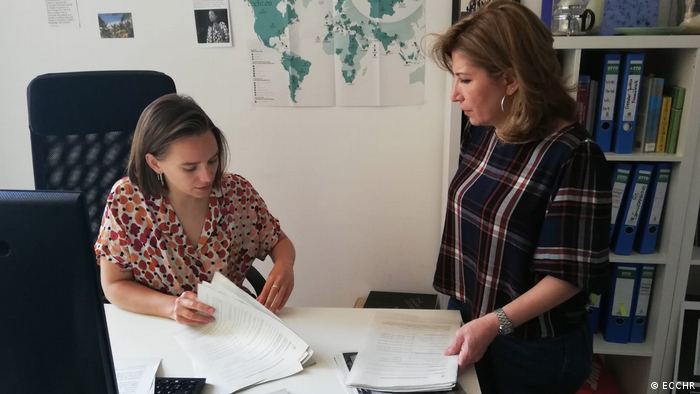
Lily Kather and Joumana Seif of the ECCHR

Sunday, 14 June 2020

Régime’s destruction of farmland cements displacement


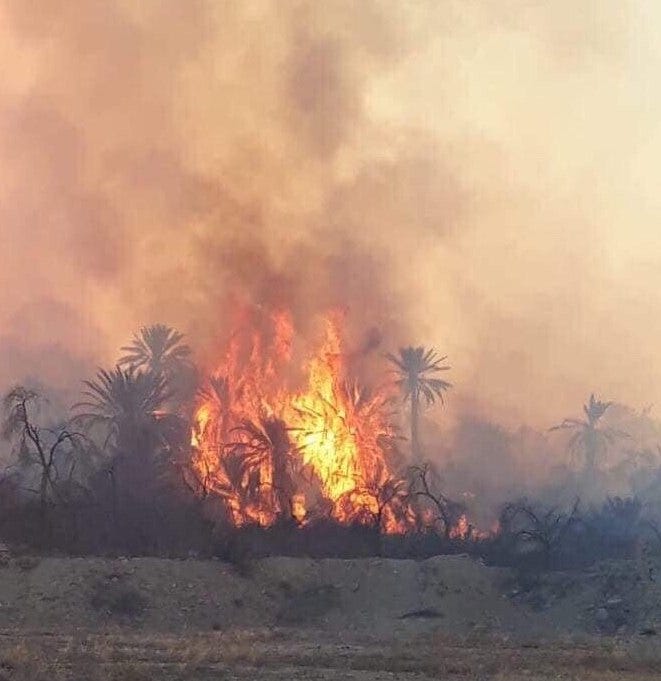
 'In a disturbing trend, the Syrian régime and its allies have recently been burning agricultural lands belonging to displaced Syrians with a clear intent to cement their displacement. The systematic nature of the targeting is evident as the fires have been instigated in different areas and governorates under the control of the régime, making it impossible for the displaced to return and harvest the fields and orchards. This text provides a closer look in such incidents in Palmyra, Harasta and Al-Qusayr.


 The city of Palmyra is an oasis that adorns the Syrian desert, located northeast of Damascus. It is a UNESCO World Heritage site featuring Roman monuments that bear witness to a great city that was once one of the most important cultural centers of the ancient world. It came under international spotlight when ISIS took control of it and destroyed some of the priceless artefacts, before the régime regained the control of the area.

 In May, fires burned agricultural lands in the area near the Meridian Hotel, in the vicinity of the Temple of Antiquities. The sources of the Syrian Association for Citizens’ Dignity in the region confirmed that the fires raged in the area for hours, with the Syrian régime not making any notable effort to control the blaze. According to eyewitnesses, the deliberate failure to deal with these fires might be motivated by the desire to cover up the smuggling of antiquities the régime is carrying out in collusion with Iranian militias.

 Our sources reported seeing digging equipment and trucks moving to the area immediately before the fires were started. According to these sources, the militia controlling the area has been excavating for more than two years for the antiquities in the area where the fires occurred. The area where the digging is going on has been sealed off for “security reasons” to prevent civilians from accessing it. The displacement of the local residents is at the same time a tool and a long-term consequence of this criminal effort.

 Excavation and smuggling of antiquities from Palmyra is considered an important economic resource that the régime and Iranian militias use to finance the war in Syria. The practice was documented by Al-Quds Al-Arabi newspaper, which reported that “Iranian militias, led by the militia of Al-Najaba and Fatimiyun, began a new exploration campaign on the antiquities in the ancient city of Palmyra and its eastern desert that extended towards Deir Al-Zour, where excavation mechanisms brought in by the militias have been monitored over the past three months.” The area where these excavations started was blocked off to the people who live there, and the route of the motorway Deir Al-Zour-Damascus, which passes near Palmyra, was changed for this purpose.


 We have recently reported on the régime’s demolitions of private property in the area of Harasta, in Eastern Ghouta. In the aftermath of that, the local sources reported massive fires in the same area which burned agricultural lands overlooking the Damascus-Homs International Highway during the month of May.

 According to this information, members of régime’s forces present in the area intentionally set fire to the surrounding lands in the Panorama area in the city of Harasta, on both sides of the international highway from the Qaboun side, as well as the agricultural lands separating Dahiet Elasad and the Harasta and Barzeh farms.

 These recent fires caused great damage to the crops and the trees planted in those lands, especially in the orchards that extend between Harasta and Arabin from the governorate side.

 This is not the first time fires have been used to devastate agricultural lands in this area. The eastern Ghouta groves, overlooking the Damascus-Homs international highway, witnessed major fires during May 2019. Thousands of olive trees, some hundreds of years old, were burned in the groves of the Karm Al-Ras area, separating the cities of Duma and Harasta, and the western area of ​​the highway in Harasta. One of the engineers working in the Damascus countryside governorate suggested that the fires are aimed at emptying the agricultural areas and forcing the residents to sell or accept the régime’s expropriation, as part of a plan to include it into the “re-organization” that covers the northern entrance to the capital.


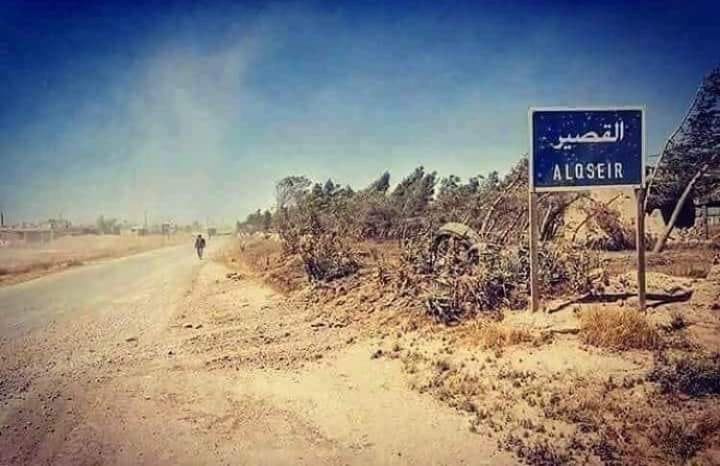
 Lastly, at the beginning of April 2020, a big fire broke out in some of the orchards in the villages of Al-Qusayr, a town in the Homs governorate on the border with Lebanon. The area is under control of Hezbollah and the information from the ground suggests that the fires were instigated to clear the land which the militia plans to use to expand its cannabis-growing operation in the area, which is reportedly a major source of income.

 The area is of importance to Hezbollah as it has a number of crossings along the border between Lebanon and Syria from the Al-Qusayr side, which are used to transport the loot from Syria which is then sold in the Central Bekaa valley and the southern suburbs of Beirut. Hezbollah also uses the Al-Qusayr region as a training camp for the new recruits deployed in the operations in the Aleppo countryside and Daraa.

 With the increasing pressure on Hezbollah in Lebanon as a result of the collapse of the Lebanese economy, Al-Qusayr with its vast green areas is increasingly important to the militia as a source of income and resources. It is for this reason that the southern countryside of Homs remains empty of residents despite several attempts at return of some of those who are displaced in the areas held by the régime, such as the city of Homs or the city of Damascus.


 The described practice of burning of agricultural lands in Palmyra, Harasta and Al-Qusayr clearly aim to cement the displacement of the local population by depriving them of a source of livelihood and making their return more difficult. Initial displacement affected by brutal violence and destruction is made worse, with the goal of making it permanent, by the destruction of lands and oases, which then either become settled by members of militia families who live off trafficking (Palmyra), are exploited for cultivation of narcotics (Al-Qusayr) or designated for “re-organization” (Harasta). Or, as was recently the case in the areas of the eastern and southern Idlib countryside and the western countryside of Aleppo, from which people were displaced as a result of the recent military campaign against the Syrian north, the crops sown by the displaced are first harvested by the régime forces and militias, and then set alight.

 The pattern of these actions reveals a systematic targeting of the displaced Syrians, which is one of the key causes for the imposition of sanctions by the EU and the US on the régime’s officials and the individuals and entities involved in such criminal conduct. The reversal of these actions, restitution of property and lands to the rightful owners and safe and voluntary return of displaced people who lived on the harvests from the lands devastated by deliberate burning, will be among the basic pre-conditions for the lifting of the sanctions and the possibility of a political solution that guarantees the right to all Syrians.'

How new protests in Syria are pushing Assad to the brink

How new protests in Syria are pushing Assad to the brink

 'Syrian dictator Bashar al-Assad has survived a nine-year-long civil war after brutally suppressing a countrywide protest movement. But a new wave of protests fuelled by economic distress has once again exposed the régime leader to the bitter reality — that beggars can't be choosers.

 “When you look at recent military developments on the Syrian ground, Assad appears to create some advantages for his rule. Except for the Idlib province in northwestern Syria, he was able to control much of the country through military operations,” said Serhat Erkmen, a Turkish political analyst on Syria.

 For Erkmen, Assad's ability to conduct military operations does not warrant for his survival.

 “While Assad feels that he is so close to the eventual victory in the civil war, he could bitterly discover that he might not have the economic power, which is the most essential means to control the rest of the country (taken over by force mostly).”


 Assad has been the only surviving dictator from the Arab Spring movement, which began in 2011, toppling autocrats across the Middle East from Tunisia’s Zine El Abidine Ben Ali to Egypt’s Hosni Mubarak and Libya’s Muammar Qaddafi.

 On Thursday, Assad sacked his prime minister, Imad Khamis, who had been in office for four years, scapegoating him for the country’s economic hardships.

 “For most, life in 2020 is a great deal worse than life at the peak of nationwide armed conflict in 2014-15. In holding on to power, Assad has effectively—and purposely—destroyed his own nation and economy,” wrote Charles Lister, a senior fellow and the director of the Syria and Countering Terrorism and Extremism programs at the Middle East Institute, who is also the author of The Syrian Jihad: Al-Qaeda, the Islamic State and the Evolution of an Insurgency.

 The civil war has badly hit the Syrian economy and the US sanctions against Damascus have worsened the country’s pains, exposing people to degrading living conditions.

 Most recently, the losses of the Syrian currency have reached enormous dimensions, decreasing people’s purchasing power by extreme margins.

 “At the beginning of the civil war, one US dollar was equal to 47 Syrian pounds. Last week, one US dollar was equal to 3200 Syrian pounds, seeing a huge hike in its losses of the value of the country’s currency,” Erkmen said.

 As a result, some experts believe the protests could be motivated mainly by economic distress rather than political distrust, while anti-Assad opposition is smouldering in rage across the country.


 “This could bring him down in the most simple language,” Erkmen says.

 He sees the fall of Assad possible not only due to the protests but also due to the reemergence of several crucial dynamics of the Syrian conflict.

 First of all, some clear political infighting has recently become noticeable, Erkmen says, referring to Assad’s decision to confiscate the assets of Rami Makhlouf, his oligarch cousin. Makhlouf is Syria's richest man. He reportedly owns more than half of the country’s wealth.

 The Baath Party in Syria has been stained by internal strife between different power holders or political clans ever since it began ruling the country. These rivalries sometimes morphed into full-blown clashes mainly between Bashar al-Assad's father Hafez al-Assad and his uncle Rifaat Ali al-Assad.

 “Hafez’s victory over Rifaat was not ensured because the family supported Hafez over Rifaat, who was militarily and economically more powerful than Hafez. It happened thanks to Hafez’s power coalition inside the Baath party,” Erkmen observed.


 Erkmen thinks that similar political dogfighting is now going on in Syria with Assad’s taking over Makhlouf’s assets. While both Assad and Makhlouf are part of the Alawite religious sect, which is considered to have secure connections with Shiism, their political base might not be just related to the minority sect, according to Erkmen.

 “In this sense, we can find similarities between the past (referring to the fight between the two brothers) and the current, referring to the struggle between Assad and Makhlouf,” Erkmen suggested.

 According to the political analyst, it could be an inadequate assessment if the current infighting should be understood in the context of a struggle between Bashar al Assad and other family members.

 “It has to be understood in the context of a broader political and economic power fight between Syria’s different political groups,” Erkmen says.

 Erkmen thinks that Assad, whose wife Asma is coming from a prominent Syrian Sunni family, is currently not only “liquidating” Mahklouf but also other political and military figures including the fired prime minister, who might support the powerful cousin.

 Some crucial generals have also been changed with others, Erkmen says.

 “Right after a crucial operation in Idlib, changing generals, who occupy critical positions in the army, does not appear to be logical as long as some serious issues do not exist inside the régime,” Erkmen analyses.


 Moscow, Iran and the Gulf's economically vibrant capitals might matter most for the survival of the Assad régime, according to Erkmen.

 Throughout the destructive Syrian civil war, Russia invested heavily in the Assad régime to reassert itself across the Middle East, lending its military might in the service of Damascus to defeat the once-powerful opposition forces.

 But, while the régime has taken much of the country back, Bashar al-Assad does not seem to be ready to heed Russia’s advice to compromise with his enemies and lay out the country’s future, escalating tensions between Moscow and Damascus.

 Erkmen still thinks that after so much investment to the Assad régime, Moscow will not allow Damascus to fall apart. But despite Assad’s dislike, Russians also want to satisfy some American demands in Syria, Erkmen says.

 Iran, a Shiite-majority country, which has heavily supported the régime with its Shiite militias and other military means, might not do much because of its existing economic and pandemic-related difficulties, according to Erkmen.

 “The flowing of the Gulf’s wealth could be the most important factor for Assad’s future. If Assad does not receive covert financial support from the countries like Saudi Arabia and the UAE, he might not dodge the current economic crisis,” Erkmen said.

 But that support might also depend on the approval of Washington.

 If the economic crisis worsens, the two political scenarios might emerge, says Erkmen.

 Assad might force his chances to beat opposition forces in Idlib, the last rebel stronghold, to rally the population under his banner, Erkmen says.

 “Or, the protests could further expand across the country. If fresh protests hit the country, things could irreversibly change in Syria,” the political analyst views.

 “If the Syrian régime again chooses to violently suppress a possible new wave of protests, refusing to learn any lessons from the past, I do not think that Assad could survive this time,“ the analyst concluded.'

Friday, 12 June 2020

Failure of Syrian economy goes beyond Caesar Act

A merchant counts Syrian pound notes, bearing a portrait of the Syrian President Bashar al-Assad, at the Bzourieh market in the centre of the Syrian capital Damascus on 11 September 2019. [LOUAI BESHARA/AFP via Getty Images]

 'The Syrian economy is in freefall. At the beginning of the uprising in March 2011, $1 was equivalent to approximately 50 Syrian Pounds. Today, it is equivalent to around 3,000 Syrian Pounds, a 600-fold increase over the past nine years. A state employee in Syria was paid what was equivalent to around $200 per month in March 2011 but that is now worth approximately $15-$20 a month. This is barely enough to cover basic groceries, and the collapse of the economy has been even more severe over the past 6 months with the Syrian Pound clearly weakened to the extent that salaries have become worthless.

 The collapse of the economy under Bashar Al-Assad is due to a number of reasons, not least because the régime has transformed itself into a war economy, with the killing machine massacring its own people and using money meant for humanitarian aid to do so. According to Foreign Affairs, most of the $30 billion in UN-led humanitarian aid to Syria has been used by the régime to skirt sanctions and subsidise its war effort.

 The régime is infamous for its deep-rooted corruption and cronyism led by the Assad family’s money man, Rami Makhlouf, who controlled a huge slice of the Syrian economy and essentially had a veto on any proposed business enterprises. Moreover, the threat and intimidation of the notorious Mukhabarat — secret police — led to a brain drain and the flight of working age young people as well as the emigration of wealthy business people and potential investors.


 More recently, the Lebanese banking crisis has had an impact on Syria, as many Syrian businesses use Lebanese banks as a safe haven for their funds, and some businesses attached to the régime use it for money laundering. The economic problems faced by Iran, the main financial supporter of the Syrian régime, have increased recently as the coronavirus crisis has exacerbated the effect of sanctions.

 The Syrian régime has been guided by corruption and poor economic decision-making, and has stopped the currency exchangers from operating and threatened their workers with imprisonment. Millions of dollars in remittances from expatriates to support their families in Syria have thus been lost to the economy. Local businesses have suffered as they can no longer import materials for pharmaceuticals, textiles and other industries vital to the Syrian economy. Iran and Russia have demanded repayment of their war loans because of their own financial crises. Ordinary Syrian citizens now have to pay grossly-inflated prices for locally produced food items, which shouldn’t be affected so badly by the exchange rate of the US Dollar.


 Even before the implementation of America’s Caesar Syria Civilian Protection Act which will come into force next week introducing sanctions against the régime for alleged war crimes, over $500 billion is needed to rebuild the country. Unfortunately for the Assad régime, Russia is no longer able to act as its main financial patron and rebuild the country singlehandedly.

 The Caesar Act demands the régime to stop bombarding civilians and put an end to siege warfare and using starvation as a weapon. It also demands the release of all political detainees and for humanitarian aid to be distributed freely with no restrictions, while allowing all refugees to return safely to their homes with no threat of repercussions. Moreover, the Act stipulates that war criminals should be held accountable and that Iranian militias should be made to leave Syria, making clear that human rights organisations should have the unrestricted rights to visit Syrian prisons. It ultimately states that Geneva Resolution 2254, which references the transitional political process, has to be implemented.

 Fundamentally, the Caesar Act — named after Caesar, a former Syrian military photographer who fled at great personal risk in 2014 with 55,000 images proving the cruelty and brutality of Assad’s prisons — is not aimed at disadvantaging civilians in Syria. Its aims are the exact opposite, as it wants to prevent any country, non-state actor or company from financing or supporting the current régime in Damascus.


 As a former Soviet intelligence agent who witnessed the dramatic collapse of the USSR, Russia’s Vladimir Putin has always dreamed of restoring Russia to its so called former glory and would like to set the stage for a new Yalta, in imitation of his Soviet, American and British predecessors who planned a new world order after the Second World War. The US, however, does not consider Russia to be its equal as a superpower in the way that President Franklin D Roosevelt viewed Premier Joseph Stalin. Nevertheless, even with its current indifference, the Syrian issue cannot be resolved without the US. The fact that Washington has pushed through the Caesar Act implies that its involvement is essential.

 Russia has staked a larger slice of the Syrian pie, and due to the lack of payment from the Syrian régime, Moscow has started to take control of its ports (the port of Tartus, for example, has been taken on lease for 49 years) as well as its businesses as a form of repayment. Both Syriatel and SyrianAir are rumoured to be part of this.

 Even without the implementation of the Caesar Act, the Assad régime is on the brink of economic collapse. Once the act is implemented, though, it is likely that the entire system will come crashing down. Assad cannot control his own economy. In recent days, protests have been erupting in areas of Syria, such as Suweida, which in nine years of conflict have never criticised the régime.

 The Syrian people yearn for their freedom from Assad’s tyranny. They may not have much longer to wait. Despite the lack of military intervention and the belated Caesar Act, it is starting to look as if the régime will finally crumble under the weight of its own deadly incompetence.'

Syrian woman holds a hen at a camp hosting Syrian families, who have been forced to displace due to the attacks carried out by Assad regime and Russia, in Idlib, Syria on 10 January 2020. [Esra Hacioğlu - Anadolu Agency]

Monday, 8 June 2020

Anti-Assad demonstrations reach Damascus countryside


 'An anti-Assad demonstration took place yesterday evening Sunday in the town of Zakia in the western countryside of Damascus, as a result of the deteriorating living conditions, after similar demonstrations in Daraa and Suwaida.

 The demonstrators expressed their protest against the living conditions and the deteriorating economic situation, and demanded the overthrow of the Assad régime and the exit of Russia and Iran from the country, local sources said .

 Dozens of civilians demonstrated yesterday for the same reason in the city of "Tafas" in the western countryside of Daraa, and chanted slogans calling for the fall of the régime.

 Dozens of Suwaida residents [pictured above] demonstrated this morning, wandering the streets of the city, demanding the fall of the régime and the departure of Bashar Al-Assad, against the background of corruption and causing the country's economy to deteriorate and the standard of living to decline.

 Reference is made to the poor living conditions of Syrians in the areas seized by the Assad régime, due to the low income and the devaluation of the Syrian currency; what caused a significant increase in prices, and the Syrian pound today touched 3,000 against the US dollar.'


 Note 20/8/25, link broken.

Saturday, 30 May 2020

Assad versus Makhlouf


 'The open rift between Syrian President Bashar al-Assad and Rami Makhlouf, who with his dubious business interests controls a considerable segment of the Syrian economy, gives some idea of the seriousness of the crisis currently facing the Syrian régime. And it also demonstrates the magnitude of government corruption.

 The signs of disintegration that have long since been evident in the military and security apparatus, as well as in the country's economic life are now beginning to show in the all-powerful ruling clan as well. Against the backdrop of the military and political presence of Russia and Iran and growing criticism of Assad's actions by the Russian media over the past few weeks, a few surprises are still to be expected.

 A power struggle amongst mafia-like players for economic resources and political supremacy, plus a reckoning for the enormous number of victims amongst the Syrian population since 2011 are some of the factors that will define how things play out.


 To begin, though, we have to ask how Syria got itself into this dismal situation in the first place. So let's take a look back. The revolution of 2011 only became radicalised when the Assad régime decided to embark on a strategy of repression and military force to suppress a rebellion that had started out peacefully.

 There can be no doubt that the military response to the uprisings and the resulting elimination of the civil and popular character of the Syrian revolution in 2011 and 2012 was what led the Syrian Free Army to splinter into many different militias.

 And yet the régime preferred to embrace a scorched earth policy rather than curtailing Syrian presidential powers, or even implementing a minimum of political reforms to ensure social participation and the accountability of those in office.

 This may not be anything unusual for dictatorships. But it makes a huge difference whether a régime comes to the realisation that all signs are pointing toward radical change (as in some other Arab countries, where a new president at least took office), or whether it holds fast to its leader until its dying breath, without caring in the least what price there is to pay.


 In the hope of circumventing a political solution and reforms, the Syrian régime first enlisted the help of the Hezbollah from Lebanon and then called in Iranian government militias.

 When these steps failed to give the régime the necessary clout to regain the upper hand against the insurgents, it appealed to Russia with its fighter planes and military bases. In September 2015, Russia thus arrived on the scene and put all its weight into crushing the revolution, at a time when the insurgents were just on the verge of tipping the scales against the régime.

 The cumulative result of all these developments was millions of displaced persons and hundreds of thousands of Syrians killed. The régime increasingly put itself in the hands of Iran and Russia. In the meantime, Turkey to the north had become another player in the Syrian game.

 The fanatical policy pursued by the Syrian régime with the aim of maintaining total power has ended up robbing the President and his government of every last shred of credibility and sovereignty. The bloody treatment chosen by Bashar al-Assad to treat the revolution that began in 2011 has proven a hundred times worse than insurgents and activists could ever have imagined in their talks at the beginning of the uprisings.


 One of the products of the violent suppression of the revolution and the ensuing chaos has been the terrorist organisation "Islamic State". ISIS would never have been able to take advantage of the turmoil had Assad's government made any attempt at the outset to reach a political understanding with the insurgents. The régime completely misjudged the events and the deep-seated anger among the Syrian population. It was a misstep that would culminate in serious crimes against humanity.

 The monstrous scale of the murder and destruction perpetrated against the Syrian people since then has prompted numerous efforts to initiate criminal proceedings against the régime. In Germany, for example, litigation began a few weeks ago against members of the Syrian secret service who are alleged to have committed war crimes and crimes against humanity on behalf of the government.

 Victims finally have an opportunity to testify as witnesses against their tormentors, who are accused of torture, murder and the execution of prisoners. The indictment makes it clear that such acts were part of a systematic policy against activists and non-violent freedom fighters. The courts will also seek to prosecute those who ordered the executions, murders, torture and kidnappings.

 There is also the prospect that the trials and indictments will lead to further legal action. European countries including the Netherlands have for example begun to process tens of thousands of cases of missing persons who disappeared in the régime's prisons. The régime will not succeed forever in hiding from millions of Syrians around the world.
The revolution broke out at a time when the Syrian people had had enough of the régime's repressive approach, its disregard for the dignity and freedom of its citizens, and its lacklustre economic and security policies. Having sold off the country's resources to a small and influential elite, the government managed to degrade Syria's economic standing to place it near the bottom of the international league table.


 While the régime had still shared its financial resources with various sectors of society under former President Hafiz al-Assad, when his son Bashar al-Assad took office everything changed. Corruption and special interests came to the fore, to the increasing detriment of the lower and middle classes. In 2011 the people of Syria, like those of other Arab countries, rose up to demand a decent living standard and a minimum of social justice.

 All the while, the régime failed to realise that its repressive measures and the war it had launched against certain parts of Syrian society would end up contributing to the downfall of the old political system. Or that its propaganda claim that it would emerge victorious from that war was but a figment of its imagination.

 For how can a country speak of victory while driving out its own people, destroying its own economy, its villages and cities, and killing hundreds of thousands of its native daughters and sons?


 After the massacre of Hama in 1982, the régime still managed to bridge the country's divides. But what has happened in the years since 2011 has taken on a whole new dimension. All of Syria has become one colossal crime against humanity.

 The régime's ability to achieve reconciliation with its people and within the ruling elite has diminished under the presidency of Bashar al-Assad. Since the beginning of the uprising, the president has utterly squandered his moral and political capital.

 The fact that world and regional powers will now determine the fate of Syria is without doubt the natural consequence of the destruction of the country and its social structures by its own government and security apparatus.

 The coming events are still likely to throw up a few surprises. For Syria, the revolution of 2011 was the beginning of a new history. And thus, the ability of the Syrians to regain their honour will also be put to the test in the months and years to come.'

Friday, 22 May 2020

Assad regime threatens thousands of lives in Daraa

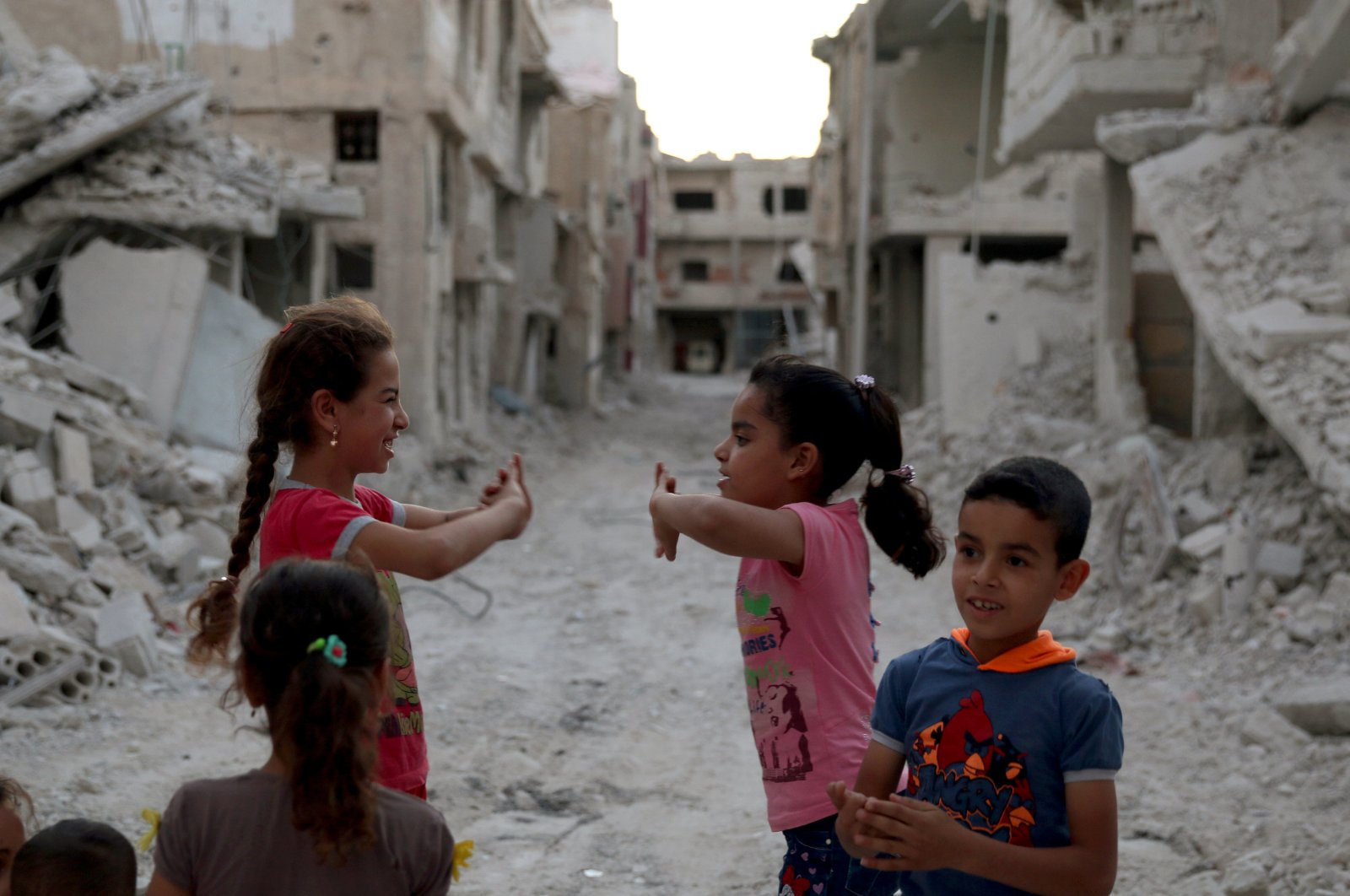
Syrian children are seen play amidst the rubble of damaged buildings in Deraa, July 15, 2017. (Reuters)

 'The Syrian opposition expressed concern over the Syrian régime elements' escalation in the southern province of Daraa on Thursday, warning that the civilians in the region could face a "massacre."

 Abdurrahman Mustafa, head of the Syrian Interim Government, said despite being under régime control since 2018, the locals in Daraa continue to resist Bashar Assad rule and its supporters.

 "In order to oppress the rising opposing voices, the régime and its militia are deploying troops to Daraa," Mustafa said.

 Criticizing the régime's policy of intimidation against the civilians, Mustafa warned that the deployment of the military to the region would mean even greater risks for the locals.

 "We are concerned that the bloody-minded Syrian régime which has committed war crimes in Syria will cause a massacre in Daraa," Mustafa underlined.


 "Our people, who are against régime forces entering the region and kidnapping children, do not want to be under régime rule again. Our revolution will continue. The future belongs to our people," he said, emphasizing that Assad's rule is doomed to fail.

 He also called on the international community to take action against the régime's actions in southern Syria.

 "We need immediate precautions," he said.


 Back in 2011, upon the flow of the Arab Spring's spreading to Syria, a group of students in Daraa began the Syrian opposition movement by writing "Ejak el door ya Doctor," meaning "Your turn, doctor," on a school wall.

 After this initial move, Daraa was taken under opposition forces' control.

 However, in 2018, when Daraa was under heavy attack and blockade of régime forces, Russia became a mediator between the opposition and the régime. As a result of Russian mediation, the ones who wanted to stay in the region agreed to lay down their arms, while the groups that refused to reconcile were forced to migrate to the northern parts of the country.


 Currently, opposition groups who chose to stay continue their fight with light arms in regions that régime forces infiltrated.

 In accordance with the 2018 deal, public buildings display régime flags and have one régime security guard each.

 Although Assad régime forces claim that Daraa is completely under their control, in reality, there are constant attack attempts by unknown perpetrators. In these attacks, many régime figures, including high-ranking military officials, have been killed.

 Civilians in the region, on the other hand, warn régime forces to respect the boundaries of the deal while often staging protests for the release of the prisoners.'

Thursday, 21 May 2020

The Gangs of Damascus


 'The hash came in milk cartons, four tons in total, carefully packed in 19,000 individual Tetra Paks. Customs officers discovered the goods on a ship in the Egyptian port of Port Said in mid-April. The cargo came from Syria and should probably be transported to Libya, the next civil war country.

 It is not the first time that drugs from Syrian production have appeared in a port in the region. Cases are piling up: Investigators confiscated several loads of amphetamine pills in Dubai, most recently in January; In Saudi Arabia, customs officers found 45 million Captagon tablets at the end of April, probably from Syrian laboratories. The goods were mostly hidden in packaging for mate tea from a Syrian company with connections to the Assad family.

 The ships always came from Latakia, the Syrian Mediterranean city whose port Iran leased last autumn. The drug finds show how desperate the Bashar al-Assad Syrian régime and its allies in Tehran are looking for sources of income. The country is almost broke. According to the United Nations, 80 percent of people live in poverty; the gross domestic product has dropped to a quarter of the pre-war level. The currency is falling faster and faster, prices are rising, but wages are hardly. Iran cannot help, Russia no longer wants to pay.


 The trade in drugs is one of the few remaining opportunities to come to foreign exchange. Hezbollah, Iran's bridgehead in Lebanon, conquered the Syrian city of Qusayr and the surrounding area as early as 2013 and declared the region a restricted area. The militia built dozens of small manufacturing facilities for an amphetamine known as Captagon. At the same time, the group pushed cannabis cultivation.

 According to several sources, Maher al-Assad, Bashar's younger brother and commander of the 4th division of the Syrian army, took over the security of Qusayr and the transport routes to the port in Latakia on the Mediterranean. Maher al-Assad's force is one of two still reasonably combat-ready units of the desolate Syrian army. And: It belongs to the Iranian faction within the armed forces.

 The corporate consortium of the Syrian entrepreneur and billionaire Rami Makhlouf, a cousin of the dictator, is responsible for camouflage and export. The four tons of hashish that appeared in Egypt were packaged in boxes from the Milkman company owned by Makhlouf. He denies the allegations.


 To the outside world, Assad almost won the nine-year campaign against his people, albeit at the cost of the extensive destruction of Syria. On the inside, however, the continued terror and the economic crash of the country are undermining his rule - the struggle for money and power escalates in the close circle of Assad's family.

 In the center of the two clans are Bashar al-Assad and Rami Makhlouf, of the dictator and the entrepreneur. The argument is so heated because the groups are related but don't particularly like each other. They complemented each other as long as there was enough to loot. That is over now.

 Now the richest man in Syria is publicly attacking the most powerful. On April 30, and again days later, Rami Makhlouf published two videos on Facebook, in which the tycoon complained bitterly: Claims by the tax authorities that he was supposed to pay the equivalent of around $ 100 million had been "manipulated" by sinister ranks. He was also outraged that his employees would now be arrested by intelligence officers. This was "a violation of laws and the constitution", and that, which was "the biggest sponsor of the security apparatus during the war": "Mr. President, do not allow it!"

 Rami Makhlouf, of all people, ridiculed Syrians, "Rami, al-Harami", the criminal, his nickname for years. At the start of the uprising, he was the richest man in Syria, estimated at $ 5 billion, who booted out all his competitors or had him jailed. He controlled the highly profitable mobile phone company SyriaTel. He owns construction and oil companies, and shares in almost everything that is worthwhile.


 Assad's problem is that his family's rule has been based on the Alawite religious minority for five decades, although around three quarters of the population were Sunnis before the war. Bashar al-Assad's mother Anisa, who married Hafis al-Assad, the founder of the dynasty in 1957, also came from the powerful Alawite family of Makhloufs. She and her family saw with disapproval that Bashar al-Assad married the Sunni banker Asma al-Akhras in 2000, whom he had met in London. In the Alawite homeland around the city of Latakia, many people wore black that day.

 Bashar's mother Anisa thought that a presidential wife should remain a housewife - but Asma is a glamorous lady who also speaks English better than her husband. Asma's feud with Rami Makhlouf, however, has primarily economic reasons. Both founded charities that have become one of the last ways to get UN aid since the beginning of international sanctions.

 From 2011, Makhlouf had supplemented his charitable “Bustan” foundation with an armed arm, whose up to 20,000 militia officers mowed down their own countrymen. Until Assad took action against the private army last fall. After an assassination attempt on the Bustan commander, arson attacks on their vehicle fleet and dozens of arrests, the Foundation fell silent.

 Now Asma is reportedly preparing to take over Makhlouf's crown jewel: As early as autumn, the telecom authority announced that a new mobile phone company would soon take over existing networks. The company, according to an unnamed source, should be called "Ematel" and belong to Asma al-Assad.


 Rami Makhlouf videos are dangerous , no mortal would survive something like that Assad's kingdom. But it could show that the majesty insults via Facebook prove to be a life-supporting measure in the end. For Makhlouf, the usual departure from disgraced grandees in Assad's empire is now ruled out: official suicide with several bullets in the back of the head. Nobody would believe in suicide after these videos.

 In any case, Makhlouf continues to reside in his property in Jaafur near Damascus. However, his videos have not led to an uprising by Alawi loyalists or the thousands that have been on Makhlouf's payroll so far.

 A member of one of the most powerful oligarch families in Damascus, who uses encrypted communication channels every few weeks, sees the drama of the two cousins as a secondary scene: What are they supposed to do? If Rami lets his followers march against Damascus, everyone will perish. Apart from that, someone whose sons present themselves on Instagram with the Villa and Ferrari collection is not too popular with impoverished Alawites who might be happy if they were fed up.

 The decisive factor, the man from Damascus continues, is another drama. Rami Makhlouf also plays a key role in this, only in a different family constellation. This is about the gigantic drug business, where deliveries have blown up so suspiciously lately. Makhlouf is not the goal, but his Iranian partner.

 The whole thing is a clever castling: Moscow has had enough of the Syrian régime and its insubordination. Russia wants to consolidate, finally wants a peace agreement so that the billions flow from abroad for reconstruction. But the Iranians have to get out of it. Because they wanted to continue using Syria as a threat against Israel.

 Moscow would not attack the Iranian-controlled units militarily, but would seek a more elegant way. It wants to deprive its Tehran allies tumbling on the verge of ruin from Syrian sources of income - including large-scale drug production.


 For a long time the Russians apparently had nothing against the export of illegal goods. But that changed last year when they instructed Syrian investigators to investigate Maher al-Assad's right-hand man for drug dealing. A brigadier general and a mafioso were removed from circulation. It was, as Maher himself pointed out, his most important men. The president's brother was so angry that, in the middle of the Idlib offensive, he pulled out all the units under his command.

 That was not well received in Moscow. Then Maher also stated that he no longer wanted to transfer foreign currency from the business of his 4th division to the central bank. This illustrates his lack of understanding of Russia's sudden entry. Why should the army suddenly no longer be part of a drug cartel?

 Moscow basically has no objection to its vassals torturing, murdering or doing obscure business at home as long as they remain loyal. But if a dictator by Russia's grace is always ungrateful and obstructs the Kremlin's plans, that is different.

 Russia is evidently in the process of showing the torture instruments to the drug trio from Rami Makhlouf, Maher al-Assad and Hezbollah. The blown-up deliveries are an indication of this, and that is also seen in Damascus, the oligarch relative continues: "The Russians want to shoot the Iranians business." it’s hardly a coincidence.

 The subcontractors of the Kremlin, like the Stroitransgas group with contracts for phosphate mines, fertilizer production, the port of Tartus, gas and oil exploitation, have already put themselves in a perfect position to benefit from the reconstruction. But he would have to start soon: "The Russians are running out of time." What he heard at the dinners of the minions and generals was the fear of an end to Russian patience on the big question of who should rule in the future: "You are there to give up Assad. You just don't know how. ”


 In any case, that would make sense of the drastic criticism of the régime that has recently come from various Moscow sources. It started in April with articles in Russian media about rampant corruption and an alleged poll among Syrians that only 32 percent would vote for Assad in the next election. Then the state news agency Tass commented that Assad was "not only unable to govern", but would "plunge Moscow into an Afghan scenario."

 The newspaper "Gosnovosti" wrote that Assad had David Hockney's pop art painting "The Splash" auctioned at Sotheby's for the equivalent of more than 26 million euros - to give it to Asma. While his people are starving and Russia is to wage war for Assad.

 The fact that the painting history was probably a fake makes things even more interesting: even Moscow's troll apparatus is directed against Assad, who was otherwise always labeled as a "legitimate president". One can interpret the criticism as a warning - or as preparation for the Russian and Syrian public that the "legitimate president" might not be president one morning.


 Something is shifting in the international fabric on which Assad's fate depends. Israel has carried out six airstrikes against Iranian positions in Syria since April, apparently with the green light from Moscow. The S-300 and S-400 batteries operated by Russian military, Syria's most modern air defense, have not fired a single missile at the jets that are coming in more and more often. Washington's Syrian commissioner, James Jeffrey, said in a U.S. State Department briefing: "Getting Russia out of Syria has never been our goal."

 In Damascus, the rows are closed. The palace released an apparatchik from the chain that was allowed to speak out publicly against the allies: if Moscow put further pressure on Assad, it could unleash a war against the "Russian occupiers", which "will forever remove Putin's name from Russian history" will.

 In the family circle, Maher al-Assad also hurries to distance himself from his cousin and smuggling partner Rami. But how close the two were, at least temporarily, was revealed by the history of the Facebook account in which Rami launched his campaign: he had taken over the account from Maher.'

Sunday, 17 May 2020

Online English classes revive ties severed by war in Syria

In this April 13, 2020 photo, Tariq al-Obeid, displaced from the eastern countryside of Idlib, Syria, shows a lesson for his children on a mobile phone in Kelly, a town in northern Idlib. Al-Obeid received the education material from a teacher on a private WhatsApp group. As the world moves online, the Syrians in opposition-held areas are too. In the time of coronavirus, the internet is becoming an educational tool, and one to salvage bonds essential for surviving the brutal conflict.

 'Who got married? Who had a baby? Have we lost anyone?

 Through crackling internet lines and jumpy connections, a group of Syrian students recently reunited after nearly two years, recreating their English language classes and their small community online from pockets of opposition-held areas.

 In the age of the coronavirus, schools and universities across the world have rushed to switch to education online. In this corner of Syria, the move also brings together students separated by war, distance and technological hurdles.


 The students spent much of the first lessons catching up, at times extending their Zoom call twice. One student said her brother was released after three years in régime jails — rare good news in a civil war where tens of thousands are unaccounted for.

 Some had babies, others got married or changed jobs. Many lost their homes or were displaced in Assad régime military offensives.

 In one class, eight students reunited halfway into the Islamic holy month of Ramadan. They talked over internet connections that often broke mid-sentence. Walls visible in some screen backgrounds bore what appeared to be cracks from past bombings.

 “This is the worst Ramadan,” said one of the students, Fatima Darwish, displaced in a régime offensive on Aleppo province and forced to spend the holy month huddled in a strange new place, a village where she knows no one.

 Her teachers offered sympathy, then reminded Darwish that countless others in the shrinking rebel-held enclave share her fate.

 In another class last month, 19 students discussed coronavirus restrictions. One said people were not taking the pandemic seriously, seeing it just as “another wave of killing.” Another said it has not changed daily life because in rebel-held areas, people still feel as isolated from the world as before.


 Before the pandemic, the general perception here was that online education was an expensive and impersonal experience. Now, that view is changing.

 “Everyone is online. The idea of online courses changed in people’s minds,” said Abdulkafi Alhamdo, a co-founder of the Institute of Language Studies, himself displaced in Idlib. “That is why we had the courage to do it.”

 It’s a family of sorts — especially for those who lost their own, he added.

 Founded in the eastern, rebel-held half of the city of Aleppo in 2015, the institute relocated to Idlib the following year, after Assad régime forces recaptured all of Aleppo.

 The school survived régime offensives and rebel infighting but it was the distance that finally forced the shutdown. Alhamdo lived a two-hour drive from the school, a deadly trek in the war zone. The institute’s co-founder, Wissam Zarqa, moved to Turkey to join his family and start graduate studies.


 A recent Russian-backed military campaign against the last rebel enclave displaced nearly a million people inside the territory, and also targeted schools and hospitals. Shortly after a cease-fire took effect in March, coronavirus restrictions began, further upending life.

 Resilient Syrians in rebel-held territory have overcome many obstacles in the country’s civil war, pulling together to hold classes in underground shelters or moving schoolrooms between displacement camps.

 The war-battered region has sporadic electricity and relies on satellite internet for communication.

 Now, nearly 60% of the 500,000 enrolled students in northwestern Syria are estimated to have joined online education programs, said Layla Hasso of Hurras Network, a group facilitating virtual education in the region.

 For Darwish’s English-language-for-adults classes, Zoom sessions take place late at night, hosted from neighboring Turkey by Zarqa.


 Last week, students lamented how the virus restrictions have dampened the Ramadan spirit — gone are the large family meals with many visiting relatives and friends, and the late-night communal prayers, so characteristic of the holy month.

 They all agreed they miss one thing online classes can’t replace: the handing out of sweets among themselves to celebrate marriages, newborns and other happy news.'

Wednesday, 13 May 2020

Assad becoming an expensive client for Moscow


 'In several media interviews last week, James Jeffrey, the US special envoy to Syria, signaled that Washington had taken part in talks with the Russians. Whereas in the past such talks were mostly about the deconfliction of military operations, they now seem to be aimed at finding an end to the conflict through diplomatic channels.

 On Thursday, Jeffrey made a reserved statement about Russia cooperating to end the crisis in Syria. And he said in another interview that the Russians know “what kind of ally” they have in Syria. Jeffrey also pointed out the media campaign launched against Bashar Assad by Russia, while the majority of the Syrian people are lingering in poverty. There is no clear indication that Russia is yet willing to let go of Assad, but the facts nonetheless signal an important issue: Assad is becoming too expensive a client for Moscow.


 Despite a generally inconsistent US foreign policy, there has been a consistent attitude regarding the Russian intervention in Syria. Barack Obama, as well as Donald Trump, wanted the intervention to become too costly for Moscow to handle. This is why the Americans have been reluctant to put any serious offer on the table for Russia regarding letting Assad go.

 When Russia first intervened in 2015, Obama told Vladimir Putin that he was going to sink in a “quagmire,” the same way the US sank in Iraq. Putin banked on his intervention bolstering Russia’s position as a superpower and being able to use it to leverage business deals with countries in the Middle East, as well as to present himself as a key powerbroker in Syria and the region. Because of their positions on Syria, the Gulf countries, Turkey and Israel want to court the Russians, but the US is trying to limit those relations.

 After Turkey bought the S-400 missile defense system from Moscow, America pressured Ankara to keep the Russian missiles in their boxes and not deploy them. In return, it offered Turkey US-made Patriot missiles to protect its borders. Therefore, the US policy has been to limit the influence Russia can garner regionally from its position in Syria. Meanwhile, the US is watching Russia incur very high costs, knowing that it cannot support such an expensive venture for too long and that it needs to start recouping the costs, especially now the coronavirus pandemic and low oil prices are taking their toll on the Russian economy. As for keeping the Iranians in check, Israel is doing that job by bombing Iranian targets in Syria with Russian acquiescence.


 The US is not in a rush, as long as Assad is contained as a regional problem. It is happy to see Russia bleeding cash and scrambling for a way out. Washington wants to negotiate with Russia, but from a position of power and not a position of weakness, while ensuring minimum military involvement, which is in line with Trump’s isolationist foreign policy.

 Syria is not a country with important natural resources. The lease of the port of Tartus for 49 years and contracts to exploit Syrian phosphate resources are not enough to pay for Moscow’s expenses in Syria. Unlike Iraq, which has the potential to pay for its own reconstruction, Syria needs international donors to start the process. Russia is hoping to get an important chunk of those contracts. Nevertheless, the West is firm in its position on the conflict: There will be no reconstruction until there is a clear political transition, which is not very likely with Assad in power.

 Meanwhile, Russia has reached a cap on the deals it can close in the region, or at least on the deals the US will allow. And every day in Syria means additional staggering expenses for the Russian military. Needless to say, the Russian intervention has also been costly in terms of lives. It has lost at least 19 manned aircraft.


 On the other hand, Assad has not changed his behavior in a manner that would allow Syrians to accept his rule. His brutality is unaltered. He does not commit to any settlements brokered by the Russians with the opposition, nor has he been able to provide any basic services. According to a Russian source of mine, Moscow is fed up with Assad’s free rider attitude. Obsessed with victory and with reconquering all territories, he is totally divorced from reality. The Russians are realizing that Assad is becoming increasingly expensive and that he is putting them in an unsustainable situation. Despite media campaigns and cracks in the house of Assad — with Bashar’s cousin, Rami Makhlouf, denouncing in a YouTube video what he described as being wrongly targeted by the régime — Russia is not yet ready to let Assad go.

 Removing Assad prior to stabilizing the country might lead to a total collapse of the régime, with Russia left to bring order to an even more chaotic situation. So the Kremlin is trying hard to restrain him and pressure him in order to minimize its costs. Few expected the most recent cease-fire in Idlib to hold. Nevertheless, it is holding and Jeffrey said he is expecting it to hold for a few more months. It is probably because of Russian pressure that Assad is refraining from a full-fledged assault on the province.


 The months to come will be even more difficult for Russia. America’s Caesar Act will come into effect on June 17, inflicting biting sanctions on Russian companies that deal with Assad. In addition to finding a proper alternative that can keep most of the régime together, Putin does not want to be seen as giving up on his ally. More importantly, he does not want to look as though he is bowing to Western pressure. Putin’s central narrative is anti-Western; hyping up the breakup of the Soviet Union and the way the West reneged on its promises, leaving Russia to linger in dire economic conditions.'

Author

Sunday, 10 May 2020

Iftar amid the rubble a symbol of Syria's revolution


 'Nearly 100 people attended an iftar, the meal breaking the daytime fast observed by Muslims during the holy month of Ramadan, set up in the town of Atarib in the western Aleppo countryside that was devastated by the Russian-backed régime offensive earlier this year. A 3 March ceasefire reached between Turkey and Russia has allowed those displaced by the fighting to return home. Régime forces control territory just four kilometres away.

 The preparation for the banquet was carried out by volunteers from the civil defence, who also sterilised the area.

 The iftar organisers said they wanted to show the continuance of the Syrian revolution. "We chose the town of Atarib for its revolutionary symbolism after the regime tried to advance on it recently," said Abdullah Tuimi, director of the community association which ran the iftar.

 Seventy-three thousand people have returned to the city and have started repairing their homes and shops while trying to rebuild their lives.

 "We returned after fleeing the bombing to find our homes flattened and destroyed. We wanted to attend this iftar because it would allow us all to meet again after our displacement," said Mustafa al-Shun, a resident of the town who attended the banquet.'


Thursday, 30 April 2020

Syria's long road to justice and the man hoping to walk it


 'It is 10:30am on April 22; a sunny Wednesday morning.

 Anwar al-Bunni, a 61-year-old with small dark eyes beneath bushy brows, is standing outside Berlin Hauptbahnhof, the German city's main train station, in a light grey jacket and dark pants. Where travellers and commuters usually hurry in and out of the large glass and steel building, all is quiet today. Whoever can, is staying at home because of the coronavirus.

 The renowned Syrian human rights lawyer is making his way to Koblenz's Higher Regional Court, where he will testify in a case due to begin the next day. But al-Bunni is more than just a witness at the trial. He is, many of those connected to the trial agree, one of the people who made it possible.


 In the landmark trial, Anwar Raslan and Eyad al-Gharib - alleged members of Branch 251 of the Syrian military intelligence service in Damascus - stand accused of committing crimes against humanity.

 The accusations against al-Gharib relate to the brutal assault and torture of 30 anti-government demonstrators he allegedly rounded up in the autumn of 2011.

 But it is Raslan's case that is seen as the most significant. The former senior military official stands accused of being the head of Branch 251's investigations and thereby responsible for at least 4,000 cases of torture, 58 deaths and two cases of rape or sexual assault between April 2011 and September 2012. If found guilty, he could receive a life sentence.

 Both men ultimately defected - Raslan in 2012 and al-Gharib in 2014. They fled Syria and started new lives in Germany - where they were arrested in 2019.


 Since 2011, when protests against Syrian President Bashar al-Assad's government broke out, the German Federal Prosecutor has been collecting evidence about crimes committed in Syria.

 Now, it is using the principle of universal jurisdiction to hold the world's first criminal trial on torture in Syria.

 The German Code of Crimes against International Law, implemented in 2002, allows the German authorities to prosecute anyone who commits crimes against humanity, even if they have no direct connection to Germany.


 The train carriage is almost empty as al-Bunni takes his seat in it. Travelling with him is a Syrian survivor of torture, her mother and a Syrian journalist.

 Concealed behind sunglasses, the young woman, who asked to remain anonymous, is on the verge of tears.

 "This man has been looking after me like a father," she says. "He is the only one who is really on our side."

 Like tens of thousands of Syrians, she was tortured in al-Assad's notorious prisons, where she was detained for about a year in 2012.

 Now a refugee in Germany, she has not recovered from the physical and psychological damage done to her. Despite several operations, her kidneys are still seriously damaged and she needs psychotherapy. "I really want to support the trial by testifying," she says. "But I cannot speak about the details of what they did to me."


 As important as this trial is, according to al-Bunni, it is just the beginning of Syria's long road to justice, at the end of which may stand the prosecution of al-Assad himself.

 "We already submitted a lawsuit against him to the German Federal Prosecutor in 2018," he explains. "The evidence heard at the trial in Koblenz will support our case against al-Assad by exposing the whole Syrian régime."


 It has been a long time coming for al-Bunni, who began defending political prisoners in Syria in 1986.

 He was born and raised in Hama in a family that gave him every reason to become a lawyer.

 "All together, my siblings and their spouses have spent almost 70 years in Syria's prisons," he laughs.

 But, al-Bunni actually started his working life doing something entirely different. In the early 1980s, he was an assistant engineer on the construction of Saydnaya Prison, a place Amnesty International labelled a "human slaughterhouse" in 2017 because of the mass executions of prisoners that have taken place there.

 But at the age of 21, after three of his siblings were arrested, he decided to return to university to study law.

 His oldest brother was the first to be detained in 1977; others followed.

 "My brothers and sisters as well as many of my friends were political activists. I was not, so I decided to become a lawyer: at least I would be able to contribute by defending them," he explains.


 Arbitrary arrests of political activists and opposition members, like torture, was commonplace under the rule of Bashar al-Assad's father, Hafez al-Assad.

 Al-Bunni spent almost 20 years defending Syrian inmates: political prisoners pro bono, criminals to make a living.

 Finally, in 2006, he, too, was arrested. He was sentenced to five years in prison for spreading seditious false news.

 "The prison guards tried to kill me twice, but I survived with the help of other inmates," he recalls. "I tried to make the best of my time there. I started working out and devised plans for Syria's political future that I later wrote down and published."

 In 2011 he was released, just in time to see the first months of Syria’s uprising. In 2014, however, he fled from Syria to Lebanon, where he and his family received humanitarian visas from the German embassy.

 "I wanted to stay in Syria as long as possible to defend the increasing number of political prisoners," he says. "But at some point it became clear that being arrested was tantamount to death. Not just one's own death, but the death of the whole family. So we left."


 In Germany, al-Bunni founded the Syrian Center for Legal Studies and Research, where he and his colleagues collect information about Syrian régime members and build cases around them.

 Even though he is not licensed to work as a lawyer in Germany, he has cooperated with the European Center for Constitutional and Human Rights (ECCHR) to prepare lawsuits and put the German prosecution in touch with many witnesses.

 Their statements give detailed accounts of Syria's detention centres and what happens inside them. They are among the most important pieces of evidence in this groundbreaking case.

 Many of the witnesses knew al-Bunni from Syria, where he had already defended them during their detention. Others have met him in Germany, where a large Syrian exile community has formed since around one million refugees arrived in 2015.

 Because al-Bunni is well known and trusted within the community, he and his fellow activists were able to locate former inmates and torture survivors in Germany and encourage them to testify with the Federal Prosecution.

 "He is of great value to our work," explains Patrick Kroker, one of the lawyers at ECCHR who are representing the Syrian plaintiffs at the trial.

 "He has an incredibly large network and standing among the Syrian community. He and other Syrian lawyers such as Mazen Darwish and Jumana Saif have been the link between the Syrian witnesses and the German judiciary."


 As the high-speed train rushes past green meadows, wheat fields and forests, al-Bunni gives one media interview after another. He says he does not mind; on the contrary, he is delighted by all the media attention the trial has received across the world.

 "The media is our strongest weapon," he says. "The whole world needs to understand that these people can never play a part in Syria's future."

 In English and Arabic, he patiently answers the same questions over and over again: Yes, it is true that he ran into the accused Anwar Raslan a few years ago at the refugee accommodation centre in Berlin Marienfelde. Yes, he did recognise him as the man who had arrested him in 2006. No, this trial is not his own personal vendetta against him. It is much bigger than that.

 "He arrested them, tortured them, killed them under torture," al-Bunni almost shouts into his phone during one interview about Raslan.

 After hanging up, he smiles apologetically, and looks around to see whether he has bothered other passengers. Then he explains: "Our goal is not to convict a small cog of the infernal machinery that continues to murder people. Instead, we want to use this small cog to prove the existence of the machinery and to show the extent of its infernality."

 Al-Bunni has had to explain many times why he is backing the trial. He has been criticised for it, even by friends and colleagues who believe that putting two defectors on trial, while high-ranking Syrian officials are still free, is the wrong approach.


 For al-Bunni, however, it makes no difference, whether or not they defected.

 "In Islam we have this principle that whoever becomes a Muslim is absolved of any sins he may have committed before," he explains. "But justice does not work like that outside of religion. Just because they defected, they cannot be considered innocent. Justice must always be served in accordance with the needs of the victims, not the perpetrators."

 Several victims will participate as joint plaintiffs in the trial against Raslan. This allows them to play a more active role in shaping the trial instead of just testifying once in front of the court. They can attend every hearing, summon witnesses and file motions.

 Others who were incarcerated and tortured in Syria will testify like al-Bunni or attend the hearings as spectators.


 Al-Bunni hopes the trial will be the first step towards change.

 "Usually, when violent conflicts end the winner sets the framework for transitional justice," he says, after the first two trial days have ended and he is again on the train, back to Berlin for the weekend.

 "But in this case, justice is served while the crimes continue to be committed. Justice will set the framework for how the conflict in Syria will develop."

 This trial is just one element of that. Syrian activists and NGOs across Europe have prompted their federal prosecutors to issue international arrest warrants against the highest-ranking members of the Syrian régime.

 It will take patience to see the results, but right now Anwar al-Bunni is optimistic.

 "I had no doubts that this moment would come," he says. "But this trial is not our final goal. It is just one step on the way to bringing all criminals to justice." '