Saturday, 18 January 2020

Two Men Dead as Demonstrations Rock Syria’s Sweida


 'Protests were held on Friday in southern Syria’s Sweida governorate for the third consecutive day over deteriorating economic conditions and a drop in the value of the Syrian pound. According to local sources, protests “against corrupt officials, who are still insisting on ignoring the chaos in the governorate, will continue.” They said weapons have proliferated and the rate of kidnappings and murders for money has become very high.

 On Thursday, two men were killed in separate incidents in the countryside of Sweida for unknown reasons, they noted, stressing that such incidents have occurred on a daily basis. Nearly 12 people were killed in the past year, in addition to high inflation which has increased poverty, hunger and diseases.

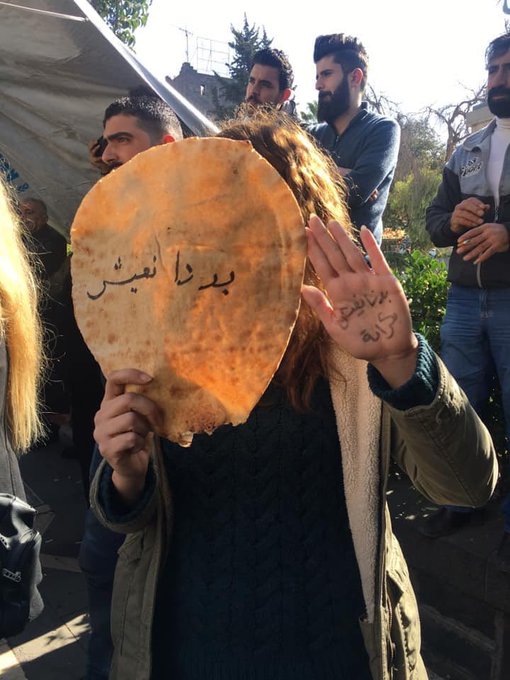
 On Friday, demonstrators swarmed the streets of Shahba city, north of Sweida, raising loaves of bread and shouting “We want to live.” Videos broadcast by local news sites showed protesters gathered in Shahba’s square, chanting slogans against the corruption of regime officials and accusing them of ignoring the people’s suffering. Protesters demanded a peaceful revolution and the restoration of the value of the Syrian pound.

 A group of people, including children, raised banners and denounced the collapse of the pound, and demanded an improvement in living conditions, price control and accountability of the corrupt, Suwayda 24 official Facebook page reported on Friday. Photos published on the page also showed demonstrators raising banners slamming Bouthaina Shaaban, the political and media adviser to head of the Syrian regime Bashar al-Assad. Shaaban has been facing a campaign of widespread criticism by loyalists and opponents after the release of a video recording her stating that “the Syrian economy today is 50 times better than it was in 2011.”

 The Syrian pound in the black market in Damascus was on Thursday at SYP1,300 compared to the US dollar. Specialized websites, however, stated that the exchange rate of the US dollar ranges between SYP1,230 and 1,210, while the official rate is SYP514. UN reports affirm that 83 percent of Syrians live below the poverty line.'
Image

Thursday, 16 January 2020

'Humanity is dying': Syrians feel abandoned by the world


 Dani al-Qappani:

 'As the poet John Donne famously noted, 'No man is an island'; all peoples on earth are interconnected on the large and small scale, with our destinies intertwined.
Solitary confinement is commonly used as a form of punishment because, on the small or large scale, without our fellow humans we are isolated, hopeless and, after long enough, even suicidal.

 This has been proven true on the international scale for Syria, whose people have been abandoned for almost nine years to date by the international community, which has been wilfully blind, deaf and mute to the endless, daily atrocities by the Assad régime and its allies against civilians.


 Despite the mountains of bodies, the video and photographic documentation, the thousands of testimonies and all the rest of near-limitless evidence of this industrial-scale carnage, the world has looked the other way and continues to do so.

 Since the beginning of 2020, things have not got any better nor has the bombardment of civilians stopped. On January 1, Reuters reported, "At least eight people were killed when the Syrian army launched missiles that struck a shelter for displaced families in the country's northwest, witnesses and residents said."

 This climate of wilful ignorance has created a culture of impunity for evil, enabling the régime, with Russia and Iran backing, to reinforce and intensify the systemic injustice that the people rose up to overthrow in every area it has recaptured, razing towns, villages and cities, terrorising, murdering, 'disappearing' or dispossessing millions.

 In late March 2015, the Idlib governorate was almost freed from the control of régime and Iranian forces; the régime saw this as an opportunity to begin forcibly displacing those in other areas which had dared to demand freedom to the Idlib region.

 Among the citizens forcibly displaced to Idlib were all those who refused to accept the régime's fake 'settlements' or to believe its transparent lies about ensuring peace and dignity, which were more especially unbelievable since the revolutionaries' main demand – the fall of the régime – was never addressed.


 As a result of this forced displacement, at least three million people fled or were transferred to Idlib governorate from across Syria, joining the people of the region which was one of the first to rise up against Assad in 2011. Despite years of enduring the horrors of bombing, siege and terror by Assad and others, Idlib's people never stopped calling for justice, dignity and humanity.

 All this took place against a background of international agreements and ceasefires which the régime-Russian alliance never abided by, such as the de-escalation agreement signed in May 2017 and the Sochi agreement signed in September 2018, while the international organisations nominally responsible for protecting civilians passively watched the slaughter.

 Since April 2019, the Idlib region has seen a massive military escalation by the régime and its accomplices in an effort to control Idlib, killing hundreds of civilians, including children and women, and destroying dozens of schools, hospitals and places of worship.


 The problem for Syrians is that they are sacrificing their lives and their children's lives waiting for someone to make a move to end this bloodbath, being profoundly aware that they've been abandoned by a world that makes speeches about human rights but does nothing to defend the defenceless, and left wondering about the real function and usefulness of international bodies like the United Nations and its various organs like the Security Council, or the 'Friends of Syria' whose friendship seems more like enmity.

 For the UN, Mark Coutts, the UN Deputy Regional Humanitarian Coordinator for the Syria Crisis, stated on January 7, 2020: "I am alarmed at the deteriorating humanitarian situation in Idlib, northwest Syria, where over three million civilians remain trapped in a war zone – the vast majority of them women and children. At least 300,000 civilians have fled their homes in southern Idlib since mid-December, following a sharp escalation in hostilities."

 Having noted this, Cutts then continued his statement by saying, "On Sunday, we received reports of at least nine civilians killed and 20 others injured in Ariha, following airstrikes in the area. According to humanitarian staff on the ground, the airstrikes resulted in destruction and damage to buildings, including a school, a kindergarten and a mosque."

 As with all the UN reports since 2011, Syrians are left wondering: Did anything change? Has the UN become a news agency now? And when the rest of the world is progressing and moving towards greater modernity and development, why are its attitudes towards Syria's humanity going in the opposite, regressive direction?


 Speaking about the hopelessness of the current situation, a media activist and photographer in Idlib, whose name is withheld here to protect his safety, said, "During the last two weeks, every kind of weapon was used, including the Syrian and Russian warplanes. We see aviation squadrons of helicopters dropping barrel bombs over the areas daily, concentrating on the eastern suburbs of Ma'aret al Nu'man.

 "The most heartbreaking thing I saw was in Ma'saran town. When I arrived there, I saw people fleeing using cars, motorbikes and even running on foot. I saw people carrying their children while running and screaming after an airstrike which targeted the centre of the town. People weren't even safe after that. They were targeted with artillery by the régime while trying to flee, killing a woman and a man, and injuring several others."


 It's not only the deprivation and harsh winter weather conditions that make life hard for the people in Idlib, but the constant fear of régime attacks even on refugee camps; as a report published by the Syrian Network for Human Rights on December 13, 2019 noted, the Syrian régime carried out another attack on the Qah IDP camp located on the Syrian-Turkish border on November 20, using cluster munitions that killed 16 civilians, including 11 children and three women. As the SNHR pointed out, this was only the latest of dozens of similar attacks on refugee camps.

 Heba, a college student and resident of Idlib, says "We are really facing a catastrophic situation, having a hard time in dealing with every kind of death, not only the literal death that you know of, but other kinds of deaths and terrors like fear of the unknown, of displacement, of being injured and so on.

 "No sane human can see the tears streaming down people's cheeks, the body parts all over the place, the children in camps, and stay silent for no reason. Humanity is dying – are there any saviours? Please move and stop our blood from being shed!"

 And what was the world's reaction to this atrocity, as to all the other thousands of régime attacks on camps, homes, hospitals, schools? It was the same polite 'thoughts and prayers' concern given for any minor accident, and the same failure to attribute any responsibility.

 The international bodies issued their usual statements 'without assigning responsibility'. For Syrians, this shrug of indifference is one more indication of the world's contempt that disregards any sense of interconnection or shared humanity and reassures tyrants they're free to do as they please. There is nowhere to turn for safety, with the world's indifference helping to strengthen injustice.

 As another Syrian warned, "Either humanity will prevail, starting in this land, Syria, or it will be a black hole devouring everything that remains – and what will remain when there's no humanity left?"

 Ibrahim, a young man displaced from Damascus suburbs now living in Idlib where he currently works at a gas station, said, "People have lost faith in the international community and humanity; we haven't followed any conferences or international news for so long because we all agree or have a feeling that the international community is conspiring against us.

 "We have learnt from the lesson of the 'red lines'; we're not waiting for anything from the international community, the Arab League, human rights bodies, animal rights bodies or anyone else. We're dying." '

Tuesday, 14 January 2020

Running the gauntlet in Idlib

The Assad regime on the offensive in Syria’s Idlib

 Merna al-Hasan: 

 'The Russian air force plays a pivotal role in the battle for Idlib. Its advanced jets and helicopters can easily hit multiple targets at once with a high degree of accuracy, causing extensive damage to infrastructure and housing. The joint Syrian-Russian shelling has turned parts of the city into crematoriums for their inhabitants, and many of the surrounding villages, such as Maaret Hurmah, Sheikh Mustafa, Kafar Sijnah and Rakaya, have been razed completely.

 The recent military escalation is of a different intensity and scope to previous attacks. One minute the Russian warplanes launch tens of rocket-propelled grenades, while simultaneously dozens of barrel bombs are dropped on the exact same spot. Sometimes, internationally-banned phosphorus shells are used. These bombs have targeted and destroyed vital infrastructure, such as markets, hospitals and schools. Even mosques have not been spared, as many in the south and east of Idlib province have been targeted. Assad, with the help of the Russians, is trying to destroy anything that supports life, so internet cables, communication towers and water supplies have also been hit.

 Opposition factions always retaliate when attacked by the régime and the Russians. However, their responses are muted in comparison. Armed opposition groups have tried to repel the régime’s attack on Idlib by employing simple ambushes and hit-and-run tactics. Nobody has complete control over the towns and villages around Idlib, especially in the countryside to the south of the city. For example, lands taken in the morning by the opposition are ceded to the régime forces with Russian air support in the afternoon. Some groups linked to the Free Syria Army have recently moved from the ‘Euphrates Shield’ area to the countryside surrounding the city of Idlib, but they were too few to change the tide of the battle there. The régime employs a scorched earth policy, meaning that firstly vital installations are targeted, forcing inhabitants to seek refuge away from the frontline. Then when the areas are almost completely deserted, régime forces advance in overland. The régime aims to control the M5, the international road between Aleppo and Damascus, and the M4, a major commercial route that connects the western port of Latakia to the cities of Aleppo, Raqqa and oil-rich Deir ez-Zor in the east.


 The military escalation between SDF and Free Syrian Army in the provinces of Raqqa and Hassakeh has negatively affected civilians in Idlib. Fuel prices in the city have increased beyond the reach of most households, because roads have been cut off, meaning fuel products cannot enter.

 It is a humanitarian catastrophe by any definition. What is happening now in and around Idlib is considered to be one of the largest displacements of people in the modern era, if not the largest. There is no sanctuary for Internally Displaced People (IDPs) from the eastern and southern Idlib countryside to take refuge in. No city is completely safe, but IDPs seek out refuge in less dangerous areas. According to some statistics released by local associations operating in Idlib (such as the Civil Response Coordinators Association in Northern Syria, an association that collects data on displaced persons), more than 300,000 civilians were displaced from the southern and eastern countryside of Idlib in December 2019 alone.


 Those fleeing Assad’s attacks head towards areas near the Turkish border, such as al-Dana, Sarmada, Atma, and Darkush. The displaced persons are taking refuge in evermore crowded refugee camps. Despite the efforts made by individuals and organisations to open new shelters and new camps, severe overcrowding and dire conditions remain. Hundreds of families have been placed in bombed-out buildings. Some mosques have also opened their doors to those who have fled. The people of Idlib are running the gauntlet between one death trap and another. Roughly 4 million civilians are caught facing extermination from land and air. Any attempt to cater to the needs of such a large number of people have so far proved useless. A further 40,000 citizens are at risk of being displaced if the attacks advance into the town of Saraqib and the surrounding countryside.

 The reality of the talks in Astana or Geneva is that normal citizens always suffer the negative fallout from these political discussions. Oftentimes things only get worse after such talks. Syrian civilians continue to be shelled and are forced to exist in dire humanitarian conditions. People like us are always the biggest victims of devastating wars. We also can’t fail to mention the negative effect that Russia using its veto at the UN Security Council has had. The IDPs have suffered because this veto led to the blocking of cross-border aid deliveries from Turkey and Iraq to millions of Syrian civilians.

 There is much said internationally about a peaceful resolution to the situation in Idlib, but in reality, such conflicts are always resolved by force, with the strongest party prevailing. Idlib’s inhabitants have lost all hope that their lot will improve, not even a glimmer remains. No outside country wants to intervene on their behalf to end the bloodshed either. After nine years of killing, destruction and displacement, those in Idlib don’t have the luxury of hope! We no longer talk of human rights, but we seek help from the world so that the régime does not annihilate us all. And here we are, waiting for our unknown fate, we may be displaced tomorrow or killed, or we do not know!


 It is not easy to be a woman reporting in a relatively conservative city like Idlib. Society here is not so accepting of female journalists covering news from the streets. Before the revolution broke out in 2011, people in places like Idlib and Aleppo were not used to seeing women working in the streets. There is a major problem in ensuring the safety of journalists in general. When I go to cover news after air strikes and bombings, there is always a risk that another air strike will hit the same place, regardless of any media professionals who have arrived to report on it. We also constantly receive death threats, especially on social media. Both those who support the régime and others who oppose it regularly insult me and accuse me of being disloyal to the Syrian nation. They even threaten to blackmail me, kill me or hurt me in other ways. As a journalist in the thick of events, I’m targeted by people from both sides as most of whom do not want the world to see the truth.

 In the past few months, we journalists in Idlib have been trying to contact various Arab and international media outlets to cover the strikes against Idlib. We have found them to be reluctant and inflexible. We feel that nobody cares about what happens to us! After nine years of war and destruction, Idlib is the last pocket of régime opponents who went to the streets to protest in 2011. I would say what little international coverage there has been of Idlib has been characterised by manipulation. The stories that come out about what’s going on here are often full of misinformation, falsification of the facts and a random narration of incomplete stories about the massacres. The result is that the media does not play its role effectively in conveying facts and raising awareness of people so they can to form nuanced opinions based on correct information.

 For example, in the case of the White Helmets, media campaigns distorted their image and fake stories were circulated about them, especially by Syrian state media. Furthermore, after Russia had denied Assad’s responsibility for carrying out the deadly chemical attack on Khan Shaykhun in April 2017 and accused ‘foreign agents’, different media platforms have adopted this narrative. The régime is internationally recognised, therefore its official media story is covered in the international press unlike the opposition’s narrative. Assad has managed to convince the world that we are all terrorists, and that we absolutely deserve to be killed. The people of Idlib are not terrorists, they just want to live for the love of life itself.'

Saturday, 11 January 2020

Idlib demonstrators revive Syrian revolution


 'Syrian demonstrators took to the streets on Friday (January 10) in Idlib city center, chanting anti-Russia and Assad militia slogans, confirming the continuity of the Syrian revolution and condemning Assad and Russian bombardment on Idlib.

 The demonstrators expressed their sympathy and support to the forcibly displaced persons from Maarat al-Numan.

 They asked the international community to press the Assad regime and Russia to stop killing civilians and to release the detainees.

 Meanwhile, about a dozen demonstrators organized a sit-in in Maarat al-Numan to express their attachment to their land despite severe Assad and Russian bombardment that displaced most of its inhabitants.

 Two weeks ago, thousands of Syrian demonstrators and activists worldwide took to the streets in more than 50 cities and capitals worldwide chanting anti-Russia and Assad militia slogans and condemning Putin and Assad's crimes in Syria.

 Assad-Russian warplanes have committed dozens of massacres in Idlib and Hama countryside since they launched their bombing campaign on the 30th of April, largely violating the de-escalation zone deal reached between Russia and Turkey.'

Tuesday, 7 January 2020

We try to find hope amid the slaughter in northern Syria

Syrians surround body bags containing the corpses of victims of a reported regime airstrike in the town of Ariha in the Idlib province on Jan. 5. (Omar Haj Kadour/Afp Via Getty Images)

 Raed al-Saleh:

 
'The world may be focused on America’s feud with Iran, but the war in Syria continues unabated. As 2020 dawns, the olive groves of northern Syria have become shelters of last resort for nearly a quarter of a million people forced to leave their homes in recent weeks. Many of them were attacked from the air even as they scrambled for safety.

 For the three and a half million civilians in Idlib, constant bombardments and displacements are facts of life. Yet eight years of empty promises from the international institutions set up to protect civilians have not broken our resilience. Every day, amid the horrors, we witness astonishing acts of humanity and selflessness that give us hope.

 Only by persisting in this hope can we see our way through. This is what inspires us to believe, despite the odds, that 2020 will be the year when world leaders finally act to protect civilians. We refuse to succumb to despair.


 In response to the latest wave of bombings and mass displacements by the Syrian regime and Russia, our White Helmet teams have been working desperately to help civilians reach safety. We have been setting up camps anywhere we can, even rehabilitating sports stadiums and other available spaces. We have been providing coats and blankets and digging trenches to keep the camps from flooding. Our teams of female volunteers have been helping those fleeing on the roads by providing information, food, water and medical advice.

 In 2019, 3,364 civilians, including 842 children, were killed across Syria. Our teams have pulled 4,530 people, including 1,054 children, from the rubble of bombed-out buildings — saving the lives of those whom Syrian and Russian forces want dead. The White Helmets take our motto from the Koran: “To save a life is to save all of humanity.” I repeat it to myself every time we lose another colleague and friend.

 We mourn 17 volunteers who lost their lives over the past year, most in so-called double-tap airstrikes, when warplanes returned to bomb for a second time after our rescue workers gathered to help the injured. Russian reconnaissance aircraft monitor our rescue missions and target them, destroying life-saving equipment and ambulances. Everything is calculated to make life as unbearable and horrific as possible so that people have no option but to flee.


 My teammate Anwar is mourning the loss of his three little girls and his wife as the new year begins. Last month he received an emergency call while on duty about bombing and artillery shelling in his town. When he arrived at the site of the attack to rescue the injured, he found his own house bombed and completely destroyed. The loss tears us all apart.

 The crisis is worse than it has ever been. War crimes are being committed on a weekly or daily basis, and the world meets them with earth-shattering silence. For us on the front line it’s incomprehensible — the indifference is impossible to understand.

 In December that indifference turned toxic when Russia and China blocked one of the last lifelines — cross-border aid from Turkey meant to help four million people in need of humanitarian assistance. The crisis for civilians trapped in Idlib is about to get even worse.


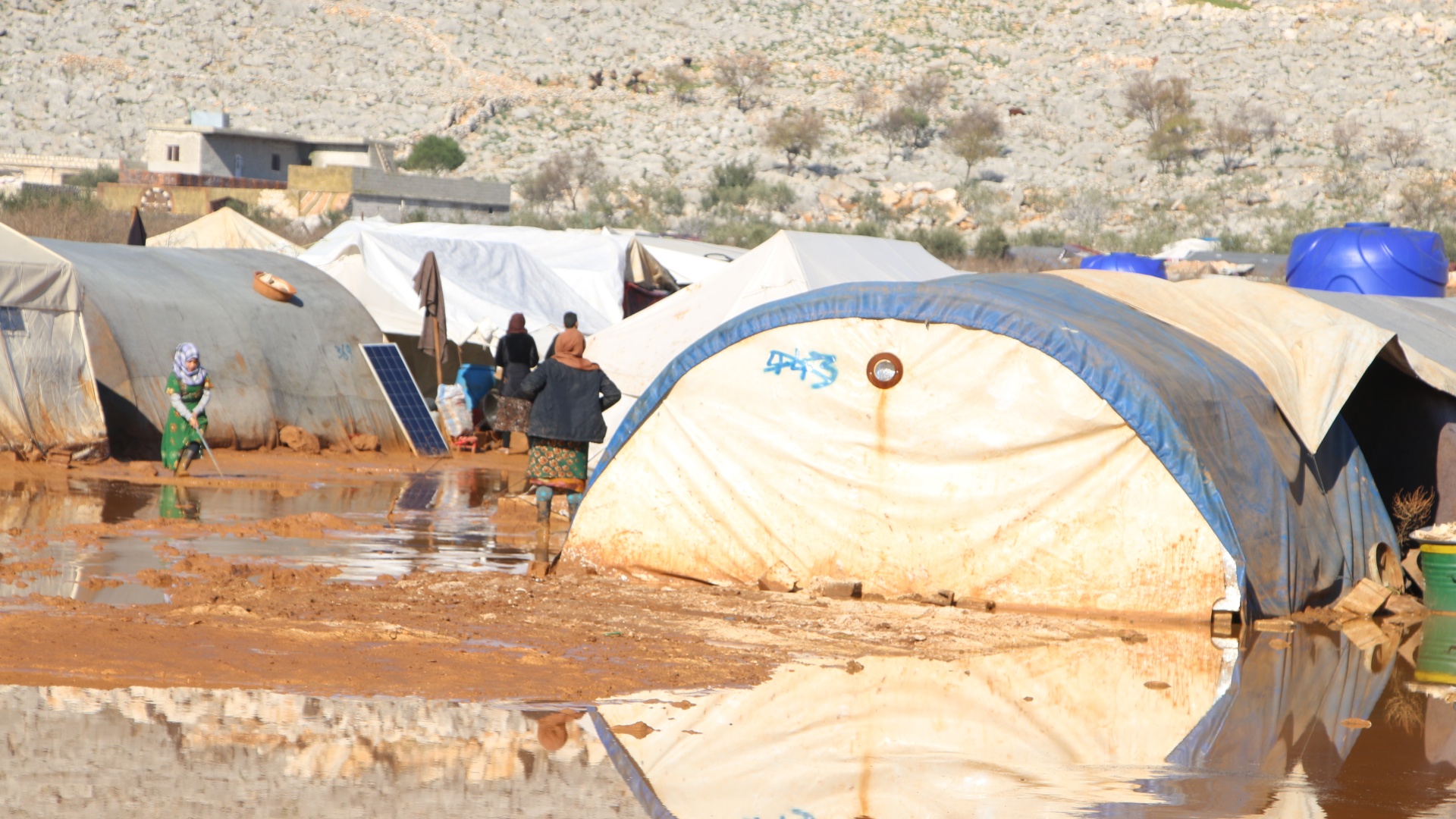
 All of this has taken a heavy toll on our volunteers, many of whom are among the most affected by the bombs. Many are themselves displaced with their families, and each time they leave to do their work, they fear they may never see each other again or that they may return to a flooded tent.

 Under such conditions, hope is the precondition of survival, and we persist in seeing it in every child rescued from a collapsed bedroom that was bombed while they slept. My colleagues sing nursery rhymes to them in the ambulance on the way to the hospital or make balloons from surgical gloves to give them a reason to keep smiling.

 All we ask is that the international community share our belief in the people of northern Syria. There are millions of civilians getting up every day and finding reasons to work, play or volunteer in their communities, all despite the extremists who surround them and the bombs that fall from the sky.


 Funding cuts have left people without proper shelter, clean water or sanitation services, while the world’s most powerful nations meet the horrors of our daily lives with silence and inaction. But I know that as long as we can save a single life, we will continue to dig for it from the depths of death and destruction.

 The White Helmets have saved more than 120,000 lives since our formation. For us, this is our greatest accomplishment: offering a glimmer of hope for the Syrian people in the face of utter failure from politicians and world leaders. I hope 2020 will be the year the world finally steps up to end the suffering of Syrian civilians and hold all war criminals to account. It’s not too late to save lives.'

Saturday, 4 January 2020

Syrians rejoice in death of terrorist Qasem Soleimani


 'The Syrian opposition on Friday hailed the killing of top Iranian and Iraqi commanders in a US strike. The strike outside Baghdad airport killed top Iranian commander Qasem Soleimani and the deputy chief of Iraq's pro-Iran paramilitary organisation, Abu Mahdi al-Muhandis.

 Soleimani had been a key backer of Bashar al-Assad and helped him save his position after an uprising that began in 2011 threatened to topple his regime.

 He was Iran's pointman in organising Iranian forces and their Shiite-dominated foreign proxies on the Syrian battlefield and a frequent visitor to Damascus.


 Thanks to the support of Iran and its proxies as well as to the decisive 2015 military intervention of Russia, Assad has clawed back most of the territory he lost in the early stages of the war.

 In the few areas still that still escape the regime's control, some Syrians celebrated the death of a man they hold responsible for thousands of civilians deaths.

 During a weekly Friday protest in the northwestern city of Idlib, one demonstrator held a placard that read: "We rejoice in the death of the terrorist Qasem Soleimani. Thank you Trump."

 "This piece of good news will encourage us to keep advancing, God willing, the revolution will continue and the revolution will triumph," said another protester, who gave his name as Mohamed Shkeib.

 Others handed out sweets to celebrate Soleimani's death.


 Leaders of Syrian opposition groups for their part hailed the death of a man they blame for thousands for thousands of deaths in the nearly nine-year-old civil war.

 "The murder of Qasem Soleimani, the number one perpetrator of Revolutionary Guards' crimes against the people of Syria and Iraq, is a blow that confirms that the world is able to stop Iran and protect Syrian civilians if it wants to," Nasr Hariri, a senior political opposition leader, said.

 Ahmed Ramadan, another senior opposition figure, also praised the US strike.

 "The killer of Syria's children has been killed, the killer of Iraq's free people has been killed," he said in a post on social media.'

Demonstration in Idlib to revive Syrian revolution


 'Syrian demonstrators took to the streets on Friday (January 3) in Idlib city center, chanting anti-Russia and Assad militia slogans and confirming the continuity of the Syrian revolution and condemning Assad and Russian bombardment on Idlib.

 The demonstrators expressed their sympathy and support to the forcibly displaced persons from Maarat al-Nuaman city.

 They asked the international community to press Assad regime and Russia to stop killing civilians and to release the detainees.

 Last week, thousands of Syrian demonstrators and activists worldwide took to the streets in more than 50 cities and capitals worldwide chanting anti-Russia and Assad militia slogans and condemning Putin and Assad crimes in Syria.

 Assad-Russian warplanes have committed dozens of massacres in Idlib and Hama countryside since they launched their bombing campaign on the 30th of April, largely violating the de-escalation zone deal reached between Russia and Turkey.'

Thursday, 2 January 2020

Russia’s role in Syria is sinister

Russian President Vladimir Putin (R) meets with Syrian President Bashar al-Assad (L) in Sochi, Russia on 21 November 2017 [Kremlin Press Office/Anadolu Agency]

 'As we enter a new year and a new decade, the Syrian conflict rages on, well into its ninth year. The estimated death toll is touching one million, with over ten million others displaced both internally and externally, from a pre-war population of around 23 million in 2011. The role of the regime of Bashar Al-Assad in suppressing protests and attempting to crush the rebellion is well understood, but far less has been mentioned about Russia’s intervention in the conflict.

 Russia intervened militarily in Assad’s favour in 2015, although in reality it was backing the regime diplomatically from the onset. It has used its UN Security Council veto 14 times on the Syrian issue in the past 9 years and blocked any attempt to hold the government accountable for its crimes. Whilst the west was offering a veneer of hope for the uprising, Russia made no secret of its support for the regime. The military intervention is now an occupation which has tipped the scales in favour of the regime; the Russian Foreign Minister himself said that if it were not for their intervention, Assad and his government would have collapsed in a matter of weeks. And although Russia claimed that its intervention was to attack Daesh in eastern Syria, most air strikes targeted opposition held areas that had no link to Daesh or jihadist groups whatsoever. When Russia entered Ghouta, for example, there were no Daesh fighters, but it made no secret of its intervention in that area.

 There is an extremely strong case to be made against Russian President Vladimir Putin for committing war crimes in Syria. Multiple hospitals have been hit by Russian forces in a brazen attempt to terrify opposition-held areas into submission. There was a particularly well known instance in which the UN gave Russia the coordinates for hospitals in northern Syria specifically to avoid hitting them by accident; Russian air strikes still hit the hospitals in what was clearly a war crime. More than 50 hospitals have been hit in the past 6 months as Russia continues its campaign of fear against the Syrian population, and although the UN has failed the Syrian people on many occasions, the New York Times has just published a very powerful report investigating the many incidents where Russian and Assad forces deliberately attacked hospitals and schools in the north of Syria.


 There is a measure of irony here; Russia has played up its “diplomatic” role during the crisis by hosting the Astana Process on Syria and brokering the Sochi agreement back in the autumn. It claimed that it was the major power behind persuading Assad to get rid of his chemical weapon stockpile in 2013 after a massacre. Any attempt to play honest broker by Putin offers a thin veil of legitimacy and is quickly broken down by Russia’s military might behind Assad’s recent victories on the battlefield.

 Delving deeper into Putin’s mind, it is clear that he views Syria as a client state. The Russian leader himself was a KGB agent of the Soviet Union for over 15 years and is well versed in the mechanics of a totalitarian state. The Syrian city of Tartus on the Mediterranean Sea hosts a Russian naval base, its only port outside Russia itself. The Litvinenko murder in 2006 and Skripal poisonings in 2018 in Britain demonstrated how Russia will stop at nothing to punish any dissent. The example of the Russian invasion and annexation of Crimea in 2014 showed that borders are an abstract concept for the Russian state and are in no way respected. Is a state like this trusted to bring justice to Syria and to lead any reconciliation process?


 Nine years in, and Syrians see the conflict beyond simply a revolution against the Assad regime. The situation on the ground in Syria is akin to an invasion by Russia and Iran, with the former dictating the course of the war. This is not dissimilar to the situation of Afghanistan in the early 1990s when Najibullah was president with the Soviet Union there as the occupier and decision maker. Moreover, Putin himself claimed that he has used the war in Syria to test Russian weaponry and develop artillery at the expense of the Syrian people. Putin even arranged for Assad to visit Moscow during the conflict on a military aircraft in an act which underlined how weak the Syrian leader really is. This was by no means the only humiliation that Assad suffered at the hands of Russia, as he was essentially treated like a puppet on his own soil. Russian forces are not simply limited to the sky; they have been witnessed on the ground in Syria patrolling checkpoints and acting as a quasi-secret police service.

 As well as diplomatic and military interventions, Russia’s control over the Assad regime extends to directing the system of Syria’s government. Russia has authority over the political and economic decisions taken by the Syrian government which has gone beyond simple military decision-making. Putin is pulling the strings in Syria and the Syrian people are beginning to view the conflict through the lens of independence from Iran and Russia and their Syrian cronies; independence to plan their own course on and into the future.'

Friday, 27 December 2019

Syrian opposition calls on the world to aid rebel-held Idlib


 'A Syrian opposition leader has called on the international community to help millions of civilians in the country’s last rebel-held stronghold amid a crushing government offensive, calling it a “disaster area”.

 After weeks of intense bombardment, Assad régime forces launched a ground offensive on the southern and eastern parts of Idlib province in the north-west last week.

 It has forced tens of thousands of people to flee their homes.


 Opposition leader Nasr Hariri told reporters in Istanbul that the international community “should turn on the red lights because there is a humanitarian catastrophe inside Syria”.

 He added that large numbers of people are fleeing toward the Turkish border in what could trigger a new refugee crisis.

 “We declare this area a disaster area and it should be dealt with accordingly,” said Mr Hariri, who heads the High Negotiations Committee.

 He said work should be done to reach a permanent ceasefire in Idlib, not a truce that would crumble later.

 Mr Hariri said if the international community cannot protect those civilians, they should send them humanitarian assistance “so that they will be able to survive in this cold weather and difficult circumstances”.


 More than 235,000 people have been displaced between December 12 and December 25.

 It said many of those who fled moved out of the town of Maaret al-Numan, toward which Syrian troops have been advancing since Thursday.

 Mercy Corps, a global humanitarian aid group, said aid workers were rapidly scaling up operations to respond to the massive influx of newly displaced people.

 In just the past three days, Mercy Corps has handed out new arrival kits containing essentials for cooking and hygiene to more than 3,000 people and reached an additional 2,500 with fresh water, it said.

 “Thunderous bombs and shelling keep getting closer to major civilian areas,” said Wolfgang Gressmann, Syria country director for the organisation.

 “For thousands of innocent civilians the only choice is to flee, and now even their escape is a violent and frightening affair.”


 The town sits on a key road linking the capital Damascus with the northern city of Aleppo, Syria’s largest.

 The immediate goal of Assad’s forces appeared to be reopening the strategic road, which has been closed by the rebels since 2012.'


 Note 17/8/25, original link to msn.com broken.

Friday, 20 December 2019

Where Doctors Are Criminals


 'The Syrian medical students were well aware of the risks when they crossed over to rebel-held districts of Aleppo in 2013. The previous year, two other students had been arrested trying to smuggle bandages and painkillers through a checkpoint. A week later the security services told other students to collect the corpses, which had holes in their foreheads, tongues and eyes from a power drill.

 “That was a message for all the medical students,” said a former student who asked that his name not be used because of fear of retaliation. “ ‘If you do something against us, this is the result.’ ”

 Still, he and a friend decided to go. “There were no doctors at all in eastern Aleppo. The aerial strikes were really intense. It was a catastrophe.”


 Today the former student is working at a hospital in rural Germany where the hills are carpeted with vineyards. Two years after arriving he speaks fluent German and is studying for an exam that will give him status equal to a German-educated doctor. He lives with his young family in a quiet village. He told his story in a compact living room furnished with two soft brown couches and a large-screen television.

 After making contact with other students already working in east Aleppo, the student and a friend crossed over, pretending to visit relatives. As a third-year medical student, he had few skills, but doctors there taught him basics like inserting an IV needle or stitching a wound.

 In the beginning, medical supplies were so scarce that surgeons conducted an appendectomy on a young boy without anesthetics. “That was terrible.”

 Later the situation improved as outside aid groups provided supplies and training. A British doctor taught the Syrian surgeons how to repair a severed artery — essential in a war zone. The medical students visited Turkey to learn how to treat victims of chemical warfare.

 Despite their inexperience, the students admitted patients and provided emergency treatment because the doctors were always busy operating. The wounded were classified by color code: white for survival without treatment, black for hopeless, yellow or red for those in between.


Some cases haunt him. A family trying to escape Aleppo by car came under fire, killing the father and fatally wounding the two children, one cut almost in half. “The mother said to me, ‘Please don’t help me, help my children.’”

He lied to the mother that the children were fine, and the doctors treated her. She was the only survivor.

Another time a government missile struck a marketplace and ignited cans of fuel for sale. About 10 people came in severely burned. He and other students pushed tubes down their throats to administer liquids and medicine, but as far as he knows only one person survived.

After a couple of months he crossed back to west Aleppo to take his exams. The head doctor at the hospital told him he was crazy — the student had been filmed by a French television crew. Undaunted, he passed his exams and returned to east Aleppo.


 Asked why he had gone back, he told a story about a mother brought in by her children after a bombing attack in the middle of the night. She was covered in blood and classified as “black” — a hopeless case. But the doctors revived the woman with blood transfusions and liquids, as her children, aged 3 and 6, were curled asleep beside her. The children awoke, overjoyed. Cases like that, he said, “were a motivation for me to go back.”

 After about another six months, around January 2014, he left east Aleppo again to take more exams. He applied for a passport, because it was getting harder to cross into Turkey and he wanted more training there.

 That was a mistake.

 His name was on a list at the passport office. The clerk said the student needed to answer some questions that would take five minutes. He said “it lasted about 110 days.”


 The first night he was held with eight people in a cell measuring one meter by two meters. He was interrogated repeatedly and accused of providing treatment to rebels, but he was not tortured.

 That changed after he was transferred to another facility in Aleppo, which he described as a large house, operated by state security.

 For the next 96 days he was detained with 35 men in a cell about as big as his living room in Germany, or about three meters by three meters. There wasn’t room for anyone to lie down. The prisoners sat in rows, their legs wrapped around the person in front. The first three days he couldn’t sleep. The prisoners wore only their underwear and were allowed two bathroom trips daily. The guards counted down as the prisoners relieved themselves.

 Occasionally prisoners were hauled out. The others could hear the screams from beatings in nearby rooms. The youngest prisoner was 14, arrested for demonstrating. The oldest was 76, a teacher who developed a foot infection after a beating and died.


 Eventually the medical student’s turn came. A muscled guard made him lie down on the floor, hands bound. He was blindfolded and beaten with a braided electric cord. He said the first blow was unbearable. The beating lasted an hour.

 The next day he was beaten again until he was bleeding, with broken teeth lying on the floor. The guard wanted him to confess to giving medical treatment to rebels.

 After 96 days he and 50 other prisoners were loaded onto a bus with blacked-out windows. Guards told them they were en route to the desert to be shot.

 “I said, ‘O.K., this is it. This is the end.’” But it turned out they were en route to Damascus, where conditions improved dramatically.


 He was held in a less crowded cell with a toilet. He got a haircut and was allowed to wash and shave. The meals included eggs, vegetables and fruit.

 It turned out his parents had bribed officials the equivalent of about $1,650 to win his release. After 10 days he was freed.

 Despite his trauma, he went back to east Aleppo. The city by then was under constant attack, and his contacts behind the lines told him the situation was catastrophic. The student’s father tried to stop him. “He said, ‘Are you the only doctor? Please don’t go.’ I went anyway.”

 After a short time in east Aleppo he left, finished his medical studies and married a doctor colleague. Demoralized by the fall of Aleppo, in 2016 they became refugees bound for Germany.

 That was another odyssey, including a crossing in an overcrowded inflatable boat from Turkey to the Greek island of Chios on New Year’s Eve and the sale of his wedding ring to pay for train fare from Warsaw to Berlin.

 Now he works 7 a.m. to 7 p.m. in the hospital now, but isn’t complaining. “People here are very nice.”

                                       **********************************************

 Soon after the Syria demonstrations began in February 2011, the government started using lethal force against the protesters, and medical personnel were pulled in to help.

 A pharmacist from Damascus began handing out basic first aid supplies because his pharmacy was in one of the suburbs where the protests first took hold.

 “People came for bandages and cotton,” he said. “People tried to organize themselves. They tried to set up field hospitals, in houses, to do some managing,” he said. “Some doctors tried to do that. I knew a lot of them. A lot of them were my friends. A lot of them were arrested.”

 Wary of Syria’s feared intelligence service, protesters cared for the injured in secret, fetching medical personnel to treat them in private homes or safe houses, not trusting the public hospitals where the police and intelligence agents could detain wounded patients.

 The pharmacist began organizing networks of medical workers. He had experience from his student days when he had raised money to help orphans and the sick. He began collecting drugs and medical supplies from friends, relatives and organizations and getting them delivered.


 By 2012 the protests had spread countrywide and escalated into an armed uprising. The government had sealed off opposition-held areas including the eastern Ghouta suburb of Damascus, the southwest city of Dara’a and districts of the western city of Homs, preventing food and medical deliveries by enforcing a blockade.

 “The régime was preventing any help for them,” the pharmacist said. “The régime claimed that those people were part of the opposition parties and militias - children, women or men, without discrimination.”

 As a pharmacist, he supplied drugs to public hospitals, so he had access to drug supplies and he carried a health ministry card, which allowed him to drive through government checkpoints unhindered.

 “Sometimes I was trying to deliver very critical drugs,” he said. “We are talking about cancer, cancer affects all people, anyone can have this disease,” he went on. “In the besieged areas it was a very important intervention from my side to deliver those drugs.”


 He knew an oncologist in eastern Ghouta who had chosen to stay within the besieged suburb, and he sought ways to keep supplying drugs and medical supplies to her hospital.

 The pharmacist paid government militias to take drugs and medical supplies across government lines, and delivered supplies near tunnels in eastern Ghouta that the rebels had dug.

 The dangers to people like him were clear, the pharmacist said. Under President Bashar al-Assad — who was a doctor himself, specializing in ophthalmology — the Syrian government arrested medical professionals who showed any sympathy for the popular uprising.

 “If they find a weapon in your car it will be easier for you than if they find bags of blood, for example, or anesthesia drugs,” he said. ”Working in medicine was a very critical issue because the régime hated us more than the people, more than the revolutionaries.”


 Moreover, he said, the government mistrusted medical professionals because they were educated and capable of independent thinking.

 “They hate the educated people because we are trying to do some organizing that is not in their way,” he said. “They are trying to make all people think in the same way, what Assad needs and what Assad wants, not against him.”

 Fear of arrest did not deter him, he said. “It is our choice, our life,” he said. “As a human, we have this belief, and we have our belief in God, as a Muslim. And it is our families and our people who are being affected.”

 One of the supply networks he had formed with a friend consisted of 10 doctors and medical personnel. They used basic security, operating in cells, using code names. Only the leader, his friend, knew who the other 10 members were. But it turned out one member was a government informant.


 They worked for two years, longer than many medical activists, but in July 2014, agents of the Syrian intelligence service detained the group leader, who led them to the pharmacist.

 Plainclothes intelligence officers surrounded the pharmacist outside his office as he was getting into his car. He spotted his friend sitting in one of their cars. They took the pharmacist home and seized his computer, cash, and car, and ordered him to call his wife to tell her to come home.

 As they hauled him away, he recalled, the couple exchanged glances. “I looked at her — it was a very sad moment,” he said.


 He was interrogated and tortured with beatings for 60 days in the 215th branch of the Intelligence Service in Damascus.

 “My interrogator asked me directly: ‘Where is your gun? Why are you helping terrorists?’” The interrogator dismissed his protests that he was a government-approved pharmacist supplying public hospitals. They showed him a fellow member of his network who had been arrested. The man’s back had been broken after he was bent backward in a form of torture that inmates call the German chair.

 The pharmacist’s ordeal reinforced to him the Syrian government’s weaponization of medical care in war.

 “My interrogator told me, ‘We hate you more than the fighters. Why? Because you will treat people, you will treat fighters,’” he said.


 He was held in a cell so cramped that inmates had to take turns to rest. One sat with knees bent while another stood. Disease was rife that prisoners sometimes died in the cell.

 A family of three, father, son and grandfather, died one after the other. The father died after interrogation, and the 18-year-old son, who had been arrested trying to buy bread at the local bakery, was so traumatized that started biting cellmates. “He died in the night, and the guards did not remove his body for a whole day.”

 The pharmacist ended up signing blank papers and his interrogators filled in his confession, inventing details that he had stored weapons in a mountain cave, had treated fighters and knew the leaders of Al Qaeda and other militias.


 If the government had really believed such accusations his captors would never have let him out alive, he said. “They know I am not like that,” he said. Instead, they took a bribe of $10,000 from the pharmacist’s family to gain his release. A few months later he paid $2,000 for him and his wife to be smuggled out of Damascus and into Turkey.

 He lives in a modern apartment block in the city of Gaziantep, not far from the Syrian border in southern Turkey, and works for a nongovernmental agency, providing humanitarian assistance to vulnerable Syrians.

 The pharmacist said he remains opposed to the Syrian government and its enforcers. “We are fighting them, not with weapons but with ideas, concerns and also humanitarian work.”

                                 *********************************************************

 For some, the war destroyed their dreams.

 Ballour’s ambition was to be a pediatrician. She lived in Ghouta, a large suburb east of Damascus, and was in her fifth year of a medical degree in Damascus when demonstrations began in 2011. She recalls a building sense of terror.

 Police began checking student’s IDs at the university entrance and she watched in fear as fellow medical students were beaten and detained, and people were hauled off buses.

 “That started very early,” she said. “Everyone in Syria saw that.”


 A slim pale-faced figure in a head scarf and long coat, Ms. Ballour, 32, recounted her ordeal with the calm efficiency of a medical professional as she sat in the sparse one-room apartment she shares with her husband, a civil engineer, Hamza el Hiraki, 37.

 When demonstrations broke out in her own suburb, the risk of detention grew. “They started to do the same thing,” she said, “I felt very afraid.”

 Then one day, Nov. 25, 2011, her brother and brother-in-law, both mechanics who were traveling by bus on their way to fix a water pump, were detained.

 “My brother did not participate in the demonstrations,” she said, “but they took their IDs and because they were from Ghouta they were arrested.”

 “They disappeared from that time, nine years ago,” she said. “Till now we don’t know.”


 Ms. Ballour was still traveling to the university by bus, and was already helping to treat wounded protesters in a small clinic in Ghouta.

 “It was dangerous for doctors,” she said. “If you helped injured people they would arrest you, so I had to decide if I wanted to stay in Ghouta, or stay in Damascus and study. I decided to stay in Ghouta.”

 People who knew she was studying pediatrics began bringing their children to her. She handled respiratory and intestinal infections and referred serious cases to specialists in Damascus.


 When the government imposed a siege on the suburb, conditions worsened. At the beginning of 2013, a woman came to her with newborn twins. They were in good health, but she had no milk. And with no milk powder available, the babies died within weeks.

 The medics relied on expired medicines they found in an old pharmaceutical factory, but by 2014 even those were exhausted. “We did not think it would last that long,” she recalled of the siege. “By 2014 we had nothing. I saw a lot of children die with infections, and some died of pneumonia.”


 The numbers of wounded escalated sharply when the government began aerial bombardment in 2012. When a hospital she worked in was destroyed by fire, Ms. Ballour began assisting a surgeon, Dr. Salim Namour in a hospital that was dug underground to protect against airstrikes. Their work in The Cave is now the subject of a documentary film.

 They trained volunteers to assist in the operating theater, and on the wards and Ms. Ballour was able to focus on pediatric cases. Eventually the staff voted for her to become the hospital’s manager.

 “He bombed it six or seven times but he could not injure anyone, he could not reach the basement,” she said, not needing to mention President Bashar al-Assad by name. Only when Russia intervened in Syria in 2015 and Russian jets joined the fight, were they able to pierce underground, she said.

 “A missile entered the basement,” she said. “They destroyed a part of the hospital and they killed three of my colleagues.” Ms. Ballour had just walked out of their room into the corridor and narrowly escaped.

 “They focus on hospitals because if they destroy the hospitals, people would give up,” she said.


 “A doctor represents hope for the patient,” her husband, Mr. el-Hiraki chipped in.

 Nothing prepared her for the devastating sarin gas attack of 2013. “This was the most difficult thing I saw. I had never seen something like that before, hundreds of dead bodies.”

 When she reached the hospital that night the whole square in front of the hospital was covered in bodies. “There was no blood,” she said. We did not know what it was but people were shouting, ‘Chemical, chemical!’”

 “I saw a lot of people, most of them children and they were suffocating,” she said. “Some of them were dead and some were dying.”

 The patients were foaming at the mouth, had pinpoint pupils and were in seizure. As medics tried to suck out the foam, more foam kept building. They gave every patient an injection of atropine but it was not enough and they had no oxygen.

 “People asked me to help their children but they were dead,” she said. With seconds to save those still alive, she brushed off a woman whose three children were her patients. “I could not even look at them. They were dead and I had to help others. There was no time and I did not sympathize with her. And when I remember that I feel bad.”

 “That night 1,400 died, most of them were children,” she said.


 The incident made Ms. Ballour and her surgeon colleague, Dr. Salim, targets of the Assad government because they were important witnesses to one of the war’s worst atrocities.

 They were eventually evacuated in to Idlib, the last opposition-held province in northwestern Syria. But there, they received a warning that they were on a government hit list because of their knowledge of the sarin attack and were forced to move to Turkey.

 In Ghouta medical colleagues who chose to stay behind were arrested, including a former military doctor, Dr. Motaz. He died in prison.

 For Ms. Ballour, the last days of the siege, when she saw so many children killed and maimed, many of them her own patients, finally broke her. She is working on a new project for Syrian women but gave up her dreams of being a pediatrician.

 “I cannot describe it, there are no words, but I could not work,” she said. “I will not be a pediatrician any more. I could not work with the children. Every child reminds me of another child.”

                                ******************************************************

 Dr. Ahmed was training to be an orthopedic surgeon at a government training hospital on the outskirts of Damascus when he became involved in coordinating first-aid points for injured protesters in 2011. With a group of 10 friends in the suburb of Dummar, Dr. Ahmed helped to move wounded protesters to a couple’s private house where he would bring his instruments and medication, and provide first aid.

 They kept the medical work secret, but at the same time were actively supporting the demonstrations on social media.

 “We were expressing our opinions in public on Facebook. I was using my real name,” he said. “That was to encourage people to express their opinion. So I never used a fake name which was crazy in that time.”


 In August 2011, intelligence officials came to the hospital where he worked and detained him. Unknown to Dr. Ahmed, the whole group was taken into custody at the same time.

 He endured a month of interrogation and torture of beatings, electric shocks and mock executions. He was beaten with rubber, wooden and steel cables, and electrocuted in ankle-deep in water.

 “It was like someone threw me into a wall. I lost consciousness and then I woke up on the watery floor.”

 Three times his torturers told him to prepare for his death by hanging, marching him out in the morning, and then after hours of waiting, giving him a reprieve.

 Although his interrogators did not know about his secret medical work, they always took exception to his status as a doctor and his education.

 “They said you studied in government schools, and it was for free, and the health service is free. So now you are receiving training from the government and receiving a salary, and now you want to bring down this government. You are a cheat,” he said.

 “They always were torturing me double because I was a doctor.”


 Eventually he confessed, was charged with multiple crimes including trying to overthrow the government, and released. Despite a grueling four months detention, he immediately returned to his activism.

 “A lot had changed,” he said. “The Free Syrian Army had formed, the international community was with us. I felt, ‘O.K., we have hope.’ And the régime increased its violence so I felt it was our responsibility and we should not stop.”

 He created a network of safe houses to treat the wounded, both civilians and those who took up arms and joined the Free Syrian Army. “We helped all of them. At that time there was no Al Qaeda or ISIS, so we felt the F.S.A. were part of us.”

 He set up a safe house in a luxury villa just yards from one of the Syrian government’s main military bases. They devised a network to ferry serious casualties to Lebanon. He returned to his post in the government hospital, working by day as a government orthopedic surgeon and by night for the opposition. “Like Dr. Jekyll and Mr. Hyde,” he said, laughing. “Most of us had these two lives.”

 At one first-aid point he amputated the arm of a Free Syrian Army fighter without equipment. He used a simple razor blade and cut the bones with garden shears. “It worked,” he said, “but a couple of hours after we finished, they said that the Army was very close to the center and we have to evacuate.” The doctors could drive out because they had passes, but they had to leave the patient. “He told us, go, and we left and we don’t know what happened to him. It was one of the most difficult moments of my life.”


 In 2013, he received a warning that he was about to be arrested and fled Damascus for the rebel-held area of Idlib. It was just in time, as government officials came looking for him at the hospital the next day.

 He joined a small rural hospital, and in 2014 encountered one of the most dramatic surgeries of his life. A car bomb exploded in the market and caused dozens of casualties. He treated a 10-year-old boy who had an open leg fracture, but then discovered his femoral artery was ruptured. As the blood spurted out, he told his assistant to put his hand on the wound and called a surgeon friend in Germany.

 “He said ‘O.K. I will send you a YouTube link, watch it and then go to the operating theater and call me through Skype and I will tell you what to do,’” he recalled. Dr. Ahmed watched the video, and then his friend talked him through the operation, taking a piece of vein from the boy’s other leg, mending the rupture and watching the color return to the boy’s foot. “Till now, I have never felt happiness like this in my life,” he said.

 He now works in Gaziantep in southern Turkey, meeting for an interview in a cafe because his wife wants no more activism in their lives.

 He no longer practices medicine and describes feeling survivors’ guilt. “Maybe I could have done more. This feeling of guilt never left us,” he said. His new mission is to help train and support medical personnel in northwestern Syria, where there is a lack of doctors.

 “I came here to bridge the gap as much as I can, and I think I did good work in that.” '


A Syrian medical student in Frankfurt, Germany. He was detained and beaten for treating patients in east Aleppo, an opposition stronghold.A pharmacist who was detained and interrogated by intelligence services for providing medical supplies during protests in Syria.
Dr. Amani Ballour in her apartment in Gaziantep, Turkey in Nov. 2019. Dr. Ballour managed an underground hospital in the besieged suburb of Ghouta, Syria.Dr. Ahmed in a park in Gaziantep, Turkey in Nov. 2019. He was detained by the Syrian military and subjected to beatings, electric shocks and mock executions.

Wednesday, 18 December 2019

Peace a mirage until returnees guaranteed safe haven


 Kareem Shaheen:

 'The arrests this month of 174 Syrians who had returned to government-controlled areas, after being urged to do so by the Assad régime, are a chilling development. The detained had been residents of the besieged Rukban camp, once a 40,000-strong settlement housing families displaced when they fled from ISIS years ago. The camp sits close to a US military base in the desert where the borders of Syria, Jordan and Iraq meet and had been under siege since October last year, its residents being slowly starved to death as aid supplies were cut off. Syrian President Bashar al-Assad promised a "humanitarian corridor" for returnees – then promptly arrested them when they took him up on his offer.

 Confirmation of the arrests was made by a grassroots organisation called the Syrian Association for Citizens’ Dignity that campaigns for the rights of displaced Syrians. Most of those arrested were military-age men who had defected from the army or evaded the draft and who had been given guarantees that they would be left alone if they agreed to surrender.


 The camp, where just a few thousand people remain, has been cut off from the outside world. Dozens of babies have died since the régime first stopped the flow of crucial supplies, and US forces nearby have refused to intervene to end an unfolding humanitarian tragedy in the desert of eastern Syria.

 The people arrested have been sent to government terrorism courts, which have been known to carry out summary executions. The episode highlights the Assad régime’s untrustworthiness – further evidence, if any were needed, that it can never be a real partner in peace. But it should also serve as a warning to countries in the Middle East and farther afield who are contemplating encouraging the return of Syrian refugees because they have convinced themselves that the conflict is over. Those who do will have blood on their hands.

 The issue of sending refugees home has been at the forefront of political debates among Syria’s neighbours this year, particularly as the Assad régime has consolidated its military victory over the rebels. As some semblance of normality has returned to parts of the country reclaimed by the government, countries that hosted refugees have sought to appease voters at home by arguing that they should be sent back because Syria is now safe.

 In Lebanon, hundreds of Syrians have been returned after years of having their lives made increasingly miserable by the Lebanese authorities and assorted non-state actors. In Turkey, which hosts more than three million refugees, human rights groups say the government has forcibly repatriated Syrians to so-called “safe zones” controlled by Turkish-backed Syrian proxy fighters, who have shown a penchant for looting, committing atrocities and filming them during military campaigns.

 The drive to send refugees home has been fuelled by the scapegoating of Syrians by the government in Ankara, which has profoundly mismanaged its economy and contributed to rising inflation and a collapse in the national currency.

 Right-wing populists in Europe have also argued that Syrians should be encouraged or forced to return home, seeking to capitalise on rising xenophobic sentiment.

 The residents of Rukban have a different status as IDPs, or internally displaced persons, but the principle is the same. The government has repeatedly encouraged those living in opposition-controlled areas to surrender and rejoin the fold of an Assad-led society, often with the added coercion of relentless bombardment and the wanton killing of civilians.


 Sporadic reports have emerged over the past year-and-a-half of returnees being taken in for questioning or facing detention and torture due to their ties to rebels, but it has been difficult to confirm such details or to establish whether the practice was systematic as many who went home, for various reasons, were often fearful of speaking to journalists.

 However, the world can no longer ignore the mounting evidence of the régime’s targeting of returnees who simply want to live in peace after nine years of war. For a régime that used chemical weapons on its own people, dropped barrel bombs on schools and markets and starved civilians to death, it is simply a return to form.

 But the broader tragedy is that arrests and the impunity they belie offer a glimpse at the real prospects of peace and reform in Syria. That hope is impossible as long as the Assad régime survives. Reconstruction aid and the lifting of sanctions on its acolytes by the European Union, the US and other countries is supposed to be tied to real and measurable progress on political reforms and reconciliation. With every passing day, the régime's actions concerning the Rukban detainees shows that its promises are empty.


 For real and lasting peace, the fate of tens of thousands of detainees and of those arbitrarily disappeared, including from Rukban, must be resolved. No country should force refugees to go back home when that home is still not safe. Régime supporters such as Russia must play a greater role in enforcing the guarantees it has provided to the régime’s opponents if they hope to bring an end to the conflict and relief for Syria’s economy.

 Without even this lowest of bars, true peace in Syria will stay a mirage.'

Wednesday, 11 December 2019

I lost my unborn child to a hospital airstrike in Syria


 'I run a maternal and paediatric hospital in Idlib. There are four gynaecologists, four midwives and 19 nurses working full-time.

 All of us are women, and we work around the clock in the midst of ongoing violence and bombardment. When an attack happens nearby, we usually don't receive casualties from the shelling, but that doesn't mean we are protected from the fallout.

 As women health workers in a maternity hospital, are we spared from these attacks? Of course not.

 Eight months ago, the area around my hospital came under heavy bombardment. When a hospital is targeted, people usually imagine horrendous destruction: Body parts, people trapped under rubble, injuries, and so on.


 The people in Syria, or at least those who have experienced such aerial bombardment, know what I'm describing. The targeting of hospitals is hard to describe.


 On the day of the attack, we immediately had to evacuate infants, young children, and expectant mothers. Our neonatal intensive care unit (NICU) was full. Of our 14 incubators, only one was available. We were forced to take 13 premature babies out of incubators to evacuate them and save their lives.

 While we were evacuating the hospital, the surgical department prepared to deliver babies via cesarean section, and we transferred some patients to a nearby hospital.


 As the evacuation got underway, I was in the operating room finishing an emergency c-section. I had no other choice. If I didn't operate, my patient and her baby would never have survived. That moment - the stress, nerves and fatigue - began to take a toll on me. When I heard the first cry of her baby, I felt a sense of relief.

 Attacks on civilian infrastructure are unlawful and a crime against humanity. We all know this on a rational level. However, when your own hospital comes under attack, it's an entirely different feeling. You can't just think about yourself. There are vulnerable patients and babies who depend on you for their survival and safety.

 When first responders arrive at a hospital that has just been targeted, they don't consider the medical staff victims of the bombardment. They consider us their colleagues, working hand in hand to evacuate and save as many patients as possible.


 We have been trained as first responders over the years, even though we never signed up for that job.

 On that unforgettable day, ambulances were coming to the hospital to transfer premature infants and patients to nearby facilities.

 When I finished the surgery, I was told that the baby I had just delivered needed an incubator. The baby was too weak.

 We had already evacuated the entire NICU in anticipation of a "double-tap" attack, a technique that has been used since the beginning of the conflict in Syria to target first responders and other health workers.

We immediately started looking for a hospital that had an available incubator. We first drove to Al-Ghadfeh Hospital, but they had no incubator available. Al-Salam Hospital in Ma'arat Al-Numan had one available, but it was an hour away. I monitored the newborn's condition during the drive, and fortunately, we made it in time.

 I was in my first trimester of pregnancy when the attack happened. On that day, I lost my unborn child due to bleeding.


 No one can possibly describe the overwhelming despair a mother feels when she loses her child, especially under such inhumane circumstances.

 No woman should ever experience this, but it is all too common for those of us living in northwest Syria. That's why I was determined to do whatever it takes to save this newborn. I can't bear to see another mother suffer an unfathomable loss because of violence and displacement.

 A few days later, we reopened our hospital. The mother still hadn't seen her son because she was still recovering from her c-section.

 We brought the child to meet his mother for the first time after 10 days in the incubator at al-Salam Hospital. He survived, despite everything.

 Although I lost my own child that day, I was blessed with another. Had the hospital not been bombed, my unborn child might have survived too, and I would have a third child in my family today.'

Thursday, 5 December 2019

Torture & Mass Executions Cornerstone of Assad’s Rule


 'Coordinator of the Syrian National Commission for Detainees and Missing Persons and member of the Syrian National Coalition’s political committee Yasser Al-Farhan, said that arrest, torture, and murder are still the cornerstone of Assad’s rule of Syria. He reasserted the international community’s responsibility for the rescue of detainees and protection of civilians.

 Al-Farhan said that the Assad regime has been systematically violating the international humanitarian law and international human rights law as well as showing utter disregard for the UN Security Council resolutions and all international norms conventions. “This requires effective measures to put an end to these crimes; redress the victims; and prevent impunity.”

 Despite the Assad regime’s escalating violence, the Syrian people will not give up the demands for which they went out in peaceful demonstrations eight years ago, Al-Farhan said. He pointed out that there is no alternative to the removal of the regime “which has become a threat to international peace and security and continues to commit war crimes, genocide, and crimes against humanity.”

 Al-Farhan praised the demonstrations organized by dozens of young men in the towns of Ma’araba and Heit in Dara’a province in the last two days. Demonstrators demanded the immediate release of detainees from the prisons of the Assad regime, an end to arrests, and the withdrawal of the Iranian militias.

 Local activists said that demonstrators in Ma’araba held signs that read “Iran and Hezbollah have no place among us," "release the detainees from your prisons," and "the people want the detainees out." Demonstrators in Heit held signs calling for solutions to the deteriorating economic conditions, combating corruption, and emphasizing commitment to the Syrian revolution.

 For more than two weeks, the towns and villages of Dara’a province have seen renewed anti-regime protests calling for the release of detainees, an end to arbitrary arrests by the regime's security forces, and the withdrawal of the Iranian sectarian militias from the province.'

Forewarning of a new revolution in Daraa


 'The political scene in Daraa is in a state of chaos after increasing the operations against the Syrian régime which responded by the assassination of former leaders and members of the opposition. The province fuelled by angry popular demonstrations, carrying political messages to the régime and its allies and foreshadowing a new revolution.

 Successive negative events in the governorate varied between security operations against régime members and officers, and recurrent assassinations of former leaders and elements of the former opposition, followed by angry demonstrations against the entities of the régime and its security arms.


 The former governor of Daraa, lawyer Ali al-Salkhadi, mentioned to Enab Baladi, that the “revolution” has taken a new line in Daraa, with these intensive operations targeting régime elements and their affiliates. “The issue of traitors and mercenaries is still ongoing. Anyone who is proved to have been dealing with the régime will be killed,” he declared.

 The former leader of the opposition, Adham al-Karad, wrote on his Facebook page, in conjunction with several operations targeting elements of the régime, on November 27, “Today is the first day of the blessed revolution and the previous years were a preparation, the free people today have a lot of cards that can change the situation and achieve success, they are used successively and the escalation will be gradual in God’s Will.”

 According to Salkhdi, the security operations, which have lately increased in pace, send a political message to negotiators in international forums, especially in Geneva. Moreover, the content of that message is that these negotiations are based on the blood of the Syrians and the massacres committed against them by Russia and the régime. “Horan people cannot keep silent in front of injustice,” as he put it.

 This is what al-Karad stated on Facebook, “The problem is that the politicians drowned in the quagmire of details and lost the compass over and over. That is why they had to be reminded that the movement will not stop until goals are achieved.”

 Al-Karad added: “Anyone who is seeking peace in Syria must stop the arrests immediately and definitely and begin to disclose the conditions of detainees in prison according to a clear and open schedule to the public.”


 Al-Salkhadi pointed out that the assassinations targeting leaders and members of the former opposition are reprisals against the régime in response to the security operations that are affecting its buses, headquarters and military and security figures.

 “The régime is behind the assassinations of former opponents, which is a retaliatory act of the régime and its allies after its members were repeatedly killed in different parts of Daraa,” he added.

 The Syrian régime does not comment on the security and political developments in Daraa, and that is a policy pursued by the official media which is merely promoting the services provided by the régime to the people of the region after taking control of the province with Russian support in July 2018.


 The assassinations of former dissidents in the region have led to popular outrage. This fury included demonstrations, some of which occurred during the funerals, after the escalation of assassinations recorded against unknowns.

 The most prominent of these events was the assassination of former leader of the opposition factions, Waseem al-Rawashdeh, by an unknown device, in Tafas town of Idlib countryside, on 27 November. This turned his funeral into an angry demonstration calling for the overthrow of the régime and the expulsion of Iranian militias from the area.

 The demonstrators waved revolutionary flags and placards that read, “Those whose law was based on injustice and corruption can only succeed in killing and destruction in the country,” and “Horan did not and will not end, and the day will come when Horan says its last word.”

 Soon after, the brothers Muhammad and Ahmad al-Sayasna, two former members of the opposition, were killed by unknown gunmen in the center of the city of Daraa al-Balad, causing the rise of the city’s neighborhoods the next day, in an angry popular demonstration in which hundreds attended the funeral of the two brothers.

 In the past two weeks, several areas in Daraa have also witnessed demonstrations and protests calling for the overthrow of the régime and the lifting of the security grip and called for the release of detainees, most notably in the towns of Tal Shihab, al-Yadudah,Muzayrib, Tafas, Daraa al-Balad, Jillen, Beit Sahem, Jasim and Karak al-Charki.


 On the other hand, there was an increase of “retaliation” security operations that targeted officers and members of the Syrian régime in different areas of Daraa, amid warnings of opponents of raising the level of operations against the backdrop of the deteriorating security situation.

 The biggest escalation took place on November 28, when unidentified assassins murdered four security members in the ranks of the régime including an officer and an assistant. According to the correspondent of “Sama TV “ Firas al-Ahmad, Lieutenant Riad Abdullah al-Taleb, from the ranks of ” The National Defense”, affiliated to the régime, was shot dead by unknown assailants in al-Muzayrib town, west of Daraa, and another person was injured.

 Al-Ahmad added that unidentified gunmen also assassinated the head of the Air Force Intelligence Detachment, Assistant Izz al-Din Rajab, in the town of Buser al-Harir, east of Daraa, by shooting him in an intended ambush.

 An unidentified gunman also targeted the car of a member named “Abu Jaafar”, from the military security, in Daraa countryside. Also earlier, the body of Ahmed Sharaf al-Dairi, from the city of Al-Shaykh Maskin, was found dead, according to Enab Baladi‘s reporter.

 The régime’s eastern checkpoint in the town of Sahwa, east of Daraa, was attacked by unknown assailants on November 15. The attack co-occurred with a similar attack on the régime’s security detachment in al-Harah city, north of Daraa, and another attack on the house of Firas and Alaa al-Labbad who are working for Military Security in Al-Sanamayn city.

 Naser al-Mitwali was also assassinated in Tafas on 19 January. He was accused of collaborating with the Lebanese Hezbollah. The next day, Hamdi al-Zu’bi from al-Yadouda was accused of working for military security.'

“My Only Crime Was That I Was a Doctor”


 'In 2011, the Syrian government cracked down with extreme violence on mass popular protests calling for sweeping economic and political reform after more than 50 years of dictatorship. The anti-government opposition responded to that repression by organizing both political and military resistance to the Syrian regime. By mid-2012, Syria was experiencing a full-fledged internal conflict. For the past eight years, the Syrian government and its allies have sought to systematically extinguish dissent through every means at their disposal, a strategy that has entailed massive human rights violations. The conflict has killed hundreds of thousands of civilians and displaced more than half of Syria’s population internally and across the country’s borders.

 The Syrian government has prosecuted the war by intentionally targeting civilian populations in restive areas and any perceived opposition supporters. It has imposed sieges on opposition-held areas, shelled and bombarded densely populated urban centers, and conducted a campaign of arrest, torture, and enforced disappearance of suspected insurgents and their supporters that has laid waste to much of the country and sparked an exodus of millions of Syrians seeking refuge in neighboring countries and beyond.

 The Syrian government and its allies have also systematically targeted health facilities and health workers as part of a wider strategy of war aimed at breaking civilian populations and forcing them into submission. Since the beginning of the conflict, Physicians for Human Rights (PHR) has documented 583 attacks on health facilities; the Syrian government and its allies have been responsible for carrying out more than 90 percent of these attacks. Through their purposeful assault on health, the Syrian government and its allies have systematically denied access to medical care in areas outside of their immediate control and actively persecuted health workers who, in adherence to their professional ethics, courageously provide such care to the sick and wounded, including opposition supporters. The Syrian government has blatantly disregarded special protections afforded to medical units and personnel under international humanitarian law and has branded health workers – who provide nondiscriminatory health care in line with their legal and ethical obligations – as enemies of the state.

 The formerly detained health workers interviewed by PHR were arrested by Syrian government forces specifically because of their status as care providers, and their real or perceived involvement in the provision of health services to opposition members and sympathizers. This report details the price they paid for doing so, while recognizing that they are among those fortunate enough to have survived Syrian government detention facilities.


 Dr. Youssef was in his fourth year of surgical residency when the conflict in Syria erupted. He joined several friends to create an anonymous network of volunteers who established medical points to treat individuals who were injured while peacefully protesting.

 On August 21, 2011, seven plainclothes security officers arrested Dr. Youssef as he was treating a patient in a hospital in the Qalamoun region north of Rural Damascus governorate. They took him to the al-Nabek State Security Branch. There, the authorities took his personal effects, strip-searched him, and confined him in a 1-by-1.5 meter cell for the next 69 days. He was not charged or given any reason for his arrest and was not allowed to contact his family or seek counsel. State security authorities interrogated and tortured Dr. Youssef daily for periods of between one and three hours. The interrogators had detailed knowledge of his activities, including awareness of jokes he had told to certain individuals on specific days. Dr. Youssef’s interrogators repeatedly asked him about the medical point network he had helped to establish and the network’s members. Interrogators told him they detained him for supporting “terrorists” and working against the regime. The severity of the torture increased in each session. The initial torture sessions consisted of his interrogators beating his stomach and legs with heavy electric cables. They later applied electricity to his genitalia and administered electrical shocks to his body while he was submerged in water. They threatened to hang him on three separate occasions. Despite the constant torture, Dr. Youssef continued to deny all charges, both fabricated and real, in order to protect himself, his colleagues, and his friends.

 A month into his detention, an interrogator told Dr. Youssef that authorities had already detained his colleagues, mentioning them by name. The guards nevertheless continued to torture him, apparently solely to punish him. They beat the soles of his feet with thick plastic pipes filled with concrete. He eventually confessed to various activities he was accused of having been involved in, including providing support to protesters, on the express condition that his captors improve the conditions of his detention. The authorities required that he write his confession three separate times.

 On the 69th day of his detention, the authorities moved Dr. Youssef to a larger cell within al-Nabek State Security Branch for two weeks before transferring him to the General Intelligence Branch in Kafarsouseh, Damascus. At the end of these two weeks, and after almost three months of detention in intelligence facilities without charges, he was transferred to Adra Civilian Prison north of Damascus. In Adra, Dr. Youssef had more regular access to food, and could communicate with his family for the first time since his arrest. The authorities finally filed formal legal charges against him in the Civil Court of Damascus and subsequently released him on bail in December 2011 without rendering a verdict.

 In September 2013, Dr. Youssef learned from members of the opposition that they had information from an agent working with an intelligence branch in al-Nabek that the authorities intended to re-arrest him. He immediately left for opposition-controlled Idlib, where he began working in a field hospital. In August 2014, Dr. Youssef left for Turkey. While he is not able to practice medicine in Turkey, he has continued to provide administrative and programmatic support to the medical sector inside Syria.


 Before the conflict, Tareq worked in marketing in Aleppo. He had no previous medical training. Soon after the government crackdown began in 2011, he trained in first aid and started working as a paramedic, transferring patients between medical facilities. He eventually joined a group of doctors as a member of a non-profit organization that offered medical services in eastern Aleppo and became the administrative director of one of the main trauma hospitals in opposition-controlled East Aleppo.

 Toward the end of May 2013, Military Security arrested Tareq at home and placed him in solitary confinement at the Military Security Branch of Aleppo until the end of the summer. In addition to a raft of accusations related to “undermining” the Syrian state, Tareq’s interrogators charged him with “membership in a terrorist organization,” in reference to the Aleppo City Medical Council. About four months into his detention, Military Security transferred Tareq to Damascus, where he was imprisoned underground in al-Mazzeh Military Airport for one week before being transferred to the Palestine Branch of Military Intelligence in Damascus. They placed him in solitary confinement in cell number 56. He was interrogated and tortured three months later and then again two months after that.

 Tareq’s interrogators subjected him to a broad range of torture methods including a variety of stress positions, beatings, electrocution, burning of the body – including the genitalia – with boiling water, and sexual assault. Tareq described how he often fainted from the pain during interrogation sessions. “Losing consciousness was a blessing because it was a break from all the physical and psychological torture,” he said. At one point during his detention in the Palestine Branch, Tareq was hung naked by the arms in front of a female detainee placed in the same position.

 “They brought me in and hung me from the ceiling and, in a second, removed all my clothes. I suddenly realized I was completely naked. I was unable to understand what was happening until I saw a naked woman one meter in front of me. Her nipples were burnt. There were cigarette burns across her chest. Her hair was unkempt. There was dried up blood between her thighs. I felt a deep shame. For three days, the woman was hung in front of me. It was the most difficult period of the past four years. The prison guard used to enter and insult us. He did not touch us with his hands because he was disgusted by us. He used to molest the woman with a plastic tube and tell me: “Why don’t you defend her? Where’s your honor?” In the same way, he used to molest me while interrogating me to get me to have an erection. Ultimately, he would insult her and ask her: “Is it enough? Is its size large enough for you? Are you satisfied?” She would cry.”

 In addition, he witnessed several other instances of sexual violence against other detainees.

 “They brought in two women and the soldiers on duty raped them right in front of us. One of them fainted from screaming. I thought she was dead. She was a nurse from Qusair in Homs. Confronting those kinds of atrocities and feeling powerless in front of this inhumanity is much harder than physical torture.”

 In total, Tareq was detained in the Palestine Branch for 14 months. After numerous cycles of torture, they took his fingerprints, which he interpreted as a sign that he would go to court. Instead, he was transferred to the Military Police prison in Qaboun, Damascus, where he was detained for nearly one month. On October 29, 2014, Tareq was transferred to Adra Prison, which he described as a “five-star hotel compared to the previous detention facilities.” While at Adra Prison, he appeared in Counter-terrorism Court about once every six months. He was charged with “supporting a terrorist organization” (the medical board) and plotting to overthrow the Syrian regime. The court sentenced him to 10 years in prison, revoked his Syrian nationality, confiscated his assets, and fined him 1,800,000 Syrian pounds (the equivalent of $3,500 at the time). With the help of a lawyer provided to him by the International Committee of the Red Cross, he was released after having been detained for four years, five months, and ten days.


 Hassan, a nurse from Homs, described the first week of Ramadan in 2012 at the Riot Unit in Homs Central Prison, when prison authorities cut off food, water, and electricity in response to detainees protesting poor conditions. Hassan spoke of how blockaded detainees resorted to drinking stagnant water from an old reservoir and to hunting mice and rats and cooking them over burning blankets to break their fast.

 The majority of interviewees described being denied regular access to showers and soap. Omar, the health volunteer from Harasta, explained that in his 63 days of detention in the Kafarsouseh Military Security Branch in Damascus, prison authorities allowed him to shower only twice. Describing the process, he said:

 “They told us to take our clothes off and rounded us up by groups of 50. They led us from our building to another and then down into a basement. There, we were led into the showers three at a time. The water was boiling hot. They gave us 60 seconds to shower. Anything over that and we would get the whip. They gave us one bar of soap and the three of us would try to lather each other up as quickly as possible. That shower space was also a toilet and the kitchen where the prison’s food was cooked.”

 Some interviewees reported not being allowed access to the toilet, forcing them to relieve themselves in their cells. The cells were often described as filthy, with grime, blood, and dirt covering the ground and the walls. Unsanitary conditions led to chronic diarrhea, widespread lice, scabies, and a range of severe skin infections. Describing conditions in Military Intelligence Branch 215, Omar said:

 “Lice was itself a form of punishment because they didn’t even try to treat it. Eleven of us would need to share a single blanket, even though some of us would have lice or scabies. It was a tactic they used to transmit these diseases and make us feel even more depressed.”


 The gravity of enforced disappearances and their impact on the families of detainees was palpable in Dr. Jamal’s description of the scene outside the Civilian Court in Damascus on the day he was released:

 “As soon as I came out of the courthouse – and this is a something I will never forget – about 50 women rushed me. Each one of them had a picture in her hand. ‘This is my son,’ ‘This is my husband,’ ‘This is my brother,’ they would tell me. ‘Have you seen my son?’ I tried to look at the pictures, but I couldn’t recognize any of the faces. There was a man there who told me to leave before more of them showed up. And that’s what I did. I ran away. It was such a difficult moment. They’re just standing there, and they show these pictures to every detainee who gets released out of that courthouse.” '