Saturday, 19 January 2019

The Assad régime has redirected Isis against the rebels


 Omar Sabbour:

 'In September 2018, when the Assad régime was preparing to launch its (now on-hold) offensive against rebel-held Idlib in northern Syria, a rather surprising report emerged in the Times. The report alleged that the régime had transported 400 Isis fighters from the province of Deir Al-Zor, where the group has been under siege by the US-backed Syrian Democratic Forces and the régime, to the vicinity of Idlib.

 Idlib had been Isis-free since 2014, when opposition fighters managed to expel the fighters that had briefly held territory. In early 2018, the group staged a brief comeback, but were once again repelled.

 The Assad régime has long claimed its aim is to "fight and crush terrorism", so the idea that it aided and abetted Isis fighters may seem shocking. But in fact, the claim of a régime-Isis deal was not the first of its kind. Over the past two years, a pattern has emerged, where the Assad régime and Isis have co-existed on the battlefield while attacking rebel forces. The two so-called enemies have struck evacuation deals, and the Assad régime has been accused of smuggling Isis fighters into rebel-held areas.


 The flow of Isis fighters into rebel-held areas begins with the evacuation deals. The first one to be agreed between the régime and Isis was publicly recognised to have taken place in August 2017, with the involvement of the Lebanese militia Hezbollah. A month later, another deal would be announced for the evacuation of ISIS fighters trapped in a pocket of territory in the countryside of Hama in north-west Syria, surrounded by régime-held territory. Late that month, the régime announced it had reached an agreement in which the besieged fighters would surrender.

 The Assad régime claimed the deal as a victory. As reported by pro-régime media, the régime declared that Isis had been “completely defeated” in the province of Hama. On 4 October, one prominent régime-sponsored national newspaper, Al-Watan, declared that “Daesh is no longer present in Hama province” and that the Syrian Army had taken “complete control” of the region.

 According to the September evacuation deal, Isis fighters would be evacuated from their besieged Hama pocket to Isis-held territory in Deir Al-Zor, some 200 miles east.


 But this did not happen. Instead, military maps shared by pro-régime, opposition and neutral monitors during the subsequent period all demonstrate that the group was simply relocated a few miles further north onto the frontline with rebel forces. Looking at the maps shared by pro-régime sources, it seems that the only way Isis could move out of its besieged Hama pocket and affix itself onto the rebel frontline was by passing through régime territory – namely, a corridor in the area of Ithriyah. One media activist in the area claimed that the régime had “opened its barricades along 13 kilometers to allow Isis to cross from its control areas”, whilst moving south in exchange to take control of the vacated Isis pocket.

 Viewed from this perspective, evacuation deals have not “fought and crushed terrorism”, but instead allowed the Assad régime to redirect it against rebel-held groups.


 Between October 2017 and January 2018, both the Assad régime and Isis launched assaults on rebel-held Idlib. The Assad régime would go on to succeed in recapturing the eastern portion of the province – home to a crucial highway linking Damascus to Aleppo, as well as critical electricity supply lines running through the area.

 While Western media did cover the régime's entry into Idlib, the simultaneous Isis incursion was far less well reported. This began on 9 October in the northern countryside of the province of Hama. The rebels preparing to fight encompassed a plethora of factions, from the extremist Hay’at Tahrir al-Sham (commonly known as HTS, the successor of the former Al-Nusra Front), to the Free Syrian Army coalitions.

 A small and besieged Isis pocket situated east and south-east of the city of Hama was vacated, to be replaced with a new and huge Isis presence north-east of Hama. While the régime and Isis did clash in January, the main régime operation to take control of the new, larger Isis territory did not begin until February. Within four days, the Syrian régime would take control of it in its entirety - recapturing more than 100 towns, villages and hamlets. At the same time, rebels again accused the régime of facilitating the infiltration by “evacuated” Isis fighters into their territory, after arresting hundreds of suspected militants.


 The tactic of using militants to sow chaos is a tried and tested one of the Assad régime: in the mid 2000s, Assad was suspected of allowing jihadis to pass through Syria in order to destabilise the US occupation of Iraq, and has regularly been accused of deliberately releasing Islamist prisoners in 2011 to undermine the idea of a democratic revolution.

 But if the Assad régime is redeploying Isis fighters within Syria, it is playing with fire. Four months after the Hama deal, rebels in the southern province of Dara’a would report the systematic infiltration of Isis fighters from régime-held areas. The consequences would affect civilians in régime-held areas as well as those under control of the opposition.

 The birthplace of the 2011 uprising, by the start of 2018, Dara’a was dominated by a coalition of more than 50 major Free Syrian Army (FSA) factions, known as the Southern Front. In May, rebels in Dara’a claimed to have arrested Isis infiltrators. They accused the régime of attempting to use an “evacuation deal”, this time concerning the Yarmouk refugee camp and areas south of Damascus, to facilitate their entry into the southern regions.

 In an interview recorded in June, a commander in the FSA’s Southern Front – whose name at the time was willingly provided, but which we have decided to withhold due to the sensitive situations of former rebel fighters who have since signed “reconciliation” agreements with the régime – declared: “The régime is trying to smuggle the Dawaesh [a pejorative term for Isis fighters used by Syrian rebels] of Southern Damascus, particularly from the Hajar Al-Aswad and Tadamon areas [adjacent to the Yarmouk refugee camp], through the province of Sweida into the direction of Dara’a”. One of the factions of the Southern Front reported capturing 19 suspected Isis fighters on 24 May at a border crossing in the area of Al-Lajat.

 On the same day, another rebel commander from a different Southern Front faction reported capturing a further 20 Isis fighters at the checkpoints of the city of Eastern Mleiha, followed by a further four three days later. The commander also claimed that the Isis fighters had arrived as a result of a “deportation-transfer”.

 According to this commander, Isis fighters were sorted according to importance. The rank-and-file Isis fighters were transferred to the city of Suwaida, in Sweida, where they met middlemen who took them to the eastern border of the province, and handed them over to local smugglers. They in turn took them over the border into rebel-held territory, usually to the city limits of the city of Eastern Mleiha. Higher-ranking Isis fighters – the commanders and leaders known as "emirs" – were taken in groups of three. The rebel group Jaish al-Islam reported their capture in the area of Tafas of two foreign emirs, an Algerian and a Jordanian.


 The rebels’ complaints about infiltrators were largely ignored. A month later, Isis launched a massacre in the neighbouring province of Sweida.

 The province of Sweida is dominated by the Druze, followers of a monotheistic faith that many consider separable from mainstream Islam. Isis views members of the heterodox Druze community as heretics. Whilst the Druze of Sweida cannot be put strictly in the same “opposition” bracket as their counterparts in Idlib and Dara’a, the area has nonetheless long resisted the imposition of full régime control. Sweida has long been a semi-autonomous province where security is controlled by local Druze militias, most important amongst them the Rijal Al-Karama or the “Men of Dignity” grouping. The group has long attempted to establish itself as a “neutral” force in the conflict - crucially, refusing to be conscripted by the régime in areas outside of Sweida.

 One testimony of what happened in July 2018 has been widely circulated among activists in the province. In it, a local man in his fifties from the village of Shbeika recounts the events of the day:

 “At 4.30 in the morning, they [Isis fighters] were knocking on the doors of the houses in the village: the woman or the man of the house would open the door and find the knife in the middle of their chest the moment they opened the door. Then they would slaughter the children with knives, leaving one boy to witness it, leave him terrorised so that he can relay the image. By the time the [rest of the] people found out and the sun came out, it took four hours, and they had already killed the people they had killed.”

 The attacks sparked widespread anger amongst Druze locals, not just against Isis, but the régime, which was blamed for a conspicuous lack of security. Angry locals expelled the régime’s provincial governor from a funeral held for victims of the attack.

 Some locals suspected the régime of being complicit in the attacks, in particular as punishment for refusing to participate in the régime’s offensive in the neighbouring province of Dara’a. During the Dara’a offensive, the “Men of Dignity” declared that they would adopt a stance of “positive neutrality in the ongoing conflict between the sons of the same nation”. Indeed, a month before the Isis attack, Russia would attempt to designate the group a “terrorist” grouping.

 Understanding the political status of Sweida during the war helps explain why Isis fighters would be relocated to its vicinity instead of Deir Al-Zor. Fighters from an “evacuation deal” agreed between the Syrian régime and Isis – following the former’s recapture of the Yarmouk refugee camp and adjacent areas south of the capital Damascus in May – were evacuated in large convoys to the desert east of Sweida (known as the Badia), much to the annoyance of Druze locals. This evacuation deal was at the time additionally reported by pro-régime media – which even offered claims that régime officials had entered the Yarmouk refugee camp to directly negotiate with ISIS commanders.

 The Shbeika witness’s accusation of regime complicity in the attacks went beyond one of passivity:

 “The régime provided everything logistically to allow this to happen… The coordination was blatantly obvious. They withdrew their forces a month ago, they took away the weapons three days beforehand, they cut off the electricity, they put them [ISIS] to the east of Sweida, where they’ve been training for three or four months, moving them in their green buses.”

 The witness even claimed that the régime had withdrawn the weapons of locals in the area a few days before the attack. Other local reports also made this accusation. The main local Druze militia in the area accused the Syrian régime of failing in its duty to protect the community, and an activist with the Suwayda 24 network told Reuters: “There was a complete absence of the Syrian Army, which was not present at all, and the people who tried to defend the area were its locals.”

 The régime claimed that the Syrian Army played a key role in pushing back Isis attackers. Following the massacre however, footage began to emerge of angry Druze locals and notables confronting régime officials. In one video, an elderly Druze notable is seen asking a Syrian Army officer a series of questions: “Why were the weapons taken away three days before the attack? Why was electricity cut from this village? Why were the Dawaesh [pejorative term for Isis fighters] moved from the Yarmouk camp to here?”

 Without addressing the accusations, the régime officer attempted to pacify the anger by repeating official rhetoric: “The conspiracy is on a scale bigger than you can imagine. We need to respond by strengthening our bonds, under the political and military leadership of the [Army] guys here”. At this point the officer was interrupted by an angry member of the crowd: “It is our boys that protected the area, not you”. The régime official attempted to continue – “This is a victory for Syria” – before again being rebuked by a member of the crowd: “This is a victory for the Jabal [Druze Mountain]”.


 Despite the outcry, days later the Syrian régime would subsequently again relocate an estimated 400 Isis fighters to Sweida’s desert. The relocation was again reported on by pro-régime media.

 An unwitting consensus of pro-régime, pro-opposition as well as Druze sources clearly demonstrate how the régime has capitalised on evacuated Isis fighters in Idlib and Dara’a/Sweida. It remains to be seen whether in any potential future régime offensive on Idlib, we will once again see a phantom Isis presence “re-emerge out of thin air” – as one pro-régime outlet once put it– in the area.'


Friday, 18 January 2019

The Syrian Clan Coalition ready to replace the Americans

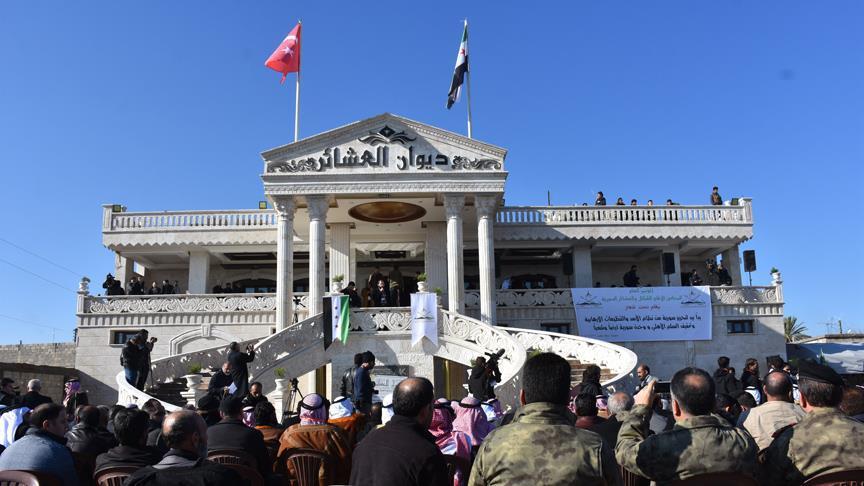
Syria tribes united against YPG/PKK, support Turkish op

 'The head of the Syrian Clan Coalition, on Thursday, expressed the readiness of the "Tribal Army" to go to the east of the Euphrates to fill the American void in Syria.

 "The army is composed of 10,000 fighters. It aims to fight the terrorist organizations and the Syrian régime," Abdulkarim al-Fahel said. "The army's priorities are to liberate the city of Manbij and then to turn east, to be a legitimate alternative to the American presence."

 He explained that the expanded conference held by the Arab tribes two weeks ago in the city of A'zaz north-west of Aleppo, including more than 1200 people representing all Syrian clans, in addition to the presence of representatives of the factions of the Free Syrian Army and popular organizations and relief in coordination with Turkey.

 He pointed out that the meeting discussed ways to face the new challenges of the revolution and the full readiness to deal with them, and the development of civil administration in the liberated areas, and provide security and services to citizens and displaced persons of Syrians, stressing that everyone gave up on the Syrian people and left them alone to die under the régime''s barrel bombs and air strikes and the missions of its allies Russia and Iran-backed sectarian militia.

 It is noteworthy that the Supreme Council of Tribes and Syrian tribes held its first conference last year 2018 in the city of Azaz in the countryside of Aleppo; in an effort to unite the Arab tribes in Syria under one title and one vision.'

Thursday, 17 January 2019

The Crushing of the Society and Dismantling of the State


 'SNHR has released its annual special report for the year 2018 which was entitled: “The Crushing of the Society and Dismantling of the State”. The report documents the most notable violations of human rights by the main parties to the conflict in Syria during the last year.

 Fadel Abdul Ghany, chairman of SNHR, says:

 “Since 2011, the Syrian régime has perpetrated various forms of brutal violence against society, including the arrest and torture of tens of thousands, and the killing of hundreds of thousands of others, along with the displacement of half of the Syrian people, which has been an intentional and deliberate goal of this ruling authority in order to crush society, punish it and subject it to the rule of the family, forever. Consequently, there is a complete termination of any opportunity or even any idea of a new popular movement due to the high cost paid by the community for demanding freedom, dignity and political pluralistic transition. However, the ruling family hasn’t cared about the material or human cost in order to achieve this brutal goal, even if this causes the dismantling of the entire Syrian state”


 According to SNHR’s database, 6,964 civilians, including 1,436 children and 923 women (adult female), were documented as being killed at the hands of the parties to the conflict in 2018. Of this total, 4,162 civilians, including 713 children and 562 women, were killed by Syrian régime forces, and 467 civilians, including 169 children and 51 women, were killed by Russian forces. 2018 saw also the death of 417 civilians, including 175 children and 90 women at the hands of International Coalition forces.

 Further, the report records that Kurdish Self-Management forces killed 285 civilians, including 29 children and 26 women, while extremist Islamist groups killed 478 civilians; of this total, ISIS killed 446 civilians, including 82 children and 41 women, while 32 civilians, including seven children and one woman, were killed by Hay’at Tahrir al Sham.

 The report documents that factions of the Armed Opposition, in 2018, killed 84 civilians, including 14 children and seven women, all of whom were either killed by executions, indiscriminate shelling, or torture. Lastly, the report records that 1,107 civilians were killed in attacks whose perpetrators could not yet be identified, or in attacks by border guards affiliated with neighboring countries – Lebanon, Jordan, and Turkey.


 According to the report, 2018 saw approximately 7,706 cases of arbitrary arrest, including 504 children and 699 women (adult female). The Syrian régime was responsible for the arrest of nearly 5,607 of these individuals, including 355 children and 596 women. Extremist Islamist groups arrested at least 755 individuals, divided into 338 arrested by ISIS, including 28 children and 13 women, and 417 individuals were arrested by Hay’at Tahrir al Sham, including 15 children and three women. The total number of detainees arrested and imprisoned by factions of the Armed Opposition was nearly 379 individuals, including 23 children and 13 women, while Kurdish Self-Management forces arrested 965 individuals, including 83 children and 74 women.

 The report states that 976 individuals were documented as being killed under torture in 2018, including 951 individuals who died due to torture at the hands of Syrian régime forces, and nine in detention centers of factions of the Armed Opposition, while one woman died due to torture at the hands of ISIS.

 The report also outlines the most significant violations against medical personnel by the parties to the conflict, through acts of killing of medical personnel and targeting of medical facilities in 2018, documenting the deaths of 53 medical personnel and 108 attacks on medical points and facilities. The Syrian-Russian alliance was responsible for the majority of these violations, killing at least 38 medical personnel and carrying out 85 attacks on medical facilities and clinics.

 In addition, the report states that 24 media workers were killed in 2018, with 63 percent of this total killed by Syrian régime forces and their Russian allies.

 The report also documents six attacks in which chemical weapons were deployed in 2018, in Idlib and Damascus Suburbs governorates, all by the Syrian régime. Meanwhile, cluster munitions were deployed in 13 attacks, with seven of these carried out by Syrian régime forces, and the remaining six by Russian forces. According to the report, Incendiary weapons were used in 28 attacks on Syrian territory last year, with 11 of these attacks carried out by Syrian régime forces, and 14 by Russian forces, while the remaining three attacks in this category were launched by International Coalition forces. The report also notes that at least 3,601 barrel bombs were dropped by Syrian régime forces in 2018.


 As the report details, 2018 was another year of massive waves of forced displacement, with hundreds of thousands of people forced to leave their homes and land by military operations launched by the parties to the conflict, especially the Syrian-Russian forces, which were by far the main parties responsible for the displacements. The report states that nearly 670 thousand people were subjected to forced displacement in 2018, including 134,000 who were forcibly displaced as a result of agreements and truces which contravene international humanitarian law.

 The report stresses that the UN Security Council must take additional steps following the adoption of Resolution 2254, which states unequivocally that all parties should: “… immediately cease any attacks against civilians and civilian objects as such…”. Also, the report states that the Security Council should refer the Syrian case to the International Criminal Court and hold all perpetrators accountable, including the Russian régime whose involvement in war crimes has been proven.

 The report calls on the Security Council to ensure the security and safety of millions of dispossessed Syrian refugees, especially women and children, who have been displaced to countries worldwide, and to ensure their safety from arrest, torture or enforced disappearance if they choose to return to areas controlled by the Syrian régime.
The report also recommends that the relevant United Nations agencies make greater efforts to provide humanitarian and food aid and medical assistance in the areas where fighting has ceased, and to camps of internally displaced persons, and to follow up with the States that had pledged to make necessary contributions.

 The report emphasizes that the OHCHR should submit a report to the Human Rights Council and other organs of the United Nations on the incidents mentioned in this report since these attacks were perpetrated by the parties to the conflict.


 Moreover, the report calls upon the international envoy to Syria to condemn the perpetrators of the crimes, including massacres, and those who were primarily responsible for dooming the de-escalation agreements to failure, and to redirect the peace process to its natural course after Russia’s attempts to distort it and to place the Constitutional Commission prior to the transitional government.

 The report calls on the international community to take steps at the national and regional levels to form alliances to support the Syrian people, to protect them from the daily killing, and to lift the siege, as well as to increase support for relief efforts.

 The report further calls for the implementation of the “Responsibility to Protect” (R2P) norm, after all political channels through the Arab League’s plan and then Mr. Kofi Annan’s plan were exhausted, proving as fruitless as the Cessation of Hostilities statements and Astana agreements that followed. Therefore, steps should be taken under Chapter VII of the United Nations Charter, and the norm of the “Responsibility to Protect”, which was established by the United Nations General Assembly, should be implemented. In the current situation, the Security Council is still hindering the protection of civilians in Syria.

 The report demands the Syrian régime end its indiscriminate shelling and targeting of residential areas, hospitals, schools and markets, stop its torture that caused the death of thousands of Syrian citizens in detention centers, reveal the fate of some 82,000 Syrian citizens arrested by the security services after concealing their fate to date, and comply with UN Security Council resolutions and customary humanitarian law.

 The report stresses that the Russian régime should launch investigations into the incidents included in this report, make the findings of these investigations public for the Syrian people, and hold the perpetrators involved accountable. Also, the Russian régime should compensate all the damaged centers and facilities, rebuild and rehabilitate them, and compensate all the victims’ families, who were killed by the current Russian régime, as well as compensating all the wounded.


 The report further adds that the Russian régime, as a guarantor party in the Astana talks, should take steps to stop the wrecking of de-escalation agreements, and apply pressure on the Syrian régime in order to end all indiscriminate attacks, and should begin making progress with respect to the detainees’ issue by revealing the fates of 82,000 forcibly disappeared persons by the Syrian régime.

 The report calls on the international coalition forces to unequivocally acknowledge that some of their bombardment operations have resulted in the killing of innocent civilians. The report calls on international coalition forces to launch serious investigations and take speedy steps to compensate and apologize to the victims and others who were affected.

 Lastly, the report calls on the states supporting the SDF to apply pressure on these forces in order to compel them to cease all of their violations in all the areas and towns under their control, and urges these states to cease all forms of support, including weapon and otherwise.'

Monday, 14 January 2019

Holding Obama Accountable for Syria


 'Like so much else in the last two years, the three-week political Sturm und Drang over American troops’ withdrawal from Syria says less about a fissuring present and more about a fractured past. Donald Trump’s now-modified withdrawal order (four months, not 30 days, unless he changes his mind again) was another sloppy policy move, but one that’s widely misunderstood. Media chatter aside, Trump’s pullout represents not a new direction in foreign affairs but a coarse coda to a decade of institutional error that we need to understand before we can repair.

 The central fact behind the withdrawal has been often stated but never explained. There were between 2,000 and 4,000 non-combat-assigned troops in the region, so why yank them out now? And that’s exactly the point. No matter the proximate cause behind Trump’s decision—the conversation with Erdogan, an isolationist sop to his base, an impulse move—keeping or leaving the troops made absolutely no difference in the bigger scheme.

 It made no difference for a simple reason. The chips had already fallen between 2009 and 2015, when the Obama administration executed its post-Bush pivot toward Iran and its regional proxy, Syria, and away from America’s allies in the region for 30 years: Saudi Arabia, Jordan, Egypt, and Israel. This is the situation Trump inherited, and Trump is not a fixer, he’s a canary in the coal mine. As with “build the wall” and “drain the swamp,” his slogan about Syria—“It’s yours, I’m leaving”—isn’t a pivot, it’s an epitaph. He doesn’t know how to fix our crises, and he doesn’t care. His only purpose is reactionary: to call the crises what they are and point a finger at the people who made them this way.


 Which brings us to James Mattis and Brett McGurk, key creators of our Syria predicament, whose resignations over Trump’s decision made them the latest symptoms of a trend wherein makers of problems that created Trump become lauded defenders of the system that opposes him.

 McGurk, a career diplomat, was Barack Obama’s appointee as deputy assistant secretary of state for Iraq and Iran and then as special presidential envoy for the Global Coalition to Counter the Islamic State. As such, he was responsible for carrying out the then-president’s regional strategy—determined by Obama and finessed by Rob Malley, head of the National Security Council’s Middle East Desk—wherein the missions of combating Bashar al-Assad and fighting ISIS were folded into Obama’s main foreign policy ambition, the since-repudiated Iran nuclear agreement of 2015.

 Mattis, the head of the United States Central Command under Obama and secretary of defense under Trump, was slightly more hawkish than Obama but still an institutionalist who saw his role in the Trump era as preserving the status quo. That status quo, left over from Obama, was to sweep the surfaces: Avoid a confrontation with Iran, which supported Assad, and make space for Iran’s ally Russia, which also supported Assad, to tamp down the Syrian Civil War, root out the obviously disruptive regional actor—ISIS—and keep the “peace.”


 What did this maintenance act mean in practice?

 It meant keeping U.S. soldiers in Syria to support vetted Syrian opposition groups that were forbidden to engage any violent element except ISIS: practically, preventing them from focusing on the main reason ISIS exists in Syria at all—Assad and the extremist resistance he engenders. A supplement to this strategy was partnering with the YPG, a Kurdish militia in Syria that has worked with Assad and, now, will likely want to negotiate an arrangement with the Assad regime which will see the regime return to the areas currently in Kurdish hands.

 It also meant refusing to formulate a serious response to Assad’s chemical weapons attack on civilians in April 2018. Surely, with prompting from Mattis, Trump could have been moved to shape a coherent anti-Syria strategy consistent with his urge to marginalize Iran: Hit the Ayatollah by pressing Assad. Instead, despite extensive evidence that a nerve agent was used, Mattis pushed against intervention, and the result was a watered-down show of force that deterred Assad not at all.

 Further, it meant tacitly allowing Iran to maintain control in Lebanon by backing the Iranian-influenced, order-oriented, do-nothing Lebanese Armed Forces (LAF). This was the Mattis-McGurk game plan: Under the pretext of “preserving Lebanon’s stability,” and of turning the LAF into a “partner in the war on ISIS,” they would back the status quo in Beirut—an Iranian-friendly army. By backing this status quo, they gave carte blanche to Hezbollah, the Iranian-backed terrorist group. Armed with advanced weaponry, Hezbollah keeps Lebanon in disorder and menaces Israel, further destabilizing the region.

 Finally, on the eastern border with Syria, in Iraq, it meant delivering resources to the Iranian Islamic Revolutionary Guard Corps (IRCG) to prosecute the anti-ISIS campaign, meaning that the U.S. anti-ISIS mission in Syria ended up empowering the Iranians in both Lebanon (via the LAF and Hezbollah) and Iraq (via the IRGC). Since Syria is an Iranian ally, and both are Russian clients, this means that Russia’s influence now extends from Central Asia to the Mediterranean.


 All of this is what McGurk helped design under Obama and Mattis acquiesced to under Trump, and the results are both tragic and frightening. Five hundred thousand Syrians have been killed, 5 million made refugees within the country and 6 million outside it. Beirut remains a party town but is governed by a Shia militia. A threatened Saudi Arabia wages a costly war in Yemen against Iran’s proxies there that has put 8 million people at risk of starvation. Iran is not only a murderous tyranny on the cusp of nuclear weapons but now also the key regional mover. And Iran’s and Syria’s patron Russia, our avowed enemy, has extended its influence. These are not consequences that 2,000 to 4,000 American troops had any hope of ameliorating—which is to say, they’re not consequences that Trump’s withdrawal decision had any effect on at all. They’re the consequences of 10 years of missteps, which turn on a single origin point: Obama’s post-Bush foreign policy fantasy that we could right all wrongs in a region that turns on fierce interstate competition by pacifying Iran, its most ruthless state competitor.

 But none of this is being talked about—and it probably won’t be. The partisan charade will only intensify, as Trump’s clumsy withdrawal gives his enemies an excuse to pounce. Left and center Democrats will forget their own histories of inaction and rush to speak up for the interventionist vagaries they opposed. Some hawkish internationalists will attack Trump as “worse than Obama”: a legitimate expression of horror at the president’s humanitarian deafness that still obscures the underlying problem by personalizing it. Others, like Lindsey Graham, will haggle over the withdrawal timing—another distinction without a real difference. And Mattis and McGurk will be treated in the media histories of the moment as “grownups in the room,” figures in the “resistance,” fodder for a thousand patriotic tweets and maybe even a book or two.

 We need to push back against all this obscuring. For, as we argue around each other, Iran maneuvers with ever more impunity. ISIS cells plot their regrowth. Assad, to whom we have given a complete victory, persists in his despotic vocation: maybe the first genocidal killer in half a century that America has chosen to forget committed genocide. And Russia, a threat at home and abroad, gains proxies up to the Mediterranean. We won’t fix this situation, one we created, by railing against the finger-pointer in the White House. We’ll only fix it by looking at what we did wrong in the first place and, from that lesson, taking a wholly different approach: treating the ayatollah, Assad, and Putin as our main regional adversaries—a bloc of hostile actors that we need, calmly and firmly, to maneuver against.'


Thursday, 10 January 2019

A photographer and a rapper document Syria under siege


 'Last summer, Tim ­Alsiofi saw a lake for the first time in almost 10 years. It was Eid Al Fitr, and Alsiofi and some friends travelled from Idlib into the Aleppan countryside, where they spent the day swimming, playing in the lake and learning to fish. After seven years of war, much of it spent trapped in besieged Ghouta, some of the children had never before seen a lake.

 Alsiofi’s photographs of his friends and their children frolicking in the water open Yours Truly, From Idlib, a photography book capturing the joys and sorrows of daily life in a war zone. In a publication produced in English, Arabic and German by the Heinrich Boll Foundation in Beirut, Alsiofi shares stories from his years living in besieged Ghouta and from Idlib, where he was forcibly displaced last spring.


 Alsiofi was 18 when the ­Syrian uprising began in 2011. He was studying sound engineering and music at an institute near his home in Ghouta, but as protests turned violent and the conflict began to worsen, he was forced to abandon his studies. Two years later, he found a new direction.

 “In 2013, Ghouta was impossible to reach. All the entrance points were closed off and it was impossible even for a loaf of bread to enter Ghouta. The people were like skeletons moving in the streets because of starvation,” he recalls on the phone from his home in Idlib. “That’s when I decided to... turn my attention to photography. I used to take pictures before the war started, but I didn’t specialise in it until 2013.”

 Alsiofi bought a professional camera, taught himself to use it and took to the streets, seeking out scenes of day-to-day life in a besieged city. His photographs were intended to create a counterpoint to the propaganda being produced by the Syrian government and by the rebel factions occupying Ghouta, who were imposing their own rules on civilians and conscripting young men to fight.

 “I documented all of it, so if one day they tried to say that they treated people well, we will tell them: ‘These are the pictures and this is the history you made’,” he says.

 Unlike the journalists present in Ghouta, who focused on capturing images of violence and death, Alsiofi wanted to focus on life.

 “The main reason for my work was the civilian, and only the civilian,” he explains. “I held the camera for the civilian – that oppressed human who is getting shot with bullets. All these weapons didn’t solve the problem, they just destroyed the country, and we’ve ended up with martyrs and civilian victims. I have nothing to do with these stories. I concentrated on the humanitarian subject, on people’s daily lives. It’s not an event or a drama, it’s just life in between the lines, which the channels don’t broadcast.”


 For Yours Truly, From Idlib, Alsiofi and the Heinrich Boll Foundation’s team selected more than 150 photographs taken in Ghouta and Idlib. Alsiofi sent voice notes describing the situations in which the photographs were taken, which were turned into captions by Syrian rapper and writer Hani Al Sawah, who is based in Beirut.

 The opening images, taken at the lake, provide a moving and uplifting introduction to Alsiofi’s work. In one, ­Shaker, 12, grins at the camera, one eye closed against the sunlight, his hair and skin glistening with water from a whole day spent in the lake, trying to catch fish. Another shows Asala, 8, the daughter of a local fisherman, who taught Alsiofi and his friends how to use a fishing rod.

 From here, the book delves back into the past, featuring friends and neighbours who lost their lives in Ghouta and whose absence overshadows even the happy moments in Idlib, as well as stories of survival and unexpected moments of joy amid the conflict.

 At an exhibition celebrating the launch of the book, Bente Scheller, director of the Heinrich Boll Foundation’s Beirut offices, emphasised that the photographs aim to show the realities of life during wartime, and should not be misrepresented as part of a narrative suggesting that life in Syria has returned to normal or that refugees should return home, as many in Lebanon are under pressure to do.

 “We live in great fear that Idlib will face the same fate as Ghouta,” says Alsiofi, who is one of an estimated three million civilians trapped in Idlib, one of the last areas of Syria still under rebel control. “It is crucial therefore to show that there are civilians living here, millions of them, who have experienced so much tragedy and yet they still carry on with their lives. It is vital for them to get support and not be labelled as terrorists and extremists merely for having opposed Bashar Al Assad and his rule.”


 His images from Ghouta help to highlight the terrible cost of war. One captures a little boy smiling as he holds fresh bread made from wheat, after weeks of subsisting on bread made from cattle feed. In another powerful image, Alsiofi captures another boy with his back to the camera, surveying a table that has half-collapsed, spilling bread on to wet, muddy ground. Alsiofi describes watching the starving child’s dilemma as he tried to decide whether to scavenge bread splattered with the seller’s blood, ultimately walking away empty-handed.

 “The photos I captured looked nice aesthetically, but their backstories were sad, and so I found excruciating tension between what I saw at first glance and what I learnt when understanding the stories,” Alsiofi writes in the preface to the book.


 Alsiofi documented the journey of about 1,500 civilians from Ghouta to Idlib in spring last year, on buses provided by rebel group Jaish Al-Islam and then the Syrian regime. His photos in Idlib dwell exclusively on civilian life, but the shadow of war is never far away. One captures people dancing at a wedding in Idlib, celebrating love in the absence of those left behind in Ghouta, while another shows a woman picking olives on the first visit to her fields after a regime attack forced her to flee her village.

 “We lived in the most dangerous area in the world, which means we are the strongest people in the world. This was the side that I tried to show, always,” he says.

 From the weeping father of two brothers who died fighting against one another in rival rebel factions, to images of children playing on a makeshift swing they have made from an unexploded bomb, Alsiofi’s photographs capture the horror of war and the resilience of the human spirit.

 “I am not… looking for sympathy for all the suffering we have gone through and continue to do so, but, on the contrary, I want to show how strong my people are,” he writes. “All we need is some stability, freedom and the needed resources, and we will choose life over and over again.” '

Thursday, 3 January 2019

Rehabilitating Assad, the greatest criminal of our time


 Mansour al-Omari:

'In the days prior to, and since the US president's announcement a fortnight ago that the US would withdraw from Syria, a flurry of Arab leaders have moved to restore their relations with the Assad regime.

 A week of PR moves saw the Sudanese president visit Damascus on 16 December, and Syria's senior security adviser, Ali Mamlouk - a man who is wanted by French prosecutors for collusion in war crimes - visit Egypt on 22 December.

 In addition, the King of Jordan stated on 23 December that "our relations with Syria will return to what they were before". The UAE reopened its embassy in Damascus on 27 December, and Tunisia resumed direct flights with Syria after seven years​. Finally, Bahrain stated last Friday that 'work continues' at its Syrian embassy.

 These announcements may have been the work of previous under-the-table agreements, but they all issued almost identical pretext: Supporting Arab unity and confronting regional interference in Syria.

 Indeed, several factors likely also contributed to these developments, including pressure from the Russians and the rocky relations between Gulf states. But Trump's surprise US withdrawal announcement - perceived by many as the decisive sign of an Assad victory - was perhaps the encouragement Arab leaders needed to get behind the Assad regime diplomatically, and publicly state their support.


 Many Syrians, including victims of Assad and human rights defenders, have voiced their concerns about these developments According to Mohammad al-Abdallah, CEO of the Washington-based Syria Justice and Accountability Center. For him, re-legitimising the Assad regime sends a clear message that he can do whatever he wants to Syrians.

 Abdallah adds that "at the very least, there should be a set of conditions before such normalisation, like the release of detainees, the disclosure of the fate of missing persons, and the abolition of Law 10", which allows authorities to seize property without due process or adequate compensation.

 For Abdallah, Trump's decision has opened the doors wide to the concept that "Assad has won, and there is no use of perceiving him as an enemy".

 Joan Farso, a Syrian Kurdish humanitarian worker in Syria, says that the UAE and Bahrain's recent decision will not help restore stability, adding that the main issues that should be addressed are reconstruction, releasing detainees, the fate of the missing persons, and forming a transitional government; one "that guarantees the rights of all Syrians".

 Restoring normal relations with Assad, without holding him accountable for the mass atrocities in Syria, or conditioning restored relations on addressing crimes and human rights violations, sends a crystal clear message to other Arab leaders that you can massacre your own people and remain a member of the international community.


 Will other Arab countries also restore their relations with Assad? Can they be relied on to address the injustices the Syrian people have suffered, and continue to suffer? Will they respect international treaties when Assad's arrest warrant is issued?

 In reality, as long as Assad is power, transitional justice in Syria will remain a myth. While the perpetrator continues to control the legal and executive systems in Syria, cries for justice will only grow louder.

 Many say the war is over, but that does not mean the suffering and crimes have stopped. Instead, the Assad regime has gained ground, and tightened its grip over a population it can oppress, silence, detain and kill using torture.

 Justice cannot be buried under the ruins of the victims own homes, and with the bodies of their loved ones.

 Today Syria has millions of victims, with the most documented mass atrocities in history. The matter is not that a person was robbed, or attacked by someone's dog. This is a nation that was massacred, displaced, destroyed from the outside, and from within.


 Ignoring justice destroys the values the Syrian society should be built on, if it is to one day be a healthy, stable society.

 In addition, justice is important not just for Syrians, but for the whole world. EU countries must use their values and judicial systems to hold the criminals accountable, making sure they will not turn into a safe haven for perpetrators of war crimes, and crimes against humanity.

 They must send a message that the international community will not be complicit and remain silent in the face of such brutality. This, importantly, also strips the extremists of their favourite recruiting tool: injustice.

 Perhaps the rehabilitation of the greatest criminal of our times will go on, unencumbered. Rights organisations and Assad's victims may not be able to stop this, but at the very least, they should be supported in their efforts towards justice, and blocking regime attempts to falsify history which add salt to the wound by turning the perpetrator into a national hero.

 And those who so freely normalise the Assad regime should keep in their hearts and minds a tiny space to consider his victims and survivors, who will live out their lives in the shadow of his regime's atrocities.'

Mansour al-Omari

Our revolution will continue, it isn't waiting for you


 From September 2018, when Idlib was expecting an imminent Assad offensive. Displaced Syrians from Homs, Aleppo and Ghouta took to the streets to protest and renew the slogans of the Revolution in support of Idlib, accompanied by Abdul-Baset al-Sarout, the Syrian football goalkeeper.

 # Syria ... our land, a paradise! Our beautiful country, our beautiful soil!
Even your Hell is Heaven! O Homs, land of Arabism
Difficulties do not deter us, for we are champions, well known to all!
We are the famous Idlib!
Syria ... our land, a paradise! #

 Abdul-Baset al-Sarout:

 "A message to Putin and de Mistura, and to all the world's conferences:
Victory is from God. We're waiting for them at the frontlines, and anything else is pointless. The frontlines and the trenches we're digging are what's important. Whoever wants to join us, we're waiting for you. No more statements or lies. We're at the frontlines, for whoever wants to join us. Our revolution will continue, it isn't waiting for you. May God support us."

 # We swear to God that we shall continue our revolution!
We won't forget our martyrs' blood!
Prophet Muhammed is our leader forever!
The Free Syrian Army crushes Assad forever!
One, one, one, Homs and Idlib are one!
One, one, one, the Syrian people are one! #

Friday, 28 December 2018

Syrian opposition reacts to US withdrawal


 'On Dec. 19, U.S. officials stated that the Pentagon had an order to move troops out of Syria as quickly as possible. Later on, they started to inform their partners in northeastern Syria about their plans regarding the immediate pullback of American forces from the region, where they have been trying to wrap up the campaign against Daesh. This surprising decision by the Donald Trump administration not only has the potential to change the dynamics of Syria, but also has the capacity to change the position of the Syrian opposition. In this regard, the Syrian opposition took the U.S.' decision to withdraw with a grain of salt at first. However, the follow-up tweets of Trump and the events following the declaration caused euphoria among the Syrian opposition as they hope to seize control of all the People's Protection Units-held (YPG) territories in Syria.

 The decision by the Trump administration makes the opposition believe in a new process in Syria where they will strengthen their position as Yusuf Hamoud, the spokesman of the Turkey-trained National Army, claimed: "We, as the National Army, alongside the Turkish army, consider us the biggest gainers of this decision, and we will move the battle east of the Euphrates soon to liberate the region from terrorist gangs such as [the Democratic Union Party] PYD."

 Hamoud also stated that: "We read Trump's decision as political diplomacy, and Turkish politicians are able to achieve understanding of American aims on the Syrian issue. So we consider this decision as a partial withdrawal from the northern part of the Syrian-Turkish border area toward the Syrian depth region."


 Also the former spokesman of the National Army, Abu Riyad Hamadin, formulated his skepticism by questioning the U.S. withdrawal; whether they will withdraw entirely from Syria or only from the region located in the Syrian-Turkish border. To this end, they will be able to prevent direct confrontation with Turkey by opening up a way for Turkey and the National Army to launch a military operation against the YPG.

 Later on Dec. 24, Hamadin expressed that all of the territories currently held by the YPG will be controlled by the National Army together with the Turkish Armed Forces (TSK) without the interference of any other, so the U.S. presence in Syria will be handed over to the TSK.

 Explaining the reasons behind the U.S. decision to withdraw, the spokesman alleged that the establishment of the National Army in clear coordination with the Turkish political and military leadership, will strengthen the position of Turkey on the political level.

 Also Muhammed Bassoun, a commander of Liwa al-Shamal, a faction belonging to the National Army, talked about his expectations that the most of Syria's north will come under the Turkish umbrella until the formulation of final political solution in Syria in which Iran will "pack their belongings and leave Syria."

 In this regard, according to Hamoud, the Syrian opposition has always demanded that foreign forces should leave Syria.


 As the declaration of the U.S. withdrawal was first skeptically received by the Syrian opposition, Wael Alwan, the spokesman of Faylaq al-Rahman, a faction which was located in eastern Ghouta previously but had to be evacuated to northern Syria after the Russian-backed regime military assault, said on the day of the declaration: "American promises cannot be trusted as the withdrawal declaration is likely to be similar to [Russian President Vladimir] Putin's previous withdrawal declaration of the Russian troops from Syria, which was made for media consumption and was not implemented on the ground." On the other side, Alwan furthered that: "Through the statements of Trump and the political battle within the U.S. administration, it is expected that the American declaration is serious and will be implemented, unlike the other examples, such as Putin's announcement."

 At the beginning, Othman Millo, the chief of the Istanbul office of the Kurdish National Council, said the U.S. withdrawal decision was made to pressure the Syrian Democratic Forces (SDF) to accept other actors' participation in the administration, to ease Turkey's security concerns and to dismantle the administrative system of the YPG.

 In this regard, the YPG rejected the deployment of Syrian peshmerga in the border region with Turkey. But later on, Millo's view evolved as he said he fears Russia and Iran will fill the void of a U.S. withdrawal, but he also pointed out that the U.S. presence inside Syria had negative aspects as well, like negatively affecting Turkey, who bravely stands with the Syrian people. Millo criticized that the U.S.' presence in Syria had no clear and supportive vision for the Syrian people and the Syrian revolution.

 Alwan's words sum up the reaction of the Syrian opposition: "Indeed, the decision announced by the American president is very important and surprising to all, because it is contrary to previous U.S. statements as they stated that the U.S. forces will stay in northeastern Syria."


 Dima Moussa, the vice president of the Syrian National Council, focused on the political impact of the U.S. withdrawal and said: "Generally, anything that would contribute to ensuring minimal U.S.-Turkey tension will likely have positive effects on Turkey's position in support of the opposition and in the Astana process, which would also have a positive effect on advancing the Syrian political process."

 All of this, of course, depends on the details of the withdrawal and the level of coordination with the Syrian opposition represented by the Syrian National Coalition and of course coordination with the Turkish side. I personally see this move as a tactical move as opposed to strategic; I think that the U.S. may pull out military personnel so that they will not have boots on the ground. However, it is unlikely that they will completely leave the area. We have seen this scenario several times in different areas of the multiple regions.'

Image result for Yusuf Hamoud sna

Thursday, 27 December 2018

Nonsense about the US withdrawal from Syria


 Michael Neumann:

 'This attempts to counter some of the foolish comments made about Trump's withdrawal from Syria.


 The least foolish of these is that the battle against ISIS is not won. No it isn't, and Trump's claim that it is, is plainly false. But to harp on this is absurd.

 For one thing, there isn't the slightest possibility that keeping US troops in Syria would win the battle, or prevent an ISIS resurgence. ISIS' ultimate strength lies, not in its Syrian or Iraqi enclaves, but in what the West and Arab authoritarian governments have done to the peoples of the region, and in the conditions in Muslim countries worldwide. These conditions guarantee a literally unending stream of militants seeking justice and revenge. The notion that 2000 US troops would affect this dynamic is ludicrous. Equally foolish are the tiresome recommendations that the underlying conditions be addressed. The sage pundits who say these things know perfectly well that the West will never, ever address these conditions: it can't, because they occur in sovereign states. It would take a Western occupation of those states, involving hundreds of thousands of troops for decades, to cure the injustices of the region, and even then it's not clear that the economic basis for healthy societies exists. In other words, whatever the West is going to do, whatever leadership it has, ISIS won't be defeated. What then is the point of warning us that Trump's withdrawal will not defeat ISIS?

 For another, forget the mantra about how effective the Kurds have been against ISIS. Their victories are almost entirely the result of overwhelming US air and artillery support. Their actual capabilities are better assessed by looking at how even a much-weakened ISIS can rout Kurdish forces with attacks during storms and under other conditions inimical to air operations. The Syrian rebels, not to mention the Turkish army, would be at least as effective as the Kurds in combating ISIS, and they wouldn't need a US ground presence to do it.


 There is more foolishness.

 It is said that withdrawal shows the US to be an unreliable ally, and that this is a dire mistake.

 In the first place, nothing says you're unreliable like supporting, with weapons, troops and air power, the armed, active enemy of your ally. That's what the US did when it backed the Syrian arm of the Kurdish PKK against its NATO ally, Turkey. So Trump's withdrawal of this support could well be seen as a return to reliability, not the abandonment of it.

 Second, it's unclear that appearing unreliable in this instance would make much difference to the US position in the world. Nations are allied to the US, not because they have touching faith in America, but because they have little choice. They don't want to fall under Russian or Chinese domination. The idea that alliances are made and preserved on trust runs contrary to all historical precedent. It's childish.


 It is said that US withdrawal is a gift to Putin.

 This carries absurdity into insanity. The unspoken truth about the US' Kurdish 'allies' is that they are also allies of Russia and Assad. In the 2015 campaigns against rebel Aleppo, Russia and Assad even provided air support to the Kurds. Later, Assad secured for the Kurds a road whereby they could move between their Northeastern and Northwestern territories. He also pays for much of the infrastructure in the Northeastern provinces. This means that, in allying with the PKK/YPG, the US is allied to Assad, Russia... and Iran. It's true that Putin probably enjoys seeing the US leave; he doesn't want a US presence in Syria. But it's also true that Obama, and until now Trump, have been fighting on Putin's side. He now faces an expanded Turkish presence in Northern Syria, which threatens and complicates his relations with Assad and Iran. Because Turkey backs the rebels, it even threatens the security of Russian bases in Latakia and Tartous. Trump's withdrawal means the US will mend relations with Turkey. That in turn means Putin can't expect to pry that country - a real strategic prize that until recently seemed almost within his grasp - away from its Western alliance. Finally, the US retains its air bases and naval presence in the region, so that US withdrawal of 2000 troops from Syria makes not the slightest difference to the regional balance of power. Some gift.


 It is said, with feeling, that the Kurds have been betrayed.

 Even if there is some truth to this, it is foolish. For one thing, the Kurds have been supremely opportunistic in their choice of allies. They feigned neutrality when the rebels were strong, yet with increasing frankness came out on Assad's side when the rebels faltered. For another, the morality of betrayal depends on circumstances. The Kurds chose to ally with a régime so monstrous that adjectives like 'brutal' can't begin to capture the extent of its atrocities. When the King of Italy abandoned Mussolini in 1943 he betrayed Hitler. Was that reprehensible?

 The criticism of Trump's withdrawal, though couched in the language of morality and even honour, is curiously oblivious to the sort of humanitarian considerations that you'd think would belong to those values. The most likely consequence of US withdrawal - should it really occur - is that Northern Syria will become a refuge for perhaps millions of Syrians, under Turkish protection. Meanwhile in the rest of Syria, as widely predicted, Syrians in formerly rebel areas are subjected to arbitrary imprisonment, torture, and murder. But sure, pontificate some more about the US withdrawal.'

Monday, 24 December 2018

Daraa’s resurgent resistance has lessons for the régime


 'Anti-régime activities in southern Syrian areas formerly held by rebels have flared up again, including both peaceful expressions, such as graffiti and demonstrations, but also violent incidents.

 More than a dozen pro-government fighters and intermediaries have been killed in a series of hit-and-run attacks since November. These attacks are especially significant in a region that the government just captured a few months ago, emphasizing that the country is very much still in a state of war.

 While abuses and bad-faith negotiations by Damascus are largely to blame for provoking renewed violence, the example of Daraa makes it clear that peace will remain elusive in the absence of a comprehensive and fair political solution.

 After the government’s capture of the south in July, achieved largely through negotiations, its intermediaries and intelligence agencies started opening regional offices to process local residents’ plea for clemency. The process theoretically provided the signatories with general amnesties, which typically was supposed to exempt them for six months from the obligatory military conscription required of men of fighting age.

 Despite those guarantees, however, the government has continued to arrest local residents, including civilians as well as former rebel fighters, even when they were in the process of turning themselves in. Reports show that authorities detained at least 68 people in October alone, while more than 30,000 men have been called up for enlistment, including both new recruits and reserves, before the six-month grace period expired.


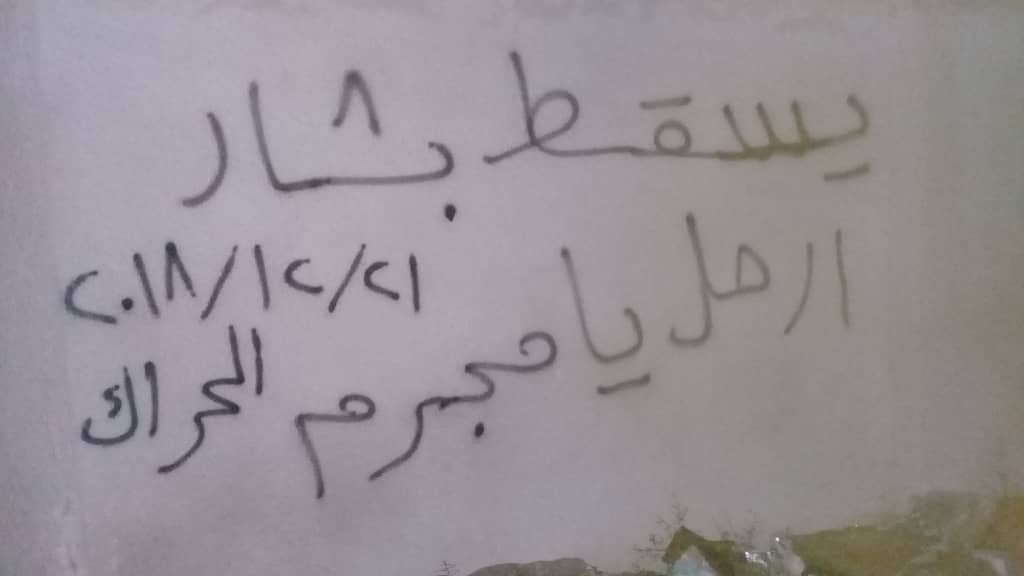
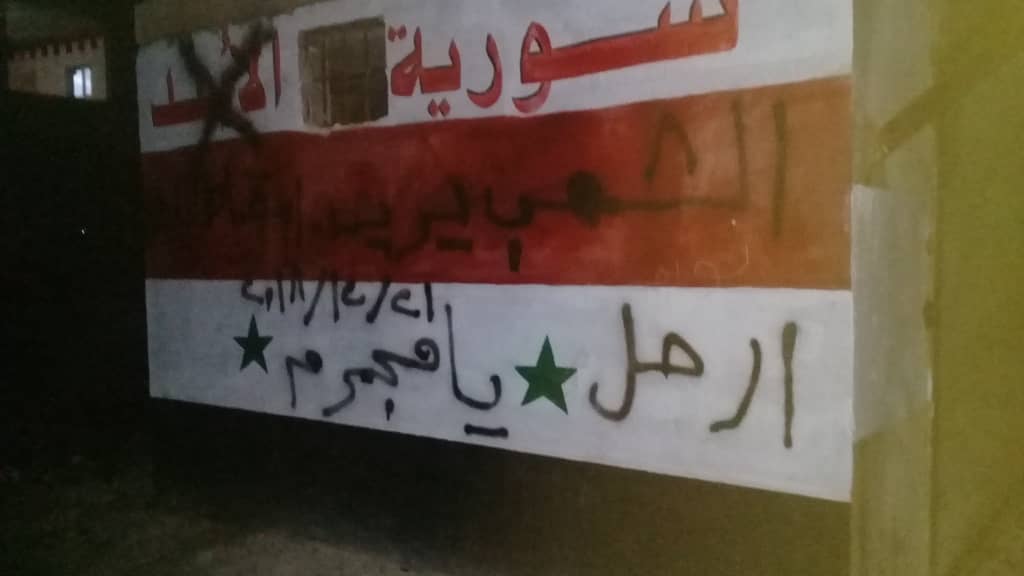
 Every indication is that the gradual increase of violations by the régime of President Bashar al-Assad is what motivated the renewed resistance after months of relative calm. In a trend similar to the early months of the uprising in 2011, anti-régime sentiment has been expressed through non-violent acts, with familiar slogans such as “down with Bashar” and “the revolution is ongoing” painted on the walls of government buildings in towns such as al-Karek, al-Mazyrb, Nawa and al-Sanamayn.

 On the other hand, guerrilla tactics such as hit-and-run attacks and ambushes have also targeted various pro-government forces in the region. One early attack hit a government checkpoint in the city of Jasmin on November 24, killing two members of the national intelligence agency. A day later, a larger coordinated operation resulted in attacks on multiple checkpoints in the city centre of al-Sanamayn, killing more than six fighters.

 While some checkpoints appear to have been targeted randomly or for operational reasons, others seem to have been prioritized because of their reputations. For example, a military-intelligence checkpoint between the towns of al-Karek and al-Gharieh was apparently attacked because of the practices of its personnel, including arresting local residents as well as soliciting bribes.


 At the same time, a group calling itself “the popular resistance in the south” has emerged, in the media at least, claiming credit for the attacks and announcing a new phase in the fight against pro-government forces.

 The “popular resistance” made its first public statement to the Arabic news website Geiroon in November by declaring war against the Assad régime, its local intermediaries and Iranian-backed militias operating in the southern region. A spokesman of the group, identified by the pseudonym Al-Sief al-Horani, or the Sword of the Horan region, claimed that the group of former rebel fighters and other men facing obligatory conscription was continuing the rebellion.

 The secrecy surrounding the group and its members makes it difficult to verify whether it actually has operational capability, or is just taking credit for attacks carried out by unidentified individuals who are staying out of the spotlight. Given the multiple threats of infiltration, leaks and capture, it makes a great deal of sense that those behind the attacks might want to operate covertly.


 The Assad régime has applied a mixture of incentives and coercion to counter this new resistance and to ferret out the people behind it. Government delegations, including parliamentary members, intelligence officials and even the Grand Mufti of Syria, Ahmad Badreddin Hassoun, have visited Daraa recently in an attempt to ease tensions and defuse local resentment.

 The overtures, however, have been combined with the stick as the régime’s agents step up arrests of suspects in the attacks and those believed to be supporting them, including former activists and rebel fighters. So far, the strategy has failed, as the detentions further fuel local resentment already simmering because of the lack of public services.

 It is difficult to predict whether anti-régime activities will increase and destabilize Daraa, where the Syrian uprising first began in March 2011. But the situation shows all the conditions needed for stiffer local resistance to re-emerge: residents resent the régime, have little hope for the future and are equipped with the military experience and weapons to fight back.'

Image result for daraa resistance revolution

Syrians Say Late Paddy Ashdown Friend of Revolution


 'Syrian activists are remembering former Liberal Democrat leader Paddy Ashdown who died on Saturday aged 77, a British politician who opposed Bashar al-Assad's regime since the outbreak of revolution in Syria in 2011.

 Ashdown was an advocate of international law and calling war criminals to account, from the Bosnia war in the 1990s to the regime's brutal suppression of the Syria revolution recently.

 In 2016, he called for the UK and its allies to drop food and aid on opposition areas in Syria, which had been put under crippling starvation sieges by the Assad regime.


 On Saturday, after the surprise announcement of Ashdown's death, Syrian activists turned to Twitter to commemorate the former Lib Dem leader.

 "Paddy Ashdown was a friend of the Syrian Revolution. He supported us in bringing the Assad regime to justice, he supported us in humanitarian aid and vouched for aid drops in Syria - and openly berated those who didn't care for Syrian lives. RIP Lord Ashdown," said Razan Saffour on Twitter.

 Other Syria activist groups also remembered Ashdown as a supporter of their cause.

 Ashdown wrote an op-ed in January 2016 with Jo Cox - an MP who was shot dead by a British fascist the same year - calling for the Royal Air Force to drop food on the encircled Damascus suburb of Madaya, which had seen children die from starvation due to a regime siege.

 "If we could do it for the starving in besieged Srebrenica and again for the besieged [Yazidis] in northern Iraq, there should be no reason it cannot be done for those suffering and dying, in besieged Madaya," they wrote.

 Paddy Ashdown also said: "If we can drop bombs in Syria, we can drop food in Syria."


 Following the chemical gas attack on the opposition suburb of Douma in 2013, he also called for intervention against Bashar al-Assad's regime.

 When parliament voted against a military response to the chemical massacre, Ashdown warned that by allowing Assad to get away with gas his own people, it would give the regime the green light to continue its atrocities.

 "Call me an old war horse if you wish, but I think our country is greatly diminished this morning," he said after the vote in 2013. "MPs cheered last night, just recognise the people who will be cheering this morning are President Putin, President Assad... [after 50 years] I've never felt more depressed and ashamed this morning now that I have to wake up and see children burning on the television sets, as they were last night, and say the answer from my country is 'it's nothing to do with me' ".

 A former military man, he argued that the UK should not engage in isolationism and had a moral duty to act following the suspected sarin chemical attack in Eastern Ghouta in 2013, which killed hundreds, for the sake of international law and to protect civilians.

 "Last night we took a vote that we were not going to stand up to protect international law that stops the use of chemical weapons. They will now be more broadly used unless this is changed," he added in an interview.


 Assad launched two further major chemical attacks since then, and used chlorine dozens of other times on civilians in Syria.

 In April 2018, he reminded the country of continued war regime war crimes.

 "After the last major chemical attack by Assad in Aug 2013 I described Parliament's decision not to use force as the most shameful of my life, adding that chemical weapons 'will become more commonplace and we will feel the effects of that'. Terrible to say, so it has become..." he tweeted.'

Sunday, 23 December 2018

Syria’s prison cells being emptied by mass murder


 'Bashar al-Assad’s army is doubling down on executions of political prisoners, with military judges accelerating the pace they issue death sentences, according to survivors of the country’s most notorious prison.

 In interviews, dozens of Syrians recently released from the Sednaya military prison in Damascus described a government campaign to clear the decks of political detainees. The former inmates said prisoners are being transferred from jails across Syria to join death-row detainees in Sednaya’s basement and then be executed in pre-dawn hangings.

 Yet despite these transfers, the population of Sednaya’s once-packed cells — which at their peak held an estimated 10,000 to 20,000 inmates — has dwindled largely because of the unyielding executions, and at least one section of the prison is now almost entirely empty, the former detainees said.

 Some of the former prisoners had themselves been sentenced to hang, escaping that fate only after relatives paid tens of thousands of dollars to secure their freedom. Others described overhearing conversations between guards relating to the transfer of prisoners to their death. The men all spoke on the condition that their full names not be disclosed out of fear for their families’ safety.


 According to two former detainees who have passed through the Damascus field court, located inside the capital’s military police headquarters, the rate of death sentences has accelerated over the past year as the attitudes of court officials hardened. These two men had each appeared twice before a military field court judge, once earlier in the war and once this year, and were able to compare the way this secretive court operates.

 “There was no room for leniency on my second visit,” one man said. “Almost everyone in that room was sentenced to death. They were reading the sentences aloud.”

 Even before they reach the gallows, many prisoners die of malnutrition, medical neglect or physical abuse, often after a psychological breakdown, the former detainees said.

 One former prisoner said guards had forced a metal pipe down the throat of a cellmate from the Damascus suburb of Darayya. “They pinned him to the wall with it and then left him to die. His body lay among us all night,” said Abu Hussein, 30, a mechanic from the western province of Homs. Another described how prisoners in his own cell had been forced to kick to death a man from the southern city of Daraa.


 Satellite imagery of the Sednaya prison grounds taken in March shows an accumulation of dozens of dark objects that experts said were consistent with human bodies.

 “Present in the imagery from March 1st and March 4th of the prison, there are dark elongated objects, similar to each other, measuring approximately five to six feet in length,” said Isaac Baker, imagery analysis manager at the Harvard Humanitarian Initiative’s Signal Program on Human Security and Technology. “While analysis and available data does not prove, it does corroborate, and is consistent with, eyewitness accounts of mass executions at this facility.”
Two former detainees held in cells nearest to the guardroom in their prison wing describe overhearing conversations between their jailers regarding executions in early March. “They were talking about a set of prisoners’ bodies that had been moved to the yard,” one man said.

 Other satellite imagery of military land near Damascus, previously identified by Amnesty International as a location of mass graves, appears to show an increase in the number of burial pits and headstones in at least one cemetery there since the start of the year. Defectors who worked in the military prison system said this area, located south of the capital, is the likely location for the mass burial of Sednaya prisoners.

 In the cemetery on the road running south from Damascus, dozens of new burial pits and headstones have appeared since the winter.


 More than 100,000 Syrian detainees remain unaccounted for. According to the United Nations and human rights groups, thousands, if not tens of thousands, are probably dead.

 Although all sides in the conflict have arrested, disappeared and killed prisoners, the Syrian Network for Human Rights monitoring group estimates that as many as 90 percent have been held across a network of government jails, where torture, starvation and other forms of lethal neglect are used systematically and to kill. At one point, Sednaya alone held as many as 20,000 inmates, according to Amnesty International.

 Former detainees recently released from Sednaya — interviewed in the Turkish cities of Istanbul, Gaziantep, Antakya and Siverek, as well as on the phone — say that guards enforced near-total silence among the prisoners, who sleep under blankets infested with mites and ticks on stone floors sticky with bodily fluids. “When you are in Sednaya, you cannot think of anything, you can’t even speak to yourself. The beatings are torture. The silence is torture,” said Mohamed, 28.

 He described the cellmates he had left behind as “caged animals.”

 “Some had their spirits completely broken, and others just became manic and crazed,” he said. “Death would be a mercy for them. It’s all they’re waiting for.”

 Although execution days vary, Sednaya’s former prisoners say the guards most commonly tour the cells on Tuesday afternoons, calling out names from lists.

 “You knew they were coming when they banged on the metal door and started screaming at us to turn around. Everyone would scramble to the wall and stand as still as they could,” one former inmate said. “Then you just stood there and prayed they didn’t pull you away.”


 In Mohamed’s case, that is exactly what they did. With a T-shirt pulled over his head, the former student was yanked out of his cell and taken to the basement death row, being beaten as he stumbled downstairs. He recalled being surrounded by the screams of others.

 He and other inmates were pushed into a cramped cell and stripped naked before the guards left, slamming the metal door behind them. The prisoners were kept there for a week.

 Even more prisoners were jammed into an adjacent cell. They included Hassan, 29, a farmer who had been transferred to Sednaya from a civilian prison in the southern city of Sweida. Sitting up all night and waiting for death, the men talked in low whispers, sharing their life stories, as well as their regrets.

 “It was dark in there, but what I could see of their faces was pure terror,” Hassan said. “Eventually everyone stopped talking.”

 Yet when guards came to take prisoners, neither Mohamed nor Hassan had their names called. They would later learn that their families had paid tens of thousands of dollars to a government-connected middleman — part of a network that has sprung up during the war to provide families with news of detained relatives and at times help release them in return for vast sums of money.


 The Assad régime has been issuing death notices for political prisoners at an unprecedented rate. The practice began accelerating in January and, in many cases, appears to confirm that detainees had been dead since the early years of the conflict.

 In a report released last month, the U.N. body established to investigate war crimes in Syria said that the mass release of death notices amounts to an admission by the government that it has been responsible for the deaths of prisoners whose detention it had denied for years.

 “We think it must be linked, obviously, to the state beginning to look ahead beyond the conflict — to feeling like ‘our existence is no longer completely under threat and we have to look ahead at how do we deal with the population at large,’ ” said Hanny Megally, a lead investigator with the U.N. Commission of Inquiry on Syria. “People are demanding now more information about what happened, why, where. Where are the bodies?”


 In interviews, former prisoners offered a rare window into the workings of the military field court, where the accused appear without lawyers and charge sheets are often the product of torture. Detainees arrive cuffed and blindfolded. Their trials rarely last longer than three minutes.

 In some cases, the recent executions in Sednaya were based on sentences handed down years ago. What has changed, former detainees say, is the haste with which new ones are being issued.

 Once the prisoners are hanged, their bodies are usually carried straight from the execution room to a waiting truck or car and then transported for registration at a military hospital before being buried in the mass graves on military land, according to Amnesty International.

 Mohamed and Hassan were among those who dodged that fate. After years of what they described as torture and extreme neglect, leaving both with scars and severe health issues, both made it across the border to Turkey earlier this year.

 As Hassan crossed from Syrian-held territory into a final rebel stronghold close to the Turkish border, the smugglers guiding his group mistakenly steered it into a minefield, and his leg was blown off. He still screams in his sleep.

 “The Sednaya memories cannot easily be forgotten,” he said. “Most of my cellmates are dead now. I keep thinking of the people who are still there.” '

Daraa demonstrators call to topple Assad regime


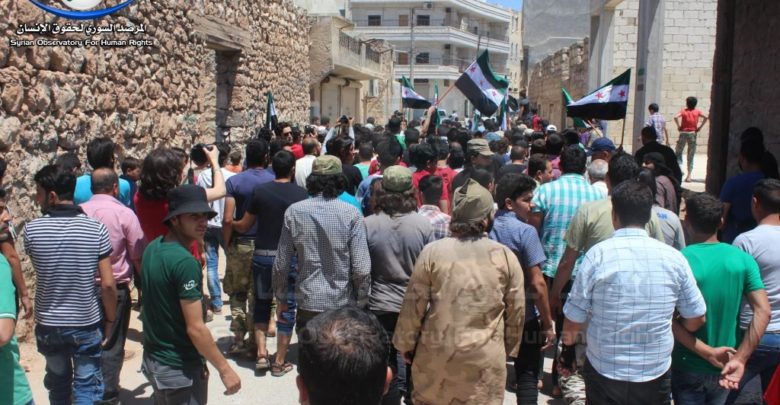
 'Dozens of Syrian demonstrators took to the streets on Friday (Dec. 21) in Daraa countryside, chanting anti-Assad slogans, and calling to topple the Assad regime.
Peaceful protesters hit the streets in Daraa al-Balad after Friday prayers chanting “The people want to overthrow the Assad regime.”

 They also called for the release the detainees in Assad regime prisons, chanting “free the detainees.”

 The demonstrators expressed their refusal of the reconciliation agreement with the Assad regime, describing the former Free Syrian Army (FSA) fighters who signed reconciliation agreement with the Assad regime as traitors.

 Syrians shared the video of the demonstration on social media, and said that it reminded them of the early weeks of the Syrian revolution.'


 'Protesters chant "no more taswiyeh" (the bureaucratic process "reconciled" adults must undergo post-surrender) & "we want the release of detainees" '
[https://twitter.com/Elizrael/status/1076127630313824256]


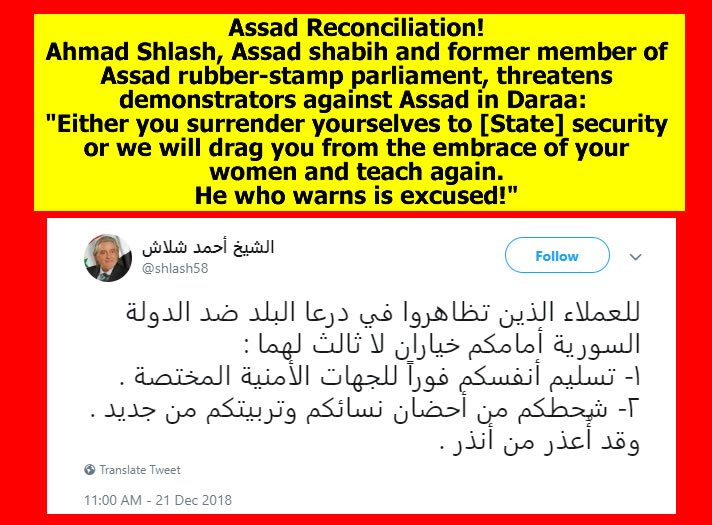
 'Ahmad Shlash, Assad shabih & former member of Assad rubber-stamp parliament, threatens demonstrators in against Assad in Daraa: Surrender yourselves to Assad security or we will teach again.'
[https://twitter.com/EagleSyrian1/status/1076468763615248384]


 'Assad regime forces are reportedly combing al-Herak, Daraa, after graffiti appeared on the walls of the local Air Force Intelligence branch calling for Assad's downfall. Similar graffiti appeared in eastern Daraa towns a month ago. '
[https://twitter.com/Elizrael/status/1076498378249388032]

Friday, 21 December 2018

Of the people, by the people, for the people


 ' "I’ve come to take part in the free elections. They make us proud." In January 2017, these were the words of a voter in the city of Idlib in north-west Syria, quoted by the news agency Agence France-Presse. The man was pleased about a particular event in the city: the first elections to the local council. It was hoped that this assembly would steer the fortunes of the local community through difficult times. Eighty five candidates were standing for election to the 25 seats. A 10-member executive committee was later chosen from its ranks, the head of which served as mayor for the city with its population of around 2,00,000 at the time. Anyone over 25 years old and born in Idlib was entitled to vote.

 The vote was a small-scale sensation in the last province still in the hands of the opposition. In the year 2015, the Syrian government army withdrew from the region on the Turkish border. Fateh al-Sham jihadists had captured the city and initially governed it. But during the course of 2016, the citizens of Idlib were able to convince the jihadists that the city needed a civilian administration. This resulted in the election and establishment of a city council.

 Since then, Idlib local council has been managing the daily business of the community. It guarantees supplies of drinking water, electricity and fuel, ensures that roads are repaired and debris is cleared following bomb attacks. Rubbish needs to be disposed of and sewers maintained. People are needed to distribute aid and somehow take care of the many sick and injured. The Idlib local council co-ordinated and organised all of this, as well as could be expected amid a humanitarian catastrophe with many internal refugees and conflict damage.


 As the Syrian opposition movement gradually brought large areas of the country under its control from 2012 onwards, public structures initially imploded in many places. Opposition-held territories became a laboratory in which people had to experiment with new forms of self-administration.

 "The local councils arose out of pure necessity," says Leila al-Shami, British-Syrian activist and writer. "They were attempts to establish day-to-day services in local areas from the bottom up."

 Al-Shami believes that the local councils arose spontaneously and were not the expression of a political ideology. At a village, municipal and provincial level, they filled a vacuum that the government had left behind and that no-one was prepared for. Initially, mostly young activists improvised, distributed aid and tried somehow to cope with the emergency. They wanted to develop a democratic alternative to the Assad state, but they lacked clear ideas for this.
Some 600 city and provincial councils were set up primarily in the provinces of Idlib, Aleppo and Daraa, as well as in the Damascus conurbation and Raqqa. They gradually consolidated their structures. After the most pressing humanitarian questions, the councils tackled projects such as school and hospital reconstruction. Local councils conducted negotiations with militias, tried to curb the influence of radical Islamists and mediated between hostile groups.


 The civic representations enjoyed varying levels of success according to region. A 2017 report by the Swiss Peace Foundation appraising five case studies from all parts of the country found that local councils had certainly succeeded in guaranteeing a minimum level of services and supplies for day-to-day life. To a certain extent, they had also created a regulatory framework for democratic decision-making within the local authority area. According to the study, opportunities for public participation had significantly improved since the councils were first set up in 2012. Whereas initially, a small group of activists drew the local representatives from their own ranks or appointed dignitaries, more and more genuine elections were held between 2013 and 2015.

 Nevertheless, the study critically notes, in many places powerful families exerted a great influence on the composition and decisions of the councils. Despite this, the authors of the study say that in view of the difficult situation and the lack of a democratic tradition in Syria, the councils’ achievements have been remarkable. They report public meetings, opportunities to make complaints and healthy discussions on Facebook.

 This impression is confirmed by Leila al-Shami from her conversations with those involved in the local councils. "Not all areas have managed to overcome undemocratic structures," she says. There were cases of nepotism and corruption in the distribution of aid. Other local authorities struggled with prevailing quarrels between clans, or the overpowering influence of political and religious groups. But they were the only institutions to rightly claim, to a certain degree, that they were representing Syrians’ concerns.

 One major deficit was the lack of female involvement. Only very few women stood for election. Not because of any official sanctions, but "because of social norms", as one anonymous council member put it. The only exception was the city council of eastern Aleppo. Following the area’s recapture by government forces, it now operates in a rebel-held rural enclave. With the 38-year-old teacher Iman Hashem, it elected a woman to chair it in 2018.

 The fair distribution of aid posed a further problem. Primarily in the early years, opposition-held areas did receive food and medicine from foreign donors such as France and the USA. But these shipments were irregular and uncoordinated, says Agnes Favier in a 2016 study of local administration in opposition-held territories. This led to conflict over its distribution, which undermined the legitimacy of the councils.


 Pressure on these councils increased further from mid-2014 onwards. With the rise of the terrorist group ISIS’, local authorities slipped out of public view and lost their international support. In western public view, the Syria conflict was increasingly perceived as a battle between Assad and the Islamists. In any case, Arab donors in the Gulf gained little from the democracy experiments. The idea that compared to the extremists, Assad was the lesser evil, began to prevail. The champions of a democratic alternative were pulverised between dictatorship and jihadists.

 This is one of the biggest failures of western politics — that the local councils did not receive more financial and above all political support. One of Favier’s criticisms back in 2016 was that international donors never had a co-ordinated strategy to bolster the local authorities in the long-term. Because of this, every local authority and every province in opposition-held areas tried to muster as much support as possible from foreign donors and exiled Syrians. This resulted in inter-authority competition which further shattered the already fragmented opposition.

 At the same time, the local councils became the favoured target of the regime. "The regime saw civil organisations and democrats as the greatest threat to its totalitarianism," says Laila al-Shami. After all, it questioned perception of the Syrian conflict as a battle against terrorism.
The example of eastern Aleppo is especially illustrative of this. As observed by Kheder Kaddour, Syria expert at the Carnegie Foundation in Beirut, the notorious barrel bomb attacks on the eastern part of this city of nearly two million began just at the point when the city council in the opposition-held area had established a functioning administration. It was the regime’s aim to destroy any impression that others might be in a position to shape the nation’s future.


 But the councils’ own weaknesses also played a part. "Despite their local prominence, the local councils were not in a position to consolidate their institutions," says Khaddour. "In addition, the Syrian National Council lacked the power to make decisions and the necessary authority. The local assemblies were not adequately represented in the Syrian National Council." This meant they did not succeed in presenting themselves as a legitimate alternative to the Assad system. The opposition not only failed because of the military superiority of Assad and its allies Russia and Iran. It also failed because of the lack of a political concept for a new Syria.

 With Russian support, government forces have been able to recapture large areas of the country since the autumn of 2015. So what has happened to the local councils? "They were mostly dissolved," says Leila al-Shami "once an area was again brought under government control." In some areas, council members were also arrested. The Assad government then installed its own councils, called baladiya. They report directly to the local authority ministry in Damascus. Members of the baladiyas are generally appointed directly by the regime. This has put an end to democratic experiments for the time being. But recollections of such experiments will remain in the collective memory.'