Tuesday, 14 November 2017

Triumph of the PYD has kindled fears history is repeating

Image result for raqqa ocalan

 Yassin al-Haj Saleh:

 
'In mid-October, the Syrian Democratic Forces, a US-backed, predominantly Kurdish militia with ties to the Kurdistan Workers’ Party (PKK) in Turkey, “liberated” my hometown, Raqqa, from Islamic State (ISIS) fighters. Arabs, a majority of the region’s population, had little to do with ISIS’s ouster. In a city where locals have long been relegated to second-class status, the triumph of the Democratic Union Party (PYD) – the Syrian branch of the PKK – has kindled fears that history is repeating.

 Activists from Raqqa have long referred to our dilapidated city as an “internal colony,” owing to its long history of economic, political, and social marginalization at the hands of Syrian governments. In the early 1970s, Raqqa – then small and poor – was nonetheless moving forward and flourishing. Schools were multiplying as attendance surged. Other public services were improving as well, and parents believed that their children would lead more prosperous lives than they and previous generations had.

 This was certainly true of my parents, who sacrificed a lot to raise their nine children. They were not happy when, in the 1970s, their older sons became communists, strongly opposing the brutal regime of Hafez al-Assad, President Bashar al-Assad’s father. But this was not a farfetched transformation in a city where people were assuming new identities – such as Nasserist, Baathist, Islamist, or communist – downplaying their regional and tribal origins.

 But by the time I was arrested in 1980, as a university student in Aleppo, the future my parents once envisioned had begun to vanish. Five years later, another son was arrested, followed by a third six months after that. Our mother died of cancer while the three of us were in prison, hardly exceptional for Syrians at the time. We were among many from across the political and ideological spectrum who were arrested and tortured for daring to oppose the Assad regime. Syrians suffered from extreme repression, with people denied the right to assemble or even to discuss issues publicly, and the country was reduced to a political desert.


 I didn’t get out of jail until 1996, when I was 35. Returning to Raqqa then, after 16 years behind bars, I was struck by what Assad’s regime – 26 years in power at that time – had done to my city. There was no trace of political life, no public debate, no young people talking about the books they were reading or the films they were watching. Before my arrest, Raqqa had three cinemas. By the time I was released, there was only one, used mostly for weddings.

 The cult of Hafez had, by then, replaced Syrians’ free will. The elder Assad’s images were ubiquitous; among the first landmarks to greet me upon my release was a huge statue of the president. The walls were covered in vapid quotations from the hollow speeches of “the master of the nation.”

 Raqqa was in rapid decline by then, and the city’s despair would intensify over the next decade. By 2007, even Abdullah Dardari, the deputy prime minister for economic affairs and a chief architect of Syria’s economic reforms (which were upended by the 2011 civil war), described Raqqa as a long-forgotten city. The arrival of ISIS only hastened the colonization of my ephemeral metropolis.


 Sadly, even with ISIS gone, the sense of siege remains. Western forces and their proxy, the PYD militia, whose real loyalty is to their leaders in Turkey, now control Raqqa. One of the first things that our new PYD liberators/occupiers did after declaring victory was to display their own foreign identity by installing a huge portrait of the PKK’s jailed leader, Abdullah Ocalan. Not a single Syrian symbol was offered in tandem. Worse, after a military operation that destroyed 90% of the city and killed some 1,800 residents, the city’s new rulers have not even begun to remove the bodies buried beneath the rubble. Instead, long-time residents have been prevented from returning to their homes.

 For those of us with long memories, it is impossible not to draw comparisons with past rulers – the Assad regime and ISIS. (The fascist organization that the Western media calls ISIS – a name that confers on it Islamic credentials – is more likely to be called Daesh in the Islamic world, a name coined by my brother Khaled, who was in jail with me in the 1980s.)

 What is different this time is the seemingly inevitable march toward ethnic conflict. The city’s previous victims are its latest victims as well. The exploited, impoverished, underrepresented, despised, and dehumanized population is living under even worse conditions, more marginalized than ever. The locals are being dealt with as tribes, according to the modern colonial model.

 Raqqa’s “liberation” is not ours. The population is more estranged than ever. Our past struggles for freedom and justice are being ignored. The locals who fought against ISIS, and who were made to disappear at its hands (including my brother Feras, abducted in July 2013), are still missing. And ISIS has served as the ideal monster for many colonial occupiers eager to appear less villainous than they are.'

Monday, 13 November 2017

Russian bombers target popular market in al-Atareb

 Hussein Akoush:

 "Three air raids conducted by jets believed to be Russian targeted the popular marketplace in my hometown al-Atareb, west of Aleppo, resulting in the killing and injuring of dozens and leaving massive destruction."


 Note 21/7/25, link broken.

Friday, 10 November 2017

The Syrian photographer who showed the world a war


 'Karam al-Masri never planned on becoming a journalist. In 2011, Aleppo native was a second-year law student when protests began in Syria, following revolutions in Egypt and Tunisia. Using his cellphone, he captured photo and video of demonstrations against the Bashar al-Assad regime.

 In April 2011, the Syrian government arrested al-Masri for posts he made on Facebook. Detained for one month, he stayed in solitary confinement and underwent torture. “The regime wanted me to say I was working for foreign agents,” al-Masri explained.

 Then, in November 2013, members of the Islamic State kidnapped and incarcerated al-Masri simply because he was a photographer documenting what was happening in Aleppo, a major sin, according to ISIS. Again, he found himself in solitary confinement, surviving on a ration of half a slice of bread and three olives. When he was released six months later, not only did he find Aleppo leveled, but discovered his home had been hit by a barrel bomb, killing his mother. Weeks later, another bomb killed his aunt. Later, Syrian snipers shot him —twice— in the leg and hand.

 Yet al-Masri doggedly resumed taking photographs, even more determined to show the world the atrocities experienced by Aleppo, particularly as foreign media fled in the midst of ISIS kidnappings and growing violence.

 "At first, I started to take videos for my channel on YouTube. My videos were just of demonstrations, there was no fighting or anything like that. I wanted the world to see what was going on on the ground because there were no foreign journalists. The mainstream media would say, 'There’s nothing happening; Syria is fine; nobody is going to demonstrations.'

 The war became a real war, not demonstrations or a revolution. The regime started to shell people with barrel bombs and missiles. It became very difficult to cover. But I wanted my work to reach everywhere in the world. Without these pictures and videos, maybe the regime would kill everyone in the areas out of [al-Assad’s] control." '


Note 20/7/25, updated link appears to show story from 2018 rather than 2017.

Thursday, 9 November 2017

So nobody says, he or she didn't know


 Julian Röpcke:

 
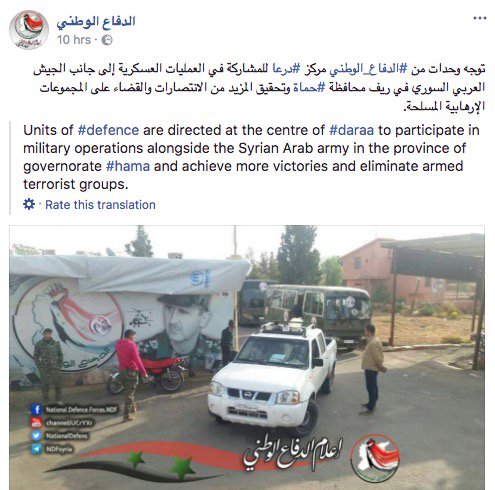
"Assad's militias publicly announce deployment from Daraa to Hama ...to kick off the final offensive to capture the northern "De-Escalation Zone" & displace 2 million civilians to Turkey and the EU."

 "Reports that Hezbollah are retreating their active forces in Syria back to Lebanon. This Hezbollah retreat froze all east Hama fronts and all regime ops stopped due to shortage of men."
[https://twitter.com/AlqalaamENG/status/928713491049078784]


 Note 21/7/25, second link broken.

The régime's goal is to capture all the liberated areas


 'Jamel al-Saleh says they have liberated four villages and four hills, and repelled many régime attempts to advance.

 He says between destroyed and captured vehicles, the régime has lost 25 vehicles. And in the past week, the régime has had 200 KIA in the NE Hama battles, and there are also captured régime fighters.

 He says the régime's eventual goal is to capture all the liberated areas. Anyone who doesn't realise this is delusional. He says the régime won't stop at any specific town or location. The régime uses the fake ceasefire agreements, which some factions have agreed to, as a way to concentrate on one area at a time.

 He says the Astana process has failed to release a single political prisoner, and hasn't been able to relieve the siege of the besieged areas. The régime continues to attempt to advance and shell areas of Hama, N.Homs, Ghouta, Daraa, etc. The negotiations are a lie.

 He says the responsibility for the blood being spilled throughout the liberated areas is on the factions that went to Astana, and are sitting and doing politics and not fighting. There purpose should be to fight the régime militarily.

 He says they will continue to fight the régime as long as they have the ability to do so or until the régime is defeated.'

Regime Air Raids On Ghouta, Shells Harasta With Napalm


 'The Revolutionary Forces of Syria Media Office confirmed that 13 air strikes hit the towns and villages of Eastern Ghouta, including raids carried out using napalm rockets which specifically shelled the neighborhood of Harasta. The towns of Saqba, Kafar Batna and the Jobar neighborhood were also subjected to similar shelling. This escalation comes during the time in which the Russian Ministry of Defense announced that it has reached an agreement to reduce military escalation in the vicinity of Damascus.

 Sources from Faylaq Al-Rahman and Jaish Al-Islam confirmed to RFS that they were unaware of the agreement, and that what is happening on the ground in Eastern Ghouta contradicts what Russia and its media are claiming.

 Six civilians, including two children and two women were killed in the city of Saqba yesterday, while another child was killed in the city of Douma, as a result of heavy artillery shelling carried out by the regime.'

Tuesday, 7 November 2017

PYD Reproducing Baathist Oppression


 'As a term, “the party” formerly denoted the Baath Party. But today there are two parties, both largely based on geography: The Baath Party and the Democratic Union Party (PYD). Both these parties govern and administer and depend on strong intelligence agencies, which, of course, are also used to pursue their aims and intentions, which overlap and which they sometimes share.

 The PYD has been able to benefit from the military confrontations occurring on Syrian territory and take control of some important sections of it, whether through military clashes with Free Syrian Army units, or through agreements with the regime, and, recently, in battles it joined to expel the Islamic State (ISIS) from the provinces of Raqqa and Deir-ez-Zor, with clear American support. The United States found in them a trained proxy ground force with high military discipline, after failing to form a force from Arab FSA groups to fight exclusively against ISIS.


 With the beginning of 2016, the year in which the opposition took a heavy military and political blow, the PYD has been able to expand its control outside the city of Afrin to include about 15 Arab villages in the northern countryside, expelling most of their residents.

 In Aleppo city, the PYD, in coordination with regime forces, has been able to take control of four new districts, Bustan al-Basha, Al-Halak, Baeedeen and Al-Haydairiya, in addition to previously controlling Sheikh Maqsoud and part of Ashrafieh.

 The PYD has imposed a frightening security force around Afrin through a system of monitoring and inspection at its entrances from the northern countryside at the Atmeh crossing, and from the western countryside at the Ghazawiya crossing.


 In the villages which the PYD has taken, Arab residents who remained in their villages are particularly suffering, especially as they are forbidden from traveling to the liberated areas. Most of them cannot see their families or relatives, even on holidays. Residents are given one very “democratic” choice: either remain or travel without returning. Meanwhile, there is no problem with them traveling to regime-held areas.

 The PYD has also imposed its own Kurdish curriculum on school students, bringing in a number of unqualified teachers for a short course around their new program in the Kurdish language. Residents have rejected the “party curriculum,” protesting by forbidding their children from attending schools, with the position of the “democratic” administration as expected: either accept the curriculum, or the schools will close.'

Sunday, 5 November 2017

FSA Breaks Siege of Beit Jinn but Later Retreats as Israeli Forces Intervene on Assad Militias’ Side


 'The Free Syrian Army (FSA) groups on Friday announced they managed to break the siege regime forces imposed on the town of Beit Jinn in western Ghouta in Rural Damascus. FSA groups launched on offensive dubbed ‘Breaking the Siege of Hermon’ to link Beit Jinn to Quneitra province but were forced to retreat after Israeli forces intervened on the side of pro-Assad militias.

 The FSA’s Mount Hermon operations room said that the offensive came in response to the fierce campaign being launched by the Assad regime forces and their allied foreign militias in the farmlands surrounding of the town of Beit Jinn and the nearby villages. Regime forces have been shelling the area and residential neighborhoods in attempts to make gains on the round.

 The FSA groups announced they would continue military action against Assad forces until the siege imposed on the area is lifted and detainees are released. They called on other FSA groups to join them and to ignore international pressure being put on these groups.

 Activists in rural Quneitra said that the Israeli occupation forces targeted the reinforcements the Free Syrian Army groups sent to the border strip of land in southwestern Syria. They pointed out that the bombing came in response to calls for help by pro-Assad militias in the town of Hadar to relieve them of the FSA army attack. The Israeli occupation forces opened the border and supplied the pro-Assad militias in Hadar with arms and ammunition, thus enabling regime forces to regain control of the areas they lost to the FSA fighters.

 Assad regime forces and the Hezbollah militia have laid siege on villages and towns of the western Rural Damascus for around 10 months. The besieged area has been subjected to violent shelling by barrel bombs and rockets amid daily attempts by regime forces to advance on the area.'

Saturday, 4 November 2017

Wendy Pearlman reads We Crossed the Bridge & It Trembled


 Part 1 - Authoritarianism

 Salah, a landscaper from Deraa: "We don't have a government. We have a mafia. And if you speak out against with this, it's off with you to Beit Kheltur, your aunt's house. That's an expression we have. It means to take someone to prison. It means forget about this person. He'll be tortured, disappeared; you'll never hear from him again."

 Ilyas, a dentist from rural Hama: "Syria had the appearance of being a stable country, but in my opinion it wasn't real stability. It was a state of terror. Nobody trusted anyone else; don't talk, the walls have ears. If anyone said anything out of the ordinary, others would suspect that he was a government informant, just trying to test people's reactions, and gather a sense of what was going on. It was a régime based on command and obedience, every state institution recreated the same kind of power. The President had absolute power in the country. The principal of a school had absolute power in the school. At the same time, the principal is terrified. Of whom? Of the janitor sweeping the floor, they are all government informants."

 Ayham, a web developer from Damascus: "The brainwashing process starts when you go to school. We love the leader, we love the régime, without them the country will collapse. You grow up with that in the back of your head, constantly reminding you that we are living thanks to the grace of the Assad family. But even as an innocent child, you see that the whole system just reeked. It fed on corruption and grew. If you want to get a passport, you have to bribe this guy, and that guy, and kiss that guy's ass. From when you're little, you're taught that this is the only way to survive in this country. As an active member of the ruling party, you're going to get better grades, better chances for better schools or jobs, everything is handled by how loyal you are to the régime. So you are raised on the principle that you have to show your loyalty."


 Part 3 - Revolution

  Shireen, a mother from Aleppo: "Oppression was residing in us. It was part of our life, like air, sun, water; we didn't even feel it. Like air is there, and you never ask, 'Where is the air?' But then, in one second, in one shout, in one voice, you blow it up. You defy it, and stand in front of death. You have an inheritance, and after thirty years you slam it on the ground and shatter it. Don't even imagine that it was easy to go out to a demonstration. No amount of courage allows you to stand there and watch someone who has a gun and is about to kill you. But still this incredible oppression made us go out. I encouraged my nieces and nephews to come with me to demonstrations. I felt that if they didn't try that experience, they'd be missing the real meaning of life. When you chant, you shudder, your body rises, and everything you imagined just comes out. Tears come down, tears of joy, because I broke the barrier. I am not afraid. I am a free being. Sadness and happiness and fear and courage, they are all mixed together in that voice, and it comes out strong."

Rima, a writer from Sweida: "I was in the demonstration, and I started to whisper, 'Freedom,' and then I started to hear myself repeating, 'Freedom, freedom, freedom,' and then I started shouting, 'Freedom!' I thought, this is the first time I have ever heard my own voice. And I told myself, that I would never let anyone steal my voice again."


 Part 4 - Militarisation

 Captain, a fighter with the Free Syrian Army from Aleppo: "When demonstrations began, security force came. We agreed, that if they were going to shoot bullets, then we needed weapons too. We were only chanting in the streets. We could have chanted for the rest of our lives without anyone even paying attention to us. But when the régime started attacking us, a lot of people who were on the sidelines started to join and protest too. Because of the blood. Blood is what moves people. Blood is the force of the revolution."


 Part 6 - Living War

Abu Firas, a fighter from Idlib: "At first, one or two people were killed. Then 20. Then it became normal. If we lost 50 people, we'd say, 'Thank God it's only 50.' It's been so long since I heard that someone died of natural causes."


 Part 7 - Flight

 Talia, future TV correspondent: "The night before I left, was the longest night of my life. I was alone with the kids, and the planes were in the sky all night. The sound of planes is scarier than the sound of barrel bombs, because you hear them and wonder when the bombs will drop. The waiting is harder than the actual attack. I didn't know if we'd leave the next day, or if this would be the night that we died. I had seen children torn in pieces before, but I wasn't strong enough to see my kids in that state. I needed to get them to safety. The kids woke up, and I got them dressed. I got two pieces of paper, and wrote our names and phone numbers, and put them in their pockets. That way, if someone got killed, people would know their identities. I waited for the driver outside. I kissed the walls on the street, because I knew that I was never coming back to them."


 Part 8 - Reflections

 Adam, a media organiser from Lattakia: "One of the most profound things that I've learned from this experience, is that the process of finding out what a country needs is never clean. Of course, when you're in a stable country, with functioning institutions, it's easy to have a moral code. But these values are only possible, because other people did dirty things to put that system in place. We opened a Pandora's Box. We had this innocent childlike interest to see what is inside the box. We thought we'd get a present, and what we got was all the evil in the world. Now we need to close the box again, but it's going to take a while. Now I'm working with an NGO, that helps the free media inside Syria. I see my job as trying to support people who want to make their dreams come true. But I'm too old to dream now, in a month and a half, I'll be 29."


Friday, 3 November 2017

The last doctor out of eastern Aleppo


 'In early 2011, Zahed Katurji had just finished his medical studies in his home town. He spent his free time playing basketball, learning German – he was considering further studies abroad – and listening to his favourite heavy metal band, Korn.

 For most of the time since, Katurji, 31, has been Dr Hamza Al-Khatib, the manager of the Al Quds hospital, and one of the last doctors in eastern Aleppo, Syria.


 In 2011, Katurji was living with his family in the ancient city of Aleppo. Although his friends had been following events in Tunisia and Egypt, where protestors in the streets were overturning authoritarian regimes, Katurji wasn't that political. In March, after protests began in Syria, he watched coverage on both government and independent TV channels.

 Then Syria’s dictatorial President, Bashar al-Assad, gave a speech. “He’s laughing,” Katurji thought, as Assad brushed over the deaths of protestors. At that moment: “I believed I should participate in [the protests] – it’s my country and that stupid man was the president of my country.”

 With the army distracted by uprisings in other cities, whole neighbourhoods in the east of Aleppo threw off the authorities, aided by the newly-formed Free Syrian Army. Katurji started making the 30 minute commute every day from his family home in the west of the city to volunteer in Salaheddine, one of the rebel neighbourhoods in the east. “In the first months it was very easy,” he recalls. “There were two main streets with snipers on them, but you could skip those.”


 Fearing for his family’s safety, he renamed himself Dr Hamza, choosing the name of a 13-year-old boy who was arrested, tortured and killed for protesting the siege of his city in southern Syria, Daraa. In late 2012, he started working at Al Quds hospital, in the emergency department. Dr Hamza was one of between 30 and 70 doctors, serving a population that fluctuated between a high of more than a million and lows in the hundreds of thousands as bombing intensified.

 The work was relentless, and as the manager of the hospital as well as a doctor, Katurji often lost track of the hours. One day, the radiographer refused to take any more x-rays.

 “I became angry with him," says Katurji. "He showed me the records. Between 8am and 5pm, he had taken 360 x-rays. He told me: ‘I will become sick and the machine will explode if I take extra pictures.’” Katurji realised he must have treated more than 400 injured patients that day. He felt suddenly exhausted.

 Katurji first realised the revolution would not be swift in September 2012, when one of his friends was killed by a sniper. By 2013, he had lost three friends, and the threat was increasingly from the skies. Everyone in eastern Aleppo seemed to have lost someone. Assad’s regime dropped barrel bombs on the inhabitants of eastern Aleppo – breaking international codes of law – and the survivors turned up at the hospital.

 One case that sticks in Katurji’s mind was that of a six-year-old boy, whose foot was crushed after a barrel bomb hit his building. “The only thing we could do was amputate it,” he says. The boy overheard the discussion, and understood what was about to happen.

 “He grabbed me and said 'Please uncle, don’t let them amputate my foot, I will be well-behaved',” Katurji recalls. “That stuck in my mind. He thought he’d done something wrong.”


 As the years passed, and the conflict intensified, the doctors saw children who knew nothing but the thunder of enemy helicopters. “They don’t know what a playground is, they don’t know what football is, they don’t know what music is,” he says. “They grew up mostly in basements.”

 Katurji himself had married by then, to the video journalist Waad al-Kateab. In December 2015, they had a daughter. Still, he did not think about trying to leave. “As a doctor, seeing all the casualties I had to deal with – you can’t just turn your back and walk away. There were hundreds of thousands of civilians. My daughter wasn’t the only child in Aleppo.”

 But by then, it was Russia launching air strikes. The intervention would prove crucial. A newly empowered Assad regime began the siege of Aleppo.

 In April 2016, the regime targeted Al Quds itself. A paediatrician was among the 55 dead.

 The attack was recorded on CCTV, and reported by the charity backing the hospital, Médecins Sans Frontières. Yet by now, the truth was under siege was well. In a widely circulated video, a Western pro-regime journalist Eva Bartlett claimed the attack was nothing more than rebel propaganda. As the siege intensified, so did an online narrative which claimed that the people holding out in eastern Aleppo were terrorists and Islamist fighters, not civilians.

 “It was very silly,” says Katurji. “A paediatrician ‘treating terrorists’ – it wasn’t making any sense.”

 In eastern Aleppo, he claims, the Free Syrian Army fighters were well protected in bunkers on the front line. The patients turning up at Al Quds were civilians. “Most of the shelling by the regime and the Russians would be over the homes, the bakeries – they were trying to kill any life in the areas that were not controlled by Assad.”

 While the international community stood by, the regime besieged eastern Aleppo in July 2016. The siege meant that doctors could no longer receive supplies from Turkey, and fruit and vegetables disappeared altogether. “My daughter never tasted bananas or apples,” says Katurji of the time.


 For years, Aleppo had been divided between the regime-held west and the rebel-held east. But in November 2016, pro-Assad forces broke the stalemate. The world watched as they closed in, street by street, bomb by bomb, on a besieged population. Journalists and activists in eastern Aleppo released what they believed might be their final messages.

 Then, under a last-minute deal brokered by Turkey and Russia, an evacuation was announced. Katurji was tasked with overseeing the medical part. “It took about seven days,” he says. With attacks on aid workers, reports of hostages and Russian and Iranian fighters manning the road out of the city, he contests the idea that the evacuation offered any safe route out. Nevertheless, he acknowledges, “unfortunately there was no other choice”. He was the last doctor to leave eastern Aleppo, on one of the last coaches.

 Katurji went first to Idlib, a rebel-held area in northwest Syria, and then to Turkey, where his medical credentials made it easier to cross the border (other refugees from eastern Aleppo were turned back or shot at when crossing the border). He was reunited with his family in the Turkish town of Gaziantep.

 When I ask him what he has done since then, he smiles ruefully: “Nothing.” He and his wife are still trying to figure out the next steps. “For five or six years, we never thought further than the next six hours,” he says. “Because we never knew what exactly would happen.” Sometimes he just marvels at his daughter running down the road in Gaziantep: “She could never run in a street in Aleppo.”

 If Katurji does have a mission, though, it is to raise awareness of the situation of those doctors in the remaining rebel-held areas of Syria. In 2013, the world recoiled after the Assad regime used chemical weapons on the inhabitants of Ghouta, a rebel-held area on the outskirts of Damascus. Four years later, 400,000 residents are under siege. In September 2017, pro-regime airstrikes hit hospitals in Idlib.

 “Aleppo isn’t the end,” Katurji says, as he prepares to leave the office and join the crowds in the darkening street. “What happened in Aleppo can happen and will happen somewhere else.” '

Bulldozing over the revolution


 'Yousof Akasheh, a rebel fighter, was astonished to find out that the regime of Bashar al-Assad in Syria was planning to seize his wife’s property. For one thing, she is dead, killed three years ago when a warplane bombed her apartment block. For another, she never owned property.

 Such is the arbitrariness of the regime’s counter-terrorism court, which has branded tens of thousands of opponents of Mr Assad enemies of the state and sent them to the country’s hellish prisons. Those lucky enough to escape arrest are tried in absentia. As punishment, the court routinely seizes their property.

 The civil war in Syria has driven more than 12m people from their homes, contributing to the largest refugee crisis in recent history. But in his typically appalling way, Mr Assad has spied opportunity amid the tragedy. “We have lost the best of our young people…but in return we have gained a healthier and more harmonious society,” the dictator said in August of a war that has killed more than 400,000 of his countrymen.

 Mr Assad is determined to keep it that way by making it exceedingly hard for those who have left to return to their homes. Property registries have been deliberately bombed, title deeds are seized at military checkpoints and new laws have been passed to make it easier for the regime to grab land, businesses and homes. In some parts of the country the regime has rewarded loyalists with property confiscated from its opponents. In other parts, bulldozers have simply flattened neighbourhoods that sided with the rebels. Large tracts of public land in cities are also quietly slipping into the hands of officials and connected businessmen.

 Some of Syria’s poorest areas, where many of the first anti-regime protests flared in 2011 and where most of the destruction has occurred, will be rebuilt without their unruly residents. The regime hopes to move forward with projects that were deeply unpopular before the war, raising skyscrapers, hotels and restaurants from the rubble. Lacking enough cash of its own, it has passed laws to encourage private investors to pay for the reconstruction. But few investors will build residences if there are no people to live in them.

 Half of Syria’s pre-war population is scattered. Many have already sought new homes abroad, away from a ruler who has systematically bombed, starved and tortured his own people. Even if the displaced return to their neighbourhoods, few will be able to afford the regime’s housing, exacerbating inequality that has grown worse during the conflict. Experts predict that 2m lawsuits will be filed after the war by people seeking restitution for damaged or stolen property. The courts may buckle under the burden.

 The regime is not the only side to have grabbed land during the war. Kurds in northern Syria have claimed Arab lands freed from the Islamic State group, which itself used stolen property to buy loyalty. “The destabilising potential of all this is pretty fearsome,” says Rhodri Williams of the International Legal Assistance Consortium. “Few things stay in the minds of people longer than the property that was taken away from them.” '

Thursday, 2 November 2017

Bloodthirsty snipers lined the streets

Image result for 'He has enriched our lives' say Darlington couple who took in young Syrian fleeing warzone

 'Just hours before embarking upon the gruelling journey that would change his life, Mouhyedin Alkhalil was told by his beloved parents that arrangements had been made for him to flee Syria and there was no time to say goodbye.

 He was just 18 and had spent much of his adolescence in the shadow of war, forced to move from house to house as bombing raids destroyed his city.

 In faltering tones, he speaks of a day-to-day existence where there was no escape from the bombs, the death and the destruction wrought by a war that has left a country decimated and its people dispersed.

 Mouhyedin’s childhood home was the family seat for more than 100 years before it was flattened in the conflict that ravages Syria to this day. He moved home repeatedly but there was no escape from the bombs that continued to rain down upon Homs, from the bullets and the atrocities of war. As a teenager, Mouhyedin lost friends, loved ones and life as he knew it, forced to abandon his studies when bloodthirsty snipers lined the streets that led to his law exams, “shooting at everything they see, dogs, cats, people".

 “Every day was different,” he says, with an intensity at odds with his usual sunny demeanour.“You never knew what would happen, people would go to work and not come home – dead. People would stay home – dead. You would be laughing and joking with friends and then the next minute, bombs.”

 The evening before he fled the country, the student was facing the threat of forced enlistment into President Bashar al-Assad’s army, where: “I would be killed or have to kill others.” His pleas to stay in Syria, where he could help his family, fell on deaf ears as his loved ones insisted he leave for Lebanon, fearing he would die otherwise.'

Tuesday, 31 October 2017

Syrian opposition: We still believe in the revolution


 'Representatives of some of Syria's armed opposition groups attending talks in the Kazakh capital, Astana, say they are hopeful of achieving a lasting ceasefire agreement in eight of the country's 14 war-ravaged provinces.

 Ayman al-Asemi, a member of the Free Syrian Army's military council attending the talks, said while the meetings would not produce a final settlement to the war, they could see a final agreement to the set-up of four so-called "de-escalation zones".


 The Astana talks are aimed at finalising a plan for four de-escalation zones, which will include certain areas of Idlib, Latakia, Aleppo, Hama, Homs, Eastern Ghouta, Deraa and al-Quneitra.

 The closed-door meetings are also seeing discussions on the release of detainees held by the government of President Bashar al-Assad and food and aid deliveries to besieged areas.

 "This war is far from over," al-Asemi told Al Jazeera.

 He said while the situation on the ground did not bode well for Syrians, regional and international powers were to blame having exposed themselves as spectators to the massacres being perpetrated.

 "We will not compromise our freedom and our ultimate goal of removing Assad and his regime from power," al-Asemi said.

 He added that the opposition had submitted several "secret files" to the UN delegation with "solid evidence" of crimes committed by the regime.

 According to al-Asemi, the crimes include the use of chemical weapons, the torture of detainees inside Homs central prison, forced expulsion of residents based on their ethnic and religious affiliations and war crimes committed by Iranian revolution guards against civilians.


 Colonel Fateh Hassoun who heads the opposition military delegation to the talks said that he still had faith in the "Syrian revolution."

 "The aim of the Syrian opposition is still to reach a political solution to the war and lead to a transition period without the regime of Assad." '

Raqqa may have fallen, but White Helmets fear instability


 'After liberating Raqqa from the Islamic State of Iraq and Syria (ISIS), the future of Syria remains unclear. The Trump administration heralded the battlefield success of the U.S.-backed forces, and repeated its pledge to suffocate ISIS' expansionist efforts -- yet the head of the Syrian Civil Defense, a Syrian humanitarian group also known as the White Helmets, isn't quite ready to celebrate.

 "Not really," Raed Saleh responded in an interview with CBS News, when asked if the Raqqa victory means anything to him. "I'm sure you are surprised," he added.

 Saleh has aided victims of the country's incessant violence and fought the human rights abuses of the Assad regime since the civil war began in 2011. He is of the opinion that winning one battle -- even a victory that resulted in the fall of ISIS' self-declared capital -- doesn't guarantee peace and stability.

 "When your city is occupied by one terrorist organization and it's liberated or taken over by another organization, and the picture of another terrorist is held up in the city, this doesn't give us any happiness," Saleh said, referring to a photo of the Kurdistan Workers Party (PKK) leader Abdullah Ocalan brandished in Raqqa after it was liberated. Though the PKK is not said to be in control of the city at this time, Saleh warns that instability may come again.

 "At least some among the people who entered Raqqa are undisciplined and will cause trouble in the future," Saleh predected when he was in Washington, D.C. last week for a conference on American policy in Syria.


 Defeating ISIS is at the center of the Trump administration's foreign policy in Syria. The liberation of Raqqa was the most significant accomplishment for the U.S.-based forces in the country in the last year.

 "The defeat of ISIS in Raqqa represents a critical breakthrough in our worldwide campaign to defeat ISIS and its wicked ideology," Trump said in a statement released by the White House. "With the liberation of ISIS's capital and the vast majority of its territory, the end of the ISIS caliphate is in sight."

 The Trump administration says it has "dramatically accelerated" the fight against ISIS in Syria, mostly through changes in authority that allow the military to act without the impediment of layers of bureaucracy. Nearly 30 percent of the gains in total territory against ISIS by August occurred under the Trump administration, according to a briefing earlier this year by Brett McGurk, the State Department's special envoy for the anti-ISIS coalition.

 And the flow of ISIS militants coming out of Syria has been reduced to a trickle. Administration officials point out that ISIS propaganda has stopped encouraging followers to come to Syria to take up the fight. Taking Raqqa away from ISIS has also significantly impacted the messaging from the militant group, given that most of their directives originated from the city, the group's declared capital. MgGurk points out the uphill battle the group now faces in disseminating its messaging from small villages.


 ISIS now holds less that 10 percent of the territory it once held, according to the administration, and it is still carrying out attacks. It carried out an attack that cost the lives of four American soldiers in October. Afterward, Joint Chiefs of Staff Chairman Gen. Joseph Dunford told reporters that ISIS would be defeated when the group is no longer able to operate across multiple regions, and when its offshoots in individual countries can be "dealt with by local forces."

 But reaching that point, that is, weakening ISIS to the point at which local forces have the ability to curtail ISIS and other terrorist groups in Syria, remains a battle because there are no government forces that can be relied upon for this. Another factor is the U.S. determination that Assad cannot remain in power, a point recently repeated by Secretary of State Rex Tillerson.

 "The United States wants a whole and unified Syria with no role for Bashar Assad in the government," Tillerson told reporters last week after a meeting in Geneva about Syria. "The reign of the Assad family is coming to an end, and the only issue is how that should be brought about."

The U.S. maintains support for the Geneva process in Syria, but getting to a place where there is enough peace on the ground to start that process will be a struggle, Saleh said. He doubts the political transition is as close as some in the U.S. government think it may be. Saleh intends to continue his efforts to help Syrians, and hopes that the accumulated efforts might over time result in peace for his country. While he still sees the Assad regime dropping barrel bombs and killing thousands in the country -- and yet, he does not wholly trust the U.S. either.

"We observe human rights violations from all parties and we talk about this when we meet with American and UN officials, but we do end up focusing on the regime's violations," says Saleh. "Not me, no other Syrians nowadays has great hopes on anyone delivering on these big promises, big red lines that we keep hearing (about). The barrel bombs keep dropping, and there is no clear hope." '

Monday, 30 October 2017

Kindergarten is bombed in besieged Ghouta


 Kareem Shaheen:

 
'Dozens of Syrian children were forced to flee a kindergarten on Sunday after it was allegedly bombed by government forces, highlighting the suffering of civilians in areas besieged by forces loyal to President Bashar al-Assad and the rampant abuses in the six-year civil war.

 Video footage shows crying and panicked children fleeing the site of the attack on Sunday, as adults usher them on to go and hide as the adults made their way towards the scene of the attack.

 The video was authenticated by the Associated Press and was released by activists of the Ghouta Media Centre, an organisation covering the war in Ghouta region near Damascus. The footage was shot in the town of Kfar Batna.

 Activists said several civilians were injured in the attack, but there were no immediate reports of fatalities. Residents said schools had been closed on Monday to protect the children against further attacks.


 Ghouta, once the breadbasket of the Syrian capital, has been under siege for years by the Assad regime, and is under rebel control. East Ghouta was supposed to be part of a “de-escalation zone” under a deal brokered by Russia, Turkey and Iran to reduce violence in the country.

 Instead, the siege has tightened in the aftermath of a government offensive this year. The suffering of civilians in Ghouta was brought into sharp focus last week with images of a starving one-month-old baby, Sahar Dofdaa, who later died of malnutrition.

 Doctors are warning that shortages of food and baby milk, which has been caused by the government’s siege as well as predatory pricing by local merchants, have led to a rise in cases of malnutrition, particularly among children.

 The UN estimates that 350,000 besieged civilians are living in east Ghouta. Last week, Zeid Ra’ad al-Hussein, the UN high commissioner for human rights, described the crisis as a humanitarian emergency and an outrage.

 Supplies for 40,000 people were allowed into the towns of Kfar Batna and Saqba on Monday for the first time in weeks.


 The latest video highlighted the continuing plight of Syria’s children, who have suffered greatly in the course of the war. They have been killed by bombs, starved by sieges and deprived of an education.

 Unicef estimates that 5.8 million children in Syria are in need, with more than 2 million under siege or in hard to reach areas. Attacks on hospitals and schools have been commonplace, and aid organisations are unable to reach all children who need to be vaccinated against polio.'

The Syrian Regime’s Funding of the Islamic State


 Kyle Orton:

 'Reuters reported on 11 October that Hussam al-Katerji, a member of Bashar al-Asad’s Syrian regime, has been engaged in trading wheat with the Islamic State (IS), helping supply the terrorists with resources to run their statelet and threaten the security of Syria’s neighbours and the wider world. This pattern of behaviour from the Asad regime—holding itself out as a counterterrorism partner, while it bolsters terrorist organizations—is well-established, and has its origins in the regime’s survival strategy: to destroy all acceptable opposition forces and make the Syrian war a binary contest between the dictatorship and terrorists.

 Reuters spoke to five local farmers and two administrators from the “Syrian Democratic Forces” (SDF), the political outfit through which the Kurdistan Workers’ Party (PKK) operates in Syria, which is displacing IS in northeastern Syria with the assistance of the U.S.-led Coalition. In addition, the manager of al-Katerji’s own office, Mohammed Kassab, confirmed that the Katerji Group had moved wheat from the IS-held areas to regime-held areas. Kassab insisted that this trade had involved no collusion with IS, though, beyond saying it was “not easy”, offered no explanation as to how that could possibly be true. Asad’s Internal Trade and Consumer Protection Minister, Abdullah al-Gharbi, claims that the regime imports its wheat from the Russians.


 From Reuters’ report:

 Five farmers in Raqqa described how they sold wheat to Katerji’s traders during Islamic State rule in interviews at the building housing the [SDF/PKK] Raqqa Civil Council, formed to take over once the city is retaken.

 “The operation was organized,” said Mahmoud al-Hadi, who owns agricultural land near Raqqa and who, like the other farmers, had come to the council’s cement offices to seek help.

 “I would sell to small traders who sent the wheat to big traders who sent it on to Katerji and the regime through two or three traders,” he said.

 He and the other farmers said they all had to pay Islamic State a 10 percent tax, or zakat, and sold all of their season’s supplies to Katerji’s traders under the multi-layered scheme.

 Local officials said Katerji’s traders bought up wheat from Raqqa and Deir Ezzor and gave Islamic State 20 percent.


 [An official from the SDF/PKK leadership council in Tabqa, Awas] Ali said he learned of the details of the arrangement with Katerji by speaking with Islamic State prisoners and others who worked in the group’s tax collection and road tolling systems. …

 The truck drivers were even allowed to smoke cigarettes as they passed through the checkpoints, something Islamic State enforcers punished with whippings elsewhere, Ali and several other sources said.

 “I would sell an entire season’s supplies to Katerji’s traders,” said farmer Ali Shanaan.

 “They are known traders. The checkpoints stopped the trucks and Daesh would take a cut and let them pass,” he said …

 The wheat was transported via the “New bridge” over the Euphrates River to a road leading out of Raqqa, the farmers and local officials said.

 As IS falls back, the control of the bridge, and these resources more generally, has been lost, but it lasted through most of the May to August trading season this year. In addition to Asad transferring tranches of cash to the IS jihadists in exchange for the wheat, the regime trucks brought supplies like food and medicine that helped the caliphate maintain its grip.


 The trade between Asad and IS will sometimes be explained in “war economy” terms, and in this case that is superficially plausible. The Asad regime needs 1.5 million tonnes of wheat to create staple products that allow it to exert control of the population in western Syria, and Hasaka, Raqqa, and Deir Ezzor contain seventy-percent of the wheat-producing areas. What this neglects is the role the regime had in shaping who controls those zones. Asad imprisoned and massacred unarmed demonstrators and blitzed any zone that fell into rebel hands—while turning loose jihadist prisoners and holding fire for an entire year as IS constructed its caliphate. The regime chose who it would need to pay for access to these resources.

 While Hussam al-Katerji is not a household name in the West, in the Arab world and especially in Syria he is very well-known as Assad’s middle-man for trade with the terrorist groups the regime has enabled to seize areas of the country, namely IS and the PKK. For instance, local reporters at Deir Ezzor 24 and Watan FM exposed the essentials of the above Reuters story in March. Al-Katerji is far from the sole intermediary between Asad and IS—another notable case is Suhayl al-Hassan—but al-Katerji’s role has been especially salient since George Haswani was sidelined.

 In late 2015, Haswani was sanctioned by the U.S. Treasury, as was his HESCO Engineering and Construction Company, for acting as “a middleman for oil purchases” between Asad and IS. Haswani had already been sanctioned by the European Union in March 2015 for the same reason. In Haswani’s telling, his running of Syria’s energy sector as a joint enterprise with IS was a patriotic endeavor to provide “electricity to all the spectrum of Syrian people”. It was broad-minded indeed to include jihadists in that spectrum. A different view was expressed by British Foreign Secretary Phillip Hammond. “This listing”, said Hammond, “gives yet another indication that Asad’s ‘war’ on ISIL is a sham and that he supports them financially”. Among the interesting things about Haswani was that he was a Christian by religion, and a dual national of Syria and Russia. Haswani had significant business interests linked to the Russian government, and it was Moscow that provided much of the connective tissue for a long while between the Asad and IS statelets. There was therefore a great deal of projection in the accusation by the pro-Asad coalition that Turkey was funding IS via oil and other trade.

 By January 2017, after a disastrous start to the U.S.-led campaign with IS’s takeover of Ramadi and Palmyra, the Coalition and its “partner forces” were pushing IS back and had taken something approaching half of its territory. The cities of Tikrit, Tel Abyad, Hasaka, al-Hawl, Ramadi, Shadadi, Falluja, Minbij, Qayyara, and Shirqat had fallen out of IS’s hands, and the offensive against Mosul was underway. At this moment, the Asad regime was the largest individual source of funds for IS. European counterterrorism officials assessed that Asad was using power in Damascus generated in IS-held plants around Palmyra like Al-Akram natural-gas facility. In turn the Asad regime was providing cash to IS. The increased trade between Asad and IS was apparently driven in part by a temporary reduction in the provision of cheap energy to Asad by Iran and Russia in late 2016, though it went on for at least a few more months.


 The money from the Asad regime helped IS counter the concerted U.S. campaign against the jihadists’ finance networks, a program that began no later than the May 2015 U.S. Special Operations Forces raid into Deir Ezzor that killed the head of the “Antiquities Division”, Fathi al-Tunisi (Abu Sayyaf al-Iraqi), and forced the reassignment of the provincial emir, Ali al-Jiburi (Abu Ayman al-Iraqi).

 Local outlets named al-Katerji as the facilitator for these arrangements between the Asad regime and IS. It appears that at least one route for the oil took it from IS hands in eastern Homs to Qamishli, where the Asad regime is permitted to run key security infrastructure in the area otherwise run by the SDF/PKK, and then into Aleppo. Syrian rebels intercepted some of these shipments between the regime and jihadi terror groups.

 In the spring of 2017, the Asad regime, sensing it had defeated the mainstream opposition, began—with Coalition supporta consistent campaign into IS-held areas. Before that, the pro-Asad forces would use political incidents like the Palmyra offensive and their various clashes with IS as evidence that they have fought the holy warriors all along. But the reality is that it was exactly at these points of closest collaboration that some of the most violent episodes between Asad and IS occurred during the long years in which they observed a de facto non-aggression pact. The 8 January 2017 blowing up of a regime gas plant by IS, for example, was a message to the regime because it had fallen behind on payments. As a Syrian oil official once explained, “You kill and fight to influence the deal, but the deal doesn’t end.”

 With IS driven from overt control of its twin capitals and the Asad regime secured for the foreseeable future by Iran and Russia, there has been a sense that Syria’s war is winding down. There is talk of “reconstruction” funds being sent into Syria, particularly by the European Union. Sometimes presented as a means to exert political leverage to force Asad out, this fantasy must be dispensed with: the regime survived this war by destroying the country and half-a-million of its people; it will not now surrender in exchange for several million dollars. The reality is that the E.U. wants to turn off the refugee flow, which has destabilized politics on the Continent and gave IS an opportunity to smuggle terrorists into Europe, and some E.U. states are prepared to pay Asad to do it. It should be obvious that neither Asad nor his allies can do this. Most Syrian refugees fled Asad and cannot return while he is in power. Beyond that, the focus on IS misses the point. The regime’s survival, propped up by Iran, provides a reservoir of political legitimacy to IS and other radical actors, ensuring instability in Syria and well outside. There is nothing to be gained by paying the pro-Asad coalition to defend us from a terrorist menace it is substantially responsible for, and there is something obscene in retrospectively subsidizing mass-murder on this scale.'

Sunday, 29 October 2017

What I witnessed in northern Syria: Idlib, Hama, Aleppo


 Mousa al-Omar:

  '
I greet you from the northern part of Syria. Before the sun sets, let me say a few words in two short minutes. For those who spread rumours, that northern Syria has turned black and is completely controlled by extremists, talk about al-Qaeda/al-Nusra and extremists is in the past and no one talks about it any more.

 I drove my car here for over 150km, without any bodyguard. I haven't been threatened, or encountered any armed groups. Even checkpoints were almost nonexistent, due to the recent mergers of rebel factions here. Also, most fighters are preoccupied with defending front lines in various directions.

 Here in the so-called Green Zone of northern Syria, which at 10,000 square kilometres is as large as Lebanon, people love life and want to do good. They love their freedom, want to rebuild their country, and above all love their revolution. They are determined that the million martyrs who died defending them did not die in vain, and their sacrifice will not be forgotten.

 I personally have not witnessed any extremism or ISIS or al-Qaeda at all. I invite you to come here and visit the fields, valleys and mountains to see that for yourselves. The hearts of people here are as green as the fields, and as pure and fruitful. This is my message to you all."

Monday, 23 October 2017

Did the West 'give up' on the Syrian rebels?


Michael Neumann:

 'In “How Assad’s Enemies Gave Up on the Syrian Opposition”, Aron Lund follows many other analysts in his account of how the West 'gave up' on Syria’s rebels. The implication is that the West tried to back them against Assad, but at long last found this well-meaning effort both futile and ill-advised. The project produced a big mess!

 That's at least highly misleading. The following argues that West never seriously supported the rebels, so it can hardly be said that support should never have been extended in the first place.


 1. Lund has a New York Times report stating that there were "flights shipping military equipment to Syria". Here he misspoke: without any sinister intent, he asserted what he knows is false. Not one single flight went to Syria. All flights went, as the article states, to Turkey or Jordan.

 2. This is of the highest significance, because it means that only a still-unknown proportion of the 3500 tons shipped actually ended up in rebel hands.

 3. What we do know is that there were many complaints that only a trickle of those arms made it across the border: the deliveries were constantly and severely restricted to bend rebel groups to the wishes of Turkey, and - especially - Jordan and the US. For example: “We need between 500-600 tons of ammunition a week. We get between 30-40 tons. So you do the calculations.”

 4. The overwhelming majority of the arms used are of Soviet design. Even ammunition tracked to outside sources is not linked to identifiable US-backed shipments. Some of this material certainly did come from the CIA operation, but there are no videos nor any first-hand testimony of large deliveries crossing the Syrian border. In short there is no evidence that, contrary to repeated rebel claims, they received large amounts of CIA-supplied weaponry, as opposed to black-market purchases from numerous sources.

 5. There is also no evidence, indeed no claim, that CIA training made a substantial difference. The later Pentagon train-and-equip program leaked small quantities of arms; the trained units were consistently steered away from fighting Assad.

 6. Even if large shipments actually ended up in rebel hands, these shipments did not afford the rebels air cover: there were no useful MANPADS or other anti-aircraft weapons. And of course in contrast to the Western-backed Kurdish forces, no one gave the rebels air cover or close air support. This, predictably, proved decisive.

 7. Without such support, the claim that Western supplies ever played a pivotal role in the course of the war is implausible. The rebels, in better days, obtained massive quantities of arms from the black market and captured régime depots. These seem quite sufficient to account for the rebels' periods of success.

 8. In short the whole idea that the US and the West made any serious effort to overthrow Assad is a non-starter. Western backers may indeed have planned to overthrow him. But between the plans and the implementation lay an almost impenetrable barrier of reluctance to support the rebels who might have brought him down. This barrier proved much more consequential than the plans or even the arms delivery flights that supposedly exacerbated the conflict.

 9. Where did this reluctance come from? Lund rightly says: "Though the Syrian president was now widely reviled as a war criminal and held responsible for tens of thousands of civilian deaths, the likely alternatives seemed to be either stateless, jihadi-infested chaos or some sort of Talibanesque theocracy. International enthusiasm for the opposition plummeted."


 Lund might have pointed out that, on all evidence, "the likely alternatives" would have been far better than Assad, particularly since the West had more than enough capacity to restrain any post-Assad 'chaos'. But this is the failure of every respectable, sober, well-informed Syria analyst. Should it have had any significant effect on Western policy, it is a lot to answer for.'

Sunday, 22 October 2017

The Russians are chaining Syria and drowning it in debt


 'Russia has drawn up a map of military bases in Syria that is re-establishing its presence as a central force in the Middle East. However, there is an economic agenda that Moscow is hiding behind its military and political presence, the most important of which is obtaining long-term economic advantages through signing agreements with the Syrian regime, as a way to return its favour in contributing to keeping the Syrian regime and its president, Bashar al-Assad.

 The economic relations between Damascus and Moscow are not the result of military intervention, but they date back to the Soviet Union and the rule of former President Hafez al-Assad in the 1990s. In addition, the son Bashar al-Assad has worked on strengthening more trade and economic relations between the two countries. In 2005, he signed about 43 agreements, in the fields of industry, trade, defence, healthcare, energy, and irrigation.
According to analysts, the regime’s concessions and signing agreements with Moscow is not new. Russia has cancelled 73% of its debts from Syria ($ 9.8 billion of the total debt of $ 13.4 billion), during Assad’s visit to Moscow in 2005, in exchange for turning the Tartus Port into a permanent military base for Russian ships.

 However, the concessions have increased after the outbreak of the revolution, after Assad resorted to Putin to maintain his regime. By that time, Russia has started taking advantage of its position by signing the 2013 “Amrit contract which is an unprecedented huge agreement with a Russian company, for oil and gas exploration in the Syrian territorial waters.

 It is a 25-year contract which includes the exploration of 2190 square kilometres at a cost of $ 100 million, funded by Russia. If oil or gas is discovered in commercial quantities, Moscow will recover the costs from the production revenues, according to what the Director-General of the General Petroleum Corporation of the regime’s government, Ali Abbas, claimed to AFP.


 After the Russian military intervention, the two sides have signed agreements in various fields, including two agreements worth 600 and 250 million Euros, in 2016, in order to repair the infrastructure that has been destroyed by the “battle”, as well as the construction of power stations and grain silos. Thus “the Syrian market has become open to Russian companies which can be present, join, and play an important role in the reconstruction and investment in Syria,” according to Syrian President Bashar al-Assad, in an interview with Sputnik Russian news agency in April.

 On June 29, the Russian Fontanka Electronic Network published a memorandum of cooperation which Europolis Russian Company signed with the Syrian Ministry of Oil and Mineral Recourses earlier this year. The memorandum states that the company is committed to “liberate and protect areas that contain oil wells and facilities,” in return of getting one quarter of oil production.

 Since early June, a Russian company, owned by billionaire Gennady Timchenko, has been carrying out maintenance work for the largest phosphate mines in Syria, located in Khunayfis region near the city of Palmyra, according to a report published by Russia Today website on June 27.

 Russia Today article confirmed that al-Assad signed the agreement on April 23. The agreement was between the General Organization for Geology and Mineral Resources of Syria and STNG Logestic, a subsidiary of Story Trans Gas, which owns 31% of the company. This agreement was aimed at implementing the maintenance needed and providing protection, production, and transport services to Selaata port in Lebanon.
Moreover, Russia intervened in the field of Syrian food and became the country with the most exports of wheat, which is considered as a strategic product. Internal Trade and Consumer Protection Minister, Abdullah al-Gharbi, announced an agreement to buy three million tons of wheat from Russia in September.

 Moreover, Russian company, SovEcon, will build four grain mills in Homs at a cost of 70 million Euros. The Syrian government will be the one covering the construction costs, according to what Ziad Balla, Director General of General Mills Company, said in April 2016. Ziad also talked about a cooperative work with the Iranian side is done in order to build and prepare five mills in many provinces.


 Economist Munaff Kuman asserted that the contracts and agreements between Russia and Syria will have devastating effects on the Syrian economy on the long run, as it will tie up the economy and the future Syrian government and will prevent it from taking any developmental steps that may lead to the autonomy of national decision and the ability to invest Syria’s natural resources.

 Kuman also asserted that “any development process will collide with Russia and Iran, which will prevent the whole process”. (Tehran also signed several agreements with the regime)

 The researcher stressed the seriousness of contracts relating to the exploitation of oil ports and the right to prospect for oil and gas and phosphate and extract it, because it will be stolen for the benefit of Russia and Iran. The two countries will work on “sucking the wealth” without taking into account any national interests of the Syrians. Russian companies may also sell oil, gas, and phosphate extracted from Syrian territory at high prices, and this will have negative effects on the government and the citizen in terms of costs and prices in the local market.'

The Tragic Legacy of Raqqa is Being Slaughtered Silently


 'Nearly two years ago, I met a group of young Syrian journalists at a dive bar around Times Square. We spoke for hours, and their stories of human cruelty were detailed and beyond appalling. These were all refugees from the city of Raqqa and, in concert with other young men and women who were still living in Syria, they formed the core of Raqqa Is Being Slaughtered Silently, a kind of underground reporting squadron, citizen journalists who, at tremendous risk to their lives, used every possible tool to smuggle out to the world words and images describing life under Isis rule. Foreign journalists found that their reports were as reliable as they were sickening. On their Web site, the R.B.S.S. journalists posted reports of mass shootings, crucifixions, beheadings, sexual abuse, and other crimes. These brave reporters, who have been honored by the Committee to Protect Journalists and portrayed in Matthew Heineman’s excellent documentary, “City of Ghosts,” worked under constant threat of death; ten of their colleagues, friends and family members, both inside Raqqa and in Turkey, were hunted down by Isis forces and executed for the crime of committing journalism.

 When news came this week that Isis had been flushed out of Raqqa by coalition air strikes, I called Abdalaziz Alhamza, perhaps the most eloquent of the young men and women I met that night in Times Square. He and I came to know each other at other events, and it was immediately clear to me that he was feeling no sense of relief, gratitude, or liberation.

 “How are you?”

 “Pretty terrible,” he said. “This is a liberation in the media. Not in Raqqa.” Alhamza felt no immediate sense of relief or happiness. His city was in ruins. He and everyone he knew had lost friends and family. After speaking on the phone, we decided to have a conversation by e-mail and what follows are his responses to my questions, edited for clarity and space, about his life and about Raqqa, its tragedy, and its future.


 Life in Raqqa before the war was as normal as any city in the world. We had schools, universities, parks, bars, and cafés, though, of course, Raqqa was not a big city like Aleppo or Damascus. Raqqa was a somewhat forgotten city even though it has oil and gas and an agricultural base. The Euphrates and the dams there provide the country with much of its electricity.

 I was born in Raqqa and I came from a middle-class family. I didn’t really want for anything in my life at all. As a child and as a teen-ager, I had a good life. Before the revolution started, in 2011, I was a college student. I hung out with my friends, stole a little money from my dad. Basically, I wasn’t doing anything all that useful. But when the revolution began, my friends started telling me about politics in Syria, about the first demonstrations in the country. They talked about how the government denied us freedom of expression and civil rights, about how people who spoke out were killed or ‘disappeared.’ The Assad family had already been in power for more than forty years. They said we could be a great country, but we aren’t.

 And so I joined early the many Syrians who began asking for basic freedoms. But the regime reacted to the demonstrations by killing civilians. We saw that the regime had to end. The international community reacted to all of this with little more than speeches. The Assad regime prevented most of media organizations from entering Syria and covering what was going on. Local television just showed banal programs, like documentaries about animals and things like that.

 So I decided to go to the next demonstration and take video footage and upload it all on social media. That film was picked up by various media organizations. That’s really how I turned into an activist and a citizen journalist. My friends and I decided to get together and establish a Facebook page to report the news and provide what we call ‘local co-ordination.’ We organized and called on people to come to demonstrations, day after day.

 Because of these activities, I was arrested three times and tortured. The methods of torture that I went through, and so many others went through, included electric shock; whippings; solitary confinement for five, six days at a time in a tiny, windowless toilet stall.


 In March, 2013, troops from al-Nusra [an Al Qaeda-allied jihadist group] and the Free Syrian Army pushed out the Syrian-government loyalists. For the next half year or more, we enjoyed a period when we could work freely and walk in the streets carrying revolutionary flags. Raqqa had more than forty civil-society organizations. I was helping to run an organization that was involved in education, and, along with my friends and comrades, we were able to re-open universities and the schools.

 Isis began to take control of the city in January, 2014. They closed Christian churches and Shia mosques. They committed countless human-rights violations, the first being a public execution that I witnessed with many others. The reaction of people in Raqqa at first was to demonstrate against Isis. Because I took part in that, I came under investigation. I was interrogated by Isis five times.

 When Isis took over complete control of the city, in mid-January, 2014, they came to my house to arrest me because I was covering the clashes between them and the rebels. I was just incredibly lucky that I wasn’t home when they came. I realized that I could no longer stay in Raqqa. At first, I thought I could stay in the city and live underground, but I was facing the threat of execution and I fled across the border to Turkey.


 When I arrived in Turkey, I kept hearing how Isis’s human-rights violations were increasing by the day. And so, in April, 2014, my colleagues, inside of Raqqa and outside, decided to start R.B.S.S. in order to report on the realities of what was going on. We also supported awareness campaigns in the most dangerous Isis strongholds: we used graffiti campaigns, we distributed posters. Eventually, we turned out to be the main source of news that was coming from Isis-controlled areas.

 We lost our first colleague in Raqqa because we were communicating through Facebook. We decided to be far more careful and got training on the use of encryption methods. Nevertheless, we lost still more friends, colleagues, and family members. They were arrested, tortured, executed, sometimes beheaded, both in Syria and Turkey. Still, our only weapon to fight Isis was through information and the Internet.

 In July, 2014, I left for Germany. Turkey no longer felt safe. But life in Europe is not so easy, either, not when there are neo-Nazis accusing me and other Syrian refugees of being terrorists!


 We had all hoped to defeat Assad by now and have a free, democratic, and unified Syria. Now I only dream about returning home and rebuilding the country. This generation of Syrians has lost everything. We can only put our hopes in the next generation. We have the resources to be a great country, but it will take a long time.

 In the meantime, R.B.S.S. will keep working, reporting the news, organizing awareness campaigns and workshops, and trying to help rebuild Raqqa. So many children were killed in the fighting. One of the things that Isis did was to target them. They opened tents for children and gave them games and dollars and candy and phones––things that their parents could no longer provide. This is how they recruited children. Even now we have to be aware that Isis will remain a timebomb. They were able to spread their ideology to so many young people in Syria, the region, and throughout the world. It’s so important to fight against this ideology and prevent the new generation being radicalized. R.B.S.S. is out of money and if you go to our Web site and donate something, you will be helping.

 You have to realize this: I am not happy. How could I be? It is true that Isis is defeated now in Raqqa. But ninety per cent of the city is destroyed, there is rubble everywhere. Thousands have been killed. Hundreds of thousands are living in miserable conditions. People are sleeping outdoors in the desert heat. They are lucky if they have a tent.


 When I tell people that the media are celebrating the ‘liberation of Raqqa,’ they are upset. Some of them say, ‘Fuck the media. Fuck isis. And fuck everyone else.’ You have to understand, there is no one from Raqqa who didn’t lose a family member, a friend, a neighbor, a beloved person. I lost my uncle. Everywhere I’ve ever lived there is gone.

 Understand: my people have been living under the worst conditions in the world and under the most brutal group, Isis. We faced constant human-rights violations for years. We faced air strikes, shelling. Human beings deserve a better life.

 According to my sources in Raqqa, most Isis fighters left the city before the final battle started. Isis used civilians as human shields. People reported that as they were fleeing the city during the air strikes, they could hear children, women, and men shouting from under the rubble, but they couldn’t do anything to help them. People cannot quite believe that they are alive. And those that did get out left behind family members, friends, who were killed.

 People told me that when the international coalition started bombing Raqqa, in 2015, the air strikes were targeted at Isis fighters, at their headquarters and their vehicles. They knew that being home was not a problem, they would be safe. They did fear Russian air strikes and Assad’s forces. But then the strategy of the coalition seemed to change; the strikes seemed more random, less accurate. They felt that the main goal was only to get rid of Isis without caring enough about thousands of civilians who are living there.

 It’s been three and a half years since I have been back home. I hope I have a future in Syria. But the city is now facing new problems, more human-rights violations. And R.B.S.S. has to go on exposing these violations and help prevent the explosion of an ideological timebomb. We don’t know who will control the city in the end. Raqqa will be liberated only when its people will be able to go back to their houses and live their lives as free men and free women.” '