Saturday, 11 February 2017

Syria war seethes despite cease-fire


 'Syria’s fronts are on fire despite a cease-fire reached in December between the rebels and the government. Though the two sides sat face-to-face in the Kazakh capital of Astana a month later, the government has pressed offensives against rebels around the capital, Damascus, and recently escalated its air campaigns in Homs and Idlib.

 Here’s a look at the fighting around Syria:


 DAMASCUS: Despite a rebel ultimatum delivered in Astana against further aggression around the capital, Syrian government forces along with Lebanon’s Hezbollah militant group pressed on with an offensive against rebels holding Damascus’ primary water source, and defeated them one week later. About 2,000 rebels, opposition activists and their families chose exile from the Barada Valley rather than remaining under government authority.

 This has become the hallmark of the government’s strategy – to squeeze its opponents through siege then offer them exile. Hundreds of thousands have fled their homes from bombardment across the country, with thousands more fleeing to northwestern Idlib province instead of submitting to government rule. Opponents call the strategy “forced displacement.”

 Government forces have also intensified their assault on the Eastern Ghouta region outside Damascus. Home to some 400,000 people, the area has hardly seen a day without fighting since the rebels expelled the government in 2012. The government justifies its attacks, saying those areas include fighters from the Al-Qaeda branch in Syria, although the rebels deny that. Rebel factions are fighting back with tank, artillery, and other heavy weapons fire.


 IDLIB: This province in northwestern Syria is now almost entirely under rebel control and has been overwhelmed by hundreds of thousands of people displaced by fighting there and elsewhere.

 But it is hardly safe. Multinational aircraft are constantly raiding the province, striking Al-Qaeda-linked rebels as well as civilian positions. U.S. coalition aircraft are believed to have killed more than 100 Al-Qaeda-linked fighters on the last day of Barack Obama’s presidency, according to the Pentagon, while government or Russian aircraft are believed to be behind a string of raids on the provincial capital, also called Idlib, that killed at least 26 civilians and more than a dozen militants earlier this week, according to the Observatory.

 Rebels, meanwhile, are fighting one another in the province as they divide into competing camps over whether to engage in the diplomatic process in Geneva and Kazakhstan. On the one side are groups aligned with the Al-Qaeda-linked affiliate, Jabhat Fatah al-Sham, while on the other are an array of Western- and Turkish-backed rebels, led by the ultraconservative Ahrar al-Sham.


 CENTRAL SYRIA Pro-government forces have intensified their bombardment of Al-Waer, the only enclave for the opposition in the country’s third-largest city, Homs. Nine people were killed in shelling and airstrikes Wednesday, according to local activists. Osama Abu Zeid, a resident, said he believes the government is trying to force the neighborhood to surrender and activists like him into exile. Rebels, meanwhile, are raiding towns and villages loyal to the government in neighboring Hama province.


 DAESH TERRITORY Daesh seized Palmyra and its ancient ruins on Dec. 11 and has maintained its grip on it ever since. It has gone so far as to threaten the government’s position at the strategic T4 air base in central Syria, but the military has so far stood up to the test. The group has seized and destroyed several natural gas fields and facilities, with consequences for the national economy for years to come.

 The extremists also stepped up their campaign for Deir al-Zour, which has been under siege since 2015, and for a nervous two weeks in January forced the U.N. food agency to abandon its air drops due to safety fears. The U.N. estimates more than 90,000 civilians are trapped inside. Government troops and loyal militias are fighting back.


 With the U.N. planning to convene peace talks in Geneva on Feb. 20, hopes for success hinge on the intentions of the three powers closest to the conflict – Turkey, Russia and Iran – who together pledged to guarantee the tenuous cease-fire.

 And nowhere will their intentions crystallize more clearly than in Al-Bab, where each side has a stake – Turkey fighting alongside the Syrian rebels, and Russia and Iran backing the Syrian government and allied Shiite militias.

 The outcome in Al-Bab – whether it is ultimately taken by the government or the rebels, and whether the front between the two sides stabilizes or dissolves into all-out warfare – will set the direction of future talks and any settlement.'


 'Assad regime seems overwhelmed. Too many frontlines at the same time. Al_Bab, Khanaser, Tiyas, DeirEzzor, Eastern Ghouta, Sayqal.'
[https://twitter.com/worldonalert/status/829823904579481600]

 'People in Latakia besieging the last gas stations. The Assad regime is running out of fuel.'
[https://twitter.com/worldonalert/status/830456597625393152]

 'Pro-Assad forces are blocked now. They will never reach Al_Bab without a bloody battle with EuphratesShield.'
[https://twitter.com/worldonalert/status/830444622019182593]


 Note 8/6/25, Twitter links broken.

Up to 13,000 secretly hanged in Syrian jail, says Amnesty


 'As many as 13,000 opponents of Bashar al-Assad were secretly hanged in one of Syria’s most infamous prisons in the first five years of the country’s civil war as part of an extermination policy ordered by the highest levels of the Syrian government, according to Amnesty International.

 Many thousands more people held in Saydnaya prison died through torture and starvation, Amnesty said, and the bodies were dumped in two mass graves on the outskirts of Damascus between midnight and dawn most Tuesday mornings for at least five years.


 The report, Human Slaughterhouse, details allegations of state-sanctioned abuse that are unprecedented in Syria’s civil war, a conflict that has consistently broken new ground in depravity, leaving at least 400,000 people dead and nearly half the country’s population displaced.

 It suggests thousands more people could have been hanged in Saydnaya since the end of 2015, after which former guards and detainees who spoke to Amnesty no longer had access to verifiable information from inside the prison.

 Among the 84 people interviewed were four former guards at two key buildings, a “red building” in which civilian detainees were held and a “white building” that held former military members and where hangings were carried out in the basement. More than 12 months of research focused on 31 men who were held in both buildings. A military judge was also interviewed.

 The witnesses claimed that once or twice a week 20 to 50 people at a time were hanged after sham trials before a military court. Their bodies were taken to the nearby Tishreen military hospital where a cause of death was typically registered as a respiratory disorder or heart failure. They were buried on military land in Nahja, south of Damascus, and Qatana, a small town to the west.


 The report’s author, Nicolette Waldman, said the estimate of the number of people hanged ranged from a minimum of 5,000 to a maximum of 13,000.

 “There is no reason at all to expect that the hangings have stopped. We believe it is very likely that the executions are going on to this day and that many thousands more people have been killed,” she said.

 “They came for them on a Monday. Before they were hanged, victims were condemned to death in a two- to three-minute hearing. The death sentence was signed by the minister of defence, who was deputised to sign by President Assad. It is inconceivable that all of the top officials did not know about it. This was a policy of extermination.”

 Waldman said the hanging victims were separate to claims of the systematic killing of more than 11,000 detainees in Syria from March 2011 until August 2013, which were documented by a photographer codenamed Caesar who worked for the Syrian military police.


 Amnesty said non-state armed groups had also carried out serious human rights abuses against detainees. It singled out the al-Qaida-inspired Jabhat al-Nusra and Islamic State as perpetrators of war crimes. But it said the “vast majority of detention-related violations since 2011 have been carried out by Syrian authorities”.

 Witnesses to the killings in Saydnaya described a methodical routine in which those about to be hung were collected from their cell block in the red building in the afternoon and told they were to be transferred to another prison. They were instead taken to the basement of the white building, several hundred metres away, and repeatedly beaten. They were taken before a military judge and condemned, before being hanged between midnight and 3am.

 “Some of them initially did not know what the sounds were,” said Waldman. “It is such a dehumanising and horrible experience in prison already.”

 Amnesty said its witnesses had detailed each step of the process, with some giving graphic accounts of having heard the hangings being carried out in the room beneath them. The organisation said it had sought a response to its allegations from Syrian officials in mid-January but received no reply. Amnesty researchers are barred from entering Syria.

 “What we have uncovered is beyond anything else we have seen,” said Waldman. “This demands a new kind of response. These practices have to stop. It is one more step of diabolical intent by the Syrian authorities.” '

Thursday, 9 February 2017

A sarcastic response to Syria's militants

Raed Fares at work at Radio Fresh FM

 'It takes a special kind of person to run a radio station in an area controlled by Islamist militants in northern Syria. Music is forbidden, so are women presenters. But Raed Fares - manager of Radio Fresh FM - has come up with a creative response to the militants' demands.

 It is mid-day and almost time for the latest news from Radio Fresh FM in the rebel-held province of Idlib, in north west Syria.

 Suddenly the airwaves are filled with assorted sounds of tweeting birds, clucking chickens and bleating goats. As the newsreader gets under way, the cacophony continues beneath his voice.

 You might be forgiven for thinking that this is some sort of farming bulletin. It's not. It's simply that the station's manager, Raed Fares, has had enough of being told what to do by the powerful jihadist group, Jabhat Fateh al-Sham or JFS - which until last July was linked to al-Qaeda and known as the al-Nusra Front.

 "They tried to force us to stop playing music on air," says Fares. "So we started to play animals in the background as a kind of sarcastic gesture against them."
In what appear to be further acts of sarcastic sabotage aimed at JFS's ban on music, Radio 
 Fresh FM has introduced long sequences of bongs from London's Big Ben clock, endless ticking sounds, ringing explosions and the whistle of shells flying through the air.

 And instead of songs with melodies, the station now plays recordings of tuneless chanting football fans.


 Fares has been getting involved in confrontations of one kind or another for years now.
He took part in hundreds of demonstrations against Syrian President Bashar Assad's regime at the beginning of the uprising in 2011 and continues to see it as the biggest enemy. Many of his friends were killed or imprisoned, as the authorities responded with increasing violence.

 Then came the threats from fighters of the so called Islamic State. Like JFS, they said the station's music was haram, or offensive to Islam. Believing this to be totally wrong, Fares ignored the threats and carried on as before, but nearly paid with his life.

 Just over three years ago, when the 44-year-old former estate agent arrived home in the early hours of the morning, after finishing work at the radio station, two IS gunmen with Kalashnikovs were waiting for him. They fired a barrage of shots, leaving more than a dozen holes in his car, even more in the wall behind, and two in the right side of his body. These shattered several bones in his shoulder and ribs, as well as puncturing his right lung.

 Fares was left lying in a pool of blood and only narrowly survived after being rushed to hospital by his brother.

 "I still have trouble breathing, he later said, but my doctor says my lungs should be no problem because of the size of my nose."


 It's not that surprising that IS doesn't like Fares. After all, he did once design a poster depicting Syria as an alien with a monster called ISIS exploding out of its chest. The group has since been pushed out of Idlib province.

 President Assad, though, is his favourite target. He once got his friends to drape themselves in shrouds and then filmed them staggering out of graves calling for Assad to step down, as if even the dead want him gone. He posted it online and it was played on a number of Arabic television stations.

 Humour, it seems, is never far from the surface with Raed Fares. Take his response to another of JFS's demands, to get rid of women news readers - who are also haram, they say.
Has he, agreed to swap them for men?

 "No, I have another solution for that issue. We simply put their voices through a computer software programme which makes them sound like men."

 The feisty 6ft 2in station manager has also refused JFS's demands to allow their members into the radio station to monitor the behaviour of his staff.

 "We said 'No,'" he says. "You have to monitor the transmissions, not what people are doing inside the radio station."


 JFS are not the only extremist rebels in the area. There are about a dozen others, and even though some of the biggest factions have recently been forming new alliances, this still makes the area chaotic to govern.

 There is little more than two hours of mains electricity a day, water supplies are limited and food increasingly expensive in a region flooded with 700,000 refugees from elsewhere in the country.

 The fact that Fares's dispute with JFS has continued for so long is evidence that the group is a little more tolerant than IS. But as a family man with three children is he not worried that sooner or one of these jihadist groups will kill him?

 "They've tried that five times already," he says. "If it happens, it happens. But they haven't succeeded yet. I try to survive, but if I can't, it's OK."

 He says that the lowest point in his life came when one of his closest friends was killed and another severely injured by a bomb last summer. Fares admits that he nearly took his own life in the days that followed. But now, he says, he is more determined than ever to carry on.

 "We started the revolution together and were all aware that we faced the same risks," he says. "That means that my life isn't more expensive than my friends who lost their lives." '

Monday, 6 February 2017

Women’s Coffee Morning in al-Waer Without Coffee


 'Women in besieged al-Waer no longer get together in the morning around a cup of coffee. Instead, they gather in the streets looking for fuel for one or a few days, from tree branches that have become an essential alternative to oil and gas during the siege and the most important resource in the absence of the men of the household.

 Eman Abdul Halim, a woman in her forties, told Enab Baladi that the siege had transformed the lives of women in the neighborhood of al-Waer in Homs from an ordinary one to a life full of obligations. Comfort has become a mere dream, added to the other dreams of the besieged, who seek freedom and safety.

 “As a woman, I noticed a change in my life over three stages, each radically different from the other”, Eman added.

 In the period before the revolution, “I lived a comfortable life with my family. However, during the revolution I gradually lost that life mainly due to being displaced, since I was forced to leave my property and my “kingdom” (her house). The siege has also deprived me of my most basic rights, such as security, basic goods and access to daily needs”, said Eman.


 The regime-imposed siege on the neighborhood since 2013 has changed Eman’s life from what it was in the past, and it is difficult to get that life back.

 “In the past, women did not have a gas range to cook on but they had a small stove on which they were able to cook the most famous Syrian dishes. Now we do not have the gas to be able to light the stoves. So we cook on heaters and fireplaces using sticks, wood and garbage that we collect from the streets every day. We’ve forgotten the taste of meat and our famous dishes. Our main meal consists of rice or bulgur. Our biggest feast now is a siege version of al-mujaddara, which is different from the ordinary one since we make it without onions, which should be sprinkled on the top”, said Eman.

 After years of siege, the lack of means of earning a living has occupied the women of al-Waer and changed the old traditions of Homs such as “al-sobhiyya” (morning gatherings), which have become a thing of the past, according to Zainab Jalal, one of the neighborhood’s residents.

 Zainab told Enab Baladi, “As you see in Syrian soap operas, the women of the neighborhood used to gather regularly in one of their houses each morning and spend wonderful moments around a cup of coffee and breakfast that we prepared together. We would talk about different topics and about the latest news in our families, discussing all the little details. Life is different now, we have become pre-occupied by the difficulties of daily life. The barriers and obstacles have pushed us to give up this habit, which was very common.”


 The difficulties of life and, for some women, losing their husbands, have made women responsible for doing the job of men, such as providing for their families and all their needs, as well as doing the housework. According to Zainab, “The war has not been easy in any way. It is rare to see a house without a ‘disaster’ that has changed its residents’ lives forever, and it is difficult to find men, since most were either arrested, martyred or gone missing. This pushed women to take on their role as father, mother and wife”.

 Zainab lost her husband after he was arrested by regime forces four years ago, making her both father and mother to their four children. Despite that, she did not let go of her morning habits but instead of spending it at home, she spends it on the street.

 “Despite the additional responsibilities that life has forced on us, it also made us share our stories and our responsibilities in the streets of the neighborhood. My friends and I go out in the morning to collect what we need. We also talk about life and the latest developments through the whole journey but the only difference is that we don’t make any coffee”, added Zainab.

 The medical and relief activist, Yasmine Umm Jihad, told Enab Baladi that these issues have not prevented women from following the revolution and contributing to it, as they see it as the only way to get rid of the regime and its oppression. “Women have become prominent in various domains such as the medical, humanitarian relief and media fields. Women are also active in education and have been able, through their persistence, to participate in leading society as a mother, wife, educator and worker all at the same time”, said Yasmine.

 She added, “Women have continued this work in spite of attempts to stop them out of fear that they will be arrested. This work is part of sustaining the popular mobilization, which men cannot do alone. One hand alone cannot clap. All Syrians must work to get rid of this regime that has filled our lives with pain and loss and proven to be the most murderous in history.” '

Saturday, 4 February 2017

Anti-Nusra Front demo in Idlib ‘start of new revolution’


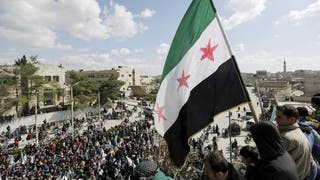
 'In spite of the military battles, every Friday residents in Idlib come together to protest peacefully against the Syrian regime to reignite the spirit of the 2011 revolution.

 But this Friday was quite different. Activists and local residents of the rebel-held city chanted the same hymns they usually do, but instead of Assad, substituted “Goddamn you, Jolani” referring to Mohamad al-Jolani, head of Jabhat Fateh al-Sham formerly known as the al-Nusra Front.

 Al-Dana, Maeret Noaman and other towns filled with hundreds of people who defied the al-Nusra Front.


 Since 2011, every Friday protest across Syria was organized under a united theme, but yesterday’s title was, ‘No room for al-Qaeda in Syria’.

 Activist and aid worker Khaled Salame told Al Arabiya English that this the beginning of a new revolution in Syria.

 “The people are ready to revolt against anything that stands in the face of their freedom.”

 He said these past days brought him back to 2011.

 “The banners of al-Qaeda have fallen, and the Syrian revolution flag has risen once again,” he said.

 “I said this two years ago, the way to liberating Damascus is through defeating the extremists,” Salame added.

 The activist said they have not only fought Assad militias, but also Hezbollah, Iraqi militias, Iran, Russia, ISIS, and al-Qaeda; referring to them all as one.

 “They are all one entity, fighting in different ways.”


 Recent heavy clashes between al-Qaeda’s former Syria branch and Syrian rebels took place last Friday.

 The clashes took place in west of Idlib near Aleppo and the Turkish border, and the south.

 According to the Syrian Observatory for Human Rights, both groups used “heavy weaponry,” and many casualties were reported.

 Militant group Ahrar al-Sham sided with Free Syrian Army groups, and Jabhat Fateh al-Sham refused to reconcile after they had targeted a rebel faction.'

Wednesday, 1 February 2017

Syrian art as a powerful record of this time period

miriam

 ' “Liberty,” designed on canvas by artist Wissam Al-Jazaeri, depicts the form of a man’s head, gashed at the neck, with a bird flying to his left. The painting makes reference to the gruesome slaughtering of singer Ibrahim Qashoush after he sang before a protest of thousands as part of the 2011 Arab Spring.

 In a Tuesday night talk in Thomson Hall — entitled “Creativity, Resilience and the Syrian Revolution” — Miriam Cooke, a professor of Arab Cultures at Duke University, discussed how the Syrian people have responded to their country’s crisis through art.

 “In Syria, a country cowered into silence for 40 years, a revolution broke out in March of 2011,” Cooke said. “In digital and plastic arts, in video and still images in film, in novels and short stories, organic intellectuals inside and outside their country are crafting works that emerge out of the revolution that insist on its persistence as a revolution and point to a new future.”

 Throughout her talk, Cooke displayed and spoke on numerous works by artists, including Ali Ferzat’s “Finger to Bashar.” Of the many satirical cartoons by Ferzat, this one came after he was beaten up, had his fingers smashed, and was hospitalized by attackers. The drawing depicts Ferzat lying miserably, bandaged and immobile in a hospital bed, with his middle finger stuck in the air.

 Cooke described how intrigued she was by the various forms of art, including graffiti, rap, and hip hop, emerging out of Syria in 2011, which led her to write on the cultural production of the Arab Spring. But within three months of the revolution’s beginning, she became hesitant to continue her work. After seeing the art emerging from Syria in a time of turmoil, she drew connections between artists under dictatorship and artwork of the revolution.

 “I started then to look at what was happening in Syria, and realized that in some ways I had to make a connection between my earlier work,” Cooke said, “and the writers and filmmakers who were saying ‘I want the world to know 50 years from now that there were people that stood up to the dictator no matter what the cost.’” '

Tuesday, 31 January 2017

I have no idea when I’ll see my children again


 'No one wants to be a refugee.

 My husband and I loved our home in Daraa, Syria: a spacious house with a courtyard that smelled of jasmine, where we ate in the evenings with our families and friends. We raised our daughters and sons to work hard and get an education; two graduated from college, and two were almost finished when the revolution began. My husband was a successful businessman; I took care of our home.

 As Sunni Muslims in a country controlled by the Alawite minority, we lived with the unfairness that the good jobs went to the Alawites, but we knew how to work within the system. We were happy. We loved our lives. We never locked our doors. Why would we? We knew all of our neighbors. We were always safe.


 Our family’s journey as refugees started in January 2012, when my children, grandchildren, and I fled Daraa for Jordan; my husband, Mohamad, stayed behind in Syria.

 The war in Syria had begun in Daraa in late winter 2011 when the secret police arrested and brutally tortured a group of boys. My family lived a mile away from their school. The boys were our neighbors’ sons.

 The boys, all between the ages of 10 and 14, were arrested by the mukhabarat, the secret police, because they spray-painted protest slogans from the Arab Spring onto the al-Banin school wall. We heard the boys were protesting their principal — they changed the word “president” in the famous slogan from the Arab Spring so it read, “The people demand that the ‘principal’ be deposed.” It was a childish prank, nothing more.

 The mukhabarat did not see it that way; they were determined the Arab Spring in Tunisia and Egypt would not spread to Syria.

 Our neighbors told us what happened: They cut off some of the boys’ penises. They ripped out their fingernails. They electrocuted their little bodies, hooking them up to electricity from their fingers to their toes. They shot the boys and kept them from dying to torture them more.

 When the parents went to demand the release of their young boys, they were told by Bashar Al-Assad’s cousin in charge of security forces in Daraa, Gen. Atef Najib: “Forget these children. Go home and make new sons. And if you cannot, bring your wives here and we will make new sons for you.”


 The people erupted. My husband saw the first of many protests on March 18; several people were detained. Over the next few weeks, we had moments of hope, but the government responded to our reasonable demands by arresting, detaining, and killing their own citizens.

 After the first few demonstrations, the local imams met with government representatives and said, “We need our kids back and all of the people you have rounded up during the protests. We need an apology for those children that were killed and for the torture. And that is all.”

 The government representatives said they would consider those demands. The people began celebrating, though some still protested.

 And then that night, after midnight, the internet was shut down. The next day, with no internet and power out in places throughout the city, the men from Daraa and the region gathered in the Omari mosque. They were waiting things out; there were rumors everywhere. They thought they were safest in the mosque.

 Thankfully, my husband was not there.

 Soldiers attacked the Omari mosque with live ammunition and gas canisters. It was a slaughter. Almost 40 people died. The men in the mosque didn’t have guns; they were not starting a revolution. All the people wanted was an apology and the return of their family members. Had the government handled things differently, the situation could have been diffused.


 Still, the brutality continued. Other children were tortured and killed in the next few weeks. The people responded with more and more outrage to their harsh tactics.

 Soon government forces surrounded the city. The center of Daraa is in a low area. They situated the soldiers, tanks, and artillery on the ridges and mountains. They put the missile launchers in the soccer field. From those places, they could hit anyone in the city. Every time there was a protest, people died — mostly men, but women and children too — even though the people chanted “peaceful, peaceful” while they walked.

 The soldiers moved through the city; they seized everything valuable they could find. They came and took my husband and our son, though we had stayed away from the protests. When my husband arrived at the police building, it looked like all of the men of Daraa had been arrested. Hundreds of men were outside in the courtyard with their hands secured behind their backs.

 There were no trials; if they thought a man was guilty, soldiers shot him right there.


 Eventually soldiers let the older men go. But they kept all the young men, including our son. They took them to the city of Damascus, about 100 miles away.

 We did not know what was happening to our son. After two long weeks, my son arrived home. We were overjoyed; we fed him and told him to sleep in his bed.

 Later that same day, seven soldiers burst into our home. Mohamad yelled at them, “What are you searching for? You already took everything! There is nothing left!”

 One soldier said, “Who is there?” and pointed to a bedroom.

 I said, “That is my son sleeping there.”

 The soldier ordered another, “Go kill him.”

 I stood in front of my son’s door and screamed: “If you kill him, I’ll kill you.” I had no gun, but I would have done it. I would have done anything to protect my son.

 Mohamad said, “Look, what are you doing here? You stole everything. Now you have come to steal more and also to kill my kid?”

 We shamed them that day by calling them killers and thieves; eventually they left. We were lucky because those soldiers were Syrians and we could still ask them to do what was right. Later, because Syrian soldiers were refusing orders to kill their own people, the government brought in soldiers from Hezbollah and Iran. They did not disobey orders.


 We knew that day that we could no longer stay in our home. We decided to rent an apartment across the border in Jordan. We thought it would be a month or two until everything blew over.

 Mohamad moved some of our children, grandchildren, and me; he went back to Daraa to run his business. When he returned, our house had been looted — everything was gone. Mohamad found out from a neighbor that we knew one of the men who had looted our house.

 Mohamad went and confronted this man. They fought; the looter and his relatives threatened to kill my husband. Mohamad said, “I don’t care, kill me, but give me my stuff.” He left that day with many of our things. He thought he had won.

 Instead, he made an enemy who would not forget.

 We planned on two months but instead, for more than two years, we lived in Jordan while Mohamad lived in Daraa. There were checkpoints all over Daraa; it took Mohamad six hours to run errands he used to do in 15 minutes. He had to avoid missiles and assassins. It was very dangerous.

 Still, every day, I made plans for going home.


 This was our turning point: One night, a missile struck our home in Daraa while Mohamad was there sleeping. It was not a random attack. The man who looted our house was a known informant of the secret service. These informants were utilized by the Syrian military to sniff out resistance and place missile trackers at the places they found resistance gathering. Our house was not being used for the resistance to gather, but our enemy saw an opportunity and used the tracker to target Mohamad.

 That missile was intended only for my husband. He made a true enemy the day he took back our belongings.

 Mohamad almost died; it was a miracle he did not. The missile carved out his entire left knee, took a chunk out of his right arm. The emergency responders rushed him across the border into Jordan. We eventually found him. One of the doctors helped us save his arm and leg, but the surgeries were complicated and painful. The healing took several months. He will have severe pain for the rest of his life. He will never work again.

 After that, we all lived in the apartment in Jordan; we registered as refugees. We always assumed we were there for a few short months as a safety precaution, to protect our children and grandchildren so they could continue school and not be at risk of injury or death. But that plan slowly dissipated; the missile decided for us that we had to be refugees.

 We no longer had a house to return to. I was devastated; I just wanted to go home. I still do.


 I am more afraid that Trump will not allow my children and grandchildren to join us, that we will be here and they will be everywhere else and I will never see them again. Some are still in Jordan, but the rest are spread throughout the region: one son at a camp in one country, another daughter with her in-laws in another country. I look at pictures of my grandchildren every day; all I want is my family.

 I want to go home, but the home we loved, with the courtyard lined with jasmine and the long table for all of my children, no longer exists. Syria is gone. There is only war. We have nowhere to go. I worry every day for my children, grandchildren, sisters, brothers, nieces, nephews, neighbors, and friends. Everyone I love is running or lost. It is more than I can bear. I’m trying to find hope in this new life, but it is almost impossible.'

Saturday, 28 January 2017

Syrians take to streets in anti-Assad protests


 'Hundreds of Syrians took to the streets of Douma and Saqeba in Damascus eastern countryside on Friday to show support for the opposition members, who went to Astana for Syria peace talks, and to remind the world of the Syrian revolution’s basic and first demand, the ouster of Assad regime and the allied Shia mercenaries. The protesters carried banners that read "The Syrian people wants to topple Assad regime". They also expressed their objection to Assad regime’s staying in power.'

Friday, 27 January 2017

Editor Aaron I. Butler on Cries from Syria


 'The most important element in the footage we focused on was the kids. The Syrian people had lived under a dictatorship for 40 years, but in 2011 the regime began openly torturing children. This was the final straw for the Syrians, and the revolution began in earnest at that point. As the regime continued to brutally attack the protesters and people who rebelled, we saw again and again in the footage the suffering of Syria’s children. No matter what you feel about the political situation in Syria, no one can deny that the suffering of these kids is inhumane.

 By far the most difficult scene to cut was the chemical weapons bombardment on civilians in Eastern Ghouta. We had footage from inside the hospitals right after the attack occurred, and watching little children convulsing and foaming at the mouth broke my heart. I focused on doing my part to help them, knowing that above all, the Syrians wanted the world to know what was happening to them. They wanted people to see the barbaric actions of their government. And I knew that the emotions I felt watching the footage were nothing compared to those who witnessed the atrocities first hand.

 When I began editing the film, I had very little knowledge of what was happening in Syria. I knew that the government had been bombing rebels in Aleppo, and that many cities had been destroyed in a civil war. But I had no idea how or why the war had begun. By the end of the film, the thing that struck me the most was who the “rebels” turned out to be. They were just ordinary civilians, who had taken to the streets to peacefully protest the brutal torture of their children. Throughout the film I got to see firsthand how these civilian’s lives were changed by the war, the fighting that they were forced into, and the brutality their own government subjected them to, simply because they asked for the most basic human rights. The overall feeling I was left with is that the Syrian people are no different than you or I, and we must do everything we can to help and protect them.

 Soon after the film was finished, we heard the news that Aleppo had fallen to the Syrian regime. It was a difficult blow to the revolution, and a horrible end to the unbelievable slaughter in that city. The war continues on, with more dying every day. My heart continues to break for the freedom fighters and refugees that the world has for the most part ignored.'

Thursday, 26 January 2017

Syrians are absent in Astana peace talks


 Malak Chabkoun:

 'Perhaps one of the biggest examples of the disconnect between Syrians inside Syria and Syrians sitting at the negotiating table in Astana this week is seen in a video produced by Shaam News Network, in which several residents of the besieged al-Waar district in northern Homs, when asked about the negotiations, responded, "What talks?"

 In another interview in the same besieged district by Qasioun News Agency, an elderly Syrian man asked, "What is this Astana? Who sent them and who elected those who went to Astana? Who are they? We are in besieged al-Waar district, and they're in Turkey, eating and drinking in hotels, while we're here 'eating' rockets."

 In Erbin, a suburb of Damascus, residents actually mobilised in protest against the Astana talks, chanting that they were sick of the same nonsense repeating itself, and calling on those at the negotiating tables to not betray the aspirations of the Syrian revolution and the Syrian people.

 In Zamalka, during one of the demonstrations, a man reminded the Astana delegation, "in the name of Aleppo, and in the name of Wadi Barada, do not forget that the Ghouta region is a trust you must uphold at Astana."

 Some in Douma expressed that they had some hope in the Astana talks, so long as those negotiating on behalf of the opposition didn't compromise on the main principles of the revolution and the necessity of lifting all sieges and releasing all detainees.


 Those interviewed in Idlib focused more on the international actors playing a role in Syria, expressing that Russia's promises couldn't be trusted and that they saw attending Astana as a bad choice, but the best one given the limited choices on the table.

 Some went so far as to suggest that the opposition boycott the talks to avoid betraying the revolution and to protest against the regime's continuing violations of the latest ceasefire. 


 Syrians have borne the brunt of the regime and Russia's record of broken promises, making it hard to believe that participating in the talks would bring tangible results on the ground.

 This translated into a very difficult decision for the opposition delegation: if they didn't go to Astana, not only did they risk further marginalisation in an already prejudiced decision-making process, but they also risked offending Turkey, who they see as not only as a broker of the talks, but also a supporter of the Syrian people.

 Furthermore, some of the better-known and more respected representatives risked losing popular support and respect in liberated areas of Syria.

 Osama Abu Zeid, who is the legal adviser to the Free Syrian Army and was an instrumental member of the negotiations committee during the pre-talks in Ankara and the actual talks in Astana, justified the committee's decision in a series of tweets, stressing that the only issues they discussed during the talks were the conditions of the ceasefire, complete cessation of hostilities, saving besieged areas, release of detainees and resuming service of the Ain el-Fijah spring.

 Another member of the negotiations team, Essam al-Reiss, said in an interview with Orient News that Astana was seen by them as "the only way how to stop the Syrian nightmare … we came here to show all the world who is the Free Syrian Army … we didn't achieve a lot, because we heard lots of promises, but it's just words for us."


 With each round of Syria peace talks, it is further clarified that Syrians under siege or being held in the regime's prisons are not the key factor in negotiations. After the last round in Astana, Turkey, Russia and Iran agreed to support a so-called ceasefire in the country, and the Syrian regime was being given 10 days to decide whether it will abide by the conditions put forth by the opposition.

 One thing is for sure. For over five years, talks on Syria have failed because the variables do not change: an opposition that feels cornered into talks because there are no other options, and international actors with agendas and interests far-removed from those of the Syrian people acting as brokers of these talks, with the added dilemma that these states are trying to broker the peace they have been responsible for disturbing.

 But it is the Syrians interviewed about the Astana talks who best summarise the two main reasons negotiations will continue to fail, no matter who is brokering them and no matter what implementation mechanisms are used: a lack of inner unity of purpose among the opposition and the absence of an external, international will to remove the regime and return Syria to its citizens.'

Helping young refugees deal with trauma using theater


 'Raghad Makhlouf played a leading part in a TV series which addressed the uprising in her homeland Syria and was consequently exiled in Beirut. There are more than one million refugees in Lebanon, half of them are children.


 What was life like for you in Syria before the conflict started?

 It was very routine and monotonous because of the dictatorship. The Syrian people were forbidden from expressing their thoughts and feelings. We were forbidden from generating change – politically and socially. You can imagine what could happen to a person who is against the Syrian regime from a slogan they released in 2011. It said: “Assad - or we will burn Syria.”

 Syria is my home, it’s my friends and my family. But I never felt like a ‘citizen’ in Syria because of the regime and the system – I dreamt of equality, justice and dignity. When the Syrian revolution began I was so happy. I participated in peaceful demonstrations across the country, distributing campaign leaflets in the streets. But because of the Syrian regime and the violence that ensued, revolution turned into war.


 What was life like for you as an actor in Syria before the conflict started?

 I played a lead role in a TV series which addressed the first seven months of the peaceful revolution and protests in 2011. After filming it in Lebanon some of the actors who went back were investigated by the regime. They couldn’t get out of Syria for several months. The situation worsened when I worked on another TV series called Amal (Hope). It also addressed the peaceful revolution and the violence waged by the Syrian army.

 Then it became impossible for me to go back to Syria. I had only two options: to be with Assad, or to be in extreme danger – arrested, tortured or killed. So I fled and now my whole family is separated. Each of my two sisters, brother and parents now live in different countries.


 Then your 2012 visit to the Zaatari refugee camp in Jordan changed your life?

 Before the visit I thought I would leave feeling depressed but the opposite happened. The refugees were happy about my visit and show of support. They took me on a tour and were talking about all the suffering but still with a smile and a sense of humour.

 This experience changed my attitude to theatre. I started thinking about how it could be useful and how it could influence society. I thought that as acting professionals we should start working with ordinary people more. I thought about their needs, opinions and problems – then built a theatre workshop around it.


 Had you done anything similar in Syria before?

 I worked in an interactive theatre group touring rural Syria from 2006 onwards. We addressed complicated issues, such as violence against women, education and polygamy. I could see the power of change, especially with young people. After we performed scenes we held discussions, involving the audience in the acting. An ordinary member of the public would enter a scene to change the course of the play.


 What was the outcome of this project?

 The Syrian regime could see the interactive theatre’s influence on communities. They halted our project after we discussed marriages between different sects. We entered a taboo area, we became afraid and the project stoppe


 Tell me more about your theatre workshops for the young refugees in Lebanon?

 It was part of the Create Syria joint project by International Alert, the British Council and Ettijahat Independent Culture to teach drama to young Syrian, Lebanese and Palestinian teenagers living in the Bekaa Valley. I worked with fellow actor Wissam al Ghati teaching them for about two months in an intensive workshop, including acting exercises that were touching on their experiences of conflict and war.

 All their stories are sad and totally unacceptable. They saw dead bodies and their loved ones being killed in front of their eyes. One of my pupils was 10-years-old when the Syrian regime arrested his father at one of the military checkpoints in Damascus. His father said: “Don’t be afraid, I will come back soon.” They both started crying. It’s been four years since, he didn’t come back.

 What positive impact did you see from the drama and acting lessons?

 We broke a lot of barriers. We built a circle of trust, which improved their self-confidence. When the children gain this they are free to express themselves in a healthy way. The drama classes provided a safe space for the young refugees to freely share their stories and deal with the trauma. It helped make them feel there is hope and their lives have value after all.


 What did you personally gain from the Create Syria project?

 After three years in Lebanon, I felt I was forgetting everything about Syria. That was devastating. I didn’t want to forget about my homeland, I loved every detail about my life there. Working with young Syrians brings back my treasured memories.


 What did your young students learn from the experience?

 I taught them the main entry points into the acting world. Theatre is a tool for teaching young people communication and conflict resolution skills, as it makes them really listen to one another. I met many uniquely talented teenagers and the lessons helped them rebuild their aspirations through drama and storytelling.


 How do theatre workshops improve young refugees’ lives?

 Acting can both function to help them process the horrors they experienced or provide a much needed escape from their troubles. Actually, my main goal was to see them laugh, smile and dream again. Drama classes are a tool for traumatised young refugees to discover their abilities and gain a sense of purpose, self-esteem, friendship and belonging. That’s how the magic of theatre gives young refugees the capacity to be positive about their future.'

Why Fateh al-Sham is lashing out at Syrian rebels


 'Al-Qaeda's former affiliate in Syria has thrown itself into a violent, desperate attempt to impose its will on other rebel groups, but its actions can only polarise and damage the hopes of the Syrian revolution, according to analysts. Jabhat Fateh al-Sham, the group formerly known as the Nusra Front, this week unleashed its fury on other groups it said were "conspiring" to undermine it by co-operating with the government of President Bashar al-Assad in peace talks in Astana.

 It comes as JFS has in the past few weeks failed in a bid to create a new rebel coalition, and found itself isolated and facing a multi-front offensive: Russian, US and Syrian attacks on its positions, exclusion from ceasefire deals - and local JFS commanders are reported to believe that local rebels are now providing coordinates for the strikes. Its response has been severe: in one day of fighting on Wednesday on the fringes of Aleppo province, JFS attacked with sufficient force to destroy Jaish al-Mujahideen, a group allied with the Free Syrian Army and armed by the US, which had withstood months of bombardment by Assad during the battle for the provincial capital.


 But analysts say while JFS had proved its unquestioned military prowess, such action has fractured an already weak rebel front with no guarantee of boosting its own position. Aymenn Jawad al-Tamimi, Jihad-Intel Research Fellow at the Middle East Forum, said JFS has grown steadily aware that some rebel groups were actively opposed to its presence in Idlib, the last bastion of rebel power after the fall of Aleppo.

 “I think part of this is rooted in JFS' perception of a conspiracy against it with the broader attempts to isolate the group,” he told Middle East Eye. "There wasn't really rebel unity in Idlib to begin with."

 The retreat of some groups from Aleppo into Idlib had hardened that perception, he said.
“I have no doubt about the broader attempts to isolate JFS as being a US strategy. And to an extent, you can perceive the effect in the wider [rebel] reluctance to offer JFS condolences for casualties in air strikes.”


 The presence of al-Qaeda-affiliated groups in the Syrian opposition has long been the most contentious factor in the country’s six-year civil war. Reactions to the militant group have ranged from outright opposition to sometimes reluctant cooperation with many other rebels recognising Nusra, or JFS, as one of the most potent and experienced fighting forces in the country. JFS began its assault on Tuesday, primarily targeting a base belonging to Jaish al-Mujahideen, a Free Syrian Army group which has previously received CIA support. Clashes then spread to numerous other sites in Syria, including opposition strongholds such as Maraat al-Numan, Kafranbel, Saraqeb and Ariha. Clashes broke out last week between JFS and their erstwhile allies Ahrar al-Sham and other rebel groups and, unlike previous disputes, appear to have escalated. On Thursday, Ahrar al-Sham, one of the larger forces in the region, said six groups were involved in the fighting. On Tuesday, Ahrar al-Sham released a statement criticising JFS for their attacks on other groups "without any justification or legitimate reason” and said it would help their “enemies” in isolating JFS from the other rebel groups.

 “We will join our brothers in the rest of the factions... to prevent JFS (or others) columns to go and attack Muslims and harass them and wrongfully take their blood and money,” read the statement.

 Though the statement appeared largely defensive, Syria analyst Charles Lister said on Twitter that Ahrar al-Sham were threatening a “full declaration of war”.

 Labib al-Nahhas, a media representative for the group, later warned JFS on Twitter that it “either completely joins the revolution or it is a new Islamic State”.


 In turn, JFS released a statement accusing other rebels of involvement in "conspiracies" and being backed by "foreign projects".

 "We attempted to make a coalition, with the open hearts of friendship... even though writers and fatwas said it would be 'suicide' to form a coalition with us," read the statement, released on Tuesday. "After the coalition failed, bombing by the international coalition began, and we were targeted in several locations. Leaders were also targeted. The message from this is clear: we were first sidelined, and then targeted, while other rebel groups were building close relations with the US. We call for the establishment of a single, united Sunni force, both political and military... We stress the importance of working fast and cooperatively to achieve this goal."

 By midday on Wednesday Jaish al-Mujahideen had been effectively destroyed, and their bases and weapons confiscated by JFS. The current round of fighting appears to have been triggered by an ongoing dispute over the presence of another militant group, Jund al-Aqsa, who were absorbed into JFS’s ranks in October. While Jund al-Aqsa had historically been linked to al-Qaeda, many other rebel groups accused them of being a front for IS and questioned the decision by JFS to allow them to join. This eventually escalated to the point where, after alleging numerous violation by Jund al-Aqsa, Ahrar al-Sham launched an operation to “annihilate” the group at the weekend.

 Though JFS announced on Monday that they had expelled Jund al-Aqsa, the damage appears to have been done, and violence continued unabated between JFS and other rebel groups, particularly those with representatives currently participating in the Astana negotiations. Another Ahrar al-Sham spokesperson suggested that JFS attacks on rebels indicated JFS's “external agenda” while prominent JFS leadership figures Abu Hassan al-Kuwaiti and Abu Sayyaf al-Jawfi reportedly quit the organisation over the violence.


 These incidents do not mark the first time that JFS has attacked other rebel groups - previously, it had effectively crushed both the Syrian Revolutionaries Front and the US-trained Hazm Movement in northern Syria, while in March 2016 mass protests erupted against JFS after it attacked and kidnapped members of the FSA’s 13th Division. However, while SRF and Hazm were unpopular organisations with heavy links to the US, Jaish al-Mujahideen are much more popular and therefore its demise, according to Lister, could have a much bigger impact. 

 Following the clashes, rebel groups appear to have started setting out their alliances in different camps. Jaish al-Mujahideen are reportedly in negotiations to join the more powerful Ahrar al-Sham, while the Sham Front, Faylaq al-Sham and Jaish al-Islam also fell on side with the group. Conversely Nour al-Din al-Zenki appears to have thrown its lot in with JFS.


 What then, does this mean for the future of Syria's rebels? Hassan Hassan, an associate fellow at Chatham House, said the infighting was not a rerun of 2014, where rebel factions including what was then Nusra united to turn on Islamic State fighters and kick them out of Idlib and Aleppo. JFS' actions meant rebels were in fact heading for further fragmentation while JFS consolidated its power: "JFS as an overlord."

 Haid Haid, also an associate fellow at Chatham House, added that JFS was undoubtedly powerful and no one, at this stage, was prepared to directly oppose them.

 "JFS has been able to prove once again that they are able to eliminate any threat they might want to and no one will stop them," he told Middle East Eye.

 And any counter plan to eliminate the group, was a long way off.

 “Jaish al-Mujahideen and others don’t want to have this fight because they don’t want to do this alone - they know that others were not ready to fight alongside them against JFS.

 Haid added that JFS had specifically blamed Jaish al-Mujahideen for providing the US coalition with their location for air strikes and "that’s why they’re being targeted". He said that despite the threats against JFS from and other rebel groups, they had largely stood by while JFS eliminated Jaish al-Mujahideen - many groups wanted to see JFS gone, but there was no united front against them.

 “Many groups want to see that, but the problem is how to do that - they are not able to start fighting JFS until they see a political solution to the conflict in Syria," he said. “They will hope that the international community will have a clear strategy to weaken and eliminate JFS, but at this point it’s quite difficult to imagine what kind of strategy that would be."


 For now, rebels opposed to JFS need to bide their time and re-assess their options.

 Tamimi said that there were effectively two paths open to the rebels at this stage: get closer to Turkey, which is prosecuting a campaign in northern Syria and considers JFS a "terrorist group", or get closer to JFS themselves.

 "Each option has its pitfalls," he said. "Neither can achieve the original goal of the revolution at this point, but Turkey is more likely to ensure the survival of more mainstream factions." '

How sports became defiance in besieged al-Waer


 'The Assi River and orchards surrounding the river separate al-Waer district, a northwestern suburb of Homs, from the city. Despite its proximity to strategic sites such as the military academy, the military hospital and Homs’ refinery, the district was considered a paradise and a summer destination.

 But when the Syrian revolution began in 2011, the repression and brutality of the Syrian regime forced many residents from other Homs neighborhoods to flee to al-Waer, at one point bringing together nearly 300,000 displaced people, in addition to the district's 50,000 original residents. Al-Waer became the last opposition-held area of the city.

 The regime began tightening the noose around al-Waer, even using missiles and explosive cylinders. Regime snipers shot civilians, and the regime ultimately besieged al-Waer in mid-2015, preventing people from moving in and out. The regime also blocked supplies of medicine and baby formula. Only small amounts of supplies enter, infrequently, through the United Nations — barely enough for 5% of the district's needs.

 Najwa Um Ziad, an al-Waer schoolteacher, said, “The number of students in the district of al-Waer is declining significantly, as more students are dropping out for long periods due to the military regime campaigns.”

 Those students who do attend class feel the war's psychological repercussions. "Students dread bombing, missiles and aircraft, and this affects their concentration during classes,” she added.


 Maher Abu Muhannad, who moved to al-Waer with his family from the Bab al-Sebaa district in Homs, said, “The blockade has caused major physical and psychological problems for my family. Almost none of their needs can be met because of the blockade, and all I can give them is the aid provided by the UN from time to time.”

 Muhannad said the war sometimes makes him feel like a failure as a parent. “When I see my children dream of a chocolate bar — in such moments, I wish I was not their father. How can I be their father if I cannot even buy them a chocolate bar?” he asked.


 In such times of oppression, people seek out vestiges of normalcy. In al-Waer, some have turned to sports, despite their lack of nourishment. Athletes in the district managed to form a sports committee in July 2015 affiliated with the General Authority for Youth and Sports in Syria, a civic anti-regime sports organization.

 These people, including soccer referee Abdul Aziz Dalati, have organized two al-Waer Sports Festivals under the auspices of the general authority, which was founded in 2014. The second festival ran from late May to early June. A large number of residents and children participated in a variety of sports including basketball, volleyball, martial arts, gymnastics, track and others.

 Dalati said, “My dream was very simple: to become an international Syrian referee and receive an international badge in arbitration from the international [soccer] federation [FIFA]. The blockade is the greatest obstacle to this dream. Syrians within the besieged regions are denied all the necessities of life.”

 He added, “It is true that this blockade prevented us from achieving our sports dream, but it made us help the children and rookie athletes to pursue their training and move forward to be able to complete the journey and make it to the podium."


 The festivals are symbols of defiance.

 “The ​​festivals came about for two reasons," Dalati said. "The first is to breathe new life into the Syrian revolution through revolutionary festivals, and the second is to give athletes the opportunity to test their abilities and join strong competitions and tournaments in various sports that can be practiced under the siege. These festivals are a way to challenge the regime and prove that, despite the worst humanitarian conditions and the bombardment, we can manage to organize festivals and tournaments.”

 The al-Waer district is still considered one of the most important strongholds of the Syrian revolution in Homs. The district is now witnessing a cease-fire in Syria, declared by the international community on Dec. 30. Meanwhile, its residents still dream of better conditions and the entry of aid agreed upon with the UN to maintain their right to life and a decent living. The last aid convoy entered al-Waer in September, and the population of the district currently amounts to 100,000 amid the ongoing blockade.'

Tuesday, 24 January 2017

A distress call from Wadi Barada


 'The communities of Wadi Barada have been under violent attack by Hezbollah and the Assad regime for over a month.

 Lebanese Hezbollah terrorists are trying to force out the local Syrian population.

 Wadi Barada’s civilians are in dire need of food and medicine.

 Wadi Barada could be reached by JPADS airdrops using GPS guided parachutes without aircraft having to enter Syrian airspace.

 The World Food Programme has used JPADS elsewhere in Syria but both the WFP and the UK refuse to help Wadi Barada.

 Theresa May dismissed MPs’ calls for airdrops as impractical but didn’t say the WFP was already using JPADS elsewhere in Syria.

 Read more: World Food Programme used JPADS for Deir Ezzor aid drops


 We have received the following distress call from civil society organisations in Wadi Barada:

 "For the 33rd day running, Assad regime forces, Hezbollah, and other militias have been attacking Wadi Barada despite a proclaimed ceasefire in Syria, which was announced on 30th December 2016. The human and material cost has been terrible.

 200 people have been killed as a result of the military attack, 60% of them women and children.

 400 people have been injured. 150 of these are in need of urgent medical evacuation.

 45,000 people have lost their homes following intense bombardment of residential areas by the regime and its allied militias.

 All hospitals and medical centres are inoperational after they were directly attacked by the regime and its allies. Two medical staff have been killed and six injured as a result of these attacks.

 The Civil Defence system is also out of service, after all its operational centres and equipment were destroyed because of deliberate targeting.

 There is a great deal of destruction throughout the villages of Wadi Barada, particularly Basimah and Ain al-Fijeh.


 80,000 people are suffering as a result of continuous bombardment and siege. Food supplies are now so meagre that people eat only one small meal a day. Sometimes this meal only consists of one apple. Families have been forced to slaughter whatever livestock they possess for food. There is now a severe shortage of children’s milk. The situation is getting worse because the regime and militia checkpoints which completely surround Wadi Barada have not allowed any food in for a month and not allowed medicine in for over four months. If the military assault continues and the regime and its allies continue with this policy, this could well lead to starvation.

 There is now an almost total lack of medicine, especially medicines to treat chronic conditions often suffered by older people, such as diabetes, heart disease, blood pressure, and blood disease. More than 20 people have died as a result of the lack of these medicines. The regime and its allies do not allow people to be evacuated from Wadi Barada for medical treatment.

 Following the regime’s bombardment of the Ain el-Fijeh water plant, the water supply cannot be purified and is now polluted and people have contracted diseases from drinking impure water. Dozens of people now suffer from symptoms such as diarrhoea and vomiting. As a result of the destruction of homes, people have taken shelter in mosques, halls, and other spaces, and this has led to overcrowding and this has exacerbated the situation, further spreading disease. Infants are especially at risk. Two new-borns have died as a result of the inability of medical staff to provide adequate care and jaundice has spread among infants due to trauma and fear.

 Due to the ongoing humanitarian catastrophe, we declare the whole of Wadi Barada a disaster area and we call on all humanitarian organizations, human rights organizations, the UN Security Council, the UN General Assembly, and the international community to urgently intervene to save the civilians trapped in Wadi Barada, who are at the mercy of the rockets and mortars of the Assad regime and its allies and who are now facing the threat of disease and starvation.


 Signed:

 Relief Corps in Wadi Barada • Medical in Wadi Barada • Media Corps in Wadi Barada • Local Council in Wadi Barada • Civil Defence in Wadi Barada • Institution of Barada Al Kheir • Institution of Ghouth Barada" '

How the Syrian Civil War is Creating a Nation of Exiles


 Leila al-Shami:

 'The world watched, throughout November and December 2016, as conditions in the rebel-held area of Aleppo became unbearable. There, amid heavy snowfall, thousands of residents were forcibly displaced from their homes. Most were sent to rebel-held Idlib, where the regime is concentrating its opponents and may soon concentrate its military might. Some of those sent to regime-held west Aleppo were reportedly arrested, including Ahmad Mustafa, a journalist with Halab Today, and Abdulhadi Kamel, a volunteer with the Syria Civil Defense. Others were forcibly conscripted by the regime army.

 Aleppo is only the latest opposition stronghold to follow a now-familiar pattern. Pro-Assadist ground troops, often Iranian-backed Shia militia from Lebanon, Iraq or Afghanistan, enforce a siege on the rebel-held area. No one is allowed to exit; those that try are detained or shot by snipers. Nothing is allowed to enter, including basic food items or medical supplies. Bashar al-Assad's regime grants few requests by humanitarian agencies to access besieged communities. The sieges, which amount to the deliberate starvation of the civilian population, are accompanied by a campaign of intense regime and Russian bombing. Internationally prohibited barrel bombs, chemical and incendiary weapons are dropped on residential areas. Agricultural lands, medical facilities and rescue workers are deliberately and systematically targeted. Weakened and exhausted, the besieged population is then forced to capitulate in a “local truce deal” often accompanied by the eviction of the whole, or part of, the population. And finally, the regime sends green buses to evacuate civilians, who may never see their homes again.


 A recent report by Siege Watch estimates that as of October 2016 there were more than 1.3 million people trapped in at least 39 besieged communities across Syria. Of the 1.3 million, 91 percent are besieged by the Assad regime and its allies. The exceptions include Deir el-Zour, where the siege is primarily enforced by ISIS—although the regime is imposing additional restrictions internally, such as regulating humanitarian aid distribution and restricting freedom of movement for civilians. In Idlib, Islamist rebel groups have besieged the predominantly Shia towns of Foua and Kfraya, using civilians as a negotiations tool—these civilians were also evacuated from their homes in the December Aleppo deal. All those trapped in these open-air prisons are vulnerable to displacement. The regime’s “starve or surrender” policy can mutate at any time to “surrender or risk annihilation.” In October, Syrian and Russian planes dropped leaflets over eastern Aleppo reading: “If you do not leave this area immediately you will be finished. You know that everyone has given up on you. They left you alone to face your doom.”

 Throughout its strategy of sieges and displacement, the regime is re-conquering territory through evacuating a civilian population it can never hope to rule through consent. On December 30 and January 6, following a reduction in hostilities, Syrians were once more on the streets in Aleppo, Idlib, Homs and Damascus, demonstrating their continuing opposition to Assad’s rule. And the regime cannot hold re-conquered territory alone. As the city’s residents left eastern Aleppo, Russian occupation forces moved through deserted streets. Fears now abound for those displaced, who have been forced into ever-decreasing opposition-held territory, or into camps of exile in the winter cold.


 Around the capital, revolutionary strongholds have faced a similar fate to Aleppo's. Daraya, for example, a suburb of Damascus, fell to the regime in August 2016. This town, a model of non-violent civil resistance and democratic self-organization, was a living example of what a post-Assad Syria could look like. Following a 1,368-day siege, and bombardment with napalm and barrel bombs—roughly 9,000 of the latter, according to local activists—Daraya’s residents were forced to surrender. As part of the truce deal negotiated between rebel groups and the regime army, the entire remaining population was forcibly displaced. Assad’s soldiers chanted pro-regime slogans as Daraya’s residents boarded the buses under United Nations supervision. Fighters were sent to rebel-held Idlib and civilians to regime-held areas of Damascus province.

 Soon after, in October, rebels and the regime negotiated a truce deal in Moadamiyeh to end the four-year siege and aerial bombardment there. Moadamiyeh was one of the towns in the Ghouta region hit in the August 2013 sarin attack, where hundreds were gassed to death. Fighters and their families, but not civilians, were transferred to Idlib, and regime security re-entered the town after its long absence. As the UN had received heavy criticism for assisting the forcible transfer of Daraya’s population, they refrained from assisting in subsequent evacuations. There is no independent monitoring of areas that have come back under regime control, and residents of Moadamiyeh have reported recent arrests and disappearances since the return of Assad’s tyranny.

 In western Damascus, the town of Khan al-Shih (which contains the “Al Awda” camp for Palestinian refugees) has also seen recent evictions. Despite the efforts of Al Awda residents to remain neutral during the revolution and war, they were subjected to arrest campaigns and regular shelling. Over the summer, regime and Russian airstrikes intensified in renewed clashes with rebel groups in the Khan al-Shih area, and the camp’s schools and hospitals were targeted. All main access roads to the camp were sealed, trapping 12,000 residents (out of what was once 30,000) inside. Facing dwindling food supplies as well as power and water shortages, they reached a deal to ease conditions in the camp in return for the evacuation of fighters and their families—as well as many activists, journalists and other civilians, according to on-the-ground reports gathered by the Action Group for Palestinians of Syria. In November and December, residents boarded the green buses to Idlib. For those who had fled Palestine in 1948, this was a second Nakba.

 In Al-Waer neighborhood, the last remaining revolutionary stronghold of the city of Homs, opposition fighters and the regime reached an agreement in August to evacuate rebels and their families to Idlib in return for an end to the siege and aerial bombardment and the release of—or update on the fate of—some 7,300 local detainees. Since then, over 600 rebel fighters and their families have left, yet only 194 detainees have been released, stalling further evacuations. Those who have left will join the 6.6 million Syrians who are no longer living in their own homes but have been internally displaced by the conflict, not counting the five million who have fled the country as refugees since 2011.


 Those who leave may never return. Old Homs, once called the “capital of the revolution,” returned to regime control in 2014. Over two years later, official statistics say only 40 percent of the estimated 300,000 that fled the city have returned. Many will not return to regime-controlled areas for fear of reprisals, arrests or forced military conscription. Others no longer hold property documents or are afraid of going to state departments to validate them. Even to rent a property today can require security clearance from thirteen different departments. In some cases those who have returned find new families living in their homes. Others may find their home in ruins. According to Human Rights Watch, thousands of houses in opposition strongholds in Damascus and Hama have been demolished by the regime, using explosives and bulldozers, effectively erasing entire neighborhoods from the map.

 Through these evacuations Assad is able to regain control over lost territory. The regime’s first priority is to empty rebel strongholds of the fighters who defend them, enabling it to concentrate its military resources elsewhere. Assad also knows he cannot win the loyalty of dissenting communities that have suffered so much at the hands of his regime, so civilians, too, are often evicted. Many are sent to rebel-held Idlib, where the huge influx is placing increasing pressure on opposition bodies to provide for the population despite limited resources. The dominance of extremist groups such as Jabhat Fatah al-Sham (previously known as Jabhat al-Nusra)—al-Qaeda’s former affiliate—in Idlib provides a ready excuse for regime assault in the name of its “War on Terror.”

 There’s an ethnic dimension to Assad’s cleansing of opposition strongholds as well. Opposition communities are mainly comprised of Sunni Arabs, which make up the majority of Syria’s population, whilst most minority communities, particularly from the Alawite sect to which the president belongs, have stayed loyal to the regime. When Old Homs was “evacuated” in 2014, reports emerged of Alawite and Shia loyalists from nearby villages being moved into vacant Sunni homes. Foreign settlers have also moved into areas cleansed of locals. Around 300 Iraqi Shia families have reportedly relocated to Daraya and Moadamiyeh, reportedly provided with a house and financial incentives. Iran has been buying real estate around the capital and in Homs, including the homes of those who have been displaced, pricing locals out of the market. Even in the old city of Damascus, which never slipped regime control, Christian residents have complained about the presence of large numbers of Iranian, Iraqi and Lebanese Shia militia changing local demographics.

 Through such demographic engineering the Syrian regime is attempting to ensure a loyal constituency in the areas it deems useful. Some observers have welcomed local truces as a prelude to peace. Yet the accompanying acts of forced population transfer and the implantation of settlers should be considered war crimes. The international community must place real diplomatic and economic pressure on the regime and its allies to end the bombing and lift the sieges, allowing freedom of movement for civilians and access for urgently needed humanitarian aid. This will not be possible without sustained pressure from a global public standing in solidarity with the oppressed Syrian people and calling on responsible parties to end their suffering. Any just peace must also include the right of return, so Syria’s millions of displaced people can safely return to their homes.'