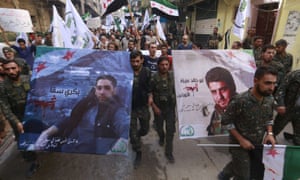
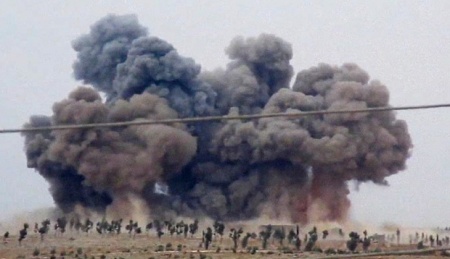
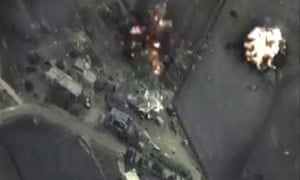
'Until now Iran had tried to avoid a public show of its role in the war, fearing that it would be portrayed as a Shia invasion force, amplifying already febrile sectarian tensions. Mohammed al-Sheikh, a senior member of an FSA-aligned unit called Division 1, said: “We know that, if the Iranians bomb us, it would be the start of the third world war. Everyone from the Arab world would come and join us, because it would be a Persian attack on Syria. This is why the regime has played it smartly, by bringing in the Russians.
For the regime, Aleppo is the economic hub. If we lose Aleppo, it doesn’t mean we lose the war, it means we lost a phase. Our friends understand the gravity of the situation, but their hands are tied by politics and international agreements. We are the Syrians who are losing on a daily basis because of these politics. If we look at who has what in Syria, you will see that Isis is only controlling the desert, and it is worthless. Yes, they have oil and water, but now we are controlling the core of Syria and that’s why the regime is crying for help.”
“We are confused about the Americans,” said Malafji. “We can only see the Americans active near the Kurdish areas, but not anywhere else.” From a base in Aleppo’s southeast, not far from the city’s airport that is still used by the regime, Abdur Rahman, a long-term member of an Islamist unit, said: “We used to dream about the sound of F-16s. But for us it’s just the Syrian planes, and the deeper roar of the Russian jets. That’s our fate.” '
'The first Russian airstrikes in Syria targeted Talbiseh, a rebel-held village in the northern suburbs of Homs, killing 30 civilians and 3 children. That Sunni community has been a hotbed of anti-Assad activity since early 2011, and for the past few months, its residents have been resisting advances by nearby ISIS. Just before Russia bombed Talbiseh, ISIS assassinated 3 of the town’s Sunni clerics because they had rallied local rebel fighters and residents to fight ISIS. Russia’s attacks on these anti-ISIS communities effectively makes Russia the air force of ISIS.
By eliminating the moderates and empowering ISIS, Putin is forcing Obama to accept Assad’s role in the fight against ISIS and in a future Syria. Sadly, it seems Obama has succumbed to Putin’s strategy even if it means that ISIS will win, at least in the short term. On Monday, the administration’s spokesman for Operation Inherent Resolve, Army Colonel Steve Warren, said: "We have seen ISIL make progress based on Russian airstrikes." The next day, White House spokesman Josh Earnest reminded reporters that countering Russia's involvement in Syria is not a high priority. Combined, these statements are a tragic admission of Obama’s resignation to accepting ISIS because of his unwillingness to confront Putin and Assad.
The White House should be worried now, not only that the policy goal of a Geneva-type Syrian peace process has become impossible, but that Putin’s actions may have destroyed all hopes of defeating ISIS too. Though many Syrians want to fight ISIS, their first priority is to stop the number one killer of civilians: the regime’s barrel bombs, which now have Russian backing. The no-fly zone that Syrian rebels need in order to focus on fighting ISIS is needed now more than ever, but it has also become more difficult and less likely due to the newest player in Syria’s skies. And while Russia targets the anti-ISIS rebels in Idlib, Latakia, and Aleppo, it is openly challenging radical Islamists from around the world to a fight that the Syrian people will pay the price for.
Obama long ago abdicated the U.S.’s moral imperative to protect Syrian civilians, and to promote peace. Now he is also capitulating to Putin on a core strategic imperative by failing to recognize and confront Russia’s empowerment of ISIS. This may be the final nail in the coffin of the US’s fight against ISIS, which has already been a complete failure due to micromanagement of the anti-ISIS airstrikes and a laughably misguided train-and-equip program. Any hope of ending this horrible conflict--or even just defeating ISIS--has now been lost, and all that a generation of Syrians will remember is that U.S. and Russian warplanes joined the Assad regime in bombing their country to oblivion.'
'Unfortunately, the SRD hospital is not the only hospital Russian jets have targeted. At the beginning of their campaign, Russian jets targeted three hospitals near the Turkish border including two hospitals that provided services to civilians and children.
In this latest Russian assault on Aleppo, the collusion game between the Assad regime, and #ISIS has apparently widened to now include Russia. Without the assistance of both Russia and Assad, it is highly unlikely that Daesh (ISIS) would be able to seize five villages on the northern edge of Aleppo from Syrian rebels. The Syrian rebels have recently been empowered with new weapons from the Turkish – Saudi Arabia – Qatar coalition, backed by the US.
In the starkest testimony of how ISIS is favored by the Assad regime, Shahba Press Agency, a Free Syrian News Agency, reported about a dissident Abu Uys Libyan who defected from Daesh with other dissidents. Nazeer Al-Khatib, Editor at Shahba Press Agency, said, “The interview of the Libyan defector exposed Daesh and its operations was a slap in the organization's (Daesh’s) face. He witnessed and exposed the game that ISIS is playing throughout the region.”
Abu Uys Libyan said, “We were with ISIS for several months and were fortified only a hundred meters from the regime’s army. They (Daesh) did not make any move against Assad’s army and the regime did not make any move against them. Not a shot was fired on us.”
Nazeer al-Khatib said, "Surrendering the free areas and surrounding areas to the regime is another spoof that the regime and ISIS are executing through their mutual agreement." Abu Libyan spoke of Daesh and the regime “seizing then dividing areas that are held by the Sunnis.” Nazeer said that the Libyan dissidents went to al-Nusra.'
'Iran, Russia and Israel have the same fundamental view on Syria.
Of course, Iran and Israel haven’t much looked like they do over 2013-2015. That’s because Israel and Iran have a clash over the broader region, which then gets partly played out in Syria when Iranian proxy forces (eg Hezbollah) get close to the stolen Golan, or when Iranian missiles are getting moved across Syria to Hezbollah in Lebanon. But that’s not really about Syria, or Assad, as such; that’s about Assad’s survival becoming increasingly dependent on the Iranian occupation.
So what do I mean the three countries, including two declared enemies, “agree” on Syria? Basically, Plan A is that the the Assad regime must be preserved, and if possible restored to control over larger areas of Syria, as the power to look after their interests in Syria. These interests include, for Russia, its Mediterranean naval bases in Tartous on the north coast; for Iran, its connection to Hezbollah in Lebanon via the Qalamoun region between the Lebanese border and Damascus; for Israel, restoration of Assad to his role as best border cop protecting Israel’s control over the Golan.
More generally, all three are threatened by a revolutionary uprising dominated by the largely Sunni Arab masses of Syria, but then again, so are the Gulf states, Turkey, US imperialism etc, without such specific interests; and all three, like their mutual friend al-Sisi of Egypt, are particularly good at using “anti-jihadist” language to justify this stance.
However, if this is impossible, then Plan B calls for the creation of an Alawite-dominated statelet (even if unofficial), consisting of the heavily Alawite coastal provinces (Latakia and Tartous) through the Lebanese border region (Homs and the Qalamoun) down to Damascus. Such a sectarian partition would aim to keep the “great unwashed” Sunni masses of “jihadists” (ie, the worker-peasant Sunni Arab majority, the backbone of the revolution) at bay behind defensible lines.
Such a statelet would serve the key Iranian interest, which is centred on the Qalamoun, and the key Russian interest, which is centred on the coast. But if it didn’t reach beyond Damascus down to the Golan “border,” it would not be able to serve the key Israeli interest.'
Muhammad Idrees Ahmad: 'Vladimir Putin can face little resistance if he bombs an ambulance in Idlib when a US gunship incinerates a hospital in Kunduz. Bashar Al Assad can get away with murder because he has conveniently pronounced his opponents “terrorists”.
The conflict in Syria is often described as a “proxy war” between the US and Russia. Syrian rebels are rarely mentioned without the obligatory prefix “US-backed”. (The regime army on the other hand isn’t often described as “Russian-backed”.) The backing, though tangible, takes distinctly different forms; and the support that the contending parties have received reflects the character of their patrons.
Not used to doing things by half, Russia has supplied the Syrian regime with bombers, gunships, armour and missiles. The US, on the other hand, has spent many years trying to ensure that no anti-aircraft weapon would reach Syrian rebels lest it affect its ally Israel’s ability to bomb Syria with impunity. Instead, its support has taken the form of non-lethal aid, such as night-vision goggles and satellite phones. It took many years before it supplied outdated TOW anti-tank missiles but has refrained from passing on any game-changing technology.
On several occasions, US officials’ commitment to the war on terror ideology has obliged them to welcome Russia as a potential partner against ISIL. Little thought is given to the toll this might extract, given Russia’s looser definition of a terrorist, and what an emboldened Mr Putin might do next.
“In all times and places,” said Thomas Hobbes, “nature abhors a vacuum.” The vacuum Mr Obama left in Syria has been filled by Mr Putin. This is now Mr Obama’s legacy: the abyss gazing back. At least we can now recognise that the war on terror is also a war of terror.'
'As always the Free Syrian Army [FSA] proves to be an active military force combating against Assad regime forces and its allies throughout Syria, and also actively contributing in liberating territories from Assad regime and from the Iranian and Russian occupation in Syria. Western media don’t give the FSA enough coverage despite they are fighting throughout Syria and they are operating on many fronts against Assad regime troops and Islamic State fighters. The Free Syrian Army do have a weak presence in north-western [Idlib] of the country but they have a strong presence in Aleppo, Central and in the South, also they have contributed a lot in liberating territories from the Assad regime forces.
On 7th October, the Assad regime backed Russian military personal and airstrikes launched an offensive on northern suburbs of Hama, in order to re-capture the opposition held territories in northern suburbs of Hama from two sides. Syrian Army [SAA] are willing to capture the Highway [Hama – Talbiseh] and also capturing all opposition territories from Rastan to Talbiseh. The FSA units have managed to stall their offensive and destroyed more than 20 Tanks and armoured vehicles using TOW missiles despite the heavy shelling and airstrikes from the Russian airforce, the FSA have managed to hold their line of defence.
The Free Syrian Army proved to the world that they do exist and they are fighting for freedom of the Syrians, Syrian people who are sacrificing for the revolution do support the Free Syrian Army because they are fighting clearly for the revolution and to bring an end to the Assad regime."
No kidding on the Western media. Just this morning there's an interchange between Gavin Esler and Jim Muir on the BBC news channel.
Gavin Esler: "There really isn't any moderate opposition in Syria, is there?" Jim Muir: "No. There is al-Qaida, and other Islamists."
Jim Muir went on to say that the supply of weaponry by regional powers to these Islamists was part of a CIA plan B when the training programme only produced a handful of fighters (he said it was that they were fighting ISIS, rather than having to promise not to fight Assad that made them targets). He had heard this from 'a diplomat in the region', which seemed to be Patrick Cockburn's code for someone in the Iraqi government who supports Assad.'
' “Akram Raslan is a martyr, and a witness to the fact that the regime and Islamic State are two sides of one axe,” cartoonist Ali Ferzat wrote on his Facebook page following the news. “They both represent the death of art and of thought.”
Raslan was arrested by Assad’s mukhabarat agents on October 2, 2012, while working at the Al-Fida newspaper in Hama. Then 34 years old, he had been criticizing the Syrian regime since the 2011 siege of Daraa through cartoons — he published more than 300 of them. One shows the suited president grinning devilishly by a pile of bloody bodies; another depicts him as an anaconda strangling Syria to death. The cartoon that purportedly got him jailed has Assad surrounded by flames and holding a sign that reads, “Assad, or the country burns.” '
'ISIS militants seized five villages on the northern edge of Aleppo, putting them within 1 mile of territory held by the Syrian regime, Reuters reports. Russian airstrikes in the area reportedly killed hundreds of anti-regime rebels, many of whom ISIS (also known as the Islamic State, ISIL, and Daesh) was also fighting. "Daesh has exploited the Russian air strikes and the preoccupation of the (rebel) Free Syrian Army in its battles in Hama, and advanced in Aleppo," one rebel commander told Reuters.
"The Russians are following the same script as the Syrian regime, which is basically to avoid ISIS as much as they can because ISIS is useful," Hassan said. "ISIS can attack the rebels. It’s not in the heartlands, it's in areas that are farther away. ... If ISIS attacks the rebels in Aleppo, that’s good news for the Russians and the regime." Consequently, Russia would hit ISIS harder only if the group creeps into regime strongholds. "The regime and Russians will focus on the heartlands — Hama, Damascus, but not Palmyra," which is an ISIS stronghold, Hassan said.'
Compare that to Patrick Cockburn's latest litany of misdirection*:
'There have been a lot of air strikes around Palmyra, and I think that the Syrian Observatory for Human Rights, which [is pro-opposition], I think yesterday they said there have been 34 strikes there. And to the west of there. There seem to be a lot of strikes there. It's fairly clear that the Russians are attacking ISIS and they're also attacking Jabhat al-Nusra and Ahrar al-Sham, which are--Jabhat al-Nusra is the Al-Qaeda representative. Ahrar al-Sham is not much different. These are all from some, in the Western media, described as [moderates]. I don't know why, because they really are not. They're very much the same ideology as the Islamic State. A lot of their commanders are former Islamic [State], ISIS people.'
' “It’s a very close community, and it was not before the revolution,” said Salem, who grew up in Damascus and came to the United States in 1996. “After 2011, when it started, a lot of Syrians started looking for others.”
Like many others, Salem spends his days worrying about relatives who are unable to leave his homeland. Salem’s parents now live with him and his family in Sharon; his wife’s parents became homeless two years ago after a rocket destroyed their home in Homs, Syria’s third-largest city. He also has two sisters who still live in Damascus and suffer through bombardments and a lack of water and electricity.
“We’ve lost multiple family members, cousins mostly,” Salem said. “Some were detained and tortured to death in regime prisons and others [died] due to Syrian Air Force aerial bombing.” '
' “Israel and Bashar [Assad] – same-same,” said Khalid el-Hassan, a 17-year-old from the Syrian coastal city of Tartus who recently made his way to Berlin.
“I think what’s happening now is Obama’s responsibility; if Obama wanted he could stop the war,” said Suleiman, who has five surviving children. “For 10 years I worked to build a house, and now it’s all crushed by Assad’s bombs,” she said. “I tried living under ISIS control, but anybody who said anything that disagreed with ISIS was beheaded.”
Idris Abdulah, 30, an unemployed Syrian Kurd who came to Germany a year ago, said it wasn’t fair to blame America for ISIS; he fingered Assad for creating the ISIS problem by releasing Islamic militants from Syrian prisons shortly after the outbreak of the civil war. “We all hate the American government because it’s not doing anything for the Syrian people even though it can. We don’t hate American people.” '
'Al-Masri said that the Assad regime is backed by the Russian regime and its warplanes, and that he believed the regime is now able to control north Hama, a precedent that demonstrates the regime's treachery and non-compliance with the truce as a peaceful solution. He added that Assad's regime only understands the language of aggression.
He added that Russia is the Syrian people’s enemy and the regime’s partner in killing their children, and appealed to the free world to support Syria’s women and children. He also called on all factions to stand up to the regime's brutality.
Syrian citizen, Abu Ahmed, said that he fled the regime's shelling of his city of Al-Lataminah two years ago and headed to Kafr Nabudah, but he can now sense the spirit of displacement looming once again.
Abu Ahmad said that Syrians only found olive groves for shelter after the town was shelled. He noted that the world has abandoned Syrians leaving them in the hands of Russians and Iranians.'
'Adopt a Revolution spokesman Elias Perabo said that the results show clearly that Syrians want to return – although the essential precondition was the removal of dictator Bashar al-Assad.
More than two-thirds of the refugees – 70 percent – said the Assad regime was responsible for the conflict in their country, while 32 percent blamed Isis.
"The German government and the EU must recognize that the greatest cause of flight in Syria is Assad and his barrel bombs [improvised explosives dropped from aircraft] and adapt their policies accordingly," Green party leader Cem Özdemir said in response to the findings.
"We have to bring an end to the brutal terror of Isis in the region, but as long as Assad rules in Syria, the country will not find lasting peace." '
' "The Syrian media always conveyed the same, that there was no conflict, no demonstrations, no shelling, no bombardment, nothing. The message from the regime is 'the sun is shining, the birds are singing, nothing, nothing at all is happening in Syria.
If we stop, no history will be recorded, and only the loud voices will be heard - the voices of the most powerful, whether it's the regime or the extremists," she said. "If we stop, no one is going to hear the voice of the vulnerable."
Elena Kudimova, sister of Politkovskaya and a member of the RAW in WAR nominations committee, said: "This brave woman ... is doing the same dangerous work as Anna did. The newspaper she runs is a rare source of truthful facts for the people in Syria, who are left either in an information vacuum or are subjected to heavy state propaganda." '
'Every so often, I’m asked to make the argument why Mr Al Assad and his deadly regime no longer have a place in Syria’s future. The very question seems like an insult. Then I remember to not answer would be a greater insult to our dead who were killed chanting for the tyrant to leave.
So why should Mr Al Assad go? He should go because the Syrian people deserve to live free from the regime’s security apparatus that has terrorised thousands of innocents over four decades.
He should go because no people in the world should live under the constant threat of barrel bombs on their homes. He should go because why must millions flee in exchange for the few to stay?
He should go because even when we convince ourselves that we live in a world of “no more good options”, it’s never acceptable to justify genocide. He should go because there will never be peace in Syria with him or his regime in power.
My greatest fear, one that has materialised over and over since 2011, is that these very lines may also read like a cruel joke 36 months from now. It is when numbers like 250,000 dead and 11 million displaced make us wince and ask: Were there really so few dead, only that many refugees, back in 2015? Why didn’t we stop the violence when we had a chance?'
'Amnesty International UK’s Syria Campaign Manager Kristyan Benedict told The Independent: “It’s absolutely no secret that the vast majority of civilian deaths in Syria have been at the hands of President Bashar al-Assad’s forces.
Syrian government forces have launched indiscriminate attack after indiscriminate attack on the country’s beleaguered civilian population.
Barrel bombings have become the most notorious of Assad’s forces’ tactics, but we mustn’t forget that countless people have also died at the hands of army snipers, through starvation in besieged areas, and at the hands of torturers in government detention centres.
It’s important that ISIS’s many crimes are properly documented and the perpetrators brought to justice, but the far bigger killing machine in Syria is the one made in Damascus." '
'YouTube shows the burning wreckage of the Russian airstrike, in Mansoura, in the western suburbs of Aleppo, as the local commander known as Abu Mohammed taunts his enemy: “Thank God, we are all fine,” says Abu Mohammed. “We don’t fear Russia or anyone helping the Russians. Bashar, we will remain resistant fighting you even without any ammunition or bullets. We will fight you with knives. We don’t need ammunition, Allahu Akhbar.”
The cameraman then adds that the Russians weren’t the only ones hitting the brigade yesterday. “The Russian airplanes are targeting Suqour al-Jabal’s weapon depots in Aleppo and ISIS attacked the bases with explosives at the same time.”
Today, Russian warplanes heavily bombarded several targets along a salient in Hama province, reportedly using thermobaric munitions and the same multiple launch rocket systemsearlier employed to devastating effect in east Ukraine. At the same time, Assad’s army advanced to dislodge the rebels from towns such as Kafr Zita, Morek and Kafr Nabudah. But the army failed, principally because many of its Free Syrian Army opponents were equipped with TOW guided anti-tank missiles, all supplied by the CIA. As many as 18 regime tanks (all manufactured in Russia or the former Soviet Union) were destroyed by these weapons in a 24-hour period. And the rebels held their ground in Hama.'
It's actually looking like as many as 24 tanks were destroyed or captured by the rebels in Hama yesterday. The Russian strategy is in tatters.
' “Any Syrian is going to be happy that there is a Syrian team that is competing on the world stage,” said Kenan Rahmani, a 27-year-old student at American University's Washington College of Law. “But it is a team that is run by the same government that is killing its own citizens. The Syrian people have suffered every tragedy you could ever imagine. It is hard to think about soccer when there are terrible forces destroying our country.” '
'It seems regime/ Iranian ground offensives will follow, particularly in northern Homs and the areas of Hama and Lattakia near the regime’s coastal stronghold. The aim is to shore up Assad’s collapsing regime in the fifth of Syria he retains. The larger hope is to destroy the opposition, leaving only Assad and ISIS standing. Then the West may more openly back Assad to take the rest of the country back.
The imperialist assault will undoubtedly extend the war in time and expand it in space. The coming months may see grievous setbacks for opposition forces. In the end, however, Russian bombs will not be able to alter the demographic reality any more than Assad’s bombs or the Iranian militias could before. Assad is running out of fighting men; foreign troops, however many arrive, can extend but not win his war. And not only the opposition militias but the majority of the Syrian people too will refuse to cooperate with any plan envisaging regime survival. For them Assad, not ISIS, is the supreme evil, and with good reason: Assad’s forces are responsible for the overwhelming majority of civilians killed and driven out.
Beyond that, Russia’s economy shrank by 5% last year. Russia isn’t strong so much as it is constantly appeased. But Syria’s fighters are in no mood for appeasement. When the Russians first walked into Afghanistan, when the Americans first walked into Vietnam, they thought their operations would be easy and brief…'
'Syrian revolutionary factions announce the victory of the revolution and the fall of the Assad regime.
Revolutionary factions fighting in Syria announced that the Syrian Revolution has triumphed and the Assad regime has fallen effectively. They call all syrians inside and abroad to mobilize to defend their land and honor, in the coming war of liberation against the Russian and Iranian occupation that Assad regime called for help.
This came in a joint statement signed by all the factions fighting on the ground and who consider Russia aggression, an occupation which began with the massacre in the northern Homs where 50 civilians have been killeds.
The statement call for all factions to unite to liberate the land and defend their identity.
'Just weeks ago, after months of diplomacy, officials were close to an agreement on enforcing aerial safe-zones to end the Assad regime’s bombing of civilians in northern and southern Syria, according to diplomats and military officials in the US-led coalition. The agreement was based on Jordanian and Turkish plans presented earlier this year.
“The Russian forces now in place make it very, very obvious that any kind of no-fly zone on the Libyan model imposed by the US and allies is now impossible, unless the coalition is actually willing to shoot down Russian aircraft,” says Justin Bronk, research analyst at the Royal United Services Institute.
Preventing the creation of US-led coalition no-fly zones in Syria is important for Moscow’s influence over events in the country. With the Assad regime’s territorial grip looking fragile in recent months, the added imposition of a US-led coalition no-fly zone could have forced negotiations that would have led to a loss of Russia’s influence. Now any diplomatic or political process that does occur will do so on Moscow’s terms.'
' "Russia's interference in Syria is a sign Assad's army is collapsing. In 2013, Hezbollah's leader Hassan Nasrallah said, 'We joined the war because the Free Syrian Army was getting close to Damascus.' Then in 2014, Shia militias entered because Hezbollah couldn't protect the régime, and now all these groups couldn't protect the régime, so we have Russia.
Russia considers anyone fighting the régime as their enemy. They didn't come here to fight ISIL, they are bombing civilians and the Free Syrian Army, and even other groups who are receiving foreign support.
America has no clear plan. They have let down the Syrian people. it's a very weak administration. They have left it all in Russia's hands. They didn't support their partners on the ground, and even the group they trained, they left them to face their fate against the régime and Russia's bombs. There's been no reaction."
He says what keeps his men fighting is that they have a just cause, fighting for freedom, dignity, and the need to rebuild a free Syria for the next generation.'
'The situation on the ground in Syria is ripe for a concerted air campaign that can assist the two major rebel coalitions ready to take Damascus and turn the course of the war. These two forces -- "Army of Conquest" in the north and "Southern Front" in the south -- are strategically positioned, battle hardened, and more than equipped to carry out what will be required by land. All they require is sustained air support that can neutralize the remnants of Assad's army brigades, national defense forces, and Hezbollah/Iranian battalions, as well as prevent Syrian planes (and now maybe Russian ones as well) from dispatching their dreaded and devastating barrel bombs. With such assistance these coalitions will be able to move into Damascus and take the capital city on their own.
Russia's growing military alliance with Iran and al-Assad in the name of defeating ISIS is a disconcerting development that complicates the situation in the Middle East. However, it is clear that the major Arab powers in the region, led by Saudi Arabia, cannot sit back and let the Russians and their proxies dictate the course of events. Over 300,000 Syrians have died and 4 million are now refugees. ISIS must be destroyed, but that can only occur once al-Assad is removed from power. Thus, we are likely to see in the near future a concerted Saudi coalition moving into Syria by air and providing the anti-Assad coalition forces the cover they need to break the stalemate of this war and, hopefully, bring it to an end.'
' "The al-Assad regime said the Russian and Iranian forces are “fighting terrorism”, while in fact they are only assisting the regime in its crimes against Syrians.
Your masks had fallen and your true faces are revealed. Especially for those countries who pretended to be our friends and support the Syrian revolution. Therefore we consider Russian and Iranian forces and government as our enemies and preserve our right to fight them as occupying forces.
We reject and refuse the dividing of Syrian land, and promise the Syrian people that we will do our best to restore our land in full. This is a goal that we will sacrifice our life for.
The scene is now clear for all Syrians— our appeals to the Arab and Muslim world were in vain after their silence on the regime's crimes. But this has only increased our determination and energy. May God bring us back victorious."
"Amid an international shift in favor of—or at least ambivalence toward— Syrian President Bashar al-Assad remaining in power, opposition groups and rebel factions have unified against the tide. Also on Saturday, the Syrian opposition's external political wing Syrian National Coalition (SNC) joined powerful Islamist factions and Western-backed rebel groups in Syria to sign a statement against a UN peacemaking framework drafted in July." '
' "My name is Caesar. I used to work for the Syrian regime. I was a photographer in the military police in Damascus. Before the revolution, I was responsible for taking photographs of crimes and accidents involving the military. This included suicides, drowning, and road and fire accidents.
I had not seen anything like this before. Before the revolution the regime would torture detainees to extract information, but they were now doing so to kill.
I saw wax marks and I once saw a round mark from a small stove used to make tea that had burned the face and hair of one of the bodies. Some of them had deep wounds, gouged eyes, broken teeth and marks from being hit by electric cables used to start car batteries."
Caesar wanted to stop working and defect, but Sami talked him into staying, because he was the only one who could gather insider evidence against the regime. He promised to stand by him - no matter what happened.
For two years, and despite the risk, Caesar copied millions of pictures of prisoners, which can be seen today online and at the Holocaust Museum in Washington DC.'
'It seems clear that the immediate goal of the Russian attacks is to degrade and demoralise moderate opposition forces as they, and not Isis, constitute the real challenge to Assad’s legitimacy. Colonel Abdul-Jabbar Akidi, former commander of Aleppo operations, told me that the Russians want to kill us all so they can convince the west that it is either Assad or Isis in Syria.
One Christian fighter for the Free Syrian Army, who leads a small FSA group, tells me that while Muslim fighters in his group do observe their religious duties faithfully, all of them are fighting for a free and democratic Syria in which Syrians enjoy equal rights, regardless of their religious or ethnic origins.
Another FSA officer, Colonel Abdulsalam Almerei, commander of Talbeissa operations in northern Homs, told me two days ago after his brigade was attacked by Russian aeroplanes: “We have no Isis here, we are fighting for our freedom and dignity. We want a united Syria for all Syrians. We do not want to oppress any sect or change one tyranny with another.”
Many Syrians have lost faith in the UN; they feel that the international community has abandoned them to the barbaric killing machines of Assad and Isis. The international law states that the principle of responsibility to protect civilians overrides the principle of sovereignty of states when a government kills its own people.'
' “Russian intervention has become a unifying factor. Groups inside Syria are now putting aside their differences to join forces against the perceived Russian invasion,” said Hassan Hassan, an associate fellow at Chatham House. “There is a deep sense of anger and little space for moderation.”
Mr Hassan warned that the Russian campaign was likely to bolster, rather than decimate, the forces of extremist groups like Jabhat al Nusra.
“It will use the Russian presence to gain legitimacy and build popularity on the ground," he said. "The Russians enter this conflict at a time when Nusra has already adjusted to the reality of American air strikes, learning to navigate terrain even as the planes fly above." '
"The Free Syrian Army was in only one of the 7 villages that the Russians bombed yesterday. Peaceful people lived in the other villages, where there were schools, hospitals, churches, mosques, houses, markets. They bombed one village with weapons for the Free Syrian Army – not the Islamic State."
“When I joined the Syrian army, there was no war yet. I just wanted to serve my country. But now everyone is forced to do horrible things. One time we were marching and a single bullet came from a village. Our commander told us to go into each house, one by one, and kill everyone inside. The village was a Sunni village, so our commander ordered all the Sunni soldiers to lead the attack. Anyone who disobeyed would be killed themselves. We did our best to aim over the heads of the people who were running away, but forty people were killed. A few nights later I fled in the middle of the night.”
The Russians are bombing Syria. They hope to destroy the Free Syrian Army, and any resistance from those who seek liberation from Assad's rule. The left, that has spent the last four years telling Syrians that the threat to them comes from Western bombing, or even support to those fighting for liberation, have finally noticed that Russia is bombing too. This isn't the cue for any change of mind, just an adding to the list that they oppose all bombing equally in the manner of a liberal pacifist. Lindsey German of the Stop the War Coalition says, I oppose Russia bombing Syria. It should stop, but less hypocrisy from those supporting US and allied bombing over last year." London2Calais, a group that has been doing some good work helping refugees stuck in France, says "We oppose ALL imperialism, whether it's the US, Britain, France or Russia," though they do want to distinguish themselves from those openly supporting the Russians and Assad, "Those in Britain who support Russia and Assad have no credibly left or respect for Syrian people. We say No to Assad, Oppose the British government's thinly veiled support for the Assad regime, No to bombing of Syria by ANY state, Freedom for Syrian people!"
I don't think this is good enough. It isn't the experience of Syrians. They have seen the Russians as their enemies from day one, as they poured military support for Assad into Syria, and blocked any condemnation in the United Nations, while the left told us that it was Western support for jihadist rebels that was destroying Syria. When Assad attacked the Damascus suburbs with chemical weapons in 2013, the left didn't protest the attacks, it went along with the Russian claims that we couldn't know who carried them out, and the important thing was to stop America reacting, because any strikes would turn into a rerun of the Iraq war, or the overthrow of Gadaffi in Libya (which as people have pointed out recently, has resulted in far less death than Assad and his allies have managed in Syria).
I am reminded of Paul Foot's account of the first time he met Tony Cliff, the longtime leader of the Socialist Workers Party:
"I saw a newspaper poster about events in the Congo, and remarked, partly to break the silence, that I'd never really understood the Congo. Quick as a flash, the rag doll came to life, and started jabbering with amazing speed and energy. I can't remember exactly what he said, but I do remember my clouds of doubt and misunderstanding suddenly disappearing and the role of the contestants in the Congo, including the United Nations, becoming brutally clear."
What had happened in the Congo was that within three months of independence, the Prime Minister Patrice Lumumba was deposed and murdered in a coup supported by the former colonial power Belgium and the United States, which became the main backer of the dicatator Mobutu, who reigned for thirty years in a manner less genteel than the Assads, though not as bloody. The UN had actively enabled the coup, and then had stood idly by while Lumumba was killed. The Russians had promised to come to Lumumba's aid, but were happy to have another opportunity to denounce American interference.
It wouldn't make sense to lump all these actors together, and hold them equally responsible for the catastrophe that occurred, because that would take the focus off the particular villains and what could be done to stop them.
Likewise in Syria we have to understand the difference between the Russian bombing from the American, or even from Assad's own. The Americans have been trying to bomb ISIS, while trying to avoid any conflict with Assad or being seen to support him, and have also been bombing Syrian rebels, most notably those they identify as their Islamist enemies, like Jabhat al-Nusra. They've tried to find groups that the can be totally OK with to retake ground from ISIS, but have been left with the one-party state that is the Kurdish region of Rojava, and a handful of Syrian rebels who were prepared to act as mercenaries and fight ISIS and not Assad. This makes sense for a power that is not responsible for Syria, that has had a couple of bruising wars, that has its priorities as preventing Islamists coming to power, that is content to make propaganda about Assad's genocide and Russian complicity but do nothing to stop it.
And so the reaction of Syrians isn't to simply lump in America with everyone else as enemies, but to object that they have not been friends. That when President Obama said there were red lines that Assad could not cross, he should have done something when Assad crossed them. Nobody asked America to invade. The media from then until now has presented this all as about the West, should America intervene, how can the West pick the right people to support. When asked, most Syrians said they were quite happy for the US to bomb Assad's forces if that would stop his assaults on them, a year after he had gutted the city of Homs and bombed the rest of Syria in unprecedented fashion, with the mass arrest, rape and torture continuing of those who had not acquired the means to resist.
What Syrians asked for was the chance to stop Assad themselves. To have the anti-aircraft missiles that would stop the devastating bombing, and precipitate millions to flee. That's what they need now. The effectiveness of Assad's bombing had become less with the disintegration of his forces. The Russian bombers can fly high enough not be seen, there is no way to flee their attacks, and so if there isn't an appropriate response soon from someone, many more civilians will have to run.
Where would that response come from? From Saudi Arabia, Qatar or Turkey, the neighbouring states most affected by Assad's genocide, and so certainly in the first two cases, not intervening because of some secret salafist plan to advance their influence through proxies. They have helped the Free Syrian Army because decency and their people have demanded it. And the commentators on the Left have demonised and lied about them, said they were supporting ISIS, or that the forces they support were equally as bad as Assad. Yes any foreign support comes with strings, but when you are facing genocide, you want the strings to be as few as possible, but when there is no alternative other than death you take the strings. There is little the Saudis or anyone else is obtaining with their support right now. Being popular among those whose homes are being barrel bombed doesn't add a dime to Saudi coffers. Any thanks they receive once Assad is overthrown will be freely given, not part of some betrayal of Syria.
Tony Cliff used the slogan Neither Washington Nor Moscow to establish opposition to repression wherever it comes from. What is ironic is that much of the left those mentioned at the start get their inspiration from Cliff, showing that words mean nothing without thinking behind them. Lindsey German would say it always means opposing your own ruling class, and therefore in the West the US. That's why she's happy to ignore the facts on the ground that show this isn't down to the West, but the effects of the spiraling down of the control of a Russian and Iranian client. There are groups in Syria who share the anti-Americanism, that would be the extreme jihadis, Jabhat al-Nusra and ISIS, who see Christians and secularists as much the same as Assad. The problem is that there is no help forthcoming for those that prefer a more secular outcome, not that people are demanding American intervention. And those jihadists, seen by the Left at its least anti-racist, as a good reason to prevaricate over support for the Syrian revolution, have sacrificed much in the fight against Assad, and so have gained the respect of the Syrian people, so a Left saying we can't support the rebels because of them is multiply cut off from the experience of Syrians. The way to win back the revolution from the jihadists is not to ignore and denounce them, but to show that there is an alternative that is just as determined to kick out Assad.
I've pointed out before that if you tell Syrians their greatest enemy is the US, they will call you pro-Assad. And I get leftists going off in a huff, complaining that I am calling them pro-Assad. I'm not, but missing the point is the far greater mistake here. Those like Lindsey German who call for a negotiated solution that leaves Assad in power have clearly strayed light-years from any fight against oppression. But those who say we have to be balanced, to condemn everyone equally, are still not connecting with the reality in Syria.
The Russian project is clearly to keep Assad in place, which will require the return of his reign of terror across Syria. The Iranians are slightly different, they would be happy with a sectarian rump state that maintained their supply lines to Lebanon, and reinforced their colonisation of the parts of Syria needed to achieve this.
For Syrians this is a most titanic struggle, against Assad, Russia and Iran. They need support from those states that might give them weapons to protect themselves. They need as little interference with that help from the US as they can get. They do not need to be told that everyone is as bad as each other. None of the bombing is likely to be a help, though the American bombing of Kobane did enable its liberation from ISIS; while we are at it the limited bombing in Libya probably did help turn the tide against Gadaffi. But the bombing isn't all equally the problem, and the American bombing of ISIS that causes some civilian casualties and may be ineffective doesn't compare with the Russian attempts to murder Syrians who resist Assad.
'We also consider that the reaction from other countries [US and European states] is a negative one. Those countries know for sure the Russians are helping the regime, and not attacking IS.
They knew that the Russian government had been sending weapons and equipment to the regime since the beginning of the revolution. And they were also aware that six or seven months ago, Russia started to send fighters and soldiers even if they deny it.
We know for sure that in certain areas in Syria - like Latakia, Tartous, Damascus or Hama - there are Russian soldiers and fighters over there. Some of them are in the mountains of Latakia. Unfortunately, they didn’t listen to us when we complained during a meeting of ambassadors that Russians were putting their feet on the ground. At the time they didn’t say anything, there was a big silence in the room when we complained there are Russians soldiers.'
'Anyone who follows what is actually happening on the ground knows that there are no battles between the Syrian army and IS. The areas IS controls were won through short battles for wide spaces and large warehouses. This was the case in Palmyra, where IS confiscated the second-largest ammunition warehouse in Syria.
Meanwhile, the FSA is completely dismissed when it comes to media coverage. It was formed early in the revolution and developed into an army defending civilians in regions outside the regime’s control. From a defense group, it grew to become an attack force and took over areas previously controlled by the regime.
The FSA recently managed to expel IS forces completely from Idlib and its countryside, and did the same in Aleppo in late February. The battles are ongoing in Aleppo's northern countryside, in Mare city and its suburbs, where more than 30 FSA fighters died to keep the regime from taking over Aug. 10.'
'Russia’s intervention in Syria “is intended to exterminate the Free Syrian Army—no, the Syrian people,” Captain Jameel a-Salih of the FSA-affiliated Tajammua al-Izza brigade in north Hama told Syria Direct Thursday, expressing a sentiment shared by pro-opposition activists and fighters present in the Syrian north.
The airstrikes are only hardening the resolve of civilians in north Homs against the regime, a civilian in Rastan told Syria Direct Thursday. “By God, we no longer know where to go. We're asking ourselves where to go,” said Mohannad al-Qasem, from Rastan, one of the towns that was bombed by Russian planes Wednesday.'
' "I was worried when I get to Syria to be killed or put in jail, and this is what happened. As soon as I get to Damascus I was 20 days in jail," he said. He was singled out by government officials when he landed in Damascus - his home village marking him as a dissenter.
Eyad said for 20 days he was tortured by Syrian government intelligence officers, who had found the cash given to him by the Australian Government and accused him of being a financier of the Syrian revolution. "They hit me on my face and on my back, on my chest," he said.
Eyad was released and made the dangerous journey back to his hometown and his family. His house had been destroyed and his wife injured. "Every day those Syrian planes come to our area ... those times they throw four barrels of explosives and they are killing children and you can watch the news and see for yourself," he said.
"One day I am expecting myself to be killed or arrested," he said. "In Syria, there are two sects. Either you are a killer or you are the killed person." '
'Wednesday's strikes were centered around the city of Homs, in western Syria near the border with Lebanon. A Syrian opposition activist living north of Homs near one of the villages targeted -- Talbiseh -- told CNN that ISIS had no presence in the area.
"Russian warplanes were targeting civilians and innocent people only, Putin is lying about targeting Daesh militants," Khdaier Khushfa said via Skype. Daesh is another name for ISIS. "Daesh withdrew from the northern countryside of Homs in an announcement they made a year ago after the groups refused to deal with them, including Ahrar al Sham and Revolutionaries Front," he said. "We know that Russia is the biggest ally of the Syrian regime, and since Bashar al-Assad considers us terrorists, then there is no doubt that Putin knows these areas are under our control and not Daesh."
Khushfa said the Russian strikes had killed 17 civilians in Talbiseh and 11 in Zafaraniya, despite rebel military posts and headquarters being located outside the two villages. "We are used to the regime airstrikes but now the entire world is watching another country killing civilians in cold blood without taking any action," he said. "We are very concerned about what will happen next -- civilians I spoke to are very scared -- it's like, after five years since the revolution started we are back to ground zero." '
"These air strikes will extend the life of the war as a first step," said Zoubi, whose Yarmouk Army fights under the banner of the Free Syrian Army (FSA). "As a second step, they will spread extremism, because when the war becomes a global one against the Syrian people, it will not retreat from its goals, and there will be fertile ground to attract foreign fighters to fight the Russians," Zoubi said. "As Russia lost in Afghanistan, it will not win in Syria. There will be more killing and more bloodshed."
'Right now we can see the criminality of the US/CIA deliberate *blocking* of large numbers of manpads (portable anti-aircraft weapons) in 2012, that were sent to Turkey from Libya for the Syrian rebels.Of course, we could already see the criminality of blocking these manpads the last 4 years under Assad’s genocidal bombing. It may have cost 100,000 lives.
But to turn this current brutal Russian aggression into Russia’s Vietnam will require good anti-aircraft weaponry. If before, many western peaceniks and nimby progressives were squeamish about the demand because they thought sending anti-aircraft weapons to rebels to help save the lives of thousands of Syrian civilians from Assad’s genocidal slaughter was “interference into the internal affairs of Syria” (sic??!!), then what new measly excuse can they come up with now that the Russian imperialist state, the major backer of Assad these 4 years, has launched a massive, devastating war of aggression against the people of Homs, Hama, Idlib, Daraa and other centres of the revolution – none of which have any ISIS since the FSA drove ISIS away from the entirety of populated western Syria in January 2014 – slaughtering civilians en masse while targeting the Free Syrian Army?
Let the Free Syrian Army get all the advanced weaponry they need, from whatever source wants to send them, above all masses of good quality anti-aircraft weapons!'
'A Hama local, who identified himself as Muhannad, 25, said on Wednesday night: “The airstrikes aren’t stopping. We have lost count of them. I can tell it is the Russians. They are faster and the sound of the bombs are different from those of the regime. They have bombed Talbiseh, al-Mukarama, Reef Homs al-shamali. All of these areas are mainly under FSA control. We don’t have here any Isis but we have a small number of al-Nusra. We expected this to happen but there is no place to flee to.”
Another Latakia local, who identified herself as Dima, believed Russia was not there to fight terrorism but to help the regime and its interests. “People with the regime have no mercy for Sunnis. If they are living on the side of the FSA and want to leave, they won’t let them. They don’t want anyone to leave alive.” '
'Activists in Homs and Hama provinces have posted images and video online claiming to show Russian planes bombing groups of non-Isis rebels who are fighting Bashar al-Assad’s forces. The death toll could not be verified but dozens of fatalities were reported, including civilians, and footage showed injured children being treated in Talbiseh, a Free Syrian Army (FSA) stronghold.
Areas reportedly hit by Russian planes today included Ltamenah and Tal Wasit, both in Hama governate, and Zaafrana, Homs. All are held by the Free Syrian Army, secular rebels, or non-Isis Islamists including Jaysh al-Fath (the Army of Conquest). In the Syrian civil war’s ever-changing web of alliances, the coalition, including Jabhat al-Nusra and Ahrar ash-Sham, sometimes co-operates with Free Syrian Army in its battles against Isis and government forces.
Senior Tories have backed Russia's intervention in Syria, saying working with Assad is the “lesser evil” in the fight against Isis.'
' "There is no future for Assad in Syria, with all due respect to the Russians or anyone else," Jubeir told reporters in New York after meetings with Saudi Arabia's allies. He spoke of only two possible outcomes for a settlement in Syria, saying a transitional council reached through a political process would be the "preferred option." A second, military option "could be a more lengthy process and a more destructive process, but the choice is entirely that of Bashar al-Assad," the Saudi foreign minister said.
Jubeir would not be drawn on specifics of what the military option would look like, but noted that Saudi Arabia is already supporting "moderate rebels" in their battle against Assad. "Whatever we may or may not do we're not talking about," he said, but quickly added: "There is a Free Syrian Army that is fighting against Bashar al-Assad. There is a moderate Syrian opposition that is fighting against Bashar al-Assad and this opposition is getting support from a number of countries," he noted. "And we expect that this support will continue and intensify." '
'It's no secret that Syrian singer Assala is a loyal supporter of the Free Syrian Army and an opponent of the Syrian government. In 2013, Assala tweeted in reference to the assassination attempt against the rebel chief in the eastern city of Deir Ezzour, saying, "Do not be frustrated because of what happened. Millions of youths have your back. May you heal [soon]."
While thousands may be on the starlet's side, others have accused her of betraying Syrian President Bashar Al Assad and the Syrian people. One person agreeing with the latter is Emirati Shaikha Mahra Bint Mohammed Bin Rashid Al Maktoum, who recently bumped into Assala and gave her a piece of her mind.
"Today at Dubai Airport, singer Assala Nasri caught a glimpse of me and ran towards me to say hello. She then reproached me for my stand on the Syrian revolution and foreign intereference in Syria. I responded with the following:
Assala, I love Syria and all I want is for peace to return to it. However, you have betrayed your country and your people and it's no honor of mine to be seen with you." '
' "The regime continuing and Assad staying is a failure," said Ahmad Qura Ali, a spokesman for the powerful Islamist Ahrar al-Sham rebel group. "It also demonstrates disrespect towards the sacrifices of the Syrian people and, even more importantly, irreverence towards the will of the Syrian people."
Activist Ibrahim al-Idlibi, who took part in the anti-government demonstrations that began in March 2011, said Syrians "will not accept that Assad stays as part of a transitional period. It's not possible to look at a terrorist killer as a protector or provider of security."
Many opposition forces say they have come to expect little support from their backers, and are disappointed after years of patchy assistance and changing policy priorities. "As Syrians, we've stopped caring about these statements, which come not as a result of what's happening on the ground, but of political parties pursuing their interests at home," Idlibi said. "In the beginning, I used to think that the West was a real ally of the Syrian people... but our opinion quickly changed because of their political inconsistency."
"We have no choice but to prepare for larger military action and to apply more pressure to show the weakness of Assad and his allies," said Major Essam al-Rayes, spokesman for the Southern Front rebel group. "Can a regime that can't even hold onto its border crossings be relied upon?"
"The regime helped ISIS grow and spread throughout Syria at the expense of the revolution... not at the expense of the regime," said Mamoun Abu Omar, an activist in Aleppo. "Those who have suffered hundreds of thousands of deaths and so much destruction cannot take a step back," said Abu Omar. "Whoever achieves only half a revolution is digging his own grave." '
'Assad is not and should never be seen as a better alternative to IS. From the very first days of the revolution, Assad and his intelligence apparatus have consistently facilitated the rise of jihadists. This policy of aiding and abetting jihadist militants and manipulating them for Damascus' policy interests is a well-established Assad family practice, dating back at least to the 1990s.
By releasing dozens of al-Qaeda prisoners in mid-2011, Assad helped give birth to a thriving Islamist insurgency, including an al-Qaeda affiliate. By then adopting a deliberate policy of not targeting IS, Assad directly facilitated that group's recovery and explosion into the transnational "Caliphate" movement it claims to be today.
Meanwhile, the Assad regime has conducted a consistent policy of intentional mass killing of civilians - first with air strikes and ballistic missiles, then with barrel bombs and widely alleged use of chemical weapons. Bashar al-Assad has professionalised and industrialised the use of detention and torture to "cleanse" his own population, while imposing dozens of medieval-style sieges on vulnerable populations. He has consistently flouted UN Security Council resolutions and according to some sources, has been responsible for 95% of all 111,000 civilian deaths since 2011.
IS remains a potent force in Syria and must be countered, but it will not be marching on Damascus anytime soon, contrary to some uninformed fear mongering. Al-Qaeda also poses a pressing and more long-term threat, perhaps more so than has been acknowledged. But at the end of the day, the root cause of the entire Syrian crisis is Assad and his regime.
Contrary to popular opinion, the Syrian armed opposition is not divided, but has in fact spent much of the past year focused on developing a clear and unified political vision. These are all groups composed of and led by Syrians and which explicitly limit their objectives to within Syria's national boundaries - not IS and roughly a dozen Al-Qaeda-linked factions.
While accommodating Russian and Iranian demands for Assad's survival and potentially even a de facto partition of the country may seem like an attainable objective, this will only prolong and intensify the conflict and will almost certainly spark a jihadist mobilization the like of which the world has never seen. The vast majority of refugees now entering Europe are fleeing Assad's murder machine, not IS or al-Qaeda. Ever since Syrians took to the streets in March 2011, the Western response has been both feeble and noncommittal, but the world is now in need of real leadership. Unfortunately, it seems our leaders are walking into the abyss with their eyes closed.'
'Sweden's Foreign Minister Margot Wallström talks about Syria negotiations and the refugee crisis. "Austria and some other European countries are in favor of involving the Assad regime in solving the Syria conflict. What do you make of it?"
"I am, frankly, very skeptical. And I'd like to know what is the signal that you want to send it, and what you would achieve with it, before I refer to a clear position. I just do not see what would the role of someone be exactly who has killed seven times as many people as IS (the terrorist militia Islamic State), and directed barrel bombs and other weapons against his own people." '
'Kerry has specifically adopted Moscow’s two primary positions:
The First, making the “war on terror and extremism” the basis of any international approach in Syria. The Second, putting off for the time being any discussion of the fate of Assad, rather than making it the first step in any discussion of a political settlement, as the Syrian opposition has been demanding since day one. Kerry has now made it clear Assad does not have to leave anytime soon when he said: “It doesn’t have to be on day one or month one. There is a process by which all the parties have to come together and reach an understanding of how this can best be achieved.”
It is, indeed, quite interesting that Washington is still blabbering that “there is no place for Assad in a future Syria”. The experience of the last four years with what the Obama administration promises hardly encourages anyone to believe that such a statement means anything.
On the other hand, talking about Assad, as an individual, may have now become pointless and overtaken by events. It is true he has been the face of the Syrian tragedy as well as its main cause, but it is also true that as an individual he is now but an irrelevant and a worthless detail. Those in control in Syria today are the ones who are striking deals, bringing in sectarian fighters across the border, and drawing with blood the maps of Syria’s partition.
As regards the Arab states, if Washington continues to dismiss their misgivings about its blessings of Iran’s hegemony over Iraq, and its self-delusion that the Syrians’ would accept the perpetuation of the four-decades old despotic mentality and its security and suppression, they would realize that nothing is going to change in Syria except the portrait of a figurehead president.
Assad must leave. There should not be any doubts about that; but the policy of “fighting ISIS” alone must not conceal Washington’s frighteningly contradictory approach to the Middle East’s problems; including, turning the Arabs and their countries to failing experiments.'
'Last Wednesday it deployed more than 103 barrel bombs; one every 14 minutes. Similarly last May, more than 40 people died in a single strike when a bakery in Manbij was targeted in this way.
These victims are not collateral damage caught in the fog of war. The Syrian regime has repeatedly and deliberately conspired in killing some of its most vulnerable citizens. In May 2012, forces loyal to President Assad stormed the town of Houla and massacred 108 people. A United Nations report found that almost all had been subject to “summary executions” among them, 49 children under the age of 10. Some had their skulls cracked open through blunt force. Others were stabbed to death.
The heroic British aid worker, Dr Abbas Khan, who worked in a field hospital in Saraqeb, also documented the sadistic rituals of Assad’s regime after falling into their hands. “My detention has included repeated and severe beatings, largely for no reason other than the pleasure of my captors,” he wrote. The day before he was due to be released, Dr Khan was murdered by the Syrian regime. Like Khatib, his emaciated corpse was covered in cigarette burns.
The idea that the Assad regime’s violence is somehow morally or strategically different to that of jihadist actors in Syria has become fashionable among some sections of the Western media. Perhaps a symptom of fatigue or sympathies forged during time spent as guests of the regime, mainstream commentators such as Patrick Cockburn and Peter Oborne have been at the forefront of this trahison des clercs.
According to the Syrian Network for Human Rights, 95 per cent of all civilian deaths in the conflict have come from the regime. The refugees now fleeing to Europe do so as a direct result of Assad’s policies.
Any attempt to rehabilitate him within the international system would be as morally bankrupt as recognising Abu Bakr al-Baghdadi as a legitimate head of state. Framed in that way, it should be obvious that the cure to Baghdadi’s murderous pathology does not lie within the Baathist poison.'
I don't think everything hits the bullseye in this Economist editorial, though it has most major points right. There is still a Free Syrian Army, and a lot of support for moderation and secularism, just not a lot of identification with the West. And it isn't possible to ignore now the contribution of jihadi groups like Jabhat al-Nusra and Ahrar al-Sham to the fight against Assad, the only way to keep Syrians wanting a more moderate and secular future is to be better at supporting their struggle than the extremists, not to suggest they are the same threat to Syrians as Assad or even ISIS.
'Most civilians are being killed by Mr Assad’s forces, and most refugees are fleeing his bombs. Backing Mr Assad, or acquiescing in the survival of his regime, would only push more Sunnis into the arms of the jihadists. If IS is the ugliest face of Sunni Arabs’ sense of disenfranchisement, Mr Assad is the worst embodiment of their nightmare. Russia’s intervention may yet help bring about [a diplomatic deal under which Mr Assad would surrender power]. More probably, it will embolden Mr Assad to cling to power; and keep fighting a war he cannot win but that will do more damage to the country, and the region.
If America put a stop to the barrel bombs, its standing among Syrians would immediately improve. Dependence on outside support would also increase the prospect of the West exerting some influence over rebel behaviour, and avoid the dark possibility of Sunni atrocities against defeated Alawites, Christians and other minorities.
Perhaps the biggest obstacle is Mr Obama himself. Right now his legacy will record not just sensible rapprochement with Iran and Cuba, but also the consolidation of a jihadist caliphate and countless boat-people. He may worry about the risks of American action and “owning” the Syrian crisis. But the greater risk is standing aside and disowning the Middle East.'