Saturday, 11 July 2015

The consequences of mislabeling Syria’s revolutionaries


 'In December, Secretary of State John F. Kerry stated that “Syrians should not have to choose between a tyrant and the terrorists.” There was, Kerry declared, a third option: “the moderate Syrian opposition who are fighting both extremists and [Syrian President Bashar al-]Assad every day.” Unfortunately, this commendable view has broken down because the United States has defined the term “moderate” in such a narrow and arbitrary fashion that it excludes the bulk of the mainstream opposition.

 The group to which I belong, Ahrar al-Sham, is one example. Our name means “Free Men of Syria.” We consider ourselves a mainstream Sunni Islamic group that is led by Syrians and fights for Syrians. We are fighting for justice for the Syrian people. Yet we have been falsely accused of having organizational links to al-Qaeda and of espousing al-Qaeda’s ideology.
Nothing could be further from the truth. We believe that Syria needs a national unifying project that cannot be controlled or delivered by a single party or group and should not be bound to a single ideology. We believe in striking a balance that respects the legitimate aspirations of the majority as well as protects minority communities and enables them to play a real and positive role in Syria’s future. We believe in a moderate future for Syria that preserves the state and institutes reforms that benefit all Syrians.

 Stuck inside their own bubble, White House policymakers have allocated millions of U.S. taxpayer dollars to support failed CIA efforts to support so-called “moderate” forces in Syria. But these “moderate” groups have proved to be a disappointment on nearly every count, not least of all in confronting the Islamic State. Further, the self-defeating policy of regarding the war against the Islamic State as being fundamentally different from, and in some cases diametrically opposed to, efforts to remove Assad from power has brought no end to either battle.

 Despite a disappointing lack of genuine engagement from the international community, we remain committed to dialogue. The issues that need to be discussed are how to end Assad’s reign, how to defeat the Islamic State and how to ensure that a stable and representative government in Damascus puts Syria on the path to peace, reconciliation and economic recovery while avoiding the disintegration of the state. It is not too late for the United States to change course. Kerry’s “third option” exists — but only if Washington is willing to open its eyes and see it.'

Friday, 10 July 2015

When Israel gave Bashar Assad a lifeline


 'Recently, an interesting news item relating to Syria seemed to remain under the public radar. In his book “Ally: My Journey Across the American-Israeli Divide,” the Israeli former ambassador to the United States, Michael Oren, wrote of how the Russian plan in 2013 to remove Syria’s chemical arsenal, and in that way avoid an impending American attack against the country, originated with an Israeli minister, Yuval Steinitz.

 The reason Steinitz did so is not difficult to understand. The Israelis saw a golden opportunity to get rid of what worried them most in Syria, namely the regime’s chemical weapons. They were far less concerned with seeing Assad and his acolytes punished for having deployed such weapons against civilians. Once the deal was agreed, Oren writes, “the phrase ‘Assad must go’ vanished from [Barack] Obama’s vocabulary.”

 Nothing has really changed since the CIA director, John Brennan, told the Council on Foreign Relations last March that the “last thing we want to do is to allow [ISIS and other jihadist groups] to march into Damascus.” Brennan had added then, “That’s why it’s important to bolster those forces within the Syrian opposition that are not extremists.” However, at the catatonic rate the U.S. is training such forces, the chances that “moderates” will soon change the tide in Syria is negligible.


 Whether we are talking about the United States or Israel, Assad has imposed on both a very successful “either-or” equation – “It’s either Assad or chaos.” That has given the Syrian president and Iran tremendous leverage over Washington and Tel Aviv. This will only increase when, as is likely, the Americans and Iranians reach a nuclear deal. Once that happens, Iranian funds to assist Assad will be freed up and the Obama administration may more firmly recognize an Iranian “sphere of influence” in Syria. That will not sit well with Israel, but the complexities of the situation will most probably expand Assad’s margin of political survival.

 Obama should bear in mind what he said about Assad. Syria’s war will not end while he remains in power. But the U.S. president has seemed unwilling to pursue his own logic in Syria. Bashar Assad has lasted thanks to such incoherence.'

Divided country, divided narratives


 'Ms Yazbek’s book makes a valuable contribution to the attempt to explain the turmoil still unfolding in Syria. Mr Glass’s work, by contrast, serves to muddy the waters further. Foreign powers are undoubtedly playing an unhelpful role, but Mr Glass attributes too much to them. He criticises Turkey and other Arab countries, who have chaotically backed Syria’s rebels, while more or less letting off Iran and Russia, who have funded and armed Mr Assad to a far greater degree. Though he is no diehard fan of the regime, he also downplays its crimes relative to those of the rebels (which are not in dispute).

 Sometimes this borders on the outright disingenuous. He writes that chemical weapons are “alleged to have been used not only by the government but by the rebels as well”. Yet there is overwhelming evidence against the regime, including of a sarin attack on Damascus suburbs in 2013 that left hundreds dead. By contrast, there is little sign of rebels using chemicals, and certainly not on that scale.

 Although Ms Yazbek’s book is written exclusively from the rebel-held area of the country, and she considers herself part of the opposition to Mr Assad, her account of weeks spent in the northern province of Idlib is more balanced. She lets people of all stripes speak for themselves: the rebel leader who threatens Alawites (the minority sect to which Ms Yazbek and the Assads belong; see article), Raed Fares, a well-known secular activist, as well as ordinary Syrians, male and female.


 She is not blind to the changing nature of the war, as it has turned from a peaceful uprising to an armed, and increasingly religious, conflict. She fears the danger not just of jihadists but of the growing devoutness of ordinary civilians left with nothing to turn to but their faith. Yet in her book, bursting with Syrian voices, the revolution to overthrow the Assad regime continues. One woman, who pleads with Ms Yazbek to tell the world what is really happening, tells her she will never “kneel” to Mr Assad. “I’m going to get pregnant every nine months and keep having children so that we don’t become extinct,” she says.

 Her trips show why: the brutality of the regime is evident on every page. In rebel-held Syria the unimaginable is now the norm: children without limbs; whole families wiped out in barrel bombs; playgrounds turned into burial grounds as cemeteries fill up. Through snippets of these people’s lives Ms Yazbek does the important job of putting faces to the numbing numbers of Syria’s crisis: over 200,000 dead and 10m displaced. Amid the rubble, many Syrians have an incredible sense of social solidarity and they find ingenious ways to survive. It is impossible not to share her anger at “the great injustice that had fallen on us as a people and a cause”.

 Ms Yazbek does much to make Syria better understood; her book is gripping. Mr Glass’s feels more hastily written and polemical. One can only hope that more Syrians, with better access to and understanding of the country, write their stories. Their take on the war needs to be heard.'

In Yarmouk, hope is the only currency with value

A child fills a container with water in Yarmouk last month.

 'Yarmouk, Khateeb’s home, a once-bustling neighbourhood in southern Damascus and a symbol of Bashar al-Assad’s regime’s supposed dedication to the Palestinian cause, is in ruins after being starved of food, water and electricity by the government in a brutal three-year siege.

 Khateeb and his friends participated in demonstrations, but never organised anything inside the camp, which housed many refugees fleeing other parts of Syria, to keep it neutral. But, he said, the regime was determined to drag the Palestinians into the conflict, allowing local factions to distribute weapons at random for self-defence and demanding they act as local enforcers.

 In response, rebels entered the camp, the Palestinian factions that were supposed to defend it withdrew and the regime responded with air strikes, many of which killed refugees. It slowly ramped up the siege, first limiting food, medical supplies and fuel, then finally imposing a total blockade that has lasted to this day.


 The brutality of the siege has left Khateeb with a desire for “personal revenge” against a regime whose violence has meant that he had to personally bury about 10 of his friends. It was that brutality, he said, that had led to the rise of extremism in Syria, where Isis now controls roughly half the country’s landmass and Jabhat al-Nusra, the al-Qaeda affiliate, reigns as one of the most powerful rebel groups.

 “Extremism is a result of extremism,” he said. “The revolution was peaceful, the regime acted with monstrosity, people carried weapons. The regime launched air strikes, more gunmen emerged. The regime used chemical weapons, people became Islamist. The regime killed women, people became Nusra. It became more extreme, people became Daesh (Isis).”
Khateeb was not surprised when Isis entered the camp in collusion with the local branch of Jabhat al-Nusra, many of whom had secretly pledged allegiance to Islamic State.

 Still, he resents how the Syrian uprising is portrayed outside the country as a battle between the regime and Isis, which he described as a “cancerous organisation”.

 “When Daesh entered, 10 people were killed in the fighting but, before that, 170 people died of hunger,” he said. “Those who see the events in Syria with the lens of Isis and extremism are partners in the massacre against the Syrian people.”

 “Yarmouk has been dying for three years,” he added.'

Exodus from Syria reaches 'almost biblical proportions'


 'A few weeks ago, Mo's life took a dramatic turn. He was picked up by Syrian authorities and held for ransom. Basatneh says government officials have asked for approximately $50,000 for his release. "The regime has been battling the Syrian revolution for five years now. They are losing resources, they are losing money," she says. "They hardly have anything so now they are up to the point where they're detaining activists and asking for money." '

Tuesday, 7 July 2015

Challenging Stereotypes with Syrian Refugee Children


 'Dick Simon responds to the question he was asked by Syrian refugee children in Turkey – “Why does everyone hate Syrians?”

 "They listened politely. And then they started asking questions. Tough questions. Although Karam Foundation’s programs have a strict no-religion/no-politics policy, my topic stirred something in the students.

 Why is the regime’s use of chemical weapons not considered terrorism?

 Are ISIS beheadings worse than dropping chemical weapons and barrel bombs slaughtering thousands of your own people?

 Why does the kidnapping of three nuns in Maloula receive international media focus while no one cares about the slaughter of more than 200,000 people, including tens of thousands of women and children?

 One handsome boy in the front row, Ali, dressed in a pressed white shirt and jeans, looked at me directly while asking, “How can you tell me there is no THEM? I watched THEM hang my uncle from a tree, cutting him with a knife until he bled to death. If America wanted to do something, they would have done it already. Why does everyone hate us?” He looked down at his desk, hiding his tears." '

Saturday, 4 July 2015

Asking Syrian Airmen anything


 ' “The regime wanted me to use excessive and unimaginable force against unarmed civilians and innocent people. … I felt I could not protect my family anymore… That is the reason why I defected and I'm proud of it. I refuse to kill my own people and destroy my own country.

 Sectarian hatred was evident from the beginning of his superiors’ involvement: “The Alawite pilots often bragged [openly] during my time at Ksheish and Kweiress airport about how they dropped bombs and killed 'Dirty Sunnis'. Sometimes we'd ask them: ‘Did you hit the target (rebels)?’ He'd say ‘No, I dropped it on a village or on fishing boats....who cares they're all Sunnis let them burn.’ I swear on everything valuable that was their response.” In another instance, when a Colonel from Homs did not react to a newscast with screams of ‘terrorist,’ “he was handcuffed and a bag was placed on his head in front of me by the moukhabarat. He was then taken and tortured for a week before he was returned.” '

Assad's chlorine bomb attacks

Embedded image permalink

 'Note how Assad's chlorine bomb attacks are nowhere near the front lines? They're 'just' used to attack civilians.'

Friday, 3 July 2015

Ogres and Orientalism


 Yassin al-Hajj Saleh:

 'Who among the Western leftists knows anything about the war in refugee camps? About the siege of Tripoli? Tal Al-Zaatar? Palestinian detainees in Assad’s prisons? And I needn’t add, what do they know about Syria in the first place? About its society, economy, or politics? Or about the Syrian detainees and the massacres the regime committed against Syrians? About the emergence of a ‘white’ segment of the population that discriminates against most Syrians and kills them in colonial-style punitive campaigns? Or about the colonial structure of the Assad state and its fostering of a ‘superior civilisation’ culture like that of the “white” settlers against the colonised peoples? About the sectarian divide-and-conquer policy also modelled on the colonial methods? Nobody.

 I have read Noam Chomsky for years and translated a book of his after my release from prison. I also helped translate a book about him. Not once have I seen in all his abundant work anything in reference to the Syrian people’s feelings about the Assads’ colonialism. He may have mentioned in passing something about the brutality and tyranny of the Assad regime, but that was it. All his views revolved around the United States and Israel. He doesn’t see us. He sees the Palestinians to some extent. Three years ago a few Syrian and Lebanese friends met with him in Beirut. The man knows very little and didn’t seem compelled to listen to his mostly young interlocutors. And it looked like he was irritated with them after the meeting because, instead of them listening to his views, they expressed theirs. I am talking here about a man with indisputable courage and morals, but the traditional Western left is incomparably less courageous and ethical than that in the region.


 To further understand this situation we should also remember that the Assad regime benefits from two types of ideologists: The ‘anti-imperialist resistance’ ideologists with previous ties to the Soviet Union (like Egypt after Abdul Nasser) and their relations with Iran and Hezbollah and with North Korea and Chavez, and the ‘modernization’ ideologists (like Saudi Arabia and the like) similar to the modernity of Iran before the Islamic revolution.

 The regime’s also gained from Western journalists like Robert Fisk, Patrick Cockburn and Seymour Hersh. All of them have visited Damascus for a few days at a time, staying in five-star hotels and meeting with Bashar and some of his trusted cabinet members and intelligence officers, engaging in classified conversations about Blair and Cameron, or Clinton, Bush, and Obama. They also accompanied Assad army tanks which were carrying out punitive measures against ‘black’ Syrians like Fisk did in summer 2012, when he was the only embedded journalist in Darya near Damascus. Or they’ve fabricated eyewitness accounts of themselves like Patrick Cockburn who falsified a report a few months ago. That man calls for a coalition between the US and Assad, between Syria’s first world and the Western first world. But to him, we - the leftist opposition to the regime - are not just invisible, we don’t even exist.

 During the second, still ongoing, Assad war on Syria, other killers turned up to aid the regime two years ago. The solution to that is to stop the killers and punish them, and for those who are ‘neutral’ to spare no effort in preventing the continuous killing, including helping those subjected to the killing to more effectively stand up to the killers. So if the people are being bombed with barrels from air space that only the Assad regime has access to, is it too much to ask for anti-aircraft weapons? Doesn’t preventing the people from defending themselves contribute to complicating matters further? And if the regime is getting mercenaries from Iran, Lebanon, and Afghanistan to support it, why aren’t these mercenaries considered terrorists just like ISIS and the Nusra Front? Isn’t this another contribution to complicate matters? Is it really so difficult to understand such things? Is it so complicated?


 Fair-minded people who study the American administration’s policy will discover that the outcome of it has been a continuation of the Syrian conflict with no regard to justice or human life, and that the U.S. has given priority to its geopolitical interests over the rights and the blood of the Syrian people.

 We are now witnessing a rise in discrimination in most Western countries against Syrian refugees. Europe is inventing new ways to monitor the Mediterranean Sea and to win the war on refugees, no matter how hard it tries to disguise this as a war on intercontinental human trafficking mafias.

 In this context, the left that is supportive of the Syrians’ struggle stands in the world’s defense, for a fairer world. And that is an honor to the left and the West.'

"The regime killed my husband"


 "There was a Christian fixer, Mother Mary Agnes [a Carmelite nun notorious for spreading pro-Assad propaganda] working for the regime who eventually put us on the bus to Homs. She forced Gilles to go on the bus to film a report."

 Mother Agnes has just had her libel action against the authors of Attack Express, about the murder of Gilles Jacquier by Assad's régime, finally* rejected by the French courts.
*[https://www.lenouvelliste.ch/monde/syrie-gain-de-cause-pour-trois-journalistes-dont-deux-suisses-dans-un-proces-a-paris-350954]


Note 9/5/25, first link from June 2013, second original link unrecoverable, replaced with one from October 2014.

No exaggeration

Embedded image permalink

 "No exaggeration, this is how medical services are operating now across Northern Syria"

 In southern Syria too*.
*[https://web.archive.org/web/20150703102043/https://www.dailystar.com.lb/News/Middle-East/2015/Jul-02/304793-4-south-syria-hospitals-shut-after-regime-raids-activists.ashx]

Thursday, 2 July 2015

Senator Kaine Leads Delegation to Syrian Border


 'During their conversations, the activists and leaders emphasized the devastating role of the Syrian regime’s brutal aerial attacks in crippling civil life throughout liberated Syria on a daily basis, as well as the disappointingly minimal role the United States has taken in helping to curtail these atrocities.

 “We can advocate in Washington until we are blue in the face,” said Executive Director Mouaz Moustafa, “but there is nothing more impactful than real Syrians – the brave young men and women who started this revolution – sitting face to face with members of congress and telling their stories. Four years on, these brave Syrians still feel abandoned by the international community. These delegations illustrate that there are still Americans in government who care about them, and want to hear their stories. We would like to thank Senator Kaine and the entire delegation for showing this interest, and making that human connection.” '

UK strategy of not attacking Isis in Syria is illogical

Michael Fallon

 “It is a new parliament and MPs will want to think very carefully about how we best deal with Isil. [There is an] illogicality [with] Isil not respecting the border lines; they don’t differentiate between Syria and Iraq, they’re establishing this evil caliphate across both countries. There is no legal bar to us operating in Syria but we don’t have the parliamentary approval for it.

 We don’t need it at the moment because we are playing our part in the campaign and what we do in Iraq actually frees up the US aircraft to attack in Syria. Isil has to be defeated in both countries. Its evil in Iraq is all being directed by its headquarters in Syria.”

 The logic is that the Americans don't want to do anything on the Syrian side of the border that might upset Assad, like protecting Syrians from ISIS attacks, or God forbid, Assad's bombing. The logic is that Britain entirely supports the American strategy, it is only because this is becoming unsustainable for those countries most directly affected by this neglect and partiality, like Turkey, which is threatening to establish a buffer zone in Northern Syria* to protect Syrians from Assad and ISIS, and forestall the possibility that the Kurds will establish a state in Northern Syria, that Michael Fallon is expressing any doubts as to the direction they've taken.
*[http://eaworldview.com/2015/06/syria-daily-turkey-considers-intervention-with-air-operations-and-ground-troops/]

European parliament to showcase regime torture photos

syria torture

 ' “This is an important victory,” said James Sadri, campaign manager at the Syria Campaign, which organised a petition urging the parliament to reverse its decision. “If European politicians won’t even look at pictures of human rights abuses in Syria what hope is there that they’ll do anything to stop them happening?”

 “Rather than send gunships to stop refugees crossing the Mediterranean these European politicians should do more to stop what these Syrians are fleeing in the first place,” he added.'

Wednesday, 1 July 2015

Syria, You’re On Your Own


 'In his May 19 briefing, White House Press Secretary Josh Earnest leveled, in his own peculiar way, with the people of Syria: “... the President feels very strongly that the very significant problems that are faced by people in Syria, for example, are not problems that the United States is going to come in and solve for them. We're not going to impose a solution on Syria. We're not going to commit billions of dollars and the lives of hundreds of thousands of our men and women in uniform to try to solve those problems.” The fact that no one is calling for a ten-figure expenditure of money or the commitment of hundreds of thousands of troops is neither here nor there: the Syria straw man strategy is a permanent staple of administration disinformation. What is important is the implicit, but blunt message to the people of Syria: you are on your own.

 There are twenty months left for an administration so self-absorbed and yet so self-unaware that a key spokesperson is actually able to say, “We’re not going to impose a solution on Syria” without betraying even a hint of irony. Twenty months in Syria-time is an eternity. One could easily imagine 500 thousand dead, 5 million refugees, and 15 million internally displaced. Recent setbacks notwithstanding, one could see the Assad regime continuing to prosecute a campaign of mass homicide, buoyed aloft by new injections of Iranian cash made possible by the lifting of sanctions. Twenty months from now an incoming US president could find Syria essentially partitioned between two sets of arch-criminals: the Assad regime in the west, and the Islamic State (ISIL or ISIS) to the east—a country in its death throes, hemorrhaging terrified human beings in all directions.

 Faced with these kinds of prospects, Syrians already aware of the moral and policy vacuity of the West have no choice but to take matters into their own hands. This is the tallest of tall orders. As ISIL gobbles up more territory while being chased futilely from 30 thousand feet and as Assad—with Iran’s blessing—plasters residential areas with barrel bombs, the options for ordinary, nationalistic Syrians and those trying to represent them seem slim indeed.'

Tuesday, 30 June 2015

As a patriotic Syrian, I never imagined I would do this


 'In an incredibly candid and powerful address Raed Saleh, head of the White Helmets, speaks truth to power at the UN Security Council Arria Briefing on the 26th of June.

 "The international community has lost its credibility for Syrians in the absence of any political will to end the killing in Syria, and the UN Security Council has been transformed from the Security to the Insecurity Council in the eyes of the downtrodden because it has failed to uphold its own resolutions.

 The Syrian people who are being killed every day, Ladies and Gentlemen, hold you responsible and demand that all measures available to end the killing, particularly with indiscriminate weapons, be taken immediately.

 As a patriotic Syrian, I never imagined I would one day ask for a foreign intervention in my country, by land or air. But the lives of innocent women and children that we see dying in our hands every day compel us to ask for any intervention possible to stop the barbaric killing machine led by Bashar al-Assad, including preventing Syrian aircraft from flying, and especially preventing helicopters from hovering above us and dropping these bombs." '


 The Associated Press take, via the Guardian*, on this is somewhat different.

 'The Security Council has been bitterly divided over Syria between Russia, a close ally of president Bashar Assad’s government, and western nations who have have campaigned for a transitional government leading to democratic elections.'

 Not an abandonment of Syria by the West, but a campaign for régime change. In miniature we see the difference between the media narrative and the experience of Syrians over the last four years, and how the delusion of many leftists that they are doing Syrians a favour by blaming their condition on Western meddling isn't some challenge to the prevailing ideology, but what the press and the politicians would like us to believe.

*[http://www.theguardian.com/world/2015/jun/27/syrian-rescue-organisation-appeals-to-un-security-council-over-barrel-bombs]

Response to EI article (Electronic Intifada)

 'Thus whilst Syria should not distract from Palestine as this is what Israel wants and would allow its ethnic cleansing to go ahead unimpeded, neither should our attention be diverted to such an extent from the fact that there has been no regime that has come close to representing Israel’s than Assad’s. He comes second to Israel in the number of Palestinians he has killed. He has tortured more Palestinians to death than Israel could ever hope to do (http://beyondcompromise.com/2014/09/19/faces-of-our-dead-photos-of-the-palestinians-tortured-to-death-by-syrian-regime/). He has employed exactly the same tactics of starvation of civilian areas under the excuse of them being ‘held hostage by terrorists'; indeed his opponents have had to dig tunnels to try and circumvent those sieges (and those tunnels been labelled ‘terrorist’ tunnels). He has carpet-bombed civilian areas to the ground for four years unimpeded. It has stopped people returning to its homes (such as the famous uprising Baba Amr neighbourhood in Homs). 

 For the past four years we have watched Syrian women and men scream in cameras ‘where are the Arabs? Where are the Muslims’ with rubble behind them in exactly the same way that they do in Gaza. If Zionism did not mean ‘Jewish nationalism’ Assad’s state would be the archetypal example of its Arab form.

 The fact remains that Hezbollah is now knees-deep in Palestinian blood, and I would like it if such outlets like EI are brave enough to call it and Iran on its betrayal of the Palestinian people, and call on it to put their actions where their mouths are, how can they be pro-Palestinian when they refuse to take off sieges of Palestinians, which according to someone who has recently visited Yarmouk and previously Gaza, has been multiple times worse than Gaza? Through doing this campaign and put pressure on it to stop the regime starving and torturing the Palestinians under its mercy (to say nothing about the Syrians).'

Monday, 29 June 2015

​The “Israel backs Jabhat al-Nusra” fairy-tale


 Michael Karadjis:

 'Thus the “Israel supports Nusra” discourse had simply led to the murder of a member of the FSA. But where does this theory come from? A number of writers in recent months have come up with the proposition that Israel is in some kind of alliance with Nusra in the southern Syrian region bordering the Israeli-stolen Golan Heights. “Why has Israel embraced al-Qaida’s branch in Syria?” asks Rania Khalek in the Electronic Intifada (​https://electronicintifada.net/content/why-has-israel-embraced-al-qaidas-branch-syria/14619). “In the Golan, Israel has cultivated an alliance with Islamist forces it falsely claims to detest: the al-Nusra Front,” claims Richard Silverstein (http://www.richardsilverstein.com/2015/06/25/israels-dangerous-game-with-syrian-islamists/). “Why is the media ignoring Israel’s alliance with al-Qaeda?” asks Asa Winstanely (https://www.middleeastmonitor.com/articles/inquiry/18855-why-is-the-media-ignoring-israels-alliance-with-al-qaeda).

 Unlike ISIS, Nusra fights mostly against the regime (and against ISIS) alongside other Syrian rebel groups. Therefore, this “Israel supports Nusra” fairy-story is not aimed at claiming that Israel is secretly aiding a sectarian diversion of the revolution, but, on the contrary, the aim is the same old warped conspiracy theory that the mighty Syrian revolution is just a conspiracy orchestrated by a US-Zionist-Gulf-Jihadist-Martian cabal bent on destroying the nice progressive “secular” regime of Assad.

 Quite deliberately, these writers conflate Nusra with the FSA and other rebels; the fact that the UN reports talk about, for example, handing two boxes to members of an “armed group” for these writers automatically means Nusra. Even when it was found out that the wounded fighter murdered by the Druze lynch-mob was in the FSA and not Nusra, these haters declare him an “Islamist” fighter, in order to be as dishonest as is humanly possible without still calling him “Nusra” – for them, Nusra, Islamists and FSA are all the same thing.

 The entire fairy-tale of Israeli support to either Nusra or the FSA in the south is based on nothing. Stupid stories, however, can have deadly results.'

Obama's ISIS policy is backwards


 'The president and his people are intellectually attuned to the fact that Tehran is the principal outside facilitator of mass murder in Syria. They are intellectually accepting of the proposition that the Assad regime mass murder is a recruiting tool for ISIL. People in the administration are not lacking in intelligence, they can connect the dots on these things.

 If the commander in chief, Barack Obama, says, 'I’ve had enough of this … I want you to do something, give me some options that minimize the slippery slope argument, but give me some options that complicate Assad’s ability to launch helicopters with these horrible barrel bombs, including the resumption of chemical warfare.' ... If the president is willing to do that, I am utterly convinced that thousands of lives can be saved starting very quickly.'

Middle East Policy and Combating ISIS


 [01:23:26] Defense Secretary Ashton Carter: "We are trying to recruit and identify people who ... can be counted on ... to fight, to have the right mindset and ideology, and not be aligned with groups like ISIL on the one hand, and on the other hand, as you put it, work towards our goals, and our goal being for them to fight ISIL in the first instance."

 In other words, they are looking for mercenaries who will agree not to fight Bashar al-Assad. The administration's line is that they are weeding out extremists, but we can glean the truth from Fox News' take* on the story:

 'Abdul-Jabbar Abu Thabet, commander of Aleppo Swords Battalion, a moderate faction that is fighting both Assad's forces and IS, said he believes the Americans are more interested in recruiting Syrian army defectors than moderate rebels.

 He said he would no longer give Americans the names of training candidates from his group, after having done so once and not receiving a U.S. response.

 "The Americans are saying they want to train rebels to fight against Daesh only," he said by telephone from northern Syria, using the Arabic acronym for the Islamic State group. "The fighting should be against Daesh, the (Assad) regime and everyone who is against the revolution." '

*[https://web.archive.org/web/20150629180343/http://www.foxnews.com/us/2015/06/29/us-training-moderate-syrian-rebels-sputtering-limited-by-strict-weeding-out/]

Syrians forced to survive on handouts during Ramadan


 'Nawal Ramadan jokingly quoted one of the most famous Syrian Ramadan series this year, Bab al-Hara, which deals with life in a Damascus neighborhood under the French mandate in the 1930s.

 The director and writer should have focused on our own time “and film how the regime hits the city of Aleppo with barrel bombs and how ISIS is executing people like sheep and lashing women.”

 “It would’ve been better,” she added bitterly.'

Sunday, 28 June 2015

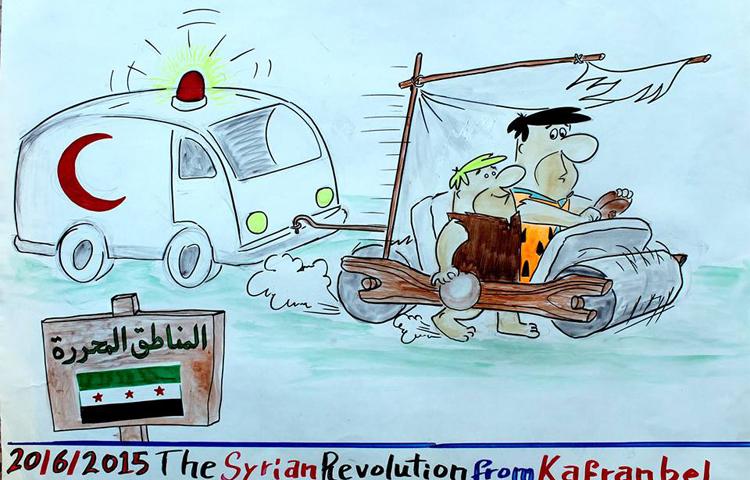
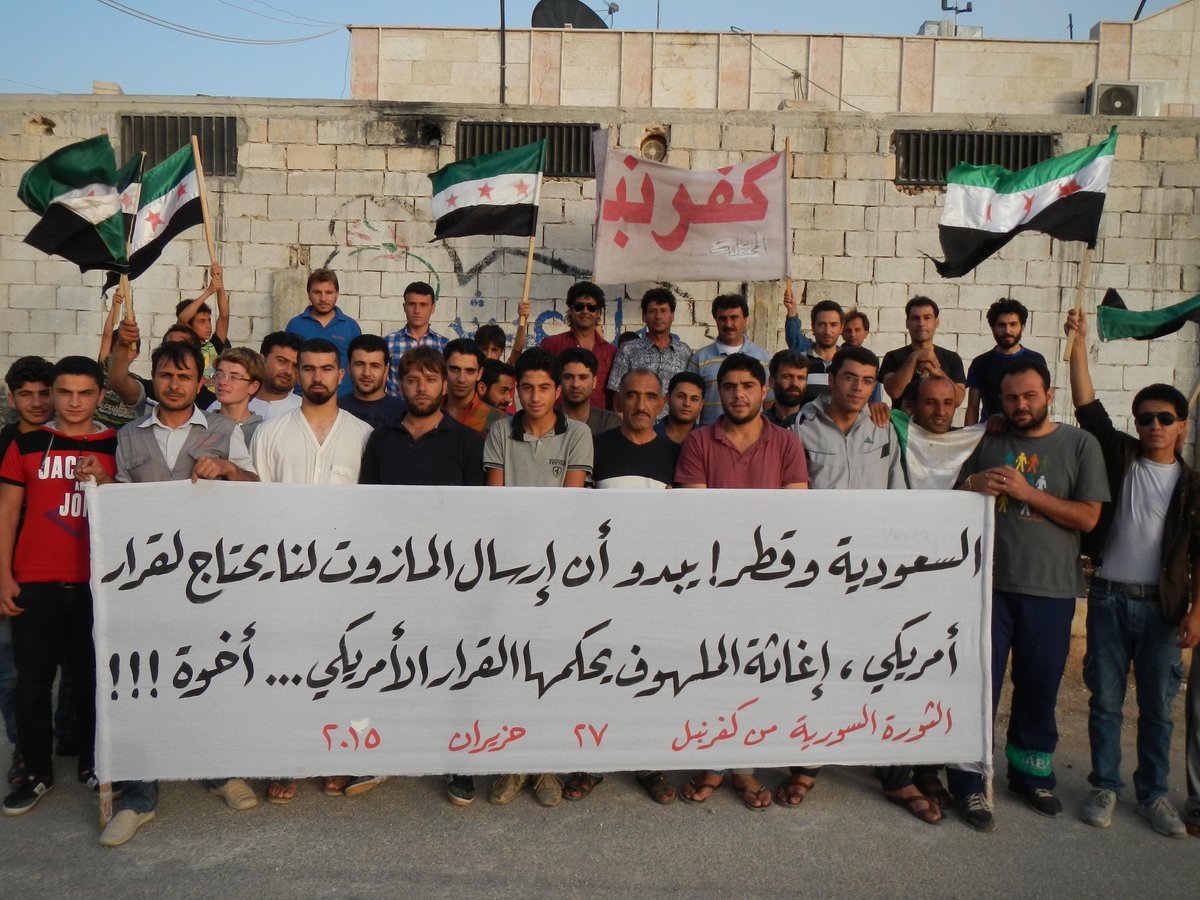
Kafranbel

Embedded image permalink

 "Qatar & Saudi Arabia! it seems you need American Decision to help us."

Breaking the Ramadan fast in Aleppo


 Looking for barrel bombs.
 Looking for barrel bombs.
 Looking for barrel bombs.
 I'm hungry.

Isis in Kobani: Why we ignore the worst of the massacres


 'They are desensitised by seeing so many pictures of children killed or maimed by Isis suicide bombers or government barrel bombs.'

 What a hypocrite. Patrick Cockburn ignores the barrel bombs, the sieges, the torture, which Assad daily visits on Syria, to scare us with the dangers of ISIS into backing Assad and his allies as they carry out more bombing, rape and torture,

 'Thus the US, Britain and their allies are supposedly seeking to combat Isis, but they simultaneously oppose the main enemies of Isis such as Iran, Hezbollah, the Syrian army, Shia militias in Iraq, and the PKK in Turkey in the shape of its Syrian branch, the PYD.'

 It's a lie that America and Britain are opposing what Iran and Assad are doing.

 Andrew Marr said this morning, "Patrick Cockburn is one of the people I turn to on the Middle East," Stephanie Flanders echoed Cockburn, "We have to stop our Sunni allies funding groups like ISIS." The British political and business establishment takes their lead from Cockburn, he isn't some anti-establishment figure, but one linking the Western élite to their Middle Eastern counterparts. Two more lies, the states mentioned are not funding ISIS, and the groups they support do not commit atrocities like Assad or even ISIS, but reading Cockburn you would never know that, as there are no moderates in his picture of Syria except for Assad, and all the people fighting him are mad Muslims.

 'Isis and al-Qaeda-type groups that are little different from it, such as Jabhat al-Nusra and Ahrar ash-Sham in Syria.'

Samar Yazbek: ‘Syria has been hung, drawn and quartered’

'Paris is beautiful, but it's not the same thing': Samar Yazbek in exile.

 ' “I was not frightened for myself. Not at all. Why should I be so? This was my homeland. This is where I had grown up. I spoke the languages, I knew the people. What did frighten me as time went on, and as I made more trips, was the way everything I had once known in Syria was being turned into something else, something I didn’t quite recognise. This had once been a cosy place, a place of traditional loyalties and hospitality. But now the people have been scarred and mutilated. I don’t know whether it will ever go back to what it was. That is what Assad has done.”

 She is especially angry with young Muslim women who have travelled from the west to join Isis. “Of course I am a feminist,” she says, “and what they are doing is sending the condition of women in Syria back to some terrible place. But also what they are doing is to ‘Orientalise’ Syria – these young girls are Muslims but they are creatures of the west. They know nothing of Syria and its ways. But they love the fantasy of the virile Arab warrior on a horse with a gun. This is a cliche and a fantasy and they come because it’s erotic and exotic – they are bored in the west and they need to rebel. But they do not understand Islam or Syria and that they are making things worse for the women who live here.” '

Syria’s Alawites: The People Behind Assad

High school students in the Alawite village of Al-Suwairi walk past a memorial for locals killed fighting on behalf of the Assad regime, June 2013. The memorial has space left for more names.

' “We are witnesses to the country’s unraveling,” a 56-year-old Alawite public servant told me last summer in Latakia, the western coast’s main city. “Many people I know—especially those who have lost loved ones—are fed up, but few dare speak out because this would contradict the facade of defiance,” he said.'

Saturday, 27 June 2015

Munther Khalil was killed in Majdal Shams


 Sam Charles Hamad:

 "Pro-Assad Druze pulled this fellow out of an ambulance and murdered him as the IDF watched on. He was slandered by Israeli Jews and Israeli Druze, for absolutely no good reason, as being a member of Jabhat an-Nusra, yet his name is Munther Khalil and he was a fighter with the Free Syrian Army. In fact, right-wing Israelis are still slandering him and justifying his murder because some injured Syrian fighter being treated in Israel made sectarian statements in an interview with some Israeli TV channel, which apparently means that murdering any Syrian fighter is perfectly understandable."


 Note 8/5/25, original Facebook link unavailable.

Syrian rebels take over regime headquarters in Daraa


 'The fall of Daraa city in the hands of rebels makes it the third Syrian city that is completely free of Assad forces after Raqqa (held by ISIS) and Idlib (held by Syrian rebels).'

The Civil War in Syria Is Invisible


 'Abounaddara—the name translates to “the man with the glasses,” which is to say the man who, through his lenses, can see clearly—has been able to maintain a steady stream of production since April 2011, when the regime of Bashar al-Assad upped their wanton killing of protesters. Since then, Abounaddara has released a new short film on Vimeo every Friday. And as the Syrian uprising turned into a revolution and then morphed into a gruesome civil war, the film collective—the majority of whose members are women—has managed to capture the social and human dimensions of war with an intimacy that is almost never seen in any conflict, let alone in Syria today.

 This is no small feat. Merely getting images from Syria is treacherous. According to the Committee to Protect Journalists, 17 journalists were killed in Syria in 2014, making it the deadliest place for journalists for three years running, and more journalists have been forced into exile since 2010 from Syria than any other country. The result is that we see very little of what’s really happening in Syria, enabling ISIS to promote its high-gloss terror pornography and the Assad regime to hide its crimes from view.'

Civilians Pay the Price


 'Ideally, those under arms who oppose the Assad regime would not take the poisoned bait of collective punishment and sectarian targeting spread promiscuously by the regime over the past four years. But some have, thereby imposing on their external supporters and suppliers an obligation to secure immediate corrective action. ISIL, of course, is beyond the pale and is not in any event part of the Syrian Revolution. Yet those seeking to draw Nusra away from its murderous al-Qaeda origins might concentrate first on stopping its war crimes.

 It is, however, the Assad regime that runs circles around “anti-Government armed groups” in terms of gross criminality. Consider some of the Commission’s more striking passages:

 “ . . . the Government continues to direct attacks towards locations where civilians are likely to congregate, among them, bus stations, marketplaces, and bakeries.”

 “In particular, the continuing use of barrel bombs in aerial campaigns against whole areas, rather than specific targets, is in violation of international humanitarian law and, as previously documented, amounts to the war crime of targeting civilians.”

 “The larger strategy [of the regime] appears to be one of making life unbearable for civilians who remain inside armed-group controlled areas.”

 “The previously documented pattern of attacks indicating that Government forces have deliberately targeted hospitals, medical units, and ambulances remains an entrenched feature of the conflict.”

 “Government sieges are imposed in a coordinated manner . . . [I]n particular, Government forces have refused to allow aid deliveries of essential medicines and surgical supplies . . . [G]overnment authorities act in direct breach of binding international humanitarian law obligations to ensure that wounded and sick persons are collected and cared for, and to ensure the rapid and unimpeded passage of humanitarian relief.”

 “Everyday decisions—whether to go visit a neighbor, to send your child to school, to step out to buy bread—have become, potentially, decisions about life and death. Large numbers of children have been killed in bombardments of their homes, schools, and playgrounds.”

 The Obama administration is operationally indifferent to all of this. This is not to say it is at a loss for words when describing the depredations of Bashar al-Assad, a person it stubbornly continues to recognize as the President of the Syrian Arab Republic. Yet its strategy for degrading and destroying ISIL—notwithstanding effective military-humanitarian interventions at Mount Sinjar in Iraq and Kobane in Syria—is operationally silent on protecting Syrian civilians from the regime. This despite its intellectual acceptance that Assad’s program of mass homicide produces recruits for ISIL from around the world and convinces increasing numbers of Syrians that ISIL may be their best bet for protection against regime atrocities.'

Hashem Alsouki risks his life crossing the Mediterranean


 'He isn’t particularly political. He’s just a 37-year-old civil servant at the regional water board. He runs the computer department, and it’s his job to print the bills every month for the residents of Damascus and the surrounding countryside. He focuses on the water business, and minds his own.

 But today, none of that will matter. The regime is going from house to house, rounding up all the men they find. Whether it’s because they’re Sunni, living in a country run by Alawites, an offshoot of the Shia, Hashem can only speculate.

 Hashem’s children watch him as he goes to open the door. Outside stand 20 men. Whether they’re from the army, the police, or a pro-regime militia, Hashem doesn’t know. But they’re here for him, and half the people on his street.


 Until now the war has largely avoided Haran al-Awamid, a place of around 15,000 a few miles south-east of Damascus. It’s a quiet town with a lot of government employees. But in recent days, tensions have been raised. The regime killed two young men, tied their corpses to a car, and dragged them around town. Not everyone dared to react, but the pair’s friends and family did – they protested and chanted in the street.

 And now, as Hashem is shoved into the back of a van, his children watching from their front room, the regime is getting its revenge. It’s a long revenge, too. First Hashem and his neighbours are taken to a secret network of cells, dug deep beneath the nearby Damascus airport. Three days later, they’re moved on – to the headquarters of aviation intelligence in Damascus.

 Here, hundreds of men are crammed into single cells, deep underground. Every day, four or five of them are dragged to torture rooms. Single men are electrocuted with shocks to their genitals. Husbands like Hashem are sometimes spared that humiliation, but instead are hung from their wrists. Hashem spends 12 hours like this, the cords cutting into his skin. Others spend even longer and their hands later have to be amputated.


 After several weeks, he’s moved to some kind of airport hangar. It’s a vast space, capable of holding a few planes. But there are so many prisoners crammed in here that they have to take it in turns to lie down. With no watches or natural light, they have no way of telling the time.

 One day, months later, the prisoners are driven in vans to the centre of Damascus, where they’re tossed out into the street. They have no idea that it’s now late October, or that today is the festival of Eid al-Adha. They emerge blinking into the bright sunlight wondering what kind of Syria awaits them.

 For Hashem, the future is immediately bleak. While he was away, two of Hayam’s brothers were shot by the same sniper on the same day. The second was trying to retrieve the corpse of the first.'

"I must save my life and not risk my family’s safety!”


 'Karima (40) is not the type of Syrian heroine that the mainstream media would like to interview. She did not participate in the Syrian Uprising. She did not lead a demonstration.'

 I don't think this is the case. The media is not looking for revolutionaries, it is looking for people who will blame the rebels as much as Assad, to reflect the same sort of balance it imagines it can impose on the conflict. That Assad's has been a war against civilians, not just or even mainly a war against those actively resisting, has been an unfamiliar theme in most press and TV, when they talk about the rest of Syria at all and not only about ISIS.

 'On March 12, 2012, Karima’s life would change forever. Around noon she heard that a mission from the Syrian Army is searching the houses in her neighborhood for armed men. She prayed that they would not take her boys and husband because they were not involved in any military activities. Around 2.00 p.m. the mission entered their apartment asking them to surrender their weapons. Her husband declared that they had no weapons. The officer ordered his fellows to take her husband out. Another officer took her eldest son Mahmmod (18) and he forced him to prostrate himself to Bashar al-Assad photograph in front of his mother and siblings. Then, they commanded Karima and her smaller children (a girl and two boys) to stay inside while they took the father and the son Mahmmod with them. In few minutes, Karima and her children heard gunshots. Karima held herself together because she was worry about the safety of her younger children.

 Her husband’s dead body was left next to their flat door, and her son was left dying on the stairs after they shot him in the head. Karima remembered how his flesh and blood had dispersed and adhered to the walls around him. Her daughter Lama (15) tried to give Mahmmod water before he died because he was muttering “water,” but he could not drink it. Karima told me this with a big sigh that even her son last wishes did not come true: “My daughter came back inside, her hands were covered with Mahmmod’s blood. I kissed her hands and I smelled my son scent.” When the army mission finished investigating the building, they came again to Karima’s apartment. She locked the door. They unlocked it by shooting it.

 It was winter and dark, and Karima, who has no experience in public spaces, felt scared and decided to stay the night at one of her neighbor’s houses. When they entered her neighbor’s house, they saw another dead body of a stranger. Karima learned that the regime forces killed all men in her neighborhood, and they randomly threw all the dead bodies into neighbor’s houses. They do so to ensure that the rest of the families are terrorized and humiliated and other anti-regime regions would look at this example of consequences for rebelling against the regime. Once again Lama covered the dead body with a sheet, so the small children would stop looking at the body exploded by bullets. Karima continued her story:

 At 6:30 in the morning we left the neighbor’s houses, the regime forces were shooting toward our feet and screaming at us to go back. I gestured with my hand that it is impossible to go back. We kept running through the shooting, and sometimes we hid in some buildings, but there were dead bodies in every building. When we passed our neighborhood, we met armed rebels. I expressed my disappointment with the rebels because they did not confront and fight the regime troops. But the rebel leader told me to thank my god because no one touched my daughter or me and we had escaped with our honor. He said in the nearby neighborhood most women were raped.'

The "Gang of Girls" Risks Their Lives to Report


 ' "We're the gang of girls. [Assad] would kill us, but he can't find us," Waleed says. The "gang of girls" she refers to are her colleagues at Enab Baladi; a little more than half the staff are women. Many of them are now refugees, in Turkey and Lebanon, and the rest are in hiding in Syria—reporting over sporadic Internet connections, giving new and urgent meaning to the phrase working remotely.

 Of the 24 founding staff members, three top editors have been killed in separate attacks. Eight reporters have been detained and tortured, and 12 have fled the country.


 Waleed and her girlfriends joined the crowds of hundreds of thousands forming across Syria, singing the anthem of the revolution, the title of which translates as "Come On, Bashar, Leave." They used Twitter and Facebook to coordinate more rallies, calling for democratic re- forms and expecting that the government—which over the past 40 years had built up one of the world's worst human rights records, crushing dissent, torturing prisoners, detaining and spying on critics, fostering endemic corruption, and creating widespread poverty—would fall or make concessions under pressure from the international community.

 But their calculations were wrong, and backing from the United States was weak. The Assad regime immediately cast the protesters as dangerous Islamists and foreign terrorists. Within weeks of the first demonstrations, government tanks rolled into city centers, opening fire on the people. Journalists and artists were detained or killed. The man rumored to have written "Come On, Bashar, Leave" was found dead in a river, his vocal cords ripped out. Assad controlled the airwaves, which spouted only propaganda.


 One morning in late August, she was having breakfast at her family's apartment in Darayya when the house shook. She rushed to the balcony to see her neighbors pouring into the alley. Minutes later, in almost the same location, there was another explosion. Waleed had grown accustomed to the occasional sound of rockets or mortars landing, as the rebels were hiding close by, on farms in the outskirts of the city. This was different. The shelling intensified, and the next morning the Waleed family fled to a relative's apartment, but as they arrived, a mortar hit the building, sending them all sprawling. The city was under attack. They ran for their cars, driving to the home of a family friend outside of town.

 For the next three days, one of the worst massacres of the Syrian war took place inside Darayya. According to reporting from Enab Baladi, which still had staffers there, the regime's soldiers sealed off all roads entering and exiting the city shortly before mortars landed.
Then, according to first-person accounts reported by Enab Baladi, soldiers went door to door, lining up men in mosques and shooting them execution style and burning homes and schools. In one particularly gruesome example, neighbors told Waleed that they'd found an entire family dead in their basement, where they had presumably been hiding. During the rampage, Waleed stayed out in the country, along with 100 others sleeping side by side in a crowded house. With no electricity or Internet access, she had no idea of the whereabouts of her team. This was the only time Enab Baladi missed an edition.'

 This is the massacre Robert Fisk lied about in the Independent, after riding into town with the very troops who had carried it out.*
*[http://claysbeach.blogspot.co.uk/2012/08/free-syria-responds-to-robert-fisk_1989.html]

Friday, 26 June 2015

We Need to Stop Giving Da’esh the Attention it Craves


 Ben Davies:

 'Suicide is strictly forbidden in Islam, as is the killing of innocent people. These monsters know this, but they use this appalling brutality because they know it will get our attention; our attention will gain them more fanatical supporters and more notoriety, enabling them to expand. There’s a reason that they’re commonly known as khwaarij. In so many words, ignorant extremists.

 Our indulgence of their gruesome publicity stunts is literally killing people, each murder more horrific than the next. We need to stop painstakingly documenting their atrocities on live TV, and instead go after them by going after the one who brought their strength into being through secret oil deals, and directly aiding them on the battlefield. Bashar al-Assad and his regime.

 Bombing Da’esh and ignoring Assad (as per Obama’s pro-Iran strategy) is only giving him the space he needs to bomb liberated areas with greater impunity and intensity. Both must be silenced to end this bloodshed. The dictator who claims he’s the solution to the extremists, and the extremists who claim they have a monopoly on Islam. In reality, all they do is harm and defame it.'


Note 8/5/25, original link to post unavailable.

Thursday, 25 June 2015

British Who Fought Assad Are Hiding From Government


 'Shaam and Ibrahim fought with militias linked to Ahrar al Sham, which loosely translates as the “Islamic Movement of the Free Men”. The group is considered one of the largest official opposition forces fighting in Syria. Although it aims to implement an “Islamic government” in Syria, its members have largely considered getting rid of Assad their main priority.

 In late 2012, Shaam joined an aid convoy in the Syrian town of Atmeh, where he helped deliver essentials to Syrian families displaced by the war. After seeing the aftermath of an attack by regime forces, he felt compelled to take up arms.

 “I had witnessed an attack in a city about 20 miles away from Atmeh – we were eating on a porch of a local house at around midday on the second day I arrived,” he says. “Some barrel bombs went off nearby, and I remember seeing two little girls, dressed almost identically with blue ribbons in their hair, starting to cry, and an old man who could no longer stand up after his knees had gone cold with fear.”

 Similar motivations led Ibrahim to travel to Syria. He recalls being “horrified by the attacks carried out by the regime” when he saw images of dead civilians and crying children broadcast on the news, and claims that it was his duty to go there to help, because “if you had the means to go and help the oppressed, then you should”.

 “You have all these groups talking about why young people are becoming radicalised and joining groups like ISIS, and there’s no one who can really tell them why what they’re doing is wrong. The groups who are currently talking about deradicalisation have no credibility – you need someone with on the ground experience of the conflict, and people who also believe in the idea of proper jihad … so that you can tell young people what they’re doing isn’t Islamically authentic.” '

Tuesday, 23 June 2015

British woman held by al-Nusra Front freed in Syria

Members of the al-Nusra Front during an offensive to take control of the Syrian city of Ariha from Assad’s forces in May.

 'The 31-year-old from from east London was detained in territory controlled by the al-Nusra Front, which is al-Qaida’s franchise in Syria. She was freed after negotiations with al-Nusra, who agreed to let her go because of her history of mental illness, those involved with the negotiations said.

 Tasnime Akunjee said the woman’s release was unlikely to offer hope to the families of Britons who have fled to Isis-controlled Syria: “Nusra are easier to deal with than Isis.” '

Syria'a Economy - Picking up the Pieces


 'The question arises as to whether a dramatic worsening in the economic situation might be the catalyst for the regime’s military collapse or for an externally imposed political settlement against Assad’s wishes; or whether further military setbacks might be the trigger for the government’s economic collapse.'

Assad Will Lose Damascus Before Years’ End


 Hard to say how accurate this is.

 'The source, who declined to be identified, said that the international coalition has accurate information about the status of Assad's forces and the terrorists, adding that no extremist groups will be allowed to seize the Syrian capital.'

Sunday, 21 June 2015

A teen's tale of torture and death in an ISIS town


 'When the Islamic State took control of her hometown of Minbaj in northern Syria she was just 17. Before then, she had organized and participated in scores of protests against Syrian President Bashar al-Assad. After the IS takeover Ms. Alif, a devout Muslim, was horrified by the group's approach to the faith, its draconian dictates, and its rules prohibiting girls from studying. Alif and a group of friends decided to take action, which was when her nightmare of beatings, stress positions and other forms of torture began.

 “We formed this small team to fight IS,” recalls Alif, who works in a cramped, overheated tissue factory in southern Turkey. "We wanted to send the message that we are against them, that we don’t want them in our town. That they are disfiguring Islam.” Mostly they spray-painted anti-IS slogans around town. Alif is still haunted by the image of a 15-year-old boy crucified on a tree and left to rot for days.

 On a crisp morning in May 2014 Alif unfolded the tricolor flag of the Syrian revolution in front of the Islamic State court as her friends documented the act and kept an eye out for IS militants. She tried to mask her identity — donning a black niqab, wearing high heels and speaking in a raspy voice. It all lasted a few seconds.'

‘Barbarism’ with chlorine gas goes unchecked in Syria


 'When the first attacks occurred in March, Mr. Kerry issued an angry statement declaring that “the international community cannot turn a blind eye to such barbarism.” But the Security Council, paralyzed by Russian obstructionism, has taken no action. And Mr. Kerry and his spokesman made it clear that the Obama administration has no plans to do anything other than remonstrate with Vladi­mir Putin’s powerless foreign minister.

 It is well within the power of the United States to put a stop to the horrific attacks. It could impose a no-fly zone in northern Syria, where Idlib province lies, or simply shoot down the slow-moving Syrian helicopters carrying out the attacks. As former ambassador to Syria Robert Ford testified to the House committee, a failure to act won’t affect only Syria: “The international consensus against CW use forged after the horrors of World War I is being eroded with each new chemical attack,” he said. “This is a risk to our own soldiers’ safety and our broader national security.”

 No matter: “I don’t have any specific measures here that I can lay out for you” to stop the chlorine attacks, said State Department spokesman John Kirby. Tell that to the families of the children whose lungs are being burned away.'

Saturday, 20 June 2015

Angelina Jolie makes brief, unannounced visit to Lebanon


 "Their memories of Syria are fading. They have stopped counting the days in displacement. Nothing is certain and they feel abandoned."

Civilians call on rebels to focus efforts on airports


 'If a small demonstration in a small town in Syria’s north is any indication, citizens are openly beginning to demand action to stop air raids, or else be considered complicit in them. As one child’s sign at the Maarat A-Numan protest read: “If you can strike the airport and you don’t, you’re a partner in our killing.” '

Worst Month Yet for Attacks on Hospitals in Syrian Conflict


 'The Syrian government’s dramatic spike in the number of attacks on medical facilities appears to be in retaliation for recent advances by opposition groups across Idlib and Hama governorates.

 “After losing territory to opposition forces, Assad responds by attacking civilians and the health care system – killing the very people who strive to save lives in the midst of war,” said Brown. “Assad is punishing people who are beyond the reach of his repressive security forces.” '

Children’s drawings offer insights


 “Syria is not always drawn as a place of cruelty, but as a green space, with water and tranquility, as if they have remained attached to the ‘before’ in the hope of going back, as if nothing had disturbed that harmony.”

Friday, 19 June 2015

Syria’s remaining hospitals under bombardment


 It is Assad who is bombing hospitals, not the rebels. Why then does Alex Thomson blame unnamed external superpowers for prolonging the conflict, as if it were all sides that are doing this, rather than that backed by Iran and Russia?

Is Iran paying Afghan mercenaries to fight in Syria?


 'From there, some have joined the fight against IS.'

 Half a minute in, James Lobel uses these words, which ruin his report. The Iranians are recruiting Shi'ites wherever they can to prop up Assad's sectarian régime fighting against the real rebels, but according to this account, they are going to fight the people who chop people's heads off and make sex slaves of Yazidi women. Not cool. Maybe not anti-Muslim in intent, but all the claims that Muslims in Syria are all crazy jihadists, if you give weapons to so-called moderates they will only end up with ISIS, have the same effect.

 Note too that the video of captured Afghans, from the Revolutionary Forces of Syria media office, is labelled as "couldn't be independently verified", like every demonstration of the facts from the rebels opposed to both Assad and ISIS since the revolution (or bitter civil war if you will) began. Assad's pronouncements are not labelled, "could not be independently verified", just the occasional vague doubt expressed when he comes out with the most blatant lies, such as there being no barrel bombs. This is how the anti-Syrian media narrative is created, by allowing confusion to prevail, making it all about ISIS, with it looking like Assad and the Iranians are fighting them.

 I see that rs21 have a new magazine out tomorrow, with a picture of migrants in a boat, and the headline "Borders Kill". I would hope that it would point out that the largest group of refugees trying to get to Europe are Syrians, that they are overwhelmingly fleeing from Assad, not from "the conflict in Syria", and that the reason they have to flee is that the US has refused to allow the Syrian rebels the anti-tank and anti-aircraft weapons that could have brought Assad's rain of terror to an end. But I don't expect it to say anything of the kind.

Seventy powers demand Syria barrel bombings end

Syrian men react following a reported barrel bomb attack by Syrian government forces that hit an open market in the northern city of Aleppo, on June 2, 2015

 Veronica Ramadan:

 "Great, another 'outraged' statement to add to four-and-a-half years' worth of 'outraged' statements - heaven forbid any of the powers actually DO SOMETHING to help protect Syrians and stop Assad's genocide..."

Thursday, 18 June 2015

Witnesses of Assad's Chlorine Warfare Plea for Help

PHOTO: Victims who it says were treated following a SAMS-reported chlorine attack by the Syrian government on the town of Al Kastan on June 7, 2015, are seen in these photos. ABC News cannot independently confirm the authenticity of these photos.

 'Dr. Annie Sparrow, a pediatrician and health activist who has worked on the Syrian border since 2012, told the committee the Assad regime has only targeted civilian populations with improvised barrel bombs and chlorine gas attacks.

 “I'm a doctor, and I'm very familiar with death. But I have never seen a more obscene way to kill children. I've never watched so many suffer in such an obscene manner,” Sparrow said. “Our preoccupation with ISIS is distracting us from these systematic assaults on civilian homes and neighborhoods and hospitals and schools.” '

Wednesday, 17 June 2015

Syrian doctors to show the US evidence of Assad’s use of chemical weapons

A Syrian man receives treatment at the Sarmin field hospital following a suspected chlorine gas attack by Assad forces in Idlib, Syria, in April 2015.

 'Recent reports suggest that militant forces in Syria, including Isis, are developing a chemical weapons capability of their own.'

 My apologies if this has already been pointed out, but it is a libel on the Syrian rebel groups fighting Assad that they have done any such thing, just as it was a lie two years ago when it was claimed that such rebel groups attacked themselves with sarin. This libel should not be reproduced in a respectable newspaper.

'Elephant rockets' kill dozens in Damascus suburb


 'The Syrian government has used so-called elephant rockets in an attack on the Damascus suburb of Douma, killing at least 36 people, including children, according to activists.
The rockets, named after the distinctive noise they make when they are launched, are improvised weapons made by attaching rocket motors to much larger bombs - a process that increases their destructive power while greatly reducing accuracy.

 Speaking in the US on Tuesday, John Kerry, secretary of state, said he was confident Assad's government was responsible for a "preponderance" of chemical attacks against his own people.

 "I think everybody's patience is wearing thin with respect to the extraordinary depravity of the weaponry and mechanisms for delivery which Assad has used against his own people," he said.'

 I think the Syrian people's patience with John Kerry's half-hearted condemnations, and double-act with the Russians to do nothing, is wearing thin.