Friday, 31 May 2019

How One Man Survived Syria’s Gulag


 'One morning in early June 2015, Omar Alshogre was taken from a cell in Sednaya, a military prison just north of Damascus, and thrown, shackled and blindfolded, into a van. The van drove down the side of the mountain, stopping at a clearing off the main road. The 20-year-old was thrown on the ground facedown. He could hear the soldiers behind him speaking in low tones. The firing squad came closer. A voice cried out, “Load!” and then “Fire!” “I just heard ‘boom!’—and then a loud humming sound,” recalls Omar. “For a moment, I thought I had died and gone on to the next phase.”

 One frigid evening in late January 2019, a youth in a half-zip polo sweater, with pushed-back hazel hair, stood on a street corner in Harlem. “It’s a lot colder in Stockholm,” he said in a Nordic accent. Omar looked around, impressed to hear that the imam of the West African mosque on 135th Street was educated in Damascus. He walks into Shrine, New York’s top Afro-Beat club, his eyes scanning the space as a bare-chested Prince impersonator groans and writhes onstage. We settle down to talk at a nearby bistro. A few hours later Omar will board a train to Washington to meet with members of Congress and National Security Council officials to talk about the 100,000 Syrians who have disappeared into the gulag of their country’s prison system.

 A lot has happened since the mock execution and Omar’s release after three years of imprisonment. In July 2015, he left Syria for Turkey and then made his way on a boat across the Aegean Sea; from Greece he followed the human tide as far north as possible, settling in Sweden, where he gained residency. Today this 23-year-old has emerged as the most visible and vocal witness of the Assad régime’s system of torture and industrial-scale brutality.


 Omar was born and raised in the village of Bayda, on Syria’s Mediterranean coast. He recalls a simple childhood, playing on the shore with his cousins and raising birds (his favorite is the yellow-vented bulbul). The Arab Spring reached Bayda in mid-March 2011, days after protests erupted in the southern city of Daraa. Fifteen youths had been arrested and tortured for scrawling graffiti on a school wall in Daraa in support of the Tunisian and Egyptian uprisings. “It’s your turn now, Doctor,” read the graffiti, referring to Bashar al-Assad, who had been an ophthalmologist before succeeding his father as ruler of Syria in 2000. When the régime fired on the demonstrators, protests spread from Daraa across the country, including to Bayda and the nearby city of Baniyas.

 “I first joined the protests for fun,” says Omar, “I was also annoyed by the corruption—I remembered that when I was 12 years old, my father had to pay a bribe of 5,000 lira to build a greenhouse.” On April 12, 2011, as people marched through Bayda, thousands of police descended on the village. “We could see them coming down the mountain, like ants—and they started shooting at us,” recalls Omar. The soldiers ordered everyone to the ground and began beating the protesters with metal pipes. Footage from the protests—uploaded by régime officials—shows the 15-year-old Omar lying face down in a mass of bodies, hands tied behind his back. Omar’s father, Ahmed, who knew local police commanders, negotiated his son’s release.

 While visiting American campuses and news organizations in early 2019, Omar was invariably asked if he had seen Capernaum, a Lebanese film then in Oscar contention, about a 12-year-old boy trying to survive in the slums of Beirut, hoping to escape with his sister to Sweden. All kinds of calamities almost befall the young protagonist—but his life is spared, and while he ends up in prison, the film has a happy ending. And in real life, the illiterate boy who plays him—Zain Al Rafeea, a Syrian refugee from Daraa—has been resettled in Norway with his family. Omar Alshogre’s story is indeed reminiscent of this film, but unlike Zain in Capernaum, every misfortune seems to have befallen him, before he and surviving members of his family ended up in Sweden. “My story is not a movie,” he says, laughing, “but I’m hoping for a happy ending.”


 In Omar’s case, the violence came quickly. Upon his first arrest, he was beaten and tortured with electric shock. “During the first arrests, they know they’re going to release you, so they don’t leave too many marks on your body—which is why they prefer electric shocks.” Omar would be arrested six times. “As soon as I was released, I returned right back to the protests,” he says, smiling. With each arrest, the torture got worse. In early 2012, an officer would tear out Omar’s fingernails one by one with a pair of pliers, asking, “How many officers did you kill? None?” while a second policeman held Omar’s head forcing him to look. “With each torn nail, you start saying yes to what they’re saying,” he notes. If the early abuse was meant to extract confessions, the later rounds of torture were meant to produce expressions of loyalty to the régime. “Who is your God?” the guard would shriek in between whips with a belt and electric shocks. “Bashar is your God!”

 In November 2012, Omar was detained for the seventh time, this time with his maternal cousins, 17-year-old Noor, 20-year-old Rashad, and 22-year-old Bashir. They were moved to detention centers around the country—in Baniyas, Tartus, and Homs—before being dropped off at Branch 215 in Damascus in December. “As soon as we arrived at Branch 215, we [the boys] were taken downstairs and stripped naked,” says Omar. “It was an unbelievable sight—people barely alive were lying in the corridor. Blue, red, and yellow welts on their bodies. They were starving, they had lost their teeth, you see just black inside their mouths. There was dry blood on the floor, in their hair. People had wounds that weren’t treated, maggots were eating their flesh.”

 Omar, Bashir, and Rashad were then taken to a lower level of Branch 215, while Noor, their female cousin, was taken to the sixth floor. “We walked over dead bodies in the hallway, until we arrived at Room No. 8.” As the boys peered into the darkness, a guard shoved Omar in with his foot. “The prisoners stared at us; we were still pretty then,” chuckles Omar. “And they looked like monsters—the biggest person was maybe 35 kilograms. I remember thinking, ‘I wonder if I’ll look like them one day.’”

 Branch 215 is a prison facility renowned for its notorious torture techniques. Human Rights Watch has documented torture methods such as “The Flying Carpet” (busat al-reeh), in which a detainee is tied on a flat board, sometimes in the shape of a cross, and then beaten; sometime the board is outwardly folded, severely stretching and dislocating the detainee’s limbs. Detainees are suspended for days by their wrists, while being burned, electrocuted, and whipped with steel cables. The guards at this facility are also known for administering a process of slow starvation. It’s not for no reason that detainees nicknamed Branch 215 “slow death.” Upon arrival, Omar was asked specifically about his cousin Noor. “‘Where does she make her bombs?’ they asked. I couldn’t answer. I can give a false confession for myself, but not for my cousin.” Some days later, a guard had Omar strip naked, suspended him from the ceiling by his wrists, and tied a string tightly around his penis. “All day he kept forcing me to drink water and eat handfuls of salt—and in the evening he sent me to pee.” This was how guards could make a detainee urinate blood for weeks.

 Omar spent a year and a half at Branch 215. And from what he has recounted to human-rights organizations in Europe and to Arabic news outlets, the level of sadism is astounding. “I witnessed horrible torture. People starving to death, men forced to rape other men, victims dying after sexual assaults.” As infection and disease spread in the prison cells, already filthy and overcrowded, guards reluctant to touch the naked prisoners would force older men to assault younger detainees. Omar recalls the case of Ibrahim Adnan al-Qadah, a 14-year-old boy and the youngest detainee in Branch 215. “One day a guard walked into Room No. 8 and ordered the biggest guy to rape this 14-year-old. ‘If you don’t do it, I’ll rape you and kill you.’ Ibrahim was raped, he stopped eating, and sat in a corner until he died.”


 More than any film, Omar’s story is reminiscent of Erika Riemann’s harrowing prison memoir The Bow on Stalin’s Mustache (2003), about how the author spent her teens in an East German prison during the early Cold War. The systematic torture and depravity that Omar and other teenage prisoners in Syria suffer is reminiscent of the Stasi’s practices, as is the Syrian régime’s meticulous and extensive record-keeping.

 At Branch 215, Omar would be assigned the task of moving 30 to 40 corpses daily to the “isolation room.” He had to write a number on the victims’ foreheads, and on a piece of paper the number and name of the prison facility where the victim had perished. “The bodies had often been dead for seven or eight days and were decomposing before we had to move them. Sometimes we would take two arms, two legs, the torso, or one piece at a time.”

 Unbeknownst to the 17-year-old was that on the other side of Damascus, at military Hospital 601, a forensic military photographer was photographing, for the interior ministry’s records, the corpses that Omar had numbered. But the photographer, who would document 50 bodies a day, was also working secretly with an opposition group, the Syrian National Movement. Starting in May 2011, “Caesar,” as this dissident would come to be known, began making duplicates of the photos he took and then sending them on a thumb drive to a relative overseas. In August 2013, fearing for his safety, Caesar fled Syria. His images—more than 50,000 of them—would form the basis of the 31-page “Caesar Report,” released in January 2014, which details the “systematic killing” of some 11,000 detainees by the Syrian government in one region from March 2011 to August 2013. The images of 10,000 dead produced by Caesar would be examined by former prosecutors from the criminal tribunals for the former Yugoslavia and Sierra Leone, and would be declared the “smoking gun” that the Syria régime had committed crimes against humanity. In 2014, Caesar testified before Congress, showing the graphic images and describing a highly bureaucratic system of killing. His statement would inspire the Caesar Syria Civilian Protection Act of 2016, legislation calling for new sanctions on the Syrian government and possibly a no-fly zone as well.

 Caesar fled Syria just as the war was entering an even more brutal phase. The darker the war became, the darker Omar’s descent in the prison system. On March 15, 2013, Omar’s older cousin Rashad died in Branch 215. “His ribs were broken from the beatings, he had difficulty breathing—his hair was burned, he had burn marks everywhere,” recalls Omar. “He died in his sleep, sitting in the fetal position.” In June 2013, a detainee arrived from Omar’s region and told him (incorrectly, it turned out) that his entire family had been killed in a government assault. In early May 2013, the Syrian government forces had stormed Bayda and Baniyas, killing, according to the United Nations, an estimated 300 to 450 people. “I suddenly realized that all I had left in the world were my friends at Branch 215 and my cousin Bashir,” says Omar. “But then even my friends began dying—my closest friend, Yaqub Al Hariri from Daraa, was executed, then Baraa, then Mohammed, then Mustafa.”


 In early 2014, Bashir fell ill with tuberculosis. “He lost weight, he lost his hair, he was coughing blood,” says Omar. “He wouldn’t eat. I would hit him so he’d eat something; ‘Do it for your mother!’ I’d say.” In Branch 215, inmates were allowed one visit to the washroom per day, and they would rush down the 35-meter hallway to the restroom as guards beat them with pipes. Each inmate got only 10 seconds on the toilet. “Bashir became very weak, very small, he couldn’t walk—I would carry him to the toilet in my arms like a baby. One day I put him down on the toilet. I could hear the guard counting down 10-9-8-7.… I leaned over to pick up Bashir. I was so tired. I started walking with him down the hall. People started shouting, ‘Stop, stop, look down—Bashir has died.’” Omar pauses, eyes welling up. “I had seen thousands of dead bodies already, but Bashir was closer to me than my brother. He was all I had in the world and he died in my arms.” The inmates washed the 23-year-old’s body. They laid him out in the center of the room and prayed the janazah funeral prayer for him. “He had such a beautiful smile on his face. He was finally free,” Omar says. Omar then carried his cousin’s body to the room of corpses and wrote a number on his forehead. “I told him, ‘I’ll never forget your number; one day I’ll tell your mother your son that died was prisoner No. 3,532.’”

 Omar was transformed—even unfettered—by his cousin’s death. “I suddenly became stronger, more desperate. I was scared other prisoners would kill me for my food, for my space. I was alone in the world, but I also had no more responsibility. I had to survive, nothing else mattered. I forgot my family and became mentally strong.”


 In August 2014, after 19 months in Branch 215, Omar was transferred to Sednaya, an even more infamous military prison located on a mountaintop north of the Syrian capital. By all accounts, this facility represents the peak of the Syrian régime’s degeneracy and violence against political opponents, as many of the detainees are professionals, writers, and prisoners of conscience. According to Amnesty International, thousands of detainees have been executed extrajudicially at the “human slaughterhouse” of Sednaya, at a rate of 50 executions a week, often more. (In the spring of 2017, the US State Department alleged that the prison even had its own crematorium, supplying satellite photographs as evidence, though a spokesman acknowledged that they were not definitive proof.)

 New arrivals to Sednaya were greeted with a “welcome party.” Omar chuckles as he recalls his welcoming hafla. Branch 215, he has said, was heaven compared to Sednaya. Upon arrival, prisoners were stripped naked, and the torture started immediately. Omar was struck across the face with a metal bar. “Why are you bleeding?” the guard screamed into his bloodied face. “I had been in prison for two years and knew the game,” says Omar. “I said, ‘I fell on the stairs on my way up here.’ The guard said, ‘OK then, you can go.’” After a quick, five-second trial, Omar says, he was declared guilty of terrorism. “I realized in Sednaya torture was not to make you talk, but to make you go silent—permanently.” He was then taken to the third floor, where the guard explained the golden rule of Sednaya: “You don’t mention God here; he won’t hear you. God is locked up in cell No. 27. Here you don’t pray, you don’t fast, you don’t say God’s name.”

 Sednaya’s attempt to ban faith and the very mention of God may seem like an obvious policy for a secular dictatorship that has long battled an Islamist opposition, but it’s actually a fairly recent measure. In the Middle East, régimes pondering how to deal with Islamist detainees have banned extremist literature, but they have generally seen access to the Quran as key to deradicalization; in some cases (Saudi Arabia and Dubai, for instance), inmates can receive reduced sentences, even amnesty, for memorizing the Holy Book. (In Guantánamo, American prison officials would also as a matter of policy ban prayer, desecrate the Quran, and force-feed prisoners during the daylight hours of Ramadan as part of an “omnipotence” or “debilitation” tactic meant “to reduce the detainee’s ego.”) Sednaya banned Qurans only after prison rebellions broke out in 2008, leaving dozens dead (including 45 military police). The first rebellion, in March 2008, grew in strength when detainees began shouting “Allahu Akbar!” and banging on metal doors. During another riot, in July 2008, security guards would trample copies of the Quran, causing inmates to rush to rescue the books. The guards would open fire, killing nine prisoners. God would thereafter be banned from Sednaya.

 In this mountain prison, death is meted out for the tiniest infraction, for any and no reason; inmates are put to death for talking, for making eye contact, for not holding on to the inmate in front when lining up, or for sitting too close to the door of the cell. Inmates are confined to a space of 40 square centimeters (roughly 16 square inches). Guards dole out daily whippings with a belt made from a tire. Guards would deprive inmates of food and/or water for days. “One day they took 12 of us down to a small underground cell,” recalls Omar. “We spent 10 days there with no food but were given water—three glasses a day. On day six, they suddenly cut off the water. By day seven, everyone is tired. By day eight”—he widens his eyes freakishly—“everyone is going crazy.” He continues, “They then had us all pee in the same bucket—and we just drank our collective pee.”

 Inmates were reduced to bones, kept barely alive, and regularly terrorized psychologically. Guards would deliberately execute a prisoner right before serving inmates their only meal of the day, often placing the corpse’s head over the platter of food, so that it would bleed into the daily mound of bread and potatoes. Prisoners were liquidated in myriad ways—shot, beaten to death, strangled with an iron cable. Omar recounts how one day a guard brought a large pot of soup to serve the inmates. He then grabbed one detainee and shoved his head into the pot. When the man gasped his last breath, the guard had the naked prisoners drink the soup.


 At Sednaya, the authorities seemed to have one goal: the psychological destruction—what the East German Stasi called the “decomposition”—of inmates before execution. The jailers would use all kinds of psychological warfare, planting enforcers (sukhra) and informants (jawasis) in each cell to sow paranoia and moral chaos, and to prevent any bonds or trust from emerging among the prisoners. Thus, it’s particularly moving when Omar recounts how inmates tried to build trust and some semblance of moral order in the face of such nihilistic barbarism. Here belief in God—whispering the Quran to one another—was essential, helping inmates to survive and maintain a sense of sanity and selfhood. In a prison where God’s name was unutterable, inmates learned quickly to pray without moving their lips, in case an informant was watching. “You focus your eyes somewhere and imagine the verses passing inside your head,” says Omar.

 Faith shaped daily life in myriad ways. “I soon came to realize that there are two kinds of people in prison,” says Omar, “those who lose their faith—asking where is God?—and those who have faith. Those who have faith stick together; they are like a body. Those who don’t have faith will think of their families and lose hope. You see them crying in the corner; they would die psychologically and physically. So we set a rule at Sednaya. No one was allowed to speak of their family or of freedom. That was the rule. But the engineers kept talking about engineering, and how they would one day rebuild the prisons of Syria. So we moved them to a corner.”

 Religious mores were followed as closely as possible. “We were kind to each other; the strong would give their food to the weak, the young would give their space to the old. We’re all on the edge of death; you could be killed off at any moment, and the last thing you do matters a lot for the afterlife.” Sitting in a windowless, dark cell for months on end, the Islamic calendar allowed inmates to tell what time of day or month of the year it was. The older prisoners could tell the time of day by listening out for the faint sound of an adhan from a distant mosque. “When eid came around, people would get very excited, hoping for a change, an amnesty maybe—but then eid would pass, and no one was released and people would die of agony,” says Omar.

 “After my third eid, I realized that the engineers were surviving the eids better—unlike the others—because their faith in science and imagination gave them hope. So we changed the rules; we allowed people to talk about freedom and family.” The inmates then created small groups whereby the professionals would move around: The doctors would speak to the other inmates about health, the lawyers about Syria’s legal system, the teachers about the educational system, and, perhaps most important, the elders who had memorized the Quran would transmit the verses to the young. “I literally learned hundreds of passages of Quran from the elders,” Omar said. “Syria’s most brilliant people are in prison, and the poor of Syria, or a village boy like me, would never get a chance to sit with lawyers and educators—but in prison we made it happen. I call it the university of whispers.”

 When he felt optimistic, Omar would engage in small acts of resistance. He would stand up and “exercise” (i.e., stretch his limbs) in his space—an act that could get an inmate tortured. He was still tagging bodies daily at Sednaya, and sometimes after an inmate died, he would write down in the report the name and number of a living inmate who had been forced to sign a confession and could be executed next, in the hope of sparing or deferring the latter’s execution. But perhaps Omar’s greatest act of resistance was that he began “writing”—that is, composing poetry and reciting the verses to himself and his friends. “For the first six months at Branch 215, I wrote about my family, but then after Bashir died, I began writing about imprisonment.” The writing was an act of political resistance, as he often wrote about the revolution in allegorical terms, where the revolution is an attractive woman, an object of love.


 Since his release, Omar has reflected often on why he survived. He’ll describe how his faith gave him strength and hope—and then he’ll mention Yasser. “The reason I survived is because there were elders in prison who protected me and wanted me to survive. And my greatest protector was Yasser al-Baridi; he saved my life so many times. When I was being tortured, he would throw his body on mine and receive the belts. And he taught me Quran, he was a hafiz.” Every prison cell had a leader of sorts, someone who would become the spokesman for the inmates, and the imposing, pious Yasser, who had been in prison “since before the Quran was banned in 2008,” was the leader of cell No. 10. One morning a guard came in and told Yasser that when he returned, he wanted him to have picked five men for execution. Yasser slowly selected four inmates, suspected “bad guys” (i.e., informants), and ordered them to the center of the room. When the guard came back, he peeked in through the door’s window and shouted, “I said five people!” Yasser answered in a mocking voice, “I know you said five. These four were praying together out loud.” Then, stepping forward, he added, “And I was their imam.” A silence descended on the third floor of Sednaya. The guards were aghast at this act of defiance and open devotion. They took Yasser and “tortured him to death, they destroyed his body, we recognized him only by his fingers,” says Omar, eyes tearing up for the second time.

 How to make sense of this carceral system, which combines bewildering depravity with obsessive record-keeping? Why endlessly torture and psychologically destroy individuals, including minors, who are already in a dungeon? Why keep them barely alive for months on end? Eliminating the hafiz, the learned Islamic figure, is actually reminiscent of colonial-era practices. In his exceptional book The Walking Qur’an (2014), historian Rudolph Ware notes that in 18th-century Senegambia, religious leaders who had memorized the Quran—who embodied God’s word, so to speak—were often the most vocal critics of the local rulers’ slaving practices and collaboration with European powers, so African monarchs would single them out for punishment. The enslavement of the hufaz would in turn trigger anti-colonial rebellions. (When Yasser died, Omar recalls, “We washed his body, and prayed for him out loud. When a good man dies, the guards don’t dare intervene in the prayer—they know we’ll do something crazy.”)

 Yet for all its proscribing of God, the Syrian régime in Sednaya and other prisons seems to have created a narrow space between life and death, eerily reminiscent of the Islamic concept of barzakh, that surreal place between the physical and spiritual worlds similar to the Christian idea of limbo. The Assad régime seems to have deliberately recreated that narrow “isthmus” between life and death that believers speak of. It’s worth adding that not all the memorizers of the Quran were executed. Many of those who fit the profile were released to replenish the ranks of jihadis, because the régime wanted to shift the struggle to the battlefield, where it had a clear military upper hand. Since mid-2011, Assad had begun periodically releasing hardened jihadis from prison to give the impression that the uprising was the work of violent extremists.


 One day in June 2015 (“I remember it was 10 days before Ramadan”), Omar was pulled from cell No. 10 and taken to another room. “I thought they were going to kill me,” he says matter-of-factly. “It’s kind of a nice feeling, actually—you think you won’t have to worry anymore.” But instead, every hour a guard would come in and lean over the blindfolded inmate and ask, “‘Hey, how would you like to be killed?’ And I would say, ‘You can shoot me?’ The guard would say, ‘That’s boring—next option.’ I would say, ‘You can hang me? You can drown me?’” This continued hourly for two days, until the 20-year-old was driven out to the side of the road for a final humiliation—the mock execution. “I thought I was dead, but then I heard them drive off—and I realized they had fired onto the ground,” says Omar. “I turned my head, I looked up—and for the first time in three years, I saw the sky, the trees, the birds.”

 Barefoot, disheveled, and sick with tuberculosis, Omar made his way to Damascus. He spent the night at a bus station. The following morning, he stumbled around the city center; at one point he stood in front of a shop window, startled to see his emaciated face in the reflection. “I hadn’t seen my face in years,” he says. Some hours later he was approached by a stranger who asked, “Are you Omar Alshogre? I know your mother.” “I knew what ‘mother’ meant,” says Omar, “but I could not remember what my mother looked like. I had completely forgotten my family.” Omar would learn that in May 2013, his father, Ahmed, and his brothers Mohammed and Osman were killed by the régime’s forces, but his mother had narrowly escaped to Turkey with his other siblings. His mother had gotten wind that her son was in Sednaya and paid a $20,000 bribe for his release. The “stranger” was a middleman, who was to help get Omar across the border to Turkey. The next day, Omar Skyped with his mother. He couldn’t remember her, and she didn’t recognize her cadaverous-looking son. Before leaving for Turkey, Omar was taken to Damascus’s renowned Ibn al-Nafees hospital for treatment. As Omar lay in the examination chair, the doctor, aware that Omar was a former prisoner, backed up and smashed the heel of his shoe into the patient’s face.

 On June 21, after a 10-day journey through mountainous country, Omar arrived at the Turkish border. One final indignity awaited him on Syrian soil: Hearing his identifiably Sunni first name, the Alawi border guard began to beat the 20-year-old’s head with a rock. “He wanted to kill me,” says Omar. “The only thing that saved me was that I started coughing. I coughed blood on my hand and blew it in his direction, and then told him I was sick with TB.” The furious guard yelled, “Take that filth to Turkey” and shoved him across the checkpoint. “From then on, anytime I had trouble at a border I would cough and blow the guards a bloody kiss,” laughs Omar.

 He was soon reunited with his family in Turkey, but he couldn’t get medical treatment, and his mother feared for his safety. Syrian agents were eliminating political opponents, even in Turkey. “So my mother decided that my 10-year-old brother Ali and I would head for Europe,” says Omar, “but she kept Ali’s twin brother, Hamza, with her. In case we drowned, she didn’t want to be alone.”


 And so in early November 2015, Omar found himself facing another life-risking situation, boarding a dinghy with his little brother and 40 other refugees to cross the perilous, barzakh-like waters of the Aegean Sea, which has swallowed the lives of so many. The boat left from Izmir and sprang a leak, but after seven and a half hours, they arrived exhausted and shivering on the Greek island of Nira. Omar couldn’t get medical assistance in Athens, so he and his brother followed the human mass northward to Macedonia, Serbia, Croatia, Slovenia, Austria, Germany, Denmark, and finally to Malmö, Sweden, where he was able to get treatment. He soon moved in with a Swedish family, and as he regained his health, the memory holes began to disappear and the recollections came flooding back.

 In the three years since his release from prison, Omar has learned Swedish and English, graduated from high school, and seems keen to annex any language and identity that will allow him to disseminate his story. He has entered public-speaking competitions, where he has described his Dantean descent into Syria’s gulag. “It’s not fun,” he’ll grin. He’ll move audiences to tears talking about how he found footage of his father being shot and mutilated by the régime’s forces and why he needs to periodically watch the video. His TED Talk is more like a one-man show, where he crouches in slow motion to show the space inmates are confined to in Sednaya. His outspokenness and charm have made him a public figure in the Nordic countries; journalists will follow him with cameras as he strolls around a lake, birdwatching or reciting his poetry. He’s affectionately described as “Superguy” or “Arab Viking.”

 But Omar’s growing profile has also brought death threats. In January 2018, his cell phone rang. “I’m here in Stockholm. I miss my country, I love my people, I was so excited to see the Syrian number,” says Omar. “As soon as the caller said marhaba [hello], I knew who it was.” It was one of his torturers from Branch 215. “The voice had inhabited me for a year and nine months,” Omar recalls. “Suddenly I felt the lash of the whip on my back, I recalled Bashir being sick—and this guard pouring his medicine down the toilet.” The guard growled, “Why are you talking about me? Why don’t you keep quiet?” Omar chatted with his torturer for 90 minutes. The guard offered him money to keep quiet. “Don’t pay me money, just tell me what you get out of torturing people?” responded Omar. “He couldn’t answer. I could hear him breathing heavily. That’s when I realized I had won the confrontation—they had silenced me for years, and now I had rendered him silent.”


 Efforts are growing to bring legal action against Syrian officials for crimes against humanity. Russia and China, both allies of the Assad régime, blocked a request by the United States to bring Syria before the International Criminal Court in 2014, but in March of this year, lawyers in The Hague filed the first-ever case against Syrian president Bashar al-Assad and his government, on behalf of 28 Syrian refugees in Jordan who were forcibly displaced, some of them after being tortured. Omar, along with other Syrian ex-detainees in Sweden, is preparing a lawsuit, backed by Sweden’s War Crimes Unit, against 25 Syrian intelligence officers. As one of the few to survive the slaughterhouse of Sednaya, and as someone who has personally tagged over 8,000 bodies, who appears in various media and can rattle off the names and locations of multiple military prisons, including the brigadier general in charge of each facility and the names of deceased inmates and their hometowns, Omar is a formidable and feared witness. Hence the ongoing death threats.

 In the United States, Omar has been making the media rounds, meeting human-rights activists, lawmakers, and members of the National Security Council. Those who meet him are struck by his powers of recall and zingy answers. (Asked what he thought of New York, Omar quipped, “I came to America for the conversations, not the tall buildings.”) American officials suspect that the Syrian régime is holding more US nationals than any other state or non-state actor, so national-security experts were keen to hear Omar describe the sixth floor of Branch 215, where English-speaking prisoners were kept. “Omar Alshogre is in Washington to raise awareness of the Americans captured and of the Caesar Syria Civilian Protection Act of 2016,” says Mouaz Moustafa of the Washington-based Syrian Emergency Task Force. But Omar has no policy prescription per se. When US officials ask him what they should do, the 23-year-old rather cryptically responds, “Just liberate one military prison like 215; in it you’ll find Syrians, Europeans, and Americans.”

 In Sweden, Omar had begun searching through Caesar’s online database and found photos of his cousin Rashad and his friends Baraa Mania and Mohammed Suleiman. Thus, one of the more emotional moments during his February visit to Washington was when he got to speak by telephone to Caesar. “If Caesar is the nameless, faceless symbol of the Syrian nation, Omar is today the very eloquent voice and face of the Syrian people,” says Moustafa, who connected the two. “They spoke casually, informally, for 20 minutes, like a nephew speaking to his uncle. Omar only appeared emotional after they hung up.”

 Omar has since been speaking to student groups on Ivy League campuses. Undergraduates will listen raptly (and then they will take him on a campus tour and urge him to apply, as he’s considering attending a US college). On stage he will stress how he survived prison because of the elders who invested in him, his positive attitude, and his faith. “I believe in God. There’s a reason for everything—everything. If I didn’t have TB, I wouldn’t have been able to cross to Turkey, or get to Europe.” Over the years, it’ll be interesting to see how this young man makes sense of why the other good people imprisoned with him—the believers, the scientists, the youngsters—did not survive. But his composure and mental strength are indeed awe-inspiring. Asked by one student how he felt, Omar replied, “I feel great, I have a great future,” and then, spreading his arms, added, “and all those people who died—Yaqub, Yasser, Baraa, everyone—I have them here within me.” '

Image result for omar alshogre

Monday, 27 May 2019

Idlib residents take a stand against Assad's assault


 Zouhir al-Shimale:

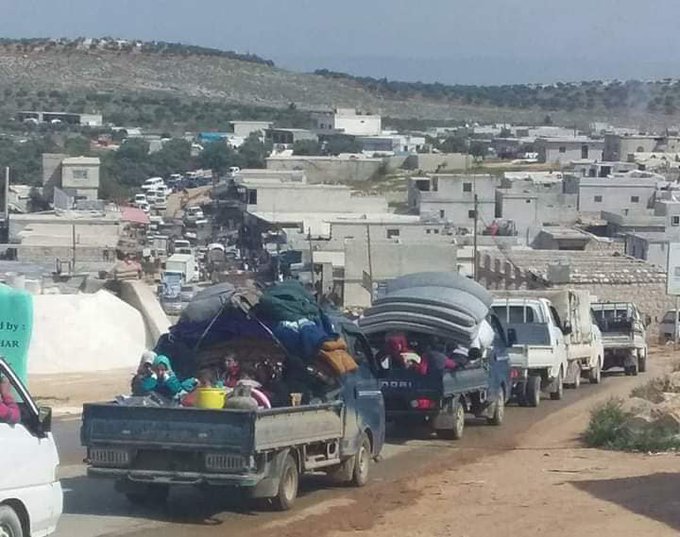
 'Residents of Syria’s Idlib province are refusing offers of safe passage to government-held territory despite increased bombardment in recent days as the Assad régime intensifies its campaign to recapture the final rebel holdout.

 More than 200 civilians are estimated to have been killed and about 180,000 displaced since the government launched a Russian-backed aerial and ground assault on the north-western province late last month, prompting an international outcry.

 While many civilians fled towards the closed border with Turkey, others said they would stay put.

 “I will not let go of my land or home, or leave, not to Turkey and definitely not back to régime areas,” said Khaled Al Essa, 35, who lives with his daughter and parents in Khan Sheikhoun.

 Mr Al Essa dismissed the offers of safe passage out of Idlib through humanitarian corridors guaranteed by Russia and the government.

 “They keep repeating the same lie of a humanitarian corridor,” he said by phone, with explosions and the sounds of aircraft in the background.

 “If they don’t want people to die then stop the attacks, as simple as that. How could we feel safe to cross their corridors when they are already crushing us here?

 “I don’t want to die under an olive tree or be humiliated with my family on the border.

 “I have nothing to lose or gain if my family and I are to die in this holy month. So be it, we will not run away from whatever is our fate.”


 The government offensive breaks a ceasefire agreed to in September last year by Russia and Turkey, which supports Syrian rebel groups, to prevent a humanitarian disaster.

 Idlib’s population has swollen to more than 3 million after fighters and civilians from other parts of Syria were given the option to move there from rebel-held areas recaptured by the government.

 Mariam Ghlo, 31, fled to the Harem mountains with her husband and three children two weeks ago, after their home in the town of Latamnah was destroyed by a barrel bomb.

 Along with dozens of other displaced families, they live in the open with scraps of fabric for shelter.

 “Even though we are destitute, homeless, with nothing, not even enough blankets, water or food for the children, I don’t want to go back to régime areas, nor does my husband,” Ms Ghlo said.

 “We learnt lessons from Ghouta, Deraa and other areas where the régime opened corridors for civilians to flee.

 “On arrival they go through security checks, the men get arrested then killed, imprisoned or forced to fight with them.

 “We would rather be here under this tree for a lifetime instead.”


 The offer of safe passage is a warning of worse attacks to come, said Jamal Barode, 30, a father of two who moved to Maarat Numan in Idlib from Deraa after the southern province was recaptured by the government last year.

 “Russia’s offer to open a passage for us to leave is a sign that a new escalation is ahead of us, worse than what we have had already,” Mr Barode said.

 “When the Russia-Assad régime make such an offer, that means a furious ground operation or chemical attacks will follow in the coming weeks.

 “This is what we were used to over the past years and the same formula is being used again here.

 “The Russians must be fooling with us. They know that the majority here have already accepted corridors out of Aleppo, Ghouta, Deraa ...

 “They chose to come to Idlib and now they are offering us a corridor to go back again? This is only a step towards another escalation.”


 Mousa Abdullah, a strategic and military expert in Istanbul, said Russia’s offer of safe passage was a diversion from an embarrassing reversal against the rebels in a village last week.

 “This comes after rebel forces recaptured Kafr Nabudah in less than 19 hours after it was taken in a fierce military campaign over 10 days,” Mr Abdullah said.

 But Syrian state media reported that government forces retook the village on Sunday from militant groups including Hayat Tahrir Al Sham, the dominant insurgent force in Idlib.

 Mr Abdullah said Russia was aware that there would be few takers for its offer of safe passage even if régime forces seized large areas of Idlib.

 “Out of nearly four million, only a few thousand might leave,” he said.

 “The majority are former internally displaced people who refused to stay in régime areas when they could, whether in Aleppo, Ghouta, etc, so it’s unlikely they will use these passages.

 “Idlib, unlike those other cities, is a special area as the final frontline between the Assad régime and Ankara, which has supported rebel forces with advanced weapons to fight back in the recent offensive.

 “There are more than 20,000 rebel forces with plenty of weapons and ammunition. Many are militant groups who have nowhere else to go and will fight to the death,” he said.


 Death is also a very real possibility for the civilians who choose to remain in Idlib.

 “We just want safety here,” Mr Al Essa said. “We won’t leave for anywhere. We are not terrorists, we are the residents and the rightful owners of these lands.

 “I might not be alive in the next 24 hours, and may not be able to be heard again. The last thing I want the world to know is that you’ve got the Syrian people’s blood on your hands.” '

Sunday, 26 May 2019

Meet the Syrian mother who raised her son in jail


 'After giving birth and raising a toddler during four years in a Syrian prison, 30-year-old Hasna Dbeis is now free - and determined to forge a new life for her family.

 Dbeis says she was two months pregnant when she was detained in August 2014 in the Eastern Ghouta suburbs of Damascus, accused of working with rebels; an allegation she denies.

 She was shuffled around various detention centres, including one where she saw her father and brother for the last time.

 “They were tortured in front of me,” she said, her face veil revealing tired eyes.

 She is one of tens of thousands of Syrians jailed during the conflict for opposing Bashar al-Assad.


 Dbeis said she was kept in solitary confinement for 40 days at one stage, in a cell littered with garbage.

 Insects crept up the walls, and the screams of inmates being tortured rang around her, she recalled.

 She was allowed out of jail only once, when she went into labour.

 “A newborn came into my life and I didn’t know what to do,” she said, clad in black.

 After giving birth to Mohammad, Dbeis was transferred to the notorious Al Fayhaa prison in Damascus.

 The facility housed other mothers, including Iraqi women detained on suspicion of working with Daesh, she said.

 Dbeis shared a cell with her newborn and a 20-year-old Ethiopian woman.

 Her cellmate, who other inmates called Lamees, would help her sew clothes for the little boy, she said, but also care for the infant when Dbeis was being interrogated.


 Guards usually entered her cell at around midnight to take her to another room where she was beaten and suspended by the wrists, she said.

 The first time, she recounted, “the interrogator started by taking off my veil. He looked at my hair, brought a knife, and started cutting” it.

 “Then he started beating me,” she said.

 Her hands were cuffed behind her back, she said, and she was left hanging from her wrists for hours.

 She also contracted tuberculosis, she claimed, and had to be kept away from her child for more than four months while she received treatment.

 By the time she recovered, her son - then nine months old - thought Lamees was his mother.

 “He didn’t know who I was,” Dbeis said.


 For three years, her hope for a better life dwindled, as she watched Mohammad grow up in a cell, the sound of other children playing echoing in from outside.

 “I used to dream of walking in the street with my child and entering a store to buy him clothes like normal mothers do,” she said.

 In April 2018, she was released.

 She did not return to Eastern Ghouta, which had fallen under government control that month, after régime bombardment and a crippling siege.

 Instead, she boarded a bus that took rebels and their families from the Damascus suburbs to opposition-held territory in the northern province of Aleppo.


 Dbeis remembers the first time Mohammad saw a stand selling tomatoes.

 “He ran towards it, grabbed a tomato, and started gobbling it up,” she said.

 “He’d never seen a tomato before.”

 But catching up with one of her sisters in the neighbouring province of Idlib brought new trauma.

 Dbeis was told that her mother was dead and that her husband had been killed by regime forces.

 Two of her sisters were detained by the government, and the fate of her father and brother - who she last saw in jail - was unknown.

 “After hearing about my family’s heart-wrenching fate, I decided to start a new life,” Dbeis said.

 She remarried and moved to Idlib, a region outside régime control.


 But four months after her wedding, her 25-year-old husband was hit in the stomach by shell shrapnel, leaving him unable to work.

 In a desperate bid to provide for her family, she joined a sewing workshop employing former female detainees.

 “The money I make, I spend on my home,” said Dbeis, who makes children’s clothes.

 But her life is under renewed threat.

 Since late April, heightened bombardment of Idlib by the regime and its ally Russia has sparked fears of an imminent full assault.

 “I don’t want the régime to enter Idlib and throw me back in prison,” Dbeis said.'

Saturday, 25 May 2019

Surviving War, Building Peace

Image result for Ghalia Rahal

 'Amid the traumas of Syria’s war, women like Ghalia Rahal are building an unprecedented role in peace talks over their country’s future. Rahal—the founder of a network of women’s centers in northwest Syria—has helped energize a Syrian women’s movement despite threats from extremists, attacks on her workplaces, and the assassination of her son, a journalist. Syrian women leaders say Rahal is one of many local activists who have enabled women to strengthen their representation in U.N.-backed negotiations for an end to the war. Now, Rahal and her women’s network in in the hilly, fig-growing province of Idlib face an extreme threat—the Syrian government military offensive against the province that has killed hundreds and displaced nearly 200,000 people.

 “In Syria, Ghalia is creating a power base for women within a very conservative area,” said Mariam Jalabi, who in 2017 founded a Syrian Women’s Political Movement with Rahal and others. In the rural town of Kafr Nabl, Rahal ran a beauty salon and, amid the war, converted her business into a center to teach women and girls job skills, literacy and first aid. “Women come to her center for a class in sewing, but they discuss what they should do in the community, and they are empowered,” said Jalabi.

 Rahal’s work “is part of the foundation for what our national women’s movement has achieved,” including a growing role in the United Nations-supported peace process between Syria’s government and its democratic opposition movement, said Jalabi, who represents the Syrian democratic opposition at U.N. headquarters in New York. The Syrian Women’s Political Movement is pressing for further gains in women’s representation in peace talks and political processes that will define the future Syria.


 As a girl, Rahal loved cross-country running through the rocky farmlands and fig orchards of northwestern Syria, and she dreamed of becoming a champion. When she got married, she has said, “I gave up cross-country running because our customs and traditions wouldn’t allow it.” Still, as a mother and housewife, she continued to push the bounds of what society would permit a woman in rural Syria. She opened a hairdressing salon and became a driving instructor.

 In 2011, Syrians roseIn Syria as elsewhere, the transformation of political protest into bloodshed marginalized women, Rahal said. “I had a 200-square-meter basement where women used to come for shelter from air strikes by the regime. We would have a lot of women sitting together, sometimes for hours.” Rahal’s crowded bomb shelter became a venue for discussion of women’s roles in a future Syria. “We imagined the situation,” she said. “How would society be if women were not able to overcome many of the woes of war and its aftermath?”


 In that basement bomb shelter, Rahal heard stories of women who had lost family members and homes, a daily stream of suffering that changed her focus. “I think I became more caring toward other people, especially girls and women,” she recalled in a 2016 film by Syrian journalist Zaina Erhaim. “Since the war erupted, I felt we all needed one another.”

 In 2013, Rahal converted her hair salon into a women’s center to provide women and girls with vital skills such as literacy and job training. The women named it Mazaya, meaning “advantage.”

 “We have lectures, vocational training, educational workshops, financial training” and other projects,” Rahal said. Hundreds of women and girls registered for classes—and others volunteered as teachers. A woman skilled in weaving taught her trade. A woman with medical knowledge taught first aid, which “was … necessary because of the many injuries caused by the shelling,” Rahal said. The women obtained a printer and began publishing a magazine to report “the difficulties facing women, news reports [and] humanitarian cases,” she said.

 Persuading women to participate in public activities despite traditions that confined them to their homes was difficult, Rahal said. “I had to make them trust and believe in our work, and bear the negative words and harsh criticism.” But with time, “I have seen how women started changing and coming out of the houses to help each other.”


 Women’s activism is discouraged in Syria by patriarchal social traditions, by habits bred under decades of oppressive, single-party rule—and by the rise of movements promoting a narrow interpretation of Islamic faith. “Our society did not accept the idea of a women’s center,” Rahal said.

 To overcome resistance, Rahal visited Kafr Nabl’s power brokers, who of course were men. “Typically, women do not approach these town elders, the sheikhs, directly. But Ghalia does it,” said Jalabi. “She explains to them that women’s education provides benefits to the whole community. She gives them a sense of co-ownership,” and shows local leaders that cooperation with her project can help them look better in the eyes of their own people. She has been “able to establish with them a social contract in which they protect her centers and her work,” Jalabi said.

 One reason for Rahal’s success, Jalabi and others noted, is that she is—and is seen as—a deeply religious person who is drawing her ideas and language for change from her community’s basic religious principles. She wins respect from local leaders on both religious and social bases. “Ghalia has broken down many of the barriers against women with the strength of her personality and the respect she has earned from everyone, including men,” Jalabi said. “She has built a business, she is financially independent, and she is the mother of adult children who are also respected in the community.”


 One of the adult children who won respect for Rahal was her oldest son, Khaled al-Issa. He was active in the 2011 uprising, and became a locally prominent photojournalist. With a few colleagues—including one of Syria’s best-known dissidents, Raed Fares, he established a media center, including a radio station, in Kafr Nabl. They reported via news organizations and social media on the brutality of the war and attacks on civilians in northwest Syria.

 “My son, Khaled, told me, ‘Mom, you have started digging a road through all the thorns, and you are able to continue on with it. It is a revolution, my mother,’” Rahal recalled.

 Apart from the resistance by traditional conservatives, Rahal and her work have faced physical attack by extremists. While Kafr Nabl has seen the growth of a democratically oriented civil society, including its women’s movement, it also has a constituency that favors Islamist groups, including Hayat Tahrir al-Sham (formerly the Nusra Front, affiliated with al-Qaida). In 2014 the Mazaya center was burned in an arson attack. Rahal and her allies rebuilt it. The next year, the Nusra Front attacked Mazaya and Khaled’s radio station. Residents of the town rallied in the streets in protest. In July 2016, Khaled was killed by a bomb planted in the home where he was living in Aleppo.

 Today, Mazaya is a network of eight women’s centers, plus five child-care centers, in Kafr Nabl and other towns across southern Idlib. The women’s centers provide nursing and vocational training, job placement and professional development services. The Mazaya organization now produces both a print and an electronic magazine that make the case for education and empowerment for women and girls. Amid new reports of bombing in Idlib, Rahal sent a text message to Jalabi on May 21 that she has had to close some of her centers for fear that they may be struck. Others are continuing to work, located in basements.

 “Ghalia has somehow been able to maintain a livelihood, swim against conservative and repressive social norms, survive the government’s relentless violence, and navigate and challenge the rise of armed extremist organizations—all while implementing her vision for a future Syria in which women are safe, empowered and free,” said Jalabi.'

Friday, 24 May 2019

Syrian doctor describes latest alleged chemical attack

Alleged chemical attack victim in Syria on Sunday

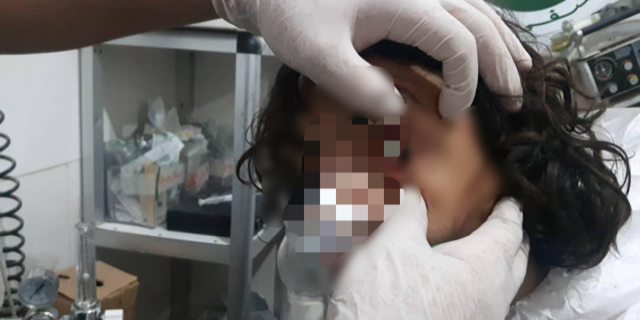
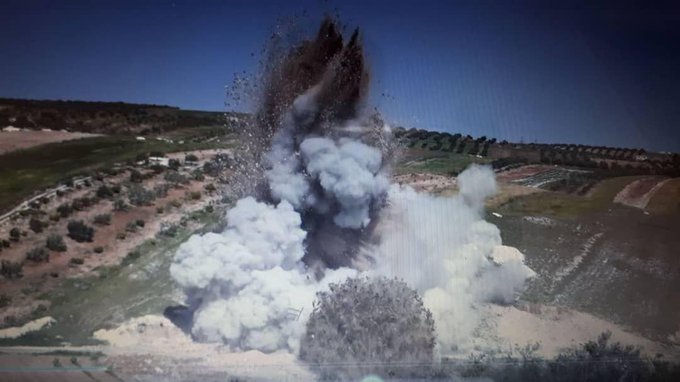
 'Just after 9 a.m Sunday, witnesses on the ground in the remote Syrian countryside near the border of Idlib province claimed they saw more than 40 rockets slash through the sky, along with three different-looking shells that landed in a thud of yellowish smoke. These were described as large cylinders that did not explode, yet produced a strong chemical smell.

 “On May 19, we received information about an attack using toxic gases in a fight between the Syrian military and ‘revolutionary’ military. I was informed to be ready. Four people came with red eyes, struggling to breathe, headaches,” Idlib-based Dr. Ahmad, who claims to have treated the wounded, said on Thursday. “We took off their clothes, put them in water, and gave them oxygen. They smelled of chlorine.”

 Doctors who supervised the treatment process recorded that the patients endured an array of other symptoms from severe coughing and watery eyes to wheezing and vomiting. The four alleged victims are said to be males under the age of 30. They were kept under observation most of the day, Dr. Ahmad claimed, and were discharged later that evening in a “generally good condition" around 9 hours after they were admitted.

 “We immediately got our emergency staff – who are trained for chemical weapon attack – ready for any inquiry or support,” concurred Nidal Shikhani, External Relations Manager at the Chemical Violations Documentation Centre of Syria (CVDCS), which has worked closely with the Organization for the Prohibition of Chemical Weapons (OPCW) to document alleged chemical weapons use. “We were informed that there were four affected victims by chemical weapons toxic gas. They all received emergency treatment.”


 Images of the victims were provided to Fox News by CVDCS under the condition that faces and hospital logos were not shown. Medical centers have routinely come under attack throughout Syria's protracted civil war.

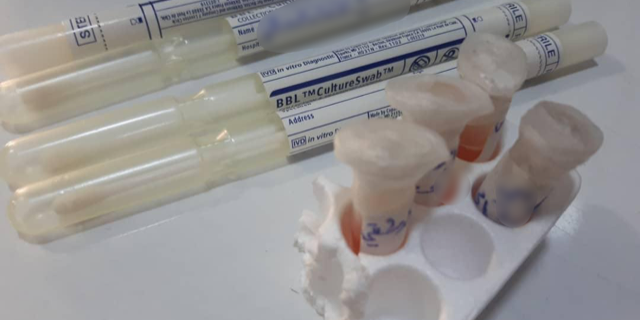
 A specialized team is said to have collected blood, urine, saliva and clothing samples from the injured to be tested, with the hope of starting a thorough investigation by OPCW.

 “We fear this will happen again and again,” Dr. Ahmad said. “They gave a green light to attack.”


 News that the government of Bashar al-Assad may have used internationally banned substances once again has prompted a harsh, if confusing, response from the United States.

 “We continue to see signs that the Assad regime may be renewing its use of chemical weapons,” said U.S State Department spokesperson Morgan Ortagus, cautioning that if the alleged actions by the Damascus government are proven, "the United States and (its) allies will respond quickly and appropriately."

 Later, the State Department’s leading diplomat for Syria, James Jeffrey, backtracked somewhat and told reporters that officials were “watching it closely” but could not yet confirm that the alleged attack had occurred.

 The U.S. has twice launched airstrikes in the past against Syrian military installations after verifying that chemical weapons were used against civilians.


 According to the most recent “credibly substantiated” data gleaned by the Berlin-based Global Public Policy Institute (GPPI), chemical weapons have been used at least 336 times since the war started in early 2011. The Assad regime stands accused of using the banned substances 98 percent of the time, while ISIS is documented as having carried out the remainder of all chemical bombardments on Syrian civilians.

 “Assad is once again testing President Trump, first by attacking Idlib despite the President’s clear warning, and now by using chemical weapons – violating the President’s bright red line,” said Jameson Cunningham, policy and public affairs strategist for Americans for a Free Syria. “President Trump has responded twice, and we urge him to take swift military action again to protect civilians and deter Assad from further use of chemical weapons.”


 Idlib remains the last major bastion of the war-embattled country that remains under the control of forces opposed to the Damascus regime. Ground fighting and bombing sharply escalated in the area earlier this month after a seven-month ceasefire agreement seemed to wither, with many fearing it will amount to an all-out assault by Assad's forces that could prove the deadliest battle in the war to date.

 Meanwhile, many in Washington have resumed their push to further punish the Assad government for its long-documented war crimes. The Senate Foreign Relations Committee on Wednesday passed the Caesar Syria Civilian Protection Act, a bill which holds the Syrian leader and its Russian and Iranian allies accountable for the crimes and hampers their ability to fund further human rights abuses.

 The law is named after a Syrian who, under the pseudonym Caesar, took grave risks earlier in the war to smuggle out more than 50,000 images of civilians who were barbarically tortured and murdered in government prisons.

 The Caesar Act provisions include sanctions on anyone aiding Damascus in executing its barbarities, including construction sectors in the war-torn nation until Assad completely halts all attacks on civilians.

 “We have taken high risk for our lives and the lives of our families when we left Syria at the beginning of the Syrian revolution. We had great hope that the world that claims freedom and humanity would put an end to the bloodshed in Syria and work to stop the killing and torture inside the Syrian prisons,” “Caesar” – who remains in-hiding – said this week. “Especially that we have all the evidence and evidence that condemns the regime of dictator Bashar al-Assad by committing the worst types of torture and systematic killing against the Syrian people inside the basements of the Syrian prisons and intelligence.”

 The whistleblower stressed the importance of his namesake legislation being put into full-force by Washington.

 “Caesar's law is a powerful message that justice will be handed to Bashar al-Assad and his oppressive regime." '

Medicines for those alleged to have been attacked by chemical weapons in Syria on Sunday (Provided CVDCS)Â

Wednesday, 22 May 2019

‘Assad or we burn the country’ must not become reality

A civil defence member carries an injured girl following air strikes which hit Idlib, Syria 2 June 2016 [REUTERS/Khalil Ashawi]

 'The bombardment of Idlib by Syrian régime forces over the past few weeks has been relentless; the long anticipated offensive on the city in northern Syria has arrived with devastating results. A massacre of gargantuan proportions awaits as air strikes hit homes, schools and hospitals. More than 120 civilians in Idlib have been killed by Russian and Syrian régime air strikes over the first two weeks of the bombardment, and more than 180,000 have been newly displaced as they flee from barrel bombs.

 Idlib is currently a refugee centre within Syria; it has absorbed most of the internally displaced persons and provided them with new homes, with nearly 4 million Syrian citizens living there. People who have had their lives torn apart and have had to escape bombardment and bloodshed are already anticipating further violence, with some preparing to flee for the second or even third time in just a few short years.

 According to British surgeon David Nott who has visited northern Syria on multiple occasions for humanitarian reasons, 12 hospitals were destroyed in the first 10 days of May and there is considerable evidence that the Assad régime is engaged in the systematic targeting of hospitals and healthcare centres to terrorise and punish civilians who have fled areas controlled by Damascus. The destruction of any form of healthcare and emergency services is clearly the goal of the régime. Civilians who have “deserted the régime” can die of their injuries is Assad’s apparent rationale. The irony is lost on no one that Assad himself was once a doctor but is now more akin to a butcher, destroying hospitals as opposed to saving the people within them.


 The potential taking of Idlib would signify the régime’s re-conquest of the Western Syrian corridor and demonstrate Assad’s so called “victory”. This is a farcical, pyrrhic victory when the Assad régime currently just controls a “rump state” which is both smaller and weaker than the pre-uprising Syria and has in a way given up sovereignty to both Russia and Iran.

 Large swathes of Syria remain uninhabited with some areas in ruins and resembling ghost towns. The régime doesn’t even bother to repair the damage caused or rebuild the areas; it leaves them – for now at least – as the horrific, visible consequence of going against Damascus, and acting as a deterrent for anyone else. The slogan “Assad or we burn the country” which was scrawled in graffiti in many places by the loyalist Shabiha (state sponsored militias) during the early days of the uprising unfortunately rings true. Parts of Syria with revolutionary zeal have been obliterated with no immediate plans for rebuilding. This arrogant belief of Assad has led to untold horrors and the ruin of a nation yet he is still somehow viewed as the legitimate ruler of the country who unfortunately still enjoys the privileges of UN membership.


 A political resolution is impossible while the perpetrator and the root of the problem – Bashar Al-Assad – remains in power. The paralysis of the UN Security Council is nothing new. As long as Russia sees fit to back Assad then he is granted political and legal cover at an international level proving that international law has a long way to go before it is able to hold rogue régimes to account. Even former UN Secretary-General Ban Ki-moon admitted that the Security Council has failed Syria. It is difficult to foresee Russia not using its veto to block any attempt to refer the Syrian régime to the International Criminal Court but recent developments in the case of Myanmar and the Rohingya refugees fleeing to Bangladesh offer a potential legal path to charge the Syrian régime with crimes against humanity.

 Idlib is holding out for now, but when considering the current onslaught by a régime that has been proven to use chemical weapons — and a report suggested that Assad used chemical weapons in northern Latakia as recently as last weekend — the worst is to be feared. If this slaughter goes on in Idlib, it will be a huge humanitarian disaster. The effects won’t be limited to the four million civilians in the city; it will lead to consequences as far away as Europe, with another wave of refugees potentially heading across the Mediterranean.

 The city of Idlib must not be allowed to fall to Assad, and every effort must be made to ensure that he and his régime are held accountable for the crimes committed against the Syrian people. We may one day view Idlib as a flashpoint within the Syrian conflict; it is imperative that history does not repeat itself as it has so many times within this eight-year conflict. The binary choice between Assad and burning the country must not be allowed to become an enduring reality.'

Graffiti Slogan saying 'Assad or we burn the country' in DamascusGraffiti in saying 'Assad or we burn the country' in Damascus, SyriaGraffiti in saying 'Assad or we burn the country' in Damascus, Syria

Sunday, 19 May 2019

Assad militiamen use chlorine gas in Latakia countryside


 'Assad militiamen used chlorine gas bombs in shelling the anti-regime factions in Latakia northern countryside on Sunday (May 19).

 The Assad militiamen used the chlorine gas shells in the Kabina Hill in the Akrad Mountain in Latakia northern countryside after they failed to make any progress on the front, according to the Hayat Tahrir al-Sham's news agency (Ibaa).

 The opposition defected brigadier, Ahmad al Rahal, confirmed the incident. "The Assad regime used chemical weapons (chlorine gas) in the village of Kabina on the coast front," he wrote on his Facebook page.


 The Acting US Ambassador to the United Nations Jonathan Cohen warned the Assad régime against using the chemical weapons during the Security Council session on Friday, adding that Russia and the Assad régime were responsible for the attacks on health centers. He said it was "most alarming" that several of the centres attacked were on a list created by Russia and the United Nations in an attempt to protect them.'


 "Results of failed SAA attempts to capture KbanaSAA losses: 85+ wounded soldiers 58+ KIA 1 BMP destroyed 1 UAV destroyed"

Friday, 17 May 2019

Amina’s three brothers


 'My name is Amina Khoulani. This is not the first time that I sit down and tell people my story, and the story of my three brothers. Tens of news channels, newspapers, events, have been talking to me about the story of my brothers, from 2011 when they were first detained to this time.

 The difference is that in the past I used to talk about them full of hope that I was going to meet them some time again, that they would be released from their prison and I would see their faces, but this is the first time that I will talk about them since I got the news that they were killed under torture.

 It’s very difficult for me to sit down and tell this story.

 When I first received the news, I made a decision that I am not going to tell anyone. I will never attend any event, and I am not going to tell anyone about the story of my brothers.

 We started to lose hope, we Syrians, after we had been telling the story of ourselves a hundred times to everyone, but no-one had listened to our pain, and no-one understood what the pain meant to us.

 Later on I decided that no. I have to tell everyone of their story. I feel very proud of them because they were the first ones who drew the big dream and the big vision of Syria for everyone. And they had a dream like any of you British people, the same as anyone in a country that takes care of human rights.

 I took the decision to tell the story of my brothers and all other young men who sacrificed themselves for the big dream, the big vision of Syria, and democracy and freedom, because they deserve that. They deserve their stories to be told and their remarkable work to be remembered.

 And I will never stop talking about their stories and telling people about how brave and how great they used to be, because it might not be my turn, not in my lifetime, to see accountability and justice prevailing, but maybe the next generation are going to see it prevail. We have to tell the whole world about the crimes of the Assad regime, and the atrocities they committed.


 The first one I’m going to tell you is the story of Majd, the youngest brother of mine, the one that we call in Syria the last piece and the vine of the grapes.

 He was studying law at Damascus University, in his second year. Majd took the decision to go to the streets at the very beginning of the Syrian revolution, and he was a peaceful activist who demonstrated for a free democratic Syria for everyone, a Syria that respects the citizenship of all citizens there.

 The last thing that Majd wrote on his Facebook page was that all the blood of every single Syrian is prohibited from being scattered, including the members of the army and the security forces—the same security forces who took the decision to detain him and torture him to death.

 Majd and his colleagues, they were the ones who initiated distributing flowers and water bottles to the security members and soldiers during demonstrations. Because they wanted to deliver a great message to them, that ‘You and I are one, so why are you killing me?’ And they wanted to tell them, ‘We are peaceful demonstrators, we don’t want any bloodshed.’ And they went to them, to hand them the flowers and the water bottles. On a bottle of water they put the Syrian flag—now we use the revolution flag—and on the other side of the flag they’d write: ‘You and I are Syrians; we are the same, so why do you have to kill me?’ And despite that they were shot by the soldiers. And that day his colleagues were shot and he was detained.

 If Majd was with us today, he could have been a lawyer and working on human rights, or he could have been a footballer, because he was a fine footballer. He used to love friends so much, and this was what was really remarkable about him.

 During all the demonstrations he attended, he used to wear this red t-shirt, and when he was arrested he was wearing that red t-shirt.


 My eldest brother, Abdulsatar, he used to go to demonstrations and participate in them. He was married with two kids. He was almost newly married.

 The Air Force Intelligence, they arrested Abdulsatar, and we didn’t know any piece of news about him. That was the first time where we contacted Amnesty. Amnesty was the first organisation that acted in aid of my brothers after they were detained. But it didn’t work. The regime never replied to any appeals. We did not receive any piece of information about them. And we kept living sometimes in hope and other times in despair until we got the chance to visit them in December 2012 in Sednaya Prison.

 Of course it was an awful shock because we had bribed the officers in the regime to allow us to go to Sednaya Prison, we paid a lot, and we went through all the regime officers, and they allowed us to go see them behind three layers of barriers between us and them. We were only there ten minutes. We agreed to only see them for ten minutes at that time.

 I don’t know why the regime kept chasing my family. In November 2012 we were forcibly evicted out of my hometown Daraya, and we moved to live in Mazzeh, which is close by. But because we hold the ID of being from Daraya, and we are of the Khoulani family which is a family that participated in the revolution, this meant that we were cursed as a family, and the intelligence forces they broke into the house that we rented in Mazzeh and they arrested my other two brothers, Bilal and Mouhamed, though they had never participated in demonstrations.

 After six months, and after paying loads and loads of money to regime officers to gain any piece of news about my two brothers, we learned that they were taken by Branch 215, and because we paid loads of money they released just one out of two: Bilal.


 Fortunately he escaped to Lebanon, and from Lebanon he got resettled in Ireland, and he is recovering, thank God. He became kind of himself again. He survived. But to this day he shows the presence of torture. He still suffers from the torture.

 When Bilal was first released it was a great happiness for the family, but at the same time it was a disaster, because when Bilal was released from prison he told us that he witnessed with his own eyes that my brother Mouhamed was killed under torture. And he was killed in the detention centre of Branch 215. But we refused to believe. We thought at that time that Bilal, when he was released from the prison, was mentally unstable, and maybe he was hallucinating, maybe he had seen things that had never happened. So we kept that piece of news to ourselves, myself and my other siblings, and we refused to let my mum and dad know about it.

 Mouhamed, when he was detained, literally we wept. His wife was pregnant with his first child, so we didn’t let her know because she was still pregnant, and we thought that piece of news is not true.

 We kept that piece of news a secret until the images of Caesar were leaked, and the first image that we were seeing was the image of my brother Mouhamed. It was horrible. But we still hold to the memories of his previous features.


 I shall remember him as he was before he was detained.

 When my family went to the regime and they asked about the reason why Mouhamed is dead, they received a note that his heart had stopped. He had heart failure. My brother was 24 years old. He was very young and healthy—how come he died of heart failure?

 In 2013, the regime arrested me and my husband at the same time, same minute. We were taken in the same car to detention centres. That was a blow to my family as well, where they lost almost every kid in detention centres for six months, and my husband remained for two years, but we were both released. Everything that happened has never stopped me from speaking up for my brothers and for every detainee.

 Me and a group of colleagues that I’m really proud of co-founded a group called Families for Freedom in 2016 in Geneva.

 If no-one is going to talk about detainees, we are the families of the detainees, and we have to speak up for them. Maybe somebody is going to hear the story, they are going to hear our voice calling for them, and that was the reason for establishing Families for Freedom.


 In 2018, cold-bloodedly, the regime started to release lists of young men and women killed under torture in the detention centres. And that release was very rude where they sent the lists to the civil registry and there they registered them as dead, as simple as that.

 My home town Daraya itself, it received a list of a thousand young men who were killed under torture. Me and my family, we were very reluctant to go and search in the civil registry lists for my brothers, Majd and Abdulsatar, because we wanted to live in the hope that we were going to meet them one day. But later on we found out that no, we won’t then have a closure for that. We have to know their destiny.

 Because no-one of my family is in Syria, no-one was able to get papers from the civil registry, and that was why we appointed a lawyer to take that mission. And we found that my two brothers were both sentenced to death, same day, same minute, 15 January 2013. And this is the piece of paper I received showing that we lost them.

 I myself was a detainee. And I experienced how to be a wife of a detainee when my husband was detained in Sednaya Prison. I also experienced how to be the sister of a detainee. I experienced how to be a human rights defender, to defend the rights of the disappeared, and I experienced speaking up for them and their release.

 What I feel proud of despite everything that I mentioned is that even when I lost my brothers, even when I was in a single cell in the detention centre, even when they threatened to rape me, they threatened to kill my children when I was in prison, threatened to kill my husband, I never lost faith in this revolution.

 I never lost faith in how just this revolution is. Despite that I might never see the results of this revolution with my own eyes, but maybe one day my grandchildren will feel very proud of me. I will never be silent.


 Even if the whole universe is not going to listen to me, I will keep speaking up. And I will keep being proud of this revolution, this just revolution, even if I am the only one remaining in the opposition, because this revolution deserves to exist, to succeed, and one day we might invite you to Syria, and we will all sit together there, and we will talk freely about these things.'

What one activist's death says about war crimes in Syria


 Paul Wood:

 'The Assad régime has disclosed that an opposition activist known as Jeddo had died in prison. He was from a suburb of Homs called Baba Amr, which was one of the first parts of the country to fall under rebel control, the ‘cradle of the revolution’. Every foreign journalist who went there knew him. Before the revolution, he’d had a shop selling vegetables. When street protests started, he picked up a video camera and became a ‘citizen journalist’. His real name was Ali Othman, but a few premature lines on his weathered face had earned him the nickname Jeddo, or Al Jed, ‘the grand-father’. He had jug ears, a ready, gap-toothed smile, and absolutely no fear of death.

 In February 2012, the régime began a relentless artillery attack on Baba Amr. Al Jed took us out in his little Suzuki jeep to have a look. The air was filled with a terrible sound of booms and crashes — the government shells — and a constant crackle of rifle fire — the rebels, using almost the only weapons they had. Jeddo rolled his jeep to a gentle stop in the centre of a crossroads to point out a smoking hole in the wall of a mosque. That’s very interesting, I told him, trying not to flinch with each crash, but perhaps we ought to move? No, no, he said, unconcerned, we’re fine. This went back and forth for an agonisingly long minute, my voice increasingly strained; Jeddo was relaxed, just out for a Sunday drive. Finally, he did a three-point turn of infinite slowness and drove away. Another shell landed, covering the place we’d stopped in a furiously billowing black cloud.

 It seemed as if he had gone a little mad because of the constant danger. I think now that it was something else: an unshakeable determination not to go back to the old days, to do anything to defeat the régime. Remembering him this week, a friend said that Jeddo had been wealthy by his neighbours’ standards (small shop, jeep); he hadn’t joined the uprising to enrich himself. "He wanted only freedom." Many of the activists in Baba Amr believed the rebels should make a stand there, whatever the cost. They knew the régime would win the battle but they thought that a massacre — filmed by citizen journalists such as Jeddo — would force the US and Europe to step in. Baba Amr would be sacrificed for the revolution. Jeddo was furious when the rebels fled, calling them cowards and dogs. ‘They are chit-chatting in Qusayr [a town miles away], watching while Baba Amr is destroyed and their women are violated.’


 He told me that when we got through to his mobile as Baba Amr fell in March 2012. He had dug a hole in his garden, ready to hide when the Syrian army kicked in the door. In fact, he managed to sneak out of Baba Amr, almost the last to leave. But he was caught a month later in a small town outside Aleppo. The story is that a female activist sent him a text telling him to come to collect some video equipment. She had been turned by the secret police, or they had her phone. A month after that, Jeddo appeared in a TV ‘interview’ from his jail cell, shown by a channel that supported the government. Nothing more was heard of him until last month, when the authorities in Homs told his family that he had died. They were given a document saying this had happened on 30 December 2013. The régime had kept them waiting — in hope and dread — for more than five years.

 This official document does not say how he died, though if the family ever get a death certificate it would probably have some innocuous term like ‘cardiac arrest’ or ‘respiratory failure’. That is usually the case with victims of the Syrian prison system. Jeddo’s friends say his broken appearance in the TV interview was evidence that he had been tortured. They could not imagine him doing the interview at all unless forced to. The Syrian Network for Human Rights says that almost 14,000 people have been tortured to death in Syrian prisons. Jeddo’s family and friends assume this is what happened to him. A fellow activist told me he didn’t want to believe it but said: ‘He’s better off dead.’

 The activists know all too well what happens in Syrian prisons. One survivor told the press this week about a guard who called himself Hitler and who made prisoners get down on all fours and bark like dogs or bray like donkeys. Prisoners were stripped naked and beaten, hung from wires, soaked with cold water, starved and forced to fight one other, even to kill other inmates. A report from the UN Human Rights Council quotes a man who was held in the Damascus Political Security Branch. ‘The officer took two girls, held their faces down on the desk, and raped them in turn. [He] told me, “You see what I am doing? I will do this to your wife and daughter.”’ Sexual violence is common. I once interviewed a government militiaman captured by the rebels who said — with no trace of emotion — that his job had been to rape women arrested at anti-government demonstrations. All these stories speak of systematic torture. It is policy. No one in Syria believes otherwise, whatever the régime’s public protestations.


 A body called the Commission for International Justice and Accountability — funded by several western governments — has been investigating Assad’s culpability. They are not trying to prove he is guilty of this or that specific war crime, but that he runs a system where such crimes are routine, so-called command responsibility. They have collected some 800,000 documents — the Syrian régime is meticulous in its bureaucracy, everything written down. The organisation’s spokesperson, Nerma Jelacic, told me the evidence against Assad was ‘very strong’. The idea was to have a case ready to go immediately if Assad were arrested.

 Assad knows enough not to travel to any western countries. Russia will use its veto in the UN Security Council to stop the creation of a Syrian tribunal at the Hague. But some argue that the UN General Assembly could vote for the tribunal by a two-thirds majority. And Assad might be toppled, not by the rebels but as a result of the régime’s vicious internal politics. President Milosevic of Serbia thought he was safe from the Hague until a successor handed him over. General Pinochet went to London for medical treatment and was arrested on human rights charges. Philippe Sands, a QC who knows this area of law better than anyone, says a war crimes prosecution hangs over Assad ‘like a sword of Damocles… A leader needs to know the possibility of justice is real.’ He would not be surprised to see Assad in the dock eventually. For a large part of the Syrian population, the war will not be over until he is.'

Thursday, 9 May 2019

Daraya: A Library Under Bombs in Syria


 'This is the tale of a group of young rebels in Daraya. Daraya was besieged and bombed by Bashar al-Assad's regime from 2012 to 2016.

 During the relentless four-year blockade, these 20-year-old revolutionaries challenged themselves to open a secret library in a Daraya basement, in order to save some 15,000 books that they dug up out of the rubble.

 As the months went on, this paper agora gradually turned into a clandestine university. It became an open debate space, where chairs were sometimes pushed aside for dancing, where slogans were invented, newspapers were written, and ideas were born while guns relentlessly fired up above. Life, despite it all. An incredible breath of fresh air amid the Syrian chaos.

 I was never able to visit them. Daraya was completely surrounded by the regime's army. But thanks to the internet, and the magic of Skype and WhatsApp, I created a special bond with these incredible book saviours.

 Amid bombs and power cuts, I listened to and wrote down their stories. I probed their fears and dreams as I tried to make out their city's skyline.

 Whether in the morning or at the dead of night, I listened to them tell me about their everyday life.


 I remember what I thought back then, as I spoke to them, seeing the first images they sent over. They were young people who looked just like us, who wear Adidas T-shirts and washed-out trainers. They were funny, curious, and full of life … They were far off from the "terrorist" label that Bashar al-Assad insisted on giving them.

 When night fell, they would watch Amelie on their laptops. They devoured Paolo Coelho's Alchemist. They were fascinated by Steven Covey's Seven Habits of Efficient People, while their city crumbled under the bombs falling from the sky (up to 80 a day).

 Refusing to accept isolation, they even sent letters to the United Nations and to Francois Hollande.

 They also wrote to me, the day after the November 13 attacks, to express their solidarity to the people of France.

 There was Ahmad, the library cofounder.

 Shadi, the citizen journalist who documented everything.

 Hussam, the flirt.

 Omar, the anti-Assad fighter who wouldn't stop reading.

 And around 40 or so young people who accompanied them, bringing a fragile and threatened dream to life, day by day.

 We see them tending to vegetable gardens to answer to the food shortages. Melting plastic to make fuel. After every lull, they tirelessly lift their heads up high once again.

 One day, we see them building a football pitch where shells have fallen the day before. Another day, they are decorating the empty shells of destroyed houses with joyful graffiti. On yet another day, they have fun filming children making cakes out of earth, mocking the absence of flour.

 I was struck by their resilience, by the collective solidarity that they never ceased to believe in. For four years, they resisted as a group. They braved explosions, the cold, power cuts, the lack of running water. Humour became their defence mechanism. Dignity became their best shield against barbarity.


 I remember how during my first contacts with them I was touched by their fervent attachment to the democratic values of the early moments of the 2011 revolution … and to culture, which they defended like a survival instinct.

 We could feel their will to stay loyal to the pacifist spirit of one of their friends who was tortured to death by the regime. He had invited protesters in the first demonstrations to respond to the Syrian soldiers' bullets by offering them gifts of roses and bottles of water.

 Despite the violence of the bombing, despite the Islamist temptation for some, these young people never ceased to answer to the unfailing barbarity of Damascus with the language of peace. They organised debates in which they promoted dialogue, always favouring discussion and listening over following a definitive plan. The obstination to build a political ideal based on respect and non-violence underlay everything they did.

 This ideal was illustrated, for instance, by the peculiar choice to place the different Free Syrian Army battalions (anti-Assad forces) under control of civilians from the Local Council (contrary to other rebel cities, such as Homs or Aleppo).

 I was constantly surprised by their ability to never renounce the hope of a better tomorrow. Defying fear and death, they intensified their creativity, embarking on new projects every day.

 Daraya, the symbolic cradle of the anti-Assad revolt, was also peculiar in that it woke up well before the 2011 uprising. My informants told me that in Daraya, civic engagement goes back to the 1990s. At the time, a group of dissidents started a number of citizen initiatives on the quiet - anti-corruption campaigns, anti-smoking campaigns, etc - in order to raise awareness among the inhabitants about claiming their rights.

 These revolutionary pioneers transmitted a kind of civil disobedience to Ahmad, Shadi, Hussam, Omar and all the young people of the new generation.


 Their relationship with books also says a lot about their attachment to democracy and the pluralist ideal. Saving books also meant saving their heritage, preserving a few traces, however minute, of their past and their cultural identity that were getting erased under the daily effect of bombs.

 It meant resisting the regime, along with its ideology and propaganda.

 One of the principles for their secret library involved writing the owners' name into the first page of each book, in the hope of giving it back once the war was over. Much to my surprise, I discovered that their paper refuge had precise rules: opening hours, return dates to be respected … They said it was a way to introduce some order into the chaos of their everyday lives.

 When all they had left to eat was a daily soup made of nothing but leaves, reading became their spiritual food.

 In the library, they read everything they could get their hands on: theology books, political science books, novels, American-style self-help books. As the months and years went by, they became fascinated with the Tunisian 14th-century sociologist Ibn Khaldoun, devoured the poems of Palestinian Mahmoud Darwish, took interest in Mustafa Khalifa's Shell, discovered Victor Hugo's Les Miserables, as well as Shakespeare's plays.

 Surrounded by tanks, with no escape, they took refuge in their books. When the bombs went quiet, their fighter friends would sneak away from the front lines to come and read with them. They read to stay human, to not succumb to madness. They read to escape. To keep a door open onto the world. To continue learning. Reading was their weapon of mass instruction.


 Towards the end of August 2016, the small group of friends was forced to evacuate Daraya within 24 hours, along with its 7,000 last resistors (the city originally numbered 250,000 inhabitants). They fled after having been through hell: hunger, explosives, chemical weapons, and, towards the end, a series of Napalm attacks that set fire to the city's only hospital.

 Delocalised to the Syrian province of Idlib, on the border with Turkey, 300km north of Daraya, they had to abandon their cavern of books, their graffiti and their broken dreams, against their will. When they left, the regimes' soldiers quickly plundered their collection.

 After a few months, some of them decided to cross the border. Shadi wanted to get medical treatment for his injured hand in Istanbul. Hussam went to join an NGO that was operating from Gaziantep.

 Of course, we met up. It strangely felt like we had just seen each other yesterday. But direct contact added an extra dimension to their story. I remember sitting with Chasi in a cafe, watching him unwrap a plastic bag filled with dozens of hard discs full of last-minute images of Daraya … I can still picture Hussam telling me that he was renouncing his pseudonym to take back his old name, Jihad. After four years of forced confinement, he was planning to get married, to travel, to go elsewhere.

 That's when I understood that this story, their story, was not over. It continued through the images, through all of the unedited videos of the blockade reported by Shadi to Istanbul, that I watched in great detail. It lived on through the burning desire that they felt to reunite. To consolidate a friendship that had been forged under the bombs.

 Mainly, it continued through their wish to keep the Daraya flame and the library dream going. Ahmad recently inaugurated a library bus in Idlib in Syria, where he chose to stay, a bus that continues to deliver books to women and children on site to this day.'


Monday, 6 May 2019

Goal of Russia's Idlib assault is to take highways

Image

 'Syrian rebels backed by Turkey said on Monday that Moscow and its Syrian government ally were trying to wrest control of two major highways in their last enclave in the northwest of the country in a bid to shore up Syria’s sanction-hit economy.

 The sixth day of the campaign by government forces saw heavy aerial attacks targeting the city of Jisr al-Shughour and the al-Ghab plain, as well as the towns of al-Latamenah and Maarat al-Numan in the south of Idlib province, the rebels said.


 Taking those areas would bring President Bashar al-Assad close to regaining control over the strategic M5 and M4 highways from Aleppo to Hama and Latakia on the Mediterranean coast, two of Syria’s most important pre-war arteries.

 The first few days of the assault struck at towns in northern Hama and southern Idlib province inside a buffer zone agreed in September between Russia and Turkey as part of a deal which averted a major offensive on the area, the last major foothold of the Syrian rebellion.

 Russia and the Syrian army say they are responding to stepped up attacks by jihadists on government-held areas and deny indiscriminate strikes that medics and rescuers say have killed dozens of civilians in recent days, knocked down at least five medical centres, and paralysed day-to-day life.

 The United Nations has said the attacks have included the worst use of barrel bombs by the Syrian army in 15 months. It says an estimated 323,000 people have been displaced in northwest Syria since September last year.

 Residents say tens of thousands have fled their homes, many to camps on the Turkish border, since the latest offensive began. Some who failed to reach those camps sought shelter in olive orchards, residents and witnesses said.


 “The shelling and aerial strikes have increased in intensity and ferocity and the area hit has widened with more intensity,” Naji Mustafa of the Turkey-backed National Liberation Front (NLF) rebel group said.

 Russia says Turkey has not done enough to evict jihadists from the buffer zone or to open the M5 and M4 highways that link cities held by the government and run from Syria’s southern tip near the border with Jordan to the northern border with Turkey.

 Opening the commercial and passenger routes through Idlib province would reassert the state’s control over a fragmented economy that sprung up during eight years of conflict and now facing U.S. and EU sanctions, economic experts say.

 Russian President Vladimir Putin said last week that he did not rule out a full-scale assault on militants in Idlib province, after Russian officials publicly questioned how far they would continue to tolerate jihadist control.


 The Syrian opposition seeking to topple Assad accuse Moscow of using the jihadists as a pretext to step up attacks on civilian areas and put pressure on Turkey.

 “There has long been a Russian aim to capture these highways. This is rejected as a princple of our revolution and it would have meant the displacement of tens of thousands of people who live in the area and refuse to be under Russian (rule),” Major Yousef Hamoud, spokesman for the Turkey-backed National Army said.

 The loss of opposition control over the highways would mean the loss of a financial asset for the rebels, as well as be a sign of their weakening hold on their last enclave.

 It would also undermine a sphere of influence that Turkey has carved out in recent years in Syria.'