Thursday, 15 March 2018

Syria Is In No Civil War


 'Having now completed its seventh year, the Syrian conflict, one of the deadliest humanitarian crises of our time, continues to be characterized as a civil war.

 Such a categorization, however, is both inaccurate and troubling, as it simplifies a very complicated situation.

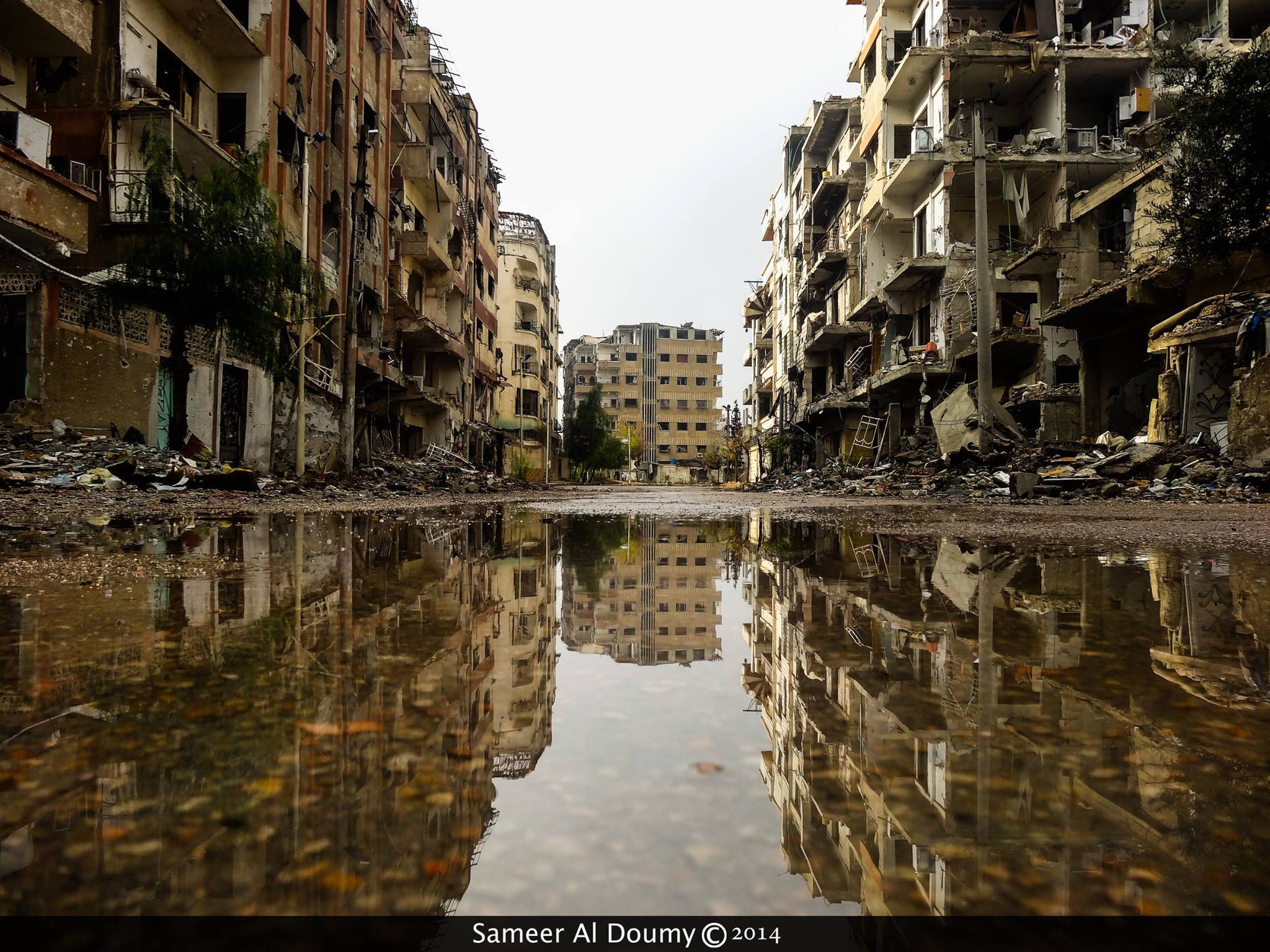
 It allows us to become disillusioned with the idea that problems “over there” are just that and have no impact elsewhere, resulting in a collective numbness and shrugging-of-shoulders when images of war-torn Syrian cities and towns (too rarely) dominate our front pages.

 Such a simplification is dangerous.

 It exonerates the international community of responsibility, producing global apathy. It allows internal and external groups to justify their involvement and use of violence, fails to acknowledge the direct and active role of powerful players like Russia and Iran, and gives Syrian president Bashar al-Assad a facade of legitimacy by equating the killer with the victims.


 In March 2011, following decades of stagnation and oppression, a sudden awakening of a disenchanted Syrian populace – one which had lost patience with a failing, anocratic state – swept through the nation when a group of teenagers were arrested and tortured in the southwestern Syrian city of Daraa for painting graffiti featuring messages in support of the Arab uprisings.

 Daraa’s consequent rallying cry for the release of the boys was met with a ferocious crackdown of security forces, who reverted to the logic of violence by killing and detaining innocent civilians.

 Struggles for freedom, economic woes, and public anger over harsh government retaliation resulted in a shift in chants from local and reformist demands, to a call for the complete overthrow of the Assad regime.

 Further, the toppling of the Tunisian and Egyptian regimes fuelled hope among Syrian protesters, who continued risking their lives demanding dignity (karama), liberty (hurriyya), and revolution (thawra).


 Armed resistance against the Assad regime grew in the form of self-defence as soldiers began defecting from the Syrian military via YouTube videos following the summer of 2011. This led to the birth of the Free Syrian Army, marking the weaponization of the conflict.

 There are local factions that fight against one another from time to time – still, the underlying power dynamic between the regime and the Syrian people is one that is too convoluted to be characterized as a civil war.

 We see this in the arbitrary violence perpetrated by the Assad regime against a helpless populace.

 Soldiers were forced to shoot unarmed demonstrators or were shot themselves. Stadiums and school classrooms were turned into prison camps where mutilation and torture of the worst kinds imaginable were inflicted on men, women, and children, including the elderly and wounded. Public rape, forced starvation, aid obstruction, and indiscriminate executions were used as instruments of warfare and deterrence.


 This degree of atrocities deployed against a largely unarmed population failed to suppress rebellion. The regime’s survival strategy – one of oppressive tactics and its attempt to blame sectarian divisions and foreign conspiracies for the violence – proved ineffective.

 And so, in a deliberate attempt to aggravate the conflict and radicalize what remained of formerly peaceful demonstrations, Assad released dangerous extremists from prison – a number of whom now compose the majority of ISIS leadership. This has helped him shift the narrative, emphasizing so-called Islamic terrorism as a key characteristic of the conflict, thereby presenting himself as a partner in the global war on terror and justifying his use of violence.

 How can we refer to the conflict as a civil war, given the vast amount of external interference?


 Foreign powers have prioritized violence and significantly exacerbated the conflict.

 Following the outbreak of demonstrations in 2011, Shiite fighters from Lebanon, Iraq, and Iran were immediately deployed in Syria to support the Assad regime.

 Moscow has also been integral to Assad’s survival. Since 2015, Russia has been launching airstrikes targeted at Syrian rebel forces, which often entails targeting Syrian neighbourhoods, hospitals, and schools.

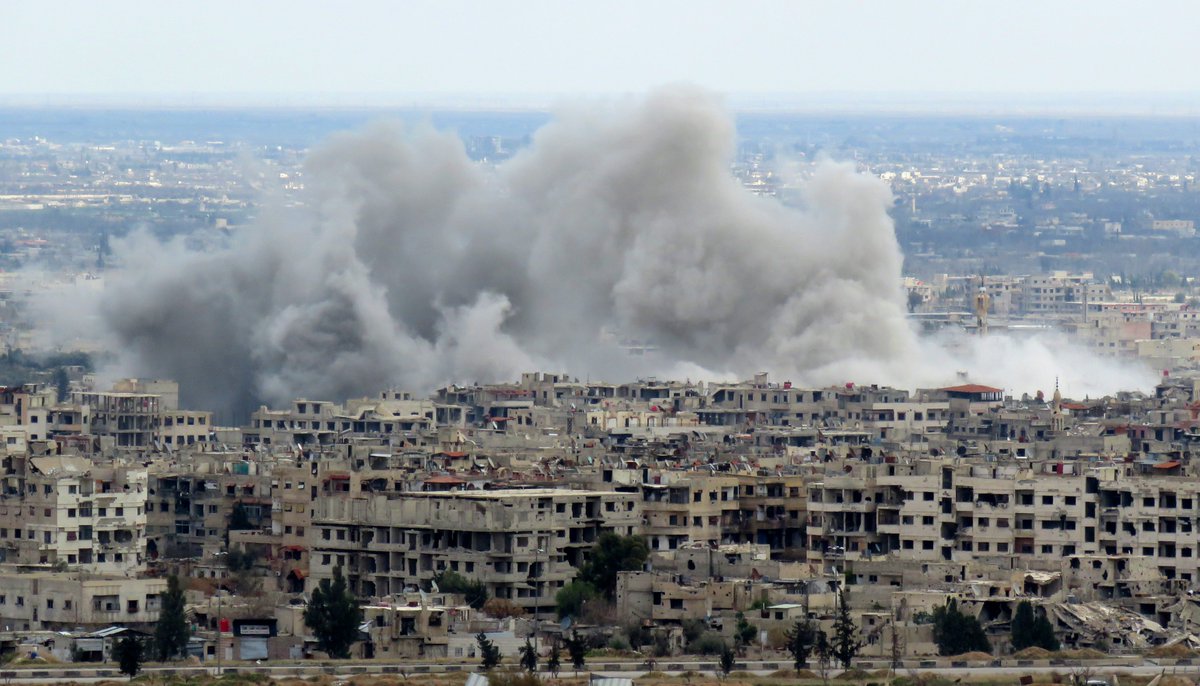
 The most brutal bombardments are currently being carried out by pro-government forces in eastern Ghouta, an agricultural, rebel-held enclave located in the northern Damascene countryside that has been under siege since 2013 and is home to an estimated 400,000 civilians. Since mid-November, over 1,200 air strikes and more than 6,000 rockets and shells – some of which have reportedly contained chlorine gas – have been fired at the enclave. This is despite the fact that eastern Ghouta was declared a “de-escalation zone” last May; that is, the region is under a diplomatic ceasefire agreed to by Russia, Iran, and Turkey.

 The death toll in eastern Ghouta continues to rise. In a one-week period earlier this year, the number of casualties exceeded 500, with thousands of civilians severely injured. Relentless air and artillery strikes have forced civilians to seek shelter underground and has left the region largely deprived of medical care, foodstuffs, sanitation, and other basic necessities.

 The conflict has produced well over five million refugees and six million have been internally displaced – more than half of the country’s pre-war population. More than eight million children have been affected by the conflict and over 13 million Syrians are in need of immediate humanitarian assistance. Nearly half a million people have been killed, more than two million injured, and more than 65,000 have disappeared in Syria’s torture prisons.


 This is a war carried out by Assad and his foreign allies against the people of Syria, a murderous campaign to exterminate a nation in order to maintain a long-standing power dynamic in the region.

 Do not equate the killer with the victim.

 This is not a civil war.'

Monday, 12 March 2018

Assad’s rape victims break their silence


 Yvonne Ridley:

   'The torture victim stood in front of her tormentor wondering what treatment would be meted out this time in the notorious Branch 215, also known as Raid Brigade run by military intelligence in Damascus. Would it be a merciless beating or would it be another sex assault on her already broken body?

 The start of the investigation was interrupted suddenly by a ringing telephone and she watched and listened with incredulity as the voice laughing and giggling down the line prompted the torturer to break into a warm smile. Almost automatically, he softened the tone of his voice, for that is the effect most daughters have on their fathers.

 In the seconds that he looked away from his torture victim he had morphed from brutal monster into a warm and caring father. This was one of the more chilling aspects that emerged from the stories I heard from Syrian women who have been swept up on an industrial scale and thrown into Bashar Al-Assad’s prisons since the start of the 2011 war. The cold reality is that the mass rapes, sexual assaults, punishment beatings and mental torture are being inflicted on women routinely by someone else’s fathers, husbands and even grandfathers.

 At the end of the shift, these men must return to their family homes and normality, having completely destroyed the lives and souls of the women and young girls in their grip. The harsh reality is that if your husband works in Branch 215 then he is probably a serial rapist or is standing by as a spectator watching the most heinous, unimaginable crimes being carried out on women prisoners and girls.

 I wonder how this particular monster responded when he got home and was asked, “What did you do today, Daddy?” Obviously he would not be telling his daughter about the teeth he smashed, the bones he had broken or the sex he had forced on his victims.


 While trying to shine a light on this dark underbelly of the Assad regime, I met several women who ended up in Branch 215 or other equally terrifying prisons and ghost jails run by the Syrian regime. In every encounter, the image of Bashar Al-Assad loomed large, either in portraits hanging on walls or on the T-shirts worn by the men responsible for the brutal rapes.

 Yes, you read that accurately. Incredible as it may seem, the face of the Syrian leader is emblazoned on T-shirts worn by the rapists in his employ, as if he defiles Syrian women by proxy. No wonder that many who manage to get out of the prisons cannot bear to look at the face of the Syrian leader. Those small, thin lips and piercing stare must send shivers down their spines every time they see his image.

 “Some days I manage to forget what happened to me,” Noor told me, “and then suddenly I’ll see someone sneer or curl their lip in a certain way and it acts like a trigger; I’m back inside 215 suffering from a flashback, feeling terror and anxiety.” Three years on from her own ordeal she puts on a good face for the outside world but you just know, in her darker moments, that she’s plunged back into the stuff of nightmares.


 Badria is not as fortunate; for her, the nightmare continues five years after she and 40 women in Homs were rounded up and taken to an apartment in the Syrian revolution’s fallen capital. When she was arrested she was dressed in black and wore a full face veil, which made her more of a target for her Alawite captors who taunted, mocked and abused her for her piety.

 Once the captors had left the large, spartan room she began to perform tayammum using the stone floor because normal wudu — the Islamic ritual of washing before prayer – was impossible. Unknown to her, CCTV cameras caught her actions and as soon as she tried to prepare for Salah the men returned and beat her with sticks.

 She had her feet and wrists bound and was left hanging from a ceiling hook by the rope around her hands. Every time she mentioned the name of God or any Islamic reference she was beaten. Hands shaking, she looked at me and opened her mouth slowly before removing her dentures. Her teeth, top and bottom, had been shattered by the sticks swung hard and with deliberate precision across her face. Her cheekbones were fractured.

 “I used to have full breasts,” she said as she lifted her shirt, “but now look.” Doctors have told her that the beatings across her breasts were so severe that the tissue was destroyed and will probably never recover. In terms of dress size she was probably an English 14, medium to large when she was arrested, but as she sat before me she looked more like a Size 6, a skeleton draped in skin which will bear the scars of captivity for life.


 Speaking through a translator, she told me how the women in her group were taken into a smaller room where they were raped and humiliated by two or more of the military intelligence officers. There, above the bed, staring down, were portraits of Assad and his brother Maher. To the side of the bed was a small table with various bottles of alcohol for the men to drink.

 To combat their drunken state, explained Badria, they took blue pills before forcing themselves on their prey. She also described how some would put an orange pill under their tongue. After some research I concluded that the drugs she described were the blue diamond-shaped Viagra and the orange pill Levitra, which works four times faster in some men, taking effect after just 15 minutes.

 There was no need to ask Badria if she had been sexually assaulted; the detail she provided about the inside of the rape room, the pills and the alcohol, and the portraits of the Assad brothers leering down told me all I needed to know. She had been forced into the room on numerous occasions where cameras were also installed and the women were led to believe that their images and photographs had been taken.

 She told me of one woman who was “gang raped to death” while another had simply lost her mind. Freedom for Badria came at a price; $17,000 was the ransom paid by her family to get her out of prison. If she thought the nightmare would end then, though, she was wrong. Her husband did not survive the military prison in Homs where he was held; witnesses told her that he died after having his eyes gouged out by his captors.

 Her father and one of her brothers were martyred fighting in the Free Syrian Army and the brother who borrowed so heavily to get her released is now in prison himself, being unable to repay the debt. Meanwhile her sister has been arrested and locked up, and those left in the family are trying desperately to raise the $1,000 being demanded for her release. So not only is the Assad regime abusing women on an industrial scale, but it is also making money out of their misery and running what amounts to a sordid slave trade.

 Badria’s son, aged around seven, sat in silence as his mother told her story; every now and again, when the details became too graphic, she sent him on an errand. He looked nearly as traumatised as his mother who was shrinking before his eyes in stature and health. She looked so frail as I got up to leave, that it was difficult to give her a sisterly hug; I honestly felt that she might snap.


 At another house I was taken to I met a mother-of-five called Aishah who was arrested in the early days of the war because she had taken part in the street demonstrations. She was taken to Branch 215 where she was beaten “in a humiliating manner”. She was moved around the intelligence system and taken to three other branches, including one at Adra.

 During her incarceration she saw girls as young as seven, old women and every age in between detained, raped and abused. She spoke of the five military officers who put on T-shirts bearing the portrait of Assad before carrying out their gang rape on one woman. “They declared Assad to be their god,” she said.

 Now living safely on the Turkish border near Hatay with her five girls aged three to 17, Aishah is widowed. Her husband, who was also arrested and abused, survived his prison ordeal only to be killed in an air raid in eastern Ghouta three years ago just after the birth of his fifth child.


 The women I met all want justice. They want to see the men who tortured, raped and abused them stand trial for the war crimes that they have all undoubtedly committed. I’d like to be able to report that they are now safe and secure but I’m not sure that they will ever be able to recover fully. One told me that the moment she closes her eyes she’s back inside the hellish prison, waiting for Assad’s men to pounce.

 What makes this all so much worse is that there are believed to be around 7,000 women and 400 children still inside the Syrian regime’s jails. That is what last week’s Conscience Convoy to the Turkey-Syria border was all about; 10,000 women from 55 nations assembled to demand the release of the prisoners.

 I don’t care if it takes money to get them out of the grip of these monsters, but having spoken to the victims, I know for certain that Assad can never be part of the solution in Syria. In more than 40 years as a journalist, I’ve interviewed prisoners from Abu Ghraib in Iraq, Bagram in Afghanistan, Guantanamo, Abu Saleem in Tripoli and Toulal 2 Prison in Meknes, Morocco, but I have never encountered evidence of so much depravity and inhuman behaviour on such a large scale as what is unfolding right now — even as you read this — in Assad’s prisons.

 There is a brutal regime in Damascus, run by monsters who masquerade as doting husbands and family men in homes around Syria while carrying out of the most horrendous crimes. “What did Daddy do at work today?” Trust me, you don’t want to know, habibi; Daddy and his monstrous associates have to be stopped.'

Sunday, 11 March 2018

A Kurdish couple's love blossoms under Assad's torture

Azad Osman and Sefira Sido, who are Syrian Kurds from Afrin, are now living in Turkey's Mersin province along with their children. They have long been persecuted by the Assad regime.

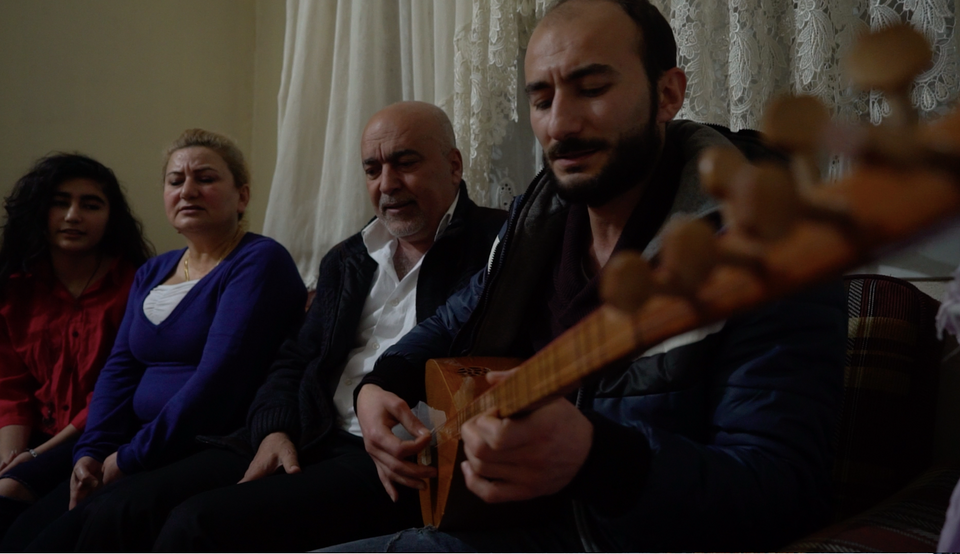
 'On the afternoon of February 12, a Kurdish family of four from northern Syria broke into an old Kurdish song. “Once upon a time there was a girl from Afrin, whose heart was broken...,” they sang in unison.

 Azad Osman, his wife, son and daughter sat in the living room of their apartment in a poor suburb of southern Turkey’s Mersin province. With his head down, the 53-year-old Osman followed the notes of the Turkish saz, its chords struck by Dilar, his son.

 For a moment, the family seemed to have drifted away from all their worries, away from morbid memories of war and trauma. But as they finished singing, they were back to reality.

 They are refugees who have not only survived the deadly bombings of the Assad regime, but also endured the abuse and trauma inflicted by the YPG, an armed extension of the PKK, which is considered as a terrorist organisation by the US, EU and Turkey.


 Both Osman and his wife, Sefira Sido, had been punished for espousing the communist cause since their youthful days. Their union began at the University of Aleppo, while at a protest against the dictatorial policies of Syria’s former president Hafez al Assad in 1987.

 First, intelligence officers arrested Osman on campus, then they picked up Sido from the nearby nursing college, where she was pursuing her diploma in paramedical sciences.

 “They (the intelligence police) took me to different places and then they finally led me into a small room where Azad was held,” she said.

 She saw Osman naked, handcuffed to the ceiling.

 “They asked me, 'how do you know each other,’” Sido recalls. “I told them, ‘I love him.’”

 She was moved to a women’s prison cell, where she spent 15 days before her release. Osman was released soon after. But they were both blacklisted. And they were dismissed from their schools and all government-run avenues were closed for them.

 Though they have grown disillusioned with the communist cause, their love for each other is resolute. When Sido speaks about Osman, her eyes still light up with joy and she often tells him 'hezdikim', 'I love you' in Kurdish.


 Born in 1965 in Aleppo, Osman grew up in a politically active family. Though his father was a peasant who struggled to make a living, he was affiliated with the Kurdistan Democratic Party (KDP), a political front currently led by Masoud Barzani in northern Iraq.

 In the 1960s, Osman’s father worked for the front’s branch in northern Syria. Barzani's father, Mullah Mustafa Barzani, led armed assaults against the then-governing Baath party in Iraq. He also spoke critically of the party’s extension in Syria led by former president Hafez al Assad.

 The Baathist regime in Syria perceived Barzani’s KDP as a threat, frequently launching military crackdowns against its members in Syria.

 Since Osman’s father was a frequent target of those crackdowns, Osman did not have a happy childhood. “When I was about six or seven years old, my mother woke me up. I got up to see my father being taken away. They were hitting him and dragging him,” Osman said.

 “It was very difficult and hard, my father was being hit and dragged right in front of my eyes. Time passed; I grew up. But what I witnessed then stayed with me.”


 In his early 20s, Osman became a member of the Syrian Communist Party, which was founded by a Syrian Kurd named Halit Bektas. The party underwent a split in 1986 and ideological differences emerged within various communist networks in the country. But Osman stayed loyal to the communist cause for almost 24 years.

 But in 2004, he couldn’t relate to the communist movement anymore, although he was smouldering with the revolutionary sentiment.

 Osman came to believe that communist parties in Syria had been hijacked by the state. His longtime comrade Mustafa Ali Mousto said that it took them a few years to understand that some of the leftist groups in the country had grown "under the wings of Assad’s Baathist regime.”


 By the mid 1990s, Osman formed a civil society group to moderate discussions on democracy among the Syrian people. He cultivated friendships among the “like-minded” Kurds, who shared similar grievances against the Baathist regime, and the PKK and its proxies.

 His drive to build up a strong opposition took him to Iraq, where he reached out to anti-Baathist networks. By the early 2000s, he had developed strong ties with “several small groups” in Sulaymaniyah, a predominantly Kurdish city in northern Iraq. He discreetly hosted meetings, introducing prominent Kurdish community leaders who held anti-Baathist and anti-PKK views, in Sulaymaniyah, Erbil, Aleppo and Damascus.

 Around the same time, he also set up a food company in Sulaymaniyah. But he couldn’t dodge Assad’s shadow state for too long. He was arrested in 2007 for conspiring against the regime, a charge that was commonly slapped on people for speaking against Assad.

 Unlike his previous detention, which lasted for two weeks, this one was much longer. He was imprisoned in the notorious Sednaya Prison, which is known as “Assad’s slaughterhouse," where 13,000 people have been secretly hanged by the Syrian regime, according to Amnesty International.

 His fellow prison inmates held differing political views. They were largely affiliated with Al Qaeda and the PYD, the PKK’s political extension in Syria.


 At times, fist fights would break out over political disagreements. Osman managed to survive the toxic prison environment. One thing always kept eating at him from the inside though: his longing for his wife Sido.

 For two and a half years she was denied a jail visit to Osman. When she was finally allowed to see her husband, she could not speak at all. “She just kept crying,” Osman said.

 Osman befriended several inmates who somehow shared a similar worldview and they all aspired for a revolution. The revolution did happen, but it did not happen in Syria. In 2011, the wave of the protests, dubbed Arab Spring, swept Tunisia, Egypt and Libya, pushing long-serving dictators out of power.

 “We were happy to hear that and we hoped it will come to our country too,” Azad said. “We had debates in the prison, some of my friends would say that the regime is too strong, fascist and indestructible. But I held the opposite view saying that the Spring would come to Syria anyway.”


 By March 2011, tens of thousands of Syrians were inspired by the Arab Spring. They took to the streets, demanding the resignation of Bashar al Assad.

 But the regime retaliated with brute force, killing hundreds of protesters, raiding towns and villages to quell the uprising. In retaliation, the Syrian people were compelled to take up arms to save themselves from Assad’s military, which was baying for blood. The hopes of Osman and his inmates to see a peaceful Syrian revolution succeed were soon dashed as the country slipped into a civil war.

 As the armed opposition made some territorial gains, Osman said, the Assad regime opened its prison gates, releasing several hundred members of Al Qaeda and the YPG/PKK.

 At the same time, Assad’s security forces withdrew from predominantly Kurdish-populated northern Syria, leaving the YPG as an essential force there.

 The idea behind releasing the dreaded militants—accused of horrendous terror acts—was to open several fronts and divide the opposition along ideological lines.

 Osman was released along with hordes of other prisoners.


 The amnesty was a calculated move. It opened a new macabre chapter of deaths and destruction in Syria. The armed revolution, that was recognised by global powers like the US, the UK and Turkey, was undermined as members of Al Qaeda, released by Assad, and other extremists groups started to mobilise, recruiting foreign fighters and raising money from the Gulf countries. Amidst the wave of extremism, Daesh emerged as another force, besides Al Qaeda-backed fronts like Al Nusra.

 “They aimed to spoil Syrian revolution by releasing those militants,” Osman said. “They soon assumed leadership positions in Al Nusra and Daesh.”

 “They (the Gulf monarchs) spread fear among their population by giving them an example of Syria. They said, 'If you want democracy, look at Syria,'” Osman said. “Even Nigeria's government used Syria’s example to bring its population under control. In the end, Syria was sacrificed.”

 On the other hand, Assad held his fort in Damascus with the help of Russia and Iran. While Russia provided military support to Assad, Iran sent its Shia militias to fight the revolutionary forces.


 Osman picked up arms in 2012. “We were dragged into the war,” he said. “We tried hard to sort out things in a peaceful manner but so many people were arrested and it didn’t work.”

 Osman joined a fighting group called the Liwa al Tawhid Brigade, which fought against both the Assad regime and Daesh.

 For Osman, a Syrian Kurd, there were many battles to fight. Apart from defending the Syrian revolution, he wanted to protect the Syrian Kurds from Assad’s influences.

 In one of the battles he fought in Aleppo, he witnessed co-operation between the Assad regime and the YPG. He could never come to terms with the YPG's tacit alliance with Assad, since he grew up witnessing his father and many other Kurds being tortured by the regime, scarring his childhood.

 “There is a neighbourhood in Aleppo called Ashrafieh,” Osman said. “The arms coming out of police stations and warehouses were distributed among YPG members there. From that point onward, I knew that no Kurd would join the civil war. Why not? Because the YPG would prevent them. With the regime’s support, no Kurd will join the war.”

 The tactic worked. The Syrian Kurds saw two forces — Daesh and the YPG — emerging out of the civil war. “The war got much worse. As Daesh got stronger, so did the YPG. The more Daesh’s horrific videos spread online, the stronger the YPG became on the ground,” Osman said.


 Back in the 1970s and 1980s, the Baathist regime, led by Assad’s father, worked hand-in-glove with various extremist groups, including the PKK and Hezbollah. In the late 1970s, when the Baathist regime occupied Lebanon’s Bekaa Valley, the PKK and several Shia militias ran training camps under Hafez al Assad’s supervision.

 The camaraderie continues to this day. Posters of Bashar al Assad and the founder of the PKK, Abdullah Ocalan, hung next to each other on the streets of Aleppo’s Afrin district after Turkey started a military operation, Olive Branch, in late January to clear the YPG militants from the region. Ocalan has been serving a prison term in Turkey since 1999.

 “YPG’s desire to turn Afrin into a second Qandil is a huge problem,” said Azad, whose father was born and raised in Afrin. “As for Turkey’s Operation Olive Branch, Turkey is a big and strong nation. Turkey wouldn’t allow Afrin to become a second Qandil (the PKK stronghold in Iraq) in front of its eyes.”

 In 2013, he moved his family from Syria to Turkey. But he continued to fight. In 2014, both Osman and his son had a close shave with death. Their safe house in Aleppo came under a mortar attack by the regime forces, leaving them seriously injured.


 The father and son came to Turkey for medical help and reunited with their family members. Osman saw his family “in a deplorable state.” “It was time for me to find a job, so they wouldn’t go hungry,” Osman said. “I started cleaning houses with my wife. Then I switched over to construction.”

 “We were laying tiles during construction. My son lifted more because (he thought) his father was injured. I tried to lift more because my son was injured. We lived through very difficult days. But, most importantly, we could sleep easy in Turkey. There were no guns, no arrest. Assad’s missiles were gone, too,” he added.

 Sido’s fondness for Osman has grown with time and separation.

 "Nobody could separate us. Not the regime, not people's comments. On the contrary, we came closer to each other. Our love grew," Sido said.

 Though the couple could not build a decisive Kurdish resistance against the Assad regime, they continue to fight everyday battles of existence from the periphery.

 “There are many problems in life, but when you stand together with each other, there are no obstacles,” Sido said.'

Azad Osman and his family members have been forced out of Syria, settling in Turkey because of their fierce opposition to the Assad regime. The Syrian Kurdish family is from Afrin, a YPG-controlled territory in northern Syria.

Saturday, 10 March 2018

Women recount torture in Assad regime prisons

Women recount torture in Assad regime prisons

 'Pleading for help for their fellow detainees, women who once languished in Syrian regime-controlled prisons are recounting their torment in an effort to raise awareness.

 A.H.Y., who was incarcerated for six months from 2015 through 2016 in a prison in Homs run by the Bashar al-Assad regime, said she faced torture and as a nurse was prevented from providing medical assistance to those who opposed the regime.

 “They raped teenage girls without showing mercy. We could do nothing. They tortured me and my elder sister in various ways,” she said.

 She lamented that Syria’s society alienates ex-women prisoners.

 “It is the most difficult thing to be a woman in Syria.”

 Narrating her life story, A.H.Y. said she took refuge in Turkey a year and a half ago with her three children, leaving her pro-regime husband behind.


 Another former prisoner, L. A., who was jailed for nine years during the rule of Hafez al-Assad, the father of Bashar al-Assad, said there has been no end to the ordeal.

 Saying she was jailed for opposing the regime, L. A., a law faculty graduate, recounted her torture in prison.

 “The beatings and torture never stopped. They put me in an electric chair. I was also beaten while lying on the ground.”

 Residing in Turkey for four years, A. also mentioned the violence and oppression in regime prisons.

 “Women there are dying every day. There are scores of women in prisons.

 “We should not forget and get them out.”


 On Tuesday, the International Conscience Convoy, which describes itself as the "voice of oppressed women in Syria," embarked on a three-day journey with 55 buses from Istanbul's Yenikapi Square.

 They held a final rally to mark International Women's Day in Hatay, which borders Syria, after making stops in the Turkish cities of Izmit, Sakarya, Ankara and Adana.

 Women from over 50 countries, including Syria, Chile, Palestine, Iraq, England, Brazil, Malaysia, Pakistan, Kuwait and Qatar, addressed a large crowd at a fairground in Antakya district.

 More than 6,700 women, including 417 young girls, are still being held in prisons run by the Syrian regime, according to a statement by the Conscience Convoy.'

Thursday, 8 March 2018

The rebels are our relatives, they are trying to defend us

buildings reduced to rubble in Eastern Ghouta

 'For the past three weeks, Maram, a young Syrian mother, has been living in an underground shelter with her 3-year-old son, Ahmad, and his 8-month-old brother, Omar.

 Like other underground shelters around their neighborhood in Eastern Ghouta, a suburb of the Syrian capital Damascus, this one is filled to capacity. They eat and sleep and wait out the days alongside 150 people as bombs fall overhead, reducing everything to rubble. They hardly see daylight and can’t get enough food. When they get a chance to peek outside, they can hardly recognize their own homes and streets.

 “The regime is trying to reach here. They are trying to reach here to kill us all,” 24-year-old Maram said. "We are afraid from the chemical [weapons]. The poisonous gases are dangerous, especially if we are in the shelters.”

 Maram asked to be identified only by her first name, since she — and so many other Syrians — fears the Russia-backed Syrian regime, which is behind most of the attacks.

 More than 860 people have been killed since the onslaught in Eastern Ghouta began late last month. Some 400,000 people have been trapped in the rebel-held enclave for years, facing severe food and medicine shortages. The latest bombardment is among the fiercest since the Syrian conflict began in 2011.


 The Syrian government recaptured half of Eastern Ghouta on Wednesday. Meanwhile, an international aid convoy that attempted to reach Ghouta earlier this week had to retreat without fully unloading due to heavy shelling. United Nations human rights chief Zeid Ra’ad al-Hussein on Wednesday called Ghouta “hell on earth” and accused Syria and its foreign allies of already planning their next “apocalypse.”

 That’s indeed how it feels for people like Maram and her family.

 “We don't know why they are targeting us,” she said of the Syrian regime. “The buildings — it’s all residential. It's not for any kind of weapons or warehouses — it's for living, it's for just children, women.”

 “The rebels, all of them, they are from our area,” she continued. “They are our relatives, our cousins. They are not from other countries. They are trying to defend us.”


 All she can do is try to keep her boys from crying. “We are still alive. Until now I don't know what is going to happen to us next.”

 Others in the area have turned to social media in hopes that international attention will lead to help for themselves and others living under bombardment.

 Eleven-year-old Noor and her 8-year-old sister, Alaa, made a video plea to Nikki Haley, the US ambassador to the United Nations. In near-perfect English, Noor describes the 200 attacks on Ghouta that day alone and asks Haley to “save Ghouta please.”

 PRI reached their mother on a shaky line to ask how her children were coping.

 “Oh my God, you can't imagine how they are feeling now. They are very scared all the time and crying and sitting under the blanket,” said Shams, who also asked to be identified only by her first name.

 Asked how she would respond to those who say she is exploiting her children by putting them before a camera — which some critics are calling propaganda — Shams explained they were simply using the tools available to them to show the world the truth.

 “We don’t lie. This is the situation here in East Ghouta,” she said. “This is our life. We need [to] reach our voice to the world to help us.”

 They couldn’t leave if they tried. The Syrian army “would kill us,” she said.


 Loubna Mrie, a Syrian photographer and writer in New York, is in touch with many other civilians in Eastern Ghouta.

 “Every time they hear a bombing or every time they hear a shelling, they feel like this is their last minute,” Mrie said. “In 10 years if the world stopped and asked, ‘Ok, why we didn't do anything to stop this insanity?’ No one could say, ‘Oh well, we didn't know about it.’ No. You knew. And this is the biggest problem in the world that everyone knows what is going on, but no one is able to stop it, sadly.”

 The fighting won’t end anytime soon, she adds, because the residents refuse to surrender or leave their hometown.

 “This is their city after all,” Mrie said. “It was built by these people, and it’s mainly farmers, and they don't want to go. And for many of them dying their way is better than being sent to a completely new place.” '

Wednesday, 7 March 2018

Syrian revolutionary speaks out for those left behind


 'After detention, torture, and flight from war-torn Syria, Noura Al-Jizawi was invited to speak at the United Nations Human Rights Council in Geneva, Switzerland last month. Presenting a final hurdle, her passport was then called a fake by border officials. It wasn’t the first time, but Al-Jizawi didn’t let it stop her — producing a receipt for the legal document from the Syrian embassy.

 Al-Jizawi is a Syrian revolutionary-turned-University of Toronto student, pursuing a masters’ degree in global affairs through their scholars-at-risk program — which supports graduate students who’ve fled war or persecution. And, as of three months ago, she’s a new mother.

 The UN Security Council demanded a 30-day ceasefire of populated areas, including eastern Ghouta, Yarmouk, Foua and Kefraya, on Feb. 24. The order was made so humanitarian aid could be delivered, and the critically sick and wounded could be evacuated. Security council met behind closed doors on Tuesday to discuss the “failure” of that cease-fire.

 “Sadly, there’s no implementation, and it depends on the international players’ will,” Al-Jizawi said. “This attack against Eastern Ghouta, the besieged areas, must stop immediately.” She said the foreign ministers in Geneva had made “good, powerful statements” on the matter, noting that “strong diplomacy” — not war — was needed to stabilize the situation in Syria.

 Al-Jizawi’s convictions were forged from childhood in Syria, she said. In grade school, she started to notice the number of her schoolmates who had missing fathers. As she moved through her school years, Al-Jizawi said she heard stories in particular about the women and mothers impacted by those missing people. A group of them would covertly share information about the issue, collected from newly-released prisoners, Al-Jizawi said. She wasn’t part of that movement, but began to advocate around that time for the rights of missing people and against political detention. She and other advocates would meet secretly, discussing the authority situation in Syria. They concluded that revolution was the only answer.

 “But no one could predict when revolution would come, because revolution is the act of the majority of people, it’s not the act of a small group,” she said. So they waited and advocated for change. In 2012, she was detained for six months. She’s spoken to several media outlets about being tortured at the time. Multiple members of her family were detained as well, so the family was displaced upon their release. She and her sister fled to Turkey in 2013, staying there until she was able to come to Canada.'

I am a student of freedom, and we called for it peacefully


 'We refuse any sort of displacement. The displacement policy is not welcome here. The Aleppo scenario will not happen in the Eastern Ghouta. Today, we call on the United Nations to execute Resolution 2401, and our message to Mr. Guterres, the children of Ghouta die by your silence, Mr. Guterres. And to UNICEF, who made a statement to the world, saying they couldn't find words to describe what is happening in Eastern Ghouta. With all the alphabets in the world they were unable to describe. An empty statement, they were unable to describe Assad's crimes.

 Yesterday, I buried a child. His name was Qusay Shab. We are being shelled with chemical weapons, and today Russia. Mr. Alexander, I ask that you get this message to Mr. Guterres. Tell him we are being killed, with Russian missiles, with the policy to horrify, and with the policy of burning our land. Twenty times you have come here, running back and forth with "aid". We do not want aid. Nor do we want bread. We were a people of freedom, and we are still determined to get our freedom from this tyrant, Bashar al-Assad. We will not retreat.

 Assad excuses himself by accusing us of attacking Damascus. We attack Damascus? Our brothers and sisters and children are in Damascus. The UN knows very well whose planes are attacking in Damascus. We are against anyone being shelled. Not one shell on a civilian. Whether they are Alawites, or Sunnis, or Kurds.

 Unlike the world that expressed outrage for the children of Kobani, the entire world, is the blood of the children of Ghouta, cheaper than the blood of the children of Kobani? Neither humans nor animals are treated like this. We just want to live normally for 24 hours.

 You ask yourself why I am speaking this way. This is from my pain. I am a student of freedom, and we called for it peacefully. Assad the tyrant forced us to fight with such weapons [holds up missile]. These are not ours. Assad used these weapons on us. This is how they respond to those that want freedom. I ask that you stand with us. Mr. Alexander, please get our message out.'

Sunday, 4 March 2018

Those who stood for our freedom also defend themselves


 Aous al-Mubarak:

 'I write this after ten days of the worst suffering I have witnessed in the last seven years. I hold my breath, as does everyone else here, and my chest is filled with sorrow due to the continuing horrors I have witnessed, as the shelling has not ceased. The shelling on civilians has decreased, but overall it has intensified and clashes continue all day, on all the fronts of Ghouta that Assad’s forces and their supporters are trying to storm.

 I do not wish my readers to think I am avoiding the truth with what I say, especially after Security Council Resolution 2401, which was approved by all Security Council members including the Russian government, and after the Russian government announced a five-hour daily ceasefire to evacuate civilians in contradiction of the Security Council resolution. We have grown used to statements from major powers that contradict their actions. The reality is that we have not witnessed a ceasefire of even five minutes over the past ten days.

 It is difficult for me to describe the exhaustion, the disaster and the horrors, and their cumulative effect over the past seven years, but in order to put my description of today’s reality in context, it is necessary to summarize.


 The Syrian revolution began in the spring of 2011, inspired by the Arab Spring revolutions that preceded it, which sought to end tyranny and dictatorship and to give power back to the people. Peaceful protests erupted across most of Syria’s cities and villages. These protests were met by Assad, who inherited the republic’s rule from his father, with repression and killing and imprisonment and torture to death, as he refused to give any rights to the people.

 Roughly a year after the start of the revolution, thousands of martyrs and tens of thousands of imprisonments later, after the regime’s lack of response to any of the demands, no matter how small, and its continuation of its brutal crackdown, protesters began to carry weapons. The revolution headed towards militarization. Radical groups, facilitated by the Assad regime, exploited this situation under the auspices of protecting civilians and the legitimate right to self-defence, obfuscating their radical agendas and pretending, rather, to take these steps out of altruism and self-sacrifice. As their forces increased in number, they flaunted their radical ideology and human rights violations, without anyone daring to defy them so as not to legitimize the regime’s indiscriminate campaign against all. For the regime never stopped bombing areas no longer under its control, targeting civilians in these areas daily.

 This was the situation in most of the areas that were no longer under the regime’s control after the first three years, including East Ghouta, close to Damascus. In 2013, however, East Ghouta, experienced two major events that had a great effect on the area.


 The first is the second largest chemical weapons massacre since World War II (second only to Saddam Hussein's 1988 Halabja Massacre). 1,500 were killed, most of them women and children, and tens of thousands of others injured. It was a horrific day, compared by witnesses to descriptions they have read about the Day of Judgement. The Assad regime got away unpunished after agreeing to give up the weapons. But in reality, the regime did not surrender the entirety of its chemical weapons arsenal, as it has used them tens of times since, the largest case being Khan Sheikhoun which the OPCW-UN Joint Investigative Mechanism has attributed to the Assad regime.

 The second event is the siege imposed by the Assad regime on East Ghouta, which has led to starvation and cut off the supply of medication, fuel, electricity, water and other necessities, forcing residents to resort to primitive methods to meet their needs. Hundreds have died from starvation and lack of medication, in addition to the thousands that have died in the daily bombings of civilians. The siege continues today, as the regime allows few supplies to reach the area, available at prices ten times those in Damascus, and blocks goods for months on ends, making prices in Ghouta the highest in the world.

 After five years, the area's 450,000 residents have forgotten what it was like not to live under siege, and children have been born who have never seen a fruit, who do not know playgrounds, electricity, or television— who do not know what it is to live in security.

 Clashes have erupted between radical groups and between more moderate and more radical groups, causing East Ghouta to become divided unto itself. But the radicalism has decreased with the withering of ISIS and the dwindling of Nusra to fewer than 1,000.


 I do not wish to say that all we have witnessed is horrific, as society has managed to make great strides in democratic self-governance, the most important being the election of local councils in which all, including women, can participate—something that had not occurred under the 50 years of rule by both Assads. We have also witnessed the development of many civil initiatives to reinforce the idea of human rights and societal development.

 But all of this is continuously undermined by the attacks on civilians by the Assad regime. The number of dead in Ghouta has reached the tens of thousands, among them those whose requests for medical evacuation were denied by the Assad regime. Despite all the rhetoric about de-escalation and truce agreements, the regime’s crimes have never stopped. Ghouta’s residents hear the news and statements then look at their reality only to find nothing has changed.

 No one believed us when we said the regime did not know anything about politics except how to regurgitate its propaganda in international fora and apply its military solution, rejecting the idea of negotiations about rights for the people. No political solution can be reached because the regime refuses to relinquish any part of its “ownership” of the country, and perhaps is unable to do so.

 In a continuation of this policy, the regime launched a campaign of unparalleled brutality on Ghouta on the night of February 18, 2018. We have lived through hundreds of massacres and bombing campaigns, but we had never seen anything like this.

 Every day tens of thousands of bombs and shells and barrel bombs are dropped. At any given moment, fighter jets and helicopters could begin swarming over Ghouta at any given moment, and artillery fire and rocket launchers bombing residential areas continuously. Ghouta is now completely paralyzed, and residents have been forced to seek shelter underground. The streets are deserted and stores are closed.

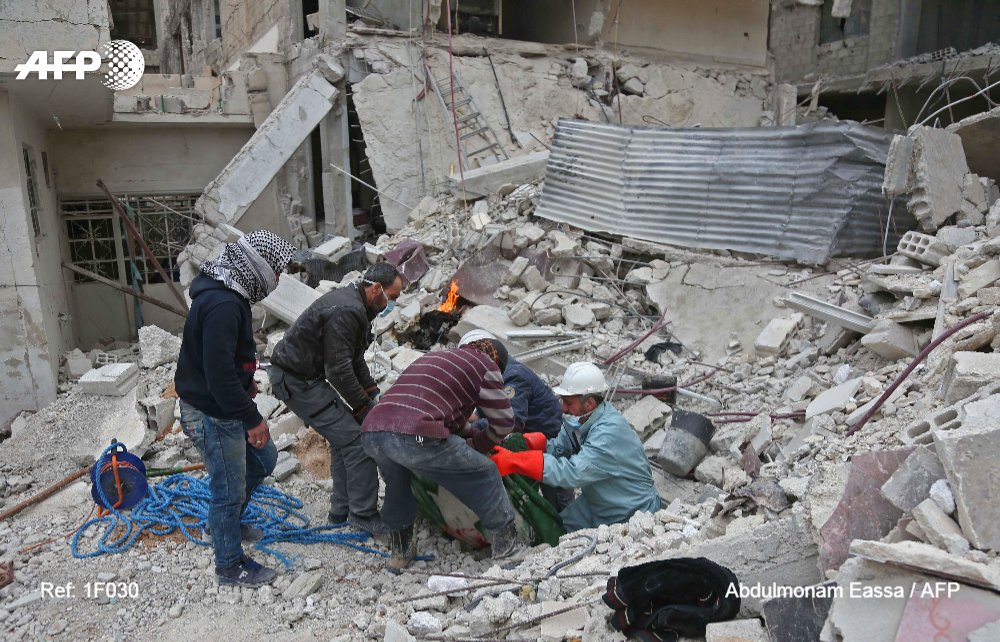
 The jets use a type of highly explosive bomb that we have not seen before; a single one of them is capable of bringing down a six-story building. Dozens of buildings have fallen in on their occupants, and underground shelters have collapsed on women and children, the rubble crushing them to death.

 The bombing surrounds us from every direction, the rockets deafen us and make us fear we are next. Something we all agree on: if it must be, make it a quick death for us and our children. Let it be a death without pain, not a slow death beneath the rubble.


 Underground field hospitals are overflowing with the dead and the injured and doctors can no longer manage to work around the clock. Hospitals are continuously bombed to prevent the injured from being treated, as the regime did to the protesters in 2011, preventing them from being treated and arresting them immediately as the hospital entrance.

 As for the White Helmets, they are the noblest people I have met since the beginning of the revolution. They are true heroes, rushing immediately towards bombed areas, despite the density and intensity of the bombing, to save the injured and pull victims out from under the rubble. Collapsed underground shelters are a new phenomenon for the White Helmets, but this has not stopped them from digging underground tunnels from neighboring streets to reach them.

 Some of them have been martyred performing their noble duty, and their centers have not been spared the concentrated bombing that seeks to put them out of service and kill the maximum number of people possible. It is not surprising that the Assad regime and its supporters would hate them and spread lies about them. The latest of these is that they are preparing a chemical attack on civilians and plan to blame it on Assad.


 Despite the great efforts by civil groups to lessen the suffering and horrors, the disaster is simply too great for its impact to be lessened by much. Many underground shelters are not equipped with bathrooms or the most basic of amenities. People spend most of their days in complete darkness, waiting for the unstoppable bombing to cease. Many of them have lost their homes in the bombing. They cannot find anything to buy outside and don't have the money required to leave the area, because they are living day-to-day, and work is very hard to come by.

 Even though the bombing has lessened in the past couple of days, as it has intensified on Ghouta's front lines, which are stormed from every direction by the regime, things remain paralyzed, with no one daring to return to normal life because of the possibility of being killed in the bombing.

 I want to remind everyone that there are countries fighting in Syria via their proxies in the regime and opposition, leaving civilians to pay the price; and that these same governments have apologized for the massacres their ancestors perpetrated against Native Americans, Africans, and Jews. Perhaps they expect their grandchildren to apologize for what they are doing to us today.

 There is, however, a positive aspect that we must keep in mind, and that is the solidarity we have experienced from people from across the world. To all who have stood with us and stood for our freedom and dignity, we are thankful and grateful. They are also defending themselves, for a victory by the tyrannical and brutal regimes over those who called for freedom and democracy in a world poses a serious threat to the fundamental values of freedom, justice, human rights, and democracy.'

Are our lives so cheap?

Image result for Darlington Syrian refugee speaks about Ghouta attacks

 ' “Are our lives so cheap?" is the question from a Syrian refugee to the international community as conflict rages in his homeland.”

 Mouhyedin Alkalel called on the world to do more to help his people as attacks on eastern Ghouta continue in violation of a 30-day ceasefire voted for by the United Nations Security Council on Saturday.

 Mr Alkalel, who now lives in Darlington, believes more action should be taken.


 Condemning the actions of Assad and allies including Russia and Iran, he said: “It is a disgrace to the international community, that all of its humanitarian organisations have witnessed all of these massacres for more than six years and have not been moved more to help the Syrians still in Syria.

 There are people dying of cold and hunger there and in countries of asylum and in Ghouta, children are being killed by ballistic missiles.

 Authorities within the international community are helping to kill the people of Syria and its children with silence about the massacres and I do not know how long this can go on for.

 All of this blood is flowing in Syria and if I could ask anything it would be for the UN Security Council, its permanent members and the United Nations to stir their feelings, if they have feelings, and issue a real decision to stop the killing.

 We are in the 21st century and all of this is happening in front of the eyes of the international community, in sight of the whole world and they are not doing enough to help. Are the lives and blood of children, women and the elderly in my country so cheap?” '


Image result for Darlington Syrian refugee speaks about Ghouta attacks

Saturday, 3 March 2018

What is happening in Syria is a revolution for humanity


 'A rescue worker portrayed in a Syrian film nominated for an Academy Award is waiting in his war-torn country for a visa to the U.S. to attend what could possibly be the most joyous event of his young life. Mahmoud, 29, who wants to only use his first name to protect his family, is one of the White Helmets rescue workers portrayed in the documentary “Last Men in Aleppo.” He survived a devastating offensive in eastern Aleppo that the government recaptured in 2016.

 Since then, Syria became one of the countries under a U.S travel ban, making Mahmoud’s trip to the U.S. to attend the ceremony a major hurdle. He has no passport and the Syrian government considers the White Helmets to be a terrorist organization because it operates in rebel areas.

 The film’s director and writer, Firas Fayyad and its producer, Kareem Abeed, made it to the U.S. after a lengthy process. Abeed thanked the U.S. State Department on his Facebook page for helping him get a visa.


 Mahmoud lives in an area under opposition control. With the conflict’s years reflected in his eyes, Mahmoud said he wants to go the U.S. to speak about his experience.

 “It is different when you have a message and you deliver it yourself,” he told the Associated Press in opposition-held rural Aleppo.

 Fayyad said he has been attempting to get Mahmoud a passport but has been met with government rejection. The Syrian government refuses issuing documents for residents living in opposition areas.

 “Mahmoud will not be able to attend and he will not get a visa,” Fayyad said in an exchange on Facebook. “It is unfortunate and very sad. He is the one who should be there.”


 The film – the first Syrian movie to be nominated for an Oscar – follows a group of men in the then rebel-held part of Aleppo, volunteering to save lives and respond to the incessant government bombings around their hometown.

 “The world has the wrong impression about Syria and what’s going on there, that it is only a civil war,” Mahmoud said.

 “What is happening in Syria is a revolution, one of pride – a revolution for humanity.”

 He said his experience with the Civil Defense team, known as White Helmets, began in 2013.

 The image of a child burning in a car following a strike with no one able to rescue him was imprinted in his mind.

 “From that day until today, his picture never leaves my mind. I thought we have to do something. This child should not die that way,” he said.


 Mahmoud moved to rebel-held rural Aleppo after the government entered eastern Aleppo. He still rescues bombing survivors and trains new volunteers.

 “This is the message I would love the whole world to know and to reach everyone: This war must stop,” he said.

 “We look around and there is death, death, death. How long can this go on? This bombing. People must have their simplest rights, peace, love, quiet, safety. You can’t imagine – people are unable to fall asleep because they are afraid of the strikes,” Mahmoud added.'

Friday, 2 March 2018

Assad's grave-robbing echoes Nazi-era abuses


 CJ Werleman:

 'The Assad regime has once again reminded the world just how savage, uncompromising and merciless it truly is.

 In the past week, it has unleashed an unrelenting aerial assault on Eastern Ghouta, accompanied by Russian warplanes that killed more than 600 civilians and injured thousands of others.

 This is a regime that knows no moral bounds, and at the risk of invoking Godwin's Law, is every bit as detestable as Germany's Nazi Party of the 1930s.

 Like the warmongering, secular-fascist governments of the previous century, it too spares no one who stands in its way, deploying chemical weapons on children, barrel bombs on hospitals and artillery fire on residential neighbourhoods.


 Last week, the UN chief described the situation as "hell on earth" for civilians besieged by the Assad regime in the rebel-held suburb.

 But photos from Qusay Noor, a journalist in Eastern Ghouta, appear to shed new light on the barbarism inflicted upon Syrians who remain cornered in Assad regime-held territory.

 The town of Harasta, located at the northeastern edge of Damascus, has switched hands between the Assad regime and opposition forces since the conflict began in 2011, but had been held by the regime for five consecutive years, until the rebels liberated the town in January.

 This week the head of the town's council, Husam al-Beiruni, explained how Assad's security forces dug up more than 300 Christian graves in search of valuables, such as jewellery and precious stones, while at the same time defacing, defiling and damaging the tombs and the remains of those buried inside.

 Al-Beiruni, who has lived under both the occupation of Assad's forces and a constellation of various rebel groups, acknowledged that while he had seen "terrible damage" inflicted upon his country by a number of groups, he described this act as the kind of "particular barbarity" associated exclusively with the Assad regime.

 "However, this regime does not limit itself to the violation of graves," said Al-Beiruni. "They bombard us with rockets on a daily basis, not only in Harasta but in all liberated areas of Syria. We must report to the world, on behalf of the Syrian people, the kinds of deeds the regime perpetrates against us daily."


 Prior to the outset of the war, approximately 35,000 Christians lived in Harasta, representing roughly 15 percent of the total population, but many fled when Assad turned his military on the pro-democracy, pro-revolution protesters in 2011.

 Significantly, Harasta is not the first time Assad's forces have been accused of robbing graves. Last year, they robbed graves in Hama of their Turkish and Italian marble headstones.

 While Assad's crimes against humanity are well-documented; disinformation campaigns, which are typically generated by respective Russian and Iran state media for the purposes of deflecting attention and criticism away from Assad-Russia-Iranian war crimes, have successfully divided the conflict's western onlookers.

 The Christian right in the United States, led and cajoled by US President Trump, for instance, has put its support behind Assad, buying into the dictator's phony "war on terrorism" narrative at best, and at worst, expressing solidarity with a secular dictator who barrel bombs Muslims.

 One might expect the American Christian right to change its views towards Assad, given allegations his forces removed gold from the teeth of dead Christians, but we wait and see.

 The point here is that Americans pride themselves on having helped defeat the Nazis in the Second World War. But everything about the Assad regime demonstrates its total disregard for human life, and mirrors the very worst of Hitler's jackboot thugs, from wanton mass murder to gassing innocent children, to pulling gold from the teeth of the dead.

 It's no wonder then, that Assad's Syria has become a "safe haven" for Nazi activity, hosting European Nazi organisations in 2017, while also remembering it once provided sanctuary to the Austrian Nazi war criminal Alois Brunner.


 While comparing anything to the Nazis is of course an "inherently tricky business", and while the scale of the tragedy of the Holocaust should never be minimised, the nature of the fallout from the Assad regime's brutal war is not too dissimilar to that of Hitler's Germany.

 For instance, and as Nicholas Kristof once noted, "the Anne Frank of today is a Syrian girl", meaning Syrians continue to die because the West fears Syrian Muslim refugees the same way it feared European Jewish refugees in the 1930s and 1940s.

 "The reasons for the opposition [to Jewish immigration in the 1930s] then were the same as they are for rejecting Syrians or Hondurans today: We can't afford it, we should look after Americans first, we can't accept everybody, they'll take American jobs, they're dangerous and different," notes Kristof.

 At the risk of stretching the all-too-often overused Nazi metaphor further, the Assad regime also has built crematoriums to dispose of those it murders in its prisons. Presumably, of course, after its thugs have first stripped their Syrian victims of their personal belongings, including the gold fillings in their teeth.'

Thursday, 1 March 2018

As long as we ignore Syria it will escalate

AFP photo

 Robin Yassin-Kassab:

 'This area is basically the eastern suburbs of the capital city, Damascus. It is predominantly working class, and it is one of the areas where the flame of the democratic protest movement burned most fiercely in 2011. When that was met by extreme repression by the Assad régime - gunfire, mass arrests, torture, rape - the people formed self-defence militias, and since then it's been total war. First the régime, then its allies Iran and Russia, have been bombarding the area continuously. From the air, from the land. In 2013 they killed over a thousand people in the area with sarin gas in five hours, and the place has been under a watertight siege since 2013, so tight that children and the elderly are dying of malnutrition.

 So even before the latest escalation, the situation in the Ghouta for the 400,000 remaining civilians is absolutely desperate. There is no ceasefire. It's just political theatre. It's true that the United Nations passed a resolution, and the Russians agreed with that, calling for a ceasefire in the whole of Syria for 30 days. It never happened. The main reason for that is that the Russians, as they've done before, as everybody knew they would do, they included a proviso that the war on what they call terrorist groups can continue. So there is a ceasefire, but not against terrorists.

 Now the problem here, is that Russia for years now, has described as terrorists anything that it hits. And what it hits repeatedly, almost on a daily basis, are schools, hospitals, market places, and residential blocks. There is no ceasefire on the ground.


 The Russians have introduced a five hour daily pause in aerial bombardment. This is part of the psychological war, because if you read about the psychological strategy of bombing, apparently civilian populations break faster when bombing is paused and resumed, and paused and resumed, than if it is just continuous. So this is a joke, really. No aid has got through. No civilians have got out.

 And, of course, most civilians don't want to get out. It is very sad, that Emmanuel Macron for example, the French President, is calling for the civilians to be removed from the area. That's what happened in Aleppo in the end. It is better than them all being killed, but it would still be an internationally sanctioned war crime. Forced population displacement is a war crime. And now our great European statesmen are calling for war crimes, just that they be done a little more gently.

 I don't think the Assad régime would still be there, if it weren't for the huge amount of help it has received from Iran and Russia. Iran has been providing a financial lifeline. It provides transnational Shia jihadist militias organised by Iran, from Iraq, Lebanon, Pakistan, and even further afield. This is the majority of Assad's ground troops now. They're not Syrians any more. And even with those Iranian forces, without Russian bombing, he wouldn't have been able to get back a lot of the country as he has. So I don't think he would still be there without international support.

 But Russia and Iran are in there because the United States kind of allowed them. When Obama was, I think rightly, doing his nuclear deal with Iran, he ignored something that's much more destabilising, which is Iran keeping this bloodthirsty dictator in power, by sending international Shia jihadists to police Sunni Arab areas. Which obviously creates a backlash. The Shia jihadists organised by Iran don't threaten us in the west directly, but indirectly they do, because when you have Shia jihadists policing Sunni Arabs, this is a huge recruiting sergeant for groups like ISIS and al-Qaeda. They say to the people, "You thought it was about fighting for democracy. Now you see Shia are coming from all over the world to kill you. Therefore it's not about democracy, it's about your identity as Sunni Muslims."


 The international involvement is escalating, and it is out of control. Obama had a red line over the chemical attack which disappeared, and handed Syria to Russia, and I think he thought: let them deal with it. In the last weeks, we've seen again, that the Russians can't deal with it. This is escalating. We've had Iran and Israel fighting each other in Syria in recent weeks. We've had Turkey and Kurdish groups fighting in Syria. We've had the Americans bombing a group of Russian mercenaries and killing dozens. This is still escalating, and so long as we ignore it, or appease the main aggressors, it will continue to escalate, and it will have effects everywhere.

 In 2012 and 2013, Western powers stopped countries providing advanced military equipment to the Free Army militias. They said we don't want more weapons going in. They didn't stop the Russians and Iranians pouring weapons in, and they didn't do anything about the international jihadist groups were beginning to build a base there. They sat back and watched the Syrians being slaughtered, until inevitably, as you would expect, al-Qaeda and ISIS and transnational jihadist groups arrived into the chaos, and made a base.

 And then they got involved. Let's not imagine the West is staying out of Syria. The Americans are bombing every day. They're supposedly bombing ISIS, and that's a good thing, Syrians are happy that ISIS is no longer in charge of cities like Raqqa. But unfortunately, to liberate Raqqa from ISIS, they had to destroy the city completely. The vast majority of Raqqa's population are no longer there, because their houses have been totally destroyed.

 So, the Americans are involved, they are bombing, killing civilians, and dong a lot of damage. But they're not doing it in any concerted way, to address the issues that led to this in the first place. They're just taking this myopically as a War on Terror. They are bombing the symptoms not looking at the causes, not empowering the Syrian people themselves.'


 Note 28/7/25, link broken.

Life Under Assad’s Bombs in a Damascus Suburb


 Wendy Pearlman & Loubna Mrie:

 'The people of Ghouta have lived through a lot.

 As the Damascus suburb joined protests against the regime of Bashar Assad during the Arab Spring, the government cracked down, and rebels took up arms. Regime forces were pushed out of the area in late 2012 and replied with a siege that prevented food, medicine and people from entering or leaving. In August 2013, a chemical-weapons attack on the enclave killed more than 1,400 civilians. In the years that followed, the siege tightened and aerial bombardment continued.

 But on Feb. 18, the Assad regime and its Russian allies abruptly ramped up attacks, launching one of the most intense bombing campaigns yet seen in a war that has become a complex patchwork of overlapping global interests. Turkey is fighting Kurdish forces in the north, Iran is building military bases in the south, while Russian mercenaries have clashed with U.S. forces in the east. Meanwhile, Assad hammers what he calls extremists on the ground in eastern Ghouta, one of the last rebel redoubts left standing.

 The campaign has left at least 500 civilians dead and thousands injured. Attempts by the U.N. to forge a lasting cease-fire have failed; Secretary-General António Guterres has called the situation “hell on earth.” Relief workers say regime forces are using chemical weapons in their daily bombardments.

 The people of eastern Ghouta are also speaking for themselves. Here are some of their voices.


 Eyad, 27, father:

 "We were underground for six days, sharing a basement shelter with 70 other people. You feel the dampness in your bones. The smell of so many people is horrible. You don’t even know which smell belongs to you.

 Every time we hear fighter jets, we think that this moment will be our last. The sound of jets terrifies me because I was wounded in an airstrike before. But what scares me most is that I’ll die, and my wife and our 3-year-old will be alone. Or they’ll be killed, and I won’t know how to live without them.

 We heard that there was a cease-fire and got back home to find it all dust and broken glass. I only wanted two things: to drink coffee and shower. We started a fire to heat the water, and I’d just gotten in the shower when they started bombing again. I didn’t even have a chance to rinse the shampoo before we ran back to the shelter.

 I saw one of my neighbors holding bread and cheese, staring at a building that had turned to rubble. He said, “My children are under there. They hadn’t eaten for three days, and I had just left to get food. I don’t know if they’re alive or dead.” Luckily, his children were later rescued.

 All I want is for the bombing to stop, and to stay in Ghouta with my neighbors and the streets where I grew up. This is our home. We can deal with destruction and rebuild. We just want to stay."


 Nivin, 38, teacher

 "I left all the news groups that circulate updated lists of those who have been killed. My heart couldn’t take it anymore. But in spite of myself, I read the names of Najah and Lina. I refused to believe that those were my students. The sweet brunette who asked me, “Miss, what will you tell Mom about my grades?” That was before massive shelling forced us to suspend the schools …

 In my extended families not a single person is armed. From the youngest to the oldest, we are civilians trying to serve our community. If you’re pro-regime, rest assured that the regime doesn’t care about you any more than it cares about us. Your turn just hasn’t come yet."


 Taaqi, 30, relief worker

 "I volunteer for a group called Molham Team. One day a woman came to me, but she was so shy that she wouldn’t make eye contact. She told me that her husband was injured and they hadn’t eaten for two days. Her son was so hungry that she caught him eating his own feces.

 I delivered some food to their house and was shocked to find it nearly empty. They’d used most of their furniture as firewood.

 I returned last night to see if they had kept safe in this bombing. The whole neighborhood had been destroyed. I have no idea if they’re alive or dead."


 Hamzi, 24, paramedic

 "When you’re rescuing someone, you have two minutes max. The regime usually bombs the same area twice in a row, aiming to hit rescue workers with the second strike.

 Most of our medical facilities are no longer operating. We’re running out of crucial things, like anesthetics. We aren’t able to do much for deep wounds, so we end up amputating entire limbs.

 Last September, a tiny 3-year-old came into the emergency room with an acute outbreak of herpes. He needed a certain medication that we didn’t have. We sent his name to the Red Cross, which asked the government to permit his immediate evacuation from Ghouta. There was no response.

 I’ll never forget the day that he passed away."


 Loubna, 38, activist

 "The first time the road out of Ghouta was blocked, five years ago, I didn’t understand. What did it mean that we were trapped? Then stores’ shelves gradually went empty. Food, fuel, the most basic essentials … everything began to vanish. Even so, people were generous. My neighbor would send me two tablespoons of food in a teacup. She could barely feed her children but still thought of me.

 It’s embarrassing to complain about such a small detail, but the hardest days for me were when I had my period. There was one store that sold pads for $3 apiece. Later people started making pads and baby diapers out of plastic. They weren’t clean, but that’s all we could do.

 In those days, my biggest fear was of being kidnapped or killed. Civil-society activists got death threats from Jaysh al-Islam, especially those who dared to criticize it. That pushed us out.

 Our center, Women Now for Development, offered classes in English, literacy, sewing. Anything to empower women. Nearly 100 women came every day, some walking hours. Their dedication to learn despite all the horror surrounding them was truly inspiring. Women have been the heroes of the siege."


 Muhammad, 35, activist

 "Imagine what it’s like to be trapped. No electricity, no water, no soap. You wear your same dirty clothes, day in and day out.

 We got to the point where we’d pay $8 for rotting bread. I’d tear off the green spots and dip the bread in oil. When I ran out of oil, I’d dip it in water.

 Another guy and I planted potatoes. He couldn’t stop talking about how excited he was to make french fries! When I finally boiled those potatoes, I was so happy I practically cried. At the same time, I was heartbroken. The guy who’d planted with me had died, and I felt guilty for eating without him.

 It cost me $4,000 to get out of Ghouta and cross to Lebanon. For the people who control the borders, you’re not a human being fleeing for your life. You’re money, and they’ll take ­everything you’ve got.

 Today, I feel how all Syrians in exile feel: guilty and depressed. You just can’t comprehend this nightmare unless it happens to you. I hope it never will." '

Wednesday, 28 February 2018

Solidarity for Ghouta in régime areas of Damascus


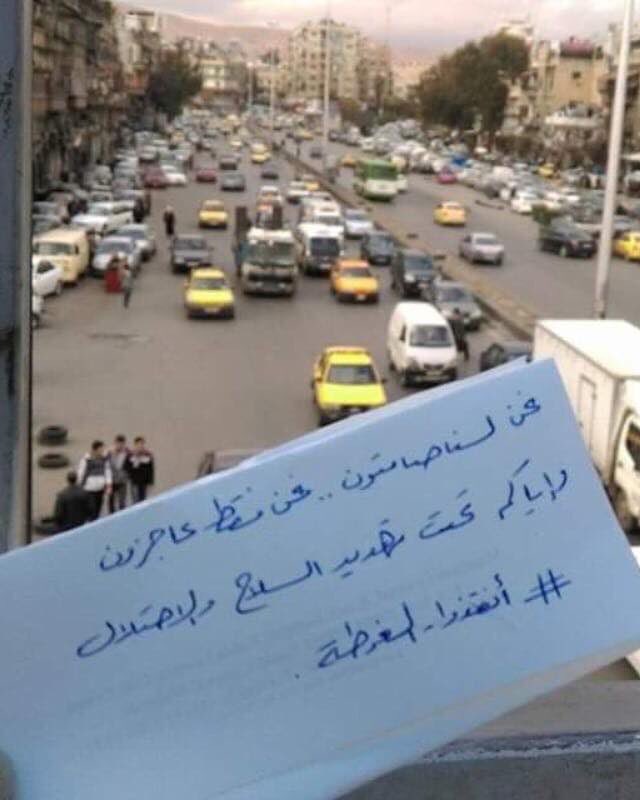
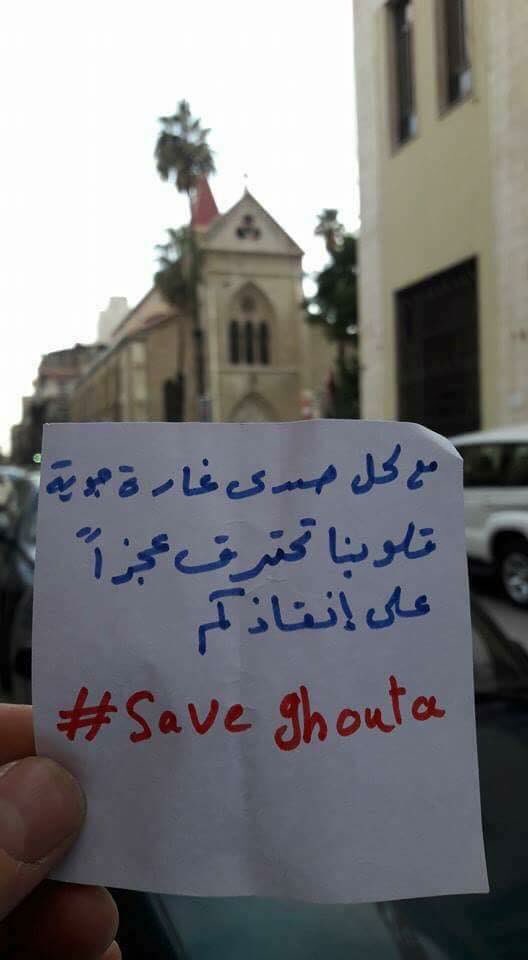
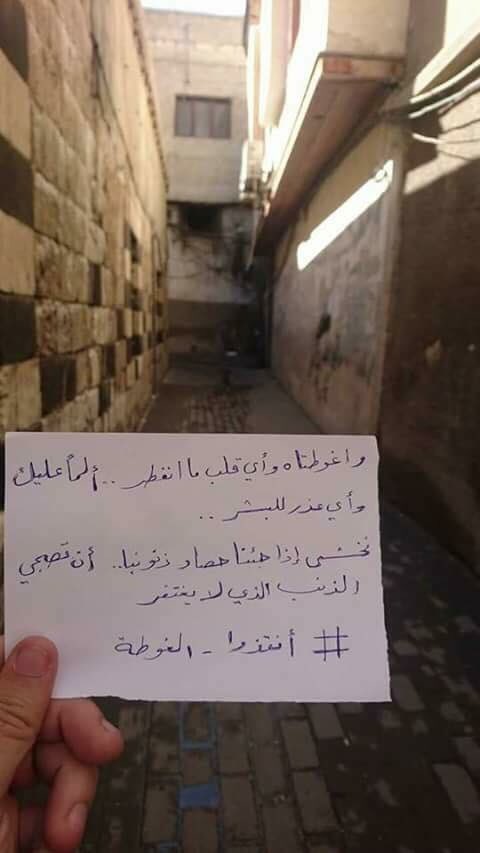
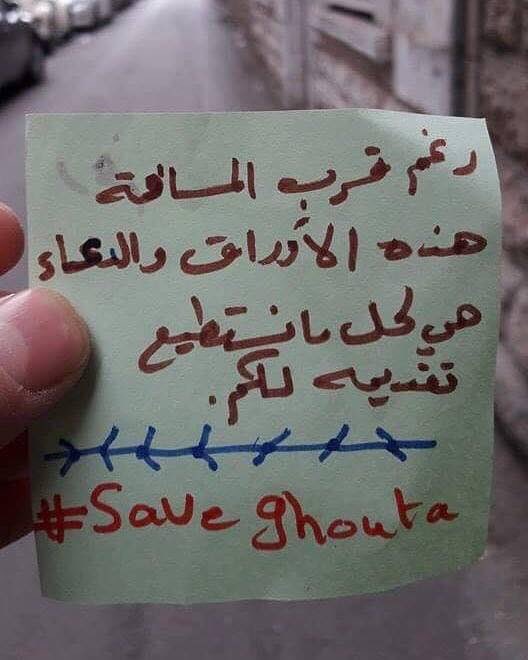
 'Syrians living in the capital Damascus show discreet solidarity with their compatriots in Ghouta. Of course, if they get caught, they'll end up like the ones in the Caesar photos.'

Regime released 13,000 prisoners planted in terror groups

Anwar Majni

 'The Assad regime supported certain radical groups and released them from prison when the Syrian civil war broke out in 2011, planting them in terror groups, according to former prosecutor of Aleppo Anwar Majni, who worked in different regions of Syria after graduating from the Faculty of Law at the University of Aleppo in 1996.

 “More than 13,000 terrorists were set free, mainly from the prisons in Tadmur, Sidnaya, Adra and Hama. Those who were released in 2011 and 2012 were then planted in terrorist organizations by the al-Mukhabarat (Syrian intelligence organization), and it was the U.S.’s Abu Ghraib prison model in Iraq which served as an example for the regime’s actions on this matter,” said Majni.

 He also stated that all terror elements in Syria, particularly the Kurdistan Workers’ Party (PKK) and Daesh, were somehow trained in the above mentioned Syrian penitentiaries and that 70 of these former prisoners are now top figures in the PKK terror organization.

 “We, as the people of Syria, protested against the despotic Assad regime, regardless of our differences in terms of social class, ideology or ethnicity. Hafez al-Assad and his son Bashar al-Assad ran the country for 40 years, ignoring the will of the people. We protested against it as the people of Syria. However, Daesh and the PKK elements dragged our revolution to an ethnic and ideological dimension. Assad’s strategy of breaking the resistance by supporting terror was more effective than his bombardments, and it succeeded.”

 “While the Damascus government released thousands of terrorists from prisons, it imprisoned 250,000 innocent civilians who supported the revolution across the country, 30,000 of whom were brutally slaughtered. The Assad regime which pardoned registered terrorists brutally tortured hundreds of thousands of men and women to death,” he added.

 “Eleven thousand civilians died from torture at the military hospital known as Branch 215 Damascus. Additionally, ‘the Field Court,’ a court which was granted extraordinary powers, executed 13,000 Syrians. There are dozens of prisons in the Assad-controlled regions. They carry out all sorts of torture on the tens of thousands of innocent civilians who they arrested, deeming them as criminals. There are mass graves all around the country, mainly in Damascus, Homs, Daraa, Deir ez-Zor and Aleppo. The Baath regime is no different than the PKK or Daesh in that sense. Our people are the captives of Assad and his supporters,” Majni concluded.'

Civilians of Eastern Ghouta vow they will not leave


 'Civilians in Syria’s besieged Eastern Ghouta enclave said Wednesday they would not leave their home despite a UN cease-fire meant to provide a respite from a barrage of Assad regime attacks.

 The target of a five-year siege by Assad regime forces -- cutting it off completely from humanitarian aid, food, and medicine -- Eastern Ghouta has faced intensified attacks in recent days.

 Since Feb. 19, escalating hostilities have resulted in 500 deaths and some 1,500 injuries in Eastern Ghouta, with 24 health facilities impacted by shelling and airstrikes, according to UN officials.

 The attacks come despite a UN Security Council resolution passed last Saturday for a 30-day cease-fire in Syria.

 While the Assad regime airdrops messages telling the 400,000 people of Ghouta to leave, Russia announced a five-hour daily “humanitarian pause” to allow civilian evacuation.


 Muhammad Awwad, who lives in Eastern Ghouta’s Kafr Batna district, said that he lost his two children in recent regime attacks.

 “While we were trying to rescue people under the debris, warplanes hit us… They hit our children,” he explained.

 Saying that they will resist no matter what, he added:

 “Whatever happens, our home and lands are here. No one can take us away from here. We will stay here until we die.”


 Muhammad Yaarub, another resident of the besieged enclave, said that there are no military installations in Eastern Ghouta, only civilians.

 He called the regime claim that it is targeting terrorists a lie, as there are no fighters in the area.

 “We will endure till the end no matter how long it lasts. We won’t leave here.”

 Maha Ukasha, a teacher, said that many of her students lost their lives even when seeking protection in underground shelters.

 “We won’t give up. We will continue their education,” she said defiantly.


 According to the Syrian White Helmets civil defense group in Eastern Ghouta, in the last two weeks the regime has targeted 22 health centers, a mosque, and an orphanage.

 Eastern Ghouta falls within a network of de-escalation zones -- endorsed by Turkey, Russia and Iran -- in which acts of aggression are expressly prohibited.

 The UN resolution also calls for the medical evacuation of 700 people, particularly in Eastern Ghouta.'

Assad is targeting ‘everything that moves’ in Ghouta

image: Deana Lynn sits with family

 'An American woman living in a besieged suburb of Damascus, Syria, described eight days of “constant bombardment” in an interview at her home on Tuesday.

 Bombing and artillery fire has not stopped in eastern Ghouta, she said, despite Russia’s promise to implement a daily five-hour cease-fire starting Tuesday to allow aid deliveries.

 “We’re supposed to be in a cease-fire, and there’s still bombing and artillery,” she said, as explosions rang out in the background.

 “They’ve targeted medical facilities. They’ve targeted shelters. They’ve targeted everything that moves here,” she said, referring to the forces of Syrian President Bashar al-Assad.

 The woman, Deana Lynn, who asked to be identified by her first and middle names only, was born in Michigan and has lived in Syria with her husband and eight children since 2000.


 She taught English for nine years until schools closed because of the war. Her husband, who worked in the food industry before fighting erupted, is now affiliated with the local faction of the Free Syrian Army, a group of moderate rebels.

 “The missiles, when they come, they come one after another,” Deana Lynn said. “If I’m in the house, I have to gather the kids. We have to lay on the floor.”

 Deana Lynn, 44, said she and other families have sought shelter in basements — in some instances, 60 people together share one toilet. She described shortages of food, drinking water and electricity.

 “Right now no food is being let in. We have very high prices. The children here are not eating well, if they’re eating at all,” she said.


 She described living at the mercy of the Assad regime. “If he wants to let food in, he lets food in. If he doesn’t want to, like now, he’s closed completely the food and medicine routes.”

 “They’re giving us two choices: we’ll either bomb you or you can leave with a so-called safe passageway, which isn’t safe if we’re going to see Assad’s regime at the other side,” she said.

 Deana Lynn explained that she has remained in eastern Ghouta because it’s where her family is. She wants to be able to stay and live without fear of bombardment.

 “It’s been very, very terrifying,” she said.'