Friday, 9 February 2018

"How many appeals do we still have to make?"

Image result for Babies rescued from Syrian hospital after Russian airstrike 1:10 Video nbc

 'After surviving seven years of war, Aya Qrai was offered a unique chance at joy: her first child, a son.

 "Abdulrazaq let me live in my own world and I forgot the war — I saw the beauty of life through him," said Qrai, 19, speaking from a rebel enclave in northwestern Syria. "With all the war and all the sadness, I was full of happiness."

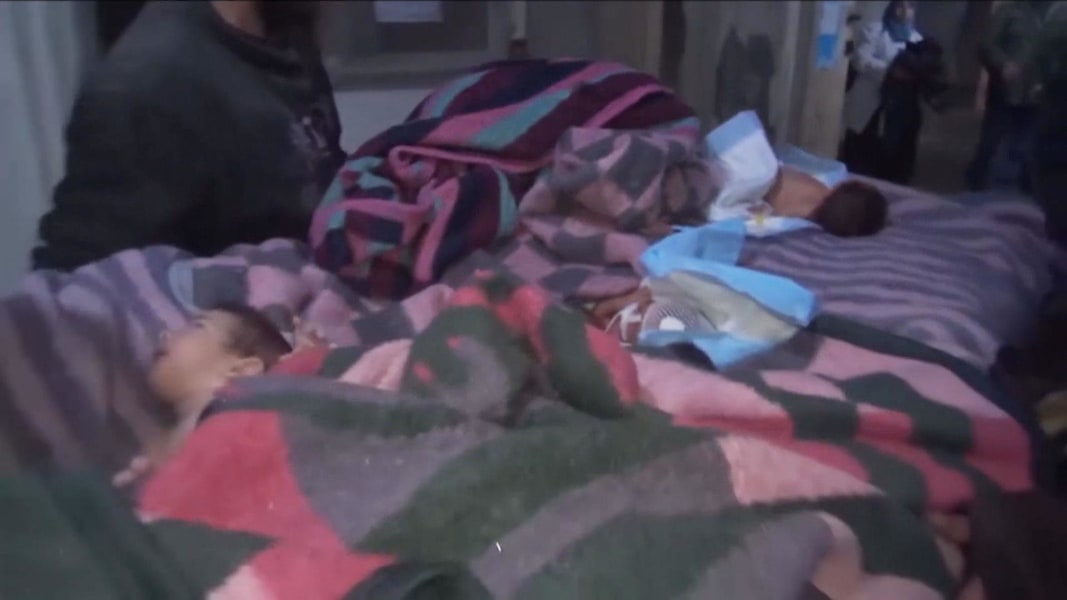
 Abdulrazaq was born two months premature and went into intensive care at a hospital in the city of Maarat al-Numan in northwestern Syria. He died 16 days later, after airstrikes badly damaged the facility in Idlib Province on Sunday and forced the evacuation of at least 10 newborns.

 Abdulrazaq died from lack of oxygen before he reached another hospital, according to his family.

 Video shot on Sunday in the aftermath of an attack that rebels and observers say was carried out by a Russian warplane shows newborns being rushed from the damaged building.
Tearful and exhausted, Aya Qrai says she wants to die.

 “We Syrians are not allowed to smile and to live a normal life,” she said, sitting close to her husband, Hamoud. “When I decided to live and to challenge the war [by having a baby], the airstrike took my baby away from me.”

 A hospital in nearby Kafr Nabl was also bombed Sunday, forcing the evacuation of patients.
The shelling of the hospitals and other areas where civilians are trapped comes amid intensifying attacks on rebel-held areas near the city of Aleppo and the capital, Damascus.


 The Qrai family’s grief is just one piece in a mosaic of tragedy created by Syria’s civil war, which started as pro-democracy street protests against the rule of President Bashar al-Assad in 2011. The conflict quickly spiraled into a full-fledged conflict that has killed hundreds of thousands of people and forced millions from their homes.

 The Qrais are among some two million people now living in Idlib — where fighting is forcing civilians to move constantly to escape fighting, according to the United Nations. Two pro-government villages in Idlib were also being besieged by rebels, the U.N. announced on Tuesday.

 When asked if the couple had a message for the world, Hamoud Qrai angrily interjects: “Sir, how many messages do we have to send? How many appeals do we still have to make to stop the killing? We are being killed by a dictator who wants to rule us by force.”
“Who on earth would target a hospital?” he said.

 This week, the U.N. called for an immediate humanitarian cease-fire in Syria of at least a month after heavy airstrikes claimed scores of lives.

 Aid workers, meanwhile, warn that rebel areas are not receiving desperately needed deliveries.

 "For the last two months we have not had a single convoy,” said Panos Moumtzis, assistant U.N. secretary general and regional humanitarian coordinator for the Syria crisis. “This is really outrageous." '

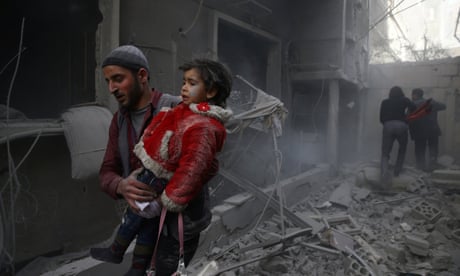
Image: A destroyed hospital in Kafr Nabl

Talal Derki's new film following a Nusra Front soldier


 'My life before these bad times was different. I was living in Damascus. I studied cinema in Greece. Most of the people I knew in Damascus as a filmmaker were artists, you know, we never were in touch with the religious people, and by saying religious I am talking jihadis, salafists, those were very rare in Syria. After the revolution started, I filmed my documentary "Return to Homs" in Syria, with people who were into democracy and freedom. During the time of the shooting people started to talk about a "caliphate." It was the month when ISIS declared itself, in Spring 2013. I witnessed how many people loved them, so much brainwashing! That was for me the biggest shock.

 During the last block of shooting for the film in 2013, I met for the first time a jihadi from IS in the desert north of Homs. I was there waiting, and the only people with internet access were IS. So I met some people and later I thought, you know, I have the possibility to do it, I have access. I believe it's difficult for someone else to do this. So it has really been a big journey since we started in 2014.

 The Islamists didn't have much knowledge about my background. I had hidden all information, had avoided all photos of me drinking alcohol and being with girls. And before I didn't write any article against the jihad. So there was no clash. I also gave some interviews on opposition Arabic radio and TV that supported them, and they were happy thinking this is a guy supporting us. And I told them I was motivated by their movement, I wanted to learn from them.

 I wanted to go psychologically inside the society of the jihadis. I wanted to understand how it happened, how they become what they are. Who are these people? How do they look from the inside? What are their codes? How do they brainwash people? To understand how they convince people through the story of the new generation. And the film is also about a father's legacy of violence. There's a lot of violence, so what happens to the kids? In a way, I believe that every father can watch this film and find himself or his father somewhere inside it. I tried to capture moments that are eternal moments.

 It's a matter of day by day. You have to forget who you are. You have to be a new person to make such a film. There was no other option. I had to do this. Firstly for my safety. Secondly to observe, to go to their point of view. To understand what their life looks like. You need to let them trust you. I also tried mostly to reduce the places where you shoot, and I filmed a lot inside the house.


 When I went with the father outside, he always met with other jihadis from other Arab countries and from Europe, and these are dangerous people because they don't easily trust you filming them, whatever your background. And they have experience researching online. When they investigated me, I had to tell I am a war photographer. And also from the outside I had to be exactly like them. So I was praying with them, listening to them, shaking my head like them.

 I learned from my father that to tame your nightmares, you need to capture them first. It's about getting them out from the subconscious to the conscious. Write it down. Write it with a camera and then leave it there. That's what I did.

 One of the boys featured closely in the film is Osama, who is very sensitive and rebellious. Osama is the one who lied to his father that he prayed, but he did not pray. And I know him. If he grew up in a different family, he would be an artist. I am sure.

 If the society was strong in that region, if there wouldn't be violence against kids and women, if women were equal there, if there was a clear law about what children learn, the jihadis would not be able to find a place, nobody would welcome them. Look at countries like Iraq, Afghanistan, Syria, Libya — violence will bring more violence, will bring more radical people. And this will go on.'

Sundance Film Festival 2018 - Film Of Fathers and Sons (Courtesy of Sundance Institute/K. Hasson/T. Derki)

Thursday, 8 February 2018

East Ghouta ‘drowning in blood’ after third day of bombing

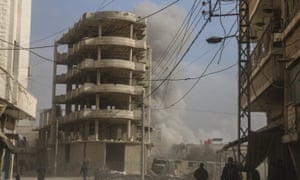
Smoke after an airstrike

 'Residents of the besieged Syrian enclave of eastern Ghouta have endured a fourth day of relentless bombardment by the government of Bashar al-Assad, a campaign that has so far killed more than 200 people and left a ceasefire deal that lasted months in tatters.

 The bombardment continued despite international pleas for a countrywide ceasefire to alleviate “extreme” suffering in Syria, where the violence has been renewed after failed peace talks earlier this month.

 “Ghouta is drowning in blood,” said a doctor in Arbeen, one of the towns in the region in which 100 people were wounded and at least 14 killed, including a rescue worker and several children.

 “There is no safe place in Ghouta,” said Raed Srewel, a journalist based in Douma, another town in the area. “You can describe it with this saying we have: “On top of death, the graves are too small.”


 59 civilians, including 15 children, have been killed on Thursday alone in eastern Ghouta, an enclave that has been under siege for years, endured a devastating sarin gas attack in 2013 and was once the bread basket of the nearby capital, Damascus.

 The killings capped three days of shelling and bombardment after a national dialogue conference brokered by Russia failed to produce a breakthrough in peace talks. The violence, which continued in other parts of Syria as well, marked the effective end of a de-escalation agreement brokered by Moscow, Ankara and Tehran to reduce violence around the country and pave the way for peace talks.

 That deal has unravelled with a broad government offensive in Idlib province in Syria’s north-west and eastern Ghouta, two of the last major strongholds of the opposition fighting Assad.

 The offensive in Idlib has already displaced more than 300,000 people by UN estimates, numbers that have risen in the last few days. Many have sought refuge near the Turkish border, threatening a new influx of refugees.


 In eastern Ghouta, rescue workers spent much of the day searching through the rubble of buildings that had collapsed under the airstrikes. They said they had tracked at least 76 airstrikes on Tuesday and Wednesday alone in the region.

 “It has become a city of ghosts, and if you walk in it, it is filled with the smell of death and blood,” Srewel said, describing his hometown of Douma. “The planes are always in the skies of Ghouta, the markets and homes are being bombed, there are martyrs and wounded, and God is our only solace.”

 Earlier this week the UN commission of inquiry, tasked with investigating war crimes and crimes against humanity in Syria, condemned the upsurge of violence in Idlib and Ghouta, saying they “make a mockery” of the de-escalation agreement.

 “What is happening in eastern Ghouta is not simply a humanitarian crisis because aid is denied. These sieges involve the international crimes of indiscriminate bombardment and deliberate starvation of the civilian population,” said Paulo Pinheiro, the chair of the commission.


 Russia dismissed calls for a month-long humanitarian ceasefire as the UN Security Council met to discuss the worsening humanitarian crisis. “That is not realistic,” said Russia’s UN envoy, Vassily Nebenzia. “We would like to see a ceasefire, the end of the war, but the terrorists, I am not sure, are in agreement.”

 France’s ambassador to the UN, François Delattre, called for unhindered access for aid agencies. “Eastern Ghouta is experiencing a Middle Ages-style siege. That is totally unacceptable,” he said.

 Syrian government forces also clashed with US forces in the eastern province of Deir ez-Zor, the first time such a large-scale confrontation has occurred on Syrian land.

 An official with the US-led coalition against Islamic State told Reuters it had repelled a coordinated assault by pro-regime militias on a base in the region, a battle that Syrian state media appeared to confirm with a news bulletin that accused the coalition of killing dozens of militia fighters.

 The official said no US troops had been killed or wounded in the attack, which was carried out by about 500 fighters, but one Syrian fighter allied with the coalition was wounded. More than a hundred pro-regime fighters were killed.'

The Russians strike the symbols of the Syrian revolution


 'Residents in parts of Syria have been experiencing some of the most terrifying days of their seven-year-long war.

 This week, the Syrian government and its Russian ally pummeled towns and villages in the opposition-held northern Syrian province of Idlib with air attacks. A relentless series of payloads were dropped in the space of just a few hours in the darkness of Sunday night.

 The dead are still being counted. Residents say dozens of people are missing under the rubble of collapsed buildings.

 Airstrikes on Eastern Ghouta, the besieged rebel-held suburbs outside Damascus, are ongoing. More than 100 people have been killed in the past 48 hours alone, according to residents.


 "It's clear these attacks are part of a systematic strategy in order to basically punish civilians," said Haid Haid, an analyst with the British think tank Chatham House.

 Hassan Hassan, a Syria analyst and author, agreed that civilians are the focus of these attacks. "Most of the airstrikes have not hit front lines," he said.

 Instead, the air campaign appears focused on residential buildings and hospitals.


 On Monday, Raed Fares, an activist in Kafranbel, an opposition-held town about 8 miles from the nearest front line in Idlib province, said he woke up to bombing raids on the local hospital.

 "In the early morning, they attacked the hospital here four times. It's very close to my house, and it was so horrible to wake up to this sound," he says. "Everything was shaking."

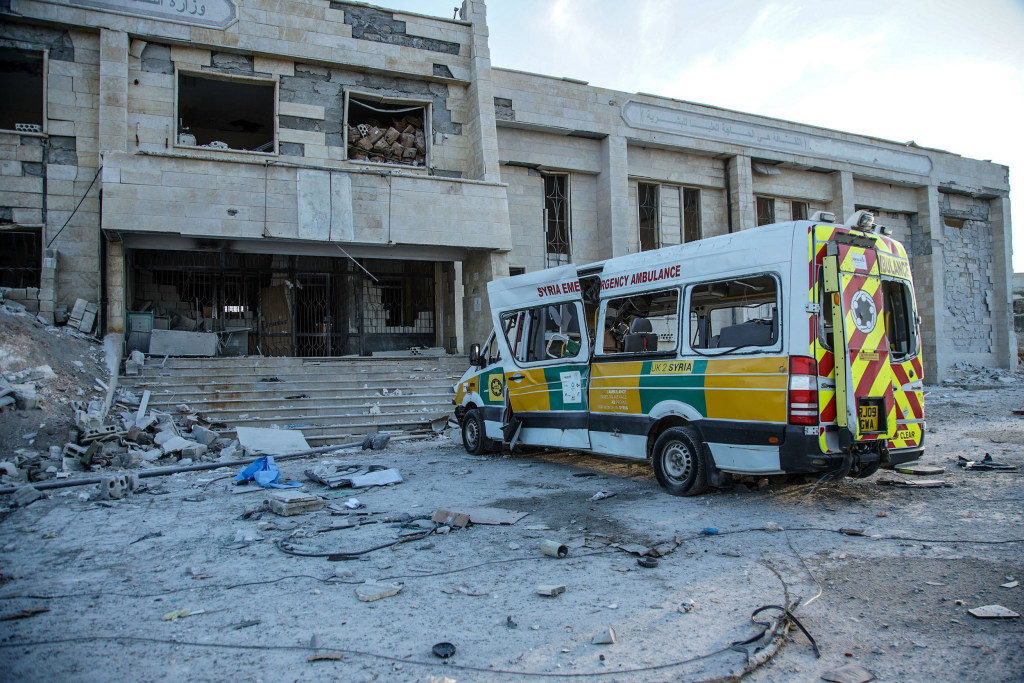
 Fares shared photographs on his Facebook page of the hospital building, with its roof caved in, and of an ambulance destroyed by shrapnel.

 This was the second hospital reported to have been hit in 48 hours. Residents of Maaret al-Numan, another town in Idlib province, shared videos of premature babies struggling for breath after they had to be ripped out of incubators to be rescued from a hospital damaged by a plane's payload.


 There have also been reports of chlorine gas attacks. Doctors in the town of Saraqeb, in Idlib, reported treating 11 patients who suffered from the suffocating symptoms of the chemical weapon.

 These attacks have been interpreted partly as a response to the rebel downing of a Russian Su-25 plane Saturday near Saraqeb. The Russian pilot ejected from the plane and was shot dead by militants, according to Russia's Defense Ministry.

 Kremlin spokesman Dmitry Peskov called the attacks "precision strikes," according to Russia's TASS news agency, and said they were "provoked by the tragic event when terrorists shot down our plane."

 But analysts also see these attacks as an attempt to punish opponents of Syrian President Bashar Assad by targeting towns and villages in Syria that are sympathetic to the opposition.


 Last month, the Syrian opposition decided to boycott peace talks hosted by Russia in the Black Sea city of Sochi.

 Hassan, the Syrian analyst, said the boycott was a major blow for the Russians.

 "Sochi was envisioned by Russia to be a milestone, at least as a public relations stunt, to say, 'Not only did we defeat ISIS,' as [Russian President Vladimir] Putin announced inside Syria at the Hmeimim air base, but also, 'we have managed to steer the politics in Syria as well,' " he said.

 With these air attacks, Hassan said, Russia may be "trying to show [the opposition] that 'this is the result of not bowing to our demands.' "


 The Syrian regime and its Russian ally have repeatedly said they are targeting Islamist extremists and al-Qaida. But, Hassan said, this spate of bombardments has focused on towns in Idlib where residents have rejected the more-militant groups and have shown allegiance to the moderate anti-government opposition.

 Take Kafranbel, the hometown of the activist Fares. It has repeatedly rejected al-Qaida's rule.

 "Kafranbel is the civil face of the revolution, and it's democratic," Fares said. "Russia and the Syrian regime want to paint all of Idlib as being the black of extremists," he added, referring to the black flags used by groups like Islamic State. "But Kafranbel is green and civil," he said, referring to a color on the Syrian opposition flag.

 Hassan emphasized the potential for symbolism in recent airstrikes: "If Russia wants to strike against the Syrian opposition and show them the costs of not playing along," he said, "it makes sense because in striking these areas, they strike the symbols of the Syrian revolution." '

Wednesday, 7 February 2018

Living Under Assad’s Siege


Yassin al-Haj Saleh:

 'On Tuesday, 78 people were killed in the Syrian rebel enclave of Eastern Ghouta after heavy aerial bombardment by Syrian and Russian forces. The United Nations has called for a cease-fire for a month across Syria to be able to deliver humanitarian aid and evacuate the critically ill and wounded.

 The siege of Eastern Ghouta has turned into one of the longest and most destructive sieges in recent wars — about a year longer than the nearly four-year siege of Sarajevo. Ghouta is an area of small towns and fertile countryside east of Damascus.

 The regime of Bashar al-Assad has barred the residents from leaving and outsiders from visiting their relatives in the besieged area, according to Osama Nassar, an activist and journalist who has been living in the Douma district of the area since 2013.

 The people of Eastern Ghouta joined the protests against the Assad regime in March 2011, in the very early days of the Syrian uprising, and government forces killed many young men there. I was there a few weeks after those protests and attended the funeral of eight people killed by the regime.

 The killings militarized the uprising by the fall of 2011. By July 2012, the regime began attacking population centers with barrel bombs. Peaceful protests came to an end.

 In October and November 2012, the rebels drove out regime forces from Eastern Ghouta. In the beginning of 2013, the regime, supported by Iran and Hezbollah, regained the military initiative and imposed the siege.


 I arrived in the Douma district in April 2013 and lived with a civil defense unit that came to be known as the White Helmets. Regime planes bombed the region daily. I saw the bodies of the dead being brought to the civil defense unit every day for registration. One day there were nine bodies. Another day, 26.

 Yet people were still hopeful despite everyday life’s becoming increasingly difficult. On Aug. 21, 2013, the Assad regime attacked Eastern Ghouta with sarin gas and killed more than 1,400 civilians, including 426 children.

 A deal between the United States and Russia forced the Assad regime to agree to surrendering its chemical weapons to United Nations investigators, but President Barack Obama decided not to enforce a no-fly zone over Syria. Mr. Assad concluded that he could use all other weapons, including barrel bombs and starvation, to crush the uprising.

 A month after the chemical weapons deal, in October 2013, Mr. Assad’s forces intensified the siege of Eastern Ghouta. Even people who needed medical care were prevented from leaving or getting help from outside. Arbitrary daily bombings turned life precarious; people struggled even to retrieve corpses from the rubble of their houses.


 Around that time, Jaish al-Islam, a Salafi militant group, came to dominate Douma and established a despotic system, arresting, kidnapping and assassinating people who did not comply with its dictates. Other rebel groups in the besieged areas include Faylaq al-Rahman, an affiliate of the Free Syrian Army, and Hayyat Tahrir al-Sham, which largely draws its membership from a Syrian al-Qaeda affiliate. And there are numerous smaller groups and brigades, which control and fight in smaller areas.

 The civilians share an ambivalent relationship with the rebel groups. They offer them support for fighting against the Assad regime but criticize them for failing to overcome their factionalism and uniting against the regime. The civilians also protest and chafe at the rebels intervening in their daily life whether it is dealing harshly with them or arresting someone.

 When I left Eastern Ghouta for Raqqa in the summer of 2013, the cost of everyday amenities had already increased significantly because of the war. Our only electric supply was a generator for four hours a day.

 Samira al-Khalil, my wife, had joined me a few months earlier. We didn’t have enough to eat and began losing weight. We laughed that our friend Razan Zeitouna, a lawyer and writer documenting the atrocities, couldn’t lose weight because she was reed thin. The regime’s slogan was “Aljoo’ or Arrukoo’” (Starve or Surrender).

 During the siege, Samira, who had been imprisoned for four years under the Hafez al-Assad regime for her activism, wrote in her diary, “Prison was just a joke when compared to siege, for all the people suffer from the latter: the children, the elderly.” She added: “ Under the siege there is nothing! No medicines, no bread, no water, no electricity, nothing. No! I forgot something important: death. It is available everywhere, in every family.”


 By the fall of 2013, along with Eastern Ghouta, the rebel enclaves of Daraya, Moadamiya, Madaya and Zabadani, which are close to Damascus, were also under siege, being bombed and starved.

 Eastern Ghouta showed great resilience and embraced innovative ways to survive. People continued growing food on their farms, and that partly helped keep hunger at bay. They found a way to breach the siege by digging a network of underground tunnels, some of which led to neighborhoods in Damascus and were used to smuggle in necessary commodities.

 Numerous conversations with friends and acquaintainces still living there give me a fuller sense of how they survived. People recycled plastic garbage and extracted fuel from it. They used this fuel for the generators that had been smuggled in through the tunnels. The electricity this generated became essential to connect with satellite internet and the outside world. They ground fodder and used it as flour to bake bread; they toasted oats and used it to make a beverage to replace coffee. They embraced wild herbs, which were untouched in peace, as a staple vegetable. They turned the basements of hospitals and schools into storage facilities in the face of the barrel bombs.


 In a cruel twist, the regime sought to extract profit by doing some business with the besieged populace. Muhyi Eddin Manfoush, a businessman connected to the Syrian Republican Guard headed by Mr. Assad’s brother, Maher al-Assad, was allowed by the regime to sell flour, packaged food, butter, oil, tea and sugar, among other things, in the besieged area, according to several merchants in Eastern Ghouta.

 The deal was that Mr. Manfoush would charge the besieged and impoverished buyers a tax beyond the usual price. For a kilogram of flour, sugar and rice he charged an extra 2,000 Syrian pounds, or about $4; for clothes, shoes and cleaning material he charged an extra 3,000 Syrian pounds, or about $6, according to multiple residents. But medicines, medical equipment, electronics and building equipment were strictly prohibited from entering the besieged area.

 The people of Eastern Ghouta were left with few resources and a terribly depleted capacity to buy anything. The few sources of support were financial aid from a group of NGOs and some religious networks. By 2017, the fourth year of the siege, Mr. Assad’s forces had taken control of many neighborhoods from the rebels. In March, the regime took Barzeh and Qaboun, two neighborhoods in Damascus that were crucial for the survival of the besieged areas. The tunnels that the opposition had dug to bring in supplies led from Eastern Ghouta to Barzeh and Qaboun. Mr. Assad’s forces destroyed the tunnel network and blocked the supplies.

 Within days of the fall of Barzeh and Qaboun, the price of diesel jumped to about $10 per liter from about 63 cents per liter. The season for harvesting crops and planting vegetables was days away. The farmers couldn’t afford the fuel for their agricultural tools — generators, water pumps, tractors. They simply couldn’t water their lands or even harvest the crops.

 The failure to cultivate and harvest the local produce, the destruction of the tunnel system and the relentless siege pushed the cost of living punitively higher. In October, according to various residents and activists in Eastern Ghouta, a kilogram of sugar cost 2,400 Syrian pounds, or about $5; a kilo of rice was 2,900 Syrian pounds, or about $5; a kilo of lentils was 2,000 Syrian , or about $5; a liter of frying oil was 3,000 Syrian pounds, or about $6.

 The besieged couldn’t afford it. Children were the first to starve and die. And that is when the images of the emaciated, undernourished children began coming out of Eastern Ghouta.


 In late November, the businessmen connected to the regime brought in a new contingent of supplies at their usual extortionate rates. Few could afford it, and it barely lasted two weeks, according to Aous al-Mubarak, a dentist living there. Around 400 children suffered from extreme malnourishment, he said. The numbers have only risen.

 Eastern Ghouta has been turned into a concentration camp by the Assad regime. Mr. Assad has perfected a system of political nihilism, which wipes out people who oppose it and enslaves those who acquiesce and submit. Even after five years of siege and bombardment, the residents are holding on to human dignity, mourning each death, not turning callous in the face of its familiarity.

 Bara’a, a 15-year-old girl who was a friend of Mr. Nassar’s daughter, was killed in January after the regime planes bombed Douma. Mr. Nassar had thought five years of living under siege was familiarizing him with death. “I shudder every time I think of her mother,” he said.'


Saturday, 3 February 2018

US says Syria may be developing new chemical weapons

Opposition forces receive medical treatment after the Assad regime allegedly carried out a chemical gas attack in the de-conflict zone in Damascus, Syria on 20 July 2017 [Alaa Muhammed/Anadolu Agency)

 'The Syrian government may be developing new types of chemical weapons, and U.S. President Donald Trump is prepared to consider further military action if necessary to deter chemical attacks, senior U.S. officials said on Thursday.

 President Bashar al-Assad is believed to have secretly kept part of Syria’s chemical weapons stockpile despite a U.S.-Russian deal under which Damascus was supposed to have handed over all such weapons for destruction in 2014, the officials said.

 Assad’s forces have instead “evolved” their chemical weapons and made continued occasional use of them in smaller amounts since a deadly attack last April that drew a U.S. missile strike on a Syrian air base, the officials told reporters in a briefing.

 Characteristics of some of those recent attacks suggest that Syria may be developing new weapons and methods for delivering poison chemicals, possibly to make it harder to trace their origin, the officials said, speaking on condition of anonymity, but they declined to provide specifics.


 A deadly sarin attack on a rebel-held area in April prompted Trump to order a missile strike last year on the Shayrat air base, from which the Syrian operation is said to have been launched.

 “We reserve the right to use military force to prevent or deter the use of chemical weapons,” one official said, while declining to specify how serious a chemical attack would have to be to draw a fresh U.S. military response.

 A second official said, however, that the Trump administration hopes that stepped-up international sanctions and diplomatic pressure will help rein in Assad’s chemical weapons program.

 If the international community does not act quickly to tighten the screws on Assad, Syria’s chemical weapons could spread beyond its borders and possibly even “to U.S. shores,” the second official said.

 “It will spread if we don’t do something,” the official warned.


 The officials echoed U.S. Secretary of State Rex Tillerson’s recent accusation that Russia, Assad’s ally in Syria’s multi-sided civil war, bears some responsibility for failing to enforce the chemical weapons ban.

 Russia has denied any complicity, and the Syrian government has said it has not carried out any of the attacks.

 The U.S. officials suggested that if left unchecked there would be more smaller chemical attacks as an “instrument of terror” to compensate for Assad’s lack of adequate manpower to retake some opposition-held areas.

 “They think they can get away with it if they keep it under a certain level,” an official said.

 Western officials have cast suspicion on the Syrian government for a chlorine gas attack on a rebel-held enclave east of Damascus last week that sickened at least 13 people.

 State Department spokeswoman Heather Nauert said on Thursday the United States was “extremely concerned” about reports that Syrian forces had carried out another chlorine gas attack this week in the eastern Ghouta area.'

'We need to rebuild the families'


 'He'd told her the screaming and the torture goes on all night. Their tiny cell, strategically placed next to the torture chamber so they can hear what’s going on inside, is crammed with 150 naked people. In the morning -- after breakfast of a small piece of bread and five olives -- the detainees’ first job is to remove the bodies of those killed during the night. There are usually about 35 victims. Sometimes there are as many as 50. They put the bodies into sacks and load them onto trucks. Then they wash the torture chamber’s floor of the victims’ blood. This is the morning ritual at the military intelligence detention centre, branch 227, in the Syrian capital of Damascus.

 As she describes the detention centre where she believes her husband, Nasser, a civil activist, is being held, Farizah Jahjah, 50, takes a huge breath and her eyes fill with tears. She's been perfectly composed until now. Neatly dressed in a black knee-length dress and red scarf with glasses perched on her dark hair, she talks passionately yet calmly about the issue of detainees in Syria.

 It’s been nearly four years since she’s had news from her husband. She has no idea if he’s dead or alive. She’s heard rumours but nothing concrete, nothing from an official source. She’s only heard an account of his time in prison from a man who was with him when he was first detained and subsequently released.

 Farizah’s husband is one of thousands of Syrians being held in secret detention centres and prisons throughout the country. A year ago, she and four other Syrian women founded Families for Freedom, an NGO that aims to give a voice to the families of detainees and highlight their plight.

 Ultimately, they’re asking for the immediate release of all those unlawfully detained. But in the meantime, they’re urging the Syrian government to release a list of names of all those in custody -- along with their location and status -- and allow international aid groups access to detention facilities.


 It’s impossible to give a precise figure of the number of detainees in Syria because no international observers have been given access to detention centres. Estimates of those behind bars vary wildly -- from 200,000 to as many as 300,000. As of January 2018, the Syrian Network for Human Rights says at least 215,000 people are believed to be in the custody of authorities, including women and children.

 Some have been detained for peaceful opposition, simply being in the wrong place at the wrong time or for the “crime” of delivering milk.

 Hala al Ghawi, 39, a doctor and another of the group’s founders, says that every family in her neighbourhood is missing someone. Farizah rattles off lists of friends who are missing family members -- cousins, grandparents, siblings and children. Sometimes, whole families have been disappeared or detained.

 Forced disappearance and arbitrary detention have long been a weapon of Syrian President Bashar al-Assad’s government but there has been a sharp escalation since the beginning of the civil war in 2011. Although detention and torture are practised by all sides in the conflict, Assad’s government is believed to be behind the vast majority of arrests.

 Some of the detainees are civil activists, like Farizah’s husband; others are doctors, like Hala’s husband, who was arrested in 2011.

“He wasn’t involved in any political activity,” she says. “He is a doctor. He made it his duty to help people.”

 Dr. al Ghawi was arrested after a man rang his clinic to make an appointment for his wife, saying she was suffering from stomach problems. When the man arrived and found Dr. al Ghawi in his practice, he said he’d return with his wife – but instead, security forces swooped in and took the doctor away. He was lucky enough to be released after 70 days.

 He was freed, Hala believes, so that he would warn people outside of the horrible conditions inside prison. Seven years later, he suffers from depression, PTSD and still has flashbacks from his time inside. “He dreams that they are coming to capture him,” she says.

 Then in 2013 her father-in-law, 70, was arrested at the market when he was buying vegetables. And 20 days later they took her brother, now 33, from his metal workshop in the west-central city of Hama.

 Despite begging for information and going to every prison she could, she has no news of either of them.


 “It’s chaos in some places,” said Mohammed Ghannam, 38, who spent 14 months in prison in Homs and now lives in Paris. “There are people who are thrown in prison and they completely forget about them. There are no papers for their arrest.”

 The prisons are overflowing and some people are being held in underground shopping malls that have been turned into secret detention centres. Ghannam was briefly detained and interrogated in a cultural centre in the northwestern city of Idlib.

 Assad has refused to bow to demands for international observers to visit the prisons. On the rare occasion that he does, as he did in Homs in 2011, the Assad regime manages to find a way to hoodwink the international community.

 “They always find a way to trick the system”, said Ghannam. “I was there. They moved us from the [detention] centre. Those observers saw an empty bombed out building.”


 Before the 2011 popular uprising, many Syrians were too afraid to speak out for fear of retribution. “My parents told me the walls have ears,” said Hala, who grew up in the city of Hama, scene of the 1982 massacre, where an estimated 20,000 people were killed on the orders of Hafez al-Assad -- the current president’s father.

 But the revolution -- and the disappearance of their loved ones -- gave them courage. Although both Hala and Farizah now live outside of Syria, they still have family at home. Hala, who lives in Turkey, says she is very careful and cautious about what she says. She wants to stress that Families for Freedom is asking for the release of detainees as a humanitarian gesture. They don’t want Assad to use the detainees as a negotiating tool.

 Before her husband’s arrest in 2014, Farizah herself had been threatened with detention. She fled Syria with their two children, eventually making a new home in France. But her husband had refused to leave on the principle “that if all of us are seeking freedom and a better future -- some of us have to stay”. Farizah was initially too afraid to speak out about her husband’s arrest. After years of silence she felt it was her only option. She won’t even talk about her family in Syria for fear of reprisals against them.

 Hala shrugs when she explains why her parents refuse to leave the country. They’re waiting for her brother, she says, “that maybe one day he will knock the door and come”.

 Part of the success of Families for Freedom, they say, lies not just in the comfort that it’s brought to detainees’ families -- who now share photos of their relatives and talk more openly about the issue -- but that it’s also helped raised awareness of the horrific conditions in Syria's prisons and detention centres.


 “You beg them to kill you after they hang you for hours,” says Ghannam who was imprisoned on terrorism charges after delivering food and medical supplies to the besieged city of Homs in 2011.

 After a three-month interrogation where he was raped with a plastic stick, doused in diesel and threatened with a lighter, left in a room with four dead bodies for three days and three nights and slung upside down like a dead cat, he “sang like a canary”.

 “They broke me,” he said, after a brutal night of interrogation in the notorious “heaven room” of the Palestine branch of Damascus’s detention centre.

 “I really felt I wanted to work with the government, that I was completely wrong, and that the revolution was a conspiracy.”

 Ghannam was transferred to Homs central prison and was lucky enough to be released on parole after his friends “hired at least eight lawyers and paid a lot of money”. He fled to Lebanon three days later and was sentenced to eight years in absentia.

 “I’m not scared from bombing like I’m scared to be detained,” says Hala. “It’s very horrible.”


 Negotiations to release the detainees have so far failed. Their plight has been repeatedly sidelined at UN talks in Geneva, Sochi and Astana.

 Part of the problem lies in the Assad government’s “reluctance” to address the problem, said Sara Kayyali, Syria researcher at Human Rights Watch.

 The release of detainees is “crucial for any forward-looking solution” to the Syrian conflict, Kayyali added, “especially as talks of the conflict winding down and people returning are advanced”.

 Hala believes in the West’s power to pressure Assad if there is the political will to do so.

 Both women are disappointed by French President Emmanuel Macron’s position on Assad. Macron’s predecessor, François Hollande, had called for Assad’s exit, describing him as a “butcher” of his own people and insisting that “he cannot be part of the solution”.

 But Macron says Assad’s departure is no longer a prerequisite, adding that Paris’s priority is fighting terrorism and ensuring Syria does not become a failed state. He has also questioned the Syrian opposition’s credibility.

 "If the Assad regime were gone, ISIS would go,” says Hala. “They depend on each other to survive,” referring to Assad’s 2011 release of militant Islamists from Saydnaya prison, some of whom went on to play leading roles within the Islamic State group, Al Nusra Front and other extremist groups.

 Ghannam is not optimistic about the detainees’ fate. “There’s no oil behind them, there is no f***** piece of land. What benefits can France get? Maybe reconstruction deals?”

 “They’re talking about rebuilding the country -- the buildings -- but they need to rebuild the families,” says Hala. “If I know that a person is related to the regime and he tortured my brother til death I cannot forgive him.”


Some Syrians Are Going Back to War Alongside Turkey


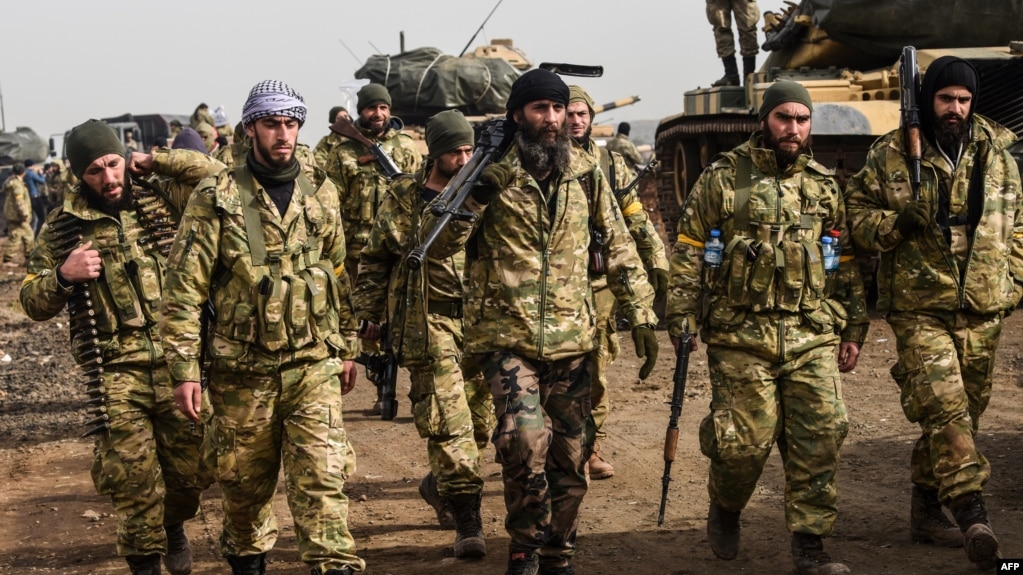
 'Turkey is relying on a newly reconfigured, 20,000-member force with three army corps as it tries to carve out a buffer zone within Syria. The force has already taken 16 casualties in two weeks of fighting on the front lines.

 But the soldiers are not Turks. Rather they are the mostly Arab fighters of the Free Syrian Army.

 The Free Syrian Army, out of favor with the United States and badly depleted after seven years of fighting on multiple fronts, has long had common cause with Turkey, whose incursion has angered the Americans.

 On the other side are Kurdish groups, under the umbrella of the Syrian Democratic Forces, who are the United States’ favored fighting tool on the ground but who are disliked by local Syrians for driving them from their homes and seen by Turkey as a security threat.


 Last week, in a cafe in Kilis, a small Turkish city a few miles from the Syrian border, Lt. Col. Mohammed Hammadin was back for a few hours after leading an assault against Kurdish positions on a mountain south of the border. He is a former Syrian Army officer and a commander of the Levant Front, the largest faction of the Free Syrian Army.

 Colonel Hammadin, 40, watched as a Free Syrian Army journalist shared video footage showing the colonel, still panting from his exertions, his hand on the shoulder of a captured Kurdish fighter.

 He explained that his Syrian force shared aims with Turkey, first in wanting to see Mr. Assad go, but also in its dislike for the Kurdistan Workers’ Party, or P.K.K., which has waged a separatist insurgency for three decades against Turkey.

 Like most members of the Syrian opposition in Turkey, the colonel described all the various Kurdish militant groups, no matter which side of the border they were on, as part of the same P.K.K. organization.

 “Turkey has a right to attack the P.K.K. for its own national security,” he said. “It has the right to clear the area because the P.K.K. can attack its cities from the border.”


 While he and his forces want Mr. Assad gone, they also want a united Syria. The Kurds, whose population straddles Turkey, Syria and Iraq, have long wanted to carve out their own nation.

 “The most important reason to fight them is that they are separatists,” he said. “They want their own cantons on the northern border.”

 The Kurdish militias had frequently sided with the Syrian government against the Free Syrian Army in the war, he said, helping enforce the siege of Aleppo, displacing Arab communities from their villages, and oppressing their own Kurdish people.

 “They committed many violations,” he said. “They were very pragmatic to gain their own ends — an independent state.”

 Syrians forced to flee to Turkey are bitter at the Kurdish militants. As such, the Free Syrian Army has embraced the Turkish fight against the Kurdish militants with gusto.

 Free Syrian Army soldiers posted video on social media showing themselves heading to the border to join the Turkish operation. Syrian volunteers have flocked to a recruitment center in the town of Urfa to sign up.

 “People are volunteering,” Colonel Hammadin said. “It’s good they want to apply, but our numbers are enough.”


 Hunched over a coffee table in another part of Kilis, two Syrian brothers, Murshid and Bashar Sheikh Naif, explained why their family supported Turkey’s latest operation.

 They had joined the uprising against the Assad government from the start in 2011. Murshid, 32, a former policeman, was imprisoned by the government for 18 months. He was released when the Free Syrian Army exchanged captured government soldiers for him.

 Of eight brothers in the Naif family, five have joined the Free Syrian Army over the years. They have fought multiple enemies — first Syrian government troops, then Russian and Iranian forces, then extremists of the Islamic State, and now American-backed Kurdish militias, whom they blame for forcing them from their home.

 Two brothers were killed, one fighting against the government and one against the Islamic State. Bashar, 22, was wounded fighting the Islamic State in an earlier operation alongside the Turkish Army. Two more brothers have joined the latest operation against the Kurdish militias in the enclave of Afrin, they said.

 “We were neighbors,” the elder Mr. Naif said of the Kurdish fighters. “There were no problems until the S.D.F. became an enemy and pushed us out of our villages.”

 The family fled to Turkey as the Kurdish militia seized their hometown, Tal Rifaat, and surrounding villages in 2016, he said.

 He played a video on his cellphone showing the exodus of refugees — some 200,000 Arabs were displaced from a string of 15 villages and towns north of Aleppo — and their shelters in mud-soaked camps.

 Their father died soon after, distraught at the loss of their home, Mr. Naif said. Their mother was dying of cancer, his younger brother added.

 “So we have a common cause,” Mr. Naif said. “There is a common interest in fighting against the P.K.K. with Turkey. Turkey is our personal ally and they helped the people a lot.”


 President Recep Tayyip Erdogan of Turkey gave the Free Syrian Army a strong endorsement in a speech on Tuesday, comparing them to Turkey’s National Forces, which fought for independence in the early 20th century.

 “The Free Syrian Army is a civil formation, organized by people who gathered to protect their own country,” he said, addressing legislators from his Justice and Development Party. “We are happy to be side by side with our Syrian brothers in their freedom struggle.”

 Nationalist support for the military campaign is running high in Turkey and dissent largely stifled. About 300 people, including members of the Turkish Medical Association, have been detained for expressing criticism of the operation on social media.


 Some Syrian refugees in Turkey are confused as to what to think about Ankara’s decision to send tanks and planes into Syria.

 Political and humanitarian activists voice fears that the operation will cause Syrians yet more civilian suffering, or stir strife between Kurdish and Arab communities in Syria.

 Some warn that Syrian fighters are being used by foreign powers.

 “Afrin is not our battle,” said an opposition activist, Yusuf Mousa. “As Syrians, we respect that Turkey is an ally of the Syrian revolution, but they are trying to make actions for their benefit.”

 Yet while Turkey’s operation in Afrin has been cast as a narrow fight against Kurdish separatists, seizing the territory would boost the standing of the Free Syrian Army.

 The group has steadily lost ground as an opposition force as the Syrian Democratic Forces, which the United States regards as its most effective partner in the fight against the Islamic State, have gained prominence.

 With Turkey’s help, the Free Syrian Army wants to seize the northern countryside around Tal Rifaat and open a corridor to the northwestern province of Idlib, to rescue more than a million trapped civilians and fighters.

 Mr. Erdogan has vowed to take control of a 20-mile zone along the length of Turkey’s border with Syria, and has called on United States forces to pull back from the Syrian town of Manbij.

 Colonel Hammadin did not say how far his soldiers would go, but he ruled out any confrontation with American troops. He said he hoped for the United States’ support against Mr. Assad.

 “America has the ability to do anything,” he said. “We look forward to them making the Assad regime leave.” '


Tuesday, 30 January 2018

Tests link Syrian stockpile to largest sarin attack


 'The Syrian government’s chemical weapons stockpile has been linked for the first time by laboratory tests to the largest sarin nerve agent attack of the civil war, supporting claims that government forces under President Bashar al-Assad were behind the atrocity.

 Laboratories working for the Organisation for the Prohibition of Chemical Weapons compared samples taken by a U.N. mission in the Damascus suburb of Ghouta after the Aug. 21, 2013 attack, when hundreds of civilians died of sarin gas poisoning, to chemicals handed over by Damascus for destruction in 2014.

 The tests found “markers” in samples taken at Ghouta and at the sites of two other nerve agent attacks, in the towns of Khan Sheikhoun in Idlib governorate on April 4, 2017 and Khan al-Assal, Aleppo, in March 2013, two people involved in the process said.

 “We compared Khan Sheikhoun, Khan al-Assal, Ghouta,” said one source who asked not to be named because of the sensitivity of the findings. “There were signatures in all three of them that matched.”

 The same test results were the basis for a report by the OPCW-United Nations Joint Investigative Mechanism in October which said the Syrian government was responsible for the Khan Sheikhoun attack, which killed dozens.


 The findings on Ghouta, whose details were confirmed by two separate diplomatic sources, were not released in the October report to the U.N. Security Council because they were not part of the team’s mandate.

 They will nonetheless bolster claims that Assad’s government still possesses and uses banned munitions in violation of several Security Council resolutions and the Chemical Weapons Convention.

 The OPCW declined to comment. Syria has repeatedly denied using chemical weapons in the conflict now in its seventh year and has blamed the chemical attacks in the rebel-held territory of Ghouta on the insurgents themselves.

 Russia has also denied that Syrian government forces have carried out chemical attacks and has questioned the reliability of the OCPW inquiries. Officials in Moscow have said the rebels staged the attacks to discredit the Assad government and whip up international condemnation.

 Under a U.S.-Russian deal after the Ghouta attack in 2013, Damascus joined the OPCW and agreed to permanently eliminate its chemical weapons program, including destroying a 1,300-tonne stockpile of industrial precursors that has now been linked to the Ghouta attack.


 But inspectors have found proof of an ongoing chemical weapons program in Syria, including the systematic use of chlorine barrel bombs and sarin, which they say was ordered at the highest levels of government.

 The sarin attack on Khan Sheikhoun in April last year prompted U.S. President Donald Trump to order a missile strike against the Shayrat air base, from which the Syrian operation is said to have been launched.

 Diplomatic and scientific sources said efforts by Syria and Russia to discredit the U.N.-OPCW tests establishing a connection to Ghouta have so far come up with nothing.

 Russia’s blocking of resolutions at the Security Council seeking accountability for war crimes in Syria gained new relevance when Russia stationed its aircraft at Shayrat in 2015.

 Washington fired missiles at Shayrat in April 2017, saying the Syrian air force used it to stage the Khan Sheikhoun sarin attack on April 4 a few days earlier, killing more than 80 people.

 No Russian military assets are believed to have been hit, but Moscow warned at the time it could have serious consequences.

 In June, the Pentagon said it had seen what appeared to be preparations for another chemical attack at the same airfield, prompting Russia to say it would respond proportionately if Washington took pre-emptive measures against Syrian forces there.


 The chemical tests were carried out at the request of the U.N.-OPCW inquiry, which was searching for potential links between the stockpile and samples from Khan Sheikhoun. The analysis results raised the possibility that they would provide a link to other sarin attacks, the source said.

 Two compounds in the Ghouta sample matched those also found in Khan Sheikhoun, one formed from sarin and the stabilizer hexamine and another specific fluorophosphate that appears during sarin production, the tests showed.

 “Like in all science, it should be repeated a couple of times, but it was serious matching and serious laboratory work,” the source said.

 Independent experts, however, said the findings are the strongest scientific evidence to date that the Syrian government was behind Ghouta, the deadliest chemical weapons attack since the Halabja massacres of 1988 during the Iran-Iraq war.

 “A match of samples from the 2013 Ghouta attacks to tests of chemicals in the Syrian stockpile is the equivalent of DNA evidence: definitive proof,” said Amy Smithson, a U.S. nonproliferation expert.

 The hexamine finding “is a particularly significant match,” Smithson said, because it is a chemical identified as a unique hallmark of the Syrian military’s process to make sarin.

 “This match adds to the mountain of physical evidence that points conclusively, without a shadow of doubt, to the Syrian government,” she said.


 Smithson and other sources familiar with the matter said it would have been virtually impossible for the rebels to carry out a coordinated, large-scale strike with poisonous munitions, even if they had been able to steal the chemicals from the government’s stockpile.

 “I don’t think there is a cat in hell’s chance that rebels or Islamic State were responsible for the Aug. 21 Ghouta attack,” said Hamish de Bretton-Gordon, an independent specialist in biological and chemical weapons.

 The U.N.-OPCW inquiry, which was disbanded in November after being blocked by Syria’s ally Russia at the U.N. Security Council, also found that Islamic State had used the less toxic blistering agent sulfur mustard gas on a small scale in Syria.

 The Ghouta attack, by comparison, was textbook chemical warfare, Smithson and de Bretton-Gordon said, perfectly executed by forces trained to handle sarin, a toxin which is more difficult to use because it must be mixed just before delivery.

 Surface-to-surface rockets delivered hundreds of litres of sarin in perfect weather conditions that made them as lethal as possible: low temperatures and wind in the early hours of the morning, when the gas would remain concentrated and kill sleeping victims, many of them children.

 Pre-attack air raids with conventional bombs shattered windows and doors and drove people into shelters where the heavy poison seeped down into underground hiding places. Aerial bombing afterwards sought to destroy the evidence.

 The large quantity of chemicals used, along with radar images of rocket traces showing they originated from Syrian Brigade positions, are further proof that the rebels could not have carried out the Ghouta attack, the experts said.'

Image result for Tests link Syrian government stockpile to largest sarin attack - sources

Thursday, 25 January 2018

Not to fight the Kurds, but to save them from the YPG


 Azad Sabu, commander, Free Syrian Army: "I'm taking part in this offensive, not to fight the Kurds, but to save them from the terrorism of the YPG. They planted terror into the heads of our youth."

 Refugee in Azaz: "The Kurdish militia stole our villages, killed our young people, and displaced us Arabs. God should bless the military offensive."

Wednesday, 24 January 2018

In Douma women model resilience


 'The sound of female laughter and the cheerful beat of an Arabic goblet drum pierce the walls of a ground floor apartment in the rebel-held Syrian city of Douma.

 Such sounds seem incongruous in the city, where food is scarce and bombing attacks routine, and in a region the United Nations envoy for Syria has described as an “epicenter for human suffering.”

 Indeed, how to feed their children is just one of the extreme challenges faced daily by the women who gathered at the apartment recently to support one another and choose to be happy.

 To carve out moments of joy for Douma’s women takes a unique brand of courage and creativity. Yet Sabah, a charismatic mother of five who hosted the recent gathering, has it in spades.

 “We are the privileged ones,” says Sabah, who like others interviewed for this story spoke under a pseudonym out of concern for the safety of her family. “I am sad for the younger generation who were born during the siege and remember nothing but war. We have memories, and these memories give us strength.”

 Sabah left behind a husband and a luxurious life in Abu Dhabi to join the Syrian uprising against President Bashar al-Assad in her native Douma. She recalls a time when seaside trips were snap decisions taken with the morning coffee. Now she can barely find coffee at a premium price, and leaving town is not an option.


 Douma, a conservative middle- and working-class city just 10 miles northeast of Damascus, has never been a base of enthusiastic support for Mr. Assad or his father and predecessor, Hafez. In 2011, the primarily Sunni community was at the forefront of weekly demonstrations calling at first for reform and then the ouster of the Assad regime. Forces loyal to Assad have laid siege to the rebel-held town since 2013, limiting the movement of people and the entry of food, fuel, humanitarian aid, and medical supplies.

 Last summer Russia, Iran, and Turkey brokered a de-escalation deal that included Eastern Ghouta, where Douma is located and where an estimated 400,000 people remain trapped, but residents say that days without heavy artillery and aerial bombardment remain the exception.

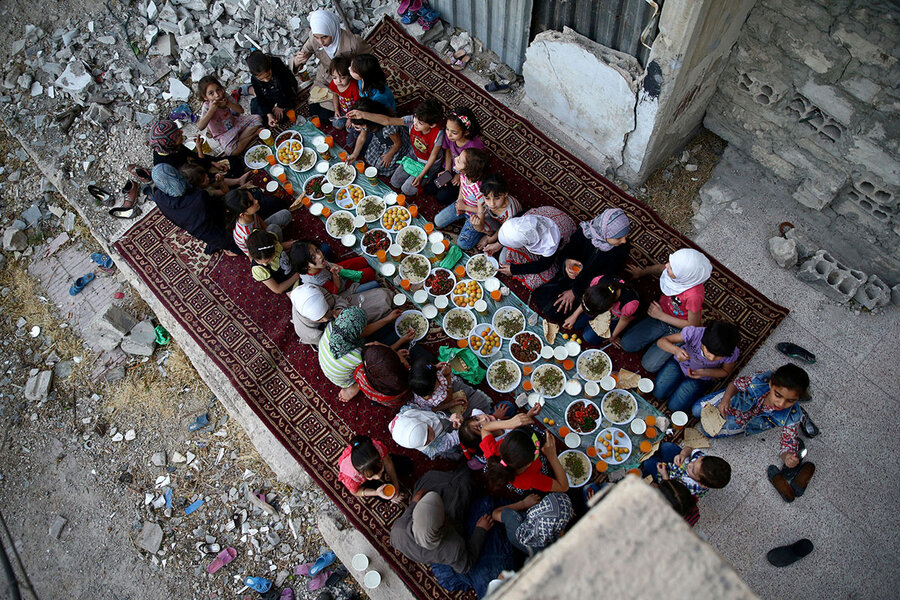
 Her own home reduced to rubble, Sabah converted her parents’ apartment in Douma into a safe haven for women, a place to gather and forget, even if just for a moment, the suffocating siege and seemingly endless war. She works with a charity supporting widows, divorcees, and single young women.

 Women of all ages stream into her cozy living room at the recent gathering. Small coffee tables offer plates of cookies and popcorn. Carpets cover the floor in a bid to trap the heat emitted by a stove burning coal and dry wood.

 The older women squeeze together onto wooden-based sofas, while the youngest stand to make room. They discuss political developments, fluctuating prices at the market, and swap recipes inspired by the limited produce of a city under siege.

 And they worry about how to feed their children in the Syrian city with the highest rate of malnutrition. According to a UN survey, nearly 12 percent of children under age 5 in Eastern Ghouta are acutely malnourished, about a third experience stunted growth, and mothers struggle to breastfeed.


 The impossibly slender fingers of Shams drum away at the derbake.

 She met the host back in 2011 while collecting medical supplies from Sabah. It was a year when the women of Eastern Ghouta came together to organize demonstrations, ferry medicine to field hospitals in their handbags, and distribute food aid to families in need.

 Before that, says Shams with laughter, life had been “simple, with no action.” She lived with her parents and divided her days between social activities and making tablecloths. Politics did not concern her until she witnessed indiscriminate security raids in her neighborhood.

 She describes as “good fortune” the night when a security officer turned a blind eye to her twin cousins – who lived in the same building and were old enough to be taken for military service – during a massive security sweep. Other young men were beaten and loaded into cars.

 “At that point, I knew that they (the regime) are treating us not as humans, and we saw them for who they really are,” she says.

 The indignities grew in scale and severity. A soldier setting up a machine gun at a checkpoint told her mother to run, warning that the weapon could “go off” by itself.

 “Imagine telling just anybody you are a target,” Shams says via a messaging application, the means for interviewing the other women in this story. “You cannot bear this, nor can you bear the fact that these people are the ones ruling your life.”


 In between uplifting moments of song and dance, memories bitter and sweet, the women share their present fears. These range from going out for an errand and never coming back to, even worse, returning to a home that has collapsed and crushed their relatives inside.

 Sarah, an unmarried 27-year-old teacher, works at a local elementary school, which, like much of the rest of the city, gets underway early to get as much done as possible before warplanes hit the skies.

 Lessons start as early as 6 a.m. In her class of 30 first-graders, some are so traumatized that they have learning and speech difficulties. An alarm system has been developed so that the children and teachers can shelter underground when there is shelling or air strikes near the school.

 “I go to work not knowing if I will come back or, even worse, if I will find my house standing and my brothers alive if I do make it back,” she says. “When the bombardments happen at school, my anxiety is double. It is terrifying because we worry about the safety of the children and how they will get home.”

 Before the war, she says, it would never have crossed her mind to live away from her father. Society in Douma is relatively conservative, with most women wearing the headscarf and girls living with their parents until they marry. While the new millennium brought with it increased educational and employment opportunities, few strayed beyond nearby Damascus to work or study.

 Sarah could have carried on teaching and living in relative safety in Damascus with her elderly father. Instead, she chose to live with her two brothers in Douma and care for the youngest, who was seriously wounded by shrapnel.

 Sarah says the lack of empathy among people in the government-controlled capital for those suffering in Douma, her hometown, contributed to her decision to move back in 2015.

 “Here we are home,” she says. “The people around me feel my pain, because we are all living the same conditions.”


 These friends could talk for days about their shared traumas: the first time their home was raided, the first time they crossed a checkpoint or saw someone shot by a sniper, or how they took tunnels to get out of Douma to bring supplies or visit loved ones, before the underground passages were destroyed by the regime.

 They’ve learned how to navigate life under siege. Sabah says half-jokingly that the strength and resilience of women in Douma is the outcome of dealing with stubborn and hardheaded men on the home front. It is also the outcome of being an integral part of the local economy. In the past, when Douma was mostly farmland, women tilled the land alongside men and made textiles when it wasn’t harvest season. Today, despite the siege, they are just as active.

 Sabah feels privileged for having access to generators that are strong enough to keep the lights on and electronic devices charging at night, even if they are too weak to keep a refrigerator going.

 Fuel might be scarce and costly, but Sabah doesn’t hesitate for a second to dedicate the little she has to power speakers and a phone to play songs that get the women dancing. She knows that good memories are not enough to sustain them. They must also make new ones.

 “If Sabah tells me right now that there is a gathering at her place, I will go over there immediately,” says Sarah speaking over the sound of bombing. “Life must go on.”

 Bombardment, siege, loss, and death, she adds, became “normal.”


 Her favorite memory of life under siege is the wedding of Lama, Sabah’s daughter, which took place last year on a day of intensive shelling and aerial bombardment.

 As the bride did her hair, first responders put out a fire sparked when a missile hit the building next door. Warplanes screeched overhead as Lama was driven to the wedding venue. A flat tire created further delays. Lama thought she would never make it but was overwhelmed with emotion when she reached the wedding hall and found it packed with people.

 Al-Hesba, a committee that oversees the application of Sharia law as Islamist rebel factions are the dominant force in town, did not permit the groom and his friends to join the celebration in the hall. They only allowed them to be at the main entrance. Undeterred, the men and women crammed into the designated space and broke out in song.

 “It was amazing!” recounts Lama in a later interview. “We danced and they sang for us. We had balloons filled with glitter, and they popped the balloons so all of us were sparkling.”

 Each in their own words, the women explain how if they wait for the “right” moment to be happy there will be none. The future does not carry with it the promise of immediate relief. Death is always at their doorstep with the regime closing in.

 Sabah, who is a regular participant in public meetings about negotiations between the regime and opposition, remains defiant and says there is no turning back. “There is no way we can accept Assad as the president anymore or to be back under the control of the security forces.”

 The women had a fright early one morning last week in what appears to have been another chemical attack. Half asleep and unaware of what had happened, Sabah opened her bedroom window, letting in toxic fumes. Her friends had to rush her to hospital for oxygen treatment, but she is now on the mend.'
Syrians are looking for their freedom

Syrian trauma surgeon Dr. Mahmoud Hariri will speak Wednesday at 8 a.m. at the UVA Health System’s McKim Hall.

 Dr. Mahmoud Hariri:

 
'So many people don’t know what’s happening in Syria. I hope these talks will help people know what’s happening on the ground and to see if there is any way for help – to help the Syrian doctors, to help the Syrian patients, and to help the Syrian people in general.

 What’s happening right now in Syria has become a global issue, not only a Syrian issue. We have to look for solutions because it will affect the world, not just a small area.

 There are so many doctors right now working inside the country under very intense situations. It’s our duty to help the innocent people who need help.

 Almost 90 percent of doctors fled the country. It’s a very difficult situation. There are some besieged areas with very few doctors who have to serve a large number of people. … But when you have a patient who survived after very hard and tough injuries and says, “Thank you, doctor,” I think that’s enough. I think that’s enough.

 There is some psychic effect on the human being when you are feeling that you are under attack. Many times our hospital has been targeted. My room itself almost collapsed. There was one facility that was targeted 25 times during this war. My hospital was targeted seven times. Two of the times I was in the hospital and fortunately survived. Part of the hospital collapsed.

 We tried to maintain the building and were underground in the basement, working in that area. To some extent, you feel you are safe, but actually it’s not safe because if the whole building collapsed, nobody would be able to get you out.


 I think the media is getting bored. The first day you see a lot in the news, the second day less, and then less day by day. So what about seven years [later]?

 We need to raise awareness. And I prefer to raise awareness slowly and constantly – by giving lectures, by telling stories. There are different ways to keep people aware about what is happening. When 9/11 happened and we say 3,000 people have been killed, it’s a number? No, those are people. Each one has a large number of people who loved him. So when you’re talking about 500,000 who have been killed in Syria – at least – that means all of the country has been affected.

 We have a large deficiency in the number of doctors. We believe establishing a university and school of medicine can help, so we started with this project. We have very few labs and not very much equipment, but we’ve started and now have third-year students and will hopefully have a next generation of doctors.

 There is hope. There is always hope. Syrians are looking for democracy, looking for their freedom.

 It’s difficult to have your freedom easily. You have to struggle for it. You have to work for it. You have to maybe risk your life for it.'

Tuesday, 23 January 2018

The never-ending siege on Eastern Ghouta


 CJ Werleman:

 'The Damascus suburb has been under siege by the Syrian regime since 2013. It is an ongoing humanitarian disaster that could become the next Aleppo.

 A siege is a military operation in which attacking forces encircle a territory, cutting off movement and supplies, while using all means of warfare to force the surrender and capitulation of those inside, including civilians. The use of terror to break the will of a hostile population is one of the oldest forms of warfare, and best exemplified in the biblical story of Jericho.

 After surrounding the walled and ancient city for seven days, located in what is now present-day occupied Palestine, Joshua commanded the Israelites to kill “every living thing in it – men and women, young and old, cattle, sheep and donkeys,” according to the Bible (Joshua 6:21).

 Four thousand years later, the Damascus suburb of Eastern Ghouta has been under a similarly brutal siege, but from the Assad regime since mid-2013.


 In May of last year, however, Turkey, Russia, and Iran agreed to a cease-fire deal in Syria, one that marked four zones in which Assad’s forces and opposition groups would cease “hostilities.” These “de-escalation zones” or “safe havens” were an attempt to reduce the violence, particularly by grounding Assad’s air force from flying over and dropping ordinance on the designated areas.

 Despite the agreement reached in Astana, the Kazakh capital, the Syrian regime has not only continued to attack civilians and rebels in the de-escalation zones, but also escalate its medieval siege of Eastern Ghouta, a siege that includes round-the-clock shelling, mortar fire, air-strikes, and unimaginable human suffering.

 The rising civilian death toll is shocking, and the methods deployed by the Assad regime are far crueler than anything described in the Bible.


 Last week, the United Nations human rights chief condemned Syrian regime forces for the upsurge in civilian casualties, and its increasing use of airstrikes and artillery shelling of the besieged suburb, observing that more than 100 civilians, including 21 women and 30 children have been killed since the start of 2018.

 This coming on the back of intensified Assad regime attacks on Eastern Ghouta during the last six weeks of 2017. The World Health Organization reported that 84 civilians were killed and 659 injured in a three-day period in November alone, and added that more than 200 mortar shells fell on heavily populated areas from 14 to 17 November.

 “The suffering of the people of Syria knows no end,” said UN High Commissioner for Human Rights Zeid Ra'ad Al Hussein.


 Evidently, the moral depravity of the Assad regime knows no end, either. On Monday, the National Coalition of Syrian Revolution and Opposition Forces released a statement claiming the regime attacked civilians in Eastern Ghouta using chlorine gas on January 22.

 “Credible reports indicated that the attack caused dozens of asphyxiation cases among civilians in the district of Douma and that most of the injured were women and children,” reads the coalition’s statement, a claim echoed by the Syrian Observatory for Human Rights (SOHR), who added that 21 people had been hospitalised as a result of the chemical weapons attack.

 Fewer than 400,000 Syrians reside in the Eastern Ghouta area today; a number that includes approximately 100,000 internally displaced people. When I asked Hassan Hassan, a noted Syrian born author and expert on the conflict, he said that the number of opposition fighters number only in the hundreds.

 “Assad has been focusing on this area as the strategic belt of Damascus. Ghouta also overlooks an important highway linking Damascus to Homs and other routes important for supply lines and access to hills on the way to Palmyra and the Syrian desert, where the regime has become a lot more active over the last year,” Hassan told me, adding that the regime has deployed various tactics to “neutralise” the outskirts of Damascus, “either through complete destruction, forcing mass displacement, or through local ceasefires.”


 Life under siege in Eastern Ghouta is every bit as horrific as one might imagine. “Shops are empty, streets are in ruins, the shelling rarely stops,” a 20-year-old resident told Syria Deeply. “Sometimes it feels like a Hollywood movie, especially when I learn what people are coming up with in order to survive.”

 Food and medical shortages are having a dramatic impact on the wellbeing of children, with UNICEF reporting that 11.9 percent of kids in Eastern Ghouta under the age of five are suffering from severe malnutrition.

 “This is the highest rate ever recorded in Syria since the conflict started,” the aid agency stated, a crisis exacerbated by the now unaffordable cost of whatever food remains on grocery store shelves, with the World Food Program observing that the typical price of a basket of food in the area costs 8 times the national average, amounting to a staggering US$521.

 Staples such as bread and rice are either unaffordable or unattainable for most residents, and images of starving children bring back memories of the world’s worst famines. A reminder that starvation is often the weapon of choice for attackers and tyrants who seek to break the will of a people they wish to subdue.

 “We are dying here. If dying from hunger doesn’t kill us, the bombs will, or the freezing cold will do it,” a 27-year-old aid worker, who wishes to remain anonymous out of fear of Assad’s security forces, told me.


 An absence of medical care is another killer. Attacking hospitals and medical facilities has been a tactic used by Assad since the conflict began five years ago. Not only has the regime struck more than 300 medical facilities, but also has “assassinated, bombed, and tortured to death almost 700 medical personnel,” according to Physicians for Human Rights.

 A doctor in Eastern Ghouta told Al Jazeera that babies are dying from a lack of access to routine medical care. “As a paediatrician, I feel that the children of the world are my children. I suffer for their suffering,” he said. “How do you feel if your child dies before your eyes and you cannot give him anything? It is something painful.”

 This human catastrophe, one of Assad’s making, is taking place in almost complete media silence. Simply, the world has lost interest in the lives of those besieged in Syria.

 Eastern Ghouta promises to become “the next Aleppo unless the international community increases pressure on besieging parties and their allies,” says The Syria Institute.

 More than 31,000 died in Aleppo, and the city was reduced to rubble. A similar fate awaits Eastern Ghouta if the international community, including the UN Security Council, fails the people of Syria again.'

Goal of the FSA to regain towns occupied by the YPG

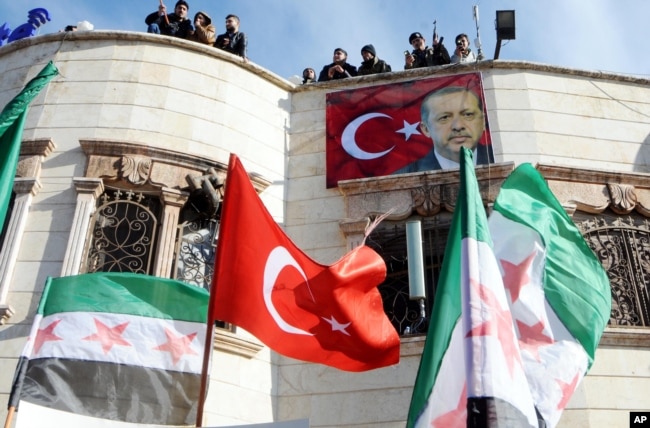
Turkey-backed Free Syrian Army, FSA, fighters stand on the roof of a building with a poster of Turkey's President Recep Tayyip Erdogan hanging on it in the Syrian town of Azez near the border with Turkey, Jan. 19, 2018.

 'Many of the rebels fighting alongside Turkish forces in northern Syria this week in a military offensive Ankara has called Operation Olive Branch come from rural northern Syria. They see the battle to wrest control of the northern Kurdish enclave of Afrin and outlying Arab villages as vengeance for the coordination they allege took place in February 2016 between the YPG and Russian-backed forces loyal to Syrian President Bashar al-Assad in an offensive to encircle Aleppo.

 That offensive saw the YPG grab the opportunity to seize a string of Arab villages and towns in northern Syria to the southeast of Afrin, including traditionally Arab Tell Rifaat.

 "The problem is not only that the Kurdish fighters cooperated with the Syrian regime and the Russians during the battle for Aleppo, but that the YPG burned dozens of Arab villages and displaced their inhabitants," said Gen. Salim Idris, a former rebel chief of staff.

 The loss of Tell Rifaat was a calamity for Syrian rebels, depriving them of the chance to establish a defensive line.

 "The goal of the Free Syrian Army is to regain 16 Arab towns and villages occupied by the YPG" in 2016, said Major Yasser Abdul Rahim, the commander of Failaq al Sham, a rebel militia.

 The Turkish offensive has the support, too, of the Syrian rebels' main political organization, the Syrian Coalition, which says it is backing Ankara's intervention. The coalition is urging YPG militiamen to "pull out of the towns and villages they occupied and from which they displaced their residents." '

Syrian opposition fighters backed by Turkey walk in front of Turkish troops near the Syria border at Hassa, Hatay province on Jan. 22, 2018.

The battle in Afrin has highlighted divisions


Faisal Al Yafai:

 'To really understand how complicated the Syrian war is becoming, it is necessary to go back a week, to a meeting in Washington between US officials and the Free Syrian Army. Senior officials of the FSA were in the US asking for the CIA to resume its programme of military aid, which was suspended last year by Donald Trump. Without a resumption, they warned, Iranian militias would be free to expand and US-supported groups would diminish.

 A week later and the FSA is now fighting alongside Turkey to clear a northern Syrian town of a militia that is supported by the United States. So rapidly has the conflict morphed in unexpected directions, that even those who oppose Bashar Al Assad's regime are uncertain which side they should support.

 On the ground, Turkey, which was one of the first to explicitly support the Syrian revolution and call for Bashar Al Assad to step down, is fighting in Afrin alongside the FSA, who remain committed to ending the regime.

 For Turkey, the US-backed People's Protection Units (YPG), a mainly Kurdish militia in Afrin, are too close to the Kurdish insurgent groups inside Turkey that have waged a long-running war against the Turkish state. Ankara has noted that US weapons supplied to the YPG have ended up across the Turkish border.


 But the FSA's involvement in Afrin has more to do with Syria than Turkey. For them, the YPG, by carving out a space away from the regime, is trying to split Syria into several pieces. Many who support the revolution support the idea of maintaining Syrian territorial integrity – except that the Kurdish enclave in Afrin is also protecting Syrian civilians from the Assad regime.

 The FSA, in fact, has a broader disagreement with the YPG, one that goes beyond the specificities of this battle. The YPG want a Kurdish-majority region, even if that means pushing out Syrian Arabs by force. But one of the aims of the revolution, and of the Syrian opposition, is to move away from a Syria of ethnicities and faiths and towards a model of citizenship.

 Syrian civilians, Kurdish and Arab, now being attacked in Afrin, might well ask how that admittedly lofty goal is served by the FSA allying itself with a foreign power (itself allied with Russia, a sponsor of the regime) and attacking an enclave inside Syrian territory. The people being attacked in Afrin are, after all, Syrians, regardless of ethnicity.

 And they ask, with the Syrian regime now besieging the small district of Ghouta outside Damascus, with Russian and Syrian planes carrying out bombing raids, if attacking Afrin is really the most pressing issue the FSA have. The Kurds are right to feel hard done by. They have allied themselves with the US, only to find that, with troops on the edge of their territory, the US has turned away.


 Away from the ground, on the sidelines, on social media and in endless debates over the past few days, supporters of the revolution have turned on each other, unable to decide which side to back.

 The questions are posed like this. Does supporting the Syrian revolution mean being against everyone who supports or enables the Al Assad regime? In that case, removing the YPG from Afrin is a positive development, because it weakens the regime while opening up space for civilians to be autonomous.

 Or does supporting the revolution, which aimed to free Syrian civilians from the Assad regime, mean supporting Syrians to live peacefully? In which case, an attack on Syrian civilians – and, worse, by Syrian fighters from the FSA – is a betrayal of those values. Moreover, for a revolution that started from the premise of a Syria for all, setting up a conflict between Syrian Arabs and Syrian Kurds is counterproductive and will have long-term repercussions.

 As long as countries outside and armed groups inside Syria continue to play out their plans across its soil, there will be no long-term solution. Syria needs to be whole, secure and stable. It will not get there with Bashar Al Assad in charge and it will not get there when Syrian civilians are killed by Syrian fighters.

 The safety of civilians will always be a secondary priority as long as Syria is the backdrop for the ambitions of groups other than the Syrian people. And as long as civilians are threatened, regardless of who is holding the guns, the Syrian revolution cannot truly have been said to be successful.'