Saturday, 3 February 2018

'We need to rebuild the families'


 'He'd told her the screaming and the torture goes on all night. Their tiny cell, strategically placed next to the torture chamber so they can hear what’s going on inside, is crammed with 150 naked people. In the morning -- after breakfast of a small piece of bread and five olives -- the detainees’ first job is to remove the bodies of those killed during the night. There are usually about 35 victims. Sometimes there are as many as 50. They put the bodies into sacks and load them onto trucks. Then they wash the torture chamber’s floor of the victims’ blood. This is the morning ritual at the military intelligence detention centre, branch 227, in the Syrian capital of Damascus.

 As she describes the detention centre where she believes her husband, Nasser, a civil activist, is being held, Farizah Jahjah, 50, takes a huge breath and her eyes fill with tears. She's been perfectly composed until now. Neatly dressed in a black knee-length dress and red scarf with glasses perched on her dark hair, she talks passionately yet calmly about the issue of detainees in Syria.

 It’s been nearly four years since she’s had news from her husband. She has no idea if he’s dead or alive. She’s heard rumours but nothing concrete, nothing from an official source. She’s only heard an account of his time in prison from a man who was with him when he was first detained and subsequently released.

 Farizah’s husband is one of thousands of Syrians being held in secret detention centres and prisons throughout the country. A year ago, she and four other Syrian women founded Families for Freedom, an NGO that aims to give a voice to the families of detainees and highlight their plight.

 Ultimately, they’re asking for the immediate release of all those unlawfully detained. But in the meantime, they’re urging the Syrian government to release a list of names of all those in custody -- along with their location and status -- and allow international aid groups access to detention facilities.


 It’s impossible to give a precise figure of the number of detainees in Syria because no international observers have been given access to detention centres. Estimates of those behind bars vary wildly -- from 200,000 to as many as 300,000. As of January 2018, the Syrian Network for Human Rights says at least 215,000 people are believed to be in the custody of authorities, including women and children.

 Some have been detained for peaceful opposition, simply being in the wrong place at the wrong time or for the “crime” of delivering milk.

 Hala al Ghawi, 39, a doctor and another of the group’s founders, says that every family in her neighbourhood is missing someone. Farizah rattles off lists of friends who are missing family members -- cousins, grandparents, siblings and children. Sometimes, whole families have been disappeared or detained.

 Forced disappearance and arbitrary detention have long been a weapon of Syrian President Bashar al-Assad’s government but there has been a sharp escalation since the beginning of the civil war in 2011. Although detention and torture are practised by all sides in the conflict, Assad’s government is believed to be behind the vast majority of arrests.

 Some of the detainees are civil activists, like Farizah’s husband; others are doctors, like Hala’s husband, who was arrested in 2011.

“He wasn’t involved in any political activity,” she says. “He is a doctor. He made it his duty to help people.”

 Dr. al Ghawi was arrested after a man rang his clinic to make an appointment for his wife, saying she was suffering from stomach problems. When the man arrived and found Dr. al Ghawi in his practice, he said he’d return with his wife – but instead, security forces swooped in and took the doctor away. He was lucky enough to be released after 70 days.

 He was freed, Hala believes, so that he would warn people outside of the horrible conditions inside prison. Seven years later, he suffers from depression, PTSD and still has flashbacks from his time inside. “He dreams that they are coming to capture him,” she says.

 Then in 2013 her father-in-law, 70, was arrested at the market when he was buying vegetables. And 20 days later they took her brother, now 33, from his metal workshop in the west-central city of Hama.

 Despite begging for information and going to every prison she could, she has no news of either of them.


 “It’s chaos in some places,” said Mohammed Ghannam, 38, who spent 14 months in prison in Homs and now lives in Paris. “There are people who are thrown in prison and they completely forget about them. There are no papers for their arrest.”

 The prisons are overflowing and some people are being held in underground shopping malls that have been turned into secret detention centres. Ghannam was briefly detained and interrogated in a cultural centre in the northwestern city of Idlib.

 Assad has refused to bow to demands for international observers to visit the prisons. On the rare occasion that he does, as he did in Homs in 2011, the Assad regime manages to find a way to hoodwink the international community.

 “They always find a way to trick the system”, said Ghannam. “I was there. They moved us from the [detention] centre. Those observers saw an empty bombed out building.”


 Before the 2011 popular uprising, many Syrians were too afraid to speak out for fear of retribution. “My parents told me the walls have ears,” said Hala, who grew up in the city of Hama, scene of the 1982 massacre, where an estimated 20,000 people were killed on the orders of Hafez al-Assad -- the current president’s father.

 But the revolution -- and the disappearance of their loved ones -- gave them courage. Although both Hala and Farizah now live outside of Syria, they still have family at home. Hala, who lives in Turkey, says she is very careful and cautious about what she says. She wants to stress that Families for Freedom is asking for the release of detainees as a humanitarian gesture. They don’t want Assad to use the detainees as a negotiating tool.

 Before her husband’s arrest in 2014, Farizah herself had been threatened with detention. She fled Syria with their two children, eventually making a new home in France. But her husband had refused to leave on the principle “that if all of us are seeking freedom and a better future -- some of us have to stay”. Farizah was initially too afraid to speak out about her husband’s arrest. After years of silence she felt it was her only option. She won’t even talk about her family in Syria for fear of reprisals against them.

 Hala shrugs when she explains why her parents refuse to leave the country. They’re waiting for her brother, she says, “that maybe one day he will knock the door and come”.

 Part of the success of Families for Freedom, they say, lies not just in the comfort that it’s brought to detainees’ families -- who now share photos of their relatives and talk more openly about the issue -- but that it’s also helped raised awareness of the horrific conditions in Syria's prisons and detention centres.


 “You beg them to kill you after they hang you for hours,” says Ghannam who was imprisoned on terrorism charges after delivering food and medical supplies to the besieged city of Homs in 2011.

 After a three-month interrogation where he was raped with a plastic stick, doused in diesel and threatened with a lighter, left in a room with four dead bodies for three days and three nights and slung upside down like a dead cat, he “sang like a canary”.

 “They broke me,” he said, after a brutal night of interrogation in the notorious “heaven room” of the Palestine branch of Damascus’s detention centre.

 “I really felt I wanted to work with the government, that I was completely wrong, and that the revolution was a conspiracy.”

 Ghannam was transferred to Homs central prison and was lucky enough to be released on parole after his friends “hired at least eight lawyers and paid a lot of money”. He fled to Lebanon three days later and was sentenced to eight years in absentia.

 “I’m not scared from bombing like I’m scared to be detained,” says Hala. “It’s very horrible.”


 Negotiations to release the detainees have so far failed. Their plight has been repeatedly sidelined at UN talks in Geneva, Sochi and Astana.

 Part of the problem lies in the Assad government’s “reluctance” to address the problem, said Sara Kayyali, Syria researcher at Human Rights Watch.

 The release of detainees is “crucial for any forward-looking solution” to the Syrian conflict, Kayyali added, “especially as talks of the conflict winding down and people returning are advanced”.

 Hala believes in the West’s power to pressure Assad if there is the political will to do so.

 Both women are disappointed by French President Emmanuel Macron’s position on Assad. Macron’s predecessor, François Hollande, had called for Assad’s exit, describing him as a “butcher” of his own people and insisting that “he cannot be part of the solution”.

 But Macron says Assad’s departure is no longer a prerequisite, adding that Paris’s priority is fighting terrorism and ensuring Syria does not become a failed state. He has also questioned the Syrian opposition’s credibility.

 "If the Assad regime were gone, ISIS would go,” says Hala. “They depend on each other to survive,” referring to Assad’s 2011 release of militant Islamists from Saydnaya prison, some of whom went on to play leading roles within the Islamic State group, Al Nusra Front and other extremist groups.

 Ghannam is not optimistic about the detainees’ fate. “There’s no oil behind them, there is no f***** piece of land. What benefits can France get? Maybe reconstruction deals?”

 “They’re talking about rebuilding the country -- the buildings -- but they need to rebuild the families,” says Hala. “If I know that a person is related to the regime and he tortured my brother til death I cannot forgive him.”


Some Syrians Are Going Back to War Alongside Turkey


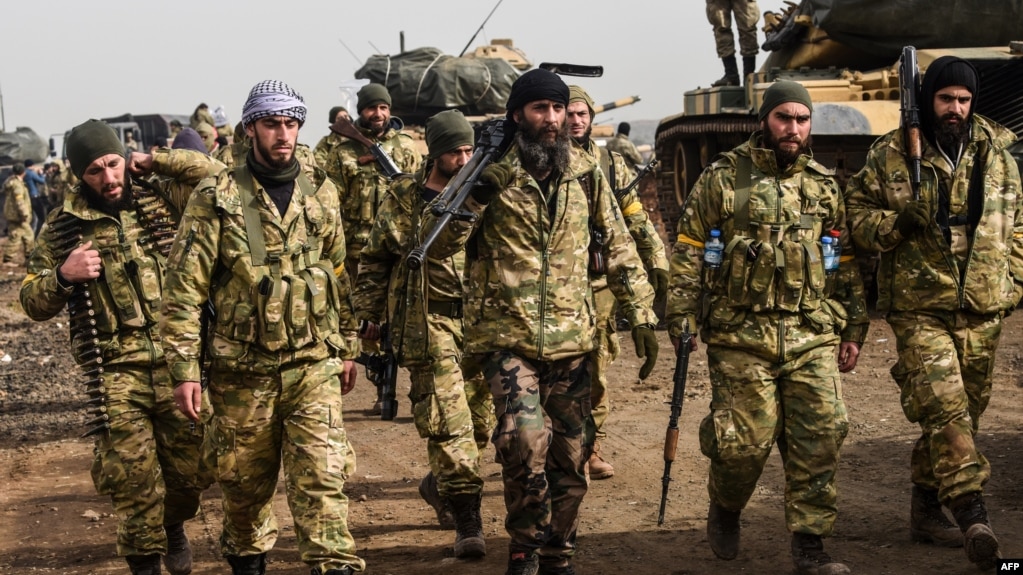
 'Turkey is relying on a newly reconfigured, 20,000-member force with three army corps as it tries to carve out a buffer zone within Syria. The force has already taken 16 casualties in two weeks of fighting on the front lines.

 But the soldiers are not Turks. Rather they are the mostly Arab fighters of the Free Syrian Army.

 The Free Syrian Army, out of favor with the United States and badly depleted after seven years of fighting on multiple fronts, has long had common cause with Turkey, whose incursion has angered the Americans.

 On the other side are Kurdish groups, under the umbrella of the Syrian Democratic Forces, who are the United States’ favored fighting tool on the ground but who are disliked by local Syrians for driving them from their homes and seen by Turkey as a security threat.


 Last week, in a cafe in Kilis, a small Turkish city a few miles from the Syrian border, Lt. Col. Mohammed Hammadin was back for a few hours after leading an assault against Kurdish positions on a mountain south of the border. He is a former Syrian Army officer and a commander of the Levant Front, the largest faction of the Free Syrian Army.

 Colonel Hammadin, 40, watched as a Free Syrian Army journalist shared video footage showing the colonel, still panting from his exertions, his hand on the shoulder of a captured Kurdish fighter.

 He explained that his Syrian force shared aims with Turkey, first in wanting to see Mr. Assad go, but also in its dislike for the Kurdistan Workers’ Party, or P.K.K., which has waged a separatist insurgency for three decades against Turkey.

 Like most members of the Syrian opposition in Turkey, the colonel described all the various Kurdish militant groups, no matter which side of the border they were on, as part of the same P.K.K. organization.

 “Turkey has a right to attack the P.K.K. for its own national security,” he said. “It has the right to clear the area because the P.K.K. can attack its cities from the border.”


 While he and his forces want Mr. Assad gone, they also want a united Syria. The Kurds, whose population straddles Turkey, Syria and Iraq, have long wanted to carve out their own nation.

 “The most important reason to fight them is that they are separatists,” he said. “They want their own cantons on the northern border.”

 The Kurdish militias had frequently sided with the Syrian government against the Free Syrian Army in the war, he said, helping enforce the siege of Aleppo, displacing Arab communities from their villages, and oppressing their own Kurdish people.

 “They committed many violations,” he said. “They were very pragmatic to gain their own ends — an independent state.”

 Syrians forced to flee to Turkey are bitter at the Kurdish militants. As such, the Free Syrian Army has embraced the Turkish fight against the Kurdish militants with gusto.

 Free Syrian Army soldiers posted video on social media showing themselves heading to the border to join the Turkish operation. Syrian volunteers have flocked to a recruitment center in the town of Urfa to sign up.

 “People are volunteering,” Colonel Hammadin said. “It’s good they want to apply, but our numbers are enough.”


 Hunched over a coffee table in another part of Kilis, two Syrian brothers, Murshid and Bashar Sheikh Naif, explained why their family supported Turkey’s latest operation.

 They had joined the uprising against the Assad government from the start in 2011. Murshid, 32, a former policeman, was imprisoned by the government for 18 months. He was released when the Free Syrian Army exchanged captured government soldiers for him.

 Of eight brothers in the Naif family, five have joined the Free Syrian Army over the years. They have fought multiple enemies — first Syrian government troops, then Russian and Iranian forces, then extremists of the Islamic State, and now American-backed Kurdish militias, whom they blame for forcing them from their home.

 Two brothers were killed, one fighting against the government and one against the Islamic State. Bashar, 22, was wounded fighting the Islamic State in an earlier operation alongside the Turkish Army. Two more brothers have joined the latest operation against the Kurdish militias in the enclave of Afrin, they said.

 “We were neighbors,” the elder Mr. Naif said of the Kurdish fighters. “There were no problems until the S.D.F. became an enemy and pushed us out of our villages.”

 The family fled to Turkey as the Kurdish militia seized their hometown, Tal Rifaat, and surrounding villages in 2016, he said.

 He played a video on his cellphone showing the exodus of refugees — some 200,000 Arabs were displaced from a string of 15 villages and towns north of Aleppo — and their shelters in mud-soaked camps.

 Their father died soon after, distraught at the loss of their home, Mr. Naif said. Their mother was dying of cancer, his younger brother added.

 “So we have a common cause,” Mr. Naif said. “There is a common interest in fighting against the P.K.K. with Turkey. Turkey is our personal ally and they helped the people a lot.”


 President Recep Tayyip Erdogan of Turkey gave the Free Syrian Army a strong endorsement in a speech on Tuesday, comparing them to Turkey’s National Forces, which fought for independence in the early 20th century.

 “The Free Syrian Army is a civil formation, organized by people who gathered to protect their own country,” he said, addressing legislators from his Justice and Development Party. “We are happy to be side by side with our Syrian brothers in their freedom struggle.”

 Nationalist support for the military campaign is running high in Turkey and dissent largely stifled. About 300 people, including members of the Turkish Medical Association, have been detained for expressing criticism of the operation on social media.


 Some Syrian refugees in Turkey are confused as to what to think about Ankara’s decision to send tanks and planes into Syria.

 Political and humanitarian activists voice fears that the operation will cause Syrians yet more civilian suffering, or stir strife between Kurdish and Arab communities in Syria.

 Some warn that Syrian fighters are being used by foreign powers.

 “Afrin is not our battle,” said an opposition activist, Yusuf Mousa. “As Syrians, we respect that Turkey is an ally of the Syrian revolution, but they are trying to make actions for their benefit.”

 Yet while Turkey’s operation in Afrin has been cast as a narrow fight against Kurdish separatists, seizing the territory would boost the standing of the Free Syrian Army.

 The group has steadily lost ground as an opposition force as the Syrian Democratic Forces, which the United States regards as its most effective partner in the fight against the Islamic State, have gained prominence.

 With Turkey’s help, the Free Syrian Army wants to seize the northern countryside around Tal Rifaat and open a corridor to the northwestern province of Idlib, to rescue more than a million trapped civilians and fighters.

 Mr. Erdogan has vowed to take control of a 20-mile zone along the length of Turkey’s border with Syria, and has called on United States forces to pull back from the Syrian town of Manbij.

 Colonel Hammadin did not say how far his soldiers would go, but he ruled out any confrontation with American troops. He said he hoped for the United States’ support against Mr. Assad.

 “America has the ability to do anything,” he said. “We look forward to them making the Assad regime leave.” '


Tuesday, 30 January 2018

Tests link Syrian stockpile to largest sarin attack


 'The Syrian government’s chemical weapons stockpile has been linked for the first time by laboratory tests to the largest sarin nerve agent attack of the civil war, supporting claims that government forces under President Bashar al-Assad were behind the atrocity.

 Laboratories working for the Organisation for the Prohibition of Chemical Weapons compared samples taken by a U.N. mission in the Damascus suburb of Ghouta after the Aug. 21, 2013 attack, when hundreds of civilians died of sarin gas poisoning, to chemicals handed over by Damascus for destruction in 2014.

 The tests found “markers” in samples taken at Ghouta and at the sites of two other nerve agent attacks, in the towns of Khan Sheikhoun in Idlib governorate on April 4, 2017 and Khan al-Assal, Aleppo, in March 2013, two people involved in the process said.

 “We compared Khan Sheikhoun, Khan al-Assal, Ghouta,” said one source who asked not to be named because of the sensitivity of the findings. “There were signatures in all three of them that matched.”

 The same test results were the basis for a report by the OPCW-United Nations Joint Investigative Mechanism in October which said the Syrian government was responsible for the Khan Sheikhoun attack, which killed dozens.


 The findings on Ghouta, whose details were confirmed by two separate diplomatic sources, were not released in the October report to the U.N. Security Council because they were not part of the team’s mandate.

 They will nonetheless bolster claims that Assad’s government still possesses and uses banned munitions in violation of several Security Council resolutions and the Chemical Weapons Convention.

 The OPCW declined to comment. Syria has repeatedly denied using chemical weapons in the conflict now in its seventh year and has blamed the chemical attacks in the rebel-held territory of Ghouta on the insurgents themselves.

 Russia has also denied that Syrian government forces have carried out chemical attacks and has questioned the reliability of the OCPW inquiries. Officials in Moscow have said the rebels staged the attacks to discredit the Assad government and whip up international condemnation.

 Under a U.S.-Russian deal after the Ghouta attack in 2013, Damascus joined the OPCW and agreed to permanently eliminate its chemical weapons program, including destroying a 1,300-tonne stockpile of industrial precursors that has now been linked to the Ghouta attack.


 But inspectors have found proof of an ongoing chemical weapons program in Syria, including the systematic use of chlorine barrel bombs and sarin, which they say was ordered at the highest levels of government.

 The sarin attack on Khan Sheikhoun in April last year prompted U.S. President Donald Trump to order a missile strike against the Shayrat air base, from which the Syrian operation is said to have been launched.

 Diplomatic and scientific sources said efforts by Syria and Russia to discredit the U.N.-OPCW tests establishing a connection to Ghouta have so far come up with nothing.

 Russia’s blocking of resolutions at the Security Council seeking accountability for war crimes in Syria gained new relevance when Russia stationed its aircraft at Shayrat in 2015.

 Washington fired missiles at Shayrat in April 2017, saying the Syrian air force used it to stage the Khan Sheikhoun sarin attack on April 4 a few days earlier, killing more than 80 people.

 No Russian military assets are believed to have been hit, but Moscow warned at the time it could have serious consequences.

 In June, the Pentagon said it had seen what appeared to be preparations for another chemical attack at the same airfield, prompting Russia to say it would respond proportionately if Washington took pre-emptive measures against Syrian forces there.


 The chemical tests were carried out at the request of the U.N.-OPCW inquiry, which was searching for potential links between the stockpile and samples from Khan Sheikhoun. The analysis results raised the possibility that they would provide a link to other sarin attacks, the source said.

 Two compounds in the Ghouta sample matched those also found in Khan Sheikhoun, one formed from sarin and the stabilizer hexamine and another specific fluorophosphate that appears during sarin production, the tests showed.

 “Like in all science, it should be repeated a couple of times, but it was serious matching and serious laboratory work,” the source said.

 Independent experts, however, said the findings are the strongest scientific evidence to date that the Syrian government was behind Ghouta, the deadliest chemical weapons attack since the Halabja massacres of 1988 during the Iran-Iraq war.

 “A match of samples from the 2013 Ghouta attacks to tests of chemicals in the Syrian stockpile is the equivalent of DNA evidence: definitive proof,” said Amy Smithson, a U.S. nonproliferation expert.

 The hexamine finding “is a particularly significant match,” Smithson said, because it is a chemical identified as a unique hallmark of the Syrian military’s process to make sarin.

 “This match adds to the mountain of physical evidence that points conclusively, without a shadow of doubt, to the Syrian government,” she said.


 Smithson and other sources familiar with the matter said it would have been virtually impossible for the rebels to carry out a coordinated, large-scale strike with poisonous munitions, even if they had been able to steal the chemicals from the government’s stockpile.

 “I don’t think there is a cat in hell’s chance that rebels or Islamic State were responsible for the Aug. 21 Ghouta attack,” said Hamish de Bretton-Gordon, an independent specialist in biological and chemical weapons.

 The U.N.-OPCW inquiry, which was disbanded in November after being blocked by Syria’s ally Russia at the U.N. Security Council, also found that Islamic State had used the less toxic blistering agent sulfur mustard gas on a small scale in Syria.

 The Ghouta attack, by comparison, was textbook chemical warfare, Smithson and de Bretton-Gordon said, perfectly executed by forces trained to handle sarin, a toxin which is more difficult to use because it must be mixed just before delivery.

 Surface-to-surface rockets delivered hundreds of litres of sarin in perfect weather conditions that made them as lethal as possible: low temperatures and wind in the early hours of the morning, when the gas would remain concentrated and kill sleeping victims, many of them children.

 Pre-attack air raids with conventional bombs shattered windows and doors and drove people into shelters where the heavy poison seeped down into underground hiding places. Aerial bombing afterwards sought to destroy the evidence.

 The large quantity of chemicals used, along with radar images of rocket traces showing they originated from Syrian Brigade positions, are further proof that the rebels could not have carried out the Ghouta attack, the experts said.'

Image result for Tests link Syrian government stockpile to largest sarin attack - sources

Thursday, 25 January 2018

Not to fight the Kurds, but to save them from the YPG


 Azad Sabu, commander, Free Syrian Army: "I'm taking part in this offensive, not to fight the Kurds, but to save them from the terrorism of the YPG. They planted terror into the heads of our youth."

 Refugee in Azaz: "The Kurdish militia stole our villages, killed our young people, and displaced us Arabs. God should bless the military offensive."

Wednesday, 24 January 2018

In Douma women model resilience


 'The sound of female laughter and the cheerful beat of an Arabic goblet drum pierce the walls of a ground floor apartment in the rebel-held Syrian city of Douma.

 Such sounds seem incongruous in the city, where food is scarce and bombing attacks routine, and in a region the United Nations envoy for Syria has described as an “epicenter for human suffering.”

 Indeed, how to feed their children is just one of the extreme challenges faced daily by the women who gathered at the apartment recently to support one another and choose to be happy.

 To carve out moments of joy for Douma’s women takes a unique brand of courage and creativity. Yet Sabah, a charismatic mother of five who hosted the recent gathering, has it in spades.

 “We are the privileged ones,” says Sabah, who like others interviewed for this story spoke under a pseudonym out of concern for the safety of her family. “I am sad for the younger generation who were born during the siege and remember nothing but war. We have memories, and these memories give us strength.”

 Sabah left behind a husband and a luxurious life in Abu Dhabi to join the Syrian uprising against President Bashar al-Assad in her native Douma. She recalls a time when seaside trips were snap decisions taken with the morning coffee. Now she can barely find coffee at a premium price, and leaving town is not an option.


 Douma, a conservative middle- and working-class city just 10 miles northeast of Damascus, has never been a base of enthusiastic support for Mr. Assad or his father and predecessor, Hafez. In 2011, the primarily Sunni community was at the forefront of weekly demonstrations calling at first for reform and then the ouster of the Assad regime. Forces loyal to Assad have laid siege to the rebel-held town since 2013, limiting the movement of people and the entry of food, fuel, humanitarian aid, and medical supplies.

 Last summer Russia, Iran, and Turkey brokered a de-escalation deal that included Eastern Ghouta, where Douma is located and where an estimated 400,000 people remain trapped, but residents say that days without heavy artillery and aerial bombardment remain the exception.

 Her own home reduced to rubble, Sabah converted her parents’ apartment in Douma into a safe haven for women, a place to gather and forget, even if just for a moment, the suffocating siege and seemingly endless war. She works with a charity supporting widows, divorcees, and single young women.

 Women of all ages stream into her cozy living room at the recent gathering. Small coffee tables offer plates of cookies and popcorn. Carpets cover the floor in a bid to trap the heat emitted by a stove burning coal and dry wood.

 The older women squeeze together onto wooden-based sofas, while the youngest stand to make room. They discuss political developments, fluctuating prices at the market, and swap recipes inspired by the limited produce of a city under siege.

 And they worry about how to feed their children in the Syrian city with the highest rate of malnutrition. According to a UN survey, nearly 12 percent of children under age 5 in Eastern Ghouta are acutely malnourished, about a third experience stunted growth, and mothers struggle to breastfeed.


 The impossibly slender fingers of Shams drum away at the derbake.

 She met the host back in 2011 while collecting medical supplies from Sabah. It was a year when the women of Eastern Ghouta came together to organize demonstrations, ferry medicine to field hospitals in their handbags, and distribute food aid to families in need.

 Before that, says Shams with laughter, life had been “simple, with no action.” She lived with her parents and divided her days between social activities and making tablecloths. Politics did not concern her until she witnessed indiscriminate security raids in her neighborhood.

 She describes as “good fortune” the night when a security officer turned a blind eye to her twin cousins – who lived in the same building and were old enough to be taken for military service – during a massive security sweep. Other young men were beaten and loaded into cars.

 “At that point, I knew that they (the regime) are treating us not as humans, and we saw them for who they really are,” she says.

 The indignities grew in scale and severity. A soldier setting up a machine gun at a checkpoint told her mother to run, warning that the weapon could “go off” by itself.

 “Imagine telling just anybody you are a target,” Shams says via a messaging application, the means for interviewing the other women in this story. “You cannot bear this, nor can you bear the fact that these people are the ones ruling your life.”


 In between uplifting moments of song and dance, memories bitter and sweet, the women share their present fears. These range from going out for an errand and never coming back to, even worse, returning to a home that has collapsed and crushed their relatives inside.

 Sarah, an unmarried 27-year-old teacher, works at a local elementary school, which, like much of the rest of the city, gets underway early to get as much done as possible before warplanes hit the skies.

 Lessons start as early as 6 a.m. In her class of 30 first-graders, some are so traumatized that they have learning and speech difficulties. An alarm system has been developed so that the children and teachers can shelter underground when there is shelling or air strikes near the school.

 “I go to work not knowing if I will come back or, even worse, if I will find my house standing and my brothers alive if I do make it back,” she says. “When the bombardments happen at school, my anxiety is double. It is terrifying because we worry about the safety of the children and how they will get home.”

 Before the war, she says, it would never have crossed her mind to live away from her father. Society in Douma is relatively conservative, with most women wearing the headscarf and girls living with their parents until they marry. While the new millennium brought with it increased educational and employment opportunities, few strayed beyond nearby Damascus to work or study.

 Sarah could have carried on teaching and living in relative safety in Damascus with her elderly father. Instead, she chose to live with her two brothers in Douma and care for the youngest, who was seriously wounded by shrapnel.

 Sarah says the lack of empathy among people in the government-controlled capital for those suffering in Douma, her hometown, contributed to her decision to move back in 2015.

 “Here we are home,” she says. “The people around me feel my pain, because we are all living the same conditions.”


 These friends could talk for days about their shared traumas: the first time their home was raided, the first time they crossed a checkpoint or saw someone shot by a sniper, or how they took tunnels to get out of Douma to bring supplies or visit loved ones, before the underground passages were destroyed by the regime.

 They’ve learned how to navigate life under siege. Sabah says half-jokingly that the strength and resilience of women in Douma is the outcome of dealing with stubborn and hardheaded men on the home front. It is also the outcome of being an integral part of the local economy. In the past, when Douma was mostly farmland, women tilled the land alongside men and made textiles when it wasn’t harvest season. Today, despite the siege, they are just as active.

 Sabah feels privileged for having access to generators that are strong enough to keep the lights on and electronic devices charging at night, even if they are too weak to keep a refrigerator going.

 Fuel might be scarce and costly, but Sabah doesn’t hesitate for a second to dedicate the little she has to power speakers and a phone to play songs that get the women dancing. She knows that good memories are not enough to sustain them. They must also make new ones.

 “If Sabah tells me right now that there is a gathering at her place, I will go over there immediately,” says Sarah speaking over the sound of bombing. “Life must go on.”

 Bombardment, siege, loss, and death, she adds, became “normal.”


 Her favorite memory of life under siege is the wedding of Lama, Sabah’s daughter, which took place last year on a day of intensive shelling and aerial bombardment.

 As the bride did her hair, first responders put out a fire sparked when a missile hit the building next door. Warplanes screeched overhead as Lama was driven to the wedding venue. A flat tire created further delays. Lama thought she would never make it but was overwhelmed with emotion when she reached the wedding hall and found it packed with people.

 Al-Hesba, a committee that oversees the application of Sharia law as Islamist rebel factions are the dominant force in town, did not permit the groom and his friends to join the celebration in the hall. They only allowed them to be at the main entrance. Undeterred, the men and women crammed into the designated space and broke out in song.

 “It was amazing!” recounts Lama in a later interview. “We danced and they sang for us. We had balloons filled with glitter, and they popped the balloons so all of us were sparkling.”

 Each in their own words, the women explain how if they wait for the “right” moment to be happy there will be none. The future does not carry with it the promise of immediate relief. Death is always at their doorstep with the regime closing in.

 Sabah, who is a regular participant in public meetings about negotiations between the regime and opposition, remains defiant and says there is no turning back. “There is no way we can accept Assad as the president anymore or to be back under the control of the security forces.”

 The women had a fright early one morning last week in what appears to have been another chemical attack. Half asleep and unaware of what had happened, Sabah opened her bedroom window, letting in toxic fumes. Her friends had to rush her to hospital for oxygen treatment, but she is now on the mend.'


Syrians are looking for their freedom

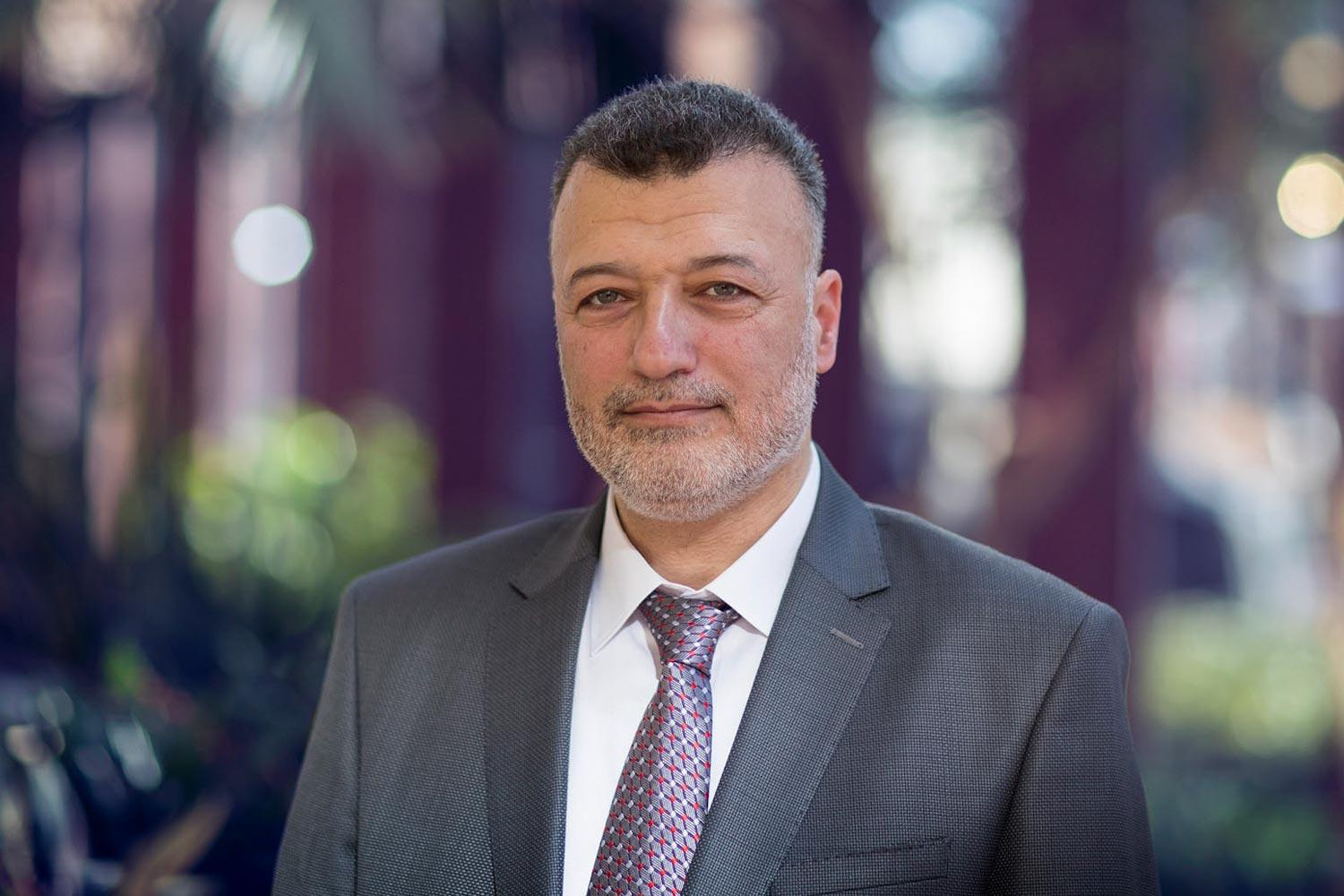
Syrian trauma surgeon Dr. Mahmoud Hariri will speak Wednesday at 8 a.m. at the UVA Health System’s McKim Hall.

 Dr. Mahmoud Hariri:

 
'So many people don’t know what’s happening in Syria. I hope these talks will help people know what’s happening on the ground and to see if there is any way for help – to help the Syrian doctors, to help the Syrian patients, and to help the Syrian people in general.

 What’s happening right now in Syria has become a global issue, not only a Syrian issue. We have to look for solutions because it will affect the world, not just a small area.

 There are so many doctors right now working inside the country under very intense situations. It’s our duty to help the innocent people who need help.

 Almost 90 percent of doctors fled the country. It’s a very difficult situation. There are some besieged areas with very few doctors who have to serve a large number of people. … But when you have a patient who survived after very hard and tough injuries and says, “Thank you, doctor,” I think that’s enough. I think that’s enough.

 There is some psychic effect on the human being when you are feeling that you are under attack. Many times our hospital has been targeted. My room itself almost collapsed. There was one facility that was targeted 25 times during this war. My hospital was targeted seven times. Two of the times I was in the hospital and fortunately survived. Part of the hospital collapsed.

 We tried to maintain the building and were underground in the basement, working in that area. To some extent, you feel you are safe, but actually it’s not safe because if the whole building collapsed, nobody would be able to get you out.


 I think the media is getting bored. The first day you see a lot in the news, the second day less, and then less day by day. So what about seven years [later]?

 We need to raise awareness. And I prefer to raise awareness slowly and constantly – by giving lectures, by telling stories. There are different ways to keep people aware about what is happening. When 9/11 happened and we say 3,000 people have been killed, it’s a number? No, those are people. Each one has a large number of people who loved him. So when you’re talking about 500,000 who have been killed in Syria – at least – that means all of the country has been affected.

 We have a large deficiency in the number of doctors. We believe establishing a university and school of medicine can help, so we started with this project. We have very few labs and not very much equipment, but we’ve started and now have third-year students and will hopefully have a next generation of doctors.

 There is hope. There is always hope. Syrians are looking for democracy, looking for their freedom.

 It’s difficult to have your freedom easily. You have to struggle for it. You have to work for it. You have to maybe risk your life for it.'

Tuesday, 23 January 2018

The never-ending siege on Eastern Ghouta


 CJ Werleman:

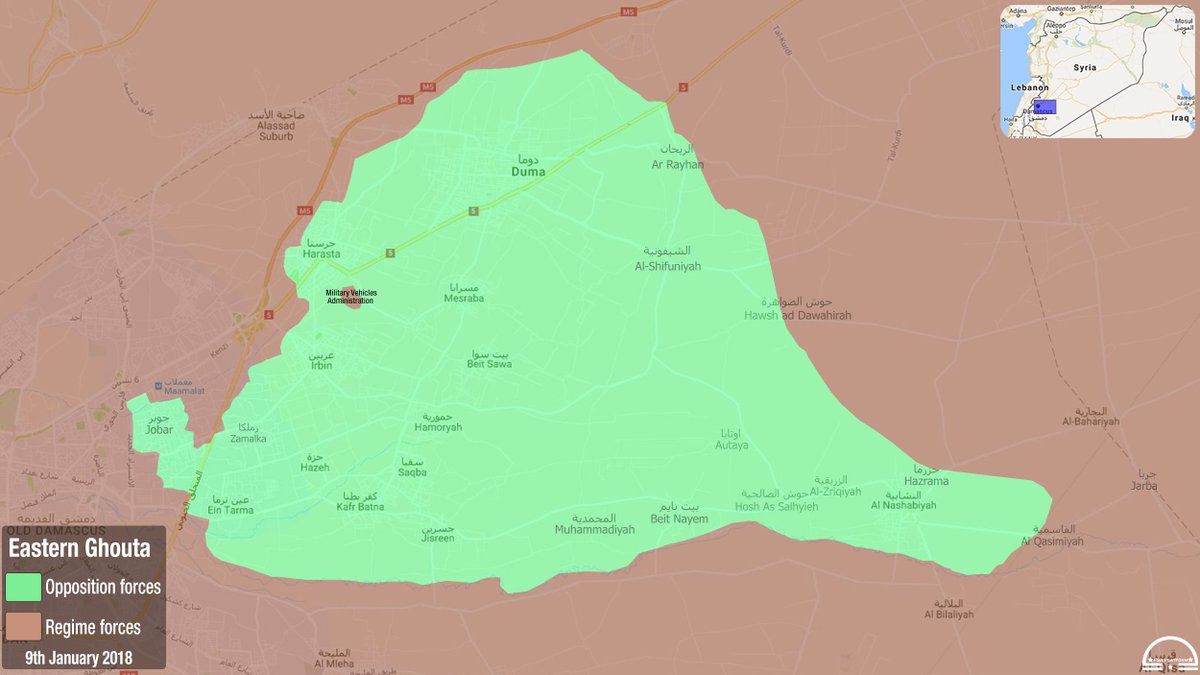
 'The Damascus suburb has been under siege by the Syrian regime since 2013. It is an ongoing humanitarian disaster that could become the next Aleppo.

 A siege is a military operation in which attacking forces encircle a territory, cutting off movement and supplies, while using all means of warfare to force the surrender and capitulation of those inside, including civilians. The use of terror to break the will of a hostile population is one of the oldest forms of warfare, and best exemplified in the biblical story of Jericho.

 After surrounding the walled and ancient city for seven days, located in what is now present-day occupied Palestine, Joshua commanded the Israelites to kill “every living thing in it – men and women, young and old, cattle, sheep and donkeys,” according to the Bible (Joshua 6:21).

 Four thousand years later, the Damascus suburb of Eastern Ghouta has been under a similarly brutal siege, but from the Assad regime since mid-2013.


 In May of last year, however, Turkey, Russia, and Iran agreed to a cease-fire deal in Syria, one that marked four zones in which Assad’s forces and opposition groups would cease “hostilities.” These “de-escalation zones” or “safe havens” were an attempt to reduce the violence, particularly by grounding Assad’s air force from flying over and dropping ordinance on the designated areas.

 Despite the agreement reached in Astana, the Kazakh capital, the Syrian regime has not only continued to attack civilians and rebels in the de-escalation zones, but also escalate its medieval siege of Eastern Ghouta, a siege that includes round-the-clock shelling, mortar fire, air-strikes, and unimaginable human suffering.

 The rising civilian death toll is shocking, and the methods deployed by the Assad regime are far crueler than anything described in the Bible.


 Last week, the United Nations human rights chief condemned Syrian regime forces for the upsurge in civilian casualties, and its increasing use of airstrikes and artillery shelling of the besieged suburb, observing that more than 100 civilians, including 21 women and 30 children have been killed since the start of 2018.

 This coming on the back of intensified Assad regime attacks on Eastern Ghouta during the last six weeks of 2017. The World Health Organization reported that 84 civilians were killed and 659 injured in a three-day period in November alone, and added that more than 200 mortar shells fell on heavily populated areas from 14 to 17 November.

 “The suffering of the people of Syria knows no end,” said UN High Commissioner for Human Rights Zeid Ra'ad Al Hussein.


 Evidently, the moral depravity of the Assad regime knows no end, either. On Monday, the National Coalition of Syrian Revolution and Opposition Forces released a statement claiming the regime attacked civilians in Eastern Ghouta using chlorine gas on January 22.

 “Credible reports indicated that the attack caused dozens of asphyxiation cases among civilians in the district of Douma and that most of the injured were women and children,” reads the coalition’s statement, a claim echoed by the Syrian Observatory for Human Rights (SOHR), who added that 21 people had been hospitalised as a result of the chemical weapons attack.

 Fewer than 400,000 Syrians reside in the Eastern Ghouta area today; a number that includes approximately 100,000 internally displaced people. When I asked Hassan Hassan, a noted Syrian born author and expert on the conflict, he said that the number of opposition fighters number only in the hundreds.

 “Assad has been focusing on this area as the strategic belt of Damascus. Ghouta also overlooks an important highway linking Damascus to Homs and other routes important for supply lines and access to hills on the way to Palmyra and the Syrian desert, where the regime has become a lot more active over the last year,” Hassan told me, adding that the regime has deployed various tactics to “neutralise” the outskirts of Damascus, “either through complete destruction, forcing mass displacement, or through local ceasefires.”


 Life under siege in Eastern Ghouta is every bit as horrific as one might imagine. “Shops are empty, streets are in ruins, the shelling rarely stops,” a 20-year-old resident told Syria Deeply. “Sometimes it feels like a Hollywood movie, especially when I learn what people are coming up with in order to survive.”

 Food and medical shortages are having a dramatic impact on the wellbeing of children, with UNICEF reporting that 11.9 percent of kids in Eastern Ghouta under the age of five are suffering from severe malnutrition.

 “This is the highest rate ever recorded in Syria since the conflict started,” the aid agency stated, a crisis exacerbated by the now unaffordable cost of whatever food remains on grocery store shelves, with the World Food Program observing that the typical price of a basket of food in the area costs 8 times the national average, amounting to a staggering US$521.

 Staples such as bread and rice are either unaffordable or unattainable for most residents, and images of starving children bring back memories of the world’s worst famines. A reminder that starvation is often the weapon of choice for attackers and tyrants who seek to break the will of a people they wish to subdue.

 “We are dying here. If dying from hunger doesn’t kill us, the bombs will, or the freezing cold will do it,” a 27-year-old aid worker, who wishes to remain anonymous out of fear of Assad’s security forces, told me.


 An absence of medical care is another killer. Attacking hospitals and medical facilities has been a tactic used by Assad since the conflict began five years ago. Not only has the regime struck more than 300 medical facilities, but also has “assassinated, bombed, and tortured to death almost 700 medical personnel,” according to Physicians for Human Rights.

 A doctor in Eastern Ghouta told Al Jazeera that babies are dying from a lack of access to routine medical care. “As a paediatrician, I feel that the children of the world are my children. I suffer for their suffering,” he said. “How do you feel if your child dies before your eyes and you cannot give him anything? It is something painful.”

 This human catastrophe, one of Assad’s making, is taking place in almost complete media silence. Simply, the world has lost interest in the lives of those besieged in Syria.

 Eastern Ghouta promises to become “the next Aleppo unless the international community increases pressure on besieging parties and their allies,” says The Syria Institute.

 More than 31,000 died in Aleppo, and the city was reduced to rubble. A similar fate awaits Eastern Ghouta if the international community, including the UN Security Council, fails the people of Syria again.'

Goal of the FSA to regain towns occupied by the YPG

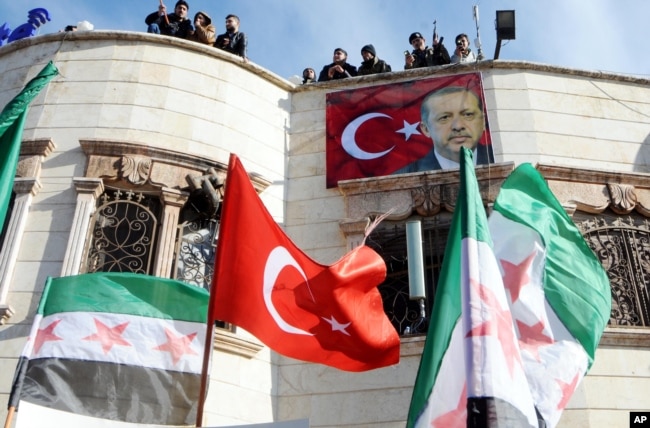
Turkey-backed Free Syrian Army, FSA, fighters stand on the roof of a building with a poster of Turkey's President Recep Tayyip Erdogan hanging on it in the Syrian town of Azez near the border with Turkey, Jan. 19, 2018.

 'Many of the rebels fighting alongside Turkish forces in northern Syria this week in a military offensive Ankara has called Operation Olive Branch come from rural northern Syria. They see the battle to wrest control of the northern Kurdish enclave of Afrin and outlying Arab villages as vengeance for the coordination they allege took place in February 2016 between the YPG and Russian-backed forces loyal to Syrian President Bashar al-Assad in an offensive to encircle Aleppo.

 That offensive saw the YPG grab the opportunity to seize a string of Arab villages and towns in northern Syria to the southeast of Afrin, including traditionally Arab Tell Rifaat.

 "The problem is not only that the Kurdish fighters cooperated with the Syrian regime and the Russians during the battle for Aleppo, but that the YPG burned dozens of Arab villages and displaced their inhabitants," said Gen. Salim Idris, a former rebel chief of staff.

 The loss of Tell Rifaat was a calamity for Syrian rebels, depriving them of the chance to establish a defensive line.

 "The goal of the Free Syrian Army is to regain 16 Arab towns and villages occupied by the YPG" in 2016, said Major Yasser Abdul Rahim, the commander of Failaq al Sham, a rebel militia.

 The Turkish offensive has the support, too, of the Syrian rebels' main political organization, the Syrian Coalition, which says it is backing Ankara's intervention. The coalition is urging YPG militiamen to "pull out of the towns and villages they occupied and from which they displaced their residents." '

Syrian opposition fighters backed by Turkey walk in front of Turkish troops near the Syria border at Hassa, Hatay province on Jan. 22, 2018.

The battle in Afrin has highlighted divisions


Faisal Al Yafai:

 'To really understand how complicated the Syrian war is becoming, it is necessary to go back a week, to a meeting in Washington between US officials and the Free Syrian Army. Senior officials of the FSA were in the US asking for the CIA to resume its programme of military aid, which was suspended last year by Donald Trump. Without a resumption, they warned, Iranian militias would be free to expand and US-supported groups would diminish.

 A week later and the FSA is now fighting alongside Turkey to clear a northern Syrian town of a militia that is supported by the United States. So rapidly has the conflict morphed in unexpected directions, that even those who oppose Bashar Al Assad's regime are uncertain which side they should support.

 On the ground, Turkey, which was one of the first to explicitly support the Syrian revolution and call for Bashar Al Assad to step down, is fighting in Afrin alongside the FSA, who remain committed to ending the regime.

 For Turkey, the US-backed People's Protection Units (YPG), a mainly Kurdish militia in Afrin, are too close to the Kurdish insurgent groups inside Turkey that have waged a long-running war against the Turkish state. Ankara has noted that US weapons supplied to the YPG have ended up across the Turkish border.


 But the FSA's involvement in Afrin has more to do with Syria than Turkey. For them, the YPG, by carving out a space away from the regime, is trying to split Syria into several pieces. Many who support the revolution support the idea of maintaining Syrian territorial integrity – except that the Kurdish enclave in Afrin is also protecting Syrian civilians from the Assad regime.

 The FSA, in fact, has a broader disagreement with the YPG, one that goes beyond the specificities of this battle. The YPG want a Kurdish-majority region, even if that means pushing out Syrian Arabs by force. But one of the aims of the revolution, and of the Syrian opposition, is to move away from a Syria of ethnicities and faiths and towards a model of citizenship.

 Syrian civilians, Kurdish and Arab, now being attacked in Afrin, might well ask how that admittedly lofty goal is served by the FSA allying itself with a foreign power (itself allied with Russia, a sponsor of the regime) and attacking an enclave inside Syrian territory. The people being attacked in Afrin are, after all, Syrians, regardless of ethnicity.

 And they ask, with the Syrian regime now besieging the small district of Ghouta outside Damascus, with Russian and Syrian planes carrying out bombing raids, if attacking Afrin is really the most pressing issue the FSA have. The Kurds are right to feel hard done by. They have allied themselves with the US, only to find that, with troops on the edge of their territory, the US has turned away.


 Away from the ground, on the sidelines, on social media and in endless debates over the past few days, supporters of the revolution have turned on each other, unable to decide which side to back.

 The questions are posed like this. Does supporting the Syrian revolution mean being against everyone who supports or enables the Al Assad regime? In that case, removing the YPG from Afrin is a positive development, because it weakens the regime while opening up space for civilians to be autonomous.

 Or does supporting the revolution, which aimed to free Syrian civilians from the Assad regime, mean supporting Syrians to live peacefully? In which case, an attack on Syrian civilians – and, worse, by Syrian fighters from the FSA – is a betrayal of those values. Moreover, for a revolution that started from the premise of a Syria for all, setting up a conflict between Syrian Arabs and Syrian Kurds is counterproductive and will have long-term repercussions.

 As long as countries outside and armed groups inside Syria continue to play out their plans across its soil, there will be no long-term solution. Syria needs to be whole, secure and stable. It will not get there with Bashar Al Assad in charge and it will not get there when Syrian civilians are killed by Syrian fighters.

 The safety of civilians will always be a secondary priority as long as Syria is the backdrop for the ambitions of groups other than the Syrian people. And as long as civilians are threatened, regardless of who is holding the guns, the Syrian revolution cannot truly have been said to be successful.'

Saturday, 20 January 2018

People of Manbij call on Turkey to rescue city from PKK

File photo

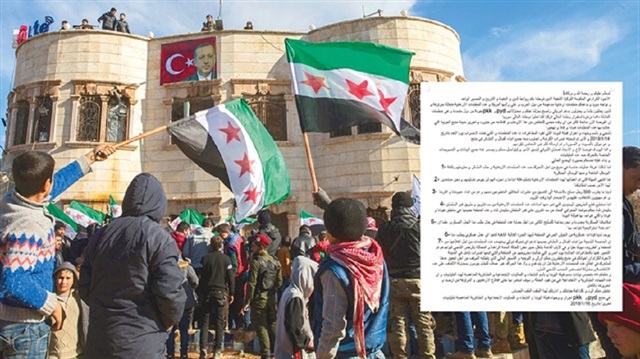
 'In a letter sent to Yeni Şafak, the people of Manbij signal that the time to clear the city from PKK/PYD terrorists has come, pledging support from the local population for any upcoming operation led by the Turkish Armed Forces (TAF).

 “The PKK carries out executions, forcefully extoll payments; they’re kidnapping our kids to fight with Turkish soldiers; Manbij is literally ready to explode. We call on [President] Erdoğan; please rescue us from the PKK. In the name of region’s population, we want to be rescued from the PKK affliction and put an end to the occupation. We’re ready to break the PKK’s link to Hasakah. The organization is summoning reinforcements to Manbij from Ayn al-Arab and Qamishli. Over the past two years, hundreds of Arab youth have abandoned their weapons and deserted the front group called SDF [Syrian Democratic Forces] that became a tool in the American ploy. Over the past week, over 200 youth left the PKK and fled. The terrorists are attacking those who defected from the PKK. In the past two days, four Arab youth were killed and seven were injured. As the region’s tribes, we’re regularly in touch,” read the letter.

 The terror organization sensed that we are in the midst of preparing a team and this situation causes them serious discomfort. There are 600 PKK terrorists in the Manbij region. They have been trying to reinforce their positions over the past few days, but Afrin is of greater importance to them that they don’t pay much attention to Manbij. We’re also capable to launch an attack from here when Turkey begins the Afrin operation. At present, we have 300 soldiers and we have set up a secret operation chamber. We want to be in touch with Turkey with regards to the issue of weapons and munitions. When battle begins, we will have no trouble finding soldiers,” the letter continued.

 ‘The Turkish army is stationed only 20 kilometers away from us. We want you to know that Manbij constitutes an easier target than believed for the Turkish soldiers and Free Syrian Army (FSA) units. Not only will the PKK be eradicated from Manbij in a matter of a few hours, they will be forced to abandon the whole of the western Euphrates. We will never abandon our resolve to have Manbij become part of the Euphrates Shield region. We ask of our Turkish brothers to please hear our call and rescue us from oppression. They are trying to brainwash our youth into fighting Turkish soldiers. They’re sending them to die in Afrin. We need your help to rescue the Kurdish, Arab and Turkmen population of Manbij from the PKK, which is the enemy of humanity and religion,” concluded the letter.'


 From December 27th, 2017:

 Syria's Manbij 'disappointed' by US support for PKK/PYD

 'The people of Manbij city in northern Syria are "disappointed" in the U.S. for allowing the PKK/PYD terrorist group to maintain a foothold in the region, a Syrian tribal leader said Wednesday.

 Ibrahim Hajji, a member of the Assembly of Syrian Tribes and Clans, blamed Washington for allowing PKK/PYD elements to maintain control of the city.

 The U.S., he said, had broken its earlier promises to disallow terrorist elements from maintaining a presence west of the Euphrates River.

 "The U.S. has deceived the people of Manbij," Hajji said. "The PYD could not have entered Manbij -- or anywhere else -- without a green light from Washington."

 An Arab-populated city located on the west bank of the Euphrates, Manbij remains under the control of the PYD, the Syrian offshoot of the PKK terrorist group.

 According to Hajji, the PKK/PYD has set up an elaborate intelligence network in the region with the aim of keeping tabs on local dissidents.

 If the U.S. had not provided the terrorist group with political and military support, he said, the opposition Free Syrian Army would have already captured the city.

 "The reality is that Manbij -- via the PYD -- has been occupied by the U.S.," Hajji added.

 Since the Daesh terrorists were driven from the city in August of last year, Manbij has remained under the control of PKK/PYD.'
[http://aa.com.tr/en/middle-east/syrias-manbij-disappointed-by-us-support-for-pkk-pyd/1016545]

Thursday, 18 January 2018

Civilians targeted in schools, mosques, entire districts

Image result for Syrians displaced by Idlib assault take shelter near Turkey

 'When fighting drove Bahr Diab from his home in southern Idlib last month, it was the fourth time he and his family had been displaced since the start of Syria’s seemingly endless conflict.

 From his pre-war home on the Lebanese border, Diab moved first east and then north searching for safety, finally taking shelter near Turkey where he hopes his wife and four children will be safe from air strikes and ground assaults.

 “Every time I get to a new place I build a house, but we are forced to leave it and move on,” he said at a makeshift camp a few miles from the border, where hundreds of people endure the mud and winter weather.

 “That’s my tent over there, that’s my home. Four homes later we decided to settle for blankets for winter.”


 Diab is part of a wave of Syrians fleeing an offensive by Syrian government forces and their allies, which several people at the Kelbit camp said involved the heaviest bombardment they had seen in nearly seven years of conflict.

 The Idlib area is the largest remaining opposition-held territory in Syria, its population swelled by insurgents and civilians retreating from shrinking rebel strongholds elsewhere. The scale of this latest upheaval has overwhelmed local authorities in Islamist-controlled Idlib.

 They say around 36,000 families have been uprooted, nearly half of which have fled to the Turkish border region. The United Nations said this week it had tracked 212,000 displacements in the last month alone, though some may have been counted more than once on their journey.

 Neighbouring Turkey, already hosting 3 million refugees, says that further fighting could trigger another mass exodus. But it has built a wall along the frontier and tightened control at crossings, leaving tens of thousands of Syrians near the border with nowhere left to flee.

 Diab, who reached Kelbit three weeks ago, said people were suffering from the cold, wet weather and sickness was rife. But compared to his last home in the Idlib town of Sinjar, where people lived in daily fear of air strikes, they felt secure.

 “The Turkish border region is safer,” he said. “Where we were before, you would hear planes 20 times a day. The children and women were terrified.”


 Another man displaced from the Sinjar region said the ground and air assault by forces loyal to President Bashar al-Assad, who is supported by Russia and Iran, was the most ferocious he had experienced.

 “There were situations when you would get civilians killed, but not like this,” said the 43-year-old father of six, who gave his name only as Abdulhamid. “This is hysteria at an insane level. It’s the first time I’ve seen civilians being targeted in schools, mosques, entire districts.”

 Abdulhamid said his home in Sinjar had been destroyed and he had lost contact with relatives during his three-day trek to the border. “My cousins, I know nothing about them. My sisters, brothers and wives, I don’t know where they are”.


 Next to the canvas and blue tarpaulin structures of the improvised camp, Turkey’s Red Crescent has built 500 new tents which will soon be ready for families to move into.

 But Hassan Darwish, an official with the local authority running the opposition-controlled Idlib region, said they desperately needed more food and shelter to support the displaced population.

 He said there were 1,300 displaced families in Kelbit area, 300 of which could not be housed at the camp. In the wider border region, he said there were 71,000 displaced families.

 The World Food Programme is helping feed tens of thousands, but WFP provisions cover less than half the needs, Darwish said.

 “People who have been displaced from all the governorates (in Syria) have nowhere apart from this region. But this region ... cannot absorb any more people,” he said. “In several camps, you find five or six families in one tent.”


 The overcrowding may only get worse if the army and its militia allies continue to advance from the south, eating further into opposition areas.

 Rakkan Khalil, who said he was first uprooted by the violence six years ago, said that given the chance he would cross the border to Turkey, but he saw no way to make the short trip with his wife, four sons and two daughters.

 “They’ve closed the borders, it’s hard for us,” he said.

 At the approach to the Bab al-Hawa crossing from Syria to Turkey, a large sign in the centre of the road encapsulates the sense of entrapment and resignation in the Islamist-controlled region.

 “All crossings and roads may be closed,” it reads. “Except the path to God.” '

Wednesday, 17 January 2018

Russia’s ‘Victory’ in Syria is Debunked and Defeated


 'Premature announcements of political triumphs often result in negative blowback, but Russian President Vladimir Putin’s declaration of victory in the Syrian war was debunked particularly swiftly (see EDM, January 11, 2018). Putin’s definition of victory included three key points: asserting the legitimacy of Bashar al-Assad’s regime and its control over most of Syria’s territory; strengthening the partnership with Turkey and Iran as the main framework for managing the residual conflicts; and withdrawing about half of the Russian forces, while expanding the naval base in Tartus and the Khmeimim air base. All three propositions have been badly shaken, if not shattered. Furthermore, Putin intended to sell the Russian victory to the West, thus pressuring the United States to accept the al-Assad regime and engage in cooperation with Russia, while cajoling the European Union into paying for Syria’s post-war reconstruction. Such bargaining has gone nowhere in both cases, and Russian tensions with US policy in Syria (muddled as it is) have reached a new high.

 The affirmation of al-Assad’s grasp on power was supposed to happen at the gathering of those opposition groups that subscribe to the arrangement for “de-escalation zones,” negotiated through the so-called “Astana process” (Russian Council, January 8, 2018). Putin wanted to stage this “congress” in Sochi immediately after his declaration of “victory” last November, but too many parties objected; so a new date in late January or early February is still uncertain (RIA Novosti, January 9, 2018). Turkey remains adamantly against any representation of Kurdish forces in this zero-trust process. And without Ankara, the “Russian peace” plan makes little sense. In order to stimulate the pacification, Syrian government forces have launched an offensive in Idlib province, which is supposed to be the largest “de-escalation zone.” However, this encroachment on Turkish interests has angered President Recep TayyipErdoğan even more (RBC, January 10, 2018).

 Putin is trying to mollify his capricious Turkish counterpart, but a more serious problem has been simultaneously growing in the relationship with Tehran (Kommersant, January 10, 2018). One factor is the al-Assad regime’s increasing dependency on the Iranian-sponsored Shia militia, which controls large parts of Syrian territory, including close to Russian bases (Nezavisimaya Gazeta, January 9, 2018). Israel refuses to accept these facts on the ground and keeps hitting Hezbollah bases with airstrikes; Russia neither interferes with nor has protested these attacks (RIA Novosti, January 9, 2018). A new and unexpected element related to the Iranian problem has been the explosion of street protests, which amplifies Putin’s angst about popular revolutions. The high point in this turmoil may have passed, but it has become clear for the Iranian leadership that foreign engagements—and in particular the huge expenses of waging the war in Syria—are a major cause for domestic discontent (New Times, January 9, 2018). Putin has no real insight into the decision-making in Tehran, and so he cannot know how and whether the behavior of this key but difficult ally might change.

 The most direct blow to Russian “victory” was delivered by a series of attacks on the Khmeimim airbase, which remains the main operational base for all Russia forces in Syria, including the semi-legal private contractors (see EDM, March 16, 2017; March 22, 2017; January 11, 2018). The Russian Ministry of Defense boasts about the success in intercepting the “drone attack” on January 6, but it has given scant information about the deadly attack on December 31, which was exposed by the media (Novaya Gazeta, January 9, 2018). The high command insists that the militants involved had received technical and targeting support from abroad, even if the captured drones are primitive plywood models fixed with tape (Kommersant, January 11, 2018). Russian generals have also announced that the terrorist group responsible for the attacks was destroyed by a high-precision strike, which is impossible to verify since no group has claimed credit for inflicting the unprecedented damage (RBC, January 12, 2018).

 This muddled emergency makes clear that Russia cannot reduce its military grouping in Syria, because the task of guarding the bases cannot be delegated to Syrian or Iranian forces. Moscow seeks to explain away the “post-victory” casualties by alleged hostile operations of US Special Forces and their proxy-rebels. But simultaneously, Russia is trying to maintain the “de-conflicting” arrangement, particularly since one of the most dangerous air incidents happened immediately after Putin’s declaration of “victory” (Gazeta.ru, December 15, 2017). While Russian propaganda insinuated US involvement in the attacks on Khmeimim, Chief of the General Staff Gennady Gerasimov and Joseph Dunford, Chairman of the Joint Chiefs of Staff, had a useful phone conversation on Syrian matters (RIA Novosti, January 11, 2018).

 It is convenient for Moscow to pin the blame for every Syrian setback on US “sabotage,” but it is also quite important to preserve a cooperative pattern because Syria is perhaps the only place where Russia has assets to bargain with in the high geopolitical game. Moscow has nothing against Washington arming the Kurdish People’s Protection Units (YPG), but it needs to dissuade the US from turning the Kurdish-controlled territories into a base for training anti-al-Assad rebels (RBC, January 10, 2018). Russia has won some time for the regime in Damascus, but its grasp on power remains tentative because it is shunned by regional stake-holders, ostracized internationally and is deeply disagreeable for Washington. The EU, for that matter, has flatly turned down Russia’s invitation to engage in post-war reconstruction of Aleppo and other cities conquered by government forces (Nezavisimaya Gazeta, January 11, 2018).

 Putin needs to prove that his declaration of victory was not a mistake but a somewhat premature mark of a real turn in the course of the protracted war, in which the dictatorial regime is the only solution to the chaos of revolution and menace of terrorism. Quietly rebuilding the reduced grouping of forces can be a part of this reaffirmation of triumph (of which there are too few). But the war is increasingly unpopular in Russia, and every new casualty casts a pall over the presidential election campaign, tightly controlled as it is. Despite launching the intervention and sustaining the air war for more than two years, for a time Putin was still open to propositions of gently removing al-Assad from power. Yet, he has now embraced the Syrian authoritarian leader, who is implicated in the use of chemical weapons, and so the flexibility is lost. The road to Damascus has led Putin into a blind alley. He can neither bomb his way out nor hope for guidance from his Iranian comrades-in-arms.'

Monday, 15 January 2018

Syrian rebel delegation seeking revival of CIA aid


 'Free Syrian Army envoys have urged U.S. officials at talks in Washington to resume a suspended CIA program of military aid if it is serious about challenging growing Iranian influence in Syria, according to Syrian opposition figures.

 Mustafa Sejari, a senior official in Syria’s mainstream rebel group, said the envoys described to U.S. officials the damaging impact of President Donald Trump’s decision last year to stop equipping and training certain rebel groups.

 Trump’s move was driven by a wish to focus on fighting Islamic State militants and to improve relations with Russia, as well as a lack of results from the CIA’s support of the FSA, U.S. officials suggested.

 “We endorse President Trump’s statements about the need to confront Iranian hegemony in the region. It is time to turn words into action. Until now on the ground it’s the Iranian militias that are expanding without serious resistance,” Sejari told Reuters by telephone from Washington.

 “With every U.S. statement about the need to confront Iran’s influence, Iran has been expanding in Syria while moderate forces that are backed by Washington see aid being dried up and are weakened,” Sejari said.

 “We asked for the resumption of aid and explained the dangers of leaving moderate FSA forces without support.”

Sejari said the delegation’s meetings had included members of the U.S. Congress and officials from the White House, and they hoped for sessions with Defense Department and State Department officials as well.

 The White House and Defense Department did not immediately respond to requests for comment.


 The FSA delegation, Sejari said, included recipients of the CIA-led program, which began in 2013 and funneled, via Jordan and Turkey, weapons, cash and trainers to vetted FSA groups fighting Syrian President Bashar al Assad.

 Sejari said his delegation had briefed U.S. officials on Iran’s “destructive” role in Syria, where Shi‘ite Muslim militias led by Lebanon’s Hezbollah have, along with Russian air power, have turned the tide of the conflict in Assad’s favor.

 The FSA also says that Iranian Shi‘ite militia fighting in Syria have stoked wider sectarian conflict in which mainly Sunni Muslims have been driven out of former opposition strongholds.

 “In all our talks with U.S. officials there was common ground, and on top of the matters discussed was the war on terrorism, (and) expelling Hezbollah and Iranian militias from Syria,” Sejari said.

 Another delegation member who requested anonymity told Reuters they told officials U.S. inaction in Syria would only allow Iran and its regional allies to recreate a land corridor linking Tehran, Baghdad, Damascus and Beirut - often termed the “Shi‘ite crescent” by Iran’s regional enemies.

 The Syrian opposition said the previous U.S. administration of President Barack Obama had given “Iran a free ride” in Syria.


 FSA rebels have long complained that U.S. support has fallen well short of what they needed to make a decisive difference in the war against Assad’s army and the Iran-backed militias helping it, including Lebanon’s Hezbollah.

 While cutting support to Syrian rebel groups that have fought Assad, the United States has deepened ties with a Kurdish-led militia alliance, the Syrian Democratic Forces, with which it partnered against Islamic State.

 The SDF is spearheaded by the Kurdish YPG militia, and has mostly avoided conflict with the Syrian government while seeking to entrench Kurdish autonomy over regions of northern Syria.'

‘The Octopus’ and a crew of rebels keep Iran from Israel

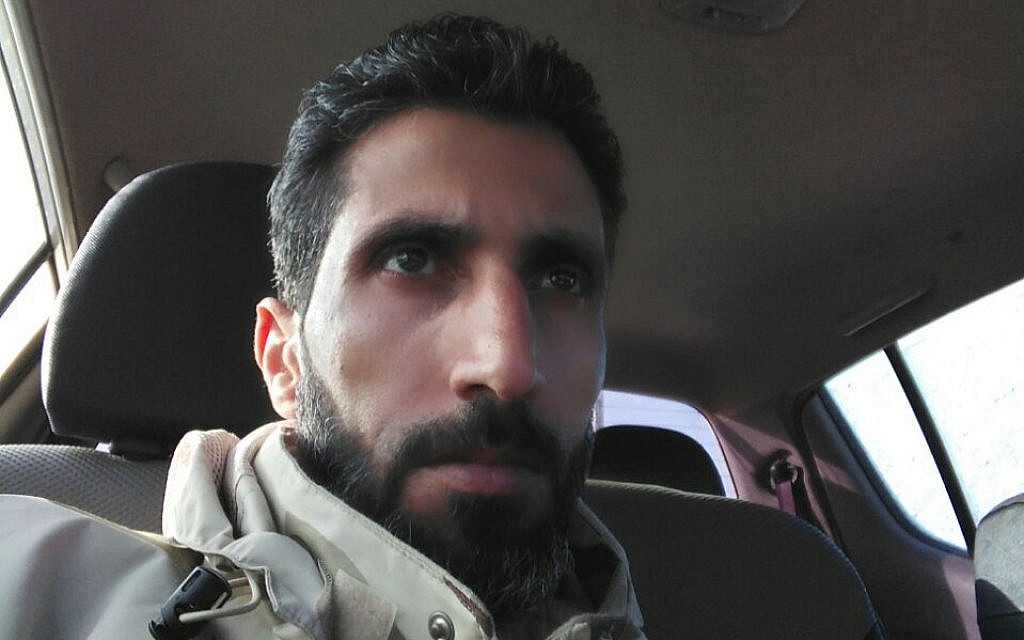
Abu Muhammad al-Akhtubut, a commander from National Syrian Liberation Front rebel group from the Syrian Golan Heights. (Courtesy)

 'As Syrian dictator Bashar Assad and the Iran-backed militias in his employ move toward Israel, the only thing standing in their way is a ragtag group of beleaguered rebels fighting for their homes and “viciously” defending the border.

 Over the past few days, a rebel officer — Abu Muhammad al-Akhtubut al-Asmar, whose nom de guerre means, literally, “The Dark Octopus” — has been speaking to The Times of Israel about their plans to fight back against the Syrian military, Hezbollah and Shiite groups, following the fall of the town of Beit Jinn, some nine kilometers (less than six miles) northeast of the Israeli border, late last month.

 His group, known collectively as the National Front for the Liberation of Syria, is made up of about a dozen groups from the Quneitra region that joined forces this summer. With various ideologies and a wide range of military capabilities, they don’t necessarily agree on much, but the hundred or so officers who make up the loose umbrella organization have recognized the need to keep Assad and the Iran-backed forces away from the border, al-Akhtubut said.

 “The issue now is defending this area because we want to preserve it,” said the Octopus, who acts as something of a spokesperson for the group. (His nickname was bestowed on him by an older comrade early in the outbreak of the Syrian civil war in 2011, who used to tell him, “You’re like an octopus — you have a hand in everything.”)

 “The borders with Israel are important politically and internationally,” he continued. “I’m not just saying this because you’re Israeli and I’m talking to you. And that’s why we are protecting this area so viciously.”


 These opposition forces have been largely isolated in the past few years, surviving in large part because of outside humanitarian assistance, not only from Israel, but also from Jordan and international aid groups.

 The need for support is acute. Al-Akhtubut, speaking via an in-and-out Skype connection, stressed that Beit Jinn — also known as Beit Jann — did not suffer a military defeat, but fell because of the extended siege placed on it by Assad.

 “[Assad’s troops] didn’t win in Beit Jinn — it wasn’t a military victory. [The rebels] were under siege for a year. It was attrition,” the Octopus said.

 On December 29, dozens of opposition fighters and their families left the Beit Jinn area as part of a ceasefire agreement, traveling on buses to the rebel-held Idlib area, in northwestern Syria, after holding out for nearly a year following a renewed push by the Assad regime to starve out the town.

 Now that Beit Jinn has fallen, al-Akhtubut fears that Assad’s army and the Iran-backed militias supporting him can better turn their attention to his group’s last holdouts and further cut off their access to supplies.

 “We can tell that they are working to take over this area and we are trying to stop it from happening,” he added.


 On Thursday, the top brass from the various opposition groups in the Quneitra region gathered at an undisclosed location for one of a series of discussions on their next steps.

 On Friday morning, the Octopus said in a message that the groups decided to plan various offensives “in order to free up some locations,” while also preparing “defense plans in case there’s an invasion by Assad and Iranian forces.”

 He said the main area under threat is the town of Jubata al-Khashab, along with Khan Arnabeh and Hamidiya, all of which lie either in the demilitarized zone between Israel and Syria or adjacent to it.

 “We see from that behavior that they’re trying to cut off access to Jubata,” he said. “They’re trying to put Jubata under siege. They’re trying to do what they did in Beit Jinn, because it worked there.”

 The regime’s control of Jabah, in particular, makes it possible for Assad to cut off Jubata al-Khashab from the rest of the rebel-held area, he said.


 The remaining rebel forces in the Quneitra region are also boxed in, as Assad forces control the towns of Dayr al-Adas, As Sanamayn, Barqa and al-Sheikh Maskin.

 It is not entirely clear how large a role the Iran-backed Hezbollah and Shiite militias have played in the fighting in southern Syria.

 Israeli and pro-rebel officials stress their involvement. Al-Akhtubut said these Iran-backed groups — including Hezbollah — are “the scariest thing right now. They are our biggest problem.”

 But according to analyst Aymenn Jawad al-Tamimi of the Middle East Forum think tank, not all of those claims are backed by facts on the ground. In a recent article on his website, al-Tamimi said the Syrian army’s 7th and 4th divisions are leading the effort on the Syrian Golan Heights, with limited assistance from Iran-backed forces.


 As the National Syrian Liberation Front prepares for its offensive and defensive campaigns, it must cope with limited weapons stores.

 “Our military support has been cut off for the past year,” al-Akhtubut said. “Several of our materiel sources have dried up as well.”

 He noted that the various groups’ limited access to weaponry and supplies was a major factor in them coming together as a group in July, after a Jordanian training and support program ended.

 When asked what specific types of weapons and munitions the groups have left in their arsenals, al-Akhtubut declined to answer, joking that it sounded like he was in an interrogation with the mukhabarat, or intelligence service.


 Beginning in 2013, Israel began providing medical treatment to Syrians wounded in the fighting who came to the border. The army initially set up a field hospital, but eventually moved to transporting them to hospitals in northern Israel.

 As Russia entered the civil war in 2015 and Assad started scoring more battlefield victories, Israeli officials grew concerned that if the Syrian dictator succeeded in routing the rebels from the Golan Heights, Iranian proxies could take up positions on the border. From there, the Iranian proxies could open up a second front should Israel go to war with the Lebanon-based Hezbollah terrorist group.

 Last year, the army dramatically expanded its humanitarian aid program, code-named Operation Good Neighbor, and started not only providing medical care to people injured in the war but also to civilians with chronic illnesses. Israel also began sending over shipments of food, fuel and other goods.

 According to the Israel Defense Forces, in 2017, the army facilitated the transfer of nearly 700 tons of food, half a million liters of fuel and over 14,000 containers of baby formula.

 The army has been upfront that while its primary mission is simply to help the beleaguered civilians in war-torn Syria, its secondary or peripheral goal is to engender goodwill toward Israel among those same people in order to plant the seeds of better relationships for the future.

 In recent months, the amount of aid has been somewhat “scaled back,” al-Akhtubut said.


 The humanitarian aid sent into Syria from Israel — as well as military assistance, according to foreign reports — has been a controversial issue, in light of the two countries still technically being at war with one another.

 The Assad regime has repeatedly used this assistance in its propaganda to “prove” that the opposition forces are actually Zionist stooges in attempts to discredit them.

 Some of the first images to come out of Beit Jinn after it was taken over by the Assad regime were of food products bearing Hebrew labels.

 According to the Octopus, despite this, most people in southern Syria do not remove the Hebrew labels from the food and other humanitarian products that come across the border, with the exception being those who try to resell the aid for profit.

 “People who have special interests do take the labels off — they’re the only ones who do,” he said.

 But al-Akhtubut said most people do not try to make money off the aid, but give it away for free.

 “There are people who do good work, and we’re trying to keep things under control so that we benefit from the aid as much as possible,” he said.

 “But there are those looking out for themselves, instead of having it benefit everyone equally so that we can endure the pressures [from the Assad forces],” he said.


 The rebel commander said the main things the civilians in the area need are baby formula, flour and medicine.

 Baby formula, which is difficult to produce locally, was in especially short supply, he said. “It’s something we always need and we’re always short on,” he said.

 However, al-Akhtubut said that while “of course there are shortages,” the rebel-held areas are able to survive for now. “It’s not that severe — we’re not there yet — but it is enough for us to feel the burden of it,” he said.'

Tehran Seeks Reduction in ‘Cost’ of Syria Involvement


 'For more than six years Syria has been on front pages and top headlines of the media in Iran as the most important international news story. The Syria “story” also enjoyed an almost unique position in the media scene in Iran because it was of keen interest to both those in power and society at large.

 Those in power regarded Syria as of urgent importance because “Supreme Guide” Ali Khamenei has described the struggle there as “decisive” for the future of the Khomeinist revolution and its ambition to dominate the Middle East.

 “The Tehran leadership believes that without maintaining control of Syria it would be unable to consolidate its gains in Lebanon and Iraq and spread its message to other Arab countries and Turkey,” says Iran media analyst Massoud Barazandeh. “In no other country has Iran spent so much money and offered so much blood. What Iran pays to use Hezbollah in Lebanon is chicken-feed compared to what it has spent in Syria.”


 Khamenei’s interest in Syria isn’t limited to his need for a base to extend the Khomeinist zone of influence. It has deep emotional roots as well.

 In 1984, Khamenei, then President of the Islamic Republic, visited Damascus for talks with then Syrian leader Hafez al-Assad. In a speech, Khamenei recalled that Damascus had been the capital of the Bani Umayyad who had “martyred” Hussein Ibn Ali, the third Imam of Shi’ism in 680 AD. Hussein had been killed in Karbala, Iraq, but his mortal remains and his captive family had been transported to Damascus.

 In a speech, interrupted by his tears, Khamenei whose full-name is Husseini Khamenei, claimed that his visit as “a descendant of Hussein” to Damascus was in itself a symbol that the martyred imam was being avenged.

 For the past six years, Khamenei has been repeating the mantra “We shall never leave Syria!”

 In other countries of interest, Iran has shown a degree of pragmatism, toning down its involvement when the price gets too high.

 In Lebanon, for example, Khamenei agreed to propel Michel Aoun, who had been Tehran’s bete-noire because of his collaboration with Saddam Hussein during the Iran-Iraq war, into the presidency because that was expedient. According to Tehran sources, the Lebanese branch of “Hezbollah” has also had to accept a modest pay-cut.

 In Bahrain, Khamenei has so far refused to arm the Khomeinist groups challenging the monarchy or to organize attacks on the US naval base there.

 More recently, in Yemen Khamenei ordered the transfer of Iran’s embassy from Sana’a to Muscat, Oman, and the withdrawal of at least half of the estimated 200 “military advisers” stationed to help the Houthi rebels.

 Even in Iraq, the dire economic situation in Iran itself has forced Khamenei to order a cut in money spent on some 23 pro-Iran militia groups there.

 But, at least until the end of 2017, support for Syrian leader Bashar al-Assad has remained constant.


 That, however, may be changing.

 One sign is that for the past two weeks at least Syria has been relegated to inside pages in the Tehran media. Even when Bashar’s army, backed by the Russian Air Force, launched what it boasted would be “the last great battle” in Idlib, the news didn’t make the front pages. The key reason, of course, was that Iran itself was shaken by more than 10 days of nationwide protests in which the slogan “Forget about Syria! Attend to our problems!” was a popular slogan.

 There was no sign of multi-page reportages, dotted with photos in color, and TV footage “from the front-line” that have been dished out for more than six years.

 There was also no sign of Jerusalem (Quds) Corps commander Qassem Soleimani, whose “selfies” have shown him leading the liberation of parts of Idlib as he had liberated Aleppo, Albukamal and Deir Ezzor before.

 More importantly, perhaps, the usual hullabaloo regarding the martyrdom of “Defenders of the Shrines” was toned down significantly. In the first week of 2018 the remains of four Iranian officers killed in clashes around Damascus were buried in four cities without attracting the usual publicity.


 To some observers, this was a sign that the decision-makers in Tehran begin to appreciate the deep unpopularity of Iran’s involvement in Syria’s seemingly endless tragedy.

 One indication of that “appreciation” came in a long editorial in the daily Kayhan, believed to reflect Khamenei’s views.

 The editorial expresses deep dissatisfaction with how things are going in Syria and the “political plan” proposed by Russia.

 “Russia is making a lot of propaganda about its plan, presenting it as the best and most complete plan” the editorial says. “However, this plan is full of major defects that must be removed before Iran, the Syrian government and the Lebanese branch of Hezbollah agree with it.”

 The editorial then singles out Khamenei’s opposition to three key features of the “Russian plan”.

 “Iran,” it says, “cannot accept the creation of a parliamentary system, as opposed to the present presidential system, in Syria. “Nor can it accept the formation of a transition government composed of the (Syrian) government and its opponents.”

 The editorial also rejects Russia’s proposal for the creation of a federal system in Syria.

 Iran cannot accept a situation in which “Kurds, Alawites and Sunni Muslims each have their own zone of domination”, the paper says.

 One reason, as far as Tehran is concerned, is that there are not enough Shi’ites in Syria to receive their chunk of territory in a federal Syria.


 However, the deeply hidden purpose of the editorial is revealed in a short sentence.

 “The process of future security developments (in Syria) can be pursued in a less costly way compared to previous years,” the Khamenei organ asserts.

 This may well be a thinly disguised threat to Russia which is anxious to disentangle itself from Syria as fast as possible and transfer more of the financial burden to Iran. The message is: We want cost reduction, not an increase!

 However, it may also be a message to Iranian protesters that the regime is contemplating a lower and less costly involvement in Syria, using Russian “double-dealing” as an excuse.

 For more than two weeks there has been no news of new Iranian forces, or even “volunteers for martyrdom” from Pakistan and Afghanistan, being dispatched to Syria while Gen. Soleimani remains in purdah.

 Iranian leaders may be beginning to understand that helping Bashar al-Assad kill more Syrians may prove too costly at home and abroad.'

Sunday, 14 January 2018

Current situation & dynamics in NW. Syria


 'Rebels took back 20+ locations from Regime - Regime & IRGC almost encircled Jebal Hoss - ISIS pocket keeps extending.'

Friday, 12 January 2018

Syrian regime arrests prominent militia leader


 'Syrian intelligence arrested one of the most prominent leaders of local militias in Syria after a series of defeats in the military Vehicles Base in the city of Harasta of Eastern Ghouta.

 Pro-regime Facebook pages such as "Republican Guard Lair" have confirmed the arrest of the commander of the Qalamoun Shield militia, Captain Firas Jazaa, and referred to the investigation after confiscating his weapons and the equipment of his own group.

 On the other hand, the news network "al-Asema" dedicated to report the news of Damascus province and its countryside reported that the leadership of the Third Division in the army of the regime dismissed the officer, "Firas Jazaa" from his post as commander of the militia, "Qalamoun Shield" and sent him to be investigated against the background of what happened in the battles of Harsta as several groups and militants escaped withdrew and defected from the Jazra militia.

 The militants of Qalamoun Shield are taking part in several fronts, notably Homs, Hama and in various areas of eastern and western Qalamoun, as well as their recent attacks on the eastern Ghouta fronts.

 The Qalamoun Shield militia was founded in early 2014 and includes fighters from cities and towns that have entered into reconciliation with the regime, such as Yabrud, al-Tal, Qarra, Jeroud and Nabek, and are supported by Russians via the Hameimim military base.

 In November, the eastern Ghouta factions announced the start of a battle "They Were Wronged" to control the Military Vehicles Base in Harasta, and after several attacks they were able to capture the Base and caused losses for the Syrian regime of dozens of human lives , as well as material losses in equipment.'


 'Harasta's Vehicle Management base has been taken, it's estimated there were 200 régime force members there, some were captured, others killed.'
[https://twitter.com/CombatChris1/status/951691306480295937]