Wednesday, 24 January 2018

Syrians are looking for their freedom

Syrian trauma surgeon Dr. Mahmoud Hariri will speak Wednesday at 8 a.m. at the UVA Health System’s McKim Hall.

 Dr. Mahmoud Hariri:

 
'So many people don’t know what’s happening in Syria. I hope these talks will help people know what’s happening on the ground and to see if there is any way for help – to help the Syrian doctors, to help the Syrian patients, and to help the Syrian people in general.

 What’s happening right now in Syria has become a global issue, not only a Syrian issue. We have to look for solutions because it will affect the world, not just a small area.

 There are so many doctors right now working inside the country under very intense situations. It’s our duty to help the innocent people who need help.

 Almost 90 percent of doctors fled the country. It’s a very difficult situation. There are some besieged areas with very few doctors who have to serve a large number of people. … But when you have a patient who survived after very hard and tough injuries and says, “Thank you, doctor,” I think that’s enough. I think that’s enough.

 There is some psychic effect on the human being when you are feeling that you are under attack. Many times our hospital has been targeted. My room itself almost collapsed. There was one facility that was targeted 25 times during this war. My hospital was targeted seven times. Two of the times I was in the hospital and fortunately survived. Part of the hospital collapsed.

 We tried to maintain the building and were underground in the basement, working in that area. To some extent, you feel you are safe, but actually it’s not safe because if the whole building collapsed, nobody would be able to get you out.


 I think the media is getting bored. The first day you see a lot in the news, the second day less, and then less day by day. So what about seven years [later]?

 We need to raise awareness. And I prefer to raise awareness slowly and constantly – by giving lectures, by telling stories. There are different ways to keep people aware about what is happening. When 9/11 happened and we say 3,000 people have been killed, it’s a number? No, those are people. Each one has a large number of people who loved him. So when you’re talking about 500,000 who have been killed in Syria – at least – that means all of the country has been affected.

 We have a large deficiency in the number of doctors. We believe establishing a university and school of medicine can help, so we started with this project. We have very few labs and not very much equipment, but we’ve started and now have third-year students and will hopefully have a next generation of doctors.

 There is hope. There is always hope. Syrians are looking for democracy, looking for their freedom.

 It’s difficult to have your freedom easily. You have to struggle for it. You have to work for it. You have to maybe risk your life for it.'

Tuesday, 23 January 2018

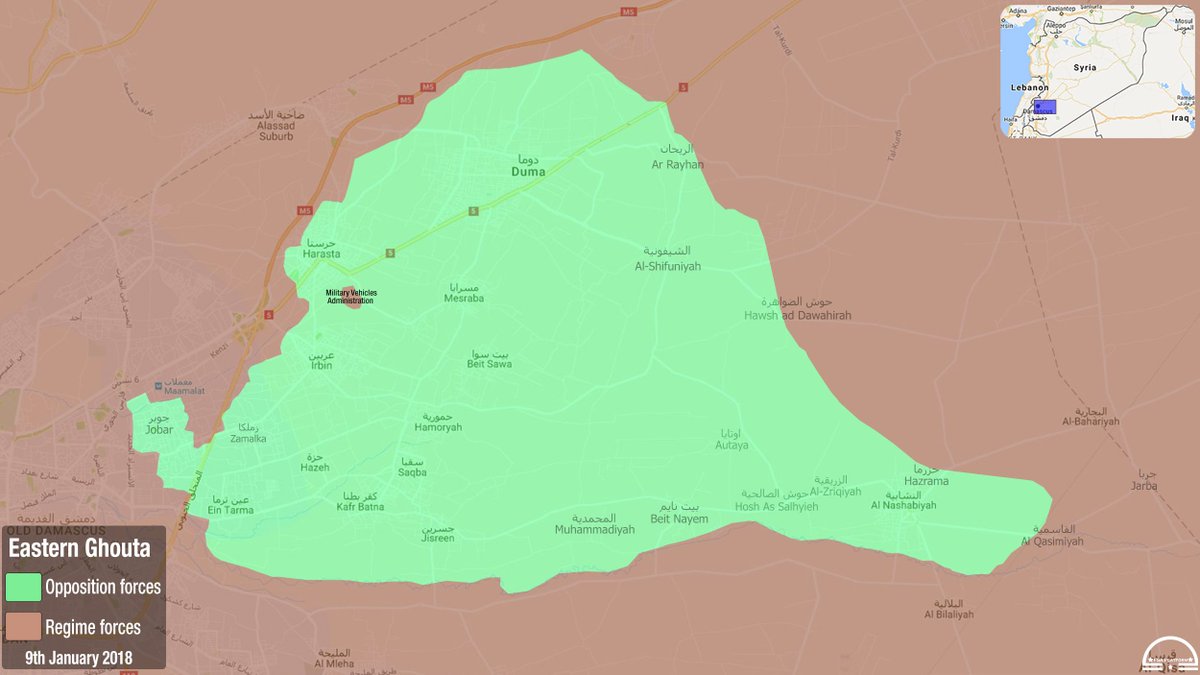
The never-ending siege on Eastern Ghouta


 CJ Werleman:

 'The Damascus suburb has been under siege by the Syrian regime since 2013. It is an ongoing humanitarian disaster that could become the next Aleppo.

 A siege is a military operation in which attacking forces encircle a territory, cutting off movement and supplies, while using all means of warfare to force the surrender and capitulation of those inside, including civilians. The use of terror to break the will of a hostile population is one of the oldest forms of warfare, and best exemplified in the biblical story of Jericho.

 After surrounding the walled and ancient city for seven days, located in what is now present-day occupied Palestine, Joshua commanded the Israelites to kill “every living thing in it – men and women, young and old, cattle, sheep and donkeys,” according to the Bible (Joshua 6:21).

 Four thousand years later, the Damascus suburb of Eastern Ghouta has been under a similarly brutal siege, but from the Assad regime since mid-2013.


 In May of last year, however, Turkey, Russia, and Iran agreed to a cease-fire deal in Syria, one that marked four zones in which Assad’s forces and opposition groups would cease “hostilities.” These “de-escalation zones” or “safe havens” were an attempt to reduce the violence, particularly by grounding Assad’s air force from flying over and dropping ordinance on the designated areas.

 Despite the agreement reached in Astana, the Kazakh capital, the Syrian regime has not only continued to attack civilians and rebels in the de-escalation zones, but also escalate its medieval siege of Eastern Ghouta, a siege that includes round-the-clock shelling, mortar fire, air-strikes, and unimaginable human suffering.

 The rising civilian death toll is shocking, and the methods deployed by the Assad regime are far crueler than anything described in the Bible.


 Last week, the United Nations human rights chief condemned Syrian regime forces for the upsurge in civilian casualties, and its increasing use of airstrikes and artillery shelling of the besieged suburb, observing that more than 100 civilians, including 21 women and 30 children have been killed since the start of 2018.

 This coming on the back of intensified Assad regime attacks on Eastern Ghouta during the last six weeks of 2017. The World Health Organization reported that 84 civilians were killed and 659 injured in a three-day period in November alone, and added that more than 200 mortar shells fell on heavily populated areas from 14 to 17 November.

 “The suffering of the people of Syria knows no end,” said UN High Commissioner for Human Rights Zeid Ra'ad Al Hussein.


 Evidently, the moral depravity of the Assad regime knows no end, either. On Monday, the National Coalition of Syrian Revolution and Opposition Forces released a statement claiming the regime attacked civilians in Eastern Ghouta using chlorine gas on January 22.

 “Credible reports indicated that the attack caused dozens of asphyxiation cases among civilians in the district of Douma and that most of the injured were women and children,” reads the coalition’s statement, a claim echoed by the Syrian Observatory for Human Rights (SOHR), who added that 21 people had been hospitalised as a result of the chemical weapons attack.

 Fewer than 400,000 Syrians reside in the Eastern Ghouta area today; a number that includes approximately 100,000 internally displaced people. When I asked Hassan Hassan, a noted Syrian born author and expert on the conflict, he said that the number of opposition fighters number only in the hundreds.

 “Assad has been focusing on this area as the strategic belt of Damascus. Ghouta also overlooks an important highway linking Damascus to Homs and other routes important for supply lines and access to hills on the way to Palmyra and the Syrian desert, where the regime has become a lot more active over the last year,” Hassan told me, adding that the regime has deployed various tactics to “neutralise” the outskirts of Damascus, “either through complete destruction, forcing mass displacement, or through local ceasefires.”


 Life under siege in Eastern Ghouta is every bit as horrific as one might imagine. “Shops are empty, streets are in ruins, the shelling rarely stops,” a 20-year-old resident told Syria Deeply. “Sometimes it feels like a Hollywood movie, especially when I learn what people are coming up with in order to survive.”

 Food and medical shortages are having a dramatic impact on the wellbeing of children, with UNICEF reporting that 11.9 percent of kids in Eastern Ghouta under the age of five are suffering from severe malnutrition.

 “This is the highest rate ever recorded in Syria since the conflict started,” the aid agency stated, a crisis exacerbated by the now unaffordable cost of whatever food remains on grocery store shelves, with the World Food Program observing that the typical price of a basket of food in the area costs 8 times the national average, amounting to a staggering US$521.

 Staples such as bread and rice are either unaffordable or unattainable for most residents, and images of starving children bring back memories of the world’s worst famines. A reminder that starvation is often the weapon of choice for attackers and tyrants who seek to break the will of a people they wish to subdue.

 “We are dying here. If dying from hunger doesn’t kill us, the bombs will, or the freezing cold will do it,” a 27-year-old aid worker, who wishes to remain anonymous out of fear of Assad’s security forces, told me.


 An absence of medical care is another killer. Attacking hospitals and medical facilities has been a tactic used by Assad since the conflict began five years ago. Not only has the regime struck more than 300 medical facilities, but also has “assassinated, bombed, and tortured to death almost 700 medical personnel,” according to Physicians for Human Rights.

 A doctor in Eastern Ghouta told Al Jazeera that babies are dying from a lack of access to routine medical care. “As a paediatrician, I feel that the children of the world are my children. I suffer for their suffering,” he said. “How do you feel if your child dies before your eyes and you cannot give him anything? It is something painful.”

 This human catastrophe, one of Assad’s making, is taking place in almost complete media silence. Simply, the world has lost interest in the lives of those besieged in Syria.

 Eastern Ghouta promises to become “the next Aleppo unless the international community increases pressure on besieging parties and their allies,” says The Syria Institute.

 More than 31,000 died in Aleppo, and the city was reduced to rubble. A similar fate awaits Eastern Ghouta if the international community, including the UN Security Council, fails the people of Syria again.'

Goal of the FSA to regain towns occupied by the YPG

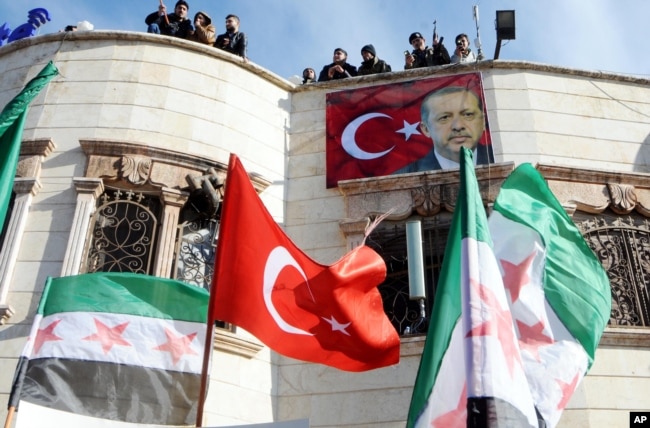
Turkey-backed Free Syrian Army, FSA, fighters stand on the roof of a building with a poster of Turkey's President Recep Tayyip Erdogan hanging on it in the Syrian town of Azez near the border with Turkey, Jan. 19, 2018.

 'Many of the rebels fighting alongside Turkish forces in northern Syria this week in a military offensive Ankara has called Operation Olive Branch come from rural northern Syria. They see the battle to wrest control of the northern Kurdish enclave of Afrin and outlying Arab villages as vengeance for the coordination they allege took place in February 2016 between the YPG and Russian-backed forces loyal to Syrian President Bashar al-Assad in an offensive to encircle Aleppo.

 That offensive saw the YPG grab the opportunity to seize a string of Arab villages and towns in northern Syria to the southeast of Afrin, including traditionally Arab Tell Rifaat.

 "The problem is not only that the Kurdish fighters cooperated with the Syrian regime and the Russians during the battle for Aleppo, but that the YPG burned dozens of Arab villages and displaced their inhabitants," said Gen. Salim Idris, a former rebel chief of staff.

 The loss of Tell Rifaat was a calamity for Syrian rebels, depriving them of the chance to establish a defensive line.

 "The goal of the Free Syrian Army is to regain 16 Arab towns and villages occupied by the YPG" in 2016, said Major Yasser Abdul Rahim, the commander of Failaq al Sham, a rebel militia.

 The Turkish offensive has the support, too, of the Syrian rebels' main political organization, the Syrian Coalition, which says it is backing Ankara's intervention. The coalition is urging YPG militiamen to "pull out of the towns and villages they occupied and from which they displaced their residents." '

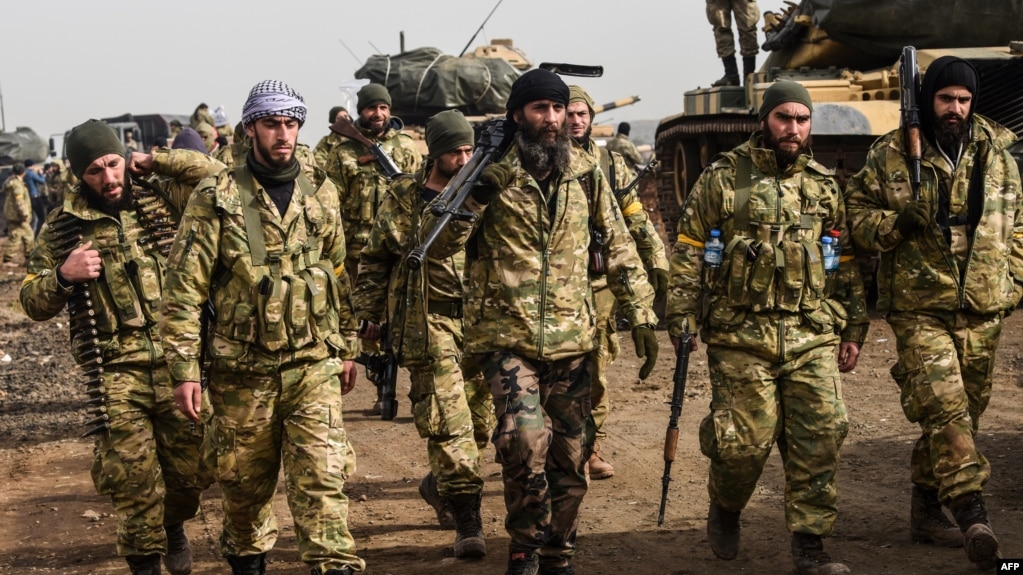
Syrian opposition fighters backed by Turkey walk in front of Turkish troops near the Syria border at Hassa, Hatay province on Jan. 22, 2018.

The battle in Afrin has highlighted divisions


Faisal Al Yafai:

 'To really understand how complicated the Syrian war is becoming, it is necessary to go back a week, to a meeting in Washington between US officials and the Free Syrian Army. Senior officials of the FSA were in the US asking for the CIA to resume its programme of military aid, which was suspended last year by Donald Trump. Without a resumption, they warned, Iranian militias would be free to expand and US-supported groups would diminish.

 A week later and the FSA is now fighting alongside Turkey to clear a northern Syrian town of a militia that is supported by the United States. So rapidly has the conflict morphed in unexpected directions, that even those who oppose Bashar Al Assad's regime are uncertain which side they should support.

 On the ground, Turkey, which was one of the first to explicitly support the Syrian revolution and call for Bashar Al Assad to step down, is fighting in Afrin alongside the FSA, who remain committed to ending the regime.

 For Turkey, the US-backed People's Protection Units (YPG), a mainly Kurdish militia in Afrin, are too close to the Kurdish insurgent groups inside Turkey that have waged a long-running war against the Turkish state. Ankara has noted that US weapons supplied to the YPG have ended up across the Turkish border.


 But the FSA's involvement in Afrin has more to do with Syria than Turkey. For them, the YPG, by carving out a space away from the regime, is trying to split Syria into several pieces. Many who support the revolution support the idea of maintaining Syrian territorial integrity – except that the Kurdish enclave in Afrin is also protecting Syrian civilians from the Assad regime.

 The FSA, in fact, has a broader disagreement with the YPG, one that goes beyond the specificities of this battle. The YPG want a Kurdish-majority region, even if that means pushing out Syrian Arabs by force. But one of the aims of the revolution, and of the Syrian opposition, is to move away from a Syria of ethnicities and faiths and towards a model of citizenship.

 Syrian civilians, Kurdish and Arab, now being attacked in Afrin, might well ask how that admittedly lofty goal is served by the FSA allying itself with a foreign power (itself allied with Russia, a sponsor of the regime) and attacking an enclave inside Syrian territory. The people being attacked in Afrin are, after all, Syrians, regardless of ethnicity.

 And they ask, with the Syrian regime now besieging the small district of Ghouta outside Damascus, with Russian and Syrian planes carrying out bombing raids, if attacking Afrin is really the most pressing issue the FSA have. The Kurds are right to feel hard done by. They have allied themselves with the US, only to find that, with troops on the edge of their territory, the US has turned away.


 Away from the ground, on the sidelines, on social media and in endless debates over the past few days, supporters of the revolution have turned on each other, unable to decide which side to back.

 The questions are posed like this. Does supporting the Syrian revolution mean being against everyone who supports or enables the Al Assad regime? In that case, removing the YPG from Afrin is a positive development, because it weakens the regime while opening up space for civilians to be autonomous.

 Or does supporting the revolution, which aimed to free Syrian civilians from the Assad regime, mean supporting Syrians to live peacefully? In which case, an attack on Syrian civilians – and, worse, by Syrian fighters from the FSA – is a betrayal of those values. Moreover, for a revolution that started from the premise of a Syria for all, setting up a conflict between Syrian Arabs and Syrian Kurds is counterproductive and will have long-term repercussions.

 As long as countries outside and armed groups inside Syria continue to play out their plans across its soil, there will be no long-term solution. Syria needs to be whole, secure and stable. It will not get there with Bashar Al Assad in charge and it will not get there when Syrian civilians are killed by Syrian fighters.

 The safety of civilians will always be a secondary priority as long as Syria is the backdrop for the ambitions of groups other than the Syrian people. And as long as civilians are threatened, regardless of who is holding the guns, the Syrian revolution cannot truly have been said to be successful.'

Saturday, 20 January 2018

People of Manbij call on Turkey to rescue city from PKK

File photo

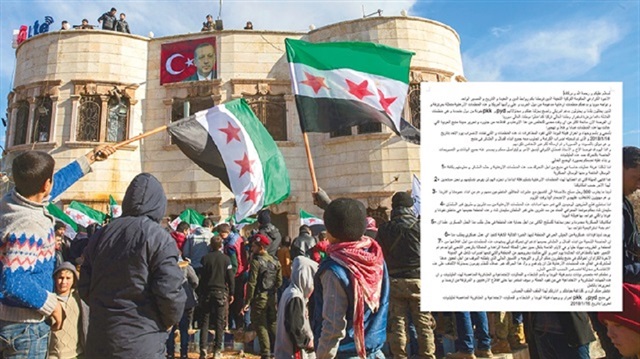
 'In a letter sent to Yeni Şafak, the people of Manbij signal that the time to clear the city from PKK/PYD terrorists has come, pledging support from the local population for any upcoming operation led by the Turkish Armed Forces (TAF).

 “The PKK carries out executions, forcefully extoll payments; they’re kidnapping our kids to fight with Turkish soldiers; Manbij is literally ready to explode. We call on [President] Erdoğan; please rescue us from the PKK. In the name of region’s population, we want to be rescued from the PKK affliction and put an end to the occupation. We’re ready to break the PKK’s link to Hasakah. The organization is summoning reinforcements to Manbij from Ayn al-Arab and Qamishli. Over the past two years, hundreds of Arab youth have abandoned their weapons and deserted the front group called SDF [Syrian Democratic Forces] that became a tool in the American ploy. Over the past week, over 200 youth left the PKK and fled. The terrorists are attacking those who defected from the PKK. In the past two days, four Arab youth were killed and seven were injured. As the region’s tribes, we’re regularly in touch,” read the letter.

 The terror organization sensed that we are in the midst of preparing a team and this situation causes them serious discomfort. There are 600 PKK terrorists in the Manbij region. They have been trying to reinforce their positions over the past few days, but Afrin is of greater importance to them that they don’t pay much attention to Manbij. We’re also capable to launch an attack from here when Turkey begins the Afrin operation. At present, we have 300 soldiers and we have set up a secret operation chamber. We want to be in touch with Turkey with regards to the issue of weapons and munitions. When battle begins, we will have no trouble finding soldiers,” the letter continued.

 ‘The Turkish army is stationed only 20 kilometers away from us. We want you to know that Manbij constitutes an easier target than believed for the Turkish soldiers and Free Syrian Army (FSA) units. Not only will the PKK be eradicated from Manbij in a matter of a few hours, they will be forced to abandon the whole of the western Euphrates. We will never abandon our resolve to have Manbij become part of the Euphrates Shield region. We ask of our Turkish brothers to please hear our call and rescue us from oppression. They are trying to brainwash our youth into fighting Turkish soldiers. They’re sending them to die in Afrin. We need your help to rescue the Kurdish, Arab and Turkmen population of Manbij from the PKK, which is the enemy of humanity and religion,” concluded the letter.'


 From December 27th, 2017:

 Syria's Manbij 'disappointed' by US support for PKK/PYD

 'The people of Manbij city in northern Syria are "disappointed" in the U.S. for allowing the PKK/PYD terrorist group to maintain a foothold in the region, a Syrian tribal leader said Wednesday.

 Ibrahim Hajji, a member of the Assembly of Syrian Tribes and Clans, blamed Washington for allowing PKK/PYD elements to maintain control of the city.

 The U.S., he said, had broken its earlier promises to disallow terrorist elements from maintaining a presence west of the Euphrates River.

 "The U.S. has deceived the people of Manbij," Hajji said. "The PYD could not have entered Manbij -- or anywhere else -- without a green light from Washington."

 An Arab-populated city located on the west bank of the Euphrates, Manbij remains under the control of the PYD, the Syrian offshoot of the PKK terrorist group.

 According to Hajji, the PKK/PYD has set up an elaborate intelligence network in the region with the aim of keeping tabs on local dissidents.

 If the U.S. had not provided the terrorist group with political and military support, he said, the opposition Free Syrian Army would have already captured the city.

 "The reality is that Manbij -- via the PYD -- has been occupied by the U.S.," Hajji added.

 Since the Daesh terrorists were driven from the city in August of last year, Manbij has remained under the control of PKK/PYD.'
[http://aa.com.tr/en/middle-east/syrias-manbij-disappointed-by-us-support-for-pkk-pyd/1016545]

Thursday, 18 January 2018

Civilians targeted in schools, mosques, entire districts

Image result for Syrians displaced by Idlib assault take shelter near Turkey

 'When fighting drove Bahr Diab from his home in southern Idlib last month, it was the fourth time he and his family had been displaced since the start of Syria’s seemingly endless conflict.

 From his pre-war home on the Lebanese border, Diab moved first east and then north searching for safety, finally taking shelter near Turkey where he hopes his wife and four children will be safe from air strikes and ground assaults.

 “Every time I get to a new place I build a house, but we are forced to leave it and move on,” he said at a makeshift camp a few miles from the border, where hundreds of people endure the mud and winter weather.

 “That’s my tent over there, that’s my home. Four homes later we decided to settle for blankets for winter.”


 Diab is part of a wave of Syrians fleeing an offensive by Syrian government forces and their allies, which several people at the Kelbit camp said involved the heaviest bombardment they had seen in nearly seven years of conflict.

 The Idlib area is the largest remaining opposition-held territory in Syria, its population swelled by insurgents and civilians retreating from shrinking rebel strongholds elsewhere. The scale of this latest upheaval has overwhelmed local authorities in Islamist-controlled Idlib.

 They say around 36,000 families have been uprooted, nearly half of which have fled to the Turkish border region. The United Nations said this week it had tracked 212,000 displacements in the last month alone, though some may have been counted more than once on their journey.

 Neighbouring Turkey, already hosting 3 million refugees, says that further fighting could trigger another mass exodus. But it has built a wall along the frontier and tightened control at crossings, leaving tens of thousands of Syrians near the border with nowhere left to flee.

 Diab, who reached Kelbit three weeks ago, said people were suffering from the cold, wet weather and sickness was rife. But compared to his last home in the Idlib town of Sinjar, where people lived in daily fear of air strikes, they felt secure.

 “The Turkish border region is safer,” he said. “Where we were before, you would hear planes 20 times a day. The children and women were terrified.”


 Another man displaced from the Sinjar region said the ground and air assault by forces loyal to President Bashar al-Assad, who is supported by Russia and Iran, was the most ferocious he had experienced.

 “There were situations when you would get civilians killed, but not like this,” said the 43-year-old father of six, who gave his name only as Abdulhamid. “This is hysteria at an insane level. It’s the first time I’ve seen civilians being targeted in schools, mosques, entire districts.”

 Abdulhamid said his home in Sinjar had been destroyed and he had lost contact with relatives during his three-day trek to the border. “My cousins, I know nothing about them. My sisters, brothers and wives, I don’t know where they are”.


 Next to the canvas and blue tarpaulin structures of the improvised camp, Turkey’s Red Crescent has built 500 new tents which will soon be ready for families to move into.

 But Hassan Darwish, an official with the local authority running the opposition-controlled Idlib region, said they desperately needed more food and shelter to support the displaced population.

 He said there were 1,300 displaced families in Kelbit area, 300 of which could not be housed at the camp. In the wider border region, he said there were 71,000 displaced families.

 The World Food Programme is helping feed tens of thousands, but WFP provisions cover less than half the needs, Darwish said.

 “People who have been displaced from all the governorates (in Syria) have nowhere apart from this region. But this region ... cannot absorb any more people,” he said. “In several camps, you find five or six families in one tent.”


 The overcrowding may only get worse if the army and its militia allies continue to advance from the south, eating further into opposition areas.

 Rakkan Khalil, who said he was first uprooted by the violence six years ago, said that given the chance he would cross the border to Turkey, but he saw no way to make the short trip with his wife, four sons and two daughters.

 “They’ve closed the borders, it’s hard for us,” he said.

 At the approach to the Bab al-Hawa crossing from Syria to Turkey, a large sign in the centre of the road encapsulates the sense of entrapment and resignation in the Islamist-controlled region.

 “All crossings and roads may be closed,” it reads. “Except the path to God.” '

Wednesday, 17 January 2018

Russia’s ‘Victory’ in Syria is Debunked and Defeated


 'Premature announcements of political triumphs often result in negative blowback, but Russian President Vladimir Putin’s declaration of victory in the Syrian war was debunked particularly swiftly (see EDM, January 11, 2018). Putin’s definition of victory included three key points: asserting the legitimacy of Bashar al-Assad’s regime and its control over most of Syria’s territory; strengthening the partnership with Turkey and Iran as the main framework for managing the residual conflicts; and withdrawing about half of the Russian forces, while expanding the naval base in Tartus and the Khmeimim air base. All three propositions have been badly shaken, if not shattered. Furthermore, Putin intended to sell the Russian victory to the West, thus pressuring the United States to accept the al-Assad regime and engage in cooperation with Russia, while cajoling the European Union into paying for Syria’s post-war reconstruction. Such bargaining has gone nowhere in both cases, and Russian tensions with US policy in Syria (muddled as it is) have reached a new high.

 The affirmation of al-Assad’s grasp on power was supposed to happen at the gathering of those opposition groups that subscribe to the arrangement for “de-escalation zones,” negotiated through the so-called “Astana process” (Russian Council, January 8, 2018). Putin wanted to stage this “congress” in Sochi immediately after his declaration of “victory” last November, but too many parties objected; so a new date in late January or early February is still uncertain (RIA Novosti, January 9, 2018). Turkey remains adamantly against any representation of Kurdish forces in this zero-trust process. And without Ankara, the “Russian peace” plan makes little sense. In order to stimulate the pacification, Syrian government forces have launched an offensive in Idlib province, which is supposed to be the largest “de-escalation zone.” However, this encroachment on Turkish interests has angered President Recep TayyipErdoğan even more (RBC, January 10, 2018).

 Putin is trying to mollify his capricious Turkish counterpart, but a more serious problem has been simultaneously growing in the relationship with Tehran (Kommersant, January 10, 2018). One factor is the al-Assad regime’s increasing dependency on the Iranian-sponsored Shia militia, which controls large parts of Syrian territory, including close to Russian bases (Nezavisimaya Gazeta, January 9, 2018). Israel refuses to accept these facts on the ground and keeps hitting Hezbollah bases with airstrikes; Russia neither interferes with nor has protested these attacks (RIA Novosti, January 9, 2018). A new and unexpected element related to the Iranian problem has been the explosion of street protests, which amplifies Putin’s angst about popular revolutions. The high point in this turmoil may have passed, but it has become clear for the Iranian leadership that foreign engagements—and in particular the huge expenses of waging the war in Syria—are a major cause for domestic discontent (New Times, January 9, 2018). Putin has no real insight into the decision-making in Tehran, and so he cannot know how and whether the behavior of this key but difficult ally might change.

 The most direct blow to Russian “victory” was delivered by a series of attacks on the Khmeimim airbase, which remains the main operational base for all Russia forces in Syria, including the semi-legal private contractors (see EDM, March 16, 2017; March 22, 2017; January 11, 2018). The Russian Ministry of Defense boasts about the success in intercepting the “drone attack” on January 6, but it has given scant information about the deadly attack on December 31, which was exposed by the media (Novaya Gazeta, January 9, 2018). The high command insists that the militants involved had received technical and targeting support from abroad, even if the captured drones are primitive plywood models fixed with tape (Kommersant, January 11, 2018). Russian generals have also announced that the terrorist group responsible for the attacks was destroyed by a high-precision strike, which is impossible to verify since no group has claimed credit for inflicting the unprecedented damage (RBC, January 12, 2018).

 This muddled emergency makes clear that Russia cannot reduce its military grouping in Syria, because the task of guarding the bases cannot be delegated to Syrian or Iranian forces. Moscow seeks to explain away the “post-victory” casualties by alleged hostile operations of US Special Forces and their proxy-rebels. But simultaneously, Russia is trying to maintain the “de-conflicting” arrangement, particularly since one of the most dangerous air incidents happened immediately after Putin’s declaration of “victory” (Gazeta.ru, December 15, 2017). While Russian propaganda insinuated US involvement in the attacks on Khmeimim, Chief of the General Staff Gennady Gerasimov and Joseph Dunford, Chairman of the Joint Chiefs of Staff, had a useful phone conversation on Syrian matters (RIA Novosti, January 11, 2018).

 It is convenient for Moscow to pin the blame for every Syrian setback on US “sabotage,” but it is also quite important to preserve a cooperative pattern because Syria is perhaps the only place where Russia has assets to bargain with in the high geopolitical game. Moscow has nothing against Washington arming the Kurdish People’s Protection Units (YPG), but it needs to dissuade the US from turning the Kurdish-controlled territories into a base for training anti-al-Assad rebels (RBC, January 10, 2018). Russia has won some time for the regime in Damascus, but its grasp on power remains tentative because it is shunned by regional stake-holders, ostracized internationally and is deeply disagreeable for Washington. The EU, for that matter, has flatly turned down Russia’s invitation to engage in post-war reconstruction of Aleppo and other cities conquered by government forces (Nezavisimaya Gazeta, January 11, 2018).

 Putin needs to prove that his declaration of victory was not a mistake but a somewhat premature mark of a real turn in the course of the protracted war, in which the dictatorial regime is the only solution to the chaos of revolution and menace of terrorism. Quietly rebuilding the reduced grouping of forces can be a part of this reaffirmation of triumph (of which there are too few). But the war is increasingly unpopular in Russia, and every new casualty casts a pall over the presidential election campaign, tightly controlled as it is. Despite launching the intervention and sustaining the air war for more than two years, for a time Putin was still open to propositions of gently removing al-Assad from power. Yet, he has now embraced the Syrian authoritarian leader, who is implicated in the use of chemical weapons, and so the flexibility is lost. The road to Damascus has led Putin into a blind alley. He can neither bomb his way out nor hope for guidance from his Iranian comrades-in-arms.'

Monday, 15 January 2018

Syrian rebel delegation seeking revival of CIA aid


 'Free Syrian Army envoys have urged U.S. officials at talks in Washington to resume a suspended CIA program of military aid if it is serious about challenging growing Iranian influence in Syria, according to Syrian opposition figures.

 Mustafa Sejari, a senior official in Syria’s mainstream rebel group, said the envoys described to U.S. officials the damaging impact of President Donald Trump’s decision last year to stop equipping and training certain rebel groups.

 Trump’s move was driven by a wish to focus on fighting Islamic State militants and to improve relations with Russia, as well as a lack of results from the CIA’s support of the FSA, U.S. officials suggested.

 “We endorse President Trump’s statements about the need to confront Iranian hegemony in the region. It is time to turn words into action. Until now on the ground it’s the Iranian militias that are expanding without serious resistance,” Sejari told Reuters by telephone from Washington.

 “With every U.S. statement about the need to confront Iran’s influence, Iran has been expanding in Syria while moderate forces that are backed by Washington see aid being dried up and are weakened,” Sejari said.

 “We asked for the resumption of aid and explained the dangers of leaving moderate FSA forces without support.”

Sejari said the delegation’s meetings had included members of the U.S. Congress and officials from the White House, and they hoped for sessions with Defense Department and State Department officials as well.

 The White House and Defense Department did not immediately respond to requests for comment.


 The FSA delegation, Sejari said, included recipients of the CIA-led program, which began in 2013 and funneled, via Jordan and Turkey, weapons, cash and trainers to vetted FSA groups fighting Syrian President Bashar al Assad.

 Sejari said his delegation had briefed U.S. officials on Iran’s “destructive” role in Syria, where Shi‘ite Muslim militias led by Lebanon’s Hezbollah have, along with Russian air power, have turned the tide of the conflict in Assad’s favor.

 The FSA also says that Iranian Shi‘ite militia fighting in Syria have stoked wider sectarian conflict in which mainly Sunni Muslims have been driven out of former opposition strongholds.

 “In all our talks with U.S. officials there was common ground, and on top of the matters discussed was the war on terrorism, (and) expelling Hezbollah and Iranian militias from Syria,” Sejari said.

 Another delegation member who requested anonymity told Reuters they told officials U.S. inaction in Syria would only allow Iran and its regional allies to recreate a land corridor linking Tehran, Baghdad, Damascus and Beirut - often termed the “Shi‘ite crescent” by Iran’s regional enemies.

 The Syrian opposition said the previous U.S. administration of President Barack Obama had given “Iran a free ride” in Syria.


 FSA rebels have long complained that U.S. support has fallen well short of what they needed to make a decisive difference in the war against Assad’s army and the Iran-backed militias helping it, including Lebanon’s Hezbollah.

 While cutting support to Syrian rebel groups that have fought Assad, the United States has deepened ties with a Kurdish-led militia alliance, the Syrian Democratic Forces, with which it partnered against Islamic State.

 The SDF is spearheaded by the Kurdish YPG militia, and has mostly avoided conflict with the Syrian government while seeking to entrench Kurdish autonomy over regions of northern Syria.'

‘The Octopus’ and a crew of rebels keep Iran from Israel

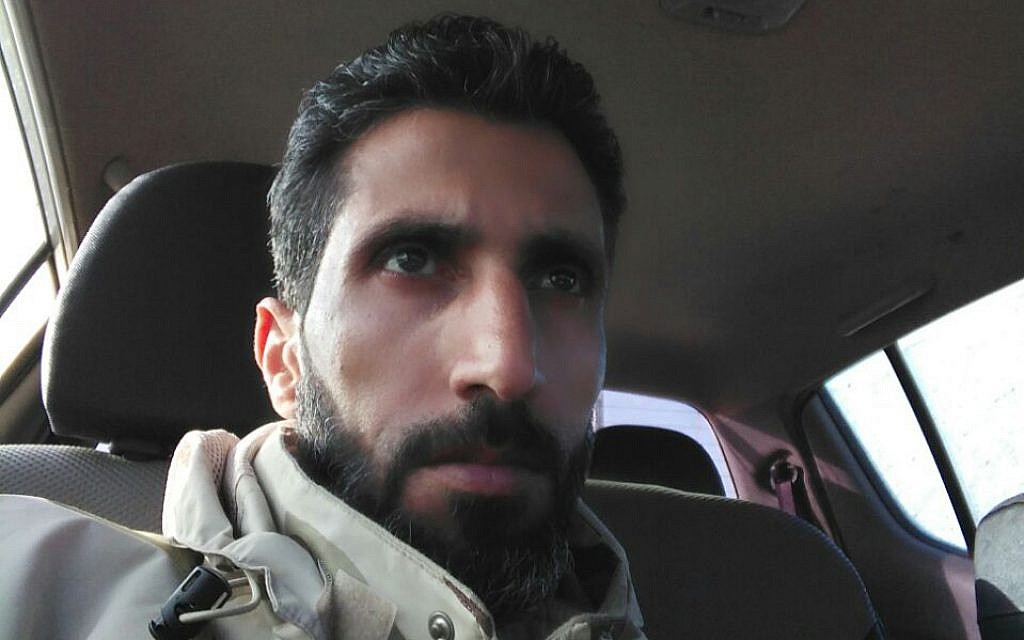
Abu Muhammad al-Akhtubut, a commander from National Syrian Liberation Front rebel group from the Syrian Golan Heights. (Courtesy)

 'As Syrian dictator Bashar Assad and the Iran-backed militias in his employ move toward Israel, the only thing standing in their way is a ragtag group of beleaguered rebels fighting for their homes and “viciously” defending the border.

 Over the past few days, a rebel officer — Abu Muhammad al-Akhtubut al-Asmar, whose nom de guerre means, literally, “The Dark Octopus” — has been speaking to The Times of Israel about their plans to fight back against the Syrian military, Hezbollah and Shiite groups, following the fall of the town of Beit Jinn, some nine kilometers (less than six miles) northeast of the Israeli border, late last month.

 His group, known collectively as the National Front for the Liberation of Syria, is made up of about a dozen groups from the Quneitra region that joined forces this summer. With various ideologies and a wide range of military capabilities, they don’t necessarily agree on much, but the hundred or so officers who make up the loose umbrella organization have recognized the need to keep Assad and the Iran-backed forces away from the border, al-Akhtubut said.

 “The issue now is defending this area because we want to preserve it,” said the Octopus, who acts as something of a spokesperson for the group. (His nickname was bestowed on him by an older comrade early in the outbreak of the Syrian civil war in 2011, who used to tell him, “You’re like an octopus — you have a hand in everything.”)

 “The borders with Israel are important politically and internationally,” he continued. “I’m not just saying this because you’re Israeli and I’m talking to you. And that’s why we are protecting this area so viciously.”


 These opposition forces have been largely isolated in the past few years, surviving in large part because of outside humanitarian assistance, not only from Israel, but also from Jordan and international aid groups.

 The need for support is acute. Al-Akhtubut, speaking via an in-and-out Skype connection, stressed that Beit Jinn — also known as Beit Jann — did not suffer a military defeat, but fell because of the extended siege placed on it by Assad.

 “[Assad’s troops] didn’t win in Beit Jinn — it wasn’t a military victory. [The rebels] were under siege for a year. It was attrition,” the Octopus said.

 On December 29, dozens of opposition fighters and their families left the Beit Jinn area as part of a ceasefire agreement, traveling on buses to the rebel-held Idlib area, in northwestern Syria, after holding out for nearly a year following a renewed push by the Assad regime to starve out the town.

 Now that Beit Jinn has fallen, al-Akhtubut fears that Assad’s army and the Iran-backed militias supporting him can better turn their attention to his group’s last holdouts and further cut off their access to supplies.

 “We can tell that they are working to take over this area and we are trying to stop it from happening,” he added.


 On Thursday, the top brass from the various opposition groups in the Quneitra region gathered at an undisclosed location for one of a series of discussions on their next steps.

 On Friday morning, the Octopus said in a message that the groups decided to plan various offensives “in order to free up some locations,” while also preparing “defense plans in case there’s an invasion by Assad and Iranian forces.”

 He said the main area under threat is the town of Jubata al-Khashab, along with Khan Arnabeh and Hamidiya, all of which lie either in the demilitarized zone between Israel and Syria or adjacent to it.

 “We see from that behavior that they’re trying to cut off access to Jubata,” he said. “They’re trying to put Jubata under siege. They’re trying to do what they did in Beit Jinn, because it worked there.”

 The regime’s control of Jabah, in particular, makes it possible for Assad to cut off Jubata al-Khashab from the rest of the rebel-held area, he said.


 The remaining rebel forces in the Quneitra region are also boxed in, as Assad forces control the towns of Dayr al-Adas, As Sanamayn, Barqa and al-Sheikh Maskin.

 It is not entirely clear how large a role the Iran-backed Hezbollah and Shiite militias have played in the fighting in southern Syria.

 Israeli and pro-rebel officials stress their involvement. Al-Akhtubut said these Iran-backed groups — including Hezbollah — are “the scariest thing right now. They are our biggest problem.”

 But according to analyst Aymenn Jawad al-Tamimi of the Middle East Forum think tank, not all of those claims are backed by facts on the ground. In a recent article on his website, al-Tamimi said the Syrian army’s 7th and 4th divisions are leading the effort on the Syrian Golan Heights, with limited assistance from Iran-backed forces.


 As the National Syrian Liberation Front prepares for its offensive and defensive campaigns, it must cope with limited weapons stores.

 “Our military support has been cut off for the past year,” al-Akhtubut said. “Several of our materiel sources have dried up as well.”

 He noted that the various groups’ limited access to weaponry and supplies was a major factor in them coming together as a group in July, after a Jordanian training and support program ended.

 When asked what specific types of weapons and munitions the groups have left in their arsenals, al-Akhtubut declined to answer, joking that it sounded like he was in an interrogation with the mukhabarat, or intelligence service.


 Beginning in 2013, Israel began providing medical treatment to Syrians wounded in the fighting who came to the border. The army initially set up a field hospital, but eventually moved to transporting them to hospitals in northern Israel.

 As Russia entered the civil war in 2015 and Assad started scoring more battlefield victories, Israeli officials grew concerned that if the Syrian dictator succeeded in routing the rebels from the Golan Heights, Iranian proxies could take up positions on the border. From there, the Iranian proxies could open up a second front should Israel go to war with the Lebanon-based Hezbollah terrorist group.

 Last year, the army dramatically expanded its humanitarian aid program, code-named Operation Good Neighbor, and started not only providing medical care to people injured in the war but also to civilians with chronic illnesses. Israel also began sending over shipments of food, fuel and other goods.

 According to the Israel Defense Forces, in 2017, the army facilitated the transfer of nearly 700 tons of food, half a million liters of fuel and over 14,000 containers of baby formula.

 The army has been upfront that while its primary mission is simply to help the beleaguered civilians in war-torn Syria, its secondary or peripheral goal is to engender goodwill toward Israel among those same people in order to plant the seeds of better relationships for the future.

 In recent months, the amount of aid has been somewhat “scaled back,” al-Akhtubut said.


 The humanitarian aid sent into Syria from Israel — as well as military assistance, according to foreign reports — has been a controversial issue, in light of the two countries still technically being at war with one another.

 The Assad regime has repeatedly used this assistance in its propaganda to “prove” that the opposition forces are actually Zionist stooges in attempts to discredit them.

 Some of the first images to come out of Beit Jinn after it was taken over by the Assad regime were of food products bearing Hebrew labels.

 According to the Octopus, despite this, most people in southern Syria do not remove the Hebrew labels from the food and other humanitarian products that come across the border, with the exception being those who try to resell the aid for profit.

 “People who have special interests do take the labels off — they’re the only ones who do,” he said.

 But al-Akhtubut said most people do not try to make money off the aid, but give it away for free.

 “There are people who do good work, and we’re trying to keep things under control so that we benefit from the aid as much as possible,” he said.

 “But there are those looking out for themselves, instead of having it benefit everyone equally so that we can endure the pressures [from the Assad forces],” he said.


 The rebel commander said the main things the civilians in the area need are baby formula, flour and medicine.

 Baby formula, which is difficult to produce locally, was in especially short supply, he said. “It’s something we always need and we’re always short on,” he said.

 However, al-Akhtubut said that while “of course there are shortages,” the rebel-held areas are able to survive for now. “It’s not that severe — we’re not there yet — but it is enough for us to feel the burden of it,” he said.'

Tehran Seeks Reduction in ‘Cost’ of Syria Involvement


 'For more than six years Syria has been on front pages and top headlines of the media in Iran as the most important international news story. The Syria “story” also enjoyed an almost unique position in the media scene in Iran because it was of keen interest to both those in power and society at large.

 Those in power regarded Syria as of urgent importance because “Supreme Guide” Ali Khamenei has described the struggle there as “decisive” for the future of the Khomeinist revolution and its ambition to dominate the Middle East.

 “The Tehran leadership believes that without maintaining control of Syria it would be unable to consolidate its gains in Lebanon and Iraq and spread its message to other Arab countries and Turkey,” says Iran media analyst Massoud Barazandeh. “In no other country has Iran spent so much money and offered so much blood. What Iran pays to use Hezbollah in Lebanon is chicken-feed compared to what it has spent in Syria.”


 Khamenei’s interest in Syria isn’t limited to his need for a base to extend the Khomeinist zone of influence. It has deep emotional roots as well.

 In 1984, Khamenei, then President of the Islamic Republic, visited Damascus for talks with then Syrian leader Hafez al-Assad. In a speech, Khamenei recalled that Damascus had been the capital of the Bani Umayyad who had “martyred” Hussein Ibn Ali, the third Imam of Shi’ism in 680 AD. Hussein had been killed in Karbala, Iraq, but his mortal remains and his captive family had been transported to Damascus.

 In a speech, interrupted by his tears, Khamenei whose full-name is Husseini Khamenei, claimed that his visit as “a descendant of Hussein” to Damascus was in itself a symbol that the martyred imam was being avenged.

 For the past six years, Khamenei has been repeating the mantra “We shall never leave Syria!”

 In other countries of interest, Iran has shown a degree of pragmatism, toning down its involvement when the price gets too high.

 In Lebanon, for example, Khamenei agreed to propel Michel Aoun, who had been Tehran’s bete-noire because of his collaboration with Saddam Hussein during the Iran-Iraq war, into the presidency because that was expedient. According to Tehran sources, the Lebanese branch of “Hezbollah” has also had to accept a modest pay-cut.

 In Bahrain, Khamenei has so far refused to arm the Khomeinist groups challenging the monarchy or to organize attacks on the US naval base there.

 More recently, in Yemen Khamenei ordered the transfer of Iran’s embassy from Sana’a to Muscat, Oman, and the withdrawal of at least half of the estimated 200 “military advisers” stationed to help the Houthi rebels.

 Even in Iraq, the dire economic situation in Iran itself has forced Khamenei to order a cut in money spent on some 23 pro-Iran militia groups there.

 But, at least until the end of 2017, support for Syrian leader Bashar al-Assad has remained constant.


 That, however, may be changing.

 One sign is that for the past two weeks at least Syria has been relegated to inside pages in the Tehran media. Even when Bashar’s army, backed by the Russian Air Force, launched what it boasted would be “the last great battle” in Idlib, the news didn’t make the front pages. The key reason, of course, was that Iran itself was shaken by more than 10 days of nationwide protests in which the slogan “Forget about Syria! Attend to our problems!” was a popular slogan.

 There was no sign of multi-page reportages, dotted with photos in color, and TV footage “from the front-line” that have been dished out for more than six years.

 There was also no sign of Jerusalem (Quds) Corps commander Qassem Soleimani, whose “selfies” have shown him leading the liberation of parts of Idlib as he had liberated Aleppo, Albukamal and Deir Ezzor before.

 More importantly, perhaps, the usual hullabaloo regarding the martyrdom of “Defenders of the Shrines” was toned down significantly. In the first week of 2018 the remains of four Iranian officers killed in clashes around Damascus were buried in four cities without attracting the usual publicity.


 To some observers, this was a sign that the decision-makers in Tehran begin to appreciate the deep unpopularity of Iran’s involvement in Syria’s seemingly endless tragedy.

 One indication of that “appreciation” came in a long editorial in the daily Kayhan, believed to reflect Khamenei’s views.

 The editorial expresses deep dissatisfaction with how things are going in Syria and the “political plan” proposed by Russia.

 “Russia is making a lot of propaganda about its plan, presenting it as the best and most complete plan” the editorial says. “However, this plan is full of major defects that must be removed before Iran, the Syrian government and the Lebanese branch of Hezbollah agree with it.”

 The editorial then singles out Khamenei’s opposition to three key features of the “Russian plan”.

 “Iran,” it says, “cannot accept the creation of a parliamentary system, as opposed to the present presidential system, in Syria. “Nor can it accept the formation of a transition government composed of the (Syrian) government and its opponents.”

 The editorial also rejects Russia’s proposal for the creation of a federal system in Syria.

 Iran cannot accept a situation in which “Kurds, Alawites and Sunni Muslims each have their own zone of domination”, the paper says.

 One reason, as far as Tehran is concerned, is that there are not enough Shi’ites in Syria to receive their chunk of territory in a federal Syria.


 However, the deeply hidden purpose of the editorial is revealed in a short sentence.

 “The process of future security developments (in Syria) can be pursued in a less costly way compared to previous years,” the Khamenei organ asserts.

 This may well be a thinly disguised threat to Russia which is anxious to disentangle itself from Syria as fast as possible and transfer more of the financial burden to Iran. The message is: We want cost reduction, not an increase!

 However, it may also be a message to Iranian protesters that the regime is contemplating a lower and less costly involvement in Syria, using Russian “double-dealing” as an excuse.

 For more than two weeks there has been no news of new Iranian forces, or even “volunteers for martyrdom” from Pakistan and Afghanistan, being dispatched to Syria while Gen. Soleimani remains in purdah.

 Iranian leaders may be beginning to understand that helping Bashar al-Assad kill more Syrians may prove too costly at home and abroad.'

Sunday, 14 January 2018

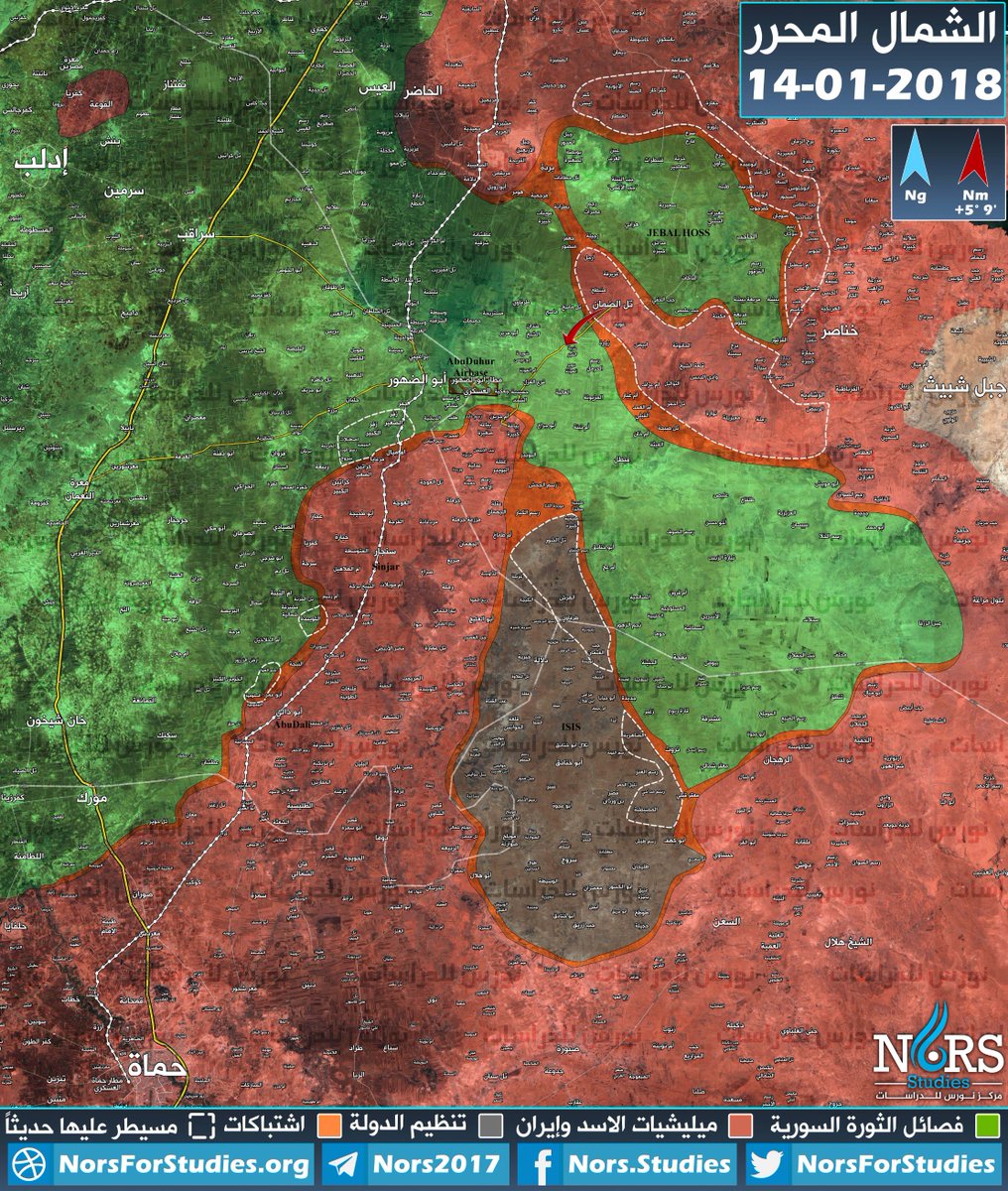
Current situation & dynamics in NW. Syria


 'Rebels took back 20+ locations from Regime - Regime & IRGC almost encircled Jebal Hoss - ISIS pocket keeps extending.'

Friday, 12 January 2018

Syrian regime arrests prominent militia leader


 'Syrian intelligence arrested one of the most prominent leaders of local militias in Syria after a series of defeats in the military Vehicles Base in the city of Harasta of Eastern Ghouta.

 Pro-regime Facebook pages such as "Republican Guard Lair" have confirmed the arrest of the commander of the Qalamoun Shield militia, Captain Firas Jazaa, and referred to the investigation after confiscating his weapons and the equipment of his own group.

 On the other hand, the news network "al-Asema" dedicated to report the news of Damascus province and its countryside reported that the leadership of the Third Division in the army of the regime dismissed the officer, "Firas Jazaa" from his post as commander of the militia, "Qalamoun Shield" and sent him to be investigated against the background of what happened in the battles of Harsta as several groups and militants escaped withdrew and defected from the Jazra militia.

 The militants of Qalamoun Shield are taking part in several fronts, notably Homs, Hama and in various areas of eastern and western Qalamoun, as well as their recent attacks on the eastern Ghouta fronts.

 The Qalamoun Shield militia was founded in early 2014 and includes fighters from cities and towns that have entered into reconciliation with the regime, such as Yabrud, al-Tal, Qarra, Jeroud and Nabek, and are supported by Russians via the Hameimim military base.

 In November, the eastern Ghouta factions announced the start of a battle "They Were Wronged" to control the Military Vehicles Base in Harasta, and after several attacks they were able to capture the Base and caused losses for the Syrian regime of dozens of human lives , as well as material losses in equipment.'


 'Harasta's Vehicle Management base has been taken, it's estimated there were 200 régime force members there, some were captured, others killed.'
[https://twitter.com/CombatChris1/status/951691306480295937]

Options for Syrian opposition factions after funding cuts


 'When the Free Syrian Army was founded by dissident officers and leaders in the revolutionary move in early 2012, the issues of financial support and overlapping agendas were not as complex as they are today. The “Free Army” factions were linked to two Military Operations and Support Coordination Rooms, known as MOC and MOM, which played a significant role in the military momentum on the ground and the organization of the internal affairs of the factions. They also played an important role on the opposition deterioration on the ground, as happened after the United States announced ending military and logistical supply, which led to a new phase of disproportionate powers.

In the beginning of 2018, the factions of the Free Army are facing a big challenge accompanied by questions and speculations about the possibility of pursuing operations against al-Assad forces in the absence of support and possible solutions to overcome this restriction, whether by relying on other sources of funding or introducing new measures that will fill the financial and military vacuum.

Going back to the early years of the “Free Army” formation, the fronts witnessed clear progress in favor of the opposition, but gradually began to withdraw after the foreign supporter interfered in the ammunition and field plans and directed targets to fight ISIS away from the sites of the Syrian regime.


 The cut of support for the factions was not recent as it was stated by the media earlier this year. It has started and gradually diminished since the beginning of 2017, and later became related to the conditioned of fighting against ISIS.

 The fighters training stopped in July 2017 and the movements of the factions supported by the operating rooms were restricted, which was confirmed by the decision to withdraw support from the Martyrs of Islam Brigade faction and to cut the heavy weapons supply after it attacked the Iranian militias in the Syrian Badia area. This was followed by Russian raids on the faction’s controlled sites.

 After the change of administration and the election of the new president, Donald Trump, Washington has opted for to reducing support for the Syrian file at the military level, considering that this support is inappropriately provided, and that all the fighting factions in are supposed to integrate within one military platform.


 So far, the main reasons for the decision have not been made clear. While in July 2017, Trump justified the decision and said that the support program was “huge, dangerous, and ineffective,” the Washington Post published an article entitled “Cooperation with Russia becomes central in Trump strategy in Syria,” in which it said that the resolution is the result of US-Russian agreement.

 MOC is a military coordination room with US, British, French, and Arabic representatives of Intelligence agencies formed in 2013 and based in Jordan.

 It provides military support to FSA factions, especially in the southern region.

 MOM, however, is a support coordination room for the Free Army factions. It is constituted by almost the same countries, but supports the northern fronts in Syria and is based in Turkey.

 According to the military adviser in the “Free Army,” Ibrahim al-Idlibi, the political rapprochement between Russia and America had a major role in the interruption of factions’ support program, which negatively affected the Syrian revolution in general and militarization in particular.


 Another reason of the factions’ failure in receiving support is due to an internal confusion from within, especially with regard to al-Nusra Front earlier fighting, which has cut ties with to al-Qaeda organization and has joined Hay’at Tahrir al-Sham. It is deployed in various areas in the south of Syria and most of Idlib governorate and its countryside in the north.

 In the Syrian context, the beginning of each year is marked by new political plans on the relief, military, or logistics levels. What happened in the beginning of 2017 is the openness of the American policy on the “Free Army” and increased support to defeat the extremist factions and even defeat the regime and Iran. According to al-Idlibi, the timing of fighting al-Nusra Front “was the point of disagreement, which led to the cessation of support, as the factions do not intend to wage a bloody war with al-Nusra,” despite its military power which is capable of eliminating it at the time.

 He added to Enab Baladi that in July 2017, the US administration asked the “Free Army” factions to be unified within one body, and then the so-called Military Operations Room was formed, which constitutes an assembly of all factions led by a person named Abu Yamen. It is affiliated with Faylaq al-Sham faction and divided into sectors (Homs, Idlib, Hama), but it has not been implemented, as it carries a tendency to eliminate the factions and work by a central decision in the battles.

 Later, in early April, the ammunition decreased and problems have surfaced with regard to logistics equipment, heavy weapons and tanks, which led to a big power difference reflected on the ground. Al-Idlibi described the current situation, saying, “today’s fighter fires a bullet which is irreversible.”

 The factions today are unable to withstand the pressures, as they previously found reliable support warehouses, but Tahrir al-Sham completely took control of, mainly after the recent fighting against the Ahrar al- Sham Movement, which further weakened the factions fight capacities.


 From the point of view of the military analyst, Col. Ahmad Rahal, the factions did not need support in previous years for two reasons. First, the weapon in their possession could liberate Syria completely. The second goes back to the beginning of the Syrian revolution when borders were closed and controlled by the Syrian regime. The factions, however, were able to obtain the ammunition. This is confirmed by the Eastern Ghouta factions, which relied in their operations on the booty they took from the regime in battles that were launched from time to time.

 “The problem now is not about arming, but about the structure of the factions to continue fighting against al-Assad forces and the different militias which are combatting with it. Some factions are linked to political and military agendas, and others to the financial sources which contributed to its establishment in previous years,” said Colonel Rahal.

 The northern Syrian fronts are witnessing battles in which al-Assad forces are trying to make incursions into the southern and eastern Idlib countryside, as a step to reach Abu al-Duhur Military Airbase, amid the talk of non-serious participation of the military factions in the region.

 Military sources from the region told Enab Baladi that the response is limited to four factions in the Free Army only, which are Jaysh al-Izza, Jaysh al-Nasr, the Central Division, the Free Idlib Army as well as Tahrir al-Sham that were charged with handing over areas to al-Assad forces in the vicinity of the Sinjar village without fighting.

 According to Ibrahim al-Idlibi, the factions are in a great dilemma since they are divided to two different standpoints, namely participating or abandoning in the battles. al-Idlibi pointed out that the factions must attack Tahrir al-Sham warehouses to seize and obtain ammunition, in light of international funding interruption.

 He said that the Free Army factions in the south-east of Idlib (al-Nasr, al-Izza, and Free Idlib armies) revenues after the end of the support reached 35%.

 In his view, the factions must consider preserving the geographical area before looking for internal alternatives to the organization process. He pointed out that the Free Army factions must defend the land in order to gain the support of the international community, which gives territories basic considerations.


 Enab Baladi has conducted a poll on its website, which asked the following question “In your opinion, what is the fate of the military factions in Syria after international support halted?”

 Forty per cent of the participants, 300 people, considered that the best solution for the factions of the Free Army is to dissolve itself. They held the faction leaders responsible for the current situation they have reached.

 “At the beginning of the Syrian revolution, there was no international support. The factions liberated three quarters of Syria with light weapons. However, after the support, the regime restored three quarters of Syria,” wrote Ali Ibrahim in his comments.

 The other 39% of the participants felt that integration into a unified military body would change the reality of the military factions. In early 2107, this suggestion was put forward by the US administration and it is currently being discussed.


 According to the young man Anwar al-Ahmad, if the factions unite and disengage from external support and return to the years of the Syrian revolution, the Free Army will be much more influential and will overcome the support difficulties it is currently witnessing.

 “I think that the factions of the Free Army should unite and start a new revolution as they did in the beginning of 2011,” said Walid Haddad.

 The option of relying on self-financing was not agreed upon by the participants, and the rate of approval for this solution was only 21%, although some military analysts confirmed its success, especially in eastern Ghouta.

 Hamza Shibli commented on the poll saying that “self-armament should be implemented from the beginning since the regime is buying weapons for Syria.

 The stronger deserves to own weapons.”

 Some observers rejected the proposals, and considered that the opportunity was over, due to the control over the past years and the fact that the factions depended on what they described as “America’s charity”


 In the south, the fighter’s salary dropped to less than 40 dollars per month, whereas before fighter’s salary used to exceed 200 dollars. Therefore, the south factions lacked financial resources and were left only with little support.

 The situation in the north did not differ much from the south. A leader of the Sham Legion faction, who preferred to remain anonymous, stated in an interview with Enab Baladi that the salaries within the faction had turned into grants that differed from one sector to the other, for Idlib sector differed from Hama and Aleppo’s.

 The grants range from 70 to 100 dollars. The leader pointed out that this does not apply to all fighters, but to some of them.

 The talks in the sixth version of Astana held in September 2017, along with the demarcation of de-escalation areas marked the major turning point in the support process. The outcome of the conference rejected several factions including the Southern Front in Daraa and the factions operating in northern Hama countryside, most prominent of which are Jaysh al-Izza, Jaysh al-Nasr, and the Central Division.”

 The Military Operation Center (MOC) decided to dissolve the Southern Front and restructure Daraa and Quneitra factions at the end of July 2017.

 The move came after the Southern front factions boycotted “Astana 5”, on July 4, attributing this decision to the “inability of the successive international conferences to take any serious decision that would stop the shedding of Syrian blood.”

 The factions of Badia, which were directly supported by the United States, are also suffering. According to military sources in the faction of the Forces of Martyr Ahmed al-Abdo, the salaries are currently ranging from 100 to 150 dollars per member, while it ranged previously from 300 to 1,000 dollars during the thrust of military operations.

 The sources pointed to the current dependence on the reserve, whether financial in terms of salaries, or military in terms of weapons and ammunition. The sources also noted that the international reduction affected only the heavy military equipment.


 On the side of the forces opposing the Syrian regime, there are also Islamic factions which are not affiliated to the Free Army, and their financial situation varies according to the sources on which they depend.

 Ahrar al-Sham’s loss of Bab al-Hawa border crossing with Turkey for Hay’at Tahrir al-Sham left a significant impact on its financial composition. The fighters’ financial granting stopped for three months after the faction withdrew from the crossing and then returned in “small amounts”.

 According to the information, which Enab Baladi has received from a fighter who is familiar with financial matters in the movement, the average fighter’s grant ranges from 40 to 60 dollars, while the married one gets an additional ten or twenty dollars only.

 As for staff or administrators, their salaries are higher and range from 80 to 100 dollars.

 The fighter noted that, in some cases, grants are more or less according to “efficiency”.

 Before the withdrawal from “Bab al-Hawa,” the salary of the unmarried fighter amounted to 70 dollars while the married gets 90 dollars and the administrative member gets 100 to 150 dollars.

 He explained that previously, the fighters used to receive relief basket and warm clothing, in addition to salaries, which amounted to 20 dollars, as well as irregular financial incentives.

 As for Hay’at Tahrir al-Sham, Enab Baladi has been able to obtain a little amount of information about the salaries of the fighters which have not changed since the formation of the former Fateh al-Sham front.

 Salaries range from 100 to 350 dollars per specialty, in addition to a relief basket in some cases apart from some privileges offered to some fighters which include rent-paid homes and means of transport (motorbike).


 Speaking of the military forces affiliated to the Free Army in northern Aleppo, the National Syrian Army, which formation has been announced by the Ministry of Defense of the Syrian Interim Government, on December 30, 2017, relies on the revenues of the northern Aleppo countryside crossings. According to its affiliated factions, these revenues are the only source of support for the financial sector, which is responsible for three newly formed troops in the region.

 Turkey has set the financial map to support the factions to which it had been previously providing military and logistical support against ISIS since August 2016, with the launching of the military Operation Euphrates Shield that led to the expulsion of ISIS from the entire northern and eastern region of the province.

 The military structure includes a unified military command for all factions in the “Euphrates Shield” area. Three troops emerge from within, namely the National Army, Sultan Murad Division, and Sham Legion.

 After the formation of the troops, the factions were stripped of their names and divided into three teams in each corps and three brigades within each division, in addition to including three battalions of fighters in each brigade, according to the New Staff.

 Colonel Haytham al-Afeesy, the deputy Chief of Staff, to which The National Army is affiliated, stated to Enab Baladi that the Army relies on self-support, provided by the interim government.

 He explained that the distribution of revenues of the crossings “will be supervised by specialized committees to ensure fair distribution among all.” He stressed that “all fighters of the three corps will receive the same salary, after considering the military rank.”

 “The support of the fighters is not unified in the region,” said Abu Walid al-Azi, a leader of the Sultan Murad Division. He pointed out that “until the end of last year, support was distributed between Turkey, America, and MOC room.

 According to the leader, the Turkish-backed fighter receives a monthly salary of 300 dollars, while the former US-backed fighter used to receive 200 dollars and the MOC room had earlier provided 150 dollars.

 The financial support of the three corps did not start until January 6, 2018. According to the leader, two months ago, the MOC paid the fighters the last salaries until the end of December 2017. MOC’s financial support has stopped since then.

 Al-Azi explained that “the support of the corps will depend on the crossings of Bab al-Salamah, Al-Rai, Jarabulus, and new crossings under Turkey’s supervision, provided that the revenues are transferred to the Agricultural Bank of Turkey to be then equally divided at the end of each month between the factions of the Free Army, the interim government, and the opposition coalition, as he put it.

 There are no specified salaries according to the new mechanism until now, nor did any combatant in the three corps receive any financial revenue, according to the leader of the Sultan Murad Division, who pointed out that the division’s leader determines the salaries of his officers, stressing that all combatants will receive the same amount of money after the distribution begins.

 The Syrian borders with Turkey are linked with 10 border crossings, only three of which have been partially operational: Bab al-Hawa Crossing Border in the northern countryside of Idlib, Bab al-Salamah near Azaz in northern Aleppo as well as Jarabulus in the eastern countryside of Aleppo, and finally Al-Rai crossing which was officially opened in December 2017.

 Syrian opposition factions are currently running the four crossings under direct supervision of Turkey.


 Some opposition factions have started looking for self-support instead of external support, which would enable them to continue their work by controlling important economic outlets in the areas under their control.

 Within this framework of self-support emerged the experience of the two factions Jaysh al-Islam and Faylaq al-Rahman in eastern Ghouta, in addition to the experience of Hay’at Tahrir al-Sham which dominated Idlib’s economic parts.

 According to Enab Baladi’s information, Faylaq al-Rahman established projects inside and outside Ghouta, which started with digging two commercial tunnels between Ghouta and the regions of Qaboun and Barzeh that have reconciled with the regime.

 Faylaq al-Rahman worked on operating its tunnels through the trade of food supplies, electrical appliances, mobiles, computers, and solar panels, as well as the currency conversion and exchange, which led to huge revenues that reach millions of dollars.

 It also founded the Rahma Foundation for the management of the tunnels, which had monthly profits of 30 million liras, according to one of Rahma Foundation directors, whose name Enab Baladi was reserved to mention in a previous investigative report entitled: Ghouta Economic Map… Tunnels and Cavities. The management of the tunnels was ended with the control of al-Assad’s forces over Qaboun and Barzeh.

 In addition to the aforementioned, Faylaq al-Rahman faction entered into a series of development projects through institutions it established in early 2016 such as cattle and broiler farms and shops, as well as investing in the agricultural sector through the planting of hundreds of dunams of land and the establishment of an agricultural unit managed by engineers to finance the formation of necessary foodstuffs to feed its employees.

 Faylaq al-Rahman has a series of traders who work in collecting copper, aluminum, and raw materials which had been previously sold to Damascus through tunnels.

 As for Jaysh al-Islam, which is considered as the largest formation in al-Ghouta, like Faylaq al-Rahman, it managed commercial, profit, and development projects to finance its military body and support its combatants. It worked on opening a series of commercial projects inside and outside al-Ghouta. In addition, it managed the “Al-Wafedeen” (incoming) camp crossing through establishing an economic office which runs its projects and discharging its goods in the market.

 It also set up offices for the disposal and transfer of funds, in addition to its work in the agriculture field as well in the suburbs of Duma to supply and finance itself.

 In its turn, Hay’at Tahrir al-Sham in the north of Syria sought self-support, although external support has not been reduced. It managed to take control of all the economic resources in Idlib and its countryside after a military clash with Ahrar al-Sham, as whoever seizes the governorate’s economy would eventually extend its military control in it.

 Hay’at Tahrir al-Sham established the so-called General Organization for Cash Management and Consumer Protection, which aims to regulate exchange operations and prevent monopoly and manipulation of currency prices. This was also meant to control the market of money management and control the movement of funds and exchange offices.

 It also took control over the files of the water institutions, the real estate register, the civil registry, the local administration and agriculture through its Civil Service Administration, which imposed itself on the electricity sector.

 In July 2017, it worked on merging its electricity institution with the institution of Ahrar al-Sham in an effort to harness any service objects that stood in front of its expansion project. Whoever holds the power lines would eventually hold the region’s economy, due to their high dependence, especially in bakeries and water pumps. In addition, they knew that Idlib’s economy is mainly based on agriculture and therefore needs water and electricity, which are the lifeblood of any society, according to what the economic researcher Ayman Desouky, have previously stated to Enab Baladi.

 As part of its economic plans, in November 2017, Hay’at Tahrir al-Sham handed over all the civil services that are run by the civil administration to the Salvation Government which was formed in the city of Idlib, and which is considered as the civilian body of Hay’at Tahrir al-Sham.


 It is impossible to not to talk about the strategic border crossing of Bab al-Hawa, of the northern region, which is under the authority of a civil administration of Hay’at Tahrir al-Sham, because it constitutes a financial revenue to the party that controls it, whether from the entry and exit of persons or the entry of goods.

 Since 2013, the supporting countries started to put their hands on the factions of the Free Syrian Army by providing their conditioned support. Those who accepted the conditions, continued receiving support, while those who did not, were sidelined and even killed in many cases, and the assassinations of some of the leaders that were carried out on the liberated lands’ area are a clear testimony.

 After the supporting countries managed to clearly control the decisions of the factions, these factions started implementing the agendas of their funders, and so, the revolution’s objectives were lost, and the areas were handed over one after the other, which weakened these factions themselves and thus they gradually started to make concessions under the pretext of the cessation of support.

 With this process, Al-Assad has been indirectly supported by the funding countries that are carrying out agendas dictated by those who control the world and who clearly wish to reproduce al-Assad and his regime.

 The military factions that receive external support are doomed to dissolution and disappearance after accomplishing the mission of burying the revolution as a result of selfish, factionist, and partisan interests over the interests of the Syrian people and their main cause of protest.

 It is possible that the supporter gives gratification rewards to some leaders and some parties in a fifth position in a state ruled by al-Assad and his gangs. unless something emanates from the factions and the Syrian people which may turn things upside down.

 Those who seek support sources will not find any support unless they rely on self-financing, which some factions have succeeded in implementing, especially in the eastern Ghouta, as the nucleus of the “Dawn of the Nation”.

 There is a decision that has been made and heard by many of the world’s decision-makers: It is not permissible to have two armies in Syria, al-Assad’s army or any other army. Otherwise, why have they weakened the Free Syrian Army? Why was every effort made to unify the leaders of the Free Syrian Army hindered? … This is totally clear, as for what is happening now from the formation of the Ministry of Defense and Staff, it represents only those who created it, and who control the coalition and the interim government for personal and partisan agendas, or else how to explain the exclusion of many officers who are leaders and recognized for their patriotism, and the appointment of some officers who are highly questioned in leadership positions. This is a farce which our people paid for with their blood and suffering. What is happening now in Idlib is the biggest proof. Thousands of our people are being displaced under the trees with no shelter, while the interim government and the Ministry of Defense are blindly busy in issuing data and sharing positions.

 In this context, it is difficult to form a unified army, especially if those who are in charge of forming the army represent a particular category of people who only care about higher positions and who brought our revolution to such a gloomy condition.'

Tuesday, 9 January 2018

We are seeing the worst days for the revolution now

Families cowers in a hole in Idlib province to avoid warplanes in the skies

 'The Syrian government has increased pressure on the rebels’ last-remaining strongholds with deadly air strikes and bombings, as it looks to reclaim every inch of the country.

 Syrian and allied Russian aircraft pounded targets in the northwestern region of Idlib on Sunday and Monday, pressing an offensive targeting the only province outside of regime control.

 Air strikes left at least 21 dead, including eight children and 11 members of the same family west of the town of Sinjar, according to monitors. Meanwhile, an explosion near an Islamist rebel group base on Sunday night killed 34 people, including 19 civilians.

 The Syrian army lost Idlib, which borders Turkey, to insurgents when the provincial capital fell in 2015.

 Idlib has seen fierce clashes in recent weeks, as the army pushed to seize a pivotal road between Damascus and the city of Aleppo.


 The province is part of a so-called de-escalation zone agreement struck last year by President Bashar al-Assad’s sponsors, Russia and Iran, and opposition ally Turkey. However, the regime has failed to abide by the deal and has targeted all but one of the four areas covered.

 At the same time, the regime has stepped up its bombing campaign on the besieged Damascus suburb of Eastern Ghouta.

 Shelling and bombardment of the enclave, where the humanitarian conditions have sharply deteriorated, has claimed the lives of hundreds of civilians in recent weeks.

 At the height of the fighting, in 2015, the Syrian government controlled less than a sixth of the country. Since offensives in the cities of Aleppo, Homs and Deir Ezzor in the east, they have regained control more than half of Syrian territory.

 Assad has repeatedly vowed to retake “every inch” of the country, including Raqqa and other areas taken from Islamic State of Iraq and the Levant (Isil) by US-backed forces.

 “The regime is doing now what it did in Aleppo,” said Abdulkafi al-Hamdo, a teacher from Aleppo who was displaced to Idlib. “The bombing is unbelievable in the south. We are seeing the worst days for the revolution now.”


 Pictures shared by Syrian activists showed a family who had fled fighting in their village in the south of Idlib hiding in a hole in the ground in an attempt to escape circling warplanes.

 Fighting has driven tens of thousands of residents of the Aleppo and Idlib countryside to areas further north and to the closed Turkish border.

 According to aid agencies, more than 80,000 have arrived in camps in the last two weeks. While Turkish security forces caught a record number of nearly 10,000 attempting to cross the frontier in the last 10 days of December.

 "If the strikes on civilian centres continue, there is the possibility of an additional 400,000 civilians trying to make their way to the Turkish border,” said Selim Tosun, from the IHH Humanitarian Relief Foundation. “This area is already saturated with people and is currently housing roughly one million people.” '