Tuesday, 2 January 2018

Dancing in Damascus


 miriam cooke:

 'I along with all the creative workers I deal with in this book, do not believe at all in the way the revolution has been characterised. So that now people are talking about a civil war, how can it be a civil war when the government is exterminating its own people? When the Assad régime has been conducting almost a genocide on his own people. So perhaps we called call it a pure war in the way that Paul Virilio refers to it, as the crushing of the people by the government. But I think it is absolutely crucial to be in solidarity with those who started the revolution, and whether they have stayed inside the country or whether they have left, their insistence is always on the fact that it's a revolution.

 So, as many people will know, the Arab Spring broke out in the December of 2010 in Tunisia, and very quickly spread to Egypt and Yemen, Bahrain and Libya. And of course in the first cases, Ben Ali was forced to escape out of Tunisia, Mubarak was forced to resign, Saleh out of Yemen; and in Libya of course we had a similar situation happening to Gadaffi as happened to Saddam Hussein, ultimately found in a hole. The hole happened to be a sewer for Gadaffi.

 So when these young boys in a town called Daraa, which is on the border with Jordan in the south, picking up the mood of the moment, scribbled on a wall - they were schoolchildren, returning home from school - "It's your turn, doctor", addressing themselves to Bashar Assad, who's an ophthalmologist; and then scribbling another motto or slogan that had gone around the Arab world, "The people want the régime to fall".

 Unlike what had happened elsewhere, where there was in the beginning toleration for these forms of expression, artistic expression, so when El Général sang his famous song, addressing the Rais Lebled, who was Ben Ali, the head of the country, and told him, your people are suffering and you've got to go, and Ben Ali didn't punish him immediately; in Daraa it was very different.

 The boys were immediately picked up, taken to the local police station, and they were tortured. News spread like wildfire across Syria, and this for me has been so interesting, the way news of demonstrations travels so quickly. People just flooded the streets, and the government cracked down. And they cracked down again and again, and the demonstrations continued. Particularly on Friday, because Friday was the only day where there was official permission for people to assemble, because of course Friday is the day of the Jumu'ah Friday prayer in the mosque.

 And so the demonstrations were, in Syria, very different from the other countries, because in the other Arab Spring countries, the demonstrations in general happened in one city. usually the capital. So Sana'a in Yemen, and Cairo's Tahrir Square in Egypt, Tunis in Tunisia, Bahrain Bahrain; but here it was almost everywhere in the country that people stood up to the violence, the injustice, the radical cruel injustice, of the régime.

 So that, I think, gives a timeline for the revolution that continues until today. If you talk to any of the people that I have written about in dancing in Damascus, there is not one who would not call it a revolution. On fact, a book came out, I think it was three or four months ago, Wendy Pearlman's We Crossed a Bridge and It Trembled; of the many dozens of people she interviewed, they all referred to it as a revolution as well. And in fact one of her interlocutors says, it is the international media that has destroyed the revolution by calling it a civil war.

***********************************************

 The Syrian situation is really quite different from any other Arab country. Perhaps comparable, in the 90s, to the situation of Iraqis under Saddam Hussein. When I was in Syria, for seven months in 95/96, I interviewed writers, film-makers, people who had been in Hafez Assad's prisons for many years; some terrible prisons, some people refer to these Syrian prisons as among the worst, if not the worst, in the world; and art at that time that was still being produced, and again I'm thinking of art-activism as not being specifically image-making, but also telling stories, and making films and videos, it was so, so, important that one stay in the country, a country that was ruled with an iron fist, where fear dominated every aspect of everybody's life, and not to leave. Because the assumption there, and this has been true in many Arab countries, that the artist-activists feel that once they leave the country, their voice has lost an important gravitas. Because what you say, what you write, what you paint, what you shoot with a camera, doesn't have the same effect and power when it is done from the safety of London and Paris or New York. So, to stay meant to risk freedom, sometimes to risk life, to be able to speak truth to power, and for the people to see that they have among them someone who is daring to resist, and resist on their behalf.

 So, there was a sense in which these artist-activists were spokespersons for the people. And I analyse this in my 2007 book, Dissident Syria, where I talk about the various ways the Hafez Assad régime tries to manipulate these artist-activists. And so I distinguish between permitted criticism, and what I call commissioned criticism. Permitted criticism is that which the régime allows to be distributed, and it can be criticism of the schools. It can even be light criticism, making fun of something that is happening in the government. And it allows for what the Syrians call tanafus, which is to breath. The translation in general into English is a pressure cooker system. That is, tension is building, building, building, among the people, and then at a certain point it comes so close to breaking into violence that something has to be done. And still the régime had calibrated those moments when things were getting to be so repressive that the system was endangering itself.

 So people who were involved in permitted criticism were referred to by the people as muharij, or court jester.Yes, it makes us feel better, but anyhow this guy is never going to be punished, and this is what the régime wants this person to do, and so it is a form, a perverted form, of propaganda. Saying, well look, we have the freedom to criticise, so everything's OK.

 Commissioned criticism was very different. And it was not condoned, and the outcome of such criticism was unclear. Would this person be thrown into jail? Would the passport be revoked? Would there be ways in which that person who had spoken out so bravely and outrageously against the régime; if he was not made to pay in some ways, but rather continued to live perfectly well in some ways, as in the case of someone like Sardella Wanlous, who was actually sponsored by the government to go to London for regular cancer treatment; did that turn that person into a court jester?

 And so in some ways these artist-activists were between Scylla and Charybdis. Of loss of freedom or life, and on the other hand, not being taken seriously. And yet each time, they were risking everything that mattered to them.

 So this was the situation in a society I had described as atomised. And there I'm using Hannah Arendt's term, that she used of course in describing in Totalitarianism, the situation in Hitler's Germany. Of course like all great books, it should apply beyond the particular case to the universal.What she talks about in Hitler's Germany, fits very well for Syria. And that is, everybody is afraid of everybody. And I'm afraid of my spouse, my parents, of my children, my teacher, my school friends. I'm afraid that they're going to write a report, that will then be sent to the mukhabarat, to the intelligence service. And so I will be punished for maybe making fun of Hafez Assad.

 And so this country, which I knew in 95/96, was a country where people were afraid, pretty much, to talk out loud about anything that even had the slightest whiff of politics, lest their words be twisted in a report. And so what was extraordinary, when the revolution broke out, was to see the streets flooded with these people, who had been so atomised that they didn't dare to speak to each other.

***********************************************

 When Hafez Assad died, and his son the ophthalmologist was returned from London to Damascus, he was not at all trained to be a politician. His brother Bassel, who died in a car crash in 1994, was the one who had been groomed to be leader. And because Bashar has seemed so unsuited to the task of leadership. I think Hafez Assad never really worked on grooming him for the job as he had done with his older son.

 So when Bashar came to power, at the same time two other sons were coming to power, one in Jordan and one in Morocco, there was an expectation that the younger generation would change things. That there would be a transformation in the system. As there had been when Muhammed VI took over from his father Hassan II in Morocco, and when Abdullah took over from his father King Hussein in Jordan.

 So for the first few months, there were a lot of new liberties. People were allowed to meet, even allowed to meet in semi-formal contexts, referred to as a mutada or a mutada yert, which are like the Paris salons of the 19th Century. People meeting semi-publicly, sometimes in homes, sometimes in clubs, to discuss pretty much whatever they liked. Bashar closed down the two worst prisons, one in Mezzeh, and one in Tadmur, which is Palmyra. And there was a sense that there was a radically new Syria in the making.

 But of course what happened was that the freedoms became too much for the régime to deal with. There were a number of documents that intellectuals had put together, asking for real freedoms, not just these almost dinner-party freedoms, asking for radical change. And then, in 2006, there was a huge famine that brought the country, especially the rural parts, to the edge of rebellion.

 The people had smelt freedom, had felt that they had enough power behind them that they could demand radical changes, could demand a revolution almost. And it was then that the Bashar régime started to crack down in very familiar ways to those that had been through the Hafez régime. And the reason I say that it was familiar was then when Bashar took over, as I said not trained, shaped, groomed for the job of President of Syria, he had no men and women that he brought in with him. No seasoned politicians. And so basically he just stepped into his father's shoes, and nothing around him changed in terms of the personnel. The atmosphere changed, but the people didn't change.


 And so the draconian measures that Hafez Assad and his entourage had established in the country from 1970 when Hafez Assad took over until 2000 when he died, were in place, and Bashar could fall back on that old system.

 While I say the wall of fear had cracked, and throughout the Arab Spring countries people talked about the wall of fear, it cracked due to the Damascus Spring, that everyone dates differently. It was at least a few months, and for some it went on until 2004. People had begun to feel what it could be like to be able to meet with each other, to not be afraid to discuss what was wrong with the system, not to anticipate that every word would be twisted and turned into some kind of indictment in a report. And so although Hafez al-Assad's men were there to replace the old draconian systems, people had tasted what it was like to be able to talk to each other.

 So they were no longer as afraid of each other, no longer as afraid of the régime and the mukhabarat or the secret service. So I think that's where one can begin to see the cracks, as Leonard Cohen said, "There's a crack in everything, that's how the light comes in." And I think there was a crack in everything in the Syrian régime, and the light that came in, of course, was the revolution.

***********************************************

 Artists who were already practising, some of them were painting, and in this case I'm talking about artists who had been educated in Damascus Academy of art. There were writers, particularly dramatists, who had been trained in the Syrian Academy of Dramatic Arts. They immediately began to produce work. The famous artist, I think outside the country, is the artist-activist Ali Ferzat. He had been producing caricatures for years and years and years, quite careful in terms of what Sadik al-Azm called the line between dissidence and martyrdom. So that's an important line that most of them tried to get close to, but not to step onto the other side into martyrdom.

 So Ali Ferzat had always been functioning on that line between dissidence and martyrdom. And when the Damascus Spring broke out, blossomed, he started a cartoon magazine, he had a magazine called al-Domari, the Lamplighter. It lasted for two years. It was closed down, but it was full of very daring, oppositional work, and one of the images that I use in my book was one that came out during that period, I think it was around 2006 - so five years before the actual revolution broke out - and it's an image of a cell in the Tadmur Prison. Tadmur being Palmyra, or for people who don't know, in Arabic Palmyra is Tadmur. And it shows a prisoner hanging from hooks, like meathooks, from the wall. A hand has been amputated, a foot has been amputated, he's obviously dying. And seated on the floor next to him, surrounded by his torture tools, and blood from the dripping body, is his torturer who was weeping as he watches a soap opera.

 I thought that this was such a remarkable image, because before 2000, even to use the name Tadmur or Palmyra Prison, was taboo. You couldn't talk about it. Those prisoners who I met when I was there and afterwards, who had either spent any time in Tadmur or Mezzeh or Sadnaya, they weren't allowed to talk about their time there. And here was this cartoon that had gone viral. So again, Ali Ferzat was one of the first to literally stick a finger to the régime. And it happened in August, so about five months after the beginning of the revolution. He was picked up, in Damascus, by some of the government thugs. They take him to a desert area near the airport, beat the living daylights out of him, and are particularly concerned to crush his fingers. Telling him: OK, you think that you can produce resistance and rebellion in the people through what your fingers produce. Your fingers will not produce anything, any more. So, he was found, taken to a prison, and somebody took a photograph of him, lying in bed, all bandaged up. So when his hands and fingers healed, which they did, beautifully, he then produced a cartoon of himself, in bed, with his fingers bandaged, and the middle finger upright, to Bashar. So this is: you think you can stop me, no you can't.

 So that was one of the first really affective images that went viral. He also was the first whose work was posted to an extraordinary site called The Creative Memory of the Syrian Revolution. It's a site that was launched in early 2013, by a woman called Sana Yazigi, who is a graphic artist. She had noticed the tsunami of creative works that had been produced right from the beginning of the revolution. She designed this website; the first caricature that was posted was another cartoon by Ali Ferzat, and it's called al-Takatuf al-Duwaliya or International Sympathy, and he shows on the left, a bent over man holding out a cup, like a begging bowl; and lined up are four figures, who are obviously international leaders, one looks Chinese, another is Russian; and each one is dropping two tears into his bowl. Obviously crocodile tears.

***********************************************

 There is a radical need to resist violence, and not on its own terms. You can't destroy the master's house with the master's tools. There has to be another way, and then what drives the resistance is the commitment to hope. That they will, through their works, not only assure the world that the revolution is ongoing, but that the revolution will do what revolutions do, and that is to turn the system upside down.

 They can't be shut up, because in the Internet Age, whatever they put on to the web, can be silenced in one place, but will pop up somewhere else. And so I think what we're seeing here would not have been possible, even twenty years ago.Without Youtube or Facebook or blogging, it would not be possible for these artist-activists to be as empowered as they are. They're empowered by the fact - maybe if not at the beginning, certainly not long after they had started producing their works - they realised that people noticed what they were doing, that it mattered to the people inside Syria and outside Syria, that the commitment to the revolution was staunch. There was nothing that the Assad régime did to the people, to the works, that could stop the revolution.

 So this theme of hope is an interesting one, and this was made explicit in the 2016 Bordeaux Festival des Arts. Every October, Bordeaux has an arts festival, and the organisers of last year's festival had heard of Sana Yazigi, and had invited her to participate in the 2016 Festival, and they asked her if she would provide thirty images from the site.

 She launched the site in early 2013. Unbelievably, by the time the festival came around, there were 23,000 works on the site. She doesn't have a single piece of documentary evidence. She doesn't take photographs, unless it is is a photograph that has somehow been manipulated by someone in a creative way. Because, she says, the media is full of documentary evidence, this is not what the site is about. It is about creative memory. It is about creative memory for the future, always thinking about how people are going to look back to this period, and how will they be able to assess the role of the people who said no to Bashar.

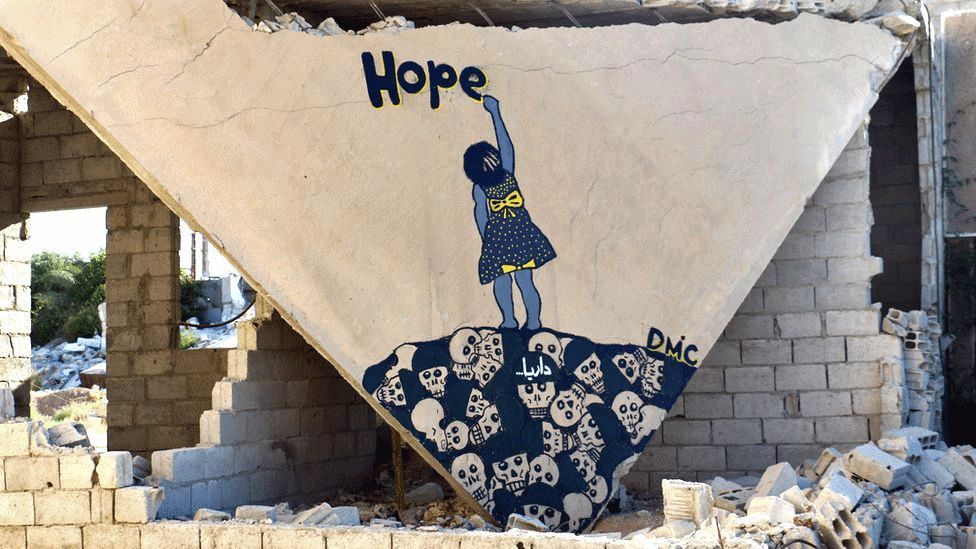
 So back to Bordeaux. She has to sift through tens of thousands of images and find thirty. And she said what became evident to her was that so many of these images were images of hope, they could be angry, the videos could be insulting - I have a whole chapter in Dancing in Damascus on insulting Bashar - but what really underscores everything that is on this site is the whole question of hope. And so she picked her thirty pieces, and the major piece for this show was a piece of graffiti, done by somebody referred to as the Banksy of Syria, and it's a graffiti he did on a broken piece of concrete, off a recently destroyed building, and it's of a little girl. She's balancing precariously, on a pile of skulls, to indicate a mass grave. And tiptoeing on top of them, she's writing the word, "Hope".

 So, I thought that was one of the most inspiring, but also grimace images from this collection. And without hope, there would be no art. There would be no music. Because even out of music, there have been extraordinary developments. There is the case of Ibrahim Qashoush, who I think in 2014 [probably 2011] led a crowd in a song that can be found online. A very powerful song, that basically says, OK Bashar, just go. So he'll sing it, Yalla Erhal Ya Bashar, and the crowd then shouting it back. When you look at it on Youtube, the crowd is so huge that it cannot be contained in the image on Youtube. So enormous excitement. The next day - this happened in Hama, and through Hama runs a river called the Orontes - on the following day, in the Orontes River was found Qashoush's corpse with his throat cut.

 So within a week, and this is something else that absolutely is astounding, an artist, Wissam Al-Jazairy, had produced an image, and it was an oil painting, so not something that you can throw together overnight. An oil painting of Qashoush, his throat deeply cut, blood pouring out of it, but also, flying out of it, is a bird. And the bird is the bird of freedom, and indicates, in English for the international audience that he wants, and the bird is covered in blood, but is nevertheless soaring towards freedom.

***********************************************

 I had not been back to Syria since the revolution broke out, for obvious reasons, it was too dangerous, but I've spent quite a bit of time in Turkey, and a little bit of time in Beirut. I've spent quite a bit of time in Lebanon, but since the revolution only a few weeks. And in both Turkey and Beirut and in Paris, and also in Manchester, England, I've met with artist-activists, and spent time with them. There is an artists' colony in Aley. It's called Art Residence Aley. It was designed specifically for artists who are fresh out of Syria. The woman who runs it is Syrian. She's an art benefactor, an engineer also. She had to come to Beirut also, like Sana Yazigi in 2012, and because she had worked so closely with artists inside Syria, and she knew that many had had to escape, she decided that what she would do is find a place in the mountains above Beirut, so not far from the Syrian border, where she could provide the artists with shelter, materials, and the space to breathe without fear, and perhaps to produce art.

 So in Aley she found an old Ottoman stable that had been pretty damaged during the civil war in Lebanon between 1975-90. And as an engineer, she converted it. She kept it very much the way it would have looked, as stables, but obviously put in a kitchen, bathrooms, and it's quite, quite, lovely. From 2012 until 2015 - I think it continues now but she moved to London - artists would be picked up from the border, somehow the message would have gotten out that the artists were making their way to or just beyond the border. She'd pick the artists up, and then take them immediately there. So by the time I got there, in the summer of 2015, there were many artists who had spent a minimum of two weeks, sometimes two months there. Sometimes alone, sometimes three or four together. And then once they had had their time up in the mountains, she then arranged for them to find places in Beirut. And it was there, through exhibitions she put together, or sometimes exhibitions up in Aley, that these artists would earn enough, to be able in some cases to go to Europe. So some of these artists, who would have remained totally internationally unknown, had they stayed in Syria - I'm not talking about during the revolution, but in general - have now become internationally famous, and a man like Tamim Alhosen, is now fetching tens of thousands of dollars for his works.

 There were artist-activists in Istanbul. Not all of these artist-activists are totally behind the revolution. One that I met, Khalid Aqil, who I met while I was in Istanbul, is more concerned about contesting Islamic State, particularly the atrocities in the Yazidi region of Iraq's Mount Sinjar, than he is in saying no to the Assad régime.

 I'm not at all interested in the artists that some people have said to me, what about the artists who are painting, creating works about the régime? Or how about those working with the Islamist groups, the Nusra Front, al-Qaeda, or Daesh (the Islamic State)? And what I said, is that the artists that interest me are not ones that are producing propaganda. They don't have a leader. They don't have an ideology. They don't have a blueprint for a future Syria. But they have a commitment to each other, and in that commitment to each other, a belief there will emerge a new Syria out of their work.'

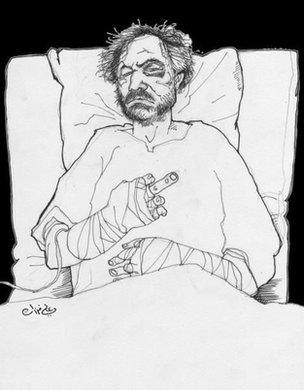
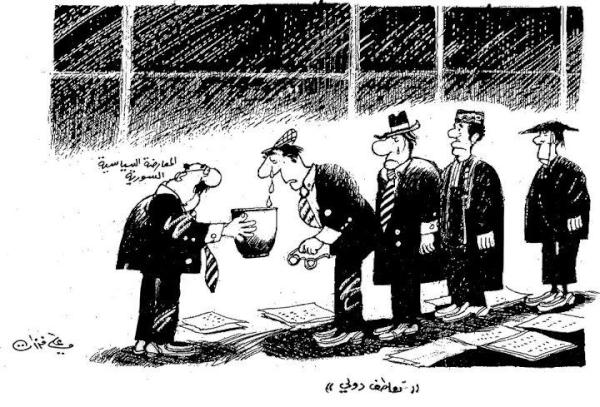
Image result for ali ferzat finger

Image result for syrian banksy hope

Sunday, 31 December 2017

One Year Later, Residents Mourn the Fall of Aleppo


 ' “The moments we are living now in Aleppo could be the last moments of our lives,” Ameer al-Halabi wrote in a Messenger conversation last December. “Regime forces are a few meters from here: We could be killed or imprisoned once they enter, especially us … because we are journalists.”

 Halabi, whose real name is Walid Mashhadi but still uses his pseudonym professionally, is still alive. He was only 25 when he left his city to survive the Syrian regime. He lives in Turkey now, while his family, his wife and son, remained in Aleppo. But they will soon reunite in France. Halabi will travel there in January 2018, and his wife and son will join him the same day from Aleppo via Beirut.

 "I was studying engineering when the revolution started. I began going to the demonstrations against the [Bashar] al-Assad regime. Then, we the protesters soon understood it was important to work in the media. For example, I dropped out of university and worked for a local radio station, Radio Hara, and for the Aleppo Media Center in 2012 and 2013."

 Halabi also worked for international media and humanitarian organizations such as the Qatar Red Crescent. “My wife is still in eastern Aleppo and many checkpoints surround the area. They know she is my wife and so she doesn’t go out too much.”

 While Halabi made it out, many friends from Aleppo — everyday citizens, journalists or activists working for the Aleppo City Council — are now in Assad’s prisons and it is difficult to know exactly where they are. “When people were evacuated to the western part of the city, they let them go and stay safe for a while. After a few weeks, the intelligence services went to arrest them. They knew all the people they wanted,” Halabi added.


 Another journalist, Salah al-Ashkar, sent a goodbye message from Aleppo last year, too, but he is now safe in France thanks to the French organization Reporters Without Borders. Ashkar confirmed to Al-Monitor the same account of Aleppo’s citizens, saying, “An activist of the Aleppo City Council, Mohammed Hayyo, was arrested after the regime retook the city a year ago, and nobody knows his fate.”

 Ashkar, 29, first worked for Agence France-Presse and then Al Jazeera during the battle for Aleppo as a freelance photojournalist.

 "Many of my childhood friends unfollowed or unfriended me from Twitter or Facebook, and I can imagine why: They are afraid that at any checkpoint a soldier could find my name on their social media accounts and arrest them. I know they are living in fear like before 2011 — and even worse, because Russian police are also there."

 Ashkar is now learning French and would like to study journalism in France. He graduated in 2011 from the University of Aleppo in banking and finance.


 Today, 75% of the city’s eastern neighborhoods are destroyed, including houses and public service facilities. But Halabi — the 2016 second-prize Spot News World Press winner with his series “Rescued from the Rubble” — says in the video “Eyes of Aleppo”, “The city is less destroyed than its people are.”

 The short video briefly explains the story of Halabi and two other photographers, Fouad Hallak and Zakaria Abdelkafi, who documented the war in Aleppo: Abdelkafi lost his right eye in an explosion, but he continued to work as a photographer and is now living in France.

 “Before the revolution I was a normal student; I was going to school like everyone else, I used to have my favorite song, I used to dream,” Halabi told Al-Monitor. “I photographed Aleppo for 3½ years, concentrating my attention on children, especially those rescued after bombs. My work has been influenced by the picture of the naked child running and crying during the war in Vietnam.” Halabi’s father volunteered with the White Helmets and died in one of the explosions.


 During the offensive when the Syrian army retook the city, many Aleppans were evacuated to the western part and others to the rebel-held Idlib countryside, where some still live, while others fled to Turkey, crossing the border illegally. Many citizens went back home, but their exact number is unknown.

 A year after the last fight and wave of displacement, the Assad government tried to restore the city’s image with sport or cultural initiatives. But among those Aleppans who came back, many could not bear the destruction and poor conditions and left again for Turkey, where many Syrians rebuilt their businesses or created new ones.

 Aleppo’s last year of death and starvation is East Ghouta’s current reality, with people struggling to survive and evacuation plans for medical emergency cases still being formed. The regime and its allies have been talking in the past few months about reconstruction, which the opposition considers the latest of Assad’s war crimes since its clear purpose will also be to erase proof of the regime’s crimes.

 Syria is still far from living in justice and peace. Many of the Aleppans who survived last December’s brutal offensive are still trying to find their way in their countries of refuge. Ashkar said:

 "If the regime one day falls, I will go back to Syria. We tried to build some democratic institutions, but with the extremist rebels and the dire conditions of fighting and siege, we couldn’t. My homeland is Aleppo. I miss every single tiny detail. My country is my city, Aleppo. But I would like to live in a country where every four years a different president is elected." '

Thursday, 28 December 2017

Really bad situation for the people in Southern Idlib

 Green/Blue - Rebels
 Red - Assad
 Black - ISIS
 Yellow - YPG

 'Really bad situation for the people in Southern Idlib. Pro-Assad forces are advancing fast northwards. 100s of airstrikes on civilians and rebels today so far.'


 River Orontes: "The battle for Hama and Idlib isn't about a tiny village taken or two, it is about breaking the regimes will, inflicting on them heavy losses so that their offensive halts. Difficult to stop the regime advances because they are using the scorched earth policy, but if the price for one small village is dozens of dead the régime doesn't have the manpower to recapture all of Idlib. Today the regime took Musharifah, and in the process lost over 60+ killed and dozens of wounded. The 60+ death are confirmed via official outlets. The régime groupings ran into several IED locations that HTS set up when retreating from Musharifah. They also fell into several ambushes trying to capture Abu Dali. To fully break the regimes offensive another front needs to be open but the opposition groups in ES areas and Southern Front are totally useless."
[https://twitter.com/river_orontes9/status/946417750464966656]


 Note 23/7/15, links broken.

Wednesday, 27 December 2017

Syrian armed opposition protects Christians for holiday


 'Southern Syria’s Christian community is celebrating the Christmas holiday amid tight security provided by armed opposition fighters.

 In opposition-held parts of the southern Al-Suwayda province, scores of Christians took part in church services in the majority-Christian town of Harb.

 Holidaymakers also visited their relatives and decked their homes, gardens and streets with colorful Christmas lights.

 Armed opposition fighters, meanwhile, have imposed strict security measures, stationing guards around the church with a view to preempting possible attacks.


 Residents expressed satisfaction with security provided by opposition groups.

 According to town resident George Bishara, Harb serves as an example of peaceful coexistence between the country’s Muslims and Christians.

 "There are no problems between us,” Bishara told Anadolu Agency. “Both communities respect each other's holidays.”

 Abu Saddam, a commander of the opposition Free Syrian Army (FSA), confirmed that FSA fighters were protecting the region’s Christian communities.

 "We are responsible for protecting Christian lives,” he said, “Contrary to the Assad regime’s claims, the FSA isn’t the enemy of the Christians.”


 Syria has only just begun to emerge from a destructive civil war that began in 2011, when the Assad regime cracked down on pro-democracy protests with unexpected ferocity.

 Since then, hundreds of thousands of people have been killed in the fighting and more than 10 million displaced, according to claims by UN officials.'

Tuesday, 26 December 2017

Syrian torture survivors speak out


 ' “My wrists were bound together with iron chains,” said the man who calls himself Abu Firas. “They put me onto an iron bar under the ceiling so that my feet were two centimetres above the floor.”

 “They hung me on my hands from the ceiling,” Abdul Karim Rihawi told Euronews.“They beat me with an iron stick.”

 “My finger felt like it was the size of a football,” said Yazan Awad. “I felt my arms were very long because my shoulders became dislocated (by this torture). I looked and saw my arms far away. “


 Sometimes, when emotions run high, Nahla Osman takes her clients for a walk alongside the river Main. Osman was born in Germany to parents from the Syrian city of Aleppo. She helps victims of torture. She and her brother run a law firm in the German city of Rüsselsheim.

 She has compiled hundreds of witness reports detailing torture on a massive scale inside Syrian prisons and will file criminal complaints using the principle of universal jurisdiction which Germany enforces.

 “Many are still waiting for family reunification,” Osman told Euronews. “If family members are still in Syria, those in Germany are afraid of taking legal action. If they trigger a case here, the Syrian regime would imprison or kill their relatives.”


 Euronews reporter Hans Von Der Brelie met two people who say they survived Syrian prison torture: co-founder of the Syrian Human Rights League Abdul Karim Rihawi, and a civil rights activist from Damascus, who didn’t want to be named. He calls himself “Abu Firas” and is speaking out for the first time.

 “They had an electric instrument and they put electric cables under my toes, under my arms and on my thumbs,” Abu Firas described. “You still can see traces from that procedure on my thumbs. Then they turned the current on and off, on and off, again and again.”

 Abu Firas wants to submit his case to the German public prosecutor and wants arrest warrants to be issued for high-ranking Syrian officials.

 “They tortured me with the car-tyre method, squeezing my body with bent arms into the tyre up to the knees so I could not move,” he alleges. “They hit me with a piece from a tank engine, a kind of a V-belt… After the first two blows, my body felt paralysed. I just hoped to see the son my wife was pregnant with.”

 “Reconciliation with all the sectarian groups in Syria is possible, yes, but not with this criminal regime,” Firas said.


 Abu’s friend Abdul Karim Rihawi invited Euronews to the hotel room he’s called home for more than two years. This is where he has been gathering evidence with his civil human rights network, which is still working undercover in Syria. Euronews asked if the photos shown during our visit included people who had tortured, he replied: “A lot of them, many of them: torturing… a lot of crime… they committed a lot of crime… For that reason, we are asking the German authorities to take action again.

 “We make a list of these murderers. Until now we have six lists, we presented this lists to the German government… There are at least 7,000 war criminals (from Syria) in Europe but the highest number of them (are residing) in Germany, especially they arrived after the massive arrival of refugees in 2015.

 “That’s also what makes me very angry: they are enjoying their life here in Germany and they have all the benefit from the law and they are war criminal.”

 The war crime unit at the German Federal Office of Criminal Investigation told Euronews that they have 4,300 reports from Syrian and Iraqi survivors, resulting in 43 person-related investigations. But it’s difficult to collect hard evidence.

 “Torture in Syria is very normal, very systemic,” said Abdul Karim Rihawi, co-founder of the Syrian Human Rights League. “It is an abnormal thing if you go to the prison and nobody tortures you… They beat me with cables, with their hands, with their legs… When they get us to the toilet we had to pass through the dead bodies on the ground. Oh my God, that was really terrible…All the night you still hear the voices of the people begging or yelling or shouting from torture… I was hearing the voice of a child: maybe he was 14 or 16 years old, he was seeking for his father: ‘please – I need my Bab (daddy), my Bab’.”


 Syrian artist Hamid Sulaiman invited Euronews to his Berlin studio. He too is familiar with Syrian prisons from the inside. After his release, he was granted asylum in Paris. Today he lives between Germany and France. Sulaiman is the author of “Freedom Hospital”, a graphic novel about the start of the civil protests in Syria, in 2011. His book is dedicated to a former friend, Hussam, who was allegedly tortured to death.

 “We were with each other at the start of the Arab Spring,” Sulaiman said. “We shared the dream of freedom in a better country. Me, I left Syria, and Hussam was getting ready to leave Syria when he was arrested … and he was killed in prison. Five days later, they called his mother to come and get his body.

 “I am a survivor, the others are dead. I have a duty to tell their story.

 “I gave a lot of thought about how to present the violence in this book, because there are quite a few people who will say: you did not have to talk about the blood and violence to talk about Syria .. but at the same time I said to myself: that’s the reality.”


 Next, we headed to an organisation tracking war criminals around the globe: the European Center for Constitutional and Human Rights where we met prominent Syrian human rights lawyer Anwar al-Bunni, and Syrian civil rights activist Yazan Awad, both torture survivors.

 Hamid Sulaiman’s artwork is displayed at the centre. Anwar and Yazan have filed criminal complaints with the German Federal Prosecutor through their legal advisor Alexandra Lily. They want to hunt down those who gave the orders.

 Lily spoke to us about the next step in the case:

 “Following these person-specific investigations we hope for arrest warrants issued by the Federal Supreme Court in Germany and following those German arrest warrants we hope for a European wide and international arrest warrants against those individuals.”

 “Personally, I met the head of (the Syrian) National Security Office and told him about the torture”, said Anwar. “He knows that… because I was in detention, in his detention,” said Anwar.


 The next person we met during our investigation, Yazan, is listed by the German federal prosecutor as ‘key witness number 24’. Yazan had organised youth protests during the ‘Arab Spring’. In November 2011 he was arrested and says he was tortured so badly, that he confessed to crimes he never committed – such as having killed the prime minister of Lebanon.

 “I told the torturer: I will confess to everything, I will even testify against my own mother,” said Yazan. “He replied: we will bring her and we will see. He went and after 15 or 30 minutes he told me: we brought your mother, but I knew he was lying. I started to cry: I said, what, my mother, where is my mother? And he punched me in the face. The torturer said: okay you will see what we will do with your mother – but I was blindfolded. The psychological pressure on me was huge – I collapsed because they abused an innocent women. I did not know her, maybe she was just one of the prisoners in Jaweyeh. They brought her, she was inside the room and it was obvious that two people were torturing or raping her because I recognised several voices. I collapsed… I told the torturer: I admit to whatever you want but stop torturing her, stop raping her. He told me: The guys have not finished with her yet.

 “They had been torturing the other prisoners before, but all five or six of them came to me and tortured me together. They tortured me, tortured me… From my point of view, I thought I was already dead. From their point of view, they pretended that I am a man attacking them. But how can a man forced to strip attack his torturers? They said to me: You think you are a man? We will show you that you are a woman. They continued beating me and the torturer who was using the butt of the gun for hitting me, suddenly turned the gun around and put the barrel into my body from behind and then he ripped it out again. When he took it out, the iron sights on the gun barrel destroyed the anus.”


 The International Criminal Court in the Hague could not take action against Syrian officials because Russia and China used their veto. But Germany and about a dozen other countries have implemented the principle of universal jurisdiction and started investigations on a national level.

 “First message we want to send it to the murderers and criminals in Syria and in whole the world in fact: impunity time is finished,” said Anwar. “Impunity is not allowed anytime, anywhere. Be careful! And: Justice is waiting for you! Without justice, there is no Syria. No country in the whole world can (be) built without justice.”

 Al-Bunni has some top-level appointments in Brussels, with the European Commission and the Belgian government. He wants to convince more EU member states to use the tool of “universal jurisdiction” too: No safe harbour for torturers, anywhere.'

Syrian rebel groups reject Sochi conference

Image result for Syrian rebel groups reject Russian-sponsored Sochi conference 

 'Syrian rebel groups on Monday rejected Russia’s planned Sochi conference on Syria, saying Moscow was seeking to bypass a U.N.-based Geneva peace process and blaming Russia for committing war crimes in the war-torn country.

 In a statement by around 40 rebel groups who include some of the military factions who participated in earlier rounds of Geneva peace talks, they said Moscow had not put pressure on the Syrian government to reach a political settlement.

 “Russia has not contributed one step to easing the suffering of Syrians and has not pressured the regime that it claims it is a guarantor by move in any real path towards a solution,” the rebel statement said.

 Russia, which has emerged as the dominant player in Syria after a major military intervention over two years ago, received backing from Turkey and Iran for holding a Syrian national dialogue congress in the Russian city of Sochi on Jan. 29-30.

 “Russia is an aggressor country that has committed war crimes against Syrians... It stood with the regime militarily and defended its politically and over seven years preventing U.N. condemnation of (Syrian President Bashar) Assad’s regime,” the statement said.

 Moscow says it targets militants but rebels and residents say the Russian air strikes conducted since a major aerial campaign over two years ago has caused hundreds of civilian casualties in indiscriminate bombing of civilian areas away from the frontline.'


 River Orontes: "If you reject the Russian conferences, reject them not through statements, but aid the frontlines, lessen the pressure on Beit Jinn and besieged areas, do so both militarily and politically. As for these meaningless statements, they are exactly that, meaningless."
[https://web.archive.org/web/20171225212743/https://twitter.com/river_orontes9/]

Sunday, 24 December 2017

U.S.-Backed MOM Ops Room Ends Support for FSA


 'America and the "Friends of Syria" countries will end their military and financial support for Free Syrian Army groups at the end of the month, Syrian rebel sources have confirmed.

 The sources said that all the groups who benefit from this support had been informed of the decision that December would be the last month that fighters of these groups would receive their salaries.

 The military operations and support coordination room, known by the acronym MOM, has overseen support and supplying of “moderate groups” with money, ammunition, training and some weapons since 2014.

 A commander in the First Coastal Division, who asked not to be named, said: “The groups were informed around three months ago that the support would end without a reason being given.”

 He added that there were a number of factors that contributed to this, including “a change in American policy and its concession to Russia on the Syrian issue, the changing of the situation on the ground, and the decline of most groups in favor of Hay’at Tahrir al-Sham.”

 Responding to the possibility of there being a link between this decision and the developments in the international negotiations, the military commander said it was too early to talk about a real solution on the ground as long as President Bashar al-Assad did not comply with international resolutions.

 “The United States has not been honest for one day in giving sufficient support to the opposition groups as they did with the Kurdish People’s Protection Units, because Assad was not one of their priorities,” he added.


 For his part, the military commander of the Jaish al-Azza rebel group, Mustafa Marati, told Sada al-Sham that “MOM stopped support for Al-Azza four months ago because of accusations it was fighting against the Assad regime.”

 Marati added that one of the most important factors for stopping the support was “the desire of the backers to stop fighting against regime forces and not to respond to its violations.”

 A defected officer from the regime forces, Mohamad Khalil, said that the groups had achieved important victories before the start of the MOM operations, and at the time the fighters had “secured their salaries from the spoils of fighting.” He added that despite the negative impact of the decision today, it “liberates the groups from all the pressures they had endured and frees them from all burdens.”

 Khalil said that the United States, through this support, had “played a negative role toward the revolution, given its many interventions in affairs on the ground and forbidding the groups from obtaining effective weapons, especially anti-aircraft weapons.”

 Khalil did not rule out that this decision could be temporary to pressure the groups to accept new concessions on the ground, including allying with Assad’s forces to fight Hay’at Tahrir al-Sham, which is something all the groups reject.'

Friday, 22 December 2017

Freedom for Syria


  ' “The withdrawal of Assad has ceased to be a priority” – is repeated in the European as well as International Summits.Some like Emmanuel Macron even dare to specify that they do not deny Assad’s crimes against humanity and that maybe one day they’ll demand accountability for those crimes. In this terrible moment when democracies define that a bloodthirsty dictator is unavoidable, we are not only walking on the graves of those who have been killed by the tormentor – but the words and actions of those politicians burry alive the revolutionaries.

 Because the revolution is not dead. It rather is the prisoner of dictatorship. One year after the massacres in Aleppo, the revolutionaries are not only in the areas occupied and bombed by the regime but also in Assad’s torture centers. They are tens of thousands, as dozens of reports, irrefutable evidences and witness reports, testify. What started as a fight in the streets finds its continuation in those horror factories where they make the attempt to break humanity. Those torture centers are not only places of physical and mental destruction of the revolutionaries being held as prisoners but also a weapon of the regime to prevent new possible acts of resistance.

 You do not necessarily enter those centers through an official arrest: Numerous journalists, writers, activists, demonstrators just “vanish” and the regime won’t give the slightest information on their subject. Often also relatives disappear when they try to get some news. Assad’s order of the day: the one who dares to remember there’s a revolution needs to suffer.

 None of our leaders dares to say: “Keeping Assad in power is a necessity as is keeping his torture centers”. However, not demanding the dictator to stand down is supporting his crimes in this exact moment. The matter is not peace by negotiation, because the imprisoned revolutionaries are not given the possibility for negotiation. By watching Assad kill, we are not defending peace. We rather let him win the war by extinguishing his political opponents. By being silent about that systematic extinction we approve this enterprise of horror as well as its dehumanization which we name “disappearance”. Of course, we cannot forget the revolutionaries held prisoners by the other enemies of the Syrian revolution as ISIS or Jaish al-Islam and we also claim their freedom.

 The revolution has not disappeared. Our companions haven’t disappeared. They fight against their total extermination in Assad’s torture centers. Even if we do not know exactly where they are. But Assad does. As does Putin. As does Macron. As does the European Union.

 As it seems that Realpolitik and human rights get quite along with each other - that the democratic values are never better defended then by tolerating despots – we came to ask one very simple and realistic thing of our leaders: We want to deliver our solidarity messages to our companions and we do not except to spend another year without them. The freedom of the dictator is not a problem for democracy? So why the freedom of ours should be?'

Friday, 15 December 2017

Comrade Corbyn supports Russian imperialism in Syria


 Sam Charles Hamad:

 "Under the heavy blizzard of issues surrounding the Brexit negotiations engulfing the UK over the past few weeks, Jeremy Corbyn's Labour Party has endorsed what is surely its most brazen policy of outright support for 'President Assad'.

 'President Assad' - this is precisely how Labour Shadow Foreign Secretary Emily Thornberry refers to the unelected tyrant of a rump state, responsible for murder, torture, rape and ethnic cleansing on a genocidal scale.

 Thornberry was addressing and, to some extent, lambasting British Foreign Secretary Boris Johnson for the UK's refusal to throw its weight behind the Astana 'peace process', which is largely seen as a fig leaf for Russian and Iranian hegemony over Syria.

 The UK government supports the UN-mediated, Syrian opposition-supported Geneva process, which, however imperfect, keeps up the demand that Assad must leave power.


 What ought to concern those who understand the pro-Assad political context of Astana isn't that the Labour Party, which has a very good chance of forming the next government, is blindly endorsing Astana as a means of mere party-political contrarianism, but that it too fully understands the political context.

 In her statement to Johnson, Thornberry asked very clearly - is the UK willing to accept a deal that would see Iranian militias leave the country and allow 'President Assad' to remain in power?

 Moreover, is the UK willing to accept the full withdrawal of 'all coalition forces', and international aid for Assad to 'reconstruct' the country?


 Only a week or so before Thornberry's public questions, the BBC's Panorama put out a documentary with the sensationalist, Islamophobic dog-whistling, gutter tabloid title 'The Jihadis You Pay For'.

 The programme made the dubious case that UK funding for the Free Syrian Police (FSP) - a voluntary organisation that provides unarmed security for civilians in Syria who live in liberated areas of the country - was somehow falling into the hands of the eponymous jihadists, including the al-Qaeda affiliate, the Nusra Front.

 Simultaneous with their campaigns of genocidal terror against any aspect of Free Syria, it has long been the tactic of the Assad regime, Iran and Russia - often through formal and informal propagandists on their behalf - to perpetuate narratives that de-legitimise the pillars and institutions of the revolution.


 We saw the same with the attacks against the White Helmets, including almost identical claims that they were aiding or were themselves 'jihadists'.

 These groups are targeted precisely because they are not what their detractors claim, but rather because they show the world that Syrians exist beyond the Islamophobic stereotypes of menacing, destructive 'jihadists' and Assad's absurd but effective propaganda paradigm of 'jihadi chaos' vs 'secular tyrannical order'.

 While the propaganda campaign to delegitimise the White Helmets was unsuccessful, it was not the case for the FSP.

 Despite extensive denials from the British charity that runs the aid project, as well as from the groups that run the Free Syrian Police, in addition to a catalogue of evidence that contradicts Panorama's claims, the British government caved to the sensationalism and resulting political pressure and suspended aid to the FSP.

 Corbyn's Labour led the charge, with the leader himself reproducing all the usual pro-Assad tropes, saying that UK aid destined for an Al Qaeda affiliate was "yet another blow to Britain's reputation" on the world stage.

 He also went on to connect the humanitarian crisis in Syria and the millions of Syrian refugees and internally displaced with the British government's alleged will to "support sectarian division rather than humanitarian need".

 This is how Corbyn describes an unarmed force of volunteers set up to provide security to Syrians who live free of Assad - as 'sectarians'. Combined with his Shadow Foreign Secretary's comments pressuring the British government to monetarily support 'President Assad', one need not be an expert on Syria to understand what exactly Corbyn's policy is here.


 Somehow, by some gross, obscure distortion, supporting groups like the FSP is 'sectarian' and has led to the humanitarian and refugee crisis in Syria (not once has Corbyn condemned what's happening in Ghouta or any Assad-Iran-Russia besieged area of Syria), but apparently aiding 'President Assad' is not.

 And only the most deluded or vicious propagandists for Assad's war can claim to be ignorant when knowing exactly what it the logistics are behind Labour's will to see 'President Assad to remain in power'.

 For those who are genuinely unsure, it means what we witnessed when pro-Assad forces destroyed, captured and ethnically cleansed Free Aleppo last year. Or when they did the exact same in Homs, or what they're trying to do so viciously right now in East Ghouta.

 It means precisely what Assad and Iran's war effort has been since 2012, not to return Syria to the status quo ante bellum, but to ethnically cleanse areas of Syria that had been previously liberated by the rebels or that had non-compliant, pro-revolutionary civilian populations. Corbyn will never mention it, but this is the real reason for the vast refugee crisis.

 Indeed, Corbyn cares about none of these realities; instead, he opts for endorsing the crude propaganda shared by Iran, Russia and the Syrian regime.


 Labour says that 'President Assad' can remain in power in exchange for 'Iranian militias' leaving the country, but the fundamental duplicity that lurks behind this superficially reasonable demand is that Assad can only remain in power with the backing of these Iranian militias.

 In other words, despite dangling the carrot of peace by referencing the Russian-dominated Astana process and talking about bringing the war to an end, Labour are simply outlining a position that better enables Assad to smash the Syrian revolution with the stick of genocidal, imperialist war and tyrannical revanchism.

 As Assad's vicious apparatuses of tyranny were already moving in and doing what they do best - raping, murdering, torturing and cleansing civilians, something that has continued with brutal consistency - Corbyn was defending The Morning Star, for whom he occaionally writes, for describing this as a 'liberation'.

 As Russia and Assad's air forces bombed the city into oblivion, his Shadow Foreign Secretary Emily Thornberry was on TV advertising the ethnic cleansing of Homs as a solution to the crisis of Aleppo and blaming the brutal bombardment on the alleged presence of '900 Jihadis'.

 This is the 'peace' Labour speak of when they attach it to the triumph of 'President Assad'.


 When Labour speak so recklessly of 'reconstruction' through international aid, again attached to the triumph of Assad, they conceal the fact, to quote the academic and Syria expert Jean-Pierre Filiu in an interview with Al-Jumhuriya, that "for Assad, 'reconstruction' is the continuation of its merciless war against its own people… using other means."

 Filiu makes the further point that 'reconstruction' for Assad is completely determined by Russian and Iranian imperialism, with firms from both countries exploiting the destruction they caused.

 This is a crucial point. Labour, by completely ignoring Geneva and supporting Russia's Astana process, are simply endorsing Russian imperial hegemony over Syria. As with the elements of the US' goals in Iraq, the Russian endgame in Syria has been to aid in the destruction of the country and then serve as the imperialist arbiter for its 'reconstruction'.

 As with the US and Iraqi oil contracts, Russia will be the main force handing out contracts for all areas of reconstruction, to its allies in China, Europe and possibly even South America. It will have a major geopolitical and economic foothold in the Middle East, far beyond some neglected naval bases. In this sense, it is classic imperialism.

 And this is precisely what Corbyn's Labour support and it's no surprise, given Corbyn's own ideological trajectory on this question.

 This is after all a man who was chair of the at-times openly pro-Assad Stop the War Coalition, as well as someone who used his position as a backbench MP to oppose all and any kind of aid to Syrian revolutionary forces.

 This is a man who only mentioned Assad's gassing to death of Syrians at Khan Sheikhoun to oppose the US airstrike on the base from which the gas was launched. And even then, he maliciously cast doubt on whether Assad was the perpetrator.


 Corbyn and his key allies have served as informal lobbyists for both Iran and Russia. In every area where Russian imperialism exists, it has found an ally in Corbyn and members of his leadership team.

 In this respect, Labour's policy makes depressing sense.

 Corbyn's politics are determined by an amalgamation of Labourism and Stalinism - he views Russian imperialism, and all forces deemed to be opposed to US imperialism, as worthy of support.

 It's no surprise that the party he leads supports defunding and delegitimising those groups that resist Assad's tyranny, and seeks to aid the forces that are smashing Free Syria and ruthlessly exploiting the ocean of misery and blood they have created."

Tuesday, 12 December 2017

Regime and ISIS aren't fighting each other


 'Hama : Regime and ISIS aren't fighting each other but are attacking the Opposition instead. Red arrows are Regime black ones are ISIS.'

'I married in a Syrian prison - then he disappeared'


 'It is March 2012 in Damascus. Noura Ghazi Safadi is waiting for her fiancé, Bassel, 34, to come home. They are about to book party arrangements for their wedding, in two weeks’ time. But he does not arrive.

 “It was a sign that he had been arrested. This is normal in Syria. I cannot describe how much I suffered. It was painful,” says the Syrian human rights lawyer, now 36.

 Bassel Khartabil Safadi had been arrested by the Syrian regime of Bashar al-Assad, whose prisons are notorious for torture and execution, but have been largely forgotten throughout the seven-year long conflict.

 Noura's husband was taken in what she describes as a "kidnap" style arrest. "There are no reasons for detentions in Syria. There are... no arrest warrants, nothing to tell families or to that person that they were [going] to arrest him, why they arrest him and where, [or] who they are," she says.

 "I cannot describe how much I suffered. It was painful. I was just thinking about the wedding. It was one of the most painful and difficult periods in my life."


 Noura eventually learnt that Bassel had been detained in Adra prison, a notorious institution, north of the Syrian capital. In the first week of 2013, they eventually married on one of her brief visits to see him.

 "It was perfect. I wore a blue dress because Bassel asked me to," Noura remembers.

 The wedding took place over two prison visits: the first time, Noura and Bassel exchanged vows, between the metal bars that separated them, in whispers, so the prison guards would not notice. "My parents and his parents were with me, and he was behind bars. So we just exchanged the marriage speech," she explains.

 On the second visit, Noura was accompanied by her uncle, a lawyer, and the marriage was officially approved.

 “It was amazing. I did it in prison. Can you imagine? I challenged all the circumstances, all the bars, all the guards and everything and I married Bassel,” Noura says.


 But, little more than two years later, her husband disappeared. Noura’s face falls, as she recalls the last time she set eyes on him.

 “I saw him for my birthday in September 2015. Three days after this visit he called me to tell me ‘they came to take me’. But I don’t know who.”

 Bassel, a software programmer for international companies such as Creative Commons and Firefox, was taken to a military field court and charged with being a threat to state security, a common accusation thrown at anyone who opposes Assad’s dictatorship.

 He was executed shortly after, although Noura had not been able to confirm his death until this August.

 She “collapsed” for a month, as she describes it, matter-of-factly. She still does not know what has happened to her husband’s remains.


 The UN has described “inhuman living conditions” in Syria's detention facilities, where the international body believes the crimes against humanity of “extermination, murder, rape or other forms of sexual violence, torture, imprisonment, enforced disappearance and other inhuman acts” have taken place.

 Last year, Amnesty International said that Syrian authorities were committing torture on a "massive scale" in government prisons including beatings, electric shocks, rape and psychological abuse that amount to crimes against humanity.

 Noura refuses to let Bassel’s death crush her. If anything, it propels her forward. “My aim now is to try to prevent any detainee in Syria having Bassel’s fate”, she explains. “I don’t just sit and wish. I do.”

 She is part of Families for Freedom, established this year as the first female-led advocacy group for Syrian detainees and their relatives. With most of the 85,000 people currently disappeared in the country male, it is women who bear the burden of their absence.

 They have campaigned in European cities, including Geneva - a base for Syria peace negotiations - and last month visited London. The trip saw them take a red London bus to Parliament Square, covered in photographs of those people missing in Syrian prisons. In place of display adverts, it read: “Freedom for the detainees”.


 But the agony of losing their loved ones is not the only challenge facing these women - ordinary teachers, mothers and university graduates - some of whom had previously been detained themselves.

 Making their voices heard in a male-dominated society is a daily struggle. The fight to make women’s voices heard is, says Families for Freedom member Amina Kholani, “a revolution against tyranny and against tradition.” A history graduate and mother of three, Kholani herself spent six months detained in a Syrian government jail with her husband before becoming an activist.

 “Women who make their voices heard are very few. We live in an eastern society - it looks like the society in the Middle Ages in Europe, where [women don’t] have that much encouragement or ability to speak”, she told a meeting at the Houses of Parliament, hosted by Baroness Hodgson of Abinger, co-chair of the All-Party Parliamentary Group on Women, Peace and Security. “We have to break the tradition and talk about it.”

 A few weeks later, Amina discovered that her brother Mohammed, arrested in 2013, had died in detention.

 With news of deaths announced all too frequently, Families for Freedom wants the British government to work with other European countries to pressure the Syrian regime and its ally Russia to allow international human rights monitors unfettered access to detention facilities, and to allow aid organisations in to provide medicine and food.


 There are powerful, immediate reasons why the UK should care about the issues of disappearance and detention. “We know that this migrant surge has affected the UK and Europe more broadly”, says James Sadri, director at The Syria Campaign, a human rights group that supported Families for Freedom during the UK visit.

 “The vast majority of these refugees want to go home, but we know that they will not return to Syria until they know they can do that safely. This requires an end to the conflict and an end to the programme of mass detention carried out primarily by the Assad regime.”

 “We want to talk with all the governments who are involved,” says Noura. “Especially in Syrian human rights.” '

The couple at their engagement party in October 2011

Monday, 11 December 2017

Stories Of Syria's Uprising, And Its Backyard Funerals


 'Tania El Khoury splits her time between London and Beirut, where she helped found an artists' collective. Three years ago, moved by stories she was hearing about the Syrian uprising, she created an interactive work called "Gardens Speak." It grew out of an image she saw of a mother digging a grave for her son in her home garden because public funerals had become too dangerous.

 "I didn't know that this was happening," El Khoury says. "And I started to collect these stories and interviews. And this is when I had the idea that gardens can now speak all of these stories that [have] been buried in them."

 One grave tells the story of a man identified as Abdel Wahid. He tells visitors — lying down with their heads close to his tombstone — that after taking part in protests against President Bashar Assad's regime, he was detained and tortured. When he was released, he joined the resistance.

 "I don't know how," his testimony reads. "But I don't care about anything other than taking part in the revolution.

 "The army had intensified its attack. I ran quickly. I was in such a hurry that I wore my T-shirt backwards. I carried my rifle. And then before I could use it, I was shot 10 times from afar."


 "Gardens Speak" was first mounted in Lebanon in 2014 — in Arabic. Since then, it's been translated to English, French and Italian, and traveled widely. It opened in Miami Beach two days after the Supreme Court allowed the Trump administration's ban on travel from six predominantly Muslim countries to go forward.

 That gives new perspective to stories like those of Abdel Wahid, whose family buried him quietly, out of sight in their home garden.

 "They put me under the pomegranate tree my mother planted for me," his testimony reads. "There were no other noises than the sound of shelling and soil falling on me, bit by bit." '

Saturday, 9 December 2017

Demonstrators of Liberated areas reject Trump's decision

 'Mass demonstrations broke out in several liberated areas of north and south Syria on Thursday, rejecting the decision of US President "Donald Trump" on the recognition of Jerusalem as the capital of Israel and the transfer of the US Embassy to the Arabic city.

 The demonstrations took place in the town of Azaz and Mare' in the northern countryside of Aleppo, in addition to organizing a solidarity stand with Jerusalem in the town of Ma'rat al-Nu'man in the governorate of Idlib.

 Hundreds of children with the teaching staff at the Hamuriya school in the besieged eastern Ghouta carried out a protest against the Trump decision and solidarity with the Palestinians.

 "The Syrian activists and the Palestinian Authority of Syria called for demonstrations and attended by the people of the area in addition to the Palestinian refugees," one of the organizers of the demonstration in the city of Azaz said.

 It is noteworthy that hundreds of demonstrations rejecting Trump's decision came out in many Arab and Islamic countries while the Assad regime-held areas have seen nothing to protest such great incident.'


 Note 22/7/25, link broken.

The revolution is alive, but buried under rubble


 'The Syrian revolution is “still there, but it is buried under all this rubble”, the writer Yassin al-Haj Saleh told a London audience on Tuesday.

 The situation facing Syrian civil society was formed in layers, Saleh said.

 The first layer was the first two years of the revolution (2011-13), when there was an explosion of collective community action against Bashar al-Assad’s regime.

 The second layer was the struggle of regional powers including Saudi Arabia, Qatar and Turkey who feared the spread of popular rebellion.

 The third layer was the intervention in Syria of American and Russian forces in 2014.


 The world had stood by when the Assad regime launched a chemical attack on civilians at Ghouta in 2013: after that, Syrians had felt “isolated and betrayed”, Saleh said.

 Those who had participated in the revolution were “exhausted”, he continued. A quarter of the population had been displaced, many of whom were now living outside the country.

 The regime was being restored, with the support of the international powers, but none of the economic and social problems that caused the 2011 uprising had been solved. Even Syrians who were not opposed to the regime wanted their lives to change for the better, and no such change is likely.

 Outside Syria, Saleh said, groups of activists are working in the field of culture, and on human rights issues.

 “We are still in struggle. We are not pessimists”, he said.


 Saleh was speaking over skype to a meeting on Tuesday organised by the Syrian Society of students at the School of Oriental and African Studies. He is a long-standing radical political activist, a political prisoner under the Assad regime (1980-1996) and the author of The Impossible Revolution, published this year in English.

 Saleh argued that the Syrian revolution faced three “monsters”: the Assad regime (“fascists in neckties”), the Salafist militia (“fascists with beards”) and the “world order” headed by the USA and Russia.

 Saleh responded passionately to a question about whether any of the sides could be regarded as a “lesser evil”.

 “It’s disgusting and unethical to talk about a ‘lesser evil’. It’s despicable that the great powers now base their Syrian policy on Bashar al-Assad, who has been responsible for 90% of the destruction and responsible for gassing his own people.”

 These evil actors on all sides had to be confronted. The Syrian people had resisted both the regime and the Islamists, “and we were betrayed”, he said.


 The meeting on Tuesday, addressed by Saleh and researcher Husam Al-Katlaby, was held to highlight the case of four Syrian community activists, victims of forced disappearance: Razan Zaitouneh, Wael Hammadeh, Samira Al-Khalil and Nazem Hammadi.

 The four were kidnapped in December 2013 from their workplace, the Violations Documentation Centre (VDC), in the city of Douma. There has been no news of their whereabouts since.

 The VDC monitors human rights violations committed by all actors in Syria. The four were all active participants in the revolution, and, before that, in struggles against the Assad regime.

 Razan Zaitouneh, a human rights lawyer, defended political prisoners in Syria since 2001. She helped establish the VDC and co-founded the Local Coordination Committees (LCCs), among other organisations.

 Samira Al-Khalil is a long-time political activist, and had been detained by the Syrian authorities as a result. She worked to help women in Douma support themselves by starting small income-generating projects.

 Wa’el Hamada was an active member of the VDC and a co-founder of the LCC network.

 Nazem Hammadi is a Syrian human rights lawyer and poet, who played a crucial role in providing humanitarian assistance to besieged civilians.


 In his opening talk to Tuesday’s meeting, Yassin al-Haj Saleh – who is the husband of Samira Al-Khalil and a good friend of the other Douma 4 activists – spoke from a personal standpoint about the effect of forced disappearances on the victims’ families.

 “Death dies – forced disappearance kills”, he said. While the effect of the loss of a loved one who has died gradually reduces over time, the suffering of the families of people who have been forcibly disappeared grows over time, he said.

 Researcher Husam Al-Katlaby, the chief executive of the VDC, also addressed Tuesday’s meeting. He said that, in total, the number of victims of forced disappearance in Syria is estimated at between 75,000 and 85,000.'

Tuesday, 5 December 2017

Siege versus prison in Assad’s Syria


 Osama Nassar:

 'Many are the cities and neighborhoods that have been besieged in the past, in Syria and around the world. A number of them remain so to this day. It’s not news to anyone that the Assad regime has used besiegement as one of its most effective weapons against areas outside its control, where ‘outside its control’ here refers only to the regime’s inability to physically detain the areas’ residents. The regime’s fire, of course, can still reach any area it likes, as can its fighter jets, and certainly its chemical weapons. It goes without saying, too, that the regime uses detention and torture till death against its opponents as yet more tools of subjugation brought back from bygone eras.

 The situation in Ghouta, however, is different. The siege here is not like the siege of Gaza, or Leningrad, or Vienna, or Qatar. And without wishing to belittle any suffering, past or present, inflicted on any of the world’s persecuted peoples, the word ‘siege’ seems insufficient to describe what is happening in East Ghouta.

 It is not merely a besieged neighborhood, but resembles instead a concentration camp; a giant lockup containing half a million humans. A concentration camp readied for genocide by gas or incineration. Ghouta, like other areas, has been struck with banned chemical gas multiple times, of which the worst—so far—was that of the summer of 2013. Near Ghouta, the regime created a crematorium inside Saydnaya prison, in which to burn those killed by torture, or starvation, or cold, or lack of medical treatment, or other, unconventional causes of death invented by minds whose creativity is confined to the production of death and ugliness.

 The siege is often compared to prison, and ex-prisoners often find benefits in the practical and psychological skills they learned in jail, dealing with the hardships of siege as people of experience. The reverse can also happen: that the prison experience increases their ordeal under siege, particularly when the jailor of yesterday is the same as the besieger of today.


 In prison, you are inside a (communal) cell. If the jailor brings you food—any food—you eat, and if he doesn’t, the hunger will contort you, perhaps to death. It might be that food comes, but medicine doesn’t, or medicine comes that’s of no use to your condition, or is expired. You don’t know when you’ll be released, or when your circumstances might improve, and you don’t know what you can do, or stop doing, to change your situation.

 You find yourself using gadgets it had never before occurred to you existed, let alone that you’d use them. You enter a world wondrous in its inventions and alternatives: alternative electricity and water networks; an alternative hospital; alternative medicine; alternative transport; alternative fuel; alternative power; alternative food; alternative agricultural soil; alternative residence; an alternative family; an alternative loaf of bread…

 The besieged dream of the opening of the road, in the way that the imprisoned dream of the emptying of the prisons or the issuance of an amnesty.

 The besieged live in terror of bombardment, while the perennial terror of the imprisoned is to be called for interrogation.


 Under siege, as in prison, the vocabulary narrows and is abridged, so that a group of mostly locally-hewn words and terms suffices, or a vocabulary that previously existed acquires new local meanings. Thus:

 Injured = Returned from interrogation

 Abducted = Was in our cell, and we don’t know what happened to him

 Sound of airstrike = The knocking of the iron bolt of the cell door

 Ceasefire = Outdoor time

 The siege vocabulary: firewood – piston – generators – 12 volts – shrapnel – al-manfush (a notoriously extortionate seller of dairy products in besieged Douma) – tunnel – airstrike – martyr – wannana (the buzzing sound of drones) – security official – humanitarian aid – under the rubble.

 The prison vocabulary: sufra (literally ‘dining table;’ but in this case a piece of cloth placed on the ground underneath food) – solitary – lice comb – kreeza (fit of craziness) – insubordination – Abu Haydar (stock name for prison guard) – bowl – jailor – shawish (an inmate who communicates with the guards on behalf of the others) – tasyeef (being unable, for space reasons, to sleep on one’s back, thus having to sleep on one’s side) – air vent – dulab (car tire, inside which prisoners are forced as a means of torture) – the interpretation of dreams.


 In prison, and in East Ghouta, you are not permitted to receive visits. Your family and loved ones are meters away from you, but many years may pass without you seeing them or them seeing you.

 If you’re a student, your classmates graduate from university, and might take up further studies, while you stay ruminating on your woes, and the memories of the months you spent with them on campus, or on the seats of the amphitheaters, or in the library and the college cafeteria. If you’re an employee, you lose your employment, and your salary, and your career, and your colleagues. If you have a father or a mother, you don’t attend their funerals, or anyone else’s. If you are a father, your children grow up far away from you, as you do as well. You don’t make the acquaintance of your nephews and nieces, nor do they make yours. Your fiancée grows old and withers, as do you. You’re deprived of cities, and countries, and places—and they’re deprived, too.

 The mother residing in Damascus sees her émigré son in the diaspora more often than she does her other son besieged/imprisoned a stone’s throw away in East Ghouta.


 When you’re imprisoned, for one of your acquaintances to ask about your location or your fate is deemed a risk that could cost them an exorbitant price. And, likewise, when you’re besieged, if a friend contacts you from a non-besieged area, they are gambling with their life.

 In both cases, every detail of your life is governed by what those other than you decide.

 You withdraw within yourself, and rot. Your greatest skills are counting, dreaming, and being tortured.

 However good or bad your situation is in prison, you don’t leave it; indeed it’s forbidden that you change your cell for another one. Transferring inmates from one prison to another is a complicated matter, mostly done as a punitive measure, as with the transferral of an inmate from Adra prison to Saydnaya, or to the desert prison, or from Hama Central prison to Homs’ al-Baluna, or returning a prisoner to one of the torture branches from which he was previously sent. And, by analogy: transferring the besieged in Qudsaya, Daraya, East Aleppo, or al-Wa’er to Idlib, or returning them to the ‘embrace of the nation’ (i.e., regime-controlled areas).

 None of the usual givens is a given in prison or under siege: food, drink, coffee, going to the bathroom, showering, sleeping, light, colors, air, the mother’s touch. Diseases and epidemics thought by medicine to have been extinct make a return. Ailments not normally fatal—indeed easily treatable—can take the lives of the besieged or imprisoned. Whether myiasis, gangrene, or polio in East Ghouta; scabies in Saydnaya; diarrhea in the Air Force Intelligence prison; or a simple cut inflicted in one of the State Security Branch cells; it will aggravate and suppurate in the contaminated air crammed with mounds of humans and their waste, until it becomes fatal.


 In the summer of 2003, in the ‘Palestine Branch’ detention facility of the military intelligence in Damascus, a man in his fifties suffering a heart attack needed to be rushed to hospital. The shawish knocked on the cell door, and when the guard arrived, everyone inside the cell—including the vicious ones—implored him to summon a doctor, or at least fetch a pill, for their dying cellmate. “When he dies, knock on the door so we remove the corpse,” came the reply. And that, indeed, is what they did.

 In the fall of 2017, in East Ghouta, after much effort, delegations from the United Nations, the International Committee of the Red Cross, the World Health Organization, the Red Crescent, and others inspected the emergency evacuation list prepared by the doctors of Ghouta. The list comprised 500 cases of grave illness requiring immediate treatment unavailable in Ghouta. They saw the patients with their own eyes, and expressed sympathy and concern, and promised all would be well. Then they got back in their Land Cruisers and left the emergency evacuation list to await death. And death, indeed, came to them.

 Death alone broke the siege for the young man Nabil, afflicted with cancer, making him the tenth person so far to be liberated from the list. The child, Osama, preceding Nabil on the list, was in need of a box of medicine that can be bought from any pharmacy outside the East Ghouta concentration camp. Before Osama and Nabil, the girl Aisha spat on the list, and on this wretched world, as she departed from it. And before them, and after them, the only thing that succeeds in lifting the siege of Ghouta, and raising them above the subjugation and shabbiness of the world, is death.

 In 2000, in the Air Force Intelligence prison in Mazze airbase, the guard shouted to the shawish: “How many do you have?” The shawish replied, “28,” so he threw him, in the food bowl, a single spoon smeared with halawa (a sweet substance).

 In 2017, after a long wait, a supposedly ‘large’ UN aid convoy arrived to East Ghouta containing food insufficient for a single meal for each of the half a million besieged. We don’t know if the convoy came with the phrase “Hopefully it’s poisoned,” as the prison guard in the Mazze airbase yelled while slapping the stunned expression on the face of the shawish, who carried the spoon of halawa to the 28 starving inmates.


 Prisoners grow suspicious of any improvement in the guards’ dealings with them, such as a reduction in torture, or an improvement in the food, or a promise of release. They’ve learned that such things are bad omens; liable to be followed by ‘execution parties,’ or exacerbations of one kind or another.

 The besieged, likewise, have grown accustomed to ‘breakthroughs,’ such as the opening of the road, or the entrance of aid, being accompanied by escalations in massacres and punishments. The arrival of a UN aid convoy comes with virtually unending bombardment beforehand, and afterward, and sometimes even during.

 These are not isolated, one-off cases, which makes them something to think about, perhaps, for those searching for the causes of extremism and the flourishing of nihilist thought in this subjugating, and subjugated, world.


 Both in prison and under siege, both the highest and lowest of what lies in the soul are brought out, for yourself and those around you. You see manifestations of love and sagacity and altruism, as well as hatred and depravity and selfishness and treachery. You get lost in existential questions about rebuking the starving or the naked or the imprisoned if they seek to meet the natural needs of mankind.

 In prison, you’re a loser at all times: the whips hurt you if it’s your turn for the torture festivities, and you’re also pained as you count the whips shredding your cellmate. And under siege, the hunger bites you, and you writhe in pain, and you’re no happier if you eat, as long as the whip of starvation lashes the poor fellow next to you.

 Your productivity is linked to the extent of your conviction about the immutability of the situation; that is, what the inmates call your istihbas, which is your dealing with imprisonment as a permanent, unchangeable reality. Your thoughts of the imminent opening of the road, and other ‘breakthroughs,’ increase your suffering, and impede your acclimatization.

 You’re astonished by your ability, or the ability of your imprisoned/besieged colleagues, to persist; to persist in anything, even moving and breathing and the rest of the vital functions.

 Your aspirations and dreams diminish in size. The utmost that the prisoner in one of the torture branches desires is to sleep on his back, or to stretch his body out fully. In one of the lockups, a young man confided in his cellmate his wish: to ride the Mazzat Jabal-Karajat service from start to finish. And in one of the towns of East Ghouta, a young girl longed for a cup of coffee in the Sarouja market.


 Should it happen that you exit from this prison/siege, you’ll remain encumbered with many scars, on body and soul. You’re supposed to have acquired the blessings of comfort and plenitude, and, most importantly, the blessing of freedom. Yet the bad news is you won’t live them once you attain them. It’s true you’ll carry your scars as medals, which may provide a source of power if you survive, but at the same time the survivors’ guilt will prevent you from carrying on your life as others do.

 Finally, there are people sharing the imprisonment/siege with you whose fundamental mission is to increase your suffering, and that of the rest of your unfortunate counterparts. It might be that the jailor commissions them to execute this task, or they may do it of their own volition. And the jailor is certainly pleased whenever they relieve him of the work of torturing you, and imprison you a second time inside your imprisonment.'