Thursday, 17 August 2017

The Exile


 Khaled Almilaji:

 'I always knew I’d become a doctor. I grew up in a family of physicians—three of my uncles were doctors, and one ran a big hospital in Aleppo. It was like a second home for my sisters and me when we were growing up. We would do our homework in the waiting rooms and follow my uncle on his rounds, a gang of little kids carefully washing our hands before we visited patients. When I finished medical school in 2005, I started working for a pharmaceutical company while completing my residency as an ear, nose and throat specialist. In 2011, I planned to move to Germany to train as a head and neck surgeon. Just as I was about to leave, the Syrian revolution started.

 Like everyone who grew up in Syria, I knew people who had suffered under Assad’s regime. I have an uncle who was imprisoned for 15 years. He died two years after he was released, mentally and physically destroyed by his time in jail. My father, who taught Arab literature, was forced to check in with the intelligence service every month so they could make sure he wasn’t becoming politically active.

 When the Arab Spring revolutions in Egypt, Tunisia and Libya spread to Syria, I joined the movement in the streets. One morning in early 2011, I met some friends and drove to Homs, where the largest protests were taking place. We made our way to the site of the demonstration and heard the roar of thousands of people chanting and yelling. In that moment, I began to cry. I thought about my uncle and my father. I thought about all the sorrow brought on by this regime. It was the first time I had grieved. We returned every weekend, protesting with our people.

 The government’s response was bloody and terrible. They shot activists in the street. Doctors set up secret hospitals to treat people who had been hurt in the protests, and my friends and I joined them. We ran field hospitals in ground-floor apartments. We saw soldiers who had defected and were shot in the back by their own comrades. One man had been shot by a tank. His leg was a mess of shattered bones and bloody flesh. We knew what would happen if we were caught, but we didn’t care.


 In September 2011, I went to Damascus to meet with friends who were active in the protests. I stopped at an ATM and noticed a man looking at me intently. He asked for my ID. Terrified, I gave it to him and hurried outside. Within seconds, men appeared with machine guns. They shoved me into a car, and we sped off.

 A few minutes later, we arrived at the Air Force Intelligence Doctorate headquarters, where I was questioned for two hours, then sent to an interrogation prison. For two weeks, I was detained in a tiny room with 18 other men. There was no running water, no toilet. In the mornings, the guards would take a prisoner or two out of the room. When they returned, the men would be bloody, their hands broken, their skin burned with cigarettes, nails ripped off their fingers. I treated them as best I could, cleaning their wounds. The guards were experts at torturing people without killing them. They electrocuted us and hit us with cables. They hung me by my wrists, my toes just touching the ground, and left me in the heat of the sun for 24 hours. The thirst was indescribable. But the worst part was the helplessness. You never knew if this was the moment they were going to kill you.

 After two weeks, I was transferred to solitary confinement in another prison. As strange as it sounds, I felt triumphant. If the regime was afraid of us, then we were doing something right. In March 2012, after I had been in jail for six months, the door opened. By then the protests had become a civil war. I suspect they only released me because they needed the space. Suddenly, I was back on the streets of Damascus again, wearing my summer clothes in the winter cold. The first thing I did was call my parents. When I got my mother on the phone, we both burst into tears. I couldn’t hear a word she said, she was crying so hard.

 When I got back to Aleppo, I spent a month helping displaced families, trying to find them housing and medical care. But even helping protesters was a crime. One night a colleague was arrested. That’s when I knew it was time to get out.


 In April 2012, I crossed the Turkish border and made my way to a city called Gaziantep, where I had relatives. I rented a small apartment and soon sent for my parents. Gaziantep is just 65 kilometres from the border, and Syrians were slowly making their way to the city. Every day we would see injured refugees coming across the border—confused families and children, soldiers who had defected, people who didn’t know the language. They were often alone, injured and terrified.

 I wasn’t an aid worker, but I had an education and connections. When Syrians crossed the border, they started calling me. Soon I was working in Turkish hospitals, connecting refugees with their families. After six months, an old friend called me from Jordan. He was working with a charity for Syrian refugees, and he asked me to run the office in Turkey.

 For the next few months, I sent ambulances to the border so they could bring people to hospitals. Although I was helping refugees, what I really wanted to do was provide relief for Syrians who were still trapped in my country. About a year into my aid work, the Syrian National Coalition asked me to establish a humanitarian medical office in Turkey. It would be my job to try to organize care for people in the parts of Syria controlled by rebels. It was an opportunity to put my training to good use and leave the politics to other people. I could never make sense of politics. With humanitarian work, at least there’s logic. There is always a clear objective: you simply do your best to help people.

 Along with a colleague, I developed an early warning system to catch possible disease outbreaks. In 2013, we saw our first cases of polio in eastern Syria. At that point, the disease existed only in parts of Afghanistan, Nigeria and Pakistan. We reported the case to the World Health Organization and the Centers for Disease Control. They wanted to start a mass vaccination, but in that part of Syria there was no single group that could organize such a massive operation. So we did it ourselves.

 We put together 8,500 volunteers in just under three weeks. We planned all the logistics, determined to show the WHO that we could handle the job. The vaccine needed to be refrigerated at all times, so we had to figure out how to get refrigerated trucks out to rural towns. We needed to go village to village, house to house, in areas that were being barrel bombed.

 Once we showed the WHO our plan, they agreed to give us the polio vaccine. In Turkey, the government helped us distribute the inoculations, but we had to smuggle the vaccine across the front lines to reach certain parts of Syria. That first week, I was in Gaziantep, getting daily updates from the people in the field. In Aleppo, a volunteer had just finished vaccinating the children in an apartment block when the entire building was destroyed by a barrel bomb, killing him. One of my friends, a doctor managing the regional vaccinations at a health centre, was killed by an air strike. The losses were heartbreaking, but our mission was a success: in eight days we managed to vaccinate 1.2 million kids under five.

 At the beginning, no one would fund us. I had to convince my boss to use $1 million earmarked for food on the project. A month later we did another round, and donors started to take notice. By the fourth round, we had full funding from the Gates Foundation.

 Our work was all-consuming. Everyone would go home to sleep for a few hours before coming back to the office. We took on more ambitious projects—testing water in northern Syria, training doctors and nurses. When Assad began deploying chemical weapons, I went across the border myself to collect samples so we could prove that he was using Sarin. In 2014, I met two humanitarian doctors, Jay Dahman and Mark Cameron, who had come to Turkey to train Syrian nurses and doctors. I convinced them that we could be much more effective if, instead of bringing a handful of Syrians to Turkey, we crossed the border and trained people there. Eventually, the three of us formed our own NGO, the Canadian International Medical Relief Organization.


 For years, all I did was work. I barely had time to eat or sleep; I definitely didn’t have time to date. But in 2014, an old high school friend and colleague introduced me to his wife’s cousin, a 24-year-old medical student named Jehan Mouhsen. She was born in Montenegro and escaped to Aleppo as a child during the Balkan War. When the fighting started in Aleppo, she fled back to Montenegro. At first, the three of us chatted on Facebook. Soon, Jehan and I were privately messaging and chatting on Skype. Slowly, we got to know one another. Jehan was beautiful. She was serious when she needed to be serious, but she could also be incredibly funny. I hadn’t realized it, but for three years, an essential part of me had been frozen. Jehan made me feel human again. She made me feel like myself. Meeting her was a beautiful gift.

 In late 2014, I went to Geneva for work. On my way home, I visited Jehan in Montenegro for a week—a tiny, precious window of time to get to know one another before we were thrown back into our chaotic lives. That week, we walked along the shore, bundling up against the winter cold. We ate in restaurants overlooking the Adriatic Sea. I met her family, and we shared stories from Aleppo. Mostly we just talked—for hours and hours, about the mundane details of life, about our plans for the future, as if we were just two regular people getting to know one another, not two people stuck in a civil war. By the time I left, I knew she was the woman I wanted to spend my life with. When I returned to Turkey, we kept talking, and I visited her when I could. On one of those trips, in February 2015, I asked her to marry me, and she said yes. We decided to have the wedding a year later, when she had finished medical school.

 In Turkey, my NGO was taking on more demanding projects. All this time I had been doing public health work, but I had no real training for any of it, no credentials. Even when projects succeeded, a small part of me believed that it was all just a matter of luck and sheer will. In 2016, I applied for a master’s in public health at Brown University in Rhode Island. It was a fantastic opportunity to better myself and improve my work in Syria. During my interview over Skype, I explained the fieldwork I had been doing to the dean. When they offered me a full scholarship, I was overjoyed.


 The next few months were busy. My mother needed heart surgery, so my parents made their way to Germany, taking a boat to Greece and then travelling by land along with thousands of other Syrian refugees. Jehan and I followed them there that summer. Our wedding was set for July 9 in Stuttgart. We didn’t have time for elaborate planning. I spent the entire day before the wedding doing the decorations myself, draping white cloth around the hall and filling the place with flowers and balloons.

 The ceremony was beautiful. Both of our families were there. Most moving of all was the fact that some of my old friends were able to attend, people who had ended up in Germany as refugees. They were doctors who had been with me at the beginning, treating protesters in makeshift hospitals and suffering alongside me in prison. After we’d all experienced so many difficult days together, it seemed like a miracle to see them on my happiest day.

 A month after the wedding, Jehan and I got our visas. We arrived in New York City on August 15. For five days, we did all the touristy stuff—seeing the Statue of Liberty and Times Square, visiting the Met and Central Park. Then we moved to Providence, where I began my master’s. The university gave us housing in College Hill, a quiet and welcoming neighbourhood. It seemed like the perfect place to settle down, concentrate on our studies and begin our lives together.


 The fall semester was exhausting. Every morning, I would wake up at 6 a.m. for a conference with my NGO staff in Turkey (they were seven hours ahead). Then I’d work 14 hours straight on my studies. Jehan was shadowing doctors at the university, studying for the tests that would let her practise medicine in the States. It was a crazy time, but we were happy. We made friends in our classes. The courses were fascinating, and I finished my first semester with strong grades. In December, we got the best news imaginable: Jehan was pregnant.

 When the fall semester ended, I decided to go back to Turkey for a short trip. I had a week of meetings with my team and the UN, and I wanted to renew my residency permit. Jehan and I were both nervous about me leaving the country. Trump hadn’t yet been inaugurated, but we knew what he’d promised. Some of my friends—Syrian doctors who had been in the U.S. for years—said they weren’t going to risk leaving the country until they got their green cards. For me, that wasn’t an option. My work helping Syrians is the most important thing in my life. I couldn’t live with myself if I abandoned my team and my people just because I was afraid I might not get back into America.


 On New Year’s Day, Jehan drove me to JFK airport to say goodbye. She was anxious, but I told her not to worry. I would be home by January 8; Trump’s inauguration wasn’t until the 20th. After my week in Turkey, I went to the airport in Gaziantep to fly home. At the desk, they told me there had been a snowstorm in Istanbul and my connecting flight had been cancelled. They also said that something was wrong with my visa, telling me to check with the American embassy. I had no idea what they meant. I called a few Americans I knew in Turkey. They were confused, too. A few days later, after the snowstorm was over, I went back to the airport. This time, their message was clear. “My friend, you have a problem,” they told me. “And the problem is with the Americans. Your visa has been revoked.”

 I was shocked. I didn’t realize it then, but that month, before Trump’s inauguration, at least 40 visiting students had had their visas revoked when they left the United States. Many of them were from the Middle East. Maybe immigration officials were just being extra cautious. Maybe someone at the airport was flagging Syrians for travelling to Turkey. We still don’t know. On January 18, I got a call from the American Consulate in Istanbul telling me that Jehan’s visa had also been revoked. They didn’t give me a reason but asked me to reapply immediately. Two days later, I had a meeting with the U.S. Consulate in Istanbul.

 The officers interviewed me for less than five minutes. It was clear that they were just going through the motions. They had no suspicions, no concerns, no new questions. They knew I had already completed a thorough process to get my visa. And anyone who checked could see I was doing humanitarian work. I left the consulate hopeful that they would just correct the mistake and I would be able to go home in a couple of weeks. Then, on January 27, Trump announced his travel ban. My application was frozen.

 When I read the news, I wasn’t angry. Jehan and I have been through a lot. If we lost it whenever we got a piece of bad news, we would be dead by now. I phoned her that day, and we talked through our situation calmly and logically. I didn’t think the travel ban would make it through the courts. High-level administrators at Brown were bringing in powerful advocates to help get me back. Even a Rhode Island senator was pleading my case. “Everything will be okay,” I told Jehan. “I’m sure I’ll be home in a couple of weeks.”

 When the new semester started, I tried to continue my studies, watching lectures online and borrowing my classmates’ notes. In the end, I couldn’t keep up. Living in a hotel, I followed the protests that were taking over American airports. I was filled with hope as I watched Americans defending the rights of people like me. After two weeks, I rented a small apartment in Gaziantep and prepared to wait. Separated from my wife and my studies, I threw myself into my NGO, spending the days working on whatever I could. We were in the middle of building the Avicenna women’s and children’s hospital, a massive underground complex in northwest Syria that would be safe from the government’s air strikes. I spent my days fundraising and talking with engineers, figuring out logistics.


 In early February, when the courts blocked Trump’s travel ban, I spoke with my lawyers again. They told me there was a chance my visa would be accepted, but even if I was allowed back into the United States, there was no way I could keep visiting the Middle East. Because Jehan’s visa had also been revoked, she would need to leave the country and reapply as well. Who knew if she’d be accepted? The situation seemed hopeless. Jehan and I talked about having her join me in Turkey, but that would have meant starting again from scratch. All of our things were in America. We wanted to advance. The idea of leaving those opportunities behind was heartbreaking.

 When U of T offered me a scholarship, I accepted, and we applied for student visas in Canada. In June, my Canadian partners and I received the Meritorious Service Medal from the Governor General for our humanitarian work. A few days later, Jehan and I got our Canadian visas approved.

 In Toronto, the notion that everyone should be accepted and respected, regardless of their nationality or background, is something that’s practised on a daily basis. I saw it on my first day. In the airport, I looked around and saw people with different faces, different skin tones, different ethnicities, but the same spirit. To see a stable, established country like Canada using diversity to make itself richer and stronger has inspired me. This was what we were fighting for in Syria in 2011. That’s what I want for the future of my country. That’s the spirit I hope to bring to Syria when I return one day.

 For Jehan and me, the long-term plan remains the same: we want to learn everything we can before returning to rebuild the health care system of Syria. But first we’re going to start our family. Jehan is due to deliver at the end of August, and our apartment is full of baby things. Friends in Turkey and Canada held baby showers for us and sent boxes over. There’s a stroller and toys from friends from Providence. There are all of the baby clothes I bought while I was walking around in Turkey, separated from my wife. A few years ago, I never would have imagined having a child in Canada. Now I’m honoured by the fact that my daughter will be a Canadian. Hopefully she can take that with her for the rest of her life.'

Wednesday, 16 August 2017

Saudi Arabia's ultimate betrayal of the Syrian revolution


 Sam Charles Hamad:

 'It’s something of an understatement to say Syria is a ‘multifaceted’ war – often discerning the dynamics of different microeconomic and macroeconomic struggles is half the battle. But as counter-revolution sweeps across the land, the ‘geopolitical’ shifts that will affect the lives of all Syrians continue to change.

 The most prominent of these happenings has not just been the abandonment of the anti-Assad rebels by their self-declared allies, a process which began years ago, but rather a battle over the narrative of who was to blame for the catastrophe that has engulfed the Syrian revolution.

 There’s something much bigger at stake than the fate of mere Syrians in the mind of these actors: an attempt to curtail and ideologically condition the trajectory of the Arab spring.

 One could roughly split the sides in this struggle into two main blocs, though there are nuances and areas of disagreement between the two, namely the Saudi Arabia-UAE-US bloc and the Qatar-Turkish bloc. In many ways, this is an old struggle made new – one must never forget the divide that defined the calamity of the original attempts to set up coherent opposition.


 To cut multiple long stories short, Saudi Arabia refused to arm rebel forces or back opposition outfits connected to the Muslim Brotherhood or any force that wasn’t sufficiently supportive of Saudi interests, while Qatar and Turkey had a more open approach to arming and aiding groups. This is essentially the main dynamic of the divide – Saudi Arabia and the UAE are determined to ensure that democratic Islamist forces, such as the Muslim Brotherhood, are not allowed to triumph, not just in Syria but across the region.

 The contours of this clash are hardly difficult to discern. We’ve seen the Saudi and UAE-led ‘siege’ on Qatar. We’ve seen Saudi Arabia and the UAE’s own counter-revolutionary rampage across the region, most notably their support in Egypt for Abdel Fattah El Sisi’s brutal counter-revolution against the democratically elected Mohamed Morsi, of the Brotherhood-affiliated Freedom and Justice Party. In addition to this, the UAE, and to a lesser but not insignificant degree, Saudi Arabia, have ploughed their resources into backing the hugely destructive anti-Muslim Brotherhood crusade of Khalifa Haftar in Libya.

 This was the spirit that lurked behind a recent op-ed in the UAE newspaper The National, which sought to pin the blame firmly on Turkey for the current plight of the Syrian rebels. The article somewhat briefly and irresolutely mentions that Saudi Arabia has allegedly called for the Syrian opposition, or its chief negotiating body the High Negotiations Committee (HNC), to accept the rule of Bashar al-Assad as a precondition for any negotiations with Assad and his allies.

 The author also attempts to casually exonerate Riyadh for what has been a clear shift in its policy towards the Syrian rebels since the arrival of Donald Trump in the White House, claiming that it ‘considered lifting pressure from the regime in Damascus as a way to reduce its need for Iran’, before going on to say that Turkey’s alleged policy shift has been ‘most damaging’.


 Saudi Arabia and the UAE love nothing more than to justify everything they do by conjuring up the spectre of Iran, but there is absolutely no doubt that the rationale behind Saudi’s veritable abandonment of the Syrian rebels has everything to do with it falling behind Trump’s policy towards the Syrian revolution, as well as it being congruent with their specific stance against liberty in the region. Riyadh went out of its way to accommodate Trump, and while one calculation might be Trump’s rhetorically hawkish stance against Iranian expansionism, the reality is that the policy casually dismissed by the author above has been far more destructive than anything Turkey has done.

 The policy that the author claims is a way to force Assad to reduce his reliance on Iran has meant, in concrete terms, the announcement of the end of the, to quote Trump himself, ‘dangerous and wasteful’ not-so-secret CIA arms and funding programme for anti-Assad rebels. One must understand that though this programme was never even remotely adequate or even geared towards allowing rebel forces to overthrow Assad (though it did wield successes), the main function of the CIA in it was to ‘vet’ rebel brigades and ensure that weapons got over the border with Jordan – the weapons themselves were provided by Saudi Arabia.

 In other words, one of the last lifelines to the rebels, no matter how paltry, was cut off to some rebels and, far from it being a US decision alone, it was very much a joint decision by Saudi and the US. However, it was just a public confirmation of what has been a reality in Syria for two years – Saudi aid to rebels dried up.


 As per the anti-Brotherhood agenda of Saudi when it came to arming rebels, this briefly changed in 2015, following the death of King Abdullah and the assumption of the throne by Salman. Salman decided that Abdullah’s policy towards groups like the Muslim Brotherhood had been too harsh, which saw the Army of Conquest, which was led by the anti-Saudi moderate Islamist force Ahrar al-Sham, as well as groups like the MB-affiliated democratic Islamist force Sham Legion, receive Saudi-sourced TOW anti-tank missiles.

 This was in June 2015, but, after Russia intervened decisively on behalf of Assad and the US turned towards focussing solely on fight against the Islamic State group (IS), the aid to the anti-Assad rebels dried up and the momentum gained by this influx of weaponry was stalled and reversed. It was at this moment that Iranian-led pro-regime forces, buoyed by the Russian air force, began to solidify their semi-occupation of Syria.

 The author of course mentions none of this. Instead, he ironically blames Turkey for shifting its focus away from anti-Assad rebels to ‘focussing on disrupting Kurdish expansion’, adding that Turkey ‘has since worked closely with Iran and Russia … politically … and ‘militarily on the ground’.

 There’s little doubt that Turkey’s general anti-Kurdish separatist agenda fuels its current policy in Northern Syria (and liberty in Syria’s revolution ought to have no ethnic or sectarian limits), but Turkey isn’t trying to take Rojava proper – it is aiding rebels to take back villages and towns near the Turkish border that have been occupied by IS, or which the YPG grabbed under the cover of deadly Russian airstrikes.

 The YPG have imposed their rule on these areas and, in places that are not needed to cement their one-party state, have occupied the cities or handed-back control to the Assad regime. Moreover, as was the case in Aleppo and Manbij, we’ve seen the YPG directly aid the Iranian-led militias that the author accuses Turkey of working with.


 Unlike the YPG, the rebel forces that fight with Turkey remain committed to fighting Assad and refugees are able to be resettled – this and ensuring genuine ceasefires is the main calculation behind Turkey’s role in the Astana process, which contrary to the author’s sentiments, Turkey has never said was an alternative to Geneva.

 But while the author wants to paint a picture of Turkey ‘collaborating’ with Assad, Russia and Iran, and while it’s certainly true that Turkey has good relations with both, its role in Syria, while flawed, is nowhere near as destructive as the current US or Saudi policy. Look, for example, at the Saudi/US-backed Southern Front of the Free Syrian Army, which has been transformed from one of the most efficient anti-Assad coalitions to a mere shell that would, under pain of losing its funding and backing, look the other way as Iranian-led pro-Assad forces murdering Syrians to fight only IS.

 The author also tries to put the blame of the current triumph of the fascist counter-revolutionaries of Hay’at Tahrir al-Sham (HTS – al-Qaeda’s franchise in Syria) in Idlib, claiming that ‘Turkey also stood idly by as HTS weakened and fragmented Ahrar Al Sham … and forced it to give up control of a border crossing.’. It’s perfectly true that Turkey hasn’t done enough to support rebel forces in Idlib an that its policy has been conditioned by US pressure to focus solely on IS, but these are the same rebels that Saudi Arabia and the US have now officially abandoned.

 The author also misses the fact that Turkey sent rebel forces it funds into Idlib to bolster moderate forces against HTS, as well as providing medical services to injured rebels.


 Turkey, as with all other states, will ultimately put its own interests first. But this does not mean that the interests of all states are as equally cynical when it comes to Syria. Turkey did its very best to get the US to implement a no-fly zone over areas of Syria being hit by Assad, while the US wouldn’t even entertain it.

 Meanwhile, Saudi Arabia and the UAE use their powerful airforces only to commit hugely destructive war crimes in Yemen, a situation they created due to their fear of the MB-affiliated Al-Islah gaining power in a post-Saleh democracy.

 Syrians have always been let down by their allies, but with the US, Saudi and UAE allegedly on their side, they don’t need enemies.'

Sunday, 13 August 2017

How Assad And Iran Are Enabled To Win The War In Syria

Image result for How Assad And Iran Are Enabled To Win The War In Syria

 'Despite a cease-fire agreement for southern Syria that was brokered by the Trump administration and Russia, the Iranian-backed, pro-Assad coalition continues to capture areas in the border region with Jordan, the Sunni Arabic newspaper Asharq al-Awsat reported Friday.

 This happened despite the presence of a Russian observer force which is supposed to safeguard the cease-fire and prevent the presence of Iranian proxies in the border regions in southern Syria.

 “The Syrian regime-linked Team 15, in addition to Iran’s Revolutionary Guards and members of Lebanon’s Hezbollah, have already reached the Syrian-Jordanian borders and control the areas of Bi’r Saboun-Tal Assada, reaching the entire Abu Sharshouh border crossing and border posts,” the newspaper Asharq al-Awsat wrote, citing a report by an unknown German news agency.

 The report was confirmed by the Syrian Observatory For Human Rights, which reported the pro-Assad coalition’s new advances ended the presence of rebel groups along the Jordanian border in the Syrian Suweida Province, which is home to a large Druze community.

 “With this advancement, the factions are now left with no external access east and southeast of Syria, except for a border strip on the southeast border of the Damascus countryside with Jordan, in addition to a border strip with Iraq extending over the provinces of Damascus countryside and Homs, which includes al-Tanf border crossing between Syria and Iraq,” according to the SOHR.


 The Asharq al-Awsat report will no doubt raise concerns in Israel about the encroachment of Iranian-backed forces on the border area at the Golan Heights.

 Israel strongly opposed the cease-fire arrangement, which aimed to establish de-conflicting zones along the Israeli and Jordanian border with Syria.

 Last month, Israeli officials held secret talks about the cease-fire plan with their American and Russian counterparts in an unknown European capital and the Jordanian capital of Amman.

 During these talks, Israel presented the U.S. and Russia with numerous objections to the agreement, claiming the two regional superpowers were not paying enough attention to the Iranian attempts to use the chaos in Syria for advancing its imperialistic aspirations, which include the “liberation” of the Israel Golan Heights.

 The U.S. and Russia see the cease-fire as a means to neutralize the threat of the Jihadist organizations Islamic State and the former Al-Qaeda affiliate Jabhat Fateh al-Sham, which control much of the border region along the Israel and Jordanian border.

 High-ranking Israeli diplomats, however, told their American and Russian counterparts they should consider the situation from a long-term strategic perspective and focus on the emerging Iranian threat in Syria.

 The Israelis reportedly demanded that the agreement include a provision banning the Quds Force of the Iranian Revolutionary Guards Corps and their local Shiite proxies like Hezbollah from entering a 15-mile-wide buffer zone along the Israeli border, but to no avail.

 The government in Jerusalem was shocked to find out the draft version of the agreement ignored almost all of Israel’s reservations and even contradicted Israel’s position on the issues discussed in Amman and the European capital.

 Israeli officials later revealed that the agreement didn’t even mention Iran or Hezbollah and said the draft text led Prime Minister Benyamin Netanyahu to publicly voice his opposition to the agreement July 16 while visiting Paris.


 The Israeli PM says the agreement not only condones, but effectively perpetuates, Iran’s presence in Syria.

 Netanyahu’s criticism led Russian Foreign Minister Sergei Lavrov to reassure Israel over its security concerns, while Secretary of State Rex Tillerson later announced the U.S. would not continue its cooperation with Russia in Syria if the Iranian backed-forces wouldn’t be expelled from the country.

 “The direct presence of Iranian military forces inside of Syria, they must leave and go home, whether those are Iranian Revolutionary Guard forces or whether those are paid militias, foreign fighters, that Iran has brought into Syria in this battle,” Tillerson told reporters in Washington last week.

 The message may have come too late, however.

 By concentrating too much on the threat Islamic State poses for the West and the U.S. in particular, the previous and current U.S. administrations enabled the rise of Iran in Iraq and Syria.

 For example, the U.S. is currently helping the Iranians cleansing the Syrian-Lebanon border region from Sunni Islamist rebels and their families by assisting the Lebanese army, which has been turned into an Iranian proxy. The U.S. is also not confronting Hezbollah, which is Iran’s major ally in the attempt to turn Syria in a new client state of the Islamic Republic.


 The lack of a clear American anti-Iran policy in Iraq and Syria “worries Israel … because it casts doubt over the depth of American commitment, the ability of the Americans to deliver, or the relevance of the ‘Art of the Deal’ to the Middle East and international politics,” wrote Yossi Kupperwasser, former Director General of the Israel Ministry of Strategic Affairs and head of the Research Division of IDF Military Intelligence, wrote last week.

 The Trump administration, however, is plagued by internal division on the strategically important issue of Iran and its hegemonic drive in the Middle East.

 Tillerson and most of Trump’s advisers on issues related to Iran appear to have adopted a strategy of non-confrontation toward Iran and its regional allies. Trump, meanwhile, indicates he wants to confront Iran over its lack of adhering to what Trump calls the “spirit” of the nuclear deal.

 On Thursday, for example, the president told reporters at his golf retreat in New Jersey that Iran “wasn’t living up to the spirit of the agreement,” and warned for serious consequences.

 “I think you’ll see some very strong things taking place if they don’t get themselves in compliance,” the president said after he made clear the nuclear deal had enabled Iran to push its destabilizing agenda for the Middle East.

 The State Department, however, sings a different tune when it comes to the developments in Syria and the cooperation between dictator Bashar al-Assad and the Iranians. Brett McGurk the U.S. envoy for the war in Iraq and Syria, said last week that soft power must be used to oust Assad, who has become Iran’s straw man in the devastated country.'


 Note 11/7/25, link broken.

Saturday, 12 August 2017

We Crossed a Bridge and It Trembled review

A Syrian refugee in Lebanon.

 Robin Yassin-Kassab:

 
'Everyone talks about Syrians, but very few actually talk to them. Perhaps that’s why Syria’s revolution and war have been so badly misunderstood in the west – variously as a US-led regime-change plot, an ancient Sunni-Shia conflict or a struggle between secularism and jihadism.

 We Crossed a Bridge and It Trembled bucks the trend. Here the story is told entirely through the mouths of Wendy Pearlman’s Syrian interviewees, hundreds of them, from all social backgrounds, Christians and Muslims, Ismailis and Druze, rural and urban, middle class and poor. These best of all possible informants – the people who made the events, and who suffer the consequences – provide not only gripping eyewitness accounts but erudite analysis and sober reflection.

 The introduction, alongside a concise overview of developments from 1970 to the present, describes Pearlman’s method. She interviewed refugees (who are therefore overwhelmingly anti-regime) in locations ranging from Jordan to Germany. And she interviewed them in Arabic, enabling “a connection that would have been impossible had I relied on an interpreter”. The result is testament both to Syrian expressive powers and the translation’s high literary standard.

 These heart-stopping tales of torment and triumph are perfectly enchained, chronologically and thematically, to reflect the course of the crisis. They begin with life under Bashar al-Assad’s regime, “not a government but a mafia”, when children were trained to lie for their family’s security. “It was a state of terror,” says Ilyas, a dentist. “Every citizen was terrified. The regime was also terrified.”

 Assad inherited power from his father in 2000. His crony-capitalist “reforms” meant “the poor got poorer and people got angrier, day after day”. Interviewees recount the 2004 Kurdish uprising and smaller, isolated acts of resistance.


 In 2011, against the background of the Arab spring, decades of frustration exploded. According to Cherin, a mother from Aleppo who speaks like a grassroots poet: “You have an inheritance, and after 30 years you slam it on the ground and shatter it.” State repression only intensified the fury. “The government sent dead to every village,” says Abu Thair, an engineer from Daraa. “The funerals began. And imagine, each funeral becomes a demonstration.”

T he early revolution was marked by cross-sect cooperation, a new sympathy for distant regions and a reinvigorated sense of nationality. “You are my people,” enthuses Waddah from Latakia. “You are extraordinary.” Revolutionaries set up coordination committees to organise and record protests, to try to provide security, then to build makeshift field hospitals (the injured arriving at state hospitals were often murdered). Later, people elected local councils to administer liberated areas – the first experience of democracy in more than 40 years, remarkably under-reported, and an evidential rebuke to those who believe Arabs are culturally unsuited to ruling themselves.

 In response, the regime practised rape and torture. It delivered tens of thousands of peaceful activists into prisons that serve as extermination camps, and simultaneously released jihadists. Ayham, a web developer, complains: “The regime puts all the movement leaders in prison, and then says the movement has no leaders.”

 Curfews were followed by sieges, gunfire and warplanes. The revolution’s militarisation was inevitable, even necessary, but it inevitably brought down a host of curses, from banditry to warlordism. “We need somebody to do the wrong thing in order for future generations to have a life that is morally stable and functioning,” Adam, a media organiser, says, before admitting: “We opened Pandora’s box.”


 Pearlman hears rebel fighters talking of their motivations (houses burnt, relatives abducted) and civilians recounting experiences of bombing, massacres and chemical attacks. Assad deliberately provoked sectarian breakdown; foreign interventions fanned the flames. Global jihadist groups arrived as parasites on the chaos, and some Syrians joined them, because, in one informant’s words: “You are in dire need for a narrative that can justify this futility.” A fighter explains the generalised rage thus: “No country in the world is paying attention to me. Not a single one is doing anything to protect any fraction of the rights I should have as a human on this earth.”

 Now revolutionaries resist the new authoritarians alongside the old. Khalil, a defected army officer, articulates a common sentiment: “We won’t accept another dictator to take [Assad’s] place.”

 High ideals coexist with grim reality. More than half the population have been driven from their homes, and families have splintered. Pearlman hears of the poverty, disease and humiliation of exile. She talks to a woman who kissed the walls of her neighbourhood before she fled, and a mother who made terrible journeys through Europe, ending with her determined journey to Berlin.

 There is certainly hope. Throughout this book, Syrian irrepressibility and resilience are set against the logic of self-immolation and nihilism of “Assad or we burn the country”. It is a book that sheds necessary light and confounds misapprehensions, not least in that it reveals the roles of revolutionary women, usually invisible to the outside.

 A reader wishing for a fuller political and cultural background will consult other works too, but this one contains all the human context necessary, and in the people’s own voices. Syrians, Pearlman writes, are too often cast as “victims to be pitied, bodies to be sheltered, radicals to be denounced or threats to be feared ... it can be difficult to find chances to listen to actual Syrians as human beings”. But she has listened.'

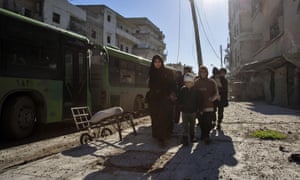
Syrians evacuate Aleppo in December 2016.

Friday, 11 August 2017

Why Trump shouldn't pull the plug on Syrian rebels

Image result for Why Trump shouldn't pull the plug on Syrian rebels

Mohammed Alaa Ghanem:

 'President Trump is making a dangerous mistake if he is ending a CIA program to arm moderate Syrian rebels, as was asserted by the Washington Post last month. His decision will mostly serve to empower Al Qaeda and Iran. The president should reconsider.

 I have tracked the program since its inception in 2013 while serving as Government Relations Director of the Syrian American Council, a nonprofit that advocates for a democratic and pluralistic Syria. I believe that the President’s decision could not have come at a worse time.

 Battles that will determine the strength of Al Qaeda and Iran in Syria for years to come are raging right now. The president’s decision undercuts the good guys.


 The CIA program was never meant to defeat Assad. Known as “Timber Sycamore,” it proposed working with only a few dozen moderate rebels per month (there were around 100,000 rebels overall at the time) and providing them only with basic training and light arms.

 I still remember the day the program was introduced because I received an inside report on the Obama administration’s meeting with senators to introduce it. Most senators were, to put it mildly, skeptical.

 House and Senate Intelligence Committee members rightly asked how such a meager program could succeed. Some wondered if the program was meant only to be a cosmetic substitute for more robust action.

 Obama Administration officials responded that the U.S. needed “skin in the game” to keep regional opposition backers in line and check extremism in the rebel camp. This was a key argument that got the program approved. And this, ultimately, was the program’s main purpose.


 Even by these very limited standards, the program was set up to fail. In early 2014, a highly disciplined coalition of CIA-vetted rebels called the “Hazzm Movement” formed in northern Syria. The group was strongly committed to fighting extremism; they eventually entered into a 3-front war with ISIS, Al Qaeda, and Assad forces.

 I knew the leadership of this group and even arranged meetings for them with the administration to help them gain increased support.

 But the support was not forthcoming. When Hazzm fighters captured enemy tanks, the CIA would not give them the money needed to operate them, so the weapons sat idle. The CIA at one point shipped 36 rifles to a commander who had requested 1,000. When the Hazzm Movement was overrun by Al-Qaeda in early 2015, its commanders reported receiving just 16 bullets per fighter per month.

 A leader of the group later described depending on America for support as “a losing bet.”


 Trump has cited the CIA program’s cost inefficiencies and indirect benefits to Al Qaeda as reasons for ending it. Neither argument is valid in southern Syria, where the CIA and regional partners adapted to failures in the north by devising a new, more egalitarian system of weapons provision that helped moderates to unify.

 A coalition of Free Syrian Army rebels rose to prominence in early 2015 and has dominated southern Syria until today. This coalition has kept Al Qaeda weak in southern Syria; contained suspected ISIS affiliates at the Israeli border; and kept Iran and Hezbollah away from Jordan and Israel through blistering military defeats.

 Further east, affiliates of the coalition have allied with a Pentagon-trained group to expel ISIS from the outskirts of the Syrian capital.

 Even in northern Syria, it is wrong to call the CIA program a flop. Former CIA-vetted rebels remain heavily involved in anti-Qaeda efforts in northern Idlib province, where Al Qaeda hopes to establish an emirate. Groups such as the Free Idlib Army and Levant Front have kept pockets of democracy alive.

 Local rebels waged a major battle against Al Qaeda last month, and former CIA partners north of Idlib are now the best hope to destroy Al Qaeda at its main base in that province.


 That the CIA program achieved successes even though Obama set it up to fail is a testament to the potential of the collaboration. Trump now needs to decide whether he will bring this potential to fruition, or complete Obama’s failures.

 Under Obama, Iran became much stronger in Syria, because Obama’s Syria policy was largely premised on appeasing Iran to secure a nuclear deal. As a result, the CIA program in northern Syria failed to hold Al Qaeda at bay; but Trump’s cancellation of the program might be the finishing blow for moderate forces that will give Al Qaeda its cherished emirate.

 It could also give Iran its ultimate goal: a direct ground corridor to Lebanon, allowing it to supercharge Hezbollah and threaten U.S. allies in the region like never before.

 The CIA-backed “Lions of the East” resistance group is the main obstacle to such a historic Iranian victory at this time. The Lions came under fierce attack from Iranian proxies after contesting Iran’s route to Lebanon through eastern Syria.

 The Pentagon carried out multiple airstrikes against those proxies before backing off; the Lions persevered and last week launched a furious new offensive. With proper support, these forces could cause major damage to Iranian interests in Syria. Without aid it is only a matter of time before they are defeated.


 The idea of Trump’s decision to end support sends a chill up the spine of anti-Assad democrats across Syria. Thousands of Syrians will take it as a signal that America no longer wishes to support their struggle for freedom – be it against Assad, Iran, or Al Qaeda.

 Thousands of fighters who received salaries from the program will no longer have a livelihood, forcing them to join better-funded extremists or leave the field altogether for Al Qaeda and Iran to flourish. The situation will get worse, not better.

 The CIA program was far too limited and was in dire need of reform. But if Trump thinks that he struck a blow against the extremists by pulling the plug on CIA partners in Syria, then he should know that he is only extending Obama’s failed policies.

 A more robust program that gives vetted rebels freedom to target ISIS, Al Qaeda, and Iran alike would better serve U.S. national interests.'


Thursday, 10 August 2017

Yassin al-Haj Saleh's 'The Impossible Revolution'


 Muhammad Idrees Ahmad:

 'Since the beginning of the Syrian revolution over six years ago, there has been a determined effort to smother it both literally and figuratively.

 There is the ceaseless attrition of bullets, bombs, torture, starvation and poison gas; there is the relentless subversion of truth through erasure, distortion, slant and fabrication.

 But in defiance of the terror, through myriad betrayals, regardless of the slander, and in the face of global indifference, the revolution survives. Every time the violence ebbs, the revolutionary flag returns to the street borne by crowds chanting the same slogans that reverberated through earlier, more hopeful days.

 Even in the absence of peace, besieged neighbourhoods have elected local councils, provided social services, educated children, treated the wounded and fed the needy. Under impossible circumstances, the people who stood up against one of history's most murderous regimes persist.


 You would know none of this if your only window into the Syrian conflict is the western media or, worse, its Kremlin counterpart. Syria, for all one can tell from their coverage, is about Islamic State atrocities, Al Qaeda gains, coalition bombings, regime advances, Russian resurgence and CIA manoeuvres.

It is a geopolitical chessboard in which Syrians are mere pawns, denied agency, except in violence; denied humanity, except in victimhood.

 When earlier this week the UN war crimes prosecutor Carla del Ponte resigned over the Security Council's inaction, she saw fit to add: "everyone in Syria is bad now". She said this as the news of the execution of media activist Bassel Khartabil was becoming public, Idlib University was holding free elections, Saraqib and Eastern Ghouta were electing local councils and volunteers from the Syrian Civil Defence were risking lives to rescue victims of the regime's relentless bombings. For del Ponte and her ilk, these people might as well not exist.

 Such is the moral haze in which the debate on Syria has unfolded. And it is this fog that Yassin al-Haj Saleh has chosen to dispel in the ten essays that make up The Impossible Revolution: Making Sense of the Syrian Tragedy.

 In its lucidity, erudition, range and percipience, the book is worthy of a Gramsci. In its method, rigour and predictions, it is an intellectual achievement of extraordinary significance. The book honours the revolution by describing with precision its causes and aspirations and recording with complexity its challenges and achievements. It is the living chronicle of a revolution, a sustained diagnosis, a prophecy and a 'J'accuse'.


 Yassin al-Haj Saleh, one of Syria's most celebrated intellectuals, wrote these essays over a period of five years, from underground in Damascus, Douma and Raqqa, and from exile in Istanbul. Saleh's compelling biography and his colossal sacrifices lend his writings unusual moral authority.

 While still in college, Saleh was arrested by the regime and spent 16 years in its notorious prisons; and, since the start of the revolution, his wife and brother have both been disappeared by jihadis (the latter by IS). Yet, in spite of the personal tragedy, Saleh writes with remarkable dispassion and objectivity.

 The essays in this book tackle questions that most confound audiences in the West.


 The discussions range from the causes of the revolution, the regime's violent repression, the revolution's turn to arms, the rise of the Islamists, the threat of militant nihilism to the question of sectarianism. They are rooted in history but they aren't the usual apologetic narratives of colonial depredation and native passivity. Saleh's interest is in postcolonial Syria, in its initial promise, halting progress, and eventual betrayal under Baathist rule.

 The Baath Party however was merely a cover for what Saleh calls Hafez al-Assad's "neo-sultanic" rule under which the social functions of the state declined, the population became dependent on a new elite through networks of patronage from below, while the security state maintained order through surveillance and terror from above.

 The regime used the logic of sectarianism to keep the population split vertically, so that people at the bottom could only access state resources and services through intermediaries from their own sect. Sectarianism in the regime's hands became a political means of control. It had nothing to do with doctrinal differences; its guiding principle was power.

 In this system kinship become a key principle, money guaranteed access, and together they created the supreme value: power. People at the top of the pyramid were free to expropriate state resources and a legal system was instituted to protect the gains.

 The state functioned on two levels: a "non-sectarian yet powerless visible state" and an invisible "private and sectarian" one. It is the latter that enjoyed "sovereignty over people's fates, internal domestic affairs, public resources, and regional international relations".


 Under Bashar al-Assad the state also replaced its "obsolete, inhumane political apparatus with a glamorous material façade". A regressive and exploitative system was given cover by a purely culturalist notion of modernity with the left-behind blamed for their own immiseration because of their attachment to "tradition".

 Tellingly, when revolution came, virtually all the defections happened in the visible state while the invisible, sectarian state remained cohesive and resilient. Beyond resilience, however, the privatised state also tried to neutralise the revolution's political advantage by forcing upon it a military contest for which it was decidedly unprepared.

 As early as June 2011, Saleh warned against the dangers of this "state of nature": Violence could replace the revolution's positive aspirations with the logic of necessity and desperation. Saleh charges the regime as the primary instigator of violence. But while wary of military confrontations, Saleh does not blame the armed uprising for undermining the revolution.

 Abandoned by the world and faced with the regime's lethal provocations, revolutionary conscience could only hold out so long. Saleh recognises the necessity of armed resistance when the alternative is total annihilation. He also notes that contrary to pacifist dogma, "those who took up arms did not replace the peaceful revolution but rather contributed to its expansion and resilience".

 By July 2011, three months into the uprising, Human Rights Watch had recorded 887 unarmed protesters killed by regime snipers. The Free Syria Army was formed shortly after that. It was partly through the protection of rebel arms that street protests continued to grow (reaching their peak during the summer of 2012). Citizen journalists provided additional protection by filming violations and beaming them out to the world.


 But if Saleh recognises the legitimacy of armed resistance, he is withering in his condemnation of what he calls "militant nihilism" (a term he prefers to "terrorism" which has been diluted of meaning through misuse by repressive states).

 It is neither morally defensible nor practically justifiable because it "necessarily hurts the innocent, owing to its arbitrariness". Even when motivated by real injustice "the 'goal' of terrorism collapses into the very act of rebellion against this condition and into the elimination of enemies without ever achieving anything greater, such as… national independence, or ending poverty, or even punishing criminals among the rulers and their collaborators".

 Saleh was predicting the rise of such nihilism already in May 2012. Without support for the revolutionary forces, he warned, the nihilists will strengthen. "Were a nihilist organisation to somehow come to power", Saleh writes in a prophetic passage, "the result could only be brutal despotism. Not only are nihilist organisations accustomed to indiscriminate violence: their radical withdrawal from the world encourages the cultural and psychological conditions necessary for prohibiting dissent and uprooting any alternative."

 In a section on media activists, Saleh describes them as creating an "objective memory of the uprising". In these ten essays, he has achieved something similar.

 For all its resilience, the revolution in Syria appears headed toward a grim denouement. But in the face of cynical efforts by counter-revolutionary ideologues to rewrite history, Saleh's work will stand as an imperishable reminder of the circumstances through which this impossible revolution endured.'

Wednesday, 9 August 2017

Assad and ISIS are playing one game


 Karam Abo Aljoud:

 'The regime advanced recently in the areas I highlighted with blue, in very quick time with no resistance from ISIS. all those areas were controlled by ISIS. The question is, why the regime keep only a narrow corridor for himself in Hama (next to the arrow)? why the regime is not fighting against ISIS there.

 The answer is that, the regime wants to make it possible for ISIS to go to Idleb, so the regime can claim that ISIS is in Idleb.

 Assad and ISIS are playing one game.'

Exiles despair for city of ghosts

An elderly Syrian sits outside a newly reopened shop selling tablecloths amid the destruction of Aleppo’s old city. Picture: AFP

 'When he speaks of his house in Aleppo, Abu Fares al-Halabi remembers it as it was ­before he fled into exile: the honey-coloured stone arches sweeping over the lower rooms, the breezes coming through the wood lattice windows, and the scent of jasmine in the courtyard.

 Relatives and former neighbours have described the reality now. An outer wall has been ­destroyed by a barrel bomb, opening the way for looters. Much of the neighbourhood is destroyed. “My father wants to rebuild it, other relatives say forget it,” said Mr Halabi, 31, of the house where he grew up in Aleppo’s old city.

 “We sent a carpenter to repair the door, but as he was doing it a local official came past and told him not to bother, as it will only be broken into again by the looters. Then the official helped himself to one of our antique hookah pipes.”


 Aleppo’s ancient heart is home to a huge souk, an imposing citadel, a famous mosque, and a warren of alleyways full of houses and businesses.

 Before the war it was home to an estimated 120,000 people, many of whom fled as the area ­became the epicentre of battles between rebel forces and the Syrian regime. After three and a half years of conflict, the city was ­recaptured by President Bashar al-Assad’s forces and allies in ­December, but much of the area that was once controlled by the rebels remains in ruins.

 Mazen Samman, UNESCO’s program co-ordinator in Aleppo, said last week that detailed plans exist for its full restoration. “Our vision is to rebuild the old city ­exactly as it was before the war, with the same stones where we can,” he said. Former residents say they are dubious of such claims.


 “What’s UNESCO’s plan, to build for me and not consult me?” said Mr Halabi, whose family is in exile in Europe and the US. “There are the monuments, but most of the old city is people’s homes. We are part of the heritage. What is their plan for us?” The mistrust partly stems from the fact that UNESCO can work in Syria only with the blessing of Assad, whose forces are responsible for most of the destruction.

 Many abandoned homes have been requisitioned by supporters of the regime, or squatted by families who lost their homes in the fighting. A second property owned by Mr Halabi’s family has been taken over by a family known for their connections to Assad; despite appeals to the authorities, the family has been told they cannot be evicted. Even those who stayed often lost the title deeds to their properties and cannot return to begin rebuilding.

 “So many gangs and shabiha (pro-government paramilitaries) are in charge. We still cannot visit freely,” Ahmed, 56, a textiles merchant who used to supply manufacturers all over Syria from his shop next to the 12th-century Umayyad Mosque, said. He fled in 2012, and returned to find his shop destroyed. “Aleppo is not the same without its old city and businesses. I hope that we will be able to rebuild it without anyone’s help,” he said.


 Of those who fled abroad, some choose to stay in exile, fearing retribution from the regime. The threat of conscription into the army means that there is a dearth of young men in Aleppo — the people who would do the bulk of the reconstruction work.

 For those who do want to return, the cost of the paperwork at a Syrian consulate has rocketed to $US400 per person. Some observers fear the void could be filled by new residents and investors who care little for the old character of the city. “There are plans available of the footprint of the old city, and there have been architectural surveys,” said Michael Danti, a professor of archeology who worked in Syria for two decades before the war.

 “However, to say those plans can be used to rebuild historic neighbourhoods where there is only rubble and desolation is like saying you could rebuild clear-cut sections of the Amazon using blueprints. One of my biggest fears is that the post-conflict redevelopment will attempt to sweep away all memory of the hundreds of thousands who perished and the millions who fled and might never return. If so, Aleppo will ­become a city of ghosts.” '


 Note 11/7/25, link broken.

Syrian Names Immortalized in Tomato Sauce and Blood


 'Under the clinical white lights of a Maryland conservation center on Tuesday, Mansour Omari carefully laid out five scraps of worn material that have traveled within the collar of his shirt — past Syrian government forces and across oceans — covered in blood and rust, and in the fading names of the disappeared.

 A human-rights activist, fighting for freedom of speech and chronicling the missing, Mr. Omari was arrested in February 2012 in his Damascus office and went on to spend about a year in a series of prisons, including nine months in a brutal facility under the supervision of Maher al-Assad, the brother of President Bashar al-Assad of Syria.

 It was in that fetid underground jail that Mr. Omari and four of his fellow inmates set out to record the names of all 82 prisoners there, in the hope of informing their families and documenting the atrocities.

 “When I was inside, I saw myself, what I was documenting,” he said. “I saw it firsthand. I felt it was my duty, actually.”

 The resulting lists, which included the prisoners’ contact details, were sewn into the collar and cuffs of a shirt and smuggled out by Mr. Omari, who was the first among the group to be released.

 The scraps of material are now being lent to the United States Holocaust Memorial Museum for an exhibition in Washington.


 Back in that Syrian prison, with ruthless government guards watching over them, Mr. Omari and his friends had set about quietly improvising writing materials: Small panels of fabric were cut carefully from the backs of their shirts. Broken chicken bones were used as pens. And when the tomato sauce from their rations proved too thin for makeshift ink, the friends used blood from their ailing gums mixed with flakes of rust from the prison’s iron bars.

 “We did it almost secretly. We didn’t want other people to know because there is a danger that some of them would tell the general,” Mr. Omari, 37, said, explaining how groups of cellmates form close friendships in the confined quarters.

 “We were going to some groups, sitting with them, asking for their names,” he added.

 Conservationists at the museum are preparing to study the fabric and are researching how best to preserve it. The chief conservator, Jane E. Klinger, said her team was looking to construct containers to hold the documents — perhaps from plexiglass fitted with ultraviolet lights — which have so far been buried within a notebook Mr. Omari bought at the civilian prison to which he was moved in late 2012.

 “That’s a very good solution for a lay person because they’re protected, flat, there’s an amount of cushioning,” she said, using white gloves and small metal tools to look through Mr. Omari’s notebook.


 On Tuesday at the museum’s David and Fela Shapell Family Collections, Conservation and Research Center, about an hour’s drive from Washington, Mr. Omari unveiled the names of the prisoners to a small group of conservationists.

 Flipping through the notebook’s worn pages, he revealed memories, all dated carefully on the top of every page.

 Scribbled neatly on the book’s tattered front are the words “la dolce vita,” or “the good life.”

 “I don’t take it out so much,” he said in slow, hushed English. “It’s so emotional for me when I see it.”

 “I was writing it for myself, trying to see that life is beautiful even after all that happened,” he added.

 Some pages are filled with Arabic, lessons in journalism and poetry that Mr. Omari taught an illiterate prisoner. There are also lines of basic English — “She knows her nose is big” — as part of the language instruction he provided for others.

 “You are in a place that you have all the time. You have nothing. You are doing nothing. You have nothing to do. So we had a lot of activities,” he said, explaining how inmates created “televisions” by holding up a sheet and taking turns to perform before it.

 “I convinced people. We are detained. We don’t know how long we will be there,” he added. “But when you are released, if you have a language, that will help you.”


 Mr. Omari, who now lives in Sweden, estimates about 100,000 people have been held by government forces in Syria, where half the population is thought to have been displaced since the war began more than six years ago.

 Scraps of documentation are slowly emerging, including letters from inmates and more names of missing people, as well as photographs smuggled out of the country by a Syrian police photographer that show widespread torture.

 Mr. Omari was arrested for his contact with foreign entities, among other things. And though the reasons for his release remain unclear, he says pressure from overseas is likely to have contributed to it.

 This week, the family of Bassel Khartabil, another well-known activist, shared news that he was executed in 2015 shortly after being imprisoned.

 Along with trying to share stories of the atrocities that are occurring in the Syrian war, Mr. Omari is calling on foreign powers to intervene in the conflict. He says that much of the public shares his view.

 “They hate so much Obama because he drew a red line, and he didn’t interfere,” he said of former President Barack Obama. “They hate Obama so much, really.”

 While President Trump’s decision to launch a missile strike in Syria in response to a chemical weapon attack in April was met with some criticism overseas, Mr. Omari said that among the Syrian public, “almost everybody was happy.” '


Monday, 7 August 2017

Syrians in Istanbul worry about being caught in the middle

Image result for Syrian refugees look out from an evacuated house the Kucukpazar district of Istanbul, Turkey. (Gurcan Ozturk / AFP/Getty Images)

 'The night of last year’s attempted coup in Turkey, Alaa Khaldi considered packing his bags.

 The 31-year-old Syrian refugee from Damascus, who fled to Turkey in 2015, was worried that Turkish President Recep Tayyip Erdogan would fall. Erdogan’s Islamist government has opened Turkey’s doors to more than 3 million Syrians fleeing the civil war in their country, and Khaldi thought a new government might roll up the welcome mat.

 “The main party is with us,” Khaldi said, referring to Erdogan’s Justice and Development Party, or AKP. “What happens after them, we don’t know.”


 Erdogan survived the attempted coup July 15, 2016, and has amassed more power, imposing a seemingly indefinite state of emergency and deeply polarizing Turkish society. But Syrians living in Istanbul worry that the widening political divisions will put them at risk, particularly as their numbers continue to grow while Europe blocks refugees from entering through Turkey.

 “If the regime changes, we would definitely be at risk,” said Khaldi, who works at a software company in central Istanbul’s Fatih district, a densely populated neighborhood with a large Syrian population.

 Erdogan has cast Turkey’s acceptance of the refugees as a benevolent project toward fellow Muslims — and particularly Syria, which shares a history with Turkey as both were under the rule of the Ottoman Empire until 1922.

 While Europe has tried to stop the flow of refugees and some European countries have been openly hostile to arrivals, Turkey has absorbed the influx with relatively little unrest. The vast majority of Syrians who work do so under the table, but Erdogan has offered a limited number of work permits that could raise Syrians’ wages and even floated the idea last year of offering Syrians the chance to apply for Turkish citizenship.

 That triggered a backlash among many Turks, even Erdogan’s supporters. His announcement came amid a smattering of news reports alleging the involvement of Syrians in various crimes, and soon the hashtag, “I don’t want Syrians in my country,” was trending on Turkish social media.


 Erdogan’s political opponents — who castigate him as an increasingly authoritarian figure who has imprisoned tens of thousands since the failed coup — have also voiced concern about the large Syrian presence.

 Kemal Kilicdaroglu, who has emerged as perhaps the most influential opposition figure after leading a massive anti-government demonstration in July, has called for a national referendum on the Syrian citizenship question and said that a growing Syrian population would make it difficult to identify suspected militants among them.

 Erdogan has not changed his policy, saying in a speech in late July that anyone who brought up stories of Syrians causing unrest in Turkey was effectively a terrorist.


 About 300,000 Syrian refugees live in 26 camps run by the Turkish government, with the vast majority of the overall population clustering in cities like Istanbul, Ankara, Izmir and Gaziantep, near the Syrian border.

 Syrians account for 3.6% of Turkey’s population, and their presence is obvious in areas like Fatih, where Syrian sweet shops and fast-food joints line the sidewalks and signs on storefronts are printed in Arabic script.

 Such neighborhoods are undeniably signs of Istanbul’s cosmopolitanism, but experts also say there are underlying tensions and misunderstandings, particularly because most Syrians don’t speak Turkish.

 “In the beginning, the idea of a common civilization really smoothed things over, but in the long run we’re seeing these Syrian ghettos develop, especially in major cities,” said Selim Koru, an analyst at the Economic Policy Research Foundation of Turkey.

 “People in Syrian ghettos are going to be resistant to learning Turkish, adjusting to Turkish culture and traditions. So in the medium to long run, that could present some problems,” Koru said.


 At a small grocery store in Fatih, a 37-year-old shopkeeper from Damascus, who gave his name only as Kinan, said recently that nearly all his customers were Syrian. Turks probably wouldn’t patronize his store if they knew he was Syrian, he said.

 “They accept us, but they don’t really like us,” he said.

 A medical engineer who fled Damascus in early 2016, Kinan lives in an apartment in Fatih with five other Syrian refugees. Since clashes broke out in May between Turks and South Asian migrants in another part of the city, Kinan said he is careful when he rides public transit not to speak Arabic.

 “Day after day it will become worse for us, this is my fear,” said Kinan, who works to send money to his wife and son in Damascus. “On social media, you see stories of Syrians being attacked, even killed in Turkey. They feel we are taking their jobs. They will become less accepting of us.”


 At a Syrian chicken restaurant along Fatih’s main drag, 15-year-old Hassan Sakka from the Syrian city of Aleppo showed a scar on his ear from a fight he’d had that week with a Turkish neighbor who he said had tried to shake him down for money. The neighbor’s reasoning, Hassan said, was that he didn’t have a job while Hassan and his cousin did.

 “The relationship between Syrians and Turkish people is just about work. There is no friendly relationship,” said Hassan’s cousin, Haytham Mahmoud.

 The 26-year-old works in a factory assembling boxes for about $350 a month alongside a dozen other men, all Syrians, to send money to his parents and two sisters in Aleppo.

 “There is no friendly relationship,” Mahmoud said. “Here we just eat, sleep and work. Any of us would love to go back to Syria.”

Image result for Syrian refugees look out from an evacuated house the Kucukpazar district of Istanbul, Turkey. (Gurcan Ozturk / AFP/Getty Images)

‘This is the chance the war gave us – to empower women’


 'In the early, heady days of the Syrian revolution, opponents of Bashar al-Assad’s regime and advocates for human rights saw an opportunity. “Women were extremely active and present,” says writer and journalist Samar Yazbek. But as the war escalated, some of this hope was lost. “The war became extremely violent and women’s rights became a secondary issue. But despite the horrifying intensity of the war, there are still women activists working to create life and maintain a civil society, both within the heart of war and as refugees.”

 These activists are fighting to ensure that women have a place not just at the negotiating table, but in post-war Syria. As the chaos of war causes major social upheaval, these women are pushing for girls and women to be empowered, and to have equal access to education and representation – in keeping with the UN’s sustainable development goal 5, which points out that such changes benefit humanity at large.

 In 2012, Yazbek won the Penn Pinter prize, a prestigious literary award. She used the money to start Women Now for Development, one of a number of organisations trying to challenge traditional patriarchal norms. Initially, the work revolved around helping women to support themselves financially. As violence intensified and the revolution became militarised, it adapted to protect women’s status and to support them through displacement. “I wanted to help build a democratic society,” says Yazbek. “It seems very far away now, but the ambition is to create pockets of civil society that can link up together to rebuild Syria after the war.”

 Even in the relative normality of life before the war, it was clear that women were suffering from discrimination. In November 2011 a UNFPA report (pdf) found that one in three women in Syria experienced domestic violence. Several Syrian laws clearly disadvantage women; the penalty for “honour” killing is softer than for other murders, and there is no legislation that specifically prohibits gender discrimination. The Syrian family code limits a woman’s financial rights within marriage if she works outside the home without her husband’s consent. The Syrian regime has at times been cynical about its engagement with women’s rights, presenting itself as a safe option compared to the rank misogyny of extremist groups. This has often been hollow, for instance, using women as spokespeople while keeping them out of roles of real influence, and failing to take any action on discriminatory laws. And Yazbek points out that in areas of Syria held by Isis and other religious factions, the situation for women has drastically worsened. “We were already fighting against patriarchy and dictatorship before the war. Now we have to fight not only that, but also religious extremism.”


 Women Now runs seven centres – two in Lebanon and five within Syria. Starting as a small support group for a few families in rebel-held territory in Syria, it has expanded to become a major women’s network. In addition to providing psychosocial support, skills training (in English and IT among others), and economic empowerment, it has a clear political goal: getting women’s voices heard – from the family setting to international peace talks. “We try to educate women about their rights, and spread awareness,” says Ola El-Jindi, a programme manager at the NGO. “This is the chance the war gave us – to empower women. If we didn’t use it well, it would be another disaster of war. We must use this opportunity to do better things.”

 At the Women Now centre in Chtoura, a town in Lebanon’s Bekaa Valley, women and their children pass in and out all day; the centre acts as a safe space for women to express their ideas, engage with politics, and fight the loneliness that can be a central part of the refugee experience. In a room adjacent to the main office, two Syrian women, Noor and Hala, told me about their dreams. “I’d like to set up a business,” says Hala, who wears a full niqab. “My ideal would be designing evening gowns.”

 “I want to get a job to send my kids to a good school,” says Noor, who is learning English at the centre. “Now I feel I have a purpose, I am not only serving my family and my kids, but also doing something for myself.”

 There is clearly a large gulf between women living as refugees, in challenging economic situations, and the more privileged women already engaged in Syrian politics. “We aim to empower women in their daily lives and make them capable of representing themselves,” says El-Jindi. “It is hard to get women’s voices heard – there is a big gap between the women in Geneva and the women here at this centre. But our first goal is not only participating in international peace talks. It is to make women empowered enough to participate in general.”


 In many places around the world – including Britain after World War Two – war can be a turning point for female empowerment. As men are absent, fighting or killed, women move out of their traditional roles. This is true inside Syria, where women are keeping society going in the midst of war – working as doctors, teachers, nurses and advocates. In places like Lebanon – where many refugees don’t have the legal right to stay – men are more likely to be stopped at checkpoints than women, meaning their movement is restricted.

 “In Arab culture, the man is often the breadwinner, has the decision-making power in the family, and spends more time outside,” says Chiara Butti, Lebanon country director for the peace-building charity International Alert. “When they have to leave their country they become very frustrated sitting in the camp. For women, it’s often easier to move around. So they can work in the community, meet other women. After a few years, they are identified as influential people in the community – they’re able to bring people together and represent their community.”

 Of course, refugee women face a whole host of gender-specific challenges – not least heightened risk sexual assault or exploitation, and caring responsibilities for their children. Engaging in international peace talks can seem a whole world away; some face resistance from male members of their families when they start to participate in politics.

 But recent history shows that women’s presence at international talks is vital. In 2014, when Syrian women were still excluded from the process, the Women’s International League for Peace and Freedom (WILPF) held a conference in Sarajevo bringing together Syrian and Bosnian women. The Bosnian party shared their experiences of being left out from the 1995 Dayton peace negotiations, where no women were present at all. According to WILPF, the exclusion of women from Bosnia’s peace process “has had concrete consequences both for the society as a whole and also for women … and their ability to be recognised as agents of change in later processes.” This is not unique to Bosnia; in 2012, UN Women published a review (pdf) of 31 peace processes, showing that only 4% of peace agreements had women as signatories.

 The top negotiating teams for both Syrian opposition and regime are entirely male – but in March 2016, a Syrian women’s advisory board attended Geneva talks for the first time. “All of us are women who regularly face a room full of men attempting to resolve a conflict fought mostly by men,” Marah Bukai, one of the committee members, wrote recently. “In our own ways, we persist in taking on a political role that many people in our society do not accept.”

 Women Now wants to ensure that grassroots concerns are reflected too, and runs consulting sessions with women, supporting them to write recommendations and demands, which they then feedback to the opposition commission and the team of Staffan de Mistura, the UN envoy to Syria.

 “There is nothing good about the war,” says El-Jindi. “Women are forced to relocate, and work as well as looking after their families. We have been forced to change. We didn’t choose it. But now, we are not going to go back to our previous position.” '