Wednesday, 19 July 2017

Two Testimonials Shed Light on Syrian Life and Death


 ' “I lived in a country where dying was taught to us from childhood,” the writer Svetlana Alexievich said in her 2015 Nobel Prize acceptance speech. “We were taught death.” Alexievich was speaking of Belarus, where she grew up and where, during World War II, 2.2 million people died — nearly one person in four. The scale of this suffering seems impossible to fathom, numbers so large that the mind snaps shut. Yet one needn’t cast back in history for such figures. Since the war in Syria began six years ago, 6.5 million people — more than one in three Syrians — have been internally displaced, and another 470,000 are dead. Now, as the war grinds into its seventh horrifying year, literature written in English and borne out of the conflict is finally beginning to reach the rest of the world.

 Alia Malek’s memoir, “The Home That Was Our Country,” is one of the finest examples of this new testimonial writing. Born in Baltimore to Syrian-American parents, Malek is a journalist and attorney who landed a job in the civil rights division of the Justice Department less than a year before 9/11. Unable to endure the political climate under President George W. Bush, she quit the United States for the Middle East, where she traveled and taught human rights for the better part of a decade. Her political and cultural fluency, as well as her deep familiarity with the landscape, allow her to become “a human ear” as Svetlana Alexievich calls it, recording the tragic absurdities of daily life that give way to dark humor. On an earlier trip, she had visited southern Lebanon and toured a prison that was recently closed. Her guide, a former inmate, instructed the group’s members to cover their noses and mouths, “so as not to inhale the germs of diseases that he was convinced still lingered.” The disease that lingered, of course, was despair. She spotted a sign for the “suffering yard” — suffering, she writes, “was their translation for torture.”

 In April 2011, Malek moved to the Syrian capital of Damascus to report in secret for The Nation and The New York Times. The country was in the initial throes of what many hoped would become a democratic uprising born out of the Arab Spring. Yet there were already terrible signs that the regime of Bashar al-Assad wasn’t going to give up without bloody reprisals. In February, his security forces had rounded up and tortured at least 15 children for anti-Assad graffiti in their town of Dara’a. Ordinary Syrians, long oppressed by two generations of the Assad family’s brutality, were taking to the streets in protest. In an attempt to quell reports of dissent, the regime banned many foreign journalists. Malek went to work anyway. As a cover story, she tells her Syrian cousins that she’s writing a book about her maternal grandmother, Salma, the daughter of a Christian businessman, Sheikh Abdeljawwad al-Mir, born in the Ottoman Empire in 1889.

 Her cover story wasn’t entirely false, as that book becomes this one, and Malek grounds her narrative throughout in her grandmother’s story. Salma, a charismatic and embittered matriarch, grew up as the chain-smoking daughter in a family that prized only men, and after suffering a stroke, spends the last seven years of her life in her Damascus apartment, “locked in” her body, paralyzed yet alert, able to communicate only with her eyes. When Salma dies, she leaves behind a chic flat for Malek’s family, which, after decades of feuding with a hostile tenant, they succeed in reclaiming.


 As Syria burns, it falls to Malek to renovate the flat — haggling for light fixtures from the Electricity Souk during a blackout, and keeping an eye on a corrupt contractor while the Assad regime gasses its own people, drops barrel bombs — oil drums loaded with shrapnel — from helicopters, and disappears thousands to be tortured in underground prisons.

 Malek observes almost none of this firsthand. Instead, her war is largely made up of what she can’t see. She lives day to day under the cloud of claustrophobia and menace that dominates the Syrian capital, where her presence poses a significant risk both to herself and to her Syrian family. Attempting, at one point, to communicate to Malek the kind of danger she’s putting her family in, a beloved cousin grabs her own hair, imitating the treatment the security forces mete out upon women, which can include gang rape. “That’s what they will do,” she tells Malek. “They will take all of us if you do something.”

 Although it becomes increasingly clear that her family would prefer that Malek leave Syria immediately, she stays on for two years, conducting clandestine interviews with ordinary Syrians undertaking extreme acts of courage — from those shuttling medical supplies to besieged areas to others launching ingenious and nonviolent protests against the regime. Some have survived unspeakable horrors in the basement of the nearby office of the security forces. Malek often walks past “with a shudder.” Its cells, she learns from torture survivors, are smeared with blood.

 This office dominates her waking life, as Malek, both insider and outsider, is forced to pass it most days, thinking about much that others would rather ignore. In her neighborhood, as elsewhere, she realizes, the proximity of the mukhabarat, as the security forces are called, has a double purpose. Their nearness terrifies local civilians into submission. “But most insidiously, no matter how much we averted our gaze, the fact that we knew what was happening inside and yet went about our lives made us complicit.” This quotidian collusion takes a moral toll. By the time she leaves for good in May 2013, she realizes that, whether she likes it or not, she too has become an unwilling collaborator: “By going about our lives, we had become bit players in the regime’s effort to maintain that everything was normal.”


 By contrast, “We Crossed a Bridge and It Trembled” chronicles Syrian lives that are anything but normal. In it, Wendy Pearlman, a professor of politics at Northwestern University, collects the accounts of refugees, most of whom have fled the brutality of the Assad regime. Pearlman speaks fluent Arabic, and between 2012 and 2016, she travels to Jordan, Turkey, Lebanon and Europe to record their stories.

 Many of these voices render themselves unforgettable. A doctor named Annas tells Pearlman during an interview in Turkey how he and others found unconventional ways to treat protesters gassed by the regime: “People were choking on tear gas and we’d pour cola on their faces, which counters the effect of gas. Their faces were sticky and glistening.” Another, Adam, a media organizer interviewed by Pearlman in Denmark, debunks facile Western talk about ancient religious divisions in Syria: “Our children are in prison ... and you’re talking about Shia and Sunnis?”

 Amin, a physical therapist, shares an ingenious bit of activist tradecraft on how to elude security forces, who often dial the contacts in the phone of someone they capture in order to ensnare others. “If someone dies, don’t delete his number. Just change his name to ‘Martyr.’ That way, if you get a text from him, you know that someone else has gotten a hold of the phone.” He adds, “So I’d open my contact list, and it was all Martyr, Martyr, Martyr.”

 These oral histories aren’t dutiful case studies. Instead, Pearlman shapes her subjects’ narratives, winnowing interviews down to stirring illustrations of human adaptation. In a tent in Lebanon’s Bekaa Valley, Pearlman finds a woman named Bushra, a mother who has, five years into the war, raised her children largely on the move and out of doors by necessity. One day, she took her young daughter to a woman’s center, which was in an actual building. “After living in a tent, she was amazed by the real walls and real floors,” Bushra tells Pearlman. Astonished, her daughter exclaimed, “Take a photo of me next to the wall!”


 One slight issue, however, with these accounts: The more compelling they become, the more questions they raise about how exactly they were fashioned. Pearlman could tell us more about the process of deposition and translation. In the introduction, she describes working with more than 20 researchers to transcribe the interviews, which she then edited, she says, for “readability,” a word that calls for more explication. The stories would benefit from being framed by a detailed accounting of this process. In some places, their seamless beauty grows distracting, as we become unsure of where the speaker ends and where Pearlman’s editorial hand begins.

 Nevertheless, Pearlman’s oral histories, like Malek’s memoir, will remain essential reading in the emerging body of literary reportage from Syria in English. (Two other memoirs that will be published here this fall include the journalist Deborah Campbell’s “A Disappearance in Damascus,” and the photojournalist Jonathan Alpeyrie’s account of his captivity, “The Shattered Lens.”) What makes Pearlman’s and Malek’s books particularly necessary is their insistence on foregrounding the extraordinary heroism of ordinary Syrians — both those who remain trapped in the yoke of an oppressive regime, and those struggling to make new lives in unwelcoming places. Such stories couldn’t be more urgent. “I was writing history through the stories of its unnoticed witnesses and participants,” Svetlana Alexievich tells us. “They had never been asked anything.” '

Monday, 17 July 2017

US-Syrian keeps school going in al-Qaida-run region


 'When Syria's uprising broke out, Rania Kisar left her job in the United States and returned home to join what she dreamed would be the ouster of President Bashar Assad and the building of a new Syria. Her main focus these days has been to keep al-Qaida-linked militants from taking over the dream.

 Syrian-American Kisar runs a school in the last main enclave in Syria held by the opposition, the northwestern province of Idlib. The strongest power in the territory is al-Qaida's affiliate, and it is increasingly intervening in day-to-day affairs of administering the province. That means Kisar has had to become adept with dealing with them to keep her school running.

 Sometimes that means making concessions to them, sometimes it means pushing back. Throughout, she knows why the militants keep trying to get their way: "If they don't interfere, they won't be considered powerful."


 Al-Qaida's branch leads an alliance of factions known as Hayat Fatah al-Sham that dominates the opposition administration running Idlib. But the group has to tread carefully, balancing between its aim to control and its wariness of triggering a backlash from residents and other factions. So far, it has stayed relatively pragmatic: it takes every opportunity to show it is in charge but has shown no interest in a wide-scale imposition of an extremist vision of Islamic law.

 They halted public killings of criminals; there are no religious police patrolling streets, arresting or beating people — and they haven't forced women to wear the niqab face veil.

 That is a sharp contrast to the Islamic State group in the stretches of Syria and Iraq where the rival militant group has ruled the past three years.

 Instead, al-Qaida administrators and fighters try to enforce some rules on a smaller scale while avoiding heavy-handed confrontation and presenting themselves as the champions of Syria's "revolution" against Assad.

 Idlib now stands in a tenuous position among the international and regional powers that are effectively carving up Syria. Assad's Russian-backed military is focused on fighting Islamic States militants further to the east, as are the United States and its Kurdish led-allies. Turkey and its allies have seized a pocket of territory neighboring Idlib. Eventually, all these forces will turn their attention to the fate of the opposition enclave.


 In the meantime, Idlib, swelling with more than 900,000 Syrians displaced from fallen rebel enclaves elsewhere, is the refuge of an opposition movement that only a few years earlier appeared to have the momentum in the conflict.

 Now Kisar and others like her are trying to keep al-Qaida's influence at bay.

 "Everyone sold us out," she said in a recent interview in her office in Istanbul, where she regularly travels.

 Kisar said the international community's fear of radical Islamists taking over Syria is exaggerated and reflects a lack of understanding of the Syrian opposition. She and others argue that the militants are needed, they provide services and infrastructure as well as skilled fighters for now, but will not have support later.


 From the start, Kisar has been a true believer in the uprising. After the revolt began in 2011, she left her administrative job at a Dallas university and joined the opposition.

 She traveled with fighters on the front lines, helping displaced people. She organized services in opposition territories. Along the way, she survived an airstrike and lost a colleague who was kidnapped by Islamic State group militants and was later believed killed.

 Finally, she settled in Maaret al-Numan, Idlib's second largest city. It was one of the few strongholds of the moderate Free Syrian Army, the umbrella group for the internationally-backed opposition factions. In recent years, radical factions like al-Qaida have grown in influence and gained a foothold. But Maaret's residents largely continued to support the FSA. They held repeated protests whenever al-Qaida fighters went too far, arresting journalists or cracking down on opponents.

 In 2015, Kisar launched her foundation — SHINE, or the Syrian Humanitarian Institute for National Empowerment.

 It provides classes for adults in computers, programming and web design. Registered in Dallas and funded by donations from Turkey and private citizens in America and elsewhere, the foundation has so far graduated 237 students.

 Kisar takes great pride in the result: a "geek squad" of tech-savvy men and women who can fix smart phones and computers. That is vital in opposition-held areas, where there are no telephone lines and the population relies on satellite internet for communication.

 "There are no private institutes, no universities, there are no hospitals," she said. "It is us, a bunch of locals, volunteers, stepping forward and saying, OK, I am going to clean the street, I am going to go volunteer in a hospital and I am going to build a school. ... This is my part. This is my honor."


 Her first brush with the militants came when she had to explain her work to gain accreditation from the bureaucracy they control.

 She bickered with one official, arguing that armed groups should not control civilian affairs. He wouldn't look her in the eye since she's a woman. But "when he heard I am from America, he said: 'We have every honor that an American Muslim is here and wants to be here'," she recalled.

 Even in heated debates with the militants, she said, she has always kept a respectful tone, something that has helped keep her operating.

 It also helps that she is a woman. "I can get away with a lot of things," she said with her characteristic giggle. "There is a lot more leniency toward me because I am a woman."

 The ultraconservative militants were concerned that SHINE provides classes for men and women. So she kept it going by segregating the space — men on the bottom floor, women on the top. When airstrikes hit the top floor, she set up separate areas on the ground floor.

 Before graduation, an inspector told her not to play music at the ceremony. She argued back. Then on graduation day, the ceremony started with a nod to tradition with a Quranic recital in line with the inspector's wishes.

 But as the students filed out in front of an audience of relatives and local officials, Kisar played an anthem. It was a calculated gamble: she was betting the militants would not make a scene.

 "It was matter-of-fact. They did nothing," she said.


 Even as it interferes more in administration of opposition-held areas, al-Qaida's affiliate is struggling between its identity as a hard-line jihadi movement and its ambition to lead the rebellion with its variety of factions, wrote another Syria watcher, Mona Alami in a recent Atlantic Council article.

 When that balancing act breaks down, violence can explode.

 In June, Maaret al-Numan was shaken when pitched street battles erupted between al-Qaida militants and the FSA, bringing gruesome revenge killings and leaving at least six civilians dead. HTS fighters opened fire on residents protesting against their presence in the streets.

 For a moment, the chaos seemed to shatter Kisar's spirit. "It is going to break loose," she said over the phone at the time. "Everybody is fighting everybody."

 She left town for several days to "breathe."

 Eventually, calm was restored with a shaky reconciliation, though one that increased the militants' influence: the FSA faction running the town had to leave their offices, replaced by an agency linked to al-Qaida.

 Kisar resumed her work — and her own balancing act. This time, she was preparing festivities for local children to celebrate a major Muslim holiday.

 "You must check out the videos," she said, giggling. "It is like Disneyland. It is SHINEland. It is majestic." '

Friday, 14 July 2017

Quneitra rebels have rejected the "ceasefire" deal

 'Assad forces shelled rebel areas in Quneitra Province today.'


 Note 7/7/25, link broken.

Wednesday, 12 July 2017

How the Russians Suckered Trump in Syria


 Charles Lister:

 'The core principles underpinning the Trump administration’s new Syria policy are roughly as follows: The United States is only in Syria to fight the so-called Islamic State (widely known as ISIS) and is not in a position to directly challenge the legitimacy of the Bashar al-Assad regime, despite its many crimes. Meanwhile, it is to be conceded that Russia has invested heavily in Syria and its proposed establishment of “de-escalation zones” is the best path forward to securing stability.

 With U.S. troops actively supporting our Syrian partners in a major assault on ISIS-held Raqqa, the second portion of U.S. Syria policy is being newly revealed by our expressed diplomatic support for Russian-mediated ceasefires and our direct role in negotiating one in Syria’s southwest.

 While de-escalation by itself is a highly desirable state of affairs for humanitarian reasons, the U.S. is lending diplomatic cover to what is, in all respects, Russia’s foremost strategic mechanism for methodically guaranteeing an Assad victory by selectively freezing front lines in order to free up pro-regime forces to fight elsewhere.

 By lending American support to such schemes, the Trump administration is failing to learn from recent history in Syria, where such agreements brought short-term stability to the benefit of one party over the other.


 At the core of the agreement, which was sealed during a meeting between Presidents Donald Trump and Vladimir Putin in Hamburg last week, the U.S. and Jordan are responsible for coercing opposition groups to stop fighting, while Moscow will ensure the Assad regime, Iran, and Iranian-backed militias do the same.

 This is not a new strategy—it is a consolidation of a policy developed by President Barack Obama, whose administration frequently called for Assad’s departure, but never seriously sought to realize it. By acknowledging the limits of our objectives in Syria, the U.S. is effectively admitting its defeat to Russia and Iran. Gone are the days of “leading from behind”; today we are following from the back.

 The greatest weakness in this Syria strategy is short-termism. The U.S. may not have existential interests in Syria, but we have created a stake by intervening against ISIS and putting boots on the ground. If U.S. interests are limited and dominated by combating terrorism, then we need to begin pre-empting those threats, rather than reacting to them after they have developed and matured. There are four major problems with our Syria strategy as it currently stands.


 First, by limiting its actions to counter-terrorism, the United States continues to treat illogically a symptom of a crisis, while allowing its root cause (the Assad regime) to survive. Extremism has never been the primary cause of instability; instead, extremism feeds off pre-existing conditions that give its radical narrative credibility. Our current strategy does little if anything to address those underlying conditions.

 Assad’s horrendous brutality is well-known. Roughly 500,000 people have died since his refusal to consider the opposition’s peaceful demand for political reforms in 2011. Assad’s subsequent use of chemical weapons has shocked the world, but such agents have been responsible for less than 1 percent of civilian casualties. Recent documentation showed that 13,029 Syrians had been killed by torture since March 2011, 99.2 percent (12,920) of whom were killed by the Assad regime. Similarly, 24,799 child deaths have been documented throughout the conflict, and 85.2 percent (21,123) of them were killed by Assad regime weapons.

 Those realities, and many more besides them, are the real drivers of extremism. Whatever form ISIS takes next will undoubtedly benefit from and seek to exploit continued instability in Syria, but it is al Qaeda that stands to benefit the most. Through its presence in Syria, al Qaeda has embedded itself deeply within the anti-Assad movement, attaching its fate to that of the indigenous revolution. By that standard, a U.S. admission of Assad’s survival, and thus of Russia and Iran’s victory, would likely embolden nobody more than al Qaeda.


 Second, the U.S. does not look set to invest in long-term stabilization efforts in territories captured from ISIS. Instead, local decision-making is being devolved to our Syrian partners: the Syrian Democratic Forces (SDF), and its lead force, the Kurdish People’s Protection Units (YPG). The SDF and YPG maintain an ambiguous relationship with the Assad regime, sharing power in some areas, coordinating militarily elsewhere, and abiding by mutual détente in others.

 Senior U.S. administration officials have suggested—publicly and behind the scenes—that we expect the Assad regime to eventually re-establish influence in SDF areas and that this would not be an issue for U.S. policy. Looking beyond the YPG’s documented human rights abuses and refusal to allow party political diversity, the eventual return of the Assad regime to towns and cities we liberated from ISIS contradicts every moral and ethical value that the U.S. should uphold and will do nothing but embolden the very reason for groups like ISIS in the first place.


 Third, beyond the fight against the Islamic State, the U.S. looks set to lend its support—publicly or not—to Russia’s de-escalation zone initiative in Syria. This suggests we have some faith in Russia’s intentions and trust in its ability to deliver calm, and that we have forgotten that Russia has failed to secure a single neutral, meaningful and durable ceasefire since it intervened in Syria two years ago.

 Russia may genuinely want to achieve calm in certain areas, but it does so only to strengthen Assad’s hand. Moreover, there remains no evidence that Moscow has the necessary leverage to control the behavior of Assad, and more importantly, of Iran. Repeatedly entrusting this responsibility to Russia, while repeatedly watching its failure, means the U.S. is pursuing a strategy of insanity—doing the same thing over and over again and expecting different results.

 It is highly unlikely that Russia’s de-escalation zones will prove durable mechanisms for stability. Moreover, by placing trust in their chance of success, the U.S. is emboldening a regime whose survival precludes the likelihood of more than 6 million refugees returning to Syria and instead sustains the drivers of conflict, radicalism, and divisions that have existed since 2011.


 Fourth, a limited counter-terrorism strategy paired with a tacit admission of Assad’s victory means Iran has won a huge strategic victory. Over the past several years, Iran’s Revolutionary Guards have exploited instability in order to establish a large and intricate network of Shia militias across the Middle East. Today in 2017, Iran may exert overwhelming influence, if not de facto control over more than 230,000 militiamen in Syria, Iraq, and Lebanon combined. That number includes 150,000 in Syria alone.

 This is the realization of a long-time Iranian strategic ambition: to undermine American influence in the Middle East and to pose an acute threat to Israel. Hezbollah leader Hassan Nasrallah pointed to this victory on June 23, when he proclaimed that the next war with Israel would be strengthened by “thousands, if not hundreds of thousands of fighters” from across the region. Though the latest de-escalation agreement for southwestern Syria includes a clause requiring the withdrawal of Iran-linked militias from territory bordering Israel, Tehran has a history of extracting its assets from the area due to external pressure, before again re-infiltrating them when conditions allow. There is no reason to believe this time will be any different.


 It is true that the U.S. does not have an interest in forceful regime change in Syria, but it does have an interest in stability. The U.S. has intervened in parts of Syria and has acquired a stake in its fate—we should own that stake and protect progress made in those areas. Holding and stabilizing territory, protecting it and its inhabitants from extremism or other forms of aggression, and fostering an environment in which interim reconstruction and localized governance can take shape would serve to create an alternative reality to that of the Assad regime.

 The U.S. must urgently assume a more long-term view when it comes to Syria, based on a continued and genuine commitment to the idea of a negotiated settlement that includes as much of the opposition as possible. By sticking to the short-term vision pursued today, we risk having to intervene again in Syria further down the line, when the consequences of our limited approach come back to haunt us. By then, our options will be even more limited and risk-laden than they are today.'

Monday, 10 July 2017

Prison in Hama (Syria): Detainees take control


 'Since May 2016, Sijin Hama al-Markazi Central Prison in Hama, Syria, has been completely under the control of the prisoners. Starting from the protest against the transfer of four detainees to a detention center run by the Syrian secret services, political and ordinary prisoners united and took control of the building. The doors of the cells were broken, the outer doors barricaded. The remaining supervisors were locked up and no one can enter or leave the prison without the permission of the detainees. Since the authorities have not yet regained full control of the building and hundreds of prisoners have been released as a result of negotiations.

 En Route! Was able to contact by telephone with two mutineers, Hamid and Urwa, political prisoners still currently detained. Here we reproduce the fruit of several telephone interviews with them. They tell us how they took control of the prison, how they organize themselves inside, the negotiations with the authorities ... At their request and for obvious reasons of security we only give here part of what they told us.

 The unique and little-known situation of the Hama mutiny is the very example of the kind of tension that could spread in a Syria where armed rebellion is unable to hold but where new forms of struggle can emerge in "pacified" areas. It is likely that this experience, far from the front lines, foreshadows the challenges facing Bashar al-Assad's regime: resistance from the areas under its control.

 Following the interview with Hamid and Urwa, you will find a brief description of the Syrian prison system and its operation since the uprising.


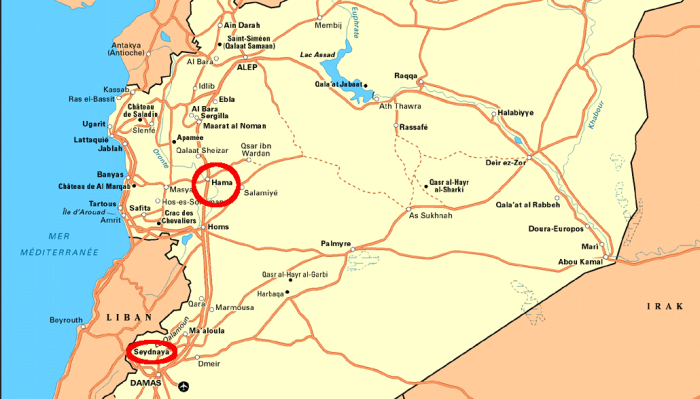
 Can you tell us how the mutiny started? It all started in May 2016 when four prisoners from Hama's central prison were to be transferred to Sednaya prison. We know that they would be transferred there for execution. They had been sentenced to death by a military court without any possibility of defending themselves. Then their families had paid a corrupt judge so that the penalties were not applied. The judge pocketed the money but it did not change anything. The secret services then tried to transfer them and we opposed it. We tried to negotiate and in the face of their refusal to discuss, we closed the doors of the prison, barricaded all the issues.

 After a walk, we took control of all parts of the prison, the courtyard, the canteen, the officers' offices, and so on. Inside we destroyed all the doors that separate the cells, to make it impossible to regain control of the prison, even if they managed to return to the prison.

 For eight days we received neither water nor food. The situation was very difficult. By closing the gates of the prison we had locked up with us several employees of the administration of the prison. They were not armed and we did not do anything to them, they were just in jail when we took control of the building. We are in conflict with the secret services and the judges.

 After eight days, the regime agreed to start negotiating. Gradually we released the employees of the administration of the prison in exchange for the release of some prisoners. It started with the release of a policeman against the release of 46 inmates. Then, in tranches, 380 prisoners were released. Finally, we reached an agreement that was only partially respected. The mutiny was terminated, and we all had to be released within four months. In reality it did not happen. Admittedly, the administration took over part of the operation of the prison, notably administrative management and the canteen. But inside we are the ones who take care of the rest as we want. The cell doors are still not closed despite their demands and threats.


 How did it happen between the prisoners? We know that you do not all have the same status, did it make it difficult to organize? The mutiny was initiated by a group of political prisoners, but it was successfully extended to prisoners of war. common right. It was not easy to make a junction with ordinary prisoners. They are judged and they know the date of their release, which is not our case. We have nothing to lose when they do not have an interest to join us in this fight. But fortunately all the prisoners were united.

 Of course we must be careful, the regime has certainly infiltrated us. But we almost all come from the city of Hama which has facilitated the building of bonds of trust between us.

 What has made this trust possible is that we do not have a leader and we are not affiliated with political movements. In general, for decisions taken urgently, we improvise with the principle of always remaining together. For the other decisions we discuss it among ourselves in each cell, we decide on something and the coordinators of each cell come together to decide together. If we do not agree we vote but generally we try to all agree.
Subsequently, committees are appointed to negotiate with the administration of the prison and with the State.


 What did the mutiny actually change in your daily life? Before we could rarely get out of our cells, we were crammed into closed cells with a ban on going out for a walk. Now everything is open and we go out for a walk whenever we want. We choose in which cell and with whom we sleep. And above all, there is no danger of being transferred to a prison of the secret services. The policemen and the masters who enter come in only when they are given permission and without their weapons. They are harmless. The mutiny, even since the partial return of the administration of the prison, allows us to protect ourselves from the secret services. On the other hand, we have very little food and no access to care.


 And where are you today? Despite the promises, there have been no new releases so the fight continues. There have been several visits by representatives of the regime, including the Minister of the Interior and the Minister of Justice. Also of the so-called "opposition of the interior", deputies presented as opponents in Syria but who in reality are affiliated to the regime. Each time they come to give us guarantees, we make promises. They are afraid that the movement will grow, make noise and spread to the city or other prisons. So they try to save time like that.

 What we are asking for is not only the cancellation of the transfer of our four comrades, but the release of all prisoners from our prison.

 Currently we have control of the prison but the security forces are all around. We can not go out and they can not enter. It's been a hard year. Sometimes members of the prison administration and police officers enter the prison, but without their weapons. On the other hand, they can not question anyone or summon anyone. There are distributions of food, but in insufficient quantity. We are obliged to buy most of our food from the administration of the prison, which makes good use of it. There is a shortage of medicines and there are several serious illnesses. The situation in the prison is very difficult, but it is better than before the mutiny because we are free of our movements and we are all together.


 Do you know how it happens in other prisons? Are there similar movements? I believe that there were attempts at an uprising in Tartous Prison. But no mutiny situation like here in Hama. In some prisons, police officers find it difficult to enter and take one of the prisoners to transfer or interrogate. They must come in groups to intervene in the cells. But at home it is not at all possible. In other civilian prisons, such as Adra prison in Damascus, a mutiny like home is more difficult because the prisoners come from all over Syria and do not necessarily know each other. So it's more complicated to create bonds of trust, everyone suspects to collaborate with the regime. In addition to Adra the political prisoners and common law are mixed. So the political networks, from which the mutinies, the trusted groups, are separated and divided. Common prisoners are often responsible for monitoring political prisoners, so there is internal control by the prisoners themselves. It is well known that the regime did not hesitate to starve or bomb whole districts to resume them To the rebels. How do you explain the fact that they have not already done so for Hama prison?


 Did they not have the means to forcibly restore it? The regime repeatedly tried to force it back into prison by sending tear gas and firing live ammunition. But it must be understood that there are technical reasons but also political reasons for his inability to return to prison. Technical, Because we completely barricaded the whole prison and they can not enter. The only solution would be to bomb the prison and exterminate us. The regime would certainly have no problem doing that in another prison, especially in a military prison or a prison run by the secret service. Except that, and this is the more political reason, our prison is a civil prison and all the prisoners come from Hama. Hama is a Sunni city, traditionally hostile to the Assad regime (an insurrection was violently crushed in 1982). Since 2011, the regime has invested heavily so that the insurrection does not take in this city. Indeed, the rebels never managed to take it and the front line is about 30 km to the north. So we're really in the back of the front line with the rebels, it's an area that the regime can not afford to see wavering. I think that here, more than anywhere else, the regime must keep the population safe. They cannot afford to risk an insurrection some kilometers from the Idlib front. This is partly why he is trying to avoid the passage in force here. Then, the regime has no special interest in losing that card there. They certainly think they can appear to be making concessions by releasing prisoners. If we are in this prison and we are not in a prison managed by the secret services, it is because they do not consider us to be really dangerous. If we were rebel fighters or mere supporters of the armed rebellion we would have been tortured to death. So we say that the regime wants to keep us as a bargaining chip, to be able to make a move when the time comes. It must be realized that such a mutiny in another prison would probably not have been possible.

---------------------------------------------------------------------------------------------------------------------

 In Syria, there are several types of prisons corresponding to several detention regimes.
First of all, there are civilian prisons for ordinary prisoners. Prisoners pass before a judge, are tried and know the length of their detention. Since the beginning of the revolt, due to lack of space, political prisoners are also detained in civilian prisons. This is the case of the Hama central prison. Civilian prisons are administered by the prison administration and the police, and are under the control of the Ministry of the Interior. Political prisoners are generally arrested and tortured by the secret services in various centers, which depend on their authority, and therefore have no connection with the police and the judiciary. Then these prisoners with special status are sometimes transferred to civilian prisons, Where conditions of life are better (access, no interrogation under torture, the possibility of purchasing food, and an easily corruptible prison administration).

 Finally, there are detention centers depending on the regimes of exceptions: that is, centers run by the army or the secret services directly. It is the case of the Palestine Branch, the prison of Palmyra (before its destruction by the Islamic State) and Sednaya , as well as numerous clandestine detention centers scattered in the buildings of the various secret services, military bases and hospitals. Mass executions and systematic torture have been reported by Amnesty International, including the Sednaya prison.

 The organized and bureaucratic nature of these massacres was revealed following the defection of "Caesar" [ 1 ].

 The vast majority of political prisoners, especially when accused of supporting the rebels (having taken up arms, But also nourished, cared for, welcomed ...) are locked there.Torture is systematic and the living conditions are terrible. It is rare to get out alive. These prisons existed before the outbreak of the insurrection. After the 1980s, the Syrian regime massively locked up Islamist militants, far-left or pro-Palestinian. [ 2 ]


 Since the beginning of the insurgency, new detention centers have emerged to deal with the massive influx of prisoners. In hospitals, military bases, cellars, clandestine torture and detention centers are set up. Each secret service, Syrian or foreign militia has its own detention centers.

 The issue at the outset of the Hama mutiny was precisely to prevent the transfer of prisoners from a civilian prison to one of those detention centers which are not alive and which depend on the exception regime of the secret services.

 While attempts at a political settlement of the Syrian conflict have been proliferating for many years without any results, the issue of the release or exchange of prisoners is regularly highlighted in the negotiations as the only way there may be some progress.
At the international conferences in Astana (since January 2017) and Geneva (2012, 2014, 2016, 2017), the issue of the release of prisoners is systematically raised. At the same time, the actors of the conflict regularly sign local agreements which can allow the release or exchange of prisoners (for more details consult the article Diplomacy against the Syrian rebels which revisits the agreements of Astana,

[ 1 ] Caesar is the code name given by international lawyers and Syrian activists who interviewed this official military police photographer, who defected in January 2014. Caesar was responsible for photographing the bodies of dead detainees in order to archive. He left Syria with tens of thousands of images, many of them showing the bodies of deceased detainees in Syria's detention centers.

[ 2 ] The book The Shell , by Mustapha Khalifa, is one of the best stories about Syrian prisons before the insurrection.'

Assad Supporters Protest Face-to-Face With Regime


 'Loyalists of the Bashar al-Assad regime in Aleppo protested on Thursday against violations by its forces and allied militias amid growing anger at the regime’s failure to control the abuses of the shabeeha members.

 The Aleppo News site on Thursday published images of dozens of regime loyalists protesting in the industrial city near a military barrier called the “prison checkpoint.” The protesters held up placards denouncing thefts by regime forces manning the checkpoints, chanting “no to the barriers of theft” while calling on Assad to control the abuses.

 Images showed the protesters standing up to the regime forces at the military checkpoint, a development warning of the growing state of discontent in regime-held areas, as most loyalists are content to express their anger on social media rather than take to the streets in direct confrontation with government forces.

 Residents in the regime areas of Aleppo live in constant terror as a result of increasing kidnappings, especially of women and girls, and extortion by the loyalist shabeeha militias. In some cases captives have been killed at the hands of the kidnappers either because the family is unable to pay the ransom or to settle personal accounts.


 According to regime media, hardly a week goes by without Aleppo being shaken by a new crime, the most recent of which was on June 11 when a popular committees member shot a child named Ahmad Jaweesh while he was selling chewing gum in the Al-Mojambo district. The culprit is still in hiding, amid calls from residents to impose the death penalty on the member of the pro-regime forces.

 The many abuses, killings, kidnappings and thefts in the city indicate the clear inability of the Assad regime to control its forces. According to a media activist from Aleppo, Mohamad al-Shafei, the reason for that is that some of the fighters in the regime forces are backed by official figures and it is not possible to approach them or to hold them to account for their crimes.

 The people of the city live in constant anticipation, not because they are subjected to killing and kidnapping, but because of the spread of crime in their districts, and the fear of what could result from any dispute with regime fighters.

 The situation in Aleppo’s districts resembles the remaining areas under regime control in which local and foreign militias are deployed at military checkpoints, especially in Homs and Damascus. The “ta’feesh” (looting) carried out by regime forces in the areas where they are located are considered a characteristic associated with them, while the regime has not appeared to respond to the appeals of residents of these areas harmed by the practices of the shabeeha.'


 Infighting between Syrian regime militants in Aleppo city*

 'In the past two days the city of Aleppo witnessed violent clashes and mutual shootings between militias loyal to the Syrian regime and groups of National Defense Forces (NDF).

 The clashes resulted in fatalities and injuries from both sides, Following the inability of the regime forces to control the insurgency of these militias in the city.

 Activists reported that a dispute between members of the “Marrdel” militia and the National Defense Forces ,outskirt of the Arts faculty in the ‘villaat’ street in Sheikh-Taha neighborhood in the center of Aleppo, and escalated later into violent clashes during which the parties used light and medium weapons in addition to hand grenades.

 The incident sparked a wide trending on the social media platforms , as loyalists considered it as the most prominent example of the security chaos and the absence of state and power.'
*[http://qasioun.net/en/news/show/82302]


 Note 7/7/25, qasioun.net link broken.

Sunday, 9 July 2017

Revolutionary flag flying over Ahrar border crossing


 'Syrian rebels raised the revolutionary flag above a border crossing with Turkey on Saturday, the first time the green-white-black banner has flown over the Bab al-Hawa in many years.

 Ahrar al-Sham fighters hoisted the huge banner on the Turkey border on Saturday, where it will fly alongside a white "Shahada" flag - bearing the Muslim testimony of faith - which the Islamist group commonly uses.

 The flag is 17 metres in length and was hoisted on a 25 metre flag post at the Bab al-Hawa crossing.

 The green-white-black banner was Syria's national flag before the Baath Party ruled the country and has been adopted by anti-regime revolutionaries since near the start of the 2011 revolution.


 It is believed to be the first time since at least 2013 that the flag has flown over the Bab al-Hawa crossing in Idlib province.

 The flag is used by Syria's opposition government and the Free Syrian Army which has been one of the rebel camp's more moderate forces.

 The decision by Ahrar al-Sham to raise the flag at the border point it controls comes at a significant time.

 Tensions are simmering between the Islamist coalition group and its al-Qaeda linked rival Tahrir al-Sham northern Syria's Idlib province, according to activists.

 Both coalitions are competing for influence in the only Syrian province fully in the control of rebels, with some analysts suggesting a potential intra-opposition battle could break out at the border crossing.

 In an attempt to appear the moderate party, Ahrar al-Sham issued a fatwa permitting the use of the colours of the revolutionary banner in its branding and for supporters to fly the flag.

 A leader from the group also appeared next to the flag during a video statement last month.'

Saturday, 8 July 2017

‘It Was Pretty Much Suicide To Stay In’ Aleppo


 'The United States and Russia have reached an agreement on a cease-fire in southwest Syria.

 Although details about the agreement and how it will be implemented aren’t yet available, the cease-fire is set to take effect Sunday at noon, Damascus time.

 “Honestly, when I hear something like that, I get a little happy and hopeful,” said Syrian refugee Mahmud Hallak.


 Hallak grew up in Aleppo, a Syrian city hit the hardest by the country’s civil war.

 He came to Philadelphia in 2012, after he was forced to flee his home country.

 “The government was able to get our names, who we are, and what we did,” said Hallak. “That point it was pretty much suicide to stay in the city.”

 Hallak – just a teenager back then in Syria – was part of a protesting group of Syrian people fighting for freedom, trying to overthrow the country’s oppressive government.


 While he was able to flee to America, his father did not and was killed during the war.

 Over the past five years of the unrest in Syria, Hallak also lost a cousin and several friends.

 He is hopeful that this new cease-fire, backed by the U.S., Russia and Jordan, will work.

 He also hopes the world understands it is not a victory for the Syrian people.

 “At this point, there is peace, but not really,” he said. “It’s just a government taking over full control. Seeing that, it’s just like all that happened was pointless. All these people died, all this distraction and we did not come up with anything.” '

Thursday, 6 July 2017

PYD leader threatens to hand over Afrin to Assad regime


 'The Democratic Union Party (PYD) ringleader, Saleh Muslim, threatened to hand over the region of Efrin in Aleppo north-western countryside to the Assad regime if Russia and the US would not put an end to Turkish threats of entering Efrin.

 The co-president of the Kurdish party, which is primarily made up of People's Protection Units (YPG), told Ronahi News TV Channel on Wednesday (July 5) "We asked the United States and Russia to intervene and stop the Turkish aggression on Afrin. If they do not help us stop this aggression, we will hand over Afrin to the Syrian (Assad) regime, just as we did with Manbij,” Rojava News reported.

 The latest threats by Muslim came hours after Turkey said it may launch a cross-border operation into the Kurdish-controlled enclave of Efrin in northern Syria if it constitutes a "constant security threat."

 Turkish Defense Minister Fikri Isik told state-run television TRT on Tuesday that Turkey's military will continue to respond to the "slightest fire" into Turkish territory from Afrin.

 He spoke hours after reports that Turkey's military retaliated overnight to fire from areas controlled by the YPG.


 Turkey considers the main Syrian Kurdish militia (YPG), which is supported by the United States, to be an extension of Kurdish rebels fighting in Turkey (PKK).

 Last year, Turkey sent troops into Syria to help Syrian opposition forces battling to oust ISIS terrorists from another border region and to curb the territorial advances of the Syrian Kurdish militia.

 "We would not abstain from doing what is necessary if Afrin becomes a constant security threat," Isik said.


 Turkish media reported that during the past days, about 20,000 Free Syrian Army fighters will participate in a Turkish military operation in Afrin region, after Ankara completed preparations for the process, which will take 70 days, and includes the capture of Tal Rafa’at city and the YPG-controlled Mennagh Military Airport.

 Turkish newspaper Milliyet reported earlier that the Turkish side has conducted rounds of negotiations with the Russian one to discuss the planned military operation, pointing out that Russia began withdrawing troops it had deployed earlier in Afrin under the pretext of monitoring the truce.

 The newspaper quoted a Russian diplomatic source as saying that “a new area is planned to reduce the tension in Afrin,” pointing out that security is ensured in this region by Turkish and Russian military, similar to the proposed mechanism to ensure security in the areas of “de-escalation zones”, including Idlib countryside.

 Turkish Karar news website revealed on Friday a new operation by the Turkish army in northern Syria aimed at targeting PKK-affiliated militants.

 The website reported that the Turkish operation, dubbed “Euphrates Sword”, has mobilized 7 thousand of its forces on the border, as it is expected to start operations from west of Azaz in the town of Ain Dokneh and Mennagh Military Airport until Tel Rifaat, Afrin, and Tel al-Abyad.'


 Syrian Lense:

 'With the operation for Tell Rifaat looming and several people drawing parallels to Euphrates Shield, it's important to delineate the differences between the last operation and this prospective one. First, FSA forces, most notably Liwa Mutassim, have received training for months now. Although much is still severely undertrained, comparing the competency of N Aleppo rebels eight months ago with now is a mistake. With that being said, the terrain is completely different from the open plains where much of the Euphrates Shield operation took place. The Afrin canton is largely mountainous, making any push incredibly difficult Kurdish armed groups are in their niche when fight is in mountains. And no, Afrin city is most likely not a target. This is the more probable plan for this operation:'
[https://twitter.com/SyrianLense/status/880832708607397889]


 'Large protests against YPG in Northern Aleppo. People calling for the liberation of Arab areas under YPG control.'
[https://twitter.com/worldonalert/status/883297679731826688/photo/1]


Note 6/7/25, Twitter links broken.

Regime dropped chlorine on Eastern Damascus again


 '#Damascus#Assad regime helicopters dropped chlorine gas on Eastern #Damascus again. pic.twitter.com/UiT29sFPcA

 #BREAKING

 #SAA TERRORISTS CARRIED OUT #CHEMICAL ATTACK ON #EIN_TERMA & #JOBAR, SEVERAL SUFFOCATION CASES AFTER #DAMASCUS #SYRIA JULY 6

 12:26 AM - 6 Jul 2017
[https://twitter.com/AEJKhalil/status/882863402351292416?s=04]'


 Note 7/6/25, links broken.

This Utah family fled Syria as the bombs fell


 'Yassir Alzoubi loves to cook. His chicken shawarma and falafel are right out of Syria and sing with Middle Eastern flavors.

 The recipes Yassir holds close to his heart are among the few things he and his family brought from their southern Syrian village that was practically bombed out of existence near the city of Daraa.

 Yassir and his wife, Manal, have three sons, ages 17, 12 and 8, and 15-year-old twin daughters. They now live in Midvale with the children's grandmother, Soubhieh Abdullah, 81.

 The family members escaped with little but the clothes on their backs in March 2013, when Syrian government bombers flattened Khirbet Ghazaleh, their suburban town of 30,000. During a pause in the bombing, they caught a ride in a van to the southernmost village in Syria and then walked 15 miles into Jordan. There, they lived in the Zaatari refugee camp for 2½ years.

 These days, the Alzoubis keep memories of home alive with traditions, the most sensory of which is food.


 Daraa, a city of about 1 million in southwestern Syria is about 55 miles south of Damascus. It is sometimes called the "cradle of the revolution," because protests erupted there when a dozen boys were arrested for painting anti-government graffiti. That, some say, sparked the Arab Spring in Syria and the rebellion in 2011.

 Later that year, bombs began to fall in and around Daraa. Many nights, the family retired to the safety of the basement. But it was difficult to sleep with explosions all around, said Mohammed, the 17-year-old.

 Yassir and Manal were both educators in Khirbet Ghazaleh, which also was home to engineers, physicians and other professionals, he explained proudly.

 "It's a special place. People there cared about each other," Yassir said through a translation by Mohammed.

 They had built a new house in 2007, Yassir said. "Our home is gone now — bomb."

 Yassir and his siblings also owned a small farm nearby, where they grew wheat, olives, tomatoes and watermelon.

 "It was good land," Yassir said. "It was good for growing."


 As he prepared a large number of chicken shawarma sandwiches, Yassir recalled his older brother, who is still in Syria.

 "No place is safe in Syria," he said. "When we got out of there, the situation was very bad. But now it is worse."

 Mohammed translated for his father: "The government does not help people," he said. "It turned against them and started killing them."

 Yassir and Manal were both educators in Khirbet Ghazaleh, which also was home to engineers, physicians and other professionals, he explained proudly. "It's a special place. People there cared about each other," Yassir said through a translation by Mohammed.

 They had built a new house in 2007, Yassir said. "Our home is gone now — bomb." Yassir and his siblings also owned a small farm nearby, where they grew wheat, olives, tomatoes and watermelon. "It was good land," Yassir said. "It was good for growing."


 As he prepared a large number of chicken shawarma sandwiches, Yassir recalled his older brother, who is still in Syria. "No place is safe in Syria," he said. "When we got out of there, the situation was very bad. But now it is worse." Mohammed translated for his father: "The government does not help people," he said. "It turned against them and started killing them."

 Although they put on a hopeful face, the transition to a new country and culture is not easy.

 "We didn't know anyone here," Manal said. "But people in America are very nice. We are happy to be in Utah."

 Nonetheless, she pines for her homeland and the brother and sister she left behind. "My hope is that my family can join us here."

 Yassir, too, misses Syria. "It's sad," he said through Mohammed. "I spent most of my life there, so it is hard to leave." '

Tuesday, 4 July 2017

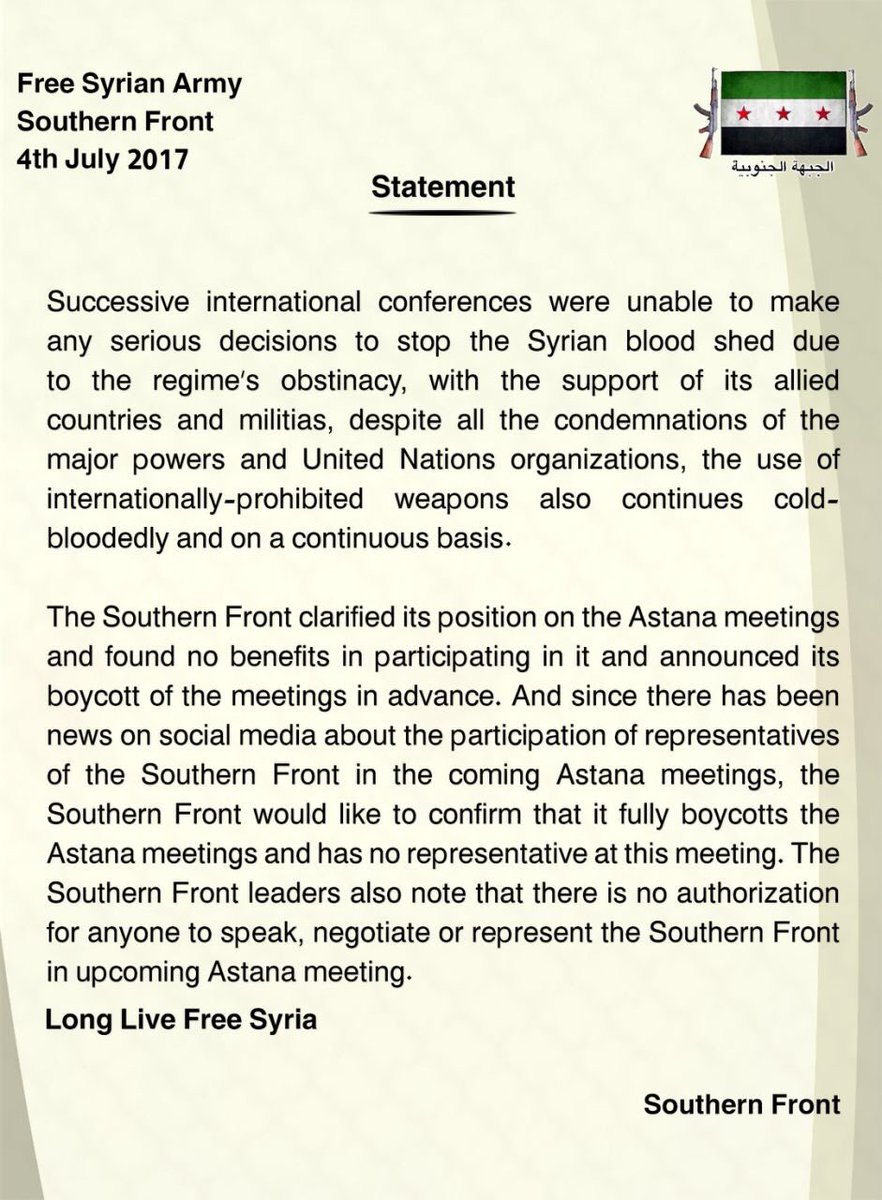
FSA groups announce boycott of Astana talks.


How a Syrian NGO is rebuilding destroyed parts of Idlib


 'A non-governmental organisation has launched an initiative to rebuild parts of northern Syria that have been destroyed in the country's ongoing war.

 The Violet Organization aims to clean, rebuild and renovate schools, roads, parks and other public spaces in rebel-held Idlib. The first project, dubbed "Idlib's Spring", focuses on the heart of Idlib city, where volunteers have painted, planted and renovated the famous clock square.

 "We have 1,500 volunteers working on this project with the help of local committees, and we will continue with a similar project in areas such as in Ariha, Jisr al-Shughour, Maaret al-Numan, Marea and Kafranbel in Idlib province," said spokesman Fouad Sayyed Issa.

 "The feeling of hope was felt by everyone as we finished our project in Idlib's clock square. This clock tower means so much to the people of Idlib," he added. "We could see happiness on the faces of adults and children; everyone was so happy. Everyone felt like life was brought back to them."


 Founded in Idlib city in 2011, the same year the Syrian conflict began, the Violet Organization was launched by a group of volunteers focused on distributing humanitarian aid.

 "Between 2015 and 2016, we managed to reach out to 2.7 million people in need," Issa said. "We mostly receive our donations from organisations and individuals. Our work includes creating shelters, providing health facilities and education, and protection."

 Amid deadly fighting between rebels and government forces, the team later moved its office to the suburbs and expanded aid operations to Aleppo, Hama, Latakia, Homs and the Damascus suburbs.

 Most of Idlib province in northwestern Syria has been under rebel control since 2015. It is regularly bombed by both Syrian and allied Russian warplanes, and many schools, hospitals and homes have been destroyed.


 The Violet Organization has received praise from the United Nations for its aid during the eastern Aleppo evacuation, and the group has also teamed up with other relief groups, including Save the Children and the International Rescue Committee.

 "Our message to the world is that the Syrian people can and will get back on their feet. We will bring life back to our country and smiles back to our peoples' faces. The war must stop; the air strikes and the fighting must stop," Issa said.'

'You destroy, we rebuild': a builder's life in war-torn Syria


 'When builder Abu Salem repairs a shell hole in a house in rebel-held southern Syria, he knows it might not be the last job he does on the structure.

 "There is a chance the buildings will be hit again," he said, "But in the short term people should be able to take refuge in their homes."

 Abu Salem heads a group of 12 construction workers who rebuild and patch up buildings damaged by barrel bombs, air strikes and shelling in and around Syria's Deraa city.

 With no access to modern tools, and materials made expensive by the war, Abu Salem's men break up buildings, mix concrete and carry loads by hand. Despite the difficulties, they have kept their sense of humor.


 Three months ago a video circulated widely on Syrian social media showing masked men kneeling in formation, brandishing staffs and rising to shouts of "God is Great".

 At first glance it looks like a typical example of the belligerent propaganda footage often posted by armed groups in the Syrian conflict. But it isn't what it seems.

 "In the name of God, I am Abu Salem al-Muhameed and I announce the formation of a Concrete Pouring Brigade in the free areas!" Salem shouts into the camera in an unmistakable parody of fired-up rebel leaders fighting President Bashar al-Assad.

 "If you destroy, by God we will rebuild!" he cries as his men wave pickaxes and shovels and then descend into laughter.


 After the You Destroy and We Rebuild Brigade's video appeared, people began stopping Abu Salem in the street.

 "They said: you are the best brigade formed since the start of the Syrian crisis," he sia.

 Syria's war has destroyed the national economy and fractured the country into a patchwork of areas of control which bisect trading routes, raising prices and causing local shortages of vital commodities.

 But money can sometimes talk louder than political loyalty, and across Syria goods still find their way across front lines, with heavy bribes and taxes paid at checkpoints.


 Abu Salem lives in a rebel-held area but sources his building materials from government-controlled zones.

 Cement secured from Damascus may cost about 30,000 Syrian pounds a ton at source, he said, but arrives in Deraa at a price of 50,000 to 55,000 pounds after passing through all the checkpoints.

 "By the time they get to us the price has become 50, 60 or sometimes 100 percent more than their real price," said Abu Salem, a 39-year-old father of five who was a builder before the war.

 Abu Salem is passionate about his mission to reverse the destruction, but laments he can't do as good a job as he'd like.

 There are no engineers, modern construction techniques or cement mixers. He and his colleagues reuse rubble and steel from destroyed buildings and do everything by hand.

 "The quality of building has changed significantly ... If there was equipment we would be able to build faster and better. But these are war conditions," said Abu Salem, who has had to vacate and repair his own house because of air attacks.


 Brigade members are paid in accordance with what customers can afford, averaging the equivalent of a mere four or five U.S. dollars a day.

 "It's always just (enough for) food and water. There are no savings because of the high prices," Abu Salem said.

 Abu Salem said he and his men stood ready to help whichever parties eventually agree to rebuild Syria. "But if someone comes with a rocket or a weapon and says 'fight', I won't," he said.'

Monday, 3 July 2017

We’ve attacked Bashar Assad, and yet no ‘World War III’


 Mohammed Alaa Ghanem:

 'When President Trump ordered a Tomahawk missile barrage against Assad forces in retaliation for the Syrian nerve gas massacre of April 2017 – an act the White House threatened to repeat just last week based on intelligence of an imminent chemical attack – he not only caused massive damage to the Assad regime’s aerial fleet but also left in smoldering ruins years of Obama Administration talking points about action against Assad triggering “World War Three.”

 In the last years of the Obama presidency, Administration officials waved off any and all of my suggestions to build Syrian opposition leverage and coerce Assad into negotiating. They warned that such suggestions – even humanitarian airdrops – could trigger World War Three with Russia, the most important backer of the Assad regime.

 But since April, America has continued to hit pro-regime forces and their Iran-supported allies in Syria, targeting multiple Iran-backed columns and Iran-supplied drones that threatened a U.S. training base for Free Syrian Army rebel fighters. When the U.S. shot down a regime plane in air-to-air combat last week, it was the first event of its kind since the 1990s war in Kosovo.

 With these moves, the U.S. has managed to deter regime chemical attacks on civilians – something President Obama failed to do through diplomacy – and repel Iranian aggressions against U.S. assets without triggering World War Three. Yet former Obama Administration officials are doubling down.

 Colin Kahl, who advised Vice President Biden on national security, writes on Twitter that America is on the path to a “possible clash with Russia” and “war with Iran.” And a former Obama Administration Iran team member, Ilan Goldenberg, warned in an op-ed that more aggressive policies could lead the U.S. to “stumble into a devastating conflict” in Syria.


 The irony is that Obama’s isolationist policies have already caused a devastating conflict. In January 2014, the Assad regime began fiercely bombarding Aleppo as rebels from the area pushed ISIS to the brink in the group’s capital. This weakened the rebel offensive, allowed ISIS to regroup, and led to ISIS storming into Mosul from Syria six months later and declaring a Caliphate.

 Last week, with regime warplanes bombing Pentagon partners fighting ISIS near the group’s capital of Raqqah, Trump responded as Obama should have: by shooting down Assad’s planes.

 Had Obama taken that same step in 2014, ISIS might have been defeated before declaring a Caliphate. Dozens of ISIS terror attacks in Manchester, Orlando, Paris, Brussels, Berlin, and elsewhere that were inspired by ISIS’s rise most likely would not have happened. We are already in a “devastating conflict” due to Obama’s inaction.

 And before policymakers heed Kahl’s pleas to avoid a “possible clash with Russia,” they should reflect on how such a clash became possible. There was no risk of a clash with Russia in mid-2015, when Turkey presented former U.S. anti-ISIS tsar John Allen with a proposed “safe zone” in northern Syria and earned his support. Russian forces had not yet entered Syria then – and based on my own diplomatic sources, Russian diplomats were spooked by the discussions. But Russia was emboldened when the U.S. nixed the proposal in late July. One month later, Russia signed a secret pact with Assad to enter the war.


 Military action against Assad is not a simple matter; it never was. But the record shows that failure to confront Assad has caused far more complications than action against him would have. This remains true today.

 Debate is raging within the Trump Administration over how far to go in support of U.S. partners, particularly anti-ISIS Free Syrian Army rebels supported by a Pentagon training base near Jordan. Key National Security Council officials favor action against Iran-backed militias near the base, while multiple Pentagon officials favor a focus purely on ISIS.

 The problem with an ISIS-only focus is that Iran is exploiting the ISIS fight to damage U.S. interests. Two weeks ago, regime forces evicted ISIS from a narrow strip of territory near the Pentagon’s training base – not to launch an offensive against ISIS, but to prevent U.S.-backed rebels from doing so. The regime has also attacked U.S.-backed groups directly, leading to the defensive airstrikes that so dismay former Obama officials.


 Yet the U.S. cannot stand by in the face of such attacks, which have the goal of conquering eastern Syria “before the Americans get there” and opening an Iranian land corridor to the Mediterranean for the first time in millennia. That corridor would drastically increase Iranian weapons shipments to Hezbollah, open new Iranian trading with Europe, and thereby make it harder for the U.S. to corral European support even for future sanctions on Iran’s nuclear program.

 Gains against ISIS by U.S.-backed Free Syrian Army forces are the main obstacle to this corridor. So the increased tempo of U.S. attacks on Assad and Iran is not only laudable; it is not enough. The U.S. must preempt Iran-backed advances by empowering FSA forces to enter major eastern Syrian population centers. Most FSA fighters at the base are from eastern Syria and would be welcomed by locals.

 In the long run, Trump needs a coherent policy that leverages his newfound assertiveness to help pressure Assad, whom Trump has called an “animal,” to negotiate his exit from power. A new FSA offensive against ISIS in the east is only the first step – the first of many that Trump can take without triggering ‘World War Three’ in Syria.'


Why Assad Keeps Looking To Use Chemical Weapons

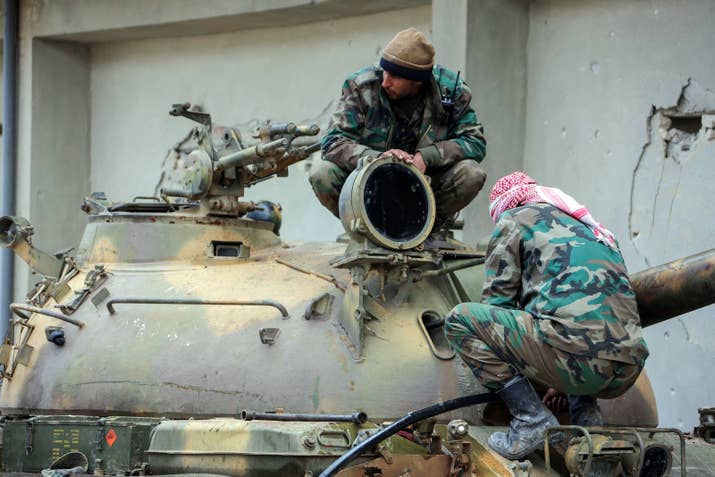
Members of the Syrian government forces sit over the turret of a tank.

 'The Trump administration seems confident that a US warning Monday headed off a planned chemical attack by forces loyal to Syrian President Bashar al-Assad, but is divided over which part of Syria the government actually planned to attack.

 Some intelligence officials, particularly in the US military, believe that the regime, whose troops in recent weeks have been pushing eastward, had its sights set on Deir Ezzor, an ISIS-controlled city near the Iraqi border where thousands of Syrian army troops are surrounded. Others believe the target was likely remaining pockets of opposition in the west, around the cities of Homs and Hama or in the suburbs of the capital, Damascus.

 The officials said Assad might consider either to be strategically important enough to risk the international fallout from using chemical weapons, which have been banned internationally for nearly a century. That said, it’s unknown whether US intelligence officials attempted to answer which target was most likely before the White House warned the Assad regime that it would “pay a heavy price” should it launch another chemical attack on civilians. Another possible target would be Idlib province, where some of the regime's most entrenched opposition sits.

 US officials could not say for certain that the regime was planning such an attack. Instead, they said the warning was based on aircraft movements and “chatter” about a possible aerial attack to be launched from Shayrat airfield, the base from which a sarin gas attack was launched in April that killed more than 70 in the town of Khan Shaykhun, prompting the US to launch 59 Tomahawk missiles at the airfield two days later.


 At first glance, it might seem hard to understand why the Assad regime would risk using chemical weapons. The strike on Shayrat airfield destroyed 20% of Syria’s operable aircraft, according to the US military, and the use of chemical weapons during the civil war has earned the Syrian government the moral denunciation of the world, particularly for the 2013 chemical attack in the Damascus suburbs that killed hundreds.

 But despite government advances in recent months, the opposition continues to hold on to key territory after six years of brutal war, leaving the government to resort to chemical weapons in hopes of driving rebels from the areas they hold, according to Andrew Tabler, a Syria expert for the Washington Institute for Near East Policy.

 Few weapons are as psychologically traumatizing as chemicals, Tabler said, and that, too, can be an incentive for the regime.

 The Syrian government has most often used sarin gas to try to squash its opponents when its forces seem on the brink of a major loss. That was the case in 2013 when the regime faced stiff opposition in Damascus’s Ghouta suburbs. In April’s Khan Shaykhun attack, the target appeared to be a key opposition logistics hub far beyond the front lines.


 But why use chemical weapons now, and risk another Trump administration retaliation, particularly on areas already under unrelenting Russian aerial assault? As recently as Wednesday, warplanes attacked opposition and ISIS-controlled territory near Homs and Hama, according to the Syrian Observatory for Human Rights.

 At the Pentagon, some officials believe pro-Assad forces may have intended to use chemicals to help break the siege at Deir Ezzor, where ISIS forces have surrounded a pocket of regime supporters.

 “The regime is desperately trying to push out east to show they are sovereign over their country, which they haven’t been able to say in about half a decade,” Tabler said. “It’s completely logical they would use chemical weapons against ISIS because they think no one would care.”

 There would be some precedent for such a move. Assad conducted a suspected sarin gas attack against an ISIS position east of Hama City in the months before the strike against Khan Shaykhun, and received basically no international backlash, said Jennifer Cafarella, a Syria analyst for the Washington Institute for the Study of War.

 “It is possible he's preparing to test whether he can achieve the same outcome even post Shayrat strike,” Cafarella said.


 For the US military, the use of chemical weapons in the east be would particularly problematic as it would be in vicinity of US troops and bring the Syrian civil war physically closer to the ongoing US war against ISIS.

 Other intelligence officials say the Damascus suburbs were the more likely target. Such an attack would be more in line with previous sarin gas attacks and would be designed to deal a death blow to opposition forces, a US official told BuzzFeed News.

 “The full capture of the Syrian capital is a strategic objective for Assad. He is close to achieving it, but the remaining rebel holdout in eastern Ghouta will be difficult to capture,” Cafarella said. “One major chemical weapons attack could be decisive because it could provide enough disruption of the rebel-held area to enable pro-regime forces to break through final rebel defensive lines and seize the area.”


 On Wednesday, Secretary of Defense Jim Mattis told reporters en route to Brussels that the preemptive statement Monday appeared to have worked.

 “They took the warning seriously,” Mattis said. “They didn’t do it.”

 But Tabler warned that the situation in Syria has not changed enough for the regime to rule out using sarin gas in the future.

 “What drives all this is the regime does not have manpower to retake its territory,” he said.'

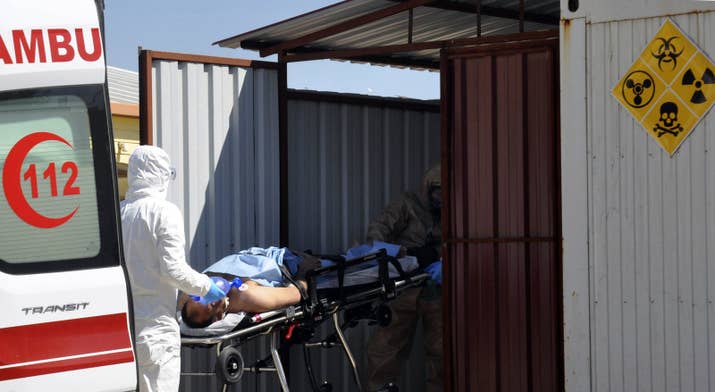
Turkish experts evacuate a victim of a suspected chemical weapons attack.

Assad Struggles to Assert Influence against ‘Shabiha’


 'Damascenes are living in great fear as the Syrian regime comes closer to restoring its complete control over the capital.

 They fear that the return of the regime will see the occurrence of the crimes that were committed in Aleppo when it recaptured it from the opposition. The city had witnessed in late 2016 an unprecedented crime wave committed by the regime’s “Shabiha” thugs. Forty-eight cases of rape, eight kidnappings, 13 murders and over 18 robberies were recorded during that time, said local sources.

 Concerns of a similar crime wave taking place in Damascus have occupied the people’s mind amid reports that the regime was no longer capable of reining in the Shabiha. Some of the thugs have even initiated contact with the Russian base in Hameimen and Iranian militia head al-Sayyed Jawad. One observer went so far as to say that Jawad “is Bashar Assad in Syria.”

 Regime head Assad had recently issued orders to “limit the presence of the Shabiha,” but some circles believe that such a measure was done to save face because the thugs are out of his control.


 Damascus has seen over the past five years murders, rape, kidnappings for ransom, car theft and house and store robberies. These crimes often took place the Shabiha-controlled areas.

 The thugs even set up checkpoints under the pretext of security and even hurled insults at the civilians.

 One such civilian said that he had to wait two hours to purchase a bag of bread at a staggering 50 liras. “We were optimistic by Assad’s recent order, but it seems the situation is headed from bad to worse,” he said.

 He explained that the bread trade has become a profitable business for the Shabiha because they are selling it at three times the price of bakeries.

 The regime crackdown against the thugs comes in wake of Defense Ministry order to destroy all non-regime issues security cards.


 The Shabiha emerged in 2011 from the “Popular Defense Committees.” Backed by Iran, the committees were originally formed in 2011 at the beginning of the Syrian uprising. They were employed to help the regime in cracking down on the peaceful protests. They included unemployed individuals, retirees, drug abusers and people with criminal records.

 They operated under the name of “National Defense Forces,” “Baath Brigades,” and others. They also included members from Iraq and Iran, as well as Lebanese members of the “Hezbollah” militia.

 Members of these groups were later called Shabiha [ghosts] due to their crimes and destruction.


 After six years of war, the clear role of the Shabiha in regime-held areas emerged and they now hold final say in those regions. Informed sources estimated that there are around 60,000 thugs, while the regime forces numbers that had stood at 350,000 before the unrest has dwindled to 60,000 to 70,000.

 The majority of the Shabiha made fortunes due to looting, robberies, embezzlement and other crimes. This is demonstrated in the lavish spending seen in their daily lives. The thugs own luxury vehicles and several houses, which resulted in the emergence of a social and class divide in Syria.

 The streets of Damascus have seen the deployment of the police and security forces members in order to implement Assad’s recent orders on the Shabiha. Several vehicles have been halted for either lacking license plates or having tinted windows.

 A dispute often breaks out between the police and the vehicle owner, who is often a thug. It also often ends with the Shabiha member refusing to remove the tinted windows.


 In addition, the regime has started to remove several of the militia checkpoints in Damascus. It is seeking to render the capital, Homs, Hama, Latakia and Tartous free of checkpoints by August, said sources in Damascus.

 Locals have doubted the regime’s ability to remove checkpoints from the capital because the Shabiha have become the actual rulers of some neighborhoods, such as al-Sumeriya and al-Tadamon.

 “The unlimited power that the regime granted to those militias prompted them to rebel against the regime itself,” said a local.

 Several observers had warned of such a development, adding that controlling the militias in the future will be very difficult.

 Furthermore, some militants have even refused to head to the battle frontlines out of the pretext that they had initially joined the militia to “defend their neighborhoods only.”

 They have even gone so far as to prevent members of the regime security forces from entering those neighborhoods if the forces were on a mission to apprehend a suspect. Several fierce clashes had erupted between two sides as a result, with deaths reported on either side.


 The regime has witnessed some success in eliminating the Shabiha in the Waar neighborhood in northern Damascus. Members of the Fourth Division removed the thugs, who had terrorized the locals, especially in the Barzeh neighborhood.

 Observers believe that the regime campaign against the Shabiha stems from several possible reasons.

 The first is that Russia is pushing Assad to increase his popularity ahead of the upcoming elections.

 The second is Assad’s concern of possible clashes taking place between the Shabiha and Russian and Iranian forces that will be deployed around Damascus, said sources from the Turkish presidency.

 The third reasons, said the observers, is that Russia and Iran have pressured Assad to contain the violations of the thugs, who have started to provide weapons to the opposition and terrorist groups alike.

 A Shabiha member earns around 30,000 to 60,000 liras a month or around 550 dollars. The salaries are paid by Iran. The wages of Iranian, Iraqi and Lebanese militants ranges between 200 to 800 dollars. The observers said that like “Hezbollah”, the majority of the militias in Syria are now more allied to Iran than the regime, which is worrying Assad.'

Sunday, 2 July 2017

Fear came with Hafez al-Assad

Syria: A man holds a picture of Syrias President Bashar al-Assad and his father Vater Hafez al-Assad (2010).

 Ameenah Sawwan: 

 ' "The father of all Syrians has left us." Those were the words used on Syrian national television to announce the death of Hafez al-Assad on June 10, 2000, a sweltering summer day in the Syrian capital of Damascus. I was just nine years old, but I knew this was something big – and I was terrified. I ran to my uncle's house across the street to find my cousin. She was on the first-floor balcony, so I called to her from the street: "He died, he died, Hafez al-Assad is dead!" My cousin, who was a little older than me, quickly ran downstairs to put her hand over my mouth. She didn’t believe me until I told her to turn on the TV and see for herself.

 The only way to describe how we felt in that moment of uncertainty – after three decades of Hafez al-Assad as president – is that Syrians were afraid of what the future might bring. Hafez al-Assad had served as president of Syria since 1971 and was responsible for establishing an authoritarian government under the control of the Ba'ath Party. He had held many important positions in government – the last as minister of defense – before seizing power himself in 1970, when he toppled President Salah Jadid and appointed himself the undisputed leader of Syria.

 Hafez locked Salah Jadid away in the Mezze Prison in Damascus, where Jadid remained until his death in 1993. To Syrians and the outside world, the coup seemed calm and bloodless and the only evidence of change was the disappearance of free newspapers, radio and television stations. After that, all media was controlled by the state.

 Hafez Assad called his military coup "The Corrective Movement" and it is still celebrated as a national holiday known as 16 November Day, when the Arab Socialist Ba'ath Party celebrates its so-called "accomplishments". Hafez al-Assad's real achievement, though, was the lengths he was willing to go to hang on to power after the coup. One of the most notorious incidents took place in 1982 in Hama. The Muslim Brotherhood used mosque loudspeakers to urge people to take to the streets in protest against Hafez al-Assad and kill one of the leaders of the Ba’ath Party. In response, the dictator ordered his army to crush the movement, with troops ultimately demolishing half of Hama Province and killing more than 10,000 civilians.


 Born in the 1990s, I did not experience this history that shaped today’s Syria. I grew up in Muadamiyat al-Sham, a suburb in the western part of Damascus, a community where people would talk about everything, but would change the subject immediately if politics came up. This was not only true for my family, but for every family who lived there.

 Many people in this community have now left Syria in the wake of the revolution that began in 2011. It all started with peaceful demonstrations, but very soon the soldiers and militias of Bashar al-Assad began to brutally suppress these protests. They arrested and killed demonstrators and activists and shot at innocent people in the streets. As the conflict turned first into a civil war and then into a proxy war, many people had to flee to neighbouring countries. It had become too dangerous to stay in Syria.

 I was also forced to leave at the end of 2013. I was about to be arrested, but was able to get out even as other members of my family were arrested by the Assad regime. After a long journey, I ultimately ended up in Berlin, where I now have the opportunity to help Syrian voices to be heard.'