Tuesday, 7 March 2017

The military performance and political solution

DAMASCUS, SYRIA: Syrians stage a protest against the Assad regime's violation of the ceasefire after Friday prayers in Damascus, Syria on 3 March 2017. [Yusuf El Bustani/Anadolu Agency]

 'With the approach of the Syrian revolution’s sixth anniversary, the fourth Geneva negotiations seem to be closer to a mockery than a solution given the military developments. We must ask ourselves, once again, what the reasons behind the crisis’ intractability thus far.

 Perhaps the military aspect of the conflict in Syria would have ended years ago if it weren’t for the direct intervention of regional and international forces. One of the most prominent admissions of this may be the statement Russian Foreign Minister Sergey Lavrov issued last month regarding Damascus being only two or three weeks away from being toppled before Moscow’s intervention.

 If this had happened and the Syrian capital had fallen under opposition control, then negotiations regarding the overthrow, ousting and prosecuting the president would have been easier. However, this did not happen. Contrary to the situation in Libya, where the military intervention by the NATO, led by France, rescued Benghazi, the revolution capital in March 2011, the intervention of Iran and Russia, as well as non-governmental armed organisations (Sunni and Shia) from Lebanon, Iraq, Pakistan and Afghanistan, rescued Bashar Al-Assad numerous times.

 However, rescuing the head of the regime does not necessarily mean the rescue of the regime itself, as Al-Assad’s forces lost over 100,000 individuals, a similar number of wounded and paralysed, and tens of thousands of pro-revolution fighters. All of these losses were suffered by an army consisting of 320,000 soldiers in 2010. Hence, Al-Assad is depending on more than 120,000 soldiers and fighters from foreign countries and militias to control less than 25 per cent of Syria’s territories. Regardless of the definition of the term “regime” in political science, this does not apply to the military entities controlling parts of Damascus, the coast, and other provinces. In other words, the revolution broke Al-Assad’s regime militarily without any aerial support in its favour.


 The revolutionary factions have grown close to military victory numerous times in the past six years. The first time was in July 2012 when the rebels stormed Damascus and took control of over six southern and eastern neighbourhoods, as well as attacking the regime’s national security building, resulting in the death of Al-Assad’s senior military officials, including foreign minister Dawoud Rajiha, deputy foreign minister Assef Shawkat, director of the National Security Bureau of the Regional Command Hisham Ikhtiyar, and chief of crisis operations Hasan Turkumani (this military/security authority was the highest authority combatting the revolution).

 This was followed by the rebels’ progress in the northwestern part of the country, specifically in Aleppo, Homs and Idlib, but this progression ended in late 2012 and early 2013, with the escalation of the direct Iranian military intervention, along with Lebanon’s Hezbollah and other non-Syrian armed organisations.

 The revolution forces pushed the pro-Assad forces to the verge of military defeat once again in July 2015 when the opposition forces gradually gained control of the strongholds of the regime’s remnants along the coast in the suburbs of Latakia. Two months later, on 14 September 2015, the opposition forces from Duma and Ghouta came close to isolating Al-Assad’s forces in Damascus from the northern part of the country by taking control of strategic hills overlooking the capital and hindering the international motorway. However, Russia’s military intervention and air raids during the same month stalled this progression.

 Comparatively, the military performance and capabilities of the Syrian revolution is much better than other similar cases of rebellion against colonialism, tyranny, or both, including the Libyan revolution and the revolutionary forces loyal to the republicans in Spain in the 1930s. However, the dilemma that lies in transforming this enormous military effort into diplomatic and political gains that bring the revolution closer to achieving its goals. The failure to do so has led to an interesting combination of facts, variables and new alliances.


 At the end of 2016, there were five military alliances working inside Syria with contradicting goals: Al-Assad’s forces and allies, the opposition forces with Arab leaderships (with various ethnicities and doctrines), opposition forces with Kurdish leaderships (also with various ethnicities and doctrines), Jabhat Fatah Al-Sham (formerly Al-Nusra Front and the Syrian wing of Al-Qaeda) and Daesh. The goals of the latter two, despite fighting Al-Assad forces, contradict the revolution’s goals both secretly and publically.

 These five alliances have not only fought each other, but also fought within themselves. This includes clashes between Al-Assad’s forces and its affiliated militias, as well as clashes between Daesh’s units. With the Turkish-Russian ceasefire initiative and the Astana negotiations in February, the level of tension and “repositioning” between the opposition forces and Jabhat Fatah Al-Sham, especially in Idlib, the opposition’s stronghold that is full of displaced Syrians and Al-Assad’s victims and that is targeted relentlessly by air raids carried out by various international parties, increased.

 On the back of such developments, Jabhat Fatah Al-Sham integrated with four local organisations active in northern Syria, namely the Nour Al-Din Al-Zenki Movement, Liwa Al-Haqq (the Truth Brigade), Jaysh Al-Sunna, and Jabhat Ansar Al-Din under the alliance Hay’at Tahrir Al-Sham. This alliance attracted a number of factions from the Ahrar Al-Sham movement, which some have estimated make up a quarter of the movement’s forces in northern Syria. This includes former head of Ahrar Al-Sham, Hesham Al-Sheikh, who is the current leader of Hay’at Tahrir Al-Sham.

 Almost at the same time, five other military formations, most importantly Suqour Al-Sham Brigade, Jaysh Al-Islam (the Idlib wing), and Levant Front (Jabhat Al-Shamiyah) joined Ahrar Al-Sham in order to avoid joining Hay’at Tahrir Al-Sham or taking control of its resources. The new head of the Ahrar Al-Sham alliance is Ali Al-Omar.


 These developments in the opposition structures reflect the calculations of the balances of power and survival more than ideological similarities. Some believe that integration and repositioning is a tactic to reduce the danger of drone bombings and aerial assassinations (especially in the case of Fatah Al-Sham/Al-Nusra front) or to reduce the potential of one faction joining another by force (in the case of the Nour Al-Din Al-Zenki Movement, and others). While the Al-Ahrar alliance sees the need to accept parallel paths of diplomatic and military work against Al-Assad the Tahrir alliance believes military work alone is enough to eliminate the regime’s remnants and expel the foreign forces loyal to the regime.

 The vision of both sides reflects the strategic impasses experienced by most armed revolutionary forces in modern days. Some have overcome the impasses while others have failed to do so. Al-Ahrar’s main impasse is represented by the inability to invest military gains in diplomatic negotiations and this is due to the lack of a central military leadership and an ideology that adopts sectarian aspects. It is also due to the fact that the other factions with military weight have not agreed to accept both paths and the lack of clear plans for the medium and long-terms.

 As for the Tahrir alliance, it has a much bigger problem. Disregarding the classification of its hitting force (Fatah Al-Sham/Nusra Front formerly) as a terrorist organisations (some countries may negotiate, agree, reconcile and ally with terrorists if they have enough military force and political flexibility, as we have seen in the past) and disregarding the fact that their military capabilities do not match their aspirations (as surprises could happen and other parties that are militarily weak and internationally shunned have been victorious before) and disregarding its ideological and sectarian extremism and rejection of most revolutionary forces, and Syrians in general, the Tahrir alliance’s problem is basically the lack of an executable strategy.

 One of the basic rules of a strategy, according to prominent German strategist, General Carl von Clausewitz, is that war is a tool of politics and military efforts must serve the political goal, or else the effort itself will become “the noise before defeat” according to a strategist from another continent and century, Chinese General Sun Tzu.


 In light of the conflicting priorities and goals amongst the regional forces, the almost absence of serious guarantees and commitments to a ceasefire, and the regime remnants’ desire to thwart any change process, even if it is gradually reformative, the opposition, including its right and left wings, need to rethink their strategy, resources and internal conflicts. This is because it is very likely, given the current variables and data, that there will unfortunately be another round of open war in the revolution’s sixth year.'

Lessons from Syria on women's empowerment


 ' “I risked my life to participate in demonstrations against dictatorship and the oppression of Bashar Al-Assad. I’m not afraid of anyone, anymore. I’m a free woman.” (Syrian woman activist from Women Now’s network, 2012).

 In this quote you hear the voice of a capable and strong woman. Yet both in regime-controlled areas and in other regions of Syria, women’s rights have become instrumentalised by political forces seeking legitimacy in the eyes of the international community. From prior to the deterioration of the crisis until the present day, there have been commentators who have focused on the ‘Western’ and apparently ‘emancipated’ personality of Asma Al-Assad and other women associated with the regime, or the recent nomination of a woman to the head of the Syrian Parliament. Likewise, the women fighters of the Kurdish forces have also been the subject of significant attention by the Western media. Much of the media coverage of these women plays into longer-term romanticized and orientalist tropes. Meanwhile, the demands of thousands of Syrian women activists are being routinely ignored. How are we here and what is to be done?

 The Assad regime has long instrumentalised women’s rights to legitimate its dictatorship in a way similar to other regimes in the region. The Assad regime’s discourse has major blind spots. For example, according to a report published by the UNFPA in November 2011, one in three women living in Syria has suffered domestic violence, with the prevalence of domestic violence in 2005 one of the highest in the world (with a percentage of 67%, Syria is second after Ethiopia 71%, and before Bangladesh 53%). These figures were gathered before the conflict in Syria and reflect phenomena hidden behind state propaganda pre-2011 which instead trumpeted the participation of elite women in the political sphere.

 Moreover, several Syrian laws contain discriminatory provisions against women, for example the penalty for honour killing is still softer than for other kinds of murder and no legislation specifically prohibits gender-based discrimination. Indeed, the discrimination of ISIS against women is rooted – at least in part – in the Syrian family code.


 An international approach to women’s participation that really listened to women would help them through the protection of basic human rights and to support their demands, as should have happened during the Daraya campaign. By the end of March 2016, the siege of the city of Daraya was in its worse stage. Women in our network told us that they had not been able to eat in the past 48 hours, that their children were surviving by eating grass soup. Shocked, we shared this information in all our centres, presenting videos and organizing Skype calls with women in Daraya to understand what was happening there.

 A women’s group in the city wrote a letter to demand the end of the siege and the letter was diffused throughout all our centres. Women organized gatherings and wrote and signed in English and French, taking advantage of what they had learnt in our centres. They spend days and nights working to prepare the gatherings as documented in their diaries. Some of them wrote long letters which were sent to EU parliamentarians. Then on 1st June, the International Syria Support Group (ISSG) announced its intention to send aid.

 The women felt that for the first time, their voices had been heard.

 Unfortunately, two months later, the women of Daraya were forced to send another letter about the use of napalm by the Syrian regime against their city. The letter remained unanswered as on the same day a decision was made to evacuate the civilian from the city opening the door to a new episode of Syrian tragedy: the forced displacement of population.


 Syrian women have shown incredible resilience and commitment to sustaining civilian activities, including the pursuit of peaceful livelihoods and education. Even as the bombs have rained down on the districts in which they live, women have continued to attend training to empower themselves. After one of the Women Now For Development centres was relocated due to the horrific deterioration of attacks in that area, we were contacted by one young woman asking us to maintain its presence, explaining that it was her one lifeline to education and hope: ‘Please keep it open, it’s my only way to replace my university studies’. Another young woman in a northern area of Syria under daily Russian airstrikes shared with us her happiness at winning a book-reading contest – having read twenty books over the previous two months.

 Syrian women will be the pillars of any future democratic process in Syria. Women have been at the frontline of confronting violence, corruption and fundamentalism. They have organized against each of these at the community level and have issued statements with detailed recommendations on how to tackle them. Their efforts deserve support from national and international actors.'

Monday, 6 March 2017

In Syria, the extra weak link of women’s health


 'Fatima, 25, was at her home in eastern Aleppo with her three children when the first barrel bomb struck. Her husband, who was at work at the time, heard the explosion from his office. He knew instantly the sound had come from the direction of his house. He waited for the “double-tap” — the second round of barrel bombs that would drop from the Syrian and Russian warplanes — before sprinting off towards home. He arrived in time to watch a third round of bombing decimate his family.

 The While Helmets rushed Fatima and nine-year-old Mammoud to hospital, but Mammoud’s twin brother, Abdo, and their three-year-old sister, Eilaf, were found dead beneath the rubble. Fatima, who was three months’ pregnant at the time of the bombing, suffered a miscarriage and internal bleeding, leaving her in critical condition and on life support.


 Dr Zaher Sahloul, Fatima’s critical-care doctor, uses his patient’s story to illustrate how the conflict in Syria is crippling maternal health care, with thousands of women suffering as warplanes systematically wipe out medical facilities, and blockades leave hospitals with almost no equipment or resources.

 Sahloul, a Syrian-American trauma specialist, and Chicago-based paediatrician John Kahler arrived in war-torn eastern Aleppo last year as members of the medical charity Syrian American Medical Society (Sams). They flew to Syria in June 2016 to spend five days working in hospitals that were bombed daily.

 Doctors in besieged areas of Syria have been struggling throughout the conflict to provide proper medical care to those in need. Syrian-Russian government forces have specifically targeted health care workers and hospitals, killing more than 750 health care providers and bombing 265 medical facilities throughout the country. When Sahloul and Kahler arrived last June, only 30 doctors were left to treat eastern Aleppo’s 300,000 civilians.


 Farida, who, for safety reasons would only allow her first name to be published, was the last obstetrician-gynaecologist in eastern Aleppo until she was evacuated to Idlib at the end of last year. While in Aleppo, she worked at Omar Ibn Abdul Aziz hospital, code-named M2 by doctors in a futile attempt to protect its coordinates from bombings by the Syrian regime.

 Farida’s voice is high and urgent as she describes what she witnessed in Aleppo, describing widespread malnutrition among women in besieged areas. She says basic food such as meat, vegetables and dairy products are unavailable. “Most of the women are anaemic with decalcification in their bones ... there are no vegetables,” she says.


 The vice-president of Sams, Dr Basel Termanini, travels to northern Syria every six months to provide medical care. “I have seen mothers who really don’t even know how to describe an orange to their children, because their children have never seen one before. People are really deprived,” he says.

 Malnutrition has a devastating impact on prenatal and neonatal health, leading to a host of problems, including low birth weight — “Most of the babies being born are under six pounds,” says Farida — and an inability to produce breast milk. In northern Syria, aid organisations prioritise the delivery of baby formula, as many mothers can’t breast-feed their babies, says Termanini. In places where fighting and blockades make it impossible for aid deliveries to get through, even formula feed isn’t available. Asked what mothers in eastern Aleppo feed their babies when they are unable to breast-feed or buy formula, Farida says: “Nothing. The baby eats nothing.”


 Doctors across besieged areas of Syria have reported an increase in the number of deliveries by caesarean section, which they also attribute to the constant bombings. Knowing that hospitals are targets for air strikes, women are often too frightened to visit doctors for prenatal screenings, says Termanini. Many don’t find out about serious conditions during their pregnancy, such as pre-eclampsia, until it comes time to deliver their babies, which can result in the need for emergency C-sections.

 Many pregnant women also choose to have C-sections so they can plan to deliver their babies at night, when bombings are less likely. It’s a decision doctors say is understandable but risky. “It is an unnecessary surgery that is not appropriate as it increases the risks of complications and future complications related to pregnancy,” says Sahloul. With hospitals in parts of Syria being targeted by air strikes on an almost daily basis, Kahler confirmed that there are no longer any working medical facilities in Aleppo. Sahloul says that during his last mission to Syria, every few minutes the government would detonate bunker-buster bombs and barrel bombs in the direction of hospitals. “These things happen all the time in Syria,” he says.

 And that means health providers have had to adapt in ways they never imagined. Farida recalls one incident when M2 hospital was bombarded as she was performing a C-section. The explosion caused parts of the ceiling above her to cave in, and crumbling debris dropped into her patient’s open abdomen. As the bombings continued, Farida asked nurses to remove the rubble from inside her patient and clean her abdomen with saline. “We finished the operation, and in the end, the patient [survived] and was very good,” Farida says.


 The daily destruction also means that trauma care takes precedence over preventive or primary care. During times of bombardment, civilians only seek medical care if they are seriously injured, says Sahloul. Preventive care for women, such as mammograms and cervical screen tests, are nonexistent in Syria’s war-torn areas. “The last thing a person under siege will be thinking about is preventive measures of medicine,” he says. According to doctors in the country, if a woman is aware that she has a serious condition, such as a lump in her breast, she will not seek medical attention because she knows there are no oncologists or surgeons who can perform the surgery.

 As Syria and Russia continue to bombard Syrian citizens, women don’t have the luxury of thinking about their future health — they are focusing only on how to keep themselves and their children alive right now. Hana Dawood and her husband, Humam, are former residents of Moadamiya. With Humam acting as her interpreter, Dawood tells of how she had a baby boy in October 2016, at home and without the care of an obstetrician. Less than a day after she gave birth, Dawood and her family were loaded onto an evacuation bus bound for Istanbul. For 24 hours, she sat on a bus with no bathroom facilities, cradling her newborn son.

 Humam, a dentist who had to train himself to be an orthopaedic surgeon and anaesthesiologist because there was none in Moadamiya, says he was upset that his wife had to make the journey so soon after giving birth. “It was really difficult for her,” he says. “I can’t believe she was able to do that.” '

What Palmyra tells us about US policy in Syria


 Hassan Hassan:

 'When ISIL recaptured the ancient city of Palmyra on December 11, the Syrian regime and Russia were in the middle of a vicious assault to retake the eastern parts of Aleppo from the rebels. The diversion of regime resources left an opening for the militants to roll back into the city after they lost it in March. The loss of Palmyra happened despite a serious attempt by Russia to prevent it, and showed the regime was unable to defend all of its fronts as it sought to fortify critical strongholds in Aleppo, Homs and Damascus.


 The recapture of Palmyra on Thursday, as with its loss in December, exposes the regime’s vulnerabilities. Damascus has Russia, Iran, Hizbollah and the United States to thank for the defeat of ISIL in Palmyra. The regime forces could not have done it on their own and the Russian air force may not have been able to expel the militants without the near complete destruction of the city.

 But there is something more telling about the recapture of Palmyra. The contribution of the US air force to the fight is a notable turn of events. In December, Lt Gen Stephen Townsend, commander of the anti-ISIL coalition, told reporters in Baghdad that the US would step in to strike against ISIL in Palmyra "if the Russians and the regime don’t strike it".


 "We’re just kind of staying out of it and watching it right now, and protecting our own interest, and letting the Russians sort that out, which I think is probably the common sense way to go about Palmyra," he said.

 The US did not stay out of it, however. It carried out dozens of air strikes against ISIL even though Russia and the regime did too. Regardless of whether the participation suggests a policy shift, the move points to a subtle change in the American behaviour in Syria. This change of attitude involves complete disregard for the conflict’s sensitivities.


 American officials involved in the fight against ISIL no longer seem interested in dealing with the political context of its operations in Syria. A de facto alliance with Iran, Hizbollah and Russia against ISIL in Palmyra would have been more eyebrow-raising a year ago. Today it is a passing event.

 This was not an isolated incident. The US has also insisted that Kurdish militias will spearhead the fight against ISIL in Raqqa. In arguing the case, officials seem to focus on Turkey’s objection to the Kurdish role, as if that is the only flaw in the decision. The primary concern for the lead role of Kurdish militias is local perception of these forces. It is what makes those battling ISIL "liberating" versus "occupying" forces.


 Gen Townsend dismissed the concern over how these militias are perceived locally by stating the fighters are from the wider Raqqa province. The statement suggests that the YPG, the Kurdish People’s Protection Units, are Raqqa locals, because the wider province of Raqqa includes Kurds. This ignores how people in Raqqa, and elsewhere, view the YPG militias and distinguish them from the Kurdish people in general.


 The statement also appears to avoid dealing with the question of keeping out militias viewed suspiciously by locals, a logic the US pushed for in Mosul. Gen Townsend’s remarks could indeed be a response to a statement by the Turkish prime minister that called on the US to follow the same logic it itself championed in Mosul in Raqqa.

 Another example of the disconnect is the move by the US-backed forces in Manbij on Thursday to hand over some areas under their control to the Syrian regime as a way to create a buffer zone between them and the Turkish-backed rebel forces fighting ISIL in eastern Aleppo. If the prospective role of the Kurdish-led militias in Raqqa was a bad idea, this move made it even worse. It has ensured that many more will see these forces as regime allies. Worse, the same US-backed forces allowed "humanitarian" convoys to enter the city of Manbij, which was liberated from ISIL in August. According to Pentagon spokesman Captain Jeff Davis, the convoys included "some armoured equipment".


 For any Syrian opposed to the regime, these developments in Palmyra, Manbij and Raqqa point to an unsavoury US policy. After nearly two and a half years in Syria, American officials may have lost sight of such sensitivities but they should not.

 The regime’s ability to secure even the 35 per cent of territory under its control is limited. It is incapable of fighting on several fronts without risking the loss of territory, as happened in December in Palmyra. It is also incapable of securing its supposedly safe areas, as demonstrated by the sophisticated operation that Al Qaeda carried out in Homs last Saturday, in which five militants infiltrated two well-guarded neighbourhoods, stormed intelligence compounds and shot dead a high-ranking official and around 40 other security cadres.


 The regime’s limitations mean proper investment in other forces to fight extremism elsewhere inSyria should be a priority for the US, if it wants to defeat extremists and keep them defeated. No matter where the US stands on the question of the regime’s legitimacy, it should understand that the regime is incapable of fighting extremism in the whole of Syria. And in order to invest in other forces to fill the vacuum, it has to stay focused on how its policy is perceived.


 Unfortunately, the US seems to be developing more dangerous blind spots in Syria. This unawareness, or disregard, of the political context in which it operates will undoubtedly come back to haunt it in the future.'

Wednesday, 1 March 2017

A Possible Game Changer In The Syrian Revolution

 'The rebels in the Turkish Euphrates Shield Operation have completely captured the last stronghold of ISIS on the 24th of February 2017, after a string of losses for ISIS in the Northern Aleppo Governorate, most notably are Dabiq and Manbij. Especially Dabiq was of strategic importance as ISIS used the Islamic relevance of this town for years in their recruiting propaganda. The town has been used to legitimize their project, their English glossy was even named after the town. The propaganda machine of ISIS was therefore severely damaged when they lost the town within less than a day to the Turkish backed rebels without much of a fight. The loss of Dabiq made ISIS change the name of their English glossy, and their exclusive interpretations of the prophetically predicted conflict in Dabiq all together.

 ISIS has been on a losing streak the last two years as they lost swathes of territory in both Iraq and Syria. They have lost many positions in Iraq, among them are Falujah, Tikrit, Ramadi, Diyala, Beji, Haditha, Sinjar, Kirkuk, Salahudinne, and they have already lost more than half of Mosul; their last remaining stronghold in Iraq. The list of cities, villages and towns goes on in Syria as they lost large swathes of territory the past two years against especially the US supported Kurdish separatists, and the Syrian rebels in Aleppo more recently under the Euphrates Shield Operation. The city of Raqqah is their last remaining stronghold in Syria.

 Many of the positions they have lost in Syria were first liberated by the opposition rebels and factions at the outset of the Syrian revolution, before they were pushed out by ISIS who in turned lost many of these positions to the Kurdish separatists and the regime. This same scenario seemed to repeat itself in the Southwest of Daraa recently as the ISIS affiliate of Jaysh Khalid Ibn Waleed attacked rebel held positions, who were distracted by the ongoing campaign they have launched against the regime in the Manshiyah district in Daraa city.


 After the loss of Al-Baab however we have seen a new and unique development in the Syrian revolution. Several towns and villages fell right after the fall of Al-Baab, positions like Qabaseen and Bazza’ah for example, this made ISIS retreat from more than 30 villages south of Al-Baab. The Assad regime grabbed this opportunity as they captured the ISIS held villages in rural Eastern Aleppo all the way to Kurdish held territory in Manbij. This push has completely cut of the Euphrates Shield Operation from any further advancements against ISIS. The rebels in the Northern Aleppo Governorate are now isolated between the Kurdish separatists from the West and the East and the regime from the South. This has already forced the rebels in minor clashes with the regime in Taduf south of Al-Baab. Any future developments of this scenario could have major implications for the Syrian revolution.

 The Euphrates Shield has to choose between attacking the regime in the South to continue their march against ISIS, and this will put Turkey in a tough position with Russia, or they will have to push towards the East against the Kurdish separatists in Manbij to eventually continue their march against ISIS, and this will put Turkey in a tough position with the US. If they will choose to halt the campaign all together, then this will put Turkey in a tough position with the rebels and Syrians who are counting on their support. The regime or the Kurdish separatists could also agree in pulling back so as to make way for the Euphrates Shield, but this will also damage the credibility of the already weakened image of Turkey amongst many Syrians.'


 Note 9/6/25, link to Bilal Abdul Kareem's On the Ground News broken.

Tuesday, 28 February 2017

Excerpt from “The Home That Was Our Country”


 "The Home That Was Our Country: A Memoir of Syria is a memoir written by journalist and civil rights lawyer Alia Malek about her time living in Syria, her parents’ homeland, from 2011 to 2013, during the start of the Syrian Civil War. In this excerpt, Alia reveals the events that took place during spring 2012, in the early days of the war, as peaceful protests by civilians were countered by violence from the Syrian Armed Forces. She details the pace of life before the Houla Massacre, which steeled the Assad regime’s resolve to “crush” the insurgency, where even small acts of dissent and resistance were cause for detention.

-----------------------------------------------------------------------------------------------------------------

 'I would meet many brave, ordinary Syrians, all very different individuals. Many of them didn’t believe in taking up arms, were civically minded, and espoused secular politics. Outside Syria, they would come to be called activists, but at the time, they were simply moved to act because they were horrified by what was happening and couldn’t ignore the suffering of their countrymen. Both the regime and the jihadists would want to eliminate them. In my cell phone and notes, I gave everyone aliases to avoid putting them in jeopardy, should my materials ever be seized by the mukhabarat—or if I was seized myself.

 […]

 Not long after, I got word that the architecture student I would come to call “Carnations” had been taken for something she had done the evening before. With a few other friends—who were also young women—she had walked around downtown Damascus handing out carnations to pedestrians in the city’s center. Each flower bore a tag that said simply, “Stop the killing.”

 […]

 The flowers operation had been a few days in the making: four young women were to carry bunches of carnations and hand them out to passersby on the street. They wanted to counter the regime’s image of the activists as terrorists or foreign-paid agents, and they wanted to register some resistance to the regime’s demand that Damascenes act as if nothing were happening in the rest of the country.

 On that afternoon, the young women had set out in pairs. Her partner had finished handing out the last of her flowers, and Carnations still had three left and was about to cross a street when an Opel station wagon (they didn’t need to be marked, everyone knew these belonged to themukhabarat) pulled up next to her. Two men with large guns across their bodies jumped in her way.

 “We got her,” yelled one of them. “Go find the other.”


 But the other woman, without flowers in her hand, wasn’t so easy to spot. She had kept going even though she saw Carnations get stopped. They had agreed beforehand that if one got detained, the other should just walk away.

 The man sent to find her returned alone.

 “What’s in your hand?” asked the man blocking Carnation’s way.

 She nervously laughed and answered, “Flowers.”

 He snatched them from her and read the tag. “‘Stop the killing’? Who are you saying that to?” Before she could answer, he told her to get in the car.

 “You don’t have a warrant,” she objected. Later, she would giggle at her own courage. “I don’t know where I thought I was! Europe? America?”

 “Get in the car!” the mukhabarat man yelled again.

 “On what grounds are you taking me?” she challenged him.

 “Get in the car, or I will humiliate you on the street and drag you off in front of everyone.”

 “Fine, I will walk,” she said, catching the two men so off-guard that they agreed. One man got back into the car, while the other walked alongside with her. They quickly reached the offices of the political affairs mukhabarat.


 They took her bag and left her in a waiting room. Her mother and brother were coming to Damascus from Dara‘a that evening for a dentist appointment the next day. She had told them to come a day early so they could go out that night, since in Dara‘a, for safety, they spent a lot of time cooped up at home. Knowing they would soon panic, she was preoccupied with how to tell them she was okay.

 After a long wait (though she had no way of telling time), she was led into a room with a man who was seated behind a desk, going through her bag.

 “How much did Qatar pay you?” he asked with a heavy Deir al-Zour accent.

 “Nothing,” she answered.

 “You must be crazy,” he said as he rifled through her things. “Do you think you and your kind can do anything to the government? Think you can make revolution?”


 As he flipped through her wallet, he saw she was from Dara‘a. “So you are a terrorist,” he said. And when he found simple blueprints (from a university assignment), he became agitated and suspicious. He asked her what the plans were for.

 She was so afraid that she couldn’t stifle her laugh, and told him she was an architecture undergraduate.

 “Shut up,” he told her. Then he turned to what he wanted to know. “Who was the girl who was with you?”


 At first she denied there was anyone with her. And then she said it was a girl she had just met. He asked for a description, and Carnations said she was a very tall, fair-skinned girl, when in fact she was short and had olive skin. The other young woman had already been taken once, and Carnations didn’t want to give her up. When he asked for a name, Carnations invented one, “Lina.”

 For the next several hours (how many she didn’t know) she was taken in and out of different interrogation rooms. Similar questions were asked while she remained standing: Who paid her? Who was the other girl?

 Finally she was placed before a man who seemed to be in charge. Referring to the tags attached to the carnations, he asked, “What do you mean, ‘Stop the killing’? Who are you telling to stop?”

 “All those killing people,” she said carefully. This is why they had left the tags ambiguous.

 “Do you mean the Syrian Army? Do you mean the president?” he urged her.

 “Is the president killing Syrians? Is the Syrian Army killing people?” she asked, in a way that turned it back on him for suggesting it.

 On hearing this, I was in awe of her composure.

 He got angry, hurling insults at her.


 She decided to play the part of a vulnerable girl. “I’m afraid,” she said. “Afraid for the country and for the people.”

 Seeing she was from Dara‘a, he criticized the town with disgust, calling it the place “where you have your revolution and demonstrations.”

 She asked for water and to sit down; both requests were denied.

 He wanted her email and Facebook accounts and passwords. She kept two different ones, and one of them was clean in case she was taken.

 After he could find nothing incriminating, he said to her, “Do you think you are smarter than me? I know you have another [account].”

 “I am a student, in class from morning to night. I don’t have time to be on Facebook all day,” she said.

 Then he found a Lina among her Facebook friends. “Is this the Lina that was with you?” he asked triumphantly.

 Carnations suppressed laughter. That Lina, from the university, was notoriously pro-regime.


 He then moved on to who her father was, and what he did for a living, and whether anyone from her family had ever been in political prison.

 Her mother was from Aleppo, which had once stood up to the regime (in the years when I used to come to Syria as a small child). Her maternal uncle had in fact been taken in the 1980s, and they still didn’t know where he was or if he was even alive. She also had a cousin from that side of the family who had been in political prison for ten years. But her interrogator didn’t seem to know, and she didn’t bother to tell him.

 They took her back to the first interrogator from Deir al-Zour.

 She was finally allowed to sit and drink water. She thought maybe she was going to be released.

 “You are so stupid,” he said. “Your father is a respected merchant in Dara‘a. Why are you doing this? Who used you, who got you to participate?” He was sure she hadn’t been capable of deciding to get involved on her own.

 Again, she insisted, truthfully, that no one had paid her. “I want to talk to my parents,” she ventured.

 “Forget your parents,” he said.


 She was taken back to the room where she had been left waiting. Then at some point, maybe after midnight, two men escorted her to a car.

 “Are you going to let me go?” she asked.

 They started laughing and put her in the car. They then blindfolded and cuffed her and told her to keep her head down. As they drove away, she started to cry.

 “Shut up. Don’t lift your head,” one of them yelled. “If you do, you’ll see something you won’t like.”


 When they arrived at their destination, her blindfold was removed, and they walked her down some stairs. She saw blood everywhere and then a sight that made her scream and cry. In the room before her, several naked men were hanging from the ceiling and were being flogged.

 One of the men doing the whipping came over to her escorts and said, annoyed, “Don’t tell me you’re bringing in a girl now. Wait.”

 The tortured men were roughly let down and led out of the room. A woman arrived to search her.

 Throughout it all, Carnations wept. She was then taken to a cell and heard them bring the men back and refasten them to the ceiling. The beatings resumed.

 The cell she estimated was no more than about three by six feet and smelled of rancid bodily fluids.

 Another woman was in there as well; Carnations was aghast—she was eight months pregnant. She told Carnations they were in the Khatib.' "

Sunday, 26 February 2017

The Pain Syrian Children Are Experiencing


 'It feels insufficient to say that children from Syria are suffering from “PTSD.” The oft-orphaned survivors of a horrible ongoing humanitarian crisis are, likely, experiencing post-traumatic stress, but these children of war have experienced more trauma — physical and emotional — than the medical professionals who care for them have ever seen.

 “Human devastation syndrome” is Dr. M.K. Hamza's term for the orphaned end-result.

 “We have talked to so many children, and their devastation is above and beyond what even soldiers are able to see in the war. They have seen dismantled human beings that used to be their parents, or their siblings. You get out of a family of five or six or 10 or whatever — you get one survivor, two survivors sometimes. A lot of them have physical impairments. Amputations. Severe injuries. And they’ve made it to the refugee camp somehow.”


 Hamza chairs the mental health committee of SAMS, whose 1,000 Syrian-American members have volunteered to provide medical aid wherever survivors of the worst war the 21st century has yet seen can be found.

 “You have children who are devastated,” he said, “and this is not the end of it.”

 The emotional and material problems facing Syrian civilians are compounded every day by the crushing poverty and exploitation that Syrians experience at refugee camps — where 1 in 5 of the half-million inhabitants are under the age of 11 — and on the streets of Lebanon, Turkey, and Jordan, which host the majority of the more than 4.9 million people who have fled Syria since 2011, when mass protests for democracy were met with bullets by the regime of Bashar al-Assad. Another 6.3 million people are internally displaced, according to the United Nations Refugee Agency, and another half a million have been killed.

 “Even the word ‘poor’ is not justifiable here because it’s a less than human condition,” Hamza said, speaking from the sidelines of SAMS’ Feb. 18 conference in Huntington Beach, California.

 Iyad Alkhouri, a psychiatrist who volunteers with SAMS, testified to that.

 “I have patients who tell me they were touched inappropriately by their doctors,” Alkhouri said in an address to the conference. “The doctors, because [the patients] were Syrian, assumed they were ‘whores.’ There are girls on the streets of Beirut selling themselves — 8, 9 years old,” he said. “And then you tell their parents: Why don’t you send them to school so they can improve themselves? And they say, ‘They make $50 a day. Can you give me $50 a day?’”


 Anas Moughrabieh, an intensive-care physician with SAMS, has helped care for Syrian patients evacuated to the Turkish border town of Antakya, where he’s also trained medical workers returning to treat the victims of bombings and shellings in Syria itself. “We try to fill the gaps,” he said, “but all the relief organizations — we’re just putting a Band-Aid on the wound. We’re not addressing the root cause of the problem.”

 The root cause of the problem, as he sees it, is a “tyranny” that, “faced with peaceful people who were demonstrating for democracy in the beginning — it faced them with arms and airstrikes.” Nearly every hospital or clinic SAMS supports in Syria has been attacked, and nine out of 10 times it’s by airstrikes, he said, meaning those strikes were carried out by the regime or its Russian ally (the armed opposition does not have an air force).

 Over 90 percent of the civilians killed in Syria since March 2011 have been killed by the regime and its allies, according to the Syrian Network for Human Rights, an independent monitoring organization.

 “Instead of providing resources to treat this 10-year-old child who was hit by a missile,” he argued, “we have to stop the missile before it hits them.”

 But missiles and governments aren’t the only killers in Syria. “We had one hospital in Aleppo… that was attacked by ISIS thugs, and they came in actually to the ICU and killed one of the patients, who was a civilian,” Moughrabieh said. And in Idlib, the last major opposition bastion after the fall of Aleppo, an armed group “attacked one of our hospitals” and tried to take it over, he said, rebel in-fighting on the ground complementing the threat from above.


 One irony, SAMS President Dr. Ahmad Tarakji said, is that working in the same area as some of these hostile groups is enough to get one labeled as their ally. Indeed, that’s one of the major threats to humanitarian work these days.

 “Anybody who is involved in humanitarian care could be labeled a terrorist,” he said. “The concept — the illusion — of protecting health care workers has been challenged in Syria, meaning you can be killed. A child who makes it to a refugee camp in these conditions is one of the lucky ones.“

 “You have millions of children who are devastated,” Hamza, the neuropsychologist, said, “and you have to ask, ‘Where is this going to lead?’” One thing is for sure, and it runs counter to the see-no-evil isolationism that, at least rhetorically, is now en vogue: “It’s going to impact the whole world.” '

Saturday, 25 February 2017

Twin attacks on Homs security bases kill dozens

 '5 HTS fighters stormed HQs of general and military security branches in Homs killed dozens including head of military security. The military security agency branch is one of Assad's regime major torture and execution centres responsible for killing 1000s of people. Most of the victims documented in the Caesar report were tortured to death on the order of this criminal, former head of section 215, Hassan Daboul.'


 Note 9/6/25, link deleted.

For Syrian Refugees, There Is No Going Home


 'As a new round of peace talks convened Thursday in Geneva, Syrians interviewed at a randomly selected camp in the Bekaa Valley this week offered a unanimous reality check. Their old homes are either destroyed or unsafe, they fear arrest by security forces and they know that despite recent victories by pro-government forces, the fighting and bombing are far from over. They are not going anywhere.

 Every family interviewed had at least one member who had disappeared after being arrested or forcibly drafted by the government. The refugees said they cared less about whether Mr. Assad stayed or went than about reforms of the security system. Without an end to torture, disappearances and arbitrary arrests, they said, they would remain wary of going back. Virtually all said that they dreamed of going back, but that it was increasingly a dream for the next generation.

 “If the Lebanese president would offer me the choice of staying in prison forever here and going back to Syria now, I would choose prison,” said Khaled Khodor, 23, who spent four days in a Lebanese jail for sneaking across the border. “They didn’t torture me or beat me,” he explained. “It was fine. In Syria, if you’re taken, you’re gone forever.”


 Mr. Khodor is wanted by the Syrian authorities because he defected from the Syrian Army in 2012. He had two reasons, he said: his own horror at taking part in shelling the rebellious neighborhood of Baba Amr in the city of Homs and threats from rebels in his hometown.

 Mr. Assad has promised amnesty to soldiers who defected. But Mr. Khodor said a cousin of his who believed the offer had been detained in Syria five months ago and had not been heard from since.

 The only way he would go back, he said, is if there were international guarantees of his safety. Asked how that would work, he smiled and said: “I don’t know. That’s why I lost hope.”


 Mustafa Selim, 19, fled Syria with his mother and siblings just last fall. Battles had erupted near their house, and one brother had been arrested and forcibly drafted as he was traveling to his university. They do not know if he is still alive.

 “The regime is lying when they say it’s safe and secure,” he said. “To survive in Syria, you have to be a soldier. It’s impossible to live as a civilian. And if you go to the army, it’s kill or be killed.” '

Regime executes paediatrician for treating Aleppo children

Syrian paediatrician Mahmoud Satu, executed by the Assad regime.

 'To the great sorrow of those he risked his life to care for, the Middle East Monitor reported on Saturday, February 18, that the Assad regime forces had executed Syrian pediatrician Mahmoud Satu two months after he was arrested while trying to leave Aleppo with his family during the evacuation of the area last December. Dr. Satu was apparently indicted and sentenced to death for treating and feeding the children of Aleppo when its eastern districts were controlled by the opposition, according to a news report by the Jordanian Assabeel newspaper on Friday.

 Asabeel also cited the London-based news website The New Arab as saying that local sources in Aleppo said that another man named Ahmed As’ad was executed along with Dr. Satu. According to the sources inside Aleppo, both men were executed in the main square of the al-Sukkari neighborhood in Aleppo, the area where Dr. Satu and his family had lived. Sources close to the doctor also told the Syrian media network ElDorar AlShamia that he was arrested on December 11, 2016, when the regime raided the al-Salihin neighborhood of Aleppo.

 The Assad regime and its Iran-backed Shia militias with the assistance of Russian warplanes were nearing the end of a major offensive on east Aleppo that had subjected residents in the liberated area of the city to relentless airstrikes and ground attacks for three months. Hundreds of civilians were killed and wounded as homes, schools and hospitals were targeted. Residents had also reported in mid-December that civilians in some neighborhoods were being massacred as they tried to evacuate to safer areas.

 ElDorar AlShamia also said that the pediatrician and his family were captured as they were trying to leave Aleppo with the other residents. Dr. Satu had been working in field hospitals in Aleppo and was reported as having refused along with his family to be forced to leave their home and the people of their city who needed his help. For this reason, they were arrested and the good doctor was executed for “treating and feeding the children of terrorists.”

 According to Al-Araby Al-Jadeed, Dr. Satu had written this message on his Facebook page before he was arrested: “What is going on in Aleppo is heart-breaking and a savage and barbaric act which is not being done except by a dog dealing with pigs. He [Assad] forgets that God is watching.” '

Friday, 24 February 2017

Syrians to opposition: 'No concessions over our blood'


 'Om Abd al-Rahman* holds little hope for the future of Syria. She is not optimistic, she says.

 After losing her husband in the war and having to leave her home in Aleppo for Idlib, the 40-year-old mother of three is currently the sole breadwinner in her family. Every day she makes the dangerous 45km trip from her home in Idilb to her office at a charity organisation in western Aleppo province through areas where kidnappings and killings are rampant, leaving behind her children anxious and fearing for her safety.

 As she struggles with yet another day of insecurity, fear and despair, some 3000km west of Idlib, diplomats prepare to shuttle between the two five-star hotels hosting the Syrian opposition and the regime delegation in Geneva. For many Syrians like Om Abd Al-Rahman, who live in opposition-held areas, the talks, scheduled to start on Thursday, will not change much.

 "I no longer have big hopes that any negotiations will end the war," she says. "The statements of the regime and the weakness, fragmentation and infighting of the opposition killed the hope. All this does not bode well that there will be a solution in the interest of the civilians."

 After every round of negotiations, the regime mobilises its forces to take over more territory from the opposition, which results in more suffering for the civilians, says Om Abd al-Rahman.


 Abu Ali*, a 23-year-old resident of the southern Syrian city of Deraa, says that he almost died in a recent bombing of his city. Fighter jets struck close to his house and completely destroyed his motorcycle.

 The Russian air strikes on the city and the surrounding areas, that were carried out after a ground offensive by the opposition forces, hit civilian areas and damaged six hospitals.

 Abu Ali, whose family had to go to a refugee camp to seek safety from the persisting air strikes, says he does not see much point in the negotiations. "We always offer concessions and it is the regime that breaches the truces. The opposition factions always observe them, but the regime never does," he told Al Jazeera.


 Nadia Mohamed, 43, who had to leave her home in Latakia countryside and flee to the city of Jisr al-Shughur, near the Syrian-Turkish border, concurs. She says the bombardment of the surrounding area has continued, and while air strikes near the refugee camps at the border decreased after the Astana talks in January, however, they persisted over nearby villages.

 Nadia and her husband have to rely on the earnings of their two sons to survive. Although the $150 they earn each month is not enough to sustain the seven members of their family, she is grateful with what she has; others have no one to provide for them, she says.

 "These Geneva negotiations will be like Geneva 1, 2 and 3. The Syrians did not get anything from them except more killing, more of Bashar [al-Assad's] crimes and Russian intervention," she says. "The regime continues bombing. It hasn't even observed the Astana ceasefire, much less apply [what is to be agreed at] Geneva."

 Nadia believes that there is no reason for the opposition to participate in negotiations unless there are international guarantees that Assad will be removed and the situation of the Syrian people improved.

 "To the opposition I would like to say, remember the prisoners and the refugees in the camps and do not make concessions over our blood," says Mohamed.


 Some 100km away from her, in Atma camp, Abu Adi* is similarly pessimistic about the Geneva talks.

 "We as people who have been living in camps for the past five years, we haven't really benefited from the negotiations," he says. "Whether the opposition participates or not, it will be the same result."

 The 34-year-old father of two says he is having trouble feeding his family with the $150 he earns from working in cement production and wood cutting. Before the war, he says he had a small business, which provided well for his family; now he worries about the security and education of his children and the terrible conditions they endure in the overcrowded camp.

 In his opinion, the opposition has to work to improve the conditions of its people in terms of food, medical care of the injured and social provision for the families of the martyrs. It should also try to set up safe zones to protect the internally displaced.


 Osama al-Koshak, a Syrian researcher and activist, explains that these negative attitudes towards the Geneva talks with Syrians' lack of faith in political negotiations. "People would say, politics will not get us victory. The Palestinian Question was lost because of politics," he says.

 According to him, it is a widely held view that negotiations can only be effective if the opposition makes significant gains on the ground which it would then leverage on the negotiating table.

 Al-Koshak pointed out that today the opposition would be in a much stronger position if - before the Astana talks - the armed groups had undertaken offensives against the regime to put pressure on it. They had the necessary force but divisions and disagreements made it difficult for them to carry this out, he says.

 After the fall of Aleppo and the declaration of a ceasefire that excluded a number of extreme armed groups, infighting erupted in Northern Syria resulting in significant gains for Jabhat Fateh al-Sham (formerly al-Nusra Front), which announced the formation of coalition Hay'et Tahrir al-Sham along with a number of other armed factions. The infighting further weakened the armed opposition in the run-up to the Geneva talks.

 "Until now, there is no military body which represents the armed factions and there is no strong political body which really represents political power. This is our main problem as Syrians: There is no one to represent us who we trust," al-Koshak concluded.'

*The names have been changed upon the request of the interviewees.

From Aleppo to Drexel


 'In Aleppo, Syria, Mahmoud Hallak’s life was relatively normal — until it wasn’t.

 His parents, both physicians, worked to support Hallak and his two sisters. But as the regime of President Bashar al-Assad tightened its grip on Syria, everything began to change.

 “He [my father] decided to help some injured civilians … at that point, that was viewed as treason. Helping anybody who was injured by the government was a crime. So he was kidnapped, arrested and killed because of that,” Hallak, a pre-junior chemical engineering major, said.


 The incident took place in May 2011. Hallak’s family was one of the first to be affected by political unrest in that part of Syria.

 In the southern part of the country, protests were becoming common. However, around the time Hallak’s father died, Aleppo was still fairly complacent. Hallak was one of several catalysts that brought the resistance to his city.

 “I was one of the people who decided that, in order for the revolution to carry on, our city has got to be part of it,” he said.

 When he first began protesting, all the assemblies were peaceful.

 “A group of people and I started protesting, and the city, in a few months, started joining more and more. So we started from a few people, to tens, to hundreds, and then we ended up with thousands of people every protest.”


 By that time, Hallak said, essentially the entire country was swept up in the revolution. The Free Syrian Army was established soon after with the goal of overthrowing the Assad regime. It was when the FSA entered Aleppo to free it from regime control that the war really began, according to Hallak.

 “Neighborhoods near mine were liberated, fighting started near me, and at that point, I gained the news that our identities were exposed. So the government knows who was protesting, and how we were working on that. So I had to flee the country.” '

Tuesday, 21 February 2017

Rehabilitating Assad

Image result for malcolmite twitter hafez al-assad statue hama

 Bakr Sidqi:

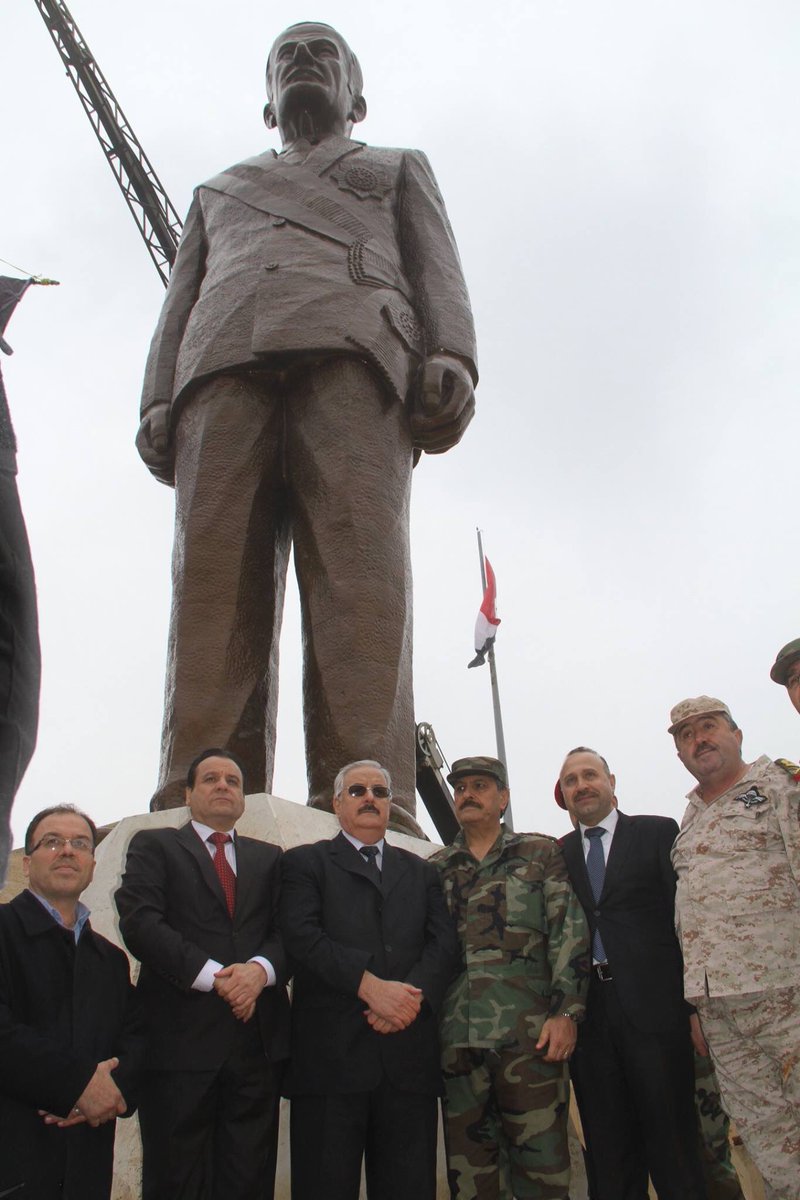
 'While the "Riviera Hotel Conference" was launching what was later called the "Beirut Platform," which would declare Chemical Assad's fate no longer an issue for international deliberation as well as "the end of the war against the regime" according to Louay Hussein, the regime was returning Hafez Assad's statue to the city of Hama on the 35th anniversary of the city's destruction by Hafez Assad.

 This "Hezbollah Platform" attempts to block the opposition delegation from attending the Geneva negotiations scheduled for February 20. At the same time, it seeks to aid the great campaign of despair, launched after the fall of Aleppo to convince people of the end of the revolution and the regime’s reestablishment of control over Syria.

 The reinstallation of Hafez Assad’s statue in the city of Hama reveals the kind of future awaiting the Syrians if the ruling gang was to regain control: a replica of Assad's experience in the wake of his devastating victory in Hama in 1982 by turning the disaster that the city underwent into the means of perpetual terrorization of the Syrian people. Contrary to the common legal principle, in Syria, every Syrian is accused until proven innocent. No Syrian is safe unless the regime and its affiliated institutions and thugs say so.


 Is this possible? Could the regime take over Syria in the same way that it did in 1982, and could Syrians become slaves again?

 These are the hopes of the regime and its small support base, which viewed the revolution as a threat against their existence. They were encouraged by the fact that their destruction of Syria and the Syrians passed with impunity, while this would have justified the ousting of 10 regimes. Contrary to the claim that the opposition relied on outside aid, it was rather the regime and its supporters who turned out to be more reliant on outside help.

 It was not only allies like Iran and Russia that supported the regime, hostile countries also joined in. This is why we do not see pro-resistance media on occasions such as visits from Western parliamentary delegations or foreign media and statements from Western politicians on the possibility of rehabilitating the regime and restoring its legitimacy or its desirability as a lesser evil in the face of terrorism.

 No one seems to care about the people of Syria enough to ask if they would accept a return to a regime of slavery. It seems that they have the least say in determining their own fate and that of their country's. However, they have changed a lot over the course of the revolution and the war, something that will prevent the repetition of the 1982 experience. Maybe the most important change was that they realized their silence in the face of the disaster of Hama did not protect them from a similar fate. Syrians may not all know what could be done in such horrible circumstances, but they definitely know what should not be done, which is to accept slavery again.'

Sunday, 19 February 2017

The Assad Régime Used Child Rape as a Weapon of War


 'They took off my clothes!”, the 11-year-old girl screamed. She didn’t seem to know what she was saying as she wandered the streets of her village, located in southern Syria near the city of Daraa.

 For safety reasons, Fatima did not want the name of her village to be used. As if crazy, the child, Nora, yelled snippets of words, sentences with no beginning or end and repeated again and again: “They took off my clothes! They took off my clothes!”

 Nora’s mother, Fatima, stumbled across her daughter by chance when she turned down this street. For the past few hours, she had been frantically searching for her child after hearing a rumor that a group of children who had been detained in a military base might have been released. As soon as she heard, the 35-year-old mother took to the streets, hoping beyond hope to find her missing daughter.

 When she finally saw her child, Fatima struggled to recognize the features that she had once known by heart. She moved closer. Nora, in a state of shock, didn’t recognize her.


 They had last seen each other only a month and a half before– 45 days to be exact. Yet it was as if an eternity had passed since May 3, 2011. It was the very beginning of Syria’s Arab Spring. All across the country, more and more people were joining protests against the regime of President Bashar al-Assad and the regime was cracking down. The wave of repression was at its bloodiest in Daraa and its surrounding region, the epicenter of the popular uprising.

 In early May 2011, Syrian soldiers and pro-government militias known as the Shabihas had surrounded the town. As helicopters circled over the neighborhoods, soldiers went house-by-house to flush out the protesters they considered “terrorists.”

 Karim, Fatima’s husband and Nora’s father, was accused of having helped people who were wounded by bullets fired during the protests. On that particular evening, Karim wasn’t at home. The soldiers ordered Fatima to contact him. She pleaded with them, trying to explain that she and her husband were “practically divorced,” but the soldiers didn’t want to hear any of it.

 An officer’s gaze settled on the two children in the room: Nora and her younger brother. Fatima panicked. In an attempt to protect them, she told the officer that they weren’t her children. But terrified Nora cried out, “Mama!”

 “We are going to hold your daughter hostage until your husband turns himself in,” the officer announced, grabbing Nora. He and his men hauled her off to a military base in Daraa [the exact location is withheld for security reasons]. The same night, Nora’s father, Karim, turned himself in at the military intelligence agency. Despite this, his daughter would remain a prisoner for the next 45 days. Karim, for his part, would never return.


 The family fled Syria close to four years ago and they now live in an apartment in a poor neighborhood in Amman, the capital of Jordan.

 Nora is now a fragile 16-year-old. Her purple abaya, which is dotted with white flowers, doesn’t hide how frail and slight her body is.

 Fatima speaks in a low voice, but there is no mistaking her determination to speak out. Many Syrian parents have chosen to remain silent about the violence suffered by their children in an effort to protect them from the shame of the social exclusion that could ensue. Fatima, however, wants people to know about “what Bashar al-Assad did to us”.

 With a slow movement, she pulls out several jars of pills from a well-worn handbag.
“Nora takes medicine to help calm her down,” she says gently. “I can’t tell you her story in front of her, or else…”

 … or else, she might hurt herself. Nora has already tried to kill herself several times.
Patiently, Fatima recounts the story that her daughter eventually told her.


 When Nora arrived at the military base, she realized that she was not the only child there. More than 45 people, mostly women and teenagers, shared her cell. Starting very early in the morning, the prisoners were given pills. The youngest were also given injections. Nora endured regular blows from her jailers. On the 40th day, the jailers told the children to “get ready”. The children thought that the hour of liberation had finally arrived.

 Soldiers took Nora from the cell. Soldiers undressed her then brought her into another room. There, a naked “man with grey hair”– the director of the military base– was waiting for her.

 It pains Fatima to continue.

 “Nora told me, ‘He took me. And he raped me. He slept with me.’ Nora screamed, she tried to flee, she struggled to escape his grasp.”

 What happened next is deeply disturbing.

 “He then gave her a small yellow pill and gave her a shot in her right arm. He hit her so hard that her head started spinning.”

 The next morning, the little girl woke up in an interrogation room. She was covered with blood and several officers were standing around her. Why was there blood there? she wondered. What happened? Nora has no idea what these other men did to her.

 “She remembers seeing the man who raped her,” says her mother. “But she has no idea what the others did to her.”


 In mid-June 2011, shortly after Nora was assaulted, the soldiers on the base defected en masse. As they left, they helped the children to escape.

 Fatima found her daughter wandering around in the street. She immediately took her to the doctor. The practitioner confirmed that Nora had been raped. She also explained that Nora’s vagina was so damaged that she would need an operation.

 Fatima only knows what the doctor told her. Her daughter won’t talk about it.

 It wasn’t until January 2013– a full year and a half after Nora was assaulted that she told her mother what happened to her.

 “When we fled to Jordan, Nora cried,” Fatima said. “I thought that she was sad to leave Syria. But she said, “No, I’m happy to leave that place.” I asked her why and she told me everything.”
Five years after the incident, the family is still traumatized. Nora can’t bear to be around any men. Both she and her little brother have received care from a center for orphans in Jordan. One of the coordinators at the center, Loubna, has taken Nora under her wing over the past year.

 “When I met Nora, she acted like a woman, not like a little girl,” Loubna remembers. “She said, ‘I know what happens between men and women. And she really knew. How could she know those things?”

 While confiding in Loubna, Nora disclosed other details of the assault.

 “The prison director told her that she was cute,” Loubna said. “He also took her to see a woman who was being tortured. ‘If you don’t want to suffer like that, you should come with me.’ Nora didn’t know what that meant. She was only 11 years old. She was a child.”


 Nora was a child who was drugged, raped and mutilated. Like other underage victims in Syria, Nora was targeted, and then abducted, by the regime because she was the child of man considered to be a “terrorist”.

 Because sexual violence against children is the ultimate taboo, it is hard to measure the extent of its role in the Syrian conflict. There have been reports of rape, threats of sexual violence as well as simulations, sexual mutilations and the electrocution of genital organs.

 In more than six years of war in Syria, no one knows how many children have fallen victim to violation and abuse, despite the fact that these crimes fall under the “six grave violations” against children during armed conflict (as established by the UN Security Council). Documentation of these crimes remains extremely rare, and are buried in general reports. However, there hasn’t been a single investigation focused entirely on violence against children.

 “There is proof that girls and boys scarcely over the age of 12 have experienced sexual violence, including both torture to their genitals and rape,” said international human rights organization Save the Children in its 2013 report Childhood under Fire.

 The NGO Human Rights Watch also mentions sexual violence against children in two more general publications, one about the detention of children and the second about sexual assault within Syrian prisons. The Office of the United Nations High Commissioner for Human Rights, which documents human rights violations in Syria, has also written several paragraphs about this topic in various reports.

 In 2014, in a publication by the UN Secretary General on “children and armed conflict in Syria”, investigators said that the “UN was assembling proof of sexual violence endured by children detained by government forces in both official and secret detention centres”. UN investigators don’t hesitate to state that “this violence [against children] serves to humiliate, wound, obtain forced confessions or to pressure a parent to turn himself in.”


 The Syrian regime has started using sexual violence against children as a weapon in its repressive machine. This very first victim of this weapon was likely a Syrian boy named Hamza El Khatib.

 On April 29, 2011, anger and unrest were rumbling across Syria. On that day, 13-year-old Hamza was arrested by Syrian authorities during protest in Daraa. This round-faced boy would die in detention. A month after his arrest, Syrian authorities returned his horribly mutilated body to his parents, as if to send a warning to those clamoring for revolution in Daraa. Hamza’s small body bore many signs of torture. Among other things, his penis had been cut off.

 This gruesome warning, however, did not play out to its desired effect. Instead, it set the country ablaze. Young Hamza became the first martyr of the Damascus Arab Spring.

 To understand the extent to which this violence was systematic, one must to cross the Syrian border into southern Turkey, to an area called Antakya, where many former actors of the state’s repressive machine now live. One of them is Bassam Al Aloulou, 54, a former general in the Syrian army who was once the director of Aleppo’s civilian prison.

 Since 2012, this general and his family have been living in Apaydin, a Turkish military camp reserved for roughly 5,000 officers who deserted the Syrian army and their families. The camp is tightly controlled and the living conditions there are better than the refugee camps in Jordan and Greece, which overflows with tens of thousands of Syrian refugees who don’t have any special titles or medals.

 General Al Aloulou served Assad’s regime for three decades, first as a director of a police academy, then as a prison director in Daraa and Aleppo. The day he deserted– July 18, 2012– is engraved in his memory.

 Even in the early hours of the revolution, Aleppo’s civilian prison, which was thought to be less repressive than the detention centers run by the government’s intelligence services and other branches of the military, was overflowing with inmates. Though its capacity was 4,500, it soon had 7,500 inmates on the books.

 There were even more prisoners who did not exist officially. These were the prisoners “who we weren’t supposed to ask any questions about”, according to Al Aloulou. Though he had always been a loyal cog in the wheel of Assad’s repressive machine, this long-time military man and civil servant was starting to become fearful… of God.

 “I said to myself that I needed to start applying the law because, the day I die, God will punish me.”

 Al Aloulou, the former general, clings to his Muslim prayer beads, called a misbaha, yet he speaks with the military precision of someone who is used to giving reports.

 “When I left, there were about 1,000 minors in the civil prison in Aleppo,” he says. “Most were criminals, but some had been detained to put pressure on their parents. To my knowledge, the youngest was 13 years old.”

 Al Aloulou says that, Damascus has had a clear policy on detained children since Spring 2011.

 “The Damascus committee [Editor’s note: A body including the highest directors of each branch of security in the Syrian government] ordered us not to differentiate between minors and adults. They told us: ‘Because they are at protests with the adults, we will treat them in the same manner’.”


 Minors are no longer kept separately from the other prisoners. Now, they are imprisoned with adults, many of whom are common criminals.

 The effects of these orders on child detainees were immediate and devastating.

 “The older prisoners started to exploit the younger ones. They forced them to carry out tasks like dishwashing and cleaning… they also raped them,” Al Aloulou said.

 Al Aloulou swears that he requested that minors be once again separated from the adults. He also says his request was granted, but it’s impossible to verify this statement.

 However, Sema Nassar, an activist who has worked on sexual violence perpetrated against Syrian women, confirmed the complex layers of violence experienced by underage prisoners.

 “The violence against children isn’t just carried out by prison guards and torturers, but also by other inmates, especially those who have leadership roles within each cell, who have influence over other prisoners and who take advantage of the children.”

 Al Aloulou also admitted that the prison that he ran contained a special cell holding about 30 women and young girls, most of whom were family members of opposition figures, and children “under the age of 13”.

 Sometimes, he says, the orders were literally, “Drag this person out of his home. If he isn’t there, you can take anyone– his wife, his daughters. And we’ll keep them until the man who we are looking for turns himself in.”

 That’s what happened to Nora, the little girl from Daraa.


 However, the sincerity of the remorse expressed by the prison director quickly comes into question. According to an activist media network in Aleppo, Al Aloulou is known for his violent and predatory behavior towards female prisoners and the wives of inmates.

 Zero Impunity located a man who served as Al Aloulou’s assistant at the prison. The man, a colonel, has since also deserted. He upheld the activists’ accusations against Al Aloulou.

 “He often took sexual advantage of female criminals and the wives of prisoners who came to ask a favor for their imprisoned husbands,” he said.

 For the time being, this snippet of information has no more power than an annoying noise. However, if this were to be proven, Al Aloulou could be prosecuted and brought before the international justice system.


 Abdelharim Mihbat, 46, could also be arrested one day. It’s almost impossible to believe this lieutenant specialized in military intelligence as he stands there, protesting that he was simply following orders, that he has a “clean conscience” and that he “never did any harm to anyone during his 28 years of service”…

 Before deserting five years ago, this non-commissioned officer, was a mukhabarat, an officer with the Military Intelligence Directorate. Mihbat worked for the patrols department—called branch 290—which was a veritable house of death, a place where “torturing someone was an activity as banal as drinking some tea.”

 When asked if children were tortured as well, Mihbat responded:

 “The key words are: ‘you don’t differentiate,’” he said.

 Mihbat thinks that the regime had a clear strategy when it decided, at the start of the revolution, to stop differentiating between minors and adults.

 “To say that there would be no difference in the treatment of men, women and children was a way to terrorize the population so much that they would stop protesting.”

 And so, in the prison where Mihbat worked as well as Al Aloulou’s prison, teenagers who were over the age of 13 were incarcerated with adults. Mihbat said he saw this decision play out in the same way that Al Aloulou did.

 “So many rapes took place in the cells,” he said. “Many, every day.”

 Did the leaders in Damascus know that mixing children and adults would result in these abuses? Was it done deliberately?

 “Yes,” Mihbat said. “This measure was enacted at the same time as the law against terrorism.


 However, in Syria, locking up children is nothing new. It’s actually been a common practice for a long time, according to the late Wladimir Glassman, a Syrian expert and author of the blog “An eye on Syria”, published by French newspaper Le Monde. According to Glassman, an estimated 600 children were held as political prisoners between 1980 and 1983 for the sole reason that one of their family members was part of the Muslim Brotherhood. At the time, this organization was considered the sworn enemy of Damascus.

 “Anyone suspected of being part of this organization was destroyed” both physically and psychologically, according to French journalist Christian Chesnot, the co-author of Les chemins de Damas, a book about Franco-Syrian relations.

 Detention centers were not the only place where Syrian children were raped. Children, both boys and girls, became the playthings of the regime all across Syria: at checkpoints, during raids and in their own homes.

 Mihbat, the intelligence officer from Aleppo, was part of a unit in charge of arrests and raids in neighborhoods suspected of supporting the rebels.

 “At the start of the revolution, the director general of military intelligence, Abdulfatah Homsi, gave orders to our director general. From that moment forward, ‘we had a free hand’. Before, there was at least some oversight. When the revolution started, that was over. There were no more limits.”

 According to the former agent, orders to arrest someone were occasionally written down and often given verbally. However, “when it involved real members of the opposition who had participated in the protests”, the mukhabarats had the authorization to “take the family, the wife and the children, if he wasn’t there.”

 This is what happened when they carried out an operation in a house in Assoukari, a neighborhood in Aleppo.

 “The man wasn’t there, so my colleagues ripped apart his home, threatened his wife and took his three young daughters, who were elementary-school aged,” Mihbat remembered.

 Mihbat, who claims that he “just watched” the proceedings, did help throw the girls into a car, which he then drove to the military branch. The three children were taken into an interrogation room. No one knows what happened to these three little girls after that.


 Colonel Khaled was on the other side of the struggle– he was part of the Free Syrian Army in Daraa, to be exact.

 Khaled once worked for Assad’s side, but he had defected in 2012 and joined the opposition. Starting in the summer of 2014, the walkie-talkies that he and his men used actually picked up the communications of government forces. They listened in for a full year.

 “We heard mukhabarats give orders to Shabihas [Editor’s note: pro-government militia groups],” he remembered. “They said: ‘anything you get your hands on belongs to you. You can do what you like with it’. That included rape. They knew that we were listening and they were almost proud of it. They spoke about raping women and all the other damage they were going to do to destroy our morale.”

 According to Mihbat, the man behind this is Louay Al-Ali, the head of military intelligence in Daraa.

 “Everything in the region is in his hands. It’s his strategy to tell the Shabihas [the militias] to do whatever they want. They are the people who are violent with women and children,” Mihbat said.

 The regime targets children in order to terrorize members of the revolution. Other adolescents fall victim to violence simply by being in the wrong place at the wrong time in the chaos of war.


 Night has fallen in Amman, the capital of Jordan. A peace has settled across the city and there is a freshness in the air. In his living room, Abdul Hamid Kiwan, a man with a salt-and-pepper beard, serves tea as he waits for his friend Bassam Sharif. These two family men met in prison in Syria. Now, they live in the same neighborhood in the Jordanian capital.

 “In prison, you hear a lot of stories about children being raped,” Sharif says. He has a yellowish tint from years spent in prison.

 When he was first imprisoned in August 2011 by the intelligence unit of the Air Force, Sharif met two 16-year-old boys, Mourad* and Nourredine*, who were captured in a sweep of Deraya, a suburb of Damascus.

 “Two handsome boys, mashallah!” Sharif remembered, smiling.

 But his face darkens when he speaks of what was done to them.

 “They inserted a bottle of Pepsi into Mourad’s… and, for Nourredine, it was some kind of wooden stick.”

 How was he so sure the boys were sodomized?

 “When they came back to the cell, they couldn’t sit down. So we guessed what had happened to them. Later, they told us, but they had no shame. They didn’t see it as a sexual assault, just classic torture because the interrogators had used objects.”

 Perched on the edge of his sofa, Kiwan gives his analysis.

 “It’s a method to break society. When former prisoners get together, what we talk about most is the rapes that occurred. Before the revolution, we were used to torture. But not that.”

 Sharif goes one step further.

 “The sexual violence began when rebels took up arms. It was a way to terrorize people. When the stories of rape started filtering out of the prisons, Syrians started to fear that their children would be raped.”


 Close to six years after the conflict began, children continue to be destroyed both physically and psychologically in utter silence and impunity – the result of the free rein given to those who would torture them. Starting with the first breath of the uprising—when young Hamza El Khatib was tortured and killed— the Syrian government has sought to crush this generation.

 That said, in 2012, after a “senior official” complained about this violence against children, the government did take the initiative to have cameras installed in Military Intelligence Branch 235 (known as the “Palestine Branch”), according to Syrian activist Sema Nassar. However, “that didn’t stop the rapes. The perpetrators just stopped committing them in front of the cameras.”

 The impunity is such that Syrian refugees often cite fear of rape as one of the “main reasons they decided to flee Syria”.

 “Raping children? That creates chaos,” says Omar Guerrero, a clinical psychologist at the Primo Levi Centre, which specializes in treatment of victims of torture and political violence.

 “We haven’t started thinking about Syria after-the-war. But what are we going to build a society on? What is going to happen to children who were abused? What kind of men and women will they grow up to be? Will they get their dignity back one day?”

 Using bombs, torture and rape, has the Syrian regime succeeded in crushing the next generation?

 “Children are resilient,” says an aid worker who works with children in conflict zones. “Though we think that the repercussions of this violence will destroy them, they do find a way to get through it”. The young woman remains optimistic. “They are stronger than we think.” '

* Names were changed to protect their identity.

Image result for zero impunity rape at the end of february 2011 children from daraa assad