Friday, 23 September 2016

Obama’s Syria Policy Striptease


 I don't entirely agree with Tony Badran's conclusion that the US administration is fundamentally realigning its alliances in the Middle East towards Iran and away from Saudi Arabia and the Gulf states, but this is a brilliant dissection of its Syria deceptions.


 'America’s settled policy of standing by while half a million Syrians have been killed, millions have become refugees, and large swaths of their country have been reduced to rubble is not a simple “mistake,” as critics like Nicholas D. Kristof and Roger Cohen have lately claimed. Nor is it the product of any deeper-seated American impotence or of Vladimir Putin’s more recent aggressions. Rather, it is a byproduct of America’s overriding desire to clinch a nuclear deal with Iran, which was meant to allow America to permanently remove itself from a war footing with that country and to shed its old allies and entanglements in the Middle East, which might also draw us into war. By allowing Iran and its allies to kill Syrians with impunity, America could demonstrate the corresponding firmness of its resolve to let Iran protect what President Barack Obama called its “equities” in Syria, which are every bit as important to Iran as pallets of cash.

 America’s Syria policy can, therefore, be best understood not in the terms most familiar to Mideast analysts, such as “getting Assad to step aside” or “supporting the moderate opposition” or “paving the way to a peaceful transition and elections.” Rather, it is a strategic-communications campaign tightly run from the White House, whose purpose was and is to serve as a smokescreen for an entirely coherent and purposeful policy that comes directly from the president himself, but which he and his aides did not wish to publicly own. The goal of the president and his closest aides is to convince the Iranians that we would meet our commitments to them while confusing and obscuring the real reasons behind the president’s set decision of nonintervention in Syria from American legislators and the public alike.

 In a recent interview, Wall Street Journal reporter Jay Solomon revealed that in 2013, Iran told President Obama that if he were to strike the regime of Bashar Assad following the latter’s chemical-weapons attack, the Iranians would collapse the talks over their nuclear program. Obama canceled the strike, of course, and later reassured Iran that the United States would not touch Assad. Solomon’s reporting confirms a critical fact about Obama’s Iran and Syria policies: They are one and the same. Or, stated differently, Syria is part of the price for the president’s deal with Iran.

 The White House reaction to Solomon’s assertion was a predictably swift denial. After all, the Obama administration would not want to associate the president’s signature foreign-policy initiative with the indiscriminate slaughter of half a million people and the worst refugee crisis of the new century. In doing so, it followed a well-worn playbook: At key junctures over the previous five years, the administration put out various talking points in the press, often sourced to anonymous officials, whose lines were then validated by allies and surrogates, including officials who had left government and resumed their positions in the think-tank world.


 Obama showed his cards on Syria literally from day one of the uprising against Assad. Unlike his nonnegotiable demand that longtime U.S. ally Hosni Mubarak, Egypt’s former president, step down immediately—not today, but “yesterday”—Obama very visibly and deliberately refused to call for Assad’s removal from power. In the White House, this call was contemptuously dubbed the “magic words,” and the belief was that saying those words would raise expectations of an active U.S. policy to see it through. This view—espoused by officials such as Steven Simon, then-National Security Council senior director for the Middle East and Africa—one of the linchpins of the White House communications strategy both from inside and then outside the White House, was put out in the media through favored surrogates, like George Washington University’s Marc Lynch, who reiterated the White House’s case and derided critics of the president’s refusal to utter the “magic words.”

 One of the initial go-to lines was that the administration wanted to avoid further “militarization” of the situation. “We do not believe that militarization, further militarization of the situation in Syria at this point is the right course of action,” said then-White House press secretary Jay Carney. “We believe that it would lead to greater chaos, greater carnage.”

 Again, White House surrogates faithfully disseminated its talking points and policy preferences. In an article in February of 2012, Washington Post columnist David Ignatius quoted an unnamed senior official who derided the rebel Free Syrian Army, then regurgitated the administration’s view that “shoveling weapons to this disorganized opposition now is likely only to increase civilian deaths.” Marc Lynch likewise repeated the administration’s position, often using its own stock lines verbatim, in several articles for Foreign Policy and in a paper for the Center for a New American Security.


 To shore up the noninterventionist position it had already guaranteed the Iranians, the White House introduced the enduring fixture of its Syria policy: bringing in Russia as a principal partner. The move coincided with the creation of the Friends of Syria group —intended to bypass Russian obstructionism at the U.N. Security Council. Obama then undercut this group of U.S. allies by instead drawing closer to Russia.

 Working to accelerate Assad’s fall, the White House messaged, “could undercut U.S. efforts to persuade Russia to halt military aid to the Syrian regime.” Marc Lynch echoed the line in his CNAS paper: “It would also be very difficult to stop Russia, Iran, or others from supplying fresh arms and aid to Assad once the opposition’s backers are openly doing so.” Meanwhile, the Washington Post’s David Ignatius seconded the administration’s move “to make Moscow part of the solution,” and give “Russian leader Vladimir Putin a role in brokering the transition.” If people wanted a solution to the Syrian problem, the White House argued, they should go and talk to the Russians. “So the question shouldn’t be how to turn up the heat on Assad,” Ignatius wrote. Rather, U.S. regional allies should do “the heavy-lifting,” and go to Moscow. Having established the principle of nonintervention and set the role of Russia as principal interlocutor for the region, the White House set the contours of America’s actual Syria policy, which endure unchanged to this day.

 The partnership with Russia became a public fact in 2013. Following Assad’s chemical-weapons strikes, Obama reached a deal with Putin that allowed the U.S. president to continue his policy of nonintervention against Assad. At this point, White House messaging made a 180-degree shift. Obama’s decision, administration officials readily acknowledged, meant Assad—who, a year before, they said was about to fall at the hands of the people or as the result of a coup—now had “considerable staying power.” It was, therefore, too bad, other administration officials said, that “the window of opportunity for strengthening the moderate opposition may have closed.”


 Instead, administration officials started telling reporters on background that no outside support would have mattered, anyway, as the gap between America and the Syrian regime and its allies was simply too big to ever have been bridged. The president himself would publicly voice this position, declaring the notion that supporting the rebels—“former doctors, farmers, and pharmacists,” as the president disparagingly referred to them—would have made a difference against a regime backed by Russia and Iran, has “always been a fantasy.” To suggest otherwise, the president said, was “horseshit.”

 Like the assertions of 2012, these claims, presented as serious assessments of the situation on the ground in Syria, were simply part of a White House messaging campaign, whose purpose was to support a policy that was already set—but which the public was judged not to be ready for. That the arguments the administration was making were paradoxical and contradictory didn’t matter, so long as the point was the same: America wouldn’t and couldn’t intervene against Assad. Naturally, surrogates like Lynch echoed the administration’s arguments, even when they changed, and also felt at home in the contradictions of their positions. “There’s no way to know for sure” whether U.S. support in 2012 would have made a difference, Lynch would later write. In fact, he asserted, things would’ve played out exactly as they have, with the only difference that the United States would’ve been in the middle of the fighting.


 By the end of 2013, the White House began to mainstream its open disregard for even the pretense of removing Assad, thereby circling back to its initial position in 2011. Unnamed senior administration officials were cited as talking privately about Assad “staying for the foreseeable future” and “voic[ing] regret about the decision, in August 2011, to call for him to step aside.” In early 2014, Frank Wisner of The Iran Project and Leslie Gelb, both veterans of the realist foreign-policy establishment, were chosen to carry this White House message to members of the Council on Foreign Relations and other thumb-sucking senior types. The president and officials at the White House, Wisner and Gelb wrote, realized “it was too quick off the mark and too absolute” in calling for Assad’s departure. “Perhaps now,” they added, “administration officials are prepared to entertain a transitional working arrangement with Assad.” The new focus for U.S. policy, the authors wrote, should be on combating Sunni terrorism and on providing humanitarian aid to Syrians. Amazingly, much like the expert advice not to intervene militarily in 2012, what Wisner and Gelb were “recommending” was the actual substance of White House policy, which the communications effort had formerly been designed to obscure.

 The form of Wisner and Gelb’s article became the preferred genre for the White House’s Syria echo chamber: the striptease. Hand-picked experts offer fresh policy advice to the president. The authors demonstrate their independence by criticizing the supposed current policy and propose a new course of action. Within weeks, the new course of action is acknowledged as policy, thus flattering the importance of the experts. Only, what the experts suggested was already the policy—and what they were “criticizing”—was the fan that the messaging campaign had manufactured to obscure, for a time, what the White House was actually doing in Syria.

 The success of this dance was great enough that many more proposals for “new” policy, all recycling the White House’s latest set of talking points, were floated, each with the aim of revealing another few inches of actual policy. Simon, who was now out of government, put forward a “new plan for Syria,” in which he called for “containing extremist violence” and “reducing the number of noncombatant deaths.” One month later, Lynch published another paper with CNAS, in which he reproduced all the key White House talking points used to describe its policy to this day, debuting terminology, like “de-escalation” and “protecting Iranian equities,” which was then promptly adopted by the White House.

 Both Simon and Lynch floated the idea of promoting local cease-fires—now a mainstay of the White House’s declared policy—as the way to go in Syria. Again, they were not so much promoting views that were original to them but promoting a pre-existing conceit, whose actual sponsor, Robert Malley, was appointed in February 2014 as a senior director at the National Security Council, where he worked alongside Phillip Gordon, who came in the year before as coordinator for Middle East policy.

 By following in Malley’s footprints, it is easy to see where specific ideas came from, and the corrupted nature of the policy debates that were used by the White House to promote its set agenda. For example, Malley met in Washington with journalist Nir Rosen, who has a close relationship with the Assad regime. Following his meeting with Malley, Rosen authored an unpublished pro-Assad report making the case for local cease-fires—which have been an instrument of warfare for the regime camp. Malley distributed Rosen’s report, which, naturally, was also leaked to David Ignatius. Simon’s and Lynch’s pieces floated the approach favored by Malley and the White House in much cleaner form and venues than the tarnished Rosen.


 The emergence of ISIS presented an opportunity for the White House to advance the president’s vision of a regional realignment. Under the rubric of a new war on Sunni jihadism, the president elevated Russia and Iran to senior partners, and privileged their position, while shelving all discussion about Assad. What had been secret and a cause for strenuous denials was now palatable state policy, which the White House could therefore publicly own.

 Hence, Simon, reflecting the direction of White House policy in the guise of fresh advice, proclaimed the United States should start discussing Syria with Iran in order to have “the best chance of long-term success.” Similarly, Marc Lynch proposed the White House adopt “an alternative Iran-centric approach, one built upon seeking a working accord with Iran rooted in common interests in … stabilizing Iraq and Syria, and fighting jihadist groups.” In addition, like Wisner, Gelb, and Simon had all written earlier, Lynch echoed the White House by calling for sacrificing the “goal of ‘near-term’ regime change” in Syria.

 Following the White House’s standard operating procedure, anonymous administration officials had already been leaking all these talking points to the press during the course of 2014. For instance, in July of that year, it was reported that administration officials were proposing setting aside the removal of Assad from power. “Anyone calling for regime change in Syria is, frankly, blind to the past decade,” one unnamed senior official told The Daily Beast. Other officials were “suggesting that Iran could be a partner in a postwar Syria.” When Lynch spoke of “us[ing] the ISIS crisis to create a sustainable regional accord,” he was therefore merely putting his own name to statements that the White House had already publicly vetted.


 Obama’s Syria policy once again came under criticism following the Kremlin’s move to intervene directly in Syria. The president looked weak in the face of Russian assertiveness on behalf of its ally. The White House’s initial messaging was therefore to paint the Russian intervention as an idiotic decision that would inevitably backfire on Moscow. Putin’s intervention reflected weakness, not strength, the president maintained. As such, the preferred White House talking point was that Russia was only getting itself trapped in a quagmire. “An attempt by Russia and Iran to prop up Assad and try to pacify the population is just going to get them stuck in a quagmire, and it won’t work,” Obama said in early October.

 These lines were quickly put out in friendly media outlets. The Brookings Institution’s Jeremy Shapiro, who had worked for Philip Gordon at the State Department before the latter moved to the White House, enthusiastically regurgitated the administration’s approved talking points in an interview with Vox also in early October. Shapiro repeated the claim that the Russian intervention was “incredibly stupid stuff,” a “serious mistake,” and, naturally, that it would get Moscow into a “quagmire.” The Russians, Shapiro declared, were “banking on this idea that they’re going to bring us around” on Syria. But, he asserted, “I don’t think they are.”

 As the White House pushed these talking points about how dumb Putin was, it also continued to stress the president’s unshakable principle of nonintervention. “We’re not going to make Syria into a proxy war between the United States and Russia,” Obama made clear. “This is not some superpower chessboard contest.” Anyone suggesting military options, the president continued, was simply “offering up half-baked ideas” and “a bunch of mumbo-jumbo.”

 Philip Gordon, now also out of government, was a notable conduit for the main talking points: de-escalation, cease-fires, humanitarian aid, and shelving the question of Assad. “The White House,” one senior administration official—the point man for Syria at the time, and now, is Robert Malley — told Bloomberg View in early October, “thinks we can de-escalate the conflict while keeping Assad in power.” Gordon, Malley’s recent colleague at the NSC, and now a freshly minted fellow at the Council on Foreign Relations, then laid out this White House position in an essay and a paper for the CFR, which fall into the familiar genre of validating current policy in the guise of “rethinking” it. He also echoed the White House’s direction of bringing Iran formally to the Syria table as a major stakeholder. More aid to the rebels, he opined, would only add to the violence and would harm prospects of a deal with Russia. Escalating the war, Gordon wrote, wouldn’t succeed. In fact, it was counterproductive. However much we escalate, the Russians would only counter-escalate. When would the bloodshed ever cease?

 Through Gordon, the White House laid out where it wanted to go, and where it is today: a bilateral process with the Russians, cutting out all those annoying U.S. allies pushing us to escalate and insisting on Assad’s departure. Hence, Steven Simon, now also a freshly-minted objective policy expert and not an NSC operative, would express “satisfaction” at the presence in Syria “of a powerful military player” like Russia, which he described as “really the only tacit partner” of the United States. The Russian presence, Simon wrote in a Foreign Affairs essay that October, makes it “no longer feasible for the United States to establish a safe haven or no-fly zone”—steps the administration had strongly opposed years before the Russians were anywhere near Syria. Critics of Obama’s policy who were calling for any consideration of military action, the message went, could take a hike.


 None of this is conjecture. Partnership with Russia is what the White House has sought after since late 2015 and throughout 2016—with Malley as the point man, negotiating directly with the Kremlin’s special envoy. By early 2016, Shapiro, who had parroted the White House’s misguiding spin on the incredible stupidity of the Russians’ intervention, was now saying the Russians actually held all the cards in Syria, and the only option for the U.S. is to work with them, on their terms. What’s more, echoing Malley, Shapiro laid out the White House position on the need to finally take military action—against the group then known as Jabhat al-Nusra, and to push (meaning, to threaten) the opposition and its backers to stop all cooperation with it, if the killing was to stop in Aleppo. This was, in fact, the deal that Malley negotiated for the White House, and which Secretary of State John Kerry announced several days ago.

 For five-and-a-half years, Obama has maintained an unwavering position against intervention on the side of Assad’s enemies in order to set the stage for a U.S. realignment in the Middle East. To shield this ambition from view, and therefore from criticism, the White House launched an elaborate spin campaign whose purpose was to deflect and manage domestic and allied criticism while the president pursued his objective. In partnership with Russia, Obama has directly shaped the course of the Syrian war while single-mindedly working to actualize his vision of a new American alliance with Russia and Iran that will allow America to take a permanent vacation from the Middle East. While the end result of this effort may not be what Obama and his closest advisers hope, his actions are clear, and their consequences now appear to be locked in, no matter who comes after him in the White House.'
Thursday, 22 September 2016

 Syrian Writers Speak Out Against US and Russian Policy

Airstrikes in Syria

 'We the undersigned are democratic and secular Syrian writers, artists, and journalists who have opposed the tyrannical Assad regime for years, even decades. We are participants in the struggle for democracy and justice in our country, our region and in the world. We unreservedly, and in the strongest language, condemn the Russian and US approach of intervening in our internal Syrian affairs. At least since 2013, these two powers have been working to co-opt the Syrian liberation struggle under the rubric of the “war against terror.” This is a war that has failed to score a single success since its outset, and has led instead to the destruction of a number of countries.

 Three years ago the two imperialist nations signed a reprehensible deal on chemical weapons that resolved a problem for the United States, Israel, and Russia, and even for the Assad regime, which had just murdered 1,466 of its subjects. The deal however did not resolve any of the problems facing the Syrian people. Rather it gave free rein to an extremely criminal regime that kills Syrians, destroys their villages and communities, and drives them into exile. The deal has also proved to be a priceless gift to Islamist nihilistic groups like Daesh and Jabhat an-Nusra. Three years into this contemptible deal—with the death count now at around half a million Syrians—Russians and Americans have agreed to freeze the current situation so that the two military powers can carry on their endless war against terror. The agreement remains silent on the untold number of detainees held in brutal conditions, and includes no call for lifting the blockade on besieged areas, or the withdrawal of Iran, the Hezbollah militia, or any other sectarian militia. It is also devoid of any reference to the concept of a new and democratic Syria. Nor are the warplanes of Bashar al-Assad restrained from bombing areas that will ultimately be the subject of a later agreement between Russia and the United States. Not only does this show complete lack of a moral sense of justice on the part of the Russian and American negotiating teams, it also exposes the degradation of politics and the lowly level of officials in the two most powerful nations in the world today.

 Our feelings of anger over these agreements and their authors know no bounds. And we reject them absolutely. We are also disappointed in the United Nations, angered that, as was recently revealed, it has been financing the criminal oligarchy of Assad and his cronies throughout their war against the Syrians.


 As Syrian writers, artists, and journalists, we see the world today heading toward an unprecedented numbing of ethics. Levels of fear and hatred escalate in parallel with the increasing visibility of politicians who invest in the same feelings of fear, hatred, and isolationism. We see democracy in retreat around the world, while surveillance, control, and fear are rife and advancing. We do not believe that our fate is defined by these conditions, but rather that these are a result of dangerous choices taken by dangerous political elites, and that we must work together to voice our opposition to them, right now and wherever we may be.

 A destroyed Syria is the symbol of the state of the world today. The Syrian revolution was broken against the solid wall of the international community, and not only against the wall of the forces aligned with Assadist fascism. This international community allows politicians like Obama and Putin, along with their agents and clones—people lacking all sense of humanity—to take decisions that violate our right to self-determination, as individuals and groups but also as a nation. We have not elected them, and we have no access to any mechanism that can call them to account. This is an unfair system that fiercely opposes democracy. Therefore it must change.

 Unfortunately, there seems to be too little awareness of how hazardous reality has become. Many, especially in the West, prefer to hide behind fatalistic theories steeped in religion or culture—when they do not attribute events to climate change. This explains why a bad situation has become much worse, but it also absolves the powerful elite, including Bashar al-Assad and his gang, of their political responsibilities.

 This world must change. In just five and a half years, it has allowed the destruction of one of the most ancient cradles of civilization. The world today is a Syrian problem, just like Syria today is a world problem. And for the sake of this world, for all our sakes, we call for the condemnation of the politicians responsible for this disaster and for their exposure as nihilistic murderers and terrorists, similar to their arch-rivals in the Islamist nihilistic camp.'

Sunday, 18 September 2016

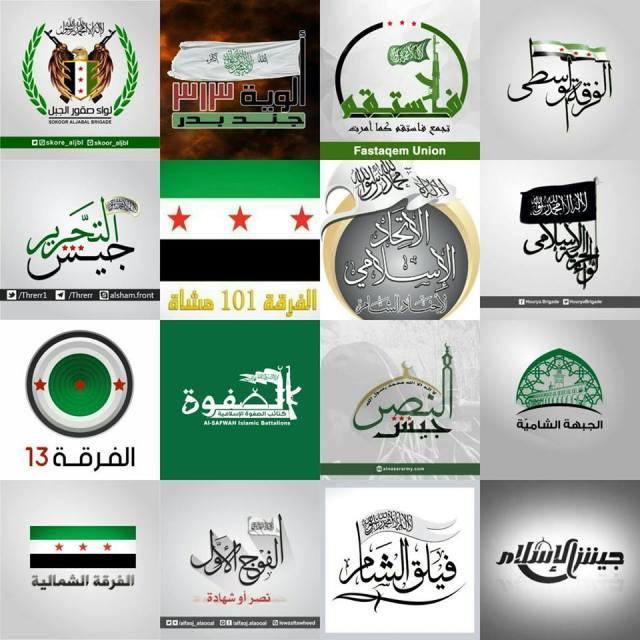
The Free Syrian Army rejects the US-Russian deal

14364752_1186034518135788_5539454607277129300_n.jpg

 'The false proponents of justice and freedom and the ‘guardians’ of human rights and democracy continue to insist on trading with the tragedy of the Syrian people and their corpses, taking from the Nakba [catastrophe] and ordeal of this poor population an arena for their competition and struggles for influence and interests, and a tinged road on whose sides drip the blood of the innocents in order to achieve some gains and ambitions, laying beneath their feet all of the meanings of justice and humanity and leaving behind their backs the demands for dignity and freedom.

 Subsequently, a few days ago we received details of the /US-Russian/ agreement concerning a ceasefire to hostilities and a general truce in Syria accompanied by the entering of humanitarian assistance into the besieged neighbourhoods of the city of Aleppo, and after a careful study of those clauses and an in-depth reading of the whole of the internal and external challenges and the humanitarian and military realities on the ground and the complex political scene, the factions of the Syrian revolution view it as necessary upon itself to clarify to its people before anyone else the host of reservations it has with regards to this dry and unjust agreement:


 – Firstly: The incredible humanitarian tragedy that our people and families are subjected to have always placed at the head of our priorities the necessity to improve the humanitarian situation of the rebelling Syrian people and especially in the liberated areas, and proceeding from this feeling of responsibility we have always taken care to evaluate international initiatives and truce proposals that are presented to us so long as they do not compromise any of the revolution’s fundamentals and its higher interests.

 – Secondly: With our assiduous commitment to alleviate the burdens off our families we are nonetheless also assiduous in avoiding quick and temporary gains which are faced with certain dangers which will have a negative effect in the long run, such as some of the truces that may stop the bombardment and barrel bombs for a few days or allow the entry of limited quantities of food and medicine in exchange for hazarding the future of the revolution and losing strategic points and locations to the regime of criminality and its allies.

 – Thirdly: The international unwillingness and indeed impotence to take any effective measures that can stop this massacre or ease the weight of the bombardment and siege of our people is no longer a secret, meaning that the only option remaining to us is to rely on our lord first and then on our self-capacities and the justice of our cause second, and to proceed in our battle against the regime and its allies until the last bullet in our rifles and the last fighter from our heroes.

 – Fourthly: We welcome the decision to allow the entry of humanitarian aid to the besieged areas of Aleppo and we declare our full co-operation in the achievement of this, and the safeguarding of protection for the workers in international and humanitarian organisations; however at the same time we categorically refuse tying these assistances (which are a right for Syrians) with any locational truce or alleged political solution from which we have gained nothing until this hour but additional killing, destruction, displacement and overlooking of the killers and criminals; likewise we cannot ever accept any exceptions in the agreement’s clauses to the rest of the besieged ares exhausted by bombardment and siege, and whose people are being pressured by the “starve or kneel policy” pursued by the regime of criminality and terrorism to deliver these areas [to new settlers] and expel its local population as occurred in Daraya and is occurring now in Homs and the countryside of Damascus; this ethnic cleansing which it has become entirely evident is being conducted on sectarian bases which aim to create demographic changes in these areas, the matter which we will not accept under any circumstance and will resist with all means and ways available.

 – Fifthly: The ceasefire terms in its current form leaves open the field for the regime and its allies to exploit it and commit more massacres against civilians and achieve strategic military gains that it was impotent to previously achieve which raises for us serious fears and doubts about the timing and clauses of this truce, for prevailing the long-term interest of the revolution is placed before momentary or temporary gains with our full trust that the regime and its Russian and Iranian allies and the rest of the terrorist border-crossing militias will never abide by them and will circumvent them with every means and methods.

 – Sixthly: The ceasefire terms were vacant from any reference to real guarantees, monitoring mechanisms or clear and injunctive punishments in the event that the regime and its allies break this ceasefire; which will encourage them to break it and utilise it to achieve political and military gains (as in the previous occasions).

 – Seventhly: The ceasefire clauses declared that the prohibition on regime warplanes sorties won’t occur except after 48 hours of truce have been completed, to be followed by another 5-day truce after which a “Joint Execution Group” will be formed to adopt monitoring mechanisms which we see as plenty opportunity for the regime to engage in more killing, destruction and [sectarian/ethnic] expulsion.

 – Eighthly: The terms of the ceasefire have excluded Jabhat Fath al-Sham [The Front for the Conquest of the Levant] whilst it has completely turned a blind eye to the foreign sectarian militias that fight with the regime, and which have been committing its crimes since years in Syria with absolute freedom and without accountability or monitoring, and we consider this matter a dubious and rejected double standard. Accordingly we refuse the targeting of Jabhat Fath al-Sham or any other faction which fights the regime which could weaken the military strength of the revolution and strengthen the Assad regime and its allies.

 – Concluding: We affirm that the Syrian people and its factions will never forget who killed them and who bombed them and who besieged them and who burned their cities and villages, and on the other hand they will not forget who supported them and stood with them in their plight and sacrificed in defence of their blood and honoured possessions.


 Have trust that we will never settle for disgrace in the principles of our revolution and we will not give in to the pressures and cheap political and humanitarian blackmail that is being practiced against us, and we are are fully aware of the malicious traps that are set up for us in order to sink us in a swamp of concessions or lead us to infighting that tears the ranks and disperses the common word.

 On the oath we remain, to the rope of God we hold fast and with his strength and might we seek recourse, not damaged by those who failed us, until we perish without [attaining] our right and freedom and dignity, or God writes for us victory and the prevailing of our revolution.'


 [Commonly-known name in bold]
 Faylaq al-Sham [Levant Legion]
 Harakat Nour al-Deen al-Zinki [Nour al-Deen al-Zinki Movement]
 Al-Fawj al-Awal [First Corps]
 Al-Ferqa 101 Mushah [101st Infantry Division]
 Faylaq Homs [Homs Legion]
 Jaish al-Islam [Army of Islam]
 Al-Itihad al-Islami ly Ajnad al-Sham [Islamic Union of the Soldiers of the Levant]
 Jabhat Ansar al-Islam [Supports of Islam Front]
 Al-Ferqa 13 [13th Division]
 Liwa’ al-Fath [Conquest Brigade]
 Al-Ferqa al-Shamalia [Northern Division]
 Al-Jabha al-Shamia [Levant Front]
 Kata’ib al-Safwa al-Islamia [Al-Safwa Islamic Battalions]
 Al-Feraq al-Westa [Central Division]
 Tajamu’ Fastaqim Kama Umert [‘Be Upright as Ordered’ Union]
 Jaish al-Nasr [Victory Army]
 Jaish al-Tahreer [Liberation Army]
 Liwa’ Suqoor al-Jabal [Hawks of the Mountain Brigade]
 Liwa’ al-Horiya al-Islami [Islamic Freedom Brigade]
 Jabhat al-Asala wal Tanmiya [Authenticity and Development Front]
 Jond Badr 313 [Soldiers of Badr 313]

In Aleppo, besieged residents convinced truce will not last


 'Residents in the rebel-held districts of Aleppo now have a reprieve from the incessant bombings by Syrian government warplanes. They have a promise of an end to the crippling siege that has left produce stalls bare. For nearly a week under the cease-fire brokered by the U.S. and Russia, families have been able to leave their homes and visit each other. Children play on swing-sets in the streets. Hospitals have gone to a normal routine of treating the sick and helping pregnant mothers, rather than struggling with those wounded by war.

 Still, war-hardened residents of Aleppo's eastern districts — one of the last large urban centers defying President Bashar Assad — are skeptical the cease-fire will hold. Many of them say the truce, which began last Monday, is a trap aimed at forcing them and rebel fighters to surrender. Some urge rebel fighters to rest and regroup, then resume fighting that they say is the only way to freedom.

 Ibrahim Alhaj doesn't have to wake up to the sound of barrel bombs that jolted him out of bed almost every day. The 26-year-old was always one of the first on the scene whenever the crude but devastating bombs hit. He is a member of the Syrian Civil Defense, a group of volunteer first responders also known as the White Helmets. He films rescue efforts and documents any "double-tap" attacks — a common government tactic of striking a target again shortly after the first hit to cause more casualties.

 "In the last few days, we rested for a large part. We hope it lasts. On the sixth anniversary of the revolution, we are tired."

 His group is nominated for the Nobel Peace Prize. But he sees its role as bigger: In the future, civil defense will be needed to help rebuild — after Assad's fall, he hopes.

 "We will be honored to build the new Syria and get rid of this sectarian regime," he said.


 Dr. Farida, the only female gynecologist in eastern Aleppo, now has the small luxury of working in a hospital that is not packed with war wounded and without the fear of being shelled as she operates. On a single day this week, she delivered a baby and had two back-to-back emergency operations, including one to save an unborn baby. Then she returned home in the afternoon in time to receive guests for the holiday, took her daughter out to play in the park, and — she noted happily — she had a coffee outdoors in the park. But she has little faith in this cease-fire.

 "If they don't open a corridor to come and go and let out humanitarian cases, what good is it?" she said. She spoke on condition she be identified only by her first name to protect family members who live in government-controlled areas.

 What makes Farida more skeptical is that the truce allows for continued airstrikes against the Fatah al-Sham Front, the affiliate of al-Qaida in Syria formerly known as the Nusra Front.

 It is one of the most powerful Syrian rebel factions and has been crucial on Aleppo's front lines defending opposition areas. Rebels say that if they break ranks with Fatah al-Sham or stand idly by while airstrikes hit the group, that will allow Assad's forces to retake the city. For Farida and other residents, the plan to keep striking it simply aims to crush the resistance against Assad in the city and will spell the end of the cease-fire.

 "Fatah al-Sham is the faction that defended us most," she said. "If it weren't for them, Aleppo would have been handed in long ago."


 On the fourth day of the cease-fire, Wissam Zarqa started a new term teaching English and creative writing to adults.

 It's part of a parallel education system that has sprung up in rebel-held areas, where volunteer teachers like the 34-year-old Zarqa hold classes using their own curricula.

 Zarqa said the truce is doomed to fail because rebels don't accept that one faction will still be hit. He and other activists want the rebels to keep fighting. On Thursday, he joined a demonstration against letting in aid.

 "We don't want aid to come through. We want (rebels) to fight to break the siege," he said. "We need this uprising to go on. The worst thing that can happen is to have a half-finished uprising."


 Mohammed Zein Khandakani, a 28-year old attorney, says the relief of a truce is incredible, given the months of horror.

 "It is an unexplainable feeling to wake up and sleep to the sound and smell of bloodshed," he said. "Those killed are friends, families, innocent people who want to live only in peace, dignity and safety."

 His greatest joy of the past week has been to take his two children and his widowed sister's children to the amusement park after four months locked inside.

 His own father is in Germany, his mother and brother in Turkey, one sister in government-controlled areas, and the widowed sister with him in Aleppo, where her husband was killed in fighting.

 "Imagine if it lasts," he said of the truce. "Imagine if the door opens, and the prison is no more."

 The haggling over the humanitarian convoys offends him.

 "Are we locked-up animals that need food and drinks?" he said. Aleppo's people want to be free to come and go, not be penned in and dependent on convoys. And ultimately, Aleppans won't accept surrender, he said.

 "We don't want to leave our city and in the meantime, we don't want the return of Assad's rule to our city." '

Tuesday, 13 September 2016

At hajj, Syrian pilgrims talk of exile and war


 'Fatima, 38, managed to leave Syria after government troops assaulted her home neighbourhood of Baba Amr in the central city of Homs, one of the cradles of the revolt against President Bashar al-Assad. Of that time, she doesn't want to say much, out of fear of being recognised. She simply says she left "because of the killings and the terror." Fatima only agreed to talk on condition that she not give her family name and not show her face.

 "We are here at the hajj as free Syrians, to say that the regime of the tyrant lies when it says Syrians were deprived of the hajj by Saudi Arabia," said former business student Abdullah Abu Zeid. He comes from Anadan, a rebel-held town just north of Syria's battleground second city Aleppo. He said he would return to his hometown straight after the hajj despite the long bombardment by government forces that has reduced much of it to rubble.

 Mohammed Limam, 26, was a first-year student of Arab literature in Aleppo until the war forced him, too, to drop out. He said that now he is a fighter for the rebels who "resisted in the face of bombardments and destruction". He said he had never left Syria before and the first two days away were hard. "I left for the hajj but right after I will go back and if God wills it, we will liberate all of our country," he said. In Aleppo now, "no one lives normally in a house. You take shelter, you hide, you only go out after properly checking the surroundings, to protect ourselves and our loved ones" especially from air strikes.

 Abdel Rahman al-Nahlawi of the Syrian Hajj Committee, has lived in Turkey for several years, but has lost none of the protective reflexes of those in the war zone. When Saudi helicopters fly overhead monitoring the hajj crowds, he unconsciously frowns and looks around, as do the other pilgrims. "Only a Syrian could have such a reaction each time he hears a helicopter," he quips.'

"I spend time with my friends and brothers in revolution"

View image on Twitter

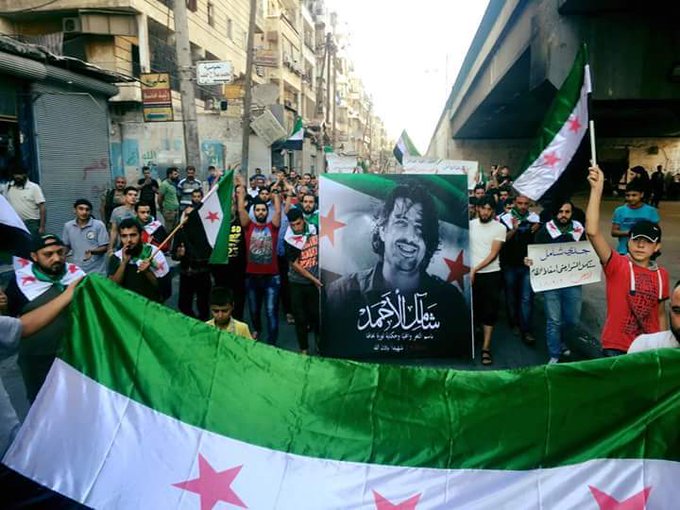
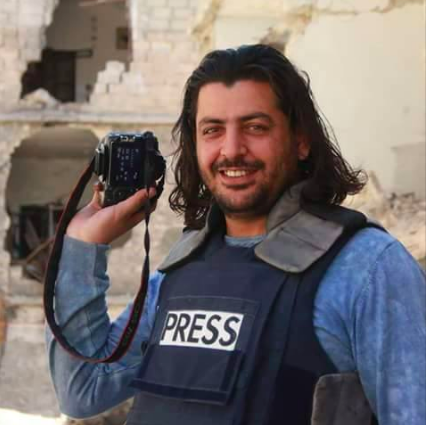
 'Shamel Al-Ahmad passed away along other victims of recent Assad/Russian bombing of the Aleppo city. His 9th month pregnant wife who was with him durning barrel bomb attack passed away a few days earlier. The baby and her 2 and 5 years old siblings survived. At the beginning of September, the Facebook page Humans of Aleppo shared a message from Ahmad.


 “It is not possible to risk my two children’s lives at this deadly point, they are all I have in this world,” Shamel once said.

 My name is Shamel Al-Ahmad. I am 35 years old married and have two children. My life changed when I saw a video of the Syrian regime’s security forces while they were humiliating my people and treading on their heads in Bayda, Banias.


 In July 2012, the freedom fighters entered my city, Aleppo. I became obsessed by the idea of being arrested and detained by regime forces. We were out of the regime control, and I didn't have to hide my identity anymore.

 The risk of being detained is over, but my city turned into an open space for the regime to target all its opponents. Artillery, fighter jets, barrel bombs and even scud missiles. We experienced all those lethal weapons that I documented with my lens. I thought these pictures would tell the story and push the international community to act or at least help the civilians, but lately I've realized that was hopeless.

 ISIS took over parts of my country. I immediately knew that our battle for freedom would be endless and that Assad is not our only problem. I joined the “life makers” team, working on social development and acclimating them with the new reality, the war-time reality.


 I sometimes get depressed and disappointed, and sometimes lose hope. I spend time with my friends and brothers in revolution, who are my hope and source of strength, to overcome my depression. Months ago, somebody offered me to join on a boat trip to Europe. We talked about it many times and I was about to accept it, but eventually I said no…Syria is my country and my cause. However, it is not possible to risk my two children’s lives at this deadly point, they are all I have in this world.

 My friend made it to Germany in late 2015. He seemed happy. We Skype every week and he keeps encouraging me to follow his steps. I just keep refusing. Despite all the reasons, which increase every day and push me to leave, I am the kind of person who can’t survive away from their streets. Aleppo is part of me, I can’t leave it alone. I feel sorry that Aleppo is facing all this horror, but I can still breathe its freedom.

 I was saddened by friends who I lost and who I'm still losing, especially those who are close and brothers in revolution. Many of them lost hope and are not able to carry on. I don’t blame them, but I just feel sorry for not having them around me. I am not against those who decide to leave and seek asylum, because many were forced to do that. I am just against the idea of being there to enjoy life without work or purpose, or without an aim to serve their homeland. I don’t want them to be a burden on the host communities.


 Finally, it’s not easy to stay in Syria anymore, since nobody knows how their complicated story is going to end, but there is still hope to continue the fight.'

Friday, 9 September 2016

Here’s why Assad’s army can’t win the war in Syria

A Syrian army soldier atop Fahr-al-Din castle, photo by Valery Sharifullin/TASS

 Robin Yassin-Kassab:

 ' "This is fascinating. Robert Fisk, Patrick Cockburn* and other commentators dressed up as reporters tell us the only coherent force in Syria is the Syrian ‘government’ and its army, and that the Free Army doesn’t exist. Here a Russian imperialist officer, addressing his own, explains that the Syrian army is only good for extortion, that it can’t recruit any more fighters, and that the Free Army and Islamist resistance far outweighs it in morale and combat ability. He concludes that a victory for Assad is impossible, and that Russia should therefore pull out."

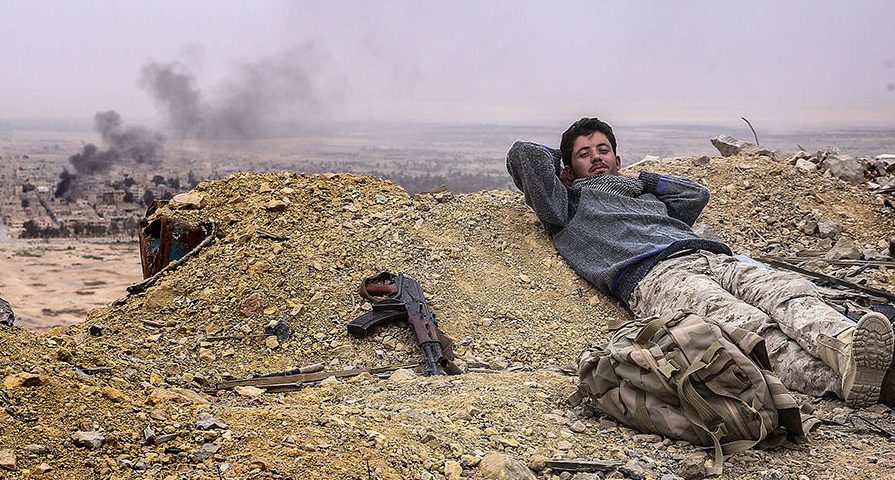
 While militias, Iranian volunteers, Hezbollah and PMCs fight in lieu of the Syrian army, Bashar Assad’s soldier busy themselves with collecting bribes at checkpoints. This view becomes more and more widespread among military experts aware of the actual situation in Syria. The country’s air force is worn down and uses home-made bombs, the soldiers dig moats to protect from terrorists’ tunnels, while the militants enjoy tactical and moral superiority, says Mikhail Khodarenok, Gazeta.ru’s military observer.


 The actual fighting against opposition groups is mostly done by Syrian militias, the Lebanese Hezbollah Shia units, Iranian and Iraqi volunteers and Private Military Companies (PMCs). The main military actions Assad’s army engages in is extorting a tribute from the locals. The Syrian armed forces have not conducted a single successful offensive during the past year. Apparently Syria’s General Staff has no coherent short-term or mid-term strategic plans. Assad’s generals do not believe their troops can bring the country to order without military aid from foreign states. They do not plan large-scale operations, giving the reasoning of ostensibly high combat capabilities of the illegal armed groups, lack of ammunition and modern equipment, a fear of heavy losses and a negative outcome of the fighting.

 The Syrian army fighters see no close end to the crisis. There are no set dates of ending military service. The achievements of soldiers and officers are not encouraged or awarded. The materiel and food supplies are inadequate. There are no benefits for soldiers or their families. Most importantly, even if the Syrian leadership wished to solve these problems, they couldn’t raise the funds to do so. Assad’s government currently has no stable income sources. Years of fighting have severely disrupted the country’s economy. Industrial production has fallen by 70%, agriculture — by 60%, oil production — by 95% and natural production — by 70%. The Syrian treasury has no money even for immediate defense expenditures.


 This situation is further exacerbated by the Syrian army being severely understaffed and underequipped. Currently, the staffing and equipment levels stand a bit over 50% of the required figures. The yearly draft does not satisfy even the minimal needs of the army. Due to this, since 2011 sergeants and privates who have served their terms have not been discharged.

 The draft fails due to a number of reasons. Some potential conscripts support the anti-government forces and actively dodge the draft. Others have joined the illegal armed groups. Still others have adopted a wait-and-see attitude, preferring not to fight for any of the sides. Many potential recruits have become refugees outside Syria, some of them in Europe. A large part of the population lives on territories outside the government troops’ control. Finally, recruits and their families fear reprisals from the militants.

 The majority of Syrian army units are based at fortified checkpoints. There are in total about 2 thousand such checkpoints throughout Syria. Thus, over a half of the army operates with no connection to their units. Sitting inside those fortified checkpoints, the Syrian regulars are mostly doing defensive duties and extorting money from the locals. They do not conduct any major operations to liberate population or administration centers.


 The Air Force deserves a special mention. The Syrian Arab Air Force conducts a significant number of sorties daily (reaching 100 in certain days in 2015), over 85% of which are bombing runs. The Air Force’s contribution to the overall fire damage is about 70%. The airstrikes are conducted by several dozen fighter/bomber jets and around 40 army aviation helicopters. The SyAAF’s main modus operandi is solitary sorties. Flights in pairs and larger units are not done in order to save resources. In order to decrease losses, the bombing runs are done at heights of 3 thousand meters and above. In extreme cases, dive bombing is used.

 Due to the lack of air ordnance, the Syrian army has until recently used even sea mines, torpedoes and depth charges for ground attacks. The so-called “barrel bombs” are also widely used. Over 10,000 of the latter have been dropped on the enemy. A “barrel bomb” is a type of home-made air ordnance weighting 200 to 1000 kg. It is a section of a wide oil pipeline welded shut with metal plates from both sides and stuffed with a high amount of explosives. A “barrel bomb” is highly explosive and is used to destroy buildings and attack large gatherings of the militants.

 There is no pilot training to replenish the combat losses (training in Russia has been discontinued). The aircraft are not being repaired (the only aircraft repair plant is inside the Aleppo warzone).


 Underground tunnels and passages have been dug in Syria since the times of the Roman Empire and the founding of the first cities, such as Palmyra (Tadmor), Damascus, Raqqa and Homs. The local soil encourages this. Being rather soft and clayey, the soil does not slough, which is why both sides of the conflict toil endlessly to dig underground passages of all kinds and purposes. Militants dig tunnels or use a wide network of old ones to achieve surprise during attacks on military facilities and government troops. Despite a severe underground threat, the Syrian army has a rather negligent attitude to this. There is almost no information on caves or underground communications in towns or militant-controlled territories adjacent to them.

 The Free Syrian Army (FSA) higher officers are former General Staff leaders, brigade and division generals and colonels, while the rebel units are mostly staffed with deserters from Assad’s army. The militants are highly mobile and capable of rapidly creating assault groups at critical points of the frontline. They have good knowledge of the area (70% of the illegal armed groups’ fighters are Syrian nationals) and command significant financial and human resources. In the absence of a precise front line, the armed opposition groups engage in active focal fighting. Most of their efforts are applied to holding commanding heights and towns prepared for a perimeter defense. This enables fire control of government troops’ movement lines. The high survivability of the militants during stationary fighting in fortified areas is ensured by using shelters prepared in advance. Those shelters often hide their actual location, numbers and composition.

 The militants place observation points close to the contact line for advance detection of the government troops’ assault groupings. A post is manned by 2-3 people with means of observation, communication and transportation. The militants srtive to maintain control over areas by conducting local counterattacks, sabotage in the rear (including suicide attacks), constantly work to seize initiative from the government troops. As a rule, counterattacks are performed by small groups of 10-15 militants in 3-4 cars with mounted heavy machine guns and 82mm mortars, supported by multi-launching rocket systems. One to five such groups may take part in an attack. The purpose of the counterattacks is regaining initiative with the aim to reestablish control over the lost position an the territory in general.

 When under attack from Russian forces, the armed groups leave their positions and towns, maintaining small groups of observers. The militants’ units that have sustained significant damage are redeployed to Turkey or to areas under active ceasefire to restore capabilities, reinforce and resupply.


 The morale and combat capabilities of the militants are highly above those of the SAA soldiers.

 The illegal armed groups have integrated guerrilla and terrorist techniques into their tactics, combining them with conventional warfare methods utilized by regular troops. Their tactics continue to adapt based on the enemy’s behavior. The command system the illegal armed groups have created enables prompt and rather efficient reactive measures towards changing conditions. The militants’ success is made easier by the openness of Syria’s borders (the government only controls the Syria-Lebanon border and a 50 km stretch of the Syria-Jordan border.


 At the start of the civil war, the government troops enjoyed a quantitative advantage in everything, especially aviation, tanks and artillery. Assad could reasonably hope for a swift success in fighting irregular armed groups of the rebels. However, the Syrian Civil War and the fight against islamists have once again confirmed that a numeric and technical advantage is not enough to achieve victory. Even good theoretical knowledge of the leadership does not play a decisive role.

 In order to win a military conflict, just like in old times, one needs a strong spirit, an unyielding will for victory, trust in oneself and one’s troops, decisiveness, bravery, inventiveness, flexibility and an ability to lead others. All this lacks severely in Assad’s army. It is unclear what should be done to the half-rotten structure of the Syrian army. No amount of repressions, be it shootings, penal battalions or retreat-blocking detachments, can’t make it fight. There are no examples of this in military history. Strict disciplinary measures may establish order in shaky units and detachments which fell under a spell of panic on the battlefield. Arms could be used to neutralize the panic and flight instigators, shoot deserters, self-injurers, traitors and defeatists. But no war has ever been won with military tribunals and death sentences. If the soldiers have no higher goal to protect their motherland, aren’t ready to sacrifice themselves, defend every position to the last drop of blood and look into the face of death while rushing in an attack, no amount of penal companies or retreat-blocking detachments can save such an army.

 One the one hand, it would seem easy to completely demobilize (in other words, completely disband) the Syrian army and recruit a new one. In other words, restart the process of building up the country’s military. On the other hand, the main problem is that new men are nowhere to be found in modern Syria. Any newly created army will naturally inherit all the malaises of the old SAA. There also is no definitive answer to a substantial question: who’s gonna pay for that?

 It is impossible to win the war with such an ally as Assad’s army.

 The militias can’t be fully relied on either. Hezbollah and the Iranians have their own interests. This is why apparently the Russian military and political leadership shall have to take a drastic decision: end the Syria campaign before the end of 2016, withdrawing all troops and leaving only the military bases. It is impossible to restore the constitutional order to Syria by solely military means without serious diplomatic, political, economic and propaganda efforts, as well as significant support of the ruined country by foreign states.'


*Patrick Cockburn has been touring an empty Daraya with its occupiers. My comment has been deleted.[http://www.independent.co.uk/news/world/middle-east/the-silent-devastation-of-daraya-capture-of-suburb-is-a-big-step-towards-assad-winning-the-battle-a7232031.html]

 'Sickening stuff from Patrick Cockburn. Like touring occupied Srebrenica with Karadjic.
"divided among themselves"

 No evidence given for this invention.

 "There is not so much as an ancient slogan on a wall to show they ever existed."

 Cockburn isn't much of a journalist.
[https://notris.blogspot.com/2016/09/painting-revolution-in-daraya.html]

 "The nightmarish complexity of getting UN relief convoys into Zabadani and Madaya."

 It isn't complicated, the Assad régime (or Iran in the cases of Zabadani and Madaya) says no, the UN doesn't make a fuss. That's why many NGO are withdrawing their cooperation from the UN.

 "But every month or so, commercial traders are allowed in and people stock up."

 I doubt this is true. I do know that the people of al-Waer are having to treat their children's burns from government napalm attacks with mud.
[https://twitter.com/moonnor27/status/771255643583807488?lang=en]

 Patrick Cockburn would like to believe this is a major victory for Assad, and a sign he will win the war. The truth is Assad needs the appearance of victory against a brave bunch of volunteers who held off his army for four years against overwhelming odds, because he simply doesn't have an army capable of winning any war.'


 Note 2/6/25, moonnor link broken.

Thursday, 8 September 2016

"We must bring Assad to justice"


Yassin al-Haj Saleh:

 'Syria is not a simple dictatorship. It has all the features of what I call "the modern sultanate. Bashar al-Assad behaves like the owner of the country and its people. By its geographical position, Syria occupies an essential place in geopolitics, so many powers such as Russia, Iran, the United States and Israel prefer to keep the status quo. No foreign force has seriously supported the population during the uprising.

 Since 2011, not a day has passed without women or men killed by the regime. This government enjoys a form of impunity, it seems even rewarded for his actions. Revolutions can be beaten, put down, but in Syria, the entire population is crushed. The situation is complicated with the presence of jihadist forces I describe as "nihilistic": they have given Syria an image particularly repellent to the international powers.


 The plight of the opposition stems from several things: Syria has not experienced a normal political life for nearly a half century. During the long reign of Hafez al-Assad, an entire generation of political activists spent most of their lives in prison; they did not share the daily life of the Syrians nor were they able to develop a political strategy. The repression continued with the arrival of Hafez's son in power. After the very start of the uprising, all the young hopeful revolutionaries were jailed or killed; there were tens of thousands of deaths between 2011 and 2012. The driving forces of the uprising were left paralyzed. The uprising became the act of disunited groups, often isolated from each other by their attachment to regional forces.

 Like Tunisians, Egyptians, Yemenis, the Syrian people had no support for their uprising but each other. Assad launched the slogan: "It's me or nothing." The Western powers have believed this without trying to seek a viable alternative. They look at Syria as a geopolitical position, not as a people claiming freedom, dignity and citizenship.


 No revolution in the world has created a perfect new society overnight. Take the example of France, it took years of struggle, change, and civil wars to achieve relative political stability. How can anyone imagine that Syria can overthrow a despot and straight away build perfect institutions after fifty years of harsh dictatorship? How can we easily and immediately move to a democratic republic? We defend the idea of ​​a transition; it is necessary that the Syrian social forces get used to living, to discussing, to exchanging ideas together, before to build a new Syria. Assad has made Syria a political desert. It is impossible that it becomes a leafy garden in one or two years.'

A Glimmer of Hope Opens for Syrian Rebels


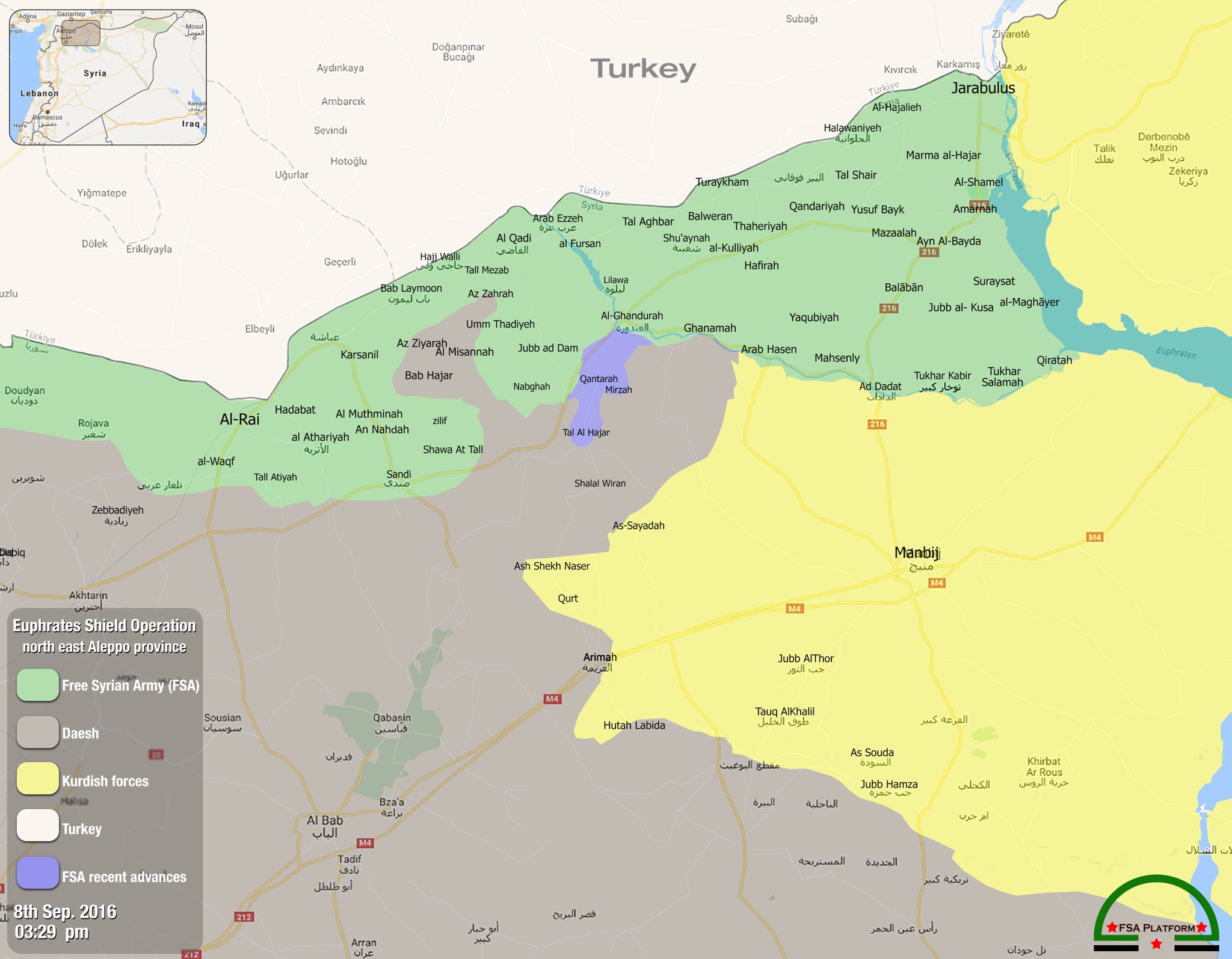
 'When Turkish tanks and warplanes crossed into Syria to help rebels retake the town of Jarabulus from ISIS on August 24, Syrian refugees at a camp just north of the border celebrated. A man named Abdel Wahab Shobak even shaved his beard, mirroring celebrations by other Syrian men freed from restrictive jihadi rule. Stranded in Turkey, Shobak hadn’t been living under ISIS, but he was still elated. “I was so happy at the liberation of these areas, and in hope of going back home soon,” he says. “The operation actually gave us some hope.”

 The two-week-old Turkish military incursion unsettled the already chaotic battlefield in Syria, strengthening the hand of the Syrian opposition and angering the regime of President Bashar Assad and his key backer, Russia. The operation expelled Islamic State forces from the last stretch they controlled on the Syrian-Turkish border, depriving the jihadists of an important smuggling route to Turkey’s major cities and to Europe, potentially cutting off the path for new jihadis.

 The operation also provides a glimmer of hope to some of the nearly three million Syrian refugees who remain stranded in Turkey, among a total population of 4.8 million people scattered across the region and beyond. A few are already aspiring to return to their homes in what Turkish officials are calling a “de facto safe zone” in northern Syria. Even those whose homes are not directly affected expressed relief at seeing ISIS eliminated from the border area. The operation also emboldened some of the embattled forces of the Syrian opposition, who stand to take control of the newly-liberated areas.

 “The situation is very good. The Syrian opposition is advancing backed by Turkish forces,” says Zaki Amin, a local council official from the newly-freed town of Ghandoura, speaking by phone from Syria. “They’re advancing every minute, thank God, and hopefully in the coming days we’ll liberate al-Bab.”


 The opposition-affiliated local councils are in the early stages of setting up governance and aid distribution in the newly-freed areas. Mohamed Haji Ibrahim, a lawyer and head of the Ghandoura local council, said he is preparing to return to the town after years in which his town suffocated under ISIS rule. “Ghandoura has been neglected for more than three years. The people of the world don’t know where Ghandoura is and what a strategic town it is,” he said in an interview in the city of Gaziantep in Turkey.

 A Russian and American-backed ceasefire declared in February collapsed within a few months as Russian-backed regime forces advanced. Those advances included imposing a siege on the key rebel stronghold in the city of Aleppo in June. Briefly interrupted by an Islamist-led counterattack in August, the siege of eastern Aleppo is now back in place, trapping an estimated 300,000 civilians in the rebel enclave.

 Back in the Turkish city of Gaziantep, another refugee named Ahmed Dallal, 45, sits in his living room where he lives with his family of seven. He had lived in Aleppo before fleeing intense shelling by the regime in 2012. He returned with his family to his hometown of Jarabulus, on the Turkish border. They lived there happily until 2013, when ISIS began infiltrating the town, preparing the way for a takeover that would come later that year. In February of 2013, he denounced ISIS during a relative’s funeral and had to flee after a jihadi official threatened him. Following the Turkish incursion, Jarabulus now falls in the so-called “safe zone.” He says, “I support this action. It should have come sooner.” He has no plans to return for now, but that may change. “I will go back to Jarabulus if I feel it is safe.” '


 "FSA advances today against Daesh in northern Aleppo province with TAF support."[https://twitter.com/FSAPlatform/status/773862371525734401]

ISIS Tears Attention Away From Activism in Syria


 'When Omar Arab hears the sound of shelling nearby, he does not run for cover. He runs toward the noise. Arab is an independent photojournalist living in Aleppo, Syria. Once an ancient metropolis, it is now the battleground of what the Red Cross recently described as “one of the most devastating urban conflicts in modern times.”

 With help from Russian aerial forces and elite Iranian soldiers, Assad has launched a brutal assault on rebel-held parts of the city. Activists on the ground have accused the regime of deliberately targeting schools and medical centers throughout the siege.

 Arab also claims that in addition to targeting schools and medical centers, Russian and Syrian aircraft have targeted residential neighborhoods, including his own in a small swath of rebel-held territory in western Aleppo.

 “The situation in Aleppo is very bad. There are many dead after the regime targeted neighborhoods with rockets. They also destroyed my house,” Arab wrote to me back in June. The situation has only worsened since.


 The attention of the international community has shifted away from drawing red lines against the Assad regime and supporting the opposition to the fight against ISIS.

 Activists feel forgotten by the international community, and Syrians hope and demand that the world redirect its focus back to the revolution and understand that empowering activists is critical for a long-term solution for Syria. Defeating ISIS alone is not the end-all solution to the conflict.

 The revolution began as a grass-roots effort. Inspired by the successful overthrow of oppressive leaders in Egypt and Tunisia during the Arab Spring, the Syrians sought to confront their own despot. Protests erupted throughout the country in the beginning of 2011. The political objectives of the Damascus Spring of 2000 had included establishing a multi-party democracy, recognizing freedom of assembly, press and speech, the release of political prisoners, economic rights for all citizens and lifting of the 1963 emergency law. Syrian activists adopted these demands in 2011, but soon reached breaking point only a few months after the uprising began with the torture of 15 schoolboys detained for scrawling anti-regime graffiti in the city of Dara’a.

 When the protests demanding the boys’ release were met with indiscriminate gunfire, they expanded to demand an end to the Assad regime.


 Protests not only continued to take place but grew larger despite the regime’s brutal crackdown. The uprising began as a series of stop-and-go protests, and eventually blossomed into a full-blown revolution. The goals of the revolution transcended religious sects, with Sunni and Shia Muslims and other religious minorities working parallel, and often together, against the regime. Activists formed local revolutionary councils, the most popular being the Local Coordination Committees (LCC) aimed at helping organize protests in their own communities and supporting the Syrian National Coalition (SNC).

 As the crackdown by the regime became increasingly violent, a growing number of soldiers refused to shoot at protesters and began defecting en masse. The wave of defections, including 10,000 in the first year of the revolution, allowed for the creation of the Free Syria Army (FSA). Although the LCCs and activists believe foremost in the efficacy of nonviolent protest, they understood that the conflict had become militarized, and that their work would need to adapt accordingly.

 Rebel-held territories like eastern Aleppo allow activists to thrive and work peacefully toward the goals of the revolution. But their efforts would become greatly complicated by the rise of ISIS, which has torn international attention away from the revolution that consequently bolsters the Assad regime, the very outcome that the activists worked so hard to avoid.


 The emergence of ISIS in Syria has transformed the work of the Syrian opposition movement, especially its activists on the ground still fighting for the revolution. International media has callously conflated the opposition as a single entity that includes ISIS. It is this very misconception that has given momentum to the regime. Foreign states view Syria through a binary lens between the opposition and the Assad regime and consequentially believe that to defeat ISIS the Syrian government must stay in power.

 “Activists on the ground feel forgotten. They feel like they were betrayed by the rest of the world. It’s sexier—a hotter topic to talk about ISIS rather than talk about the wants and demands of Syrian civilians, which is a free and democratic nation,” Ala’a Basatneh, a young activist born in Syria but raised in the US, emphasizes to me during an interview. Basatneh is the main subject of the documentary #ChicagoGirl: The Social Network Takes on a Dictator, which depicts her bold efforts to help activists in Syria coordinate with each other through social media. Even with the rise of ISIS, she explains, dethroning Assad continues to be a priority for most activists.

 “[Assad] was a big factor in creating ISIS. He has won time, he has won allies worldwide—it’s not only Russia, China and Iran [that] are aiding him or are lenient on him because of ISIS. So, the only one benefactor for what’s going on in Syria and what ISIS is doing is the Syrian regime.”


 For Ola Karman, a Syrian activist living in Aleppo, ISIS has not overwhelmingly affected her work because eastern Aleppo where she resides is protected by the rebels, which has helped preserve it as a hub of revolutionary activity. It has not changed her determination to work toward the “fall of the regime and liberation.”

 As Syrians are bombarded by both state forces and radical Islamists, LCCs have expanded their experiment in self-governance by organizing much-needed humanitarian work. The opposition has built clinics and hospitals, organized makeshift schools for the youth and helps support first responders like the revered White Helmets rescue volunteers. Syrian activists who coordinate with rebels to channel aid to besieged and liberated territories are often targeted by the regime and, more recently, Russian airstrikes. The revolution now is not only an ambitious effort to depose the Assad regime, but also to survive.

 The opposition movement has thus had to resort to moving underground. As the documentary #ChicagoGirl shows, even before the rise of ISIS clinics gradually moved underground. However, that has not stopped the regime from finding and targeting them in direct airstrikes. The clinics Basatneh visited and brought medical supplies to in 2012 have since been destroyed.


 Instead of organizing protests against the regime, activists have shifted focus to documenting the revolution and atrocities committed by Assad and his accomplices, mainly Russia and Iran. Thanks to the work of citizen journalists, the conflict is considerably the most well-documented of its kind. Through a variety of social media platforms like Facebook, Twitter and YouTube activists like Omar Arab expose the actions of the Assad regime to the rest of the world.

 “I am a photographer and document the crimes of the regime in pictures and video because I have to be a witness and prove that the regime is not aiming at terrorists but civilians,” says Arab.

 His photos depict the grim reality of everyday life in Aleppo—the daily bombs that pound the city, the destruction and the human compassion of ordinary Syrians helping each other survive.

 Ala’a Basatneh also points out that their work embodies the long-term picture of a post-Assad Syria: “The more documentation we have the more we are able to bring people into account after the topple happens in the Syrian regime, after Assad is gone.”


 Syrians are not calling for the international community to redirect its focus to the revolution in order to minimize the real threat that ISIS poses, but rather because they strongly believe that supporting the revolution will help put an end to the terror wrought by the group. Activists help lay the foundation for a free and democratic Syria by developing a robust civil society that works toward solidifying the values of the revolution—mainly promoting equality, justice, pluralism and freedom of speech and religion.

 Karman emphasizes the importance of civil society in the revolution because of individuals who have helped lessen Syrians’ dependence on the government: “The role of Syrian activists is really important in the Syrian revolution between doctors, teachers, first responders, etc., because they have the ability to build institutions and schools outside of the regime’s control [which] might negatively affect Assad’s regime.”

 Those active in the revolution understand that a free and democratic Syria will not come with the overhaul of the existing regime alone, but of state institutions as well. A smooth transition to democracy is incumbent upon avoiding a power vacuum that could empower ISIS even more. The activists are working to guarantee that they are prepared for a post-Assad Syria.


 This past summer alone, ISIS has launched a wave of terrorist attacks that have killed hundreds around the world. It is undeniably a global threat. The Syrians know this better than anyone. By boosting funds to groups like the White Helmets to appease the preconditions of the opposition in order to encourage them to join the peace talks and, most importantly, supporting Syrian activists by following their fight against the Assad regime, the international community can make headway in helping the revolution while simultaneously fighting ISIS.

 The alternative is the status quo, with the international community continuing to look at the Syrian conflict through a binary lens between the Assad regime and ISIS. Even if the world has given up on the revolution, the activists are the ones keeping the country from an irreversible collapse and are the best hope that Syria has for a stable future.

 “If they stop, no one else is talking against Assad. If they stop, then hundreds of people will have died for nothing. These protesters and people who were targeted during protests by barrel bombs and sniper bullets—they are demanding for Assad to go. Their work, the activists that continue their work, they are the ones that continue that legacy to make sure that Assad goes. If Assad doesn’t go, then ISIS will grow, and more chaos will grow, in not only the Middle East, but also in the West—and we won’t see ISIS back down if Assad doesn’t go.” said Basatneh.

 The greatest goal of the revolution was to have the voices of the Syrian people heard. It is time the world started listening.'

Wednesday, 7 September 2016

Turkey's shifting interests and the perils of inaction


 Sam Charles Hamad:

 'Turkey's strategic interests here are clear: The first is to stop the development of a contiguous state run by a PKK-affiliate on its border. The second is to halt infiltration from IS (we must not forget that Turkey is, outside of places where IS has a concrete presence, the country that has faced the most terror attacks from the group) and carry out mortar attacks on Turkish towns near the Syrian border. It is itself a tragedy that one must determine anything related to Syria based on ethnicity, but the narrative, widely perpetuated by the ever more unhinged PYD (they are now claiming not that Turkey merely supports IS, but that itis IS), that Turkey is "attacking the Kurds" and assaulting the PYD's Rojava statelet, is simply inaccurate.

 The Turkish military is assisting the Syrian rebel forces in retaking Arab-majority villages that the YPG took opportunistically during a time when the rebels were overstretched fighting Assad and IS. The YPG's purpose in this was to join up the Afrin Canton of Rojava with the Kobani Canton. The price of such unification would be vast areas of land occupied by Syrian Arabs. In this respect, the rebels are merely using a rare and much-needed strategic advantage to take their towns and cities back from IS, and reverse the opportunistic land grabs of the YPG. Ideologically speaking, both Rojava and the Islamic State are - to different degrees - hostile to the idea of a Free Syria and the goals of the Syrian revolution. IS is unambiguously monstrous, but beneath the YPG's progressive rhetoric, they too are hostile to political pluralism, suppressing Kurdish opposition within Rojava. In addition, they are prone to ethnic cleansing based on the interrelated evils of chauvinism and the Realpolitik of state-building.


 The YPG's ranks are of course made up of people who want to defend their communities from the fascism of IS, but this doesn't mean that this very real fight can't also be used as a pretext for more pragmatic manoeuvers. Manbij, an Arab-majority city that was recently occupied by the YPG is a good example. While the YPG have sought to portray the primary motivation of taking the city as being part of its fight against IS, the targeting of that city was not arbitrary. Manbij not only gives the YPG access to water resources via the Euphrates River, but it would also be key in uniting Kobani with Afrin. It is clear that the YPG had no intention whatsoever of giving up Manbij, despite the city being previously run by a revolutionary council elected after the city was first liberated by local Syrian rebels in 2012, prior to occupation by IS.

 The US - the YPG's main backer - even ordered the group to leave the city for locals to run it (this has not occurred in any meaningful capacity), but things reached crisis point when the YPG then set up the Jarabulus Military Council, indicating that it planned on moving on the strategically important Arab-majority city. For Turkey, this constituted a crossing of the red line that ultimately prompted the incursion. The YPG's narrative that Turkey and the Syrian rebels' current offensive is motivated by a similar "jihadi" ideology as that of IS, simply has no veracity. Of the Syrian rebel groups currently fighting IS and the YPG, all are fighting for a democratic and pluralistic Syria. This is not an issue of the perceived "secularism" of the YPG being assaulted by the Islamist barbarism of Turkey and the rebels.

 The different rationales behind the Turkish intervention, are of course interrelated. The more IS is allowed to run riot in northern Syria, the better the pretext for the YPG to conduct land grabs towards the unification of its cantons. Turkey is not attacking Rojava proper and has absolutely no justification to do so - any such aggression would be indicative of its will to oppose Kurdish autonomy at all costs, which ought to be anathema to supporters of the Syrian revolution. Since the war began, the YPG has had, in contrast to the rebels, a fairly easy time of it when it comes to Assad (as I detailed here), but its main fight has been against IS and - in line with expanding its state - the Syrian rebels. To the latter end, it has taken advantage of Russian airstrikes against rebel positions and coordinated attacks against the rebels with Assad's forces.


 The Turkish intervention is symptomatic of a central tragedy of the war in Syria. Assad and his Iranian and Russian allies can now ethnically cleanse the rebel-held, revolutionary-run areas of Syria. These have been broken down by years of brutal besiegement and bombardment, just as we saw recently in Daraya, and are key to Assad's survival. We'll soon see this in al-Waer in Homs, and other precarious rebel-held areas - the main argument of appeasement now is that nobody can act to aid these rebel forces because it would run the risk of military confrontation with Russia. But, in reality, as this Turkish intervention proves, if those countries who had the capability to do so, were to comprehensively aid rebel forces fighting against ethnic cleansing, mass extermination and this brutal dynasty and its imperialist allies, it could with some ease do so without risking a World War. Turkey has shown the arguments for inaction are completely void, but still, the world will watch passively as Assad and his allies continue with their genocide.'

Iraqi Families Sent to Syria to Change Demographics


 'Iraqi families are being sent to Syria to change the demographics in the country, according to sources close to the activities of the Iranian-backed armed militias in Syria.

 “The most important plan currently conducted by the armed militias, is to bring Iraqi families mostly coming from the southern Shi’ite-majority provinces, and place them in several Syrian areas, particularly in Daraya, Maadamiyat al-Sham and al-Midan,” the source said, adding that around 300 Iraqi families have already arrived to Syria with an aim to produce a demographic change.

 The source, who lives in Beirut, said that Harakat al-Nujaba is the movement responsible for sending those Iraqi families by collaborating with other parties and factions in Syria. He said Harakat al-Nujaba is headed by Akram al-Kaabi, a close ally to Iran and who has a direct relationship with Iranian Supreme leader Ali Khamenei.'

Aleppo is Besieged and Burning from Chlorine Attack


 Bilal Abdul Kareem:

 "The smell of chlorine is very strong here..."

Syrian civil society survives amid the rubble

A youth center in Daraarun by Baytna Syria

 'Beneath the rubble and burning buildings of Syria's civil war exists a small women's center in the Al-Mashhad neighborhood of Aleppo. Last July, the grounds above the center were barrel bombed three times. Bashar Assad's regime has repeatedly used these bombs indiscriminately, and discriminately, to level infrastructure and kill thousands of civilians.

 "We don't understand why [the regime] wanted to bomb our center and kill us," said Bakri Kaakeh, the CEO of Silkroad, a local civil society group that administers the center.

 Silkroad is one of many local civil society groups that have established initiatives to promote democracy in opposition-controlled parts of the country. Those who work in these organizations put their lives on the line. They have crossed in and out of Syria to administer schools, youth centers, hospitals, bakeries and vocational centers, all of which have been systematically targeted by regime forces and extremist groups in the country.


 After Syria's Baath Party assumed power in 1963, the government set up state-funded associations while barring the establishment of any independent organizations. Syrian activists continue to be arrested, tortured and murdered today. Yet due to their perseverance, civil society may have expanded more during five years of conflict than it did in almost five decades under Baathist rule.

 One lifeline for many civil society groups is an organization called Baytna Syria - "Syria, our home" - which aims to build a community of active citizens while financing an array of community projects in opposition-controlled areas.

 During the early stages of the uprising against Assad's regime, demonstrations were repressed and activists were often hunted and executed. Many others were killed by barrel bombs and regime snipers along with the very people they were trying to help. The "Islamic State" group, which didn't announce its presence in Syria until April 2013, has executed numerous media activists and dissenters.


 Other opposition groups in the north of Syria have coerced, restricted and even threatened activists in the area. Achi recalled a time when Baytna Syria had to cancel a project to finance a youth center in Idlib after Jabhat Fateh al Sham - previously known as al-Nusra Front - threatened to kill the man who was supposed to oversee the center when it opened. The setback was a reminder of how fear and violence shape all aspects of life in Syria today.

 "We only had four incidents out of the 84 projects we've supported in 15 months. Overall I think we been pretty successful in evading risks," said Assaad Al Achi, executive director of Baytna Syria. "Part of it is risk management, but part of it is luck as well. When the regime is dropping a barrel bomb, it's either a hit or miss."

 Many activists, however, haven't been as lucky. Razan Zeiytouneh, a human rights lawyer who ran the Violations Documentation Center, a network that monitored the deaths and violations of opposition and regime forces, was abducted along with three of her colleagues in December 2013. There has been no news of them since.


 Tammam Al Jamous, one of the founding board members of Ghosun Zeiytoun - "olive branch" in English - said three people in his organization had died from indiscriminate attacks by the regime.

 Ghosun Zeiytoun was first formed to create safe spaces for children while helping to keep schools running. One of their first initiatives, Al Jamous explained, was to send teachers basic necessities to allow them to keep working since the conflict prevented them from retrieving their salaries. The group has also provided children with language and software classes as well as first-aid training.

 "We want freedom for Syria and we want a democracy," he said. "The partnership we have with Baytna Syria has been one of the most successful we've ever had. They are Syrian [so unlike some international donors] they know the exact situation in the country and the risks."
Activists who first mobilized to coordinate demonstrations have managed to build small institutions, helping bring a semblance of normalcy to life in parts of the beleaguered country. Their defiance alone has put them on at least one hit list.

 "Any action we carried out without the regime's permission means we're terrorists [in their eyes], Al Jamous said. "But we won't stop. We are promoting a language of peace. "We promised our friends [who died] that we would continue their work for them." '

Sunday, 4 September 2016

To Syrian Alawis: We have hostility only to the régime


 Message of the heroes in the Hama countryside: "To Syrian Alawis: We have no hostility to you but only to the régime... anyone who helps us or remains in his home or raises a white flag will be safe... the safety of women and children and old men is assured... as for the foreign mercenaries, our behaviour with them may well be different... we aren't the 'opposition', don't fool yourselves, the 'opposition' competes for seats in parliament, no, we are the revolution... and in this country it will either be the revolution or the regime."