Thursday, 8 September 2016

A Glimmer of Hope Opens for Syrian Rebels


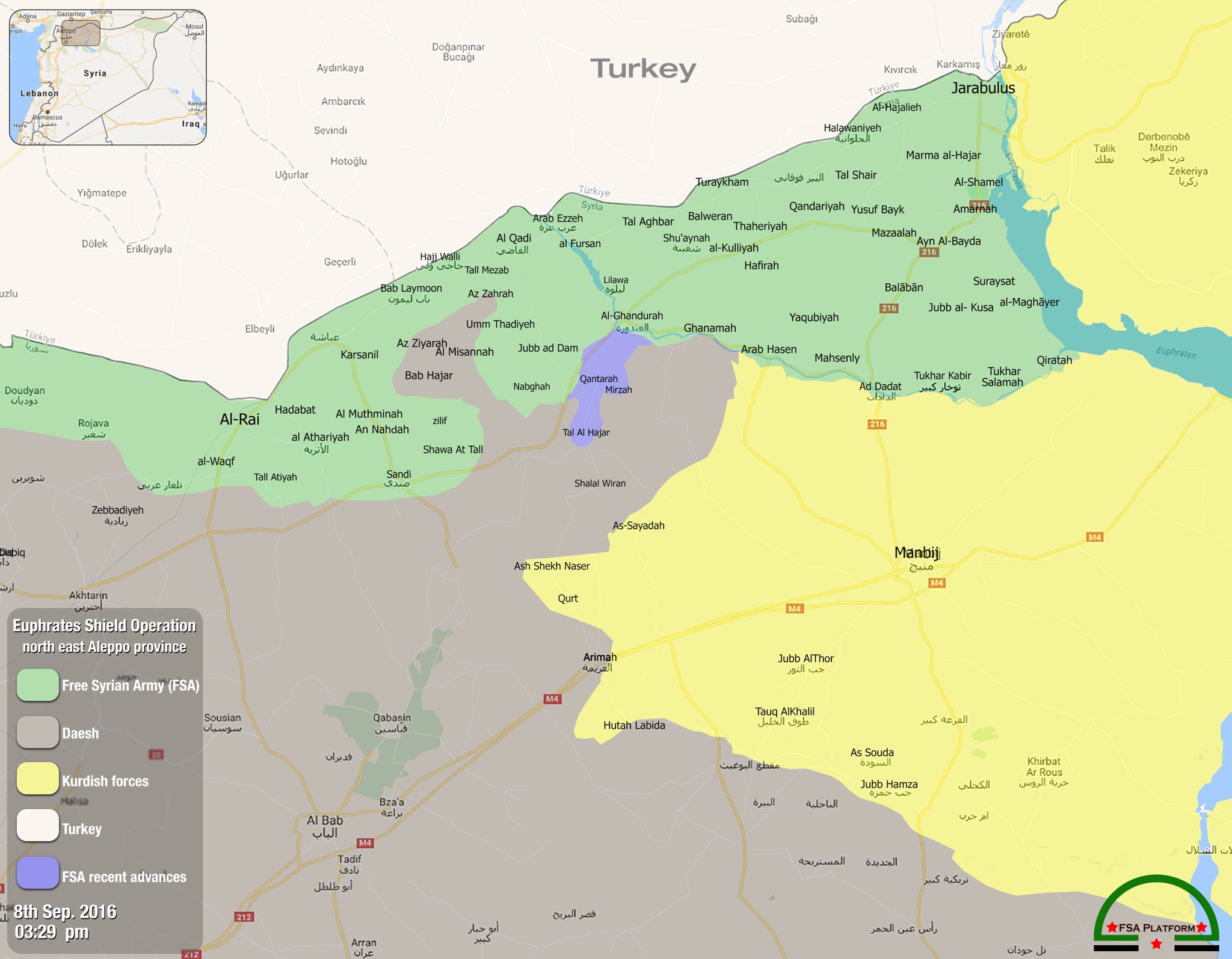
 'When Turkish tanks and warplanes crossed into Syria to help rebels retake the town of Jarabulus from ISIS on August 24, Syrian refugees at a camp just north of the border celebrated. A man named Abdel Wahab Shobak even shaved his beard, mirroring celebrations by other Syrian men freed from restrictive jihadi rule. Stranded in Turkey, Shobak hadn’t been living under ISIS, but he was still elated. “I was so happy at the liberation of these areas, and in hope of going back home soon,” he says. “The operation actually gave us some hope.”

 The two-week-old Turkish military incursion unsettled the already chaotic battlefield in Syria, strengthening the hand of the Syrian opposition and angering the regime of President Bashar Assad and his key backer, Russia. The operation expelled Islamic State forces from the last stretch they controlled on the Syrian-Turkish border, depriving the jihadists of an important smuggling route to Turkey’s major cities and to Europe, potentially cutting off the path for new jihadis.

 The operation also provides a glimmer of hope to some of the nearly three million Syrian refugees who remain stranded in Turkey, among a total population of 4.8 million people scattered across the region and beyond. A few are already aspiring to return to their homes in what Turkish officials are calling a “de facto safe zone” in northern Syria. Even those whose homes are not directly affected expressed relief at seeing ISIS eliminated from the border area. The operation also emboldened some of the embattled forces of the Syrian opposition, who stand to take control of the newly-liberated areas.

 “The situation is very good. The Syrian opposition is advancing backed by Turkish forces,” says Zaki Amin, a local council official from the newly-freed town of Ghandoura, speaking by phone from Syria. “They’re advancing every minute, thank God, and hopefully in the coming days we’ll liberate al-Bab.”


 The opposition-affiliated local councils are in the early stages of setting up governance and aid distribution in the newly-freed areas. Mohamed Haji Ibrahim, a lawyer and head of the Ghandoura local council, said he is preparing to return to the town after years in which his town suffocated under ISIS rule. “Ghandoura has been neglected for more than three years. The people of the world don’t know where Ghandoura is and what a strategic town it is,” he said in an interview in the city of Gaziantep in Turkey.

 A Russian and American-backed ceasefire declared in February collapsed within a few months as Russian-backed regime forces advanced. Those advances included imposing a siege on the key rebel stronghold in the city of Aleppo in June. Briefly interrupted by an Islamist-led counterattack in August, the siege of eastern Aleppo is now back in place, trapping an estimated 300,000 civilians in the rebel enclave.

 Back in the Turkish city of Gaziantep, another refugee named Ahmed Dallal, 45, sits in his living room where he lives with his family of seven. He had lived in Aleppo before fleeing intense shelling by the regime in 2012. He returned with his family to his hometown of Jarabulus, on the Turkish border. They lived there happily until 2013, when ISIS began infiltrating the town, preparing the way for a takeover that would come later that year. In February of 2013, he denounced ISIS during a relative’s funeral and had to flee after a jihadi official threatened him. Following the Turkish incursion, Jarabulus now falls in the so-called “safe zone.” He says, “I support this action. It should have come sooner.” He has no plans to return for now, but that may change. “I will go back to Jarabulus if I feel it is safe.” '


 "FSA advances today against Daesh in northern Aleppo province with TAF support."[https://twitter.com/FSAPlatform/status/773862371525734401]
ISIS Tears Attention Away From Activism in Syria


 'When Omar Arab hears the sound of shelling nearby, he does not run for cover. He runs toward the noise. Arab is an independent photojournalist living in Aleppo, Syria. Once an ancient metropolis, it is now the battleground of what the Red Cross recently described as “one of the most devastating urban conflicts in modern times.”

 With help from Russian aerial forces and elite Iranian soldiers, Assad has launched a brutal assault on rebel-held parts of the city. Activists on the ground have accused the regime of deliberately targeting schools and medical centers throughout the siege.

 Arab also claims that in addition to targeting schools and medical centers, Russian and Syrian aircraft have targeted residential neighborhoods, including his own in a small swath of rebel-held territory in western Aleppo.

 “The situation in Aleppo is very bad. There are many dead after the regime targeted neighborhoods with rockets. They also destroyed my house,” Arab wrote to me back in June. The situation has only worsened since.


 The attention of the international community has shifted away from drawing red lines against the Assad regime and supporting the opposition to the fight against ISIS.

 Activists feel forgotten by the international community, and Syrians hope and demand that the world redirect its focus back to the revolution and understand that empowering activists is critical for a long-term solution for Syria. Defeating ISIS alone is not the end-all solution to the conflict.

 The revolution began as a grass-roots effort. Inspired by the successful overthrow of oppressive leaders in Egypt and Tunisia during the Arab Spring, the Syrians sought to confront their own despot. Protests erupted throughout the country in the beginning of 2011. The political objectives of the Damascus Spring of 2000 had included establishing a multi-party democracy, recognizing freedom of assembly, press and speech, the release of political prisoners, economic rights for all citizens and lifting of the 1963 emergency law. Syrian activists adopted these demands in 2011, but soon reached breaking point only a few months after the uprising began with the torture of 15 schoolboys detained for scrawling anti-regime graffiti in the city of Dara’a.

 When the protests demanding the boys’ release were met with indiscriminate gunfire, they expanded to demand an end to the Assad regime.


 Protests not only continued to take place but grew larger despite the regime’s brutal crackdown. The uprising began as a series of stop-and-go protests, and eventually blossomed into a full-blown revolution. The goals of the revolution transcended religious sects, with Sunni and Shia Muslims and other religious minorities working parallel, and often together, against the regime. Activists formed local revolutionary councils, the most popular being the Local Coordination Committees (LCC) aimed at helping organize protests in their own communities and supporting the Syrian National Coalition (SNC).

 As the crackdown by the regime became increasingly violent, a growing number of soldiers refused to shoot at protesters and began defecting en masse. The wave of defections, including 10,000 in the first year of the revolution, allowed for the creation of the Free Syria Army (FSA). Although the LCCs and activists believe foremost in the efficacy of nonviolent protest, they understood that the conflict had become militarized, and that their work would need to adapt accordingly.

 Rebel-held territories like eastern Aleppo allow activists to thrive and work peacefully toward the goals of the revolution. But their efforts would become greatly complicated by the rise of ISIS, which has torn international attention away from the revolution that consequently bolsters the Assad regime, the very outcome that the activists worked so hard to avoid.


 The emergence of ISIS in Syria has transformed the work of the Syrian opposition movement, especially its activists on the ground still fighting for the revolution. International media has callously conflated the opposition as a single entity that includes ISIS. It is this very misconception that has given momentum to the regime. Foreign states view Syria through a binary lens between the opposition and the Assad regime and consequentially believe that to defeat ISIS the Syrian government must stay in power.

 “Activists on the ground feel forgotten. They feel like they were betrayed by the rest of the world. It’s sexier—a hotter topic to talk about ISIS rather than talk about the wants and demands of Syrian civilians, which is a free and democratic nation,” Ala’a Basatneh, a young activist born in Syria but raised in the US, emphasizes to me during an interview. Basatneh is the main subject of the documentary #ChicagoGirl: The Social Network Takes on a Dictator, which depicts her bold efforts to help activists in Syria coordinate with each other through social media. Even with the rise of ISIS, she explains, dethroning Assad continues to be a priority for most activists.

 “[Assad] was a big factor in creating ISIS. He has won time, he has won allies worldwide—it’s not only Russia, China and Iran [that] are aiding him or are lenient on him because of ISIS. So, the only one benefactor for what’s going on in Syria and what ISIS is doing is the Syrian regime.”


 For Ola Karman, a Syrian activist living in Aleppo, ISIS has not overwhelmingly affected her work because eastern Aleppo where she resides is protected by the rebels, which has helped preserve it as a hub of revolutionary activity. It has not changed her determination to work toward the “fall of the regime and liberation.”

 As Syrians are bombarded by both state forces and radical Islamists, LCCs have expanded their experiment in self-governance by organizing much-needed humanitarian work. The opposition has built clinics and hospitals, organized makeshift schools for the youth and helps support first responders like the revered White Helmets rescue volunteers. Syrian activists who coordinate with rebels to channel aid to besieged and liberated territories are often targeted by the regime and, more recently, Russian airstrikes. The revolution now is not only an ambitious effort to depose the Assad regime, but also to survive.

 The opposition movement has thus had to resort to moving underground. As the documentary #ChicagoGirl shows, even before the rise of ISIS clinics gradually moved underground. However, that has not stopped the regime from finding and targeting them in direct airstrikes. The clinics Basatneh visited and brought medical supplies to in 2012 have since been destroyed.


 Instead of organizing protests against the regime, activists have shifted focus to documenting the revolution and atrocities committed by Assad and his accomplices, mainly Russia and Iran. Thanks to the work of citizen journalists, the conflict is considerably the most well-documented of its kind. Through a variety of social media platforms like Facebook, Twitter and YouTube activists like Omar Arab expose the actions of the Assad regime to the rest of the world.

 “I am a photographer and document the crimes of the regime in pictures and video because I have to be a witness and prove that the regime is not aiming at terrorists but civilians,” says Arab.

 His photos depict the grim reality of everyday life in Aleppo—the daily bombs that pound the city, the destruction and the human compassion of ordinary Syrians helping each other survive.

 Ala’a Basatneh also points out that their work embodies the long-term picture of a post-Assad Syria: “The more documentation we have the more we are able to bring people into account after the topple happens in the Syrian regime, after Assad is gone.”


 Syrians are not calling for the international community to redirect its focus to the revolution in order to minimize the real threat that ISIS poses, but rather because they strongly believe that supporting the revolution will help put an end to the terror wrought by the group. Activists help lay the foundation for a free and democratic Syria by developing a robust civil society that works toward solidifying the values of the revolution—mainly promoting equality, justice, pluralism and freedom of speech and religion.

 Karman emphasizes the importance of civil society in the revolution because of individuals who have helped lessen Syrians’ dependence on the government: “The role of Syrian activists is really important in the Syrian revolution between doctors, teachers, first responders, etc., because they have the ability to build institutions and schools outside of the regime’s control [which] might negatively affect Assad’s regime.”

 Those active in the revolution understand that a free and democratic Syria will not come with the overhaul of the existing regime alone, but of state institutions as well. A smooth transition to democracy is incumbent upon avoiding a power vacuum that could empower ISIS even more. The activists are working to guarantee that they are prepared for a post-Assad Syria.


 This past summer alone, ISIS has launched a wave of terrorist attacks that have killed hundreds around the world. It is undeniably a global threat. The Syrians know this better than anyone. By boosting funds to groups like the White Helmets to appease the preconditions of the opposition in order to encourage them to join the peace talks and, most importantly, supporting Syrian activists by following their fight against the Assad regime, the international community can make headway in helping the revolution while simultaneously fighting ISIS.

 The alternative is the status quo, with the international community continuing to look at the Syrian conflict through a binary lens between the Assad regime and ISIS. Even if the world has given up on the revolution, the activists are the ones keeping the country from an irreversible collapse and are the best hope that Syria has for a stable future.

 “If they stop, no one else is talking against Assad. If they stop, then hundreds of people will have died for nothing. These protesters and people who were targeted during protests by barrel bombs and sniper bullets—they are demanding for Assad to go. Their work, the activists that continue their work, they are the ones that continue that legacy to make sure that Assad goes. If Assad doesn’t go, then ISIS will grow, and more chaos will grow, in not only the Middle East, but also in the West—and we won’t see ISIS back down if Assad doesn’t go.” said Basatneh.

 The greatest goal of the revolution was to have the voices of the Syrian people heard. It is time the world started listening.'

Wednesday, 7 September 2016

Turkey's shifting interests and the perils of inaction


 Sam Charles Hamad:

 'Turkey's strategic interests here are clear: The first is to stop the development of a contiguous state run by a PKK-affiliate on its border. The second is to halt infiltration from IS (we must not forget that Turkey is, outside of places where IS has a concrete presence, the country that has faced the most terror attacks from the group) and carry out mortar attacks on Turkish towns near the Syrian border. It is itself a tragedy that one must determine anything related to Syria based on ethnicity, but the narrative, widely perpetuated by the ever more unhinged PYD (they are now claiming not that Turkey merely supports IS, but that itis IS), that Turkey is "attacking the Kurds" and assaulting the PYD's Rojava statelet, is simply inaccurate.

 The Turkish military is assisting the Syrian rebel forces in retaking Arab-majority villages that the YPG took opportunistically during a time when the rebels were overstretched fighting Assad and IS. The YPG's purpose in this was to join up the Afrin Canton of Rojava with the Kobani Canton. The price of such unification would be vast areas of land occupied by Syrian Arabs. In this respect, the rebels are merely using a rare and much-needed strategic advantage to take their towns and cities back from IS, and reverse the opportunistic land grabs of the YPG. Ideologically speaking, both Rojava and the Islamic State are - to different degrees - hostile to the idea of a Free Syria and the goals of the Syrian revolution. IS is unambiguously monstrous, but beneath the YPG's progressive rhetoric, they too are hostile to political pluralism, suppressing Kurdish opposition within Rojava. In addition, they are prone to ethnic cleansing based on the interrelated evils of chauvinism and the Realpolitik of state-building.


 The YPG's ranks are of course made up of people who want to defend their communities from the fascism of IS, but this doesn't mean that this very real fight can't also be used as a pretext for more pragmatic manoeuvers. Manbij, an Arab-majority city that was recently occupied by the YPG is a good example. While the YPG have sought to portray the primary motivation of taking the city as being part of its fight against IS, the targeting of that city was not arbitrary. Manbij not only gives the YPG access to water resources via the Euphrates River, but it would also be key in uniting Kobani with Afrin. It is clear that the YPG had no intention whatsoever of giving up Manbij, despite the city being previously run by a revolutionary council elected after the city was first liberated by local Syrian rebels in 2012, prior to occupation by IS.

 The US - the YPG's main backer - even ordered the group to leave the city for locals to run it (this has not occurred in any meaningful capacity), but things reached crisis point when the YPG then set up the Jarabulus Military Council, indicating that it planned on moving on the strategically important Arab-majority city. For Turkey, this constituted a crossing of the red line that ultimately prompted the incursion. The YPG's narrative that Turkey and the Syrian rebels' current offensive is motivated by a similar "jihadi" ideology as that of IS, simply has no veracity. Of the Syrian rebel groups currently fighting IS and the YPG, all are fighting for a democratic and pluralistic Syria. This is not an issue of the perceived "secularism" of the YPG being assaulted by the Islamist barbarism of Turkey and the rebels.

 The different rationales behind the Turkish intervention, are of course interrelated. The more IS is allowed to run riot in northern Syria, the better the pretext for the YPG to conduct land grabs towards the unification of its cantons. Turkey is not attacking Rojava proper and has absolutely no justification to do so - any such aggression would be indicative of its will to oppose Kurdish autonomy at all costs, which ought to be anathema to supporters of the Syrian revolution. Since the war began, the YPG has had, in contrast to the rebels, a fairly easy time of it when it comes to Assad (as I detailed here), but its main fight has been against IS and - in line with expanding its state - the Syrian rebels. To the latter end, it has taken advantage of Russian airstrikes against rebel positions and coordinated attacks against the rebels with Assad's forces.


 The Turkish intervention is symptomatic of a central tragedy of the war in Syria. Assad and his Iranian and Russian allies can now ethnically cleanse the rebel-held, revolutionary-run areas of Syria. These have been broken down by years of brutal besiegement and bombardment, just as we saw recently in Daraya, and are key to Assad's survival. We'll soon see this in al-Waer in Homs, and other precarious rebel-held areas - the main argument of appeasement now is that nobody can act to aid these rebel forces because it would run the risk of military confrontation with Russia. But, in reality, as this Turkish intervention proves, if those countries who had the capability to do so, were to comprehensively aid rebel forces fighting against ethnic cleansing, mass extermination and this brutal dynasty and its imperialist allies, it could with some ease do so without risking a World War. Turkey has shown the arguments for inaction are completely void, but still, the world will watch passively as Assad and his allies continue with their genocide.'

Iraqi Families Sent to Syria to Change Demographics


 'Iraqi families are being sent to Syria to change the demographics in the country, according to sources close to the activities of the Iranian-backed armed militias in Syria.

 “The most important plan currently conducted by the armed militias, is to bring Iraqi families mostly coming from the southern Shi’ite-majority provinces, and place them in several Syrian areas, particularly in Daraya, Maadamiyat al-Sham and al-Midan,” the source said, adding that around 300 Iraqi families have already arrived to Syria with an aim to produce a demographic change.

 The source, who lives in Beirut, said that Harakat al-Nujaba is the movement responsible for sending those Iraqi families by collaborating with other parties and factions in Syria. He said Harakat al-Nujaba is headed by Akram al-Kaabi, a close ally to Iran and who has a direct relationship with Iranian Supreme leader Ali Khamenei.'

Aleppo is Besieged and Burning from Chlorine Attack


 Bilal Abdul Kareem:

 "The smell of chlorine is very strong here..."

Syrian civil society survives amid the rubble

A youth center in Daraarun by Baytna Syria

 'Beneath the rubble and burning buildings of Syria's civil war exists a small women's center in the Al-Mashhad neighborhood of Aleppo. Last July, the grounds above the center were barrel bombed three times. Bashar Assad's regime has repeatedly used these bombs indiscriminately, and discriminately, to level infrastructure and kill thousands of civilians.

 "We don't understand why [the regime] wanted to bomb our center and kill us," said Bakri Kaakeh, the CEO of Silkroad, a local civil society group that administers the center.

 Silkroad is one of many local civil society groups that have established initiatives to promote democracy in opposition-controlled parts of the country. Those who work in these organizations put their lives on the line. They have crossed in and out of Syria to administer schools, youth centers, hospitals, bakeries and vocational centers, all of which have been systematically targeted by regime forces and extremist groups in the country.


 After Syria's Baath Party assumed power in 1963, the government set up state-funded associations while barring the establishment of any independent organizations. Syrian activists continue to be arrested, tortured and murdered today. Yet due to their perseverance, civil society may have expanded more during five years of conflict than it did in almost five decades under Baathist rule.

 One lifeline for many civil society groups is an organization called Baytna Syria - "Syria, our home" - which aims to build a community of active citizens while financing an array of community projects in opposition-controlled areas.

 During the early stages of the uprising against Assad's regime, demonstrations were repressed and activists were often hunted and executed. Many others were killed by barrel bombs and regime snipers along with the very people they were trying to help. The "Islamic State" group, which didn't announce its presence in Syria until April 2013, has executed numerous media activists and dissenters.


 Other opposition groups in the north of Syria have coerced, restricted and even threatened activists in the area. Achi recalled a time when Baytna Syria had to cancel a project to finance a youth center in Idlib after Jabhat Fateh al Sham - previously known as al-Nusra Front - threatened to kill the man who was supposed to oversee the center when it opened. The setback was a reminder of how fear and violence shape all aspects of life in Syria today.

 "We only had four incidents out of the 84 projects we've supported in 15 months. Overall I think we been pretty successful in evading risks," said Assaad Al Achi, executive director of Baytna Syria. "Part of it is risk management, but part of it is luck as well. When the regime is dropping a barrel bomb, it's either a hit or miss."

 Many activists, however, haven't been as lucky. Razan Zeiytouneh, a human rights lawyer who ran the Violations Documentation Center, a network that monitored the deaths and violations of opposition and regime forces, was abducted along with three of her colleagues in December 2013. There has been no news of them since.


 Tammam Al Jamous, one of the founding board members of Ghosun Zeiytoun - "olive branch" in English - said three people in his organization had died from indiscriminate attacks by the regime.

 Ghosun Zeiytoun was first formed to create safe spaces for children while helping to keep schools running. One of their first initiatives, Al Jamous explained, was to send teachers basic necessities to allow them to keep working since the conflict prevented them from retrieving their salaries. The group has also provided children with language and software classes as well as first-aid training.

 "We want freedom for Syria and we want a democracy," he said. "The partnership we have with Baytna Syria has been one of the most successful we've ever had. They are Syrian [so unlike some international donors] they know the exact situation in the country and the risks."
Activists who first mobilized to coordinate demonstrations have managed to build small institutions, helping bring a semblance of normalcy to life in parts of the beleaguered country. Their defiance alone has put them on at least one hit list.

 "Any action we carried out without the regime's permission means we're terrorists [in their eyes], Al Jamous said. "But we won't stop. We are promoting a language of peace. "We promised our friends [who died] that we would continue their work for them." '

Sunday, 4 September 2016

To Syrian Alawis: We have hostility only to the régime


 Message of the heroes in the Hama countryside: "To Syrian Alawis: We have no hostility to you but only to the régime... anyone who helps us or remains in his home or raises a white flag will be safe... the safety of women and children and old men is assured... as for the foreign mercenaries, our behaviour with them may well be different... we aren't the 'opposition', don't fool yourselves, the 'opposition' competes for seats in parliament, no, we are the revolution... and in this country it will either be the revolution or the regime."

Thursday, 1 September 2016

Syria’s Thermopylae: Daraya’s rebels could tip balance


 'Around 700 rebel fighters from Liwa Shuhada al-Islam, packed into dozens of coaches usually reserved for tourists, rolled into the opposition stronghold of Idlib early on Sunday morning. From the besieged Damascene suburb of Daraya, the fighters were provided safe passage by the regime of Bashar al-Assad after they signed an instrument of surrender.

 The deal included the lifting of the siege of Daraya and safe passage for its residents, on the condition of a rebel surrender. Rebels were also forced to give up heavy weaponry and artillery, but were allowed to keep their small arms.

 Despite this, they were greeted as heroes; the mere fact that they, and the other rebel groups in Daraya, have even survived is a victory in itself. Abo Jamal, the leader of Shuhada Al-Islam, was lifted onto the shoulders of opposition fighters and proclaimed that the revolution would continue until “Aleppo, the coast [Latakia], and Idlib have united to liberate Damascus”.


 The suburb of Daraya had been besieged for four years prior to last week’s deal. So intense was the siege that residents were forced to survive on grass and soup, and there are even tales of children relishing their first taste of fresh fruit and vegetables after leaving Daraya.

 With such isolation imposed on them, Shuhada Al-Islam found it particularly difficult to establish a foothold. Weapons were difficult to come by, and even after being vetted by the CIA-supervised operations room in Amman and receiving a very small number of TOW anti-tank missiles, the question of a reliable supply route into the suburb lingered.

 The nature of urban warfare also played a critical role in the development of Daraya’s resistance. The enclave was besieged by the Syrian Arab Army’s elite Fourth Armoured Division, an Alawite-majority division that is regarded as one of the best trained and equipped units at the regime’s disposal. It is also headed by Maher Al-Assad, younger brother of the president. Videos posted by Shuhada al-Islam show capable urban fighters – a skill unique in Syria, and one that is likely to be of use as the battle to liberate the rest of Aleppo from regime control intensifies.


 Jamal’s status, and Shuhada al-Islam’s more broadly, is now cemented as legendary amongst Syria’s opposition for their military heroics. He is modern Syria’s Leonidas I, and his men the equivalent of the 7,000 Greeks who famously held off the 100,000 strong Persian army for seven days. Prior to the revolution he was a talented officer who worked in the elite military academy of Aleppo, and his skills as a military tactician were a critical factor in Daraya’s resistance.

 When asked whether or not Shuhada al-Islam were likely to merge with one of the larger rebels groups active in Syria, a senior figure within the group replied “my friend, I am sure Shuhada al-Islam will continue. None of us want to leave this unit. We are going to continue fighting the regime, and come back to Daraya, and topple the regime."


 But if "resistance" is the mot-de-jour from Daraya, then "merger" is surely the term for northern Syria. A significant merger of rebels groups is widely believed to lurk around the corner. The rebranding of Jabhat Al-Nusra as Jabhat Fatah Al-Sham (JFS) and ostensible disaffiliation from Al-Qaeda has set the stage for this merger. Should such a merger include JFS, Ahrar Al-Sham and Harakat Nour al-Din al-Zenki, as rumours have suggested it will, it could potentially boast upwards of 40,000 fighters unified under a single command structure.

 Further to this, any sort of merger would require serious ideological concession from Shuhada Al-Islam. The group’s roots lie in what Thomas Pierret, a senior lecturer in contemporary islam at the University of Edinburgh, terms “local Islam” – a non-Salafi form of Islam that was popular within Syria’s middle class before the uprising.

 Formerly part of the Free Syrian Army, their outlook is “distinctly national – as opposed to Salafi-jihadism’s transnational approach”. Their presence in Daraya was notable for their obedience to the town’s civil governance apparatus, which is to say it was a group at the service of the people, something described by Syrian civil rights activist Razan Zaitouneh as an “exemplary model for the future of Syria”.


 There is also immense anger at the Free Syrian Army-aligned Southern Front (SF) in Daraa. Many hold their idleness against the government forces as the primary factor in freeing up regime forces to tighten the siege on Daraya to breaking point. As Pierret says: “Given their ideological orientation, they should normally be attracted to FSA affiliates or mildly Islamist groups rather than to Salafi and Jihadi factions, but: they were clearly let down by their own FSA alliance (The Southern Front), which by freezing operations in Daraa and Quneitra for months, allowed the regime to withdraw manpower from the south and use it against Daraya”. 

 This is an episode that will not be forgotten any time soon, and even has the potential to push them into the arms of the Salafists of northern Syria.

 Perhaps an indicator of things to come was the presence of Sheikh Abdallah Muhammad al-Muhaysini, the Saudi cleric who is hugely influential amongst Syria’s Salafists to the extent that one observer has described him as being treated “like a rock star”. True to rock star form, as Daraya’s rebels touched down in Idlib, he was there to greet them – and even to pose for selfies. He is undeniably pro-al-Qaeda, but his status as a cult opposition cleric in the battle for freedom in Syria saw him warmly embraced by Daraya’s rebels.

 Islamist leaders in northern Syria know it would be especially foolish to pick a quarrel with Daraya’s heroes, but with relatively few fighters it is highly likely that actors in the liberated areas of Aleppo and Idlib will attempt to co-opt a group whose urban combat capabilities might help to tip the balance in the battle for Aleppo. The question remains whether Shuhada al-Islam will remain true to their revolutionary instincts or material needs will force them into ideological concessions.'

Painting the revolution in Daraya


 'Over the past three years, Abu Malek al-Shami’s canvas has been the besieged rebel city of Daraya. Splashed across the fields of destruction, a cityscape laid waste by four years of relentless bombing, are 32 of his murals. They crop up randomly, like wildflowers, adorning the ruins of what once were homes, schools and hospitals.


 It was back in January 2013 that Shami left his home and struck out from the city towards the sounds of shelling that had rolled like thunder over the hills from Daraya since the FSA took up positions there a few months earlier. As part of a large family of political activists, Shami had begun marching in demonstrations in Damascus two years earlier, while still a high school student. But the government’s continuously heavy-handed and bloody response towards the civilian demonstrators convinced him that protests alone were not enough to prevail and he left to seek training with the FSA.

 The murals span a range of political topics, invoking the hopes, fears, and dark humour born of years living under siege. Strategically angled so as to be seen from both “above and below”, the work is directed at the people of Daraya but also the world beyond its walls. Motivated by a deep commitment to the principles of democratic governance and pluralism that launched the Syrian uprising of March 2011, his work has stood as evidence of Daraya’s resistance while also being a cry for help.

 In the light of the rebel defeat in this Damascus suburb, his message to the Syrian opposition has taken on a more urgent and dire dimension.

 “There was a danger of people forgetting,” says Shami. “Forgetting about the struggle and forgetting the values that brought us here. There was a need to remind people exactly what they were fighting for, what this revolution meant.”


 It is not hard to see why the government prioritised breaking the resistance here. Until last week, Daraya stood alone as the last secular rebel stronghold in Syria, which residents and fighters proudly declared free of militants. With its democratic culture of local councils, communal farming arrangements, and fierce, grassroots resistance movements, the suburb was romantically called the “Idol of the Revolution” by opposition supporters.

 The Assad government, however, has ruthlessly pursued a strategy of eliminating credible rivals that could join it at a future negotiating table, reducing the war to a brutal choice between dictatorship and bloodthirsty militants. Daraya was as a lingering obstacle to that goal, clinging on in a state of a crushing siege since early 2014.


 Now, in the wake of the ultimate defeat of the rebellion in Daraya, the future of its fighters and inhabitants is hard to predict. Shami and his fellow rebels have begun the hard task of disengaging and making the long journey to Idlib.

 However, their struggle to spread the values of freedom and democracy has been immortalised in Daraya’s remarkable four-year-old resistance. Shami hopes his murals can educate Syrians about what they are capable of and will stand as a testament to the self-determination that initially inspired Shami to leave his home for a life of struggle.

 “When we started this uprising, it was for freedom and dignity,” he says. “We never wanted a fight. The need to carry a weapon was thrust upon us by the regime. I want to show that there are many like us left in Syria, whose goals are pure and who continue to fight for those same values the uprising started with.” '

Wednesday, 31 August 2016

Decay of regime much worse than you think


 'The government’s fighting force today consists of a dizzying array of hyper-local militias aligned with various factions, domestic and foreign sponsors, and local warlords. Aymenn al-Tamimi’s profiles of loyalist militias provide some insight into their diverse backgrounds. Among these groups, only a handful are still capable of anything close to offensive action. Much more so than sectarian or demographic limitations, this fragmentation is the direct result of the interaction between national and local economic and governance pressures. As the once totalitarian Syrian central state atrophies, its constituent parts — be they sectarian, rentierist, or simple brutes — have gained a stunning degree of political and economic independence from Damascus. Contrary to what others have claimed, Assad’s regime has not struck some grand bargain with a large section the Syria’s urban Sunni population. Instead, he has elevated to power the most brutish elements of the country and doubled down on the sectarian, tribal, and thuggish inclinations of its base. In much of the country, loyalist security forces function like a grand racketeering scheme: simultaneously a cause and consequence of state collapse at the local level.


 As an introduction to the Tiger Forces, we can turn to Robert Fisk’s fawning account of his “audience with […] Bashar al-Assad’s favorite soldier,” Suheil Hassan, who leads the Tiger Forces. Hassan is an officer of the regime’s feared Air Force Intelligence Directorate. Besides leading what is said to be the government’s most elite fighting force, he is also thought to be one of the architects of Assad’s scorched earth and barrel-bombing campaign. Hassan enjoys almostcult-like popularity among regime supporters.

 The real story of the Tiger Forces is far less glamourous, yet far more instructive to those trying to understand the regime. During the early days of the uprising against Assad, Hassan coordinated the suppression of protests in Hama, an effort that relied on a collection of ordinary thugs, air force officers, and area tribal leaders. His effectiveness was found in his ability to rally local support rather than depending on the already crumbling state institutions. In due time, this early network of enforcers would evolve into the so-called Tiger Forces. While the unit has since developed a more stable core of permanent quasi-soldiers, Tiger loyalists today still hail from a vast web of militias, criminals, and smugglers stretching across Syria’s central and arguably most strategic province of Hama. Many of his direct subordinates have become notorious throughout the country for brigandage, smuggling activity, and general lawlessness. Earlier this year, Ali Shelly, a powerful thug from the town of Tell Salhab who is directly responsible to Hassan, pushed his abuses to the point where the regime finally had him arrested and thrown in jail. However, within days, Shelly was released and returned to the frontline. Such incidents should be seen as more than mere bureaucratic infighting over corruption. According to interviews I’ve conducted, Hassan loyalist warlords are widely known to smuggle guns, people, and oil to ISIL and opposition territory, directly undermining the regime’s war effort. But the central government has little choice but to look on helplessly.

 This summer, Islamic State militants blew up the last major gas facility still operating in the country, exacerbating the already tenuous situation in the country. Syria’s ever accelerating economic and fiscal tailspin has not only wiped out savings, diminished wages, and thus thrown millions into poverty, but also precipitated a dramatic currency collapse as I have seen from my own collection of black market exchange rates across Syria. Whereas the effect of inflation on military recruitment has been widely documented, currency depreciation has other secondary effects: At current rates, imports of basic goods have become prohibitively expensive. Meanwhile, the government price controls and producer monopolies have driven local producers into idleness and raised the incentive for smugglers to traffic what few goods enter the country right back across the border. The resulting price hikes, shortages, and rationing had a debilitating effect across the country, while making some men with the necessary know-how and muscle tremendously wealthy.


 The Desert Hawks were founded by the brothers Mohamed and Aymen Jaber, who personify the rise of smugglers to power. The two had made their first big money as ordinary criminals in the Iraqi oil-for-food smugglingbonanza of the late 1990s and then prudently invested their newfound wealth into state-granted monopolies on the Syrian coast during Bashar’s first privatization wave. In August 2013, under pressure from outside sanctions and rebel advances, Assad signed a decree allowing private businessmen to raise their own militias in defense of their capital assets. With the stroke of a pen, the regime thus armed its own kleptocrats. During the much publicized Palmyra offensive in March, tensions between the Desert Hawks and other loyalists came to a head, after Jaber accused the Tiger Forces of deliberately firing onto one of his positions, killing nine and wounding two dozen more. According to multiple sources, including since deleted social media accounts, the militiamen were said to have drawn their guns at Hassan’s men and threatened to depart. In the end, Damascus dispatched a high-ranking delegation to reconcile the warlords and bring the offensive back on track. The units have not shared a frontline since.

 Rather than attempt to capture resource monopolies, certain armed groups have taken to making a profit by exploiting the suffering population directly. Consider the town of al-Tall, just north of the capital Damascus. Technically under a truce agreement with the regime, this small opposition community now houses hundreds of thousands of internally displaced people who have fled there from around the capital. Despite guarantees by the government, local loyalist militias tasked with manning the checkpoints in the area have recently begun leveraging a tax of 100 Syrian Pounds per kilogram on all incoming food products. Even a conservative estimate would put the monthly revenue of such a levy into the millions of U.S. dollars.

 Assad’s men have long begun feeding off the land and the civilian population. Today, the larger part of loyalist fighting formations no longer rely on the regime for the majority of their income, equipment, or recruits. While strategically valuable to Assad, it is by no means certain that the regime is fully in control of upholding a number of sieges, especially in rural Damascus, Homs, and the Qalamoun mountains. A local source who moves regularly between Damascus and Ghouta by way of smuggling tunnels, told me of local rebel battalions run by Syrian Arab Army officers. As the country’s economy and governance institutions continue to falter, these “ghosts,” as Syrians colloquially refer to regime-aligned criminals, have come back to haunt those in power. Despite what color-coded “control” maps show, Bashar al-Assad retains very little meaningful authority over much of the territory he is said to rule. As the war progresses, these dynamics will inevitably lead to divergence of interests among local fighters and the regime, as well as Damascus and its foreign backers.


 This April’s parliamentary “elections” further indicated the structural transformation of the regime from a centralized state to a loose hodgepodge of warlord. A number of long-serving Ba’athist rubberstamp bureaucrats and local dignitaries, pillars of the regime’s traditional rentier system, lost their seats in favor of upstart smugglers, militia leaders, and tribal chiefs. The old guard took note: After results were announced, the supplanted agents of the regime in Hama dispatched an urgent delegation to the capital to warn Assad’s inner circle of the character and disposition of the men they had chosen to elevate. But for lack of alternative, Assad needs to keep these men close by.

 Assad’s kleptocratic maternal cousins, the brothers Makhlouf, have built a militia network of their own through their Al-Bustan Association, a private foundation, created before the war that funds both humanitarian relief efforts as well as armed groups. This spans the width and breadth of regime-held territory and is carefully kept outside of state control. At the same time, the Ba’ath party’s earliest political nemesis, the Syrian Social Nationalist Party (SSNP), has reemerged on the scene and already made tremendous inroads among the country’s Orthodox Christian and Druze communities, recruiting for their own growing military wing. Considering the historical role the Makhlouf family played in the SSNP, many in Damascus have cause to worry about centrifugal forces tearing the regime apart even further.

 Assad’s foreign sponsors are not much help either. Iran appears perfectly content with the muddled situation on the ground, having put great resources into developing its own client network across the country. Russia meanwhile, the country arguably most concerned with regime stability, appears to be oblivious to the entire situation. Its officers and soldiers are regularly photographed fighting and fraternizing alongside a wide range of tribal and sectarian militias.


 Over the past three years, despite foreign military aid and support, the regime under Assad has continued to atrophy at an ever increasing pace. If these trends continue, the Syrian president will soon find himself little more than a primus inter pares, a symbolic common denominator around which a loose coalition of thieves and fiefdoms can rally. Thus, with the slow decay of the once powerful state, military, and party establishment, the person of Bashar al-Assad himself has increasingly come to embody the last remaining pillar not of a state but of “the regime” and its brutal war against its own citizens.

 The great majority of forces in Syria today, particularly among the regime’s minority supporters, fight an increasingly localized war for the protection of their particular communities. It is only through the continued existence of the regime — personified in Assad — that these defensive goals have been tied to an aggressive, national vision which we know to be unacceptable to a great majority of Syrians, disastrous to its supporters, and militarily unrealistic. While removing the tyrant may spark in-fighting among the surviving warlords, it would likely not mean a collapse of their forces and the slaughter of their villages. Latakia is being protected not by Assad’s largely imaginary “4th Corps” of the Syrian Arab Army, but by Mohamed Jaber and his merry men of the Desert Hawks. If indeed there is no strong bureaucratic and military class left that could salvage and revive the state and if loyalist militants have developed an increasing degree of self-reliance, then the situation is not as Western policymakers assume. Syria’s president has become not only perfectly expendable as guarantor of the state, but ought to be considered the last remaining obstacle to a peace process based on local ceasefires and return to displaced peoples to their home communities.

 This makes those calls heard in Western capitals, as well as Moscow, that Syria’s state institutions must be preserved ring hollow. All this suffering — to preserve what precisely?


 It is the fiction of a national regime upheld by Assad that drives the worst abuses of this war, that obliges Alawite kids from the coastal mountains and the plains of Hama to fight their own countrymen in distant corners of a country long fractured into smaller fiefdoms beyond the reach of the state. The United States should not be complicit in this pretension. The Syrian state is gone for good. At this point, a quick decapitation might be preferable to a drawn-out implosion.

 When Syrians first rose up, they demanded not just the downfall of Bashar al-Assad, but of the “nizam.” Commonly translated as “regime”, it more closely means “system”. Humanitarian suffering, state failure and — yes — terrorism in Syria are not competing concerns that need to be balanced, but symptoms of a singular disease: The mis-rule of Bashar al-Assad and his clients, cronies, and the petty criminals it has elevated to power.'

Tuesday, 30 August 2016

Rebels capture strategic town in northern Hama province

Smoke billows from Atshan after pro-regime forces captured the village as part of their offensive across central Hama province, on October 11, 2015

 'Syrian rebels captured the strategic town of Halfaya in northern Hama province in an overnight offensive that overran several army and pro-government checkpoints. "We are now cleansing the town after liberating it from the regime and will have more surprises in store," said Abu Kinan, a commander in Jaish al Ezza, a rebel group that fought in the town.'

 'Fighters meet up with their relatives again after the liberation of Helfaya.' [https://twitter.com/CombatChris1/status/770307349802287104]


 '1000s of civilians fleeing from Helfaia to rebel areas further north, fearing Russian & Assad airstrikes.'
[https://twitter.com/worldonalert/status/770551640244031488]


 Note 2/6/25, last link broken.

Saturday, 27 August 2016

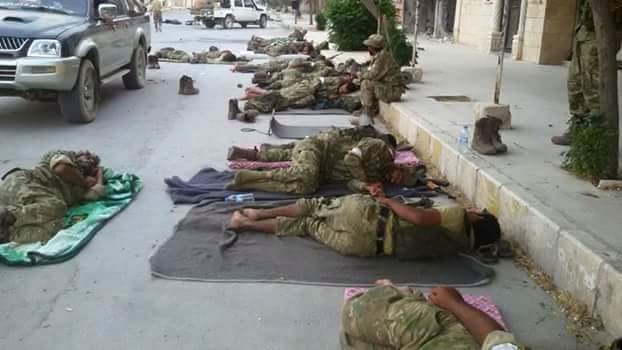
This is what good guys look like


 "The FSA slept on the street in Jarabulus."

 Rather than occupy the houses of the displaced residents.

Thursday, 25 August 2016

Daraya is lost


 Abdurahman Hark:

 "The besieged city fought off regime elite forces of 4th Division for 4 years. 1000s of Assadis were killed at its walls."

  
Sami:
 "Daraya civilians (who regime said never existed) will be evacuated to Sahnaya & Ma'araba tomorrow, rebels will follow the day after to Idlib. Daraya will always be the symbol of our revolution. Don't ask why they surrendered, but ask how they resisted & survived all these years."
[https://twitter.com/Paradoxy13/status/768848178795913217]
[https://twitter.com/Paradoxy13/status/768847307106377728]

Wednesday, 24 August 2016

What One Father Lost to Syria's Civil War


 'Ali Abuljud's children ran through the archways of Aleppo, toy guns in hand.

 They took pretend shots at each other across the courtyards. One child poked at his brother's back with a plastic rifle.

 "Come on and walk with us," he said, leading his brother away to a fake jail.
It's a version of the cruel scene they had grown accustomed to seeing in the war-torn Syrian city.

 "We are the children of the Syrian Revolution," one of the kids said. "We're recreating everything happening in the city, and the things people are doing."

 Chants of "Allahu Akbar" — or "God is great" — followed.


 But only a few days later, there would be no more games.

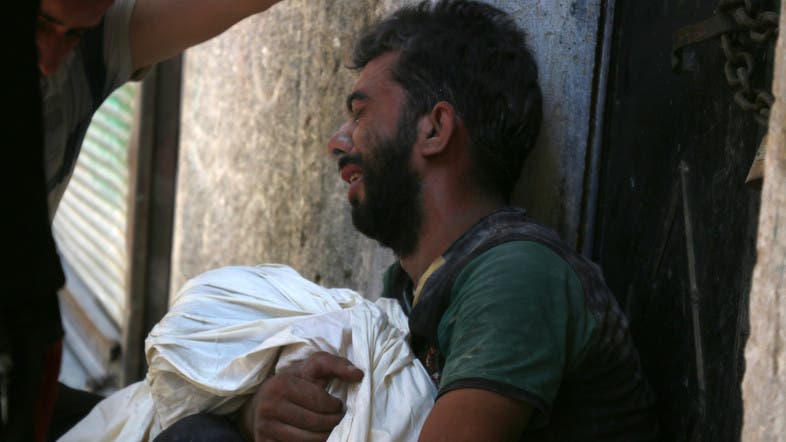
 A barrel bomb struck around 3 a.m. on Saturday, killing the four siblings: Aysha, 12, Mohammad 11, Obeida, 9, and Afraa, 7.

 Abuljud implored his friends not to focus on his children's death.

 "Don't look at this generation like this," he said. "This generation looks up in the sky and sees these Russian airplanes [backing Syrian President Bashar al-Assad], just looking up in the sky as they drop bombs. This generation is going to be titans! I swear they will never be afraid of anything, thank God!"

 As Abuljud walked back to what was left of his home, he said he did not want the world to feel sorry for him.

 "I want our voices — not just my voice — but for all of our voices to reach the entire world," Abuljud said.'

Image: Afraa Abuljud

Tuesday, 23 August 2016

Yes, do compare atrocities!

a scene from the sectarian massacre in al-Bayda, May 2013

 Michael Neumann:

 'Why then is there such surprise that, despite all reports of régime atrocities in Syria, no people of no nation seem able to work up enduring outrage? Report what you like, and soon you will get the reaction inculcated in us for decades: well yes, but doesn't the other side commit terrible crimes? Won't atrocities always be with us until we learn to respect international law? Isn't it suspiciously hysterical to scream about this one offender?

 Policy analysts refashion this into a mantra replete with adolescent wisdom: there are no good guys in Syria. This slides easily into: let's just back whoever we like, however much we like, for our own interests. "Our own interests" means, for US governments, what won't upset the voters. That in turn means no serious commitment in Syria, because that would entail either American deaths and great expense, or arming 'Arabs'. So already the moralizing has important effects on policy.

 There is another, equally damaging effect: the almost universally accepted convention that when it comes to atrocity, we don't need to know the details. It's all criminal, isn't it? Why wallow in sadism and cruelty? This is why, for instance, the Caesar archive of photos, widely distributed, has had no impact - and why so many see no reason to view them. They are supposed to force people to confront Syria's realities but the fact is, they don't. They are supposed to present details but the fact is, they do no such thing. We see emaciated corpses, some with injuries. That doesn't tell us how these people died, and zero tolerance tells us: "well, aren't people dying all over in this terrible conflict? Don't people die terrible deaths worldwide? Why then should these pictures tell us anything about what should happen in Syria.? After all, isn't it just a question of backing one bad guy rather than another? After all, why should Americans die to clean up a mess created by a bunch of bad guys running around killing each other? Can we really change the sort of society that generates these crimes? Is it really our job to do so?"


 Imagine that people did actually examine and compare the record of the various parties to the Syrian conflict. They might find reasons why it is not only morally permissible but morally obligatory, at times, to give full military support to people who commit war crimes and violate human rights. That realization can occur only when people stop saying it's all the same and really look at the details of atrocities.

 The worst atrocities are almost never reported. Incredibly, the latest Amnesty International account of torture in Syrian jails specifies the details of only of cases which are mild by Assad's standards. Perhaps here again, to report worse is thought merely prurient by an agency known for its 'even-handedness', that is, its refusal to compare.

 For Assad, barrel bombs are a mere convenience. Before the barrel bombs, his forces didn't kill children from the sky. They took knives and slit the throats of babies and toddlers. There are photographs and well-confirmed reports of this for anyone who takes the trouble to find them.


 The refusal to compare and its consequent avoidance of details conceals uncomfortable facts. ISIS' beheadings that so shock the world take moments; they are humane compared to the slow deaths Assad's torturers have inflicted on victims as young as 11. Bombing hospitals is indeed terrible: before the bombings, régime troops invaded the hospitals on foot and tortured people in their hospital beds. And the tortures of Abu Ghraib are love pats compared to what Assad inflicts on human flesh.

 To these qualitative comparisons must be added quantitative ones. Assad murders and tortures many times more people than any other participant in the conflict. To first preach about the awfulness of atrocities, and then assign no weight to how many human beings suffer them, is nothing short of bizarre.

 It's hardly a surprise that honest comparisons are avoided: the conclusions they compel are so unwelcome. But they loom large because they point to a crossroads of morality and political realism. The fact - it is a fact - is that ISIS, which conducts massacres, beheads people, blows up civilians, executes by burning alive and throws homosexuals off buildings - is, according to all reports on the scale and nature of the atrocities, much less brutal than the Syrian government. That is not a world it is in anyone's interest to legitimate and therefore to perpetuate. Before Assad we already lived with fine declarations masking pathetically low real standards governing how we treat one another. To let Assad remain in power - or his entire régime minus the man himself - is to lower standards even more. The fact that many prefer ISIS' horrible rule to his own is clear evidence what dangers lie in the refusal to compare.'

Monday, 22 August 2016

Assad is terrified of the children


 'Colleague Ali Abu Al-Joud, after documenting the martyrdom of his four children and his wife, sends a message to the Arab peoples from Aleppo:

 "I'm not going to even bother calling on the UN, or Arab or western leaders. My message is to the people, your turn will come. To all the people of the world if you don't protest, the same thing that happened to us will happen to you. My children have gone to paradise, and our revolution will succeed regardless if the powers that be said yes or no. Assad is terrified of the children because he knows this generation will fight & defeat him." '

Saturday, 20 August 2016

Syrian Genocide Memorial Day


 Tomorrow, the civilised people of the world will mark Syrian Genocide Memorial Day. I hope that you will be among them. In the future, I expect many people will be guilt-tripped into marking this day. Schoolchildren will be forced to remember the facts, to look at the pictures, to wonder how we can have been so callous to watch a people massacred before our eyes.

 It is three years since Bashar al-Assad fired rockets full of sarin gas into two rebel-held neighbourhoods of Damascus. 1500 people died, many of them children, because they were sleeping on the ground floor of their homes for fear they would not survive a bomb attack by Assad on the upper floors. It is the worst single massacre of this century.

 Someone asked on TV the other day, as Assad continues day-by-day to attack defenceless people with chlorine gas, why we are more concerned about death by chemical weapons than other sorts of murder. In a better world we wouldn't be. But it is one of the worst excesses of criminal war fighting, an identifiable weapon that cannot be used discriminately, and something any just world must have prohibitions against.


 This was also why it was President Obama's alibi for doing nothing to protect the Syrian people. In 2012 he declared it was a red line if Assad used a whole bunch of chemical weapons, presumably thinking that Assad would use all other methods to kill people, and he would be off the hook. But Assad's rule is never going to be stable again, and every time his grip on power is threatened, he needs to up the ante, to make people scared that this would turn into a confrontation between him and the United States. So he used a whole bunch of chemical weapons, and President Obama did nothing.

 And the use of chemical weapons were the occasion for the greatest lie of the century, that it wasn't Assad, but the rebels who used chemical weapons. There has grown up a media industry, some for the political benefit of Russia and Iran, some seemingly for the smug contrariness, that went into overdrive to cast doubt upon the victims of these chemical attacks. The same sort of invention as Holocaust denial, the creation of spurious doubt, the invention of alternative scenarios, the deliberate ignorance of what the victims had to say, but rather being the province of just a few fascist cranks, widespread among those who think themselves in some way progressive. Along with a constant stream of other lies about the Syrian revolution, that it is a NATO invasion, that it is all for Israel's benefit, that the rebels are the same as ISIS and are just as bad, and so on. These lies will come back to haunt us.

 There is a article in the Daily Mail three days ago, with an appropriately hysterical headline, "Former prisoners held in Assad's Syrian jails reveal how guards made the men rape one another to avoid execution… and regularly tortured or beat them to death".* Only it isn't hysteria, it's the truth. And when nobody has an interest in covering for Assad's crimes, when no-one has an interest in pretending the real crime would be to try and stop it, they will look for everyone on the left who said we should be Pharisees rather than Good Samaritans. And every word uttered by those left wing politicians who said the real problem was the rebels and our funding of them, will be used as evidence that the left are in love with genocidal dictatorship, and even those of us who have stood in solidarity will not escape the backlash.


 Please mark Syrian Genocide Memorial Day tomorrow. Please do not share articles by genocide deniers like Sam Kriss, Tariq Ali and Ray McGovern, just to mention a few I have seen recently. Please support those who would propose action that would stop Assad committing genocide, and oppose those who do not. And then you can tell kids in the future that you stood against Assad's genocide when it counted, while it was still going on, and while there were people who could be saved.

*[https://www.dailymail.co.uk/news/article-3744052/Former-prisoners-held-Assad-s-Syrian-jails-reveal-guards-men-rape-one-avoid-execution-regularly-tortured-beat-death.html]

What parents in Aleppo tell their children about war


 'I try very hard to explain to my kids, especially those who were born after the war began, what is going on around them, but it's not easy. So I spin tales about battles in the neighborhood between right and wrong and tell them about our revolution and our demands for freedom.

 I told them about the demonstrations that swept the streets demanding (Syrian President Bashar al-) Assad go, and how he and his army came with tanks and warplanes so more than half of the people fled.

 After five years of war, children are not surprised by the sound of the planes. Some of them scream in fear and some of them cry and some of them laugh. They bombard me with a stream of questions. Who is bombing? And why? And how long they will continue? Where do the planes come from and who pilots them?


 My daughter, who is five years old, was born in this war and does not know anything about normal life. She is used to seeing the streets in ruins, full of debris; houses without walls or ceilings; and trees broken or burned. She has never once asked to go to a park or a playground or the theater, because all of that ended in Aleppo before her birth. All she knows is that people are dying because of the bombing. She cannot even understand a natural death. When one of the neighbors passed away she asked if he died because of the shelling. I said no. Then barrel bombs? I said no. Then shrapnel? I said no. So she sat, puzzled, and asked, "Then how did he die?" It was difficult to explain to her how people normally die.

 My oldest son, Ibrahim, who is 10 years old, was injured in the legs and abdomen and it almost cost him his life. To this day he fears every strange sound or loud noise, whether it's a plane or a motorcycle or a speeding car. Every sound for him appears to be caused by the bombing he was exposed to. He once jumped from the motorcycle I was driving when he heard a loud sound and thought he was being bombed again.


 A single hour does not pass without me communicating with my family so I may be reassured of their safety. Existence in Aleppo means that you are always in danger. When my son nearly lost his life and his legs, he had only gone to a shop on our street. The shop was hit by an airstrike while Ibrahim was there. I learned that the raid targeted our neighborhood. I hurried home and learned that Ibrahim did not return from the store. I continued to search for more than an hour, under the rubble of collapsed walls but was unable to find him. Then we started to search the local hospitals where we found him in the emergency department.

 I could not believe I found him alive. He was lying covered with dust mixed with blood that filled the wounds on his body and wounds on his legs and abdomen. A few hours after he entered the operating room, he was out of critical condition and began waking up from the anesthesia. He was crying and repeating unintelligible sentences. We tried to console him, to tell him it's OK and tell him he's a hero to overcome this ordeal. When he woke up totally he did not ask me who bombed him -- he knows quite well that it was the Assad regime. He did not know why and did not care. He had seen many children before in his same situation.

 He was only concerned with the fate of his leg because he could not feel it. He didn't dare ask the question because he was scared we would answer, "Yes, they amputated your leg." We tried to convince him this was not true, that he would not lose his leg, that it was fine. He wouldn't accept it. The only solution was to take a picture of his leg on my mobile and show it to him so that he could be sure it was OK.'

Friday, 19 August 2016

Amid deafening silence, growing screams for no-fly zone


 ' “Words will not stop Assad and Russia’s bombs from killing us,” Hamood Jneid, a local from Kafranbel, Syria tells Al Arabiya English, adding that the Syrians blame “anyone” who has the authority to stop the killing and doesn’t. According to Jneid, most people in his village, Kafranbel, point fingers at America, which has done “absolutely nothing” and used only “meaningless words” despite the atrocities being committed by Assad and Russia. Jneid and the residents of the village are not the only ones bitter about the international community not creating safe buffer zones in Syria.

 “Why us? Why is it our children that are dying? Why do children anywhere else in the word have the right to live, and our children are being killed? All this, because we demanded our freedom?” he lamented.

 Khaled Salame, an aid worker from northwestern Syria, said that he can’t understand how an army can kill its own people. Salame explained how he watched Russian jets fly over the village of Saraqeb, Idlib, on Monday and drop “several” bombs. He said he can’t get “the screams of children and women out of his head”.

 “I felt hysterical. The hardest thing is to see an old man running around and crying like a child… I’m used to seeing children cry, not old grown men,” he said.


 Mostafa Saroot, a photographer with Aleppo’s Media Center, and the man behind the shocking footage, expresses his puzzlement towards the popularity of this single shot, since pictures like this are coming out every day.

“There are dozens of Omrans every day in Aleppo, I wish they would implement a no fly zone so children can keep safe.”

 The dazed, dusted, and bloodied face of Omran is only a minuscule window into the horror, atrocities, and nightmare of Allepo. With 400,000+ death and millions more displaced, Syrian conflict has stretched on for years.

 “Our children are becoming mentally disturbed,” Saroot continues. “Omran’s silence spoke for the all the Syrians suffering.” Shrouded head to toe in a blanket of dust and caked on ruble and debris, Omran was captured in a dead end, numb daze, his reaction to his own bloodied face chillingly indifferent and anesthetized.

 “I hope this picture reaches the UN and the international community and they understand that our children have developed psychological problems due to the heavy bombardment on Aleppo,” he said.


 US President Barrack Obama ruled out a no-fly zone over Syria for several factors, calling it “counterproductive” since ISIS does not have planes and carries out attacks on the ground. US Deputy National Security Advisor Ben Rhodes said even if there were areas in Syria where planes could not fly over it, the killing would not stop, because ISIS would still be able to carry out massacres. He also mentioned that a no-fly zone would require an “enormous” amount of US resources, when America’s main focus is to wipe out ISIS.

 “A no fly zone might create some additional ability to manage some of the refugee flows and brush back some of the Syrian regime’s air attacks on civilians, but frankly that violence could just manifest itself in different ways on the ground or migrate to different areas,” Rhodes said in a podcast on “The Axe Files”.


 Mohammed Alaa Ghanem, senior political adviser, government relations director, and strategist for the Syrian American Council in Washington DC, said that not only would a no-fly zone in Syria “stem the flow of refugees by protecting civilians” but also “increase” the possibility of a political solution by proving to the Syrian regime that Assad “cannot” win militarily. He said he believes the only backlash is the risk of “increased US-Russia tensions”.

 According to Ghanem, top ex-US generals have told him that such a solution would be feasible, in spite of Russia’s heavy involvement, and that Obama’s decision to abstain is “political”.

 “Most likely, at the start of his administration, President Obama was motivated mainly by the desire to avoid another Iraq. But once Iran got seriously involved on the regime side, Obama likely felt the need to avoid targeting Assad in order to preserve the nuclear deal,” he explained.

 Mohammed said he believes a “no-fly zone would tilt the scales in favor of moderation and stability in opposition-controlled areas while providing Syrians with a chance to build up a real alternative to Assad's dictatorship.”

 Ghanem says that the constant air raids on obvious civilian targets are “designed” to create havoc in opposition areas, preventing a real alternative to Assad and to create conditions “so desperate that extremism is a natural reaction for many”.


 Shiyam Galyon, a Syrian-American writer and researcher has been advocating a no-fly zone for a long time.

 “So many people around the world want to stand in solidarity with Syria. And that’s great: The Syrian revolution is based on principles that no doubt will elicit solidarity from anyone who values human and civil rights. However, when people are being brutalized, I no longer want to stand in solidarity with them. For those people, I will shout loudly for intervention,” Galyon said. She says that is why it is vital for anyone who believes in freedom and dignity to “shout for a no-fly zone”.

 Earlier this month, children in besieged Aleppo were hailed “little heroes” all over the media after they burnt tires to create “no-fly zones” by raising smoke to confuse the planes bombing them, hospitals, and markets.

 “When Aleppo’s children burned tires to blacken the sky, they proved that there is a clear Syrian will for a no-fly zone. That children in a war zone did more to avert planes coming to bomb them than the international community ever did is a sign that they are dysfunctional,” Galyon said.'

Let us be clear


 Loubna Mrie:

 'I have long shunned away from the immensely frustrating practice of sharing videos of atrocities from Syria, particularly ones produced by western news outlets. ًThese videos have not only grown more abundant and grotesque over the years, but also, with the vast majority of them showing the aftermath of airstrikes against civilian structures in the opposition-held areas, they present an indisputable evidence for who is responsible for the killing: The regime and its allies.

 The other side does not have an air force.

 Yet, commentary in the videos and underneath them never fails to divert attention from this very obvious fact. Generic talk of "war is bad", with endless variants, runs amok, almost always neglecting to name the actual criminal involved. Worse yet, many use this very same footage--sincerely or maliciously, it hardly matters--to advance their own misplaced agendas.


 So, just in case this is not obvious, let us be clear:

 The vast majority of suffering in Syria is NOT a direct or indirect byproduct of the 2003 intervention in Iraq, as much as you hate and hated that war.

 It is NOT a case of "America needs to stop bombing Muslims," as true as this could be elsewhere.

 It is NOT because the Saudi state exports Wahhabism, as terrible said state and ideology are.

 It is NOT because Turkish AKP has turned its back as Jihadists trickled through the border in 2013, as appalling and narrow-sighted you might think that was.

 It is NOT because global warming led to a drought in pre-war Syria, catalyzing an economic and political crisis, as sexy and convenient this theory seems.

 It is NOT because of ISIS, who is responsible for but a small fraction of the death and destruction that has befallen Syria, and for an even much smaller fraction of the country's recent history, as much as you might be horrified by their actions and tempted to blame it all on that magnet of resentment.

 And, most certainly, it is NOT because of any one state, not the least the US, having the wrong refugee policy. The US has admitted less than 10,000 refugees as of date, which is less than 0.1% of all people displaced in Syria, and, with the wildest improvement imaginable, would not hit 1%, as much as democrats and progressives think it easy to score points against Trump et al on this issue and feel better about their stance on Syria.


 Important as any one issue of the above may be, to blame Syria on any or all of them is wrong and intellectually lazy, if not offensive.

 Rather, what is happening in Syria is first and foremost the doing of a brutal, totalitarian government, simply put--and simply it should be. The Syrian air force has been operational for the last 4 years, on a daily basis. It has targeted hospitals, vegetable markets, bakery lines, gas stations, and schools, on purpose, and repeatedly. It is directly overseen and micromanaged by the Commander of the Armed Forces, who also happens to be the sitting president of Syria. He also has the "rights" to dissolve the Syrian parliament and control the highest judiciary body in the country, based on a constitution first put in place by his dear father. He, like his father, was "elected" by 99% of the vote for the longest presidential term on earth. Over the past half-decade, he has overseen the collective punishment and destruction of one of the most beautiful countries on earth, primarily because he has not been able to reign it into submission. In the process, he has instigated a war that killed half a million humans and displaced more people than in WWI. His name is Bashar al Assad, and he wants you to talk about everything and everyone but what HE did.

 Please do not help him.'


 Note 1/6/25, link currently unavailable.