Tuesday, 16 August 2016

How the BBC silences Free Syrians


 By changing sentences from active to passive, so perpetrators and victims are replaced by an unfortunate conflict.

 Mohammed: "Because of the rockets that Bashar al-Assad, and the Russians, and their allies, are throwing over our Free City of Aleppo."
BBC subtitles: "There are barrel bombs and rockets."

 Wissam: "The régime/Russia are targetting every hospital, and all neighbourhoods."
BBC subtitles: "Hospitals are being targetted."


 Note 1/6/25, video no longer available.

Sunday, 14 August 2016

Former detainees recount torture and organ harvesting


 'Omar al-Shogre was 17 when they came for him. Omar would spend the rest of his adolescence in a total of 11 Syrian prisons, facing torture from a multitude of men belonging to the government’s elaborate, sinister security apparatus. "I could drink their blood."

 In Tartus he was tortured with electrocution – to his neck, arms, legs, and genitals. On another occasion, prisoners were force-fed salt before being offered water as a relief from the thirst. But their penises were then tied up, preventing them from urinating and causing intense kidney pain.

 Omar began to know the meaning of hunger: the prisoners often went without food for days; when it came it was a few potatoes and eggs, often covered in blood or mould. “It continued for months,” Omar said. “People were crying from hunger.” There was always extra torture on celebratory days, such as the Muslim festivals of Eid al-Fitr and Eid al-Adha, and Mother’s Day. Torture parties, Omar called them.


 Prisoners came from many backgrounds and nationalities. They shared skills, professions and languages. They taught themselves how to divide their tiny food rations with threads from the military uniforms they were forced to wear, and how to kill the lice that crawled over their bodies. Omar recalled two fellow inmates with particular warmth: Bara’a Manieh from rural Damascus, was a natural leader, and “always happy”. Radwan al-Eisa from Hama became a close friend.

 But over time both were taken away by officers and had their toes burnt off with acid and their eyes pulled out. Neither one was seen alive again.

 Omar’s final prison was the notorious Sednaya jail, north of Damascus. One of his many "duties" was helping to dispose of the corpses of dead inmates. He once saw a room full of bodies, with none of the usual signs of torture. Instead, there were large wounds where their hearts, livers and kidneys once were.

 Organ harvesting appeared to be taking place on a large scale.


 Yehia Rashid al-Salim from Palmyra can still feel the pain of the beatings. Yehia was subjected to the “al-Shabah” torture method: a prisoner’s hands are shackled and he is suspended from the ceiling of his cell, feet centimetres from the floor. Then he is beaten.

 He was then transferred to the military police branch in the city of Homs, and then to the notorious “Palestine Branch” prison in Damascus, where he was tortured three or four times a day. Life inside the cell was “revolting”. People were forced to remain naked and infectious diseases spread quickly. Tuberculosis, lice and scabies caused infections and death on an almost daily basis.

 “The jailer would enter and ask how many dead there were that day,” Yehia said. “We put the bodies by the door of the cell, where they were taken to an unknown location.”

 The lucky prisoners died, Yehia says, because death was a blessed escape. “I wish death upon the detainees at every turn. It is an escape from torment and pain, from the hunger and oppression and humiliation and torment and humiliation, from everything inside.”

 Yehia ended up in Idomeni camp, the makeshift city home to 10,000 refugees on the Greece-Macedonia border that was closed down in May.

 “There are scars and marks on my back to the present day. I wish to show the violations of this criminal regime. Until now I have not had the opportunity. I want the world to see what is happening: the Assad regime's violations against detainees.”


 More than 12,500 people have died under torture in prisons in the past five years, according to the Syrian Network for Human Rights. The government of Bashar al-Assad is responsible for 99 per cent of those victims, according to a special report that the monitoring group released in June. The group accuses the Syrian government of denying torture and blaming arrests made on al-Qaeda and other militant groups.

 The group's chairman, Fadel Abdul Ghani, said: “We are still waiting for the free world to take the next stop in order to protect humanity in Syria, now that this mechanism is exposed.” '

Saturday, 13 August 2016

Nobody in this country is advocating American military intervention


 Nicholas Burns:

 "Back in 2012, we know now that she [Hillary Clinton] was part of a group, including Leon Panetta and David Petraeus, advocating not that the US intervene militarily in Syria, but that we arm those Sunni rebels that could oppose the Assad régime; and the Assad régime has killed most of the civilians in Syria. In 2013, if you do draw a line in the sand as President Obama did, and then if Assad crossed it and you do nothing, that is a symbol of weakness. So I think actually she's in the mainstream of what most Democrats, and most Republicans, here in our country, and I think in many European capitals, think would have been the right way to go on Syria.

 I think it made sense in 2012, and still makes sense in 2016, that if there are Syrians in the Sunni majority Arab community in Syria, who want to defend themselves, who are not part of the Islamic State or Jabhat al-Nusra...In this civil war, that has produced twelve million homeless, the destruction of the entire country, the greatest humanitarian crisis of our time, we shouldn't stand by.

 Nobody in this country, my country, is advocating an American military intervention. But what we are advocating is two things. Help those moderate Sunni rebels who want to defend their homes, and their villages, and their towns, against this rapacious government in Damascus, and its Russian, Iranian, and Hezbollah allies. Number two, you've got to help the refugees, and that means we've got to get humanitarian aid corridors by the United Nations and NGOs into Aleppo, which is being besieged right now, pressure the Russians and the Chinese to stop vetoing those aid columns at the United Nations. This is not an intervention of the type, and it was wrong I think in retrospect, of the type of Iraq in 2003, it is simply trying to deal responsibly with the greatest crisis in the Middle East and Syria and Iraq. It also means we have to fight the Islamic State, and that's what Europe and the Arab world and the US are trying to do."

Friday, 12 August 2016

Chasing bananas, dodging bombs


 Zaina Erhaim:

 ' “Within couple of days, they will take the last road connecting Aleppo city to its suburb, Castello,” he said. “I must leave now to make it in.”

 In 2012, Mahmoud Rashwani, a 30-year-old activist, had left his home and family in Aleppo after he was arrested and tortured for participating in peaceful demonstrations. On 12 July, he left another family – me and our six-month-old baby – to go back to what is left of Eastern Aleppo. Vegetables and fruits were already running out in the city, so he carried some tomatoes to share with friends, and walked through the middle of the night with two doctors, who infiltrated through the government siege along with him. I couldn’t help feeling abandoned. I was left with the great burden of taking care of a baby on my own. Still at least, I am not being left for another woman, but rather for a siege and a cause.

 “I saw a banana today! But I couldn’t catch it. It was running fast in the first-aid car that entered the city,” Mahmoud wrote on 10 August. Among the estimated 300,000 to 400,000 people living on Aleppo’s eastside, Mahmoud hadn’t had any vegetables or fruit for the past month. Aside from lack of fresh food, civilians in Aleppo were suffering shortages of fuel, canned food, eggs, sugar, flour and baby milk. Bakeries have stopped selling bread. Instead, local councils are distributing it to achieve a balance so people will not hoard the precious commodity.


 “The shelves of shops were all empty by the fourth week of the siege,” Salah, a media activist living in Aleppo, told me. “The big generators providing electricity to our houses stopped working because they couldn’t find fuel.”

 The reasons Salah was drawn back into Aleppo were no different from those that took Mahmoud from us. “Being here will help the besieged civilians - either by documenting what’s happening to them with my camera or providing moral support to them,” he told me.
Although the encircling of Aleppo could be seen coming for months, it still shocked people.


 “We were surprised when it happened, in spite of speaking about it for so long,” said Samar, director of counselling and social support in the Space Of Hope organisation, a local development group working inside the city. When the siege began, they ramped up a household farming project run by activists who volunteered to find and distribute seeds of basic vegetables to families so they could work towards food self-sufficiency.

 Like other organisations in Aleppo, Space of Hope didn’t stop providing services and running child educational centres during the siege. “To give the people a sense that life hasn’t stopped, we are carrying on, and so are our projects,” Samar told me.

 The main challenge the organisation has faced is the lack of fuel and the sudden halt of transportation. Even amid blazing heat and skies bristling with prowling jets, walking is the only available option. Public coordination has shown its worst face over the past month. Some traders hid food to sell it later at even higher prices. But others kept prices the same, telling buyers, “We live and die together”. Some activists turned their cars into free public taxis to help those struggling to move around the city.

 Samar hasn’t seen her 19- and 12-year-old daughters for four months, and when she finally managed to get permission to cross the Turkish border to see them, the road to Aleppo was cut.

 “I was so desperate and sad that I couldn’t hold my tears and stopped speaking to them, fearing that I might collapse,” she said.

 Her shaky voice faded as we talked, then she continued: “When the rebels opened the road, I felt the ultimate happiness, more than when I held Momena (one of her daughters) in my arms for the first time. I really can't describe it to you.”


 Amid the siege and before the rebel counter-offensive, public spirits hit a low. People resigned themselves to a destiny like that of Madaya, a city that has suffered for years from siege and hunger.

 As the siege was broken, Salah said, “the public mood lifted dramatically, people went down to the streets offering any kind of help, they all started burning tyres creating a black cloud to block the [Russian and Syrian] air force, applying a homemade no-fly-zone."

 It didn’t offer much protection though. Bombing during the siege and even now is extensive, mostly targeting the road through which people can flee the besieged city.

 “This is how humanitarian the corridors suggested by the regime are,” Berbers Meshaal, a group leader of the While Helmets (civil defence force), told me.

 Berbers lives with his wife in the city, and is awaiting the arrival of more supplies, while Salah, Samar and Mahmoud eye the road, a couple of metres of asphalt that separates them from their families, some for years in a recurrent scenario for Syrians as the UN stands by worrying, only worrying.'

Tuesday, 9 August 2016

Saraqib Being Annihilated By Russian Airforce


 'Russian air force continues to bomb the town of Saraqib in rural Idlib relentlessly, targeting mainly residential neighborhoods, civilian homes, and vital civilian facilities. The brutal Russian airstrikes did not even spare the blood bank building, ambulances, mills and the only water station in the town. The main public market was reduced to rubble by intense, deliberate airstrikes. At least 80 airstrikes targeted the town in the past week, with cluster and thermobaric bombs used in many of those raids.

 Nearly 35,000 civilians fled Saraqib after their homes have been destroyed in the continued Russian bombardment.

 As Russia’s war crimes and blatant violations in Syria continue unabated, the Syrian Coalition calls upon the international community to take urgent action in order to deter Russia’s aggression on Syria and stop its barbaric crimes against Syrian civilians.

 Recovering the bodies of the Russian crewmembers whose helicopter crashed on the outskirts of Saraqib can only be achieved through negotiations. The Russian invaders must realize that taking revenge on civilians and threatening to annihilate the town of Saraqib will only serve to further complicate the situation.

 Crimes carried out by Russia and the Assad regime against the Syrian people provide further proof that their strategy to bring the Syrian people to their knees by military force will not work. Military escalation will not break the will of the Syrian people who will eventually emerge victorious and decide their own future. Invaders and tyrants will not have a role in or place in Syria’s future.

 May our wounded recover, our detainees be free, and our fallen heroes rest in peace.
Long live Syria and its people, free and with honor.'

Monday, 8 August 2016

Opposition on the verge of most 'surprising' victory


 'A nearly month long government siege of Syria's largest city is on the verge of collapse after a week of heavy fighting in northern and eastern Aleppo led to the defeat of pro-regime forces by a coalition of Syrian opposition groups.

 The Free Syrian Army — aided by a military alliance of several rebel brigades known as Jaysh al Fateh, or the Army of Conquest — successfully regained control over a significant portion of Aleppo, including a government supply line leading into the city from the south and a major regime artillery academy.

 "There was initially significant resistance from the pro-regime forces, but after parts of the frontline were re-captured by the rebels, the regime-allied forces deteriorated very quickly," said Syrian journalist Hadi Alabdallah.

 "It was very surprising, and much faster than anyone had expected. Officers from those [pro-regime] militias fled that their soldiers out on the field, so they started to flee as well. That's why the artillery academy was so easy to overrun — it was captured within two hours."


 Alabdallah's account lines up with what one alleged Hezbollah fighter said in a tape recorded during last week's heavy fighting, which was later leaked on social media.

 "They [fellow pro-regime fighters] all left us, the Iranian, Afghans and Syrians … all of them left us. We are like dummies, we don't know anything, we are fighting alone. I went to the academy in the afternoon … and only the Lebanese were still there."

 He cautioned against characterizing the battle as an offensive launched and won by Jabhat Fatah al-Sham, an Islamist rebel brigade formerly known as Jabhat al-Nusra, Al Qaeda's affiliate in Syria, until late last month.

 "There have been many different players, all playing a critical role," Alabdallah said of the opposition. "The forces fighting the regime from inside Aleppo have been almost exclusively FSA [Free Syrian Army]. When it comes to operations in southwest Aleppo, Ahrar al-Sham probably played a bigger role than Jabhat Fatah al-Sham."


 Still, Alabdallah said, it remains difficult to say whether any of the rebel groups played an outsize role in the fight to break the siege.

 "Jaysh al Fateh used to fight in a way where each group would take a different front, so that they were essentially divided on battlefield," Alabdallah said. "They would attack together but their resources would be divided. The policy now — in this battle at least — is that all the groups are intermixed in battle. It's a much more cohesive operation."

 Alabdallah stressed that the cohesiveness of the operation does not necessarily indicate that the former Al Qaeda affiliate is winning over hearts and minds. The group still "differs too much ideologically" with the more mainstream groups, he said. Rather, Jabhat Fatah al-Sham is just one component of a much broader military alliance of groups that each bring their own strengths to table.

 "Some smaller groups might explore merging in with Jabhat Fatah al-Sham," Alabdallah said. "But I don't expect the dynamics to change that much — the ideological differences are still there."


 Photos of an aid convoy carrying food into the rebel-held east from Idlib prompted civilians to take to the streets in celebration — even as the threat of intensified airstrikes loomed over them.

 "The civilians are so happy," Alabdallah said. "They will continue to be bombed, and they will continue taking whatever precautions they need to to avoid being killed in the airstrikes. But at least now they won’t be starving." '

Syrian refugees settling in US at a faster clip


 'When Ajwad Al Zoubi, a tall, stocky man who for years drove trucks across the Middle East, saw the emailed photo of his beloved home with the bountiful orange trees burned to the ground, he turned into a pool of tears. They come suddenly, even now, when he talks about it.

 Before the war he couldn't have fathomed leaving his hometown in Syria. It was here where he built up two stores and designed his dream house for his mother, wife and nine children. Then government forces came searching for him in a wider strategy to detain all adult men. Dara'a, the forefront of Syria's protest against President Bashar al-Assad, was becoming a graveyard.


 For Al Zoubi, the nation's opposition to Syrian refugees doesn't fit with people like him who have lost everything.

 "We came here from Syria to escape (such extremism,)" he said of safety concerns regarding refugees. "That's not us. We ran away from what they are describing."


 The 42-year-old still remembers the March 2011 protests that sparked the war clearly, catapulting Dara'a into the "cradle of the revolution." Following the success of protests in Tunisia, 15 teenage boys in Dara'a spray painted anti-government graffiti on a school wall. They were arrested and tortured, suffering beatings, electric shocks and having their fingernails ripped off.

 The city of about 150,000 people roughly 8 miles north of the Jordanian border erupted in widespread protest. Al Zoubi attended some of them. Security forces cracked down, killing hundreds of people over the next month, including the nephew of Al Zoubi's wife.

 Life in Dara'a turned increasingly complicated. To punish the city's residents, the government cut electricity and blocked telephone and Internet service. Water and bread became luxury items.

 "The government started destroying the city," Al Zoubi said.


 For a time, the family tried to stick out the violence, huddling together at home. But with roads into the city blocked, Al Zoubi could no longer buy the items he sold in his stores and he resumed driving trucks.

 During one such trip away, security forces raided his house, threatening his 63-year-old mother and violently pushing the diabetic to the floor with the butt of a rifle. They were searching for Al Zoubi. According to Human Rights Watch, which investigated the attacks in the city, security forces detained hundreds of adults and children in such random sweeps.

 Fearing that he would be taken into custody too, Al Zoubi went to Jordan, where he thought he could work while the conflict tided over. But it only worsened. His children saw bombs erupt as they played outside and he said security forces drove through their neighborhood, shooting at random.


 On May 28, 2012, his family piled into a taxi with just enough clothes to convince border guards that they were only visiting Al Zoubi in Jordan for the weekend. They never came back. After a friend later emailed him a picture of the charred remains of his house, it sunk in- finally - that he could never go home again.

 His wife, Taghred Ahmad, has scouted all of Houston's Arabic markets, discovering to her delight that she can find most of the traditional delicacies they were accustomed to at home. One of the kids, 17-year-old Mohammad, used to wake up terrified in the middle of the night, shaking from nightmares of the shelling of bombs. Now he is slowly learning to sleep through peacefully.'

Sunday, 7 August 2016

The flag of freedom


 "As long as this flag is flying, we can tell the whole world that we are fighters for freedom. Revolution until victory."

Whoever enters a mosque or a church is safe


 'Following in the footstep of the prophet, the first leader, we assure the people of Aleppo that whoever enters his home is safe, whoever enters a mosque or a church is safe and whoever lies down his weapon is safe too.

 Our heroic revolutionaries are seekers of freedom not bloodthirsty killers. They are also advocates for mercy not tyrants.'

Wednesday, 3 August 2016

Connecting Relief Work and Civil Activism

[Photo: Dr. Jalal Nofal with psychologist Wifa' al-Hayek - Yabrud - Rif Dimashq - 7-9-2012 (Yabrud Ahl al-Khayr Facebook Page)].

 'Dr. Jalal Nofal, born 1963 in Damascus to a working class family from as-Sweida’, is a prominent psychiatrist and activist who has been involved in politics and relief efforts throughout his lifetime.

 In 1978 Nofal joined the Communist Action Party (CAP), after rejecting the Syrian Communist Party’s pro-regime stances, particularly during the Muslim Brotherhood uprising (1976-82) and the ensuing government crackdown. “With regards to the Hama massacre (1982), for me as a leftist, the Communist Action Party took the most balanced and satisfactory stances,” explained the doctor.

 Nofal, a medical student at Damascus University at the time, remained an active party member until his arrest in 1983, when the regime launched a nationwide crackdown against leftists. He was released in 1991 after more than eight years in prison. Like many of his contemporaries, Nofal decided to resume his studies, graduating from medical school and specializing in psychiatry.


 Before the start of the revolution in March 2011, Nofal was working on a campaign to improve public transport under the slogan “Public Transport that Respects Citizens”. After the revolution began, however, he transitioned from reformist calls to participating in the revolutionary activism sweeping the country. Nofal was convinced that “all democratic movements and individuals must take part in revolutionary activism, regardless of ideology or religion.”

 Nofal worked with the Damascus Neighborhoods Coordinating Committee to organize a protest in the capital’s Arnus Square on May 2, 2011, demanding democracy, an end to the regime’s violence and sectarianism, and the lifting of the siege on the southern city of Darʿa. He was arrested at the protest and spent ten days in ʿAdra prison before being released in an amnesty. He then returned to work with the committee, though it was soon dissolved after its founders were arrested.

 After that, he joined the Damascus Doctors Coordinating Committee, which was set up to cure patients, especially protesters, who were routinely arrested, abused, and tortured at hospitals in the presence of Dr. Nofal and his colleagues. This campaign was effectively halted, as were most others, by widespread arrest campaigns.

 Nofal also worked with the Syrian Arab Red Crescent (SARC), which in his words was “one of the few organizations where revolutionary humanitarian workers were allowed to operate.” Nofal’s relief work focused on psychological and social support for internally displaced persons (IDPs) living in Damascus and victims and witnesses of conflict and siege throughout Rif Dimashq. “Working in Damascus with IDPs was far more dangerous as we were accused of supporting terrorism, while we had more liberties in Rif Dimashq due to the looser grip of the regime,” clarified Nofal.


 The government continued to clamp down on relief efforts, accusing any aid agency of supporting terrorism and arresting and exiling many field workers. In April 2012, Nofal himself was arrested while on SARC duty in Rif Dimashq and subjected to torture while in prison.
Towards the second half of 2012, the armed struggle began to take an increasingly prominent role, but Nofal persisted in his peaceful initiatives. In 2013, he was a founding member of the National Call Movement, which had over 200 members in Damascus and “called for the establishment of a democratic civil state that rejects sectarianism, Islamization and civil war,” as Nofal put it.

 The National Call Movement members aimed to revive the peaceful movement and along with the Syrian Revolutionary Youth they installed speakers chanting anti-regime songs across Damascus. By early 2014, the network was exposed and disbanded; its members, including Nofal, were arrested and forced to confess under torture at the capital’s Military Intelligence Branch 215.

 After his release in early July, Nofal continued his relief and civil society work, only to be arrested less than two weeks later. He was accused of funding terrorism by the Counter-Terrorism Court for having provided relief with his wife in Yarmuk, and spent six months in prison. When Nofal was let out in January 2015, he was smuggled out of the country and fled to Germany to join his wife, poet and activist Khawla Dunia, who had fled the country earlier.
Nevertheless, this reunion did not last long. “What I could offer in Germany was far less than that which I could in Turkey,” explained the doctor. Nofal currently resides in the Turkish southern border town of Gaziantep, where he is a regular guest on programs such as those of Alwan FM, Radio Hara, and Radio Rozana. He is also part of a team of psychiatrists and social workers who work in schools and orphanages, while training therapists and supporting similar activities inside Syria.

 Jalal Nofal is an example of how many Syrian revolutionaries have never drawn a line between two inextricably intertwined realms: relief work and civil society activism. In their opinion, it is in fact impossible to ignore the political dimension that has led to the current suffering.'

Tuesday, 2 August 2016

Closer than close

 Marcus Henry Weber:

 "Battle for Aleppo: Regime (red) supply route into W. Aleppo has been cut. Rebels(green) are close to fully breaking the siege and opening route into rebel-held Aleppo neighborhoods."


Note 30/5/25, link currently unavailable.

Saraqeb 'attacked with chlorine gas'


 'Barrels suspected to contain chlorine gas have been dropped on a town in Syria, a doctor and rescuers have said. It is not clear who was responsible.'

 It is clear who was responsible. It is only Assad who has been dropping barrels of chlorine from aircraft to kill children. Shame on the BBC.

 They've also only just stopped saying the Russian military helicopter which was shot down nearby, packed to the gills with weaponry, was on a humanitarian mission. Sky News was better, reporting the Syrian National Council's reaction:

 'After shelling, besieging and killing civilians and perpetrating war crimes on them, the Assad regime has resorted once again, and in breach of UN resolutions 2118 and 2235, to using chemical substances and toxic gasses. The daily reality confirms that all the international agreements and previous security council decisions, be they about chemical weapons or otherwise, are meaningless for the Assad regime.'
[https://web.archive.org/web/20160803224353/http://www.skynews.com.au/news/world/mideast/2016/08/03/claims-of-chemical-warfare-in-syria.html]

Captive Syria


Banner reads: "No negotiations before: the cessation of the shelling, the lifting of the siege and the release of the prisoners."

 'No sunlight enters the dingy, oxygen-less cell. Six by ten meters in length, each identical to the other two dozen, occupied by thirty men who sleep on the cold ground. Thaer bides his time, nursing a broken foot and abscessed ear—poorly healed marks from a previous torture session—by drawing caricatures on the walls, caked with a slovenly, muck-like amalgam of sweat, blood, and the thick black smoke from the burning trash which provides the only heat during the cold desert nights in Syria’s heartland. It’s an idle retreat that allows him to briefly escape his reality.

 “Life inside the prison is utterly static. The only physical action is you and your cellmates being drained psychologically and somatically. Your sense of time and place and your surroundings disappears, like shadows you can see but cannot grasp,” Thaer told Newsweek Middle East. We spoke to him through a cellphone he managed to smuggle into the prison. His name is being concealed to protect his safety, but Newsweek Middle East has confirmed his identity and case number through a family member, as well as a lawyer in Damascus.
When revolution broke out in Syria in 2011, Thaer, then an out-of-work theatre director, quickly began organizing theatrical performances promoting freedom, dignity and citizen participation. 

 For a time, art was a relatively safe way to express dissent in Syria. He took part in peaceful demonstrations, and urged fellow activists to remain committed to non-violence when the revolution started arming itself. Then, one summer morning in 2013, the “ghosts” came for him. Named for their shadow business as government hitmen, they carry out the Syrian regime’s dirty work before disappearing without a trace. It was 6:30AM when three cars pulled up to Thaer’s home in Hama. Ten men poured out carrying Kalashnikovs. Without a word, they broke down the door, cracked him in the head with the butt of their rifles, tied his hands and feet and threw him in the trunk of the car. Three years later, he sits in Hama Central Prison, with about 850 others in the “disorder wing”—reserved for political prisoners.


 Thaer is one of the lucky ones. He is alive. His family knows where he is. The same cannot be said for the over 200,000 Syrians estimated to have simply disappeared—swallowed up by a shadowy system of secret prisons without any record in the courts. Agonized, their families have gone years not knowing where they are, if they’ve been charged or sentenced, or if they are alive or dead. In most cases, all that’s known is that they were taken away by the secret police, and never seen again. A few weeks ago, tensions reached a breaking point. The prisoners staged a revolt, blockading themselves inside the disorder wing. In a desperate battle for their lives, they found themselves in control of half of the prison—staring down their jailers, it was either victory or death.

 The most comprehensive effort to date documenting human rights violations committed over the course of the Syrian conflict was completed in April 2016 in a report by the Violations Documentation Center of Syria (VDC). After years of painstaking research collecting documentation through gut-wrenching interviews with the family members of detainees, it estimates some 200,000 have disappeared inside the prison system, and confirmed 23,000 of their names. After testifying with his research at a U.N. commission of inquiry, Bassam Al Ahmad, one of VDC’s founders, collected his files and left Syria. “It’s too much. We’re talking about not just a catastrophe on the level of Syrian society, the future of the economy, of families… People will need psycho-social support for generations.”


 In early 2014, officers of the secret police came to Khalid’s office to arrest him. “Will you cooperate? Or will you be a problem?” the captain asked him. He went quietly, and was taken to a branch of one of the intelligence divisions, where officers accused him of helping to organize demonstrations. Khalid answered that he had never taken part in any. The captain, named Maher, replied, “So you’re going to be a problem now.” Guards seized him, and began to beat him with metal pipes, making him count to eighty. “While they’re beating you, it’s like a dream. You become unconscious, but you are still aware of what is happening. Your mind just hopes that your body can survive the beating,” Khalid recalled. After some time, the officers threw a bucket of cold water on him. His skin shrank, having been stretched out by the beating. Maher asked if he was ready to confess. Khalid swore to God that he had nothing to confess. He says he’ll never forget what the captain uttered next: “Bring me the mother of storms.”

 A guard brought Captain Maher a silicone bat with a metal tip charged with electrical shocks, searing Khalid’s drenched body. “Each hit felt like it made a hole in my head. I didn’t know if I was alive or dead.” But the worst was still to come. Guards fixed thin plastic cuffs to Khalid’s wrists and hoisted him up, suspended from the ceiling. The plastic cut into his skin as he hung with his full weight. He doesn’t know how long he hung for, but eventually he couldn’t take it anymore. When he was brought down, he said he could see bone protruding from his wrist. Khalid then signed a document written up for him, using his mouth to hold the pen.

 “If I didn’t have this experience, I would never believe it. After I’ve been inside, I’ve seen things that will make you crazy for the rest of your life,” Khalid said. After eight months in a civil prison in Adra, Khalid was brought to the Terrorism Court in Damascus. Chained together in a line with twenty other men, officers led them into the building through an underground entrance at the east of the building, then up a long flight of stairs, where a row of soldiers kicked and beat them with clubs as they walked toward the courtroom. As Khalid waited, he listened to the sentences handed down to detainees before him. Execution by hanging. Seven years’ prison. Ten years’ prison with labor. When it was Khalid’s turn, the judge recognized him and asked, “You’re a lawyer, aren’t you?” Khalid nodded his head. “So you confessed under torture.” He was released without charges, and walked out the door. A week later, he left Syria.

 Given asylum in Germany, Khalid now assists with a clandestine network of lawyers advocating on behalf of prisoners who have no voice. Some, taking exceptional risk, operate underground from inside Syria while others in exile are more free to communicate and liaise with the families of those detained, providing one of the only lifelines of information over safely encrypted channels. Lawyers participating in the network, say they have connections inside ten prisons throughout Syria—including to police and intelligence officials who, they claim, are willing to talk.'

Monday, 1 August 2016

The stories we will tell


 Rami Jarrah:

 "Imagine the stories we will tell years from now;
 
 Once upon a time children stood up to a notorious army because the world lied to them and told them they were by their side.

 The sketch is self explanatory: children of Aleppo burn tires to fill the skies with smoke to protect their homes from the planes in the sky."

Regime / Russia Destroy 3 Medical Facilities In 6 Hours


 Dr. Anas Al Kassem:

 '3 more medical facilities have been destroyed by a wave of targeted airstrikes by the Regime / Russian air force in the past 6 hours (2200 hr Damascus time)


 1) Jassem Hospital in Daraa (Southern Syria): Hospital ambulance entrance hit by an airstrike resulting in 10 casualties including: 2 children, 4 women, 1 pharmacist and a nurse. The hospital has 60 staff and serves roughly 2350 patient a month and attends to a population of 40,000. UOSSM supports the hospital with medicine/medical supplies. The hospital is also supported by other large international NGO’s.

 2) Hoor Clinic in (Western Aleppo Countryside)
Destroyed by an airstrike. Casualty/ injury numbers unconfirmed. Clinic managed by the NGO “Iskan”

 3) Forensic Lab in Aleppo:
Hit by airstrikes for the 3rd time in 4 days and completely destroyed. 2 staff are killed including a 25 year old technician and more injured.


 Hospital hit by Airstrike in Northern Aleppo at approximately 11pm Damascus time on July 30, 2016. The hospital was the last operating in Western Rural Aleppo. UOSSM supports the Anadan Hospital with medicine and supplies.

 Anadan had 4 ICU's and a maternity ward, serves 5000 patients monthly, performs 100 surgeries, 35 cesarean section surgeries. This was the last operating hospital in Northern Aleppo leaving a population of 100,000 without medical access.
July 29, 2016‘

 Save The Children’ maternity hospital was bombed in Idleb leaving two people killed, six injured, and a six months pregnant woman who lost both her legs.
In the past 7 days, 4 other hospitals have been bombed in Aleppo crippling the medical system at a time when trauma injuries are skyrocketing from the government siege. Patients are avoiding critical treatments fearing injury/death from frequent hospital attacks.'


 Julian Röpcke:

 "UOSSM Canada-supported staff fled from Anadan to Hawar after the air strike last night. Today they got hit there again."
[https://twitter.com/JulianRoepcke/status/759862111694573568]

Local councils and civil institutions fill a gap


 'Where rebel groups have taken over areas previously held by Bashar al-Assad’s government, local residents have begun to organize councils to provide basic functions for their communities, who now enjoy freedoms that were prohibited by Assad. For the first time since the Ba’ath party gained control of Syria in 1963, democratic elections for appointments to local and provincial councils have taken place.

 Robin Yassin-Kassab and Leila Al-Shami, authors of “Burning Country: Syrians in Revolution and War,” met with Syrians who fled to Lebanon, Turkey and Jordan to learn more about the details of the local councils and their structure.


 Al-Shami: "The local councils are in liberated areas where the regime has completely withdrawn or has been pushed out. Now basic administrative units are functioning there, so they’re responsible for the provision of all social services, and they’re responsible for water supplies, electricity supplies. They often work with external donors to distribute humanitarian aid, or aid which they’ve collected from the local community. They’re providing support to the makeshift hospitals, makeshift education facilities. In some areas they’ve also been responsible for growing and distributing food, specifically in communities which have been under siege, such as Darayya. And in Darayya they’ve set up a fantastic local library, and they also have legal services. They also sometimes operate security services or community police forces. It depends on their size and capacity."

 Yassin-Kassab: "They are, of course, in survival mode, and that’s that sad thing. They’re dealing with the day-to-day, trying to keep life going under bombardment, under siege."

 Al-Shami: "The level of survival sustenance they have is in relation to how much of a target that community is for the regime and for its ally Russia. Some of the communities which have been most under attack by the regime are communities which have had very successful local councils and have had very successful experience in building these grassroot structures, such as Darayya. It seems that these democratic structures are precisely what has been under attack by the regime in a lot of places."

 Al-Shami: "Governments have provided money through the provincial councils, and lots of international aid agencies are sending things through the local councils. Lots of Syrian aid agencies."


 Yassin-Kassab: "In many places, there’s nothing really getting through, and people are trying to grow food on their rooftops, and so on. The real, fundamental point about sustainability is that if you got access to Aleppo, you could take them water purifiers, tons of food, and you build hospitals. And then the next day, these things would be bombed by the regime and Russia. So these things are ultimately not sustainable, of course, and won’t be sustainable if the world continues to sit back and watch."

 Yassin-Kassab: "They’re in the liberated areas [rebel-held areas]. There’s a lot of them in the south, in Daraa, where the regime has been pulled out of that southern province, reaching down to the border with Jordan. In the suburbs in Damascus, which are liberated from the regime, and usually besieged, so places like Darayya, places like Douma, Harasta. Idlib province, part of Hama province. A little bit of Homs province. A bit of the north of Latakia province, and large areas of Aleppo province and Aleppo city."

 Al-Shami: "In areas that are under regime control, there are councils which are still operating in secret."

 Al-Shami: "I think the council structures themselves have not been inclusive to women at all. There’s very few women that are sitting on local councils. What they try to do is include people who are selected to the council for their technical, professional expertise. They’ve tried to include people from prominent families and tribes. They’ve always included, in mixed communities, minority groups, so people from different religions or sects.

 There’s been lots of campaigning by activists to call for greater women’s greater representation."


 Yassin-Kassab: "There are members who are liberals and democrats, and then the more moderate sort of Islamist as well has been involved, and then nationalists and ex-Baathists and so on. But in a way it’s not been so important. In general, they’re non-ideological bodies, particularly at the local level, which, in a way, looks like a way forward. It doesn’t matter if one guy is a leftist and the guy next to him is an Islamist. They’re there because one of them knows something about how to get the water system working, and another one knows something about education, and they’re working about practical things for the sake of the community."

 Al-Shami: "I think it’s been very different, the experience of cooperation between these civilians and administrative structures and armed groups. And I think some of the difference often comes down to whether armed groups are the local community itself. Because in many areas, the armed groups that are operating there, they’re the sons and brothers and fathers from that neighborhood. The men have picked up arms to defend their community. So then they’re also part of the same families or the same networks as the local councils. In those kind of areas, cooperation’s been very broad. Some councils, and Darayya is one example, they’ve specifically set up structures to improve cooperation. So for example, the military brigade in that area attends some of the meetings of the local council, and they ensure cooperation so that the militia is essentially working as a security force which is subject to popular and local control and to civil control. So that’s obviously an ideal model. That’s not the case everywhere."

 Yassin-Kassab: "It’s difficult to remember that in 2011, 2012 — it was this brief window — it looked like there could be a completely different future in Syria and the wider Middle East. Change was happening at a tremendous rate, and people were really interested in democratic ideas. These weren’t seen as something imposed from the West or imported from the West. They were seen as immediate necessities. And people were discussing what that meant: how could people run their own lives, how could they live without dictatorship.

 The democratically elected local councils are a glimmer of that hope surviving in the midst of all of this chaos." '

Sunday, 31 July 2016

Syrians are left saving themselves


Anna Nolan:

 "These burning tyres are saving lives than billions of dollars spent on the 'war in syria' refuse to.

 300,000 people are under siege in ‪Aleppo‬. Cut out from food and medicine and penned in on all sides Russian and Regime jets are dropping barrels bombs and missiles on trapped civilians.

 For years Syrian heroes like the White Helmets and medics have asked for a no-fly zone to stop these brutal attacks from the air. Their calls have been ignored.
As a last resort they are now burning tyres to create smoke so the fighter jets cannot see the hospitals, schools and homes they like to target.

 Yet again Syrians are left saving themselves."


Rami Jarrah:

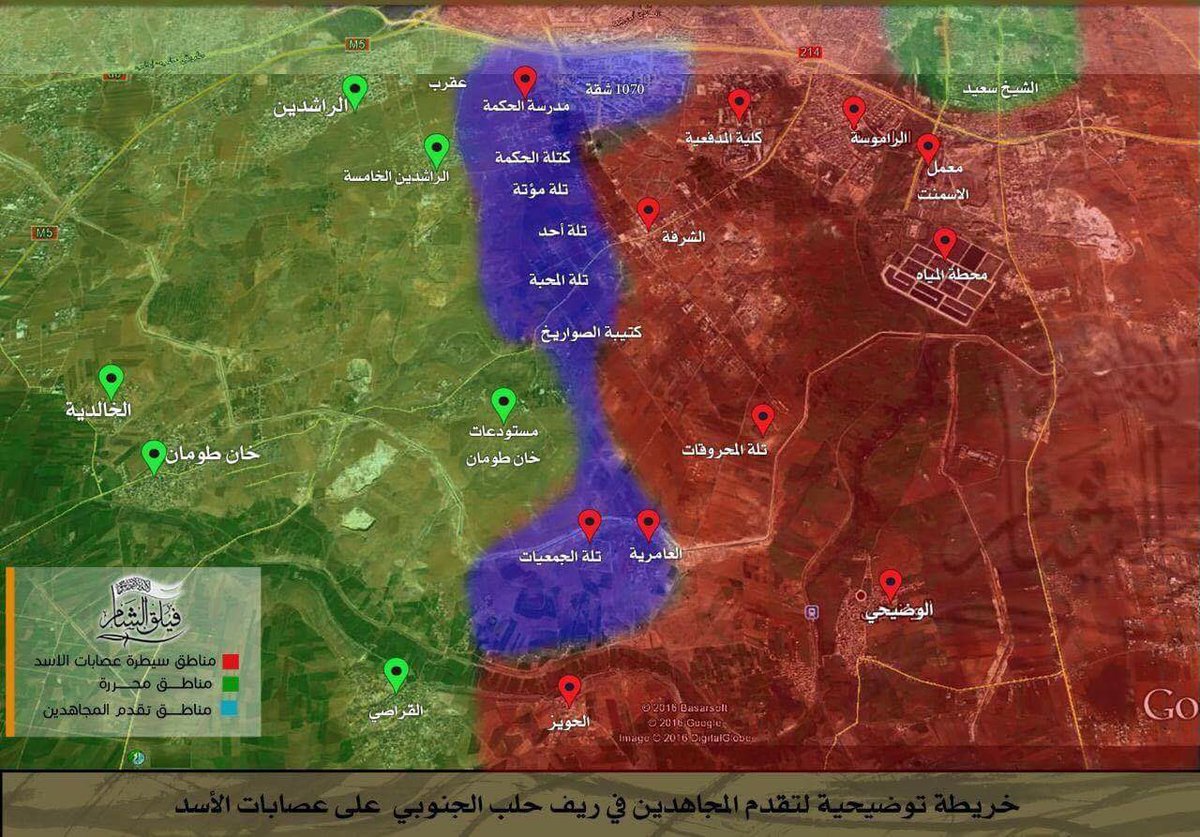
 "Resistance groups in Aleppo have began a mass operation that has already gained significant territory from Assad's forces. Rebel groups claim that 1km of advance is left to break the siege of Aleppo. Blue area are those that resistance groups in besieged Aleppo (green) have taken from Assad's forces (red)."
[https://twitter.com/RamiJarrah/status/759808541536419840]


 Note 30/5/25, first link broken.

Hillary Clinton will reset Syria policy

A child clears damage and debris in the besieged area of Homs

 'Hillary Clinton will order a "full review" of the United States' strategy on Syria as a "first key task" of her presidency, resetting the policy to emphasise the "murderous" nature of the Assad regime, foreign policy adviser with her campaign has said.

 Jeremy Bash, who served as chief of staff for the Pentagon and the Central Intelligence Agency, said Mrs Clinton would both escalate the fight against the Islamic State of Iraq and the Levant, and work to get Bashar al-Assad, the Syrian president, "out of there".

 "A Clinton administration will not shrink from making clear to the world exactly what the Assad regime is," he said in an exclusive interview with The Telegraph. "It is a murderous regime that violates human rights; that has violated international law; used chemical weapons against his own people; has killed hundreds of thousands of people, including tens of thousands of children."

 Mr Obama has been roundly criticised by top experts and members of his own administration for instating an approach to the Syrian war - which has seen estimates of more than 400,000 people killed - that is riven with contradictions.

 The White House remains notionally committed to removing Mr Assad, whilst at the same time, working in alliance with Russia, Damascus' top champion. As America switches its focus to destroying Isil and creating alliances with Moscow, the White House has quietly dropped its rhetoric against the Assad regime. Critics warn that this approach will only foster anti-American sentiment among Syrians, who feel abandoned by the United States following its failure to take decisive action against Damascus.

 A source with access to White House officials said the administration sees the dangers that partnering with Russia could have in terms of worsening the dynamics on the ground, but that the president is trying to cover his bases until he steps down in November. The source said the White House feels it cannot not be seen to be doing nothing against an Al-Qaeda affiliate at a time of heightened national security in America. Were there to be an attack in the US that was claimed by Al-Qaeda the president's legacy would be destroyed, they fear.'

Making the Anti-Assad Case in Washington


 'Few political movements have a harder case to make to the world, or to the American public and its leaders, than Syria’s secular opposition. And few movements have more reason to feel discouraged or abandoned right now. An organization like the Syrian American Council, for example, faces a morass in both Syria and Washington, D.C., pleading the ever-imperiled case for supporting democracy in Syria even as the conflict worsens and attention to situation flags in the U.S.

 A collection of non-jihadist rebel groups was recently encircled by the Syrian army in their former stronghold in Aleppo, and are coping with a number of steep geopolitical hurdles outside the country: the perception of Assad as a partner in fighting terrorism, the widespread conflation of the Syrian opposition with Sunni jihadism, a U.S. administration wary of antagonizing the pro-Assad Iranian regime and seemingly set on brokering the opposition’s surrender, and a U.S. and western public allergic to anything that even smacks of expanded involvement in the Middle East.


 But the people making the anti-Assad case in Washington are not exactly discouraged or demoralized. On July 20, while most of the country fixated on the chaos unfolding at the Republican National Convention in Cleveland, I met with Chad Brand and Shlomo Bolts of the Washington, D.C.-based Syrian American Council (SAC), a group whose mission is to “organize and advocate for a free, democratic, and pluralistic Syria through American support.”

 SAC backs things like no-fly zones, the establishment of humanitarian safe-areas in Syria, and U.S. weapons and training assistance for the Syrian opposition. They’ve gotten a cold hearing from the White House, and have largely given up on lobbying Obama’s inner circle. At the same time, they push an attainable legislative agenda and have had some successes in Congress. House Foreign Affairs Committee chairman Ed Royce, once a problematic member of Congress from the Syrian opposition’s perspective, is now a full-fledged ally; earlier this month he helped introduce a bill authored by Democrat Eliot Engel that would expand U.S. sanctions against the Assad regime.

 As Brand, one of SAC’s government relations officers, explained, Congress is “nipping at” Boeing’s controversial sale of aircraft to the Iran government, with some members of Congress insisting on measures that would ensure the planes aren’t used to ferry weapons and personnel to Syria. SAC has successfully advocated for including funding for the Syrian “train and equip” program in defense authorization bills.

 And they often get a sympathetic hearing from members of Congress and their staff when they recount the abuses of the Assad regime and the dangers the Syrian government poses to global order. Congressmen and their staff sometimes learn of specific regime atrocities for the first time from SAC: “To a person they say, ‘We didn’t know about that and we wish we knew.’ The problem is that the administration doesn’t brief us on these things, Brand said. He emphasized that SAC is a nonpartisan organization, “even if and when we get stymied by the administration.”


 Not even the potentially dubious choices of their own government, or the recent global wave of attacks by supporters of ISIS, whose “capital” is in the Syrian city of Raqqa; or the reality of ceaseless death and destruction in a strategically vital part of the world, have been enough to really make Americans care about Syria, even during a fractious election year. If anything, one of the two major U.S. political parties is tacking in a sharply isolationist direction, with Donald Trump alleging that Democratic opponent Hillary Clinton had supported regime change in Syria during his July 21 acceptance speech for the Republican presidential nomination.

 The fact that Americans have largely tuned out the moral and humanitarian dimensions of the conflict doesn’t mean SAC’s goals are hopeless. Bolts believes there a pragmatism to the American public and its leaders that won’t allow a situation like Syria’s to endure forever. “My own personal view is that something happens in the American political cycle when the public sees a lot of people dying repeatedly,” said Bolts. “There’s awareness for the first few massacres, and then after awhile people wonder, ‘What’s next?’ And if large numbers of people are killed, it deadens sensitivities. The main hope for us is to get people to understand the costs of their inactions….it’s not practical to ignore when tens of thousands of people are being killed.”

 “Long-term, long-game, there’s reason for optimism,” he added. “It could just be a much longer time frame than a lot of us were hoping for.” '

I don't know if Syria can be put back together


 CIA Director John Brennan:

 'So we need to be able to have some sense that Assad is on the way out. There can be a transition period, but it needs to be clear that he's not part of Syria's future. Until that happens, until there is at least the beginning, or the acknowledgment of that transition, you're going to have Syrians dying, continue to die, because they...many of them are trying to reclaim their country, for the good of Syria's future, but many of them also want Syria to be the safe haven for terrorists.

 So I don't know whether or not Syria can be put back together again, whether there's going to be some kind of confederal structure, where the various confessional groups are going to have the lead in governing their portion of the country. We've looked at the different parts of the country, and which ones could be self-sustaining, which ones would rely so much on external assistance. Most of the people in Syria are in that western spine of the country, but large portions of the eastern part of Syria are desert and limited urban centres.

 So, I don't think also you're going to be able to have some sense of tranquillity in Syria until you're also able to address the Iraq issue, and that's why I think this administration, and President Obama, gets a lot of credit at trying to look at what we need to do in both countries, so that what we're doing is going to be complementary to this effort.'


 1. Assad must go - At the most basic level, this can be treated as misdirection. The US has done everything to ensure Assad remains, getting ever closer to the Russians in their strategy of bombing anything that moves in rebel areas.

 We can also look at a slightly more interactive level. Partly it is a response to the coming message of the Clinton campaign, forcing the current administration to be somewhat on the same page. It can also be seen as focusing on Assad as an individual, believing that if Assad is gone, there can be a peaceful continuation with the régime essentially intact. It's hard to tell if the administration doesn't realise this wouldn't stop the killing, rape and torture - the régime's modus operandi - or just doesn't care. Implicitly it is a message to the Russians to agree to give up Assad in order to keep the régime, but they have no reason to give him up, and reason to fear the régime would lose legitimacy without them, hastening the day when a representative government that would reject Russian domination might come to power.

 2. Many of them are trying to reclaim their country - And the administration wants to do as little as possible to help them do that. Again, it is only because there are other forces that want to support the rebels that the rhetoric changes to this from "We're not sure if there are forces in Syria we can work with."

 The only people trying to make Syria a safe haven for terrorists are ISIS. And Assad and all his allies of course. Jabhat al-Nusra was always focused on fighting against Assad, not attacking the West, but the US intelligence community's predilection for seeing everything in the Middle East about al-Qaida was always likely to see them as the threat rather than ISIS or Assad. They simply cannot see that this is a disaster, that Assad was always going to be seen as Syrians as the threat, and attacking Nusra, or Jabhat Fath al-Sham as they are now, was only going to encourage Syrians to their world view where all the secularists and non-Muslims were conspiring against them.

 3. Partition - They've clearly thought about the mechanics of this, but possibly just by reading up on the geography in encyclopedias. Do they really think the rate of ethnic cleansing would slow down or become a peaceful transfer of population if they were internationally sanctioned areas of ethnic supremacy? How would you stop the war at all if Sunni Muslims are expelled from large parts of the West, or that Assad - assuming he continued as the warlord of Damascus and the West - would agree to stop the war when that's the only thing keeping his régime going? Plan B is no plan at all.

 4. Give the President some credit - Give it a rest. This is the President who said nothing should be done about Syria until ISIS took over half of Iraq, then that ISIS should be taken on in Iraq while Syria should have a train-and-equip programme that produced a literal handful of fighters, and even now thinks that sectarian militias backed up by sometimes ill-directed American bombing is the best way to deal with ISIS while the biggest dangers to life are accommodated.


Julian Röpcke:

 "This is how WE are increasingly seen because of our ignorance of the situation in #Syria ...Silence is complicity."
[https://twitter.com/JulianRoepcke/status/759693074129825792]

Saturday, 30 July 2016

Waiting for a miracle


 'Syrian authorities backed by Russia on Thursday offered safe corridors out for residents and rebels in the city of Aleppo's besieged quarters.

 Rebels and residents of Aleppo said they were skeptical of the safe-corridors offer, saying it presents them with an impossible choice between a slow death if they stay behind and possible detention if they attempt to leave. There was no sign of people massing to leave the besieged parts of the city.

 "I will not leave. I will be the last man in the city," said Mohammed Zein Khandakani, 28, a resident of the Maadi neighborhood of Aleppo who volunteers with the city's medical council. "I can't imagine ever seeing a member of this regime one more time."

 But Khandakani, formerly a lawyer who was detained for a month in the early days of the protests against the Syrian government, said he was worried about his family.

 A father of two -- the youngest a girl of 9 months -- he said that despite the risk of maltreatment and even arrest, he is urging his mother, wife and sister to use the safe passages to leave the city. He said he hopes the Russian role and intense international attention to the humanitarian corridors proposition means the government would abstain from flagrant violations.


 Few residents of eastern Aleppo said they expected good treatment if they accepted the government's offer.

 "All the passages are going to the Assad regime," said Farida, a doctor in an Aleppo hospital who gave only her first name for safety reasons. Surrendering, she said, would mean, "death or jail," while the latter would eventually mean "death in the jail."

 She acknowledged, however, that some civilians want to leave.


 Aid groups have been warning of an impending siege, and with it a humanitarian crisis, after government forces cut the last road connecting Aleppo's eastern districts to rebel-held areas to the north.

 Zaher Azzaher, an activist in Aleppo, said residents had begun to feel the pinch; one of his neighbors had acquired two barrels of fuel, and scores of people had lined up to get a share, he said.

 "People are fighting over two bags of eggplants," he said. "I don't know how these eggplants managed to find their way here."

 He said some residents hesitated to eat the food packs dropped from the air, out of fear that they might be poisoned.


 Khandakani said life has progressively gotten harder under the 10-day old siege with bread and water shortages and electricity finally going out Wednesday.

 "The next 48 hours are fateful for the whole revolution," he said via Whatsapp.

 Youssef Rahal, a lawyer from Aleppo who left the city 10 days ago but remains in touch with people inside, said there is no way to get in vegetables or diesel fuel, which rebel-held areas used to buy from the market and transport through the now blockaded Castello Road.
This has affected bread production. "It means some people are getting only a quarter loaf of bread a day," he said.


 Russia's defense minister said in televised comments that President Vladimir Putin has ordered a "large-scale humanitarian operation" that will begin outside Aleppo to help civilians as well as allow fighters who wanted to lay down their arms to surrender.

 Shoigu said three corridors will be open for civilians and fighters who lay down their arms and a fourth corridor will provide fighters a "safe exit with weapons."

 Bahaa Halabi, an opposition media activist inside Aleppo, said there are no corridors out of east Aleppo and even if there were, he would not take them.

 "Definitely not. We will not surrender ourselves to the criminals. They are killing us every day. Slaughtering us, starving us, and besieging civilians," he said, speaking from the city via Skype.


 Assad has issued amnesty offers several times during Syria's civil war, now in its sixth year. The latest offer, like those before it, is largely seen by opposition fighters as a publicity stunt and psychological warfare against the rebels. More than a quarter of a million people have died and millions have been displaced since March 2011, when Syria's conflict broke out.
Khandakani said the offensive and siege is depriving him of his "brief feelings of independence and freedom" living in the part of the city under rebel control since 2012.

 "I am still waiting for a miracle. Something extraordinary, like the rebels for instance managing to open a corridor for us toward the liberated rural areas," he said.'


 'Russia's "humanitarian corridor" in Syria. F**k the Putin,Obama,Assad,UN, and Arab world especially.'
[https://twitter.com/Malcolmite/status/759072634319536128]

 '#Syria Rebels in eastern #Aleppo have enough weapons & ammo for years to resist against the siege by #Putin, #Assad & #Khamenei.'
[https://twitter.com/markito0171/status/759033595524558848]


 Note 30/5/25, link to Malcolmite broken.

Friday, 29 July 2016

Nusra confirms split with al-Qaeda


 'Nusra Front leader Abu Mohamed al-Golani confirmed late on Thursday that his group has formally split from al-Qaeda and has renamed itself the Levantine Conquest Front.

 "The creation of this new front aims to close the gap between the jihadi factions in the Levant," Golani said in his first televised appearance, soon after Nusra released the first photo of the leader ever seen publicly. "By breaking our link, we aim to protect the Syrian revolution."


 The split appears to be an attempt by Nusra to attract other opposition groups to unify with it, just as the US and Russia have reportedly agreed to target Nusra and the Islamic State (IS) militant group.

 Earlier this week, a writer purporting to be a Dutch associate of Nusra called Al-Maqalaat said that the timing of the decision was "no coincidence".

 "The overall message of the break with al-Qaeda will be that the US is not enemies with al-Qaeda or any other so-called terrorist organisation, but their animosity is against the Muslim Ummah as a whole, especially the Muslims who are seeking to establish the rule of Islam," Al-Maqalaat wrote.

 "If the other parties agree to any of these preconditions, then this would be the best deal in the history of Islam, or rather mankind. If the other parties agree to these preconditions, then the breaking of ties between Jabhat Nusra and al-Qaeda will form a major backlash for the West."


 At the daily State Department news conference on Thursday, spokesman John Kirby said the US has "certainly seen no indication that would give us reason to change the designation of this group".

 "My interpretation is that Nusra was not doing it to avoid being bombed, because it will be bombed either way," said Thomas Pierret, a lecturer in contemporary Islam at the University of Edinburgh.

 Instead, the group is "playing chess" with other rebel groups, like Ahrar al-Sham, who have long demanded that Nusra break its allegiance to al-Qaeda in order for the groups to unify. When joint Russian-US operations start, Pierret said, Nusra will be able to say it has fulfilled its end of the bargain.

 "I think there will be limited appetite among more mainline or nationalist rebel brigades to join up with the Nusra that has been picking them off one by one and progressively seizing political control in the north," Sam Heller, a Beirut-based analyst who tweets as Abu Jamajem, said.


 Both analysts said it is unlikely that Ahrar al-Sham, the other main fighting force in northern Syria, would join the new Nusra venture.

 Since its inception, they said, Ahrar has tried to avoid being designated as a terrorist group by the US, and has been successful. If Ahrar joined the new incarnation of Nusra, it would risk being blacklisted, especially as the US will likely continue to designate Nusra a terrorist organisation regardless of the split.

 "My gut feeling is that an integration between Ahrar and a non-al-Qaeda Nusra wouldn't mainstream and legitimise Nusra; to the contrary, it would just render Ahrar politically toxic," Heller said.


 Still, Pierret said, Ahrar's leadership is divided. One faction within the leadership has pushed for a "moderate line" that has included involvement in peace negotiations and abiding by ceasefires, with little pay-off for the group.

 "So inevitably, if the line you are pushing appears to be a complete failure in the end, the countervailing line gets more weight and credit within the organisation. So I wouldn’t be surprised if the hardliners were on the rise again," Pierret said. If this faction were to join the new Nusra, he added, it would be such a strong force that it would be difficult for the rest of the organisation not to join.

 Equally, he said, other rebel groups may be eyeing the Nusra split and wondering whether this is a last-ditch opportunity, especially since the result of "playing nice" over the winter - abiding by ceasefires and participating in negotiations - is Aleppo besieged and the rebels "got exterminated," he said.

 "So what is the point of being a moderate rebel today in Syria?" he said, referring to the US-backed New Syrian Army push last month in eastern Syria, which resulted in the group being routed by IS.

 "The only credible option is to be cannon fodder for silly [US-led] anti-IS operations in the desert." '

Why’s Obama Covering for Russian War Crimes in Syria?


 'As evidence mounts that Russia is deliberately targeting civilians in Syria with cluster bombs and other anti-personnel weapons, what has long been a nagging question about Washington’s policy has now taken on real urgency: Why is there no comment from the U.S. government is to confirm or refute the allegations of war crimes?


 A Human Rights Watch report out Thursday documents how Russian aircraft dropped cluster bombs on an informal fuel market outside Termanin, a village in Idlib province, on July 11, killing 10 and wounding more than 30 people. The victims were all civilians and included two who were first responders.

 According to HRW, three fighter aircraft, two of them SU-34s flown only by Russia, and an SU-24 that’s in both the Russian and Syrian air force, launched eight attacks: the first two of them using cluster bombs—large canisters containing dozens of tiny bomblets that scatter through the air and across the ground. Many do not explode—at first, but may kill and maim days, months, even years later.


 The Daily Beast asked the State Department how the U.S. expects to bring Russia into compliance with the 1949 Geneva Conventions’ ban on indiscriminate attacks if it doesn’t publish or otherwise inform the public of its intelligence findings. There was no response.

 One reason for U.S. silence about Russian violations is that the Obama administration has classified its intelligence findings in order to “protect sources and methods” of collection. Making that information public “would also set a precedent of the U.S. reporting on foreign military activity,” a senior administration official told us earlier this year. “Where do you draw the line?”

 But that leaves open the question of whether the U.S. government has raised the issue with Russia and how Russia responded. It also raises the larger question of whether international law as drafted after World War II will be respected when a major power violates the laws of armed conflict with impunity and there’s no public protest from the United States.


 Ever since Russia began its bombing campaign Sept. 30, the U.S. response has been largely “hands-off.” Despite public pleas by Syria’s moderate opposition and private urging by neighboring states like Turkey, the U.S. has not stepped up aid to moderate rebel forces already receiving U.S. military support, nor has it threatened the use of force or any other measures that would raise the price for Russian intervention. Instead, the administration has sought a cease-fire through what it calls diplomatic means, which it hopes will lead to a negotiated settlement of the Syrian conflict.

 But the Russian and Syrian governments in the past month instead have gone for the kill in Aleppo, Syria’s biggest city, and now the timetable for negotiations appears to be put off until the end of August. Syrian forces, augmented by Iranian ground troops and the Lebanese Hezbollah milita and Russian air power, cut the last road to the rebel held enclave July 10. Besides surrounding the eastern part of Aleppo, which has a population of at least 300,000, the regime-led forces destroyed four of the eight hospitals and the only blood bank and forensic lab. They also dropped barrel bombs and other munitions on residential areas.

 But the Obama administration has yet to draw attention to the biggest siege since Serb forces surrounded Sarajevo from 1992 to 1995.


 Throughout the Russian intervention in Syria, the administration has refused to clarify whether Russia or Syria is responsible for the destruction of hospitals, schools, mosques, and infrastructure protected by international law.

 In early May, after airstrikes destroyed a camp for displaced persons in northern Idlib province, Russia rejected charges that its aircraft were responsible. After Russia and the Syrian regime were accused of bombing several major hospitals in rebel-held Aleppo, a hospital in regime-held Aleppo came under attack also in early May. The government blamed rebel forces, but those forces said they didn’t have weapons that could have reached the target and said the government had launched the attack in order to claim that the rebels were a criminal force.

 Given that the U.S. intelligence gathering capabilities in the region are extensive, especially where warplanes are concerned, Washington almost certainly knows who is doing what from the air. But there are none so blind as those who will not see, and the official refusal to acknowledge culpability undermines the efforts of those organizations and journalists who are trying to get at the truth.


 Increasingly, it appears that the administration has written off Aleppo and with it the popular rebellion against Syrian strongman Bashar al-Assad. Whatever criticism the U.S. may have stated when Russia began its armed intervention, officials now rationalized it as Moscow’s rescue of a longtime ally.

 In March, a senior U.S. official said that Russia had intervened because rebel forces were advancing so fast that they threatened the survival of the Assad regime. There was great concern in Russia “about potential catastrophic success” under which “Assad collapses, but so do all the Syrian state institutions.”

 The Russian intervention has returned Syria “to the stalemate,” the official said.

 On Wednesday, the State Department cast the Russian intervention in the context of Moscow’s long-term alliance with Damascus. Russia has “a historic defense relationship with Syria that goes well back before the current conflict,” department spokesman John Kirby told reporters. “They’ve had basing there. They’ve had troops there. They’ve had a presence there. So it came as a shock to no one in the State Department that as the civil war progressed in Syria, that they would have interest in how things were going,” he said.

 The question of the moment, however, is why Washington seems to have no interest in the war crimes Russia commits as part of that “interest in how things were going.” '

Thursday, 28 July 2016

Syria's Secret Library


 'When a place has been besieged for years and hunger stalks the streets, you might have thought people would have little interest in books. But enthusiasts have stocked an underground library in Syria with volumes rescued from bombed buildings - and users dodge shells and bullets to reach it. Buried beneath a bomb-damaged building, it's home to a secret library that provides learning, hope and inspiration to many in the besieged Damascus suburb of Darayya.

 "We saw that it was vital to create a new library so that we could continue our education. We put it in the basement to help stop it being destroyed by shells and bombs like so many other buildings here," says Anas Ahmad, a former civil engineering student who was one of the founders.

 "In many cases we get books from bomb or shell-damaged homes. The majority of these places are near the front line, so collecting them is very dangerous," he says. "We have to go through bombed-out buildings to hide ourselves from snipers. We have to be extremely careful because snipers sometimes follow us in their sights, anticipating the next step we'll take."
Since a temporary truce broke down in May, shells and barrel bombs have fallen almost every day. The location of the library is secret because Anas and other users fear it would be targeted by Darayya's attackers if they knew where it was.


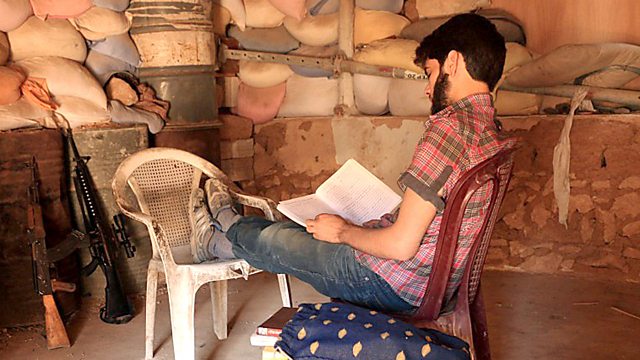
 It turns out that even the greatly out-gunned Free Syrian Army fighters, who have the daunting task of defending the town, are avid readers.

 "Truly I swear the library holds a special place in all our hearts. And every time there's shelling near the library we pray for it," says Omar Abu Anas, a former engineering student now helping to defend his home town.

 Unfortunately for Omar, his fellow fighters and the people of Darayya, they may soon have little time for reading. Over the past two weeks Syrian government forces and their Hezbollah allies have moved into all the farmland around the suburb and even some outlying residential areas. For now though, Omar says the library is helping to strengthen the town's defences as well as its resolve.

 "Books motivate us to keep on going. We read how in the past everyone turned their backs on a particular nation, yet they still made it. So we can be like that too. They help us plan for life once Assad is gone. We can only do that through the books we are reading. We want to be a free nation. And hopefully, by reading, we can achieve this." '