Monday, 13 June 2016

Childhood's end in Assad's prisons


 'In 2011 the Syrian revolution spread to Baniyas, the home of then-17 year old Omar al-Shogre. Omar's father had served in the Syrian army for more than 24 years which protected him for some time from mass arrests that were taking place in Baniyas. However soon the army came for him and violently arrested him and his three cousins in al-Bayda village.

 "They harassed Noor (his cousin) in the car. It wasn’t normal at that point to beat girls so every time she refused to answer a question they beat us instead," he said.

 During Omar’s horrific time in prison his father and brothers were killed in the Baniyas massacre in May 2013, although he would not know until after his release.


 After they were arrested, a bus came and took them to a detention facility in the city of Tartous, where they were immediately welcomed with a beating. "During the registration they asked us to strip naked, we didn’t want to take off our undergarments so they started talking about my mothers and sisters in a way bad way," said Omar.

 "The soldier asked: 'What is your name?' I said my name is Omar al-Shogre from al-Bayda village. The man said it is not a problem that you were demonstrating, that you are from this village and from this family. But your name is not welcome here." (Omar is an easily identifiable Sunni-affiliated name).

 "My cousins were tortured despite being badly injured. They used their wounds as a way to torture him. They threatened to harm one of cousins' sister and made them confess to things that they didn’t know," he said.
Omar would later learn that his cousins Bashir and Rashad died in prison after eight months.


 He was sent to the notorious Sednaya prison where he was held for one month before being referred to the military court.

 "I was placed in a section that held 1,250 prisoners. I had to stay standing all the time. Everyone there was suffering from skin disease and there were a lot of lice everywhere," said Omar.

 Omar saw emaciated people weighing no more than 30 kilos each. He said he saw the two men fighting with each other for a place to sit, who were brothers.

 "One of them died when it was around lunch time. Eight people eat from the same plate. One of them had a choice - either to eat it or to put it in the corpse room. They put the food on top of the dead brother," said Omar. "Being in these conditions makes your forget that that you are human, you don’t think normally."


 Omar said his cousin Bashir was interrogated and tortured by a screwdriver and electrocution before his death.

 "You can start to tell the torture methods apart by the screams," said Omar. "When you are in that situation you are on high alert and everything is super sensitive. They started by electrocuting me, poured hot and cold water on me. They put me on the Doulab and whipped me,” he said, referring to putting detainees on a large tire to whip them.

 Omar also told of horrific sexual abuse in Sednaya prison.

 "They made everyone strip in prison. The guard would choose the slimmest and largest prisoners and then ask the large one to rape the small one. If they don’t they would get killed," said Omar.

 Omar said one of the guards' divisions targeted young boys. They would take them upstairs to join the investigation in exchange for better conditions or force them too by raping them. Omar relayed that these younger detainees were also especially subject to sexual assault.

 "One of these young boys was raped in a really bad way and he lost his mind and decided to become one of the people upstairs. He started torturing people in a bad way and burnt people," said Omar.


 Omar told stories of corruption and hierarchy within the communities of prisoners themselves.

 He alleged that that one prisoner who was a doctor became so corrupt that he carried out executions himself.

 "If you have money when you are detained you could become head of a cell...you could get your own boy service and sexually abuse him," said Omar. "Sexual abuse was a daily occurrence. People got used to it."

 "One of my good friends was transferred to the room where they did the shabha - torture method involving hanging by hands - almost no one survived this room. My friend did bu he came back he was really disturbed and depressed."

 Omar asked him what happened to him. His friend didn’t want to tell him how he was tortured and raped and how he was wounded and he died two days later.


 Omar was given the job of taking bodies to the corpse room.

 "I was involved in carrying the bodies from downstairs to upstairs. People kept counting the number of dead because people started dying from sickness and lack of ventilation. Some of the guards told me to go to the corpse room and take bodies to the room. The bodies would be heavily deformed and some would have missing organs."

 Omar suspected that organ trafficking was taking place.

 "We witnessed many fires when we were in Sednaya. Although the guards told us it was from electricity or other stories, we knew better. We knew that this was the smell of body burning."


 Omar finally escaped prison after his mother made a deal with high-ranking officer, and paid a ransom for his release.

 "The detention system in Syria turned people into merchandise. Whoever pays the most gets out," he said.

 Omar is now in Sweden with his youngest brother. He recently shared for the first time his story with his Swedish host family.'

Wednesday, 8 June 2016

A Hard Rain's Gonna Fall


 The Russians have firebombed¹ suburbs of Aleppo with white phosphorus, and the last Free district of Homs that Assad hasn't razed to the ground with napalm². Not to be left out, Assad has dropped barrel bombs on Aleppo³. Where are the people who wanted to Stop the Bombing of Syria? Possibly watching the BBC's coverage, that has been so bad as to prompt a complaint from Syrians⁴.

 ISIS is losing ground rapidly though, I think they may have thought that anyone liberated by the Kurdish Maoist YPG (aka "the best fighters against ISIS") would be happier with ISIS, so ISIS kept on attacking the moderate and nonideological Free Syrian Army even as they lost ground to the YPG. That now seems to have turned round, the FSA have managed to reconnect Mare'a⁵ to the Azaz corridor, and the YPG has had to give back Sheikh Issa⁶, which it blackmailed the FSA in allowing it to take last week by threatening to allow all the civilians in Mare'a to be massacred by ISIS.

 1. [https://twitter.com/Malcolmite/status/740459634536939520]
 2. [https://twitter.com/Malcolmite/status/740235529065779201]
 3. [https://www.youtube.com/watch?v=gFTIJYzp_nI]
 4. [https://www.youtube.com/watch?v=_-dsQZRWHOE]
 5. [https://twitter.com/JulianRoepcke/status/740443280404533248]
 6. [https://twitter.com/JulianRoepcke/status/740490490261475328]


 Note 28/5/25, links 1,2 & 4 broken.

Media and politics’ very short memory on Assad


 Julian Röpcke:

 'For an attentive observer it is extremely interesting to see how media organizations and leading politicians worldwide reshape their perception of the Assad regime almost on a weekly basis, depending on the selectively perceived actions of the dictator’s army and their allies.
In the beginning of 2016, before the "Cessation of Hostilities" came into effect, Assad and his forces were widely criticized for their offensives around Aleppo and in Hama and Latakia, forcing hundreds of thousands to flee their homes. Harsh words like "forced displacement", "deliberate depopulation" and even "ethnic cleansing" were used for the regime’s actions. For several weeks, Assad’s future was called into question (even a "Plan B" was publicly discussed) by politicians as well as the media.

 Then after February 27, the international media/policy narrative - once again - changed dramatically. Suddenly, the regime was portrayed not just as a necessary but also a reasonable partner for the future of Syria, having agreed to stop fighting moderate rebels and the population and just conducting operations vs. Jabhat al-Nusra and ISIS. Strongman Assad turned "president Assad" again, his scattered army, Russia’s jets and allied Shiite militias "Syrian government forces".

 Then in the end of April, the regime’s - and Russia’s! - daily war crimes could for a while not be ignored any longer by the international media and political environment. The "#AleppoIsBurning" online campaign gained global attention and - at least for a couple of days - reminded everyone that Assad and his thugs didn’t suddenly turn into a "government" again after slaughtering more than 200.000 civilians since 2011.

 For a few days, "government forces" turned into the "regime helicopters" bombing markets and "the Russian air force" bombing hospitals and vital infrastructure. Governments in the EU and the US reacted by negotiating "regime of silence" with Russia, Assad and Putin should stick to. Another "success" on Syria with the "political parties" Russia and Assad, as it was sold. Despite as good as no progress and the regime still killing between 30 and 70 civilians every day, politicians like German FM Frank-Walter Steinmeier on May 9 spoke of a "clear easing of the situation", just to not comment on/fully ignore the sharp escalation shortly after which lasts until today.


 Most media and politicians are lauding the "Syrian government offensive" vs. ISIS while not even mentioning the heinous attacks on Idlib city some days before with more than 50 dead and civilian infrastructure such as Idlib’s national hospital being deliberated targeted by Assad and/or Putin.

 I will bring up an easy comparison, politicians and media representatives should consider when whitewashing the dictator’s image, applauding Assad’s gains vs. ISIS: If a serial killer kills another serial killer while continuing to kill innocents - every day - does this make him a righteous man? The answer is too obvious.

 Last but not least the core problem in Syria must not be hidden behind a hypocritical "realpolitik" approach. As Walter Russell Mead put it in late May: "Ultimately, as hideous as ISIS is, it’s a symptom of the Assad regime, rather than the root of Syria’s troubles. And ISIS will never truly be defeated until Assad is dealt with." '

Tuesday, 7 June 2016

The Dreamer’s Voice

2016-06-06-1465222487-1658917-10962208_333044936899197_1870328947_n.jpg

 'This is part 2 of the Interview “The Dreamer’s Voice” with Ammar Ahmad.

 The siege was getting worse and worse in Moaddamiyeh, and 12 civilians starved to death. People in Moaddamiyeh thought things could not become any worse until the day of the chemical attack during which the regime’s forces hit the city with chemical missiles. Ammar was awake with his friends at the morning of 21 August 2013 when they heard a strange whistling to then hear people screaming for help. They rushed to the scene and found an unknown white powder covering the street. The regime hit the basements where civilians were forced to do their prayers after they could no longer visit the mosques. It was the time of Fajer, the early Morning Prayer, and the place was crowded.

 “I went downstairs and saw the people in a horrific situation, they had spasms, their irises were expanded and the way their bodies were shaking looked terrifying. Their eyes were wide open, but they seemed to be in another world. I tried to carry the person closest to me, and when I started to climb the stairs I felt I’m losing my strength. I was holding the man on my shoulder but we fell down several times. I tried to climb the stairs again, but that’s the last thing I remember. I was in a coma for almost 10 days, and after I awoke I had not been able to be fully awake for another month. That is when I learned that we were attacked with chemicals!”

 Ammar was one of the casualties most serious affected by the chemical attack that day, Moaddamiyeh losing 82 civilians overall in the so-called the chemical massacre.


 After a period of time, Ammar had fully recovered and immediately went back to support the besieged city and advocate for it. But the situation was getting worse, especially for dozens of children who suffered from malnutrition during to the food blockade and the long strict siege. The regime was working on a shaky truce which stated that the regime had to release all the detainees from Moadamaiyeh, uphold a ceasefire, allow all the employees and students from Moadamiyeh to go back to their work and study, remove all of the regime’s forces who had surrounded the city almost since mid-2011, and open all the crossings to the city.

 The regime ended up only opening the crossings to the town for a few months; arresting more than 250 civilians who tried to get in and out of the town during that period. Meanwhile, people were allowed to bring in food, but only in specific amounts that were only enough for one or two days.

 This tactic ensured that the residents would stay hungry as they still were not able to store food, reminding them that the town’s fate and their survival remained in the hands of the regime. One of the regime’s conditions for the truce was raising the regime’s flag on the highest place inside Moaddamiyeh considered a symbol of victory.

 “That day I cried like a little baby! That wasn’t what we aimed for! We lost more than
2,500 martyrs and more than 1,500 are still detained. I felt so shattered, but we didn’t
have any other choice after we were so utterly disappointed of the international efforts.”


 Ammar and his fellows are currently working to help the residents who are living under the regime’s siege. The city has almost 45,000 inhabitants—a massive amount of people for these activists to help. Ammar needs to be multitasking; the people can see him everywhere as he tries to help in many areas and always lending a hand when one is needed.


Ammar Ahmad with his daughter Mela. Moaddamiyeh 2016.

 And yet, Moaddamiyeh, along with thirteen other areas, is currently under siege again. After all, people in Moaddamiyeh are planting to defeat the siege. Ammar is now married and he has a beautiful baby girl named Mela. Despite everything he went through life went on. But he is as determined as he had been in 2011, when he told me:

 “I dream of a Syria without weapons and without oppression. We are a peaceful people, but we were forced to hold weapons to defend our lives and our families. Weapons were the last choice after almost five decades of Assad reign. It’s not like any other place in the world. Dozens were killed in Syria while holding roses and banners in the demonstrations. Weapons were held in Syria to defend the peaceful life we were seeking when we demonstrated against Assad. After all that happened I still believe I might be close to my dreams, maybe closer than I’ve ever thought.”

 Ammar finished our conversation adding: “What we need in Syria is to get rid of Assad and when that happens I can assure that nobody is going to see any more weapons. The Syrians hate weapons and once we are done with Assad, they are going back to their colleges, their careers and their normal life, the normal life that they were never able to live under a regime that suspected every three people talking in street to be part of an opposition talking politics. We asked for human rights and they now forced us to ask for humanitarian aids. That was never part of our plans! Syrians need to get what they first asked for.” '

Sunday, 5 June 2016

Syrian refugees praise 'good treatment' in Scotland


 'Refugees living in North Lanarkshire were invited to play in the "cup of kindness" football tournament on Friday in Airdrie which saw mixed teams including ten Syrian refugees and staff from organisations involved in the resettlement programme compete in an integration event.

 Speaking through an interpreter, Syrian refugee, Mansour Zalaf, 49, said: "We were in Syria during the war. It was such a terrible life being under the torture and detention of the regime. We have been received very well. Very good treatment. Treated very well and we have felt very welcome."

 Also speaking through an interpreter, Syrian refugee, Chadii Amiri, 31, said: "There's a big difference from being in Syria. The first thing is the quietness and safety. The most important thing is the equal opportunities. There is no difference between wealthy and poorer men, so everyone is equal."

 A 23-year-old Syrian refugee, who did not wish to be named for fear of what might happen to his existing family in Syria under the Assad regime, spoke of his experiences arriving in Scotland.

 "I am feeling sad as family still in Syria. I feel better here. All my friends here is very good. Every person if I need help will help me. Thank you so much to every person who has helped every Syrian person." '

Rebels Defeat Iran and Assad Regime South of Aleppo


 'Syria’s rebels have inflicted the third significant defeat in two months on pro-Assad forces south of Aleppo city. In a sudden offensive on Friday, the Jaish al-Fatah rebel bloc overran Iranian forces and Iranian-led Iraqi and Afghan militia east and south of Khan Tuman, close to the Aleppo-to-Damascus highway.

 Among the positions captured were a large military fuel depot and Iranian weapons stores. Four villages — Khirbat Mirata, al-Qarassi, al-Humayra, and Qalaajiyah (see map) were taken. Operations included two vehicle suicide bombings by Jabhat al-Nusra fighters, in which the jihadists claimed about 120 pro-Assad troops were killed.The rebels and the jihadists of Jabhat al-Nusra. succeeded despite, in the words of one local source, “Insane air attacks on the battlefield. Russia and regime deploying everything that can fly.” '

Thursday, 2 June 2016

Civilians Press for More Control in Syria’s Rebel Areas

A man covered with dust sits on a street following a reported airstrike by Syrian government forces in the rebel-held neighborhood of Sukkari in the northern city of Aleppo, May 30, 2016.

 'In rebel-controlled areas of the city of Aleppo, two sides of Syria’s revolution have cohered more effectively in recent weeks, with less friction between the civilians and the armed groups. The local city council in Aleppo is one of several hundred councils functioning in rebel-held towns and villages across Syria, some elected in rudimentary-run polls, others not. It has made significant progress in gaining control from the armed groups of much of the governance of insurgent-held districts, including distribution of humanitarian aid and organizing basic public services, says Eyad Kalloul, a development worker with the Muwatana, a pro-opposition but independent Syrian NGO. Kalloul, a father of two, cites as a recent example the control of a neighborhood water well.

 “We asked why the well should be controlled by a militia instead of the council,” he says. “And after negotiations involving local notables as well, the militia agreed.” He adds: “The aim is to get all civil services under civilian control.”

 Progress defining areas of civilian responsibility — from the provision of water and electricity to health care and education — has been easier in the city of Aleppo thanks to the recent departure of fighters with Jabhat al-Nusra, the al-Qaida affiliate that is the most reluctant of the armed groups in northern Syria to relinquish any power to civilians, a reflection of the jihadists’ theocratic beliefs.

 According to Gen. Salim Idris, former chief of the staff of the Western-backed Free Syrian Army, al-Nusra has withdrawn many fighters from Aleppo, fearing it could suffer major losses if the government, backed by the Russians, do mount a major assault on rebel districts.


 In neighboring Idlib province, civilians have been much more restricted in what they can do. Foreign donors have been reluctant to provide funds for civilian projects there, from reconstruction to relief services, fearing al-Nusra entanglement.

 ​“Al-Nusra doesn’t want to talk to us because we are secular,” says Kalloul, speaking in English, which he learned as a detainee in Syria’s notorious Sednaya prison by listening to VOA on a smuggled radio.

 A one-time Communist, he says English wasn’t the only thing he learned during his five years in jail. Debating in prison with other detainees, reading and being exposed to news from around the world, his political views changed.

 He now describes himself as a liberal, but says prison debates equipped him with the skills that now help him to facilitate talks between civilians and armed militias that hold opposing political views.

 Setting up a justice system in the rebel-held areas has proved difficult.

 ”Justice is much more complicated than who oversees the provision of basic services and even education,” Kalloul explains. In different districts, there are different and often competing courts. “Civilians have asked for a unified court system across rebel-held areas and one controlled by civilians and not the armed groups,” he says.'

Tuesday, 31 May 2016

National hospital in Idlib City bombed by Russia


 Rami Jarrah:

 "I find it fucking appalling that the main stream media has not picked up the fact that Russian jet fighters have brought down Idlib's National Hospital.

 An air strike was performed on the facility killing dozens and leaving over 150 injured, It has become clear that there is a systematic approach to targeting any facilities that can ensure any form of security for civilians."

Monday, 30 May 2016

Casualties mount in air strikes on Aleppo


 'Covered in his own blood, his hands mangled, Ahmed Jamili begged the doctors not to cut up his clothes. The child, 9, was just one of the victims as the Syrian government pounded rebel strongholds with hundreds of air strikes.

 "My dad only bought them [the clothes] yesterday," Ahmed sobbed. "Please don't cut my clothes."

 He had been playing outside in the rebel-held district of Al-Sakhour in Aleppo when government war planes dropped their bombs. His two brothers were killed. A building close by collapsed entirely.

 Civil Defence volunteers said that in 48 hours, Syrian government forces launched more than 700 air strikes on rebel-held areas of Aleppo city, and across the province. It is part of a concerted government assault on some of the last major rebel strongholds: Aleppo, Homs and Daraya. There has been a high civilian toll, with many children and babies among the dead and injured.

 Aid groups said suffering in Daraya is compounded by the refusal of Syrian President Bashar al-Assad's forces to let aid convoys into the city. The United Nations said it may not be able to go ahead with planned aid drops, saying it would be too dangerous without the Syrian government's cooperation.'

Sunday, 29 May 2016

Fears of UN reversal over aid airdrops plan

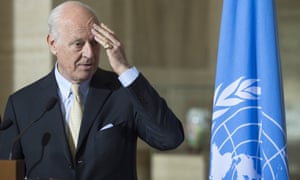
Staffan de Mistura, UN special envoy for Syria

 'The UN special envoy for Syria, Staffan de Mistura, appeared to backtrack on airdrops at a press conference last week, the day before he announced no further peace talks were possible for at least three weeks due to the breakdown in the cessation of hostilities. He said: “It is clear from the briefing that we got that in order for airdrops to become concrete either by delivery at high altitude or by helicopters, there is a need for the cooperation of the government of Syria.”

 The apparent reversal was condemned by the former Liberal Democrat leader Paddy Ashdown, who said: “The deadline set by the ISSG poses a serious question. Are the words of the international community meant to mean anything? We would all much rather airdrops did not have to be contemplated – they are complex operations – but if the 1 June deadline passes without ground convoys getting in then the UK has to see that the international commitment to the people of Syria is fulfilled. Not only are lives on the line, so is the credibility of the ISSG.”

 Jason McCartney, the Conservative MP for Colne Valley and a former RAF officer, said: “We are at the stage of last resort where airdrops – however imperfect – are the only way to save lives.”

 Jo Cox, the Labour MP who has raised the issue of airdrops most consistently, said: “If the words of the foreign secretary and the international community don’t turn to action, if we don’t see aid getting in by road or by air, then we’ve reached a new low making empty promises to starving children.” '

 The left of the Labour Party could not be reached for comment.

Saturday, 28 May 2016

In Syria, a slow-motion genocide while diplomats chatter

 Janine di Giovanni:

 ' “The challenge we face now is to transform these possibilities into the reality of an agreement,” U.S. Secretary of State John F. Kerry declared, referring to a “basic framework” for a united, non-sectarian Syria.

 Those words mean nothing to the fighters on the ground, who continue to push for more territory. In Aleppo, missiles fall and helicopters whir in the sky. In Daraya, a suburb of Damascus that has been besieged by Syrian government forces since 2012, 8,000 inhabitants are starving.


 In August 2012, I defied government rules by sneaking into Daraya after what locals had called a massacre and the government called a prisoner swap gone wrong. Three hundred people were dead. One of the first witnesses I met was an injured man, a mechanic, searching for his elderly father. They had been separated during the fighting and the mechanic had lost his eye. The smell of dead bodies was overwhelming. We searched for a while, together, and the mechanic eventually found his father's body, rotting, in a farmhouse outside of town.

 “This is not my Syria,” he told me, weeping. “This is not my Syria.”


 I spent four years gathering testimonies in my notebook. I met Nada, a young activist from Latakia, who was taken from her home, placed into a tiny cell and beaten and raped for months by government police and security services. “They used my body to practice their judo moves.”

 Hassan, a law student from Homs, was tortured by regime physicians who operated on him without anaesthetic. He escaped by pretending to be dead and was tossed on top of a pile of corpses. One of them was his brother's.

 But the worst was the little boy who followed me around a displaced persons camp near Azaz. He had no face, only a hole for a mouth and a hole for a nose. His father told me the story of hearing “the worse thing in the world, the screams of your own child’s pain” after his son was struck by a rocket inside his home in Hama.


 The war in Syria will eventually end, and the battered country will be sewn back together. But we missed many opportunities to prevent the war, or to stop it. The initial days of the uprising might have been a time for the U.S. to pressure Assad not to kill his own people. The crossing of the chemical weapon “red line” in 2013 was another chance.

 But the war continued, as did the death toll. How do we explain – to the living, to the survivors, to the orphans, to those who lost homes, families and livelihoods – how we stood back and did nothing?'

The Morning They Came For Us by Janine di Giovanni

Atma camp Syria

 It's useful to understand that the rĂ©gime's use of rape as a weapon has made it impossible to live again under its rule, and has silenced the victim's voice to the extent that it doesn't appear at all in the mainstream media's There Are Atrocities On All Sides narrative. We hear about ISIS and sex slaves, we hear nothing about this atrocity.

 Robin-Yassin Kassab:

 'The fear of rape is perhaps the greatest factor in making the rebellious population flee. Giovanni gathers victims’ experiences both as journalist and as a UNHCR researcher, and she recounts the double trauma of violation and retelling. Here the tragedy accumulates. Searching for rape survivors in Atma camp she comes across a burned 11-year-old, his mouth “nothing more than a hole” his nose non-existent, his ears flaps of skin “stretched tight into pink crevasses”.

 Giovanni attended the aftermath of the regime’s August 2012 massacre of at least 300 civilians in Darayya, a suburb west of Damascus. The war correspondent Robert Fisk, she notes, entered Darayya on the same day, embedded with the regime army, and described the rebels as the perpetrators. Giovanni went in with civilians, interviewing locals. None of them corroborated Fisk’s story. Nor did Human Rights Watch, nor Darayya’s local coordination committee. Of course, once Giovanni’s article appeared, her Syrian visa was revoked.'

Wednesday, 25 May 2016

An Interview with One of Aleppo's Last Doctors


 'For almost four years now, eastern Aleppo has been the target of bombing by the Syrian air force, with Russia joining the bombardment as of last September. The cease-fire announced in February only briefly changed the situation. Beginning in April, the Syrian army again increased its targeting of civilians. Prior to the war, thousands of doctors worked in the city, which was once home to a million people. In the eastern part of Aleppo, only around 30 doctors remain today. Osama Abo El Ezz, a 30-year-old surgeon, is one of the few still holding out.


 SPIEGEL: Did the April 27 attack on the al-Quds hospital have an impact on you and your work?

 Ezz: Absolutely, even if they aren't bombing us, we still run to the cellar every time jets appear over the city. They are able to target much more precisely than they could before when they dropped their untargeted barrel bombs. They were savagely powerful, but they hit their target less often. Today they do hit their targets. And they obviously want to hit and kill the last doctors and nurses in eastern Aleppo.

 SPIEGEL: And you? Will you stay on?

 Ezz: I won't go. If we doctors leave, we are not only robbing the people of their chance to get medical treatment, but also of the hope that our city will survive. There is no replacement for anyone who leaves or dies. Many people here are being driven crazy by fear and desperation. Children are hysterical and are wetting themselves. The elderly get heart palpitations when they hear the sound of the jets. Three months ago, rockets killed an entire family in the Firdaus quarter, except for the seven-year-old son. We took him to the hospital and treated his injuries, but then we had to tend to the other patients. He suddenly began to shake uncontrollably. He had swallowed all the pills he could find. We were just able to save him.

 SPIEGEL: You don't think the attacks are random?

 Ezz: No, they never were. I had three colleagues with whom I provided care to wounded protesters starting in 2011. In May 2012, they were arrested together at a regime checkpoint. Seventy-two hours later, residents found three charred bodies that were taken to the coroner. The families of the three then identified them. Any person providing medical aid is risking their life. Why are they killing us? It is not enough for them to kill people every day in Aleppo. They also want to destroy any chance that they can be treated. Assad's regime has swept away the universal idea that doctors should be spared along with all other humanitarian principles. No government cares that we are all being killed one after the other. Human rights and all that? They are empty words. Like all the others who are still staying here, I am nonetheless waiting for the world to stop being indifferent about our fate. What choice do we have anyway? Should we give up and flee?


 SPIEGEL: Since the beginning of the revolution, you have campaigned for the release of arrested doctors as well as providing care for the injured. Did you envision yourself being involved in a war, even years later?

 Ezz: No. In 2011 I was beaten after protests together with 27 other colleagues and 14 of us were arrested, but we were released again the next day. We founded the network Nur al-Hayat, or Light of Life. We wanted to defend peaceful demonstrations and treat people who had been shot. But then I learned that the military's secret service was searching for me. Colleagues were murdered and I had to abandon my work at the university hospital and go underground. Later we founded the Aleppo Doctors Council and attempted to continue providing medical care.

 SPIEGEL: What do you tell your family regarding your decision to remain in Aleppo?

 Ezz: My wife and the three children are now living in Turkey. When we speak about it, I always tell them that our life is in God's hands. I hope he will protect me. But if I die in our hospital, at least that is the right place. I could leave the city and die anywhere in the world in a traffic accident. That would be a betrayal of all those who hope that this criminal regime will one day be gone. I don't want my children to grow up as refugees. They should be able to live in Syria as free people.


 SPIEGEL: Did you have hope when the cease-fire was announced in February?

 Ezz: Of course I had hope. As fragile as this peace may have been, at least the people had a chance to catch their breath after years of fighting and bombing that had indiscriminately hit residential areas, markets, bakeries and hospitals. But of course the attacks have begun again -- and they have been even more intense in recent weeks than they were before. I have lost so many friends and colleagues in the last five years -- and now it looks as though Aleppo, or at least the eastern half of it, is simply going to be destroyed completely.

 SPIEGEL: What do you believe to be the purpose of the attacks?

 Ezz: To rid Aleppo of all people, just like in Homs. And then to hunt down anyone who has ever stood up against Assad's regime. To not allow the original residents to return, but rather to change the demographics of the city and the entire country -- even if that means the destruction of Syria.'

Sunday, 22 May 2016

Ex-detainee tells about horror of Sednaya Prison


 'Doctor Kamal Muhee al-Deen al-Jum’a devoted himself to the work of Coordination Committees since the onset of the Syrian revolution. He worked in Ma’aret al-Nu’maan and countryside of Aleppo. He secretly transported medication between the two cities to help the injured; however, a colleague doctor in surgery department of Aleppo University Hospital reported him which led to his detention.

 He refused to confess although he was severely tortured for 45 days and he was unconscious for days. Kamal was transferred from the 285 Security Branch to Sednaya Prison where there are three wings; one for the political prisoners, the white wing for civilians, and the red wing for terrorists. Kamal says, “whoever faces terrorism charges is put in the red prison. The red prison is known to be the prison of death and daily killings. Very few survive the red wing.”

 Kamal lived through a daily death experience in the red wing. There is no language to describe the ugliness and savagery the ex-detainee experienced in Sednaya Prison in addition to cases of scabies, lice, furuncles, infections, and tuberculosis. Kamal tried to treat the different diseases with primitive methods and to offer treatment to injured to ease their pains as he was injured himself.


 Kamal adds, “they used to give us moldy salt, jam, and bread. Animals would not eat the food they gave us. They physically and psychologically torture us as they give the food. This is not to mention the endless humiliations.”

 The dormitory was 5 meter of length and 3 meters of width, Kamal was assigned with 100 other prisoners to the dormitory.

 The red wing detainees do not forget the morning and evening deportation of prisoners either to hospital or to security branches for further interrogations. Whoever was deported in the evening is usually shot directly or hanged.


 After a year and 8 months in Sednaya Prison, Kamal was taken to Military Court in Qaboon. There, he was tortured with others in a collective torture. He was deported suddenly to al-Baluneh Prison in Homs. Al-Bauneh is the military prison subordinate to Sednaya; however, it was better conditions for him and his colleagues there and he could see his wife for half an hour. There are three dormitories underground. The prisoners were granted one-hour break to see sun light.

 Kamal signed on his release papers on 9th of March 2016. He was released on 13th of April carrying his ID and a hope that did not leave him. Kamal al-Jum’a returned to his house in al-Ghadfa town in Idlib countryside. He is trying to heal himself physically and psychologically to return to life with a bigger determination without giving up to any tyrant or jailor.'

There is no ’Syrian government’


 'In most of western political discourse - and the ongoing peace negotiations - a tripartite is used when describing the current political situation in Syria. We have the so-called "Islamic State", a terrorist organization that rules mostly desert area and some bigger cities, "the rebels", various groups from moderates to Islamists that hold scattered areas throughout the country and the "Syrian government", the regime that ruled all of Syria until 2011 and which is still led by Bashar al-Assad. Such a description would be unproblematic if the used terms wouldn’t be connoted with highly normative content.

 No one doubts that the "Islamic State" has no legitimacy whatsoever in ruling any square meter of Syria as its aims and methods are widely believed to be inhumane and nonnegotiable. The term "rebels", sometimes replaced by "insurgents", "the armed uprising" or "the Syrian opposition" is not necessarily negatively charged. Still, it describes a questionable, dubious and often doubtful movement, rather shaped by aspiration to receive legitimacy and the entitlement to govern than the natural right to do so. The mostly-used term ’rebels’ also (mis-)leads as an antonym to the remaining party as it defines it as the legitimate ruling body of Syria - the "Syrian government".


 Saying someone represents a "government" means acknowledging he has the "authority" - the power and right - to govern a country, speak for its population and represent its interests in internal and external negotiations. And there are hundreds of reasons why the reverse is true for dictator Assad and his gang.

 Yes, most people still live in government areas but this has several - not less criminal - reasons. The war, driven by dictator Assad, displaced more than 11 million people and 4.5 million have left Syria since then, most to neighboring countries and some to Europe. Another 7 million people are listed as internally displaced. Former population hubs that are now under rebel control have lost most of their population. Some fled rebel rule but most fled the ongoing regime air strikes on these areas and unbearable living conditions, caused by starvation campaigns and targeted attacks on vital infrastructure like schools, hospitals, electricity and water facilities. Up to 400.000 civilians, almost 2 percent of Syria’s population, have been killed, 9 of 10 of them by Assad’s brutal campaign against the people of Syria. So, there are many reasons why the majority of Syrians still live under Assad’s control. None of them qualifies the regime to be called "the government" of Syria.

 The Assad regime today relies mostly on foreign support, namely from Iran and its proxies and Russia. The power of its reign doesn’t originate from inside Syria anymore. With hundreds of thousands of young men having fled looming conscription by Assad’s collapsing military, foreign ground and air forces do the job for the regime in Damascus today. This qualifies Assad at best as a proxy war lord, realistically as Tehran’s and Moscow’s puppet at the strategically important eastern shore of the Mediterranean.


 All these aspects bring us back to the question why western politicians continue to refer to Assad-loyal officials and troops as the "Syrian government". Continuing to refer to the Assad regime as the "Syrian government" contradicts all facts on the ground in Syria and ignores the atrocities and campaign of millionfold displacement this body is practicing. What the "Syrian government" euphemism does is legitimizing the party that continues to kill between 30 and 60 civilians per day and has no intention to stop that policy until every person in Syria is either dead, fled the country or obeys its absolute claim to power.'

Friday, 20 May 2016

Arab civilians suffer long struggle for self-determination


 'In late 1400 and early 1401, the Mongol conqueror Tamerlane left “pyramids of skulls, like those constructed by Islamic State today” across Syria, recalls the French Middle East expert Jean-Pierre Filiu; it’s impossible not to see a parallel with the behaviour of the Syrian dictator Bashar al-Assad. In his most recent book, From Deep State to Islamic State; The Arab Counter-Revolution and Its Jihadi Legacy, (published by Hurst in London) Filiu concludes that the Arab revolution of 2011 - a term he prefers to “Arab spring” - is being destroyed by a counter-revolution led by the remnants of dictatorships in collusion with jihadists.


 Over the past century, Filiu writes, the Arabs’ right to self-determination was “denied by colonial intervention, ‘hi- jacked’ at independence by military regimes, trampled on by the double standards of the war for Kuwait and the ‘global war on terror,’ and perverted in the UN, where peoples are represented by the regimes who oppress them”.

 No other people have faced “so many obstacles, enemies and horrors in the quest for basic rights”, Filiu says. “In 1926, the French bombarded Damascus while holding an election in Aleppo; in 2016, Assad bombarded Aleppo while holding elections in Damascus,” Filiu says. “The logic is the same: faced with a revolutionary movement, hold meaningless elections.”
Filiu portrays the Arab dictators as modern-day Mamluks, after the former Ottoman slaves who ruled Egypt and Syria from 1258 until 1516. “They were a military caste, totally foreign to the population,” he explains. “They lived in a closed, endogenous society that inter-married, and the only thing that interested them was their internal power struggles. They were ready to burn down their own countries to keep power.” To support dictators against Islamic State “is not only immoral, it cannot work”, Filiu says. He wants the West to abandon faith in Arab “armies of occupation” and help Arab peoples.

 Filiu strongly objects to President Barack Obama’s two basic tenets on Syria: that the people Obama has referred to as “former doctors, farmers, pharmacists and so forth” were incapable of overthrowing the Assad regime; and Obama’s refusal to intervene without knowing who would replace Assad.

 Sovereignty can come only from the people, Filiu argues: “Who liberated America from the British? It was doctors, farmers and pharmacists. A revolution is made by the people who exist.” Burned by the Libyan experience, Obama demanded the impossible in Syria. “Imagine if in [the French revolution in] 1789, people had asked who would replace the king. Revolutions don’t work like that,” he says.


 Filiu wrote a book on his stay in revolutionary Aleppo in 2013, when the population drove jihadists out. The world then allowed regime forces to decimate the “doctors, farmers and pharmacists” who had risen up.

 “There were a million people in the revolutionary zone,” Filiu recounts. “Then Assad started the TNT barrel bombs. There are fewer than 300,000 left now. Assad and Putin cannot take Aleppo house by house, so they decided to starve them and kill all the doctors in the hope people will die of their wounds. They want to turn Aleppo into Grozny [the capital of Chechnya, where 200,000 people were killed by Russian forces.]”

 Despite our fixation on dictators versus jihadists, Filiu reminds us, the people count. In March, local militias along the Libyan-Tunisian border drove Islamic State out of their area. When the Syrian resistance briefly took the town of Rai from Islamic State in April, they received no help from the West.

 “When the Berlin Wall fell, no one said, ‘That’s the east Europeans’ problem’. We have to stop obsessing about Islam and the ‘caliphate’ and talk about Arabs and the right of Arab peoples to self-determination.” '

Choosing Iran over Syria is a moral and strategic failure


 'For years, Syria’s revolutionaries have suspected America’s lack of meaningful support for their uprising against dictator Bashar al-Assad was tied to President Barack Obama’s desire to re-engage with Iran.

 There is one outgrowth of Syria’s civil war that Obama thinks is sufficiently threatening to American security that it must be met with force: the rise of the so-called Islamic State jihadist group. Islamic State’s murderous nihilism is rejected by most Syrians. They also know Assad is the most prolific killer in their country. That America stood by when Assad’s forces used poison gas against civilians in 2013, and that America appears to prioritize improving relations with Iran over stopping Assad’s slaughter, pushes Syrians opposed to Assad into the arms of jihadists, says Hamdi Rifai, director of Arab Americans for Democracy in Syria.

 “We understand none of these people are our friends, but when our friends are betraying us, then we are left with no one else but our enemies to help us,” he says. The Americans “force us to play a game of realpolitik just as they have. They’re forcing us into the hands of the very people they want us to fight.”

 Obama’s refusal to do much to stop Assad’s mass murder is not just a moral failure but a strategic one. The lives of millions of Syrians have been destroyed. It’s impossible to know how much of that suffering America might have mitigated by forcibly challenging Assad, but—unlike when civilians are threatened by Islamic State—it’s barely tried.'

Thursday, 19 May 2016

What’s Left of the Syrian Arab Army?


 'The general impression is that the Syrian Arab Army remains the largest military force involved in the Syrian Civil War, and that — together with the so-called National Defense Forces — it remains the dominant military service under the control of government of Pres. Bashar Al Assad.

 Media that are at least sympathetic to the Al-Assad regime remain insistent in presenting the image of the “SAA fighting on all front lines” — only sometimes supported by the NDF and, less often, by “allies.”

 The devil is in the details, as some say. Indeed, a closer examination of facts on the ground reveals an entirely different picture. The SAA and NDF are nearly extinct.


 Unsurprisingly, the regime was already critically short of troops by summer of 2012, when advisers from the Qods Force of Iran’s Islamic Revolutionary Guards Corps concluded that units organized along religious and political lines had proven more effective in combat than the rest of the Syrian military had. Thus the regime’s creation, in cooperation with Iran, of the National Defense Forces. Officially, the NDF is a pro-government militia acting as a part-time volunteer reserve component of the military. The IRGC and various other domestic and foreign actors began sponsoring specific NDF battalions. These actors included the Ba’ath Party, the Syrian Socialist National Party (SSNP), groups of Palestinian refugees living in Syria for decades — such the Popular Front for the Liberation of Palestine — the General Command and the Palestine Liberation Army and even the Gozarto Protection Force, the latter made up of local Christian Assyrian/Syriac and some Armenian communities.

 This process or reorganizing the Syrian military into a gaggle of sectarian militias was nearly complete by the time when Russians launched their military intervention in the country in the summer of 2015.

 Correspondingly, while planning a counteroffensive against insurgents in northern Latakia, the Russians established what they call the “4th Assault Corps” — a typical formation for what can be considered the modern-day Syrian armed forces.


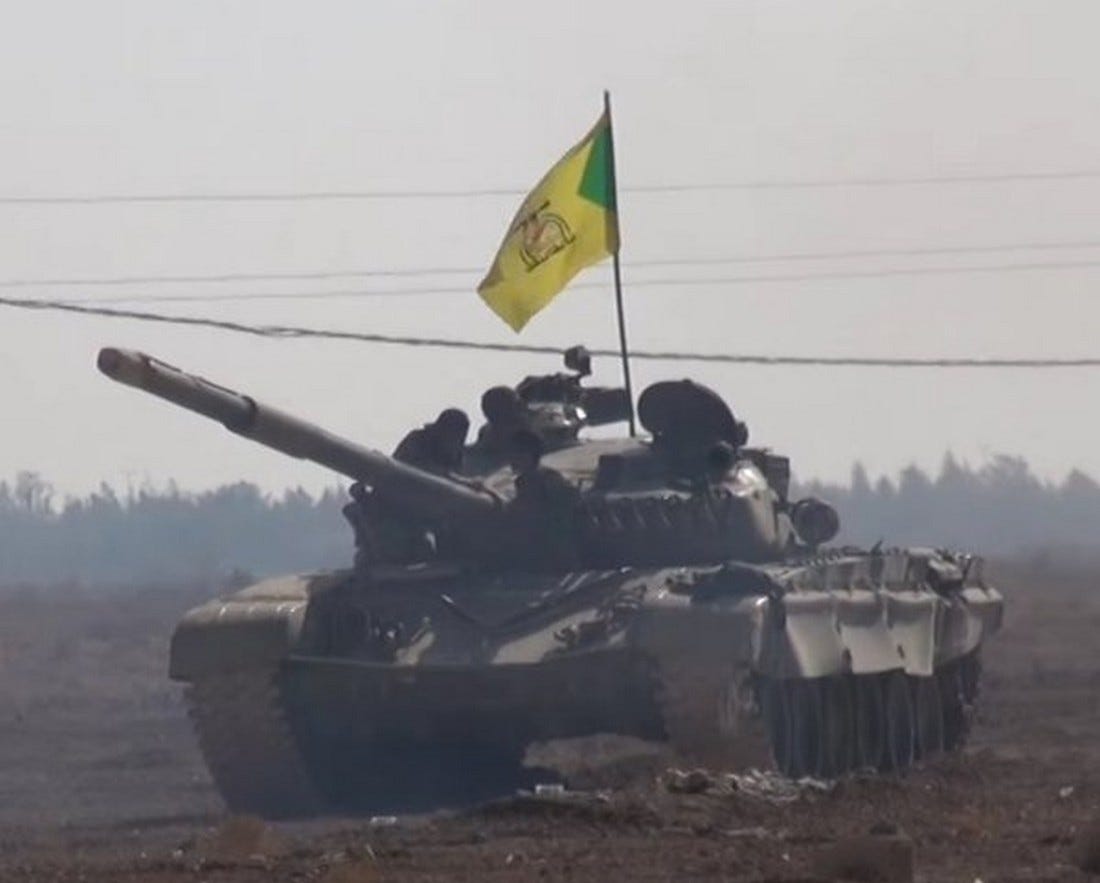
 A similar organization was subsequently introduced in the Damascus area, too. Although the regime can still fall back on at least five brigades of the Republican Guards Division deployed there, these units are incapable of running offensive operations. Therefore, major assaults on insurgent-held pockets in Damascus and eastern Ghouta are overseen by two brigades from the Lebanese Hezbollah, three brigades of the PLA and various of local IRGC surrogates, including the Syrian branch of Hezbollah. Units of Iraqi Shi’a militias are not only securing the Sayyida Zaynab District of southern Homs, but have also deployed to fight Syrian insurgents, too. Furthermore, IRGC-controled units of Iraq’s Hezbollah branch, Hezbollah-Syria, the PFLP-GC and the PLA played a crucial role during the offensive that resulted in the capture of Sheikh Mishkin in January 2016.

 Currently, Homs and Hama appear to be the last two governorates with any kind of significant concentration of the SAA. Actually, merely the HQs of various former SAA units are still wearing their official designations. Their battalions all consist of various sectarian militias — including that of the Ba’ath.

 Despite the presence of such units as the Ba’ath Commando Brigade, the city and province of Aleppo are largely controlled by Iranians, foremost the IRGC. The latter is usually said to operate three or four units in Syria. Actually, the Fatimioun Brigade (staffed by Afghan Hazars) and the Zainabioun Brigade (staffed by Pakistani Shi’a) are most often cited, while the Pasdaran have deployed four other such formations in Aleppo province alone — all staffed by their own regulars. Even larger are different contingents of Iraqi Shi’a, including nine brigade-size formations of Badhr and Sadrist movements, seven brigades of the Assaib Ahl Al Haq movement, five brigades of the Abu Fadhl Al Abbas movement, two brigades of the Iraqi Popular Mobilization Units and nine brigades staffed by Iraqi Sh’ia but which the author of this report was unable to associate with specific political movements in Iraq.

 Correspondingly, there is hardly anything to be seen of the actual SAA and very little of the NDF. It’s unlikely that Al Assad has more than 70,000 troops left under his command.'

Stories of torture in Syria shock Swiss students


 ' “I was beaten on my back by a torture device called ‘Flying Carpet’. My left foot was broken. My hair was cut with a knife. Cigarettes were put out in my hands. I was lashed with a whip on my back and hands as they beat me. My left hand needed 48 stitches. I bled for three months. I lost my eyesight for three hours, then I was transferred to a hospital where I underwent gynaecological surgery – I don’t know what they did, and I am a virgin.”

 This is part of the testimony with which Amal Nasr opened her talk to students. She was not the victim in that case. The victim was a 22-year-old political prisoner in the Adra prison for women in Damascus, one of the largest prisons in the country. She sent a letter to Nasr, a feminist activist who since the 1990s has been defending the rights of women in Syria. She has been arrested several times.

 Nasr was granted asylum in Switzerland more than a year ago after she had to escape from Syria because the security forces pursued her after she had left prison. She told the young audience that most Syrian women fled their homeland “to protect their children from rape, killing, kidnapping and detention”.

 She explained that the last time she had been detained was because of her involvement in a peace initiative between women supporters and opponents of the Syrian regime. But her dream of peace turned into a nightmare in the Adra prison after she had been charged with terrorism.

 She found herself behind bars with about 800 women, “the sisters, mothers or daughters of young men who had to take up arms to confront the regime’s violence”.

 “We experienced political detention before the revolution, but the detention after the revolution has been scary,” she said. “We were 12 women in a cell about two metres long and one-and-a-half metres wide. We could neither sleep nor sit. There were girls aged 13 and mothers aged 86 among us. I will never forget the day when a young woman entered the cell and shouted the number of a corpse outside: 15,940.”


 The young woman knew the number because many prisoners, young and old, had a number on their back, explained Raneem Ma’touq, who was also detained in Adra prison where she met Nasr, a friend of her parents.

 “I saw children in the prison with numbers on their backs, and of course the fate of each child or person with a number on their back was death under torture or execution. You can’t believe that those children were terrorists,” said Ma’touq, who took refuge in Germany with her mother and brother about a year ago.

 “ Around 11 corpses would be carried out of the prison every day, and this was not done right after death: the dead bodies used to stay with the prisoners for several days to the extent that the smell of freedom became associated with the smell of death.”

 In a quiet voice, she explained how detainees were often locked away in secret places so no information would be available about them or about where “the worst kinds of torture are practised, women raped and organs of detainees trafficked”.

 Speaking about the “crime” that took her to Adra prison, the young university student said: “My activity in Syria was the organisation of peaceful student demonstrations demanding freedom and a civil state. For the regime, our activity was more dangerous than armed groups or the terrorism of the so-called Daesh [Islamic State]. Despite all our peaceful demands for freedom, we were always referred to terrorism courts.”


 One person said: “I’m always touched by such testimonies about things we do not have here in Europe. We cannot imagine what this suffering means to these people. We can just try to understand it. This mother is here, but her daughter is still there in Syria (...). We don’t get the same picture of Syria if we read newspapers or watch TV. So when we listen to testimonies like these, it’s as if we’re discovering a new truth." '

Wednesday, 18 May 2016

Open Letter from Aleppo to Prime Minister David Cameron


 'Dear Prime Minister,

 You don’t know me, but my name is Farah Alfarhan. I was born in Preston, Lancashire, and I am a British citizen who has lived and worked in Aleppo, Syria, for 27 years. As a result of my humanitarian work with displaced children, I was arrested by the Assad regime in October 2014 and spent a total of 35 days in detention. I was subjected to brutal and humiliating torture at the hands of this regime. Upon my release, I returned home to Britain.

 I have been outraged to see that the violence and human rights abuses in Syria are not only continuing to increase in number, but also continue to be met with a failure to act by the British government.

 Prime Minister, as someone who has lived through the horrors of the Syrian conflict, I am urging — indeed, demanding — that the British government makes use of the Royal Air Force based a short flight away in Cyprus to deliver humanitarian aid to the starving civilians living in besieged areas across Syria.

 Prime Minister, as someone who has lived through the horrors of the Syrian conflict, I am urging — demanding — that the British government takes steps to ensure that the Assad regime’s crimes do not go unaccounted for. We should back the establishment of an international war crimes tribunal without delay.

 Prime Minister, as someone who has lived through the horrors of the Syrian conflict, I am urging — demanding yet again — that the British government, of which you are the leader, puts pressure on those such as Russia who fund the brutal Assad regime, provide it with weapons and kill Syrians on its behalf.'

Russian-Iranian Plan to Take over Aleppo


 'Asaad al-Zoubi, head of the Syrian opposition delegation of High Negotiations Committee (HNC) in Geneva, revealed that Russian air campaigns joined by Iranian forces and regime forces have a recent attack plan underway. The offensive, called “Postharvest soil turnover”, comprises instigating six battle fronts simultaneously to take over Aleppo. Al-Zoubi urged the international community to unconditionally supply the Syrian Opposition to be capable of defending themselves.

 “Battles will be waged on fronts including Syrian Democratic Forces, ISIS, Afghani forces present inside Aleppo, Iranian forces in South and Southeastern Aleppo, regime forces located near east Aleppo near Sheikh Najjar and the so-called Hezbollah forces near Al-Zahraa town, located northwest of Aleppo,” he briefed. Al-Zoubi expressed his deep regret regarding the unwarranted opposition’s deficiency in arms, which would inhibit their chances of outweighing the opponent despite their efforts.


 Al-Zoubi reassured that despite the substantial lack of arms, the affectionate connection rebels share with land will be a key player in defending their territory and supporting their mission.s for support delivered to Syrian Opposition factions, Al-Zoubi said “ongoing word on the international community potentially supplying the opposition with arms is being circulated with no backing substance. The international community, evidently, will not allow the opposition to be armed. Then should they approve of providing support artillery, it would be under the condition of only using it against ISIS,” in reference to the fact that several fronts and groups drain the Syrian Opposition forces, other than ISIS.

 Syria-based Qasion News Agency reported Russian warplanes launching strikes on Monday evening over Handarat camp. Syrian Opposition had recently taken control over the camp. The strikes also breached the premises of the Canadian-Run Aleppo Hospital. However, no deaths or injuries were reported. On the other hand, many other media outlets confirmed the arrival to Aleppo of over 500 Iranian Islamic Revolutionary Guard Corps (IRGC) members, who are missioned to aid regime forces in launching a military operation across the rural areas of Aleppo. Free Syrian Army (FSA) forces took control over three towns located in the northern rural areas of Aleppo after fierce clashes with ISIS.'

Sunday, 15 May 2016

The Dwindling Value of Syrian State Salaries


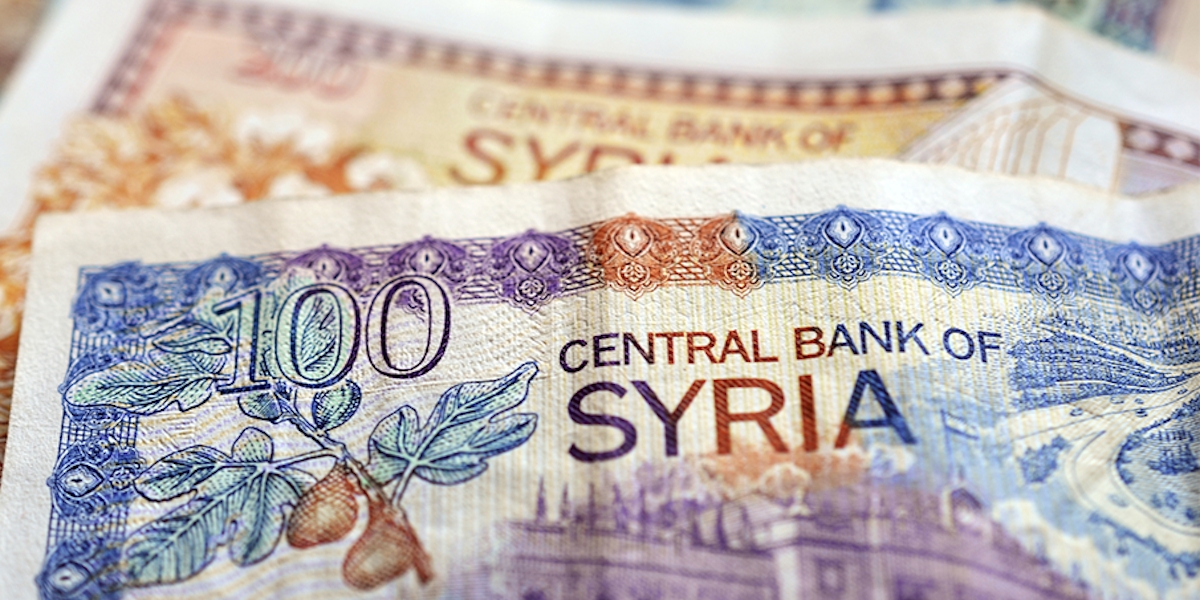
 'Since this March, the value of Syria’s currency, the pound, has been sliding fast. Some economists now warn of a serious currency crisis. The dwindling value of the pound is cutting into Syrians’ purchasing power while raising the cost of subsidies on things like oil, which is imported and must be paid for in hard currency.

 Until now, President Bashar al-Assad’s government had been able to use its foreign reserves, but these seem to have been depleted. It has also relied on financial support from its allies, primarily Iran. While the government in Tehran has spent billions of dollars on keeping its Syrian ally afloat, Vladimir Putin’s Russia seems to have contributed much less, despite intervening militarily on Assad’s side in September 2015. Iranian-backed oil shipments from Iraq are still keeping fuel flowing in Syria, and the government remains able to pay salaries, even outside areas of army control; this has been key to Assad’s hopes of one day reclaiming lost territory. But this spring, the devaluation of the Syrian pound has shown the weak foundation of the state’s influence. Little by little, the Syrian state is losing the ability to provide the services and patronage that has undergirded Assad’s rule.

 Already, the falling pound has meant that most civil servants, soldiers, and others working for Assad’s government are unable to live off their salaries. Second and third jobs, various forms of corruption, remittances from family members abroad, and a strong dose of Syrian creativity have enabled many to survive, barely. But for how long, and what happens when paychecks are simply too small and too few to move the full machinery of state?


 In mid-March 2016, Putin unexpectedly announced he would withdraw part of the Russian expeditionary corps from Syria. Although the withdrawal was largely a political stunt, the announcement set off a panic among Syrian currency traders, and by March 24, the value of the pound tumbled to an all-time low, at 500 pounds per dollar. The government urged calm, but seemed unable to stem the decline. Syria’s currency reserves, which had been estimated at around $18 billion at the start of the war, were now reportedly down to $700 million. On May 7, the value of the pound dropped past 600 to a dollar. The Central Bank blamed a “fierce media campaign” by Syria’s enemies, but this did little to restore public confidence in the economy.

 At 1,000 pounds to the dollar, an average salary in Syria would be worth $20 to $30, while the living costs of a family are calculated at around $500 per month. The situation is looking very grim indeed and reports have begun to emerge that people near President Assad’s inner circle are moving money abroad. “The Damascus businessmen are now actually beginning to be afraid, for real,” a trader told the Financial Times.

 Some 2.7 million people draw a salary or a pension from the state. This makes the government by far the largest employer in Syria and a vastly dominant economic actor in the regions still under Assad’s control. State employees received a significant pay hike in June 2013 and another, smaller one, in September 2015, but these have long since been outstripped by inflation; in real terms, their income is now much less than it was five years ago.

 Most troublingly for Assad, that includes the security sector. The basic monthly pay of a soldier in the Syrian Arab Army is reportedly 18,000 Syrian pounds, though this can be complemented by various bonuses and officers earn more. Five years ago, 18,000 pounds would have meant $383, but at today’s rates, it is closer to $28. Last summer, the government ordered a special salary bonus of 10,000 pounds monthly for frontline troops, to compensate for inflation and to boost morale. But by the time the bonus began to be paid out in June 2015, its value had shrunk to a modest $34 and it is now down to $16.


 These problems are slowly digging into the fundament of Assad’s power. As noted by the Syrian researcher Kheder Khaddour, the hollowing-out of Syrian military salaries since 2011 has pushed the officer corps even deeper into corruption. In order to make ends meet, many commanders allow recruits to bribe their way out of the service, aggravating an already crippling manpower shortage. Many units seem to contain “ghost soldiers,” who are listed on the payroll only to generate income for those in charge. The role of non-state funding for pro-government paramilitary groups, from Iran or Assad-connected businessmen, has grown tremendously. Since local militiasare often able to provide higher salaries, they are a double-edged sword. On the one hand, the proliferation of militias has strengthened Assad’s military might; on the other, it is empowering parochial interests and weakening the military as a national institution.

 Syria’s crumbling economy will thus continue to undermine both Assad’s military might and his capacity to govern, just as surely as it undermines the Syrian state and any hope for post-war reconstruction. The question is how much more the pressure can rise before something, deep inside the state, snaps.'

Saturday, 14 May 2016

Assad is considering genocide and has Russian backing


 'Last week the Syrian regime bombed Al-Kamouna camp for internally displaced people on the outskirts of Idlib. Moscow and Damascus both resorted immediately to deception in order to ward off any accusations of responsibility for this criminal act. They accused Al-Nusra Front of killing those displaced in a camp which is in an area under the group’s control. Washington also participated in the deception, with the secretary of state saying no more than “nothing justifies attacks on civilians.”

 What is the result of this lack of responsibility demonstrated by Russia and the US? The alarming answer to this question is the legitimisation of genocide. With the escalation of the conflict and the heated search for an end to a crisis that has become more complicated both internally and externally, the regime believes that it has a solution supported by its Iranian and Russian allies – genocide — elements of which it has adopted periodically since 2011 in a repeat of the 1982 Hama massacre that the US also chose to overlook.

 An example of this genocidal mentality and its justification can be seen in the heinous acts committed by the Kurds from Afrin on the bodies of those they’ve killed. It was one of the ugliest incidents of the war, but it happened and passed without anyone addressing it, as if it was something normal.


 A study conducted by the United Nations Economic and Social Commission for West Asia (UNESCWA) and Britain’s University of St Andrews, is shocking: “Millions are deprived of the essential necessities of life: 13.5 million are in need of human assistance and 12.1 million lack adequate access to water, sanitation and waste disposal, over 4 million of whom live in Damascus, its suburbs, and Aleppo.” These are areas that the regime intends finish off in order to achieve what Assad called “the final victory” in a telegram thanking Vladimir Putin.
What was revealed in Aleppo and then in the bombing of the Kamuna camp was not only the approach of genocide or the difficulty in reaching a comprehensive truce, but also the US-Russian efforts to cover up the false “political solution” that actually aims to subordinate the Syrian conflict to the war criminal Assad and his gang of killers. Perhaps this approach to the logic of genocide is what pushed the French, the British and the Germans to sound the alarm bells, which is what the Arabs and Turks did before them. They support the American action and understand much of its aspects, despite its vagueness and confusion. However, they reject the idea of the Americans following the Russian-Iranian approach and justifying and overlooking Assad’s crimes.

 The Europeans believe that there is a vast difference between using the US-Russian understanding to urge Assad and the opposition to come to a political understanding that requires commitments and concessions, and using this understanding to please the Iranians and encourage the Syrian president to carry out a military takeover and protect him from any accountability or responsibility. What is more important is that the Europeans who wanted to alleviate or ease the waves of refugees and therefore accepted a political solution, albeit one that is unfair to the opposition, realised that the Americans and Russians lied in terms of the truce being upheld or the feasibility of the proposed political process.

 What is happening now is that the difficulty in establishing a truce and ensuring that it is respected and upheld by the regime and the Iranians has made it difficult to get the opposition to return to the Geneva talks, because the game that is being played with people’s lives has been exposed. Now the regime does not even want the unfair settlement, as it wants to break the truce deliberately in order to hinder negotiations. This is what drove the Europeans to call for a new initiative, as the formulation stemming from the Vienna talks, that later became UN Resolution 2254 has been ruined — and destroyed — by the Russians, Assad and the Iranians.'

Friday, 13 May 2016

Syrian Regime Blocks Aid Convoy and Shells Civilians


 'On Thursday, Omar eagerly awaited the arrival of an international aid convoy that was scheduled to bring medicine and baby formula into Daraya. It would have been the first convoy to reach Daraya since it was first besieged in 2012 — but the trucks didn't make it to the town.

 According to the ICRC, it was turned away at the last checkpoint outside of Daraya. Just minutes after the convoy was sent back, the Local Council of Daraya — a committee that operates as the local government — reported that the Syrian army had shelled a group of civilians who'd gathered to receive the aid. A father and son were killed and five other civilians were injured, the council said.

 After the shelling, Omar rushed to a nearby field hospital where the wounded were being treated.

 "The people are now filled with frustration and anger," he told VICE News via messaging app. "To be honest, at this point we no longer trust the international community or the UN."


 Though it's just a 20-minute drive from the center of Damascus, Daraya is one of the most isolated places in Syria: it's been under siege for over four years, and it's one of the few areas where no aid convoys have ever been permitted to enter. According to residents interviewed by VICE News, people survive on meager meals of lentil and rice soup that are often fortified with weeds or grass. The water supply was cut off two years ago.

 The UN later reported that regime soldiers at the last checkpoint outside of Daraya began removing medical and nutritional items for children — everything except vaccines — from the convoy. Speaking to reporters in New York, UN spokesperson Stephane Dujarric said that Staffan de Mistura, the UN's special envoy for Syria, and Jacob el-Hillo, its humanitarian coordinator for the country, "made the decision not to go through because these key items were taken out" despite the fact that the regime had already authorized their delivery.

 But less than an hour after the UN accused the Syrian regime of pilfering supplies, the UN and ICRC released a joint statement with no reference to the removal of items in the Daraya mission. The convoy was simply "refused entry," the statement said.

 Pawel Krzysiek, an ICRC spokesperson who was traveling with the convoy, also stressed that the convoy didn't turn back because certain items were removed. The convoy had waited for more than seven hours at the regime checkpoint outside of Daraya before being turned away, he said, noting that he didn't think the soldiers at the checkpoint had any intention of permitting the convoy into the besieged area.


 Daraya has endured round after round of atrocities. Shortly before the siege was imposed in November 2012, nearly 500 residents were killed in just two and a half days in one of the most bloody massacres of the Syrian civil war. For most of the last four years, Daraya has been pounded from the air — locals say Assad's forces dropped more than 6,800 barrel bombs between January 2014 and February 2016, when a cessation of hostilities agreement was reached between the regime and some rebels groups. Over the course of the war, what was once a city of 80,000 people has dwindled to a ghost town of 8,000.

 Muhammad Shihadeh, an English teacher who works with the Local Council, said that the failure of Thursday's aid convoy fits within the regime's pattern of behavior.

"I believe it's revenge," he told VICE News via-messaging app. "The regime is trying to take revenge against the people by starving it, even as they allow aid to other places within Syria." '

Wednesday, 11 May 2016

Women emerge as changemakers in war-torn Syria


 'As in a number of Arab countries, many of Syria's women were largely confined to traditional roles before the uprising against Syrian President Bashar al-Assad and the outbreak of war. Now, however, more and more women are at the forefront of new efforts to solve local problems and counter the death and destruction that has engulfed the country.

 One of the ways they've done this is by starting their own independent magazines and radio stations, such as Jasmine Syria, Sayedet Souriya, Radio Souriyat and Nasaem Radio, which focus on highlighting the daily struggles of Syrian women amid the conflict."The stereotypical image of women presented in media reflects a patriarchal society," said Reem al-Halabi, director of Nasaem Radio, which is based in the northwestern city of Aleppo. "Women's interests are not limited to fashion, beauty, cooking, family and children. This image does not reflect the real interests or concerns of Syrian women or how hard they are working to take part in building their country."


 More women are also launching community initiatives, such as Women Now for Development, a center formed by women in 2012 in the besieged town of Hazza in the Damascus countryside to provide training in new skills. The initiative focuses on young women who have had to quit school due to the security situation and widows who need to generate income to support their families. Layla, the manager of Women Now for Development, said the conflict had paradoxically "opened new horizons" for some Syrian women. "They are more self-confident and not afraid to express their opinions anymore, and this is reflected in the way they raise their children and deal with their husbands and the society around them," said Layla, who asked that her real name not be used for security reasons.Layla added that Women Now's workshops about women's rights have contributed to increasing the number of women who voted in local council elections in Eastern Ghouta, a suburb of the Syrian capital, Damascus.

 "Since the revolution began, Syrian women have shown an interest in politics," she said. "They do not base their opinions on what men say; they form their own opinions by analyzing the news themselves."


 Another such initiative is the Network of Guardians, which was founded by a group of young women in 2012 and provides training in caring for children during emergencies – for example, how to deal with the psychological shock many children suffer after a bombing. The organization also works with educators in schools in Ghouta, near the capital, and northwestern Idlib to develop school curricula that take into consideration war and its influence on children.

 "My work with the Network of Guardians helped me develop management skills, which was something I never learned in college," said Hiba, a fourth-year architecture student at the University of Damascus who had to quit her studies because of the security situation, especially the random arrests at checkpoints between Damascus and her home in Douma. "The current conflict in Syria has played a positive role in breaking the stereotype of women as housewives. Women today have a great opportunity and they should take advantage of it, especially with the number of men being lost in Syria to the fighting, imprisonment and abduction."


 In the city of Raqqa in northeastern Syria, Suad Nofal has become a symbol of resistance to tyranny. For a long time, she had opposed the Syrian regime. Later, she confronted the Islamic State. Since she had been a well-known teacher in Raqqa, she initially succeeded in opening a dialogue with a number of IS fighters who were former students, which irritated IS's foreign leaders. They banned their fighters from talking to her, then they began to harass and threaten Suad and issued a fatwa ordering her execution, which forced her to move to Turkey in 2013.'

Tuesday, 10 May 2016

Humanitarian workers recall death threats, prison and torture


 'In April 2011, as protesters began gathering in Homs’ Clock Square, Atassi joined them. Like many women, she brought her children along. For hours, she said, people stood and peacefully protested, for “freedom, justice, dignity, and pride.” Around midnight, regime forces began shooting.

 “I saw the first man killed. He was killed in front of his wife and children. My children were so afraid. We left, running to the car,” said Atassi. Though they escaped unharmed, she said, “this made me look for victims of the regime … This is when I decided to help.”

 In late 2012, her son, who was then 17, was detained at a Red Cross checkpoint in Homs while en route to distribute supplies to protesters. He was released only a week later.

 “Then myself and my family received direct threats for our humane work,” said Atassi. “That’s when we decided to leave.”


 Before fleeing Syria, Sandra Bitarova told Women in the World, she was detained twice for getting involved in humanitarian work there. This included connecting protesters with media outlets to share videos of their demonstrations, and distributing supplies, such as baby milk, in central Homs. The first time Bitarova was detained for only 24 hours. But the second time she said she was held for 35 days. While in jail, she said, “I kept hearing people screaming out of torture, and smelling burning flesh.”

 “I am one of the lucky few who didn’t get physically tortured, but there was psychological torture,” she said. “They were saying: ‘You will be next’ and ‘Where is your sister? We hear she is active too.’”

 After being released, Bitarova said she received information from a government agent, who later defected, that she would be arrested a third time. This time, the agent said, she would not be released. “He said you have two days to vanish,” according to Bitarova. And so, in August 2012, she and her sister fled the country.


 The women described a continued lack of basic services in many areas of Syria, random searches and arrests by government forces, millions who have lost their homes, children who have never been to school, and no recourse for government violations. “Anybody who does open a mouth is detained and tortured, eventually leading to death,” claimed Atassi.

 While Atassi said the general atmosphere of fear increased after the extremist group ISIS — or Daesh, as it is known in Syria — began seizing large parts of the country, the main terror remains Assad’s forces.

 “We always have to have hope, because without hope, we are not going to be living creatures,” said Atassi. “Our hope is to get rid of this crisis and this war… But I implore the world community to stick to their resolution to get Assad out, because as long as Assad is there, the problems are not going to end.” '