Friday, 25 March 2016

The surprising ways fear has shaped Syria’s war


 'Syrians’ stories about life before 2011 call attention to a silencing fear that served as a pillar of the authoritarian regimes of Hafez al-Assad and then Bashar al-Assad. People consistently describe a political system in which those who had authority could abuse it limitlessly and those without power found no law to protect them. As one man explained: “We don’t have a government. We have a mafia. And if you speak out against this, it’s off with you to bayt khaltu — ‘your aunt’s house.’ That’s an expression that means to take someone to prison. It means, forget about this person. He’ll be tortured, disappeared. You’ll never hear from him again.”

 A lawyer described a world in which “a single security officer could control an area of 20,000 people holding only a notebook, because if he records your name in it, it’s all over for you.” Undercover spies and pervasive surveillance led parents to warn children not to speak because “the walls have ears.”

 “Nobody trusted anyone else,” a rural dentist noted. “If anyone said anything out of the ordinary, others would suspect he was an informant trying to test people’s reactions.” A drama student joked, “My father and brothers and sisters and I might be sitting and talking . . . And then each of us would glance at the other, [as if to think] ‘Don’t turn out to be from the security forces!’ ”

 A Syrian in exile since childhood noted: “When you meet somebody coming out of Syria for the first time, you start to hear the same sentences. That Syria is a great country, the economy is doing great. … It’ll take him like six months, up to a year, to become a normal human being. To say what he thinks, what he feels. … Then they might start whispering. They won’t speak loudly. That is too scary. After all that time, even outside Syria, you feel that someone is recording.”


 The spread of peaceful protests across the Arab world in 2011 helped launch a dramatically distinct experience of fear as a personal barrier to be surmounted. Syrians who participated in demonstrations explained that, aware of state violence, they never ceased to be afraid. However, they mobilized a new capacity to act through or despite fear. A mother told me that “no amount of courage allows you to just stand there and watch someone who has a gun and is about to kill you. But still, this incredible oppression made us go out … When you chant, everything you imagined just comes out. Tears come down. Tears of joy, because I broke the barrier. I am not afraid; I am a free being.”

 Syrians I meet follow each new crisis, from the Assad regime’s use of newly horrific weapons to the rise of the Islamic State, and lament the fate of a revolution that now fights tyranny on multiple fronts. Nearly all expressed despair with the foreign agendas distorting what began as a popular groundswell for dignity. “Many countries have interests in Syria and they are all woven together like threads in a carpet,” a Free Syrian Army commander shook his head. “We don’t know where this is leading. All we know is that we’re everyone else’s battlefield.” The 20-somethings who led demonstrations count lost comrades with a pain tinged with depression, even guilt. “I belong to the revolution generation, and I’m proud of that,” one young woman explained. “We tried our best to build something. We faced a lot, and we faced it alone. But we lost control. We don’t know what is useful anymore.”


 Many people’s most urgent fear is for their loved ones: children who have lost years of schooling, family scattered among Syria and several other countries, and relatives who have been arrested and never heard from again. A Syrian colleague articulated this fear in reaction to the January 2014 revelation of photographs evidencing systematic torture in regime prisons. “The most difficult part of the torture pictures,” he told me, “is not the decomposed flesh, the starved bodies … or even the knowledge that the torture is both widespread and systematic. These things have always been elements of our Syrian reality. What is so difficult that I do not think we have the strength to overcome is the fear that some of these pictures may show us the body of someone we know and we hope is still alive.”

 In describing how they have experienced the Assad regime before and since 2011, citizens are transforming its power from something too menacing to be named into something whose naming renders it contestable. When a state uses fear to silence subjects, their talking about that fear — articulating its existence, identifying its sources, describing its workings — is itself a form of defiance and an assertion of the will to be free.'

Thursday, 24 March 2016

We're not just numbers to be moved around


 'Despite surrendering to the Syrian regime last September, Madaya remains blockaded. That means nothing and no one enter or exit without the government’s permission. The 40,000 civilians trapped inside rely entirely on the goodwill of the Syrian regime to eat, and in the case of Ibrahim Abbas, for permission to leave the town to get the surgery he needs to stay alive beyond the short term.

 "I was injured on March 7, 2015—a Friday. I was going to Friday prayers, and was hit by a sniper round in my stomach that cut up my intestines. Currently there are no colostomy bags in the field hospital. I have one bag in poor condition. You're supposed to change the bag once a week. I've been using this bag for an entire month.

 We're human beings, not just numbers to be moved around. We don't need aid or humanitarian campaigns, we need the world to look at us with humane eyes. We need the world to appreciate, and understand our situation. I'm a young man, 26 years old, and until now I've done nothing in my life, and I feel like I'm an old man of 60.

 The regime arrested me at the end of 2012 and forced me to join the army. I served for six months, then fled at the beginning of 2013 and returned to my hometown of Baqin, next to, and administratively a part of, Madaya. I committed myself to civil resistance and worked as an independent citizen journalist. Currently I'm an activist with a civilian project called Ammirha.

 This isn't a war, it's a revolution belonging to people who came out to demand the most basic rights—freedom, equality, and life with dignity. I'm with this revolution until my last breath; on the other hand, I hope it ends as soon as possible and in a way that satisfies everyone. Five years is enough in my opinion.
" '

Monday, 21 March 2016

Daraa tells story of Syrian revolution

Syrian opponents gathered at the Bosra Ancient City chant slogans and hold Syrian flags during a protest against Assad Regime after Friday prayers in Daraa

 ' “The first spark of the Syrian revolution came out from the al-Arbaeen school in Daraa after a number of students were detained for spraying anti-regime graffiti,” Abu Ali Mahamid, a member of the so-called Shura Council of Daraa, told Anadolu Agency on Monday.

 On March 18, 2011, thousands of protesters set out from the historic Omari Mosque in the city to protest abuses by regime forces and demand the release of students. Mahamid said pro-Assad forces threatened to open fire on the protesters in an effort to disperse the mass rallies.

 “As demonstrators did not heed their calls, security forces opened fire on the protesters, killing two people, who were the first two martyrs of the Syrian revolution,” he said.

 Five years after the revolution, almost all of Daraa’s landmarks have been destroyed, including the Omari Mosque, whose minaret was brought down by regime shelling in 2013.'

Thursday, 17 March 2016

The Syrian Spring Blossoms Again

2016-03-15-1458064070-4309677-12829472_968879269862955_354419225731936069_o.jpg

 'I still remember that day clearly, the February 11, 2011. The people of Egypt succeeded in overthrowing the regime that held it for three decades. The windows in our house were closed that day by my mom; she was fearful like any other parent in Syria. My mom always told us not to have any political discussion with anybody out of the walls of our place. My mom closed the windows and started dancing, clapping and ululating. In Arab countries ululation is commonly used to express celebration - that day we celebrated the feeling of freedom in our house for the first time.

 Many people thought at the beginning that the Syrian revolution is a copy of the other revolutions in the Arab world, but this is false. Syria was a very specific situation which pushed the people to be unintentionally ready for a change which was demanded years ago. People had been fed up with injustice and all the regime needed to do is make one more mistake.

 As time passed, the regime had almost the complete comfort to react violently to the peaceful chants. The regime's brutality increased and many massacres were committed in different Syrian cities and towns.

 The number of political detainees reached unbelievable numbers. Syrians raised their voices again and again but the international community did nothing serious to stop the bloodshed. Some Syrians lost hope in getting any international support, so the Free Syrian Army was established by officers who quit the regime's army, the ones who refused to join the regime that was committing war crimes.


 Five years have passed and everybody is trying to cover up what really happened and is still happening in Syria. They want Syria to turn into black and then they can be satisfied with their scenarios about extremism and Syria being a field for a civil war, but they are not going to be able to hide the truth which is as clear as the sun.

 Syrians are the doctors in the field hospitals who are keeping Syrians alive. Syrians are the civilians who are sharing their last amount of food under siege and shelling. Syrians are the teachers who are volunteering to teach the children under siege and doing their best to feed their minds even though they can't feed their stomachs. They are the refugees who are still holding Syria inside their hearts wherever they are going and trying to show the best in them to the whole world.

 The revolution flag was all over Syria for the last two Fridays, and the black flags that the regime and regime's supporting entities wanted to look like as if they belong to the revolutionaries just disappeared!

 The color that they tried to make Syria stick to for the last 3 years was demolished in two days and by hundreds of peaceful demonstrations. The Syrian revolution is still alive against all the faces of oppression in Syria. And if you are not able to see it after all, that would be because you don't want to.'

Wednesday, 16 March 2016

Meeting the Syrians who helped start the revolution


 'Mohanned: "We stood defiant, facing the police and the shabiha militia, demanding freedom, justice and democracy. They opened fire, some of us fell dead, but we held on, unarmed, in a peaceful manner. It was an incredible feeling, it's indescribable.

 I'd rather sacrifice myself for 5 or 10 years, to put an end to this régime, than be controlled by this régime for centuries on end. In most countries, people are allowed to protest, as part of their fundamental rights, but in Syria, it was suicidal."


 Riad al-Asaad: "The entire world has turned a blind eye to the situation. Now there are talks of a political solution, but the régime should put an end to its offensive, and to its bombings. During the last conference in Geneva, the Syrian régime kept on advancing towards Deraa, and on the coast, and besieged Aleppo. The régime prevents access to humanitarian aid, and starves civilians, while the US and Europe do nothing about it."


 Aziza Jalad: "Just last week, we saw that many protests broke out in Syria. If the bombings ended, and if the régime stopped killing or arresting demonstrators, I believe the entire country would keep on protesting, including in territories controlled by the régime."


 Yassin: "The ceasefire could pave the way for a permanent solution in Syria. But for that to happen, things need to change. There will not be any solution if Bashar al-Assad stays in power. Syrians are fleeing their homes because of the war. If the war ends, they will stay in Syria. But the war started because they wanted Assad to step down, so if the current régime stays in place, the migrant crisis will continue."


 Ziad Majed: "Russia pretended it was there to fight Daesh [ISIS], and we see that Daesh is still occupying 40% of the Syrian territory. What Russia really did was save the Assad régime from military collapse, they gave it the possibility to regain some territory. The peace talks are starting, and maybe the Russians thought that Assad was asking too much, the analogy used by his state affairs minister about refusing any discussion concerning the transition, is challenging the Russian, American and de Mistura discourses about the necessity of having a transition. Putin wanted to show he is back internationally, and is imposing himself on the Syrian situation, and maybe he is telling Assad to calm down a little bit, because Assad was saved due to this military intervention.

 Maybe with the new Russian position, it will put pressure on the régime to accept compromises. What continues to be the problem, is the place of Bashar al-Assad in a transition. For the opposition and for the majority of the Syrian people. After 45 years of rule by the Assad family, the only condition of success for the talks, is the departure of Bashar al-Assad. So that the fight against Daesh will start, so that the many challenges facing Syrian society can start being addressed. If they agree on how to deal with the Assad question, many of the other things, I'm not saying they would be easy, but at least negotiations on that could start.

 The problem today is, what kind of transition? The Syrian régime uses the term, 'coalition government', meaning the régime will stay, and add some opposition figures. While Geneva I stipulates a transitional body, that will lead to elections, and then to turning the page of the past. So I think the negotiations will mainly be about that, and how to deal with Daesh later.

 I think the Syrian population has benefitted a lot from the ceasefire, because for four years now it has been under the bombing of the Assad's aeroplanes, of barrel bombing, of the Ruusians recently, and the consequences of all sorts of fighting. We've seen that as soon as the ceasefire was respected, partially, all kinds of demonstrations against the régime; peaceful gatherings, started again, and there was a kind of rebirth of civil society, that in the last years emerged, tried to organise itself, to survive, and now is feeling some help to end the conflict. On the other hand, without a political horizon for the ceasefire, all parties will try to benefit from it, militarily speaking, to reorganise their troops, to prepare for the next phase. Unless they understand that this is a long-term ceasefire, and in parallel the peace process will lead to long-term changes in Syria. The priority would be the régime change, at least the Assad change, if some structures of the régime would be preserved for the next phase.

 There are three or four reasons why Assad didn't fall in 2011. Unlike in Tunisia, in Syria the structure of the régime is a mixture of security services, military, and a family clan, based on sectarianism and the confessional configuration in Syria. The reaction of the régime was not to look for a political compromise, but to crack down on the demonstrators, to destroy the society of the demonstrators, and use all sorts of force, exactly as Bashar's father did in 1980 and 1982. The the reaction of the régime was quite different, and led to the militarisation.

 The second thing is the geo-strategic location of Syria. On the Israeli border, on the Iraqi border, on the Turkish border, with all that meant with regional actors becoming involved.

 Thirdly, the Syrian régime had a strong ally in Iran, that from day one supported it, and then Russia also jumped in, because it considered it was its ally that was being targetted, and Putin wanted to show that he is loyal to his old alliances, and will protect them.

 All that generalised the conflict, and internationalised it, plus Daesh, but at the origin, and I think the major responsibility, is of course that of the régime, that refused all kinds of political compromises, of dealing politically with its own society, and preferred to just use violence against it, to crack down on it. This has also been the history of Syria, unfortunately, since 1970, where the régime replaced politics in the society with violence, that is the killing machine that operates against all kinds of dissidence and opposition, and preserves politics for regional and international questions. So I think it's a mixture of that, and the timing did not play for a quick change in the régime. We saw in 2015 with all that, that the régime was very close to collapse, and that's probably why at that moment Russia decide to restore the balance, in order to make a compromise where they were part of the new Syria." '

Syrian revolutionaries: ‘Carrying arms was not a choice’


 'Mohammad al-Ibrahim, 23, was one of thousands of young men who took part in the early, initially peaceful demonstrations. He told Al Arabiya English that the uprising forced him to switch paths and take up arms to defend himself. He was 17 when he said he led some of the demonstrations, shouting anti-government slogans, reciting poetry, and singing revolutionary songs. His personal turning point was towards the end of 2011, during a peaceful protest. He said none of his fellow demonstrators were armed when regime soldiers opened fire, killing two of his cousins.

 “I don’t regret using weapons against a monstrous and brutal regime… and if I can go back in time and pick up arms in the face of a regime that destroyed my homeland, my future, and killed my beloved ones I would not hesitate,” said Ibrahim. “I don’t believe that the revolution ‘failed’ because it became armed,” he said, adding that the Syrian regime had been behind the creation of Islamist militant groups and had been aided by foreign intervention.

 Ibrahim’s mother, who refers to herself as Umm Mohammad, said she had not wanted her son to take up arms, but felt she had no right to interfere in his decision. “I told myself my son isn’t of more value than the rest of the Syrian men who are dying to protect us.” Repeating what she claims is the sentiment of most of the wounded men, she said “[It turned out] the only reaction the regime understood was the same weaponized response they used against us, even though the revolution was initially peaceful. The very regime that drowned out our voices with its bullets had to hear us when we picked up our guns. They took our land, homes, memories, everything beautiful, even our beloved ones, and their actions led to my son becoming crippled in front of my own two eyes. What do you think our reaction is going to be? Of course were going to resort to arms… to protect ourselves.”


 Hadi Abdullah, an independent Syrian journalist and activist from the city of Al-Qusayr, Homs, said that many Syrian men had no other choice other than to pick up arms. “The crimes committed by the Assad regime pushed the Syrian protestors to carry arms… many Syrian men carried arms not by choice but were forced to defend themselves. We hoped that our revolution would continue as a peaceful movement and attain freedom and democracy without a single bullet,” Abdullah told Al Arabiya English.

 “No one can sit and watch Assad’s Shabiha [thugs] slaughtering entire families than resist taking arms to defend their family. No one can sit and watch the regime forces detain women and abstain from picking up weapons. It’s human nature to fight to live and defend those you love.”

 Bashar al-Zoubi, who is also referred to as Abu Fadi, the Commander-in-Chief of the Southern Front and is head of the Yarmouk Brigade, also said that picking up arms was never a choice and that they were ‘welcomed with tanks and bullets’ while peacefully protesting. “We are revolutionaries and not opposition. We took the streets demanding freedom, and a better future for Syria. Our words were not heard, so we were forced to take up arms. The opposition might have a different agenda than the revolutionaries, but this is what we’re fighting for. The ceasefire in Syria has brought back the wonderful old days of the revolution, where we went out as one and demanded for our rights.”

 Mohamad, 24, who asked to not have his full name disclosed, said he decided to join one of the early rebel groups, the Free Syrian Army, after his mother was killed in the town of Manbij in the northern Aleppo province. He said he was at home when Syrian airstrikes hit the market where his mother and sister had gone to buy clothes for his sister’s soon-to-be-born child. She had lost both her legs and there weren’t enough medical professionals and supplies to save her. After losing my mother, I felt I had nothing left to lose. If someone keeps hitting you, and you tell them to stop through words over and over, and they continuously hit you... you're going to strike back, am I correct?" '

Tuesday, 15 March 2016

The Young Men Who Started Syria's Revolution Speak


 'Omar first heard about the graffiti at morning recess. It was winter, he was 14, in the middle of 10th grade, and his friends said it was just a prank. The day before, just after school, a handful of Omar's classmates found some red paint and scrawled, "Your turn doctor," on the school's wall. The "doctor" was Bashar al-Assad, Syria's dictator, and in Daraa, Syria, in February 2011, those words could get you killed.

 It's been five years since Omar's friends wrote on their schoolyard wall; now the city of Daraa is divided between enclaves controlled by the Syrian government and parts that Omar says have been "liberated" by the Free Syrian Army. Omar avoided arrest, but his friend Yacoub, who was 14 at the time and also in the 10th grade, was not so lucky. Over the course of weeks, the police in Daraa completely brutalized Yacoub. They forced him to sleep naked on a freezing wet mattress, they strung him up on the wall and left him in stress positions for hours, and they electrocuted him with metal prods.


 It was in Daraa, a mostly Sunni city well known for its well-to-do families and close military and financial links to the state and the Assad family, that the first full-blown rebellion broke out.

 Omar remembers going to mosque on one of the first Friday protests and watching the imam — who had for years read out a pro-government message at the end of his sermons — throw the regime's talking points on the ground. After prayers, the families and friends of the boys who had been arrested poured onto the streets, and began chanting "We want our kids out of prison." The police responded with tear gas, live ammunition, and sniper fire. Omar was among that first group of protesters, and remembers fondly how the people of Daraa — even those who had no connection to his friends — rallied around them.

 "I thought the people in the neighborhood would be against us, and think we were just stupid kids," Omar remembered. "In the end, writing on that wall was viewed as something heroic and courageous."


 Ismael, now 43, worked as an administrator at Daraa's main hospital during the early days of the uprising. One of his young cousins had been rounded up in the graffiti arrests, and Ismael was one of the first to join the protests. A few weeks into the uprising, Ismael secretly filmed medical workers uncovering a mass grave on the outskirts of town, he passed the film to a relative in the US, and it was eventually aired on CNN. Afterwards, Ismael was arrested, but his family managed to scrape together $20,000 to bribe an official and get him released. He immediately fled the country, and he's now a refugee in Toledo, Ohio. He says countless cousins and uncles have disappeared into Assad's prisons, or wound up dead on the streets.


 An official with the Free Syrian Army, Khaled now lives in rebel-controlled Daraa and he's had a few close calls, dodging the explosive-filled metal drums the Syrian military shoves out the back of helicopters. Since Russia, the US, the Syrian government and rebels agreed to a partial ceasefire last month, the front line that divides the Daraa city center has been largely quiet. But the years of barrel bombs, offensives, and counteroffensives, have taken a serious toll. "This generation is pretty much destroyed emotionally — now kids' toys are weapons." Khaled says. "We all need therapy." Khaled has the means to flee Syria, but he's decided instead to devote his life to overthrowing the Assad regime. He spends his days coordinating rebel activity around Daraa: he helps train new recruits, and make sure that some government services continue to function. "I want things to go back to normal, that's my real hope." '

Sunday, 13 March 2016

'Curse your soul, Jolani'


 'Hundreds of anti-regime demonstrations have taken place in Syrian opposition towns over the past week after a five year hiatus.

 One of the most surprising twists to this tale has been how the Syrian population have remained largely "unradicalised", despite nothing more than superficial support from democratic powers.


 Popular songs have even take aim at the jihadi fighters in the neighbourhood.

 [The revolution] was hijacked by the bearded men,

 Curse your soul Jolani [Nusra leader] and your soul Hassoon [pro-regime Sunni cleric],

 Curse your soul Baghdadi [IS leader] wherever you are too!


 This combined with the fact that, in many areas, Islamist fighters such as the Nusra Front - al-Qaeda's Syrian franchise - are their only lines of defence against pro-regime militias is proof that Syrians have not fallen victim to Stockholm Syndrome. Chants in support of the Free Syrian Army accompanied by energetic singing and dancing relive the heady days of 2011. The relative peace means the war - but not the fight - has been temporarily put on hold.

 Such secular "slights" to the puritanical sensitivities of local Salafi-jihadi fighters have rattled some elements within Nusra, which angrily broke up one demonstration in Idlib province this week, threatening to shoot at protesters.


 "Both fundamentalist extremists and Assad regime supporters have been embarrassed by the protests. Supporters of both groups have claimed that the protesters are being paid by foreign agents," said Oz Katerji, a Middle East analyst. "Democracy and free speech terrifies reactionary counter-revolutionary forces more than anything else."


 "As soon as the bombing lightens then immediately the jihadists are weakened," said Robin Yassin-Kassab, a British-Syrian writer and co-author of Burning Country: Syrians in Revolution and War. "Assad produces jihadists. When a battle takes place, Nusra is seen as a friend of the revolution because it is fighting the regime. When a battle isn't taking place then Nusra is seen as an authoritarian power trying to enforce an unjust political project. Nusra's project is not democratic and it must be upset that after five years of trying to embed itself in revolutionary Syria, still the people on the streets are calling for freedom, democracy and the Free Syrian Army, and not the jihadist militias."


 Michael Karadjis, from the University of Western Sydney College and a writer on Syrian affairs, believes that a reduction in bombing has given moderate revolutionary forces a shot in the arm. "The FSA supporters and civil uprisings were very tactically wise in coming out all over the country as soon as there was a lull in the bombing... or perhaps people spontaneously came out," he said.

 If Russia and the regime re-launch major bombing raids on rebel towns to suppress these protests, as has been reported today in eastern Ghouta, then it would no doubt backfire and likely trigger a more unified and extreme military response from the opposition, particularly if international condemnation remains muted. Groups such as Nusra, which have been among the best-performing armed opposition groups, would no doubt be among the main benefactors. The West and regional powers would also be in no position to ask rebels to cut ties with the extremist groups.

 "It is futile to demand the FSA not to have military coordination with groups like Nusra to fight the regime as the US has demanded for years. I'd go further, it is a call for mutual destruction of anti-Assad forces," Karadjis added. "With a regime like Assad's, some military element in [the resistance] is almost essential. But the greater the response, the less the civil component of the FSA's military struggle can raise its hand."


 The longer the bombing continues, the greater the potential that groups such as Nusra have to expand their ranks. "The ceasefire does have an isolating effect on groups like Nusra precisely because they thrive on the extremist atmosphere that inevitably comes from war," said Karadjis. "That is why Assad pushed for civil war from the moment the civil uprisings began." '

Saturday, 12 March 2016

Activists who lit Syria revolt washed away in migrant wave


 ' "When I arrived in Germany, I felt like I was living with an open wound, like I'd lost my soul. I felt guilty for leaving everything behind," says Jimmy Shahinian, a 28-year-old activist with sharp features and jet-black hair. "We had made a promise that we would change things."

 Syria's conflict erupted on March 15, 2011, when protesters massed on the streets to demand that President Bashar al-Assad step down. Shahinian, a Christian, joined the movement, and was subsequently jailed and tortured.

 When the jihadist Islamic State group took over his native city Raqa in 2013, he began receiving terrifying death threats. Smuggled into Turkey in an ambulance, Shahinian became one of nearly five million Syrians who have fled the country since the conflict began.


 Yazan lived through a brutal, nearly two-year siege in the Old City of Homs, once known as the "capital of the revolution" but now squarely back in regime hands. "In Syria my body was besieged. Here, I am besieged in my head," says the 30-year-old. He admits he can't move on while his father and brother remain among the estimated 200,000 people held in the regime's hellish jails.

 "Here I can eat, I can sleep in safety. But however hard I try, I can't imagine the future," Yazan says. "My whole life is on hold until the regime falls."


 Ahmad al-Rifai, a 24-year-old who spent months taking photos in opposition strongholds across northern Syria, is also in Germany -- where more than one million asylum requests were registered last year. He blames the Syrian government but also the international community for the transformation of the revolt into a war that has killed 270,000 people.

 "In the good old days, the people would decide when and where to protest, or when to go on strike," Rifai says. "Now, the Syrian people have no decision-making power at all. Syria has become a playing field for major powers like Russia, the United States and Iran." '

Thursday, 10 March 2016

The Syrian Revolution Is Not a Holy War


 Hind Kabawat:

'Before the uprising, Daraya was a sleepy middle-class suburb for Damascus residents. By 2011, it had become an epicenter of peaceful protests, as thousands marched in the streets calling for Assad to step down from power. As a member of the Syrian Christian community, I was overwhelmed with excitement to join this grassroots people’s movement that called for democracy, freedom and rights for all Syrians, no matter our differences.

 Syrians were united then. The church bells rang in Daraya in solidarity with the protesters. From their balconies in the narrow streets, Syrian Christians showered protesters below with rice and flowers. They marched hand in hand.

 By 2012, the Assad regime intensified its armed crackdown against the unarmed protesters in Daraya. A terrible massacre occurred there on Aug. 24, 2012, as Assad’s regime sent troops, secret police, and members of the elite 4th Division to prevent residents from fleeing the city by any means necessary. Families were executed in their homes, whole buildings of women and children were machine-gunned in the streets, and residents were even decapitated — long before the so-called Islamic State even existed.

 The state-run media launched an aggressive propaganda campaign claiming Muslims were massacring Christians, aiming to stoke fear of the opposition in the Christian community. As regime soldiers went door to door, searching for people to murder, it was the Christian community of Daraya that opened theirs to protect those fleeing the atrocities. One Catholic church treated the injured and prepared food for them.


 Assad attempted to break Daraya with chemical weapons in 2013, launching a horrific sarin gas attack that killed over 1,000 across the Damascus suburbs — many were children still in their pajamas when the nighttime attack happened. Images of asphyxiated children lined up on the ground are etched in our memories of that night. The international community was on the verge of holding Assad accountable for that atrocity, but the Russians intervened at the eleventh hour with a negotiated settlement. Before the ink was dry, Assad instituted a brutal starvation siege upon Daraya and neighboring Moadamiya.

 The Russians and Assad have proven adept at shifting the narrative surrounding the peace talks. We are asked to discount the atrocities that Daraya and other towns in Syria continue to suffer at the direction of Russian-manned command centers in Damascus. The fight against the Islamic State and al Qaeda, the narrative goes, is paramount.

 But how can one fight these extremists, who threaten to slaughter Christians and Muslims alike, without a moral commitment to ending the humanitarian crisis? And how can Moscow claim that it is fighting terror in Syria when it systematically contributes to the destruction of the very antidote to terror — civil society activists, women, and, yes, even us Christians who once lived in harmony with our countrymen in Daraya?

 Syrian priests to this day continue to defy the regime by covertly smuggling food into besieged Muslim neighborhoods, at the risk of their lives. The Bible tells us: Do not repay anyone evil for evil. If your enemy is hungry, feed him; if he is thirsty, give him something to drink. The threat this principle poses to Assad’s and the Islamic State’s authoritarian worldviews is more powerful than any man-made weapon.


 Just this week, Daraya’s local council reported to me that regime tanks are encircling the town and seem poised to stage a ground raid. Despite this threat, Daraya residents are taking advantage of the relative calm to organize peaceful demonstrations and a children’s festival. These demonstrations are happening throughout the country — after nearly five years of war, even a brief respite from the indiscriminate attacks was enough for Syrians to return to the streets to peacefully demonstrate their commitment to freedom from tyranny in all its forms.

 If Assad remains emboldened and enabled to treat peaceful opposition as terror — I myself have been charged by the regime’s terrorism court — it can only ensure that the church bells of Daraya never ring again.'

Wednesday, 9 March 2016

We have no children any more, only small adults

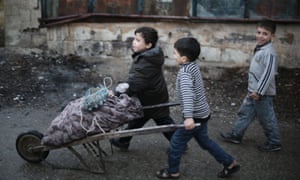
Children push a barrow filled with firewood in Ghouta, Syria

 'Sick children dying as lifesaving medicine waits at checkpoints, youngsters forced to survive on animal feed and leaves, and families burning their mattresses just to find something to keep them warm.

 Schools moving underground for shelter from barrel bombs, the crude, explosive-filled and indiscriminate crates that fall from the sky and are so inaccurate that some observers have said their use is a de facto war crime.

 The wounded left to die for lack of medical supplies, anaesthetics, painkillers and chronic medicine; children dying of malnutrition and even rabies due to the absence of vaccines, while landmines and snipers await anyone trying to escape.


 Tanya Steele, Save the Children’s chief executive, said: “Children are dying from lack of food and medicines in parts of Syria just a few kilometres from warehouses that are piled high with aid. They are paying the price for the world’s inaction.”

 At least a quarter of a million children are living in besieged areas across Syria, Save the Children estimates, in conditions that the charity describes as living in an open-air prison.

 Rihab, a woman living in eastern Ghouta near Damascus, which has been besieged by Bashar al-Assad’s regime, was quoted as saying: “Fear has taken control. Children now wait for their turn to be killed. Even adults live only to wait for their turn to die.”


 A truce negotiated last month by major powers was supposed to bring relief and aid into the besieged areas, but humanitarian workers and activists say the Assad government, which is conducting the vast majority of siege warfare in the country, has repeatedly delayed access, potentially in violation of the truce agreement.

 Ahmed, a boy living in the besieged Damascus suburb of Douma, told interviewers: “When I hear the sound of a shell or a plane then I get very afraid and I hurry to escape and hide under my bed.” '

Tuesday, 8 March 2016

From Damascus to Dawson Creek


 'Before the revolution began in March 2011, Osama Saed worked in construction, restoring mosques, churches and other ancient structures. He lived in Damascus, the second-largest city in Syria, and enjoyed lifting weights at the gym.

 He hopes to see peace in his home country.

 "I believe the Syrian people are just asking for justice," he said. "There was a lot of injustice in Syria and this is the only thing that the Syrian people are asking for—basic justice for all the people." '

Saturday, 5 March 2016

Free City Radio interview — Robin Yassin-Kassab

 'We felt very strongly that the voices of the Syrian people have not been heard. With some great, and valiant exceptions, the media has done a very poor job of reporting what's happening in Syria; and unfortunately the leftist media has been just as bad, if not worse, than the rightist media, in this. As Yassin Al-Haj Saleh, he's quoted in our book as saying, he can't see the difference between the left and the right from a Syrian leftist point of view. So we felt that people approached this from inappropriate grand narratives. They zoomed out so far that they saw in it terms of a fight between Russia and America, which wasn't actually happening; or between Saudi Arabia and Iran, which it's now become partly about that, but it certainly wasn't when it started; or they think that this is a rerun of Iraq 2003, when it's a completely different situation, there was a popular revolution.


 What's happened is that everyone knows about jihadists cutting people's heads off, and so on, they know about the movements of states, but they don't know about the remarkable things the Syrian people have done. Not many people have asked what are the Syrian people's motivations, what are their fears, hopes; what is their experience of what's happening. So in the book we've tried to amplify the voices of people on the ground. I'll give an example of why it's important before I go on. At the moment, there are over 400 local councils in the liberated parts of Syria - now by liberated I mean the areas that are not under the control of the Assad régime, and are not under the control of ISIS or Daesh or ISIL, I'm not sure what you call them in Canada; in both of those areas there is activism, but it must by necessity happen in secret underground - in the areas that are under the control of other oppositional militias, from Islamists to Free Army groups, in those areas there are over 400 local councils. 

 The communities have organised themselves in those areas in the most difficult of circumstances, with bombs dropping onto them, in some areas under starvation siege. They've held elections, most of these local councils are democratically elected. This is a remarkable story. There's also an explosion of popular culture, of debates, there are over 60 Free newspapers in a country where a few years ago everything was controlled by the state. Lots of Free radio stations. Lots of exciting things that are going on and happening, that we should know about. It's not often you have a real revolutionary situation in history, it's a rare historical moment, and we've kind of missed out on this one, because we've been relying on very poor journalism, and poor assumptions, because we've started from a point where we've been very ignorant about the Middle East in general, and we've missed out on this stuff which is inspiring, and interesting, and necessary for us to learn from.


 At the same time, at the moment, this democratic alternative is being smashed by a full-scale international military assault. Iranian transnational Shia militias on the ground, and Russian planes cluster bombing from the sky. The country is being depopulated. There is another alternative, there was another alternative, but the Western and Eastern states seem to be collaborating in trying to crush this alternative, which we know so little about.

 We've interviewed a lot of people who've been involved in these experiments. We've interviewed a lot of activists, medical practitioners, fighters, organisers, refugees, intellectuals. We've deliberately tried to amplify the voices of revolutionary Syrians, of course that's a range of revolutionary Syrians with a range of different ideas; but we've also tried to give context, because I think without context, you're just left with assumptions and ideology.


 So we've tried to put the whole story, first into a historical context, so we start off with the history of Syria, and go to the Ottoman Empire, and then the French occupation, and then the the short experience of democracy after that, and then the rise of the Ba'ath Party, the militarisation of the Ba'ath party, the rule of Hafez al-Assad, and the neo-liberal economic reforms of the son, Bashar al-Assad; and then the revolution, how it started. How is was a wide-ranging, largely, entirely leaderless, a popular movement that involved people of all sects and backgrounds, and how that was savagely repressed, how the régime deliberately provoked a civil war and a sectarian war.

 Which sounds strange to people. Why on Earth would the régime do that? Well, they did it because they've done it before. They did it in the late 70s, when there was a movement of leftists and nationalists and liberals and Islamists against them. It wasn't a huge popular revolution like 2011, but it was a movement, and they crushed it so ruthlessly that by 1982 all that was left was the armed wing of the Muslim Brotherhood, who staged an uprising in the city of Hama, and then the régime had a war situation, which they could deal with. They went in and smashed the city, and killed tens of thousands of people, destroyed the Muslim Brotherhood, and left Syrians silent for the next three decades until 2011.

 So they wanted to replicate this, and how did they do it? at the same time they were rounding up tens of thousands of peaceful, non-sectarian democratic activists for death by torture, in the Spring of 2011 they were also releasing thousands of Salafist jihadist terrorists from prison. People that they'd helped to go to Iraq after 2003 to fight the Americans, but more to the point, to fight the Shia population there, which helped to start the civil war there; when these jihadists came back from Iraq, the Assad régime put them all in prison, and kept them there until the outbreak of the revolution in 2011, when it needed them again, so it sent them out. During the Spring of 2012 there was a string of sectarian massacres, organised by the régime, in the area between Homs and Hama; it was designed to create a sectarian Sunni backlash which would then in turn terrify the minority Alawi community, which the régime relies on, because 80% of the officers in the army are Alawis, because the heads of the intelligence services are Alawis.


 When we talk about context, we talk about the sectarianisation and the Islamisation, and then how foreign jihadist groups who had nothing to do with Syria exploited the chaos and came in. And how then how they were allowed to grow, because it got to the situation we are in now, where President Assad is saying, "look the choice in Syria is now between me and the mad jihadists." Most states in the world, and lot of the public in the world, because they think that is the only alternative, between him and the mad jihadists, the they think, yes we should accept what the Iranians and Russians are doing, we should maybe even help Assad get control of the country from these mad head cutters. But it was he who created the conditions for the head cutters to come in. It was his scorched Earth that helped them to come in. It was his effective non-aggression pact with ISIS for years which allowed them to grow.

 Even today, over 80% of Russian bombs are not falling on ISIS, they are falling on the opposition to both Assad and ISIS. The people who have driven ISIS out of their areas before. The people that we need for any kind of serious solution in Syria, these are the people being eliminated at the moment, having the Hell bombed out of them, hundreds of thousands of new refugees to add to the more than 11 million already displaced. More than half the Syrian population. It's an enormous and expanding tragedy, and the west, through the leadership - if that's what you would call it - of the United States, Obama and John Kerry, have effectively handed Syria over to Russia and Iran. In the name of disengagement from the Middle East, which did seem like a good idea when Obama arrived in power after the Bush experience, but his done it in such a precipitous and dangerous way that takes no account of the democratic movements and revolutions in the region, the hopes of the people there, and all he's ended up doing is handing over Syria and Iraq, in effect, to even more savage imperialist powers, Russia and Iran in this case, which sadly has become a regional imperialist, and the end result is that it is such a Hell, such a mess has been formed in these two countries, the United States is not disengaged at all, it's there bombing the Hell out of Syria and Iraq, but it's bombing the symptoms, and not the cause. It's allowing the Russians to set the terms, as it' is bombing the democratic nationalist opposition, the only hope for a long-term serious settlement of the problem.


 I think the proportion of leftists who were released from prison in 2011 was very, very small, in relation to the number of jihadists. The word jihad in English only has negative connotations. When you talk about a jihadist, it immediately sounds like someone who cuts people's heads off, in order to impose a very extreme and puritanical version of an Islamic state. In Arabic the word 'jihad' just means struggle or effort. That's why you find Christian Arabs who have the name Jihad sometimes. It's a very positive word. Islamically, it means a spiritual struggle, so the first meaning of jihad is a struggle against the baser elements of your self, the struggle to be a better person, the struggle to be honest, the struggle to be a good parent, a good husband, this kind of stuff is the traditional understanding of the main meaning of jihad. Of course throughout history it has also had a warlike meaning, something that approximates to the English translation of 'holy war', and at times it's been used as a propaganda word for Muslim armies taking over other places. In the current situation I think when we are talking about the Islamists in Syria, we have to recognise there is a huge range of Islamists; and in the world, 'Islamism' is a very vague thing. It's the notion that some aspects of Islam should be applied in some way to social and political organisation. You even have some, though it's a few, leftists versions of Islamism, there's a feminist version of Islamism, there are anarcho-Islamists; these are little minority groups, but they exist, so it's a wide-ranging thing.

 Now, in Syria, in terms of the militias fighting, firstly we have the Free Army groups, who I think are the people who should be getting much more consistent support, and should be allowed to have anti-aircraft weapons to defend their people from this terrible aerial assault. Those people have no political agenda other than to get rid of this régime, to defend people against the régime and its foreign backers, and then to arrive at a situation in which the Syrian people themselves can decide what happens next through some kind of democratic process.

 After that you've got a group of militias who are collectively known as the Islamic Front. The most famous include Jaish al-Islam, the leader Zahran Alloush was recently killed by a Russian airstrike in the Damascus suburbs. Jaish al-Islam is strongest in some of the Damascus suburbs, in the Ghouta area. And then we also have a group called Ahrar al-Sham, which is Turkish backed. It operates mainly in the North of Syria. It's probably the most extreme of these ones in the Islamic Front. Now, the position of many revolutionaries with regard to these Islamic groups is that they are both counter-revolutionary and revolutionary at the same time. It's very complicated. In this war situation, people like me feel torn by an obvious contradiction. On the one hand, supporting these organisations in their fight against the régime and its foreign backers, and in defending their communities, which is what they're trying to do. And we recognise that they are Syrians, these are Syrian organisations, not foreign organisations, and they do have a constituency, they do represent some Syrians. They also allow local councils, women's centres, free newspapers, in the areas controlled by Syrian Islamic militias, this kind of democratic civil society is allowed to continue. There are obvious exceptions. The biggest exception is the case of the Douma 4, where four revolutionary and human rights activists, primarily Razan Zaitouneh, who our book is dedicated to, were abducted, almost definitely by Jaish al-Islam, this Islamic Front militia, in Douma, in the Damascus suburbs, and we've never seen anything of these four since. Of course, Jaish al-Islam denies doing it, they say it was the régime, or some other group, it wasn't them, but the families of these activists, and the friends of these activists, people who know, are convinced it was Jaish al-Islam. So there are these terrible authoritarian tendencies, and they've made very sectarian comments at times, which helps Assad by continuing to alienate scared minority groups from the revolution. So in this sense they are counter-revolutionary, but as I've said, they are much better than either Assad or ISIS. In a war situation, people will put up with this kind of people, and we would hope that in a future where the régime is gone, and the bombing has stopped, the civilian councils, which are allowed to operate in these areas, will call for the disarmament of such militias, and as they consist of Syrian men who are of the people, I hope they would listen.

 Now I have to go on to the transnational salafist jihadists, who have a global agenda, not just a Syrian agenda, and there are two of them. There is Jabhat al-Nusra, which is the Syrian wing of al-Qaida, it is al-Qaida. And then there is ISIS, or Daesh. These two, of course, are at war with each other, and ISIS is at war with everybody. It's at war with the Free Army, with the Islamic Front, with Jabhat al-Nusra, with al-Qaida, and the states in the region, and the world. I think ISIS, because it's apocalyptic, and millenarian, and at least its propaganda is that these are the End of Days, and its declared war on everybody. It doesn't have a Syrian constituency. It's trying to engineer one, by brainwashing children in schools and so on at the moment, but it doesn't have a Syrian constuency, It's an occupation force, though many Syrians have joined up for various reasons, because they see no option, or whatever. But because it has declared war on everybody, I think that everybody will finally defeat it. If you could stop the chaos in Syria, it would naturally be defeated by the people, if you stop the bombing, and so on. Jabhat al-Nusra, traditional al-Qaida if you like, is a different matter. It has learned a lot of lessons from its past experiences, and it's been very intelligent in Syria in not trying to impose total control in certain areas. It's working in coalition with other militias, it's working inside communities. There are women's centres, for example, that are open in towns where the dominant militia is Jabhat al-Nusra. They've sometimes made trouble, but in general they haven't, because they're embedding themselves deeply in Syrian society, they're showing the tormented Syrian people, "Look, no-one has come to your aid, now the West is openly collaborating with the régime, it's agreeing with the Russian and foreign onslaught on you, and we are here as your Muslim brothers from all over the world to support you."

 That's why they are better rooted in Syrian society, because no-one has sent any anti-aircraft weaponry, which would be more useful than millions and millions of pounds of charity, to the Free Army, to help them defend their communities from this constant aerial bombardment, but Muslims from all over the world have turned up and said we're willing to help. So that's a long-term danger, the abandonment of the Syrian people by the states of the world, but also by the left, who often believed silly conspiracy theories about it, and didn't engage, and didn't find out what was actually happening. And then Islamists came from abroad, and actually engaged. As a result, they've got a stake on the ground now, sadly. This is very dangerous for the Syrian people, because some of the Syrian people are Islamists, and have different ideas about different kinds of Islamic state. To some Syrian ears, the notion 'Islamic state' doesn't mean head cutting and amputations, it means good, honest, clean government, and moral government. So there are Syrians who are Islamists, but I think the vast majority of Syrians, what they would like, and we're so far from this, is a society in which they can choose, and nobody will impose upon them. What these foreign jihadist groups have in common with the Assad régime, and Russia, and Iran, and the powers of the world, is that they don't want democracy in Syria, they don't like revolutions, they don't want people organising themselves, they don't want people making their own decisions. They want to impose their ideas by force. So Syrians are now at war with all forms of authoritarianism, and it's not a struggle that is well understood, which is why we wrote the book.'

Thursday, 3 March 2016

Louder than bombs


 'Saturday's ceasefire has given residents of "free" areas a rare respite from war and allowed civil movements to re-emerge from the periphery of Syria's war. Over the past five days, activists and residents have taken to the streets in rebel-held towns to protest against the regime. They also reaffirmed their commitment to freedom and democracy, and called for rebel unity.

 Many of these colourful protests were led by the same activists who organised demonstrations in 2011, but were later made impossible due to regime sniper fire, mortars and bombs. "The people want the downfall of the regime," people chanted on the streets of Damascus' suburbs this week, just as they did during the early days of the revolution in 2011.

 "In many ways it wasn't surprising, because I've often thought that if the bombs stop falling civil society may regain its former place in the movement," said Leila al-Shami, a British-Syrian writer who co-authored Burning Country: Syrians in Revolution and War. "But it's amazing to see Syrians' strength and courage and their unwavering commitment to be free. It's also good to see women taking to the streets in some areas. They've often said that the security situation has prevented them from doing so."


 The Syrian regime has sought to exterminate these sights from the eyes of the world, since pro-democracy, peaceful and civilian protests sprung up across the country five years ago. Mass rallies calling for reforms in 2011 were broken up with broken skulls, when riot police charged into the peaceful crowds. Later, bullets did the job, and led brave soldiers to defect their posts and join the demonstrators.

 Damascus had sought legitimacy by portraying itself as a secular government protecting Syria's mosaic of ethnic and religious diversity. When mentioned in the media, Syrian opposition and rebel groups are often faithfully affixed with "Sunni", "Islamist", "extremist" and occasionally "terrorist". Meanwhile, Damascus bolstered the ranks of its army which was decimated by defections. Shabiha gangs, Shia militias and Iranian troops have now transformed the so-called Syrian Arab Army into a confederation of theistic tribes and thuggish militias.


 The protesters' calls were not for sectarian-tinged revenge, or even sharia law, but stayed true to the original principles of the revolution - freedom for all, and oppression by none. When the bombing and fighting ends for good in Syria we might see a country emerge from the ashes that people hoped for in 2011. But at the price of hundreds of thousands of dead. Yet the past week has shown that it is possible for Syrians to overcome the nightmares they have experienced, and perhaps one day their differences will become the building blocks for a better, stronger and united Syria.'

Wednesday, 2 March 2016

Genocide in Syria


 'Children are often collateral damage but Assad’s deliberately targeting children makes Syria “disturbingly unique.”

 War Child UK released, Syria: A War on Childhood, documenting how Assad’s forces take children from their parents, schools and communities and transfer these children to detention centers or military units for use as human shields. The children are brutally tortured, raped, and murdered. “Children and young people have been summarily massacred; illegally detained; sexual abused; used in combat; abducted and tortured; denied schooling and access to humanitarian aid; and deliberately targeted in violent attacks.”

 In November 2011 the UN’s Human Commissioner for Human Rights (HRHC) presented a detailed report on Syria. Over 223 people were interviewed. Anal rape of young boys, the summary execution of a two year old girl, and the severe torture of young children resulting in death were all documented. In March the High Commissioner said, “They have gone for the children… in huge numbers. Hundreds detained and tortured… it’s just horrendous.” In June the Commission released a second report documenting the massacre in Al-Houla were children and women were executed in their homes. In Homs parents were forced to watch the rape of their daughters.

 In July, Human Rights Watch (HRW) released a report, based on over 200 interviews, detailing Syrian state torture centers where children are detained. In June HRW reported children were being shot in head and raped. One witness from the Latakia state torture center said “one boy came into the cell bleeding from behind. He couldn’t walk. It was something they just did to the boys.”

 The government is slaughtering our children.

 When asked why he defected, a former Syrian Army Captain responded “the government is slaughtering our children.” Six independent bodies confirm this.

 The false-fuzziness “we’re not really sure if it is a genocide” is the by-product of self-serving politicians more interested in political careers and elections than upholding international humanitarian law. The legal definition of genocide, however, is remarkably clear. It has been met in Syria. How long will the world stand by and watch?'

Assad vows to 'do our part' on holding Syria ceasefire


 'The ceasefire has brought relative calm to swathes of territory in Syria's north, south, and around the capital, where civilians were back on the streets demonstrating against the regime. In the besieged rebel town of Daraya, near Damascus, dozens of young men chanted against the government and carried signs reading "Daraya will not kneel!"

 "Of course we're going to seize this opportunity (to protest) because the rest of the time there were constant barrel bombs and shelling," said activist Shadi Matar.

 "There are much fewer airplanes, which is very good... (But) there's still artillery, mortar fire, and we hear the planes flying above us," said Hasaan Abu Nuh, an activist in the flashpoint town of Talbisseh. "People still have the same routine -- they still go down to the shelters when they hear the planes."

 Speaking in Washington, top NATO General Philip Breedlove said Russia and Syria had turned the refugee crisis into a "weapon" against the West.

 "Together, Russia and the Assad regime are deliberately weaponizing migration in an attempt to overwhelm European structures and break European resolve," he told US lawmakers.'

Living Under Assad's Siege, Again

smaer abu amr

 'The Assad regime's brutal murder campaign on Syria has destroyed my life back home. Four years ago, I had a lot of dreams that I planned to implement in my hometown. Today, I write this plea as a refugee who has lost family members to indiscriminate bombs and arbitrary detainment.


 My name is Ameenah and I am 25 years old, yet somehow I feel much older. I have experienced the siege on Moadamiyeh by Assad's forces in 2013. It's an experience I can never forget. To be besieged means to see tears and depression. You see grown men and women crying because they are not able to feed their starving children. You hear the voices of the children at night crying, unable to sleep because of the piercing pain of hunger.

 Moadamiyeh, a suburb of Damascus, has been part of the Syrian revolution against President Bashar al-Assad and has suffered from the regime's oppression and violence since. On December 25, 2015, 45,000 residents of the city were placed under a strict siege, surrounded by Syrian regime forces and its allies.

 The December 2013 truce stated that the regime had to release all the detainees from Moadamaiyeh, uphold a ceasefire in fighting, allow all the employees and students from Moadamiyeh to go back to their work\study, remove all of the regime's forces who had surrounded the city almost since mid-2011, and open all the crossings to the city.


 Though I was able to escape during this brief truce in Dec 2013, the agreements outlines under the ceasefire were never honored by the regime. The regime ended up only opening the crossings to the town for a few months; arresting more than 200 civilians who tried to get in and out of the town during that period. Meanwhile, people were allowed to bring in food, but only in specific amounts that were only enough for one or two days.

 To make this nightmare even worse, of my immediate family who are still alive, they have been besieged now for the second time in the last 4 years by the Assad regime - at risk of dying from starvation and cold. And despite our phone calls and their messages of reassurance, I know that any attempts to save them are not in my control. It requires international intervention to stop Assad's belligerence. Unfortunately, we Syrians have learned the hard way not to place faith in humanity after the international community has failed over and over again to support us with even the most basic amount of dignity.'

Monday, 29 February 2016

The Morning They Came for Us review

Homs, Syria, one of the many flashpoints in a protracted and bitter civil war.

 'When I chaired an English PEN committee that campaigned on behalf of imprisoned writers, I heard first-hand about the torture that went on in the country’s prisons. One of the most notorious jails was close to Palmyra, where opponents of the government had their joints ripped apart on a horrific instrument of torture called the “German chair”. I used to wonder what would happen when decades of this brutal repression became intolerable and ordinary Syrians rose against Assad.


 The answer turned out to be an extraordinarily savage civil war. It is a story that encompasses a massive refugee crisis and a whole series of war crimes, including rape of the regime’s opponents, male and female alike, and the use of chemical weapons. Now Russia’s entry into the conflict appears to have turned the odds in President Assad’s favour, while causing significant civilian casualties.

 What life is like for ordinary Syrians who have stayed behind is the subject of Janine di Giovanni’s heartbreaking book.


 A young woman called Nada, who carried medical supplies to opposition fighters and broadcast reports calling for a democratic Syria, describes how she received a panicked phone call from a friend, telling her he had been arrested. “Can you get here right away?” he begged. “They want to talk to you, too.”

 It was a pre-arranged signal, giving Nada time to run, but she had nowhere to go. She destroyed anything that might incriminate her, but it made no difference when the knock came in the early morning, two days later. Nada spent the next eight months being tortured and made to listen as other prisoners were stripped, beaten and forced to drink urine. She was also raped, something confirmed by one of her friends, although Nada herself is unable to talk about it.

 Di Giovanni confronts the nightmarish subject of sexual violence as a means of terrorising prisoners early in this extremely harrowing book. Her account of rapes in Assad’s prisons is unsensational but unsparing, a tone she maintains when she meets Hussein, a student. Hussein was never a fighter but that didn’t stop him being arrested and his story about being tortured by men who described themselves as doctors is too graphic to repeat. He survived only because another doctor took pity on him, certifying him dead so he would be taken to the morgue, where a nurse helped him escape.'

‘We live and die in Syria’

A boy describes the barrel bomb attack on Ansari mosqueA boy describes the barrel bomb attack on Ansari mosqueA boy describes the barrel bomb attack on Ansari mosque

 'The sound of the azan marked the end of fasting and the beginning of the barrel bombs. Throughout Ramadan the crude bombs—oil barrels packed with explosives and metal—had been dropped from helicopters at the start and end of each day’s fasting, intending to strike while people gathered. One night, a barrel bomb hit while people were gathered at the Ansari mosque. Fifteen people were killed and several wounded.

 One day we met the First Brigade’s media activist at his home. First Brigade was one of the largest and most powerful Free Syrian Army brigades in Aleppo. On the floor was body armor, torn to shreds. The media activist who had once worn it survived the bullet to his torso, but not the one that hit him in the face. At least six Syrian citizen journalists had been killed over the last few days, either on the front or from barrel bombs. The body armor would be refitted and reused again by another media activist or fighter.


 Jaysh al Fatah (“The Army of Conquest”), a large rebel operation, had conquered Idlib, a large city west of Aleppo, and were swiftly moving south towards Latakia and Hama, where Abdul happened to be working in the operational command based in a hospital in Jisr Shughour, a nearby town. Seeing another opportunity to flee, Abdul escaped and began negotiations with the rebels for his surrender. Al-Nusra Front accepted him, and he was able to contact Nasser and his family who lived on the rebel side of Syria. After a month of detention, Nusra decided that Abdul could return to his family.

 It was rare, after years of war, for people to stay positive. Wiam, on the other hand, bore a streak of cynicism. She was Kurdish, from Homs, and was there during the early days of the war. She documented everything with her camera. She started with the early protests, and then when everything went to shit she found herself filming the regime firing mortars into the crowds.

 When Homs fell, she was invited to speak in France and elsewhere about what was happening. Everything seemed to fall on deaf ears. Wiam disliked the Islamists because they were obliterating any sense of freedom in her country. Women in Syria had been able to choose whether to wear a headscarf or not. They could choose to work or study. Now Wiam was often told to wear a black abaya. She refused.

 The orphanage was huge, home to more than 800 children. Most of the orphans’ fathers had lost their lives fighting with the Free Syrian Army. One of the first trips I made to Syria was to find an Australian kickboxer named Roger Abbas, who had reportedly been killed in Aleppo by a regime sniper. As I followed his trail, I learned that he had been working in the camps of Baba Salam before joining the fight in Aleppo with the FSA. When you see the living conditions of the children here, the hundreds of refugees fleeing, the bombings, it seemed to me that it would be easy to pick up a weapon and fight.


 We made it to Kafranbel on a Friday. Helicopters were in the air, so the protest was on hold. We made it to the radio station and met the organizer of the protest. He showed us the posters and the banners, which ridiculed the regime, ISIS, and American policy. One featured Assad feeding Abu Bakr al-Baghdadi, drawn as a baby drinking from a milk bottle filled with the blood of Syrian civilians.

 On the way back to Idlib, I fell asleep in the back of the pickup and woke to the sight of regime flags. The pickup stopped at the front of a government office. It was an empty husk of a building. A large, torn poster of Assad flapped in the wind. The battle had only lasted a week, and the government was driven out. Jaysh al Fatah now controlled the city.

 Civilians were returning to Idlib. A coffee house was being built and the marketplace was being stocked. A Corolla taxi rolled into town with bedding and luggage attached to the roof. With so many leaving Syria, there were still a few returning to their lives at home. The battle in the city was rather quick, and the visible damage wasn’t as bad as Aleppo.


 “We will stay,” a man who had returned to the city with his wife and children said to me as they were unpacking. “There might be nothing left. We might be bombed. We might be gassed by chemicals, but I would rather be home than to be miserable without my homeland. We live and die in Syria.”

 We spent mornings monitoring the helicopters. We heard radio reports of the neighborhoods they flew over. Each helicopter could carry two or three barrel bombs, depending on the weight. The larger ones were about 500 kilos of packed explosives and shrapnel. Between 6 a.m. am to 10 a.m. they would do two or three runs. The White Helmets sat ready and waiting for the reports to come in. Several bombs dropped, but there were no casualties; some didn’t explode.

 Most of the medical equipment at the hospital was from the 1970s. It had been targeted several times before and had to constantly change its location. Many of the doctors had fled Syria; the few who stayed could now be counted on two hands. They worked tirelessly with the wounded.

 “The regime punishes us. It makes us want to flee Syria,” a surgeon told me as he prepped for another patient. “If we leave, we never want to come back. There is nothing left for us.”

 Later, we went to the blood bank. It had narrowly avoided the wrath of a regime barrel bomb, and a large hole now took the place of a window. The manager was happy to see us, so happy that he set us up to give blood while giving an interview. “If I had a message for the West but also the whole world: If you have the power to stop the war in Syria, do it,” he said. “If you can’t, please do not fan the flames of war.”

 The next day we visited a school. It was hidden away in the marketplace. The classes were filled and the teachers running it were women. Zeina, the head principal, allowed us to walk around and see the classes, each filled with children.

 “At first, we were too afraid to send our children to the schools because of the barrel bombs,” she said. “But now we send them. Bashar al-Assad, he wants the next generation to be ignorant, illiterate. He bombs us into fear, he makes us flee, we lose our heritage, we lose our culture, we lose our religion. The fear we have is ingrained into our children.” '

Friday, 26 February 2016

There are some 12,000 Russian troops in Syria now


 'I’d like to point out that many of the soldiers and officers who left Assad’s army did it for moral and ideological reasons. They did so in an effort to put an end to the injustice, havoc, and murders in Syria rather than because of hunger or lack of money. These officers swore an oath of allegiance to their fellow countrymen and remained true to that oath, taking the side of the Syrian revolution.


 When Assad’s army started to crumble, Assad had to form the so-called Shabiha squads. Shabiha were not proper military; they were armed gangs killing Syrians. When Shabiha could no longer hold back the Syrian revolution, the Assad regime invited mercenaries from abroad. First, they invited Lebanese Hezbollah; later, they brought Iraqi brigades and invited Qasem Suleimani with the Iranian Army of the Guardians of the Islamic Revolution (IRGC) and the Failak Al Quds corps. They also released and trained convicts from Tehran’s jails to send them as mercenaries to Syria. That was how control over the military passed from Bashar Assad into Iran’s hands, with Qasem Suleimani becoming Syria’s supreme warlord.

 But even after the Hezbollah and Iranian-Iraqi incursion, Assad continued to lose ground, having to seek the backing of the Russian air force to continue the extermination of the Syrian people. Today, Russian warplanes bomb Syrian civilians under the pretext of combating ISIS. Over 95% of all air strikes are made against Syrian civilians and the Free Syrian Army (FSA).


 Assad’s regular army is history now. Let’s count foreign mercenaries. Hezbollah: 15 to 20 thousand fighters from Lebanon.

 Iraqi mercenaries: the al-Nujaba militia, Abu Fadl Al-Abbas, and others (approximately 36 Iraqi brigades), 20 to 30 thousand men, all Shiites.

 Iran sent IRGC’s advisors Failak Al Quds: the so-called “army of volunteers” who “volunteered” to fight in Syria. Iran also sent Afghani convicts and junkies. All in all, 20 to 30 thousand people.

 There are also mercenaries from Chechnya, Afghanistan, India and Pakistan. 3 more thousand people have been recently brought from Nigeria.

 All in all, there are about 100 thousand people fighting for Assad. This is not counting the Russian troops.


 On 12 February, we captured 3 towns in the Turkmen Mountain area; the week before, we recaptured 7 villages near Aleppo. None of it was mentioned in the media. Not a word will ever be said about Russian casualties or Hezbollah fighting in Aleppo. That is, the Russian media deliberately and consistently misinform both their fellow citizens and the whole international community.

 As soon as Russian air strikes end, we will take back all the areas seized by the regime’s fighters under the cover of the Russian air force. Assad’s mercenaries can move forward with the backing of the Russian aerospace forces only; they cannot retain those areas on their own.

 We do not have anti-aircraft missiles at the moment, and we did not have them previously. From the beginning of war, the Assad regime has moved all air defense systems to the main bases, since the FSA does not have airplanes, and so that the systems did not end up in the hands of rebels.

 The information about supply of air defense systems to the rebels is not true; we are not receiving these from any sources, because the US has imposed an embargo on such supplies from the very beginning of the revolution. From the start of uprising, everyone knows the ‘3 no’s’ of American ambassador to Syria, Robert Ford: ‘no weapons supplies, no no-fly zone, and no military intervention’, and each of these 3 ‘no’s’ is in force at present time. Air defense systems are lethal weapons. Syrian revolution will obtain no such support.


 IS, a terrorist organization, was developed by Assad guards, together with Russia, Iran, Iraq and some of western special service agencies. Russia subsidizes IS. IS does not fight against the regime, but against the FSA that has liberated the coast from IS, to the south of Aleppo and in Idlib. Now IS is located in the north-east of Aleppo. However, Russian jets do not strike IS. The question is why? IS has a line of contact with the regime troops, while Shia groups fight only against FSA. Why do they not fight against IS? They have a line of contact stretching 70 km, so what is the secret?

 These rhetorical questions demonstrate explicit cooperation between the regime and IS: they were provided large strategic warehouses in Palmira, their convoy, 3 km in length, travelled from Raqqa to Palmira in the open desert. Why was it not hit by an airstrike? They were given warehouses, 17-th division and an airbase in Tabqa. That is because both Assad and Russia realize that a demise of IS will lead to the fall of Assad regime. Why Russia is so opposed to the involvement of the Saudi and Turkish troops to fight IS? The reason is that IS serves as an excuse for the Russian intervention in Syria. Kremlin did not spend a single day or moment to fight IS.


 Definitely, the presence of Russia in Syria is a type of occupation. The actual military situation makes it clear that discontinuing Russian intervention would mean inevitable fall of the regime. For this reason, the regime is doing everything possible to please Russia. Introducing Russian music and language, Putin is enticing Russian businessmen to invest in Syrian coastal territories. These things are happening as part of the agreement between Assad and Russia, it is a degrading and enslaving type of agreement.

 There is unspoken agreement between representatives of the EU and the US on the matter, to not allow the unification of allied rebel forces, because the US has interest in continuing the war in order to weaken Hezbollah, Iran and Russia in Syria. Thus, any unification of all groups within a strong army would mean ruining these plans. Americans are playing their own game with their narrative about the disparity of rebel forces. In 2013 I visited Europe, meeting with politicians and explaining how their support in development of strong armed forces to fight Assad would guarantee the fall of his regime in half a year. We argued that their support in building up of a national army capable of wiping out the Assad regime over the 6 months, would be incomparable to their future losses, when Europe is faced with millions of refugees coming from Syria. Europeans agreed with our view, but the US blocked the creation of the armed forces.


 Fighting in the coastal area had a purpose to establish borders of the Alawite state; fighting on the northeastern side of Aleppo – for the Kurdish state; and the remaining territory, from Iraq to Idlib, is meant for the Sunni state. The international community may not agree with this approach, yet Russia aims to dictate conditions for keeping Assad in power – through the use of military forces, killing of civilians, destruction of infrastructure (8 hospitals, 25 schools, 20 humanitarian agencies) and bombings of refugees at the Turkish border. People of Syria will never accept this. Even if the whole country is occupied, there will be guerrilla resistance. 

 There are 300,000 troops that will not allow neither Russians, nor Iranians, and especially Assad to stay on Syrian land. The international community is working to find a compromise, while Russia wants to grab the greatest share and assert control over our territory. Russia makes plans for a role in the future of Syria. Our country will have no military or economic relations with Russia.

 People of Syria view the Russian government as war criminals that utilize all types of means and weapons to fight against Syrian people. People of Syria will not forgive Putin for the mess he has created. There is one solution and that is the departure of Assad. In case the international community is not able to find political means to remove the Assad regime from power, then support should be provided to people of Syria in order to take down the regime. One way or another, the revolution will continue until it achieves its victory.'