Friday, 26 February 2016

Russian generals reportedly killed by opposition in Latakia


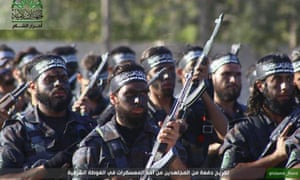
 'Dozens of senior Russian generals were reportedly killed in a car bomb attack perpetrated by Syrian opposition groups Ahrar al-Sham and the Bayan Movement in the western Syrian province of Latakia on Sunday.

 Announcing the incident on Wednesday, the media office of Ahrar al-Sham claimed that the attack by the two factions was conducted with local insurgents on the Russian military base in the Snoubar Jabla neighborhood where they said they observed that senior Russian generals were holding a meeting there. In the statement the group said: "After weeks of hard intelligence work we were able to determine the location and time of the meeting and planted the car in the location. After the explosion several ambulances and Russian choppers rushed to the location and they were seen evacuating dead and wounded Russians to Latakia and Jableh hospitals."

 The reason of the delay in announcing the attack was for security reasons until the opposition fighters returned to opposition-held areas, the armed group's statement said.

 Ahrar al-Sham was one of the first armed groups that emerged to try to topple the regime and has been one of the best organized. It was founded in Hama and Idlib in early 2011 by former Islamist political prisoners and Iraq war veterans held in the Sednaya Prison north of Damascus after their release from jail in early 2011. The founders have a Salafist understanding of Islam but, as opposed to DAESH, were at peace with the traditions of people and other groups like Sufis. The group has never been a part of the Western-backed Free Syrian Army (FSA), but has also not refused to ally with them. The group has never become a branch of al-Qaida and has said that their battle is limited to Syria.'

What Do Syrian Rebels Think of the Cease-Fire?


 'Abu Mohammad Aziz, the nom de guerre of a commander in the Levant Front, which is fighting in northern Aleppo province, doesn’t believe Russia or the regime will adhere to the truce, which is intended to redirect armed efforts at jihadi forces.

 “The Russians will continue to bomb us and claim they are hitting ISIS or Nusra. The regime can’t be trusted.”


 Zachariah al-Sun, 36, sits next to his 23-year-old niece outside the Kilis hospital. Sun fled his northern Aleppo village before the regime advance at the beginning of February and made it to Turkey as a refugee before the gates slammed shut. A Russian bomb killed his brother, while his niece, who declines to give her name, narrowly escaped the bombardment and a YPG ground advance. She was able to come to Turkey for medical attention because she is pregnant and needed an ultrasound; most of her family members are stranded in camps on the Syrian side of the border.

 “There was bombing everywhere. Hospitals were destroyed and there was no food,” says Sun’s niece. “We tried to stay at first, but the bombing was too intense and everything was destroyed,” she adds, depicting scenes of panic as she and her neighbors fled. “We feel Aleppo is lost.”

 Zachariah al-Sun blames the Assad regime for his family’s dire situation. “With the will of god we will continue to resist, but who knows, with the current situation,” he says cautiously.

 Sun’s nephew, 26-year-old Mohammed al-Sun, the son of Zachariah’s dead brother, lies riddled with bullet holes in a hospital bed upstairs. Mohammed, a fighter with the Saudi-supported Fatah brigade, was shot in the back three times during an ambush by US-armed YPG forces amid intense Russian bombardment near the town of Deir Rafat in northern Aleppo.


 In a parking lot on the Turkish side of the border fence, a handful of FSA fighters and refugees trying to reach besieged family members wait to return to Syria. Among them is a 30-year-old machine gunner with the CIA-vetted and -backed al-Mutasem Billah brigades who calls himself Abu Mohandeseen. He whips out his phone and starts pointing to the different colors on a graphic of a battlefield map to show how his comrades are surrounded.

 To the west (highlighted in yellow), he says they face attack by advancing US-armed YPG forces. To the east (shaded black), they are clashing with ISIS. To the south (highlighted in red), they are under attack by regime forces. All the while, he says, there is constant Russian bombardment from the air.

 “The government, ISIS, and the [YPG] are all trying to finish us off before they start fighting each other,” contends the stocky militant. Abu Mohandeseen describes how his unit, which received US training and weapons primarily to fight ISIS, now finds that it is locked in a losing battle with both other US partners and Assad’s forces.

 Abu Mohandeseen also says that he has seen Russian ground troops in Syria and heard them on the radio. Although Russia is officially only engaged in an air-assault campaign, in January, Hezbollah commanders said that Russian special forces had boots on the ground in the northwestern province of Latakia.'

Defying the odds, Syrian refugees return to Aleppo

man standing next to ruins

Copyright: picture alliance/abaca

 'In addition to the cluster bombs from the Syrian regime and Russian airstrikes that indiscriminately strike civilians no matter how near or far they are from the front lines, economic opportunities inside Aleppo are shrinking, making it more and more difficult to live from day to day. With the last secure supply line into the rebel-held areas of the city cut, the city is effectively under a partial siege, making it more and more difficult to deliver supplies to those trapped inside. As the situation worsens, many are fearing a situation similar to that in Yarmouk or Madaya where a complete government siege completely cut off the town from any aid, including food, causing civilians to starve to death.


 "I don't know what I can do to help my family," Abdullah continues, composing himself. "But I want to be there anyway."

 Since the beginning of February, the Syrian regime has launched a major offensive on the opposition-held areas in the Aleppo province of Syria, a strategically important region that was once a stronghold of the opposition and that symbolized the revolution's success. However, as the most recent Russian-backed offensive re-captures surrounding towns, many are afraid that Aleppo will fall under control of the regime, shifting the tides of the war - perhaps permanently - in its favor.


 "Most of our fights are against IS, but recently the Kurdish forces have also been pushing against us," a Free Syrian Army fighter waiting at the border, who called himself Abu Muhidden, told DW.

 "But most of the refugees right now had to flee because of the Russian airstrikes," he continues. "The technology is more advanced than that of the regime, making them more deadly."

 While the United States and Russia have brokered a truce due to go into effect on Saturday, Abu Muhidden says that this is unlikely - and will not affect his brigade's fighting strategy.
"It's a war," he laughs bitterly, shrugging off what he sees as the latest in a string of unlikely promises from the international community. "We have to be prepared for the worst." '

Thursday, 25 February 2016

Syria’s Other Government

 'Eight months ago, the Douma local council—the body that has governed there since the fall of 2012—obtained money to expand the cemetery, from one tier to seven, and to hire new workers to bury the dead.


 On February 14, three of those newly hired graveyard workers were killed by a regime shell as they buried another local man who himself had been killed by regime shelling. Two days before, two of the children of one of the graveyard workers, ages seven and nine, were killed by a shell on their way to school. The local council has a photograph of them; the council keeps as much documentation as it can of atrocities against its citizens in hopes that the perpetrators will one day be brought to justice.

 Extended families no longer attend funerals in Douma. With the possibility of shelling, it is considered too dangerous: people are afraid of having their whole families killed at once if they are shelled. Only two or three family members come to oversee the burials. Ahmed Taha, one of the founders of the Douma local council, now its representative in Turkey, says the regime doesn’t care about targeting funerals: “Those who shell people in the market don’t have a problem with targeting a funeral.”


 In October of 2012, after Bashar al-Assad’s forces withdrew completely from the town of Douma, there were no more municipal services. Trash began to pile up. “We got together and decided we had to do something about providing services to people,” says Taha, a former Douma resident who was once a mechanical engineer, in his Spartan office in Gaziantep in Southeastern Turkey. Along one wall are images of children, dozens of them, one with her face painted the colors of the Syrian flag. All but one of the children in the photographs are dead. Most were from Douma. The Douma local council has offices that deal with the basics: water and electricity, health and education, agriculture, legal affairs, civil records, sanitation, subsidies, women’s affairs, employment, media and the cemetery.

 Notably, there is no department of religious affairs. All the mosques are controlled by the Salafis of Jeish al-Islam, whose name translates to the Army of Islam. This group took over Douma in November of 2014 and arrested all the imams who didn’t share its hardline beliefs, says Taha. Before the revolution, the state controlled the mosques. Jeish al-Islam tried to take over the council too but soon gave up. “They knew they would fail if they put their sheikhs in charge,” says Taha, who says most of the council’s members are technocrats: engineers, lawyers, members of civil society.

 “Since the siege, no one has worked in their original jobs,” he says. He and many of the others on the council identify as socialists but there are also a number of members from the Muslim Brotherhood. Taha says they work well together, and even some Salafis joined the council eventually.


 There are 416 local councils across Syria in areas not controlled by the regime or the Islamic State, and eight provincial councils. Many hold elections, some popular, others by representative bodies. In Douma, the council holds elections on an annual basis.

 The council doesn’t have a prison, but Jeish al-Islam, responsible for military activities in the area, does. Taha says when you have an armed group take over an area, a prison is usually the first thing it builds. Taha himself was jailed more than two decades ago by the current president’s father, Hafez al-Assad.

 “In 1991 I was jailed for a year for writing a statement against the regime. I spent a year in solitary confinement. For a year I saw no light. But a year is nothing for Syrian activists.” This is a common sentiment among Syrians, many of whom don’t even bring up their detentions if it was a few months, thinking it not significant enough to mention in the face of the hardship of those who spent decades behind bars under the Assad regimes.

 “In Douma there are no days that pass without shelling; sometimes it’s light, sometimes it’s heavy,” says Taha. “Before the Russian intervention, the night was safe. When it rained, when there was fog, it was safe. After the Russian intervention, there is 24 hours of danger. Their planes aren’t affected by these things.”


 Life in Dareya takes place almost entirely underground: the field hospital, run by the local council, is in the basement of an apartment building—it’s the only hospital left in Daraya, the schools too and most families have moved into the basement of buildings to escape the shelling. Here the local council is doing what it can—the biggest needs civilians face are money, medicine and fuel. The council also tries to work with refugees and Internally Displaced Persons (IDPs) inside Syria. For a month, the city has been completely cut off, even from adjacent towns from which residents would normally pick up the aid they’re able to get. In this video, children of Daraya describe the food shortages under the siege: they ask their mothers for food and the mothers tell them to eat olives, it’s all they have left.

 “If the Syrian Democratic Forces [a largely Kurdish entity that also includes some Arab, Turkmen and Armenians as well as some free Syrian army units who, according to recent evidence, are likely coordinating with the regime and the Russian air force] and the regime take the area [referring to Aleppo and the countryside around it] then all of our work will be for nothing because they consider the local councils to be a part of the revolution,” says Dr. Diaa Abdallah, a former member of the Aleppo City Council, “there is the choice of the revolution--those who reject both the regime and Daesh. It’s the Free Syrian Army and the local councils. The local councils are the civilian side of the revolution... It’s like a civilian and a military wing, a Ministry of Defense and a Ministry of Civilian Affairs.”


 “We are trying to have an alternative organization to govern the city because Assad’s propaganda depends on the narrative, ‘only I can control Syria and if you throw me out, Syria will burn,’” says Tarek Matarmawi, a member of the Daraya local council. “The local councils offer a real alternative to Daesh and Bashar,” Matarmawi says, but he worries that the West has already decided to back the dictator. “They think, if you leave Bashar, yes, it’s bad for Syria, but at least you won’t have bombs in Paris.”

 Taha says the regime is particularly threatened by the local councils: “The regime targets us a lot because they see it as a logical alternative, it’s local governance,” he says. “It’s a scary future and these latest developments with Russia are a catastrophe. If it continues, the regime might take Damascus, Homs and the coast. If that happens, there will be a campaign against Douma and Ghouta [which are liberated areas] and there will be an independent Kurdish state. In the end, the US left it all to Russia.”

 Ahmed Taha finds it difficult to be in Turkey, away from his home town. He says he feels guilty for leaving. He left Douma in order to get medical care for his son. He sent his family ahead of him. Two days after they left, his son’s school was bombed. He realized it was time to go.
Now, in Turkey, he has other frustrations:

 “The Muslim Brotherhood control the curriculum because of their relationship with Turkey. They keep telling my son about djinns and hell. In Douma my children were scared of planes, now they’re scared of djinns!” Says Taha, “he comes home at seven o’oclock, then I have to stay up until midnight undoing all their brainwashing!” '

Tuesday, 23 February 2016

Sectarianism in Syria (Survey Study)


 'Most respondents recognized the seriousness of the sectarian situation in Syria and are aware that its causes are linked to the state and political authority. Most respondents (65.3%) still call for a State based on citizenship and equality and deem it the optimal solution to overcome the sectarian problem. This study also demonstrates that the Syrian government and its institutions constitute an essential source of sectarian discrimination, spread and development of feelings of injustice, and distrust among individuals of different sects.

 The Syrian Arab Army ranked first in being responsible for sectarian discrimination, 60% of respondents mentioned it, followed by the intelligence services (55.3%) and government departments (52.8%). The least mentioned contribute to sectarianism was the FSA (14%).
The majority of respondents, which amounts to 67.6%, said there is one or more particular sect that benefits from the political authority than others. Nearly all respondents referred to the Alawites and Shiites.

 The answers provided by Sunni respondents demonstrate a near-consensus on supporting the 2011 demonstrations of the opposition, whereas Alawites’ and Shi’a’s answers demonstrated a position against them. More than half of Christian respondents and the largest proportion of Murshidis support them (48.4%) whereas a very considerable proportion of Druze and Ismaili respondents opposed them.

 About three-quarters of respondents said they had been subjected to sectarian discrimination (personally or a family member or relatives), and only 28.5% said they have never been exposed to it.

 Only 13.6% said they do not approve of the following statement: “Sectarian discrimination was a main impediment to the achievement of my most important aspirations” and Sunnis’ responses formed the highest approval percentages (93.8%) while it hit its lowest level at the responses of Alawites and Shiites.'

International betrayal of Aleppo has global implications


 Sam Hamad:

 'As I write this, the apocalypse, namely an Iranian-led pro-Assad ground force, encircles Aleppo - the largest and most strategic rebel stronghold, while Russia rains death upon it from above. There is nothing "post" about this "apocalypse".

 Last week in Munich, the great powers sat down in a Syrian-free environment and agreed not to a ceasefire as was first announced, but rather a "cessation in hostilities", as John Kerry was quick to correct. The agreement allows Russia to continue its attacks on what it determines to be IS and the Nusra Front, al-Qaeda's Syrian franchise, which, as everybody knows, means continuing its attacks on the rebel-held areas on behalf of Assad.

 The US, of course, knows that Russia has overwhelmingly not attacked IS or Nusra, but has rather targeted any armed Syrian opposition to Assad.


 What this agreement means is the possibility of some aid reaching starving Syrians - something again that will be in the hands of the regime - while Russia continues its bombardment of Aleppo with the "official" acquiescence of the US and the rest of the "International Syria Support Group".

 IS, whose entire raison d'etre is based on capitalising on sectarian slaughter and the notion of a war against Islam, can only be empowered, as it has been at every stage of this war, by the destruction of free Syria and millions more lives cast into precariousness and touched by brutality.

 It's a recruitment dream for IS.


 Europe, in all its grubby privilege, will continue to cry about a "refugee crisis", often allowing far-right forces to determine the narrative, while supporting a policy of pure appeasement that allows refugees to be made on a titanic scale. Apologists for Putin, Iran and Assad will no doubt accuse those of us who call for aid to the rebels in Aleppo of "warmongering", but the war is already here and has been for five years.

 Those who wonder precisely what we mean by aid to the rebels, might consider the fact that so far, according to the US, 250,000 Syrian lives aren't worth a single anti-aircraft weapon - weaponry which would allow Syrians to defend themselves from aerial assaults.

 In the 1930s, those who claimed the mantle of democracy and liberty, undertook a policy of appeasing forces of fascism in Spain, Italy and Germany - it was this passive policy, far from warmongering, that led to one of the darkest periods in history. It's the same darkness that now threatens to further engulf Syria. Those who think that it will be confined there are living in a fantasy world.'

Monday, 22 February 2016

Ex-UK student on mission to rebrand Syrian Islamists

An image posted on Twitter last year of Ahrar al-Sham fighers

 'Labib al-Nahhas is the “foreign affairs minister” for Ahrar al-Sham, a group that has fought in alliances with al-Qaida’s Syrian franchise. His role sends him around western capitals arguing that his group is an ultra-conservative but legitimate part of the opposition, using his own European roots to reach out to diplomats wary of the group’s history and beliefs.

 “From the ideological point of view, I am an Islamist of course; if not I wouldn’t be in this movement. But the difference, what enables me to do my work better, is that I understand both worlds and not only from a theoretical point of view,” he said in an interview about his role in the group and its new positioning.

 “I had an immense affinity to Syria, and specifically to Homs. Homs, which is my father’s city and where I grew up, is like the ultimate place for me. I have lived in the best cities of the world, but I could never settle down,” he said. “I kept changing places because I never found peace of mind away from Homs.”

 He had not been there long before the Arab spring swept through the region, and he joined local street protests that were the first stirrings of revolution. They went on to move from peaceful protests to violent rebellion, as founding members of a rebel group that later merged with Ahrar al-Sham.


 “The transformation was because they did not leave us any other option; it was in our own defence in the face of the passivity of the international community,” Nahhas said. “When every demonstration becomes a question of life or death, you hold on to what allows you to continue, what is worth dying for, and in our case it was faith, and the idea of freedom and dignity which united us.”

 “We don’t see any conflict with most mechanisms used in democracy in electing people’s representatives and leaders; it is a clear principle in Islam that the nation has the right to choose its leadership,” he said.


 The group’s progress in winning some cautious endorsement for engagement from figures like former US ambassador to Syria Robert Ford encapsulates the strategic dilemma the west faces as opposition to Assad fragments and radicalises. A group like Ahrar al-Sham would once have been anathema to Washington, with its commitment to “moderate” opposition groups.

 But as Russia doubles down on its ally Assad, Washington is forced to choose between uneasy allies or no allies on many areas.

 “Our refusal even to talk with groups like Ahrar further reduces the little influence Americans still have in Syria,” Ford and Ali el-Yassir said. “The administration keeps trying to lead the opposition from behind, hoping for an opposition white knight to appear. Instead, because Islamist groups like Ahrar strongly influence decisions about the fate of Syria, Washington will be left behind.” '

Friday, 19 February 2016

Russian Airforce Targets Those Who Fight Against Daesh


 'Russian airstrikes have avoided so far locations where Daesh are, and concentrate on rebel-held areas where they hit civilian neighbourhoods indiscriminately. Russia is backing murderous dictator Bashar Assad, and is not slowing down its campaign of bombing civilians until they reach a result favourable to their interests. While Iran deploys every sectarian militia at its disposal to save the murderous tyrant, including Lebanese Hezbollah. Meanwhile, there is complete inaction on part of the world community.'


 Note 21/5/25, link and video unavaible.

Tuesday, 16 February 2016

Iran no friend of Syrians nor defender of Shia


 Robin Yassin-Kassab:

 'During the July 2006 war between Israel and Hizballah, hundreds of thousands of Lebanese fled south Lebanon and south Beirut – the Hizballah heartlands where Israeli strikes were fiercest – and sought refuge inside Syria.

 Syrians welcomed them into their homes, schools and mosques. Several thousand were sheltered in Qusayr, a Sunni agricultural town between Homs and the Lebanese border. It made no difference that most of these refugees were Shia Muslims. They were just Muslims, and Arabs, and they were paying the price of a resistance war against Israeli occupation and assault. That’s how they were seen.


 Summer 2013. Throughout May, hundreds of Hizballah fighters led a devastating assault on Qusayr. Because they were local men defending their homes, the Free Syrian Army were able to resist the onslaught for weeks, but were finally defeated. A Shia flag was allegedly hung over the town’s main Sunni mosque, if true, a signal of sectarian conquest.

 Various excuses were offered up: to protect the Lebanese borders, or to protect the shrine of the Prophet’s grandaughter Zainab outside Damascus. None of them explained Hizballah’s participation in battles as far afield as Hama or Aleppo. Why would Nasrallah choose to infuriate Lebanese Sunnis, to make Lebanese Shia targets of sectarian revenge attacks, to deplete and downgrade his anti-Zionist fighting force?

 Sheikh Subhi al-Tufayli, who led Hizballah between 1989 and 1991, blamed Iran: “I was secretary general of the party,” he said, “and I know that the decision is Iranian, and the alternative would have been a confrontation with the Iranians. I know that the Lebanese in Hizballah, and Sayyed Hassan Nasrallah more than anyone, are not convinced about this war. ... Iran and Hizballah bear responsibility for every Syrian killed, every tree felled, and every house destroyed.”


 This is something that leftists, when they were internationalists, once understood: states are designed to protect the property, position and privilege of the various elites which run them, not to safeguard the interests of ordinary people. This means Iran is not the protector of the Shia, Saudi Arabia is not the protector of the Sunnis, and Israel is not the protector of the Jews.

 Need it be said that the Assad regime is the deadliest enemy of Alawis?'

How Syrian Activists in Raqqa are Resisting ISIS


 'Incredible footage obtained by Sky News shows how Syrian activists are resisting ISIS in Raqqa, the city that was dubbed ‘the capital of ISIS’. The activists are part of the group ‘Raqqa is Being Slaughtered Silently‘ (RBSS), a loosely-organized group of activists, described by the New Yorker as “as kind of underground journalistic-activist enterprise”, who have been struggling against both Bashar Al Assad's regime at the start of the revolution and then, when the Free Syrian Army (FSA)-held city fell, ISIS.

 We learn of Abdulaziz Al-Hamza, a Syrian activist who is now in exile in Turkey due to his sympathies towards the FSA and co-founder of RBSS. Al-Hamza met another activist, Sarmad Al Jilane, also in exile in Turkey and, along with 15 other people, they set up RBSS in the hope of facilitating the transfer of images and videos taken by anti-ISIS activists still residing in the heart of the terror group's ‘capital’, which controls territory across parts of Syria and Iraq.


 RBSS was honored with the Committee to Protect Journalists (CPJ)’ 2015International Press Freedom Awards for their journalism. In his acceptance speech, RBSS’ spokesperson said:

 "I speak today on behalf of millions of Syrians who are looking for a free, democratic and united country.

 I am deeply sad for my beautiful country. It is suffering greatly from regime fever and the cancer of terrorism, so greatly that I fear its spirit will melt.

 We are caught between two aggressive and brutal forces. The first is a criminal regime, obsessed with power, claiming to fight against terrorism by killing children.

 The second spreads evil and injustice, and paints our nation black.

 Each of them considers us criminals because we are disclosing their actions to the world. Now the mere mention of the name of “Raqqa is Being Slaughtered Silently” has become a crime punishable by death." '

Monday, 15 February 2016

A letter from under Russian bombs in Aleppo

 'We haven’t seen a good day in years. The shelling never stops, even for an hour or two. Life has changed, all the places you remember are gone: forget them, it is too painful. The bombs dropped by the regime are indiscriminate, destroying everything in their path. Everything is changed, destroyed or deserted, without life.

 Even in our dreams we no longer know what “safety” means. Every time you open your eyes you don’t know if it the last time you will see your kids.


 It is not just fighting on the front lines, it’s not just the continuous bombing. There are snipers hidden in every corner on the way out of the city.

 We are constantly adapting our lives. Schools have had to move underground, and medical centers have to manage with limited supplies. We tried to build new democratic institutions: we elected new leaders. Everything has been a struggle.

 We tried to go north to different neighborhoods, but bombs were falling there. We could see the planes flying above us, they sometimes display Syrian flags, sometimes Russian, sometimes we don’t even know. It feels like they are following us everywhere we go.


 The surrounding communities of Anadan, Marah, Tal Refat, Hretan, Bynoon, Azaz are also suffering. These towns and villages started a peaceful revolution. They stood with Aleppo when Syrian government forces attacked civilians in the city. They took in people fleeing the bombs and the shelling.

 But what happened to them? They were bombed, every single day. People do not know who the planes are aiming for and whether they will be next to die. Tens of air strikes per day, for the last 120 days.


 And now it is time to leave. I didn’t ever expect this time would come, but I have to give up. I am leaving for a place I am not sure even exists.

 Aleppo stands in front of a big war machine armed only with small weapons. It is not just a geographical target. Aleppo is karama, it is dignity, it is the revolution against injustice.

 Goodbye Aleppo; my hometown, the place where I spent my childhood, where all my memories are.

 I hope to see you there again one day, my friend.'

In Aleppo, one man's story of fear, defiance and survival


The 69-year-old's family fled fighting in Aleppo, but he stayed behind to care for his cars.

 'Karam al Masri is watching his city die. Or more accurately, he is watching the life gradually ebb from it. Masri is a 25-year-old photographer in Aleppo who documents the fatalism, fear and sometimes the defiance of tens of thousands of civilians who remain in rebel-held areas of the city now almost encircled by Syrian government forces and their allies.

 In broken Skype conversations across several days, Masri described how Aleppo's people are trying to continue their lives despite the bombardments. He says they have seen so much horror they are almost oblivious to it. Of course, the airstrikes are bad, he says, but in many ways the intense barrel-bombing of the past three years was worse -- more indiscriminate. As if delivering good news, Masri says only half of the recent airstrikes have killed civilians.

 Stallholders in the markets still offer their produce, though there is less of it and prices for many staples have doubled in a week. Children still go to school, though sometimes in makeshift underground classrooms. And the "White Helmets," the voluntary civil defense workers, race from one jumble of rubble to the next, though often only to retrieve the dead.


 Masri knows what it's like to be the target of the regime and its secret police. Before the uprising began, he was a law student at the University of Aleppo. He was active on Facebook and called for a revolution in Syria like those that had toppled the Tunisian and Egyptian governments. One night in April 2011, there came the dreaded knock at the door. He was detained for a month and says he was beaten and tortured.

 On November 28, 2013, a barrel bomb targeted the Myasar neighborhood. Masri jumped in an ambulance with two friends, but they ran into an unexpected roadblock. Masked ISIS fighters stopped them, tied their hands and blindfolded them. Within hours, Masri and his friends were in a makeshift jail in an industrial area called Sheikh Najjar.

 Masri spent 45 days in an underground cell. His daily ration was half a slice of bread and three olives; some days there was no ration at all. He lost 20 kilograms (about 44 pounds) in weight and often felt like he would die from starvation. He was not tortured, he says, but believes that's because his captors intended to kill him. He was, after all, a cameraman; there were few worse sins.

 Masri believes there were some 30 cells in that underground jail, holding men of the Free Syrian Army, activists and other journalists. As ISIS lost ground, the guards took their prisoners from one place to another, but every time they killed a few more of their hostages before herding the remainder onto buses. Masri saw the body of his friend Nour, the ambulance driver he had ridden with on that fateful day in November.


 While he had been in an ISIS dungeon, his family's apartment building had been hit by a barrel bomb. Unknown to Masri, his mother had been killed, along with several others in the building. His father, widowed and with no idea whether his son and only child was still alive, had left Aleppo and gone to Egypt.

 A few months later, Masri was injured in his left leg by a sniper's bullet. He spent three months alone in a small apartment, no mother and no aunt to visit and care for him. The loneliness of that time still haunts him.


 But when he recovered, Karam al Masri went back to roaming through rebel-held neighborhoods of Aleppo, taking his remarkable photographs.

 "I focus on characters who survive the pain and endure and find strength to stay in spite of the horror of war," Masri said.

 "I focus on the suffering of people and children, showing how they deal with this war, how they escape airstrikes and come out of destroyed buildings looking for their relatives."

 "I also like to show stories that demonstrate how beautiful Aleppo is and how it used to be before the war. I dream that one day the war ends and I can take photos of beautiful Aleppo and not only images of destruction and devastation."

 One of the characters he found -- and there is no shortage of them in Aleppo -- is 69-year old Abu Omar, who is a collector of vintage cars. His house was hit by a mortar and his wife and five children left the city. But he chose to stay, wiping the dust of war from his precious collection every day.


 Masri says that today, some people in Aleppo still urge resistance, futile though that might seem. There have even been small demonstrations urging the dozen or so fractious rebel groups to come together and form a "Jaysh Aleppo," or Aleppo Army.

 Masri does not believe the regime and its allies will try to reduce eastern Aleppo to dust in street-to-street fighting. They don't need to; they can just stop food and diesel getting in, he says.

 "There's not enough food stored for more than a month," Masri says. "If they force a siege for one month, people will die."

 But he says he can't imagine leaving unless forced to by the Syrian army.

 "I can't leave Aleppo. My family was buried here, I can't go away and leave their graves; it would be a betrayal. My mother could have left and saved herself, but she waited for me. She died waiting for me." '

Russia’s grip on Syria tightens


 'Opposition groups have already said they cannot accept the ceasefire if it does not halt Russian airstrikes. “No negotiation can take place while Russia is bombing our people,” said a senior member of one major Islamist opposition group. “It is a certainty that Russia will continue to attack us while claiming to target al-Nusra. They claimed that their campaign in Syria was to fight Isis but, so far, 85% to 90% of their attacks were against the moderate revolutionary groups, with a high percentage of civilian targets.”

 “The people that the Americans had been trying to sponsor are now targets of an enemy that bombs without mercy or discretion, and the Americans don’t have a problem with that?” said one Free Syrian Army member in Aleppo, who declined to be named. “They never deserved our trust.”

 “No matter what [Isis] does, no matter how bad they are, they are not as bad as the regime. They [the government] are the first enemy. They are why Syria is ruined, and they are why I am in this camp,” said 20-year-old Khalil Efrati, who had left his Raqqa home around three weeks earlier. “Yes, Isis are merciless and they do horrific things, but the regime does worse.” '

Sunday, 14 February 2016

Ex-official tells of collusion between Assad, Russia, Daesh


 ' "A month before the city fell to Daesh, we had received information that Daesh was planning to attack Tadmur and the adjacent city of Sukhna. We conveyed the information to Assad himself," said Mohamed Qassim, who formerly served as attorney-general in Syria’s central city of Tadmur. "But instead of laying out a plan to defend the city, Assad ordered military forces to vacate Tadmur in hopes of tempting Daesh to fill the vacuum," he said.


 According to Qassim, Assad had wanted to give the impression that Daesh had captured Tadmur, from which the group hoped to advance on the central city of Homs to kill Alawites and Christians. "[Assad was confident] that the destruction of ancient monuments in the city would anger world public opinion and thus demonize the revolution," he said.

 When he was serving as the city’s attorney-general, Qassim said, he had discovered scores of bodies of political detainees in regime-run prisons. "These people’s crime was to oppose the criminal Assad regime," he said. Qassim added that political detainees had been subject to horrific forms of torture. "Many were beaten, burnt, tortured or crucified to death," he said.

 "There were atrocities and crimes committed by Russia and the Assad regime that the world never knew about," he said. He asserted that most of the city’s monuments, for example, had been destroyed by Russian airstrikes or barrel bombs dropped by regime aircraft. "Russian bombardments and regime [attacks] don’t target Daesh; rather, they are killing civilians, rendering thousands of the city’s residents homeless," he said.

 Qassim went on to note that Russia -- which began striking opposition forces in Syria last September -- never attempted to retake Tadmur from Daesh. "It’s destroying the city and killing its people and is ultimately working to obliterate Tadmur," he said.


 Qassim said dozens of Russian military experts had arrived in Tadmur when he was still serving as the city’s attorney-general. "These experts visited oil and gas fields to carry out maintenance and repair operations under the protection of Daesh militants," he said.

 Qassim went on to disclose that regime forces were selling weapons to Daesh militants, asserting that a Syrian officer -- named Mohamed Gaber -- had been responsible for selling weapons to the militant group. "He [Gaber] smuggled weapons at night to Daesh militants and was paid by middlemen," he said. Providing a glimpse as to how the weapons were procured by Daesh, Qassim said Gaber used to order extra weapons at one of the army checkpoints under his control. "[Shortly afterward] Daesh militants would attack the checkpoint, from which Gaber would order his troops to withdraw -- leaving the weapons to the militants," he said. "After the militants withdrew from the checkpoint, Gaber and his forces would return to find it emptied of weapons," Qassim said.


 Asked about the illicit trafficking of ancient artifacts in Syria, Qassim said the practice had been widespread even before the outbreak of the revolution. "This has been happening for more than ten years," he said, going on to name Sabra al-Khazen, head of military intelligence in Tadmur, as one of the country’s best-known antiquities smugglers. "He [al-Khazen] amassed thousands of ancient artifacts and sold them to buyers abroad. He shared his profits with Assad and other members of the intelligence apparatus," Qassim said.

 Qassim fled Syria in late 2015 to neighboring Turkey. "I was a witness to the peacefulness of the Syrian revolution; I saw how peaceful protesters were killed by [regime forces] in Homs," he said. The former attorney-general went on to assert that Syria had since become "one big prison". "There is panic and fear everywhere," he said. According to Qassim, the Assad regime had been on the verge of collapse before Russia had intervened in the conflict. "The Russian aggression provided the regime with moral support," he said. "This support, however, remains very fragile." Qassim stressed that all Syrians -- Sunnis and Alawites alike -- despised Assad and his regime. "All are confident that he will either escape or be killed," he said. "Everyone knows Assad is doomed to defeat." '

Friday, 12 February 2016

Rebels Vow to Wage a National Liberation Guerrilla War

FILE - In this December 17, 2012 file photo, a Free Syrian Army fighter takes cover during fighting with the Syrian Army in Azaz, Syria.

 'With the partial cease-fire deal announced by the International Syria Support Group (ISSG) of 17 foreign powers, including Russia, in Munich not including a clear commitment from the Kremlin to end blistering Russian airstrikes immediately — a key demand of the Syrian opposition — the rebels dismiss the idea that Munich represents a breakthrough in the search for a political solution to end the brutal five-year-long civil war that has left upwards of 250,000 dead.

 They view it instead as another way-station on a road that will lead to an inevitable Western-backed negotiated political deal that they won’t be able to accept.

 “Fighters on the front-lines have some very harsh things to say about the West,” says Mohammed Adeeb, a senior figure in the 10,000-strong Shamiya Front, an alliance of secular and nationalist armed factions.


 Speaking in Munich after lengthy talks, U.S. Secretary of State John Kerry said a U.N. task force would “work to develop the modalities for a long term and durable cessation of violence”. He acknowledged, though, that the deal was only so good as the paper it is written on and much further works is needed.

 But some rebels and opposition politicians are drawing comparisons with another piece of paper signed in Munich in 1938.

 Pro-opposition civil society activists also remain highly doubtful about the deal and what it may hold. “I will welcome the delivery of aid to all areas that need it,” says Bassam al-Kuwaiti, a well-known figure in opposition circles.

 “As to the cease-fire, a political transition should start at the same time, or we will be allowing the Assad forces to capture lands under the banner of fighting the Islamic State or Jabhat al-Nusra, and therefore to obtain a powerful position that enables it to halt any political change,” he says.


 Some rebel commanders say they will have no choice but to back up al Nusra and Ahrar al-Sham, if a post-Munich regime offensive unfolds in Idlib — not just out of comradeship for other anti-Assad fighters but because a collapse by their forces there would weaken moderate and nationalist militias in Aleppo, too.

 Gen. Salem Idris, the former chief of staff of the Western-backed Free Syrian Army, says of al Nusra and Ahrar al-Sham: “We don’t coordinate militarily on the battlefield with them but we do have a saying that any rifle trained on Assad deserves our support.” Rebel commanders say that regardless of what they decide to do in the event Idlib is targeted their own militiamen will want to fight there, weakening the coherence of moderate factions, if they resist the demands of their ranks.

 Whatever the near future holds for the Syrian revolution against Assad, Nader Othman of the Syrian Interim Government insists the regime won’t win. “They might take more land and occupy it. There will be a resistance, it will revert to a guerrilla war, and Syrians can make things even harder for the Russians than they experienced in Afghanistan.”

 He adds: “Our mistake was not to see our revolution as a national liberation struggle. This is no longer a civil war — we are occupied by many foreign forces and we should make that clear. This is now a war to eject foreign invaders.” '

Thursday, 11 February 2016

United Nations' OCHA Helped Assad and Hurt Syrians


 Annie Sparrow:

 'OCHA’s defense that any aid delivered from Damascus is better than none has not been weighed against the human and financial cost of bolstering a regime that is deliberately increasing the hardship of people in opposition-held areas. Humanitarian aid in such circumstances can sustain the violence that gives rise to the need for aid in the first place. In providing billions of dollars of assistance, the disposition of which is largely dictated by the Syrian government, the UN has freed Syrian government resources to be used for Syrian politicians, troops, security forces, and allies. Someone has to take a stand. At the risk of alienating a key source of financing, the Syrians themselves have now done so. It’s time for OCHA to do its part by revisiting its underlying principles and acting accordingly—to check out of the Four Seasons Hotel in Damascus, to leave the Syrian capital, and to stop supporting the atrocities of the Syrian government.'

Wednesday, 10 February 2016

Syrian rebels blame West for abandoning their fight


 'What is left of the Syrian “moderate” opposition is bitter as hell. As far as they are concerned, the US and its allies have thrown them under the bus, unwilling to give them the firepower or protection necessary to resist a resurgent Russian-backed regime now pushing into Aleppo, a critical opposition redoubt.

 “For the last year we haven’t received anything. The US is preventing everyone from supplying the opposition with weapons out of fear they will fall in the hands of Islamic State,” says Bassam Hajji, a political officer in a CIA-backed rebel group in Aleppo.

 Chris Kozak, a Syria analyst at the Washington-based Institute for the Study of War, says it will be difficult for the opposition to turn the tables in and around Aleppo barring a quick escalation from regional allies such as Turkey and Saudi Arabia. Saudi officials have said they could send ground troops to Syria to fight the Islamic State – a move that could also allow it to prop up its allies. But few see this happening anytime soon since Saudi forces are already overstretched in Yemen.

 Turkey is “likely to consider some high risk options to this renewed offensive, including providing MANPADS and anti-aircraft systems to try and counteract the advantage Russian aircraft has given,” says Mr. Kozak.

 “Without the direct support of the US and NATO, I think (Turkish President Recep Tayyip) Erdogan will be hesitant to take such a dramatic intervention step as a direct military intervention in Syria,” says Kozak.


 One consequence is that beleaguered rebel groups are likely to deepen their collaboration with more Islamist-oriented factions seen as more effective fighting forces. These include Al-Qaeda’s affiliate Nusra Front, which has been a tactical partner of US-backed rebels both in the north and the south. The overlap between groups has long been contentious, as the US fears indirectly arming rebels that aren’t vetted.

 Jihadists are said to have a small presence in Aleppo City and have joined other rebel formations from the northwestern province of Idlib to reinforce the city’s defenses. Rebels in northern Aleppo Province are under massive pressure from regime forces in the south, Kurdish-led factions in the west, and the Islamic State in the east. ​

 While Hajji describes the factions ​in northern Aleppo as strictly Free Syrian Army – what the West considers moderate rebels – he adds “everyone has had to work with Al-Nusra” at some point or another. Rebel commanders argue that such alliances were born not out of ideological affinity but necessity. They blame the international community for allowing the Syrian regime to kill civilians with impunity over the past five years.

 Yasser Abdul-Rahim, a rebel commander in Aleppo Province, complained that no support is being delivered to the opposition at this time of crisis. For the West, he had one question: “Have you sold out the Syrian revolution?” '

Assad checkpoints; pay more, pass quicker


 'Bus and taxi drivers familiar with the routes and practices of given checkpoints often gather money from passengers ahead of time in order to expedite the process. The more money that is paid, the quicker they are allowed to pass. Drivers will also plan the timing of their trips to coincide with the shifts of guards whose prices are lower than those who work at other times of day.

 Guards have also been reported to have sexually harassed young women, sometimes even threatening to rape them in the presence of their own family members. They do this not only for the money, but also for the power rush they get from being able to intimidate and control. And unlike other international actors in the Syrian conflict, their threats are often followed through with heinous actions. As such they are following in the footsteps of their leader and mentor Assad.

 It can be even worse for young men, even if they are currently university students whose military service has been temporarily deferred. Guards will often take their paperwork and say they are going to check them against the lists that they have. They then come back and say that the young man’s name is indeed on the regime’s wanted list even if it is not.


 The specters of detainment and torture are ever present in the minds of Syrians and the feelings of relief after successfully getting past such an ordeal have been compared to being born again. Those who do not make it through often end up dead or wishing that they were. Many Syrian families have family members who disappeared at a checkpoint on their way to somewhere inside Syria.

 The harassment is not always confined to young men either. Teenagers all the way up to men in their early 40s are considered to be suitable for military service. But in reality, checkpoint guards are far more interested in the profits they gain through extortion than they are in the regime’s ability to keep replenishing its depleting number of forces.

 Even Syrians living in regime controlled areas who originally supported Assad are being treated the same way causing many of them to turn against him or flee the country as well.

 Life continues to become increasingly difficult in Syria, psychologically as well as physically, and it is hard to imagine how the evil and corrupt practices that have become so commonplace will ever end as long as an illegitimate and corrupt system is allowed to remain in place.'

The Depopulation of Syria


 Robin Yassin-Kassab:

 'What Russia and Iran are doing at the moment, with the complicity of the West, is they are trying to destroy entirely the democratic nationalist opposition. They're not just hitting Islamists, they're hitting Free Syrian Army militias too. They're hitting civilian structures, they're bombing schools and hospitals and depopulating these areas. I think the aim is to destroy the democratic nationalist opposition, so the only two sides left are Assad and the insane jihadists. They then hope the world will come together in agreement, in open and direct agreement, that they should all co-operate in winning the country back for Assad. However, the demographic realities mean that even if it takes decades, it's not going to happen. As long as there are Syrians, there will be a great many people who want to fight against the régime, and what's perceived as a foreign invasion.

 There is no serious conversation about peace, and by continuing in this theatre that there is, Kerry is complicit in what is going on. One reason the rebels, the opposition militias have collapsed recently, is because the Americans have told the Saudis and others to stop delivering weapons. Not one anti-aircraft weapon, which is what the civilians need to defend themselves from this scorched earth and depopulation, not one of them has come through. So the Americans, who present themselves as Friends of Syria, certainly aren't friends with the Syrian Revolution. They've just done a deal with the Iranians, at the same moment the Iranians are sending Shia jihadist militants to Syria and Iraq, which is making the Sunni Islamist backlash so much worse. When the Russians wanted to bring their own opposition team, so-called opposition team, to Vienna, the Americans said that's OK. When the genuine Syrian opposition team said they wanted United Nations resolutions, that the Americans and Russians had already agreed on, implemented; for example, a ceasefire, and end to the aerial bombardment in civilian areas, John Kerry told the opposition that this was a precondition they shouldn't be talking about at this stage.

 So whatever the rhetoric coming out of the Americans, their actions suggest they have handed this over to Russia and Iran. So in the name of disengagement, the Americans, back in 2013 when sarin gas was used, Obama's red line over chemical weapons disappeared, they in effect handed Syria over to Russia. It hasn't brought about stabilisation, it's brought about an absolute disaster. It has dragged the West back in. This year, the pressure of refugees trying to cross the Mediterranean, it will be more than last year, and I wish the Europeans would stop waiting for the Americans, for American leadership on this, because it clearly isn't coming.

 The Americans and the Qataris and the Saudis and the Turks have sent weapons in, in an inconsistent and disorganised way, each one trying to back their own people. It's not only the fault of these powers, it's also the fault of the Syrian opposition, of the fractiousness of Syrian society which hasn't had the experience of democracy for four decades, but if in 2012 we'd seen a serious international effort to provide weapons through a central command, the Free Syrian Army, in much greater quantities than were given, and those had been allowed to defend themselves against President Assad, I think now we'd be looking at a very different situation.'

Tuesday, 9 February 2016

'Total chaos and crisis in Aleppo'


 Rami Jarrah:

 'What's very apparent is the airstrikes, there's an escalation of attacks on the centre of the city, and this is happening many in the marketplaces, residential populated areas of the city. The strategy of this seems very obvious, that they want to push people out of Aleppo, before a total siege is performed on the city. There is one retreat route, and this is to Idlib. What we're seeing on the outskirts, and this is towards northern areas of Aleppo, is escalated attacks, by the Russians in terms of airstrikes, and ground troops, that are trying to totally siege Aleppo. This siege is not a siege that is just performed by the Syrian régime and the Russians over the rebel groups; it would not be possible without ISIS, which has also gained some areas.

 Resources are totally cut off. Fuel, we're talking mainly about diesel that used to come from ISIS territory towards Aleppo, that's been cut off. Vegetables, meat, poultry; this is all something that has become much more expensive right now. It's still cold in Syria, so the fuel that's used to heat the homes, that's been cut off. People are stocking up, but in the coming days and weeks, this is going to become more a humanitarian crisis. There is total chaos and havoc in Aleppo right now. This is a situation we haven't seen in Aleppo since the beginning of the uprising.

 There is some censorship, there is some misinformation. There isn't any Western media reporting from inside the country. What we are seeing is more a narrative that is coming from the Russians and Syrians, it's propaganda media. We're not seeing any narrative on what's actually happening to the civilians there. So what I intend to do is actually go back to Aleppo, but the problem we're having right now is Turkish authorities on the border are not making that possible. The situation right now is there isn't really much to stand for any more in Aleppo. There was hope before, that maybe trying to convey what was going on in this city would influence the international community, and the pan-Arabic community, that something has to be done. This is something that is totally being avoided. Today there was a UN human rights report that was released, and this human rights report was blaming all sides, saying that there were rebel groups, the opposition, the government, all committing crimes, and it made it seem as if these were equal, and this is really disappointing, because there are numbers, there are statistics, that have been proven. Over 180,000 people have been killed, this is documented evidence, of people that have been killed, civilians, by government attacks. Whereas we look at a group like ISIS, and ISIS is definitely a terrorist organisation, are only responsible for around 2,000 deaths, that's 1% of what the government is responsible for, the Syrian régime.

 One thing I'm seeing in Syria today. When walking in the street, and you look at the civilians, you look at people who are walking, you don't see parents holding their children's hands. And I was asking myself the question, why don't I see that? I see this in Turkey, I see this in Egypt, I see this in other countries, in Europe, when I walk around. I see people, you know, they hold their children's hands. Why in Syria do I not I see that? And it's because, psychologically, these people know that at any moment they could lose their loved ones, and psychologically, they are automatically distancing themselves from their children, from their loved ones, because they know that at any moment they could lose their children. And this is a situation I see in Syria where emotion has been totally destroyed. These people are coping only because they've accepted the idea that there could be an end to their lives, to their loved ones' lives. That's something very disturbing now I've seen in Syria recently.'

Residents in Aleppo say world has abandoned them


 'Residents of rebel-held areas of Aleppo say that floundering western efforts to broker a peace deal in Syria are irrelevant to people facing a daily onslaught of Russian air strikes and preparing to defend themselves from advancing pro-government forces.

 Umm Layla, a street vendor, also said she believed that a peace deal was impossible. “This is the third conference. What have the previous conferences done for us? What have they done except bomb us with planes. The planes are killing us.”

 “I believe there is no hope, none at all,” said Abu Umar, another resident.

 “The killing of the Syrian people over the last five years is unprecedented in that the world is standing by watching it happen,” said a local doctor, who did not want to give his name.

 “People have been dying in such a public way,” said a German rebel fighter who did not want to be identified. “I came here to help when no one else did. Yet if I wanted to return home for any reason then I will be arrested and put into prison. It’s unreal."


 “The reason for the severe bombardment is that the people here belong to the revolutionaries. They want freedom and they want an end to the regime,” said Abu Jafar, an elderly man who spoke to MEE in the town of Harytan on the outskirts of Aleppo, a few kilometres south of the Shia-majority villages of Nubl and Zahra, where government forces last week broke a years-long siege by rebels.

 As Abu Jafar spoke, two rockets slammed into a nearby building, forcing him to duck for cover, although neither rocket exploded. He said residents had been living with the constant threat of air strikes for years, but had nowhere to go.

 “Go where? A refugee camp? They are bombing those too. It’s better if my family and I are killed in our own home.” '

Monday, 8 February 2016

Deaths in Detention in the Syrian Arab Republic


 'In the Syrian Arab Republic, massive and systematised violence – including the killing of detainees in official and makeshift detention centres – has taken place out of sight, far from the battlefield. Detainees held by the Government were beaten to death, or died as a result of injuries sustained due to torture. Others perished as a consequence of inhuman living conditions. The Government has committed the crimes against humanity of extermination, murder, rape or other forms of sexual violence, torture, imprisonment, enforced disappearance and other inhuman acts. Based on the same conduct, war crimes have also been committed. Some anti-Government armed groups established makeshift places of detention where captured Government soldiers were ill treated, and executed.

 Those who were kept in the custody of security and armed forces were almost always denied any means of contacting their families. Some families were first informed about the death or whereabouts of their relatives from released fellow prisoners. In its thematic report “Without a trace: enforced disappearances in Syria”, as well as in its periodic reports, the commission has reported that the crime of enforced disappearance was committed by Government forces as part of a widespread and systematic attack against the civilian population.

 Former detainees detailed how cellmates were killed as they were beaten to death during interrogations and in their cells, or died as a result of severe injuries sustained due to torture or ill treatment. Others perished as a consequence of inhuman living conditions inflicted on the prison population, including severe over-crowding, lack of food, and unclean drinking water. Prisoners were given inadequate or no medical care, and died in large numbers from preventable conditions such as diarrhoea or other contagious infections spread in the unhygienic and overcrowded cells.

 While the overwhelming majority of the victims who perished while detained in Government-controlled prison facilities were men, the commission has documented cases of women and children as young as seven years old dying in the custody of State forces. One of the earliest documented cases of death in detention is that of a 13-year-old boy, arrested during a protest in Sayda (Dara’a) in late April 2011. His mutilated body was returned to his family in May 2011. Women, boys and girls, as well as the elderly, have been subjected to torture and brutal prison conditions and have suffered physical and mental trauma. They too have been the victims of, as well as witnesses to, deaths in custody.


 Interrogators and guards employed gruesome methods of torture to kill detainees. In 2014, a detainee held in a centre under the control of the 4th Division of the Syrian army had his genitals mutilated during torture. Bleeding severely and left without treatment, he died three days later. A detainee of a Military Security branch in Homs witnessed an elderly man being severely beaten, and then hung by his wrists from the ceiling. The guards burned his eyes with a cigarette, and pierced his body with a heated, sharp metal object. After hanging in the same position for three hours, the man died.

 Prison conditions were similar across detention facilities. They included severely overcrowded cells where prisoners were often forced to stand and sleep in shifts, stripped to their underwear. Lack of clean drinking water, sanitation, lice infestations and other unhygienic conditions caused the spread of disease and infections. Many prisoners were forced to use their toilet as a source of drinking water.

 Detainees were frequently either ignored or punished with torture when requesting medical assistance. Some prisoners received limited and mostly inadequate medicine, while most received no treatment at all. Some severely ill prisoners were transferred to military hospitals in the Damascus area, including Mezzeh military hospital 601 and Tishreen military hospital located near Barzah Al-Balad neighbourhood. Prisoners were tortured by medical staff at the hospital. Others received limited medical care before they were sent back to the same life-threatening prison conditions. Several prisoners died in the hospital, with prisoner-patients recounting how they were asked to assist in wrapping dead bodies in plastic.


 Many detainees were subjected to rape and other forms of sexual violence,7 and exposed to humiliation and degrading treatment. Prisoners were subjected to threats of sexual violence against female relatives.

 Denied contact with their families and held in inhuman and degrading conditions in overcrowded cells or prolonged solitary confinement and continuously subjected to torture, prisoners often suffered severe psychological disturbances and depression. Numerous accounts describe how some detainees started hallucinating or displaying other signs of psychological disorders, stopped eating and drinking, and eventually passed away in their cell for unidentified reasons.

 In all cases where the body was returned to the family, it bore marks of extensive torture. Some bodies were returned from hospital morgues to their family only after the family agreed to sign a statement confirming that the deceased had been killed by “terrorists.”


 The Military Security Damascus Branch 227 is located in Mezzeh neighbourhood and is estimated to hold several thousand detainees at all times. Detainees who survived to give accounts of their detention in the branch witnessed the death of fellow inmates as a result of torture, disease, and appalling prison conditions, including chronic lack of food. Former prisoners of Branch 235, located north of Al-Qazzaz neighbourhood in south-eastern Damascus, detail a large number of detainees dying. At least 30 persons were observed dying under torture in this branch between 2011 and mid-2012.

 The Investigations branch of the Air Force Intelligence is located in Mezzeh military airport, south west of central Damascus. Survivors of this branch recounted daily torture sessions. Detainees were brought back to their cells by the guards with open wounds, swollen limbs, haemorrhaging and left without medical care. When they died, the bodies would be removed from the overcrowded cells by prison staff within a few hours.

 Many of those interviewed also recounted having witnessed the death of inmates of the Air Force Intelligence branch located in Harasta (Damascus and southern region branch). Interrogators and prison guards routinely tortured detainees.


 Main detention facilities controlled by the General Intelligence Directorate include Interior Security branch 251 and Investigations branch 285 located in Kafr Soussa, west of central Damascus. Former detainees described inhuman conditions of detention resulting in frequent custodial deaths. Officers were observed giving orders to subordinates on methods of torture to be used on detainees. Corpses were transported by other prisoners through the corridors, sometimes to be kept in the toilets, before being removed from the branch.

 Since mid-2012, the Military Police has been in charge of transferring and holding prisoners between branches and courts. Detention facilities such as Sednaya prison hold thousands of inmates who are transferred there, often following a summary trial, sometimes resulting in the issuance of a death penalty and followed by execution. There were dozens of accounts of deaths occurring in Sednaya prison, with prisoners being beaten to death by guards, or dying from preventable health conditions. Following a practice similar to that described in other facilities, inmates witnessed guards removing bodies from the cells.

 The commission further recommends that United Nations Security Council: (a) Under Chapter VII of the United Nations Charter: i. Demand that the Syrian Arab Republic and non-State armed groups immediately halt all detention practices resulting in custodial deaths and torture; ii. Ensure the enforcement of accountability by referring the situation to the International Criminal Court or other judicial mechanisms; iii. Adopt targeted sanctions against persons, agencies and groups credibly suspected of being responsible for or complicit in conduct leading to custodial deaths, torture and enforced disappearances.'

Kerry 'blames opposition' for continued Syria bombing


 'Two Syrian aid workers said they approached Kerry at a donor conference drinks reception and told him that he had not done enough to protect Syrian civilians. He then said they should blame the opposition.

 "He said that basically, it was the opposition that didn’t want to negotiate and didn’t want a ceasefire, and they walked away,” the second of the aid workers told MEE in a separate conversation and also on the basis of anonymity.

 “‘What do you want me to do? Go to war with Russia? Is that what you want?’” the aid worker said Kerry told her.


 Both aid workers said Kerry told them that he anticipated three months of bombing during which time “the opposition will be decimated”.

 The second aid worker said the most that Kerry seemed prepared to offer were aid drops for besieged Syrian towns which he said he had discussed with Russia.

 "He said they were close and they were talking to the Russians about it," she said.'

Underground schools face bombardments and burnout


 'At the unofficial schools run by Syrian activist group Kesh Malek in opposition-held districts of Aleppo, the children don't go outside to play during breaks in case a barrel bomb should drop from the sky. Kesh Malek has tried to locate its schools in basements surrounded by high buildings - that present clear targets - to provide some protection against aerial bombardments.

 "Sometimes you feel ashamed of yourself, you are choosing places where others are going to be bombed and you are surrounded by protection, their houses are protection," said Shehwaro.

 A former dentist who left the profession in 2010 to study political science, she later became an early participant in protests against President Bashar al-Assad that evolved into the civil war that has killed at least 250,000 people across Syria and driven 11 million from their homes. A Christian, Shehwaro serves Aleppo's Sunni Muslim community.


 The name Kesh Malek means checkmate, or defeat of the king in chess, and refers to the group's ideal of creating a democratic republic in Syria rather than what it sees as Assad's dictatorship.

 The group started setting up schools in Aleppo in 2011, at first using normal school premises, but that changed after a government bombardment in April 2014 on the Ein Jalout school in the city. Shehwaro said 23 children had died in that attack.

 "The worst case scenario is he (Assad) is going to target schools. Right now none of our schools have a yard. We don't have sports or this kind of activity," she said. "We replace that with drawing and puppet shows and indoor activities."

 Shehwaro said the group was political, but the children were not exposed to political slogans or campaigns.

 "We don't want them to know about the revolution, but we want them to know they have rights," she said.


 Gender is a major focus for Shehwaro, who describes herself as a feminist. Activities have included encouraging girls to formulate dreams for the future such as becoming a president or a carpenter, and one of the services on offer is home schooling for girls who married early.

 Shehwaro said one of the difficulties was that 80 percent of the teachers were inexperienced, and most of them were women who had little access to relevant training as most programs available in Syria targeting women focused on areas like sewing or cooking.

 "Let us break this view of Middle Eastern women ... We should be enabling them in every sector they are trying to work in, not only what we assume is a sector they should work in."

 "One of the teachers said to me, 'why are we teaching children who are going to die next week?' To me it's harsh, but it has its own logic. They look at the children and imagine that they are going to be the next victims." '

Sunday, 7 February 2016

I Work On The Syrian Border, And I've Stopped Crying


 Sabreen Shalabi:

 'The day begins with a call from a family member.

 "She is very sick and the siege has left no medicine in the town."

 Later on, you receive a message from your sister, who still remains in an area under siege by the regime.

 "Just pray for us."


 The day continues with a trip to a Syrian camp, where they literally have nothing. A women begins to bleed profusely, and trapped within the borders of the camp she cannot leave.

 You watch as the four year old, walks across with no shoes to help his mother carry the blanket, and just think to yourself "these children are no longer children."

 In an area with no communication, a mother gives you a small piece of paper with a phone number on it.

 "Please let my family know I'm alive."
You receive a phone call from your friend.

 They're crying, they just lost someone.

 You listen to them trying to calm them down.

 The call ends.


 You look to the clock it's 12 a.m.

 You open Facebook to read the news, only to hear of another 100 dying under airstrikes.

 You scroll down, pictures of people starving from areas under siege.

 You decide to close the page, enough news for the day.

 You close your eyes and realize.

 You didn't let a single tear drop.'

Moderate Syrian Rebel Factions Face Wipe-Out

Kasim Genco, 21, a fighter with the Syrian opposition who was wounded during airstrikes on Syrian villages near the Turkey border, lies in his hospital bed in the southeastern city of Kilis, Turkey, Feb. 7, 2016.

 'The sweeping Russian-backed offensive in northern Syria by President Bashar al-Assad’s military and foreign fighters from Iran, Lebanon and Afghanistan is triggering a humanitarian crisis by propelling thousands of civilians to flee to the Turkish border, say political activists and rebel commanders.

 Some forecast an implosion of secular and less religious-based militias aligned with the Western-backed Free Syrian Army (FSA) in northern Syria. “This is the end of the FSA in northern Syria,” Bassam al-Kuwaiti, a well-known figure in political opposition circles, told VOA.

 Al-Kuwaiti said some moderate militias will be forced to merge; others will have no alternative but to disband altogether and join either the powerful Islamist insurgent group Ahrar al-Sham, [Free Men of Syria] or enlist with al-Qaida’s affiliate in Syria, Jabhat al-Nusra.

 In villages and towns northwest and north of Aleppo, FSA militias are already relying on Ahrar al-Sham and al-Nusra to help them to try to survive a week-long Assad onslaught that has seen Russian warplanes fly hundreds of round-the-clock bombing sorties.


 Regime forces have managed to capture a chain of villages that control the main rebel supply route for insurgent-held districts in Aleppo city.

 “The situation is disastrous,” said rebel fighter Abu Zaid, who had just returned to Turkey from the front-lines. “The Russians are flying six-plane sorties and we are being bombarded by artillery and coming under multiple rocket attacks.”

 “You hardly see Syrian army troops fighting,” Malahefji said. “We are fighting Iranians, Afghans and Hezbollah.”

 He was bitter about what he sees as a Western desertion of the Syrian revolution.
“I have spoken with the ambassadors and their staffs of the U.S., Britain and France and asked them, 'What will you do other than just makes statements?’ ”

 He offered a message from a U.S. official that read: “God willing, we are working on changing the conditions on the ground in the next few weeks.”

 “But we don’t have weeks,” snapped Malahefji, a former higher education teacher. “We need portable anti-aircraft missiles if we are to persevere” he said. “And we need more anti-armor missile systems like anti-tank TOW missiles.”


 The position of the Kurdish YPG, or People’s Protection Units, which is dominated by Syria’s Democratic Union Party (PYD), appears the most tortuous. Rebel commanders accuse the YPG of being two-faced.

 YPG and rebel factions have been protecting civilians as they travel from Azaz. But at the same time the YPG has launched attacks on Islamist and moderate rebel factions around Afrin, seeking to expand the Kurdish enclave. Russian airstrikes on Saturday helped Kurdish fighters alongside militiamen from Jaysh al-Thwar, a YPG Sunni Arab ally, to capture the strategic Tal Zinkah hill north of Aleppo.

 Syrian rebels argue the YPG, the most effective ground partner for the U.S.-led international coalition fighting Islamic State militants, is a secret partner of Assad and directly and indirectly coordinates with Damascus. YPG commanders have always denied the claim.

 In an exclusive phone interview with VOA, PYD leader Salih Muslim echoed Assad and Russian officials. “The Russian airstrikes are targeting terrorists, Ahrar al-Sham and Jabhat al-Nusra,” Muslim said. “The offensive won’t impact Syrian Kurds.” '