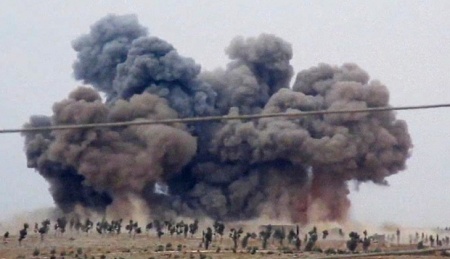
'YouTube shows the burning wreckage of the Russian airstrike, in Mansoura, in the western suburbs of Aleppo, as the local commander known as Abu Mohammed taunts his enemy: “Thank God, we are all fine,” says Abu Mohammed. “We don’t fear Russia or anyone helping the Russians. Bashar, we will remain resistant fighting you even without any ammunition or bullets. We will fight you with knives. We don’t need ammunition, Allahu Akhbar.”
The cameraman then adds that the Russians weren’t the only ones hitting the brigade yesterday. “The Russian airplanes are targeting Suqour al-Jabal’s weapon depots in Aleppo and ISIS attacked the bases with explosives at the same time.”
Today, Russian warplanes heavily bombarded several targets along a salient in Hama province, reportedly using thermobaric munitions and the same multiple launch rocket systemsearlier employed to devastating effect in east Ukraine. At the same time, Assad’s army advanced to dislodge the rebels from towns such as Kafr Zita, Morek and Kafr Nabudah. But the army failed, principally because many of its Free Syrian Army opponents were equipped with TOW guided anti-tank missiles, all supplied by the CIA. As many as 18 regime tanks (all manufactured in Russia or the former Soviet Union) were destroyed by these weapons in a 24-hour period. And the rebels held their ground in Hama.'
It's actually looking like as many as 24 tanks were destroyed or captured by the rebels in Hama yesterday. The Russian strategy is in tatters.
' “Any Syrian is going to be happy that there is a Syrian team that is competing on the world stage,” said Kenan Rahmani, a 27-year-old student at American University's Washington College of Law. “But it is a team that is run by the same government that is killing its own citizens. The Syrian people have suffered every tragedy you could ever imagine. It is hard to think about soccer when there are terrible forces destroying our country.” '
'It seems regime/ Iranian ground offensives will follow, particularly in northern Homs and the areas of Hama and Lattakia near the regime’s coastal stronghold. The aim is to shore up Assad’s collapsing regime in the fifth of Syria he retains. The larger hope is to destroy the opposition, leaving only Assad and ISIS standing. Then the West may more openly back Assad to take the rest of the country back.
The imperialist assault will undoubtedly extend the war in time and expand it in space. The coming months may see grievous setbacks for opposition forces. In the end, however, Russian bombs will not be able to alter the demographic reality any more than Assad’s bombs or the Iranian militias could before. Assad is running out of fighting men; foreign troops, however many arrive, can extend but not win his war. And not only the opposition militias but the majority of the Syrian people too will refuse to cooperate with any plan envisaging regime survival. For them Assad, not ISIS, is the supreme evil, and with good reason: Assad’s forces are responsible for the overwhelming majority of civilians killed and driven out.
Beyond that, Russia’s economy shrank by 5% last year. Russia isn’t strong so much as it is constantly appeased. But Syria’s fighters are in no mood for appeasement. When the Russians first walked into Afghanistan, when the Americans first walked into Vietnam, they thought their operations would be easy and brief…'
'Syrian revolutionary factions announce the victory of the revolution and the fall of the Assad regime.
Revolutionary factions fighting in Syria announced that the Syrian Revolution has triumphed and the Assad regime has fallen effectively. They call all syrians inside and abroad to mobilize to defend their land and honor, in the coming war of liberation against the Russian and Iranian occupation that Assad regime called for help.
This came in a joint statement signed by all the factions fighting on the ground and who consider Russia aggression, an occupation which began with the massacre in the northern Homs where 50 civilians have been killeds.
The statement call for all factions to unite to liberate the land and defend their identity.
'Just weeks ago, after months of diplomacy, officials were close to an agreement on enforcing aerial safe-zones to end the Assad regime’s bombing of civilians in northern and southern Syria, according to diplomats and military officials in the US-led coalition. The agreement was based on Jordanian and Turkish plans presented earlier this year.
“The Russian forces now in place make it very, very obvious that any kind of no-fly zone on the Libyan model imposed by the US and allies is now impossible, unless the coalition is actually willing to shoot down Russian aircraft,” says Justin Bronk, research analyst at the Royal United Services Institute.
Preventing the creation of US-led coalition no-fly zones in Syria is important for Moscow’s influence over events in the country. With the Assad regime’s territorial grip looking fragile in recent months, the added imposition of a US-led coalition no-fly zone could have forced negotiations that would have led to a loss of Russia’s influence. Now any diplomatic or political process that does occur will do so on Moscow’s terms.'
' "Russia's interference in Syria is a sign Assad's army is collapsing. In 2013, Hezbollah's leader Hassan Nasrallah said, 'We joined the war because the Free Syrian Army was getting close to Damascus.' Then in 2014, Shia militias entered because Hezbollah couldn't protect the régime, and now all these groups couldn't protect the régime, so we have Russia.
Russia considers anyone fighting the régime as their enemy. They didn't come here to fight ISIL, they are bombing civilians and the Free Syrian Army, and even other groups who are receiving foreign support.
America has no clear plan. They have let down the Syrian people. it's a very weak administration. They have left it all in Russia's hands. They didn't support their partners on the ground, and even the group they trained, they left them to face their fate against the régime and Russia's bombs. There's been no reaction."
He says what keeps his men fighting is that they have a just cause, fighting for freedom, dignity, and the need to rebuild a free Syria for the next generation.'
'The situation on the ground in Syria is ripe for a concerted air campaign that can assist the two major rebel coalitions ready to take Damascus and turn the course of the war. These two forces -- "Army of Conquest" in the north and "Southern Front" in the south -- are strategically positioned, battle hardened, and more than equipped to carry out what will be required by land. All they require is sustained air support that can neutralize the remnants of Assad's army brigades, national defense forces, and Hezbollah/Iranian battalions, as well as prevent Syrian planes (and now maybe Russian ones as well) from dispatching their dreaded and devastating barrel bombs. With such assistance these coalitions will be able to move into Damascus and take the capital city on their own.
Russia's growing military alliance with Iran and al-Assad in the name of defeating ISIS is a disconcerting development that complicates the situation in the Middle East. However, it is clear that the major Arab powers in the region, led by Saudi Arabia, cannot sit back and let the Russians and their proxies dictate the course of events. Over 300,000 Syrians have died and 4 million are now refugees. ISIS must be destroyed, but that can only occur once al-Assad is removed from power. Thus, we are likely to see in the near future a concerted Saudi coalition moving into Syria by air and providing the anti-Assad coalition forces the cover they need to break the stalemate of this war and, hopefully, bring it to an end.'
' "The al-Assad regime said the Russian and Iranian forces are “fighting terrorism”, while in fact they are only assisting the regime in its crimes against Syrians.
Your masks had fallen and your true faces are revealed. Especially for those countries who pretended to be our friends and support the Syrian revolution. Therefore we consider Russian and Iranian forces and government as our enemies and preserve our right to fight them as occupying forces.
We reject and refuse the dividing of Syrian land, and promise the Syrian people that we will do our best to restore our land in full. This is a goal that we will sacrifice our life for.
The scene is now clear for all Syrians— our appeals to the Arab and Muslim world were in vain after their silence on the regime's crimes. But this has only increased our determination and energy. May God bring us back victorious."
"Amid an international shift in favor of—or at least ambivalence toward— Syrian President Bashar al-Assad remaining in power, opposition groups and rebel factions have unified against the tide. Also on Saturday, the Syrian opposition's external political wing Syrian National Coalition (SNC) joined powerful Islamist factions and Western-backed rebel groups in Syria to sign a statement against a UN peacemaking framework drafted in July." '
' "My name is Caesar. I used to work for the Syrian regime. I was a photographer in the military police in Damascus. Before the revolution, I was responsible for taking photographs of crimes and accidents involving the military. This included suicides, drowning, and road and fire accidents.
I had not seen anything like this before. Before the revolution the regime would torture detainees to extract information, but they were now doing so to kill.
I saw wax marks and I once saw a round mark from a small stove used to make tea that had burned the face and hair of one of the bodies. Some of them had deep wounds, gouged eyes, broken teeth and marks from being hit by electric cables used to start car batteries."
Caesar wanted to stop working and defect, but Sami talked him into staying, because he was the only one who could gather insider evidence against the regime. He promised to stand by him - no matter what happened.
For two years, and despite the risk, Caesar copied millions of pictures of prisoners, which can be seen today online and at the Holocaust Museum in Washington DC.'
'It seems clear that the immediate goal of the Russian attacks is to degrade and demoralise moderate opposition forces as they, and not Isis, constitute the real challenge to Assad’s legitimacy. Colonel Abdul-Jabbar Akidi, former commander of Aleppo operations, told me that the Russians want to kill us all so they can convince the west that it is either Assad or Isis in Syria.
One Christian fighter for the Free Syrian Army, who leads a small FSA group, tells me that while Muslim fighters in his group do observe their religious duties faithfully, all of them are fighting for a free and democratic Syria in which Syrians enjoy equal rights, regardless of their religious or ethnic origins.
Another FSA officer, Colonel Abdulsalam Almerei, commander of Talbeissa operations in northern Homs, told me two days ago after his brigade was attacked by Russian aeroplanes: “We have no Isis here, we are fighting for our freedom and dignity. We want a united Syria for all Syrians. We do not want to oppress any sect or change one tyranny with another.”
Many Syrians have lost faith in the UN; they feel that the international community has abandoned them to the barbaric killing machines of Assad and Isis. The international law states that the principle of responsibility to protect civilians overrides the principle of sovereignty of states when a government kills its own people.'
' “Russian intervention has become a unifying factor. Groups inside Syria are now putting aside their differences to join forces against the perceived Russian invasion,” said Hassan Hassan, an associate fellow at Chatham House. “There is a deep sense of anger and little space for moderation.”
Mr Hassan warned that the Russian campaign was likely to bolster, rather than decimate, the forces of extremist groups like Jabhat al Nusra.
“It will use the Russian presence to gain legitimacy and build popularity on the ground," he said. "The Russians enter this conflict at a time when Nusra has already adjusted to the reality of American air strikes, learning to navigate terrain even as the planes fly above." '
"The Free Syrian Army was in only one of the 7 villages that the Russians bombed yesterday. Peaceful people lived in the other villages, where there were schools, hospitals, churches, mosques, houses, markets. They bombed one village with weapons for the Free Syrian Army – not the Islamic State."
“When I joined the Syrian army, there was no war yet. I just wanted to serve my country. But now everyone is forced to do horrible things. One time we were marching and a single bullet came from a village. Our commander told us to go into each house, one by one, and kill everyone inside. The village was a Sunni village, so our commander ordered all the Sunni soldiers to lead the attack. Anyone who disobeyed would be killed themselves. We did our best to aim over the heads of the people who were running away, but forty people were killed. A few nights later I fled in the middle of the night.”
The Russians are bombing Syria. They hope to destroy the Free Syrian Army, and any resistance from those who seek liberation from Assad's rule. The left, that has spent the last four years telling Syrians that the threat to them comes from Western bombing, or even support to those fighting for liberation, have finally noticed that Russia is bombing too. This isn't the cue for any change of mind, just an adding to the list that they oppose all bombing equally in the manner of a liberal pacifist. Lindsey German of the Stop the War Coalition says, I oppose Russia bombing Syria. It should stop, but less hypocrisy from those supporting US and allied bombing over last year." London2Calais, a group that has been doing some good work helping refugees stuck in France, says "We oppose ALL imperialism, whether it's the US, Britain, France or Russia," though they do want to distinguish themselves from those openly supporting the Russians and Assad, "Those in Britain who support Russia and Assad have no credibly left or respect for Syrian people. We say No to Assad, Oppose the British government's thinly veiled support for the Assad regime, No to bombing of Syria by ANY state, Freedom for Syrian people!"
I don't think this is good enough. It isn't the experience of Syrians. They have seen the Russians as their enemies from day one, as they poured military support for Assad into Syria, and blocked any condemnation in the United Nations, while the left told us that it was Western support for jihadist rebels that was destroying Syria. When Assad attacked the Damascus suburbs with chemical weapons in 2013, the left didn't protest the attacks, it went along with the Russian claims that we couldn't know who carried them out, and the important thing was to stop America reacting, because any strikes would turn into a rerun of the Iraq war, or the overthrow of Gadaffi in Libya (which as people have pointed out recently, has resulted in far less death than Assad and his allies have managed in Syria).
I am reminded of Paul Foot's account of the first time he met Tony Cliff, the longtime leader of the Socialist Workers Party:
"I saw a newspaper poster about events in the Congo, and remarked, partly to break the silence, that I'd never really understood the Congo. Quick as a flash, the rag doll came to life, and started jabbering with amazing speed and energy. I can't remember exactly what he said, but I do remember my clouds of doubt and misunderstanding suddenly disappearing and the role of the contestants in the Congo, including the United Nations, becoming brutally clear."
What had happened in the Congo was that within three months of independence, the Prime Minister Patrice Lumumba was deposed and murdered in a coup supported by the former colonial power Belgium and the United States, which became the main backer of the dicatator Mobutu, who reigned for thirty years in a manner less genteel than the Assads, though not as bloody. The UN had actively enabled the coup, and then had stood idly by while Lumumba was killed. The Russians had promised to come to Lumumba's aid, but were happy to have another opportunity to denounce American interference.
It wouldn't make sense to lump all these actors together, and hold them equally responsible for the catastrophe that occurred, because that would take the focus off the particular villains and what could be done to stop them.
Likewise in Syria we have to understand the difference between the Russian bombing from the American, or even from Assad's own. The Americans have been trying to bomb ISIS, while trying to avoid any conflict with Assad or being seen to support him, and have also been bombing Syrian rebels, most notably those they identify as their Islamist enemies, like Jabhat al-Nusra. They've tried to find groups that the can be totally OK with to retake ground from ISIS, but have been left with the one-party state that is the Kurdish region of Rojava, and a handful of Syrian rebels who were prepared to act as mercenaries and fight ISIS and not Assad. This makes sense for a power that is not responsible for Syria, that has had a couple of bruising wars, that has its priorities as preventing Islamists coming to power, that is content to make propaganda about Assad's genocide and Russian complicity but do nothing to stop it.
And so the reaction of Syrians isn't to simply lump in America with everyone else as enemies, but to object that they have not been friends. That when President Obama said there were red lines that Assad could not cross, he should have done something when Assad crossed them. Nobody asked America to invade. The media from then until now has presented this all as about the West, should America intervene, how can the West pick the right people to support. When asked, most Syrians said they were quite happy for the US to bomb Assad's forces if that would stop his assaults on them, a year after he had gutted the city of Homs and bombed the rest of Syria in unprecedented fashion, with the mass arrest, rape and torture continuing of those who had not acquired the means to resist.
What Syrians asked for was the chance to stop Assad themselves. To have the anti-aircraft missiles that would stop the devastating bombing, and precipitate millions to flee. That's what they need now. The effectiveness of Assad's bombing had become less with the disintegration of his forces. The Russian bombers can fly high enough not be seen, there is no way to flee their attacks, and so if there isn't an appropriate response soon from someone, many more civilians will have to run.
Where would that response come from? From Saudi Arabia, Qatar or Turkey, the neighbouring states most affected by Assad's genocide, and so certainly in the first two cases, not intervening because of some secret salafist plan to advance their influence through proxies. They have helped the Free Syrian Army because decency and their people have demanded it. And the commentators on the Left have demonised and lied about them, said they were supporting ISIS, or that the forces they support were equally as bad as Assad. Yes any foreign support comes with strings, but when you are facing genocide, you want the strings to be as few as possible, but when there is no alternative other than death you take the strings. There is little the Saudis or anyone else is obtaining with their support right now. Being popular among those whose homes are being barrel bombed doesn't add a dime to Saudi coffers. Any thanks they receive once Assad is overthrown will be freely given, not part of some betrayal of Syria.
Tony Cliff used the slogan Neither Washington Nor Moscow to establish opposition to repression wherever it comes from. What is ironic is that much of the left those mentioned at the start get their inspiration from Cliff, showing that words mean nothing without thinking behind them. Lindsey German would say it always means opposing your own ruling class, and therefore in the West the US. That's why she's happy to ignore the facts on the ground that show this isn't down to the West, but the effects of the spiraling down of the control of a Russian and Iranian client. There are groups in Syria who share the anti-Americanism, that would be the extreme jihadis, Jabhat al-Nusra and ISIS, who see Christians and secularists as much the same as Assad. The problem is that there is no help forthcoming for those that prefer a more secular outcome, not that people are demanding American intervention. And those jihadists, seen by the Left at its least anti-racist, as a good reason to prevaricate over support for the Syrian revolution, have sacrificed much in the fight against Assad, and so have gained the respect of the Syrian people, so a Left saying we can't support the rebels because of them is multiply cut off from the experience of Syrians. The way to win back the revolution from the jihadists is not to ignore and denounce them, but to show that there is an alternative that is just as determined to kick out Assad.
I've pointed out before that if you tell Syrians their greatest enemy is the US, they will call you pro-Assad. And I get leftists going off in a huff, complaining that I am calling them pro-Assad. I'm not, but missing the point is the far greater mistake here. Those like Lindsey German who call for a negotiated solution that leaves Assad in power have clearly strayed light-years from any fight against oppression. But those who say we have to be balanced, to condemn everyone equally, are still not connecting with the reality in Syria.
The Russian project is clearly to keep Assad in place, which will require the return of his reign of terror across Syria. The Iranians are slightly different, they would be happy with a sectarian rump state that maintained their supply lines to Lebanon, and reinforced their colonisation of the parts of Syria needed to achieve this.
For Syrians this is a most titanic struggle, against Assad, Russia and Iran. They need support from those states that might give them weapons to protect themselves. They need as little interference with that help from the US as they can get. They do not need to be told that everyone is as bad as each other. None of the bombing is likely to be a help, though the American bombing of Kobane did enable its liberation from ISIS; while we are at it the limited bombing in Libya probably did help turn the tide against Gadaffi. But the bombing isn't all equally the problem, and the American bombing of ISIS that causes some civilian casualties and may be ineffective doesn't compare with the Russian attempts to murder Syrians who resist Assad.
'We also consider that the reaction from other countries [US and European states] is a negative one. Those countries know for sure the Russians are helping the regime, and not attacking IS.
They knew that the Russian government had been sending weapons and equipment to the regime since the beginning of the revolution. And they were also aware that six or seven months ago, Russia started to send fighters and soldiers even if they deny it.
We know for sure that in certain areas in Syria - like Latakia, Tartous, Damascus or Hama - there are Russian soldiers and fighters over there. Some of them are in the mountains of Latakia. Unfortunately, they didn’t listen to us when we complained during a meeting of ambassadors that Russians were putting their feet on the ground. At the time they didn’t say anything, there was a big silence in the room when we complained there are Russians soldiers.'
'Anyone who follows what is actually happening on the ground knows that there are no battles between the Syrian army and IS. The areas IS controls were won through short battles for wide spaces and large warehouses. This was the case in Palmyra, where IS confiscated the second-largest ammunition warehouse in Syria.
Meanwhile, the FSA is completely dismissed when it comes to media coverage. It was formed early in the revolution and developed into an army defending civilians in regions outside the regime’s control. From a defense group, it grew to become an attack force and took over areas previously controlled by the regime.
The FSA recently managed to expel IS forces completely from Idlib and its countryside, and did the same in Aleppo in late February. The battles are ongoing in Aleppo's northern countryside, in Mare city and its suburbs, where more than 30 FSA fighters died to keep the regime from taking over Aug. 10.'
'Russia’s intervention in Syria “is intended to exterminate the Free Syrian Army—no, the Syrian people,” Captain Jameel a-Salih of the FSA-affiliated Tajammua al-Izza brigade in north Hama told Syria Direct Thursday, expressing a sentiment shared by pro-opposition activists and fighters present in the Syrian north.
The airstrikes are only hardening the resolve of civilians in north Homs against the regime, a civilian in Rastan told Syria Direct Thursday. “By God, we no longer know where to go. We're asking ourselves where to go,” said Mohannad al-Qasem, from Rastan, one of the towns that was bombed by Russian planes Wednesday.'
' "I was worried when I get to Syria to be killed or put in jail, and this is what happened. As soon as I get to Damascus I was 20 days in jail," he said. He was singled out by government officials when he landed in Damascus - his home village marking him as a dissenter.
Eyad said for 20 days he was tortured by Syrian government intelligence officers, who had found the cash given to him by the Australian Government and accused him of being a financier of the Syrian revolution. "They hit me on my face and on my back, on my chest," he said.
Eyad was released and made the dangerous journey back to his hometown and his family. His house had been destroyed and his wife injured. "Every day those Syrian planes come to our area ... those times they throw four barrels of explosives and they are killing children and you can watch the news and see for yourself," he said.
"One day I am expecting myself to be killed or arrested," he said. "In Syria, there are two sects. Either you are a killer or you are the killed person." '
'Wednesday's strikes were centered around the city of Homs, in western Syria near the border with Lebanon. A Syrian opposition activist living north of Homs near one of the villages targeted -- Talbiseh -- told CNN that ISIS had no presence in the area.
"Russian warplanes were targeting civilians and innocent people only, Putin is lying about targeting Daesh militants," Khdaier Khushfa said via Skype. Daesh is another name for ISIS. "Daesh withdrew from the northern countryside of Homs in an announcement they made a year ago after the groups refused to deal with them, including Ahrar al Sham and Revolutionaries Front," he said. "We know that Russia is the biggest ally of the Syrian regime, and since Bashar al-Assad considers us terrorists, then there is no doubt that Putin knows these areas are under our control and not Daesh."
Khushfa said the Russian strikes had killed 17 civilians in Talbiseh and 11 in Zafaraniya, despite rebel military posts and headquarters being located outside the two villages. "We are used to the regime airstrikes but now the entire world is watching another country killing civilians in cold blood without taking any action," he said. "We are very concerned about what will happen next -- civilians I spoke to are very scared -- it's like, after five years since the revolution started we are back to ground zero." '
"These air strikes will extend the life of the war as a first step," said Zoubi, whose Yarmouk Army fights under the banner of the Free Syrian Army (FSA). "As a second step, they will spread extremism, because when the war becomes a global one against the Syrian people, it will not retreat from its goals, and there will be fertile ground to attract foreign fighters to fight the Russians," Zoubi said. "As Russia lost in Afghanistan, it will not win in Syria. There will be more killing and more bloodshed."
'Right now we can see the criminality of the US/CIA deliberate *blocking* of large numbers of manpads (portable anti-aircraft weapons) in 2012, that were sent to Turkey from Libya for the Syrian rebels.Of course, we could already see the criminality of blocking these manpads the last 4 years under Assad’s genocidal bombing. It may have cost 100,000 lives.
But to turn this current brutal Russian aggression into Russia’s Vietnam will require good anti-aircraft weaponry. If before, many western peaceniks and nimby progressives were squeamish about the demand because they thought sending anti-aircraft weapons to rebels to help save the lives of thousands of Syrian civilians from Assad’s genocidal slaughter was “interference into the internal affairs of Syria” (sic??!!), then what new measly excuse can they come up with now that the Russian imperialist state, the major backer of Assad these 4 years, has launched a massive, devastating war of aggression against the people of Homs, Hama, Idlib, Daraa and other centres of the revolution – none of which have any ISIS since the FSA drove ISIS away from the entirety of populated western Syria in January 2014 – slaughtering civilians en masse while targeting the Free Syrian Army?
Let the Free Syrian Army get all the advanced weaponry they need, from whatever source wants to send them, above all masses of good quality anti-aircraft weapons!'
'A Hama local, who identified himself as Muhannad, 25, said on Wednesday night: “The airstrikes aren’t stopping. We have lost count of them. I can tell it is the Russians. They are faster and the sound of the bombs are different from those of the regime. They have bombed Talbiseh, al-Mukarama, Reef Homs al-shamali. All of these areas are mainly under FSA control. We don’t have here any Isis but we have a small number of al-Nusra. We expected this to happen but there is no place to flee to.”
Another Latakia local, who identified herself as Dima, believed Russia was not there to fight terrorism but to help the regime and its interests. “People with the regime have no mercy for Sunnis. If they are living on the side of the FSA and want to leave, they won’t let them. They don’t want anyone to leave alive.” '
'Activists in Homs and Hama provinces have posted images and video online claiming to show Russian planes bombing groups of non-Isis rebels who are fighting Bashar al-Assad’s forces. The death toll could not be verified but dozens of fatalities were reported, including civilians, and footage showed injured children being treated in Talbiseh, a Free Syrian Army (FSA) stronghold.
Areas reportedly hit by Russian planes today included Ltamenah and Tal Wasit, both in Hama governate, and Zaafrana, Homs. All are held by the Free Syrian Army, secular rebels, or non-Isis Islamists including Jaysh al-Fath (the Army of Conquest). In the Syrian civil war’s ever-changing web of alliances, the coalition, including Jabhat al-Nusra and Ahrar ash-Sham, sometimes co-operates with Free Syrian Army in its battles against Isis and government forces.
Senior Tories have backed Russia's intervention in Syria, saying working with Assad is the “lesser evil” in the fight against Isis.'
' "There is no future for Assad in Syria, with all due respect to the Russians or anyone else," Jubeir told reporters in New York after meetings with Saudi Arabia's allies. He spoke of only two possible outcomes for a settlement in Syria, saying a transitional council reached through a political process would be the "preferred option." A second, military option "could be a more lengthy process and a more destructive process, but the choice is entirely that of Bashar al-Assad," the Saudi foreign minister said.
Jubeir would not be drawn on specifics of what the military option would look like, but noted that Saudi Arabia is already supporting "moderate rebels" in their battle against Assad. "Whatever we may or may not do we're not talking about," he said, but quickly added: "There is a Free Syrian Army that is fighting against Bashar al-Assad. There is a moderate Syrian opposition that is fighting against Bashar al-Assad and this opposition is getting support from a number of countries," he noted. "And we expect that this support will continue and intensify." '
'It's no secret that Syrian singer Assala is a loyal supporter of the Free Syrian Army and an opponent of the Syrian government. In 2013, Assala tweeted in reference to the assassination attempt against the rebel chief in the eastern city of Deir Ezzour, saying, "Do not be frustrated because of what happened. Millions of youths have your back. May you heal [soon]."
While thousands may be on the starlet's side, others have accused her of betraying Syrian President Bashar Al Assad and the Syrian people. One person agreeing with the latter is Emirati Shaikha Mahra Bint Mohammed Bin Rashid Al Maktoum, who recently bumped into Assala and gave her a piece of her mind.
"Today at Dubai Airport, singer Assala Nasri caught a glimpse of me and ran towards me to say hello. She then reproached me for my stand on the Syrian revolution and foreign intereference in Syria. I responded with the following:
Assala, I love Syria and all I want is for peace to return to it. However, you have betrayed your country and your people and it's no honor of mine to be seen with you." '
' "The regime continuing and Assad staying is a failure," said Ahmad Qura Ali, a spokesman for the powerful Islamist Ahrar al-Sham rebel group. "It also demonstrates disrespect towards the sacrifices of the Syrian people and, even more importantly, irreverence towards the will of the Syrian people."
Activist Ibrahim al-Idlibi, who took part in the anti-government demonstrations that began in March 2011, said Syrians "will not accept that Assad stays as part of a transitional period. It's not possible to look at a terrorist killer as a protector or provider of security."
Many opposition forces say they have come to expect little support from their backers, and are disappointed after years of patchy assistance and changing policy priorities. "As Syrians, we've stopped caring about these statements, which come not as a result of what's happening on the ground, but of political parties pursuing their interests at home," Idlibi said. "In the beginning, I used to think that the West was a real ally of the Syrian people... but our opinion quickly changed because of their political inconsistency."
"We have no choice but to prepare for larger military action and to apply more pressure to show the weakness of Assad and his allies," said Major Essam al-Rayes, spokesman for the Southern Front rebel group. "Can a regime that can't even hold onto its border crossings be relied upon?"
"The regime helped ISIS grow and spread throughout Syria at the expense of the revolution... not at the expense of the regime," said Mamoun Abu Omar, an activist in Aleppo. "Those who have suffered hundreds of thousands of deaths and so much destruction cannot take a step back," said Abu Omar. "Whoever achieves only half a revolution is digging his own grave." '
'Assad is not and should never be seen as a better alternative to IS. From the very first days of the revolution, Assad and his intelligence apparatus have consistently facilitated the rise of jihadists. This policy of aiding and abetting jihadist militants and manipulating them for Damascus' policy interests is a well-established Assad family practice, dating back at least to the 1990s.
By releasing dozens of al-Qaeda prisoners in mid-2011, Assad helped give birth to a thriving Islamist insurgency, including an al-Qaeda affiliate. By then adopting a deliberate policy of not targeting IS, Assad directly facilitated that group's recovery and explosion into the transnational "Caliphate" movement it claims to be today.
Meanwhile, the Assad regime has conducted a consistent policy of intentional mass killing of civilians - first with air strikes and ballistic missiles, then with barrel bombs and widely alleged use of chemical weapons. Bashar al-Assad has professionalised and industrialised the use of detention and torture to "cleanse" his own population, while imposing dozens of medieval-style sieges on vulnerable populations. He has consistently flouted UN Security Council resolutions and according to some sources, has been responsible for 95% of all 111,000 civilian deaths since 2011.
IS remains a potent force in Syria and must be countered, but it will not be marching on Damascus anytime soon, contrary to some uninformed fear mongering. Al-Qaeda also poses a pressing and more long-term threat, perhaps more so than has been acknowledged. But at the end of the day, the root cause of the entire Syrian crisis is Assad and his regime.
Contrary to popular opinion, the Syrian armed opposition is not divided, but has in fact spent much of the past year focused on developing a clear and unified political vision. These are all groups composed of and led by Syrians and which explicitly limit their objectives to within Syria's national boundaries - not IS and roughly a dozen Al-Qaeda-linked factions.
While accommodating Russian and Iranian demands for Assad's survival and potentially even a de facto partition of the country may seem like an attainable objective, this will only prolong and intensify the conflict and will almost certainly spark a jihadist mobilization the like of which the world has never seen. The vast majority of refugees now entering Europe are fleeing Assad's murder machine, not IS or al-Qaeda. Ever since Syrians took to the streets in March 2011, the Western response has been both feeble and noncommittal, but the world is now in need of real leadership. Unfortunately, it seems our leaders are walking into the abyss with their eyes closed.'
'Sweden's Foreign Minister Margot Wallström talks about Syria negotiations and the refugee crisis. "Austria and some other European countries are in favor of involving the Assad regime in solving the Syria conflict. What do you make of it?"
"I am, frankly, very skeptical. And I'd like to know what is the signal that you want to send it, and what you would achieve with it, before I refer to a clear position. I just do not see what would the role of someone be exactly who has killed seven times as many people as IS (the terrorist militia Islamic State), and directed barrel bombs and other weapons against his own people." '
'Kerry has specifically adopted Moscow’s two primary positions:
The First, making the “war on terror and extremism” the basis of any international approach in Syria. The Second, putting off for the time being any discussion of the fate of Assad, rather than making it the first step in any discussion of a political settlement, as the Syrian opposition has been demanding since day one. Kerry has now made it clear Assad does not have to leave anytime soon when he said: “It doesn’t have to be on day one or month one. There is a process by which all the parties have to come together and reach an understanding of how this can best be achieved.”
It is, indeed, quite interesting that Washington is still blabbering that “there is no place for Assad in a future Syria”. The experience of the last four years with what the Obama administration promises hardly encourages anyone to believe that such a statement means anything.
On the other hand, talking about Assad, as an individual, may have now become pointless and overtaken by events. It is true he has been the face of the Syrian tragedy as well as its main cause, but it is also true that as an individual he is now but an irrelevant and a worthless detail. Those in control in Syria today are the ones who are striking deals, bringing in sectarian fighters across the border, and drawing with blood the maps of Syria’s partition.
As regards the Arab states, if Washington continues to dismiss their misgivings about its blessings of Iran’s hegemony over Iraq, and its self-delusion that the Syrians’ would accept the perpetuation of the four-decades old despotic mentality and its security and suppression, they would realize that nothing is going to change in Syria except the portrait of a figurehead president.
Assad must leave. There should not be any doubts about that; but the policy of “fighting ISIS” alone must not conceal Washington’s frighteningly contradictory approach to the Middle East’s problems; including, turning the Arabs and their countries to failing experiments.'
'Last Wednesday it deployed more than 103 barrel bombs; one every 14 minutes. Similarly last May, more than 40 people died in a single strike when a bakery in Manbij was targeted in this way.
These victims are not collateral damage caught in the fog of war. The Syrian regime has repeatedly and deliberately conspired in killing some of its most vulnerable citizens. In May 2012, forces loyal to President Assad stormed the town of Houla and massacred 108 people. A United Nations report found that almost all had been subject to “summary executions” among them, 49 children under the age of 10. Some had their skulls cracked open through blunt force. Others were stabbed to death.
The heroic British aid worker, Dr Abbas Khan, who worked in a field hospital in Saraqeb, also documented the sadistic rituals of Assad’s regime after falling into their hands. “My detention has included repeated and severe beatings, largely for no reason other than the pleasure of my captors,” he wrote. The day before he was due to be released, Dr Khan was murdered by the Syrian regime. Like Khatib, his emaciated corpse was covered in cigarette burns.
The idea that the Assad regime’s violence is somehow morally or strategically different to that of jihadist actors in Syria has become fashionable among some sections of the Western media. Perhaps a symptom of fatigue or sympathies forged during time spent as guests of the regime, mainstream commentators such as Patrick Cockburn and Peter Oborne have been at the forefront of this trahison des clercs.
According to the Syrian Network for Human Rights, 95 per cent of all civilian deaths in the conflict have come from the regime. The refugees now fleeing to Europe do so as a direct result of Assad’s policies.
Any attempt to rehabilitate him within the international system would be as morally bankrupt as recognising Abu Bakr al-Baghdadi as a legitimate head of state. Framed in that way, it should be obvious that the cure to Baghdadi’s murderous pathology does not lie within the Baathist poison.'
I don't think everything hits the bullseye in this Economist editorial, though it has most major points right. There is still a Free Syrian Army, and a lot of support for moderation and secularism, just not a lot of identification with the West. And it isn't possible to ignore now the contribution of jihadi groups like Jabhat al-Nusra and Ahrar al-Sham to the fight against Assad, the only way to keep Syrians wanting a more moderate and secular future is to be better at supporting their struggle than the extremists, not to suggest they are the same threat to Syrians as Assad or even ISIS.
'Most civilians are being killed by Mr Assad’s forces, and most refugees are fleeing his bombs. Backing Mr Assad, or acquiescing in the survival of his regime, would only push more Sunnis into the arms of the jihadists. If IS is the ugliest face of Sunni Arabs’ sense of disenfranchisement, Mr Assad is the worst embodiment of their nightmare. Russia’s intervention may yet help bring about [a diplomatic deal under which Mr Assad would surrender power]. More probably, it will embolden Mr Assad to cling to power; and keep fighting a war he cannot win but that will do more damage to the country, and the region.
If America put a stop to the barrel bombs, its standing among Syrians would immediately improve. Dependence on outside support would also increase the prospect of the West exerting some influence over rebel behaviour, and avoid the dark possibility of Sunni atrocities against defeated Alawites, Christians and other minorities.
Perhaps the biggest obstacle is Mr Obama himself. Right now his legacy will record not just sensible rapprochement with Iran and Cuba, but also the consolidation of a jihadist caliphate and countless boat-people. He may worry about the risks of American action and “owning” the Syrian crisis. But the greater risk is standing aside and disowning the Middle East.'
'It is impossible to envisage a ceasefire with this regime. Only the regime's collapse could lead to peace, said Saleh almost three years ago, in an interview with news website Syria Deeply; at the time he still lived in Damascus.
He believes the same thing today. Four years after the Syrian uprising the Assad regime remains in power. These days Russia increases its military presence in Syria, and the USA is still leading attacks against Islamic state (IS). The tragedy of Syria has been unfolding because the international community has allowed Assad to remain, believes Yassin al Haj Saleh, who uses the Arabic term Daesh for IS.
- As long Daesh exists, it is not enough to get rid of Assad regime - but it is not enough to fight only against Daesh, as the US does, says Saleh.
- Building a Syrian majority for a new Syria requires both overthrowing the regime and simultaneously fighting Daesh. That can not be achieved without international support. One cannot let the country be in the hands of a regime that has killed more than 250,000 people. It is extremely unethical, says Saleh. International attention has largely been directed against the atrocities committed by IS in the past year.
- Among Syria's victims is one of seven killed by Daesh and other groups. Six of seven were killed by the regime. Daesh' crimes are more "sexy" and meet with great fascination in the Western media.The mindset of the West prevents Western media from thinking about the six of seven killed by the regime in a less "sexy" way. The regime has also killed foreigners, so it's not about that. Or if it does, it gives an even worse impression of the international community, said Saleh, who believes that Assad could have been overthrown long ago if it was really a desire for it internationally.
The paralysis over Syria has been explained by international fears of an unstable post-Assad Syria where IS gets free rein.
- But how much worse can it be, asks Saleh, throwing out his arms.
- It seems like they think the situation in Syria began yesterday.The regime has been there for decades. Tens of thousands of people, myself included, have fought against the regime and been imprisoned. Many have been killed. If the world prefers one that Assad stays because they want stability, Syrians would be forced to pay for it. It will trigger and has already triggered a dynamic of extremism, sectarianism and militarism that has resulted in Daesh. Daesh did not emerge from nothing. Syrians are not extremists, but some have become extremists in the situation that has been allowed to develop, says Saleh.
In addition to Iran, Russia is the Assad regime's loyal international backer. Peace in Syria can not come without Russian involvement, many believe. But Russia will not contribute to peace, says Saleh.
- One cannot say "Russia" and "peace" in the same sentence - and especially not in Syria. Russia has helped the regime to kill Syrians for 55 months now, and use its veto power to prevent action in the Security Council. So how can we talk about Russia's role promoting peace? They still say that Assad must stay. They said that before Daesh existed. Russia has always taken the side of the regime. Russia has never said that they want a political process that really involves change, says Saleh.'
Compare with the rubbish Noam Chomsky¹ came out with on Democracy Now a couple of days ago.
' "The Obama doctrine vis-à-vis Syria?" "It’s a good question. Washington hasn’t a clue. It’s obvious. And it’s a little hard to fault them for that. It’s very hard to think of a constructive outcome to this utter disaster.The United States has taken a somewhat hands-off position, except that it’s supporting its allies, who are very clear. As I mentioned, Turkey, a NATO ally, has been supporting the al-Qaeda-related jihadi front, namely the al-Nusra Front, a couple of others. The Gulf states, also U.S. ally, Saudi Arabia, where they have been strong supporters of what’s now become the Islamic State—technically, Saudi Arabia, the government, no longer—claims no longer to support them directly, but surely did in the past, and funders from the Gulf—wealthy Gulf states are still presumably funding them, as they have in the past. It’s pretty open in the case of Qatar. So there’s—these are indirect U.S. policies.
The only conceivable hope for some resolution of this horrendous crisis, which is totally destroying the country, is the kind of negotiated settlement that was worked on by serious negotiators, like Lakhdar Brahimi, an international negotiator, very respectable, sensible. And the main idea, which—shared by any analyst with a grey cell functioning, is some kind of negotiated settlement which will involve the Assad government, like it or not, and involve the opposition elements, like it or not. There can’t be negotiations that don’t involve the parties that are fighting. That’s pretty obvious, just as South African negotiations had to involve the leadership of the apartheid state. There’s no other way. They can’t have other negotiations. It’s perfectly obvious that the Assad government is not going to enter into negotiations that are based on the condition that it commits suicide. If that’s the condition, they’re just going to keep destroying the country. That unfortunately is the—has been the U.S. position of the negotiations. U.S. and its allies have demanded that negotiations be based on the precondition that the Assad government will not survive. It’s a horrible government, and I’d like it not to survive, but that’s a prescription for destroying Syria, because it’s not going to enter into negotiations on those terms.
Right now, and in fact in the past, these have been proposals pretty much supported by the Russians. And, in fact, you may not have seen this, but for those of you who read the international press, British press, a couple of days ago there was a very interesting revelation that in 2012 the Russians had apparently presented a proposal for an interim regime which would not include Assad, and it was turned down by the United States and the West. That was reported in practically the entire British press—Guardian, The Independent, Daily Telegraph, across the spectrum. Didn’t appear in the United States for a while, but finally it did appear, not in print, as far as I can tell, but in an online edition ofThe Washington Post, where there’s an article of the usual type. It sort of mentions that this is rumored, but can’t take it seriously, and, you know, so on, probably didn’t mean it, and so on and so forth. Well, OK, you can draw your own conclusions.
But as far as—if you ask what the Obama doctrine is, it doesn’t exist. We saw the Obama doctrine a couple of weeks ago when the Pentagon sent in these 50 fighters, who had been trained for years, and they were immediately captured, killed, or just defected, by Turkey’s ally, the al-Nusra Front, as I mentioned, apparently with Turkish intelligence support. Now that’s the doctrine, is nothing, except to support the allies, which are in fact supporting jihadi forces. But what the doctrine ought to be, I think, is pretty clear. What the chances are for settlement of those terms is hard to say—not very high. But if you can think of an alternative, you should present it. No other alternative has been proposed."
Obviously he in this interview (1) Pretends to want Assad out, but in reality not. Just like President Obama, (2) Pretends that America is secretly backing rebels/jihadis because its allies are [sic], (3) Thinks a state of mass torture can be reformed the way the apartheid state was, (4) Imagines that the UN and local ceasefires are a route to peace, when the UN has done nothing to restrain Assad, and the local ceasefires have always been an opportunity to tighten the sieges and redouble the bombardment, (5) Does the Saudis fund ISIS, Turkey loves ISIS, the Russians wanted peace, conspiracy theories, the last of which Brian Slocock dismantled here². Clearly Chomsky is still getting his ignorance from his friend Patrick Cockburn's contrived ignorance. He doesn't quite go for the full acceptance of the war on terror retread, but still expresses regret. Of course he has no idea that there is any alternative proposed to defend Syrians from Assad other than a US invasion, because Cockburn and President Obama have said there is no alternative. He also lumps the authoritarian Islamist régimes in with their radical Islamist enemies, which has had no basis since Osama bin Laden took against the Saudi monarchy when they let the US establish military bases there in the 90s.
'The major center of radical Islam, extremist radical Islam, is Saudi Arabia, unquestionably. They are the source of the Wahhabization of the region, which Patrick Cockburn points out is one of the major developments of the modern era.'
Crispin Blunt³, Conservative chair of the House of Commons Foreign Affairs Select Committee, has a similar outlook to Chomsky's, not surprising as Patrick Cockburn was the most prominent witness at his committee's hearing on Syria a couple of weeks ago. From 7m42s:
"We have made strenuous efforts to try and stand up the Free Syrian Army and Western-oriented forces in there, and that's come a complete cropper. As we have seen, there is no hard power being exercised on the ground by parties to this civil war who are aligned to the West." He then calls Nusra al-Qaida, and then says they are in a coalition, but doesn't say with whom, and just says they are getting support from Turkey and Saudi Arabia.
' "My wife – the girls' mother – died when the roof of our house collapsed after a barrel bomb attack," says 38-year-old Mohammed, sitting on the floor inside the sweltering corrugated metal building that has been home for three years now.
We were sleeping in our house in the early morning around 5 a.m. when the bomb struck. We woke up with rubble on top of us. I lost consciousness and was separated from my children and brought to the hospital."
Mohammed said fighters in the Free Syrian Army carried him on their backs to the Jordanian border. Days later, he was reunited with his children at the home of a friend.
"I would like to go back to Syria – nothing can replace my country," '
'Two years into the revolt, opposition supporters inside Syria had self-organized into coordination committees, or tansiqiyas. In villages and neighborhoods, the citizen groups called for demonstrations, organized civil defense, and shared information on social media. Soon, a revolution that began with unarmed demonstrators quickly grew in need of an ever-expanding list of equipment: Samsung cell phones, better cameras, satellite phones. As early as the summer of 2011, when the regime first cracked down on protests, the opposition needed medicine.
The first place activists turned was overseas; some 10 million Syrians already lived abroad by 2011. Many members of the diaspora were longtime opponents of the Syrian regime; a few had made fortunes for themselves. And just as spontaneously as the local uprising had organized, the diaspora began to coalesce into their own tansiqiyas — in Abu Dhabi, Dubai, Kuwait City, Doha, Jeddah, and elsewhere. Like so many of the first activists in 2011, many in the Syrian diaspora saw the initial uprising as a singular chance for a different kind of Syria. Mostly of an older generation, they watched, awestruck — even embarrassed — by how young people stood up to the regime they had run from. But while those who fled Syria hadn’t fought Assad and his soldiers back then, they could do so now using a weapon few inside the country could wield: money.
Their story is one of the Syrian conflict’s most invisible — and most important. The diaspora crowdfunded the early days of the uprising, kept activists and families sustained as times got rough, and sent vital remittances to breathe life into a destitute state. At times, they dabbled in weapons; they formed key links between regional governments and militias on the ground. It is unlikely we will ever know exactly how much money the Syrian diaspora poured into fighting the Assad regime. No accounting exists of its hundreds of decentralized networks spread across dozens of countries. But one thing is clear: Four years into a bloody civil war, the only reason that many in the country are still fighting — and surviving — is because of money and assistance provided by those who fled decades ago.
Amid it all, Abu Dhabi’s tansiqiya is expanding as the existing diaspora absorbs hundreds of thousands more Syrians. In the UAE alone, expats estimate that some 100,000 Syrians have recently arrived. Some of the tansiqiya’s aid is now focused inward, supporting the parents, sisters, nieces, and nephews who have arrived to the Gulf on visit visas without work.
Unlike the middle-class businessmen who fled decades ago, the new arrivals are often destitute — and increasingly dependent on their more established relatives and friends. “Each one of us here is sustaining 50 people,” says Abu Akhram, a member of the Abu Dhabi group. “The diaspora has been able to help the people and the revolution to survive.” '
'Scores of Iranian political activists and intellectuals have launched an online campaign calling on Iran to end its support for Syrian President Bashar al-Assad and take in Syrian refugees fleeing violence there.
The more than 70 activists, who include several former political prisoners, blame Assad and his foreign supporters, including Tehran, for the exodus of tens of thousands of Syrian refugees to Europe. They have launched a Facebook page called Sorry, Syria, where so far about two dozen users have expressed "shame" over Iran's assistance for Assad's "crimes" and warned that silence could be interpreted as consent.'
Statement from Professor Nader Hashemi, Director of the Center for Middle East Studies at the University of Denver and co-editor of 'The People Reloaded: The Green Movement and the Struggle for Iran's Future' and "The Syria Dilemma':
"One day there will be democratic transition in Iran and all will be revealed. Not just the injustices and crimes committed within Iran also what was done in the name of Iran and Islam outside of Iran’s borders. At the top of this list is the Islamic Republic of Iran’s role in Syria post-March 2011. We don’t have all the documentation yet but the circumstantial evidence suggests that the Islamic Republic’s fingerprints are all over the Assad regime’s state-sanctioned war crimes and crimes against humanity. When the truth is revealed Iranians will be horrified by what was done in their name. A public apology and compensation must follow. The struggle for democracy in Iran and Syria links the two countries. We now know that the Iranian regime’s fear of the Arab Spring spreading to Iran was the chief reason why the Green Movement leaders were arrested in February 2011. They remain in prison today to this day. I’m certain that if their voice could be heard they would support this Facebook campaign in solidarity with the Syrian people. It is the least than can be done to express moral outrage at the ongoing suffering of the Syrian people and the Islamic Republic’s complicity in perpetuating this suffering."
Marcia Biggs: "Mohamed and Amira are from Homs, the birthplace of the Syrian revolution. He was a carpenter and she a high school physics teacher. All three children were small in 2011, when the revolution began and Bashar al-Assad issued a brutal crackdown on their town."
Mohamed Darbi (through interpreter): "When they would raid the homes, we were afraid for our children, our women. We were afraid they would kidnap one of us. That’s when the fear started."
Marcia Biggs: "It was 2012, when the family narrowly missed the missiles that flattened their neighborhood, that they finally fled. They waited for weeks near the border to be able to make the dangerous crossing into Jordan, running for their lives."
Mohamed Darbi (through interpreter): 'For me, I see no future. I’m 42 years old. I will barely make a living and provide for them a decent life. The future is theirs. When they came back from school yesterday, I asked them, “How was your day?” They said: “We were really happy. We had such a fun day.”
'One of the most persistent criticisms was the extent to which the group is fighting against other Sunni rebels. According to the defectors, toppling the Assad regime didn't seem to be a priority, and little was done to help the (Sunni) Muslims who were targeted by it.
Most of the group's attention, they said, was consumed by quarrels with other rebels and the leadership's obsession with "spies" and "traitors." This was not the kind of jihad they had come to Syria and Iraq to fight.'
We get none of this from the BBC* version of the story, in which Assad and the rebels disappear, to be replaced by Western governments and Other Muslims.
'Most defectors said they were concerned with brutality against fellow Muslims.'
From Paul Wood's video report:
'To Western governments, they are kidnappers, murderers, terrorists...A fighter from Asia dismisses American airstrikes, 'A malicious crusaders' campaign, it's only increased our resolution.'...There are other defectors in hiding, here in Turkey, people disgusted with the killing and the cruelty of Islamic State rule. But the jihadis have their supporters too, and perhaps more of them, because of anger over American airstrikes...Opinion in the rebel-held areas remains deeply divided.'
' "We will never forget the blood of our martyrs."
I lay down, with my headphones in my ears, listening to the people of Dara'a chanting the Syrian revolutionary slogans in March, 2011. A few weeks later, those same sounds started filling the streets of my own neighborhood. My disbelief that day led me to think I was dreaming. I remember I left my house and ran to join the rally. It was a solidarity march with the martyrs who had fallen in Dara'a. "We will never forget the blood of our martyrs," they repeated.
As time proceeded, martyrs began to fall in my city. During their funeral marches, I would walk next to those carrying the coffins. One day, I turned to the man next to me, the street lights reflected the many lines on his wrinkled forehead, and I asked "How was he martyred?" I was shocked to find that the man I was asking was my father; he had been a part of the marches, as well.
As events escalated in Syria, the secret police would raid the demonstrations killing and arresting people. In July 2011, one of the demonstrations I partook in was raided by a military bus. I found myself running, with many others, through narrow lanes that I had not discovered in my city before. A car came to pick us up, and many of the guys and I stuffed ourselves into the back. After catching my breath, I looked to find that the driver was my father. I left to Turkey to work in press and media freely, but my father stayed in Syria. He refused to leave the city of Deir Ezzor, which was under regime control and under constant threat, bombardment, and gunfire from both ISIS and the regime.
The siege is now entering its ninth month and people are starving to death. There are seven documented deaths from starvations, three of whom were children. The current siege on Deir Ezzor is categorized as the worst siege in Syria, with the price of food being three times more than any other area in Syria. The tight grip by ISIS has not allowed any food or supplies into Deir Ezzor for nine months. ISIS besieged the city of Deir Ezzor in order to pressure the Syrian Regime and conquer the rich and strategic area, but the Syrian regime seems to be unaffected. The regime continues to freely use the Deir Ezzor airport, pays the engineers working in ISIS-controlled oilfields, and the regime checkpoints are still receiving equipment and supplies, including buckets of cigarettes. Even when ISIS first laid siege to Deir Ezzor, the regime confiscated much of the supplies within the city and raised the food prices by tenfold, while regime-allied businessmen used it as an opportunity for profit.
My father remains under the siege of ISIS and the regime, surviving on sour bread. In nine months, he has lost almost half his weight dropping from 192 to 121 pounds, and he's quickly running out of medicine for his diabetic needs. The laughter of children in the streets has been replaced with bombs and gunfire, the marketplace has grown empty, the buildings have continued to fall, turning into piles of rubble, and the people have kept disappearing.
With no end in sight, with no intervention and with no help, Deir Ezzor is dying and it is dying slowly and painfully.
"The birds in our garden -- I am afraid one day I will not be able to share my dry bread with them," my father continued. " I am afraid they will die." '
'The coastal region, where Russia has deployed, is nowhere near Islamic State territories. The deployment is clearly designed to shore up the regime’s military capabilities, which have shown serious signs of weakness since March, when the rebels made a string of swift gains in different parts of the country.
If Russia and the United States join forces against the Islamic State, America should beware: Russia is less worried about collateral damage and civilian casualties could cause serious harm to Washington, especially given the negative perception of Russia inside Syria.
Washington’s best bet is to increase its engagement with the rebel forces that will prove vital in the fight against ISIS. Russia’s aid is unlikely to help the Assad regime gain control of the country but it will strengthen the government’s ability to protect itself against attacks from increasingly more capable and battle-hardened rebel forces. This is a recipe for a deeper stalemate that leave the U.S. with no allies on the ground.'
The administration doubles down on denigrating the rebels.
'Gen. Lloyd Austin, commander of the US Central Command, testified before the Senate Armed Services Committee on Sept. 16 that only “four or five” US-trained rebels were in the fight against the Islamic State (IS) in Syria, despite a plan that 5,400 fighters would be trained using a budget of over $500 million.
Julian Pecquet reports that some Democrats on the committee are starting to ask whether the United States should rethink its precondition that Syrian President Bashar al-Assad should step aside, especially given the failure to date of the US train-and-equip mission. Sen. Joe Manchin, D-W.Va., told Al-Monitor that he is concerned about a "void" that could be left if Assad is removed and there is no viable political opposition, and raised the specter of US interventions in Iraq and Libya. "Who are you going to replace him with? What are you going to do? Leave a void?" he told Al-Monitor. "That hasn't worked with Saddam [Hussein] or with [Moammar] Gadhafi. It's a royal, royal mess, and we're just throwing more money at it and making it messier."
The next day, White House spokesman Josh Earnest lauded Austin for the integrity of his testimony, especially compared with critics of the Obama administration’s Syria policy. “We haven’t seen that kind of character on display from our critics who have suggested for years that this [arming Syrian rebel forces] was the recipe for success in Syria.”
Earnest called on critics of Obama’s policies to “fess up,” and characterized arguments that the United States could have turned the tide against Assad if it had done more sooner to militarily back Syrian rebel forces as throwing good money after bad: “It would call into question the vetting standards if somebody could do something in the space of four years that might prevent them from being included in that group. I don't think that there is a particularly strong case to be made that an earlier and more significant investment in a program that has shown not very good results — to put it mildly — is a recipe for success.”
Republican presidential candidates Donald Trump and Sen. Rand Paul, R-KY, also questioned whether the United States benefits from getting more militarily entangled in Syria’s civil war. “Sometimes the interventions backfire,” Paul said during last week’s debate, recalling how Iran benefited from the US overthrow of Saddam in Iraq.'
That doesn't make South Africa's stance* much of an anti-Western one.
'Zuma also took the opportunity to make a major foreign policy decision on Syria.
“To achieve lasting peace in Syria, the international community must reject all calls for regime change in that country,” he said. “The international community must not support external military interference or any action in Syria that is not in line with the charter of the United Nations. Support for non-state actors and terrorist organisations that seek to effect a regime change in Syria is unacceptable.” ' *[http://www.irishtimes.com/news/world/africa/south-africa-adopts-strong-anti-western-stance-1.2358995]