'The situation in Syria is very bad, war is eating everything. (The) government destroy everything, buildings, people, they kill children, women — there are no safe areas in Syria.
Everyone wants to leave Syria. My (home) is the most dangerous city in the world. About 70 percent of the city is destroyed ... In Syria, Al Qaeda want me, Daesh (the Islamic State extremist group), the government — I fought them all. I don't care. Some people are afraid. I'm not.
It's hard to take up weapons and fight, but we want freedom. When I started fighting my son was 28 days old. Sometimes, he couldn't remember me because I was away fighting. He didn't call me papa, he called me by my name [Laith — Arabic for lion].
In the first month of revolution, I was injured in the head. I stayed in my house about one month. After that, I came back to fight, and after a year I was wounded again, a government airplane shot a rocket at me.
Everything in Syria is beautiful. It is destroyed but it is beautiful for me. Our streets our buildings, my friends ... everything is beautiful in Syria. Maybe I will come back after my family is in Holland. I can't leave my country, I have a name in my country. I can't lose it. My friends are still fighting there.'
'Since the chemical attacks on August 21st 2013 the inhabitants of Eastern Ghouta have had no respite from the suffering inflicted upon them by the Assad regime. The siege which only parts of Eastern Ghouta had suffered since early 2013, have now become total. Food and medical aid is reduced to a trickle, and falls far short of what is needed to meet the basic needs of the besieged population.
Hospitals are targeted by regularly by the regime. The Medical Director of the hospital in the town of Erbeen reported they had been attacked 10 times in the previous year, killing two nurses and badly damaging the facility.
Over 500 civilians have been killed between January and June this year from regime air strikes. Schools, markets, hospitals; the basic services required to sustain life are all attacked. The aim is to make the situation unliveable and break the will of the population to resist the regime.
The dire situation has lead to the phenomena of ‘bucket children’, groups of children who roam Eastern Ghouta scavenging and begging for food. With their parents unable to provide for them and little or no educational facilities, scavenging has become a way to pass the time, and perhaps secure at least one meal. In the situation of lawlessness and dire poverty, these children suffer high levels of abuse and labour exploitation, as well as the everyday risk of death from snipers, barrel bombs or shells.
The residents of Eastern Ghouta still participate in the resistance to the regime. The town of Saqba has a Friday demonstration every week without fail. The demonstrations range from a few hundred of several thousand at a time, and are used to demonstrate their opposition to the regime, and to place demands on the armed groups of the opposition.
The situation in Eastern Ghouta is a scandal and demands action. Join the demonstration on August 22nd to highlight the continued suffering of people in the Ghouta. Across Syria between 650,000 and 1,000,000 are trapped in nightmarish conditions, subject to siege and warfare. They need our support now more than ever. On Saturday 22 August we will mark the second anniversary of the chemical weapons massacre in Ghouta, Syria.
We will assemble at 2pm in Trafalgar Square, before walking to Downing Street. Please bring flowers to mourn the dead.'
'At a time when the world is talking about terror and the spread of radical ISIS Islamists in Syria and Iraq, the daily atrocities of Syrian dictator Assad, in whose civil war ISIS first came into being, are being overlooked. Our reporters have interviewed Syrians who themselves took part in the murder machine for years. They recount how children were raped in front of their imprisoned fathers, how they were forced to issue false death certificates for victims of torture, and how Assad is still poisoning his people with chemical weapons. Why are we standing idly by doing nothing as a nation is destroyed?
Former Chief Pathologist Dr. Shahrour cannot understand why no one is stopping the dictator:
“After I fled Syria on 14th November 2013, I was invited to the International Court of Justice in The Hague. I testified for an hour about all the massacres that I had witnessed. I have seen more than 3,000 victims of cold-blooded murder. All of them died a senseless death. In The Hague, I handed over a police report by the regime about the poison gas attack in Khan al-Assal, which I had stolen and smuggled out from Syria under my shirt. You can still see the marks left on the document by the cold sweat of my fear. In the top-secret report, the regime itself writes that on the morning of the poison gas attack, several witnesses saw fighter jets in the skies over Khan al-Assal. Only the regime has fighter jets. But no-one wanted to know who was responsible for the poison gas attack.The U.N. just wanted to know if chemical weapons were really used. Of course they were. I've seen bodies turned blue, people foaming at the mouth who have died in agony, choking to death. Our nurses also suffered poisoning from handling the bodies. We had to resuscitate one of them.
I have taken soil samples in Khan al-Assal. I have collected cigarettes and a dead bird, I have analysed the corpses’ clothes. Where have these documents gone? I handed them all over to the public prosecutor’s office in Aleppo. No-one has told me how much of the Assad government’s report remains at the U.N. I doubt that my complete analyses are there, because the regime is responsible for everything I have witnessed and studied.
Near the missile impact site, the regime has a military base. Countless civilians were poisoned, but not a single Assad soldier died. Did they use gas masks? Was it just a coincidence? I saw the dead and the injured. There was not a single soldier, just men, women, and children in their pyjamas. How can that be? Why is the U.N. not interested?
When I was studying, I read about what happened in World War II. Never in my life did I think that I would have to document something similar in my work. I could never have imagined that something like this would happen in the world again. I've seen a women who was dressed for her wedding night. Her body was intact, but her head was smashed in, just a bloody pulp. I put my jacket over her face, it was an unbearable sight. This emotional impulse alone could have cost me my head. For the last 40 years, we have paid Syrian taxes so that Assad can buy weapons. Now he is using these weapons against us. It’s a tragedy.” '
'Activists say at least 80 people have died after government air strikes on a marketplace in the rebel-held town of Douma, near Damascus. Around 200 people were reportedly injured in the attack. Government forces have been regularly attacking rebel-held Douma and its surrounding areas in recent months by air raids and helicopter barrel bomb attacks. A Douma-based activist told AP the situation was "catastrophic", adding that clinics in the area were full and many of the wounded were being rushed in civilian cars to other medical facilities since ambulances were overwhelmed. The latest reported strikes coincide with the first visit to the country by the UN humanitarian chief Stephen O'Brien since he took up the post in May.'
When Assad attacked the eastern Ghouta with sarin gas two years ago this month, one of the excuses given for why he wouldn't have done it was that there were chemical weapons inspectors in the country. In fact Assad has calculated that there is no act of terror that would lead to the international community supporting those he attacks the way Russia and Iran support him, and so far he's been right.
' "I can't say there are peaceful protests now because there is no opportunity for them to take place. When you go out to protest and missiles are dropped on you, how do you protest? And how are they going to be peaceful?" asks Yazbek, in reference to Bashar's violent crackdown on the demonstrators.
"They tried to go out and be peaceful, but they had to take up arms and when people take up arms other people begin to profit and it becomes like an arms trade. Some people want there to be a war so they can invest and become war lords and this is how the revolution was derailed from its democratic path. However, this doesn't mean there aren't still people in Syria that aren't still working towards a democratic path. Just because their voices aren't heard and they're not backed, it doesn't mean there aren't still Syrians who believe in a democratic, civilian Syria.
On her third crossing, Yazbek helped the wife of a martyr set up a project to sell cleaning products from her home, so she could support herself rather than marrying a Yemeni fighter in exchange for money. "The women are in a bad situation but they are still operating," she says. "I believe that we, the people who left the country - and I'm really upset that we had to leave - have to be a bridge and a voice for the people of Syria. The situation of women is bad and the areas where we operate are still being bombed. They're using weapons and bombs and barrels and missiles and cluster bombs. They just destroy everything."
In the areas controlled by armed, Islamist militants women have no life she says. "They are no longer a part of the public and they're being subjected to all forms of exploitation and violation. The conditions of the Syrian women are just like the Syrian people but because they're women it's worse. Because they're Islamists they think the women are awrah [should not appear in public]. They treat women inhumanely and they've misinterpreted Islam and made up their own rules. So the women are really suffering."
Yazbek believes the Obama administration has taken a contradictory position when it comes to intervention in Syria. In August 2013 UN weapons inspectors confirmed the nerve agent sarin was used in Damascus by the Assad regime, a massacre that killed hundreds in the suburbs just outside Damascus. Obama had previously vowed this was a "red line" that would incite US intervention in Syria, but he never acted on that promise.
"There's Iranian intervention and American intervention but it's all in favour of Assad... don't you think Hezbollah's involvement is intervention?" she asks. "When Turkey allows all the fighters to go through its borders, isn't that intervention? When the armed groups are supported and backed whereas the Free Syrian Army's leaders are assassinated and not given weapons isn't that foreign intervention?"
Hopefully her book can help, after all "writers need to be part of the change" she tells me; but what does Yazbek want people to take away from it? "I don't want a lot. I want them to know that what happened in Syria was a revolution. It was a popular, civilian, democratic revolution staged by a nation that tried to call for freedom." '
"Assad's forces are pulling back, not because of Daesh (ISIS), it's actually Nusra, so al-Qaida affiliates, and other Turkish-backed and Western-backed groupings of fighters. There's a lot going on in Syria, as there is in Iraq a lot going on, that's actually independent of ISIS. The problem is, that what is going on, especially in the West, is that everyone looks at the Middle East now through the prism of ISIS, which is kind of what they want you to do. They want to claim victories that are actually not their own. They are fighting in a way that is much more guerrilla warfare, but not strong guerrilla warfare. They're not able to hold ground, like they used to be. There are current fights in Syria that they are just keeping out of, and letting others fight among themselves.
The air campaign will never win, and everybody knows that. What you're going to need is governance on lands they control now, and that is the big problem in Syria, and that is the problem in Iraq. Iraq has been witnessing protests for over a week, where people are going out onto the streets and calling for secularism, in eleven provinces. That's how you will fight ISIS, that you will call for a secular, or let's say a government for all its citizens regardless of religion. The fact that you have people braving the heat of Iraq, and also braving the possibility of bomb attacks on them, and braving a security force that is not always predictable inside of Iraq. To go out and protest, and call for a secular government, that's how you will defeat ISIS in the end, not by air bombing. And you can actually support those sort of movements.
And the same could be said of Syria. Syria, all sorts of strange groupings are actually being supported at the moment. Some that are al-Qaida affiliated, and it's almost like it's OK, as long as they're not ISIS, we can live with them. No, we can't live with them. That shouldn't be the low bar that we have. The only way this region will get out of the rut it's in now, is to say, hang on, there are values we will fight for, because that's what the people of the region actually want. And these aren't slogans, that's the reality. So the air campaign can go on infinitely. There's very dubious reporting about who is actually being killed in these airstrikes. We don't know, we're only taking what the government feeds to us, whether it's the US government or governments in the Gulf. Journalists are attacked by ISIS, and it's become very convenient on all sides not to have journalists telling us what's going on on the ground.
So, in a nutshell, the air campaign will never succeed, but there are some promising signs on the ground, Syria we've seen some very interesting diplomacy, with Kerry, Lavrov, and the Saudi foreign minister. So there's some movements on the ground, but it has to be coupled with a political solution that doesn't just mean that as long as it's not ISIS it's acceptable."
'For Syrians, August may be the cruelest month. Two years ago at night, President Assad’s grim reapers in the form of rockets laden with chemical warheads visited Eastern Ghouta, a suburb of Damascus and claimed the lives of 1400 civilians, mostly women, children and babies. Once again the Syrians experienced the tragic meaning of ‘the smallest coffins are the heaviest.’
The world was horrified and looked for the sole superpower to exact retribution but that was not meant to be. The President of the United States of America after unsheathing his sword for the battle, took a walk with his White House Chief of Staff Denis McDonough and returned with the sword sheathed, fearing maybe that a strong military slap at Assad’s lisping mouth will not poll well with his political base. Four Augusts ago, President Obama (along with European leaders) explicitly called for Assad to resign, after months of bloody crackdown on civilian protesters. ‘For the sake of the Syrian people, the time has come for President Assad to step aside’ Obama said in a written statement. In the following years, Syrian skies have been constantly raining barrel bombs, ravaging bodies and souls, and cutting deep scars in Syria’s landscape and collective psyche.'
This is an offer by Iran to exchange two Shi'ite villages in Idlib province that have served as barracks for Hezbollah's occupying forces now surrounded by rebels, for the evacuation of Zabadani, thus legitmising the sectarian partition and occupation of Syria.
'We, the sons of Zabadani who fought and will fight the Iranian regime and the forces of occupation in every inch and every house do not accept any Syrian citizen to come out of their homes, and do not accept that we go out of our homes. All we ask is to live in freedom and dignity in our country or die honorably defend them ...'
'The expression “no justice, no peace” is usually associated these days with US demonstrations against police killings of African-Americans. But it also applies to Syria, according to Stephen Rapp, who has just stepped down as US ambassador at large and chief of the State Department’s Office of Global Criminal Justice.
“You can’t even get to peace unless a justice process is developed that’s going to give people confidence that the authors of mass rape and killing are going to be held to account,” Rapp said in the Aug. 11 interview. “Anything else won’t last.”
Mohammad Al Abdallah, executive director of the Syria Justice and Accountability Center, praised Rapp for reaching out to Syrian opposition groups, providing technical advice and encouraging President Barack Obama and his administration “to do more than depositing the Caesar photos with the FBI.”
But Abdallah told Al-Monitor that “without a comprehensive policy from the administration” on Syria, Rapp’s contributions were welcome but insufficient.
“The less push for accountability, the more tendency to be violent,” Abdallah said of the Syrian conflict. “People would say that nobody cares.” '
' “Let’s be clear about what the Assad regime is doing [in] Moadamiyah,” said Chris Harmer, a Syria analyst at the Washington, D.C.-based Institute for the Study of War. “They are besieging and starving to death tens of thousands of innocent civilians. This is just the latest example that when it comes to U.S. policy toward Syria there are no actual red lines that the Assad regime can cross. With the rise of the Islamic State American policy in action has essentially said the Assad regime can do whatever it wants without any consequences whatsoever.” '
'Islamic State (Isis) is the catastrophic consequence of political illegitimacy in Iraq and Syria. In Syria the vacuum’s creator is Bashar al-Assad – with the enthusiastic backing of Iran, he pursues a political survival strategy of collective punishment, featuring mass homicide focused on civilians.
Assad is the cause of Syria’s legitimacy crisis. Isis, aside from the humanitarian catastrophe spawned by Assad, is the principal effect. Assad’s barrel bombs and starvation sieges are gifts of incalculable value to Isis. And Isis’s subjugation of eastern Syria is essential to sustain the group’s military operations in Iraq.
Key near-term aims could be to introduce regional ground forces into eastern Syria to rout Isis and stand up a new Syrian government, while stopping Assad regime barrel bombs and strikes on residential areas in western Syria. If the desired end in Syria is a negotiated political solution, Isis must be beaten militarily and the regime atrocities stopped. Otherwise there is no basis for talks.
Legitimate governance for all of Syria – and for that matter all of Iraq – is a long way off. Defeating Isis in Syria – where its lack of a popular base makes it most vulnerable – is the essential first step. Time is of the essence. The Assad-abetted Isis malignancy makes time the enemy.'
'For many in Eastern Ghouta life "has become a prolonged experience of hardship and suffering," said Said Boumedouha, acting director of Amnesty's Middle East and North Africa programme.
"By repeatedly bombing heavily populated areas in a series of direct, indiscriminate and disproportionate attacks as well as by unlawfully besieging civilians, Syrian government forces have committed war crimes and displayed a sinister callousness towards Eastern Ghouta's civilians."
Amnesty said it documented at least 60 aerial attacks on Eastern Ghouta in the first half of 2015 that killed around 500 civilians.
"The timing and location of these attacks appear deliberately orchestrated to maximise damage or civilian casualties in a gruesome attempt by the Syrian government forces to terrorise the population." '
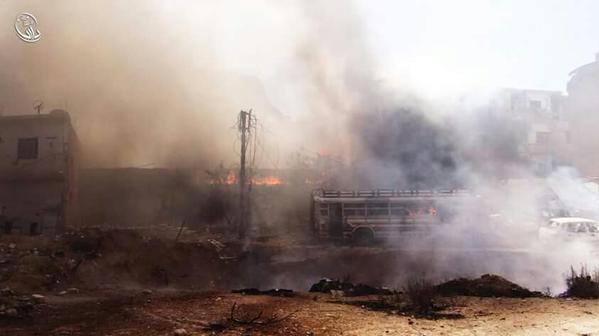
'Daraya after being shelled by missiles filled with napalm, August 11, 2015.'
Also, from Monday, demonstration in Atarib with Free Syrian flags,
'A demonstration in the city of #Atarib yesterday chanted for the Free Syrian Army and demanded that #Jabhat_al-Nusra leave the city and release detainees in its prisons.'
'The ultraconservative Ahrar al-Sham group says such a zone is "vital" and serves the interests of the Syrian people.'
Jabhat al-Nusra¹ hasn't been quite so positive, but seems to be staying out of the way, rather than trying to undermine the arrangement. Elsewhere, régime fronts seem to be collapsing in Hama², and now Daraa³. There are fears of a new régime massacre in the Damascus suburb of Moademiyah, one more way in which local truces have not been a way to bring peace, but "just facilitating the entry of people – the only benefit they received was returning to their destroyed homes to be placed under siege again."⁴ This⁵ seems like a reasonable view of the recent anti-Turkish campaigns by Kurdish groups, supported by much of the international left, leading one Syrian to exclaim, "Honestly - fuck western leftists who continue to fetishize rojava/kurdistan; fuck western leftists who organize and mobilize against the turkish government and ISIS, without also organizing against the syrian regime... fuck your hypocrisy, fuck your conditional solidarity, and fuck your unnuanced politics. tfou."
1. [http://foreignpolicy.com/2015/08/10/jabhat-al-nusra-abandons-fight-north-of-aleppo-as-turkey-and-u-s-plot-safe-zone/] [https://www.lawfareblog.com/statement-jabhat-al-nusra-about-recents-events-rural-northern-aleppo-turkish-intervention] 2. [http://eaworldview.com/2015/08/syria-video-feature-two-contrasting-images-of-regimes-retreat-from-hama-province/] 3. [https://yallasouriya.wordpress.com/2015/08/11/syria-the-southern-battle-front-fsa-begins-to-storm-daraa/] 4. [https://syrianobserver.com/syrian-actors/truces_fail_damascus_countryside_regime_flexes_control_rebel_held_areas.html] 5. 'The PKK and HDP wasted a historic opportunity for the sake of this unrealistic plan and chose to fight instead. They vastly overrated themselves and underestimated Turkey. Now in a panic, they are trying to portray themselves as victims so that the process can begin again. However, they are the ones who killed people in front of their families or while sleeping in their beds. And 80 percent of the Turkish public supports the operations against ISIS and the PKK.' [http://www.dailysabah.com/columns/markar_esayan/2015/08/11/why-did-the-pkk-and-hdp-commit-this-lunacy]
'One of the most puzzling aspects of this new phase of American involvement is that it is in no way expressly intended to provide protection for civilians. Yet it is precisely because civilians are not being protected that Isis has been able to grow.
It is hard, these days, to find any strong American high-level language denouncing the slaughterhouse that Bashar al-Assad has brought down on his own people. Nor is there any talk of an international tribunal that might deal one day with these crimes. Of course Russia would veto any of this, but why not at least expose Moscow’s complicity by raising the question of mass atrocities – not just chemical weapon use – in the UN security council?
In the case of Syria, a whole body of international norms meant to counter state-sponsored massacres of civilians has been put aside, including the notion of the “responsibility to protect” which was voted in the UN 10 years ago.
Obama’s apparent indifference to the plight of Syrian civilians – not just the fact that he failed to work out a solution – will be part of his legacy.'
'There is no doubt that any bets on the possibility of Al-Assad's regime surviving in Syria are a delusion because the survival of the regime poses more of a disaster to its supporters than to its opposition. This is because it has become a black hole that absorbs all of its supporters' resources and credibility while giving nothing in return. The Iranian government was sectarian and politically exposed and it lost the support of the people in the region due to its support of the regime's atrocities. Iran also lost Hezbollah by involving it in the quagmire. If the regime survives, it will only behave worse, thus increasing financial and moral cost for Tehran. This will only make Tehran drown, just as the Soviet Union sunk in the Afghanistan quagmire.
The continuation of the current situation in Syria would be impossible without Western support, and it will not continue since there is no desirable benefit in exchange for this support. The dangers that resulted from the survival of the Syrian regime and its policies did not occur due to a lack of support, but rather from the magnitude of the support for it. More support will only drag the West into the regime's quagmire without actually lessening the harms of its survival. It will only mean more displacement for Syrians (and perhaps even the Lebanese as well) who will head towards the coasts of Europe and contribute to the destabilisation of the area.
Whatever the case, the issue was decided with the launch of Turkey's equivalent of Saudi's Operation Decisive Storm which aims to seize areas under Daesh's control and hand them over to the moderate Syrian opposition. It also aims to create safe zones for both the opposition and the civilians. This will lead to creating conditions conducive to hastening the process of overthrowing the Syrian regime and secure a suitable alternative. Therefore, the "end game" will mean the end of the Assad regime. The wise in Russia and Iran understand this and are trying to turn this catastrophe into a gain before it is too late.'
'This is a message to the world from the revolutionists in Zabadani, a lovely city in Syria. Assad Regime is killing us and destroying our city. You are all responsible for our death. Your silence is keeping him strong. Remember, we only wanted to live in a free Syria. Syria for all Syrians.'
'From the start of the war, the Assad government has pursued a murderous policy toward Syrian citizens who happen to live in areas that have been seized by opposition armed groups. The apparent aim is to kill and terrorize civilians (and destroy civilian structures) so as to drive civilians from opposition-held areas and to send a warning of the misery that attends anyone whose neighborhood is taken by opposition groups. Mr. Assad is thus pursuing the “total war” strategy that the Geneva Conventions and the laws of war flatly prohibit and criminalize.
Beyond killing civilians, barrel bombs are playing a big part in forcing Syrians from their country. In most wars, civilians can find a modicum of safety by moving away from the front lines. But Mr. Assad’s indiscriminate use of barrel bombs deep in opposition-held territory means that for many there is no safe place to hide. That ugly reality has played a major part in persuading four million people to flee the country.
Yet the international community has made little effort to stop Mr. Assad’s barrel bombing of civilians. The two governments with the greatest potential to influence Mr. Assad — his principal backers, Russia and Iran — have refused to get him to stop. Western governments have been reluctant to exert strong public pressure on them because of other priorities — Ukraine, in the case of Russia, and the nuclear deal, in the case of Iran. The European Union is putting far more effort into stopping Syrian asylum seekers from reaching the Continent than addressing the root causes of their flight. The United States and Turkey recently announced a plan to make a 60-mile strip in northern Syria an “ISIS-free zone,” but the goal is to fight ISIS militants, not protect civilians.
Because of Western reticence, too few people understand the extraordinary slaughter that the Syrian military is committing with its barrel bombs. Mr. Assad’s chlorine gas attacks, terrifying as they are, kill a tiny fraction of the barrel-bomb toll, though they have recently attracted more attention than the barrel bombs.
One reason for soft-pedaling is a fear that ending the barrel-bomb attacks might undermine Mr. Assad’s ability to cling to power, and thus facilitate an Islamic State takeover. But barrel bombs are so imprecise that the Syrian military does not usually drop them near the front lines, for fear of hitting its own troops. They are useful mainly for pummeling civilian neighborhoods.
President Obama has reportedly been reluctant to act too decisively in Syria for fear that he might then “own” the country and the chaotic mess it has become. But firmer pressure on Syria, Russia and Iran to stop the barrel bombs wouldn’t make the United States responsible for anything other than fewer civilians dead, injured and displaced.'
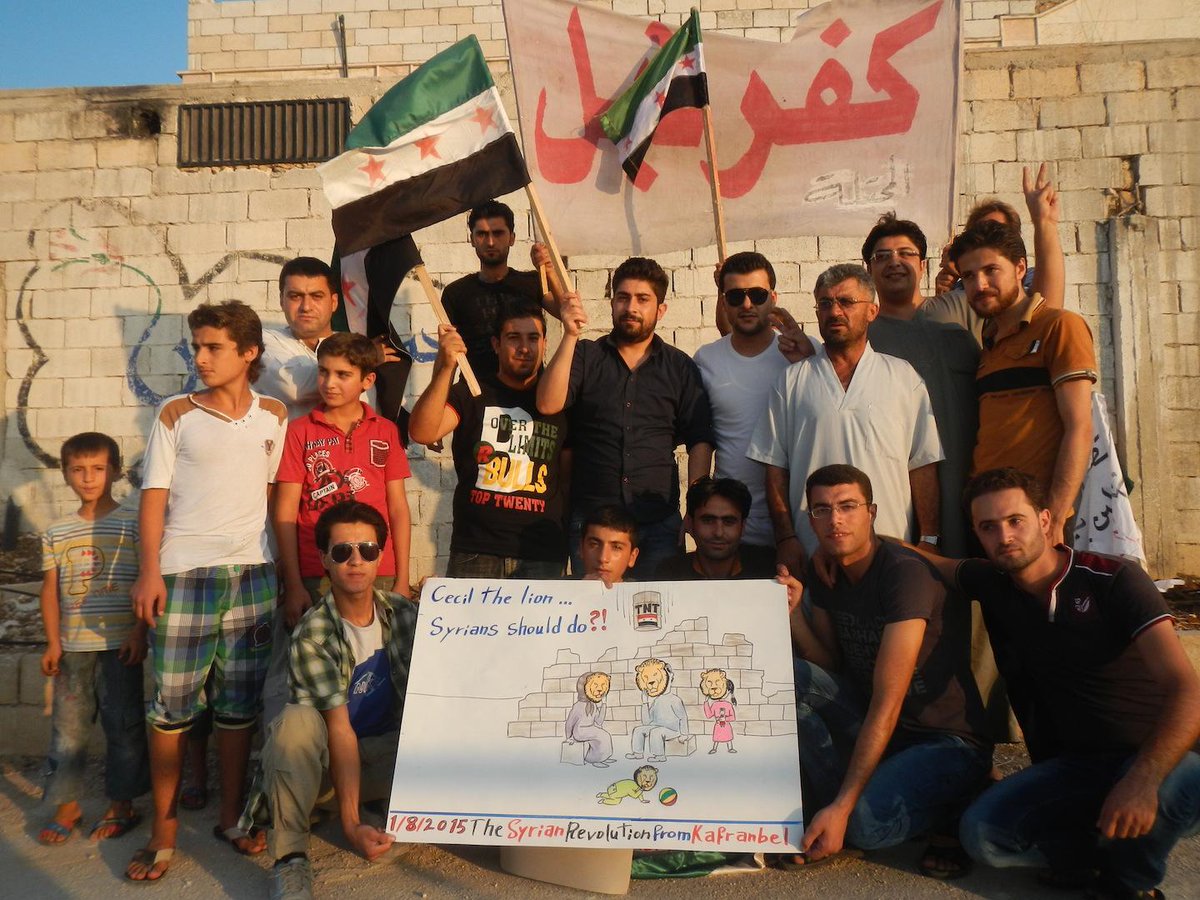
'I often wonder what is wrong with America. You do not hear stories like this in Syria, partly because we already killed all our lions but also because we killed all our dentists.
The hardest part was explaining to my eldest son why Cecil was killed. He asked if Cecil was a Kurd or a Christian, and I said no, sometimes people and animals are killed for totally unjustifiable reasons.
I must go now. The Shabiha have surrounded the building to either press gang us into the Army or execute us. No matter. If we die, we die knowing that the infidel dentist has been appropriately punished on Facebook.
Hopefully I will see Cecil in the afterlife, along with my grandparents who were murdered at the massacre in Hama.
To further complicate matters, the place of death for most of them is listed as "Syria" or "the shrine in Damascus," which is meant to back up the fiction that they were martyred while defending Shiite pilgrimage sites rather than, for example, fighting in Aleppo far to the north. The Qods Force and its Afghan/Pakistani recruits are spread thin and suffering significant casualties, spurring the deployment of the IRGC Ground Forces to Syria. Even so, Iran is unlikely to abandon its commitment to its proxy regime in Damascus in the short term. The Islamic Republic in general, and the IRGC in particular, have invested so much blood and treasure in the war that they no longer believe they can withdraw their support.'
* 'Given what is at stake in Syria -- the fall of Assad would dramatically complicate Hezbollah's supply lines from its Iranian patrons -- the militia is all in. If the past four years are any indication, the group will continue to hold its own against Sunni rebels along the border and serve as Assad's crack force in strategically important areas. As the war drags on, however, Hezbollah's operational stresses and limitations will become ever more apparent. Bolstered by Tehran and Nasrallah, Assad could hang on for some time, but even his most reliable Shiite allies may not be able to sustain him as the war's attrition increasingly highlights his demographic disadvantage. For better or worse, the only factor that may forestall his seemingly inevitable fall is the estimated $60 billion in sanctions relief that Iran stands to gain after a nuclear deal is inked.'
'Turkey has most readily provided Syrians, from all strata of society, with an opportunity to resume a sense of normalcy in their lives. Syrian engineers, agronomists and medical professionals are able to use their expertise to give back to their host country by working in one of the several non-governmental and international organizations that are based in Turkey and provide humanitarian assistance across the border. Others, with considerably lower levels of education, are hired in restaurants or as day laborers where employers can get away with paying lower wages. Even so, compared to the policies of most Gulf countries — Kuwait has banned entry for Syrians altogether – Syrians in Turkey are able to find work and send their children to schools. Refugee camps along the Turkey-Syria border, where more than 217,000 Syrians in Turkey reside, are considered to provide “better living conditions compared to those in other countries.”
Syrians often report being treated with disdain — at best, as guests who must eventually depart or, worse, as intruders who should be expelled immediately. Below the surface of the daily live-and-let-live miracles of Turkey’s support for Syrians as they attempt to restart their lives, one can sense the growing hostility from host communities toward the large Syrian populations living among them. Earlier this year, Turkish parents protested a school’s decision to provide afternoon classes to Syrian children; “Different culture, Different language, Different faith,” they chanted.
Many yet are hopeful they will be able to return to their homes in Aleppo, Idlib, Hama and Homs. While only a few are optimistic about the future, if and when the dust settles, they retain pride in and patriotism for their country and remain resistant. When I asked a Syrian friend of mine if he would like to move to the United States or Europe, his response was emphatic: “We were born in Syria, we started the revolution in Syria and we will die in Syria.” '
'Until early this year two of Syria’s players, the regime of Bashar Assad and Islamic State (IS), were in the ascendant. The tide against both has since turned. Recent analysis by Jane’s, a defence analyst, suggests that after a series of losses to both IS and other, rival rebel groups, the area fully controlled by government forces has shrunk since January by some 16%, to a mere 30,000 square kilometres (11,600 square miles), or barely a sixth of Syria’s territory.
And this was before a recent offensive by a coalition of mostly Islamist militias calling itself Jaish al-Fatah, which on July 28th captured the government’s last salient on the route linking Syria’s second city, Aleppo, to the coast. The advance, which follows the fall in March of a provincial capital, Idlib, and of another big town, Jisr al-Shughour, in April, further consolidates rebel control of Idlib province. Jaish al-Fatah now threatens both the surrounding rich agricultural region and the coastal mountain range that is the heartland of Mr Assad’s own Alawite sect.
Despite the fact that Turkey has long argued for a stronger international effort against Mr Assad, its formal entry into the fray is unlikely to tip the equation decisively against Syria’s regime. Iran, soon to be flush with funds unblocked by the lifting of sanctions, is for now at least still committed to propping up the Syrian leader. Even with better weapons and stronger momentum, Sunni rebels lack both the manpower and unity of command needed for a push towards Damascus, the Syrian capital. Some of their component groups, such as Jabhat al-Nusra, which declares allegiance to al-Qaeda, remain anathema to Western powers who might otherwise be keener to accelerate Mr Assad’s fall.
Despite its success at Palmyra, IS’s “caliphate” is an unhappy place, bludgeoned from the air by coalition strikes and shrinking in size. Kurdish forces have relentlessly expanded since breaking the jihadists’ siege of Kobane last winter, most recently seizing the town of Sarrin on the Euphrates River. While few expect any sudden collapse, many analysts believe that, barring some error by its enemies that would win it a flood of new allies, IS may have already peaked in size and strength.'
It might be said they can't push towards Damascus because the Americans won't allow them to.
There have been no barrel bomb attacks by Assad in Aleppo for two days, for the first time since 2013*, probably because of the threat of Turkish intervention in the area. Syrian refugees in Lebanon support** the Turkish proposal to create a safe zone in Northern Syria, in the hope they will be able to return home. If you read Patrick Cockburn you will hear none of this, as his project to make the horrors in Syria not about Assad once again requires blaming Turkey.
'Ankara’s objective is the precise opposite of Washington’s and little different from that of Isis.'
Get some proportion. ISIS want to set up a brutal caliphate, Turkey wants an end to the genocide in Syria, and the return of the refugees it has generously provided for. There is a bit of a difference.
'The Turks and their allies in Saudi Arabia and Qatar would like to rebrand the Jabhat al-Nusra and Ahrar al-Sham, movements, whose beliefs and actions differ little from Isis, as born-again moderates.'
We've been through this lie before. Saudi Arabia and Qatar have provided support for the FSA Cockburn has spent a lot of time pretending don't exist, but are prepared to acknowledge that groups like Ahrar al-Sham are part of the insurgency and can't be seen as a greater threat than Assad as the Americans do. They were greeted as liberators when they freed Idlib, they didn't chop one head off, they differ quite a lot from ISIS.
'Al-Nusra abducted Nadeem Hassan, the leader of a small faction trained by the US after careful vetting. And last year, al-Nusra wiped out two groups, the Syrian Revolutionary Front and Harakat Hazm, who were being trained and supplied by the CIA as “a third force” opposed to both Assad and the extreme jihadis.'
When these groups existed, Cockburn would pretend they didn't. When it was proposed that the US vet rebels, we were told that would be impossible. They weren't being trained as a force opposed to Assad at all, that is why the US cvould only get 54 of them.
'If US aircraft based at Incirlik are forbidden to attack Isis fighters when they are battling either the Syrian Kurds or the Syrian army, the militants’ two main opponents on the ground...'
Ignoring the FSA groups who have been fighting ISIS since the start of last year. I can't think of anything more likely to increase support for ISIS than the US acting as Assad's airforce.
'Close observers of the Syrian armed opposition in northern Syria say that it welcomes the Turkish attack on the PKK.'
I think we can assume that these close observers are enemies of the Syrian opposition, and no evidence for this lie will be found.
Richard Spencer has a rather better piece*** suggesting President Obama doesn't want to defeat ISIS until moderate Sunni forces are built up in Iraq and Syria. Joseph Daher has a poor one****, taking all the bad things about Turkey's relationship with the Kurds to pretend that Turkey is encouraging ISIS. *[https://twitter.com/IbnNabih1/status/627500310571950080] **[https://www.aa.com.tr/en/world/syrian-refugees-in-lebanon-support-safe-zone-proposal/21048] ***[http://www.telegraph.co.uk/news/worldnews/islamic-state/11776845/Barack-Obama-does-not-want-to-defeat-Isil-yet.html] ****[https://syriafreedomforever.wordpress.com/2015/07/22/the-terrorist-attack-of-daech-in-suruc-turkey-the-akp-and-the-turkish-deep-state-are-also-guilty/]
' "My son is too weak; my body doesn't produce milk (and) ... we can't afford buying milk," says Kutana al-Hamadi, whose 7-month-old son Almunzir suffers from malnutrition. "Our lives are miserable with no food, we only have this not-clean water to fill our stomachs with."
"We survived the barrel bombs in Syria but I'm afraid we won't survive the lack of health and food," she added.'
Patrick Cockburn this time starts his lies with the headline. The US isn't trying to build an opposition to the régime, but a mercenary force that will fight only ISIS. They've even insisted all recruits sign a pledge to only use US weapons against ISIS and not the régime.
'A Syrian activist and a second opposition source were quoted by agencies as saying that 54 fighters trained by the US were from Division 30.'
All 54 of the fighters trained by the US, Cockburn omits to mention.
'The US has been frustrated by the lack of any moderate military leadership opposed to Mr Assad’s government in Damascus.'
No, this is another lie. They have tried to get the moderates to fight ISIS and even Jabhat al-Nusra in preference to taking on the régime, without giving them any heavy weaponry, which are two reasons Syrians have seen more Islamist groups as more reliable.
'It has sought to re-brand itself as being less sectarian and less violent than Isis, saying that Alawites, Druze and other Syrian minorities would not be automatically massacred. But it still insists on their forcible conversion to its fundamentalist variant of Islam which is ideologically close to Saudi Wahhabism.'
It's four months since the Army of Conquest took Idlib. If there were forced conversions, we'd have heard about it by now. If they were chopping heads off like ISIS, refugees would be streaming away. Cockburn doesn't feel the need for any evidence for his assertions.
'There are attempts to present Ahrar al-Sham, with between 10,000 and 20,000 fighters, as being anti-Isis, which it certainly is, and a more moderate alternative to the jihadis, which it is certainly not.'
Again, fact-free.
'The US is eager not to allow Turkey to relabel Jabhat al-Nusra or its clones as suitable partners in an anti-Assad and anti-Isis front. In practice, it may be some time before any anti-Isis free zone is established because of these differences.'
So all other anti-Assad rebels are Jabhat al-Nusra clones. That saves the effort of knowing who these people are, they are all mad Muslims, stay away. If an ISIS-free zone is established, and it isn't only inhabited by the mad of the bad, I expect Cockburn will ignore his false prognosis as he usually does.
There's a more informed discussion of this incident at EA Worldview*:
'A local activist summarizes the situation for the US-trained rebels: Sending in the 54 and then bombing JAN a few miles away from their positions — implying the 54 acted as spotters for the US Air Force — looks like constructing a case that “See, all our well-meant support is hopeless”.
Good folks say the US was totally aware that the solely anti-Islamic State soldiers would find their butts in a Jabhat al-Nusra jail shortly after crossing the border. There’s only disagreement about the motivation of US actions: evil intention vs. plain stupidity.'
'For Iran, what is at stake in Syria is both huge and remarkably narrow: it is Hezbollah. For sure, the alliance with Damascus used to mean more than that for the Islamic Republic, namely, a significant foothold in an otherwise largely hostile Arab state system. Yet, as Syria turned into a failed state beyond repair, its status in regional politics shifted from that of key player to everyone’s battlefield. For Iran, therefore, the only value of those parts of Syria that remain controlled by Asad is that they constitute Hezbollah’s strategic depth.
There is no political solution in Syria without Iran, but the latter is unlikely to get on board in the foreseeable future. In practice, this leaves Western countries with two options: the first one is to alter the military balance on the ground so as to change Iran’s calculations by making its strategy unsustainable in the short term; the second one is to keep on uttering ritual calls for a negotiated solution during another decade of war.'
'The truth of the matter is not so attractive. The United States and its P5+1 partners elected to set aside raising slaughter in Syria and Tehran’s decisive role in facilitating with Iran to avoid complicating and perhaps undermining the nuclear negotiations.
Western leaders, beginning with President Obama, grasp with total clarity the fact that Assad’s scorched earth survival strategy that has made Syria safe for ISIL. They understand with certainty that every barrel bomb, every chemical attack, and every child starved to death is a recruitment lifeline to ISIL, both within Syria and around the world. They fully get it that Tehran’s unconditional support for Assad regime lawlessness highlights the operational bifurcation of Iran’s objectives toward ISIL: kill it in Iraq, where it presents a security threat to Iran and its Iraqi allies; keep it alive in Syria, where it remains Bashar al-Assad’s opponent of choice; their client’s potential ticket back to polite society.
To “sell” Syria to Iran would, therefore, be to deed much of the country to ISIL. Except when the regime finds itself sitting atop something ISIL wants—an oil field, an airbase, or a desert town filled with priceless antiquities—Assad and the pseudo-caliph find live-and-let-live far preferable to fighting each other. Instead, they focus their respective military energies on eliminating anyone offering an alternative to each. The caliph and Assad want to be the last two parties standing in Syria: Assad so he can confront the West with a “me or them” choice; the caliph so he can recruit around the world as the hero combatting the twin evils of Assad and Washington.
The other big winner in such a scenario would be Iran: its ability to support Lebanon’s Hezbollah from a secure portion of Syria would be assured. Unlike the canard that the United States is behind the creation of ISIL, the selling of Syria thesis is at least understandable if one appreciates the experiences and perspectives of those willing to reach such a profoundly negative conclusion. Syrians both inside Syria and around the world have felt totally abandoned by the West. They see a senior US official mark the twentieth anniversary of the Srebrenica massacre by tweeting, with no sense of irony, “Remember—and never let it happen again.” They watch the Assad regime and Hezbollah do the political equivalent of a victory lap in celebration of what they think their Iranian masters have accomplished for their benefit.
Mr. Obama has a war to win against ISIL and a vote to win in the US Congress. The common denominator in surmounting both challenges is Iran: specifically, its support of ISIL-sustaining mass murder by the Assad regime. Throwing sand in the gears of Assad’s mass murder mechanisms is essential to winning the fight against ISIL. It may also persuade some fence-sitting Democrats in the US Senate that the administration is not credulous when it comes to Iran.'
'More than 11,000 barrel bombs have been dropped since October, according to an announcement for the Security Council meeting, which was called by France and Spain. Bassam Alahmad from the Violations Documentation Centre in Syria said that 1160 civilians, 290 of them children, had been killed by barrel bombs since Security Council Resolution 2139 passed more than a year ago, calling for an end to these and other indiscriminate attacks.
Syrian President Bashar al-Assad denies that his forces have anything to do with these weapons, but Human Rights Watch says otherwise.
The government is the only party to the conflict with helicopters.
The rest of the world is still too divided about who is to blame to do anything to help.'
' “The oil trade between the jihadis and the Turks was held up as evidence of an alliance between the two,” The Guardian reported on Monday.'
So the US have raided ISIS, and we are told third hand that their intelligence services have found evidence that they were exporting oil through Turkey with the connivance of some Turkish officials. Compared to the evidence that Assad has not only been buying oil and gas from ISIS, but co-ordinating with them in attacks on Syrian rebels, this seems like a poor attempt to blame Turkey for what is going on in Syria, just as we got the story that Saudi Arabia and Qatar supported ISIS - with the proof that Joe Biden said it - last year, and the year before it was John McCain who supported ISIS, there were pictures to prove it.
'A young lawyer said something striking: “This is not just a revolution against Bashar al-Assad. It is a revolution for self-government. Replacing Bashar with someone else issuing decrees from Damascus — even someone much better than Bashar — is not acceptable.”
There are today hundreds of local councils throughout non-Assad parts of Syria. Some operate clandestinely in areas overrun by the so-called Islamic State. Some operate in areas where the Assad regime — with Iran’s full support — unloads helicopter-borne “barrel bombs” onto schools, hospitals and mosques. Some operate in neighborhoods subjected to Iranian-facilitated starvation sieges. These local councils are supported by a vast network of civil society organizations — the kinds of voluntary professional associations that undergird Western democracies. All of this is new to Syria. It is the essence of the Syrian Revolution.
The alternative to Assad is arising from Syria’s grass roots. That alternative needs to be nurtured and protected by the United States and its partners. And it needs to be connected to external structures recognized by the West as legitimate. Failure to do so to date accounts in part for bizarre concerns vocalized by Obama administration officials that Assad — the mass murderer — may fall too quickly. He cannot fall quickly enough. Yet those in governments who agonize about the seeming absence of alternatives have done far too little to nurture one. They have failed to connect the dots between would-be leaders in exile and those inside Syria who are leading a self-government revolution.'
' “We consider ISIS and the regime the same, the regime used to cut the heads of people – what ISIS is doing is not new – the regime burned people and they drowned people. ISIS took the matter of horrific torture from the regime. It’s like they are defying together who is more horrific.”
Imminent threats led Amin to flee his life in eastern Aleppo, he explains, joining the conversation. Amin was working as a physiotherapist treating civilians and members of the Free Syrian Army when ISIS arrived before New Years Eve last year.
“Death. Death for everyone,” says Amin, describing what it was like when ISIS arrived in eastern Aleppo.
“When ISIS arrived all I wanted was to leave. Leave, leave, leave, I felt like my life was threatened and I knew they would condemn me for treating Free Syrian Army people because they had already killed some of my colleagues and medical staff because they used to treat Free Syrian Army, who they consider the enemy.”
The U.S.-led coalition could bomb ISIS in certain areas, muses J, but are afraid to because of the oil and gas. He says if the international community supported the Free Syrian Army from the beginning, ISIS wouldn’t have formed.
He also pointed to western media as a source that’s indirectly helping ISIS by repeatedly showing its propaganda in the news, and by neglecting to show the efforts of the Free Syrian Army, and the impact on civilians in Syria.'
'The chemical gas spreads for a few kilometers — not like barrel bombs that hit one house. People are afraid about the life of their children and their [own] life.'
"This is Salah Tabbaa, Red Crescent aid worker from Damascus. He was detained for 4 months by the Syrian regime. Salah's tortured body was delivered to his family yesterday with an apology: we had the wrong guy with the same name."
' "Organising protests through the internet was our weapon at the time in the face of the tanks that had surrounded Daraa and Homs," said Ziyad.
They had called for a lifting of the siege imposed on the two cities through peaceful protests for six months, until security forces started shooting at protesters, saying that protesters had shot first.
The protesting youths decided to respond in kind, according to Ziyad, and began arming themselves with pistols, rifles and automatic weapons procured from Arsal in Lebanon. They began responding to regime fire on protests. However, it was notable that the army did not pursue them for about a month, only later launching a surprise attack against their neighbourhoods and homes.
However, the protesters overran army checkpoints in the Damascus countryside and seized their weapons. They started planning an operation to storm Damascus.
The plan did not materialise, as the regime employed a scorched earth policy in dealing with protesters. According to Ziyad, the regime would surround an area with tanks and then launch airstrikes against it. Hundreds of civilians died in this way, he said.
The father was told to remain silent or he would also be arrested. An unfortunate neighbour who was passing by their house was also arrested, as well as a teenager who asked what was going on.
Ziyad has suffered from an easily dislocated shoulder since his childhood, and when one of his torturers was dragging him, his shoulder became dislocated again. This discovery amused the soldiers in the room, and they pulled the shoulder out of its socket and replaced it several times just for fun.
Ziyad and his brother remained in prison for about three months, while their parents did everything they could, contacting influential people and giving around two million Syrian lira (almost $40,000 at the time) in bribes to secure their release.
The prison cell in which the brothers were held was only a few metres square, but held approximately 60 prisoners - unable to sleep due to the cramped conditions.'
'Haydara Sulaiman, son of the former Ambassador of the Assad regime in Jordan, wrote that on his Facebook account on a photo that shows Zabadani's civilians holding banner that says: " We want safe passage to the cemetery, to bury our martyrs."
Haydara, who has always been a big fan of Assad, replied to the sign saying (Cynically): "Why safe passage, we will provide you with bulldozers, fuel and matchsticks ... Don't be anxious!!!"
It's worth mentioning that Zabadani city is completely surrounded by the regime and Hezbollah, after it was the destination of displaced families who fled their houses in other areas. The city is under daily brutal shelling with vacuum missiles, barrel bombs and artillery that killed dozens of civilians, amid fierce resistance shown by opposition forces who are trying to stop regime from capturing the city.'
Note 11/5/25, original link to Mirror of Syria no longer functional.
February 2020. President Assad has gone on trial for war crimes and crimes against humanity at the International Criminal Court in the Netherlands, and leader of the Labour Party Jeremy Corbyn is being interviewed by the ever-smarmy Andrew Neil for the Daily Politics, just as the date of the General Election is due to be announced.
"Mr. Corbyn, President Assad has gone on trial for the most appalling crimes, documented in detail by members of his now fallen régime. You, as chair of the Stop The War Coalition, have denied his responsibility for those crimes, instead blaming Western intervention, and have even called friend his accomplices in Hezbollah. Why should the British people trust the Neville Chamberlain of our day, who would let the worst genocidal maniacs have their way, if he could only claim 'Peace in our time'?"
Syria is not Germany in 1939, the answer is not world war but to support those Syrians fighting Assad, but once Jeremy Corbyn and his friends in the Stop The War Coalition are finished destroying the credibility of left-wing politics for a generation, you would not know the difference.
If you're left-wing, and you aren't one of the handful that daily follows the Syrian revolution, you're going to think this is scaremongering. Because either you're part of the majority who still believe the conspiracy theories, like the US backs ISIS, or chemical weapons are just a hoax like Saddam's weapons of mass destruction. You'd all be in for a shock if you really cared about those things when the truth becomes plain in front of your face, but most will pass it off as not their fault, they were just trying to be skeptical or anti-imperialist, you can't blame them for that? The Syrians you didn't care about can, and will, and the region left the worst mess imaginable is partly there because you thought Russia Today, or the more sophisticated rendering of Patrick Cockburn, were a useful counterpoint to the mainstream media and politics driving us into another Middle East War, not realising that Western politicians didn't care about Assad, and the threat of military intervention was itself the hoax designed to stop us caring about Syrians.
Or you are one of the part-time supporters of the Syrian revolution. These people get very upset if you question what they've done to support the Syrian struggle, because they want to make it very clear that they aren't like those pro-Assad people, at least as long as their interest in Syria lasts. But when it comes to anything else they don't make the link. When it comes to Greece, it doesn't matter if you reprint the views of a supporter of the genocide in Syria. If someone is anti-Israel, it doesn't matter if they back Assad to the hilt. When it comes to British politics, it doesn't matter if Miliband lied when he claimed he stopped a war in Syria. Because Syria is an issue to keep in a box, and as long as you put the right label on it everything will be alright.
Those who've been following Syria day-by-day know this isn't adequate. Because Syria is different. In terms of the level, institutionalisation, and capitalisation of the violence. This is not just a repressive régime that tortures and murders a number of its opponents. It is one that is daily torturing and starving 150,000 people (and imprisoning another 50,000) more, in the most brutal way imaginable, and then selling survivors back to their families for large ransom payments. A régime like that can never be reformed to become less psychotic, too many of those running it have a stake and a responsibility for the way it is.
Many of those with a part-time interest in Syria will say they don't need to see atrocity photos, that they know what is going on . But until you know the real scale of the Assad catastrophe, and understand that this goes on daily and has only been getting worse as Assad has been allowed to get away with it, you aren't going to see that the failure to support Syria is going to to come to dominate politics as time goes on, and it is only by bringing out the truth and seeing the links that any sort of progressive politics can be preserved. You can't talk about the crisis of refugees dying in the Mediterranean without pointing out that it is Assad who has driven so many Syrians out of the country, that it is the failure to back his opponents that has left the crisis to spiral out of control, or you are irrelevant. Better than the people still dismissing the torture photos as CIA fakes, but when the right-wing, we'll intervene when we want to, backlash comes, that won't help much in holding it back.
And I've only talked about torture, there is also the barrel bombing, the chemical weapons, the mass rape, the sieges, the mass burning of crops, and a whole bunch of other crimes to consider.
I don't know if Jeremy Corbyn is going to be leader of the Labour Party. I don't see some shift to the left that has taken everyone by surprise. Perhaps hordes of Telegraph readers have handed over £3 to encourage the Labour Party down a left-wing road. If it wasn't for Syria, I'd be all in favour of him. I don't think any of his opponents will provide anything other than reheated Blairism. But I do think that anyone who thinks he is going to revive left-wing politics in this country is pissing in the wind. If there is going to be a progressive politics in this country, it will be one that has firmly rejected the politics of Stop The War, and clear that everything needs to be done to support the Syrian struggle, because otherwise we're all going to be portrayed as worse than Nazis.
'The administration’s current approach to Syria, however, is helping to ensure the fragmentation of the country; the present trajectory will not produce a future government of a unified Syria. Moreover, lumping Ahrar and Nusra together is intellectually sloppy, especially when they exhibit ideological and political differences.
This is not to say that the United States has no differences with Ahrar. There are many, with some, such as respect for human rights and respect for Geneva war conventions, quite serious. Ahrar will have plenty of complaints against the United States as well. Nevertheless, the larger question is whether the United States should open channels for dialogue, however difficult the conversation will be. Talking is most certainly not giving military aid or arming. Our refusal even to talk with groups like Ahrar further reduces the little influence Americans still have in Syria.
As the Assad regime steadily weakens, the administration keeps trying to lead the opposition from behind, hoping for an opposition white knight to appear. Instead, because Islamist groups like Ahrar strongly influence decisions about the fate of Syria, Washington will be left behind.'
This can cut both ways, towards helping the opposition, or to military intervention as the answer. At least the former solution is getting some airplay.
' "Some of us did warn that if we didn't deal with President Assad back in 2011-12 and were not seen to support the opposition properly, then more and more people would be drawn to extremist organisations — Al-Nusra, and now Isis," said Richards.
"We are our own worst enemy. We simply ignore problems," said Robertson, who urged the UK's politicians to do more to convince the public why the government needs to take military action. "Unless people are convinced there are things worth fighting for, then we'll be in trouble. We're faced with Isis now, it's a headline issue, it's horrifying." '
'Syrian generals have reported back to Damascus that the Western air bombings have been of no use to their own forces in repelling Isis.'
We can see that Robert Fisk's posture is unashamedly pro-Assad. Syrian generals haven't done much to repel ISIS themselves, perhaps those Western airforces should have been helping the Syrian rebels who do fight them.
'The Syrians abandoned Palmyra; military personnel left behind were later executed in the Roman ruins.'
And those Assad had locked up in Palmyra prison and tortured sometimes for decades, were freed, if they hadn't already been moved to another dungeon.
'It might have been better, needless to say, if we’d asked our Gulf Arab allies to stop sending weapons to the Syrian rebels who were giving them to the Islamists whom, in turn, we were bombing.'
It's just racism to claim that all these Muslims are the same and will give all their weapons to whoever is most extreme. None of these states or groups was giving weapons to ISIS, Jabhat al-Nusra, who have been bombed by the Americans, are still using all the weapons they get to fight Assad's forces.
'There is a Syrian air force, which will now be operating alongside the Americans.'
Assad's airforce don't bomb ISIS, though they occasionally bomb civilians in ISIS-controlled areas. The Americans aren't yet barrel bombing civilians in Aleppo and Daraa, so this isn't quite accurate.
He told Zaman al-Wasl about regime’s plans to sneak from the Arab Observers’ plans to free prisoners. “toward the end of 2011, we were told by new prisoners that Arab Observers Committee was due to visit Syria to help in freeing prisoners, to escape from that, the regime kept taking us out of the prison daily via buses from 8:00 am till 10:00 pm over 10 days period, we used to be 65 prisoners in a bus.”
Another incident about the regime’s attempts to escape from promises to free prisoners was when they were put in a basement form hours because the Arab Observers Committee wanted to do an urgent visit to prison. “There I met two old prisoner with long beard, I was shocked to know that they were not aware that Hafiz al-Assad had died and Bashar has become a president.”
The prisoner who was released on-bail after being accused of terrorism mentioned that he saw Khaled Taja, the well known over seventy years old Syrian actor detained in the same prison, he confirmed that Taja was cruelly tortured and once he saw him hanged from his hands when we were in our way to the bathrooms. He mentioned that he had not believed that Taja was in the same prison till he saw him in his own eyes.'
And what a history it has been. Four million Syrian refugees, eight million internally displaced, and three hundred thousand civilians dead, the vast majority at the hands of Assad’s murderous conventional war machine, tells only part of the story. The aftershock of that vote was felt further afield, as far as Moscow in fact, where President Vladimir Putin felt he could capitalise on the West’s lack of resolve to pursue his expansionist policy in Ukraine.
In Ahrar Al-Sham we have lost 700 of our fighters in battles against IS since January 2014, and we and our allies are holding a 45km front line against Isil in Aleppo. We know what it is like to confront the menace of Isil. But Cameron should be aware that any further undermining of the Sunni Arab interest in the region in favour of Iran and its proxies will only empower Isil. We believe that Isil is not only a security or military threat but a social and ideological phenomena that needs to be confronted on multiple levels and that requires a national Sunni alternative to both Assad and Islamic State.
Thanks to Ed Miliband’s posturing two years ago, the opportunity to deal an early blow to Assad and bring the conflict to an early conclusion was missed. Two years of inaction have only made things worse. Washington’s current policy of undermining the Sunni interest in the region while pandering to Iran is furthering weakening efforts to defeat Isil, rid Syria of Assad and bring about a political resolution to the conflict. As the RAF readies to join in the military coalition against Isil, Britain’s government would be wise to consider new approaches to fighting the extremist group that goes beyond just dropping bombs.'
'This infighting provokes the anger of residents in the rebel neighborhoods. Many blame these disputes, and the resulting lack of coordination, for halting the rebels’ advance. In more idealistic days, someone drew a mural on a wall in the Al-Ferdous neighborhood—it shows an F.S.A. fighter bleeding. The original caption read: “(People) forgive us if we make mistakes. We, the F.S.A., are dying for you.”
On it, someone added the word “liar.”
This anger boils when the sky starts raining barrel bombs.
Around me, men shouted, their faces strained and their words indistinguishable. Women wept hysterically. Children screamed. A policeman warned the crowd: “Civilians leave now! There’s a helicopter in the sky. He’s going to do it again!” The Syrian air force has a habit of following their first barrel bomb with a second. People say this is to kill first responders. (The government still denies that it uses barrel bombs.)
Despite this, the crowd did not run away. They dug in the rubble with their bare hands—old men, Civil Defense volunteers, and militants alike—all except the media activists shooting video. When they found a victim, they gathered to help snatch them out, screaming “Allahu Akbar” as they did. Once they laid the victim in an ambulance, they began to dig again.'
'For Syrians who for years have been on the receiving end of regime criminality, it is no doubt infuriating to see the reality of an ongoing holocaust trumped in Western policy circles by fears of a possible abomination accompanying the fall of a heartlessly cynical and brutal regime. For 12 million Syrian victims of regime atrocities the argument that Assad provides some kind of stabilization service is bewildering. For Syria’s neighbors—awash in refugees—the open-ended continuation of refugee-producing murder and mayhem can hardly be attractive.
Imagine how articulated fears about Assad “leaving the wrong way” are processed by those who have begged the West for protection, only to be told that their plight does not rise to the “never again” standard; that the absence of United Nations Security Council consensus and the primacy of a nuclear deal with Iran render them unqualified for protection by parties having the ways and means to provide it. Imagine the credibility of the US “train-and-equip” recruiting pitch to nationalist Syrian rebels: pay no attention to those who drop barrel bombs on hospitals, schools, mosques, and bakeries—come help us fight ISIL while we entreat Moscow and Tehran to support political transition in Syria.
Through barrel bombs, starvation sieges, torture, rape, and pillage they have implanted in minority communities a fear of vengeance; fear designed to bind these minorities to the survival of a regime that steals from them while sacrificing their children.
The result is that large scale acts of vengeance victimizing innocent civilians cannot be ruled out if the fall of the regime—the family and its inner circle of enforcers—creates a security vacuum. It is not at all clear that the departure of a corruptly incompetent clan would have such an effect. Yet the response to this challenge simply cannot be one of Western action or inaction, tacitly supporting Iranian efforts to keep the mass murder machine in place and well oiled. As long as that machine functions, ISIL will have a recruiting case to make to desperate Syrians. As long as the machinery of industrial scale homicide keeps humming, the peril to those held hostage by the regime will increase.
The message from Secretary of State John Kerry to his counterpart, Foreign Minister Mohammad Javad Zarif should be stark: stop the barrel bombing or we will. To avoid taking steps—diplomatic for sure, military if necessary—to protect Syrian civilians from Assad regime mass terror is to promote extremism and to imperil those Assad has taken hostage. Failure to protect Syrian civilians is the policy equivalent of endorsing Assad’s strategy: a strategy that kills the innocent, shames the West, and facilitates the work of ISIL. Only through inaction in the face of this real, ongoing outrage can fears of Assad “leaving the wrong way” receive the ultimate form of validation: the fulfillment of a bad dream.'