Friday, 22 May 2015

How did Hamas' expertise end up with Syria's rebels?


 ' "Today Hamas is in a tough spot. It made moves towards reviving ties with Iran and Hezbollah but they (Tehran and the Lebanese movement) have responded with coolness, demanding a high political price," said Khader.

 "Hamas is asked to publicly back Assad," said Khader, adding that such a U-turn could not be contemplated by the Palestinian movement, which wants its "stances to be based on principles, not opportunism".

 "Besides," Khader said, "the vast majority of people in Gaza are with the Syrian uprising, save a minority of leftists and some others who switch sides to what benefits them at any given moment." '

 Sadly, this is like many leftists everywhere, who have chosen blind opportunism over solidarity, which will put left-wing politics on the defensive around the world, when Assad falls, the full extent of his crimes becomes obvious, and people turn away from those associated with the politics of denial.

Syria: The Imperative of Protecting Civilians


 I don't think you can lump the Gulf Arabs and the Turks in with the Russians and Iranians, the latter have provided intermittent support to those fighting Assad's genocide, while the latter have facilitated it, but the rest is to the point.

 'Some two years ago, a senior White House official told visitors from Capitol Hill that there were no attractive parties in Syria: that there was merit in simply allowing the fire consuming the country to burn itself out. That civilians—many of them women and children—would be disproportionately incinerated in the resulting inferno seems not to have struck the official as morally relevant or policy pertinent. Yet now, as reports of regime shakiness begin to accumulate, some additional practical, policy consequences of having done virtually nothing to protect Syrian civilians from an Assad regime campaign of mass homicide come into focus.

 To put the matter succinctly, the willingness of the Obama administration to make do with moralistic rhetoric about Assad regime war crimes and crimes against humanity has led it to an astounding analytical conclusion: he who has authorized acts of mass homicide on a daily basis—Bashar al-Assad—ought not be removed from power too quickly lest Islamist rebels take Damascus and conduct massacres in communities involuntarily implicated by regime criminality. The barrel bombing, starvation sieges, chemical attacks, and door-to-door atrocities have been so widespread, so intense, and so unopposed by a hollowed-out West that now the specter of additional mass atrocities—perhaps genocide—transcending Arab Sunni Muslims presents itself.

 President Barack Obama continues to insist that the only alternative to leaving people utterly unprotected—the alternative he insists his critics favor—would have been the invasion and occupation of Syria. The President has misleadingly made it a matter of all or nothing, thereby justifying his choice of nothing.

 Whatever use a straw man argument might have as a here-and-now excuse for inaction or as an alibi for future historians, it fails the test of truth telling. No one has advocated invading and occupying Syria. Even the most dedicated advocates of protecting human beings from mass murder have not recommended such a step. Ways and means that are much more modest are available to an administration willing to transcend talk and do actual things. Examples abound.


 Is there a diplomatic strategy aimed specifically at persuading Tehran and Moscow to pressure their client into abandoning mass homicide? Has President Obama wrung from his military advisors every conceivable option—short of invasion and occupation, and even short of bombing airfields—to stop (or at least complicate) the barrel bombing and (if necessary) neutralize possible mass murder alternatives such as Scud missiles and field artillery trained on residential neighborhoods? Is there an ongoing diplomatic offensive aimed at binding regional partners to the creation of safe havens inside Syria? Is there a move afoot to transcend an anemic train-and-equip program by creating an all-Syrian national stabilization force capable of protecting Syrian civilians? If patriotic Syrians cannot find ways to overcome their divisions and unite against both Iran and ISIL while themselves pledging to protect civilians, they will lose their country forever. If Iranians, Russians, Turks, and Gulf Arabs see civilian vulnerability merely as an inevitable cost of doing business, Syrians should rise up against the lot of them.

 Giving the protection of Syrian civilians operational priority as opposed to lip service can save lives, build a foundation for political conflict resolution, and prevent ongoing mass homicide from assuming the additional dimension of genocide. Yet it will take more than words. It will take this President changing course. For as bad as Syria and its neighborhood are today, they can be immeasurably worse twenty months from now.'

Regime’s Idlib front collapsing


 What Assad has left are not supporters, but hostages. Hopefully many more will get the chance to escape when the pocket around Ariha closes.

 'Five regime troops in the hospital reportedly handed themselves over to rebels on Thursday afternoon.

 According to pro-opposition outlet Siraj Press, the surrendered servicemen told the rebels that morale among regime troops still under siege had collapsed due to a lack of food and water after attempts to air drop supplies failed.

 The servicemen also said that a number of soldiers who tried to defect had been shot by the officers present, which made the remaining servicemen fear making a similar attempt.'

Islamic State seize historic Syrian city

Newshour

 Robin Yassin-Kassab:

 "It's terrible that they do control half of Syria, but of course most of the area they control is desert. So they don't actually control much of the populated areas, so it's over-exaggerated. It's very sad that minds are focused on Syria, whenever these horrific pirates, these strange people with their black flags in ISIS, do something very photogenic, when they cut the head off an American, or when they destroy some heritage, then immediately everybody pays attention, but people haven't been paying attention to what's been going on otherwise, which is much more significant.

 Recently, a combination of the Free Syrian Army, the Islamic Front, and Jabhat al-Nusra, which is a jihadist group, have defeated the Assad régime in Idlib, in Jisr al-Shugour, in the Mastoumeh military base, at the Nasib border crossing in the south, at Tel Kurbi just outside Damascus; so there's a string of defeats for this régime, which has been propped up by Iran , mainly; Iranian occupation forces and Lebanese and Iraqi Shia militias backed by Iran; and the régime is now in the biggest trouble that it's been, that despite all of these Iranian forces, Lebanese and Iraqi forces, on its frontlines, it's losing battle after battle after battle. ISIS, the "Islamic State", has also been defeated by the rebels. The media rather lazily seems to equate ISIS with the opposition, but ISIS is really a third force which is exploiting the chaos in Syria to come in and expand where it can. It's really very unpopular amongst Syrians, as is the Assad régime.

 ISIS has been defeated by the rebels, who are at war with it, in the Qalamoun region, in Quneitra, in the Damascus suburbs, just in the last couple of months. On the other hand, ISIS is defeating the Assad régime in Palmyra, and a couple of days ago it defeated the US-backed Iraqi army in Ramadi. So at the moment the strongest player on the ground seems to be a combination of the Free Syrian Army and the Islamic Front.

 Recently, it seems that things have changed around. I think one reason for this is just the exhaustion of Assad's forces. He's really down to the foreign powers that will help him, and his very narrow sectarian base. The vast majority of the Syrian people have deserted him, his economy is collapsing, and he's running out of men. I think that's the crucial factor. The second factor is that the Islamic Front groups, that's different groups as well, and the Free Army groups, have recently been able to work together much better than they had ever been able to do so before. They've become much better organised, and much more cohesive. They've formed new alliances, one called the Army of Conquest, which has been winning so many battles in the north. So it's a sign, I think, of various things; it's a sign of the new cohesion of the rebel groups, a sign of the exhaustion of the Assad régime, and also a sign that Saudi Arabia and Turkey have put aside their differences, and Qatar as well, the regional powers have recognised the huge threat of Iranian troops in Iraq and in Syria, and how this is just expanding the Sunni jihadist appeal, and they've decided to give much more anti-tank weaponry to the Free Syrian Army."


 Before that, Jim Muir had said, "It seems that the bulk of the population has fled, certainly that's the government narrative." It isn't true*, just as they left the lower ranks to be massacred when they lost Tabqa airbase**, but it is easier to report the Assad version as the plausible Syrian narrative, rather than point out it has been a lie from Day One, which would involve more careful reporting.
* "The official line of the Syrian military and State media is that President Assad’s forces evacuated all civilians as they fled on Wednesday. However, residents have said only high-ranking military officers and their families, as well as some “collaborators”, were able to leave." [http://eaworldview.com/2015/05/syria-daily-civilians-trapped-in-palmyra-after-islamic-state-takeover/]
**[http://www.dailymail.co.uk/news/article-2736764/Marched-deaths-Sickening-ISIS-slaughter-continues-250-soldiers-captured-Syrian-airbase-stripped-led-desert-mass-execution.html]

Thursday, 21 May 2015

Western leaders must heed Syrian concerns


 "Return to the cause of all this evil, which is having a dictator that is terrorising his citizens and preventing them from having a free life. We must clean this wound before closing it."

 "Where is the revolution [in the media’s reporting]? It’s not our fault. The Syrian people keep fighting the regime but nobody cares about that now because they (the media) don’t want [to show] that."

 "Most of them (JN) are Syrians [so] when you (the West) fight them … when you bomb them, they get more supporters."

 "When America blacklists, the Syrian people [are starting to] whitelist."

 "Obama can cover the whole world in red lines. Who cares? We are dying here. And Ban Ki Moon? He is ‘worried’ all the time. Ban Ki Moon is worried, Obama is drawing red lines, everybody is talking and nobody is doing anything."

 "The regime are killing people [with barrel bombs] … and they (the West and its allies) didn’t stop them. But they moved the whole world to destroy [Islamic State] in Kobane."

The moment civilian crops began burning in Daraa


 'In this video, one civilian shows us around the southern Syrian city of Daraa, where he says government forces began burning precious crops in retailiation to rebel gains there.'

 Assad does this every year, as part of his "kneel or starve" policy.

Wednesday, 20 May 2015

Reporters on Syria's war


 ' “Usually barrel bombs come in the morning when you have a blue sky, so we wake up to this,” says Fouad, a media activist with a trim beard and flannel shirt who has worked four years in Aleppo.

 So why doesn’t he leave?

 “Because it’s our cause. It’s not a civil war, it’s a revolution and we are not terrorists,” says Fouad, who asked not to be identified further. “We lost so many friends and relatives, and this forces you to stay. If we leave, the regime will take over, or the extremists will be in charge.” '

Fears for Palmyra's ancient treasures


 'Even Syrian rebels were resting their hopes in the régime forces,' said Channel 4 News just now. It's a lie.

 “We’re trapped between a rock and a hard place. In me there’s a sense of deep resentment that this binary narrative that the regime has worked so hard to impose on Syria has actually finally paid off.

 They succeeded in fostering and encouraging and allowing to emerge such a horrible entity that when you put the regime next to them, the regime seems to be a more benign option than them.”

 21:40 Sky News, "In Syria, various militia are fighting each other."

Tuesday, 19 May 2015

"The Will to Survive" Documentary


Raed Fares:

 "While Assad continues his mad efforts to destroy Syria just because its people asked for freedom, the Syrians, with unbeatable will, continue building what that criminal destroys."

Syria's First Responders Say They Need a No-Fly Zone


 ' "The Syrian people have lost confidence in all the international community,
the Syrian people have been killed for 4 years and nobody acted seriously to stop the killing."

 Asked about the perpetrators of the chlorine attacks, Saleh laughed. "There are two options," he said. "Either it's the regime or the international coalition. We believe that the recent escalation from the regime comes as a reaction to the victories of the revolutionaries on the ground," said Saleh. "The regime applies a collective punishment policy to make revenge on the population that are supportive of the revolution." '

Monday, 18 May 2015

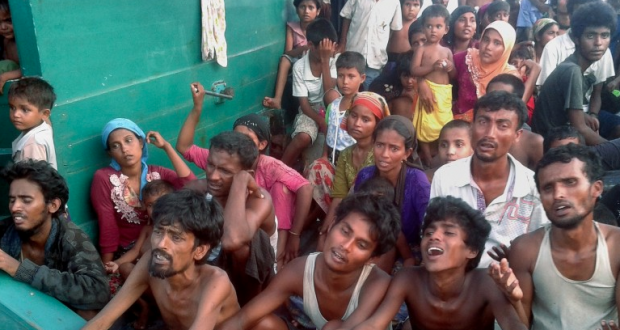
Syrian Rebels to Rohingya: Invitation for 500 Families Trapped at Sea

Syrian Rebels to Rohingya: Invitation for 500 Families Trapped at Sea

 ' “We know full well what it is like to suffer from hunger and anxiety. We can barely maintain what we have but as the Prophet said: ‘Food for 2 is enough for 3′. Hopefully we can stretch it bit more, but we can’t sit by and watch our brothers and sisters die at sea and do nothing.”

 Their plan is to convince Malaysian or Indonesian authorities to allow 500 families to come ashore and be escorted directly to the airport on a chartered flight to Istanbul wherein Turkish authorities would be asked to escort several chartered buses to the Turkish-Syrian border where they would be met and taken to a refugee camp on the Syrian side.'

Around-the-clock torture


 'Most prisoners of the Assad regime are referred to as "the vanished". These are people who were arrested at checkpoints, border crossings or in house searches and whose subsequent fate is unknown, says the Syrian lawyer Z. He estimates their number at 150,000.

 Conditions are particularly dire in the underground torture chambers operated by various intelligence services to which no one is given access, says the lawyer Z.

 He and several colleagues have been documenting the conditions in Syria's prisons for years. "About 100 prisoners are crowded together in cells measuring four by four metres. They can neither crouch nor sit, but must in some cases remain standing for weeks. The lucky ones are able to lean their backs against the wall," says Z. The prisoners are driven to the very limits of their physical and mental endurance. Some of them break down; others end up going mad. "There are prisoners who beat their head against the wall until they're dead." '

‘The whole school shook and I heard the kids screaming’


 "The regime wants to empty the opposition-controlled areas of Aleppo and punish those who continue to live there. Civilians have always been targeted. Every time the opposition controls a new area, civilian areas are bombed. The regime has bombed many schools."

Sunday, 17 May 2015

Do we value stones more than flesh and blood?


 Yvonne Ridley:

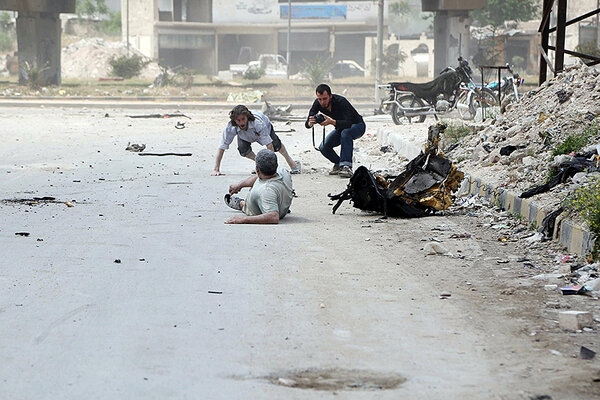
 'The real story to emerge this week is about the heroic team of "Syrian Truth Smugglers" who have risked their lives to gather and preserve documents that provide evidence of war crimes committed by the Assad regime, but apart from one story in the Guardian newspaper in London it has been largely ignored.

 To date, nearly a quarter of a million people are thought to have been killed in the Syrian civil war, more than double the death toll of the war in Bosnia two decades ago. Eyewitness accounts tell us that barrel bombs are still being dropped on residential areas and the torture dungeons are still jammed with men, women and children who are being starved to death, as well as being beaten and abused.

 And while the cruel axis of evil – Assad and ISIS – forge ahead with their continually crossing paths of destruction it seems that the media and politicians can only express their outrage over the threat of what amounts to a few stones.

 Yes, Palmyra is beautiful and we should be angry at its wanton destruction, but I put the life of one Syrian child above any ancient city; so should you if you value human flesh and blood above stone.'

 Palmyra is the location of one of the Assads' most notorious prisons*. You can see some pictures of Palmyra, as well as other parts of Syria's heritage, in this video.**
*[http://uk.complex.com/pop-culture/2012/09/the-50-craziest-prisons-and-jails-in-the-world/tadmor-military-prison]
**[https://www.youtube.com/watch?v=Kx4-hwVzoE4]

Tide of Syria civil war turns against Assad


 I don't know about 'warlords', and ISIS would lose any remaining legitimacy if there was no longer a worse alternative in the form of Assad, but generally the Telegraph is more accurate than the more liberal papers.

 ' “The Syrian regime is much more hollow at its centre than one might think,” said a well-connected Syrian businessman, who asked not to be identified. “It’s a house of cards surviving on the projected image that it can still win the war. But the officials I know have already packed their bags, ready to run should that impression collapse.”

 These developments spell neither the certain end of Mr Assad, nor the victory of his rebel enemies. But they reveal how four years of civil war have reduced the government to a shell. Power is concentrated in the hands of an inner circle of security chiefs - and their grip may not be as firm as the propaganda suggests.

 The setbacks also show how Mr Assad has been forced to rely on his regional ally, Iran, for men and money - at a cost of relinquishing much of Syria’s sovereignty.

 A diplomatic solution to the conflict would involve Mr Assad’s departure - probably to Moscow or Tehran - and a change of leadership, but the preservation of the regime’s institutions, including the deeply repressive security system that led many Syrians to join the first protests in 2011.

 Under this scenario - which may pass as the best case - the debilitating war of attrition would grind on even after Mr Assad’s removal. Power would continue to slip out of the hands of whoever occupied the presidential palace in Damascus, flowing towards the rebel warlords who now control large expanses of Syria.

 The insurgents would tighten their grip on their fiefdoms in the north and south, while Isil would hold on to the eastern region along the Euphrates valley. The slow and bloody disintegration of Syria would continue - with or without Mr Assad.'

Saturday, 16 May 2015

A Woman’s Harrowing Account of Torture and Abuse


 'I was studying at the Secretariat Institute when the revolution erupted in parts of Damascus. It started to become clear to me that this corrupt regime was killing innocent people for claiming their freedom and dignity and I decided to join up.

 I was held by the intelligence division for 47 days. I was questioned 19 times and every time they hit me on my face, then with a rifle they hit me on sensitive places on my body; they electrocuted me then put me in cold water then electrocuted me again. I died a thousand times each second. Because of the torture I confessed to things I had nothing to do with, like working with armed groups, and I told them random names that I made up. All this caused me to get in trouble for things I had nothing to do with. I still have marks of the electrocution on my body.

 Praying was forbidden for all religions, Muslims or Christians, but the majority were Muslims. The food was so bad – some days they brought us rice with bugs in it or old, freezing bulgur. We used to wake up every day to the smell of rotten bodies – people who had died from the torture. Nobody could say anything because it was forbidden to knock on the door of your cell unless you had something to add to your confession. Every day we saw no fewer than 12 bodies.'

U.S. President Obama in an interview with Al Arabiya


 Nadia Bilbassy-Charters: "Somehow it’s perceived in the region that you’re putting down the Sunni Arabs, that somehow you link them to extremists."

 Not immediately following, or it would be obvious -

 President Obama: "The problem we also have is that on the other side inside of Syria, we have extremists who may be opposed to Assad but also deeply opposed to the United States, are deeply opposed to the GCC countries; are interested in establishing a very destructive order and have engaged in the same kinds of brutality and violence that we don't want to see deeply entrenched."

 He's probably had his national security advisors tell him that Jabhat al-Nusra are just as bad as Assad or ISIS, so this may be as much down to ignorance and ideological preconceptions as mendacity. He doesn't have any problem with extremism when it comes to Saudi Arabia or the GCC countries. On what could be done to sort Syria out, he must know that it's a lie that the only options were an American invasion or nothing at all.

 President Obama: "If the United States simply sent in troops into Syria -- our military is very effective, and for a short period of time, we potentially could come down on the side of the opposition against Assad.If you look at the history of the process, essentially what they're arguing is that we should have invaded Syria and overthrown the Syrian regime."

 He should be criticised not only for not arming the Syrian opposition, the sort of action that could have seen the advances on the battlefield taking place now occur three years ago, and averted much of the destruction, but also for preventing others from giving them the weaponry they needed to change the balance of forces. But that is the sort of criticism he just ignores. And the diplomatic solution he's looking for isn't one that sees the overthrow of the régime, and the punishment of the war criminals, but one that keeps as much of Assad's state in place, and excludes as many Islamists as they can. If the rebels win, you can be sure he'll remind us that he called for Assad to go all along, but he's going to do as little as he can to help.

 President Obama: "People may criticize us for not having launched missiles against Assad after chemical weapons had been used, but keep in mind why we didn't. We didn't because they got rid of their chemical weapons.

 And that, in fact, was very important. It didn't solve barrel bombs. It didn't solve the incredible hardships that all the Syrian people are going through. But to solve those larger problems, that requires the kind of international work in which we are obviously a very significant part and a very significant partner -- and my Secretary of State, John Kerry, has been tireless in trying to arrive at a diplomatic solution to this problem."


Embedded image permalink

You fool our nation, I tear your picture


 'This same hand that hung your picture fondly and proudly on my office wall, considering you an icon and symbol of the resistance against the Zionist enemy is the same hand that tore your picture today with disgustedly and disdainfully.

 Hezbollah entered Syria to rescue the murderer Bashar Al-Assad and eliminate the Syrian people after the army failed to end the war in its favour. Nasrallah is bragging about his achievements in Syria and forgot all he, and his leader, Khamenei, had said in the past about standing by the helpless and vulnerable people in the world. Is the killer Bashar Al-Assad considered helpless and vulnerable while the Syrian people who revolted to demand their freedom and dignity are considered brutal tyrants who are stamping Al-Assad with their boots?

 Nasrallah and his party fooled us, but I thank God that we are finally seeing the light and they they are being exposed.'

Meet The Syrian Doctor Treating Aleppo’s Civilians


 'Khatib is the only doctor serving two hospitals in Aleppo. He says the supplies come from various international aid organizations. He has worked in four different hospitals since the start of the war. Two of them were shelled by the regime. He said a Palestinian doctor visited him two years into the war. 'He asked: “Why don’t you give the GPS coordinates of the hospital to the regime so they won’t hit it? We always do that with Israel,” ' Khatib recalled with a bitter laugh.

 He says he does not understand why Assad targets hospitals. “Why would the regime be killing the children? Why would the regime be killing the women, the old people? Why would they be hitting with chemical weapons?” He wondered aloud. “He (Assad) has crossed all the lines.”

Drawings from the edge of death


 'As a political refugee in Switzerland, Hani Abbas chose exile to escape Syrian security forces. Many of his fellow cartoonists and journalists had been assassinated, imprisoned or tortured.

 Abbas was born in 1977 in Yarmouk, a large Palestinian refugee camp in the suburbs of the Syrian capital of Damascus.

 Following the sudden disappearance of his two closest colleagues, who were tortured to death by the security forces of the regime, Abbas took advantage of the countrywide chaos and managed to cross the border into Lebanon with his family.'

Friday, 15 May 2015

Obama — “Assad Gave Up His Chemical Weapons”


 “Chlorine is not historically a chemical weapon.”

 The victims will be thrilled to know that.

The Muppet Show


 Jim Muir has a piece on the BBC website¹ that illustrate's Desmond Tutu's point, "If you are neutral in situations of injustice, you have chosen the side of the oppressor," and not in a good way.

 Let's start with the first couple of paragraphs.

 'Syria's President Bashar al-Assad has dismissed...', 'His Lebanese ally Hezbollah, led by Hassan Nasrallah, agrees...'

 So do we hear for balance from the Syrian National Coalition, the Free Syrian Army, or any other Syrians opposed to Assad and his foreign backers? No, we are told "some of his adversaries and critics" think his régime could collapse, an unnamed diplomat thinks he's on the ropes. So he appears the one with a plausible case, while his critics hide in the shadows.

 'Even some of his core constituents - and many ordinary citizens in Damascus and elsewhere - were deeply unsettled by recent regime losses, especially in the north-western province of Idlib, where the regional capital fell at the end of March to a rebel alliance, followed shortly by the strategic town of Jisr al-Shughour.'

 So ordinary citizens are worried that he might fall, rather than being the people who are fleeing in their millions from his bombing. This isn't really reporting the news, more catching up on what others had reported. Since the capture of Jisr al-Shugour the rebels have moved close to Ariha². As with the couple of hundred Assad soldiers trapped in the basement of the National Hospital in Jisr al-Shugour, there may be several thousand in Ariha with no way out, their capture or death would be a devastating blow to Assad's credibility. The rebels have also cut the highway to Hama³ in what looks like preparation to take the remaining régime-held areas in Syria second city, Aleppo. Incidentally, where Jabhat al-Nusra seems to have been excluded from the Fatah Halab coalition in Aleppo it seems to be happy with that, the division of labour seems like another sign that all the rebel factions are focusing on fighting Assad to the exclusion of other differences.


 'The absence of further rabbits to pull out of the hat is why some diplomats are cautiously hopeful that the low-key peace consultations launched in Geneva by the UN special envoy for Syria, Staffan de Mistura, might just bear fruit.'

 The Syrians have given a firm reply to this⁴:

 'Your positions and statements, especially the one which said Bashar al-Assad is part of the solution in Syria, have shown clear confusion in the way you deal with Syrian affairs. Your statements gave us a clear impression that you do not care about the massacres committed by the regime in Syria – such as the massacre in Douma that took place not far from your seat in Damascus, where you did not show any sign of objection or denouncement, and you also did not show any form of sympathy with the victims. This convinced us that the UN envoy had given up his neutrality, preferring one side over the other.

 The invitation lacks any clear foundations or means to reach a solution, especially as it is based on Geneva statement which did not mention the departure of Assad and his regime with all its symbols and pillars, a request upon which all the revolutionary forces agreed as the basis for any supposed solution.'

 Jim Muir isn't interested in this, the only objectors to the Geneva process he notes are by "the Saudis and their Gulf partners." That's because he sees Syria not as a revolution by Syrians, but as a proxy war⁵. While we're looking at his record, here⁶ he is from April 2014.


 'Equally, military victory by the fractious and feuding rebel groups is now a distant dream. Some of their regional backers may still want it, but the Western powers which pull many of the strings behind the scenes never did anyway.'

 While the regional powers were willing to go along with the Americans in neutering the revolution, this mutual alibiing could hide the truth that it was Assad who was relying on foreign backers, and the Western role was as a spolier not an enabler of the opposition.

 'By using their unique influence and penetration in Damascus to engineer the removal of Mr Assad and a transition to a figure acceptable as an interlocutor to the rebels and their regional backers, for whom the demise of the hated ruler is a must, the Iranians could at least hope to secure the "useful" parts of Syria rather than lose everything.'

 As we have seen, the removal of Assad, but keeping his régime in place is not acceptable to anyone in the opposition. How would any of the refugees return, with the torturers still in place? How could there be any stability with the many crimes of the régime unpunished? How could Syrians put up with any Iranian control over their country, after the ethnic cleansing they've engaged in⁷? The answer is they couldn't. So the UN process is either a way of betraying Syrians again, or at best a holding operation so the international community can be seen to be doing something.


 'Neither [Tehran or Washigton] wants to see a regime collapse and a sudden rush of more or less extremist Sunni Islamist elements to fill the vacuum.'
Washington has made it clear that it still worries more about Islamists than Assad.⁸ It is Assad who has created the sectarian problem, as Michael Young points out this week.⁹

 'Assad gave up any pretense of heading an Arab nationalist regime when, in 2011, he took the conflict in Syria in a sectarian direction. He always knew that by ordering his men to fire on unarmed protesters and labeling them Muslim extremists, he would provoke rising sectarian tensions between Alawites and Sunnis.'

 'Any ceasefire would leave Syria effectively divided into five zones of influence or control, some overlapping: areas held by government forces; "moderate" rebel forces; the Islamist al-Nusra Front and its allies; the extremist Islamic State; and the Kurds.

 If the removal of President Assad and his circle somehow paved the way for a truce between rebels and a regime under new management, all four of the non-IS forces could be motivated to go after the militants.

 The only major city in Syria controlled by IS is Raqqa, its headquarters. Analysts believe that if the other forces banded together under a joint operations room with US-led coalition air support, it would not take more than a few months to clear the militants out.

 That may seem like extreme fantasy now, but steadily-building pressures are likely to produce scenarios that are hard to predict.'

 It's a fantasy that only enables the extremists of the Assad régime to continue their genocide.


 'Most analysts rule out an outright collapse of the Alawite-dominated regime. As one put it: "They have nowhere to collapse to." '

 This again is the Assad narrative that Alawites and Christians will fight to the end to protect him. It ignores the way tens of thousands, including Alawites, have fled rather than be accomplices in genocide. It ignores that a rump state would lose international legitmacy, so the opposition could get the recognition and weaponry they need to finish off the war. It follows the pro-Assad narrative that Jabhat al-Nusra will murder all non-Sunnis if they get the chance., and that all those still in régime areas believe that, despite the fear still engendered by the arrest and torture of anyone who is alleged to be disrupting national sentiment. And what are the remains of Assad forces going to do when they can't retreat any further, just declare that the collapse isn't happening?


 While I'm at it compare Robert Fisk at the Independent a month ago,¹⁰

'Ten years later, and we still don’t know who assassinated Lebanon's leader'

 with now,¹¹

 'Rafiq Hariri tribunal: Was the former Lebanon PM's assassination the work of Syria's President Assad? A special tribunal at The Hague has heard dramatic new evidence apparently linking the Syrian regime with the 2005 killing of Lebanon's former leader – and it concurs chillingly with what Robert Fisk was told at the time.'

 The Independent must be edited by goldfish. Finally former Lebanese government minister has been sentenced for planning to carry out sectarian bombings in Lebanon for Assad.¹² It is Assad who has destabilised the region, not some combination of Western powers, and whoever the conspiracy theorists want to implicate this week. Samaha got 4 1/2 years, with time served he'll be out in December.


1. "Is Syria's war edging towards an outcome?" [http://www.bbc.co.uk/news/world-middle-east-32703945]
2. [http://eaworldview.com/2015/05/syria-daily-rebels-move-on-ariha-1-of-regimes-last-positions-in-idlib-province/]
3 .[http://syriadirect.org/news/rebels-assault-regime-supply-lines-in-hama-ahead-of-aleppo-showdown/]
4.  [https://web.archive.org/web/20150515133422/http://syrianobserver.com/EN/News/29173/Revolutionary_Factions_Reject_De_Mistura_Geneva_Invitation
]
5. [http://notris.blogspot.co.uk/2013/04/syria-proxy-war-heats-up-as-endgame.html]
6. [http://notris.blogspot.co.uk/2014/04/analysis-why-assad-can-have-confidence.html]
7. [https://syriadirect.org/sunni-activist-says-iran-behind-demographic-change-in-damascus/
]
8. 'However, the official told VOA that the US was wary of any no-fly zone because it meant involvement with rebel factions and thus — because of battlefield cooperation — the Islamist group Jabhat al-Nusra: “Jabhat al-Nusra is a designated terrorist organization, we are prevented by U.S. law from working with the group.”

He also cited the supposed dangers of others in the Jaish al-Fatah rebel operations room, which was launched for the successful rebel offensive in northwest Syria and is now being implemented in other parts of Syria: “Other militias [Jaish al-Fatah] in the Army of Conquest like Ahrar-Sham may not be designated terrorist organizations and we may consider them more gray, but it is a gray which is pretty close to black.” ' [http://eaworldview.com/2015/05/syria-feature-senior-us-official-no-fly-zones-safe-havens-are-not-happening/]
9. [https://web.archive.org/web/20150515002118/http://www.dailystar.com.lb/Opinion/Columnist/2015/May-14/297874-bashar-assads-perilous-dance-with-iran.ashx
]
10. [http://www.independent.co.uk/voices/comment/ten-years-later-and-we-still-dont-know-who-assassinated-lebanons-leader-10171414.html]
11. [http://www.independent.co.uk/news/world/middle-east/rafiq-hariri-tribunal-was-the-former-lebanon-pms-assassination-the-work-of-syrias-president-assad-10245381.html]
12. [http://www.theguardian.com/world/2015/may/14/ex-minister-bomb-plot-conviction-lebanon-shady-ties-syria-assad-mamlouk]

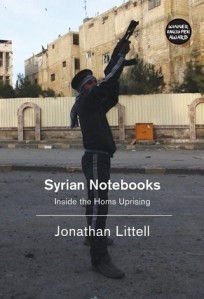
An Account Syncopated by Death: Littell’s Syrian Notebooks

syrian notebooks

 Robin Yassin-Kassab:


 'Reporting from Syria has been cursed by journalists who embed with the regime’s army or fall prey to regime-planted conspiracy theories. Littell mentions an article penned by Georges Malbrunot for Le Figaro blaming the Free Army for journalist Gilles Jacquier’s death “on the basis of an anonymous source in Paris citing an anonymous source in Homs.” Similar blame-the-victims hoaxes were retailed by Assad’s useful idiots after the Houleh and Ghouta massacres.

 Littell’s account is unembedded, and his narrative – pared down to the physical, psychological and political details – is never gullible. He records an informational chaos in which contradictory versions swirl, and remarks, for example, on revolutionaries feeding al-Jazeera a false report of captured Iranian officers – they turned out to be engineers working at a power plant. The civilian Media Office, then still clinging to the revolution’s non-violent image, persistently obstructs Littell’s investigations. The armed resistance is more helpful, though it too betrays anger that foreign coverage doesn’t translate into solidarity. “The period when we showed things is over,” complains one officer. “If your peoples haven’t understood for eleven months, there’s no point.”

 Littell travels not by permission of the regime’s security grid, but via the “counter-grid” which circumvents it, a network including revolutionary Christians, an Alawi resistance fighter, and a woman who, having lost three sons to Assad, has vowed to cook for the fighters daily. He drinks syrupy whisky with a man who “believes in Karl Marx the way others believe in Jesus or Muhammad,” and affectionately finds the Free Army to be “novice guerillas; novices in PR, above all.” '

Thursday, 14 May 2015

Doctors in Hellish Aleppo Ask the World for More Help


 'Following the release of an Amnesty International report accusing Bashar al-Assad’s government of war crimes in Aleppo, the city’s few remaining doctors are appealing for more assistance to treat hundreds of wounded people.

 The northern city has witnessed some of the most gruesome deaths and the worst destruction of the conflict. The government has systemically attacked the city’s civilian areas, notably with barrel bombs – filled with explosives and shrapnel and designed to kill and maim as many people as possible – leading Amnesty earlier this month to accuse the Assad government of committing war crimes and crimes against humanity in the commercial capital.

 Notably, the government has repeatedly targeted field hospitals in its aerial campaigns, not only in Aleppo, but in other cities such as Raqqa. Overall, the Syrian Network for Human Rights has documented the destruction of 200 hospitals across the country by the government since July 2013.'

Wednesday, 13 May 2015

Heartbreaking images of Syria's child refugees


 'Ahmed, 8, is blind. He lives in a plastic tent with his family and dreams of getting an operation so, one day, he can see. ‘There’s a rubber tire outside our house that I like to play with. But sometimes it rolls away and I can’t find it,’ he said.'

Smuggled Syrian documents enough to indict Assad

Bashar al-Assad

 'The prosecution cases against the Syrian leaders focus on their role in the suppression of the protests that triggered the conflict in 2011. Tens of thousands of suspected dissidents were detained, and many of them were tortured and killed in the Syrian prison system.'

 Many thousands more are still being tortured and killed.

Tuesday, 12 May 2015

Mayhem in Middle East as Blair plays the Invisible Man


 Once more Eamonn McCann brings us pro-Assad propaganda, unchecked for any veracity.

 'In Syria in September 2013 the residents of a Christian village, Maaloula, which had been overrun by al-Qaida-aligned Islamic extremists, appealed for and were given arms by nearby units of Bashir Assad's army. They had been horrified by credible threats from the invaders to destroy two of the most ancient Christian sites in the world.'

 There was no credible threat to destroy Christian sites in Maaloula. ' "Imad, said there had been 32 churches in Maaloula and claimed that "all of them have been destroyed" - although it was clear from the vantage point near the monastery that in fact churches were still standing, albeit with signs of damage and some burning.'

 It was all part of the Assad régime's diverting attention from its campaign of mass murder against Sunni Muslims in Syria.

 'The government recently facilitated reports on the presence of ruthless Islamist fighters in Maaloula, a town of Christians, whom the regime depicts as under threat from the rebels. Meanwhile, thousands of Syrian civilians mass in camps in the north, unseen on Western television screens, as they flee from salvoes of regime rockets.'
[http://notris.blogspot.co.uk/search?q=Maaloula]


 Eamonn's next paragraph contains multiple untruths.

 'At the time, under pressure from Israel, Saudi Arabia and elements in the US Congress, the Obama administration was contemplating a bombing campaign against Assad in retaliation for a chemical weapons assault on a suburb of Damascus which had killed dozens (at least) of civilians and which was widely attributed to Assad.'

 It's just a lie about Israel. Like Saddam's weapons of mass destruction, there is just no evidence for it whatsoever. At the time the story was put about that hundreds of AIPAC [the main pro-Israel lobbying organisation in Washington] staffers were being sent to Capitol Hill to argue for US airstrikes, it simply didn't happen. Israel has maintained a policy of neutrality in the Syrian conflict, as worried about a jihadi takeover of Syria as Eamonn McCann appears to be. There was a story that a UN report showed co-operation between Israel and Jabhat al-Nusra (or in the more lunatic version, ISIS). I've read that report. The Israelis handed over two boxes, probably of medical supplies from the context, to people not even positively identified as Nusra. And the Israelis treat Free Syrian Army casualties, not those of Nusra, and certainly not those of ISIS who fight against the Free Syrian Army rather than Assad, in their hospitals, because the Assad régime has bombed every hospital in rebel-held areas of Syria.
http://notris.blogspot.co.uk/search?q=hospital]

 The Obama administration didn't contemplate a bombing campaign, but a few token airstrikes to get off the hook of having announced red lines over Assad's war crimes, and doing nothing to enforce them. It went to Congress for the same reason Cameron went to Parliament, to get someone else to say no to military action. As I wrote at the time:

 'If the Left claims that thousands will die in carpet bombing, that depleted uranium will be scattered across Syria, that American soldiers will be dying to help al-Qaida, and none of these things turn out to be true, it will discredit the Left, and because the Left does not control the media, that impression will stay for a long time, and when the US does want to intervene, the pendulum will have swung back to it being easy again for the US to do what it wants. And if the situation in Syria takes another step towards Hell, then there is a greater likelihood that American, French or British power will be brought to bear on Syria, rather than the empowerment of those rebels that we just don’t know about from what we’ve read in the press.'
[http://notris.blogspot.co.uk/2013/09/dominoes.html]

 The hoax that the US was going to attack Syria was designed to divert attention the means that could have empowered Syrians, giving them anti-aircraft missiles, which would have stopped the barrel bomb attacks, stopped the refugees fleeing from the bombing, and left Assad without a strategy to maintain terror in Syria.

 And then there's the chemical weapons denial. There is no evidence that the rebels used or possessed any chemical weapons, and it is ludicrous to suggest that the rebels would have gassed themselves to provoke US intervention, a suggestion reminiscent of Israeli claims that Arabs don't care about human life. Especially as the proposed agent, Jabhat al-Nusra, is completely opposed to US intervention in Syria. I believe they had no presence in the areas of Damascus attacked, and would certainly have been noticed by the forces of the Free Syrian Army and the Army of Islam who were. And against the idea that Assad had no reason to use chemical weapons, he has since carried out daily attacks with chlorine bombs, and despite the deal to remove his chemical weapons stockpile (which the Israeli prime minister Benjamin Netanyahu is on record as approving), traces of VX and sarin are still being found at Assad's facilities.
[https://web.archive.org/web/20150510050142/http://uk.reuters.com/article/2015/05/08/uk-mideast-crisis-syria-chemicals-exclus-idUKKBN0NT1Z120150508]


 It is one thing to ignore Assad's genocide against Syrians, this really is in the realm of Holocaust denial, though without the gap of seventy years it is even less plausible and more offensive. And 1500 civilians were murdered, many of them children sleeping on the ground floor because their parents feared for them if the upper floors were bombed, not dozens.

 The rest of the nonsense in this piece may be more easily picked apart by those expert on the particular subjects. The Saudi war are not acting as a US proxy in its war against the Houthis, the US want a ceasefire to go along with their nuclear deal with Iran, which is one reason the Saudi king is refusing to attend a summit with President Obama and sending his crown prince instead. This language of proxies has been a mainstay of pro-Assad propaganda about Syria, the reality is that the rebel forces are overwhelmingly Syrian, and have received minimal support from the outside world, while Assad would not have survived this long without a billion dollars of weaponry each month, and since 2013, tens of thousands of Iranian, Lebanese and Iraqi sectarian mercenaries.

Monday, 11 May 2015

AP rare glimpse as Hezbollah fights for mountain range


 It's not rare for Western journalists to be embedded with Assad's forces, like Patrick Cockburn and Robert Fisk of the Independent, or Jeremy Bowen of the BBC, and report their view that this is a civil war against terrorists, rather than a revolution against tyranny. It is those Assad and Hezbollah have been bombing mercilessly who have trouble getting their story told in the world's media, because Assad murders and tortures journalists, as do the barbarians from ISIS he has encouraged to take over the liberated areas.

 'Some 3,000 militants are in the Qalamoun region, almost equally split between the Nusra Front and the Islamic State group, a Hezbollah commander recently said in Beirut.'

 Those from Nusra, and all the other rebel groups that Assad and his tame journalists pretend don't exist, have been fighting ISIS in the Qalamoun. Hezbollah has no intention of fighting ISIS there.

 ' "The situation is better than perfect," one smiling Hezbollah fighter said, speaking along with others anonymously as part of the conditions Hezbollah set to allow AP journalists to make the trip.'

 So they don't tell us that Hezbollah have already lost 7 commanders and another 40 troops in this operation before it has barely begun.


 'Christian politician Karim Pakradouni told Hezbollah's Al-Manar television station Sunday that "the battle should be carried out no matter how much it costs because it will end terrorism in Lebanon." '

 Hezbollah ally told Hezbollah's TV station.

 ' "Only Hezbollah is responsible for the repercussions of its involvement in the war at the service of" Assad, said Hariri, who lives in self-imposed exile in Saudi Arabia and France.'

 There is a Special Tribunal for Lebanon at the moment investigating the murder of Hariri's father, Rafic Hariri, by Assad in 2005, so his exile might be seen as a little more than self-imposed.

Sunday, 10 May 2015

Life in Syria for Christians


 'My colleague, Salam Al-Haddad, jumped in. He’s a Sunni Damascus native who has been volunteering at Zaatari since fleeing Syria two years ago. He asked the kids if they knew the story of the Caliph Omar. They shook their heads.

 He told them how the Caliph Omar, the second caliph of Islam, made his way to Jerusalem to sign a peace treaty that said, “… the inhabitants of Jerusalem are granted security of life and property. Their churches and crosses shall be secure. This treaty applies to all people of the city. Their places of worship shall remain intact. These shall neither be taken over nor pulled down. People shall be quite free to follow their religion. They shall not be put to any trouble.”
So, Salam asked them, if the Caliph Omar wanted to protect Christians and their places of worship, shouldn’t we want to do the same?

 The kids stared back at Salam and me, a Muslim and a Christian standing there side by side. I waited as our message sunk in. They seemed to be absorbing the idea that Syria could in fact belong to both Muslims and Christians.

 “Now who wants to rebuild both a Mosque and a church in our arts activity to rebuild Syria?” I asked. They jumped from their seats and gathered in small circles around the art supplies I had laid out for them on the floor as they shouted “Me! Me!” I looked at them pass around markers, glue sticks and cardboard while planning the design of their “new town.” '

Saturday, 9 May 2015

‘No-one helped Syrians; they’ve only helped Assad’

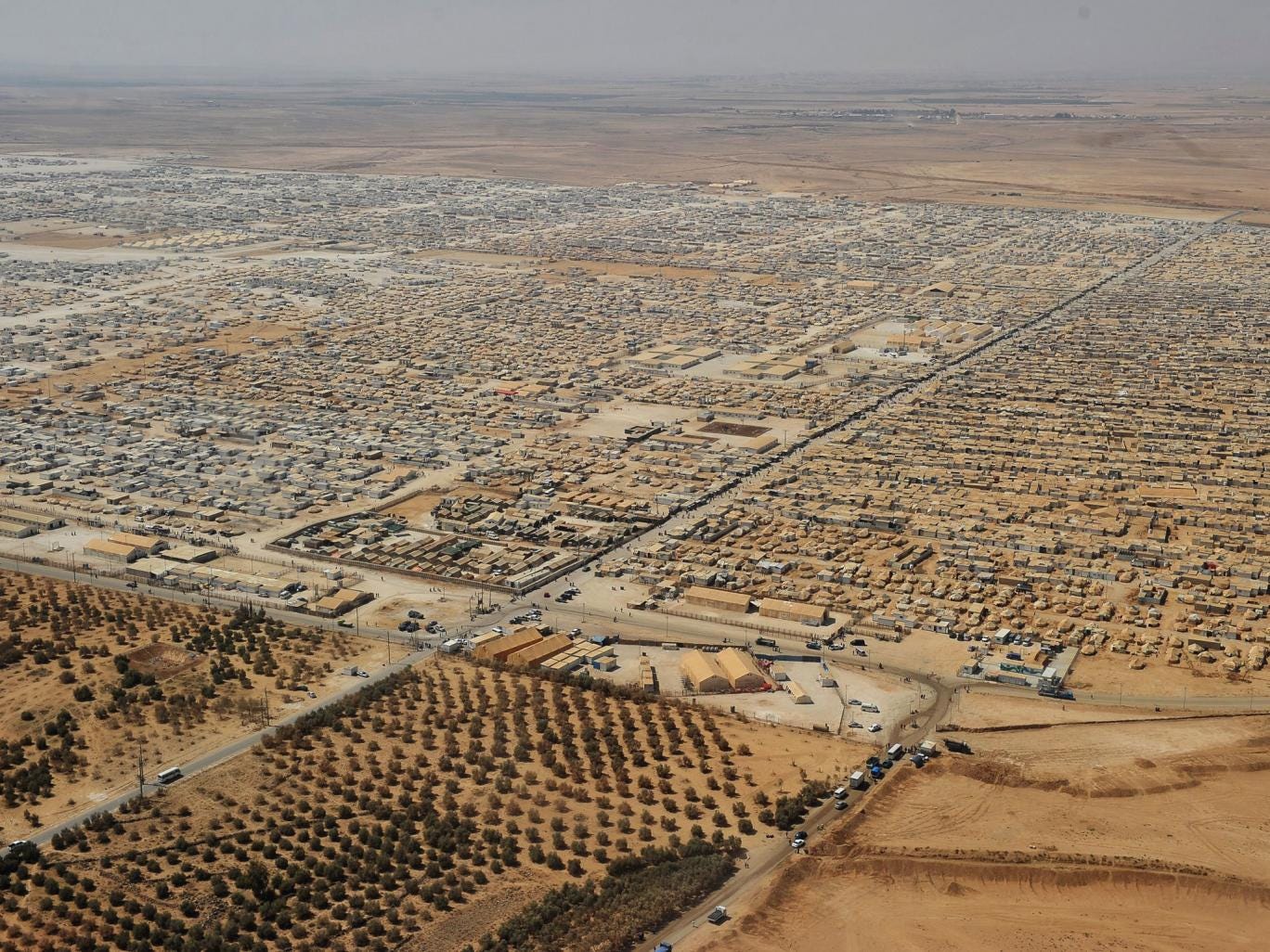
The Zaatari refugee camp near Mafraq, 8km from the Jordanian-Syrian border, is home to more than 80,000 Syrians

 “When Isis was created Europe and America directly got together with Nato and entered into Syria. But for three years Assad has massacred his people. And no one moved. Why?”

 I've just seen Kevin Ovenden, a former assistant to the Assad supporting George Galloway, write this:

 "The people fleeing to Europe are overwhelmingly from Syria, where Western policy has helped ensure social collapse in large parts of the country."

 It's very much the lie that Western support for the opposition rather than the lack of it has destroyed Syria and created the refugee crisis that makes Syrians so bitter about the West.

ISIS mostly skipping Qalamoun battles, focused on Arsal


 ' “ISIS’ main objective is to end the existence of the FSA, and attack Arsal,” the source said. “It might not have won the battle of Arsal, but ISIS worked and is succeeding in weakening the FSA in some areas.”

 After suffering major losses in Iraq’s Tikrit, the bulk of ISIS fighters in Qalamoun have withdrawn to Syrian territories following instructions from senior command. What was originally a fighting force of approximately 2,000 militants has been reduced to 400-450, the source said.
“That is why remnants of this battalion are putting the fight on the FSA, to force them to push allegiance, corner them or make them settle with casualties to reduce pressure on their forces on the eastern side of Qalamoun,” explained Mario Abou Zeid of the Carnegie Middle East Center.

 ISIS’ focus on the FSA during the current battle is also “an indicator of how much the Syrian regime is deeply connected to and interacting with ISIS,” he added.

 According to sources in Qalamoun, this relationship is also reflected in how ISIS receives its supplies, which must cross regime checkpoints on its way from Raqqa.'

Idlib, the Regime, and Militia Politics


 Darth Nader inserts a note of caution into the discussion about rebel advances.

 'The fall of the Syrian regime is not imminent. Assad’s forces are stretched thin and he is probably weaker than ever before in relative terms. Yet, his “core” provinces of (central) Damascus, Homs, and Latakia are, at this point, not under threat. If any of these places were under threat, that would be cause for the regime to sound the alarm. The capture of Idlib city and Jisr ash-Shughur can possibly be read as a step towards that, yet, we need not overstate it as a leap. It is a small step. Defeating the regime in one of the areas it considers peripheral is very different than defeating it in one of its core provinces.'

 Certainly the most loyal troops and the most military equipment are reserved for the core areas. But I don't believe morale as opposed to fear of Assad is much higher in the areas. Unlike in 2013, ther is no prospect that the shoring up of the régime gives it long-term prospects of survival. The recent scare about top officials and their families being relocated to Lattakia will return the next time that Damascus is threatened, who is going to fight for a dictator who abandons you to continue his fight? I am also reminded of Bill Hicks' routine about Saddam's élite Republican guard.*

 Darth Nader has something else important to say.

 'While it may not be the greatest threat to the regime, opposition control of Idlib—particularly the city—can have great strategic value if the opposition makes use of the opportunity to show that they can effectively and inclusively govern.A civilian and locally governed Idlib would indeed be a strategic blow to the regime in terms of what the alternatives to its rule are. While it may be naive to think that civilian residents can wrestle political power away from battle-hardened militias, the embeddedness of some of the militants in local society suggests that it may not be as unlikely as it has been in other areas, as fighters may be more responsive to local concerns and demands.'

*[https://www.youtube.com/watch?v=KWdxV8JRnUQ]

Wednesday, 6 May 2015

An Army In All Corners


 This is a little out of date, coming before the recent rebel victories.

 'These manpower limitations have led Assad to adopt a military strategy of an ‘army in all corners’ which involves the establishment and defense of remote regime outposts throughout Syria in order to pin the outer bounds of a contiguous post-war Syrian state. Assad likely hopes that this strategy will enable him to avoid decisive defeat while still outwardly claiming to control all of Syria, eventually translating into international political legitimacy.'

 And how his legitimacy has been prolonged by those like Patrick Cockburn, who claimed that he still has substantial report because he still held most of each of the provincial capitals. And this is why the idea that Assad could retreat to an Alawite sectarian state consisting of Damascus, what's left of Homs and Lattakia, are a fantasy, once the opposition can present itself as an alternative national leadership, they will get the recognition and the weaponry to finish off Assad in short order.

 'Bashar al-Assad is neither a viable partner against the Islamic State (ISIS) nor the “least worst option” for U.S. national interests in Syria for three reasons. First, the Assad regime cannot control the territory that was Syria or win the Syrian war decisively. Second, the Assad regime is Iran’s strategic asset in Syria and Assad is beholden to Iran for keeping his military viable. Third, Assad’s brutal tactics and humanitarian abuses have accelerated the growth of jihadist groups regionally and globally.'

 That's true.

 'Allowing the Syrian regime to conduct its military campaign with impunity sows the seeds for generations of regional disorder to come and empowers the expansionist designs of the Iranian regime. The U.S. does possess additional cards that it could place on the table for resolving the Syrian conflict, including the imposition of a No Fly Zone over opposition-held areas or an expedited effort to train-and-equip Syrian opposition fighters alongside regional allies. If U.S. policymakers do not adopt a more forceful and focused approach to Syria, the only foreseeable outcome is a fragmented and failed Syrian state which menaces its neighbors and brutalizes its people.'

 Or that the Syrians might win their freedom without outside help, which is another reason for the US to change course, so they aren't as despised in post-war Syria as the Iranians and Russians will be.

Rebels liberate Quneitra town from Daesh


 'Rebel forces have completely liberated the town of Qahtaniya in Quneitra province from Daesh (ISIS), killing dozens of the foreign mercenaries and extremists in fighting.

 Daesh had adopted its customary practice of waiting until rebel forces liberated Qahtaniya from the Assad regime before arriving to brutally occupy it and impose its usual rule by terror.

 Even if this repeated pattern does not prove direct coordination between the regime and Daesh, it is clear that both wish simply to impose dictatorship and to kill rebel forces and anyone else demanding freedom. Rebels continue to fight both for long-awaited Syrian freedom.'


 Note 6/5/25, link appears to be original, but does not include all the text.

Tuesday, 5 May 2015

Syria’s Rebels on Winning Streak


 'Western-backed militias saw their arms supplies and cash from Washington reduced significantly or in some cases cut altogether. U.S. officials argued this was performance-related or punishment for their fighting alongside hardcore Islamist brigades and al Nusra. Rebel commanders suspected the cuts were designed to force rebels to leave their brigades and enlist in the U.S.-planned train-and-equip program for the raising of a Syrian rebel proxy force to take on the Islamic State, still widely known as ISIS.

 Anger at the West and the Gulf states hasn’t subsided. Rather, it has turned to disdain.
Inspiring this new-found coordination among the rebel militias that have made such gains is the realization that they can’t rely on anyone but themselves. Their attitude, emphasized to me by several rebel commanders and fighters I have spoken with over the past week, is that the World has let them down and so it is up to them now.

 Western analysts have given credit for the capture of Idlib and Jisr al-Shughour to ramped-up support from Riyadh, Doha and Ankara. But the commanders here insist their recent gains, including the capture of Idlib, which is only the second provincial capital lost by Assad in this war, are not the result of outside assistance.

 “What did we get from them?” sneers a rebel commander with Jaish al Fata, or the Army of Conquest, which is what the new rebel alliance began calling itself on March 28. “The Turks speak a thousand lies. Most of our weapons are those we seized from government forces or arms that were supplied by the Gulf a year and half ago. We got nothing from the Gulf or Turkey ahead of this offensive. These are our victories, no one else’s.”


 Is it possible, likely or credible that Al Qaeda affiliate Jabhat al Nusra will split with its parent organization? The success of the offensive in Idlib is adding impetus to the debate within Jabhat al Nusra about precisely that subject. Several rebel commanders and Syrian opposition figures say it is highly likely that al Nusra will soon break apart formally, roughly along the lines of local vs. foreign fighters, with the former opting out of the infamous terrorist affiliation.
“I think it will happen soon,” says Muhamed Nabih Osman, who oversees a charitable association for former Assad prisoners. “You have to understand that al Nusra consists of two very different parts and that one part, mostly local fighters, are not interested in global jihad.”

 “The West is living in detached world of philosophical ideas,” the former engineer says, speaking slowly and methodically. “They want us to conform to their ideas but we can disagree with them without being extremists. Thousands of people are getting killed and they are worried about what happens after Assad and they want to teach us about democracy and women’s rights. They don’t provide safe havens or no-fly zones for the civilians who are being slaughtered in droves. All they worry about is who controls Syria after. Syrians will.” '

'Unthinkable atrocities' documented in report on Aleppo


 'Bashar al-Assad’s Syrian regime is committing war crimes and crimes against humanity by systematically using barrel bombs to kill civilians and destroy infrastructure in Aleppo, says Amnesty International.

 “Both sides are violating international humanitarian law and must be held to account. However, throughout the more than four years since the crisis began, government forces have been responsible for the large majority of violations and crimes.

 Their responsibility for creating one of the worst humanitarian disasters in recent history cannot be overstated. This crisis started with the state’s brutal crackdown on peaceful protesters. Its response seemed tailored to send the message that they would stop at nothing to quash dissent.” '

Fresh UN-backed talks to begin in Geneva

Syria rebel fighters in the area of Medaa town in the Eastern Ghouta of Damascus. 4 May 2015

 ' "By relentlessly and deliberately targeting civilians the Syrian government appears to have adopted a callous policy of collective punishment against the civilian population of Aleppo." '
That's why there is no negotiating to be done with such barbarians, just ways to be found to bring their reign of terror to an end.

 'In its new report, "Death everywhere: War crimes and human rights abuses in Aleppo", Amnesty says there are "horrendous war crimes and other abuses in the city by government forces and armed opposition groups on a daily basis". The report also documented "widespread torture, arbitrary detention and abduction" by both sides.'

 What Amnesty* actually say is this:

 'Civilians in the city of Aleppo, Syria are being subjected to appalling human rights violations committed by the Syrian government and many armed opposition groups. According to Amnesty International’s research these violations amount to war crimes and in the case of those committed by the Syrian government, are so systematic and widespread that they constitute crimes against humanity.'

 Can you spot the difference? Crimes against humanity committed systematically by the Syrian government, versus some war crimes committed by some rebel groups.

*[https://www.amnesty.org/en/documents/mde24/1370/2015/en/]

Monday, 4 May 2015

Syrian children killed in government barrel-bomb attack

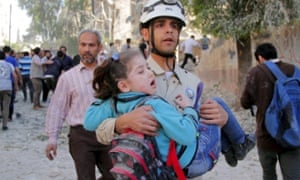
A civil defence worker rescues a schoolgirl after what activists said was a barrel-bomb attack by forces loyal to Syria's president Bashar al-Assad in Aleppo.

 'Rebel authorities accused the regime of “barbaric” targeting of schools and kindergartens in the city as a protracted conflict for Syria’s largest metropolis intensifies.

“They call these the terrorists,” one volunteer says in a video as he wraps one of the children in a burial shroud.'

Rebel worry: How to control Islamists


 ' “The Americans didn’t support the battle of Idlib,” said Mohamad al Ghabi, who claims to command a moderate force of 3,600 that includes 100 officers and 2,000 military defectors. “But they supported the battle of Jisr al Shughour and the Ghab valley.”

 That support came in the form of TOW anti-tank missiles and other military and logistical support. Ghabi, whose Sham Front is not among U.S. aid recipients, said other organizations that fought at Jisr al Shughour had U.S. supplies.

 “After four years of disunity, we came to the conclusion that if we are not united, we will not be able to defeat the regime,” said Ghabi. “So even if we don’t agree in our thoughts or our ideology, we must agree on the military task. We all share the same goal: toppling the Assad regime.”

 They worry the Islamists and Nusra will attack Christians and Alawites who’ve backed Assad. “We are expecting trouble after Ariha,” he said. “Where will the Fateh group go after Ariha falls? They will go to our areas, mixed areas.”

 One hope, Ghabi said, is more help from the United States. “If you give me support for 10,000 fighters, I will change the dialectic of the whole area,” he said. “We have professional officers. If we have support, we can rebuild the Free Syrian Army. In this case, people will come to the conclusion that there is an alternative to the regime of Bashar al Assad.” '

Saturday, 2 May 2015

At least save the Nepalese


Here are all of the problems with the reeling Syrian army


'A plunge in Syrian Army manpower

Declining support for the government

Government infighting

The regime is almost broke

Security is failing in Damascus

The rebels have consolidated'

Are Syrian Islamists moving to counterbalance Al-Qaeda?


 “We eagerly want to talk with the West and to show them what we stand for, but our total allegiance is to the revolution and toppling the regime. If the West doesn’t want to help us with this and receive our requests [for meetings], we’ll turn to others who do.”

How a new rebel unity is making headway

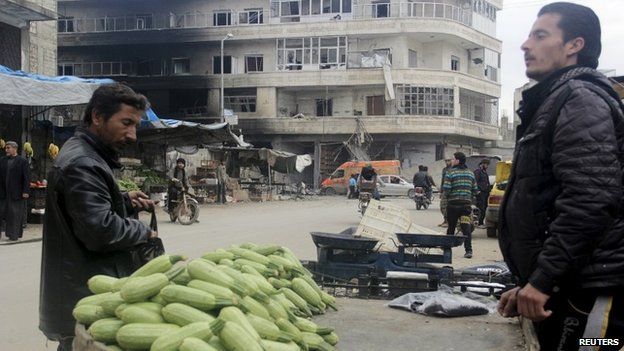
A man buys courgette from a stall in Idlib, Syria (1 April 2015)

 Lina Sinjab has done some of the better reporting for the BBC on Syria.

 'There were fears that the rebels would seek to implement a strict interpretation of Islamic law, or Sharia, but instead they established civil councils to oversee law and order, and public services.

 An audio message purportedly by al-Nusra's leader, Abu Mohammed al-Julani, declared that the Idlib would be governed according to Sharia, but Mr Hamidi believes its application will be limited.

 "To my knowledge, Saudi Arabia and Qatar put pressure on Julani to ensure al-Nusra's approach would be a moderate one," he says.

 Hadi al Abdalla, a citizen journalist who reported on the battle for Idlib from the frontline, says Western media coverage has mistakenly focused on the presence of al-Nusra.

 "For the first time all the groups here are united and they insist that they want civil rule rather than Sharia rule," he explains.'

Syrian activists reveal torture at hands of al-Nusra


 'The torture inflicted on him was not by the regime. It was by rebels supposedly on his side – another grim example of how Syria’s revolution is now consuming its own children.'

 What a load of nonsense. After last week's passing on of a Pentagon press release* about the "Khorosan" group the US has invented to justify bombing Islamist rebels against Assad, Kim Sengupta follows up with this crap. Never mind that the Assad has murdered tens of thousands of children to stop the revolution, far more important in denigrating that revolution is that an activist was arrested by Jabhat al-Nusra, tortured, released with a warning, and now plans to go back to Aleppo. And Sengupta uses his personal contact with James Foley to mix in executions by ISIS with all of this. A disgrace. It is obviously worrying when Jabhat al-Nusra does things like this, though there is no sign in this report that such incidents might become rarer now that Nusra is co-operating with other groups in Northern Syria; that's because the report is promoting a pro-Assad worldview - all the rebels are mad jihadis, there is no revolution - posing as concern.
*[http://www.independent.co.uk/news/world/middle-east/syria-conflict-khorasan-return-with-a-fresh-influx-of-fighters-awaiting-the-order-to-start-shooting-the-birds-10196611.html]

Friday, 1 May 2015

Shared battlefield goals trump ideology among rebels


 'Islamists have signaled that they are no longer determined to fight against Western-backed groups.

 “Maybe Nusra fought ... Hazzm at the start, because they said they were no good. Now they have a plan to fight only the regime,” Mazin Qusum, commander of the Siham Al-Haqq brigade, an Islamist unit fighting alongside the Army of Fatah, told Reuters in the Turkish border town of Reyhanli.

 In a sign of cooperation, an arm of the Western-backed opposition government in exile, the Syrian National Coalition, has been given the responsibility for health and education in areas the rebels have recently captured.

 Sitting in Istanbul with Division 13 and Fursan al Haq commanders, a representative of Ahrar al-Sham’s political office, Abu Mohammed, stressed unity.

 Asked whether Ahrar al-Sham would impose Sharia law in areas it controls - usually the central mission of militants - he said: “We and the others, when we liberate all of Syria, we will meet and determine what kind of law there will be.”

 Abu Hamoud, a commander from Division 13, said his group coordinated with Nusra Front, which the United States considers a terrorist organization, but this does not mean it is aligned to it.

 “It is completely stable in Idlib province, there will be no fighting between the brigades,” said Abu Hamoud.

 Hossam Abu Bakr, spokesman for Ahrar al-Sham, said the group would defend Division 13 if Nusra attacked it without the right to do so. He rejected any suggestion that the alliance was extremist.

 “Our first goal is the fall of the criminal regime and then to build a country which... preserves our identity far from extremism,” he said via Skype.'

U.S. allies in Middle East ramp up support for rebels


 'Saudi Arabia and Turkey, with an assist from Qatar, recently ended a long estrangement to address their shared concern over the lagging fight against Assad.

 Regional officials insist that the aid, including U.S.-made TOW missiles, is not going to the Islamists. Instead, they said, it is enabling moderates to enhance their stature among opposition fighters after years of being outgunned and out-financed by more militant groups.

 The new approach could undermine three years of U.S. Syria policy focused on securing a negotiated settlement to the war by putting enough pressure on Assad that he feels compelled to make compromises, but not enough to score an outright opposition victory that might result in chaos and cause Syria to collapse even further.

 Many now argue, however, that the United States needs to take more risks in arming the rebels if it wants to stay relevant.

 “The Turks, the Saudis and the Qataris are trying to shake it up,” said Robert Ford, a former U.S. ambassador to Syria. “If you don’t want them to increase arms shipments, what is your solution? The answer can’t be ‘We’re going to bomb Daesh.’ ” '