Thursday, 21 January 2016

Why Is It So Difficult for Syrians to Get Into the U.S.?


 'The al-Haj Ali family comes from Khirbet Ghazaleh, a town of 16,000. It is 15 miles from Daraa, where the revolution against Assad began, in 2011, after his security forces arrested and tortured a group of students for writing antigovernment slogans.

 The al-Haj Ali twins were only 13 at the time. They had nothing to do with the protests. Nor did anyone else in the immediate family. Although they listened to news reports of the Assad government’s ferocious attacks on civilians, they saw little indication, at first, of the violence around them. There was the odd black helicopter in the sky. And once, when Waseem was taking Azizeh to driving school, they watched a group of protesters carrying olive branches stream out of Daraa. Only later did they realize these were people fleeing a massacre by Assad’s forces.

 Then the airstrikes began. Government security forces raided the family’s home dozens of times. Their cousins, who lived next door, were imprisoned and tortured. Still, the al-Haj Alis hung on; they adapted to living in a war zone, spending evenings in the dark. Then, one morning in August 2012, they learned from a television news report that Azizeh’s brother, a high-ranking official in Assad’s military, had defected overnight to Jordan. His family would most likely be punished, with death, in his stead. He hadn’t warned them. He couldn’t: His phone was bugged, and sending a message would only have further endangered them. The al-Haj Alis never slept at home again. Within days, they left Syria for Jordan by car. Azizeh feared they’d be unable to make it across the border and was even more terrified that the names of her family members would be on a blacklist and that they would be arrested. Mahmoud handed their keys to a neighbor whose house had been flattened by airstrikes. ‘‘If we’re not back by sunset,’’ he told her, ‘‘you can have our house.’’

 If Ahmad and Mohamed had stayed in Syria, they might be dead by now — either killed by the Assad government’s barrel bombs or fallen among the young men who have joined up with the Free Syrian Army. When one of their friends or cousins fighting with the F.S.A. is killed, the boys study the photographs of his death, often posted on Facebook in tribute, with a mixture of envy and guilt.'

Wednesday, 20 January 2016

Women Are Active Behind the Lines in Syria's Civil War


 'Women in the city of Deir Ezzor have supported the Syrian revolution in various ways since its beginning. During the early stages of the revolution, women held active roles, including those that were viewed as exclusively male-dominated, such as carrying weapons in the armed opposition.

 In March 2011, the first demonstrations calling for the Syrian regime’s ouster took place in Deir Ezzor. Women started to join the protests alongside men early on. By the summer, women had a significant presence in the protests.

 “When the armed revolution started in Deir Ezzor and the opposition brigades took over the city’s central neighborhoods, the regime tried to retake the city but failed,” she said. “Without warning, it started brutally bombarding those neighborhoods. The attacks forced the residents to leave their homes and migrate to other cities.

 “Work then became limited to carrying weapons to fight the regime or working in field hospitals,” she continued. “Because of that, women’s presence was limited. However, some women carried weapons briefly during the Republican Guards’ campaign to stop the protests. One well-known woman was a nurse known as Um al-Thuwar [Mother of the Protesters], because the youth of the Free Syrian Army (FSA) considered her their mother.’’


 In January 2013, after the regime siege had lasted several months, the armed opposition freed the al-Huweqa neighborhood’s eastern entrance and used it to transfer supplies in and out of the city. This marked the end of the siege and the beginning of what the city’s residents call the “period of freedom.”

 During this period, women had the freedom to work in other fields as well. For example, the rights organization al-Mar’a wa al-Tifl Hayat was established in June 2013 in Deir Ezzor’s al-Ummal neighborhood.

In an interview in Urfa, Turkey, Baida’a al-Hassan, the organization’s director, explained, “Our activities focused on raising awareness of women’s rights. We held seminars in our center and visited women in their homes. The organization also started two training centers. At the first we taught sewing and at the second, called Ahla Talla, we taught hairstyling.

 “The purpose behind these centers was to teach uneducated women professions so that they would be able to support themselves,” al-Hassan continued. “Additionally, the organization established the Shaady Rabbah School in al-Hamediya area and the al-Amal Kindergarten in al-Ummal. Through these two schools, we managed to secure jobs for many unmarried women.”


 “On July 14, 2014, ISIS seized a neighborhood in Deir Ezzor city and shut down all the civil society organizations, including ours, and confiscated our organization’s equipment. We stopped operating for two months,” Heba said.

 “However, the extremist group and its horrible treatment of civilians would not stop us from working,” she continued. “We decided to go back to our activities, but with a new approach. We used to hold public seminars, but today we hold them secretly inside homes with a limited number of attendees. We cannot assemble large groups of women because the whole operation might get discovered.”

 Heba emphasized that one of most important issues discussed during these seminars is how women can change their behavior to protect themselves from ISIS. Another topic is how to turn away an ISIS “suitor” if he proposes to a woman. That matter has been, and still is, a danger to women of Deir Ezzor.'

Russia Is Bombing Syria’s Children


 'Abdel Rahman was standing outside his family home in the tiny Syrian village of Marayan on a November afternoon when the Russian rocket hit, knocking him to the ground. He felt fine when he came to moments later, he said, and tried to get up. That’s when he realized both his legs had been blown off. “I looked up and my brother was screaming, but I lost consciousness,” he recalled.

 About a month later, Thaer was gathering firewood when another Russian missile hit. He struggled to get up, but couldn’t. His father, Abdel Jalil al-Zein, first took his son to a local doctor, who stuck needles in his toe. There was no response. He loaded him into his car and drove him to the field hospital along the Turkish border, and when medical personnel there couldn’t help his son either, he obtained the permissions to cross into Turkey. Doctors eventually found a piece of shrapnel lodged in his spine. It has paralyzed him from the waist down, probably for life.

 The two teenagers still hang out, but now they are permanently disfigured. They lie in the sitting room of a rented apartment in the Turkish town of Reyhanli, where they now live. Al-Zein lies on the bed with a catheter running from him, and Rahmoun lies on a mat a few feet away — one a double amputee, the other a paraplegic.

 “I know that God will eventually give us our rights,” said al-Zein.


 Two hours before Ahmed Zaki Assi, a spokesperson for the Islamist rebel group Ahrar al-Sham, spoke to BuzzFeed News, Russian forces strafed his group’s positions in Maraat Numan, near where he was speaking from in Idlib province. The war has gotten tougher, he acknowledged, but it remains better than the situation in 2011, when Assad’s forces could open fire on peaceful protesters without consequence, or in 2013 when Iran and Hezbollah first entered the war in support of Assad.

 “We’ve had harder conditions before,” he said, speaking via Skype. “The revolution is weakened because of this, but it’s not going to be ended by the Russian raids or others. On the ground, the revolutionaries advance. But the weapon that we can’t respond to is airpower. We cannot address airpower with our rockets.”


 Mohammed Katoub was teaching the doctors and nurses about sexual violence against women when the Russian airstrikes began. A missile landed 400 meters away from the clinic, one of more than 100 care points and medical centers operated by the organization inside Syria. “I was explaining the difference between rape and sexual assault,” he remembers. “We ran into the streets because it is much safer than inside a facility.”

 Zakaria Ibrahim, 26, an anesthetist at a gynecology clinic in Azaz, was working when a Russian missile struck within 10 meters of the facility, setting parts of it on fire. “Now the hospital is closed,” he said, as he waits for a lift home near the Turkish border after finishing a rotation.

 “The idea is to weaken the civilians to make those living under the opposition areas feel life is hell,” he said. “By targeting bakeries, schools, and hospitals, you make people lose all hope.” '

Friday, 15 January 2016

FSA adviser: IS cannot be eliminated without us


 'The FSA is deployed from Syria’s south to its north. It is mostly present in Daraa and Quneitra, represented by the Southern Front, and in the capital, Damascus, the FSA is positioned in the Jobar neighborhood, one of the most contested areas. Al-Rahman Corps and the Shuhada al-Islam Brigade [Martyrs of Islam Brigade], which are also part of the FSA, are stationed in western and eastern Ghouta. In northern Syria, the FSA is significantly present in Aleppo, represented by Thuwar al-Sham, al-Sham Front and Sultan Murad Brigade. [The FSA-affiliated] Jaish al-Nasr [Victory Army], the Glory Army and the Central Division are stationed in Hama’s countryside, while the largest number of FSA fighters deployed on the coast is represented by the 1st and 2nd Coastal Squads and the 10th Brigade.


 The one hindering the establishment of this safe zone is none other than the US. This is not just an allegation. Rather, repeated statements were issued in this respect, [including] by Pentagon spokesman John Kirby, who said on July 1, 2015, that at that moment, the US did not see a need for the establishment of a safe zone in Syria.

 Meanwhile, the regime’s air force dropped dozens of barrel bombs on Aleppo and Darayya, and the killing of civilians led to daily waves of displacement. Indeed, if a safe zone were established, more than 70% of the people heading to Europe by sea would change their minds. Syrians are not thrilled about the suicide journey to Europe, but they are in search of a safe haven. If such a zone is established, many Syrians will return to this region. We are people who love their country, and we have our culture and our own professions.

 The only reason Syrians are migrating is that for four years now, we have been killed by the deadly weapons of Assad’s regime, and we have lost hope of being saved by the international community.

 The FSA has been fighting IS since before 2014, even before anyone in the world ever thought of fighting this organization. Our fight against IS in the northern countryside of Aleppo and in other areas is independent of any international plan. IS cannot be eliminated without the FSA. We have a history of struggle against all of those who killed Syrians. Therefore, no one can question the FSA’s objectives when it fights IS, because its project is purely Syrian, and it aims to protect Syrians rather than serve other agendas.


 The US is gradually moving from a neutral position toward being a partner in crime as it allows Assad and his allies to kill Syrians. Scary massacres are being committed against Syrians, who have been left to starve to death under siege in the city of Madaya and [killed] by chemical weapons. Syrians are paying a high price as a result of the US policy failure in Iraq and its weakness in the Middle East in general. It is not required that the US send fighters on the ground. This is not what we want. What we want is for Assad to be prevented from targeting civilians and for the [supporters] of the Syrian revolution [i.e. Turkey, Qatar and Saudi Arabia] to be allowed to provide rebels with qualitative weapons. The US supports the Syrian Democratic Forces, which include al-Sanadid Army, one of the regime's militias. We, however, do not trust these forces, and they not surprisingly getting weapons that are hundreds of times more numerous than the weapons received by the FSA.

 Russia’s declaration that it supports the FSA is ridiculous as all facts prove the contrary. Russian airstrikes are ongoing around the clock, targeting our sites and locations. Our position is clear: We will not coordinate or cooperate with Russia.'

A Syrian Response to Obama's Final State of the Union


 'Most people, including most Syrians, are quite willing to believe President Obama’s boast that the “United States of America is the most powerful nation on Earth. Period.” And they likely nodded in agreement when he said that “when it comes to every important international issue, people of the world do not look to Beijing or Moscow to lead—they call us.”


 The trouble from a Syrian perspective is that calling on the U.S.—and President Obama—for help is exactly what the Syrian people have been doing for years, ever since the early months of their revolution back in 2011, when pro-democracy protesters were marching peacefully, demanding respect for their basic rights, and giving the world a reason to hope. As President Obama himself noted at a time: “we see it in the courage of those who brave bullets while chanting, 'peaceful,' 'peaceful.'” Syria’s peaceful pro-democracy activists could never understand why President Obama chose to turn his back on them, allowing the regime to get away with mass murder, and for radical forces to emerge and hijack their revolution. In the meantime, when their oppressor called on his friends, Iran and Russia, for help, they came rushing in.

 Trump wants us to fear the others in our midst, and all around us, Obama merely wants us to be indifferent to their suffering. The first calls us names, the other merely treats us as nobodies, as a people who cannot be motivated by a simple desire for freedom, but only by a desire to settle some centuries old vendettas.


 This brings me to Obama’s willingness to refer to the current situation in the Middle East as “a transformation … rooted in conflicts that date back millennia.” This used to be how the right wing referred to the Middle East. It used to be a vocabulary that liberals like Obama spent their time decrying.

 The conflicts in the Middle East have nothing to do with what happened a thousand years ago, a fact a person with President’s Obama’s academic background should know well. Some Middle Eastern leaders might use such rhetoric to inflame sentiments, but the reality is far simpler: on the one hand we have a greedy, corrupt, and authoritarian ruling elite fleecing its people, and using them as fodder for wars meant to expand their influence and enrich their coffers.

 By showing indifference to mass slaughter and dismissing the idea of humanitarian intervention as tantamount to creating another Vietnam or Iraq, President Obama in his own way has helped diminish America in the eyes of the world, just as he allowed Syria to diminish and be torn apart.


 Yet now we have to listen to the President waxing poetic about the meaning of leadership, saying that “Leadership means a wise application of military power, and rallying the world behind causes that are right.”

 Understand how this translates to a Syrian: I never thought your cause was right, which is why I never rallied anyone behind it.

 President Obama spoke of conflicts in the Middle East lasting a generation, but here is what he did not tell us: what kind of a region, what kind of a world, does he expect to see in a generation, as he leaves extremists, terrorists, mass murders and Russian and Iranian imperialists to shape unmolested our realities, and as he leaves pro-democracy forces with no one to help them?'

Thursday, 14 January 2016

Syrian activists accuse U.N. of ‘complicity’ in blockades


 'In an open letter addressed to Stephen O’Brien, the U.N. undersecretary for humanitarian affairs, 112 Syrian civil society activists accused the world body of “complicity” in government-imposed blockades that violate the laws of war.

 “By allowing the [Assad] regime to veto aid to civilians in areas outside its control, you have allowed the U.N. to become a political tool of the war,” says the letter, adding that international humanitarian aid readily flows to government-held territory.


 The letter — compiled and distributed with the help of the Syria Campaign, an activist group critical of Assad — says that U.N. staff members in Damascus, the capital, “are either too close to the regime or too scared of having their visas revoked by the same powers that are besieging us.”

 On Wednesday, a number of influential rebel groups refused to participate in this month’s peace talks in Geneva unless the Assad government allowed humanitarian aid into areas that its forces are besieging.

 Majed Abo Ali, a spokesman for the Unified Medical Office of Eastern Ghouta, a Syrian non-governmental organization, said Thursday’s letter to the United Nations signals mounting frustration in areas cut off by government forces. In particular, he noted, recent U.N. efforts to help broker cease-fire deals in government-besieged areas, such as in the city of Homs, have fostered suspicion among residents. Those cease-fires are commonly known in rebel areas as “surrender or starve” agreements: If rebels do not surrender to government forces or flee the area, they and their families generally must resist while being cut off from food.

 “The U.N. has tools to pressure the government, but it’s not using them, and people are starving as a result,” said Abo Ali, whose organization signed the letter.'

A Syrian Village Seeks to Survive amid Carnage


 'The St. Lucie cherry trees were in bloom when the calamity began. It was not unexpected. Indeed, the men of Korin and surrounding villages had done their part to bring it about. Since winter, after two years of an almost static front line, they quickly overran several of the Syrian army's last outposts in the Idlib Province. And soon after regime troops fled the eponymously named provincial capital at the end of March, the bombs arrived. It is a pattern that has often been seen in Syria: Soon after rebels take an army base, an airport or a city, the air force arrives to pound them from above.

 For weeks, regime helicopters circled at an altitude beyond the range of rebel weapons and repeatedly dropped half-ton barrel bombs on Korin. On at least one occasion, a cylinder full of chlorine gas outfitted with detonators was dropped on the village, which is located some 40 kilometers (25 miles) south of the Turkish border. Sukhoi jets appeared between the clouds and fired rockets at those buildings that were still intact.

 It is almost as though someone had devised a wicked experiment to see what happens when everything that serves public order is suddenly removed. When police, courts and indeed the entire state simply disappears without a new one replacing it. And when the old state reappears periodically to spread death and destruction. It is a situation reminiscent of End Times science fiction tales in which marauding hordes find themselves in a constant battle for fuel, water and women. But what is it really like?

 Instead of simply crumbling, public order has merely contracted. "Korin has become a state," says Ajini, "just like all the towns here." A collection of rump states formed in self-defense. For years now, the media has portrayed Syria as being entirely consumed by horror and destruction, by explosions and black-clad barbarians who behead their victims on camera. But there are countless places that -- like islands in a storm -- are doing all they can to survive the fighting.


 The calm is astounding given the fact that it is simple for people to arm themselves. It is easier than ever to kill someone should one so desire, and it has become virtually impossible to hold criminals accountable without risking a blood feud. There are no police, and even if there were, it is no longer possible to call them. Not that a trustworthy judicial system existed under Assad, but there was a state. Today, there is merely a fragile balance that can be disturbed at any time. Everything must be negotiated. The authorities have been replaced by personal relationships and village solidarity.

 The Western view of the war in Syria tends not to look beyond the Assad regime and the brutally murderous and propagandistically adept Islamic State. The group has taken over huge swaths of land in the sparsely populated desert steppes of eastern Syria, but hasn't made much headway in the more densely populated strongholds of the insurgency -- in Idlib and Aleppo in the north, in Hama in central Syria and in Daraa in the south. For the people living there, however, IS is no less fearsome than it is to Westerners. Indeed, the radical group is often seen as being more threatening in that it is often just a few dozen kilometers away.

 Even as people from Washington to Moscow are warning of radicalization, a fundamental dilemma facing the opposition is largely being ignored. Village republics such as Korin embody both the promise and the limits of the revolution. On the one hand, the inventiveness and tenacity of these mini-states is astounding. Despite the adversity they face, they work on a local level. But only on a local level. What is happening in Syria is a revolution of localists. They vehemently deplore -- and usually rightly so -- the incompetence of the opposition in exile. But they cannot supplant it. They are aware of conflicting interests even among their supporters -- such as Saudi Arabia in opposition to Qatar, and both against the US -- but they don't join together. They want Assad to fall and they want a halfway fair, functioning state. But nobody knows who should achieve those goals.


 The Russian airstrikes hit northern Syria just as hard in September as the spring bombardments struck the village. Russian warplanes and helicopters flew up to 100 sorties a day, heading for those areas that were to be taken over by Assad's troops or their Shiite allies. But it remained largely quiet around Korin. It is a bit of geographical good luck amid the country's general disintegration. The Russian intervention notwithstanding, the Iranian military leadership in Syria negotiated a locally restricted, yet far-reaching cease-fire directly with one of the largest Islamist rebel brigades, Ahrar al-Sham. According to the deal, two isolated Shiite villages not far from Korin are not to be touched. In return, no airstrikes are to be flown in the entire region.

 It is a bit of calm in the middle of the storm. Some residents have given up anyway and are trying to flee from Korin to Europe. Around 30 people from the village have already made it to Germany, including the son of English-teacher Ajini. He now lives at a farmhouse in eastern Germany.

 Only Abdulhakim, one of the teachers in the village, can tell stories of the journey in person. He spent all of his savings to flee to Europe and made it all the way to Berlin. But a few months later, he returned to Korin. "I was in safety, but I couldn't do anything for my wife and my children as the bombs were falling here," Abdulhakim says. "I couldn't take it any longer." '

Important info about the starvation in Moadamiyah


 Translation by Amaney Neihoum.

 'Since morning hours the city has witnessed barrel bomb attacks targeting the city's southern frontline and similarly attacks from Shilka trucks targeting residential areas which led to Assad's forces, fortified by heavy artillery and tanks, numerous attempts to advance and take over the frontline but all attempts were in vain due to the heroic defence by the free army which led to causing losses whilst the Shilka vehicles continued to target residential areas until the late hours of this evening.


 Humanitarian disaster is about to befall 45000 civilians including children women the elderly for the 19th consecutive day.

 The Assad forces continue to flex their control by closing the only crossing to the city and denying entry or exit and by denying the entry any relief or humanitarian aid, worsening the humanitarian situation faced by residents. Most of those remaining in the city have not enough to feed their children.


 Whilst the humanitarian situation is worsening there are hundreds of cases of children and the elderly with chronic diseases due to malnutrition and its effects. Also the loss of urgently required medicines.

 Every day the siege continues the situation deteriorates further and today marked the death of Saeed Carbouge (15) a special needs child due to the reduced availability of required medicine and malnutrition and the Assad forces preventing his family from taking him elsewhere , raising the tally of martyrs of the siege up to today at 4: 3 children and a 25 yr old woman . All had deteriorated and the families were not allowed to take them outside the city to receive treatment.

 And due to the loss of the city's water and electricity and heating in these cold temperatures, the families have no means of protecting themselves nor their children from the bitter cold which has mercy for no one.


 The medical staff in the city have announced a dire and catastrophic situation due to their loss of medically important and urgent medical supplies and equipment in the face of increasing numbers of elderly and pediatric patients and injuries from the attacks. Their medical situation is worsened by malnutrition and the cut off of specialized medical supplies for their recovery.

 Everyday dozens of cases visit the centre but with no chance of receiving treatment and so the siege is about to claim hundreds of children and elderly people by preventing them from leaving the city to get treatment due to the compounding of the hardship.'

Rebels demand anti-aircraft missiles


 'A group of civilians, mostly schoolchildren, were killed on Monday morning as missiles rained down upon the village of Ain Jara in Aleppo province.

 "A Russian plane fired guided missiles at a residential neighbourhood in Ain Jara, killing 15 civilians including eight children," activist Alaa al-Halabi told The New Arab.

 Russian air strikes had killed more than 2,300 people since they began on September 30, among them 792 civilians.

 Moscow has slammed as "absurd" allegations that its strikes had killed civilians.


 Meanwhile, a major Syrian rebel group has said the best way to push Damascus to a political settlement of the country's civil war was to give insurgents anti-aircraft missiles - and has pledged to control the weaponry if provided. The Army of Islam, echoing opposition concerns over a UN-led drive to launch peace talks in Geneva on January 25, also said it was unacceptable to talk about a political solution to the war while people died of hunger under deadly artillery fire.

 The opposition to President Bashar al-Assad wants goodwill measures - including a cease-fire, a detainee release and the end of blockades on besieged areas - before starting negotiations.'

BBC gets stories from Madaya as Hezbollah wants


 ' "The Local Council in Madaya expresses fury and anger over the BBC Arabic’s practices which follow Hezbollah’s al-Manar way in blackmailing and abusing languished Syrian civilians to give statements in which they expressed that they were abused by opposition fighters in Madaya while the interviewees were in Hezbollah-controlled areas.

 Locals in Madaya know the geography of the area and they are certain that the interviewees are not from city.

 Also the local council disowned Naser Fares and his sister Zahraa Fares who appeared on BBC. Locals in Madaya certainly know that Naser and Zahraa had never lived in Madaya."

 BBC has turned the shield to the Syrian people and stood beside the victimizer, Assad, against the victimized Syrian people. Its policy has become shoring up Assad and reviving him and turning a blind eye to the tens of thousands of women and children who are slaughtered en masse by Assad barrel bombs and Russian bombardment, Syrians added.'

 See also, "BBC parroting Hezbollah: People of Madaya are besieging themselves!"*

*[http://www.orient-news.net/en/news_show/99174/0/BBC-parroting-Hezbollah-People-of-Madaya-are-besieging-themselves]


 Note 19/5/25, both links unfindable.

Wednesday, 13 January 2016

Life after torture for Jordan’s refugee population


 'Ibrahim owned a shop located near several security and intelligence offices in the Syrian town of Deraa. He was arrested there on three separate occasions simply because of his shop’s location. While in prison, he was beaten with the barrel of a rifle and still has broken teeth. He was blindfolded and suspended from a ceiling for hours at a time. Guards threatened to hurt his wife. For Ibrahim, the psychological torture was worse than the physical. He describes feeling deep paranoia and having chest pains when hearing the sounds of sirens.

 Now, Ibrahim lives in Jordan. His ordeal is one of 64 harrowing narratives from Syrian and Iraqi refugees now residing in Jordan collected over two years by the Centre for Victims of Torture (CVT), which provides trauma rehabilitation services. The centre’s new report, Reclaiming Hope, Dignity and Respect: Syrian and Iraqi Torture Survivors in Jordan, takes a close look at the psychological scars left behind. Jordan has seen a massive influx of refugees — nearly 630,000 registered Syrian refugees and increasing numbers of Iraqis — as a result of the ongoing Syrian war and the advance of Daesh.

 In the case of Syria, according to the report, the overwhelming majority of those interviewed who were tortured claim to have had no role in any opposition movement. With no reported involvement in demonstrations, revolution or armed groups, many interviewees were swept up arbitrarily in the violence and government crackdowns. They happened to be in the wrong place at the wrong time, often their own homes or at checkpoints. The torture was not used to extract information, simply to cause pain and create fear.

 For those who had either participated in demonstrations or attempted to document such events, the treatment was especially brutal. Kareem, an independent photographer who took photos of demonstrations, told CVT how he was forced to watch the gang rape of his wife and killing of his son before enduring brutal physical torture himself. Fatima, whose husband was a member of the Free Syrian Army, had her 12 year old daughter taken by Syrian troops, who used her as a lever to force her father to surrender in order to save her life. He did, and was killed.'

Tuesday, 12 January 2016

'Textbooks never prepared us for the injuries we see'


 'The most difficult situation that we encounter is massacres, when many injured people and martyrs come to us at once, especially a large number of children. Unfortunately, in any massacre, over half of the martyrs and injured are children. The injuries are mostly critical injuries. You might find a child whose body has been severed in half, decapitated, one who has lost limbs or lost an ear or an eye, or maybe he is crippled because of critical injuries. Truly, these are the most difficult times for us. Not because of exhaustion, but because of emotional stress--we sympathize so deeply with wounded children. When confronted with an injured child, I often feel helpless.

 In the beginning, we saw new injuries that we did not know how to treat. Fortunately, at the beginning of the revolution and when we began working in field hospitals, there was more freedom of movement. In 2012 and 2013, there was no such thing as “barrel bombs” and there was no violent shelling from airplanes, so many visiting foreign doctors came. Qualified experts from the Arab world and other countries taught us techniques that we did not know and personally trained us in treating fairly complicated injuries. But even so, they told us that they were seeing injuries that they had never seen before in books or textbooks or in the hospitals where they worked in their home countries. Unfortunately, reality forces you to learn.

 In general, the regime targets medical facilities everywhere because it knows that they are the key to survival. Without them, life stops. The second reason [for the targeting of the medical infrastructure] is part of the strategy that the regime follows. It appears that it focuses on Aleppo, more than other locations, for many reasons. Firstly, the city has a large population. Secondly, it is near the Syrian-Turkish border. There are some Shiite-majority villages around Aleppo, and for that reason Iran has more influence [in Aleppo] and thus a greater desire than the regime to retake control of Aleppo. Medical facilities in Aleppo are therefore targeted more so than in other areas.'

I Want to Be Where I Want To Be: Here or There

 Mariam Haid:

 'One of my indelible memories is the date of my arrest: January 10 2014. It was a Friday morning. I went in through the door of the Criminal Security Branch. I just walked along, listening to the sounds they were all making. I stood in the corridor for quarter of an hour, then I went into a room where there were two people. They both started to hit me. I didn’t know why they were beating me, and I started to think about them: ‘This must be their way of welcoming us to make sure we’re scared from the very beginning – but I wonder what’s gonna happen next?’ They used an electric cattle prod on me, punched and kicked me, and when they’d finished with me they took me out of the room and had me stand again.

 I was subjected to torture three times a day, each of them exactly the same: an extremely cold shower. The interrogator would say to me ‘Good morning . . . I’ve got a cold shower here, so be my guest, have a shower and have a think.’ He would turn the shower on, put me under it, and leave. It occurred to me that I might turn into someone with a fear of showering, after I got out of detention. I began to be scared from the onset of physical torture.


 Someone from the Syrian Electronic Army was brought in, who didn’t even know how to open my account. This person was examining my Facebook account and saw a chat message to me from a user called ‘Aleppo Liberation Front’. All it contained was a single phrase, the standard greeting ‘Peace be with you’ which I hadn’t ever answered. The investigator said to me, ‘You are involved with fronts in Aleppo, and you are acting as a pair of eyes for your brother who is wanted by the Political Security Branch and who left you in Syria so you could be a spy and tell him everything.’

 After an interval of the usual torture, they decided to bully me up in the air. They tied my hands together, hung me up by them and then introduced me to ‘Lakhdar Brahimi,’ who I had heard so much about and had hoped never to meet. I didn’t feel humiliated by the torture methods I was subjected to; what hurt me were the words they used – I wasn’t used to hearing them or to saying them. I felt that I was a thing these people owned, that they were trying to abuse my body so that the pain would seep right inside me, into wherever they couldn’t gain physical entry.


 After a month and a week had passed they put me on the ‘flying carpet’, the most painful torture method of all. After they had finished they forced me to walk on my feet, and put Epsom salts on them so they wouldn’t swell, or perhaps so that they could torture me again in the same way, but I feigned being entirely unable to walk for a whole week so as not to have a second experience of that method.

 One of the stories that I remember well was of a woman from Hama who lived with her husband and her two children in Lebanon. She decided to visit her family with her children, and she told me that she was seized at the border because of a deliberately deceitful statement made by one of her relatives. She knew nothing of what had happened to her two children; she used to cry a lot, and stop when she got hold of a cigarette. Another woman used to live in Jaramana, and was accused of stealing cars – even though she couldn’t drive. She used to lend me her clothes after every cold shower I was subjected to.


 On March 15 2015 we made a video about media fabrication to be shown on the television programme ‘The Watchful Eye’, so that our torture would stop and we could wait to get moved to Adra prison. I had a sense of great loss that day. I wanted to say, ‘Leave me be, I don’t want to talk and I don’t want to get out.’ But I did want to get out of there, and I paid the price.

 What do I want to say about the amount of darkness I saw in there? What about the faces that cried for help over and over with no response, and the echo of the voices pleading their innocence – ‘Leave me alone . . . I didn’t do anything to deserve this punishment! Why are you hitting me? Why are you humiliating me? For God’s sake, stop it, please! I kiss your hands, I kiss your legs, I’m begging you! I’ve got children and a family, they’ve only got me to take care of them! For God’s sake stop it stop it, I can’t take any more!’ – what do I want to say about them? What do I want to say about all the cruelty, oppression and inhumanity?

 I want to say this: I was and I am still with revolution, but the feelings inside me have become more intense. It is impossible for us to accept a regime like this and a bloodthirsty serial killer of a president who violates human rights. I want Syria to be liberated, and for there to be an end to the suffering brought by barrel bombing and depraved Russian planes. I want the people of Syria to be freed from the fear and anxiety that every bomb brings, and for their children to dream ordinary dreams with no rockets in them, no machine guns, and no blood – dreams as tranquil as their peaceful sleep.

 I know that everything has its price. We will get our freedom, even if it takes a while.'

Monday, 11 January 2016

UN chief concerned by Russian raid on Aleppo school


 'At least 17 people, including eight children, were killed Monday after a Russian jet bombed a school in the town of Ain Jara in Aleppo, local activists said.

 Monday's massacre followed a series of air raids Saturday on the opposition-held Maarat al-Numan district in northwestern Idlib province. The attacks, blamed on Russian warplanes, left dozens of civilians dead, according to activists.

 More than 570 civilians have been killed since Sept. 30 when Russia began airstrikes to prop up the regime of President Bashar al-Assad, according to a December report by the Syrian Network for Human Rights.

 "The international community must act quickly against Russia’s flagrant crimes against the Syrian people including children, women and the elderly," said the Syrian National Coalition, Syria's main opposition group.

 "Russia’s actions in Syria, while representing a continuation of Assad’s terror since the start of Syrian revolution, are designed to break the will of the Syrian people and undermine the political solution." '

Sunday, 10 January 2016

Qaeda in Syria abducts prominent media activists


 ' "Al-Nusra Front kidnapped at 0655 (0455 GMT) activists Hadi al-Abdallah and Raed Fares in the offices of Fresh FM where they work and live in Kafranbel," said Soner Taleb, head of media at the Syrian National Coalition.

 According to a statement published by Fresh FM, Al-Nusra fighters stormed the radio station and confiscated its broadcasting and technical equipment as well as its electricity generators. "The Al-Nusra members then gathered all of the revolution flags and burned them in front of everyone," the statement said. The flag featuring three red stars over a green, white and black tricolour, in use before President Bashar al-Assad's father and predecessor came to power, is the symbol of Syria's uprising.

 "Raed is the founder of Fresh FM, and he's an amazing person," said activist Ibrahim al-Idlibi, "He did not take up arms at all, not even for personal use... he always came up with new ideas, always strived to be better."

 According to Fresh FM employee Ahmad Buyush, Fares, 41, was a medical student when popular anti-regime protests began across Syria in March 2011. "Raed is the revolution, in all meanings of the word."

 Abdallah shot to prominence in 2011 when anti-regime protests erupted across Syria, before the country's descent into civil war. Last year he was one of four journalists who interviewed Al-Nusra's head, Abu Mohammad al-Jolani.

 Al-Nusra did not specify why they arrested Fares and Abdallah, but Buyush suspects it could be a show of force in Kafranbel, which has been in rebel hands since 2012. "I see that the reason is to sabotage and terrorise. They've begun to take control and impose their word, and they began with us," Buyush said.'

-----------------------------------------------------------------------------------------------------------------

 Translation of Hadi Abdullah's testimony of the events of today:

 "I don't know where to start...

 This morning officers from Jabhat al Nusra raided our Media Office in the city of Kafranbel, along with the Radio Fresh headquarters and the headquarters of the Union of Revolutionary Bureaus offices near ours.


 The accusations:

 *A Facebook post¹ by Raed Fares, the director of the Union of Revolutionary Bureaus in Idlib, that contained something prohibited by Shariah..

 *Airing songs with music on the radio


 They pulled out all the closed doors.

 They raided the headquarters, walked all over our things, and confiscated all our electronics: the radio transmitters, laptops, cell phones, satellite internet, all our cameras, including the beloved martyr Trad AlZahrawi's camera.

 I told them that these tools and electronics are mine, they answered me
"Then, we will give them back to you."

 I asked them to just give me back Trad's camera, but they refused and went on with the raid.
They took all the electronics as well as some furniture!

 They kept pulling the doors out of their frames in the Union of Revolutionary Bureaus, that belong to us!!

 They confiscated all the computers, files, and some books..


 One of the revolution flags we had raised in a protest yesterday was near a door inside, they threw it on the floor of the headquarters near the front door, so that anyone walking in or out would have to walk on it, they stepped on it with their feet several times!!

 A small revolution flag that was on my desk, they stepped on it too..

 After that they wrote on the Radio Fresh building, the media offices, and two small rooms on the roof of the office (that I had built when I first got to the north), they wrote: "Confiscated by Jabhat al Nusra, Do Not Approach"


 For an hour and a half we were detained inside the office, not allowing any of us to leave.
They then took media activist Raed Fares to an unknown location because of the accusations mentioned above..

 After long discussions with the leaders and legislators of Al Nusra all day,
we conceded to the "mistake by Shariah" that Raed had written and provided guarantees that it would not happen again!

 Jabhat al Nusra acknowledged its mistake in raiding, and said it would take care to resolve the issue, promising that it would return all confiscated materials, and provided guarantees that it would not happen again, and released Raed.


 I thank with all my heart those who asked about me and were worried, with you our revolution continues brothers and sisters.

 There is more to talk about, but right now I'm very very very tired!

 I hope you wake up to good news, victory, and freedom."

¹يا أمة إقرأ

طالما أن الدكتوراه التي نحوزها تنحصر في “الحيض والنكاح” وأن جل اهتمامنا ينصب حين نتمكن على مابين شفتي الرجل”السكارة” وبين فخذي المرأة وطالما أننا نهتم بما تلبس المرأة أكثر من ما يجب أن تتعلم ونسوق الناس إلى الصلاة سوق القطيع , ونتخم المدارس بالكتب الشرعية.. فأبشروا بألف سنة أخرى.. نقتل في بورما وشرق الصين وفي مضايا وسوريا وسائر المشرق.. ودأبنا سيبقى معايرة معايير الأمم الأخرى وإنسانيتها
الحق بقوته, والقوة بالعلم, والعلم حق


 "As long as the doctorates held by few are limited to 'menstruation and sex,' as long as most of our attention is fixated on what is between the lips of a man (cigarettes) or between the thighs of women, and as long as we care about what women wear more than education, and as long as we herd people to prayers like sheep, and as long as we are forcing Sharia books upon schools... Then I am happy to inform you that we have ahead of us 1000 more years of war... from Burma and East China to Madaya and Syria and all the East. We have and always will judge the morals and humanity of other nations.

 Truth has power, and education is power, & education is a right."
[https://www.facebook.com/raed.fares.5/posts/932858020131747?pnref=story]


 Note 19/5/25, last link to Raed Fares' Facebook page broken.

Thursday, 7 January 2016

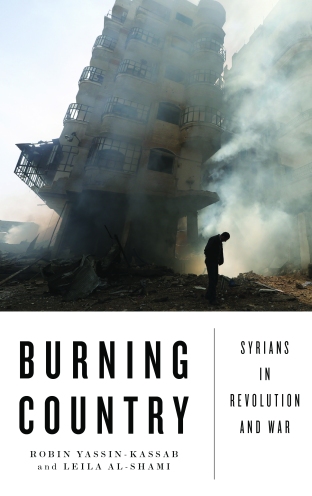
Burning Country: Syrians in Revolution and War

Yassin T03090

 'On 20 January Burning Country: Syrians in Revolution and War, a book I co-authored with Robin Yassin-Kassab, will be launched. The book would not have been possible without the help of many courageous and inspirational Syrians who shared their stories with us.'

 'Bristol 2014. A compact old lady in red hair and a flowery dress says, "I've lived in England for over thirty years, but I didn't realise until the revolution that I had a fear barrier inside. But those brave youths gave me courage; they gave me back my identity, and my freedom." This is where revolution happens first, before the guns and the political calculations - in individual hearts, in the form of new thoughts and newly unfettered words. Revolutionary Syrians often describe their first protest as an ecstastic event, the regime's savage response was a baptism of fire after which there was no going back.'

 Praise for Burning Country:

 ‘For decades Syrians have been forbidden from telling their own stories and the story of their country, but here Robin Yassin-Kassab and Leila al-Shami tell the Syrian story. Their words represent the devastated country which has denied them and their compatriots political representation. Burning Country is an indispensable book for those who wish to know the truth about Syria.’
 – Yassin al-Haj Saleh

 ‘Burning Country is poised to become the definitive book not only on the continuing Syrian conflict but on the country and its society as a whole. Very few books have been written on ‘the kingdom of silence’ that effectively capture how we all got here while not omitting the human voice, the country’s heroes and heroines — a combination that is rare but essential for understanding the conflict and its complexities. Robin Yassin-Kassab and Leila Al-Shami have written a must-read book even as the conflict still rages to understand what happened, why it happened and how it should end.’
– Hassan Hassan, co-author of ISIS: Inside the Army of Terror (New York Times bestseller), Associate Fellow, Chatham House, London

 ‘By far the best account of the Syrian uprising yet. It is a comprehensive and nuanced analysis of a multifaceted geopolitical conflict and myriad grassroots struggles. Anyone interested in comprehending the highly convoluted situation in Syria must read this extremely sophisticated book.’
– Dr. Yasser Munif, professor of sociology at Emerson College, co-founder of the Global Campaign of Solidarity with the Syrian Revolution

 ‘Burning Country could have been titled “A People’s History of the Syrian Revolution and War”: it provides a view from below that constitutes the perfect antidote to geopolitical reductionism. This book is unique in its combination of first-hand material derived from fieldwork, factual and analytical rigour, and unshakable faith in the Syrian people’s struggle for justice and dignity.
– Thomas Pierret, Lecturer in Contemporary Islam, Islamic and Middle Eastern Studies, University of Edinburgh, and Director of the Centre for the Advanced Study of the Arab World

Assad Starving His Own People In Mountain Idyll


 'When Syria rose against the violence authoritarianism of the Assad regime, the citizens of Madaya hid the award-winning writer and film maker Ramita Navai. As Assad's forces dragged activists away and hunted for opposition figures from house to house in the mountain paradise, Ms Navai was kept safe in the bosom of a town that fervently believed that the West would join them in their battle for democracy.

 "These people saved our lives while we were making a film*. They gave us a safe house and believed with all their hearts that the world would come to their aid," she said.

 That was four years ago. The Syrian revolution was forsaken by the West back then. And its people are now dying over that misplaced faith.'

 *[https://www.youtube.com/watch?v=OwjVyk59fEM] See also her interview with Anderson Cooper. "The Syrian régime, which has been lying about an awful lot, and lying for months, say that these are all terrorists, say that these are armed groups." "Well that's rubbish. We didn't meet any terrorists, none of the protesters we met were armed. We saw thousands protesting, men, women, and children, These are ordinary people. So the guys that we were with in the safe house, two of them were college graduates."
[https://www.youtube.com/watch?v=JdHkL1tvX7w]

Tuesday, 5 January 2016

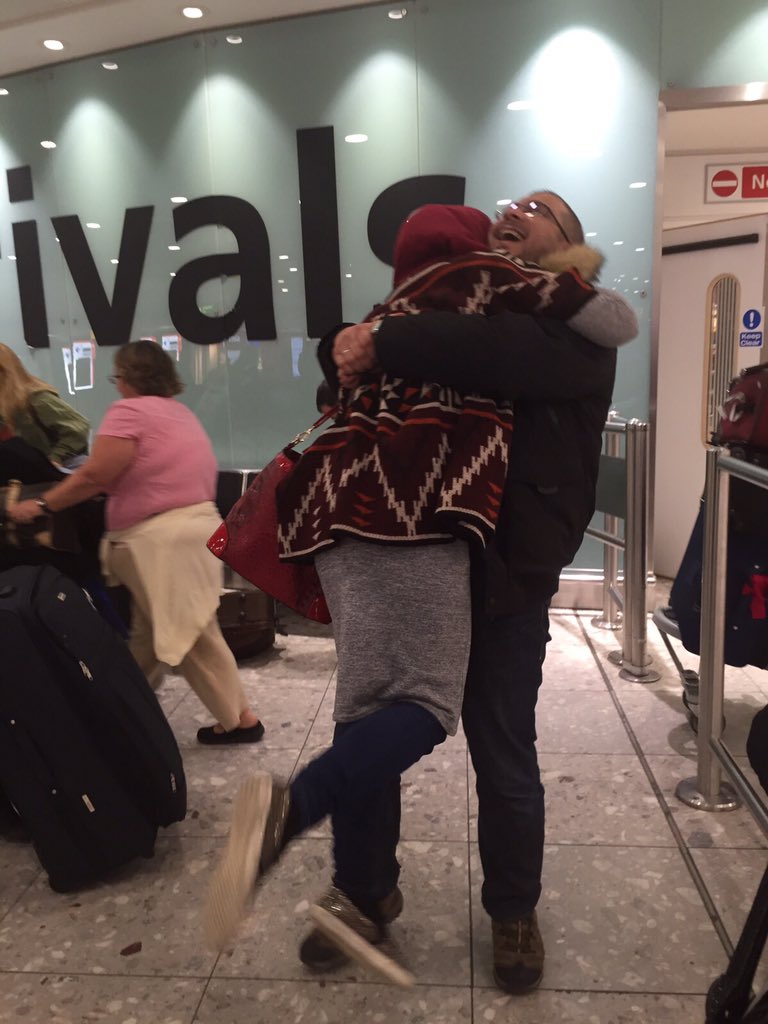
The Viral Photo Of A Syrian Couple Hugging At An Airport

Embedded image permalink

 'British-born and raised in the UK, Rose visited Syria every year, and her family and Ahmad’s were close. In 2009, they became a couple and he asked her to marry him but she turned him down. “My education was my priority, not marriage,” she explained. “He also lived in Syria, and I still had the whole ‘no way will I marry someone living in Syria’ mentality!”

 When the civil war began, the pair lost touch as both families suffered huge loss. Ahmad’s father was killed by the Assad regime, and his sister was killed by crossfire in Homs, leaving behind two young girls. His uncle was among those shown tortured to death and photographed by Caesar, the Syrian military photographer.

 Rose spent her time “trying to get the word out” about the government attacking Syrian civilians, using Twitter and Skype to translate and send reports to media and human rights groups. She later continued her work at the Baba Amr media centre in Homs, in “the same besieged area where [Sunday Times correspondent] Marie Colvin was killed”.


 When the siege ended, Ahmad returned to Damascus to finish his studies as a medical doctor. The pair met again in February 2013, and began preparations for their engagement, but their plans were halted when Rose’s uncle and his son were killed by the Assad regime. Shortly afterwards, the couple were separated once again.

 Ahmad finished his studies and worked in field hospitals across Damascus and Homs in his free time. As a doctor, he was at high risk of being killed, and every day Rose anxiously checked the news to see if he was still alive.

 Rose said: “A doctor, who later died under torture, told me just before he was detained, ‘A doctor who treats injured is a bigger threat to the regime than someone carrying weapons.’ It turns out that was true.”


 Then, in late 2013, Ahmad was detained in Damascus. “I look at him with me today and he is still suffering,” said Rose. “He can barely stand on his feet, his shoulder dislocates if he lifts too much, his back is still marked, he is in pain all the time. He has never told me the full story – he gives me tiny snippets here and there, and it just makes me freeze. He feels guilty he is now safe and his friends inside aren’t. Inside, there were women and children.”

 On his release, Ahmad’s aunt and cousin were detained, and he heard rumours that Assad’s forces wanted to take him in for a second time. It was then he knew he had to leave Syria, and with no passport, medical degree, or belongings, he fled to Lebanon and registered with the UN High Commissioner for Refugees and the Red Cross. Eventually, Ahmad and Rose worked towards gaining a spouse visa, and by mid-2015, they were legally married.

 “It feels like he will be taken again,” Rose said. “I’m so used to barriers and separation… it will take time to sink in. My friends have waited and supported me so much, they stopped me from getting depressed, and they cried and cried when they saw the picture of us at the airport. I was happy to have him arrive safely – not through the sea or in the back of a lorry – as Syrians suffer and die trying to reach safety daily.” '

Assad Killed Nearly Nine Times as Many Civilians as ISIS


 'The Syrian Network for Human Rights, which has been tracking casualties and human-rights abuses in the Syrian revolution since 2011, said the regime of Bashar al-Assad killed nearly nine times as many people as ISIS in the country during 2015.'

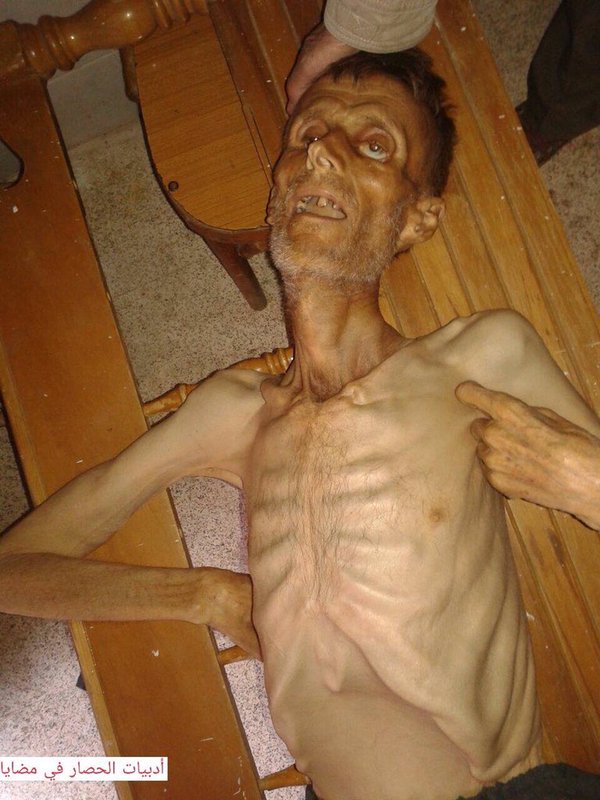
'Children Are Eating Leaves Off The Trees'

Embedded image permalink

 'In the past month alone, 31 residents have died from starvation, or in attempts to run the Hezbollah-manned blockade that encircles the town. As the death toll mounted in December, residents of Madaya began posting desperate pleas on social media, along with disturbing images, reminiscent of Nazi concentration camps.

 According to Rajai, a 26-year old English and math teacher in Madaya, the Assad regime is punishing his hometown for its participation in the Syrian uprising in 2011. When peaceful protesters took to the streets in the nearby city of Zabadani in April 2011, Rajai joined in. "We wanted to clean this country of Assad," he said. He was arrested and tortured. Now, after five years of civil war, his outlook is bleak.

 "In the early days of the revolution, we used to say no one could be made to feel hungry or afraid," he said. "But now we know we were wrong."


 In September, Hezbollah moved into the town of Zabadani, just two miles (three km) north of Madaya, and the town's only real lifeline to the outside world. A few beleaguered rebel fighters were allowed safe passage out thanks to a deal brokered by Turkey and Iran.

 As Hezbollah stormed the city, it forced people it considered hostile to move to Madaya, a tactic residents say was designed to separate out pro-regime and anti-regime civilians. Loay, a 28-year old student in Zabadani, was forced to relocate to Madaya with his mother when Hezbollah took over his town. "They said: go to Madaya," he told VICE News by phone. "There you will die, from starvation."

 In Madaya, he said, it's like "another world." "Everyone," he added, "is starving."

 As the siege grinds on, civilians are increasingly losing hope, and fear their plight will always be in the shadow of the war up north against the Islamic State. "Sure, people may read about us if you write something," Rajaai, the teacher, told VICE News. "But when they finish reading, they'll forget us." '

Sunday, 3 January 2016

FSA blows up regime military HQ in Daraa province


 01-01-2016: "Footage of the operation last night by the Free Syrian Army's Southern Front in Daraa province which blew up the the regime’s local military headquarters near the village of Atman in the north of the region A senior officer with the Southern Front forces accompanied by a number of other fighters was able to infiltrate behind regime lines late last night, booby-trapping the crowded regime headquarters building before detonating the explosives once the rebels were safely out of range. Sources within the Southern Front’s command said that the brigade’s operation led to the total destruction of the headquarters building, killing all the troops and militia members in the building."

Russia is clearing the decks for Assad


 'Russia is ostensibly pushing for a political settlement between the Assad government and the non-ISIS opposition. On the ground, Russia is assassinating the leaders of the non-ISIS opposition and working to dismantle their militias. In other words, Putin is not only looking to torpedo the Vienna process, but also trying to change the facts on the ground so Assad is the only show in town so when it comes to any ceasefire or peace deal. And the only thing that could stand against ISIS in the final instance. That way, Putin will leave the West no option but to come on board with him and Assad if they want to fight ISIS.

 The de facto military détente between Assad and ISIS continues, the trade in oil and gas continues (despite heavy American bombardment of the transport convoys), and all under the watch of Putin’s “fight against terrorists”. There should be no doubt, however, as to what Putin’s priorities are: to keep a genocidal maniac in power by using the pretext of fighting against terrorism to target any opposition to Assad except for the terrorists themselves. And once again, our Western leaders have no strategic response to this, and no real desire to do anything other than throw bombs at the problem and hope for the best.'

Thursday, 31 December 2015

Seeking the football champions divided by war

Muhammad al-Farouh

 'There were other executions and disappearances all over the country too. Raed's father, a politician who supported the wrong side when the ruling Baath party split, was taken away by the secret police and never seen again. Raed was then just 10 years old.

 "I was always afraid, afraid of everything, because our regime is very harsh," he says. "To this day I don't know where my father is, whether he's alive or not… It's better not to try to imagine, because it's so awful what happens in our prisons - it's better to think he died a long, long time ago."


 The regime was bombing Marea relentlessly, and the walls of the soccer complex were soon pitted with shrapnel. Raed returned to Russia, and Muhammad al-Farouh, the tall striker everyone had admired for his running and singing abilities, decided it was too dangerous for his family to stay in their home town. Abdul-Rahim, the impetuous one with the wild hair, is now a fighter with the Free Syrian Army.

Yasser, who created the team, thinks there are some lines that can't be crossed. He always hated the government, even as a boy, and he says he'll never speak again to another player, Abdulrazzak, who now works for Assad's political intelligence service.

"I could say hello to someone else from the government side, but not someone from my own town, a cousin of mine, who knows exactly what happened - that in the beginning there were peaceful demonstrations, but they started killing us. That I cannot forgive him for."


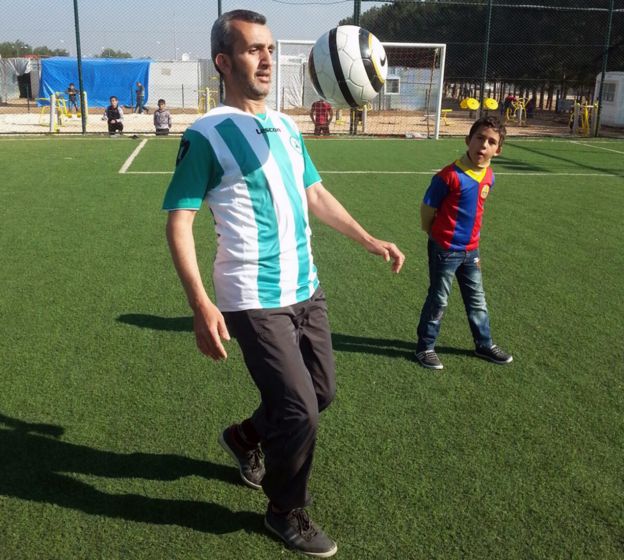
 Meanwhile Muhammad al-Farouh, the star runner who spent time as a major in the Syrian air force, still plays football every Friday in his refugee camp. He runs the camp nursery school, with 800 kids. But he can't always handle the questions they ask.

"One child asked me why Bashar is the president of Syria when he bombs Syria, and other presidents don't bomb their countries," Muhammad says.'

Wednesday, 30 December 2015

Assad regime jets bomb Douma Syria killing civilians


 It's only in the Syria Direct headline that you get the full truth of what is happening. The Mirror¹, quoting the Syrian Observatory for Human Rights, said "unidentified war planes" hit the town. For NBC², they were "government airstrikes" in the text if not in the headline. For Yahoo! News³, they were "airstrikes on rebel-held areas". The Independent⁴ said they were "a barrage blamed by some activists on Russia", though they do call them "pro-Assad airstrikes" in the headline, and quote an activist on the ground, they call them near rather on a school, and give the Syrian state News Agency space to claim with no proof that this was just a response to rebel shelling, as if it would be any justification. And that's how the daily mass murder by Assad and Putin is reduced to a confusing tragedy to which we can see no solution because we never have the cause identified.

 1. "Harrowing video of Syrian children calling for their mums after air strike kills 49 people"[http://www.mirror.co.uk/news/world-news/harrowing-video-syrian-children-calling-7017657]
 2. "Kids Cry for Mom after Airstrikes in Syria"[http://www.nbcnews.com/video/kids-cry-for-mom-after-airstrikes-in-syria-585788483988]
 3. "Children Call for Their Mother After Strikes on Douma"[https://www.yahoo.com/news/video/children-call-mother-strikes-douma-093513500.html]
 4. "At least two children among 28 civilians killed by pro-Assad air strikes 'near school' in rebel-held area of Damascus"[http://www.independent.co.uk/news/world/middle-east/at-least-28-civilians-killed-by-pro-assad-air-strikes-near-school-a6771376.html]


Note 17/5/25, link 3 broken.

Tuesday, 29 December 2015

This Filmmaker Was Assassinated In Broad Daylight


 'A foe of both ISIS and the Syrian regime, the independent filmmaker and native of Salamia, a town near the city of Hama, was among the peaceful democracy activists who spearheaded the 2011 uprising against Bashar al-Assad. They are now being subsumed by the ensuing violence and sidelined by a war that has become a regional conflagration with no end in sight.

 “It is terrifying that there are Syrians who have dedicated so much for principle and stood against tyranny and extremism yet (with) no real recognition,” Rami Jarrah, a Syrian journalist and friend of Naji al-Jerf’s based in Aleppo, wrote on his Facebook page. “It is lost in this mess of misinformation that says that there are two sides fighting (Assad and ISIS) with little mention of those that oppose both wrongs. Those like Naji.”

 The killing came as Jerf prepared to depart for Europe to escape mounting death threats that followed the airing of a film he made about ISIS and its campaign of terror against citizen activists in Aleppo. ISIS in Aleppo, chronicling the months when the group ran parts of Syria’s commercial capital and came to be despised by all other groups fighting the Assad regime, was broadcast two weeks ago on the pan-Arab Al-Arabiya satellite news channel.'


 Nader Atassi:

 "Those who have tried to expose the crimes of ISIS and the other counter-revolutionaries in Syria are all, without exception, anti-Assad activists who are part and parcel of the Syrian uprising. Anti-ISIS activism by Syrians was simply seen as a natural extension of anti-Assad activism, that is, activism against those who wish to dominate Syrians by force. This is where Raqqa is Being Slaughtered Silently's roots are, this is the background of all the activists in Syria and the surrounding countries that are organizing against and exposing ISIS. As a result, ISIS is trying to silence anti-Assad activists in Syria and in Turkey. Just this fact should be sufficient to destroy the oft-repeated talking point the 'experts' propel that Syrians have to side with Assad and be 'realistic' because he is the strongest force against ISIS. ISIS is not killing pro-Assad anti-ISIS activists—because there are none. There's only one way forward, and that is by siding with those who work tirelessly against all these forces. They have a world to overcome, but they are the only way forward."


 Note 17/5/25, link to Facebook broken.

Sunday, 27 December 2015

The District of Jobar


 Ziad Majed:

 'There are numerous places, regions, villages, cities and urban neighborhoods that come to mind when we remember the beginnings of the Syrian Revolution and the stages of its transformation into armed struggle that went before the war currently raging. Among these places, the Jobar district, which stretches from the east to northeast of the Syrian capital, has a special status, and this for several reasons.

 Among these reasons, there is the fact that Jobar had been a hotbed of peaceful protest and that this neighborhood had seen on April 22, 2011, a huge demonstration march through, where the inhabitants of many of Damascus suburbs came together with those of many areas of the capital with the goal of walking to the Abbasid Square, which is just 500 meters from Jobar, to organize a sit-in. When they got to the neighborhood of al-Zablatani, regime forces fired live ammunition at protesters, killing and wounding dozens in a few minutes, and arrested and tortured several hundred others. Young men exposed their bare chests to the forces of "order" to demonstrate their peaceful intentions but were shot mercilessly in the most significant and unforgettable historic step.

 Among the reasons, too, there is the fact that young people of this district had risen in armed revolt in late 2012, Jobar thereby becoming the most advanced front line against regime forces in the outskirts of the capital Damascus. This earned them the highest concentration of bombings a limited geographical area has ever known, both aerial and ground-to-ground missiles fired by heavy artillery and tanks. The people of Jobar also had to undergo the second use of sarin gas by the regime (in March and April 2013), four months after Homs and four months before Zamalka, Arbin and the outskirts of Mu'dhamiyyet al-Sham (three Ghouta localities of Damascus where 1500 people died August 21, 2013).


 Another features of Jobar we should also mention is the fact that since the end of 2013 and to date, it is subject to incessant attacks by the army of Bashar al-Assad, Hezbollah fighters and Iraqi (Shia) militias.

 Despite all this, one can see the defenders of the neighborhood, some holed up in basements and other highly visible, holding their positions, not giving up one inch. When al-Assad, on New Year's Eve 2014, claimed to have visited Jobar and have reviewed his armed forces (after alleging that these forces had broken through), photos circulating the next day showed that he had not exceeded the limits of al-Zablatani, and the person with whom he was seen exchanging a warm handshake was not one of his frontline soldiers, but Muhammad Ahmad Aïssa, a senior Lebanese Hezbollah officer.


 Thus, the biography of this neighborhood summarizes an entire segment of the epic hidden Syrian Revolution. It also summarizes one aspect of its tragic fate. As Syrian journalist and photographer Said Al-Batal wrote in his brilliant article entitled "Syria: quietly close their eyes" (published on the website of the Association Bidâyât in Arabic and in French in L'Express) after visiting this area in October 2014, expressing more accurately and more deeply what life is like in this little corner of the earth forgotten as it is trapped behind a wall of fire, which is an outrage for all of humanity:

 "During my Internet searches, I came across a photo of Jobar, yesterday, under the bombs, taken from another point of Damascus ... And I shuddered.

 I shuddered, not because I managed to get out from under the rubble framed in this picture. I shuddered because it reminded me that there was someone on the other side! I had forgotten that there could be someone who sees, hears, that thinks, dreams and photographs the bombs falling on us. Someone who has his thoughts and his faults, someone who is my reflection, the theory that there are others in our reality. My confinement has made me forget the other. I had come to think that we were alone in the world; the only thing that was on the other side of the shore, was death, rocket, bomb or a bullet.

 Do you think my photos, I am on the opposite bank, make you feel something when you look at my eyes? Is it possible, that you are so absorbed in your concerns, the tumult of your lives, to also forget our existence?"


 To Jobar neighborhood and its inhabitants, or rather what remains of it, admiration and heartfelt greetings.'

Saturday, 26 December 2015

What Russia Bombing the Crap Out of Your Town Is Like


 Michael Weiss:

 'Aleppo’s children are now being educated in apartments on the front-lines, because their open air schools have been bombed by Russia. In these makeshift academies, the primary fear is “elephant bombs,” the regime’s “locally made” ground-to-ground missiles (so called because sound like the an elephant’s trunk blow when they’re launched) which can hit 60 or 70 times a day.

 The Russian Defense Ministry has yet to claim responsibility for any civilian casualties and often denies striking in civilian-heavy locations which evidence suggests they have struck. But the claims of Russian collateral damage, Jarrah tells me, are “absolutely true. Russia is killing civilians and waging an information war. I want every single person on this planet to know that, whether they admit it or not.”

 Kenan Rahmani, a Syrian-American activist, spent the better part of November in Idlib, Syria’s northwest province, which is also under constant Russian bombardment. In the town of Maarat al-Noman, he says “they bombed half a kilometer from where I was, killing three children in a school. The residents in Maarat al-Noman had gotten used to the barrel bombs,” he says, referring to metal canisters filled with shrapnel and explosives dropped from Syrian helicopters. “But these were more limited in their scale of destruction. The Russians destroy more buildings and raise the stakes for Syrians to stay alive inside. But it’s the same form of collective punishment. If you want to live in opposition areas, these are the consequences.”

 On Dec. 15, Russian warplanes bombed Mash'had market in an area called Saif al-Dawla, a central marketplace in Aleppo. (ANA Press published footage of the aftermath, viewable here.) “Ten meters to the right and the missile would have landed inside the market, killing 200 or 300 people,” Jarrah says. “The attacks are not that precise. Shoot one person in a protest, and he runs away. Then the next day, more come. Then you have to shoot five people to make the same point. The Russians want to kill a lot of people at once so they don’t have to kill even more later. The marketplace, it’s like the veins of the city. If you open the veins, you bleed the city.”

 So far, there has been no conspicuous hemorrhage of civilians from Aleppo because the inhabitants don’t want to leave. Jarrah says that this isn’t because they’re patriots or defiant in the face of a brutal onslaught. It’s because most of them are already internally displaced. Jarrah reckons that, apart from Aleppo’s historic Old City, where longtime residents still remain, in the “modern” districts, only about 20 percent of the current population is native. “The rest are Syria’s poorest. If they leave, they’ll have nowhere else to go.” '

Wednesday, 23 December 2015

Assad has again used sarin gas against civilians


 'Five Syrian civilians were suffocated by sarin gas used in barrel bombs dropped by Assad helicopters on the southern part of al-Moadamiyeh city near Damascus. Assad forces have been trying to isolate Dariah from al-Moadamiyeh city for the past 24 hours using every possible means including sarin gas.'

Monday, 21 December 2015

Drawing the horror of a Syrian detention centre

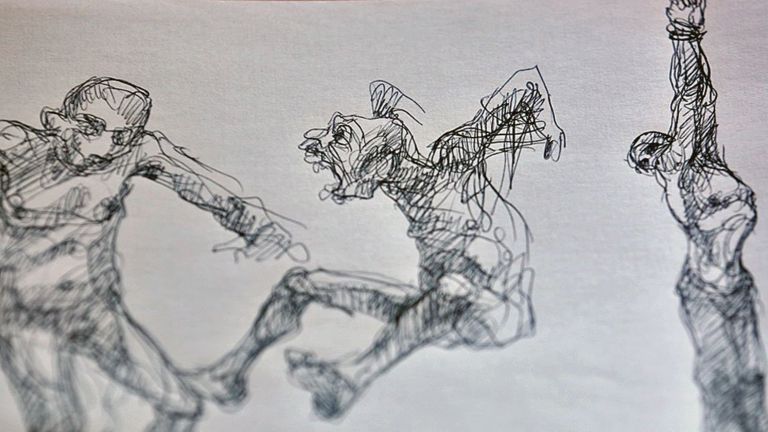
Illustration - three figures one with head bowed, one screaming, and one chained and hung by the hands

 Lina Sinjab:

 ' "Every day there would be about eight new bodies. After a week I managed to get closer and count the number written on a body's forehead. It was 5,530 - and after a month and a half, the number on another body was 5,870. I got used to it. The first night I saw a dead body and smelled it, I felt so sick and sad I couldn't sleep. But later on we were eating while a dead body was next to us. I remember leaning on a dead body and thinking, 'When are they going to remove it so I can have more space?' "

 Sami was arrested twice in the years after the Syrian uprising in 2011. His crime was coming from a town, a religious group and a family that had revolted against President Bashar al-Assad. "I had long curly hair when I was detained for first time. This modern look was a sign for the government that I belong to the co-ordination committees that organised protests. The security officer dragged me by my hair and told his boss, 'We've got one of the co-ordinators sir,'" Sami told me.

 "I was picked up on my way to work, my head was covered and I was put in a car. I don't know where they took me but they put me in a hall while my hands were tied with wires. They started beating me up madly. Then I reached the detention centre. I was bleeding, bones broken, ears damaged so that I couldn't hear properly. The place was like Dante's inferno. You are constantly tortured and you hear the cries of people being tortured. I was kept in the basement maybe seven storeys down."


 His wife, Fidaa (not her real name) had the difficult job of finding the right person to bribe. It took $3,000 simply to find out where Sami was being held. Then she had to pay money to ensure that Sami would not continue to be tortured. One of the people who promised to help ensure Sami's release disappeared after a week, forcing her to look for another contact who might help.

 Sami has lost 40 members of his family, all killed by the regime. He moved home twice inside Syria looking for a safe place to live with his wife and daughter. His own house and another belonging to his family were burned down by government forces in the Damascus suburb he comes from. Many have argued that this sort of treatment drives poor young Sunnis into the arms of Islamist radicals - though Sami says he personally never encountered any Islamists in Syria. "I didn't see any Islamists or jihadists or radicals in prison. I just saw ordinary Syrians. Needless to say, almost everyone in prison is Sunni. Men from the city with money are treated differently than those coming from poor and rural areas. The more money and connections you have, the less tortured you are."

 The threat to him, he says, came exclusively from the Assad government, and it was the government that drove him eventually to leave the country. He and his wife and daughter are now in Europe, where Sami is recovering from his ordeal. "I try to get over my fears by drawing or playing music," he says. "This is the only way I can survive." '

Sunday, 20 December 2015

Assad-Putin Airstrikes on Idlib Courthouse


 Bilal Abdul Kareem:

 "Immediate aftermath of today's Putin-Assad attack on Idlib Courthouse in Syria. If you've never seen the absolute chaos that ensues after an airstrike then this is a clip you may need to see to have a proper perspective. The airstrikes landed at approximately 10am, the busiest time of the day in the courthouse. In total there were 5 targets in the city. The number of wounded and killed are still being counted."

 When bombs drop on the halls of justice, there is no justice in the halls.