Saturday, 5 December 2015

'How I was tortured in a Syrian jail'

"Farah"

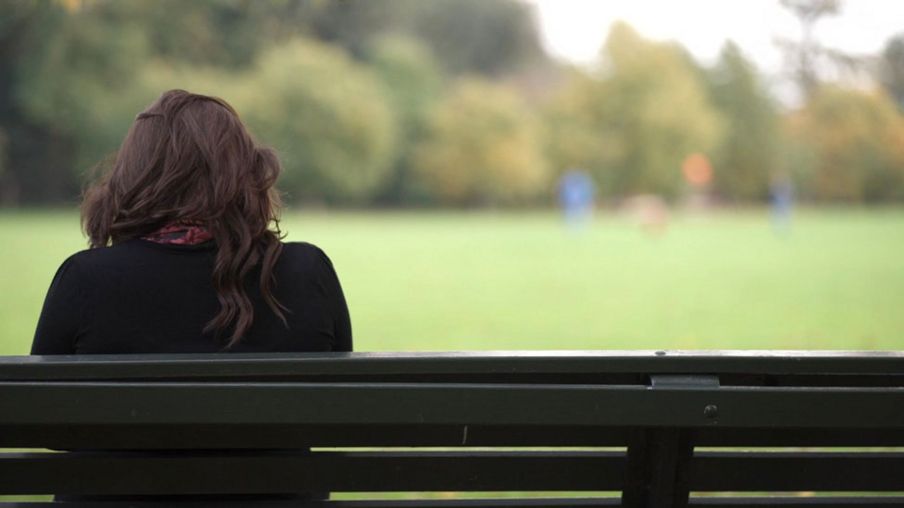
 ' "Farah" was born in Britain but grew up in Syria. Last year, she was arrested by the Syrian government security forces, who accused her of being an opposition activist. She blames Syrian President Bashar al-Assad for the torture that followed, and sees him as a bigger menace than Islamic State.

On one occasion she was tortured with electrodes. "I fainted - so I didn't feel the pain like when they used to hit me," she says. But she remembers clearly "the fear" before the event. One of the other girls in the same cell as her said she was raped. Farah didn't see this, but was threatened with rape herself. "Not just rape, but gang rape," she says.

Farah believes that she was spared even worse treatment because she was a dual UK-Syrian national - the guards nicknamed her "British" even when they were insulting her. But they tortured her psychologically as well as physically.

One incident, when a guard tortured an elderly man in her presence, sticks out in her mind. "He was just in front of me and they put him under electrocution. I had to see. I'm sure the man died. He just fell on the floor, and they carried him and threw him out of the room," Farah says.

"One time they hanged a man from his legs and hands. I tried not to see, but sometimes they hold your face to see. They were pulling the ropes… They split him. Until now I remember his voice shouting, and then suddenly I couldn't hear anything."

Her views echo those of many Syrians caught between Assad and IS. "When we say we want to get rid of Assad it doesn't mean we want ISIS - or we are happy with ISIS. In a way they are both the same, just with different ways of killing," Farah says. "Assad is the one who brought ISIS to Syria with all his death and destruction. We have to get rid of Assad and then we can get rid of ISIS." '

Friday, 4 December 2015

Rebels Change Tactics to Outsmart Putin’s Air Onslaught


 'From the very first day of fighting in these areas, pro-regime forces have used a rolling barrage of strikes, along with weapons that are prohibited internationally. In parts of Khan Tuman, pro-Assad forces waged rocket and missile attacks every twenty seconds. We have not seen this intensity previously.

 Additionally, these attacks have high precision, which we have not experienced from the regime and Iranian forces before the Russian intervention.

 Thank God, FSA forces, amongst them Fastaqim Kama Umirt, which is a key group in the area of weapons stores in Khan Tuman and in the area of Jabal al-Ais, along with other rebel groups, has been able to adapt to the regime’s new tactics.


 Accordingly, we have transformed the conflict from one of direct confrontation into a series of smaller attack and retreat skirmishes that have weighed down advancing forces and taken away the advantages provided by air-cover and heavy weaponry.

 The firepower density is awesome and has high precision because of the reconnaissance planes that broadcast directly to Russia’s control room. The true miracle is that Assad’s forces, with the support of more than 20 Iraqi, Lebanese and Iranian sectarian militias, Iranian field commanders and Russian air coverage, have failed to do more than take al-Ais.


 In the meantime, it has failed to take control of Tel Khilsa and to advance even an inch at Khan Tuman, praise be to God. Now, the rebels are working on recovering al-Ais. It’s our turn now, since the enemy forces have gone from the offensive to the defensive.

 Adding credence to Saqar’s assertions, a local opposition television channel confirmed the death of Iranian General Masoud Akbari, commander of Assad’s military operations in the southern Aleppo countryside, in a rebel attack on his personal vehicle using an American-made TOW missile.

 Abu Rahal, another opposition commander operating in the area, diminished the importance of the regime’s recent progress in and around Aleppo, pointing to the dozens of pro-Assad forces—most of whom, he alleges, hail from Shia militias in Lebanon and Iraq—that rebel groups have killed.

 Abu Rahal added that “we must acknowledge that we’re fighting Russia, Iran and Lebanese Hezbollah while entirely dependent upon friendly entities for support, who mainly just give us some basic arms. [Our] current means, in comparison to the enemy, is nearly non-existent. In other words, we should not compare us as Syrian revolutionaries to our enemies in Assad’s camp.” '

Thursday, 3 December 2015

UK air attack on Islamic State

File photo of Free Syrian Army

 Robin Yassin-Kassab:

 'The real problem is Assad not IS, however horrific they are. IS is a symptom of a larger problem and in Syria that is the Assad regime and the scorched earth policy it uses against anyone who opposes it, creating a space that jihadists from all over the world can come and exploit.

 Now you have Iran, Russia, France and the UK all getting involved. To the people on the ground the distinction between them is not very clear. They see the whole world bombing them and not bombing Assad, who is responsible for most of the killing. So it's very easy for jihadists to say it's the Shia Muslims, the Russian Orthodox Christians and the Western Christians all ganging up and bombing us because we are Sunni Muslims.

 The most depressing thing is that (opposition leader) Jeremy Corbyn repeated in Parliament that all the Syrian opposition are Salafist fundamentalists. That's not what Syrian society is like. At least David Cameron knows there are 70,000 moderate fighters whose aims are national and not international.'

Wednesday, 2 December 2015

Syrian Blogger, Seeking US Asylum, Still Tends Homeland


 'Once, Taofik Alhallak made his living interviewing Syrian artists, thinkers and doers, and scripting children’s shows for his television production company. Now, the 65-year-old huddles at his laptop in northern Virginia, an asylum-seeker chronicling the devastation of his homeland while trying to help save it. "Hundreds of thousands of Syrian children [are] out of school today," with civil war disrupting classes and leaving youngsters poorly educated and vulnerable, he blogged a few days ago for his website. He urged parents there to guard against overtures from the Islamic State group, saying, "Daesh … turns them [youths] into thugs."

 The website – SalebMujeb.com, Arabic for "Positive Negative" – gives Alhallak a voice in Syria, one that he says the Assad government has repeatedly tried to silence. "Every article is about the revolution," explains his son, Urwa Alhallak. Most of the posts "are spreading awareness of how society could move into democracy."

 "I feel this little wall every time I meet with friends," says Urwa Alhallak, 35, who arrived in the United States in 2007 to study filmmaking. "I say I’m from Syria, there’s this silence.... I feel like inside they will think: 'Syrian? Maybe terrorist?' It’s not going to change easily." He and his parents describe themselves as secular Syrians. They remember Damascus as a diverse and tolerant capital city. "We have Muslims, Christians Jews, we always lived together. It’s a mix,” says the younger Alhallak. "My parents didn’t really care about money or the house. They want a free, strong Syria, and they didn't care if they lose everything for this cause." '

Tuesday, 1 December 2015

“There is a secret deal between Assad and ISIS”

 'For Youssef Seddik, director of the press center of Aleppo, the Western media talk too much about Daesh. And not enough about the revolutionaries fighting to get out of hell.
Aleppo is separated into two parts as was Berlin. The western part is under the control of the forces of Bashar Assad. The centre is under the control of the revolutionary forces. Daech recently entered the region from the east. The artillery and aerial bombing are daily. Many people have left. But a significant portion of the population resists. In the eastern part of the city, there are five hundred thousand inhabitants of the three million there were before. Those who remain are trying to build a civil society, with neighborhood committees to deal with empty houses, manage daily life and the care of basic needs. But for a month and a half, Russian aircraft have bombed us, and each day the bombing is worse. We've seen devices that had never been seen before, faster, more powerful, with a special explosive charge. Sometimes we saw four to six planes at once. They never leave the Aleppo sky. It is estimated that Russian forces hit 5% Daesh and 95% the revolutionary forces. These attacks cause a new exodus. One hundred thousand people have fled.

 It's eerie. Daesh takes all the space. Western media show everything that comes from them while other moderate Islamist groups have a much solid popular base in Syria. Revolutionaries and other Islamist groups are composed of normal people who are fighting for noble causes, that of their people, to get out of this hell. Daesh does not represent Islam, it deceives youth, it uses them as one would throw wood into the fire, it is a holocaust. They are monsters, criminals, traitors, Islam has nothing to do with that. And we talk too much Daesh. Really, it's been two years now talking about them constantly. We talked about it to begin with excessively while Daesh had not the strength it has today. It is reinforced with Mosul in Iraq and the battle after it took the army barracks and ammunition depots in north-eastern Syria. In our fictional battles. There is a secret agreement between the Assad clan and Daesh. Assad leads imaginary battles against Daesh, he leaves arms dumps to them without a fight, as we have seen in rural areas near Homs, and Palmyra. In return, Daesh do not attack Assad's forces and even blew up Palmyra prison, a symbol of the tyranny of Assad: it had no interest in documenting this and thus erased all trace and record of the torture practiced here for years by the regime.

 France and the West cannot beat Daesh. They must first dry up its funding, oil that pays them two million dollars a day. But there will be no results until Daesh faces ground forces supported by airpower ... And the revolutionaries, there will be no total war against Daesh if Bashar Assad is not eliminated first. This is the target number 1. It was he who helped create Daesh by releasing hundreds of Islamists in May 2011. It may seem strange to Westerners, but for us, the worst terrorist, is not Daesh, but Assad. A terrorist in modern dress and civilian clothes.

 The revolutionaries in Syria have never sought war; on the contrary, have always sought to demonstrate peacefully to change the dictatorial regime. It is this regime that has imposed war on us. We have lost many friends there and sacrificed a lot in order to free our people. Our defeat would mean the victory of dictators, and the loss for humanity in the sense of struggle for freedom. We will not allow this to happen.

 We received number of journalists in recent years and we are ready to welcome who wants to enter Syria. Nothing threatens journalists in areas controlled by the revolutionaries. Neither Daesh nor the Assad regime have any power in the liberated areas. If there is a danger is that resulting from aerial bombardments or the risks inherent in journalistic work in combat zones.'

Syria Is a Chemical Weapons Free-for-All


 ' “The sad reality,” Rafael Foley said, “is that chemical weapons use is becoming routine in the Syrian civil war.”

 The first incident occurred near the Syrian town of Marea. The awful details of the attack have already been reported in the New York Times by C. J. Chivers, who has done so much to report on chemical weapons issues in Iraq and Syria. A chemical mortar hit a home. The agent — sulfur mustard — burned three family members and killed an infant. Unlike the attack against Ghouta, it seems the shell was fired by Islamic State militants.


 Where did the insurgents get the mustard? There are any number of possibilities. The simplest explanation is that it may have been captured from the Syrian government. After all, no one thinks Assad gave up everything in his stockpile even though that was what he was required to do.

 The second incident mentioned by the OPCW’s report is actually a series of attacks by the Syrian government that occurred over a period of months. Having lost their stockpiles of Sarin and mustard, the Syrian regime has resorted to filling barrels with chlorine, creating an improvised chemical weapon that can be dropped from a helicopter. The fact-finding mission documented series of so-called “barrel bomb” attacks in Idlib governorate carried out between March and May 2015; the OPCW has also documented many other uses of these barrel bombs since early 2014.


 The real solution to the problem of sides using chemical weapons in the civil war is to stop the civil war. But, as I have written before, this seems unlikely. Assad won’t shuffle off into exile. He can’t win, but Russia seems unwilling to let him fall. And Obama seems unwilling or unable to do anything to change that calculus. And so the war grinds on, with the opposition groups pinned between Assad and the Islamic State, both of whom are glad to use every tool at their disposal, including chemical weapons, to destroy anyone in between. It’s no wonder that millions of Syrians have fled their homes.

 I often hear people wondering what the use is of banning chemical weapons when so many other awful things are happening in Syria. And maybe it is an arbitrary line to pick — chemical weapons use compared to all the other travesties committed by the Assad regime and now the Islamic State. But at some point you have to say enough. For me, it’s chemical weapons. And who knows, maybe good things will happen if we show a little spine. But doing nothing seems unconscionable, particularly now that the Obama administration admits that chemical weapons use has become routine.

 That’s a remarkable statement when you think about it. After Syria agreed to give up its chemical weapons, the president warned of “consequences” if Assad did not follow through. Now, two year later, a U.S. official can characterize the use of chemical weapons in Syria as routine, without so much as delaying a turkey pardon.'

Monday, 30 November 2015

UK airstrikes must be combined with aid for moderates

Members of Free Syrian Army groups fight Assad forces in Aleppo

 ' “Cooperating with the moderate forces fighting on the ground is essential, otherwise the airstrikes are not going to be useful at all,” said Mohammad al-Hassoun, commander of a small group called Fursan al-Huria, or Knights of Freedom, north-east of Aleppo.

 Bombing Isis oil infrastructure is already hitting its financial base, Hassoun said, but its opponents need to take the whole Turkish border with the help of ground troops so they can stop the supply of another key resource for the Islamist group, foreign recruits.

 “Isis has two key resources, one is financial and one is human. Finally the coalition understands that those people are making money from the oil, and have started to bomb the oil, which is useful to cut their financial revenue,” he said. “If the FSA controlled the area [along the border] we could cut their human resources off too.”

 Commanders’ hopes for new supplies range from stinger missiles to target Russian and Assad regime aircraft, which all groups want but know they will not get off western powers, to much more realistic demands for assault and sniper rifles. Several said they would also ask for tactical support in areas like mine detection.

 “The British role was negative because they were just talking and doing nothing in Syria,” said Abu Qutaiba, a former fighter who is now a media and political activist for several groups. “Of course I support the airstrikes, but it depends how they do it. Even though its too late, I think any people could be involved against Isis are welcomed.”

 “Is it going to be useful for the British and others to bomb? The problem is the big powers have a disagreement on who is going to fight who,” said Ahmad Shhab, also political adviser to a smaller group. “Some say their priority is Isis, while for the others the priority is to finish the opposition and the FSA and the Syrian revolution in the end.” '

MPs are being asked the wrong question on Syria


 'Dear Member of Parliament, MPs are being asked the wrong question on Syria: Whether or not to bomb ISIS. Assad is the cause of ISIS. As long as the Assad regime remains, the terror threat will remain.

 The resolution we need MPs to vote on: “That this house recognises the legal justification for humanitarian intervention in Syria on the basis of evidence of overwhelming humanitarian necessity and the lack of any other feasible or workable solutions; and calls upon the Government to take exceptional measures in order to avert a humanitarian catastrophe by imposing a no-bombing zone in Syria to enforce an end to aerial bombardment attacks against civilians.” '


Note 16/5/25, link broken.

What do Syrians themselves want?


 Mark Mardell: "Muzna Al-Naib is an activist with Syria Solidarity UK. She says President Assad needs to be defeated before Islamic State can be tackled."

 Muzna Al-Naib: "I think Mr. Cameron should start talking about the real problem in Syria, which is Assad. He needs to talk about it more effectively, and make the protection of civilians from Assad the priority, in order to defeat ISIS, and protect civilians here in the UK."

 Mark Mardell: "But you're not against military action. You didn't join Stop the War at the weekend."

 Muzna Al-Naib: "We didn't join Stop the War at the weekend, because we refused to participate in a narrative that didn't have the input of Syrians. Stop the War Coalition is not listening to Syrians. They need to start listening to Syrians, when we say the protection of civilians needs to be a priority."

 Mark Mardell: "You're saying that President Assad is more of a problem than IS, Islamic State?"

 Muzna Al-Naib: "Of course! Assad killed far more civilians than ISIS ever did. ISIS wouldn't be here if Assad wasn't in power. Assad killed so many civilians, that the Syrian people now doesn't have the power to fight back against ISIS or anyone else. People there are just surviving. ISIS came to the country, from outside the country, and took ground there, because people didn't have the power to fight back; because they are being bombed every single day by Assad, the youth of the country are being jailed in detention centres and tortured to death, and the whole country is fleeing. There are areas where they cannot flee, because they are under bombardment every single day.

 Mark Mardell: "So if it does come to a vote in the House of Commons, how would you like MPs to vote?"

 Muzna Al-Naib: "My concern is only for the Syrian people, and what I want MPs to do is start talking, and discussing, the protection of civilians, rather than sending more bombs to Syria. We don't need more bombs in Syria. We are not asking for an intervention, we are not asking for imperial powers to come and occupy our country, we're just asking for the Syrian people to be given a chance to fight their fight. We're not asking you to do our fight for us."

 Mark Mardell: "How strong are the forces against President Assad. I mean, David Cameron has suggested there are 70,000 troops of the Free Syrian Army. Do you think that's correct?"

 Muzna Al-Naib: "I think that's correct, but I also invite you, not just to look at the Free Syrian Army, I also invite you to see other elements of the picture. For example, civil society institutions, grassroots and aid organisations. They are a great example of how Syrians can be organised, how they can fight their own fight, how they are able to pursue their dreams of freedom, and for freedom create a Syria that has a place for all."

Sunday, 29 November 2015

Alawites’ anti-Assad movement brewing for years


 'Assad has always claimed that Syria’s minorities – including Alawites and Christians, which make up about 10 percent of the population – would be defenseless in face of an uprising heavily hijacked by Islamists. But Hamira said that this narrative was false, and had long been propagated by Assad’s father Hafez, who ruled Syria for three decades until his death in 2000.

 “Through lying and rumors…. [Hafez al-Assad] had implanted the idea that Alawites and Sunnis are not partners but enemies,” said the activist, adding that the Assad dynasty had always strived to present itself as a protector of minorities. “The truth showed that these minorities are the ones who are protecting the regime,” Hamira explained, claiming thousands of Alawites were killed to protect Assad’s “throne” and stay in power.
 “The number of Alawites killed in comparison to their number [in proportion to Syria’s population] is very big. The regime is using them as fuel, they started thinking why my son is being killed but not those close to Assad’s family? No one is killed in Assad’s family,” he said. Kouch described protest slogans such as “you are in palaces and our sons in graves” as becoming more conspicuous. “Even in funerals, the [Alawite] families do not accept Assad’s relatives or those close to the regime, making it a form of protest,” said Kouch.
 Both Hamira and Kouch agree that Assad’s “real supporters” come from different backgrounds - including Sunnis, who make the majority of the Syrian population. “Yes, of course, there are Sunnis who are still with Bashar Al-Assad…especially bourgeoisie of the Sunnis such as merchants from Damascus, Aleppo, even Homs cities,” Kouch said, showcasing how pledging political support to an embattled leader and personal interests interest and overlap.'

'We can't hide from your bombs. Tell MPs to say no'

From left, former teacher Mona, who escaped across neighbouring rooftops; a nurse who fled Raqqa when faced with arrest; anti-Isis activist and medical students Feras

 ' “If I went to the UK parliament to make a speech, the first thing I would say is ask them to remove the cause [of our problems], which is Assad, not the symptom which is Isis,” said Abu Ahmad. “Hundreds of thousands of people died in the last few years, and no one came to bomb Damascus.”

 “Why is this just in response to Isis? Why was no one moved when the regime was bombing us in Syria? Is it just because [terror] came to western countries? For us, it doesn’t matter which bombs are killing us,” said Mona, a teacher and activist who fled from Isis James Bond-style over the rooftops of her neighbourhood.

 “People don’t like Isis at all, but if Kurdish forces come with the coalition to displace them they are both bad, and maybe some will think the least bad is Isis, so you are pushing them to join Isis,” said a nurse who reluctantly left Raqqa this autumn after the group tried to arrest him, although he still doesn’t really know why he came under suspicion. “If they want to help, they have to choose the right partner, not Kurdish forces. Picking the wrong partner might make people react against them. Tal Abyad is a perfect example. They used Kurdish forces as their partner and they displaced a lot of people.”

 “It will not benefit us [for the coalition] to fight Isis [alone] because Assad has a good relationship with them,” said Feras, an activist and medical student who was one exam short of his medical degree when government forces jailed him. He later fled Isis, but says that fighting the group in isolation will not end the war: “The Assad regime is the main problem for us.”

 “In this situation people won’t even support the Free Syrian Army as they are not credible,” the nurse said. Abu Mohammad agreed: “I like the FSA, but we need a real one; they are not organised and don’t have supplies.” '

Saturday, 28 November 2015

A letter to David Cameron from Syrians in Britain

•

 'We want more than anyone to be freed of ISIL and so we welcome international commitment to rid the world of this disease. But simply bombing ISIL will not defeat them. If anything it will make them stronger.

 The only way to defeat ISIL is by stopping the Assad regime’s indiscriminate attacks on civilian areas, including areas controlled by moderate rebel groups. Once this happens, Syrians will be freed up to drive out ISIL themselves, as they have proved themselves capable of doing.

 We are urging you Prime Minister to prioritise the resolution of the conflict in Syria over the bombing of Raqqa. It is simply not possible to defeat ISIL while Assad maintains his grip on power and keeps the war burning and refugees pouring over the borders.'

‘No IS group in Aleppo, so who is Russia bombing?’


 Rami Jarrah:

 "The morale of the people of Aleppo is very low at the moment. They feel vulnerable, since they have three enemies: the IS group, Assad’s regime, and now Russia. That the international community allows Russia to continue these air strikes on civilians – while lying about their reasons for them – has left Aleppo residents feeling that freedom, democracy and human rights are just phrases. They’ll seldom say it on camera, but off-camera, people will often tell you that they don’t believe in these principles anymore."

Thursday, 26 November 2015

The sound and the fury


Robin Yassin-Kassab:

 'In the first heady weeks of the Arab spring, commentators made much of the role played by social media, but far more significant was the carnivalesque explosion of popular culture in revolutionary public spaces. Protests in Syria against Bashar al-Assad’s dictatorship were far from grim affairs. Despite the ever-present risk of bullets, Syrians expressed their hopes for dignity and rights through slogans, graffiti, cartoons, dances and songs.

 Assad’s barrel bombs, and to a lesser extent the ravages of Isis, have displaced almost 12 million people, most internally, huddling in unregulated camps along the border fences or under trees outside their destroyed villages. More than four million are abroad, the vast majority in neighbouring states, others washing up on unwelcoming European shores. It seems the only Syrian who doesn’t want to leave is al-Assad.

 The refugees have carried their creativity with them. One of the most pressing cultural initiatives has been how to educate the lost generation of Syrian children. In the Atmeh camp –inside Syria close to the Turkish border – for instance, the basic Syrian curriculum is taught, but pictures of the president are ripped out of the textbooks and the propagandistic “nationalism” class is dispensed with. School days begin and end with a revolutionary song and a shouted question and answer (Our Aim?… Freedom!). For the Kesh Malek organisation, now based in southern Turkey, this is depressingly reminiscent of the old Ba’athist catechism. 

 The organisation’s Zaid Muhammad wants to build an alternative: “Our aim now is to build a generation through non-ideological education. For this reason, we don’t accept the revolutionary flag in the classrooms of our schools – even if we’re ready to die for it on the streets.” Syrians are rightly infuriated by their abandonment by the world’s states. But there’s good reason to hope their responses will be more positive and diverse than mere terrorism. Already Syrians have changed the image of refugees in Europe. Before, clandestine migrants crossed borders in silence, in the dark. Today – thanks to their revolutionary training – they march in broad daylight, in their thousands, still demanding dignity.'

Wednesday, 25 November 2015

Art of war

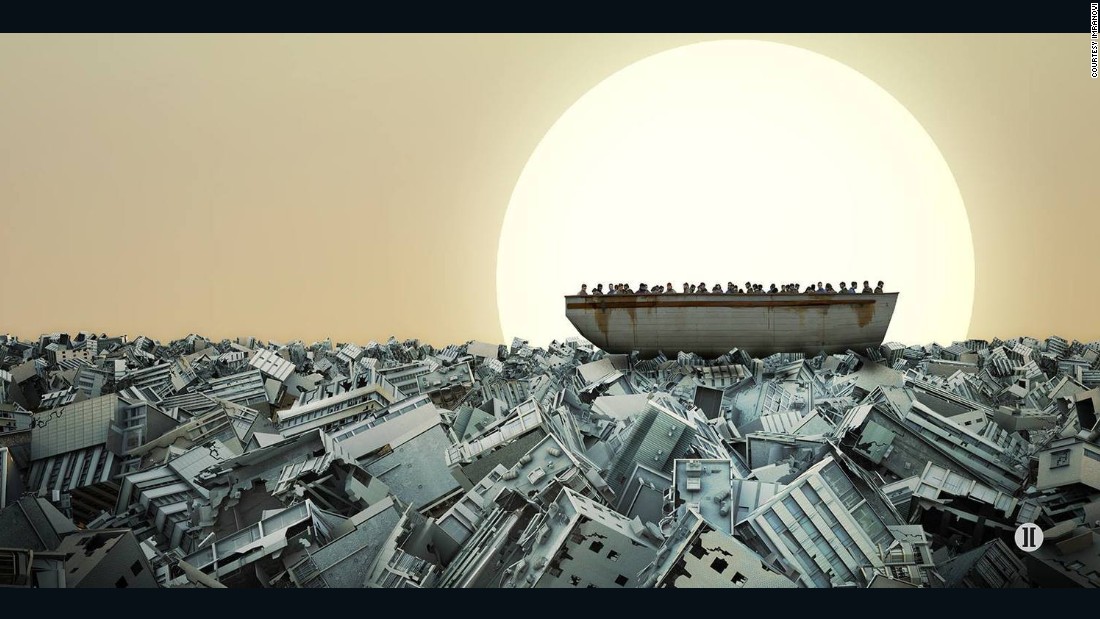
Syrian artist Imranovi creates graphics to remind us that while the world focuses on ISIS, Bashar al-Assad is still waging war on the people of Syria. <br /><br />"My main message was spreading the news. But now after this amount of time, everybody knows what's happening. So now the purpose of my art is to say this is us, whatever you can do, think, just think about these people."

 'This is the Modern Face of Syria according to Syrian artist Imranovi. The image is the centerpiece of his first ever solo exhibition in London, and part of a collection of graphics about the destruction of his home country at the hands of, as he sees it, one man:

 "It's all because of him. This man is still ruling the country, he's still in power. He's the main reason but everyone has forgotten him. Now all their attention is on ISIS."

 "I spent several months in Syria in protest; it was true freedom that we experienced. That was three years ago." He left Syria for the UAE and began work as an animator, but is worried about his family still living in Damascus. "It's all still under the control of the regime, full of barricades. There are lots of house raids and they just take whoever they find to prison. That's what happened with my two uncles. And my father. They took him as a detainee but recently we found his image as one of the people who died under torture."

 Imranovi most recently created artwork Deluge for the exhibition opening. As a depiction of Syrians in a boat floating on the debris of war, it represents a shift in the focus of his work to the people desperately trying to escape.

 "The sad thing is that I can't make something that represents the level of suffering that they are facing," he says. "I blame myself because I can't design or find any idea that fits this level. When you see the real image, it just cancels everything else."

 "The purpose of my art now is to say: think, just think about these people. Teach your children, teach your family, or find some organization that helps these refugees. If you can do anything about it, please." '

"There go the Syrian people, always heads up high."

 Rami Jarrah:

 'Trying to get doctors to speak regarding the strikes on Aleppo, all of them are saying they won't go on camera and that we are not allowed at all to film in or near the hospital. They say the Syrian regime will attack them if they try to show any of what they are doing to a public.
Usually the assumption was that the location would be identified by the Syrian regime then the hospital would be attacked but this is unrealistic given the fact that it is no hard job to have spies in the area who would easily provide coordinates to them.

 So they know where these key services are but they only attack them when they are shed light on in the media and especially the western press, Assad's propaganda machine wants to make sure that those that oppose Assad never come across as a civil society and maintain the "extremist" image. unfortunately it seems to be working because as I said noone wants to be filmed, they say we "will certainly be punished".'

Sunday, 22 November 2015

Telling the Truth About ISIS and Raqqa


 'When anti-regime demonstrations broke out in March, 2011, in Dara’a, a city in the south, and reports spread throughout Syria that Bashar Al-Assad’s security forces were firing on civilians, Al-Hamza and many others joined in protests, in Raqqa. “We wanted to be free,” he said. “It seemed simple.”

 As the uprising against Assad spread throughout Syria and the casualty counts rose, tens of thousands of people left Aleppo, Homs, Idlib and other embattled cities and towns and arrived in Raqqa, which is on the northern bank of the Euphrates River. The city swelled and became known for a while as “the hotel of the revolution.”

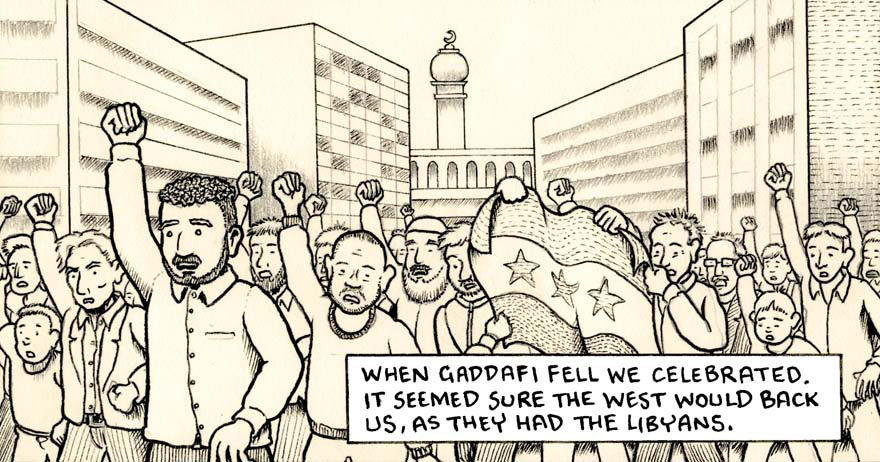
 By March, 2013, Free Syrian Army (F.S.A.) troops, as well as Islamist rebel forces, including al-Nusra, controlled the city and tore down a statue of Assad’s father, Hafez al-Assad, to celebrate. “Raqqa was the first liberated city in Syria,” Al-Hamza said.


 But at around the same time, members of ISIS, or the Islamic State, bearing black flags, began accumulating in the nearby town of Slouk. “At first, there were only around fifteen people,” Al-Hamza said. “None of us knew about it” until fighters from al-Nusra began switching over to ISIS, which had its origin in Iraq. “Over time, around ninety per cent of the Nusra fighters in the area became ISIS, and only ten per cent of them refused,” Al-Hamza said.

 In May, 2013, ISIS fighters started making kidnapping runs and attacking F.S.A. leaders, and, by late summer, there were full-scale battles with F.S.A. troops. As the F.S.A. began to suffer defeats, car bombings, kidnappings, and executions, one of the journalists at the table said, some F.S.A. soldiers “out of complete fear” also joined ISIS. People in Raqqa could see that ISIS was growing stronger, as they brought in heavy weapons from Iraq and seasoned soldiers who had fought in the Iraqi Army under Saddam Hussein. By the beginning of 2014, ISIS had absolute control of the city. They now overran the mosques, drove out Christians from the city, and turned major municipal buildings into their various headquarters. The propaganda campaign that ISIS mustered following the capture of Raqqa brought on a wave of foreigners.


 The member of R.B.S.S. are utterly frustrated with the efforts of the West to defeat both Assad, who has fended off the opposition so far, and ISIS, which has suffered recent losses in Iraq and Syria, but which has proved capable of exacting suffering from Sinai to Beirut to Paris.

 “The problem the Syrian people have with the United States is that we are suffering for five years with barrel bombs,” one R.B.S.S. journalist said. “Assad has killed so many innocents, and many people have lost hope. After Assad’s chemical attack, when he crossed the so-called ‘red line,’ the U.S. just took the weapons. It made America look like a liar and weak.

 “When you say ‘Raqqa’ the first thing people think of is ISIS,” he continued. “They forget hundreds of thousands of civilians, normal people like us. I am not a terrorist. There are so many people, normal people, who want to live in a free, democratic Syria. We want to rebuild Syria, and the only way we can do it is through our civil-society group and others like it. If the United States government and other governments want to fight ISIS on social media, their Twitter accounts are seen as propaganda. But when real life is shown through us, and you see what life is like, normal people believe it.” '

Saturday, 21 November 2015

Syrian rebels, and their clandestine war against IS


 'Over the past three days, locals in Mu Hassan, al-Mayadeen, al-Bukamal have all protested on the streets against IS' brutality.

 They also pointed out that dozens of civilians had been killed by French and Russian bombs, while no IS fighters reportedly died - a thinly veiled attack on IS policies of moving military hardware and fighters into civilian areas.

 "The protesters raised the flag of the Syrian revolution in these three cities. This is a clear sign that the people are starting to rebel against IS, step-by-step, as they did before with the Assad regime," said the Deir az-Zour activist.

 "The people in the eastern region only show support to the FSA," said Tim. "And they clearly understand that they are the only ones who can retake al-Sharqiya from IS." '
Despite airstrikes, FSA continues to confront regime


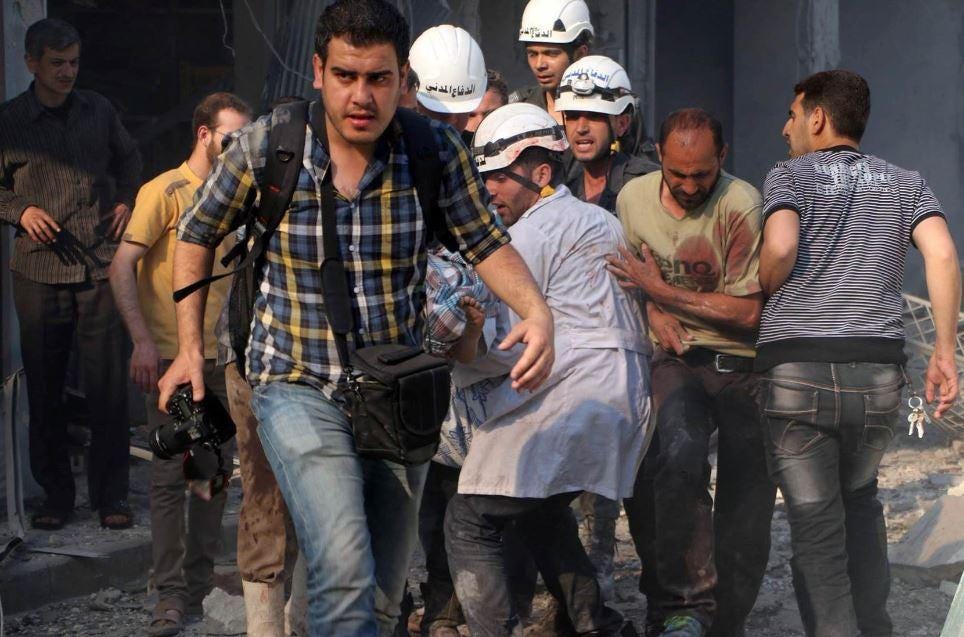
 'After the regime failed to advance toward the center of Hama’s countryside on Oct. 7 and after media outlets such as Al-Araby and All4Syria showed such abatement to the regime’s supporters, the regime opened several other fronts in the southern countryside of Aleppo, the northern countryside of Homsand the Latakia mountains as it desperately sought to advance and show its progress in the media as an achievement aimed at lifting the spirits of the regime supporters and forces.

 For this instance, a video published by pro-regime Russia Today news outlet on Oct. 12 depicts the battles led by the Syrian regime forces in some small villages in Hama’s countryside, which are, however, still under the opposition’s control.

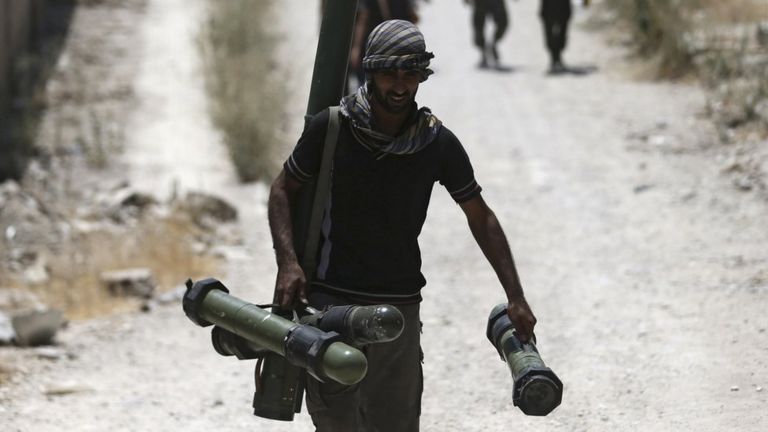
 Hamoud enjoys wide popularity among Syrian dissidents who either know him personally or from social networking sites. He has chosen the nickname of “Abu TOW” (Arabic for "father of TOW"), given his passion for the missiles.

 “Our generation lived a peaceful life full of love and joy, but what is happening in our country has forced us to engage in battles and take up arms. Despite all the violence we live in, we are still human beings, and we have not changed. We are waiting for the war to end to throw away the arms and get back to our previous lives,” he said.'

Friday, 20 November 2015

Syria’s only hope of peace is if Assad is removed

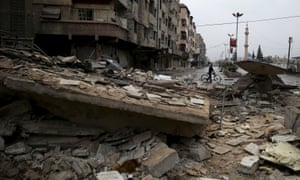
Damaged buildings in the town of Douma, Syria, earlier this week.

 'Assad never has been, nor will ever be, an alternative to Isis. He will never bring peace to Syria, nor will he ever be capable of taking on extremists. There is no capacity on the regime’s side to regain control and restore stability to the country. Moderate forces of the opposition are the only forces that have proved capable of combating Isis and winning back territory, as the Free Syrian Army (FSA) did in 2013. But, thanks to the failure of our western partners, Syria’s moderates are deeply under-resourced. Despite our repeated appeals, we never received the support needed from our friends.

 The only way to effectively take on Isis is to create a ground force capable of fighting terror and stabilising the country. With proper support, such a force could eradicate the Isis terror nest in Raqqa. But this will only happen when we formulate a political plan that ensures a transition away from Syria’s current leadership and state clearly that the end game is Assad’s exit from power.

 Under the aforementioned conditions, the opposition would work with Syrian government organisations to restore basic services and the FSA would willingly concentrate its efforts on defeating Isis. De facto cooperation would occur with the units of the Syrian national army that are not tied directly to the Assad family. The FSA, together with these army units from which identified criminal officers have been removed, would form the two natural components of an indigenous force dedicated to fighting Isis and any combination of forces that aims to destabilise the country. Such a force would provide the international community’s best chance to defeat Isis.'

Survivor of 2013 chemical attacks speaks out

Image result for Syrian refugee, survivor of 2013 chemical attacks, speaks out after U.S. House vote


 ' "Everybody failed us," he said. "And now they're talking about bad about refugees, about people who are fleeing for their lives." Eid, who goes by the name Qusai Zakarya, came to the United States on a tourism visa more than a year and a half ago. Before that, he was in the town of Moadhamiyeh in Syria when the government of Syrian president Bashar al-Assad launched a chemical weapons attack using sarin gas. "I watched hundreds of people die, suffocate," Zakarya told ABC7. "My heart practically stopped. And I was placed with the dead bodies."

 Although Zakarya is disappointed by the House Republicans and the dozens of Democrats who joined them for Thursday's vote, he also blames President Obama for the mess Syria has become. He says the President never did anything despite the fact that the chemical weapons attacks crossed the "red line" he said he had drawn. For Zakarya, the President's threat to veto the Syrian refugee bill if it passes the Senate isn't enough. "President Obama should be the last person on earth who should talk about helping others, because if he acted since the beginning of the Syrian revolution, he could have saved four hundred thousand lives," he said.'

Thursday, 19 November 2015

Assad could benefit most from renewed push against ISIL


 'Friday’s massacre in Paris has amplified calls among French politicians for coordination with Russia — and Assad — against ISIL. “Most right-wing politicians are in favor of getting closer to Putin to solve the Syrian crisis,” Bitar said. “The lesser evil narrative ... is triumphing because of these [Paris] attacks, so Assad and Putin are among the victors.”

 Syrian opposition figures believe the French and others are taking the bait set by ISIL. “The main goal is to force France to change its stances, to escalate its campaign in Syria,” said Fahd Al-Masri, a Syrian opposition figure based in Paris. “Any terror attack carries a political message. Everyone’s priority now is to fight terrorism, not topple Bashar al-Assad, who is the reason for the birth and development of terrorism in Syria.” '

Where Airstrikes in Syria Are Targeting Medical Workers


 'On Wednesday Physicians for Human Rights (PHR) released a new report documenting how the Syrian regime has systematically targeted the only people left who can save Syria’s most desperately sick and injured: medical workers.

 According to PHR, Russia, which joined the fight in Syria to bolster embattled President Bashar al-Assad, has also routinely targeted hospitals and clinics. Since Moscow launched its airstrike campaign at the end of September, Russian bombs have hit at least 10 medical facilities, resulting in injuries, collateral damage, and even the death of at least one medical staffer.

 Since 2011, there have been at least 329 attacks on medical facilities and 687 medical personnel have been killed, according to the report. Roughly 90 percent of those attacks were carried out by the Syrian regime, which the aid group alleges constitute war crimes and crimes against humanity. At least four of the facilities targeted by Russian strikes last month had already been barrel bombed or otherwise attacked by Syrian forces. According to PHR, “the Syrian government’s ongoing assault on health care is one of the most egregious the world has ever seen.” '

A daily hustle to survive


 'Mariam had come from Tal Kalakh, a Syrian farming town of 20,000 people. Everything began to change one day in May after Friday prayers. More than 3,000 people marched through the town, chanting: “The people! Want! The fall of the regime!” Men in uniform blocked their way. The mukhabarat, the plain-clothed secret police, stood behind the uniformed men, giving orders. Ahmed stopped his truck at a gas station across the road. “Go home!” a loudspeaker ordered. “Disperse! We will shoot.” The men in uniform raised their Kalashnikovs. The two sides were barely 10 yards apart. No one in the crowd moved. No one believed the security would fire. It was still the beginning of the uprising.

 Everyone waited.

 There was a sound like firecrackers. Rifle shots. Thousands of people ran in blind, disbelieving panic. A neighbor’s son lay on the ground, hit by a bullet. Others fell, dead or wounded. That is how Ahmed remembers it. “It was a peaceful demonstration, no weapons, nothing,” he said. He drove home as fast as he could to tell everyone what had happened. But they already knew. Women were in the street, ululating. People shouted: “They fired. They fired.”


 Ahmed told me the story of what happened next. At this point, it has entered Tal Kalakh folklore. The Daher family lived near the army barracks. The troops were not allowed cell phones, or TV. They were not allowed out. Officers had suspended all leave because soldiers who went home rarely returned. One night a soldier found a way to slip away to visit a nearby grocery store. A television was on: Al Jazeera. The soldier saw refugees lifting razor wire and streaming into Turkey. A woman in a headscarf was being interviewed. He watched. He couldn’t believe it.

 “That’s my mother. What’s happening?”
“The regime is killing people,” the shopkeeper said.
“What in the name of God is going on out here?”
“The whole country’s been turned upside down and you have no idea?”
“I swear, no. It’s like a prison inside the barracks. They told us: ‘It’s Israel. It’s militant gangs.’ But that’s my mother.”

 The soldier went back to the barracks and gathered his friends. They decided to escape. He shot the officer who had said they were fighting Israel. There was a gun battle inside the barracks: loyalists against defectors. The violence spilled into the streets as the defectors fled. The whole of Tal Kalakh watched green tracer fire arc back and forth across the town. There was nothing on state TV about it, of course, but by lunchtime the next day everyone knew what had happened. The Dahers’ street buzzed with the story of the soldier and the soldier’s mother. The shopkeeper swore it was true.


 The defecting soldiers joined a new organization called the Free Syrian Army. The armed rebellion had begun.

 The FSA began to appear everywhere there were people who supported the uprising. The war arrived in Tal Kalakh one evening in May 2011, when the regime decided to make an example of the town. Tanks and armored vehicles drew up along the main road outside. In the early hours of the morning, the shelling began. Mariam, Ahmed and three of their children hid in a bathroom in the center of the house. Their daughter Ala’a, their oldest child, was away taking exams in the capital, Damascus. No one slept during the bombardment. “God is our protector,” they said to each other as the ground shook and windows shattered inward. It continued until just after 6 a.m. The family emerged slowly and carefully. They found nothing left of the house next door but a pile of rubble. Ahmed and Mariam didn’t even have to discuss it: They knew they had to leave.'

'Our lives in Raqqa turned to black'

Raqqa woman Syria

 'In 2013, Raqqa became the first city to fall to rebels fighting to overthrow President Bashar al-Assad. Syrians called it the "Bride of the Revolution". A variety of rebel groups, from religious moderates to hard-line Islamists, held power. Within a year, IS had eliminated rival insurgents and controlled nearly every aspect of daily life.

 "At the first stage of the city being occupied by IS, people tried to resist their rules and even tried to protest, but then they realised it was a matter of life or death. So it was impossible," Raheb says.

 At the end of September, Russian jets joined the crowded skies above northern Syria. Although President Vladimir Putin has said they are attacking IS, air strikes have mostly targeted other rebel groups fighting against Bashar al-Assad. "I need to say that Russian attacks, even when they target Raqqa city, have never approached IS centres – never," Raheb says. "They sent them randomly and without any caution. They are targeting all the other militants, even the moderate ones, just because of their interests in protecting Assad." '
Wednesday, 18 November 2015

The Shia jihad and the death of Syria’s army


 'It was a hot July day in Ramadan when Khaled al-Shami saw an opportunity to flee Division 9 in Daraa, southern Syria, the place which had been his army barracks for the past four years. One month before, two soldiers like him had taken the same route, but had been spotted; one was gunned down and killed, the other was wounded and died as he was run over by the pursuing forces of Syrian President Bashar al-Assad. He walked five kilometres before he met soldiers from Saif Al Sham, a group in the Free Syrian Army’s Southern Front with whom he had been coordinating his defection.

 “I was living in a nightmare,” he said. “I need a software change after everything I saw and experienced. Most people like me want to leave, but it’s the overwhelming fear that stops you”. He described what life was like inside Assad’s army. “One important thing to realise is that there is no Syrian Army anymore, it is just militias, mostly Iranians and Lebanese.”

 “Without the Iranian Revolutionary Guard Corps (IRGC) and Lebanese Hezbollah the army could not stand up. Seventy percent of the troops in Division 9 are Iranian troops or Lebanese Hezbollah, the rest are shabiha. Only two to three percent are regular Syrian soldiers,” Khaled said.“Ten high-ranking Iranian officers control the division, they plan the operations. Only Iranian or Hezbollah forces can access operations rooms, no Syrian soldiers are allowed in."

 For battles, groups of 50 fighters are deployed: 15 IRGC, 15 Hezbollah, 20 Syrians, the majority of which are shabiha. Within battles the hierarchy is clear: the commander is an Iranian IRGC officer and his deputy will be a Hezbollah officer, according to Khaled.

 Major Abu Osama al-Jolani, a Free Syrian Army (FSA) commander and defected officer, told me how the war has changed over the past 12 months. “The Shia militias are leading military action to support the regime in all battles for the last year … Everyone we are fighting now are foreigners.” '

Inside ISIS’s Torture Brigades


 ' “They have a cage in this square,” Abu Khaled said, describing the place where ISIS justice is meted out in al-Bab. Abu Khaled was describing a place I’d been. I was in al-Bab during Ramadan 2012, in the relatively early days of the revolt against the Assad regime, when the town was still controlled by local rebel forces, and I saw how that same square came alive at night when activists, rebels, or local civilians transformed themselves into ad hoc cleanup crews—the Free Syrian Street Sweepers—picking up detritus and rubble left over from regime shelling, or manning field hospitals in the basement of the local mosque, because the real hospital in al-Bab had been targeted and badly damaged by the Syrian military.

 Abu Khaled listed the crimes of high treason: “Working with the FSA [the “Free Syrian Army,” an allegedly moderate collection of rebel groups], that’s capital punishment. Working with the mukhabarat, CIA, or foreigners—capital punishment.”

 “In Aleppo, people have electricity for maybe three or four hours per day. The electricity station is in Asfireh, ISIS-controlled territory, near Kweris airport. So the regime pays for the fuel to run the station. It pays the salaries for the workers because they’re specialized and can’t be replaced. And ISIS takes 52 percent of the electricity and the regime takes 48 percent. That’s the deal they have with Assad.” '

Tuesday, 17 November 2015

And the Darwin Award goes to...


 'In Syria, day after day after day, on average about 120 people die. Some would envy the deaths of the Parisians. A 13 year old boy is beaten and burned until he is hardly more than a blackened lump. He is castrated and dies. Women have rats inserted into their vaginas. Babies have their throats slit.

 The West tut-tuts, does nothing. The UN tut-tuts, does nothing. Human rights organizations call for nice, orderly, legal measures against Assad. They know with absolute certainty these measures won't be taken, except perhaps years later, after many thousands more die.

 Obama does nothing, seeks approval of Congress which he knows will reject any action. The UK makes noises, does nothing. France makes bigger noises, sees America will do nothing, does nothing.

 These governments are ahead of the opposition, who think the West should be nicer to Assad. Overwhelmingly, the people of Europe want nothing done. They aren't interested in protecting the Syrian people. Some just want to indulge themselves with charity projects for the ever-growing number of victims.

 The US gives a trickle of aid to the resistance against Assad. It won't provide anything like enough arms to overthrow him, much less the air support it provided in Libya. It fears that some fighter's third cousin threatened the West. It does nothing against Hezbollah, which actually does attack the West, but which fights for Assad.


 The only countries that help the rebels are Turkey, Qatar, and Saudi Arabia. They are condemned because they're Islamist and not democratic enough for those who condone or support Syria's dictatorship.

 Betrayed by Obama, abandoned by Europe, the Syrian people see that the secularist West is content to watch them die. They are in agony. They grow more and more religious, as often happens when people are abandoned by the secular powers and aided by religious ones.

 The Syrian rebels find that their strongest allies are radical Islamists. One such group, ISIS, goes crazy, starts attacking them, insists on restoring a Caliphate to bring justice and destroy the secular enemies.


 After hundreds of thousands of deaths, tens of thousands murdered by torture, millions homeless, starvation, gas, barrel bombs daily, some radical Syrian Islamists inflict on Paris, for one day, less than Syria suffers every day. They say this is because of Syria.

 The West is shocked. Hollande takes a moment out from his bombing campaign to call it an act of war.'

5 Obstacles That We Must Overcome in Syria

ASSAD

 'It is naïve to expect that after four and a half years of fighting for political survival, Assad and the leaders of his security agencies will negotiate their way out of Syria. They will leave only if pressured militarily and if their patrons abandon them. We need to exponentially ramp up military and financial support for the Syrian rebels and thereby send a strong message to Russia and Iran that despite their military interventions, they will not able to dictate the terms of a solution in Syria. Negotiations alone will not achieve peace in Syria.'

Can You Tell The Difference? Assad/Corbyn


 Jeremy Corbyn¹ isn't consciously a supporter of Bashar al-Assad², the Syrian president committing genocide. In the interview his quote comes from, he doesn't mention Assad once, even when he talks about what Syrian refugees are fleeing from, he says it is, "from the civil war, from ISIL, from other groups." He wants to ignore Assad's crimes in favour of blaming the Turks, the Saudis, and Western intervention, praises President Obama and hopes that a deal can be arranged with Assad's Russian partners in crime (as one activist puts it, "After Russian intervention, Syrians move from counting daily victims to counting daily massacres."³). But the almost identical language points to a closer association, the pro-Assad milieu that his press secretary Seumas Milne moves in explains why the phrasing is so similar, and bodes badly for how any Corbyn administration would deal with Assad should he last that long, and how much more disrespect a Corbyn-led Labour Party will show to those suffering the twin evils of Assad and ISIS.

1. [https://www.youtube.com/watch?v=5LDIGX9Ifig#t=4m3s]
2. [https://www.foreignaffairs.com/interviews/2015-01-25/syrias-president-speaks]
3. [https://x.com/xciconianigra/status/666245765308682240]

Monday, 16 November 2015

Syria’s Rebellious Women


 'She dresses casually in Turkey with hair uncovered, but on the job in Aleppo she is carefully dressed so as not to offend the strict dress code for women that is now enforced there. She chafes at that, but accepts its necessity, and states that “freedom from Assad is only the first step in the revolution.”

 When asked about her vision for the future, she said: “working to topple the regime, or be killed. We hoped that the international community would protect us, but the they let us down so we are on our own. The FSA protect us, I hope they can just hold on, and we can keep providing the basic services.” When asked what she wanted people to understand from the film she said: “We rose for our human rights, we are not monsters or extremists, we want to live with dignity.”

 She said that although ISIS is a huge threat to women, the main threat to civilians, including women, is Assad. She is disappointed that the world does not seem to understand that.'

Confessions of an ISIS Spy


 'Abu Khaled felt compelled to sign up because he believed America was an accomplice to global conspiracy, led by Iran and Russia, to keep the tyrant Bashar al-Assad in power. How else could it be explained that the U.S. was waging war only against Sunnis, and leaving an Alawite-run regime guilty of mass murder by almost every means and its Iranian Shia armies untouched?

 The clerics responsible for this indoctrination were know-nothing striplings from foreign countries. “There was one guy I remember from Libya, maybe he was in his mid-20s.” What kind of Islamic authority could someone so young have, Abu Khaled wondered. And where were all the Syrians?

 ISIS—at least as far as Abu Khaled characterizes it—needlessly sent thousands to their slaughter, without any tactical, much less strategic, forethought. The jihadist army had lost between 4,000 and 5,000 fighters, most of them non-Syrians.

 “Double this number are wounded and can’t fight anymore,” Abu Khaled told me. “They lost a leg or a hand.” Immigrants, then, are requisitioned as cannon fodder? He nodded. In September of last year, at the apogee of ISIS’s foreign recruitment surge, he says the influx of foreigners amazed even those welcoming them in. “We had like 3,000 foreign fighters who arrived every day to join ISIS. I mean, every day. And now we don’t have even like 50 or 60.” '

Sunday, 15 November 2015

ISIL’s French infiltration


 Jean-Pierre Filiu:

 'France was also targeted because it is the only Western country that considers the Assad regime as criminally culpable as ISIL. (Memories are still fresh and vivid at the Elysée of America’s abandonment of France in August 2013 when President Obama reneged on his initial plan to strike the Syrian dictatorship after the poison gas attacks on rebel-held Damascus suburbs.) The jihadis would like nothing more than for the entire world to follow Vladimir Putin’s example in pledging his government’s absolute and unconditional support to Assad. ISIL has little to fear from the Syrian despot, and has to date been largely spared by the Russian offensive.'

The Syrian women fighting to save their city

Zaina Erhaim

 ' “It’s not just men fighting the war in Syria; it is women, too, and they feel forgotten,” she told the Observer. “The women activists are working harder, against more problems, but are forgotten as the west obsesses on Islamic State. It is just Assad against Isis, but we are still here in this ruined place and now we are facing two enemies, Isis and Assad.”

 In Erhaim’s film, entitled Syria’s Rebellious Women and made over the past 18 months, she profiles some of her friends who have helped to document the war, deliver supplies to civilians and provide medical services in ways that some within their country now regard as unacceptable behaviour for women.

 Zein spent 14 months in a government prison for taking part in demonstrations. “The detention centre is a cemetery for the living,” she says. At one point government soldiers raped a male prisoner in front of her. When she was released she found her home had been destroyed and her family had gone. “I only wanted the Free Syrian Army. I got FSA, the al-Nusra Front and Isis. We said Syria is for all. Everybody joined in.”

 Zein has given up hope of getting married, or having a family. Erhaim, too, says that her husband gave up “nagging her” to have a baby after they both witnessed the aftermath of an airstrike on a nursery school near their flat. So many schools have been targeted that parents fear sending their children to school.

 “I met one woman who sits outside the school all day while her five children are inside,” said Erhaim. “I said to her, you cannot protect them by sitting there. And she said ‘no, but if the classroom is hit then at least I will die with them’.” '

Friday, 13 November 2015

Letter from Douma


 'It usually begins in the morning, at around 8am, and lasts all day. But recently there has been a new development: now we sometimes have air strikes at night as well. We wake up when we hear the first bomb and say Alhamdulillah (thanks to God): we are still alive.

 After breakfast, I go to my office - it's located in the building I live in, which helps me to minimise how much time I have to spend out on the streets. I work for the Syrian Nonviolence Movement, a civil society NGO founded in 2011, during the early days of the uprising. In terms of food, my family are among the lucky ones, as both my wife and I work. For breakfast we have labneh (strained yoghurt) or cheese and sometimes jam. And then later we have a second meal - today we had rice and tomatoes. Sometimes we have meat.

 When I arrived, the city was newly liberated and there was an atmosphere of hope. Alternative schools, which do not run the state curriculum, and new organisations such as the civil defence forces and the new Douma city council were set up. There were also new cultural centres, newspapers, magazines and FM radio stations. It felt like the regime would soon fall. By October of that year, the siege had tightened. It was really hard. There was no food in the markets, no fuel, almost nothing at all, and no smugglers bringing anything in. There was no bread, and no flour to make it, no rice or potatoes.

 I was here when the regime used chemical weapons to attack the eastern Ghouta area in August 2013, and we really thought that something would happen after that to stop things. If a chemical attack against children isn't a "red line", then what is? That was the international community giving Bashar al-Assad a licence to kill. They basically said - you can kill more, and you can even bring in other armies to kill people if you are short of weapons and soldiers.


 The entire world is watching Syrian children and women being killed by barrel bombs and air strikes, and yet nobody is taking any action to stop this massacre. The only way I find to stay positive is by carrying on. After losing loved ones, houses, jobs, savings … people have no choice but to go on. I stick to my ideas of nonviolence. We see now how the situation is getting worse and worse with more violence. Even if it does not look like peace is coming any time soon, that doesn't mean we should support more weapons and more violence now.

 I think the international community knows what could stop the killing in Syria, but they don't seem to care about Syrian lives.'

Syrian activists are repairing the fabric of civil society


 'The main impediment and biggest threat to civil society in Syria today is the indiscriminate bombing by the Syrian regime, especially the aerial onslaught with barrel bombs. It is no surprise that the Syrian regime wants to push these civil groups outside the country. The biggest threat to the regime today is from the progressive culture of political-truth telling embodied in newly empowered civil society. Only Syrian civil society offers a clear alternative to collapsing state institutions.

 Syria’s most promising future could, without doubt, emerge from these grassroots initiatives, instated and reinstated by unwavering activists in the face of a multitude of challenges. If the liberated territories which saw the emergence of these groups were to be given total protection, with anti-aircraft defences, from Assad’s daily onslaught of barrel bombs, this base would start to flourish, refugees would return and an alternative order to that of Assad would quickly emerge. But, for now, the bombs continue to bury people under the fragments of their destroyed neighbourhoods. And if the world defiantly continues to insist that what is happening in Syria is too complex, too confusing, no one can blame the revolutionaries for this lack of clarity for they have obsessively documented every infringement on their basic rights in front of a largely apathetic audience.

 We are tired of foreign commentators projecting tired and well worn assumptions onto the uprising—warning that any intervention by the international would encroach on Syria’s national sovereignty. We are tired of being warned that so-called political engineering by the west will achieve nothing beyond exacerbating sectarian and ethnic cleavages. The well-known risks of external political engineering must not lead us to dismiss the struggle of the Syrian people as pointless and doomed. It does these brave activists a great injustice to characterise their popular uprising as a scheme managed by imperialist forces. Syrian revolutionaries cannot afford to give up on what they started, even if they wanted to. If they give up they will be living on borrowed time, until the regime locates them and tortures or kills them. Syrian civil society is alive and well, and growing despite the most inauspicious conditions. It needs the support of the international community and an accompanying narrative which privileges civil activism over the militarised binary of ISIS and Assad.'

Assad’s Troops Are Raping Children to Silence Dissenters

1111_Syria Children

 Khaled Rawas:

 ' “I will not forgive him, nor will I let God's mercy descend onto him,” uttered a woman activist working to support rape victims at a secret humanitarian organization in Damascus.
The activist leveled this charge not against the regime and its Shabiha militias—which use this most cruel weapon of war systematically to intimidate, suppress and humiliate Assad’s many opponents—but in reference to the father of a twelve year-old girl who was brutally gang raped by pro-Assad factions in her own home in front of her family.

 The Assad regime utilizes its incredibly harmful effects on the victim and her society to suppress any form of dissent. Clearly, a 12-year-old girl was no threat to the regime, but raping her in front of her family was a means to repress the opposition and callously silence those who long for freedom.

 After the young girl gave birth to the child, the activist received additional reports that she and her baby were physically assaulted by her father for bringing dishonor upon the family. In the end, the young girl took her newborn child and fled from her home, prompting the activist’s earlier comment of the father who mercilessly forbade his daughter from aborting the child of a Shabiha-rape, but then displayed no mercy toward the child of that rape. Already stripped her of her humanity, her family’s shame and humiliation stripped her of it a second time.

 “During my detention, I saw many female detainees whose families refused to recognize them on the assumption they had been raped, even if that wasn’t true. For example, the regime forced one activist [detainee] to conduct an interview on national television and claim that twenty-one Free Syrian Army fighters gang raped her to spread its false version of who revolutionaries are by playing on the religious and social tension of regime supporters. This was not the only injustice that she faced. After being transferred to the Adra civilian prison, her father visited her and disowned her, ordering her never to return to her community. Even if she was ever released from prison, she could never go back home.”

 As a Syrian, I hope that the revolution will not only fight the Assad regime, but also the damaging traditions and mores that oppress our society. The fight for freedom calls for us to think and act logically, not to listen to overzealous religious leaders and a brutal regime.
Syria’s honor does not depend on the female hymen, but in eradicating the ruthless Assad regime and its cruel system of gender-based oppression. This is the revolution that we need.'

The local journalist shining a light on Aleppo


 'After the Free Syrian Army entered Aleppo in mid-2012, media workers started acquiring more freedom, and international news outlets made their way to the city.

 Life in Aleppo does not resemble life anywhere else in the world. My city has been ripped apart by war and has seen things that defy the imagination. Words can’t do them justice. It's a city full of love and war, childhood and death, pain and suffering. It's considered one of the most dangerous cities in the world as it gets bombed every day with barrels of explosives and slaughtered with a knife by Islamic State in the eastern countryside. I've seen the lives of innocent people destroyed by death and disability. Houses are no longer safe in Aleppo. There is nowhere left to hide. And no one knows how long it's going to last as the international community turns a blind eye to these forgotten tragedies.

 I hope one day to see smiles back on the faces of the country's children after Assad is overthrown and the Islamic State group is disposed of. Only then can we build a free and peaceful Syrian state.'

Thursday, 12 November 2015

Why Stop the War don’t want to listen to Syrians


'The Syria Solidarity Movement UK was formed to give solidarity to the people of Syria in their struggle for a democratic and free Syria. Our membership is made up of Syrians, and friends of Syrians. Our positions are led by the needs and demands of Syrians suffering brutally at the hands of a criminal regime.

 Stop the War oppose any action against Assad. This puts Stop the War against the Syrian civilians who are being bombed by Assad, it puts them not just against Syrian revolutionaries but also against Syrian doctors, against Syrian White Helmets rescue volunteers, and against Syrian civil society activists, all of whom call for international action to stop Assad’s bombs. This is why Stop the War don’t want to listen to Syrians.

 Their statement lists three claimed lies about their 2nd November meeting: that Stop the War’s Andrew Murray had called for support for the Assad government to fight ISIS, that Syrians were prevented from speaking at the meeting, and that Police were called to the meeting to control protesters.


 Andrew Murray’s “strong and credible government” is one where there is no change of regime, and no demand for Assad to step down: in other words, a continuation of the Assad regime. Stop the War did allow Muzna Al-Naib to speak in the meeting, but only when other members of the audience called for her to be heard. She was the only Syrian allowed to speak, she was interrupted, and for the rest of the meeting all other Syrians were deliberately ignored by the Chair, Diane Abbott, even when other speakers Catherine West MP and Caroline Lucas MP said they wanted to hear from Syrians.

 Stop the War deny that Police were called to the meeting to control protesters. This is the most blatant and astonishing falsehood. Police in the Houses of Parliament were called to the meeting. Syrian and Arab audience members were repeatedly told “you are going to get arrested.” One Syria Solidarity activist was prevented from re-entering the meeting by Police who arrived in numbers and were visible to all at the doors of the meeting by its end.
If Stop the War’s slogan “Don’t bomb Syria” is to have any meaning, let them demand the end of the regime whose bombs have killed so many.

 If Stop the War oppose imperialism let them demonstrate their sincerity outside the Russian Embassy. Let them demonstrate with placards calling for Russia to stop bombing Syrian hospitals.

 Lastly, if Stop the War are against war, let them stop denying war crimes; for this is their latest response, publishing a claim that Assad wasn’t responsible for the Ghouta chemical weapons massacre, “because it was so obviously not in Assad’s political and military interests.”
He asks “what would happen to the Syrians that have supported the regime” if the Free Syrian Army win. The question Matt Carr fails to grasp is what is happening to millions of the dictator’s victims right now? The Free Syrian Army are the people who have defended their homes, freedom and justice against Assad for the last five years and against ISIS for the last three, and who are now being bombed by Assad’s ally Putin. The Free Syrian Army are not the ones levelling neighbourhoods and driving millions from their homes.


 Syrian civilians need protection from Assad’s mass murder. Stop the War have nothing to offer them, and so they stop their ears.'

A perilous journey


 "My name is Khalid. I'm 24. I escaped from Syria and I have been in this asylum centre for three months."

 "I joined the protests – but kept it secret from my family. My mother would have locked me in my room to protect me. We marched in glorious unity. When the security forces shot us, it hardened our defiance ..."

Wednesday, 11 November 2015

How Syria's 'Rebel Mother' Rebuilt Her Life In Turkey


 'Early on, Najlaa brought her two sons, Hussein and Amr, with her to the protests, and rallied other women to join her. What began as a few women marching down the streets in their traditional chadors quickly evolved into an energized movement, with women chanting slogans and waving placards denouncing Assad.

 When she arrived in Aleppo, she didn't stop supporting the revolution. Najlaa worked to help injured people and made signs for the rebels. Soon, her work forced her to flee again, this time to Azaz, where some of her relatives lived. Then her 9-year-old son, Amr, was injured by one of the many improvised bombs that rained down on the city as forces loyal to Bashar al-Assad battled the Free Syrian Army. Najlaa knew she had to flee. She arrived in Turkey with her two sons and the clothes on their backs.

 Najlaa has begun to rebuild Syria in Turkey. On a recent day at the center, women in hijabs carefully pulled needles through cloth, making the Syrian revolution’s equivalent of Barbie dolls. “We called her Hajier, first martyr of the revolution,” Najlaa said as she held a doll with a kind face and golden-brown braids made of string.

 The achievements of these women are now the only thing that brings her joy, Najlaa said. They also give her hope that someday they will be able to return to a peaceful Syria. “The war will end. Nothing lasts, the war will end, and it will then be clear to women that the more work they put in, the more they will harvest.” '