Monday, 28 September 2015

West 'walking into abyss' on Syria

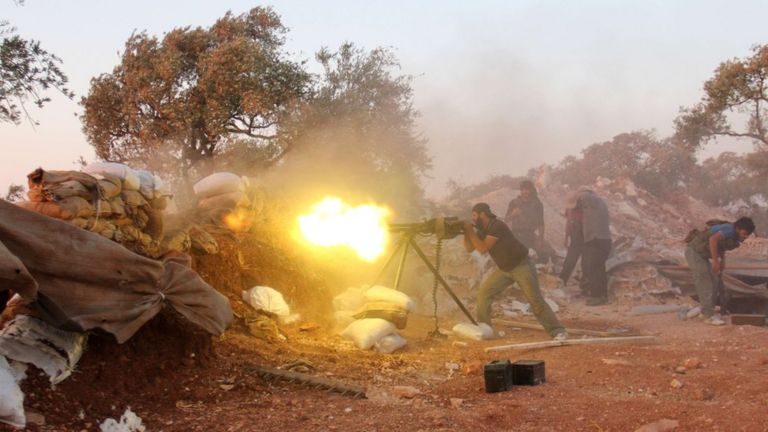
A rebel fighter fires heavy artillery during clashes with government forces in Idlib province

 Charles Lister:

 'Assad is not and should never be seen as a better alternative to IS. From the very first days of the revolution, Assad and his intelligence apparatus have consistently facilitated the rise of jihadists. This policy of aiding and abetting jihadist militants and manipulating them for Damascus' policy interests is a well-established Assad family practice, dating back at least to the 1990s.

 By releasing dozens of al-Qaeda prisoners in mid-2011, Assad helped give birth to a thriving Islamist insurgency, including an al-Qaeda affiliate. By then adopting a deliberate policy of not targeting IS, Assad directly facilitated that group's recovery and explosion into the transnational "Caliphate" movement it claims to be today.

 Meanwhile, the Assad regime has conducted a consistent policy of intentional mass killing of civilians - first with air strikes and ballistic missiles, then with barrel bombs and widely alleged use of chemical weapons. Bashar al-Assad has professionalised and industrialised the use of detention and torture to "cleanse" his own population, while imposing dozens of medieval-style sieges on vulnerable populations. He has consistently flouted UN Security Council resolutions and according to some sources, has been responsible for 95% of all 111,000 civilian deaths since 2011.


 IS remains a potent force in Syria and must be countered, but it will not be marching on Damascus anytime soon, contrary to some uninformed fear mongering. Al-Qaeda also poses a pressing and more long-term threat, perhaps more so than has been acknowledged. But at the end of the day, the root cause of the entire Syrian crisis is Assad and his regime.

 Contrary to popular opinion, the Syrian armed opposition is not divided, but has in fact spent much of the past year focused on developing a clear and unified political vision. These are all groups composed of and led by Syrians and which explicitly limit their objectives to within Syria's national boundaries - not IS and roughly a dozen Al-Qaeda-linked factions.

 While accommodating Russian and Iranian demands for Assad's survival and potentially even a de facto partition of the country may seem like an attainable objective, this will only prolong and intensify the conflict and will almost certainly spark a jihadist mobilization the like of which the world has never seen. The vast majority of refugees now entering Europe are fleeing Assad's murder machine, not IS or al-Qaeda. Ever since Syrians took to the streets in March 2011, the Western response has been both feeble and noncommittal, but the world is now in need of real leadership. Unfortunately, it seems our leaders are walking into the abyss with their eyes closed.'

Sunday, 27 September 2015

"I do not see what Assad's role would be"


 'Sweden's Foreign Minister Margot Wallström talks about Syria negotiations and the refugee crisis. "Austria and some other European countries are in favor of involving the Assad regime in solving the Syria conflict. What do you make of it?"

 "I am, frankly, very skeptical. And I'd like to know what is the signal that you want to send it, and what you would achieve with it, before I refer to a clear position. I just do not see what would the role of someone be exactly who has killed seven times as many people as IS (the terrorist militia Islamic State), and directed barrel bombs and other weapons against his own people." '

What does “settlement in Syria” mean to Washington?


 'Kerry has specifically adopted Moscow’s two primary positions:

 The First, making the “war on terror and extremism” the basis of any international approach in Syria. The Second, putting off for the time being any discussion of the fate of Assad, rather than making it the first step in any discussion of a political settlement, as the Syrian opposition has been demanding since day one. Kerry has now made it clear Assad does not have to leave anytime soon when he said: “It doesn’t have to be on day one or month one. There is a process by which all the parties have to come together and reach an understanding of how this can best be achieved.”

 It is, indeed, quite interesting that Washington is still blabbering that “there is no place for Assad in a future Syria”. The experience of the last four years with what the Obama administration promises hardly encourages anyone to believe that such a statement means anything.

 On the other hand, talking about Assad, as an individual, may have now become pointless and overtaken by events. It is true he has been the face of the Syrian tragedy as well as its main cause, but it is also true that as an individual he is now but an irrelevant and a worthless detail. Those in control in Syria today are the ones who are striking deals, bringing in sectarian fighters across the border, and drawing with blood the maps of Syria’s partition.

 As regards the Arab states, if Washington continues to dismiss their misgivings about its blessings of Iran’s hegemony over Iraq, and its self-delusion that the Syrians’ would accept the perpetuation of the four-decades old despotic mentality and its security and suppression, they would realize that nothing is going to change in Syria except the portrait of a figurehead president.

 Assad must leave. There should not be any doubts about that; but the policy of “fighting ISIS” alone must not conceal Washington’s frighteningly contradictory approach to the Middle East’s problems; including, turning the Arabs and their countries to failing experiments.'

Saturday, 26 September 2015

Bashar al-Assad is still the problem


 'Last Wednesday it deployed more than 103 barrel bombs; one every 14 minutes. Similarly last May, more than 40 people died in a single strike when a bakery in Manbij was targeted in this way.

 These victims are not collateral damage caught in the fog of war. The Syrian regime has repeatedly and deliberately conspired in killing some of its most vulnerable citizens. In May 2012, forces loyal to President Assad stormed the town of Houla and massacred 108 people. A United Nations report found that almost all had been subject to “summary executions” among them, 49 children under the age of 10. Some had their skulls cracked open through blunt force. Others were stabbed to death.

 The heroic British aid worker, Dr Abbas Khan, who worked in a field hospital in Saraqeb, also documented the sadistic rituals of Assad’s regime after falling into their hands. “My detention has included repeated and severe beatings, largely for no reason other than the pleasure of my captors,” he wrote. The day before he was due to be released, Dr Khan was murdered by the Syrian regime. Like Khatib, his emaciated corpse was covered in cigarette burns.


 The idea that the Assad regime’s violence is somehow morally or strategically different to that of jihadist actors in Syria has become fashionable among some sections of the Western media. Perhaps a symptom of fatigue or sympathies forged during time spent as guests of the regime, mainstream commentators such as Patrick Cockburn and Peter Oborne have been at the forefront of this trahison des clercs.

 According to the Syrian Network for Human Rights, 95 per cent of all civilian deaths in the conflict have come from the regime. The refugees now fleeing to Europe do so as a direct result of Assad’s policies.

 Any attempt to rehabilitate him within the international system would be as morally bankrupt as recognising Abu Bakr al-Baghdadi as a legitimate head of state. Framed in that way, it should be obvious that the cure to Baghdadi’s murderous pathology does not lie within the Baathist poison.'

Friday, 25 September 2015

The cost of inaction


 I don't think everything hits the bullseye in this Economist editorial, though it has most major points right. There is still a Free Syrian Army, and a lot of support for moderation and secularism, just not a lot of identification with the West. And it isn't possible to ignore now the contribution of jihadi groups like Jabhat al-Nusra and Ahrar al-Sham to the fight against Assad, the only way to keep Syrians wanting a more moderate and secular future is to be better at supporting their struggle than the extremists, not to suggest they are the same threat to Syrians as Assad or even ISIS.

 'Most civilians are being killed by Mr Assad’s forces, and most refugees are fleeing his bombs. Backing Mr Assad, or acquiescing in the survival of his regime, would only push more Sunnis into the arms of the jihadists. If IS is the ugliest face of Sunni Arabs’ sense of disenfranchisement, Mr Assad is the worst embodiment of their nightmare. Russia’s intervention may yet help bring about [a diplomatic deal under which Mr Assad would surrender power]. More probably, it will embolden Mr Assad to cling to power; and keep fighting a war he cannot win but that will do more damage to the country, and the region.

 If America put a stop to the barrel bombs, its standing among Syrians would immediately improve. Dependence on outside support would also increase the prospect of the West exerting some influence over rebel behaviour, and avoid the dark possibility of Sunni atrocities against defeated Alawites, Christians and other minorities.

 Perhaps the biggest obstacle is Mr Obama himself. Right now his legacy will record not just sensible rapprochement with Iran and Cuba, but also the consolidation of a jihadist caliphate and countless boat-people. He may worry about the risks of American action and “owning” the Syrian crisis. But the greater risk is standing aside and disowning the Middle East.'

Thursday, 24 September 2015

Syria has become a global crisis


 Yassin al-Haj Saleh:

 'It is impossible to envisage a ceasefire with this regime. Only the regime's collapse could lead to peace, said Saleh almost three years ago, in an interview with news website Syria Deeply; at the time he still lived in Damascus.

 He believes the same thing today. Four years after the Syrian uprising the Assad regime remains in power. These days Russia increases its military presence in Syria, and the USA is still leading attacks against Islamic state (IS). The tragedy of Syria has been unfolding because the international community has allowed Assad to remain, believes Yassin al Haj Saleh, who uses the Arabic term Daesh for IS.

 - As long Daesh exists, it is not enough to get rid of Assad regime - but it is not enough to fight only against Daesh, as the US does, says Saleh.

 - Building a Syrian majority for a new Syria requires both overthrowing the regime and simultaneously fighting Daesh. That can not be achieved without international support. One cannot let the country be in the hands of a regime that has killed more than 250,000 people. It is extremely unethical, says Saleh.
International attention has largely been directed against the atrocities committed by IS in the past year.

 - Among Syria's victims is one of seven killed by Daesh and other groups. Six of seven were killed by the regime. Daesh' crimes are more "sexy" and meet with great fascination in the Western media.The mindset of the West prevents Western media from thinking about the six of seven killed by the regime in a less "sexy" way. The regime has also killed foreigners, so it's not about that. Or if it does, it gives an even worse impression of the international community, said Saleh, who believes that Assad could have been overthrown long ago if it was really a desire for it internationally.


 The paralysis over Syria has been explained by international fears of an unstable post-Assad Syria where IS gets free rein.

 - But how much worse can it be, asks Saleh, throwing out his arms.

 - It seems like they think the situation in Syria began yesterday.The regime has been there for decades. Tens of thousands of people, myself included, have fought against the regime and been imprisoned. Many have been killed. If the world prefers one that Assad stays because they want stability, Syrians would be forced to pay for it. It will trigger and has already triggered a dynamic of extremism, sectarianism and militarism that has resulted in Daesh. Daesh did not emerge from nothing. Syrians are not extremists, but some have become extremists in the situation that has been allowed to develop, says Saleh.

 In addition to Iran, Russia is the Assad regime's loyal international backer. Peace in Syria can not come without Russian involvement, many believe. But Russia will not contribute to peace, says Saleh.

 - One cannot say "Russia" and "peace" in the same sentence - and especially not in Syria. Russia has helped the regime to kill Syrians for 55 months now, and use its veto power to prevent action in the Security Council. So how can we talk about Russia's role promoting peace? They still say that Assad must stay. They said that before Daesh existed. Russia has always taken the side of the regime. Russia has never said that they want a political process that really involves change, says Saleh.'


 Compare with the rubbish Noam Chomsky¹ came out with on Democracy Now a couple of days ago.


 ' "The Obama doctrine vis-à-vis Syria?" "It’s a good question. Washington hasn’t a clue. It’s obvious. And it’s a little hard to fault them for that. It’s very hard to think of a constructive outcome to this utter disaster.The United States has taken a somewhat hands-off position, except that it’s supporting its allies, who are very clear. As I mentioned, Turkey, a NATO ally, has been supporting the al-Qaeda-related jihadi front, namely the al-Nusra Front, a couple of others. The Gulf states, also U.S. ally, Saudi Arabia, where they have been strong supporters of what’s now become the Islamic State—technically, Saudi Arabia, the government, no longer—claims no longer to support them directly, but surely did in the past, and funders from the Gulf—wealthy Gulf states are still presumably funding them, as they have in the past. It’s pretty open in the case of Qatar. So there’s—these are indirect U.S. policies.

 The only conceivable hope for some resolution of this horrendous crisis, which is totally destroying the country, is the kind of negotiated settlement that was worked on by serious negotiators, like Lakhdar Brahimi, an international negotiator, very respectable, sensible. And the main idea, which—shared by any analyst with a grey cell functioning, is some kind of negotiated settlement which will involve the Assad government, like it or not, and involve the opposition elements, like it or not. There can’t be negotiations that don’t involve the parties that are fighting. That’s pretty obvious, just as South African negotiations had to involve the leadership of the apartheid state. There’s no other way. They can’t have other negotiations. It’s perfectly obvious that the Assad government is not going to enter into negotiations that are based on the condition that it commits suicide. If that’s the condition, they’re just going to keep destroying the country. That unfortunately is the—has been the U.S. position of the negotiations. U.S. and its allies have demanded that negotiations be based on the precondition that the Assad government will not survive. It’s a horrible government, and I’d like it not to survive, but that’s a prescription for destroying Syria, because it’s not going to enter into negotiations on those terms.

 Right now, and in fact in the past, these have been proposals pretty much supported by the Russians. And, in fact, you may not have seen this, but for those of you who read the international press, British press, a couple of days ago there was a very interesting revelation that in 2012 the Russians had apparently presented a proposal for an interim regime which would not include Assad, and it was turned down by the United States and the West. That was reported in practically the entire British press—Guardian, The Independent, Daily Telegraph, across the spectrum. Didn’t appear in the United States for a while, but finally it did appear, not in print, as far as I can tell, but in an online edition ofThe Washington Post, where there’s an article of the usual type. It sort of mentions that this is rumored, but can’t take it seriously, and, you know, so on, probably didn’t mean it, and so on and so forth. Well, OK, you can draw your own conclusions.

 But as far as—if you ask what the Obama doctrine is, it doesn’t exist. We saw the Obama doctrine a couple of weeks ago when the Pentagon sent in these 50 fighters, who had been trained for years, and they were immediately captured, killed, or just defected, by Turkey’s ally, the al-Nusra Front, as I mentioned, apparently with Turkish intelligence support. Now that’s the doctrine, is nothing, except to support the allies, which are in fact supporting jihadi forces. But what the doctrine ought to be, I think, is pretty clear. What the chances are for settlement of those terms is hard to say—not very high. But if you can think of an alternative, you should present it. No other alternative has been proposed."

 Obviously he in this interview (1) Pretends to want Assad out, but in reality not. Just like President Obama, (2) Pretends that America is secretly backing rebels/jihadis because its allies are [sic], (3) Thinks a state of mass torture can be reformed the way the apartheid state was, (4) Imagines that the UN and local ceasefires are a route to peace, when the UN has done nothing to restrain Assad, and the local ceasefires have always been an opportunity to tighten the sieges and redouble the bombardment, (5) Does the Saudis fund ISIS, Turkey loves ISIS, the Russians wanted peace, conspiracy theories, the last of which Brian Slocock dismantled here². Clearly Chomsky is still getting his ignorance from his friend Patrick Cockburn's contrived ignorance. He doesn't quite go for the full acceptance of the war on terror retread, but still expresses regret. Of course he has no idea that there is any alternative proposed to defend Syrians from Assad other than a US invasion, because Cockburn and President Obama have said there is no alternative. He also lumps the authoritarian Islamist régimes in with their radical Islamist enemies, which has had no basis since Osama bin Laden took against the Saudi monarchy when they let the US establish military bases there in the 90s.

 'The major center of radical Islam, extremist radical Islam, is Saudi Arabia, unquestionably. They are the source of the Wahhabization of the region, which Patrick Cockburn points out is one of the major developments of the modern era.'


 Crispin Blunt³, Conservative chair of the House of Commons Foreign Affairs Select Committee, has a similar outlook to Chomsky's, not surprising as Patrick Cockburn was the most prominent witness at his committee's hearing on Syria a couple of weeks ago.
 From 7m42s:

 "We have made strenuous efforts to try and stand up the Free Syrian Army and Western-oriented forces in there, and that's come a complete cropper. As we have seen, there is no hard power being exercised on the ground by parties to this civil war who are aligned to the West." He then calls Nusra al-Qaida, and then says they are in a coalition, but doesn't say with whom, and just says they are getting support from Turkey and Saudi Arabia.

 1. [https://www.democracynow.org/2015/9/22/q_a_with_noam_chomsky_on]
 2. [http://pulsemedia.org/2015/09/20/did-the-west-ignore-a-russian-offer-for-assad-to-step-down-as-president/]
 3. [https://www.bbc.co.uk/programmes/b06cr9wt]

The Syrian refugees who built a city in no-man's land


 ' "My wife – the girls' mother – died when the roof of our house collapsed after a barrel bomb attack," says 38-year-old Mohammed, sitting on the floor inside the sweltering corrugated metal building that has been home for three years now.

We were sleeping in our house in the early morning around 5 a.m. when the bomb struck. We woke up with rubble on top of us. I lost consciousness and was separated from my children and brought to the hospital."

Mohammed said fighters in the Free Syrian Army carried him on their backs to the Jordanian border. Days later, he was reunited with his children at the home of a friend.

"I would like to go back to Syria – nothing can replace my country," '

The Saints and Smugglers of Syria’s Civil War


 'Two years into the revolt, opposition supporters inside Syria had self-organized into coordination committees, or tansiqiyas. In villages and neighborhoods, the citizen groups called for demonstrations, organized civil defense, and shared information on social media. Soon, a revolution that began with unarmed demonstrators quickly grew in need of an ever-expanding list of equipment: Samsung cell phones, better cameras, satellite phones. As early as the summer of 2011, when the regime first cracked down on protests, the opposition needed medicine.

 The first place activists turned was overseas; some 10 million Syrians already lived abroad by 2011. Many members of the diaspora were longtime opponents of the Syrian regime; a few had made fortunes for themselves. And just as spontaneously as the local uprising had organized, the diaspora began to coalesce into their own tansiqiyas — in Abu Dhabi, Dubai, Kuwait City, Doha, Jeddah, and elsewhere. Like so many of the first activists in 2011, many in the Syrian diaspora saw the initial uprising as a singular chance for a different kind of Syria. Mostly of an older generation, they watched, awestruck — even embarrassed — by how young people stood up to the regime they had run from. But while those who fled Syria hadn’t fought Assad and his soldiers back then, they could do so now using a weapon few inside the country could wield: money.

 Their story is one of the Syrian conflict’s most invisible — and most important. The diaspora crowdfunded the early days of the uprising, kept activists and families sustained as times got rough, and sent vital remittances to breathe life into a destitute state. At times, they dabbled in weapons; they formed key links between regional governments and militias on the ground. It is unlikely we will ever know exactly how much money the Syrian diaspora poured into fighting the Assad regime. No accounting exists of its hundreds of decentralized networks spread across dozens of countries. But one thing is clear: Four years into a bloody civil war, the only reason that many in the country are still fighting — and surviving — is because of money and assistance provided by those who fled decades ago.

 Amid it all, Abu Dhabi’s tansiqiya is expanding as the existing diaspora absorbs hundreds of thousands more Syrians. In the UAE alone, expats estimate that some 100,000 Syrians have recently arrived. Some of the tansiqiya’s aid is now focused inward, supporting the parents, sisters, nieces, and nephews who have arrived to the Gulf on visit visas without work.

 Unlike the middle-class businessmen who fled decades ago, the new arrivals are often destitute — and increasingly dependent on their more established relatives and friends. “Each one of us here is sustaining 50 people,” says Abu Akhram, a member of the Abu Dhabi group. “The diaspora has been able to help the people and the revolution to survive.” '

Wednesday, 23 September 2015

Iranian Activists Call On Iran To End Support For Assad


 'Scores of Iranian political activists and intellectuals have launched an online campaign calling on Iran to end its support for Syrian President Bashar al-Assad and take in Syrian refugees fleeing violence there.

 The more than 70 activists, who include several former political prisoners, blame Assad and his foreign supporters, including Tehran, for the exodus of tens of thousands of Syrian refugees to Europe. They have launched a Facebook page called Sorry, Syria, where so far about two dozen users have expressed "shame" over Iran's assistance for Assad's "crimes" and warned that silence could be interpreted as consent.'


 Statement from Professor Nader Hashemi, Director of the Center for Middle East Studies at the University of Denver and co-editor of 'The People Reloaded: The Green Movement and the Struggle for Iran's Future' and "The Syria Dilemma':

 "One day there will be democratic transition in Iran and all will be revealed. Not just the injustices and crimes committed within Iran also what was done in the name of Iran and Islam outside of Iran’s borders. At the top of this list is the Islamic Republic of Iran’s role in Syria post-March 2011. We don’t have all the documentation yet but the circumstantial evidence suggests that the Islamic Republic’s fingerprints are all over the Assad regime’s state-sanctioned war crimes and crimes against humanity. When the truth is revealed Iranians will be horrified by what was done in their name. A public apology and compensation must follow. The struggle for democracy in Iran and Syria links the two countries. We now know that the Iranian regime’s fear of the Arab Spring spreading to Iran was the chief reason why the Green Movement leaders were arrested in February 2011. They remain in prison today to this day. I’m certain that if their voice could be heard they would support this Facebook campaign in solidarity with the Syrian people. It is the least than can be done to express moral outrage at the ongoing suffering of the Syrian people and the Islamic Republic’s complicity in perpetuating this suffering."
[https://www.facebook.com/photo?fbid=10153593711297560&set=o.1632585406998162]

Tuesday, 22 September 2015

Syrian family resettled in U.S. sees future for their children


 Marcia Biggs: "Mohamed and Amira are from Homs, the birthplace of the Syrian revolution. He was a carpenter and she a high school physics teacher. All three children were small in 2011, when the revolution began and Bashar al-Assad issued a brutal crackdown on their town."

 Mohamed Darbi (through interpreter): "When they would raid the homes, we were afraid for our children, our women. We were afraid they would kidnap one of us. That’s when the fear started."

 Marcia Biggs: "It was 2012, when the family narrowly missed the missiles that flattened their neighborhood, that they finally fled. They waited for weeks near the border to be able to make the dangerous crossing into Jordan, running for their lives."

 Mohamed Darbi (through interpreter): 'For me, I see no future. I’m 42 years old. I will barely make a living and provide for them a decent life. The future is theirs. When they came back from school yesterday, I asked them, “How was your day?” They said: “We were really happy. We had such a fun day.”

 For me, that’s beautiful.'

Monday, 21 September 2015

ISIS is killing Muslims, not protecting them


 'One of the most persistent criticisms was the extent to which the group is fighting against other Sunni rebels. According to the defectors, toppling the Assad regime didn't seem to be a priority, and little was done to help the (Sunni) Muslims who were targeted by it.

 Most of the group's attention, they said, was consumed by quarrels with other rebels and the leadership's obsession with "spies" and "traitors." This was not the kind of jihad they had come to Syria and Iraq to fight.'

 We get none of this from the BBC* version of the story, in which Assad and the rebels disappear, to be replaced by Western governments and Other Muslims.

 'Most defectors said they were concerned with brutality against fellow Muslims.'

 From Paul Wood's video report:

 'To Western governments, they are kidnappers, murderers, terrorists...A fighter from Asia dismisses American airstrikes, 'A malicious crusaders' campaign, it's only increased our resolution.'...There are other defectors in hiding, here in Turkey, people disgusted with the killing and the cruelty of Islamic State rule. But the jihadis have their supporters too, and perhaps more of them, because of anger over American airstrikes...Opinion in the rebel-held areas remains deeply divided.'

 You don't explain anything that way.

*[http://www.bbc.co.uk/news/world-middle-east-34313337]

Living Under the Siege of ISIS and Assad

2015-09-21-1442854828-7038871-Karam3.jpg

 ' "We will never forget the blood of our martyrs."

 I lay down, with my headphones in my ears, listening to the people of Dara'a chanting the Syrian revolutionary slogans in March, 2011. A few weeks later, those same sounds started filling the streets of my own neighborhood. My disbelief that day led me to think I was dreaming. I remember I left my house and ran to join the rally. It was a solidarity march with the martyrs who had fallen in Dara'a. "We will never forget the blood of our martyrs," they repeated.

 As time proceeded, martyrs began to fall in my city. During their funeral marches, I would walk next to those carrying the coffins. One day, I turned to the man next to me, the street lights reflected the many lines on his wrinkled forehead, and I asked "How was he martyred?" I was shocked to find that the man I was asking was my father; he had been a part of the marches, as well.


 As events escalated in Syria, the secret police would raid the demonstrations killing and arresting people. In July 2011, one of the demonstrations I partook in was raided by a military bus. I found myself running, with many others, through narrow lanes that I had not discovered in my city before. A car came to pick us up, and many of the guys and I stuffed ourselves into the back. After catching my breath, I looked to find that the driver was my father. I left to Turkey to work in press and media freely, but my father stayed in Syria. He refused to leave the city of Deir Ezzor, which was under regime control and under constant threat, bombardment, and gunfire from both ISIS and the regime.

 The siege is now entering its ninth month and people are starving to death. There are seven documented deaths from starvations, three of whom were children. The current siege on Deir Ezzor is categorized as the worst siege in Syria, with the price of food being three times more than any other area in Syria. The tight grip by ISIS has not allowed any food or supplies into Deir Ezzor for nine months. ISIS besieged the city of Deir Ezzor in order to pressure the Syrian Regime and conquer the rich and strategic area, but the Syrian regime seems to be unaffected. The regime continues to freely use the Deir Ezzor airport, pays the engineers working in ISIS-controlled oilfields, and the regime checkpoints are still receiving equipment and supplies, including buckets of cigarettes. Even when ISIS first laid siege to Deir Ezzor, the regime confiscated much of the supplies within the city and raised the food prices by tenfold, while regime-allied businessmen used it as an opportunity for profit.


 My father remains under the siege of ISIS and the regime, surviving on sour bread. In nine months, he has lost almost half his weight dropping from 192 to 121 pounds, and he's quickly running out of medicine for his diabetic needs. The laughter of children in the streets has been replaced with bombs and gunfire, the marketplace has grown empty, the buildings have continued to fall, turning into piles of rubble, and the people have kept disappearing.

 With no end in sight, with no intervention and with no help, Deir Ezzor is dying and it is dying slowly and painfully.

 "The birds in our garden -- I am afraid one day I will not be able to share my dry bread with them," my father continued. " I am afraid they will die." '

By Working With Russia, the U.S. Loses Credibility

Hassan Hassan

 'The coastal region, where Russia has deployed, is nowhere near Islamic State territories. The deployment is clearly designed to shore up the regime’s military capabilities, which have shown serious signs of weakness since March, when the rebels made a string of swift gains in different parts of the country.

 If Russia and the United States join forces against the Islamic State, America should beware: Russia is less worried about collateral damage and civilian casualties could cause serious harm to Washington, especially given the negative perception of Russia inside Syria.

 Washington’s best bet is to increase its engagement with the rebel forces that will prove vital in the fight against ISIS. Russia’s aid is unlikely to help the Assad regime gain control of the country but it will strengthen the government’s ability to protect itself against attacks from increasingly more capable and battle-hardened rebel forces. This is a recipe for a deeper stalemate that leave the U.S. with no allies on the ground.'

Pressure shifts to Iran to implement nuclear deal


 The administration doubles down on denigrating the rebels.

 'Gen. Lloyd Austin, commander of the US Central Command, testified before the Senate Armed Services Committee on Sept. 16 that only “four or five” US-trained rebels were in the fight against the Islamic State (IS) in Syria, despite a plan that 5,400 fighters would be trained using a budget of over $500 million.

 Julian Pecquet reports that some Democrats on the committee are starting to ask whether the United States should rethink its precondition that Syrian President Bashar al-Assad should step aside, especially given the failure to date of the US train-and-equip mission.
Sen. Joe Manchin, D-W.Va., told Al-Monitor that he is concerned about a "void" that could be left if Assad is removed and there is no viable political opposition, and raised the specter of US interventions in Iraq and Libya. "Who are you going to replace him with? What are you going to do? Leave a void?" he told Al-Monitor. "That hasn't worked with Saddam [Hussein] or with [Moammar] Gadhafi. It's a royal, royal mess, and we're just throwing more money at it and making it messier."


 The next day, White House spokesman Josh Earnest lauded Austin for the integrity of his testimony, especially compared with critics of the Obama administration’s Syria policy. “We haven’t seen that kind of character on display from our critics who have suggested for years that this [arming Syrian rebel forces] was the recipe for success in Syria.”

Earnest called on critics of Obama’s policies to “fess up,” and characterized arguments that the United States could have turned the tide against Assad if it had done more sooner to militarily back Syrian rebel forces as throwing good money after bad: “It would call into question the vetting standards if somebody could do something in the space of four years that might prevent them from being included in that group. I don't think that there is a particularly strong case to be made that an earlier and more significant investment in a program that has shown not very good results — to put it mildly — is a recipe for success.”

Republican presidential candidates Donald Trump and Sen. Rand Paul, R-KY, also questioned whether the United States benefits from getting more militarily entangled in Syria’s civil war. “Sometimes the interventions backfire,” Paul said during last week’s debate, recalling how Iran benefited from the US overthrow of Saddam in Iraq.'


 That doesn't make South Africa's stance* much of an anti-Western one.

 'Zuma also took the opportunity to make a major foreign policy decision on Syria.

 “To achieve lasting peace in Syria, the international community must reject all calls for regime change in that country,” he said. “The international community must not support external military interference or any action in Syria that is not in line with the charter of the United Nations. Support for non-state actors and terrorist organisations that seek to effect a regime change in Syria is unacceptable.” '
*[http://www.irishtimes.com/news/world/africa/south-africa-adopts-strong-anti-western-stance-1.2358995]

Sunday, 20 September 2015

Working in a town turned into a cemetery


 'The people of Aleppo love winter because it brings the clouds. It makes it harder for Assad's planes to fly and to drop bombs on us.

 The noise of planes haunts us. They come at the same time almost every day -- either in the morning or in the evening.

 During the day, we have a few seconds to predict where the barrel bomb will fall. But during the night its a whole different story, it's much more dangerous. It's dark and there's no way to know where the bomb will hit.

 The regime also uses "elephant rockets", or bombs with rockets attached to them. When they're launched they make a mournful trumpet sound -- giving them their name -- and it's extremely difficult to predict where they will land.

 Now I'm in France to receive the FIPCOM prize, but I'm constantly thinking about my wife, my family and my friends who stayed in Aleppo and risk their lives every day. The war is always on my mind.'

Until Assad’s tyranny is halted, the crisis will worsen


 'The facts paint an extraordinarily clear picture. Of the documented civilian deaths in Syria since 2011, a staggering 97% of victims were killed by Assad government forces, according to the Syrian Network for Human Rights (SNHR). Thus, if Europe is to have any success in stemming the flow of refugees, it must look beyond their unsustainable and financially costly absorption and towards tackling the perpetrators of their plight.

 The dogmatic non-interventionism of the West that triumphed in 2013 retains validity, yet the moral and political imperative here lies with concerted action. Here, the complexity of the political and military situation on the ground can prove advantageous. Rather than subscribing to the pacifist-interventionist binary paradigm traditionally dominating the discourse, policy-makers should adopt more nuanced positions befitting reality.


 This could involve the ‘hard military force’ David Cameron referred to, taking the form of a defensive “no-fly zone” increasingly called for by Syrian civil society groups and human rights organisations, as well as international institutions such as the International Crisis Group. Considering the International Coalition is already operating in Syria against IS, it’s certainly not beyond its capabilities to expand its mission to encompass the Syrian Arab Air force – Assad’s major instrument inflicting misery. Global opposition to the regime’s use of barrel bombs, crude explosive devices filled with shrapnel and dropped predominantly on civilian areas, counts for little so long as the bombs remain the largest cause of civilian casualties.

 A second approach to tackling the refugee crisis could involve supporting Syrian civil society and the political opposition with the governance of areas currently liberated from Assad. Refugees continue to flee rebel-liberated areas such as Idlib due to the ineffective and chaotic nature of self-rule, alongside the continued use of barrel bombs by Assad. Addressing such a failure by creating a safe-zone, as favoured by the Turkish government and Syrian opposition, would create a safe haven in which refugees could return to and in which local governance could operate without attacks from Assad. Such a policy would work to alleviate the current refugee crisis, whilst also contributing to creating the foundations for the essential long-term Syrian-led reconstruction of Syria, in the seemingly inevitable and eventual post-Assad era.


 To borrow UK PM David Cameron’s words, if there is to be a long-term solution to the refugee crisis, then Europe must act with its “head and its heart.” Simply taking in more refugees, while morally commendable, will only perpetuate an unsustainable reality. Europe must think – and act – decisively. To end the Syrian refugee crisis, alleviate the suffering of millions and facilitate the healing of a torn nation, then we must pursue its primary culprit: the Assad regime.'

My Mother, the Accidental Activist


 'My mother hates to be touched, and she never hugs me. To her, I am an eccentric, because I am a female activist. The first time I was arrested by the government, she scolded me in harsh words. “We aren’t as strong as them,” she said over and over again. She seemed to think that just repeating that statement would put an end to my rebellion.

 Up until the end of 2013, when the government imposed a total siege on Eastern Ghouta, my mother visited the area two or three times a week. Despite the short distance between the city and Eastern Ghouta, a suburb, the journey took a whole day. Every time she got ready to go there, she would ask me, “Is this situation going to last much longer? I’m fed up!” For her, I was a reliable source of information as I was a former detainee. My mother also began to tell me stories about the arguments she used to have with her classmates at school. Some of them were oblivious to the cruelties practiced by the Assad government, while she was proud not to support criminals and murderers.

 On one occasion, she almost got me arrested for a fourth time. We had met an old friend of mine who supported the government. My mother was unaware of this and gave her a meaningful nod, telling her I was an active member of the opposition. My friend told her uncle, who worked in national defence. By some miracle, I wasn’t arrested. It was only then that my mother realised she couldn’t talk freely about politics. She wasn’t happy about it and complained to me, “So why did you start a revolution?” My mother continues to follow the news so that she can give me updates over the phone. She uses simple codes when referring to the government. “You know, the people you don’t like,” she says.'

The Road to Damascus


 'He was not, however, as prepared for how the journey would open his own eyes to danger and suffering. In Kafr Zita, a town of 17,000 four miles south of Khan Shaykhun, Austin shadowed the rebels during a four-day battle with the regime. They were a disorganized and motley bunch, dressed in tracksuits and jeans and wielding machine guns, Molotov cocktails, and RPGs against the regime’s Russian tanks and helicopters. At one point during the battle, a helicopter fired on a pickup truck that Austin was riding in, and he got separated from el-Zour for four hours. A few days later, the Syrian army set fire to houses in town, leaving behind smoldering piles of rubble. When Austin returned to survey the destruction, he ducked into one of the scorched homes to take pictures and found himself standing in charred human remains. Later that day he photographed some chilling graffiti, spray-painted in Arabic on a stone wall near an abandoned Syrian army checkpoint: “Don’t worry, Bashar, you have a military that will drink blood.”

 His time as a Marine had given him a keen understanding of military tactics. “He could tell you by the angles at which these helicopters were trying to chase rebel convoys that they were purposefully trying to miss,” one journalist told me. “That was a great insight because it illustrates that there are elements in the Assad military—Sunni pilots—that are not trying to prosecute this war and are sympathizing with the opposition.”

 The Tices got a sense of Austin’s impact on Syrians on September 7, when demonstrators at the weekly Friday protests in Yabroud held up posters bearing Austin’s picture and calling for his release. “Freedom for Austin Tice, who lighted Syria with his lens,” one read in Arabic. “Seeing that protest was actually one of the most emotional things for me,” Marc said. “He talked to a lot of people in Yabroud and obviously made a big impression on them.” '

Student activists organize for a free Syria


 ' "People were reacting to the migrants drowning, but they were't reacting to people getting killed on the ground. If you think about what people in Syria were initially fighting for, it was to have a say in their government."

 Students Organize for Syria (SOS), a national network for college students founded last year, has taken the refugee crisis as a call to arms to reinvigorate their campaign to raise awareness about the plight of Syrians and the need to assist them in their quest for a free Syria.

 This fall, SOS plans to partner with a program called Paper Airplanes, which lets college students tutor Syrians in English via Skype. The program aims to help Syrians pursue a secondary education in the U.S., Turkey, Europe and more.

 “People are now focusing on refugees and what to do with the refugees in terms of admitting them to different countries,” says Sarah Yazji, national outreach manager for SOS and a senior at Yale University. “But when you ask the refugees what they think, they want to be back in Syria. Their main concern is the threat that they’ve been feeling, especially from the regime, especially from the barrel bombs that have been falling on many civilian-populated areas.” '

The Contours of the Syrian Revolution


 'Under Bashar al-Assad, the system morphed into a family dictatorship riding the global neoliberal economic wave. This system cemented power internally through the nexus of the intelligence agency and elite military units (staffed mainly from the regime’s clan), and externally through submitting to Iran.

 “Down with the regime,” children of a southern city wrote on a street wall in mid-March 2011. The revolution was formally announced, people say. The impetus for the revolution was always there, waiting for the right moment that always comes as a surprise.

 The technical definition of a “civil war” is misleading because it practically distorts the picture of what is happening on the ground in Syria. Until now, well into the fifth year of the revolution, there are no cities, towns or villages fighting one another on the basis of their respective backgrounds, sectarian or otherwise. Simply put, the Syrian story is about a fascist regime utilizing various state institutions to kill its own people.

 Yes, the peaceful revolution became an armed one. After nearly a year of facing unspeakable atrocities carried out by the Syrian regime, people’s patience gave way. Holding arms was rather spontaneous, and the regime’s use of rape as a weapon made using light arms to defend the family logical in the eyes of the people.


 In areas under regime control, survival takes the form of hypocrisy and avoiding checkpoints, extortion and bribes, and praying not to be randomly picked up and thrown into prison for unknown periods of time, a journey that might end with starvation and death. Western media reports claiming that Damascus and other major cities are loyal to the regime fail to understand the attitude of these populations and the thick psychological layers of human reaction in perilous situations.

 As for liberated areas, people enjoy a sense of freedom despite harsh living conditions and lack of services. The challenge for these people is to avoid getting hit by a barrel bomb or missile that the regime continues to fire with impunity and an international community that has turned a blind eye.

 Meanwhile, a prototype of democratic administration has formed in some regions. For example, the liberated areas of Aleppo were divided into districts, each of which elected its local administration council. Those local councils formed the council for the city as a whole. The same story exists in the southern city of Daraa and around 500 other localities. The LACs, with significant variations depending on local conditions, try to manage services, distribute aid and interface with Sharia courts as well as armed groups.

 Obviously, the setting is not perfect, but the phenomenon is encouraging as people argue on how to run mundane affairs. All this functions alongside an informal economy, bribes to Assad forces that have formed a siege around towns, a dire need for basic necessities, a lack of food, fuel and medical supplies, and amazing stories of ingenuity and survival.

 The lack of political will among major world powers and their quest to clone a Middle East not in sync with its historical mode obviates reaching a prompt end to the conflict in Syria. And when a new balance of power is sought on the skulls of children, this does not bode well for all of humanity. Eventually, the people of Syria will prevail, asserting their cultural uniqueness and rebuilding their lives in a decentralized political setting.'

Failure to Communicate


 'From the beginning of the conflict, and despite his protestations to the contrary, Obama was never serious in trying to effectively help the Syrian people beyond providing much needed humanitarian aid. His half-baked attempt at helping the armed opposition was too little too late, because he never intended to help them overthrow their tormentor – the Assad regime. Just as Obama abandoned the Libyan people after the overthrow of Qaddafi, he abandoned the Syrian people to the depredation and savagery of the Assad regime. From the beginning of the conflict, Assad’s friends – the Russians, Iranians and Hezbollah – were committed to his survival; unlike the friends of Syria, who met regularly, talked and then talked more, but were never committed to their victory against tyranny.

 There is an iconic scene in the movie Cool Hand Luke (1967) in which the prison warden played by Strother Martin, after striking Luke the main protagonist, played by Paul Newman, says: “What we’ve got here is failure to communicate”. One could say that one of America’s failures in the Middle East, historically, was communicating clearly its policies and strategies, assuming that they do exist. However, in the case of President Obama we would be more accurate if we paraphrase the warden’s sentence as: “What we’ve got here is failure of leadership.” '

Thursday, 17 September 2015

The massacre will not be hashtagged


 'Creating Facebook pages demanding the release of detainees was common during the first two years of the uprising. Their creation in itself illustrated a remarkable change in a country where political detentions before the uprising used to be cloaked with the utmost secrecy and censorship. But it was also a testament to the lengths that Syrians had come and of the various cracks they managed to break in the regime’s previously impenetrable wall of fear.
But the Facebook page created following Imad’s second arrest, this time with six of his friends, was quickly removed at the request of the detainees’ families. This time around, they said, they did not want any noise or publicity. A seemingly small detail, one illustrating a new shift taking place in Syria.

 As the revolt eventually gave way to civil war, the initial sparks of hope and buoyancy were quashed and transmuted into utter despair. The cracks that Syrians had made in that impenetrable wall had all but faded, giving way to even greater fear: fear of the mere mention that a son or daughter had been detained; fear of demanding their release; fear of merely uttering their names.

 In Syria, the forced disappearance apparatus doesn’t only seek to conceal evidence, exonerate perpetrators, and intimidate the survivors. It also operates to subsidize the Syrian regime’s prison industrial complex. The numerous security and intelligence services use the information they withhold as a bargaining chip, misleading families and exploiting their need, powerlessness and vulnerability, eventually forcing them to pay millions of SYPs for the evidence that will never come.

 Fear, silence, exploitation and intimidation become essential to the perpetuation of forced disappearance as an effective weapon in the state’s arsenal against the people, against the “unwanted” disposable class. It becomes more than just a punitive measure for caging dissidents and squelching dissent. It carries a far more destructive and collective impact, constantly hovering over entire communities.

 A thought has to be spared to those whenever we write down a hashtag that includes the names of prisoners. Because in Syria, the hundreds of thousands of forcibly disappeared will never be hashtagged, and neither will be their tragedies. In Assad’s Syria, families are tired of hoping that their loved ones will be free; all they can say, after an estimated 20,000 had been killed under torture is, “Save the rest!” They already know that no one will listen to their shattered voices and pleas.'


Wednesday, 16 September 2015

Student activists organize for a free Syria

 'When you ask the refugees what they think, they want to be back in Syria. Their main concern is the threat that they’ve been feeling, especially from the regime, especially from the barrel bombs that have been falling on many civilian-populated areas.'

Tuesday, 15 September 2015

How The Assad Regime Pushes Syrians Out

NPR logo

 'The regime has not relented on its crackdown of anyone suspected of being opposed to Mr. Assad. They're still detaining people, torturing people, according to the reports we're getting. They're still besieging opposition areas, starving them of food, denying them medicine and also bombing them almost on a daily basis. And then there's also the constant threat of being drafted into the army. A lot of families are opting to leave instead of having, you know, their sons go into the Army.'

 There is a ridiculous piece by Ian Black¹ in today's Guardian, where he tells us,

 'In places such as nearby Douma and other parts of the eastern Ghouta region – ruled by what the authorities call “terrorists” and by the UN, “armed opposition groups” (AOGs) – schools do operate, and the staff are still paid by the central government, on paper at least. But that is the limit of its involvement.'

 They are also involved by bombing² all the schools. And, 'teachers in liberated areas of the southern province of Daraa risk being arrested because they have to visit the regime’s intelligence services before receiving payment from the Directorate of Education.'³ That Ian Black gives more than equal coverage to the lies of the régime supporters is a poor reflection on his journalistic standards, as well as a result of only reporting from the government side. Just as Jeremy Bowen⁴ is doing, also from Damascus, advising us that Assad's army is professional and disciplined and can fight indefinitely.

 1. [http://www.theguardian.com/world/2015/sep/15/first-day-school-damascus-syria-aggression-common-education-war]
 2. [http://notris.blogspot.co.uk/2015/03/east-ghouta-changes-school-hours-to.html]
 3. [https://syrianobserver.com/uncategorized/teachers_daraa_risk_regime_interrogation_get_monthly_paychecks.html]
 4. [http://www.bbc.co.uk/news/world-middle-east-34244430]

Russia’s Smart-Dumb Move into Syria’s Civil War


 'The risk for Moscow is that Syria becomes its second Afghanistan or, more accurately, a Russian Vietnam. The Vietnam analogy is better than the Afghan one because the Soviet Union suddenly and fully invaded Afghanistan, as opposed to the US in Vietnam which escalated and dithered until it found itself in a full-blown war.

 The amount of power necessary to reorder Syria is staggering. The price tag on the refugee crisis alone can’t yet be calculated. To bring regime power back to all of Syria’s provinces would require a commitment of troops and power that could well cripple Russian efforts to carry out any of its basic defense needs, including holding Ukraine and keeping a lid on Chechnya.

 Even to carve out an Assad enclave will be terribly expensive and dangerous. No faction is content with such a slice of the pie: everyone is fighting to the death. To convince the FSA, Jabhat al-Nusra and the Islamic State to leave the Alawite homeland alone will require an open-ended commitment of troops and equipment that Russia can ill-afford.

 Worse, if Russian troops are killed in some headline-grabbing attack, Putin may face pressure to either escalate, as he did in Chechnya, or pull out. He can’t manage Syria as he does Ukraine where he holds the leash to the Donbas rebels’ collar.'

Monday, 14 September 2015

Assad's 'war' against the Islamic State group in Syria


 'So has the Syrian regime actually fought IS? Undoubtedly, there have been confrontations between regime forces and IS, but a closer look would reveal that those battles were to help the regime in areas its forces were surrounded, such as the Meng and al-Tabqa airbases, or because IS needed weapons.

 Since the establishment of the IS group, its main battles have been against the armed opposition forces that drove the group out of northern Syria, the Damascus and Homs countryside, in addition to Deir Ezzor. The main battles fought against IS were fought by opposition forces that saw the group as a saboteur used by the regime against the revolution, and those opposition forces continue to fight IS in areas such as Mari and Jarabulus.
A recent study on the conflict in Syria revealed that 63 percent of the IS group's fighting was against the armed Syrian opposition, while only 13 percent of the group's battles were against the regime. The rest of the battles were against the Kurds and other fundamentalist groups such as al-Nusra Front and Jaish al-Islam.

 This clarifies that role played by the IS group and how it intersects with the regime as a force assisting it against the revolution - and not a force opposing it. Perhaps the only people who believe there is a clash between the regime and IS are those who want to justify the death, destruction and displacement committed by the regime as a necessity to confront IS.'

Military Intensification And Futile Negotiations

Image result for ‫عزمي بشارة‬‎

 'Following intense diplomatic machinations over the past few weeks, the parties to the Syrian conflict are now back at square one. All sides have returned to their original positions, with the only difference being the intensity of the Syrian regime’s attacks on the country’s civilian population, once the Zabadani ceasefire had expired without an agreement between Iran and Syrian resistance forces operating in the border town. Russian Foreign Minister Sergei Lavrov thus put paid to any hopes – however remote – that Moscow’s policies towards Syria were at a turning point.

 Lavrov contradicted recent comments by Khaled Khoja, President of the National Coalition for Syrian Revolutionary and Opposition Forces, who, during a visit to Moscow in August, claimed that Russia’s commitment to the permanence of Bashar al Assad as president in the context of a peace settlement was beginning to shake. In fact, Lavrov insisted: “While some of our partners believe that it is necessary to agree in advance that at the end of the transitional period the president will leave his post, this position is unacceptable for Russia.”

 Recent gains by the armed Syrian opposition, together with a Turkish policy of creating a security corridor along its Syrian frontier, gave the Assad regime’s allies the impetus they needed to begin frenetic diplomatic maneuvers on behalf of their partner in Damascus. With armed opposition forces, and in particular ISIL, approaching the Syrian regime’s strongholds along the coastline, Russian and Iranian anxieties about the impact of these advances have been felt more keenly. This compounds the impression given by recent fighting in areas such as Jisr al Shughoor and Ariha that the regime’s forces are losing morale, with the victory long promised to them by their leaders nowhere to be seen. Sensing the danger, and wishing to take advantage of a change of leadership in Saudi Arabia, Moscow led a new diplomatic initiative.

 The Syrian regime’s response indicated its reliance on Iran, which has now shown itself to be effectively in charge of Damascus. In a speech delivered in late July, President Assad attacked Saudi Arabia and thanked Iran for its support. Assad used the occasion to legitimize the activities of, and express support for, Hezbollah and other foreign militia that were bolstering his rule, helping the regime make up for a deficiency in morale and manpower within the ranks of the regular army and across the Syrian population more broadly. Indeed, Assad did away with the last remaining fig leaf not only of the regime’s lip-service to pan-Arab nationalism but also of any specifically Syrian patriotism, when he claimed that “Syria belongs to those who defend, not those who [merely] are its nationals”. Coming from an individual who presents himself as “President of Syria”, this was tantamount to a declaration of intent to carry out a population transfer of those Syrians not sufficiently loyal to the Assad government.'

Barrel bombs and oppression


 Amr Salahi:

 'Increasingly, the conflict in Syria is being portrayed as one between the regime of President Bashar al-Assad and the Daesh militant group, with the former being portrayed as the lesser of two evils. The civil society organisations which still work on the ground overtly in areas held by moderate opposition forces and covertly in areas held by the Assad regime and Daesh, have been largely ignored by the media and the voices of refugees have not been heard.

 Oqba Fayyad, a Syrian journalist from the town of Qusair in Homs Province says he was forced to flee his hometown in May 2013, just before it was overrun by Syrian regime forces and their Hezbollah allies. He says that in the month before it fell to the regime, hundreds of people in this town of 5,000 were killed in the regime's aerial and ground attacks, which he says, included "barrel bombs, cluster bombs, and napalm… just before they stormed the town, they used vacuum bombs which can suck out the oxygen of any building, turning it into dust in seconds". He had no choice but to flee.

 He says "For three days, we travelled in the forests with no food or water, carrying the injured on our backs, with their wounds festering. We managed to reach the [opposition-held] towns in the Qalamoun area". However, they did not receive a warm welcome there. The inhabitants had seen the brutality of the assault on Qusair and now feared that if they took in the refugees, a similar fate would befall them. Clashes broke out and they fled once again to Arsal in Lebanon where they were subjected to a harsh regime by the local authorities, including a curfew after 6 pm. He eventually managed to contact the Swedish consulate in Lebanon, and was able to gain asylum in Sweden.

 However, Syrians are not only fleeing regime bombardment of opposition-held areas. Sometimes, when an area is captured by opposition forces, some of the inhabitants flee to areas still controlled by the regime. Usually they fear what the regime will do to the areas held by rebels, which includes bombardment similar to the one described by Fayyad or, in areas surrounded by regime controlled territory, prolonged sieges which lead to the starvation of inhabitants.

 Mohamad Manla is a Syrian opposition activist who has been a refugee in Germany for nearly three years. He fled from the Salah al-Din area of Aleppo when it captured by rebels from Syrian regime forces in July 2012, to western Aleppo, which stayed in regime hands. Salah al-Din later became one of the most dangerous places in the world as the Syrian regime pounded it and other rebel-held areas of Aleppo with barrel bombs.

 However, rather than finding safety in regime territory, whenever Manla went out, he was stopped at security checkpoints, and threatened by regime soldiers and agents who accused him of loyalty to the rebels, simply because his ID card said he was from an opposition-held area. Two months later, he fled once again, to Egypt, and from there to Germany.'

Syrian refugees find a haven in North Jersey


 ' “My family and I did not have the basics of life. We had lost everything,” Alroustom said in Arabic through an interpreter. “For me to come to the United States, I was willing because there was nothing for me to lose.”


 Homs, a city in west central Syria, was one of the first places to join the rebellion against the regime of President Bashar al-Assad, and it was commonly the site of mass anti-government demonstrations. As passive protest was replaced by armed revolt and the country descended into civil war, Homs became a priority target for government forces as a determined Assad held onto power. Destruction in the city became widespread as Assad’s forces took aim at rebel strongholds there with deadly implements of war.

 Alroustom lived there before the war with his wife, Suha Shaaban, his autistic son, Wesam, and his daughter, Maaesa. He said he ran a supermarket in the city and had relatives nearby. Like many people in the city in the early days of the Syrian revolution, he had hoped that the protest movement would bring reform to a regime viewed as corrupt and repressive. But as Assad cracked down, rebel-held areas in Homs came under hellish bombardment.

 Returning home after bombings, Alroustom said they would find shattered windows and blasted walls, until the toll was so great they decided to leave. They stayed with relatives in two other places, but those neighborhoods also came under fire.


 Shaaban recalled a time when her son, now 7, was standing near a window and a bullet whizzed by, just missing him. Another time, the bombing was so heavy the boy fell to the ground and struck his head.

 “Imagine those heavy barrel bombs,” Shaaban said, about the infamous and deadly explosive devices filled with shrapnel and oil and dropped by plane or helicopter.

 “Every time, he gets so scared. Even now, we have Fourth of July fireworks and he’ll go crazy,” Shaaban said, describing how her son closes his eyes, grabs her and cries.'

Syrian refugees tell their harrowing stories


 'They would randomly call out people and tie them up with their arms and legs spread out on the wall, and beat them. There was so much blood. When they came to interrogate me, they took my shoes and all my clothes and kept me blindfolded. They beat me while they questioned me about why I’m against the regime. I stayed there for about one week.

 Before I was released, a lieutenant told me: “You’re a doctor and you want democracy but we taught you — and then you fight us? We will let you live, but go back home and tell the people that we let you live. We were merciful to you and if we want we can take you back at any time.”

 If I could go back to Syria safely, I would. But I can’t. Not with the Assad regime. It hurts us so much that people around the world are looking at us, and letting him kill us.'


 'One of doctors at the hospital where I volunteer, a man who is related to Bashar Assad, supervises the nurses. Several times he told me, “you should not help the wounded, never, because they are terrorists” — even though most of the patients were children and women.
I thought I would be safer than others because the medical profession is the cleanest profession in the world, and should be there to help everyone no matter what his community, race or religion. But a few months later, the doctor had me arrested. For six days I was tortured.

 Then my father paid a large amount to the Syrian army and they released me.'


 'I was studying with my cousin when the soldiers came and arrested about a thousand men randomly.

 Of course I was punched and I was tortured. In the bus, they were humiliating and insulting us and hitting us as though we were animals.

 They told me that I was a terrorist, that I took money from Israel and United States and Qatar and Saudi Arabia. I remember that when I reached the prison I was full of blood and black and blue in my face.

 I live in Jordan now as a refugee, but my family is not with me. I don’t have a job. I never was able to finish my school, so I can do nothing.'


 'My name is Basil Mohammed Alriabi. I’m 10 years old.

 My father died by a barrel bomb dropped from the sky. Then I was separated from my mother and my brother when I was hurt by a land mine while we were trying to leave Syria.'


 'When we were living in Daraa, the Shabiha men broke down our door and came to our home. They accused my husband of being part of the opposition. He wasn’t.

 The men tied our hands and feet and they started to beat my husband. They made us watch while they each raped him. Then, they used their sticks on him. When they were tired of beating him, they forced us all to the window of our home and made us watch as they threw my husband out of it. He died.

 They kept us tied up and pushed us to the ground. One of the men brought a big pot of boiling water from the kitchen and threw it on my boys.'


 'My name is Dr. Rida Harah and I’m a refugee in Jordan. If I go back, I’m dead. I want to go home, but I don’t want to die. What do I do?'

‘Son of Syrian revolution’ scoops photojournalism award


 'Now in Paris for the prize, Halabi said, he’s keen to return to Syria, a country that refugees are desperately fleeing. He wants to continue to live in Syria to be with his family, but moreover, he said that if everyone leaves, only the Islamic State group and the regime would remain.

 "I want to return to Syria to continue the revolution," he said.'

Friday, 11 September 2015

The man who was kicked by a Hungarian reporter


 'Osama Abdel-Mohsen Al-Ghadab, who was a coach and former official in the Foutowa club in Deir Al-Zour in Syria, tried to evade the Hungarian border guards, carrying his child Zeid, in an attempt to reach safety; however, the scene of his obstruction and fall quickly spread like fire. Osama, who suffered a lot in the prisons of the Syrian regime after his defection and support for the revolution, was forced to leave Deir Al-Zour, escaping the violations of ISIS.'

Thursday, 10 September 2015

London's conflict cafe serves up Syria on a plate

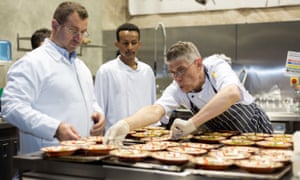
Serving up some typical Damascene dishes.

 'Yassin, still in his chef’s apron, said the west should arm Syrians to get rid of Assad and Islamic State. “They need equipment. The west and the gulf states give them only enough weapons to survive,” he said. “We need anti-aircraft weapons to bring down the planes and helicopters which are dropping explosives, destroying the people. Isis, we’ll take care of them.” '

Hezbollah supports ethnic cleansing

 Karam Nachar:

 'The newspaper of Hezbollah, also known as al-akhbar, published today a column stating the following:

 "We can say that the majority of Syrian refugees outside their country hail from those segments of society that are incapable of appreciating diversity and Syria's "special civilizational model". Therefore, losing them is not demographically significant. The real loss is that of the urban patriotic segments".

 I dedicate this paragraph to all the idiots of the global Stalinist left who continue to support the Assad regime and its allies. Ethnic cleansing based on "civilizational" worth is right up your alley, it seems.'


 Note 14/5/25, link broken.

Wednesday, 9 September 2015

Machine Guns and Barrel Bombs


 'Daraa is where Syria's revolution began four years ago. Now it's the scene of a forgotten war, in which largely secular Free Syrian Army (FSA) rebels — marginalized elsewhere in Syria — continue to lead the struggle against Bashar al-Assad's regime.

 The FSA are fighting a bitterly hard battle under a virtual media blackout to change the course of Syria's civil war. If they can take Daraa, they will stand at the beginning of the road to Damascus, the seat of Assad's government.

 VICE News follows the Fallujah Horan brigade of the FSA and their charismatic commander Abu Hadi Aboud as they fight to push the regime out of Daraa's eastern suburbs.

 In part one of a two-part series, Abu Hadi shows VICE News how his men take the fight to the regime on the front lines east of Daraa, and we also meet the volunteers trying to save locals from the barrel bombs that rain down daily on the city.'

Tuesday, 8 September 2015

A message from a Syrian refugee in Germany


 "Recently, I have heard in the media, that the Syrians are immigrating to Europe, because of ISIS or Jabhat al-Nusra. This is not correct. We leave Syria because there is no safety there, because the Assad régime keeps hurting us."

People look to the skies expecting an airstrike any time


 Yasmine Nahlawi:

 "They are there because they have no other option. They've fled a war zone, at least speaking about the Syrians that are there; they have fled a situation where people look to the skies expecting an airstrike at any time, they look to the skies expecting chemical weapons to be dropped on them. They are there because they have no other option, and we see these images, we saw the image of the little boy washed up on the Turkish shore, and people would not put themselves or their children at risk unless there was something very powerful they were fleeing.

 We'd obviously like the government to take in more refugees, to step up to its responsibility and take in more refugees; but more importantly, I think, we'd also like to see more concerted action on the international level to address the underlying root cause of the conflict in Syria. We've had a régime that's been massacring our people for the past four years, and until that stops there are going to be more refugees. We want people to be safe in their homes, but if they are not, and obviously if the international community doesn't take action then we want them to welcome more refugees."

Syrian kids find peace at last after horrors of war


 'Lilas, 5, still has a scar above her left eye where she was hit by a fragment of a bomb that killed her neighbour while she was playing outside in 2012.

 Their home city of Douma, near Damascus, has been bombed by the regime of Syrian President Bashar al-Assad since war broke out between the regime and the Free Syrian Army in the city in January 2011. It is now besieged by the regime, shutting out food and other supplies. Ms Alfuoal's brother, 27, is sometimes reduced to eating grass.

 Mr Slik, a pastry chef, was beaten up by soldiers several times just "because I am from Douma, because Douma started the revolution very early".

 The family fled in March 2013 to Egypt, where the elected President Mohamed Morsi welcomed Syrian refugees at the time. They received US$70 ($112) a month from the United Nations High Commissioner for Refugees for the first five months. But then the funding stopped "because of finances". Morsi was toppled by a coup and the military regime now makes life a misery for the 100,000 Syrian refugees there.'

Our children are slaughtered and our homes rubble


 "The last thing Syria needs are more bombs. Syrian people need airplanes stopped from killing them. If there were no airplanes, there would be no bombing. Our problem was in one person – Assad. If the UN or a big power demanded Assad leave the it would be over. Assad and ISIS are the same. Assad and ISIS are on one side – the people of Syria are on the other. If people want to help, then solve the root of the problem."