' "Organising protests through the internet was our weapon at the time in the face of the tanks that had surrounded Daraa and Homs," said Ziyad.
They had called for a lifting of the siege imposed on the two cities through peaceful protests for six months, until security forces started shooting at protesters, saying that protesters had shot first.
The protesting youths decided to respond in kind, according to Ziyad, and began arming themselves with pistols, rifles and automatic weapons procured from Arsal in Lebanon. They began responding to regime fire on protests. However, it was notable that the army did not pursue them for about a month, only later launching a surprise attack against their neighbourhoods and homes.
However, the protesters overran army checkpoints in the Damascus countryside and seized their weapons. They started planning an operation to storm Damascus.
The plan did not materialise, as the regime employed a scorched earth policy in dealing with protesters. According to Ziyad, the regime would surround an area with tanks and then launch airstrikes against it. Hundreds of civilians died in this way, he said.
The father was told to remain silent or he would also be arrested. An unfortunate neighbour who was passing by their house was also arrested, as well as a teenager who asked what was going on.
Ziyad has suffered from an easily dislocated shoulder since his childhood, and when one of his torturers was dragging him, his shoulder became dislocated again. This discovery amused the soldiers in the room, and they pulled the shoulder out of its socket and replaced it several times just for fun.
Ziyad and his brother remained in prison for about three months, while their parents did everything they could, contacting influential people and giving around two million Syrian lira (almost $40,000 at the time) in bribes to secure their release.
The prison cell in which the brothers were held was only a few metres square, but held approximately 60 prisoners - unable to sleep due to the cramped conditions.'
'Haydara Sulaiman, son of the former Ambassador of the Assad regime in Jordan, wrote that on his Facebook account on a photo that shows Zabadani's civilians holding banner that says: " We want safe passage to the cemetery, to bury our martyrs."
Haydara, who has always been a big fan of Assad, replied to the sign saying (Cynically): "Why safe passage, we will provide you with bulldozers, fuel and matchsticks ... Don't be anxious!!!"
It's worth mentioning that Zabadani city is completely surrounded by the regime and Hezbollah, after it was the destination of displaced families who fled their houses in other areas. The city is under daily brutal shelling with vacuum missiles, barrel bombs and artillery that killed dozens of civilians, amid fierce resistance shown by opposition forces who are trying to stop regime from capturing the city.'
Note 11/5/25, original link to Mirror of Syria no longer functional.
February 2020. President Assad has gone on trial for war crimes and crimes against humanity at the International Criminal Court in the Netherlands, and leader of the Labour Party Jeremy Corbyn is being interviewed by the ever-smarmy Andrew Neil for the Daily Politics, just as the date of the General Election is due to be announced.
"Mr. Corbyn, President Assad has gone on trial for the most appalling crimes, documented in detail by members of his now fallen régime. You, as chair of the Stop The War Coalition, have denied his responsibility for those crimes, instead blaming Western intervention, and have even called friend his accomplices in Hezbollah. Why should the British people trust the Neville Chamberlain of our day, who would let the worst genocidal maniacs have their way, if he could only claim 'Peace in our time'?"
Syria is not Germany in 1939, the answer is not world war but to support those Syrians fighting Assad, but once Jeremy Corbyn and his friends in the Stop The War Coalition are finished destroying the credibility of left-wing politics for a generation, you would not know the difference.
If you're left-wing, and you aren't one of the handful that daily follows the Syrian revolution, you're going to think this is scaremongering. Because either you're part of the majority who still believe the conspiracy theories, like the US backs ISIS, or chemical weapons are just a hoax like Saddam's weapons of mass destruction. You'd all be in for a shock if you really cared about those things when the truth becomes plain in front of your face, but most will pass it off as not their fault, they were just trying to be skeptical or anti-imperialist, you can't blame them for that? The Syrians you didn't care about can, and will, and the region left the worst mess imaginable is partly there because you thought Russia Today, or the more sophisticated rendering of Patrick Cockburn, were a useful counterpoint to the mainstream media and politics driving us into another Middle East War, not realising that Western politicians didn't care about Assad, and the threat of military intervention was itself the hoax designed to stop us caring about Syrians.
Or you are one of the part-time supporters of the Syrian revolution. These people get very upset if you question what they've done to support the Syrian struggle, because they want to make it very clear that they aren't like those pro-Assad people, at least as long as their interest in Syria lasts. But when it comes to anything else they don't make the link. When it comes to Greece, it doesn't matter if you reprint the views of a supporter of the genocide in Syria. If someone is anti-Israel, it doesn't matter if they back Assad to the hilt. When it comes to British politics, it doesn't matter if Miliband lied when he claimed he stopped a war in Syria. Because Syria is an issue to keep in a box, and as long as you put the right label on it everything will be alright.
Those who've been following Syria day-by-day know this isn't adequate. Because Syria is different. In terms of the level, institutionalisation, and capitalisation of the violence. This is not just a repressive régime that tortures and murders a number of its opponents. It is one that is daily torturing and starving 150,000 people (and imprisoning another 50,000) more, in the most brutal way imaginable, and then selling survivors back to their families for large ransom payments. A régime like that can never be reformed to become less psychotic, too many of those running it have a stake and a responsibility for the way it is.
Many of those with a part-time interest in Syria will say they don't need to see atrocity photos, that they know what is going on . But until you know the real scale of the Assad catastrophe, and understand that this goes on daily and has only been getting worse as Assad has been allowed to get away with it, you aren't going to see that the failure to support Syria is going to to come to dominate politics as time goes on, and it is only by bringing out the truth and seeing the links that any sort of progressive politics can be preserved. You can't talk about the crisis of refugees dying in the Mediterranean without pointing out that it is Assad who has driven so many Syrians out of the country, that it is the failure to back his opponents that has left the crisis to spiral out of control, or you are irrelevant. Better than the people still dismissing the torture photos as CIA fakes, but when the right-wing, we'll intervene when we want to, backlash comes, that won't help much in holding it back.
And I've only talked about torture, there is also the barrel bombing, the chemical weapons, the mass rape, the sieges, the mass burning of crops, and a whole bunch of other crimes to consider.
I don't know if Jeremy Corbyn is going to be leader of the Labour Party. I don't see some shift to the left that has taken everyone by surprise. Perhaps hordes of Telegraph readers have handed over £3 to encourage the Labour Party down a left-wing road. If it wasn't for Syria, I'd be all in favour of him. I don't think any of his opponents will provide anything other than reheated Blairism. But I do think that anyone who thinks he is going to revive left-wing politics in this country is pissing in the wind. If there is going to be a progressive politics in this country, it will be one that has firmly rejected the politics of Stop The War, and clear that everything needs to be done to support the Syrian struggle, because otherwise we're all going to be portrayed as worse than Nazis.
'The administration’s current approach to Syria, however, is helping to ensure the fragmentation of the country; the present trajectory will not produce a future government of a unified Syria. Moreover, lumping Ahrar and Nusra together is intellectually sloppy, especially when they exhibit ideological and political differences.
This is not to say that the United States has no differences with Ahrar. There are many, with some, such as respect for human rights and respect for Geneva war conventions, quite serious. Ahrar will have plenty of complaints against the United States as well. Nevertheless, the larger question is whether the United States should open channels for dialogue, however difficult the conversation will be. Talking is most certainly not giving military aid or arming. Our refusal even to talk with groups like Ahrar further reduces the little influence Americans still have in Syria.
As the Assad regime steadily weakens, the administration keeps trying to lead the opposition from behind, hoping for an opposition white knight to appear. Instead, because Islamist groups like Ahrar strongly influence decisions about the fate of Syria, Washington will be left behind.'
This can cut both ways, towards helping the opposition, or to military intervention as the answer. At least the former solution is getting some airplay.
' "Some of us did warn that if we didn't deal with President Assad back in 2011-12 and were not seen to support the opposition properly, then more and more people would be drawn to extremist organisations — Al-Nusra, and now Isis," said Richards.
"We are our own worst enemy. We simply ignore problems," said Robertson, who urged the UK's politicians to do more to convince the public why the government needs to take military action. "Unless people are convinced there are things worth fighting for, then we'll be in trouble. We're faced with Isis now, it's a headline issue, it's horrifying." '
'Syrian generals have reported back to Damascus that the Western air bombings have been of no use to their own forces in repelling Isis.'
We can see that Robert Fisk's posture is unashamedly pro-Assad. Syrian generals haven't done much to repel ISIS themselves, perhaps those Western airforces should have been helping the Syrian rebels who do fight them.
'The Syrians abandoned Palmyra; military personnel left behind were later executed in the Roman ruins.'
And those Assad had locked up in Palmyra prison and tortured sometimes for decades, were freed, if they hadn't already been moved to another dungeon.
'It might have been better, needless to say, if we’d asked our Gulf Arab allies to stop sending weapons to the Syrian rebels who were giving them to the Islamists whom, in turn, we were bombing.'
It's just racism to claim that all these Muslims are the same and will give all their weapons to whoever is most extreme. None of these states or groups was giving weapons to ISIS, Jabhat al-Nusra, who have been bombed by the Americans, are still using all the weapons they get to fight Assad's forces.
'There is a Syrian air force, which will now be operating alongside the Americans.'
Assad's airforce don't bomb ISIS, though they occasionally bomb civilians in ISIS-controlled areas. The Americans aren't yet barrel bombing civilians in Aleppo and Daraa, so this isn't quite accurate.
He told Zaman al-Wasl about regime’s plans to sneak from the Arab Observers’ plans to free prisoners. “toward the end of 2011, we were told by new prisoners that Arab Observers Committee was due to visit Syria to help in freeing prisoners, to escape from that, the regime kept taking us out of the prison daily via buses from 8:00 am till 10:00 pm over 10 days period, we used to be 65 prisoners in a bus.”
Another incident about the regime’s attempts to escape from promises to free prisoners was when they were put in a basement form hours because the Arab Observers Committee wanted to do an urgent visit to prison. “There I met two old prisoner with long beard, I was shocked to know that they were not aware that Hafiz al-Assad had died and Bashar has become a president.”
The prisoner who was released on-bail after being accused of terrorism mentioned that he saw Khaled Taja, the well known over seventy years old Syrian actor detained in the same prison, he confirmed that Taja was cruelly tortured and once he saw him hanged from his hands when we were in our way to the bathrooms. He mentioned that he had not believed that Taja was in the same prison till he saw him in his own eyes.'
And what a history it has been. Four million Syrian refugees, eight million internally displaced, and three hundred thousand civilians dead, the vast majority at the hands of Assad’s murderous conventional war machine, tells only part of the story. The aftershock of that vote was felt further afield, as far as Moscow in fact, where President Vladimir Putin felt he could capitalise on the West’s lack of resolve to pursue his expansionist policy in Ukraine.
In Ahrar Al-Sham we have lost 700 of our fighters in battles against IS since January 2014, and we and our allies are holding a 45km front line against Isil in Aleppo. We know what it is like to confront the menace of Isil. But Cameron should be aware that any further undermining of the Sunni Arab interest in the region in favour of Iran and its proxies will only empower Isil. We believe that Isil is not only a security or military threat but a social and ideological phenomena that needs to be confronted on multiple levels and that requires a national Sunni alternative to both Assad and Islamic State.
Thanks to Ed Miliband’s posturing two years ago, the opportunity to deal an early blow to Assad and bring the conflict to an early conclusion was missed. Two years of inaction have only made things worse. Washington’s current policy of undermining the Sunni interest in the region while pandering to Iran is furthering weakening efforts to defeat Isil, rid Syria of Assad and bring about a political resolution to the conflict. As the RAF readies to join in the military coalition against Isil, Britain’s government would be wise to consider new approaches to fighting the extremist group that goes beyond just dropping bombs.'
'This infighting provokes the anger of residents in the rebel neighborhoods. Many blame these disputes, and the resulting lack of coordination, for halting the rebels’ advance. In more idealistic days, someone drew a mural on a wall in the Al-Ferdous neighborhood—it shows an F.S.A. fighter bleeding. The original caption read: “(People) forgive us if we make mistakes. We, the F.S.A., are dying for you.”
On it, someone added the word “liar.”
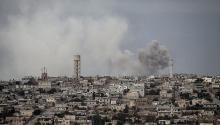
This anger boils when the sky starts raining barrel bombs.
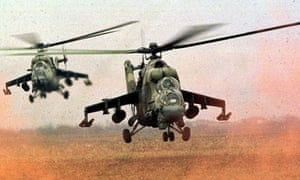
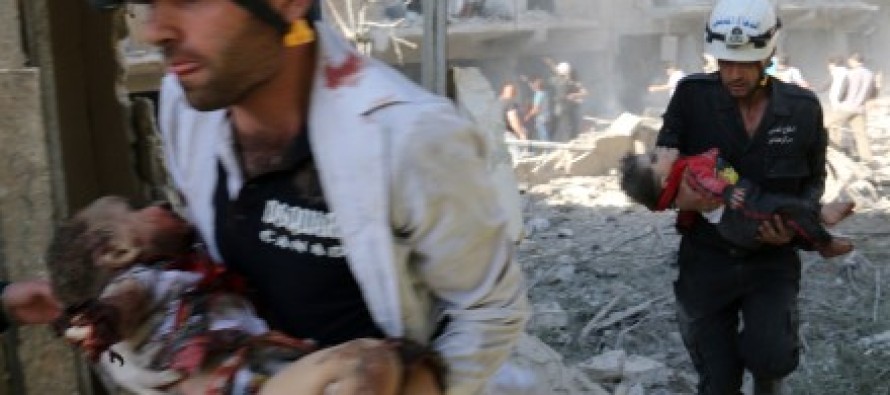
Around me, men shouted, their faces strained and their words indistinguishable. Women wept hysterically. Children screamed. A policeman warned the crowd: “Civilians leave now! There’s a helicopter in the sky. He’s going to do it again!” The Syrian air force has a habit of following their first barrel bomb with a second. People say this is to kill first responders. (The government still denies that it uses barrel bombs.)
Despite this, the crowd did not run away. They dug in the rubble with their bare hands—old men, Civil Defense volunteers, and militants alike—all except the media activists shooting video. When they found a victim, they gathered to help snatch them out, screaming “Allahu Akbar” as they did. Once they laid the victim in an ambulance, they began to dig again.'
'For Syrians who for years have been on the receiving end of regime criminality, it is no doubt infuriating to see the reality of an ongoing holocaust trumped in Western policy circles by fears of a possible abomination accompanying the fall of a heartlessly cynical and brutal regime. For 12 million Syrian victims of regime atrocities the argument that Assad provides some kind of stabilization service is bewildering. For Syria’s neighbors—awash in refugees—the open-ended continuation of refugee-producing murder and mayhem can hardly be attractive.
Imagine how articulated fears about Assad “leaving the wrong way” are processed by those who have begged the West for protection, only to be told that their plight does not rise to the “never again” standard; that the absence of United Nations Security Council consensus and the primacy of a nuclear deal with Iran render them unqualified for protection by parties having the ways and means to provide it. Imagine the credibility of the US “train-and-equip” recruiting pitch to nationalist Syrian rebels: pay no attention to those who drop barrel bombs on hospitals, schools, mosques, and bakeries—come help us fight ISIL while we entreat Moscow and Tehran to support political transition in Syria.
Through barrel bombs, starvation sieges, torture, rape, and pillage they have implanted in minority communities a fear of vengeance; fear designed to bind these minorities to the survival of a regime that steals from them while sacrificing their children.
The result is that large scale acts of vengeance victimizing innocent civilians cannot be ruled out if the fall of the regime—the family and its inner circle of enforcers—creates a security vacuum. It is not at all clear that the departure of a corruptly incompetent clan would have such an effect. Yet the response to this challenge simply cannot be one of Western action or inaction, tacitly supporting Iranian efforts to keep the mass murder machine in place and well oiled. As long as that machine functions, ISIL will have a recruiting case to make to desperate Syrians. As long as the machinery of industrial scale homicide keeps humming, the peril to those held hostage by the regime will increase.
The message from Secretary of State John Kerry to his counterpart, Foreign Minister Mohammad Javad Zarif should be stark: stop the barrel bombing or we will. To avoid taking steps—diplomatic for sure, military if necessary—to protect Syrian civilians from Assad regime mass terror is to promote extremism and to imperil those Assad has taken hostage. Failure to protect Syrian civilians is the policy equivalent of endorsing Assad’s strategy: a strategy that kills the innocent, shames the West, and facilitates the work of ISIL. Only through inaction in the face of this real, ongoing outrage can fears of Assad “leaving the wrong way” receive the ultimate form of validation: the fulfillment of a bad dream.'
Montagne: Wow. Well, let me ask you, when we first spoke with you late last year, you were quite angry that the U.S. was paying so much, at that point, attention to ISIS. And what you said was, what about the regime? The Assad regime - more people have been killed by far by them in Syria than by ISIS. I wonder, though - it's been months now - what about ISIS? Or - are they coming into your neighborhood? Is there a threat?
Al-Batal: Most of the population here, like, do not agree with how ISIS think or act. So they don't have any place to grow any followers here. But what I am afraid is that the more you have been feeling injustice and the more you feel that you have been left alone, that you have been pushed to maybe sometime even make a deal with the devil to get out of here. So we manage to push back those ridicules, but the more the situation get bad, no one knows what going to happen.
Montagne: How are you getting news, and how much news are you getting about what is happening outside?
Al-Batal: Most of the people get the news. They have this two hours a day of electricity, and they watch television. But they don't watch it with that much care anymore. They are more interested in the local news because they say that the news here, like, it has been the same for, like, three years. The only thing that's changed is the number of people who die. Nothing major have change. There's always an airstrike. There's always someone dying. Even this morning, we have two airstrikes. So people are walking the street. They hear the plane coming, so they just look up, wait for the bomb to fall, and after that they keep walking normally like nothing had happened. That's one side of human nature - that you can get used to anything. I told you my friend of mine lost all of his family, and he didn't even cry. He was, like, the meaning of death have been changed. And he was like, maybe they are relieved now or out of the siege in the one way that no one can stop them - up to the sky.
Well done again to Kareem Shaheen, for actually reporting what Syrians have to say.
' “It is the belief of many on the ground that America and Iran are strategic allies, and all the overt signs of animosity are simply hypocrisy,” said Ahmad al-Alwan, a religious official with the Army of Conquest, an alliance of rebel groups in the north of Syria that scored a series of victories against the regime’s army this year.
“Iranian assistance has never been severed from Assad and Iran has been aiding Assad above and below the table before the entire world with the tools to kill the Syrian people,” he added. “The nuclear agreement will not change this equation.”
“We have a real fear that Iran will use the unfrozen accounts for more shameless intervention in the region and enflaming strife and war, as well as providing more support to the Assad regime to prevent its fall and allow it to continue carrying out terrorist massacres against the Syrian people,” said Mohammed Maktabi, the secretary general of the Syrian National Council, the exiled opposition.
“We know that if America wanted to remove Assad it would have, but America wants to lengthen the conflict in Syria, to manage it, not to end it,” said Alwan.
“Iran is America’s best partner in the region,” said a source close to Jabhat al-Nusra. “The war in Syria will continue, and the solution for them is a political transition while preserving the regime.”
“Everyone is feeling resentment: why at this decisive time?” said Ibrahim Noureddine, a spokesman for the First Legion, an opposition faction in the south. Many of the opposition groups in the area, save for Jabhat al-Nusra, are seen as moderate and close to western and Gulf states opposed to Assad.
“The street and the opposition factions in the south resent this because it is completely against them,” he said. “Iran’s role in resolving the Syria crisis is to leave Syria.” '
Patrick Cockburn isn't lying less because someone else is saying it. Turkey and Saudi Arabia aren't providing military aid to ISIS, or even to anyone affiliated to al-Qaida in Syria. Nor are the Turks encouraging people to cross their border to join ISIS.
'A senior Shia clergyman called for the US to supply Iraq with modern weapons and to put pressure on Saudi Arabia, Turkey and Qatar to stop providing covert military aid to Isis, and to rebel groups in Syria affiliated to al-Qaeda.'
The US hasn't really supported the approach of backing the rebels. To actively support their oppressor would be a disaster. And to call them Sunni at every turn obscures their far less sectarian aims and methodology than that of the Islamic Rpeublic of Iran and its proxies. That it is Shia clergymen Cockburn is constantly quoting should give one a bit of pause on that front. I don't see any Sunni imams being given such respect.
'Shia clerical leaders are cautious, but they hope the US will no longer automatically support the approach of Sunni states like Saudi Arabia and Qatar – its traditional allies, which have backed the Sunni-dominated rebels in Syria.'
It's probably not true what he's saying about Iraq either, but I'm not an expert on that front.
'In reality, Iranian control is predominant in only three of the main militia units.'
The New York Times wants to blame all sides, but you can see, if you look, that Assad and the rebels are not the same threat.
'The show skewers President Bashar al-Assad and his government, as well as the religious groups that have taken over much of the uprising. It even mocks the rebels in the Free Syrian Army, who provide security when the show is filmed on location.
“We make fun of the way they treat civilians, but they have no choice but to protect us,” said Yamen Nour, one of the stars of the show. Mr. Nour, 37, a painter and actor who led demonstrations in 2011, considers his theater and television work a continuation of the revolution by other means.
“We want to show people that we are still living,” he said. “It’s very difficult to make people smile during war. We want them to forget the war for a moment.”
Tony el-Taieb, 24, the producer of the series, said he and the 55 or so actors and crew members who work for his company, Lamba Productions, believed that Syria’s original revolutionaries must establish cultural alternatives to those generated by the government in Damascus.
“Our videos drive the regime crazy, because we show the reality,” Mr. Taieb said. “We can’t leave the field of drama to the regime.” '
No. Even the Wikileaks version still makes it sound like the Saudis were threatening Christians, "Saudi to Vatican: Help us bring down Assad and we will ensure Christians are spared from retaliation". In fact what they told the Vatican was this, "All parties who support the Syrian people are committed to the rights of minorities in Syria and, in the event of the fall of the Syrian regime, will not accept for them to be subjected to any acts of retribution."
Similar elisions in Robert Fisk's latest for the Independent*. '[Iran's] Guard Corps and its Hizballah allies from Lebanon are literally in the front lines against the Islamists.' Not against ISIS, but against those fighting to free Syria from Assad. Similarly, "'Israel has been allowing Iran’s militant Sunni enemies to slip across the Golan from Syria into Israel for medical treatment every few days.' Will it really need him to write that all Sunnis are terrorists before it becomes obvious what Fisk is like?
Patrick Cockburn** has wrapped up his lies in support of an alliance with Assad into a neater little bundle.
'Isis, the Syrian army’s main opponent.'
'Now we apparently want to remove Daesh, but without helping Assad. These two things are incompatible. It is a choice of evils”.'
'President Bashar al-Assad probably holds another third, though these proportions are a little deceptive because the government still holds most of Damascus, the main cities and the roads linking them.'
'There is an attempt to rebrand al-Nusra as kinder, gentler jihadis, but those who believe this propaganda should reflect on al-Nusra’s unstinting praise for the perpetrators of 9/11." "Assad may be about to lose the city of Daraa in the south to the Southern Front, an alliance of groups which present themselves as more moderate than Isis or al-Qaeda.'
'It is Isis and the most extreme Islamist groups that will ultimately benefit from the weakening of Assad and the government in Damascus.'
'In the case of the Southern Front, often advertised as an anti-Assad force which is not extreme jihadi, its guise may be adopted to hoodwink foreign backers." "Assad’s forces are exhausted but are not close to collapse.'
'The militarisation of politics in Syria since 2011 has benefited both Isis and Assad: it has left Syrians opposed to Isis and al-Nusra, but even more terrified of Assad’s forces, with no alternative but to fight and die with the jihadis.""You will have heard the opposition slogan “Alawites to the cemetery and Christians to Beirut”.'
Most have some reflection of the truth, but have been elided so far from it as to be unrecognisable. His conclusion that we should ask Assad to stop barrel bombing in return for bombing ISIS that he hardly bothers to fight is a fantasy, and the idea that we will end up supporting Assad if ISIS or al-Nusra threaten Damascus, so we should do so now, is utterly stupid as it will only preserve the disorder of Assad's genocide and encourage the extremist response to it.
'You're reading the blog of a bitter and disillusioned man who once cheered for Hassan Nasrallah during the 2006 war and believed that Tehran's 'Axis of Resistance' was the region's only hope. I changed my mind because Syrians were being murdered by the thousands, their legitimate claims dismissed, and their uprising brushed off as a terrorist uprising by a tinpot dictator who would not have survived had it not been for the help of Tehran and Hezbullah. The pan-Arabists were blasé about the news. We were brutalised and the world did nothing. We were tortured, and the world did nothing. We were starved, and the world did nothing. The world looked away when Syria started.
I'm sorry that Syrians are inconvenient, that we're not being killed by the right type of enemy for you people. I'm sorry we haven't received your stamp of approval. Pan-Arabists are cheering a deal with Iran, because, as they keep reminding us, Israel is the real enemy; Palestine the real goal. Never mind the untold misery, guts and excrement that we are being forced to crawl through in the name of this mythical liberation that hovers on our horizon like a promised paradise for the wretched of the world. Syria is "complicated". Syrians are only to be felt "sorry for", like the victims of some flood or an earthquake. From your glass towers in Dubai you intellectual pan-Arabists can toast a deal with Iran, and celebrate the fact that nothing has been allowed to deviate your attention from the lofty goal of "liberating Palestine".'
"We will never return to Syria unless the Assad regime is gone. He must be ousted."
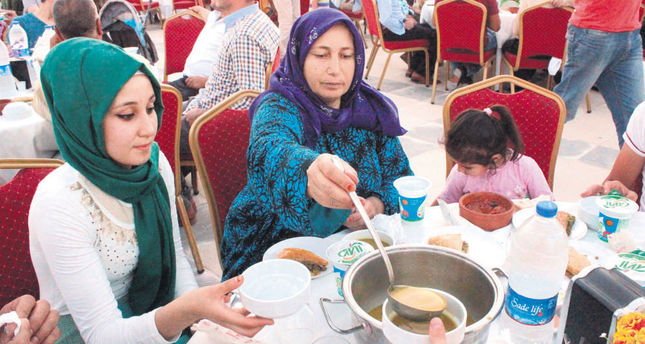
"I was a fourth-grade student and I cannot go to school here. If Assad goes in Syria, I still have a hope of returning. He is a bad guy, but Erdoğan is giving iftar to us."
"I do not have any hope of returning to Aleppo. I had built my house there with blood and sweat. But Assad's missiles turned it into ruins. I cannot go back."
' “I saw his color, and was like, ‘Thank God he wasn’t starved to death.’ He didn’t have his ears taken off or his nose. So, I thought he made them furious enough to kill him right away rather than being tortured on a daily basis. It’s always better to know, is he alive or is he dead.”
“It was systematic, the regime was using it as a way to quell the revolution.
There’s a lot of missing Syrian people and a lot of people don’t know the fate of their family members. They hear about it through rumors. They pay money to try and find information and really there’s nothing concrete. And unfortunately there’s nothing more concrete than pictures of dead bodies. So the idea was to open up to help people identify their own family members.
For an American audience, I think it was shocking. But the sheer … mass production of this, I think, is what overwhelms. They’ve documented it in such detail.
Syrians inside Syria that had any experience with intelligence [services] automatically knew why the documentation had to happen.
When there’s an order from above, they need evidence that those orders are being carried out. In a highly corrupt government, where you can pay people to release people, they need the evidence. They needed to keep the evidence to show that you told us this is what we need to do, and therefore, this is what we are doing.” '
'In a statement published by the the National Working Group for Palestinians in Syria yesterday, the families who live in the neighbourhoods of Duma, Zamalka, Hazzah and Humouriya in rural Damascus said they suffer from a severe shortage of food and medical supplies due to the suffocating siege imposed on them by the Syrian regime since the beginning of September 2013.
It said the heavy shelling and strict blockade imposed by President Bashar Al-Assad's forces caused Palestinian families to lose their income and stopped them receiving the aid needed for their survival.'
'Hezbollah units are now spearheading the fight against opposition rebel groups while the faltering Syrian army plays a supporting role. Although the militia is highly secretive about the size of its footprint in Syria, Western officials and analysts believe it has roughly 6,000 to 8,000 fighters on the ground there.
The group also refuses to discuss its losses in Syria, but the numbers are substantial and on the rise. Since Hezbollah began taking part in full-fledged combat in Syria in 2013, officials and outside analysts estimate that roughly 700 to 1,000 fighters have been killed or wounded in battle, a substantial loss for the group.
Losing the border town of Zabadani would be a massive setback for the militia, as the town lies along vital land routes that link up Hezbollah-controlled territory with Syria. In the past, Zabadani served as a logistical hub used to transport Iranian arms to the militia. Iran, which backs Hezbollah as well as other Shiite foreign fighters in Syria, has doubled down on its gamble on the Syrian regime, expanding shipments of weaponry, ammunition, and other equipment.
Tehran also has deployed advisors from the country’s Revolutionary Guard force closer to the front, and some have reportedly taken charge of some operations from Syrian army officers, analysts said.
“They’re running a high-risk, high-reward type of path right now. If it gets to a point where the [Assad] regime looks like it is on its last legs, then Iran has a big decision to make.” '
'As a Syrian, I feel guilty about warning a child or teenager against a smuggler’s promise to take him to Europe. I know where their thoughts might head if that desperate option ceases to be a possibility. I then wonder how long sane people can resist as the situation deteriorates.
It is no better in the rest of Syria. Even though ISIL dominates the headlines, the Assad regime remains the top killer in the country by some margin. The daily suffering caused by the regime now rarely makes it to public discussions, but highlighting Mr Assad’s disproportionate violence has practical benefits. Apart from the humanitarian factor, failure to focus on the atrocities committed by both ISIL and the regime distorts the reality and creates a schism between how outsiders and Syrians conceive of a resolution to the conflict.
Nowhere is this clearer than when America’s train-and-equip programme reportedly failed to attract enough recruits because volunteers are asked to focus on ISIL. A year after Barack Obama announced the programme, no more than 200 Syrians joined it. Moreover, even those who have joined the programme will be treated as mercenaries by fellow rebels as long as the focus is ISIL not the regime. Even before the US officials publicly admitted the challenge, it was apparent.
As long as the suffering and sacrifices of people on the ground are overlooked, the world should not expect true partners in the conflict. The savagery of the Assad regime is no less than the barbarity of ISIL. On the contrary, it helps perpetuate it.'
'A big number of the young men were killed in the field when they were trying to escape the army attack. Helicopters targeted them by heavy machine guns while they were driving their motorcycles - while they were fleeing the village.
Today the people of Tremseh opened a house that was burned by troops. They found two people who were burned alive. My sister told me that the only two doctors in the village were targeted by mortar shells. Both doctors were killed in their houses.
Khalid Saleh, executive member of the Syrian National Council, insisted the reported atrocities were well documented.
Asked why alleged massacres often coincide with UN security council meetings, he said:
"From the Assad regime's perspective it is very clear that any political or international solution at this point will mean the end of the Assad regime. I think the Assad regime, in committing all these massacres, is really talking to [its] shabiha, to his forces on the ground. I think these massacres unfortunately increase the morale of the Assad gangs. It is the same thing when they shot down the Turkish airplane.
Assad doesn't really care about the international community. What he is focused on is winning the battle on the ground, so he is doing all he can to raise the morale of his troops. Unfortunately it is a sad reality that committing massacres like these will increase the morale of the gangs ...
The Syrian regime has made it very clear that they are killing any chance for a peaceful transition." '
Three years ago tomorrow. All the elements of the mainstream media narrative are here. The undeniable massacre, the denial by the régime, the splitting the difference by calling the massacre 'alleged', the back-covering condemnation by the UN, the promise of some binoculars by the West to the rebels, amid American fears that guns don't mix well with Muslims, the denial by the Guardian's commentariat that we can possibly know anything. And this, from Brian Whittaker among others, is some of the best of the mainstream reportage.
'Bullets, bombs and explosive barrels have long been a feature of Bashar al-Assad’s campaign to quell dissent in the southern province of Daraa, birthplace of the rebellion against the Syrian president’s brutal rule.
Residents are now reporting a new, even more potent and indiscriminate instrument of death: naval mines, designed to destroy armoured ships, that regularly tumble from regime helicopters, leaving craters 15ft deep and up to 30ft wide.
Their explosive power has been a devastating addition to an already brutal bombing campaign directed at the first town to rise up against Assad’s regime. Witnesses to the deployment of the new weapon report that the mines are smaller than barrel bombs and can be distinguished as they fall from above by their bright red colour.'
'In December, Secretary of State John F. Kerry stated that “Syrians should not have to choose between a tyrant and the terrorists.” There was, Kerry declared, a third option: “the moderate Syrian opposition who are fighting both extremists and [Syrian President Bashar al-]Assad every day.” Unfortunately, this commendable view has broken down because the United States has defined the term “moderate” in such a narrow and arbitrary fashion that it excludes the bulk of the mainstream opposition.
The group to which I belong, Ahrar al-Sham, is one example. Our name means “Free Men of Syria.” We consider ourselves a mainstream Sunni Islamic group that is led by Syrians and fights for Syrians. We are fighting for justice for the Syrian people. Yet we have been falsely accused of having organizational links to al-Qaeda and of espousing al-Qaeda’s ideology. Nothing could be further from the truth. We believe that Syria needs a national unifying project that cannot be controlled or delivered by a single party or group and should not be bound to a single ideology. We believe in striking a balance that respects the legitimate aspirations of the majority as well as protects minority communities and enables them to play a real and positive role in Syria’s future. We believe in a moderate future for Syria that preserves the state and institutes reforms that benefit all Syrians.
Stuck inside their own bubble, White House policymakers have allocated millions of U.S. taxpayer dollars to support failed CIA efforts to support so-called “moderate” forces in Syria. But these “moderate” groups have proved to be a disappointment on nearly every count, not least of all in confronting the Islamic State. Further, the self-defeating policy of regarding the war against the Islamic State as being fundamentally different from, and in some cases diametrically opposed to, efforts to remove Assad from power has brought no end to either battle.
Despite a disappointing lack of genuine engagement from the international community, we remain committed to dialogue. The issues that need to be discussed are how to end Assad’s reign, how to defeat the Islamic State and how to ensure that a stable and representative government in Damascus puts Syria on the path to peace, reconciliation and economic recovery while avoiding the disintegration of the state. It is not too late for the United States to change course. Kerry’s “third option” exists — but only if Washington is willing to open its eyes and see it.'
'Recently, an interesting news item relating to Syria seemed to remain under the public radar. In his book “Ally: My Journey Across the American-Israeli Divide,” the Israeli former ambassador to the United States, Michael Oren, wrote of how the Russian plan in 2013 to remove Syria’s chemical arsenal, and in that way avoid an impending American attack against the country, originated with an Israeli minister, Yuval Steinitz.
The reason Steinitz did so is not difficult to understand. The Israelis saw a golden opportunity to get rid of what worried them most in Syria, namely the regime’s chemical weapons. They were far less concerned with seeing Assad and his acolytes punished for having deployed such weapons against civilians. Once the deal was agreed, Oren writes, “the phrase ‘Assad must go’ vanished from [Barack] Obama’s vocabulary.”
Nothing has really changed since the CIA director, John Brennan, told the Council on Foreign Relations last March that the “last thing we want to do is to allow [ISIS and other jihadist groups] to march into Damascus.” Brennan had added then, “That’s why it’s important to bolster those forces within the Syrian opposition that are not extremists.” However, at the catatonic rate the U.S. is training such forces, the chances that “moderates” will soon change the tide in Syria is negligible.
Whether we are talking about the United States or Israel, Assad has imposed on both a very successful “either-or” equation – “It’s either Assad or chaos.” That has given the Syrian president and Iran tremendous leverage over Washington and Tel Aviv. This will only increase when, as is likely, the Americans and Iranians reach a nuclear deal. Once that happens, Iranian funds to assist Assad will be freed up and the Obama administration may more firmly recognize an Iranian “sphere of influence” in Syria. That will not sit well with Israel, but the complexities of the situation will most probably expand Assad’s margin of political survival.
Obama should bear in mind what he said about Assad. Syria’s war will not end while he remains in power. But the U.S. president has seemed unwilling to pursue his own logic in Syria. Bashar Assad has lasted thanks to such incoherence.'
'Ms Yazbek’s book makes a valuable contribution to the attempt to explain the turmoil still unfolding in Syria. Mr Glass’s work, by contrast, serves to muddy the waters further. Foreign powers are undoubtedly playing an unhelpful role, but Mr Glass attributes too much to them. He criticises Turkey and other Arab countries, who have chaotically backed Syria’s rebels, while more or less letting off Iran and Russia, who have funded and armed Mr Assad to a far greater degree. Though he is no diehard fan of the regime, he also downplays its crimes relative to those of the rebels (which are not in dispute).
Sometimes this borders on the outright disingenuous. He writes that chemical weapons are “alleged to have been used not only by the government but by the rebels as well”. Yet there is overwhelming evidence against the regime, including of a sarin attack on Damascus suburbs in 2013 that left hundreds dead. By contrast, there is little sign of rebels using chemicals, and certainly not on that scale.
Although Ms Yazbek’s book is written exclusively from the rebel-held area of the country, and she considers herself part of the opposition to Mr Assad, her account of weeks spent in the northern province of Idlib is more balanced. She lets people of all stripes speak for themselves: the rebel leader who threatens Alawites (the minority sect to which Ms Yazbek and the Assads belong; see article), Raed Fares, a well-known secular activist, as well as ordinary Syrians, male and female.
She is not blind to the changing nature of the war, as it has turned from a peaceful uprising to an armed, and increasingly religious, conflict. She fears the danger not just of jihadists but of the growing devoutness of ordinary civilians left with nothing to turn to but their faith. Yet in her book, bursting with Syrian voices, the revolution to overthrow the Assad regime continues. One woman, who pleads with Ms Yazbek to tell the world what is really happening, tells her she will never “kneel” to Mr Assad. “I’m going to get pregnant every nine months and keep having children so that we don’t become extinct,” she says.
Her trips show why: the brutality of the regime is evident on every page. In rebel-held Syria the unimaginable is now the norm: children without limbs; whole families wiped out in barrel bombs; playgrounds turned into burial grounds as cemeteries fill up. Through snippets of these people’s lives Ms Yazbek does the important job of putting faces to the numbing numbers of Syria’s crisis: over 200,000 dead and 10m displaced. Amid the rubble, many Syrians have an incredible sense of social solidarity and they find ingenious ways to survive. It is impossible not to share her anger at “the great injustice that had fallen on us as a people and a cause”.
Ms Yazbek does much to make Syria better understood; her book is gripping. Mr Glass’s feels more hastily written and polemical. One can only hope that more Syrians, with better access to and understanding of the country, write their stories. Their take on the war needs to be heard.'
'Yarmouk, Khateeb’s home, a once-bustling neighbourhood in southern Damascus and a symbol of Bashar al-Assad’s regime’s supposed dedication to the Palestinian cause, is in ruins after being starved of food, water and electricity by the government in a brutal three-year siege.
Khateeb and his friends participated in demonstrations, but never organised anything inside the camp, which housed many refugees fleeing other parts of Syria, to keep it neutral. But, he said, the regime was determined to drag the Palestinians into the conflict, allowing local factions to distribute weapons at random for self-defence and demanding they act as local enforcers.
In response, rebels entered the camp, the Palestinian factions that were supposed to defend it withdrew and the regime responded with air strikes, many of which killed refugees. It slowly ramped up the siege, first limiting food, medical supplies and fuel, then finally imposing a total blockade that has lasted to this day.
The brutality of the siege has left Khateeb with a desire for “personal revenge” against a regime whose violence has meant that he had to personally bury about 10 of his friends. It was that brutality, he said, that had led to the rise of extremism in Syria, where Isis now controls roughly half the country’s landmass and Jabhat al-Nusra, the al-Qaeda affiliate, reigns as one of the most powerful rebel groups.
“Extremism is a result of extremism,” he said. “The revolution was peaceful, the regime acted with monstrosity, people carried weapons. The regime launched air strikes, more gunmen emerged. The regime used chemical weapons, people became Islamist. The regime killed women, people became Nusra. It became more extreme, people became Daesh (Isis).” Khateeb was not surprised when Isis entered the camp in collusion with the local branch of Jabhat al-Nusra, many of whom had secretly pledged allegiance to Islamic State.
Still, he resents how the Syrian uprising is portrayed outside the country as a battle between the regime and Isis, which he described as a “cancerous organisation”.
“When Daesh entered, 10 people were killed in the fighting but, before that, 170 people died of hunger,” he said. “Those who see the events in Syria with the lens of Isis and extremism are partners in the massacre against the Syrian people.”
“Yarmouk has been dying for three years,” he added.'
'A few weeks ago, Mo's life took a dramatic turn. He was picked up by Syrian authorities and held for ransom. Basatneh says government officials have asked for approximately $50,000 for his release. "The regime has been battling the Syrian revolution for five years now. They are losing resources, they are losing money," she says. "They hardly have anything so now they are up to the point where they're detaining activists and asking for money." '
'Dick Simon responds to the question he was asked by Syrian refugee children in Turkey – “Why does everyone hate Syrians?”
"They listened politely. And then they started asking questions. Tough questions. Although Karam Foundation’s programs have a strict no-religion/no-politics policy, my topic stirred something in the students.
Why is the regime’s use of chemical weapons not considered terrorism?
Are ISIS beheadings worse than dropping chemical weapons and barrel bombs slaughtering thousands of your own people?
Why does the kidnapping of three nuns in Maloula receive international media focus while no one cares about the slaughter of more than 200,000 people, including tens of thousands of women and children?
One handsome boy in the front row, Ali, dressed in a pressed white shirt and jeans, looked at me directly while asking, “How can you tell me there is no THEM? I watched THEM hang my uncle from a tree, cutting him with a knife until he bled to death. If America wanted to do something, they would have done it already. Why does everyone hate us?” He looked down at his desk, hiding his tears." '
' “The regime wanted me to use excessive and unimaginable force against unarmed civilians and innocent people. … I felt I could not protect my family anymore… That is the reason why I defected and I'm proud of it. I refuse to kill my own people and destroy my own country.
Sectarian hatred was evident from the beginning of his superiors’ involvement: “The Alawite pilots often bragged [openly] during my time at Ksheish and Kweiress airport about how they dropped bombs and killed 'Dirty Sunnis'. Sometimes we'd ask them: ‘Did you hit the target (rebels)?’ He'd say ‘No, I dropped it on a village or on fishing boats....who cares they're all Sunnis let them burn.’ I swear on everything valuable that was their response.” In another instance, when a Colonel from Homs did not react to a newscast with screams of ‘terrorist,’ “he was handcuffed and a bag was placed on his head in front of me by the moukhabarat. He was then taken and tortured for a week before he was returned.” '
'Who among the Western leftists knows anything about the war in refugee camps? About the siege of Tripoli? Tal Al-Zaatar? Palestinian detainees in Assad’s prisons? And I needn’t add, what do they know about Syria in the first place? About its society, economy, or politics? Or about the Syrian detainees and the massacres the regime committed against Syrians? About the emergence of a ‘white’ segment of the population that discriminates against most Syrians and kills them in colonial-style punitive campaigns? Or about the colonial structure of the Assad state and its fostering of a ‘superior civilisation’ culture like that of the “white” settlers against the colonised peoples? About the sectarian divide-and-conquer policy also modelled on the colonial methods? Nobody.
I have read Noam Chomsky for years and translated a book of his after my release from prison. I also helped translate a book about him. Not once have I seen in all his abundant work anything in reference to the Syrian people’s feelings about the Assads’ colonialism. He may have mentioned in passing something about the brutality and tyranny of the Assad regime, but that was it. All his views revolved around the United States and Israel. He doesn’t see us. He sees the Palestinians to some extent. Three years ago a few Syrian and Lebanese friends met with him in Beirut. The man knows very little and didn’t seem compelled to listen to his mostly young interlocutors. And it looked like he was irritated with them after the meeting because, instead of them listening to his views, they expressed theirs. I am talking here about a man with indisputable courage and morals, but the traditional Western left is incomparably less courageous and ethical than that in the region.
To further understand this situation we should also remember that the Assad regime benefits from two types of ideologists: The ‘anti-imperialist resistance’ ideologists with previous ties to the Soviet Union (like Egypt after Abdul Nasser) and their relations with Iran and Hezbollah and with North Korea and Chavez, and the ‘modernization’ ideologists (like Saudi Arabia and the like) similar to the modernity of Iran before the Islamic revolution.
The regime’s also gained from Western journalists like Robert Fisk, Patrick Cockburn and Seymour Hersh. All of them have visited Damascus for a few days at a time, staying in five-star hotels and meeting with Bashar and some of his trusted cabinet members and intelligence officers, engaging in classified conversations about Blair and Cameron, or Clinton, Bush, and Obama. They also accompanied Assad army tanks which were carrying out punitive measures against ‘black’ Syrians like Fisk did in summer 2012, when he was the only embedded journalist in Darya near Damascus. Or they’ve fabricated eyewitness accounts of themselves like Patrick Cockburn who falsified a report a few months ago. That man calls for a coalition between the US and Assad, between Syria’s first world and the Western first world. But to him, we - the leftist opposition to the regime - are not just invisible, we don’t even exist.
During the second, still ongoing, Assad war on Syria, other killers turned up to aid the regime two years ago. The solution to that is to stop the killers and punish them, and for those who are ‘neutral’ to spare no effort in preventing the continuous killing, including helping those subjected to the killing to more effectively stand up to the killers. So if the people are being bombed with barrels from air space that only the Assad regime has access to, is it too much to ask for anti-aircraft weapons? Doesn’t preventing the people from defending themselves contribute to complicating matters further? And if the regime is getting mercenaries from Iran, Lebanon, and Afghanistan to support it, why aren’t these mercenaries considered terrorists just like ISIS and the Nusra Front? Isn’t this another contribution to complicate matters? Is it really so difficult to understand such things? Is it so complicated?
Fair-minded people who study the American administration’s policy will discover that the outcome of it has been a continuation of the Syrian conflict with no regard to justice or human life, and that the U.S. has given priority to its geopolitical interests over the rights and the blood of the Syrian people.
We are now witnessing a rise in discrimination in most Western countries against Syrian refugees. Europe is inventing new ways to monitor the Mediterranean Sea and to win the war on refugees, no matter how hard it tries to disguise this as a war on intercontinental human trafficking mafias.
In this context, the left that is supportive of the Syrians’ struggle stands in the world’s defense, for a fairer world. And that is an honor to the left and the West.'
"There was a Christian fixer, Mother Mary Agnes [a Carmelite nun notorious for spreading pro-Assad propaganda] working for the regime who eventually put us on the bus to Homs. She forced Gilles to go on the bus to film a report."
Mother Agnes has just had her libel action against the authors of Attack Express, about the murder of Gilles Jacquier by Assad's régime, finally* rejected by the French courts. *[https://www.lenouvelliste.ch/monde/syrie-gain-de-cause-pour-trois-journalistes-dont-deux-suisses-dans-un-proces-a-paris-350954]
Note 9/5/25, first link from June 2013, second original link unrecoverable, replaced with one from October 2014.
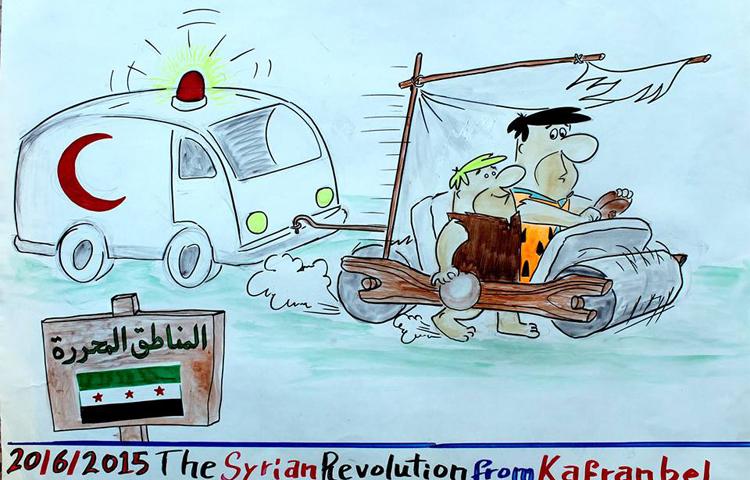
"No exaggeration, this is how medical services are operating now across Northern Syria"
In southern Syria too*. *[https://web.archive.org/web/20150703102043/https://www.dailystar.com.lb/News/Middle-East/2015/Jul-02/304793-4-south-syria-hospitals-shut-after-regime-raids-activists.ashx]
'During their conversations, the activists and leaders emphasized the devastating role of the Syrian regime’s brutal aerial attacks in crippling civil life throughout liberated Syria on a daily basis, as well as the disappointingly minimal role the United States has taken in helping to curtail these atrocities.
“We can advocate in Washington until we are blue in the face,” said Executive Director Mouaz Moustafa, “but there is nothing more impactful than real Syrians – the brave young men and women who started this revolution – sitting face to face with members of congress and telling their stories. Four years on, these brave Syrians still feel abandoned by the international community. These delegations illustrate that there are still Americans in government who care about them, and want to hear their stories. We would like to thank Senator Kaine and the entire delegation for showing this interest, and making that human connection.” '
“It is a new parliament and MPs will want to think very carefully about how we best deal with Isil. [There is an] illogicality [with] Isil not respecting the border lines; they don’t differentiate between Syria and Iraq, they’re establishing this evil caliphate across both countries. There is no legal bar to us operating in Syria but we don’t have the parliamentary approval for it.
We don’t need it at the moment because we are playing our part in the campaign and what we do in Iraq actually frees up the US aircraft to attack in Syria. Isil has to be defeated in both countries. Its evil in Iraq is all being directed by its headquarters in Syria.”
The logic is that the Americans don't want to do anything on the Syrian side of the border that might upset Assad, like protecting Syrians from ISIS attacks, or God forbid, Assad's bombing. The logic is that Britain entirely supports the American strategy, it is only because this is becoming unsustainable for those countries most directly affected by this neglect and partiality, like Turkey, which is threatening to establish a buffer zone in Northern Syria* to protect Syrians from Assad and ISIS, and forestall the possibility that the Kurds will establish a state in Northern Syria, that Michael Fallon is expressing any doubts as to the direction they've taken. *[http://eaworldview.com/2015/06/syria-daily-turkey-considers-intervention-with-air-operations-and-ground-troops/]
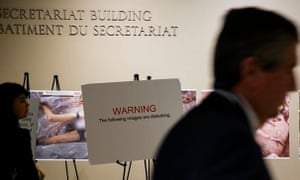
' “This is an important victory,” said James Sadri, campaign manager at the Syria Campaign, which organised a petition urging the parliament to reverse its decision. “If European politicians won’t even look at pictures of human rights abuses in Syria what hope is there that they’ll do anything to stop them happening?”
“Rather than send gunships to stop refugees crossing the Mediterranean these European politicians should do more to stop what these Syrians are fleeing in the first place,” he added.'
'In hisMay 19 briefing, White House Press Secretary Josh Earnest leveled, in his own peculiar way, with the people of Syria: “... the President feels very strongly that the very significant problems that are faced by people in Syria, for example, are not problems that the United States is going to come in and solve for them. We're not going to impose a solution on Syria. We're not going to commit billions of dollars and the lives of hundreds of thousands of our men and women in uniform to try to solve those problems.” The fact that no one is calling for a ten-figure expenditure of money or the commitment of hundreds of thousands of troops is neither here nor there: the Syria straw man strategy is a permanent staple of administration disinformation. What is important is the implicit, but blunt message to the people of Syria: you are on your own.
There are twenty months left for an administration so self-absorbed and yet so self-unaware that a key spokesperson is actually able to say, “We’re not going to impose a solution on Syria” without betraying even a hint of irony. Twenty months in Syria-time is an eternity. One could easily imagine 500 thousand dead, 5 million refugees, and 15 million internally displaced. Recent setbacks notwithstanding, one could see the Assad regime continuing to prosecute a campaign of mass homicide, buoyed aloft by new injections of Iranian cash made possible by the lifting of sanctions. Twenty months from now an incoming US president could find Syria essentially partitioned between two sets of arch-criminals: the Assad regime in the west, and the Islamic State (ISIL or ISIS) to the east—a country in its death throes, hemorrhaging terrified human beings in all directions.
Faced with these kinds of prospects, Syrians already aware of the moral and policy vacuity of the West have no choice but to take matters into their own hands. This is the tallest of tall orders. As ISIL gobbles up more territory while being chased futilely from 30 thousand feet and as Assad—with Iran’s blessing—plasters residential areas with barrel bombs, the options for ordinary, nationalistic Syrians and those trying to represent them seem slim indeed.'
'In an incredibly candid and powerful address Raed Saleh, head of the White Helmets, speaks truth to power at the UN Security Council Arria Briefing on the 26th of June.
"The international community has lost its credibility for Syrians in the absence of any political will to end the killing in Syria, and the UN Security Council has been transformed from the Security to the Insecurity Council in the eyes of the downtrodden because it has failed to uphold its own resolutions.
The Syrian people who are being killed every day, Ladies and Gentlemen, hold you responsible and demand that all measures available to end the killing, particularly with indiscriminate weapons, be taken immediately.
As a patriotic Syrian, I never imagined I would one day ask for a foreign intervention in my country, by land or air. But the lives of innocent women and children that we see dying in our hands every day compel us to ask for any intervention possible to stop the barbaric killing machine led by Bashar al-Assad, including preventing Syrian aircraft from flying, and especially preventing helicopters from hovering above us and dropping these bombs." '
The Associated Press take, via the Guardian*, on this is somewhat different.
'The Security Council has been bitterly divided over Syria between Russia, a close ally of president Bashar Assad’s government, and western nations who have have campaigned for a transitional government leading to democratic elections.'
Not an abandonment of Syria by the West, but a campaign for régime change. In miniature we see the difference between the media narrative and the experience of Syrians over the last four years, and how the delusion of many leftists that they are doing Syrians a favour by blaming their condition on Western meddling isn't some challenge to the prevailing ideology, but what the press and the politicians would like us to believe.
'Thus whilst Syria should not distract from Palestine as this is what Israel wants and would allow its ethnic cleansing to go ahead unimpeded, neither should our attention be diverted to such an extent from the fact that there has been no regime that has come close to representing Israel’s than Assad’s. He comes second to Israel in the number of Palestinians he has killed. He has tortured more Palestinians to death than Israel could ever hope to do (http://beyondcompromise.com/2014/09/19/faces-of-our-dead-photos-of-the-palestinians-tortured-to-death-by-syrian-regime/). He has employed exactly the same tactics of starvation of civilian areas under the excuse of them being ‘held hostage by terrorists'; indeed his opponents have had to dig tunnels to try and circumvent those sieges (and those tunnels been labelled ‘terrorist’ tunnels). He has carpet-bombed civilian areas to the ground for four years unimpeded. It has stopped people returning to its homes (such as the famous uprising Baba Amr neighbourhood in Homs).
For the past four years we have watched Syrian women and men scream in cameras ‘where are the Arabs? Where are the Muslims’ with rubble behind them in exactly the same way that they do in Gaza. If Zionism did not mean ‘Jewish nationalism’ Assad’s state would be the archetypal example of its Arab form.
The fact remains that Hezbollah is now knees-deep in Palestinian blood, and I would like it if such outlets like EI are brave enough to call it and Iran on its betrayal of the Palestinian people, and call on it to put their actions where their mouths are, how can they be pro-Palestinian when they refuse to take off sieges of Palestinians, which according to someone who has recently visited Yarmouk and previously Gaza, has been multiple times worse than Gaza? Through doing this campaign and put pressure on it to stop the regime starving and torturing the Palestinians under its mercy (to say nothing about the Syrians).'
Unlike ISIS, Nusra fights mostly against the regime (and against ISIS) alongside other Syrian rebel groups. Therefore, this “Israel supports Nusra” fairy-story is not aimed at claiming that Israel is secretly aiding a sectarian diversion of the revolution, but, on the contrary, the aim is the same old warped conspiracy theory that the mighty Syrian revolution is just a conspiracy orchestrated by a US-Zionist-Gulf-Jihadist-Martian cabal bent on destroying the nice progressive “secular” regime of Assad.
Quite deliberately, these writers conflate Nusra with the FSA and other rebels; the fact that the UN reports talk about, for example, handing two boxes to members of an “armed group” for these writers automatically means Nusra. Even when it was found out that the wounded fighter murdered by the Druze lynch-mob was in the FSA and not Nusra, these haters declare him an “Islamist” fighter, in order to be as dishonest as is humanly possible without still calling him “Nusra” – for them, Nusra, Islamists and FSA are all the same thing.
The entire fairy-tale of Israeli support to either Nusra or the FSA in the south is based on nothing. Stupid stories, however, can have deadly results.'