Tuesday, 9 February 2016

Residents in Aleppo say world has abandoned them


 'Residents of rebel-held areas of Aleppo say that floundering western efforts to broker a peace deal in Syria are irrelevant to people facing a daily onslaught of Russian air strikes and preparing to defend themselves from advancing pro-government forces.

 Umm Layla, a street vendor, also said she believed that a peace deal was impossible. “This is the third conference. What have the previous conferences done for us? What have they done except bomb us with planes. The planes are killing us.”

 “I believe there is no hope, none at all,” said Abu Umar, another resident.

 “The killing of the Syrian people over the last five years is unprecedented in that the world is standing by watching it happen,” said a local doctor, who did not want to give his name.

 “People have been dying in such a public way,” said a German rebel fighter who did not want to be identified. “I came here to help when no one else did. Yet if I wanted to return home for any reason then I will be arrested and put into prison. It’s unreal."


 “The reason for the severe bombardment is that the people here belong to the revolutionaries. They want freedom and they want an end to the regime,” said Abu Jafar, an elderly man who spoke to MEE in the town of Harytan on the outskirts of Aleppo, a few kilometres south of the Shia-majority villages of Nubl and Zahra, where government forces last week broke a years-long siege by rebels.

 As Abu Jafar spoke, two rockets slammed into a nearby building, forcing him to duck for cover, although neither rocket exploded. He said residents had been living with the constant threat of air strikes for years, but had nowhere to go.

 “Go where? A refugee camp? They are bombing those too. It’s better if my family and I are killed in our own home.” '

Monday, 8 February 2016

Deaths in Detention in the Syrian Arab Republic


 'In the Syrian Arab Republic, massive and systematised violence – including the killing of detainees in official and makeshift detention centres – has taken place out of sight, far from the battlefield. Detainees held by the Government were beaten to death, or died as a result of injuries sustained due to torture. Others perished as a consequence of inhuman living conditions. The Government has committed the crimes against humanity of extermination, murder, rape or other forms of sexual violence, torture, imprisonment, enforced disappearance and other inhuman acts. Based on the same conduct, war crimes have also been committed. Some anti-Government armed groups established makeshift places of detention where captured Government soldiers were ill treated, and executed.

 Those who were kept in the custody of security and armed forces were almost always denied any means of contacting their families. Some families were first informed about the death or whereabouts of their relatives from released fellow prisoners. In its thematic report “Without a trace: enforced disappearances in Syria”, as well as in its periodic reports, the commission has reported that the crime of enforced disappearance was committed by Government forces as part of a widespread and systematic attack against the civilian population.

 Former detainees detailed how cellmates were killed as they were beaten to death during interrogations and in their cells, or died as a result of severe injuries sustained due to torture or ill treatment. Others perished as a consequence of inhuman living conditions inflicted on the prison population, including severe over-crowding, lack of food, and unclean drinking water. Prisoners were given inadequate or no medical care, and died in large numbers from preventable conditions such as diarrhoea or other contagious infections spread in the unhygienic and overcrowded cells.

 While the overwhelming majority of the victims who perished while detained in Government-controlled prison facilities were men, the commission has documented cases of women and children as young as seven years old dying in the custody of State forces. One of the earliest documented cases of death in detention is that of a 13-year-old boy, arrested during a protest in Sayda (Dara’a) in late April 2011. His mutilated body was returned to his family in May 2011. Women, boys and girls, as well as the elderly, have been subjected to torture and brutal prison conditions and have suffered physical and mental trauma. They too have been the victims of, as well as witnesses to, deaths in custody.


 Interrogators and guards employed gruesome methods of torture to kill detainees. In 2014, a detainee held in a centre under the control of the 4th Division of the Syrian army had his genitals mutilated during torture. Bleeding severely and left without treatment, he died three days later. A detainee of a Military Security branch in Homs witnessed an elderly man being severely beaten, and then hung by his wrists from the ceiling. The guards burned his eyes with a cigarette, and pierced his body with a heated, sharp metal object. After hanging in the same position for three hours, the man died.

 Prison conditions were similar across detention facilities. They included severely overcrowded cells where prisoners were often forced to stand and sleep in shifts, stripped to their underwear. Lack of clean drinking water, sanitation, lice infestations and other unhygienic conditions caused the spread of disease and infections. Many prisoners were forced to use their toilet as a source of drinking water.

 Detainees were frequently either ignored or punished with torture when requesting medical assistance. Some prisoners received limited and mostly inadequate medicine, while most received no treatment at all. Some severely ill prisoners were transferred to military hospitals in the Damascus area, including Mezzeh military hospital 601 and Tishreen military hospital located near Barzah Al-Balad neighbourhood. Prisoners were tortured by medical staff at the hospital. Others received limited medical care before they were sent back to the same life-threatening prison conditions. Several prisoners died in the hospital, with prisoner-patients recounting how they were asked to assist in wrapping dead bodies in plastic.


 Many detainees were subjected to rape and other forms of sexual violence,7 and exposed to humiliation and degrading treatment. Prisoners were subjected to threats of sexual violence against female relatives.

 Denied contact with their families and held in inhuman and degrading conditions in overcrowded cells or prolonged solitary confinement and continuously subjected to torture, prisoners often suffered severe psychological disturbances and depression. Numerous accounts describe how some detainees started hallucinating or displaying other signs of psychological disorders, stopped eating and drinking, and eventually passed away in their cell for unidentified reasons.

 In all cases where the body was returned to the family, it bore marks of extensive torture. Some bodies were returned from hospital morgues to their family only after the family agreed to sign a statement confirming that the deceased had been killed by “terrorists.”


 The Military Security Damascus Branch 227 is located in Mezzeh neighbourhood and is estimated to hold several thousand detainees at all times. Detainees who survived to give accounts of their detention in the branch witnessed the death of fellow inmates as a result of torture, disease, and appalling prison conditions, including chronic lack of food. Former prisoners of Branch 235, located north of Al-Qazzaz neighbourhood in south-eastern Damascus, detail a large number of detainees dying. At least 30 persons were observed dying under torture in this branch between 2011 and mid-2012.

 The Investigations branch of the Air Force Intelligence is located in Mezzeh military airport, south west of central Damascus. Survivors of this branch recounted daily torture sessions. Detainees were brought back to their cells by the guards with open wounds, swollen limbs, haemorrhaging and left without medical care. When they died, the bodies would be removed from the overcrowded cells by prison staff within a few hours.

 Many of those interviewed also recounted having witnessed the death of inmates of the Air Force Intelligence branch located in Harasta (Damascus and southern region branch). Interrogators and prison guards routinely tortured detainees.


 Main detention facilities controlled by the General Intelligence Directorate include Interior Security branch 251 and Investigations branch 285 located in Kafr Soussa, west of central Damascus. Former detainees described inhuman conditions of detention resulting in frequent custodial deaths. Officers were observed giving orders to subordinates on methods of torture to be used on detainees. Corpses were transported by other prisoners through the corridors, sometimes to be kept in the toilets, before being removed from the branch.

 Since mid-2012, the Military Police has been in charge of transferring and holding prisoners between branches and courts. Detention facilities such as Sednaya prison hold thousands of inmates who are transferred there, often following a summary trial, sometimes resulting in the issuance of a death penalty and followed by execution. There were dozens of accounts of deaths occurring in Sednaya prison, with prisoners being beaten to death by guards, or dying from preventable health conditions. Following a practice similar to that described in other facilities, inmates witnessed guards removing bodies from the cells.

 The commission further recommends that United Nations Security Council: (a) Under Chapter VII of the United Nations Charter: i. Demand that the Syrian Arab Republic and non-State armed groups immediately halt all detention practices resulting in custodial deaths and torture; ii. Ensure the enforcement of accountability by referring the situation to the International Criminal Court or other judicial mechanisms; iii. Adopt targeted sanctions against persons, agencies and groups credibly suspected of being responsible for or complicit in conduct leading to custodial deaths, torture and enforced disappearances.'

Kerry 'blames opposition' for continued Syria bombing


 'Two Syrian aid workers said they approached Kerry at a donor conference drinks reception and told him that he had not done enough to protect Syrian civilians. He then said they should blame the opposition.

 "He said that basically, it was the opposition that didn’t want to negotiate and didn’t want a ceasefire, and they walked away,” the second of the aid workers told MEE in a separate conversation and also on the basis of anonymity.

 “‘What do you want me to do? Go to war with Russia? Is that what you want?’” the aid worker said Kerry told her.


 Both aid workers said Kerry told them that he anticipated three months of bombing during which time “the opposition will be decimated”.

 The second aid worker said the most that Kerry seemed prepared to offer were aid drops for besieged Syrian towns which he said he had discussed with Russia.

 "He said they were close and they were talking to the Russians about it," she said.'

Underground schools face bombardments and burnout


 'At the unofficial schools run by Syrian activist group Kesh Malek in opposition-held districts of Aleppo, the children don't go outside to play during breaks in case a barrel bomb should drop from the sky. Kesh Malek has tried to locate its schools in basements surrounded by high buildings - that present clear targets - to provide some protection against aerial bombardments.

 "Sometimes you feel ashamed of yourself, you are choosing places where others are going to be bombed and you are surrounded by protection, their houses are protection," said Shehwaro.

 A former dentist who left the profession in 2010 to study political science, she later became an early participant in protests against President Bashar al-Assad that evolved into the civil war that has killed at least 250,000 people across Syria and driven 11 million from their homes. A Christian, Shehwaro serves Aleppo's Sunni Muslim community.


 The name Kesh Malek means checkmate, or defeat of the king in chess, and refers to the group's ideal of creating a democratic republic in Syria rather than what it sees as Assad's dictatorship.

 The group started setting up schools in Aleppo in 2011, at first using normal school premises, but that changed after a government bombardment in April 2014 on the Ein Jalout school in the city. Shehwaro said 23 children had died in that attack.

 "The worst case scenario is he (Assad) is going to target schools. Right now none of our schools have a yard. We don't have sports or this kind of activity," she said. "We replace that with drawing and puppet shows and indoor activities."

 Shehwaro said the group was political, but the children were not exposed to political slogans or campaigns.

 "We don't want them to know about the revolution, but we want them to know they have rights," she said.


 Gender is a major focus for Shehwaro, who describes herself as a feminist. Activities have included encouraging girls to formulate dreams for the future such as becoming a president or a carpenter, and one of the services on offer is home schooling for girls who married early.

 Shehwaro said one of the difficulties was that 80 percent of the teachers were inexperienced, and most of them were women who had little access to relevant training as most programs available in Syria targeting women focused on areas like sewing or cooking.

 "Let us break this view of Middle Eastern women ... We should be enabling them in every sector they are trying to work in, not only what we assume is a sector they should work in."

 "One of the teachers said to me, 'why are we teaching children who are going to die next week?' To me it's harsh, but it has its own logic. They look at the children and imagine that they are going to be the next victims." '

Sunday, 7 February 2016

I Work On The Syrian Border, And I've Stopped Crying


 Sabreen Shalabi:

 'The day begins with a call from a family member.

 "She is very sick and the siege has left no medicine in the town."

 Later on, you receive a message from your sister, who still remains in an area under siege by the regime.

 "Just pray for us."


 The day continues with a trip to a Syrian camp, where they literally have nothing. A women begins to bleed profusely, and trapped within the borders of the camp she cannot leave.

 You watch as the four year old, walks across with no shoes to help his mother carry the blanket, and just think to yourself "these children are no longer children."

 In an area with no communication, a mother gives you a small piece of paper with a phone number on it.

 "Please let my family know I'm alive."
You receive a phone call from your friend.

 They're crying, they just lost someone.

 You listen to them trying to calm them down.

 The call ends.


 You look to the clock it's 12 a.m.

 You open Facebook to read the news, only to hear of another 100 dying under airstrikes.

 You scroll down, pictures of people starving from areas under siege.

 You decide to close the page, enough news for the day.

 You close your eyes and realize.

 You didn't let a single tear drop.'

Moderate Syrian Rebel Factions Face Wipe-Out

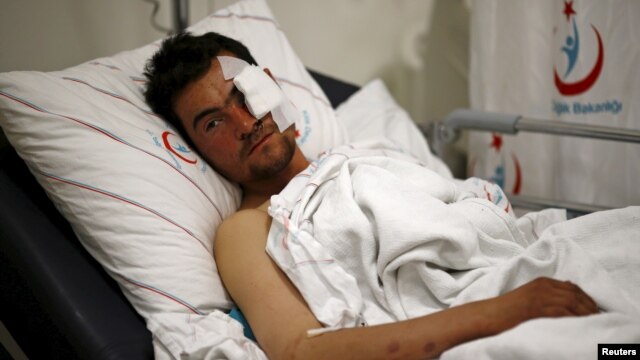
Kasim Genco, 21, a fighter with the Syrian opposition who was wounded during airstrikes on Syrian villages near the Turkey border, lies in his hospital bed in the southeastern city of Kilis, Turkey, Feb. 7, 2016.

 'The sweeping Russian-backed offensive in northern Syria by President Bashar al-Assad’s military and foreign fighters from Iran, Lebanon and Afghanistan is triggering a humanitarian crisis by propelling thousands of civilians to flee to the Turkish border, say political activists and rebel commanders.

 Some forecast an implosion of secular and less religious-based militias aligned with the Western-backed Free Syrian Army (FSA) in northern Syria. “This is the end of the FSA in northern Syria,” Bassam al-Kuwaiti, a well-known figure in political opposition circles, told VOA.

 Al-Kuwaiti said some moderate militias will be forced to merge; others will have no alternative but to disband altogether and join either the powerful Islamist insurgent group Ahrar al-Sham, [Free Men of Syria] or enlist with al-Qaida’s affiliate in Syria, Jabhat al-Nusra.

 In villages and towns northwest and north of Aleppo, FSA militias are already relying on Ahrar al-Sham and al-Nusra to help them to try to survive a week-long Assad onslaught that has seen Russian warplanes fly hundreds of round-the-clock bombing sorties.


 Regime forces have managed to capture a chain of villages that control the main rebel supply route for insurgent-held districts in Aleppo city.

 “The situation is disastrous,” said rebel fighter Abu Zaid, who had just returned to Turkey from the front-lines. “The Russians are flying six-plane sorties and we are being bombarded by artillery and coming under multiple rocket attacks.”

 “You hardly see Syrian army troops fighting,” Malahefji said. “We are fighting Iranians, Afghans and Hezbollah.”

 He was bitter about what he sees as a Western desertion of the Syrian revolution.
“I have spoken with the ambassadors and their staffs of the U.S., Britain and France and asked them, 'What will you do other than just makes statements?’ ”

 He offered a message from a U.S. official that read: “God willing, we are working on changing the conditions on the ground in the next few weeks.”

 “But we don’t have weeks,” snapped Malahefji, a former higher education teacher. “We need portable anti-aircraft missiles if we are to persevere” he said. “And we need more anti-armor missile systems like anti-tank TOW missiles.”


 The position of the Kurdish YPG, or People’s Protection Units, which is dominated by Syria’s Democratic Union Party (PYD), appears the most tortuous. Rebel commanders accuse the YPG of being two-faced.

 YPG and rebel factions have been protecting civilians as they travel from Azaz. But at the same time the YPG has launched attacks on Islamist and moderate rebel factions around Afrin, seeking to expand the Kurdish enclave. Russian airstrikes on Saturday helped Kurdish fighters alongside militiamen from Jaysh al-Thwar, a YPG Sunni Arab ally, to capture the strategic Tal Zinkah hill north of Aleppo.

 Syrian rebels argue the YPG, the most effective ground partner for the U.S.-led international coalition fighting Islamic State militants, is a secret partner of Assad and directly and indirectly coordinates with Damascus. YPG commanders have always denied the claim.

 In an exclusive phone interview with VOA, PYD leader Salih Muslim echoed Assad and Russian officials. “The Russian airstrikes are targeting terrorists, Ahrar al-Sham and Jabhat al-Nusra,” Muslim said. “The offensive won’t impact Syrian Kurds.” '

Friday, 5 February 2016

These Rebels Have Amassed A Library From Ruins


 'Syrian opponents to President Bashar al-Assad have been widely derided as extremist jihadis hungering to establish a puritanical Islamist regime. Even members of the U.S. Congress say the moderate opposition to the Damascus regime has been supplanted by sectarian extremists such as the Islamic State and Jabhat al-Nusra, al-Qaeda’s Syrian affiliate.

 But interviews with half a dozen fighters, photos, and video footage from the Daraya library east of Damascus paint a different picture of Syria’s uprising. They suggest the hopes for progressive social change, raised by the largely peaceful 2011 uprising against the Assad regime, have yet to be completely quashed.

 “Despite what people think of us, we are people who have demands and a message to deliver,” said Omar Abu Anas, a 24-year-old former university student turned rebel fighter who frequents the library. “When we were attacked, we defended. Despite your calling me a jihadi, I’m Free Syrian Army and I want to bring down the regime to build a new government, to live in a free society.” '

Tuesday, 2 February 2016

Syrians in Switzerland on the ‘Geneva 3’ talks


 Hani Abbas, a Syrian-Palestinian cartoonist:

 "Enough! We cannot be in the 21st century and look on while a people are being completely annihilated. I do not hold any hope for these talks for a number of reasons, including the failure of the “Geneva 1” and “Geneva 2” talks and the presence of many obstacles that are essentially related to the nature of the talks. After five years of criminality, bombardment and displacement, the eyes of the world and Syrians should be looking towards the International Criminal Court to put on trial all war criminals, instead of focusing on re-polishing and re-manufacturing the Syrian regime and involving it in these Geneva talks."

 Chadi, human rights activist:

 "Before anything else, justice must be administered. This would help solve the humanitarian problem as soon as possible, but also create Syrian unity when all its citizens become equal, regardless of their religion or ethnicity. Justice will also ensure the departure of Bashar al-Assad, which is the key to all other issues."

 Zyed Akkad, aid organiser:

 "When the Syrian revolution erupted, the students, intellectuals and others called for freedom and dignity, which the regime met with brutality. That is why our priority is to get rid of this regime, which has destroyed the country and displaced the people."

Monday, 1 February 2016

Refugees risk freezing to death to flee from Syrian army


 'Hundreds of people at the refugee camp at Yamadi, close to the border with Turkey, are loading their belongings onto trucks and heading deeper into rebel-held territory after pro-government forces regained control of a series of strategically placed towns.

 “We don’t want to live under the rule of the government for a minute. They have no mercy on us. If they catch you then it’s the end for you,” Umm Asim told Middle East Eye as she prepared to flee with her family amid fears that one or two more nights of heavy fighting could bring Syrian army tanks rolling down the road.

 “We are trying to leave because the government is getting closer and the Russians have done nothing good. We get shelled from one side and bombed on the other side and we are afraid. My little son doesn’t eat and he doesn't move because he is so afraid.”

 “I’m afraid for my children,” added Umm Marwan. “We are leaving because of the planes and because the children are so afraid. The army is getting closer and the planes are constantly shelling us. We want to leave and find a new place to stay.”


 Russia is accused of killing hundreds of civilians since intervening in Syria last September on the side of Syrian President Bashar al-Assad by launching air strikes in rebel-held territory.

 In November, Russian jets bombed camps including Yamadi in the Turkmen Mountain region of northern Latakia that had become refuges for Syrians fleeing from war-shattered cities, including long-besieged Homs and Aleppo, and Ariha in Idlib province.

 The bombardment came after a Russian jet crashed in the area after being shot down by Turkey for reportedly violating Turkish air space, with local rebels accusing Moscow of taking revenge.

 “The Russians came to kill the Syrian people. It’s a massacre, they use planes, tanks and missiles,” said Umm Asim. “Where do we go? If we go to the villages they bomb us, if we go elsewhere… where do we go?” '

UK program helping Syrians with skills and knowledge


 'Dotted across the north-eastern provinces of Idlib and Aleppo, which border Turkey, in the rural suburbs of Damascus and in the southern province of Deraa, almost 40 communities are functioning outside both regime control or the influence of Islamists such as Al Qaeda and Islamic State. This is the real "free Syria".

 Civilian councils are implementing projects covering everything from the supply of water and electricity and other essential services, to education and health facilities, vocational training, women's empowerment, road building and good governance. It is being funded by a covert $34 million program run by the British Government's Department for International Development (DFID) — and it has already directly benefited more than 1.4 million Syrians.

 "If we are not providing services, then the armed groups will. That's bad, especially if they are Islamist. For example, we provide vocational training to 15 to 18 year olds. They are learning skills and in a few months will be ready to work, to earn. If they were not in training they would be on the front lines. We are trying to get these people's lives as close to normal as possible."

 One the communities Mr Shayyah manages is Darret Azzeh, a city of 40,000 people with another 60,000 living on its outskirts, in rural Aleppo. The city fell out of regime control to the Free Syrian Army in 2012. It was one of the first areas to rise up against President Bashar Assad when protests broke out in 2011, demanding freedom, equality and dignity. When the movement developed into an armed insurgency, the city became a symbol of the revolution's resilience, with Free Syrian Army rebels weathering aerial bombardment from regime aircraft and attacks from Islamist radicals.

 "The people of Syria were never asked for their opinions. We are asking them what they need. They are getting the chance to express their democratic opinion and learning how to run things ... away from systems of nepotism and corruption." '

Sunday, 31 January 2016

Starving Madaya’s Rebel Commander Speaks


 'A former baker, Abu Abdulrahman leads the local unit of Islamist faction Ahrar al-Sham. He was detained in 2005, as he tried to fight in Iraq. Sent to Sednaya prison, where the regime sent many Islamists, he became friends with Hassan Abboud, the future leader of Ahrar. He and Abboud were among the detainees released by the Assad regime in 2011.

 Now Abdulrahman is in Madaya, cut off since Hezbollah and regime forces tried to overrun the nearby town of Zabadani last July. Despite a ceasefire deal in late September, the Syrian military maintained its blockade, allowing in only one aid delivery weeks later. Prices for food skyrocketed in the town, people were reduced to eating grass and leaves, and up to 75 people have reportedly died from starvation.


 Abdulrahman says he and the hundreds of rebels under his command have tried to surrender multiple times, but Hezbollah will not accept their terms. The commander first offered to leave, if the rebels retained their guns and were guaranteed safe-passage to opposition-held territory. Then, he said weapons would be given up, if the disarmed rebels were escorted out of town by UN officials. Finally he offered to stay in the town as “a police force” for the local community.

 Speaking about the rebels’ blockade of 12,500 people in two regime enclaves in northwest Syria, Abdulrahman says:

 "I am against any civilians being put under siege. Let me be clear, speaking for myself: I am against the Jaysh al-Fatah siege in Fu’ah and Kafraya."

 He continues, “After the war, I hope we can live together: Alawites, Christians, Sunnis, and Shiites, in a state of law. Someday I hope we will get along, and things will be as they were before.”


 And what of the claims from Russia and the Assad regime that rebels have caused the starvation by hoarding food?

 Abdulrahman responds, “When Madaya goes hungry, we go hungry. These are vicious lies.”

 He referred to his five children, saying that his youngest son is afraid to leave the house and go to school, and that he cries for hours on end when food runs scarce: “Can you imagine that? I am the commander, and even my child is starving.”

 A female resident offers further testimony. She says that a supposed “protest” by women and children as aid was delivered was stage-managed by Russia and Hezbollah. Claiming that she was one of the women brought out of Madaya to a barricade, she says the group was told to condemn the rebels and praise President Assad in exchange for food and safe passage from the town.


 Meanwhile, Abdulrahman prepares for more siege and struggle. He says he once “had so much respect for the way [Hezbollah] defended their homeland”. But now “I have to see Hezbollah as my enemy now: they cut down our trees and starve our children”.'

Saturday, 30 January 2016

Syria’s moderate opposition fighting on two fronts

Free Syrian Army fighters in Aleppo

 Asaad Hanna:

 'There has been talk of a number of “moderate” fighters who are open to co-operation. David Cameron has talked about the existence of 70,000 fighters opposing Daesh, and there is reason to believe the number is yet higher. I want to unpack this a little.

 Last October the UN special envoy for Syria, Steffan de Mistura, invited Syrian military factions to engage in dialogue with the regime through the so-called Four Committees Initiative. The initiative was rejected by the factions out of mistrust, but it did reveal the elevated number of opposition fighters that were active in Syria: 74 military factions signed the rejection statement, the smallest of which numbered 1,000, while others totalled more than 10,000.

 Crucially, none of these 74 are internationally classified as extremists. The moderate opposition is not a myth. Syrians do not need foreign fighters to help them fight Isis; they have indigenous fighters, better acquainted with the land and able to confront any aggressor, particularly where there is firm international will to support them to do so.


 The Syrian armed opposition is fighting a war on two fronts: against Assad and against Daesh. Assad’s barbarity has driven Syrians from their homes and resulted in the deaths of hundreds of thousands of Syrians over the past five years.

 On the other side, we are facing Daesh, a terrorist group whose creation Assad must take some of the responsibility for. Daesh is helping the Assad regime by fighting us, the armed moderate opposition. The relationship between the two should not be in doubt.

 Whenever we have made advances and secured victories, Daesh has defended the Assad regime. For example, we have seen Daesh launch offensives in order to draw Free Syrian Army forces away from battle, to ease pressure on the regime. During a battle near Qardaha – the birthplace of Bashar al-Assad – the armed opposition was achieving great victories until Daesh suddenly launched an attack on a key military position in the nearby city of Aleppo, killing a number of Free Syrian Army commanders. Just three days later they withdrew, at which point they handed the area over to regime forces.


 The moderate opposition remains firm in its struggle to combat the Syrian regime, as well as the growing threat from terrorism in Syria. The Free Syrian Army welcomes any hand extended to help bring the Syrian people closer to gaining their freedom, without being deflected from its goals or the fundamental principles of the revolution.

 “I will tell God everything I saw” was the last sentence uttered by a Syrian child before he died of injuries caused by one of the Assad regime’s barrel bombs. Almost half a million Syrians have paid with their blood, and the bloodshed needs to stop. The opposition wants to ensure that barbarism doesn’t triumph in Syria, neither Assad’s nor Daesh’s, and that the country is returned to the Syrian people.'

Reaction To U.N. Envoy's Video

A car passes in an area that was destroyed during the battle between the U.S. backed Kurdish forces and the Islamic State fighters in Kobani, north Syria, in 2015.

 Staffan de Mistura: "We've heard what you've been telling us ... enough bombing of my city where I am, and I don't know who is bombing me. I just see bombs coming down. Rockets, anything."

 Shakeeb Al-Jabri: "Dear Mr. de Mistura, We'd like to remind you that "peace" was the first cry of the Syrian Revolution. We'd also like you to know that we know exactly who is bombing us. And so do you. If you want to trust you, at least name them."

Tuesday, 26 January 2016

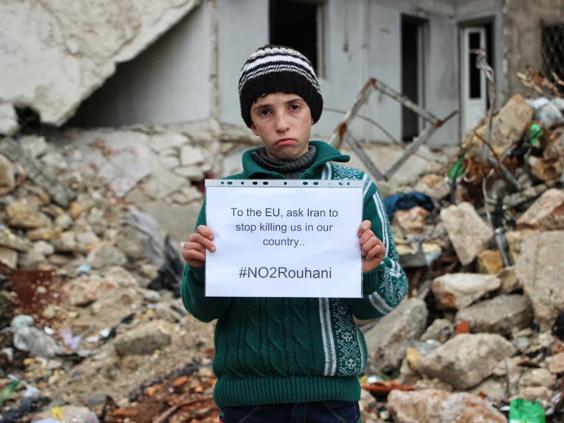
Children in Aleppo protest against Iranian intervention

Syrian-children-Iran-5.jpg

 'As the Iranian President continues his landmark visit to Europe, Syrian children have been photographed with posters calling on leaders to oppose his alleged intervention in the country’s civil war.

 Pro-rebel activists in Aleppo, where civilians have been indiscriminately bombed during continuing battles between the Syrian regime, anti-government rebels and Islamists, claimed to have photographed the children in the rubble of their former homes.

 They were seen holding posters accusing Hassan Rouhani of being “responsible for crimes committed by the Iranian regime in Syria” and addressed Francois Hollande, asking the French President to force his counterpart to withdraw troops.'

 As if there were any doubt about the Iranian invasion of Syria, or the bombing of these children's homes. Even when the Syrians being killed by Assad have their story reported at all, every effort is taken to cast doubt on their veracity.

Monday, 25 January 2016

Healthcare workers are being 'systematically' targeted


 'As he looks back over photos of his last visit to Aleppo, Syria, he pauses for a moment over a picture of two young doctors, smiling at the camera in their blue scrubs.

 “He was an anaesthetist I knew. He was killed two weeks ago last year. An air-to-ground missile,” Dr Nott says, sad but matter-of-fact, pointing to one of the pair. “And he was killed not long before,” he says, indicating the other. “Doctors are targeted.”

 In the grim logic that has taken hold among the forces of President Bashar al-Assad and his allies, “healthcare is seen as a weapon”, he says. “You take out one doctor, you take out 10,000 people he or she can no longer care for.”

 “Nearly nobody is reporting this, the direct attacks on healthcare and healthcare workers,” he told The Independent last month, citing figures from the NGO Physicians for Human Rights, which recorded 23 attacks on medical facilities in Syria in October and November last year – all but one by Syrian government or Russian forces.


 The United Nations Office for Co-ordination of Humanitarian Affairs also reported that 20 health facilities were struck or damaged by aerial bombs dropped by the Assad regime or its allies in October and November, and that many aid organisations have had to scale back or suspend their operations as a result of increasing attacks. In December, Amnesty International said Russian air strikes had killed hundreds of civilians – and hit medical facilities.

 Aid workers believe the increasing frequency of such attacks suggest a strategy. Nott has long been convinced that both Syrian – and now Russian – forces are intentionally hitting hospitals: a view that is shared by the Foreign Secretary, Philip Hammond, who accused the Russians of deliberately targeting civilians, hospitals and ambulances after speaking to Syrian civil defence workers in Southern Turkey earlier this month.


 “The nature of the bombing has changed so completely in the past few months. It has to be the Russians,” Dr Nott says. “Russian jets fly very high up. Syrian jets fly lower, firing rockets and missiles. The Russian planes tend to be 10,000ft up and you don’t see it, you just see the weapon hitting the hospital,” he says.

 “The British are fighting Isis – fair enough – but this is happening daily and has been forgotten about.”

 In 2013, he called for humanitarian corridors to be set up to support populations trapped in conflict zones. Now, he says, a no-bombing zone is urgently needed over Aleppo and Idlib provinces, which the international community should set up, even if it meets with Russian opposition.

 “It has to be achieved. Somebody has to stand up and say, ‘The humanitarian situation is so bad that this has to be achieved’. It is a systematic destruction of the healthcare system: a weapon of war which Syria and Russia are using at the moment. That has to stop.

 Make it an area refugees could come back to, protected by a peacekeeping force – I’m sure Assad and Russia would not start attacking any Americans that were there.” '

Sunday, 24 January 2016

Syria's real life stories


 Robin Yassin-Kassab:

 'Living conditions are absolutely unbearable, in some places people are actually starving to death. There's constant barrel bombing, etc., etc., chemical weapons, and so on. Having said that, the inspiring thing, and the thing the media really hasn't covered very well, is that there are over 400 democratically elected local councils in Syria.

 Now this is something that is quite amazing, and I can't understand why we're not talking about it much more, because in the previous decade the West was invading the Middle East, to bring them democracy supposedly, on the back of tanks, and that didn't really work out. Now, out of necessity, in places where the state has collapsed, or has been driven back; people have got together, they've organised elections, and they've got local councils that are trying to keep life going in the most difficult of situations. These people should be part of the solution.

 They've done it in different ways in different places, but in some ways they are elections as we would recognise here. So, for example, in the south, where the dominant militia is the Southern Front, a group of Free Army militias, they have refused to enter into alliances with Jabhat al-Nusra, the al-Qaida group, they have had no problem at all with people organising elections in the south. The leaders of militias were not allowed to stand, so we've got civilian councils.

 And the reason why those people must be part of the solution, is not only because they are democrats, but because they would allow for a decentralisation of power in the future. Now for example, currently in Syria, because of this war, we have explosive polarisations, ethnic and sectarian. In the future, it may be, in a liberal, coastal city like Tartous, which has many Christians and Alawis living in it; the local council may decide - when they get their own local council, it's under régime control, so they don't have their own, at least not in public, at the moment - if they have their own local council, they may decide that alcohol should be freely available in Tartous, whereas a conservative Sunni city like Hama or Deir Ezzor, they may decide, the local council in the area may decide that alcohol should be illegal. In that way, with decentralisation, you could allow for people with very different ideas and traditions in the same country in the future.


 Most people are not able to leave the country. You need at least one or two thousand* dollars to get someone to smuggle you over the border. There are however some people who have decided to stay, either because they've seen some neighbours who've gone off to live in Beirut for a year, and their money run out, and they came home and the army had taken their house, or another family was living in their house, or their furniture had been stolen, and they wished they'd never left. There's that. And there is also the issue that some people are so committed to the situation, that if they are going to die, they want to die on their own soil, and they want to stay doing the best they can for their community.

 We've seen the absolute depravity of the human being in Syria over the last five years. We've seen absolute horrors, people torturing children to death, a mass rape campaign; at the same time, we've seen really inspiring human stories of people being self-sacrificing, and creative, and intelligent, in the most difficult of circumstances.

 We saw Mr. Fallon, the British minister, the other day pointing out that 80% of Russia's bombs are not dropping on ISIS. They're dropping on the opposition to both Assad and ISIS, the people that we need for a solution. Now a peace process under the aegis of the power that's backing Assad and murdering the Syrian people is not going to work, it's not going to be acceptable, it's not going to begin to work. And it's rather irresponsible to be pretending we've got a peace process going on, when this enormous catastrophe on the Eastern Mediterranean, with huge implications for everybody's security, is still escalating and intensifying, the Russian intervention has made it much, much longer, it will go on for years more I would expect. It's getting much worse, it's a huge problem, it's growing exponentially, and we're pretending there's a peace process, when there isn't.


I remember the story of my friend Aziz Assad from Salamiyeh. He was in prison for two years before the revolution started, when he was 19, for writing an article for a French magazine. As soon as he came out of prison, the revolution started, and he was involved in the local coordination committee in Salamiyeh. He then became a media activist working with the Free Army. And then he ended up leaving the country, because he was being threatened by ISIS and Nusra and people like this, as well as being in danger from the Assad régime. This kind of encapsulates the tragedy of the whole thing.

 I remember Raed Fares, the director of the media centre in Kafranbel, he's a great character; I remember him being being asked, 'If you'd known what was going to happen, would you have come out in the spring of and demonstrated?" And he said, no, absolutely not, if had any idea that this would happen, that so many people would die, the country would be burned, no, I would have stayed at home. But here we are now, this is the situation we find ourselves in, there's no going back, and all we can do is keep going. Of course many of them are now out of the country, or dead, or disappeared; but there are still hundreds of local councils, for example, in Syria, which not many people talk about. Everybody's heard of ISIS, nobody's heard of the Syrians who have organised democratically selected local councils, which are keeping life going in the most difficult of circumstances, in the war zone. So those people still exist, and a lot of the ones outside have said to us that they want to go back; as soon as they feel safe they will go back and continue agitating for freedom and democracy.

 I'm not against bombing ISIS, if the people doing the bombing, as I think the British are at the moment, are very careful to try and not hit civilians, which will help the ISIS narrative. I think that ISIS is being pushed back, certainly from the Kurdish areas. I think the West should be working far more with Arab opposition militias, people who've already driven ISIS out of their areas, to continue driving ISIS further back. Having said that, none of that is going to change the big problem, because even if ISIS itself is defeated, something will come and replace it. Jabhat al-Nusra, for example, the al-Qaida franchise, which is less extreme than ISIS, it's also much more intelligent at embedding itself in Syrian society, and a lot of people who don't like al-Qaida's politics in Syria, are willing to work on the battlefield with al-Qaida, with al-Nusra, because they see the greater enemy as the régime which is barrel bombing them.


 At the moment, the Syrian people are being attacked by Iran, by transnational Shia militias, by Russia - 80% of Russia's airstrikes are not hitting ISIS, they are hitting the opposition to ISIS and Assad - and there are British and French planes mixed up in there too, and there are American planes. The Syrian people on the ground, all they can see is, everyone is bombing us, the western Christians, the Eastern Christians, the Shia are attacking us, maybe it's because we're Sunni Muslims. The only thing they're not attacking is Bashar al-Assad, the man who is responsible for 95% of the civilian casualties, and the vast majority of the displacement.

 So the narrative, or the vacuum, which allows these transnational jihadis to step in and take advantage, that's the real problem that has to be dealt with, and so long as Assad and his allies are bombing people from the sky, this radicalisation will continue and grow.'

*Corrected from "hundred".

Saturday, 23 January 2016

Dignity - Dani Qappani from Moadamiyeh


السالب والموجب من قلب المعضمية ... داني قباني .. رسالة صادقة مخلصة تاريخية . أرجو من كل سوري في المغتربات إرسالها إلى أصدقائه الأجانب .
Posted by ‎توفيق الحلاق‎ on Thursday, 21 January 2016

Friday, 22 January 2016

UN Allowing Assad Regime To Censor Syria Aid Plan


 'The United Nations altered a key humanitarian aid plan for Syria after consultation with the Assad regime, including deleting references to “besieged” areas such as Madaya where thousands of people are starving. The edits include:

 The removal of all instances of the words “besieged” and “siege” in reference to areas where nearly half a million people in Syria are thought to be trapped.

 The redaction of any mention of a programme to remove landmines, unexploded bombs, and missiles.

 The removal of references to violations of international humanitarian law, such as aerial attacks on medical facilities and the targeting of civilian areas.

 “These so-called colleagues of ours that are famed to have everyone’s best interests at heart took it upon themselves to make changes because of what the Syrian government had very obviously directed them to do. There were three or four personalities on the Damascus [UN] end that went to work on it right away. There was a lot of toning down of some of the language, they rewrote entire sections… it was a full filtering system basically and this is what caused the bilateral uproar.”

 “The document turned from a humanitarian aid document to a political document after the Syrian government changes, rather than centring on what the civilians really need,” said a coordinator from another NGO, who wished to remain anonymous to protect his relationship with the UN. “I totally understand that the UN should not take sides, but at least they should be on the side of the civilians.” '

Thursday, 21 January 2016

Secret Syria Network Saves Lives with Air Raid Warnings

W460

 'In Syria's coastal Latakia province, Abu Mohammad sends a warning from his phone to a secret network of colleagues: "Caution: A Russian plane just took off in your direction." Moments later, activists in a rebel-held area in northwestern Syria sound warning sirens that prompt civilians to take cover before incoming air raids. The message, sent via the mobile application WhatsApp, is part of an effort by a network of civilian and rebel coordinators across Syria who call themselves "the monitors".

 From positions near government-held military airports, they use messaging services or walkie-talkies -- depending on Internet coverage -- to warn activists, medics, and rebels about incoming aerial attacks. "I know when the plane takes off, and as soon as it does, I tell people that a plane is coming towards them. As soon as the news reaches people, they either hide in their bomb shelters, or some people hide in underground tunnels."

 Even before the Russian campaign began, activists had begun trying to find ways to minimize casualties in air strikes. "When the regime began using warplanes and helicopters on cities, people started thinking of ways to warn civilians," activist Hassaan Abu Nuh told AFP via the Internet. "After a lot of attempts at other things, they decided in the end to hook walkie-talkies up to the loudspeakers in the minarets of mosques."

 Russia's role in the Syrian conflict has added a new challenge for the monitors, who say they have been able to decode intercepted messages in Russian. "After a while, the guys on the ground were able to break the Russians' communication code -- as well as monitor the planes by sound and sight," Abu Nuh says. "These warnings have saved the souls of many civilians... this is life or death for people in these areas." '

We will build a democratic, multi-confessional country


 'My name is Hissam Saad and I am 60 years old. I am a surgeon who before the revolution ran a medical practice for over 20 years. I am a husband and father of three children; my eldest son, Sarmad, served in the army before the revolution.

 When the Arab Spring broke, I, as a surgeon, could not stay away from it, becoming intensively involved in all areas of the revolutionary movement and participating in all rallies. Bashar Assad is a dictator; you probably know that he started shooting at people who gathered for rallies. Though I am a Christian, I went to the mosque where we all gathered before the rallies. All Syrian rallies come out of mosques: a mosque is not only a place of worship but also a meeting venue, a place where people of various religions can get together at a certain time and day; not only it is a place for Muslims or Christians but for all those who want to get together to stand up against a dictator.


 Soon after the revolution started, the Free Syrian Army was formed. At first, its fight against the despotic regime was met with support; over time, however, all of its supporters turned away from the FSA and now the Army gets no support at all.

 ISIL was created by command of the Syrian and Iraqi regimes to shift the agenda from social and economic issues and onto religious matters.

 Sarmad saw the regime’s troops do terrible things to protesters, shooting and killing them. Two of his army comrades who refused to shoot at protesters were executed at once. Sarmad had always been a free man loathing anger and aggression. When they killed his friends, he and 23 other soldiers left the regime’s army, moving from the southern part of Aleppo to its western part where the Free Syrian Army was stationed.

After Sarmad left the army, the regime’s security service men came to my clinic to break everything there and threaten me. It happened 5 months after my son’s defection. But even after that I continued to work at the clinic, participating, as a free Syrian, in rallies, shooting and posting videos in social networks to let people know what was going on.


 On November 23, 2012, I was arrested at the clinic and taken to one of the security service departments, department 255, where they kept me for 7 months. Then they transferred me to department 285.

 They beat me. They beat me with a strap, kicked me with their boots, they beat me with everything they could. They broke my fingers. I am a surgeon and they broke all my fingers. They would lift me by my shoulder and leave me hanging like this for 3 hours. But the worst of all the torture I endured was cold (it was wintertime and I had no clothes on) and hunger: we were starving; they would not let us eat. They tortured me mentally threatening to rape my mother and daughter; they humiliated me as a human being and as a doctor. When they questioned me, I was standing before them stark naked, blindfolded, with my hands tied. It all lasted for 7 months.


 All this will end if the whole world continues its pressure and starts using all available means to stop the dictator, the murderer.

 Even if the regime succeeds in making Syria fall apart into several states, this will mean nothing: we will continue to fight no matter what. We’ll fight for a hundred years if we have to. Syria must be one country. After Assad goes, we will start building a new, free Syria: a democratic, multi-ethnic, and multi-confessional country.'

Syria is a unique symbol of injustice, apathy and amnesia


 Yassin al-Haj Saleh:

 'I am impressed by many people from many European countries, mostly individual volunteers. Their generosity, courage and humanity dignify the human race. I was touched by a message from a Norwegian woman who was in Lesbos helping refugees. As for governments, while it is not fair to include all of them in one category – Germany is not like Hungary, Sweden is not Denmark – I think they are unified in building higher walls in the face of the influx of refugees, specifically the poorest and most vulnerable ones.


 The global powers have so far been putting the cart before the horse by targeting Da’esh only, ignoring the root cause of the militarisation, radicalisation, and sectarianisation that has occurred over the past five years, namely the Assad regime. This is a short-sighted and failing policy, not to mention unethical. It is a prescription for an endless war.

 By the way, I think this enchantment with Da’esh that began in the summer of 2013 has deep connections with the sordid chemical deal between the US and Russia, which practically informed the Assad regime that it was okay to kill people with other tools, not with the one we had forbidden. The mainstream media was obedient in highlighting whatever Da’esh did and sidelining the crimes of the regime in order to legitimise that despicable deal between the two big global keepers of the peace (read: war). Da’eshmania is a way of suppressing the shame of that deal. Media and power elites want the masses to remain mesmerised, with their minds fixated on those exotic decapitators, who are absolutely different from us and our dear masses.

 I want to add one additional thing concerning this fascination with Da’esh. I suspect that the mad extent of killing and control that Da’esh is practising in the regions it occupies is the level the power elites in the “civilized world” aspire to imitate. That violence has an essential virtue: it pushes past the limits of what can be done to the population at home, giving the power elites everywhere a sense of mastery and freedom. If this can be done there, it will be possible here someday. Da’esh is the laboratory test the elites like to peep at and hope to imitate someday. It is their utopia and our dystopia. That is why the population in the West should be anxious of what has been happening in Syria for the past five years. Do not defend us, defend yourselves!


 Turkey’s record is mixed: it welcomed around 2.5 million refugees. Our situation here is acceptable and, so far, Tukey has had a consistent position towards the Shabeeha regime in Syria, but it caused a lot of trouble because of it is irrational and unjust concerns about the Kurds on both sides of the border. France’s position was mostly a consistent one, too. Both countries were clear all the time that the culprit is the regime and it should be overthrown and they tried to act accordingly, but were kept back by the United States. Washington has been the worst enemy of the Syrian revolution, worse even than Russia, which was a clear enemy from the first moment, along with Iran and the latter’s satellites in Lebanon and Iraq. I am not an essentialist anti-imperialist who thinks that imperialism is an essence hidden somewhere in the US, maybe at the White House, the Pentagon, or the CIA, but I tried hard to locate any positive elements in the Syrian policy of Obama’s administration in Syria. The world at large has become a worse place, especially after the chemical deal which was a big gift to Da’esh and al-Nusra Front (and, of course, to Assad), than it was before.


 As for internal players: I think one can identify obscurantism as the position of saying that there are no “good guys” in the Syrian conflict; they are all bad. I see this as an essentialist, Da’esh-like way of approaching our cause. I do not imply that there are no bad guys, there are many; neither do I want to say that there are many good guys, which is of course true, unless one is Robert Fisk, Patrick Cockburn, or Vladimir Putin. Rather, I want to make a paradigm shift from that reactionary distribution of labels of good and bad, to the actual dynamics of the struggle. I alluded before to the chemical massacre in which 1,466 Syrians were killed at the hand of the Assad regime, and to the chemical deal between the Americans, Russians and the regime. What was that deal? There were four actors, not three, at the time: the regime, the Americans, the Russians and millions of Syrians who had been resisting the thuggish regime for more than two years and four months, peacefully at the beginning then with arms. The regime gained not only its survival from that sordid deal but also impunity; the Russians managed to save a client regime and won a greater recognised role in the region and the world, while America (and from behind the scenes, Israel) succeeded in disarming the regime of the dangerous weapons that were thought of being deterrent to Israel. The party that was completely sacrificed is the one who had just lost 1,466 people in one hour: the rebellious Syrians. That is why that deal was despicable and its “heroes”, especially the one named Barak Obama, were extremely villainous.

 Due the regime’s brutality and the baseness of the big egos of the globe, a dynamic of radicalisation, Islamisation and militarisation, was triggered and changed everybody in the country, myself included. In September 2015, I was in Oslo for a few days, where I appeared on a TV programme. Before this show, the presenter asked me, if I was “moderate”. No, I am not, I replied. She was alarmed, but she wanted to be sure: “But you are secular, aren’t you?” For the discursive habits in the West, ‘moderate’ implies that siding with us (“We are the centre of the world.”) and “good” are synonyms. You are “extremist” and “bad” whenever you side with your own people.

 Of course, I am bad.'

As Syrian men go missing, women take leadership roles


 'They survive shelling and barrel bombs from the Syrian government and, more recently, airstrikes from Russia. Some have been living under siege with little food and hardly any medicine or electricity for almost four years. With so many men killed or missing, it’s up to the women to run their community, and they’re making a difference in people’s lives, including their own.


 Like 25-year-old Zein, who refuses to leave Aleppo despite the daily shelling. She recalls the time when the peaceful uprising started to turn violent, and a shortage of trained medical staff compelled her and fellow activists to volunteer at their local field hospital.

 A few months ago, the Syrian government carried out an airstrike on the field hospital, and several of Zein’s activist friends were killed. Now she spends most of her time doing humanitarian relief work, and she leads an all-male team of aid workers as they distribute food and medicine to families in the area.

 “I’m usually the one who goes up to the front line despite the snipers and fire fighting in order to deliver a basket of goods to some family stranded there. The guys are too jittery to do it, and they’re amazed when I do,” she said, referring to the team she leads.

 “Before the war, women mainly stayed at home, cooking and caring for the family. But now, men work in a field hospital? Well so do I. Men have started to carry arms? Well, we have here in Aleppo an all-women’s brigade, and they fight on the front line. I’m not necessarily for the idea of carrying arms, but this has really changed perceptions. That a woman can do anything a man can do.”


 Maimona is a 30-year-old activist. She heads a child welfare organization called Herras, Arabic for guardianship, and oversees schools that are struggling to stay open. She describes women in their thirties, forties, even older, enrolling in adult education to earn their high school diploma.

 Many of these women have gone on to work in field hospitals or schools — Maimona estimates that 80 percent of the people working in those places now are women.

 “Perhaps this is a silver lining. When we started the Syrian revolution, it was also a revolution for women. And when the war is over, women’s accomplishments will remain.” '

Why Is It So Difficult for Syrians to Get Into the U.S.?


 'The al-Haj Ali family comes from Khirbet Ghazaleh, a town of 16,000. It is 15 miles from Daraa, where the revolution against Assad began, in 2011, after his security forces arrested and tortured a group of students for writing antigovernment slogans.

 The al-Haj Ali twins were only 13 at the time. They had nothing to do with the protests. Nor did anyone else in the immediate family. Although they listened to news reports of the Assad government’s ferocious attacks on civilians, they saw little indication, at first, of the violence around them. There was the odd black helicopter in the sky. And once, when Waseem was taking Azizeh to driving school, they watched a group of protesters carrying olive branches stream out of Daraa. Only later did they realize these were people fleeing a massacre by Assad’s forces.

 Then the airstrikes began. Government security forces raided the family’s home dozens of times. Their cousins, who lived next door, were imprisoned and tortured. Still, the al-Haj Alis hung on; they adapted to living in a war zone, spending evenings in the dark. Then, one morning in August 2012, they learned from a television news report that Azizeh’s brother, a high-ranking official in Assad’s military, had defected overnight to Jordan. His family would most likely be punished, with death, in his stead. He hadn’t warned them. He couldn’t: His phone was bugged, and sending a message would only have further endangered them. The al-Haj Alis never slept at home again. Within days, they left Syria for Jordan by car. Azizeh feared they’d be unable to make it across the border and was even more terrified that the names of her family members would be on a blacklist and that they would be arrested. Mahmoud handed their keys to a neighbor whose house had been flattened by airstrikes. ‘‘If we’re not back by sunset,’’ he told her, ‘‘you can have our house.’’

 If Ahmad and Mohamed had stayed in Syria, they might be dead by now — either killed by the Assad government’s barrel bombs or fallen among the young men who have joined up with the Free Syrian Army. When one of their friends or cousins fighting with the F.S.A. is killed, the boys study the photographs of his death, often posted on Facebook in tribute, with a mixture of envy and guilt.'

Wednesday, 20 January 2016

Women Are Active Behind the Lines in Syria's Civil War


 'Women in the city of Deir Ezzor have supported the Syrian revolution in various ways since its beginning. During the early stages of the revolution, women held active roles, including those that were viewed as exclusively male-dominated, such as carrying weapons in the armed opposition.

 In March 2011, the first demonstrations calling for the Syrian regime’s ouster took place in Deir Ezzor. Women started to join the protests alongside men early on. By the summer, women had a significant presence in the protests.

 “When the armed revolution started in Deir Ezzor and the opposition brigades took over the city’s central neighborhoods, the regime tried to retake the city but failed,” she said. “Without warning, it started brutally bombarding those neighborhoods. The attacks forced the residents to leave their homes and migrate to other cities.

 “Work then became limited to carrying weapons to fight the regime or working in field hospitals,” she continued. “Because of that, women’s presence was limited. However, some women carried weapons briefly during the Republican Guards’ campaign to stop the protests. One well-known woman was a nurse known as Um al-Thuwar [Mother of the Protesters], because the youth of the Free Syrian Army (FSA) considered her their mother.’’


 In January 2013, after the regime siege had lasted several months, the armed opposition freed the al-Huweqa neighborhood’s eastern entrance and used it to transfer supplies in and out of the city. This marked the end of the siege and the beginning of what the city’s residents call the “period of freedom.”

 During this period, women had the freedom to work in other fields as well. For example, the rights organization al-Mar’a wa al-Tifl Hayat was established in June 2013 in Deir Ezzor’s al-Ummal neighborhood.

In an interview in Urfa, Turkey, Baida’a al-Hassan, the organization’s director, explained, “Our activities focused on raising awareness of women’s rights. We held seminars in our center and visited women in their homes. The organization also started two training centers. At the first we taught sewing and at the second, called Ahla Talla, we taught hairstyling.

 “The purpose behind these centers was to teach uneducated women professions so that they would be able to support themselves,” al-Hassan continued. “Additionally, the organization established the Shaady Rabbah School in al-Hamediya area and the al-Amal Kindergarten in al-Ummal. Through these two schools, we managed to secure jobs for many unmarried women.”


 “On July 14, 2014, ISIS seized a neighborhood in Deir Ezzor city and shut down all the civil society organizations, including ours, and confiscated our organization’s equipment. We stopped operating for two months,” Heba said.

 “However, the extremist group and its horrible treatment of civilians would not stop us from working,” she continued. “We decided to go back to our activities, but with a new approach. We used to hold public seminars, but today we hold them secretly inside homes with a limited number of attendees. We cannot assemble large groups of women because the whole operation might get discovered.”

 Heba emphasized that one of most important issues discussed during these seminars is how women can change their behavior to protect themselves from ISIS. Another topic is how to turn away an ISIS “suitor” if he proposes to a woman. That matter has been, and still is, a danger to women of Deir Ezzor.'

Russia Is Bombing Syria’s Children


 'Abdel Rahman was standing outside his family home in the tiny Syrian village of Marayan on a November afternoon when the Russian rocket hit, knocking him to the ground. He felt fine when he came to moments later, he said, and tried to get up. That’s when he realized both his legs had been blown off. “I looked up and my brother was screaming, but I lost consciousness,” he recalled.

 About a month later, Thaer was gathering firewood when another Russian missile hit. He struggled to get up, but couldn’t. His father, Abdel Jalil al-Zein, first took his son to a local doctor, who stuck needles in his toe. There was no response. He loaded him into his car and drove him to the field hospital along the Turkish border, and when medical personnel there couldn’t help his son either, he obtained the permissions to cross into Turkey. Doctors eventually found a piece of shrapnel lodged in his spine. It has paralyzed him from the waist down, probably for life.

 The two teenagers still hang out, but now they are permanently disfigured. They lie in the sitting room of a rented apartment in the Turkish town of Reyhanli, where they now live. Al-Zein lies on the bed with a catheter running from him, and Rahmoun lies on a mat a few feet away — one a double amputee, the other a paraplegic.

 “I know that God will eventually give us our rights,” said al-Zein.


 Two hours before Ahmed Zaki Assi, a spokesperson for the Islamist rebel group Ahrar al-Sham, spoke to BuzzFeed News, Russian forces strafed his group’s positions in Maraat Numan, near where he was speaking from in Idlib province. The war has gotten tougher, he acknowledged, but it remains better than the situation in 2011, when Assad’s forces could open fire on peaceful protesters without consequence, or in 2013 when Iran and Hezbollah first entered the war in support of Assad.

 “We’ve had harder conditions before,” he said, speaking via Skype. “The revolution is weakened because of this, but it’s not going to be ended by the Russian raids or others. On the ground, the revolutionaries advance. But the weapon that we can’t respond to is airpower. We cannot address airpower with our rockets.”


 Mohammed Katoub was teaching the doctors and nurses about sexual violence against women when the Russian airstrikes began. A missile landed 400 meters away from the clinic, one of more than 100 care points and medical centers operated by the organization inside Syria. “I was explaining the difference between rape and sexual assault,” he remembers. “We ran into the streets because it is much safer than inside a facility.”

 Zakaria Ibrahim, 26, an anesthetist at a gynecology clinic in Azaz, was working when a Russian missile struck within 10 meters of the facility, setting parts of it on fire. “Now the hospital is closed,” he said, as he waits for a lift home near the Turkish border after finishing a rotation.

 “The idea is to weaken the civilians to make those living under the opposition areas feel life is hell,” he said. “By targeting bakeries, schools, and hospitals, you make people lose all hope.” '

Friday, 15 January 2016

FSA adviser: IS cannot be eliminated without us


 'The FSA is deployed from Syria’s south to its north. It is mostly present in Daraa and Quneitra, represented by the Southern Front, and in the capital, Damascus, the FSA is positioned in the Jobar neighborhood, one of the most contested areas. Al-Rahman Corps and the Shuhada al-Islam Brigade [Martyrs of Islam Brigade], which are also part of the FSA, are stationed in western and eastern Ghouta. In northern Syria, the FSA is significantly present in Aleppo, represented by Thuwar al-Sham, al-Sham Front and Sultan Murad Brigade. [The FSA-affiliated] Jaish al-Nasr [Victory Army], the Glory Army and the Central Division are stationed in Hama’s countryside, while the largest number of FSA fighters deployed on the coast is represented by the 1st and 2nd Coastal Squads and the 10th Brigade.


 The one hindering the establishment of this safe zone is none other than the US. This is not just an allegation. Rather, repeated statements were issued in this respect, [including] by Pentagon spokesman John Kirby, who said on July 1, 2015, that at that moment, the US did not see a need for the establishment of a safe zone in Syria.

 Meanwhile, the regime’s air force dropped dozens of barrel bombs on Aleppo and Darayya, and the killing of civilians led to daily waves of displacement. Indeed, if a safe zone were established, more than 70% of the people heading to Europe by sea would change their minds. Syrians are not thrilled about the suicide journey to Europe, but they are in search of a safe haven. If such a zone is established, many Syrians will return to this region. We are people who love their country, and we have our culture and our own professions.

 The only reason Syrians are migrating is that for four years now, we have been killed by the deadly weapons of Assad’s regime, and we have lost hope of being saved by the international community.

 The FSA has been fighting IS since before 2014, even before anyone in the world ever thought of fighting this organization. Our fight against IS in the northern countryside of Aleppo and in other areas is independent of any international plan. IS cannot be eliminated without the FSA. We have a history of struggle against all of those who killed Syrians. Therefore, no one can question the FSA’s objectives when it fights IS, because its project is purely Syrian, and it aims to protect Syrians rather than serve other agendas.


 The US is gradually moving from a neutral position toward being a partner in crime as it allows Assad and his allies to kill Syrians. Scary massacres are being committed against Syrians, who have been left to starve to death under siege in the city of Madaya and [killed] by chemical weapons. Syrians are paying a high price as a result of the US policy failure in Iraq and its weakness in the Middle East in general. It is not required that the US send fighters on the ground. This is not what we want. What we want is for Assad to be prevented from targeting civilians and for the [supporters] of the Syrian revolution [i.e. Turkey, Qatar and Saudi Arabia] to be allowed to provide rebels with qualitative weapons. The US supports the Syrian Democratic Forces, which include al-Sanadid Army, one of the regime's militias. We, however, do not trust these forces, and they not surprisingly getting weapons that are hundreds of times more numerous than the weapons received by the FSA.

 Russia’s declaration that it supports the FSA is ridiculous as all facts prove the contrary. Russian airstrikes are ongoing around the clock, targeting our sites and locations. Our position is clear: We will not coordinate or cooperate with Russia.'

A Syrian Response to Obama's Final State of the Union


 'Most people, including most Syrians, are quite willing to believe President Obama’s boast that the “United States of America is the most powerful nation on Earth. Period.” And they likely nodded in agreement when he said that “when it comes to every important international issue, people of the world do not look to Beijing or Moscow to lead—they call us.”


 The trouble from a Syrian perspective is that calling on the U.S.—and President Obama—for help is exactly what the Syrian people have been doing for years, ever since the early months of their revolution back in 2011, when pro-democracy protesters were marching peacefully, demanding respect for their basic rights, and giving the world a reason to hope. As President Obama himself noted at a time: “we see it in the courage of those who brave bullets while chanting, 'peaceful,' 'peaceful.'” Syria’s peaceful pro-democracy activists could never understand why President Obama chose to turn his back on them, allowing the regime to get away with mass murder, and for radical forces to emerge and hijack their revolution. In the meantime, when their oppressor called on his friends, Iran and Russia, for help, they came rushing in.

 Trump wants us to fear the others in our midst, and all around us, Obama merely wants us to be indifferent to their suffering. The first calls us names, the other merely treats us as nobodies, as a people who cannot be motivated by a simple desire for freedom, but only by a desire to settle some centuries old vendettas.


 This brings me to Obama’s willingness to refer to the current situation in the Middle East as “a transformation … rooted in conflicts that date back millennia.” This used to be how the right wing referred to the Middle East. It used to be a vocabulary that liberals like Obama spent their time decrying.

 The conflicts in the Middle East have nothing to do with what happened a thousand years ago, a fact a person with President’s Obama’s academic background should know well. Some Middle Eastern leaders might use such rhetoric to inflame sentiments, but the reality is far simpler: on the one hand we have a greedy, corrupt, and authoritarian ruling elite fleecing its people, and using them as fodder for wars meant to expand their influence and enrich their coffers.

 By showing indifference to mass slaughter and dismissing the idea of humanitarian intervention as tantamount to creating another Vietnam or Iraq, President Obama in his own way has helped diminish America in the eyes of the world, just as he allowed Syria to diminish and be torn apart.


 Yet now we have to listen to the President waxing poetic about the meaning of leadership, saying that “Leadership means a wise application of military power, and rallying the world behind causes that are right.”

 Understand how this translates to a Syrian: I never thought your cause was right, which is why I never rallied anyone behind it.

 President Obama spoke of conflicts in the Middle East lasting a generation, but here is what he did not tell us: what kind of a region, what kind of a world, does he expect to see in a generation, as he leaves extremists, terrorists, mass murders and Russian and Iranian imperialists to shape unmolested our realities, and as he leaves pro-democracy forces with no one to help them?'