'Kurdish people, for example, are terrified of the victory of a jihadist extremist Islamic victory.'
Galloway reverts somewhat back to his old ways ("the era of dictatorship is over", but "there is a massive international conspiracy against Syria" rather than "Assad must go"), and picks up a André Gorz* memorial prize along the way. He talks about Syria from 6m30s. [https://plus.google.com/10272849153995852…/posts/cC59gWn5LaF]
*"Gorz was a kind of Cassandra of the left: in the 1968 Socialist Register he published a piece telling us that the great era of revolutions was over. Just a few months later he was ridiculed as May 68 unfolded." Cf. Simon Assaf: Swedish Foreign Minister Carl Bildt: "Regime losing control of all Kurdish areas of Syria. Coalition including also PKK taking over. New drama starting to unfold."
'Mr. Assad’s Syria has remained a steadfast enemy of Israel. The two countries have no formal relations and are technically at war...“Bashar kept the border quiet, and now it can be like in the case of Sinai, with chaos and terror,” '
These two contradictory passages (and I think that the latter carries the greater truth-value) in a New York Times article [http://www.nytimes.com/…/israel-worries-as-syria-deteriorat…] got me to the below, via "Isabel Kershner contributed reporting" at the end of the NYT piece, and "Isabel Kershner, a Jerusalem correspondent for the Times, is married to Hirsh Goodman, who works for a government-linked Israeli think tank called the Institute for National Security Studies. Specifically, Goodman is the senior research fellow and director of the Charles and Andrea Bronfman Program on Information Strategy, tasked with shaping a positive image of Israel in the media", from here: [http://mondoweiss.net/…/nyt-fails-to-disclose-kershners-tie…]
"For myself, if I were an Afghan I would be demonstrating in the streets or fighting in the mountains alongside the rebels. I do not see any way out of the impasse of the Afghan left which does not involve getting rid of the Russians. And that means fighting them. If any significant section of the left were to fight alongside the rebels it would mean that in the end there would bc at least a space for the left to work in. Just as now there is a space for the Iranian left because of their long struggle against the Shah. Thirdly, what attitude do we take to the rebels? Their leaders are clearly right wing. They are pious clerics in clean pressed clothes, fat landlords with bandoliers, western educated careerists with the backing of the CIA. They are unrepresentative of the people they claim to lead, and the people know it. If they once came to power in a “free Afghanistan” they would squabble over everything, united only in their contempt for the poor. And their new state would fly apart. The pressures of ethnic separatism and Islamic utopianism would pull it apart far more strongly than they are now pulling Iran apart.
Nor should we have too many illusions about the people, the “moujahedin” themselves. They were bigots before; they are worse now. Their ideas will not be changed slowly or easily. they are brave freedom fighters giving their lives in a struggle against imperialism. they are also poor men, fighting for a system that abused and humiliated poor men."
The BBC news subtitlers have reported that President Assad of Syria may have fled to "the tackier",but are as yet silent on whether his trendy wife has been persuaded to decamp in like fashion.
I don't think any Alawi state in the north-west of Syria would last for long for a number of reasons, which I might mention a couple of after ruminating a little on an interview I saw about half-an-hour ago on the BBC with Patrick Seale, who was repeating a sadly pro-regime line, but had some interesting things to say.
I'd missed Hezbollah leader Hassan Nasrallah's speech on Friday, in which he said that Western powers are trying to break up Syria, but this if anything is another reason to think the regime trying to split the country won't be acceptable to anyone but the Assad family. Seale said "Blowing up the entire military top brass is the trademark of the jihadis that gave the Americans so much trouble in Iraq," which as I've mentioned in previous posts, is one crappy theme uniting counter-revolutionaries of all stripes, that suicide bombings mean bad Muslims; but if the military hierarchy has been decimated, not so many to give the orders, it isn't just a couple of dead supervillains. Seale also said if the Americans, "Some of the weapons they throw into Syria may end up in the wrong hands", as if the Americans having so many weapons was a good thing in the first place.
Anyway, other reasons why the reign in the north-west won't last:
1. Sirte. Gadaffi was supposed to be able to hole up there indefinitely. Once he'd lost control of the state finances, once he'd lost control of the state, those who tolerate the regime because it stands for stability support it no longer, nobody can be paid (the Russians may already have the state treasury, as they took the Spanish at the start of their civil war), the only people who will fight for Assad are those whose survival depends on it, most Alawis especially those in Damascus, and other areas now likely to be lost forever to Assad, will be looking at an accommodation with the new reality, it be virtually only his family that are likely to fight to the end if they can't escape.
2.The Soviet Union was a global power in the 80s, now it is a regional power with global ambitions. Having a Med port isn't so vital that the Russians will want to flush their future influence in the region down the toilet for its sake, they are far more likely to need their Black Sea fleet against Georgia than Italy.
'Began the civil war, though, like all such events, it gathered head slowly, and people scarcely knew what a crisis they were acting in.
Terrible as the massacre was, and hideous and overpowering as the first terror had been, when the people had time to think about it, their feeling was one of anger rather than fear; although the military organisation of the state of siege was now carried out without shrinking by the clever young general. For though the ruling-classes when the news spread next morning felt one gasp of horror and even dread, yet the Government and their immediate backers felt that now the wine was drawn and must be drunk.'
The BBC just reported this as "may have been killed by a bodyguard, who turned out to be a suicide bomber." He wasn't part of some mystic tribe of suicide bombers, who are usually evil, but this time might be good; the idea of suicide bombing as an ideology rather than a tactic gives rise to such misdirected conceptions. Anyway, seems like the regime is going the way of the Nepalese monarchy, blown apart at the centre.
Frank Gardner: "It is a jihadist act, that is alien to Syria", not to all the armies in the world that have undertaken suicide missions.
"So the Americans stood idly by while Russian tanks crushed Budapest and Prague, and the Russians weren’t too upset when Presidents Johnson and Nixon sent bombers to Hanoi. No atrocity on either side, it seemed, could stop the movement towards détente."
Jonathan Rugman for Channel 4 News: "Syria is descending into a sectarian bloodbath." Lazy reporting of a government massacre and its deployment of helicopter gunships as if this was an inexplicable struggle with no right side.
Simon Assaf: "I am amazed that in the face such terror the LCCs have remained true to the principles of the independence of the revolution. And its response to the latest massacre is to call for a deepening of the revolution, when all others are calling for foreign intervention. As long as the LCCs remain, the revolution has a chance of victory. But time is running short."
"They caught me then they stabbed me," he said. "I was rescued by girls."
This isn't quite as heartwarming:
'The increasingly sectarian nature of the divide in Syrian society meant Aboud remained isolated among the Syrian exiles in Turkey, where the political and military groups are almost exclusively Sunni.'
though
'Some international observers have warned that the revolution has taken on an increasingly militant Islamic feel. Along the road from Aleppo towards Syria's fifth city Idlib, guerrilla leaders and the few villagers that remain insist that is not the case – yet.'
There's a short sequence in this, from 2m38s to 2m43s, where a soldier appears to be trying to remove graffiti with the butt of his rifle, maybe trying to prove that the sword is mightier than the pen.
'Dall'Oglio lays out, in rambling, ornate prose, his case for massive, nonviolent intervention: 3,000 unarmed observers and 30,000 civilian peacekeepers deployed in Syria to help "initiate a widespread start of grass-roots level democratic life."
It is a characteristically grandiose submission from the flamboyant Jesuit, and probably an unrealistic one.Still, the Italian-born priest warns: "If nonviolence becomes another name for a lack of responsibility, then I am not with nonviolence anymore. I am with the right to defend people." '
'There's a fellow half in shot on the right, wielding an AK variant and wearing loosely assembled fatigues, but also with a scarf round his neck in Syrian colours which looks very much like his mum knitted it for him. One hopes that both are OK.'
"In its real significance, a revolution is a fight for control of the State. That rests directly on the Army. This is why all revolutions in history sharply raised the question: on whose side is the army?..The restoration of the Sultan and his despotism would mean the end of Turkey, leaving the Turkish State to the mercy of those who want to carve it up. The victory of Turkish democracy, on the contrary, would mean peace."
"A disproportionate number of Alawis owe their livelihood to the regime. To fight for a post-regime future means to fight for a future in which their community will be, at best, less favoured than at present."
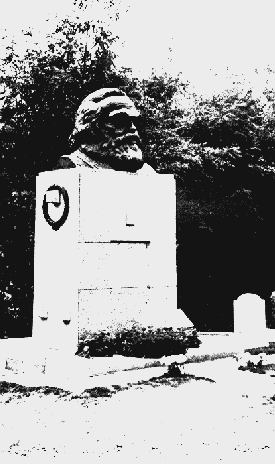
Most of the debate about Syria is about what people should do, very little is about why they do what they do. At least the above is a start. A hundred and thirty years ago at his friend's funeral, Frederick Engels said he thought his friend had discerned the primary cause:
"Marx discovered the law of development of human history: the simple fact, hitherto concealed by an overgrowth of ideology, that mankind must first of all eat, drink, have shelter and clothing, before it can pursue politics, science, art, religion, etc.; that therefore the production of the immediate material means, and consequently the degree of economic development attained by a given people or during a given epoch, form the foundation upon which the state institutions, the legal conceptions, art, and even the ideas on religion, of the people concerned have been evolved, and in the light of which they must, therefore, be explained, instead of vice versa, as had hitherto been the case."
Do the Syrian bourgeoisie and state officials support the regime because they are wrong-headed, or because they benefit from it? Will the lower-level state functionaries be won away from it by being told they'll get a smaller slice of the same cake, or that the cake will be bigger once the parasites stop creaming off the top? If the latter are there irreconcilable interests of those who wish to profit from Syria in the future and those who would have to labour to produce those profits?
How to overthrow the regime is another question. The working class has the power (in Russia in 1917 it was 2% of the population, I'm sure in Syria it is much higher), but for understandable reasons socialist politics there have been corrupted by Stalinist backers of the status quo. But still the question arises of who else will control any force capable of knocking the regime over; if that is foreign intervention they will impose their own idea of what is good for Syrians, replicating as far as they can the system of exploitation in their own country, whether that is Turkey, Saudi Arabia or the US. And if it is the FSA uncontrolled by the grassroots, then the best that can be hoped for is some sort of military Bonapartism.
Similar questions arise as to how a post-Assad Syria is to be constructed. Is it simply to be a similar scheme of exploitation, with the Assad family removed and perhaps the facade of a Western-approved democracy, in which those with power and influence compete in elections to show the limited amount they are prepared to share with their own constituencies, while sharing the rest with their corporate friends at home and abroad, à la Iraq?
These are the sort of questions that should have been asked by John Rees in this dreadful article,http://www.counterfire.org/…/15821-syria-the-left-and-a-rev…. But this supposed dialectician instead sets up a false pro/anti -intervention dialectic, in which the Syrians who don't support intervention supposedly see those who do as a bigger enemy than the regime. To which any anti-regime Syrian will reasonably tell him that he knows nothing and understands less, if they were to be more polite than he deserves.
"Syrian rebels tried to get me killed," says Channel 4 correspondent* Very stupid if true. On CNN last night they were talking of people fleeing the fighting between the army and rebels (as if they were equal threats), it only takes one incident like this to endorse a picture of a struggle between two equally [il]legitimate forces, just as it would only take one actual sectarian massacre by opposition supporters (say in response to the one in Qubair) for the government and the Russians to say that's all there is to the anti-Assad forces. They do that already, but they'll start to sound believable. Here's Marx on how the ideas of the ruling class are in every epoch the ruling ideas. *[http://www.theguardian.com/media/2012/jun/08/alex-thompson-syrian-rebels]
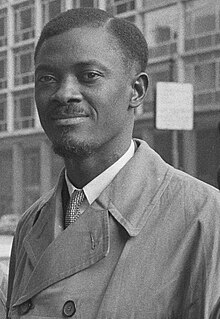
“Dead, living, free, or in prison on the orders of the colonialists, it is not I who counts. It is the Congo, it is our people for whom independence has been transformed into a cage where we are regarded from the outside… History will one day have its say, but it will not be the history that Brussels, Paris, Washington, or the United Nations will teach, but that which they will teach in the countries emancipated from colonialism and its puppets... a history of glory and dignity.” — Patrice Lumumba, October 1960
For those who might think the UN might help the people of Syria, a reminder of some of the facts of its first intervention. And brilliant though Lumumba was, it was he who made the mistake of thinking the UN would come to help. When Kofi Annan says that the Syrian opposition should stop fighting, it is so the intrigues of the Great Powers can rule the day.
Just heard Tariq Ali tell Russia Today that it is just the US that doesn't want an orderly transition in Syria, which I think is to noticeably misread the situation there (where the regime isn't going to give up without a fight), but he understands an enormous amount and knows more.
[Also RT had a report on the 150-fold increase in fines for unauthorised protests in Russia, which are still nowhere near the level said to exist in France and the UK],http://rt.com/politics/lower-house-illegal-protests-026/]
'A scuffle between Syrian air hostesses supporting their country's government and those against it resulted in the delay of a Saudi Arabian Airlines flight to Dubai, a Saudi newspaper reported Monday.'
Flight attendants at the front line of revolutionary struggle.