Wednesday, 21 July 2021

Syrians Die in Media Darkness

 Muhammad Idrees Ahmad:

 'Last April, Akram Bathiesh, a middle-aged Syrian refugee, died of a heart attack in Denmark, shortly after being told by the authorities that his asylum status had been revoked and he had a month to leave. The Danish government has been reexamining the status of five hundred refugees from Syria, and Bathiesh was among the 189 whose asylum had been revoked since last summer, 94 of them this past March alone. Others included a Syrian-Palestinian grandmother named Rihab Kassem, originally from the Yarmouk refugee camp in Damascus, whose son Waled has been a Danish resident for twenty-five years; and Aya Abu Daher, a high school student, now nineteen, who captured headlines after making a televised appeal to the government. “All my life is here,” she said in fluent Danish. “How can I go back to Syria now?”

 Over the course of the war, Denmark has granted asylum to some 32,000 Syrians. Now, however, without any changes in the threats that forced those refugees’ flight, the Danish government is adopting a stringent new approach, with the ruling Social Democrats promising a “zero asylum seekers” policy. The Danish immigration authorities’ rationale for repatriating refugees—or “refoulement,” the term of art—is that “the conditions in Damascus…are no longer so serious that there are grounds for granting or extending temporary residence permits.” Since coming to power last year, the government of Prime Minister Mette Frederiksen has expanded the scope of this determination, designating the entire governorate around the city a safe zone. Denmark’s minister of integration, Mattias Tesfaye, a former Communist and the son of an Ethiopian immigrant, was adamant in rejecting the Syrian high schooler’s plea. “I won’t back down,” he said, “it won’t happen.”

 The government’s self-righteous statements suggest that Denmark is not content with sending refugees back to possible persecution, torture, or death; it also wants to assert that it is doing the right thing. By way of justification, it is defining security as the absence of combat in the territory under regime control.


 The insecurity in Syria, however, preceded the outbreak of civil war and has persisted through it. Indeed, it was the Assad regime’s rule by terror that triggered the uprising in the first place. The only thing the war did is to make the violence overt and lay bare the Damascus government’s grisly apparatus of control. The horrors of the regime’s prisons, which were all too familiar to Syrians, became known to the wider world. Yet the global attention brought no accountability. The prisons have remained fully operational, except that the regime now runs them with complete confidence of impunity.

 It is inconceivable that the regime’s menace toward its own citizens has diminished in the Damascus governorate. Early in the conflict, in 2012, a Human Rights Watch report revealed that of the twenty-seven detention centers that comprise Syria’s “torture archipelago,” ten were in the capital itself. In 2014, when a Syrian defector codenamed “Caesar”—who had been an official forensic photographer for the military police—shared 53,275 photos documenting the deaths of 6,786 detainees under torture, the most shocking discovery was that many of these bodies had been dumped in the courtyard of Military Hospital 601, just half a mile from the presidential palace in Damascus.


 The evidence about Syria’s charnel houses has continued to mount. According to a 2017 Amnesty International investigation, between September 2011 and December 2015, the regime executed as many as 13,000 political opponents at its military prison in Sednaya, including “demonstrators, long-time political dissidents, human rights defenders, journalists, doctors, humanitarian aid workers and students.” In a 2019 New York Times investigation into Bashar al-Assad’s torture gulag, Anne Barnard reported that nearly 128,000 detainees had disappeared into Syria’s dungeons over the course of the war. The detentions and disappearances have continued, with the Syrian Network for Human Rights reporting 972 arbitrary arrests in the first half of 2021 alone.

 The Danish government’s confidence in its declarations owes much to a vacuum of such information outside of the NGO world, enabled by Syria’s virtual absence from Western media in recent months. Much of Syria, including Syria’s five largest cities, have reverted to regime control. The northeast, which includes 70 percent of Syria’s oil reserves, is under the control of the Kurdish-led Syrian Democratic Forces (SDF), while Turkey has carved out a buffer zone in the north, where it rules through Syrian proxies. Most of the displaced Syrians who remain in the country, numbering more than four million people, are squeezed into the parts of Idlib province that the regime has yet to recapture. That this enclave is controlled by the hardline Islamist group Hay’at Tahrir al-Sham puts its civilians doubly at risk: living constantly under the threat of renewed fighting, they endure arbitrary rule by these armed extremists.


 Although a 2018 ceasefire deal between Russia and Turkey was meant to have brought peace to Idlib, regime forces have continued their war of attrition against the rebel-held areas, albeit that their attacks are calibrated to a level below the threshold of international news interest. Western fatigue with the story has itself altered that calculus: in December 2019, the foreign press largely overlooked the regime forces’ major offensive to recapture Idlib. The operation appeared on the verge of success until Russia overplayed its hand and killed thirty-six Turkish soldiers. Unable to confront Russia directly, Turkey instead unleashed a lightning offensive against Syrian regime forces, killing nearly two hundred soldiers and militiamen, destroying in the process a significant part of the regime’s military arsenal. The ferocity of the Turkish retaliation halted the regime offensive, and that had the effect of buying a limited reprieve for Idlib’s majority refugee population since then.

 To the extent that this contest of wills between regional powers received any external attention, the civilians caught in the middle remained invisible. Syria received greater attention when it seemed a more hopeful story, and particularly when events happened to align with American concerns. In the West, Syria was first an Arab Spring story, then it became a chemical weapons story, then an ISIS story, then a refugee story, then a Great Power rivalry story. But once the Islamic State was defeated and Syria was quietly ceded to Russia and Turkey, it became a nonstory. And despite sporadic coverage of such atrocities as the deliberate bombing of hospitals in opposition-held areas, the regime’s quotidian violence toward its own citizens was never a major preoccupation for the international press.

 A Google Trends analysis shows that in the ten years of Syria’s war on civilians, the volume of news about it has largely remained low, except for a handful of spikes. Of these, three related to chemical weapons attacks in Syria—a use of banned weapons that President Obama once declared would be a “red line” triggering US intervention. By 2019, according to the Global Public Policy Institute, there had been 336 chemical attacks in Syria, with 98 percent carried out by the regime, the rest by the so-called Islamic State. The incidents that got attention in the Western media, however, were only the those in which the US either did retaliate or considered military action.

 Some of these developments—such as the August 2013 chemical attack or Russia’s entry into the war—were major events in Syria’s bloody war, but others of far more consequence for Syrians received barely any attention. The volume of news rose only slightly during the summer of 2012, when the regime carried out a series of sectarian massacres and started using airpower against cities (notably, helicopter-borne barrel bombs); it actually dipped after Obama retreated from his red line and the regime escalated its violence. In 2016, it rose again, though marginally, as the crisis in Aleppo escalated, but after the April 2017 chemical attack and US airstrikes, it dipped. Since then, international interest has waned.


 That events in Syria only registered when they intersected with Western interests is also illustrated by the strikingly different coverage of the population flight in 2015 compared with the one in 2019. Syrians had been fleeing their country in large numbers since the fall of 2013, as the regime used its newfound impunity after the red line fiasco to escalate, but with the combination of the rise of the Islamic State and Russia’s entry into the war in 2015, this turned into a mass exodus. Whereas, until then, Syrians had been taking refuge mainly in Turkey, Lebanon, Jordan, and Iraq, some then started making their way into Europe. This was duly pronounced a “refugee crisis.” In September 2015, the photo of young Aylan Kurdi’s drowned body being picked up from a Turkish beach changed the scope and tone of Western media coverage enough to move German Chancellor Angela Merkel into granting asylum to a large refugee population, an example that several other European states, including Denmark, and joined by Canada, followed on a smaller scale.

 The December 2019 offensive that the Damascus regime and Russia had initiated to retake Idlib had by February 2020 driven nearly a million more people from their homes. This was the largest single displacement of the conflict, yet it went virtually unreported in the West because the displacement was happening within Syria. This changed once Turkey, which was already home to 3.7 million Syrian refugees, announced that it would no longer prevent refugees from crossing into Europe. The subsequent coverage, however, focused not on the refugees but on Turkish perfidy and cynicism.

 When Western media, which has some commitment to accuracy and objectivity, moves on, or when it fails to amplify local voices with direct knowledge of the situation, it leaves an information vacuum. In the case of Syria, that is filled by Russian and Iranian media, whose coverage is of an entirely different nature. The aim of these outlets, which are less concerned with facts than with upholding state-sanctioned narratives, is obfuscation. If they can manufacture uncertainty about major events, such as chemical weapons attacks, they can cast everything about the conflict into doubt. The deluge of disinformation produced by official news operations such as Russia Today, echoed by state propaganda fronts like Sputnik, and amplified by armies of trolls, sends the denialist accounts to the top of Google, YouTube, and Twitter searches.

 This impression of a hopelessly disputed and thus unknowable reality is strategic. It is designed to disrupt an accurate apprehension of the fact that the Syrian civil war is probably the best-documented conflict in history. Many things about the conflict are complicated, but it is incontestable that the Syrian regime has been the main perpetrator of violence against civilians, and it has acted as such in a sustained, systematic, and deliberate manner. There is an overwhelming consensus among war crimes investigators, human rights groups, and tracking agencies on this score. Indeed, according to the American lawyer and former war crimes prosecutor Stephen Rapp, the evidence massed against the Syrian regime is more extensive than the Allies had in gaining convictions against Nazi leaders at the Nuremberg tribunal.

 Yet the issue has little traction with the public in the US and in Europe—in part because of the dearth of coverage, a void that has been filled by disinformation, and in part because of a general indifference toward Syria among Western leaders, despite the catastrophic consequences of the war. While Western media has moved on, Russian and Iranian state media and their various auxiliaries have waged a relentless propaganda offensive, focusing in particular on the major chemical attacks to which the Western media did pay attention. In an attempt to obscure the regime’s responsibility, these outlets and operatives have directed their campaign of disinformation and vilification at witnesses and survivors, organizations that documented the attacks (such as the volunteer rescuers and medics of the White Helmets), and the scientists who investigated and validated the evidence (such as the Organisation for the Prohibition of Chemical Weapons). The specter of Iraq is again and again raised to suggest that the allegations about the Syrian regime’s use of chemical weapons are no more credible than was the intelligence about Saddam Hussein’s weapons of mass destruction that the US used to justify the 2003 invasion. The aim is not so much to present a plausible counter-narrative as to thicken the fog of war. The manufacturing of doubt, turning knowns into unknowns, has proved effective—leaving more and more people in the West confused, making them reluctant to take sides.


 In the 1990s, in the wake of the Gulf War, a debate raged among academics about the media’s capacity to rouse public sentiment and influence policy. The so-called CNN Effect was testament to the presumed power of then novel twenty-four-hour cable news channels to inspire humanitarian action. But the effect has proven to be a myth—and Syria has settled that debate. When leaders are committed to inaction—because of perceived risks, absence of strategic interest, or fear of domestic opposition—no amount of atrocity stories will stir them into action.

 Where there is genuine interest among leaders, it makes a story newsworthy for the media, making executives willing to commit resources to covering it. But without the possibility of humanitarian redress, without a narrative of righting wrong, exposure to such conflict coverage merely creates a sense of helplessness over time. And as the scale of suffering increases, empathy paradoxically declines. The psychologists Daniel Västfjäll and Paul Slovic and colleagues have noted that compassion for a single identified individual may be natural, but it is difficult to “scale up” this emotion. “Such fading of compassion has the potential to significantly hamper individual-level and collective (e.g., political) responses to pressing large-scale crises, such as genocide or mass starvation or severe environmental degradation,” they write. Collective inaction breeds individual apathy, and apathy becomes not merely indifference, but aversion. People develop a psychic need to tune out.

 News organizations, in turn, avoid committing resources to a story for which there is no audience. Interest in Syria also waned because the story lost its novelty, its capacity to shock. The first massacre in Syria horrified people, the second one less so, and the shock value declined with each subsequent atrocity until it collapsed altogether. After the regime had tortured a child to death and returned his body to his parents with his genitals severed, as it did to Hamza al Kahtib in 2011, after it had sent goons to slit the throats of 49 children, as it did in Houla in 2012, after it gassed 426 children to death with sarin, as it did in Eastern Ghouta in 2013, after it napalmed schools, as it did in Aleppo in 2013, after it starved children, as it did in Yarmouk and Madaya in 2014-2016, after it bombed hospitals, as it did on 541 separate occasions throughout the war, no crime seemed too unimaginable for the regime. Western viewers wanted to look away: when outrage has no outcome, horror fatigue sets in.'

Tuesday, 20 July 2021

In Syria, refugee tent camps harden into concrete cities


 'Adnan al-Hamdo's neighborhood is a ruin, the houses pitted by gunfire or crushed by shelling. The shops are empty or shuttered. Fields nearby are barren because the farmers have left.


 His town sits along a front line between Syrian rebels and régime forces. His neighbors and millions of other people across central and southern Idlib province have fled to the relative safety of areas north, along the Turkish border, where camps for the displaced have swollen into cities.

 But Hamdo was standing firm, even as his town was disintegrating around him. “God knows, things might escalate,” he said during a recent interview in his spacious, spare sitting room, as neighbors told him about the latest mortar strike on the town. “This is better than a camp.”

 After years of dithering and deadlock by the international community over the fate of Idlib, one of Syria’s last rebel-held areas, the province is being transformed. Housing blocks and markets are rising in what were once vast olive groves along the Turkish border as Idlib’s center of gravity shifts from south to north. There, schools are filling with students and electricity is regular in places. There are endless traffic jams.


 By comparison, other parts of Idlib feel discarded, in an arc stretching from the east, near the city of Aleppo, along twitchy front lines in the south and onto the city of Jisr al-Shughour, which sits on a road leading to the coast along the south — abandoned to the conflict between rebels and President Bashar al-Assad’s régime, which for years has tried to recapture the restive province.

 Behind Idlib’s transformation is a merciless, years-long dislocation of millions of Syrians from around the country, many displaced from homes multiple times before they ended up in this enclave. If the north of the province feels like a boomtown, for many it is a miserable one, filled with people who survive on handouts from humanitarian organizations as they wait to return their homes. For now, many are digging in, one cinder block at a time.

 Assad’s forces, backed by Russian air power, have mounted a string of offensives to retake the province. The latest began in December 2019 and ended with a cease-fire a few months later, after Turkey, which supports some rebel groups, sent thousands of its own troops into Idlib.

 One million people have settled in a district encompassing parts of northern Idlib, near the Turkish border. Rough wooden scaffolds mark the establishment of new construction sites. Local markets burst with eggplants and onions, watermelons and cherries. Motorcycles vie with tractor-trailers for space on ragged roads.In previous years, Atma, a large camp for the displaced, was referred to by locals as the camp for those “stranded on the border.” For some, it was a way station before trying to cross illegally into Turkey.


 When Ahmed al-Hijazi arrived there in 2013, there were a few hundred families in tents. Five years ago, there were about 13,000 families in what the United Nations calls the “Atma cluster.” Now there are more than 30,000 families, or about 160,000 people. “It became a city,” Hijazi said.

 As people lost hope of returning to their towns and villages, as he had, they began to build homes. Hijazi, who works for a nonprofit organization, built a two-bedroom dwelling that cost roughly $10,000. The wealthy were building two- and three-story structures. The building spree had created some construction jobs, but they paid only a little more than $3 a day. Most people were unemployed, and many were stranded in tents.

 There is no regular electricity in Atma, but a new Syrian company has provided service recently to other parts of northern Idlib as well as the provincial capital. There were plans, as yet unrealized, to repave and widen the local roads to accommodate surging traffic.


 More and more, the region feels like a province of Turkey, with the Turkish lira used as the local currency, along with the dollar, and cellphone service available on the Turkish network. A Turkish nongovernmental organization is building tens of thousands of homes in the region.

 “It is shifting into what looks like a permanent situation,” said Dareen Khalifa, senior Syria analyst with the International Crisis Group.

 Turkey has been trying to create favorable living conditions to prevent people from crossing its border. Even Hayat Tahrir al-Sham, the militant Islamist group that controls Idlib, has been seeking to stabilize the area, mostly to persuade Western countries and other foreign donors that it has shed its extremist roots and is worthy of international recognition, Khalifa said.

 Stability is little salve for many Syrians. “We have no hope to go back to our homes in the near future — not in the next 10 years,” said Hijazi, whose home in southern Idlib was destroyed.


 The truce in Idlib looks brittle from Hamdo’s town, called Maarat al-Naasan, where the rebels and régime forces hold positions barely a few miles apart. On the day reporters visited earlier this month, régime forces shelled a group of civilians who had gathered at a water-pumping station on the outskirts of town, locals said. This time, no one was hurt.

 Hamdo downplayed the danger, calling it something short of fighting. “There are light clashes,” he said. His main worry was that the tensions elsewhere in Idlib would have a domino effect — that if régime forces started moving to retake territory in the west, rebels in his town, in eastern Idlib, would provoke a clash to divert them.

 A surge of violence over the past few weeks has seemed ominous. Clashes have erupted across front lines in southern Idlib. Régime rocket and artillery strikes on civilian areas in Idlib and Aleppo’s countryside have killed 13 children since late last week. They were among dozens of civilians killed in recent attacks — an escalation that has left locals worried that a larger military confrontation is brewing.

 Still, Hamdo seemed determined to stay in his home.

 He has little electricity, save what solar panels provide — enough to power some lights and “sometimes a fan,” he said. He laughed when asked how he powered the refrigerator. Without electricity, there was no need for a refrigerator. He had been displaced once, and while he was gone, someone stole all the doors in his house. There was not much else to take.


 For a time, after the cease-fire was called last year, “things seemed almost normal,” he said. As they grew tense again, those like Hamdo who had returned from the camps refused to leave their homes again. They had property to protect. They had sanity to preserve.

 A recent survey by the International Rescue Committee found evidence of an alarming rise in suicides in northwestern Syria, with a majority of respondents saying the reasons included depression and mental health issues or domestic violence against women. Fifty-three percent said the suicides were “due to loss of hope given the ongoing crisis and deteriorating conditions,” the IRC said.

 “Those who returned left a bad situation in the camps,” Hamdo said.


 Like Hamdo, Fayha Shahin was able to go home — about two years ago, to the town of Ariha — after being displaced for a time by fighting. But the war found her again. This month, her four daughters were injured in a strike on their house while Shahin was away at work, she said.

 Her youngest, 8-year-old Bailasan Hindawi, was in danger of losing her leg, doctors at al-Shifa hospital in Idlib city said. Two other daughters were in the same hospital. Another was in the intensive care unit of a second hospital.

 Hardship had clung to her family. Her husband was arrested by the régime soon after the 2011 revolt against the Assad régime and had never been heard from again. She and her children had been wounded by shrapnel in a previous airstrike. The house struck more recently, a rental, was rubble.

 Other displaced families in Idlib have found shelter on rocky hillsides, under olive trees, on an old railway berm that kept the water from pooling in tents. Shahin’s home is the hospital, for now, and she has not given much consideration to what comes next.

 “I have two daughters in the ICU,” she said. “I am not thinking about anything else.” '


Wednesday, 14 July 2021

The woman fighting to find her father


 'Eight years ago, as pro-democracy protests raged on the streets of Syria, Wafa Mustafa’s father, Ali, was dragged from an apartment in Damascus by armed men and driven away. It was the last time he was seen or heard from. “In just a few moments, our family was obliterated,” says Mustafa. “It was the end of our lives, and the beginning of another kind of existence altogether.” Mustafa was 23. “So young, really, although I didn’t feel like that at the time,” she says.

 Now 31, she has not talked to her father for nearly 3,000 days. “For me, losing my dad feels like losing a part of my soul,” she says. “After he was taken from us, I realised that my whole life, everything, has been about trying to impress him or imitate him. He was this powerful, essential force. For years, without him, I didn’t even know who I was.”

 The powerlessness of not knowing what has happened to Ali has been “like a kind of death”, she says. “We have done everything we could. We have assigned lawyers, leveraged every connection of a connection. We’ve bribed, beaten down every door, but it has just been silence.”

 Mustafa’s search for her father has come to dominate her life. She has become a relentless campaigner to free all of those who remain detained in Syria, fighting to ensure that the families left behind are not forgotten.


 Since the Syrian revolution began in 2011, it is believed that more than 150,000 civilians have disappeared into detention centres or been tortured and killed by the Assad régime.

 “What we’re going through is a story of collective tragedy,” says Mustafa. “In Syria, I doubt there is a single family who has not had a loved one detained, kidnapped or disappeared. Whether those who were taken were for or against the revolution, it doesn’t matter to me. I advocate for freedom for all.”

 Mustafa’s family feel certain that those who dragged Ali away were acting on the orders of Assad’s military régime. Ali was an outspoken critic of the régime and supporter of the Syrian revolution, which, in 2013 when he disappeared, was looking as if it might have the momentum to overthrow the dictatorship.

 “My father was living in a neighbourhood that was tightly controlled by the régime, but where there was a lot of support for the revolution and where there had been many arrests and kidnappings by government forces,” she says. “He was taken away with his best friend, whose family was told he had been killed under torture in a government detention facility.”


 Mustafa’s family is from Masyaf, a religiously and politically diverse city in north-west Syria, three hours from Damascus. Before his disappearance, Ali had already been arrested, detained and tortured by the régime for his human rights activism and political beliefs.

 “When he was detained, people would talk about him being in prison, but I was never ashamed,” Mustafa says. “I wanted people to know. I was proud of who he was.” Ali’s passion for politics and for freedom for Syria defined and shaped Mustafa’s childhood. “He was really a hero to us. When he was young, he was very handsome and intense. He had gone out to fight for the Palestinian cause,” she says. “I always had this very romantic idea of him being like a Palestinian freedom fighter, very passionate in love and in fighting. He filled our house with music, politics and people.”

 When she was growing up in Masyaf, Mustafa would always tell people she wanted to be a war correspondent. “I mean, that was true, but only because I knew that would impress my dad. Really, all I wanted was to be just like him.”

 Ali encouraged his three daughters to think for themselves – despite the fact that under the régime freedom of speech was curtailed. “There is this saying that we grew up with: ‘The walls have ears.’ Everyone was scared of that, but nothing was off-limits in our house. Neither my mother nor my father hid their political views from us. They wanted us to be free.”

 Her father took her to her first demonstration when she was 10 – to protest about Palestine and the war in Iraq. At that time, the régime allowed people to blow off steam for what it considered to be safe political causes. “But, even then, I knew that, when we were chanting for freedom for Palestine, we were also calling for our own freedom,” says Mustafa.

 When Egyptians started protesting in Tahrir Square at the beginning of the Arab spring in early 2011, Mustafa and Ali would take it in turns to do shifts in front of the TV news. When the Egyptian president, Hosni Mubarak, resigned, it was the first time she saw her father cry.

 “I think he understood what this meant for Syrians: that a revolution was coming,” she says. “When the protests started in Syria, he changed. He was very calm. He told me: ‘I had hoped my whole life that this would happen, but I never thought I would witness it. Even if I don’t get to see victory for the Syrian people, it is enough for me that I have been there at the beginning.’”

 The revolution turned Mustafa from politics to activism. She was out on the streets protesting every day. Her mother was terrified, but when Mustafa was arrested – she spent weeks in a Syrian government prison where she was beaten and interrogated – her father continued to support her participation in the uprising.


 “My mother supported me completely, but she was scared of what would happen to me at the protests, while my dad always said: ‘You have to do what you think is right.’ I think it takes a special kind of strength to see your children put themselves in danger for what they believe in, but support them with your whole heart.”

 By 2013, as the conflict was escalating, one of Mustafa’s closest friends was killed in a shelling by régime forces in a civilian neighbourhood, and she fell apart. “I’d been protesting every day for two years. I’d been kicked out of school for my political beliefs, I’d been detained and terrorised. And then when I lost that person it just broke me.”

 At this time, Mustafa was living in Damascus with Ali, as it had become too dangerous for him to remain in Masyaf. “My dad was there with me and he nursed me, and got me through that really dark time. It was just the two of us. Without him, I wouldn’t have made it. A few months later, he was gone.”


 On 2 July 2013, Mustafa’s mother, who had stayed with her youngest daughter in Masyaf, was on her way to Damascus to visit her husband after months of separation. “My mother and father had this epic love story. She still has letters from him that she won’t let us read. For them to be apart was really hard, but she was keeping everything together for my sister at home. Even though travel was very dangerous at that time, she decided to visit my father, and was only 15 minutes away from his apartment when she called him to say she was nearly there. When she reached the apartment, he was gone.”

 Her father’s arrest marked the end of Mustafa’s life in her homeland. “I never thought I’d ever leave, I thought that I would always stay and fight for a fair and just Syria, but my dad always told us: ‘If I am arrested, you must take your mother and your sister and get out because they will come for you all too.’ So that’s what we did. We left my father behind in Syria and we ran for our lives.”

 Taking nothing but their passports, Mustafa and her mother and youngest sister embarked on a terrifying escape, crossing over the border into Turkey under the cover of darkness. They lived there for three years as refugees, a period that Mustafa calls “the darkest of times”.

 “I was just so depressed and heartsick,” she says. “In Turkey, I felt as if I were barely alive. I only got through it because I knew I had to look after my mother and my sister.” She started documenting Islamic State (Isis) atrocities in Syria with the citizen journalism collective Raqqa Is Being Slaughtered Silently, which reported on human rights abuses by Isis and other forces occupying the northern Syrian city. But, one by one, her colleagues in Turkey were assassinated by the terrorist group. Later, she worked for a Syrian radio station and as a reporter for the New Arab website.


 In 2016, Mustafa was granted asylum in Germany and fled, leaving her family behind in Turkey. They have been separated ever since. Her mother and youngest sister are now in Canada, and her other sister is in the US. “Being separated from my mother is another hardship that is difficult to bear,” she says.

 Since she arrived in Berlin, a place of relative safety, Mustafa’s life has been consumed by the search for her father. “It’s become this daily existential crisis,” she says. “I talk about him all day, every day, but haven’t heard his voice for eight years. He’s the first thing I think about in the morning. It’s as if he’s everywhere and nowhere at the same time.

 “Enforced disappearances, kidnappings, detention, it breaks the people who are left behind. It’s a form of imprisonment in itself. You spend your life in this state of suspension, completely powerless with no way of moving forward.”

 Being interviewed over video from Berlin, Mustafa is impressive, eloquent, fiercely bright. It’s easy to see how she is shaping up to be a ferocious campaigner. “I poured all my energy into fighting for a free and peaceful Syria,” she says. “Now I am fighting for him.”

 Since 2016, while completing her education and working as a journalist, Mustafa has also worked with Families for Freedom, a campaigning group fighting for the release of the victims of forced disappearances.


 Her activism has led to the plight of the families of the Syrian disappeared being debated at the highest political and diplomatic levels. In July 2020, she was asked to give a speech to the UN security council on forced disappearances as a war crime where she demanded the release of those still detained in Syria. “Which was a surreal experience because in the same meeting was Assad’s representative at the UN. I had to sit through his speech, and afterwards I was shaking. I thought: ‘OK, if I can get through that then I know I’m strong.’” Her campaigning has seen the issue of arbitrary detention covered extensively in the international media.

 In April last year, Mustafa also held a one-woman vigil outside a courtroom in Koblenz, Germany, where two former senior Syrian military intelligence officers – Anwar Raslan and Eyad al-Gharib – were on trial in a high-profile case over alleged state-sponsored torture and murder at a Damascus detention centre. Mustafa sat alone among 121 photographs of missing people, including her father, who had been detained since the start of the Syrian uprising.

 “It felt like a heavy burden because I was very alone, sitting there surrounded by all those photos of people I’d never met. But I also felt very strong because I was there representing all those families, letting everyone know that we wouldn’t be silenced, and we wouldn’t give up until we found them.”

 She has become the public face of the search for the disappeared in Syria, and is constantly contacted by families looking for their loved ones. “It’s a huge responsibility because has my campaigning led to the release of my father? No. Has it led to the release of any other of the disappeared? No. But if I don’t scream and shout as loudly as I can about what has happened to 150,000 people, will anything ever change? We will just be forgotten. I won’t let that happen. I can show them that someone is out there fighting for them.”

 It is inconceivable that she will ever stop trying to find out what happened to her father, she says. “It’s not like one day I’m ever going to wake up and forget he’s my father or find a way to make peace with the fact that he’s missing,” she says. “No. I will do this until I get the truth, even if it takes me the rest of my life.” She understands that she has been hardened and eroded by the exhaustion of living through the pain of her father’s absence day after day. “Some days, I look in the mirror and I don’t recognise myself. I feel so old, even though I’m only 31.” '

Friday, 2 July 2021

Desperation in Daraa as Assad reverts to his old ways


 'Ten years after the Syrian war was sparked in Daraa, locals in the town once again face a brutal siege - but this time with no backing from armed rebels.

 When opposition protests broke out in Syria in 2011, the country’s régime surrounded the strategically important city of Daraa. Electricity was cut along with phone and internet services — as well as blocking vital necessities from entering the city for ten days.

 Ten years later, Daraa al-Balad, the southern part of the province that is separated by the régime-controlled north by a river, faces a brutal siege once again -- this time under what activists are calling “harsher circumstances.”

 “In 2011, the whole country was in the revolution together but now we’re left alone,” said Ahmad Mousa, a Syrian media activist in Daraa. An escalation from the Syrian régime that began on May 31 in the town turned into a siege on June 23.


 Daraa is “the birthplace of revolution” for a reason. It's where the initial uprising against Syrian régime leader Bashar al-Assad broke out, triggered by politically incendiary graffiti sprayed by school kids on a wall - and its locals are still known for being defiant. After the uprising, the town remained under full opposition control for around seven years.

 But eventually, the town was abandoned even by the armed opposition. After a Russian-brokered reconciliation agreement in 2018, they put down their heavy weapons and fled. Within the deal, the régime allowed the locals, ex-opposition leaders left behind to keep light weapons, until June this year.

 Now, Mousa says, a sense of melancholy and anxiety prevails in the entire besieged town instead.


 Locals in Daraa al-Balad are not the only Syrians that are not under régime control in the country, but they kind of exist in limbo where they’re not fully under opposition rule either.

 In northwestern Syria, over three million people, mostly civilians, are also not under régime control. HTS’s rule is not favoured by many, but as the danger of the régime’s last showdown in the town looms, it’s the only option locals are stuck with in Syria. There is now immense international pressure on the régime and Russia to prevent a military escalation.

 “In Daraa al-Balad, it’s only the locals against the régime,” Mousa says.

 “Assad promised that he wouldn't arrest the ones left behind, but there are so many people in the régime prisons. How can I trust the régime again?”


 Backing the régime, Russia then threatened to bring Iranian and Hezbollah militias, who already have a prominent presence in southern Syria, if locals don’t hand over their light weaponry as well. Then came another siege.

 Lorens, a 34 year old local activist from Daraa says that the siege is the result of lengthy protests against the régime even after the heavy weapons were put down, and recent refusals to hand down the “white arms” - weapons that don’t involve fire or explosions.

 After a national economic collapse, even Assad supporters in the areas he controls have been protesting the régime. But the régime leader seems to pay special attention to Daraa al-Balad.

 “They reinforce more soldiers on the checkpoints everyday, and anyone who attempts to cross is under threat of being shot or to get arrested,” Lorens says, adding that 10 people have been arrested since the beginning of the siege, to his knowledge.


 Activists say there are only two doctors and four nurses in the town with generally very limited access to medical treatment. A major shortage of basic necessities, which were already expensive in Syria due to the countrywide economic struggle, has been crippling.

 “Before the siege, one kg rice used to be around 30000 SYP ($23.85) and now it’s around 50000 SYP ($39.75),” he says adding that most of the shops almost ran out of basic goods and the remaining bread stocks are too old and infested by insects.

 “People who used to cross to other towns to work can’t cross anymore. There is only one way out, and it's blocked,” he says.

 Anti-government protests are why Daraa has been besieged, twice. But the demonstrators gathered after Friday prayer again this week, this time to demand the régime lift the siege.

 “I’m feeling very sad but mostly for my family -- my two children and wife. The future is unknown and thinking this is giving me anxiety,” Lorens says.

 “I might die or be arrested soon.” '

Wednesday, 30 June 2021

Witness from Syria


 'In my experience, Syrians are loath to refer to the war as a “civil war,” and Waad al-Kateab is no exception. She sees a revolution, a popular uprising, put down savagely by the dictatorship. Plus, she notes the international nature of the war: Russia is fighting alongside the government, and so is Iran.

 Waad says something almost wry: You would think that, if the world’s governments didn’t mind the bombing and killing of Syrians, they would at least mind the Russian interference.

 She was born in January 1991. In 2009, when she was 18, she moved to Aleppo, to study at the university there. Little could she have known that “siege of Aleppo” would enter the world’s vocabulary in coming years. She studied economics and marketing. What was her dream, her aspiration?

 The same as other Syrians’, she says: to get out of the country and restart life elsewhere. She was taking German classes, with this aim in mind. There was no hope in Syria, she says, no opportunity. Corruption was endemic, along with dictatorship. You simply had to leave.

 But then the revolution started, in March 2011. Suddenly, says Waad, she and others had a purpose. “For the first time, I felt like a human being, like someone who mattered.” It was possible to have a dream in Syria, and for Syria: one of freedom and dignity. “For the first time, we felt that we belonged to our country. Before, we hated Syria, and we even hated ourselves. We were just thinking about how we could leave.”


 When she was growing up, kids were told, “Be careful what you say. Even the walls have ears.” (A North Korean refugee, Yeonmi Kim, told me that, when she was four, her mother admonished her, “Don’t even whisper. The birds and mice will hear you.”) Syria was a “republic of fear,” to borrow Kanan Makiya’s description of Saddam Hussein’s Iraq. In school, kids were taught that Bashar al-Assad was immortal, destined to rule over them forever.

 In exile, Waad al-Kateab visited a Holocaust museum, and saw what German schools had been like: Children were made to honor and hail the Führer. “This is something we have lived through,” she says. “Even now, they have to do this every morning. Students cheer for the leader, saying, ‘We are his sons and daughters,’ ‘We are his soldiers.’”

 When the Siege of Aleppo began, in 2012, Waad started to film: her own life, and life around her. (Life and death.) Why? To document. To record reality.

 When there were protests, the régime denied that there had been protests. When people were killed, the régime denied that anyone had been killed. And so on and so forth.

 Waad and other activists wanted to document everything, even to reassure themselves: Yes, this is really happening, before our very eyes.

 Waad has great admiration for her countrymen. If government agents arrested 50 people at a protest one day, there would be 100 protesting the next. If they arrested 100, there would soon be 1,000. Waad has a strong sense of national pride.


 She married a doctor, Hamza. Their first daughter, Sama, was born in 2015. Their second, Taima, was born in 2017. “Sama” means “sky,” and “Taima” refers to a deep, fervent love. (It’s hard to translate, says Waad.) “Waad,” incidentally, means “promise.”

 As government forces and their Russian partners bore down on Aleppo at the end of 2016, Waad and her family had to flee the country, like so many others. They had withstood shelling for five years, says Waad. She didn’t mind being killed. That would have been a “privilege,” she says — compared with being arrested. They do things like torture you in front of your family.

 “We were fine to be attacked and bombed and shelled; we were not fine to be arrested.” This is how Waad puts it.

 She spent a year and a half in Turkey, before gaining asylum in Britain.

 She had 500 hours of film, from Aleppo. Out of these 500 hours, she made a 95-minute documentary: For Sama. She did so with a veteran documentarian, Edward Watts. For Sama tells the story of the siege, and manifold stories within the general story. This film is not for the fainthearted or weak-stomached. Neither is Syria.

 Waad runs an “advocacy campaign” called “Action for Sama.” It gets the public’s attention, or tries to, with simple messages such as “Stop Bombing Hospitals.” That seems very little to ask. The Assad régime and its foreign partners, chiefly Russia, make a practice of bombing health facilities. This is one of the most dispiriting of all bombings, if you can rank them.


 How do you keep your sanity? She says, in essence, that she can’t entertain the question: It would break faith with those who have died in the struggle. Given their sacrifice, how can she think of her own state of mind? Sometimes she breaks down, yes — but then she gets back up and keeps working. She has a cause to be faithful to: the cause of the liberation of Syria from the grip of dictatorship.

 She mentions that we are speaking on the anniversary of the death of Bassel Shehadeh. He was a young Syrian filmmaker who had won a Fulbright scholarship to study in the United States. He was at Syracuse University. But he returned to Syria after the revolution started, not wanting to be apart from this cause. He was killed in 2012, in a bombing of the city of Homs.

 Does Waad al-Kateab feel safe abroad? She is a major foe of the régime, a public figure — and someone who embarrasses the régime. She mentions that Russian agents have poisoned people, even on British soil. But her attitude is a mixture of defiance and indifference.

 “Personally, I kind of, like, don’t care. For sure, I don’t want to be killed, and don’t want harm to my family. But . . .” But what? Here is the answer: Waad lived through five years of constant bombing, with death and horror all around her. From the first day of the revolt, the Assad dictatorship has wanted people like her to keep their mouths shut. This, she cannot give them, no matter the cost.


 She notes something about the Syrian diaspora. At home, the government has taken care to fan divisions: ethnic and religious divisions, tribes against tribes, and sub-tribes against sub-tribes. The Syrians abroad feel unified, bound together by a common experience and a common cause.

 In Syria, there are many heroes, starting with the “White Helmets,” the nickname for the members of the Syria Civil Defense, who do what they can to help people, particularly after bombings. They try to rescue people from the rubble. Sometimes they are bombed as they attempt the rescue. And they are the subject of constant propaganda, from Damascus and Moscow.

 As kids elsewhere think of Superman, Spiderman, and Batman, says Waad al-Kateab, Syrian kids — and not just kids — think of the White Helmets. Only the White Helmets are real. Indeed, says Waad, one of the reasons she stayed in Aleppo for as long as she did — until the last possible second — was the knowledge that the White Helmets stood by, “to try their best to get me out of the rubble, for example.”

 There are also others: “doctors, nurses, even normal grocers, who try to keep life going.” Teachers, retreating to basements as the bombs fall, trying to teach children something, regardless. They too are “trying to keep life going,” says Waad. This is the quiet, everyday — and largely unknown — heroism in Syria.

 Waad is doing all she can, in exile, trying to rally support for her country, trying to draw attention to its plight. She hopes to go back, when Bashar al-Assad is no longer in power. When he faces a “fair and just trial,” she says. Once, she dreamed of leaving; now she dreams of returning.'

Tuesday, 22 June 2021

Syria’s multi-purpose election

 'On 26 May, Syria held its second presidential election since the 2011 revolution. What was described by most observers as a sham yielded an unsurprising result—the re-election of Bashar Al-Assad for a fourth consecutive term with 95.1% of the vote. His obscure opponents, Mahmoud Marei and Abdullah Abdullah, managed to garner just 3.3% and 1.5%, respectively, with official voter turnout reported to be 78.6%.

 While the election was neither free nor fair, it served three important purposes: to symbolise Assad’s authority domestically, to facilitate re-engagement with Arab states and to attempt to project legitimacy abroad. Elections in authoritarian states often signal to domestic and international audiences that a ‘mandate has been renewed’ and that the establishment is united behind the president.


 Assad’s re-election is particularly important to the régime’s narrowing supporter base. The Syrian pound lost 57% of its value in the past year alone, while prices for basic commodities increased by 313%. Breadlines and kilometre-long queues for fuel have become a regular sight for those living in coastal régime strongholds like Latakia. While some Syrians have seen the régime as an anchor for stability, most are facing unparalleled levels of poverty and a decline in living standards not witnessed even at the height of the country’s civil war. The régime, incapable of effectively addressing the economic situation, opted to deploy the best available tools at its disposal: coercion and fraud.

 Government employees and university students were forced to participate in the election and attend rallies or risk being dismissed or detained. Widespread evidence of voter fraud both in Syria and in diplomatic missions abroad—as was the case in Syria’s honorary consulate in Sydney—was also a common sight. Fraudulent results help portray the régime as more popular than it actually is, thereby making revolutions seem impossible.

There were also significant inconsistencies in election results. With 95.1% percent ‘voting’ for Assad, the régime gave up the pretence of presenting ‘realistic’ numbers as it tried to do in 2014, when Assad won with ‘only’ 88.7% of the vote. Damascus has claimed that more than 14 million Syrians voted, despite the fact that the total population in régime-controlled areas is roughly 13.9 million.


 The election was also intended to send a direct message to the opposition and revolutionaries who rose up against the régime a decade ago. Assad cast his vote in Douma, a city that was under a brutal five-year-long siege and the main site of the infamous 2018 chemical attack. It signalled to opponents that resistance was futile and that the régime was here to stay. During his televised victory speech, Assad said that, through the election result, voters had ‘redefined nationalism and that also means automatically redefining treason’, a message aimed at labelling all those who continue to oppose the régime as traitors.

 Regionally, the election was aimed at encouraging Arab states to mend ties with the régime. Although members of the G7 indicated that the time was not right for ‘any form of normalization’ with Damascus, that sentiment may not resonate with Syria’s neighbours. Arab states continue to flirt with the idea of rehabilitating ties with Assad, as has been seen with the United Arab Emirates, Bahrain and Oman in recent years. There are reports that Saudi Arabia is set to be next in line. Syria’s return to the Arab League after a 10-year suspension also seems to be just a matter of time. Now that the election formalities have been concluded, Gulf states have begun to lobby the US to ease its sanctions on the régime.


 On the international front, the régime used the election as a tool to demonstrate that state institutions were functioning and that the country was safe for refugees to return to—a notion directed towards European states to provide an incentive for the régime’s gradual rehabilitation in the eyes of the international community.

Contrary to Assad’s expectations, the chances of that happening remain close to zero. The foreign ministries of the United Kingdom, Germany, Italy, France and the United States issued a joint statement denouncing the election as a sham. Germany took further measures by banning the conduct of electoral procedures at the Syrian embassy in Berlin.'

Saturday, 19 June 2021

Syria Revolution Filmmakers Reflect on Ongoing Crisis


 'Ten years after the Syrian revolution began, hundreds of thousands of people have been killed, tens of thousands have disappeared — believed to have been tortured and killed in government prisons — and an estimated 13 million, more than half of Syria’s prewar population, have been forcibly displaced. Filmmakers on the front lines have played a crucial role in raising awareness beyond the din of TV news. Has it all been in vain?

 “If we look at where we are now as Syrians, nobody can ignore the pain and the suffering and the death and destruction,” says Waad Al-Kateab, co-director of “For Sama,” the 2020 Oscar-nominated civil war diary that traveled around the world. But at the same time, she says, “For me and all the people that I know, we’ve never said: ‘I wish it had never happened.’ ”

 Al-Kateab mentions a friend who is still waiting to again see her father, who was kidnapped eight years ago. So “who am I to lose hope?” she says. Every day that the Syrian tragedy continues, “the régime is getting weaker. This means that we were right. We had to stand up and fight.”


 Veteran auteur Ossama Mohammed’s poetic “Silvered Water, Syria Self-Portrait” screened at Cannes in 2014 and bore witness to the horrors of civil war using cellphone footage sent to him by hundreds of Syrians. “People were shouting, ‘Freedom!’ and filming the freedom,” Mohammed says. “It was a revolution in cinema, images and expression.” Ossama feels that, if nothing else, today the “consciousness of a multicultural Syria” has freed itself from the shackles of Bashar al-Assad, though the Syrian dictator remains firmly in place.


 Hasan Kattan served as cinematographer of Oscar-winning short “The White Helmets” and assistant director for Oscar-nominated documentary “Last Men in Aleppo.” “The Syrian uprising from day one led to something we had thought would be impossible: breaking silence against the dictatorship and the intelligence systems that had been ruling the country since the 1980s,” he says.

 As for longer-term prospects, Kattan hopes the uprising “will lead to something positive,” but doesn’t know what to expect because the revolution has led Syria to become a pawn in a complex game of geopolitical chess, where “each player is trying to obtain as much as possible, regardless of the Syrian people’s interests.”


 Filmmaker and journalist Layla Abyad is the director of upcoming doc “5 Seasons of Revolution,” which looks at four women in Damascus who were initially enthusiastic about the revolution’s prospects in 2011 but whose paths soon diverged amid the ensuing conflict. “It’s not the first revolution in history to turn into a war, and it’s not the first not to succeed in gaining the change it was aiming for,” at least not yet, Abyad says.

 “I feel that we can still go anywhere from here. On the one hand, the way things look is extremely bleak — in terms of the country’s economic situation, in terms of being practically occupied by a superpower [Russia] now, in terms of the régime becoming even more overtly oppressive,” she adds. On the other hand, “what the next generation is going to think and do about this will pretty much determine everything, and it’s too early to judge. People who were 10 years old when it all started, we still don’t know what they think. Whether their families were from opposition or support, this is not a generation that will copy and paste what their fathers told them, or what the régime told them.

 “Personally, I’m both curious and a bit fearful about what they will have to say, how they will see it,” Abyad says. “But what I’m more interested in knowing is what they are going to do about it.” '


Wednesday, 16 June 2021

'A political solution in Syria is a long way off'


Joumana Seif:

 'The result announced by Assad is an outrage. All experts and research confirm that only about 9.4 million people live in the areas controlled by the régime, and according to the statistics authority, 45 per cent of them are under 18 years old. So the maximum number of eligible voters could only be about 5.2 million people. And as for the result of allegedly 95.1 per cent for Assad, the intention is to convey that Assad is legitimised to rule the country again as harshly as his father did in the 1980s, because back then the election result was never allowed to be below 95 per cent either.


 Assad wanted to send several messages with this bad performance called elections, the result of which was a foregone conclusion. On the one hand, after his military victory thanks to Russian intervention, he wants to respond to the pressure of the democratic world by saying to the West: “I am the winner and the elected president, and like in your countries, there were even other candidates.”

 Moreover, he sends a message of power as an unrestrained ruler who is still loved by the people. For ten years he has committed crimes, killed, bombed, and displaced people, and yet he can still impose his will on everyone and does not have to bow to any pressure. Despite all these crimes, he can rely on the fear of the majority of the disenfranchised who had to go and vote in order not to get a negative endorsement that can cost them or their relatives their lives, dignity, and integrity.

 Moreover, Assad wants to use this to announce that he has become “acceptable” again, especially since some Arab states have indicated that they would like to normalise their relations with him again. The United Arab Emirates, for example, wants to reopen its embassy in Damascus. And in a speech to the people after the elections, Assad said: “Whoever stands with me is a patriot, and whoever stands against me is a traitor for whom there is no place in Syria.”


 Hafiz al-Assad, the father of the current president, seized power in a military coup in 1970, declared a state of emergency and gave the secret services the power to arrest any suspect with impunity and often make them disappear for years. He also introduced brutal torture. Moreover, he ordered massacres, such as the one in Palmyra prison in 1980 or the mass murder of Hama in 1982, when his troops were not content with destroying whole neighbourhoods but killed, tortured and arrested thousands. Women were humiliated and raped. After that, Syria was subjugated and silenced for many years.

 After his father’s death in 2000, Bashar inherited power. In his inauguration speech, he promised Syrians to introduce democracy and to respect other opinions. Therefore, many believed in him and democratic opposition members founded political associations and initiated the so-called Damascus Spring, although the emergency laws were still in force. But this soon found an end. Opposition leaders were jailed for five to ten years and their sympathisers were threatened with arrest. In the years that followed, all critical voices calling for human rights and democracy were silenced, even if they only blogged or engaged in civil society activities.

 But when the Arab countries rose up, the repression and intimidation could not prevent the Syrian people from following the example of Tunisia and Egypt – they rose up. The Syrian revolution of 2011 demanded democracy and justice, freedom and dignity. The régime responded with shootings, arrests, torture, and rape. Tens of thousands of women were affected by the brutal crackdown.

 For ten years, Bashar al-Assad killed and displaced people and destroyed cities and infrastructure, not stopping at schools and hospitals. He used outlawed weapons such as chemical warfare agents in the process, and his policy of arrests and disappearances, culminating in crimes against humanity and war crimes, continues. The “Caesar photos” prove that thousands have died in Syrian prisons since 2011 under torture, through illness, neglect, or hunger.

 Even the sanctions imposed on Assad by the West and the alliance of the “Friends of the Syrian People” could not stop him from committing further crimes, because Russia's and China's veto in the Security Council and their direct military aid protected him. The Syrians ask themselves what good is a world order that can’t do anything against a tyrant like Bashar al-Assad.


 I think that a political solution in Syria is a long way off. As long as there is no real political will internationally and no effective political pressure against the régime and its allies to force Assad to commit to a political solution based on the Geneva 1 communiqué and UN Resolution 2254 to end military violence against civilians, he will feel confident of victory. Iran and Russia are supporting him militarily, the West is holding back. Assad is bolder than ever these days and will not accept concessions or a political solution.

 It’s enough to look at what has become of the political initiatives of the past eight years. One can see that Assad only accepts political solutions under pressure. At the first Geneva Conference in 2012, hosted by Kofi Annan as special envoy for Syria, the US, China, Russia, France, Great Britain, Germany, Turkey and the Arab states agreed in principle on a transitional phase, but Russia and China did not want to touch Assad's rule in the process. So, while the opposition and most of the parties were of the opinion that a post-Assad phase had been ushered in, Moscow and Beijing insisted that Assad's fate had to be decided “by the Syrians”.

 Today, after eight rounds of negotiations and four UN special envoys to Syria – Kofi Annan, Lakhdar Ibrahimi, Staffan de Mistura and Geir Pedersen – all attempts at a solution have been sat out by the régime. The situation is no better for the Syrian Constitutional Committee, which was set up by the régime after a long delay. It has not been able to present any results to date.


 We demand from the West not to give legitimacy to the Syrian régime and not to rehabilitate it. It must be held accountable for its crimes, its violations of international law and for the suffering of the Syrian people, which is considered the greatest humanitarian disaster of the 21st century.

 Since the beginning of the Syrian revolution in 2011 and the Assad régime's violent crackdown on peaceful protesters, European states such as Germany and France have begun structural investigations into crimes against international law in Syria, in accordance with the principle of universal jurisdiction. In Germany, this was followed by an arrest warrant for Jamil Hassan, the former head of air force intelligence, and the arrest of two former intelligence officers of the Assad régime, who are being tried in Koblenz. In this trial, the world's first on crimes committed by the Assad régime, much evidence of torture, killings and sexual violence against men, women and children in Syrian prisons was presented and testimonies heard.

 Moreover, a number of international statements were issued demanding that Assad be held accountable, including a joint statement by the foreign ministers of Germany, France, the UK, Italy and the US affirming that there must be no impunity. There are also statements by the Canadian and Dutch foreign ministers. All these statements express support for the Syrian people and emphasise the need to hold Assad accountable for his crimes.

 Here lies hope for the long-suffering Syrian people. The establishment of a special court for war crimes and crimes against humanity in Syria – modelled on the trials on Yugoslavia and Rwanda – would be a necessary step towards peace after all the death, bombing, torture and rape Syrians have experienced, especially since there are hundreds of thousands of compelling pieces of evidence against the Syrian régime. Without justice, there can be no peace.

 Finally, the Assad régime must not be rehabilitated by admitting it to international organisations. Outrageously, the World Health Organisation admitted the Assad régime to its 34-member Executive Committee at the end of May. This comes after the régime has systematically and deliberately attacked the health sector in its own country, including hundreds of clinical facilities and hospitals, over the last decade.'


Thursday, 10 June 2021

Hundreds in Idlib commemorate Abdel Basset Sarout


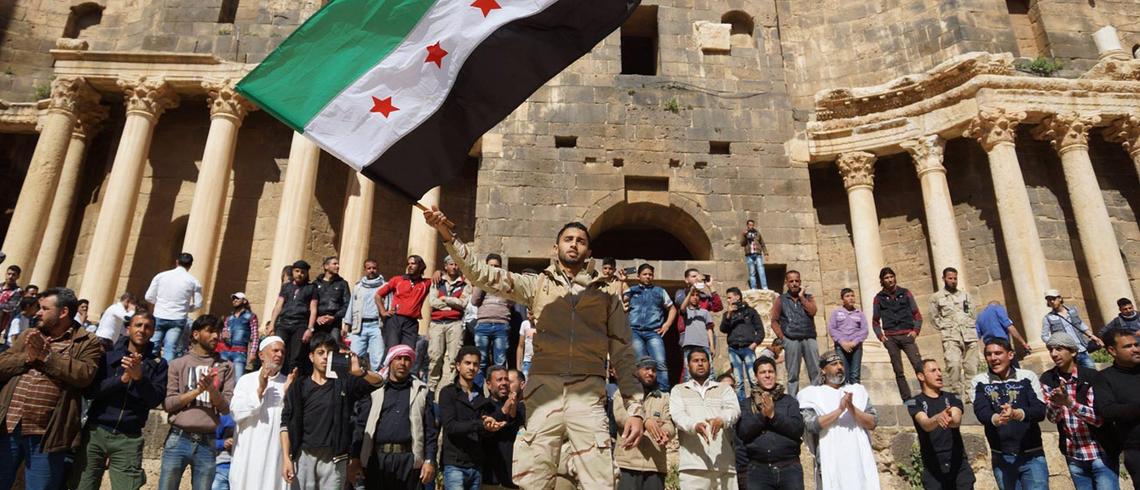
 'Hundreds of Syrians took to the streets of Idlib city on Tuesday to commemorate the second anniversary of the death of Abdel Basset Sarout, a famous goalkeeper from the city of Homs who became an icon of the uprising which broke out against President Bashar al-Assad's authoritarian rule in 2011.


 Residents and displaced people in Idlib city, which gives it name to the surrounding province in northwestern Syria, gathered at the steps of the city's public park.

 They raised banners praising Sarout and promised to uphold the principles of the Syrian uprising, which started after similar revolutions in other Arab countries and called for freedom, dignity, and democracy after decades of authoritarian rule in Syria.


 "Today we remember the goalkeeper of the revolution who was its singer and symbol and who defended it with all dedication and faith, during its peaceful campaign and its armed struggle," said Ibrahim Abboud, a Syrian activist.

 In the early days of the Syrian uprising in 2011, Sarout sang at peaceful protests calling for freedom and the removal of Assad's régime. He became known among protesters as "the guardian of freedom" – in reference to his career as a goalkeeper.

 Following the brutal suppression of the protests by the Assad régime, Sarout took up arms along with thousands of other Syrians.


 He later starred in the 2013 documentary "Return to Homs" which chronicled his activism and the siege and destruction of large swathes of the central Syrian city by the régime.

 After Homs fell to régime forces in 2014, Sarout and other fighters were evacuated to Idlib province, which is currently the last area of Syria held by anti-Assad rebels.

 He was killed on June 8 2019 in Idlib while fighting with the Jaysh al-Izza rebel group against régime forces who were engaged in a long-running assault on the area, at the age of 27.

 Suheil Hammoud, a rebel fighter, said that the anniversary of Sarout’s death would "live on for ever as the anniversary of the loss of an icon of the Syrian revolution".'

Wednesday, 2 June 2021

Syria’s elections serve another purpose


 Elizabeth Tsurkov:

 'Bashar al-Assad and his wife cast their ballots in the May 26 presidential election in the town of Douma, a suburb of the capital city of Damascus. The location was not coincidental — Assad’s forces lost control of Douma in 2012 and regained it only after years of bombings, a starvation siege and the deployment of chemical weapons in April 2018 finally subdued the city.

 Voting in Douma sent a specific message to Syrians — one of reconquest and domination. The régime made no attempt to present the election as free and fair, further stressing its ability to lie and force others to parrot the lie. Régime loyalists documented themselves voting multiple times, and the régime’s official results show more voters for Assad than the number of residents in régime-held areas.

 In an authoritarian régime like Syria’s, when the falsification of the results takes place out in the open, elections project the régime’s ability to compel compliance. Elections serve the interests of the régime, signaling to opponents that resistance is futile, encouraging its loyalists and creating a sense that the régime enjoys greater support than it actually does.


 The Syrian lira lost 57 percent of its value in one year, prices of basic goods increased by 313 percent and Syrians faced crippling shortages of subsidized goods such as bread and fuel. This collapse in living standards further narrowed the régime’s support base. Many Syrians who once saw the régime as an anchor of stability now see the crushing poverty and growing predation of those close to the régime.

 This crisis probably prompted the régime to invest much greater efforts to mobilize voters and attendees of pro-régime rallies this time compared with the two previous elections held since the Syrian crisis began. In all of these elections, government employees and students were compelled to vote at the threat of being fired or dismissed from university.

 Government coercion has now expanded into uncharted territory. In Damascus, Aleppo and Hama indicate that the secret police forced shop owners to print and hang pro-Assad posters by threatening to seal their shops with wax. Citizens are forced to donate to the printing costs of such posters, too.

 The secret police warned residents of formerly rebel-held areas in northern Homs and Qalamoun that they may be arrested if they do not vote. Residents said the régime also has made voting a condition for distribution of subsidized bread in Homs — as well as World Food Program aid baskets to the poor in the southern districts of Damascus and the displaced in the city of Aleppo.


 What do the streets filled with Assad’s posters and long lines at polling places — along with the predetermined outcome — set out to achieve? This display of strength conveys different messages to different audiences. To Assad’s diminishing base, the display of strength is reassuring, demonstrating to them that they are backing the side that has power.

 Participants often share images of rallies and cheer on the Assad régime using pro-régime Facebook groups, for instance. This signaling is particularly needed now amid the government’s inability to provide even the most basic of services.

 For the wider Syrian public, these displays of voter support also instill the belief that anti-régime mobilization is pointless, by conveying two messages: that the régime is more popular than it actually is; and in addition, or alternatively, that the régime may be unpopular and unable to change the beliefs of the population but, through its dominance, is able to create a norm of compliance among Syrians.

 For those not supportive of the régime, elections create a sense of pluralistic ignorance, a phenomenon when individuals comply with a norm but privately reject it, while assuming that others’ compliance is reflective of their private attitudes. This type of obedience despite one’s personal preference is widespread in authoritarian countries. Political scientists call this “preference falsification” — this type of coercion of citizens creates a sense that the régime is more popular than it actually is, to make revolutions appear impossible.


 Interviews with the politically dominant Alawi sect indicate that while many privately profess opposition to the régime, they are perceived by outsiders, and also members of the sect itself, to be loyal to Assad.

 Election-related displays of loyalty also target Syrians who realize that the régime is unpopular. The goal is to exact public submission, reinforcing within régime opponents the understanding that the societal norm is obedience — and that mobilization against the régime is therefore futile. These efforts don’t appear to attempt to change the beliefs of Syrians taking part in elections or public activities that profess loyalty to Assad. Organizers notify participants that attendance is mandatory, and at times even admit privately that they themselves don’t want to attend but reinforce that all have to do so. Instead, in line with the findings of political psychologists, these displays of faux loyalty aim to inculcate beliefs about norms: People comply because the prevalent norm is fearful obedience to an all-powerful régime.

 The message of obedience is useful in discouraging possible opposition, by repeatedly proving to Syrians that almost everyone is willing to participate in government-sponsored propaganda. Thus, the Assad régime signals to its supporters that they are not alone, raising their morale. To potential opponents, the régime proves that society is obeying, forcing even those who think of not complying to participate in the charade — or at least avoid mobilizing against the régime. For Syrians, it creates an atmosphere of “sustained surrender” of the population to the dictatorship — a clear message of social control.'

Monday, 24 May 2021

US sanctions regimen against Assad régime is working


 'The refrain from foreign policy cynics and progressives on the ongoing conflict in Syria, which is now in its eleventh year, generally sounds the same: “the conflict in Syria is over,” “there is no US interest there any longer,” “Bashar al-Assad and his patrons have won the war.”

 The complexity of the conflict, Assad’s sordid history alongside that of his patrons Russia and Iran, and the bevy of state and non-state actors vying for political and military terrain make simple maxims hard to come by for Syria in 2021.

 Similarly, the subtle nuance and careful study required to recognize advances toward resolution and accountability for myriad war crimes make it easy for observers to shrug their shoulders and to quickly—and conveniently—forget Assad’s barbarism since 2011. Conflict of this magnitude is exhausting. Accountability and political resolution are even harder. It seems not everyone has the stomach for the latter.

 One maxim, though, holds true: the United States’ targeted and tailored sanctions regimen against Assad and other malign actors in Syria is accomplishing its stated objectives. These designations not only give the US and its allies leverage toward a political resolution to the conflict, but so too do said designations hold together a de facto nationwide ceasefire throughout Syria.


 When President Donald Trump announced a military drawdown in Syria in 2019 following the defeat of the Islamic State of Iraq and al-Sham (ISIS), some expressed surprise and, curiously, blissful oblivion to his campaign promises to do just that. Whether the Joe Biden administration plans to follow through with that drawdown remains to be seen. President Biden’s Afghanistan withdrawal decision, though, signals limited interest in protracted military engagements. With the fall of ISIS accomplished, Biden will likely confront near-term decisions on a continued military footprint in Syria—a military mission that was and is about ISIS, not Assad.

 The problem emerges when conflating a military drawdown with the suggestion that the US has no interests in Syria or, worse yet, suggesting that the US is without resources to affect change—particularly political resolution, save military action. Such a notion naively overlooks military power as the final foreign policy resource and similarly disregards the devastatingly sharp power of the US financial system and exclusion from it under a targeted, tailored sanctions program.

 Enter the combination of sanctions designation authorities that the US has employed to date to limit Assad’s military advance; to deny his benefactors the spoils of a war with innumerable humanitarian atrocities; to hold accountable those responsible for said atrocities; and to compel political resolution through economic isolation of the Assad régime.

 The premise remains simple and transparent. Just as with other adversarial, malign actors, the US administers and enforces sanctions based on US foreign policy and national security goals against state and non-state actors alike. By excluding those targeted from the US financial system, sanctions designations create trade, financial, commercial, and currency havoc for those countries, entities, and their partners.

 The stated objectives of targeting the murderous Assad régime with US sanctions are also clear: to compel political resolution to the conflict through diplomatic and economic isolation of Assad toward a new Syrian constitution and free and fair democratic elections for the Syrian people. Additionally, they seek to hold Assad and his supporters accountable for the unthinkable war crimes committed throughout the conflict.


 To this end, the US has employed a series of sanctions authorities, including the 2017 Countering America’s Adversaries Through Sanctions Act (CAATSA) and its related authorities, Executive Order (EO) 13894 from October 14, 2019, and the 2019 Caesar Syria Civilian Protection Act (Caesar Act) against the Assad régime and its patrons.

 The reach of CAATSA allows the US to designate countries or individuals providing arms transfers to Syria—e.g. Iran and Russia—self-evident of continued, non-kinetic US national security levers and interests in Syria. While the passage of CAATSA became marred with suggestions of legislative overreach into the executive realm, CAATSA and its related authorities have provided the US opportunities to designate foreign entities in support of the Assad égime, including Rosoboroneksport, a state-owned Russian weapons trading company, its subsidiary Russian Financial Corporation Bank, and Russia’s National Security Advisor Nikolai Patrushev.

 In October 2019, the Trump administration issued EO 13894. An oft-overlooked provision of EO 13894, remains perhaps its most powerful: Section 2 of the order provides sanctions designation authority against those responsible for obstruction, disruption, or prevention of a ceasefire in northern Syria.

 Each renewal of the Idlib ceasefire further evinces 13894’s role in preserving the peace. Even the cynics cannot suggest that stymying Iranian and Russian military advances via sanctions-enforced ceasefires are not in the interest of the US or our allies.

 Finally, the Caesar Act goes right to the core of atrocity accountability for Assad and his régime. The enormous bipartisan support for Caesar has provided the US both specific and general deterrence to international actors supporting the barbarity of the Assad régime. The Caesar Act accomplishes two clear objectives: accountability for the régime’s atrocities and economic isolation of Assad to compel his participation in political resolution to the conflict.


 By the end of the Trump administration, the US had sanctioned 114 individuals and entities under the Caesar Act. In doing so, the US issued very specific and significant penalties to Assad’s patrons, including his inner circle, while establishing a very specific deterrent to individuals or entities mulling such support.

 More importantly, whether those sanctioned under the Caesar Act’s authority will ever face criminal consequences is irrelevant in review of its ability to help compel political resolution and hold accountable Assad’s enablers. The focus of Caesar has always been to preclude Assad’s furtherance of conflict and accountability for his enablers, not domestic or international civil or criminal liability for those targeted under the Act’s authority.

 Some well-intentioned Syria watchers and, separately, Assad backers, suggest that the Caesar Act’s enforcement harms the people of Syria. This argument fails on two counts: the designations targets under this authority are carefully tailored to those providing illicit financial support to bolster Assad and, to suggest that the designations, which help bolster the political voice of the oppressed Syrian people against Assad, instead harms Syrians relies on a woefully circular rationale. Simply put, it is Assad who has perpetrated barbarity against his people—the Caesar Act is one such mechanism to end the tyranny.

 Were those perpetuating the more-harm-than-good Caesar Act fallacy truly focused on the humanitarian plight of the long-suffering Syrian people, they might point to Assad and Russia’s efforts to block humanitarian access renewal at the United Nations. Or they would look at the régime’s efforts to complicate other international aid and assistance organizations’ access to Syria.

 To posit, though, that any sanctions designation against adversarial actors around the world had not a single unintended trickle-down consequence would be irresponsible. Nevertheless, Caesar’s tailored and targeted approach seeks to swiftly curtail support on a macro level to the ultimate cause of Syrian’s plight: the Assad régime. Non-kinetic solutions to geopolitical strife will require risk-reward evaluation in perpetuity. The Caesar Act analysis should continue to tip in favor of targeting the twenty-first century’s most villainous despot and political resolution to the conflict he begat.


 With that in mind, the US maintains an interest in Syria beyond the defeat of ISIS and can flex the might of the most powerful economy in the world in lieu of military action toward a de facto ceasefire—often with even greater efficacy. Additionally, the US has every interest in political resolution to the Syrian conflict, in ensuring a free and fair election to the people of Syria, and in curtailing adversaries’ advancement in Syria to the detriment of the US and our allies. Perhaps, most importantly, the US maintains an interest in ensuring accountability for the Assad régime and its enablers for the atrocious deaths of over five hundred thousand Syrians since the inception of the conflict in 2011.

 Political resolution and accountability take work. Sanctions authorities and enforcement are the best levers available to further US national security interests.'