Thursday, 10 June 2021

Hundreds in Idlib commemorate Abdel Basset Sarout


 'Hundreds of Syrians took to the streets of Idlib city on Tuesday to commemorate the second anniversary of the death of Abdel Basset Sarout, a famous goalkeeper from the city of Homs who became an icon of the uprising which broke out against President Bashar al-Assad's authoritarian rule in 2011.


 Residents and displaced people in Idlib city, which gives it name to the surrounding province in northwestern Syria, gathered at the steps of the city's public park.

 They raised banners praising Sarout and promised to uphold the principles of the Syrian uprising, which started after similar revolutions in other Arab countries and called for freedom, dignity, and democracy after decades of authoritarian rule in Syria.


 "Today we remember the goalkeeper of the revolution who was its singer and symbol and who defended it with all dedication and faith, during its peaceful campaign and its armed struggle," said Ibrahim Abboud, a Syrian activist.

 In the early days of the Syrian uprising in 2011, Sarout sang at peaceful protests calling for freedom and the removal of Assad's régime. He became known among protesters as "the guardian of freedom" – in reference to his career as a goalkeeper.

 Following the brutal suppression of the protests by the Assad régime, Sarout took up arms along with thousands of other Syrians.


 He later starred in the 2013 documentary "Return to Homs" which chronicled his activism and the siege and destruction of large swathes of the central Syrian city by the régime.

 After Homs fell to régime forces in 2014, Sarout and other fighters were evacuated to Idlib province, which is currently the last area of Syria held by anti-Assad rebels.

 He was killed on June 8 2019 in Idlib while fighting with the Jaysh al-Izza rebel group against régime forces who were engaged in a long-running assault on the area, at the age of 27.

 Suheil Hammoud, a rebel fighter, said that the anniversary of Sarout’s death would "live on for ever as the anniversary of the loss of an icon of the Syrian revolution".'

Wednesday, 2 June 2021

Syria’s elections serve another purpose


 Elizabeth Tsurkov:

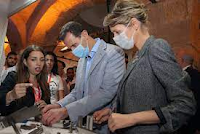
 'Bashar al-Assad and his wife cast their ballots in the May 26 presidential election in the town of Douma, a suburb of the capital city of Damascus. The location was not coincidental — Assad’s forces lost control of Douma in 2012 and regained it only after years of bombings, a starvation siege and the deployment of chemical weapons in April 2018 finally subdued the city.

 Voting in Douma sent a specific message to Syrians — one of reconquest and domination. The régime made no attempt to present the election as free and fair, further stressing its ability to lie and force others to parrot the lie. Régime loyalists documented themselves voting multiple times, and the régime’s official results show more voters for Assad than the number of residents in régime-held areas.

 In an authoritarian régime like Syria’s, when the falsification of the results takes place out in the open, elections project the régime’s ability to compel compliance. Elections serve the interests of the régime, signaling to opponents that resistance is futile, encouraging its loyalists and creating a sense that the régime enjoys greater support than it actually does.


 The Syrian lira lost 57 percent of its value in one year, prices of basic goods increased by 313 percent and Syrians faced crippling shortages of subsidized goods such as bread and fuel. This collapse in living standards further narrowed the régime’s support base. Many Syrians who once saw the régime as an anchor of stability now see the crushing poverty and growing predation of those close to the régime.

 This crisis probably prompted the régime to invest much greater efforts to mobilize voters and attendees of pro-régime rallies this time compared with the two previous elections held since the Syrian crisis began. In all of these elections, government employees and students were compelled to vote at the threat of being fired or dismissed from university.

 Government coercion has now expanded into uncharted territory. In Damascus, Aleppo and Hama indicate that the secret police forced shop owners to print and hang pro-Assad posters by threatening to seal their shops with wax. Citizens are forced to donate to the printing costs of such posters, too.

 The secret police warned residents of formerly rebel-held areas in northern Homs and Qalamoun that they may be arrested if they do not vote. Residents said the régime also has made voting a condition for distribution of subsidized bread in Homs — as well as World Food Program aid baskets to the poor in the southern districts of Damascus and the displaced in the city of Aleppo.


 What do the streets filled with Assad’s posters and long lines at polling places — along with the predetermined outcome — set out to achieve? This display of strength conveys different messages to different audiences. To Assad’s diminishing base, the display of strength is reassuring, demonstrating to them that they are backing the side that has power.

 Participants often share images of rallies and cheer on the Assad régime using pro-régime Facebook groups, for instance. This signaling is particularly needed now amid the government’s inability to provide even the most basic of services.

 For the wider Syrian public, these displays of voter support also instill the belief that anti-régime mobilization is pointless, by conveying two messages: that the régime is more popular than it actually is; and in addition, or alternatively, that the régime may be unpopular and unable to change the beliefs of the population but, through its dominance, is able to create a norm of compliance among Syrians.

 For those not supportive of the régime, elections create a sense of pluralistic ignorance, a phenomenon when individuals comply with a norm but privately reject it, while assuming that others’ compliance is reflective of their private attitudes. This type of obedience despite one’s personal preference is widespread in authoritarian countries. Political scientists call this “preference falsification” — this type of coercion of citizens creates a sense that the régime is more popular than it actually is, to make revolutions appear impossible.


 Interviews with the politically dominant Alawi sect indicate that while many privately profess opposition to the régime, they are perceived by outsiders, and also members of the sect itself, to be loyal to Assad.

 Election-related displays of loyalty also target Syrians who realize that the régime is unpopular. The goal is to exact public submission, reinforcing within régime opponents the understanding that the societal norm is obedience — and that mobilization against the régime is therefore futile. These efforts don’t appear to attempt to change the beliefs of Syrians taking part in elections or public activities that profess loyalty to Assad. Organizers notify participants that attendance is mandatory, and at times even admit privately that they themselves don’t want to attend but reinforce that all have to do so. Instead, in line with the findings of political psychologists, these displays of faux loyalty aim to inculcate beliefs about norms: People comply because the prevalent norm is fearful obedience to an all-powerful régime.

 The message of obedience is useful in discouraging possible opposition, by repeatedly proving to Syrians that almost everyone is willing to participate in government-sponsored propaganda. Thus, the Assad régime signals to its supporters that they are not alone, raising their morale. To potential opponents, the régime proves that society is obeying, forcing even those who think of not complying to participate in the charade — or at least avoid mobilizing against the régime. For Syrians, it creates an atmosphere of “sustained surrender” of the population to the dictatorship — a clear message of social control.'

Monday, 24 May 2021

US sanctions regimen against Assad régime is working


 'The refrain from foreign policy cynics and progressives on the ongoing conflict in Syria, which is now in its eleventh year, generally sounds the same: “the conflict in Syria is over,” “there is no US interest there any longer,” “Bashar al-Assad and his patrons have won the war.”

 The complexity of the conflict, Assad’s sordid history alongside that of his patrons Russia and Iran, and the bevy of state and non-state actors vying for political and military terrain make simple maxims hard to come by for Syria in 2021.

 Similarly, the subtle nuance and careful study required to recognize advances toward resolution and accountability for myriad war crimes make it easy for observers to shrug their shoulders and to quickly—and conveniently—forget Assad’s barbarism since 2011. Conflict of this magnitude is exhausting. Accountability and political resolution are even harder. It seems not everyone has the stomach for the latter.

 One maxim, though, holds true: the United States’ targeted and tailored sanctions regimen against Assad and other malign actors in Syria is accomplishing its stated objectives. These designations not only give the US and its allies leverage toward a political resolution to the conflict, but so too do said designations hold together a de facto nationwide ceasefire throughout Syria.


 When President Donald Trump announced a military drawdown in Syria in 2019 following the defeat of the Islamic State of Iraq and al-Sham (ISIS), some expressed surprise and, curiously, blissful oblivion to his campaign promises to do just that. Whether the Joe Biden administration plans to follow through with that drawdown remains to be seen. President Biden’s Afghanistan withdrawal decision, though, signals limited interest in protracted military engagements. With the fall of ISIS accomplished, Biden will likely confront near-term decisions on a continued military footprint in Syria—a military mission that was and is about ISIS, not Assad.

 The problem emerges when conflating a military drawdown with the suggestion that the US has no interests in Syria or, worse yet, suggesting that the US is without resources to affect change—particularly political resolution, save military action. Such a notion naively overlooks military power as the final foreign policy resource and similarly disregards the devastatingly sharp power of the US financial system and exclusion from it under a targeted, tailored sanctions program.

 Enter the combination of sanctions designation authorities that the US has employed to date to limit Assad’s military advance; to deny his benefactors the spoils of a war with innumerable humanitarian atrocities; to hold accountable those responsible for said atrocities; and to compel political resolution through economic isolation of the Assad régime.

 The premise remains simple and transparent. Just as with other adversarial, malign actors, the US administers and enforces sanctions based on US foreign policy and national security goals against state and non-state actors alike. By excluding those targeted from the US financial system, sanctions designations create trade, financial, commercial, and currency havoc for those countries, entities, and their partners.

 The stated objectives of targeting the murderous Assad régime with US sanctions are also clear: to compel political resolution to the conflict through diplomatic and economic isolation of Assad toward a new Syrian constitution and free and fair democratic elections for the Syrian people. Additionally, they seek to hold Assad and his supporters accountable for the unthinkable war crimes committed throughout the conflict.


 To this end, the US has employed a series of sanctions authorities, including the 2017 Countering America’s Adversaries Through Sanctions Act (CAATSA) and its related authorities, Executive Order (EO) 13894 from October 14, 2019, and the 2019 Caesar Syria Civilian Protection Act (Caesar Act) against the Assad régime and its patrons.

 The reach of CAATSA allows the US to designate countries or individuals providing arms transfers to Syria—e.g. Iran and Russia—self-evident of continued, non-kinetic US national security levers and interests in Syria. While the passage of CAATSA became marred with suggestions of legislative overreach into the executive realm, CAATSA and its related authorities have provided the US opportunities to designate foreign entities in support of the Assad égime, including Rosoboroneksport, a state-owned Russian weapons trading company, its subsidiary Russian Financial Corporation Bank, and Russia’s National Security Advisor Nikolai Patrushev.

 In October 2019, the Trump administration issued EO 13894. An oft-overlooked provision of EO 13894, remains perhaps its most powerful: Section 2 of the order provides sanctions designation authority against those responsible for obstruction, disruption, or prevention of a ceasefire in northern Syria.

 Each renewal of the Idlib ceasefire further evinces 13894’s role in preserving the peace. Even the cynics cannot suggest that stymying Iranian and Russian military advances via sanctions-enforced ceasefires are not in the interest of the US or our allies.

 Finally, the Caesar Act goes right to the core of atrocity accountability for Assad and his régime. The enormous bipartisan support for Caesar has provided the US both specific and general deterrence to international actors supporting the barbarity of the Assad régime. The Caesar Act accomplishes two clear objectives: accountability for the régime’s atrocities and economic isolation of Assad to compel his participation in political resolution to the conflict.


 By the end of the Trump administration, the US had sanctioned 114 individuals and entities under the Caesar Act. In doing so, the US issued very specific and significant penalties to Assad’s patrons, including his inner circle, while establishing a very specific deterrent to individuals or entities mulling such support.

 More importantly, whether those sanctioned under the Caesar Act’s authority will ever face criminal consequences is irrelevant in review of its ability to help compel political resolution and hold accountable Assad’s enablers. The focus of Caesar has always been to preclude Assad’s furtherance of conflict and accountability for his enablers, not domestic or international civil or criminal liability for those targeted under the Act’s authority.

 Some well-intentioned Syria watchers and, separately, Assad backers, suggest that the Caesar Act’s enforcement harms the people of Syria. This argument fails on two counts: the designations targets under this authority are carefully tailored to those providing illicit financial support to bolster Assad and, to suggest that the designations, which help bolster the political voice of the oppressed Syrian people against Assad, instead harms Syrians relies on a woefully circular rationale. Simply put, it is Assad who has perpetrated barbarity against his people—the Caesar Act is one such mechanism to end the tyranny.

 Were those perpetuating the more-harm-than-good Caesar Act fallacy truly focused on the humanitarian plight of the long-suffering Syrian people, they might point to Assad and Russia’s efforts to block humanitarian access renewal at the United Nations. Or they would look at the régime’s efforts to complicate other international aid and assistance organizations’ access to Syria.

 To posit, though, that any sanctions designation against adversarial actors around the world had not a single unintended trickle-down consequence would be irresponsible. Nevertheless, Caesar’s tailored and targeted approach seeks to swiftly curtail support on a macro level to the ultimate cause of Syrian’s plight: the Assad régime. Non-kinetic solutions to geopolitical strife will require risk-reward evaluation in perpetuity. The Caesar Act analysis should continue to tip in favor of targeting the twenty-first century’s most villainous despot and political resolution to the conflict he begat.


 With that in mind, the US maintains an interest in Syria beyond the defeat of ISIS and can flex the might of the most powerful economy in the world in lieu of military action toward a de facto ceasefire—often with even greater efficacy. Additionally, the US has every interest in political resolution to the Syrian conflict, in ensuring a free and fair election to the people of Syria, and in curtailing adversaries’ advancement in Syria to the detriment of the US and our allies. Perhaps, most importantly, the US maintains an interest in ensuring accountability for the Assad régime and its enablers for the atrocious deaths of over five hundred thousand Syrians since the inception of the conflict in 2011.

 Political resolution and accountability take work. Sanctions authorities and enforcement are the best levers available to further US national security interests.'

Sunday, 23 May 2021

Assad takes from Syrians, gives resources to Iran, Russia


 'Syria’s economic trouble is not caused by sanctions but due to the Bashar Assad régime using the country’s resources to attack its own people and giving resources over to its allies, namely Iran and Russia, Abdurrahman Mustafa, head of the Syrian Interim Government, stated.


 Mustafa said that the country has been struggling for 10 years both economically and in a humanitarian regard. He reiterated that the United Nations’ 2020 report stated 90% of the Syrian people are living below the hunger threshold.

 “Millions of people live in tents in difficult conditions at a time when unemployment has increased due to forceful displacements by régime forces and their allies,” he stated, stressing that Syria’s economy is worse than it has ever been, with the Syrian pound further losing value. The monthly income of a person has fallen to as low as $20. The reason for this awful situation is not economic sanctions as the régime and its allies claim. The real reason is that the régime uses the country’s resources to attack its own people, leaving the people hungry and in poverty while handing the resources over to the use of its allies Iran and Russia.” 


 Syria's war has devastated the country's economy since 2011, plunging around 90% of its people into poverty, according to the United Nations.

 Much of the economy in régime-held areas has been shuttered to prevent the spread of the coronavirus. The World Food Programme (WFP) last year said food prices had doubled in a year to an all-time high across Syria. Over that same period, people in régime-held areas have faced fuel crises, a plummeting Syrian pound on the black market and steep price hikes. Damascus has blamed Western sanctions for its struggling economy.

 Mustafa stated that bad administering and corruption in all levels of the government also contributed to Syria’s economic downturn.

 He once again criticized the international community for not acting and giving the Syrian people the necessary support while the régime rejects a political solution, threatening the region’s peace, stability and Syrians themselves.

 “From past experiences, it is known that the régime does not promise any cease-fire or agreement but carries out massacres whenever it has the possibility. The fact that there is no international deterrent causes the régime and its allies to conduct ever more crimes against the Syrian people. We got used to the régime bombing its own people as a means to put pressure on Turkey and the international community and to make its election theater accepted.”


 Mustafa said that the opposition knows the régime will not abide by any agreement, while the opposition on the other hand has been sticking to all agreements.

 He also thanked Turkey’s efforts to reach a cease-fire with Russia, “which had been bombing the Syrian people.”

 The Idlib de-escalation zone was forged under an agreement between Turkey and Russia. The area has been the subject of multiple cease-fire understandings, which have been frequently violated by the Assad régime and its allies.

 A fragile truce was brokered between Moscow and Ankara in March 2020 in response to months of fighting by the Russia-backed régime. Almost a million people have fled the Assad régime’s offensive. The régime still frequently carries out attacks on civilians, hindering most from returning to their homes and forcing them to stay in makeshift camps.


 The elections, which the Assad régime set for May 26, will block the roads to a political solution for the Syrian conflict, Mustafa pointed out.

 Calling the elections nonsense, he highlighted that they have neither a political nor legal basis.

 “The régime lost its legitimacy in the eyes of the Syrian people and the international community long ago. The current elections are reimposed so that this dictator (Bashar Assad) and his allies can kill and displace its people without a moral deterrent.” '

‘The régime’s cruelty pushed people’


 'On Wednesday, Bashar. al-Assad will preside over a farce of an election, just as the Baath Party has every seven years since shortly after Hafez al-Assad took power in a 1970 coup d’état.

 In the aftermath, Mr. al-Assad will be declared the victor over his two hand-picked “rivals.” If history is any guide, the official figures will claim that more than 90 per cent of the country voted for Mr. al-Assad.

 For Mr. al-Assad and his loyalists, May 26 will mark a day of triumph. After 10 years of horrific war, their totalitarian system remains improbably intact, at least in the parts of the country under the régime’s control.


 Those who oppose the régime say Wednesday won’t mark the end of their struggle, which began 10 years ago when a group of teenagers in the southern city of Daraa spray-painted “it’s your turn doctor” on the wall of their school. It was a reference to the toppling of other dictators around the Middle East in a series of uprisings known as the Arab Spring. Zine El Abedine Ben Ali had been forced to flee Tunisia. Hosni Mubarak had been jailed in Egypt. Many Syrians believed then that Mr. al-Assad, an ophthalmologist by training, would be the next to fall.

 But the staged vote will provide a harsh reality check – a reminder of how much ground the rebels have lost since the heady days of 2013 and 2014 when change felt imminent. The process is seen as a signal to Syria’s opposition – and the international community – that Mr. al-Assad and his régime aren’t going anywhere.

 “The régime thinks that it can force the result of this election on us, and the international community will start to give up [on Syria],” said Hadi al-Bahra, who served in 2014 as the president of the Syrian National Council, an umbrella group representing a kaleidoscope of rebel groups and pro-democracy forces. Mr. al-Bahra was also a top opposition negotiator through several rounds of failed peace talks with representatives of the régime.

 The Syria that Mr. al-Assad presides over is a shattered country. Ten years of war have left more than 500,000 people dead or missing, and the ongoing violence has driven more than 12 million others – more than half the country’s prewar population – from their homes. The economy is a broken mess, needing tens of billions of dollars in investment just to return it to its prewar state, when it was already one of the poorest countries in the region.

 It’s also a country that the régime, which is backed by Russia and Iran, can only claim to govern parts of. Russia’s military intervention, which began in 2015, helped save Mr. al-Assad’s forces from defeat and aided their recapture of key cities such as Aleppo, Homs and Daraa. But the east of the country is run by the Kurdish forces allied to the U.S., while the northwest province of Idlib and much of the border zone remain are controlled by rebel groups with Turkish military posts protecting them inside Syrian territory.

 “Anybody who can claim victory in Syria should be put into a mental institution,” Mr. al-Bahra said in a telephone interview. 


 Oussama Chourbagi briefly lived in a free Syria, or a corner of it. In the first three years of the conflict, the activist – who was trained as a pharmacist in France but returned to his country at the outset of the uprising – was part of the local council in Daraya. The Damascus suburb was one of the first areas to escape Mr. al-Assad’s grasp. Unlike other parts of Syria, where the once-peaceful uprising quickly turned to violence as the régime kept shooting at its opponents, Daraya placed its armed groups under civilian control.

 “We wanted to create a small example to us and to the international community that we can manage and we can control our area, because the [narrative] of the régime was, ‘if we don’t want Bashar al-Assad, you will have Islamist groups, it will be a mess, you will have chaos.’ I can say that we reached 80 per cent of our goal in Daraya … any decisions taken were taken by the majority,” Mr. Chourbagi said in an interview in Slough, a town on the outskirts of London with a large population of refugees from Syria and other conflicts.

 By the start of 2014, the opposition felt so strong in its negotiating position that it arrived at United Nations-brokered peace talks in Geneva with a proposal to create an interim government – an offer that made no mention at all of Mr. al-Assad. He and his régime were finished, they believed.

 Mr. al-Bahra, who led the opposition delegation, says all that was lacking was a unified message from the international community telling Mr. al-Assad that it was time to go. But relations between Russia and the West were plunging in early 2014 over a separate crisis in Ukraine. Moscow broke with U.S. Secretary of State John Kerry’s call in Geneva for Mr. al-Assad to resign. Instead, the Kremlin threw its full weight behind the Syrian régime.


 “The régime’s cruelty pushed people. They wanted to defend themselves,” says Mr. Chourbagi, who remains a committed pacifist, despite being arrested and tortured for three months early in the uprising. “When the revolution transformed from pacifism to military – for me that was the beginning of the end.”

 Even before the rise of the Islamic State, U.S. President Barack Obama had made clear that his support for the Syrian rebellion had limits. He warned Mr. al-Assad in 2012 not to cross the “red line” of using banned chemical weapons in the war, but did nothing when the régime’s army used sarin gas on the Damascus suburb of Ghouta in August, 2013. It would be the first of many proved uses of chemical weapons, and the beginning of the end of U.S. influence over the outcome.

 Into the vacuum stepped Russian President Vladimir Putin, who in September, 2015, caught the world off-guard by deploying his military to bolster Mr. al-Assad’s régime and protect the Soviet-era naval base in the port of Lattakia. Russian air strikes quickly turned the tide of the war, forcing the anti-Assad rebels to retreat to the corners that they still control today.

 The political opposition, once unified around the goal of fighting the régime, began to fall apart. The Islamic State caliphate drew adherents from Sunni Muslim youth who came to see the struggle for Syria in sectarian terms (the al-Assad family are adherents of a strain of Shia Islam, and the régime has been supported throughout the war by fighters from Iran, the region’s main Shia power).

 There were also the separate tensions between Turkey, which cheered on the Arab Spring revolts (and the form of political Islam they swept into office in Egypt and Tunisia), and Saudi Arabia, which feared and opposed the democratic tide. In Egypt, the Muslim Brotherhood government elected in 2011 was deposed in a military coup supported by Saudi Arabia. The regional rivalry created a rift inside the Syrian National Council as well, strengthening the Russian narrative that Syria’s only choice was between Mr. al-Assad and anarchy.

 Bahia Mardini, a Syrian Kurdish journalist who attended the Geneva peace talks in 2014, says foreign powers played the various Syrian factions “as if we were cards.” But she also blames the opposition, which started fighting amongst itself before they had achieved their shared aim of deposing Mr. al-Assad.

 “They were in a hurry to take power,” she said. “They believed change was coming, so they tried to destroy each other.”


 On Wednesday, or shortly thereafter, Mr. al-Assad will declare a sweeping victory over his two token opponents – Abdullah Salloum Abdullah, a former deputy cabinet minister whose own Socialists Unionists Party supports Mr. al-Assad, and Mahmoud Ahmed Marei, who claims to represent the opposition to Mr. al-Assad but who is derided by those still fighting the régime.

 The only real question is whether the level of official support will be allowed to dip slightly, as it did in 2014, when Mr. al-Assad won “just” 92.2 per cent of the votes in what was seen as muted acknowledgement that the régime was in the middle of a war that wasn’t going very well. It was the only time he or his father gained less than 99 per cent.

 Mr. al-Assad’s campaign slogan translates awkwardly as “Hope to Work.” Slick social-media accounts show the eye-doctor-turned-dictator, dressed in a blazer and no tie, speaking to a group of construction workers. “Working in war conditions, as well as being an honour and morality, becomes a defence of the homeland,” Mr. al-Assad was quoted as saying. (Mr. al-Assad’s campaign page had slightly more than 1,500 followers on Twitter before it was “temporarily restricted” on Tuesday, and more than 147,000 on Facebook, which had taken no action as of Thursday.)

 Another photo shows Mr. al-Assad looking at military maps. In a third, he’s holding a sapling. There’s no mention on any of the accounts regarding if or how he intends to unite his shattered state.

 “After all this blood and this revolution and the people refusing the régime – saying we don’t want Assad, we don’t want the mukhabarat [secret police], we want democracy – they should make some changes. But they don’t change anything at all. It’s still about the Baath Party, even though I don’t think even they read the Baath Party texts. They just want authority and power,” Ms. Mardini said.


 Mr. Chourbagi, the pharmacist-turned-activist said he, like most Syrians outside régime-controlled areas of the country, will ignore Wednesday’s election, and the result. Instead, he and the Afaq Academy, the non-governmental organization he founded in 2012, will focus on trying to explain the concept of democracy to Syrians who have no experience with ideas like voting, paying taxes in exchange for receiving services, or equality before the law. Afaq’s focus, for now, is an educational campaign aimed at the 55 per cent of Syrians who now live either in rebel-held areas of the country or in exile.

 “The struggle for Syria isn’t between the opposition and the régime. It’s between the people and the culture of dictatorship,” Mr. Chourbagi said. But he acknowledges that the real election he’s trying to prepare for isn’t happening any time soon. “I still have hope, but for the long term.” '

Saturday, 22 May 2021

Thousands of Syrians protest Assad regime election

 'Thousands of people across Syria on Friday protested against the upcoming presidential election under the Assad régime.

 Demonstrators gathered in al-Bab, Azaz and Idlib-all in northern Syria, areas outside Assad régime control-to oppose the so-called elections set to be held next week in the war-ravaged country.

 Demonstrators held banners saying "Boycott the child killer's elections," "Assad has no legitimacy," and "Régime election illegal."

 "The election violates UN resolutions. Bashar al-Assad committed massacres all over Syria," said Ridvan Atras, a demonstrator in Idlib.


 Rashid Hamdavi, another protester, said they oppose both the regime and the sham election.

 "The Syrian revolution will continue until the Assad régime is toppled," Hamdavi said.

 The régime's presidential election is set for May 26.

 Assad has been the victor in every election since he took power in 2000 as heir to his father, Hafez al-Assad.

 The decision to hold elections was made despite the ongoing military conflict, lack of any political solution in sight, failure of negotiations between the opposition and the regime, and the displacement of more than 10 million Syrians either as refugees or internally displaced persons.

 Moreover, about 40% of the country is not under régime control.'

Wednesday, 19 May 2021

They've Faced 10 Years of Bombs and Bullets


 'Mohammad Walid Jabas has been protesting for a decade. Back in March 2011, Jabas was one of the thousands of young people who took to the streets of Syria to demand the end of President Bashar al-Assad’s régime.


 For his trouble, in 2012, 80 percent of Jabas’ body was burned when he was struck by shelling from Syrian forces as he filmed clashes between government troops and opposition militants in the northwest. It took months of medical attention and rehabilitation in neighbouring Turkey for him to recover.

 Today, aged 30, he is back in his hometown of Kafr Takharim, north of Idlib, where he runs a Local Coordination Committee (LCC), one of the dozens of informal networks of dissident groups in the country that are still pushing for the removal of Assad.

 “We believed we could break that wall of fear,” Jabas said. “We thought we were entitled to have a free, democratic state, and we really thought things were about to change.” He is continuing the fight, he said, in honour of the estimated 500,000 Syrians – including several relatives and close friends – who have died, and the millions injured or internally displaced.

 At his town’s LCC branch, Jabas plans protest events and instructs teams to come up with new slogans and banners. Public anti-régime demonstrations are held every Friday, mostly in the city of Idlib. The north-western governorate and its surroundings were among the first areas nationwide to take up arms against the régime in the Arab Spring.

 Today, Assad, with the backing of his Russian and Iranian allies, has retaken most of Syria. The city of Idlib – home to almost 3 million people, mostly civilians and thousands of jihadist fighters – is the last major stronghold controlled by forces opposed to the Damascus government. Although the régime remains a threat, the main danger today is posed by Russian planes carrying out aerial strikes.

 “More than once it’s happened that we had planned a protest, then we had to cancel it because of Russian fighter jets roaring around the skies,” Jabas said. “We’ve paid a very heavy price for joining the revolution, we endured huge losses, but we’re not ready to give up. If I’m still fighting, it’s to live a better life in my country, not to go anywhere.”


 Nour Hallak, 33, from Saraqib town, in the Idlib region, has vivid memories of the early anti-Assad demonstrations in 2011. At that time, he was in the capital Damascus actively helping to coordinate groups of protesters and organise rallies.

 “We imagined a free Syria, free from Assad and his gang,” Hallak said. “Now we have war but it won’t last forever, one day this country will see civil change. I am one of those Syrians who are waiting for this transformation.”

 A few months into the revolution, he got involved as a volunteer, distributing relief aid and working as an assistant to medical staff at field hospitals in the southwestern region of Ghouta.

 After government-aligned troops invaded eastern Ghouta and destroyed the dispensaries at the beginning of 2012, the then aid worker along with his team took the remaining medication to store the supplies in a safer place in Homs city. During the journey through Damascus, he was caught in an ambush and arrested by secret services while carrying medicines and was jailed for two years.

 Following his release in late 2013, Hallak moved to the north and worked in various NGOs on capacity-building of local councils and civil society organisations. He currently lives with his family in the Turkish-Syrian border town Antakya and works for an international humanitarian organisation in northern Aleppo.

 “Once I was freed from detention, my mother was pushing me to go far away from Syria and not come back,” Hallak recalled. “But after spending two years in prison, I couldn’t leave my country. I don’t want to surrender and go.”

 Hallak helps to organise ongoing protests in the northern region, connecting with LCCs in the cities of Idlib and Aleppo. His role includes scheduling meeting, drafting media statements, and running social media campaigns.

 “We’re mainly confined to demonstrations since there’s limited space to do political activity,” he added, before explaining that because the Idlib region is partially under the control of extremist group Hayat Tahrir al-Sham (HTS) and allied rebels, the residents are free to oppose the Syrian régime but cannot challenge HTS from within Idlib.

 Hallak still believes Assad will be pushed out someday by political means, noting that thousands of political activists who were forced to flee their homeland are waiting to return and regain their rights when the time comes. “Those like myself who started the revolution understand the importance of continuing it,” Hallak said. “We will carry the flame of the revolution forever.”


 Journalist Fareed Mahlool was only a teenager when the civil war started. Mahlool – who grew up in the town of Maaret Al Numan, in southern Idlib – was joining protests regularly after finishing work in an auto parts store.

 “We were full of optimism in those days,” Mahlool said. “I was picturing my country as a just and democratic one. I still hope to live in the future in a state that doesn’t imprison or oppress people.”

 In May 2019, shortly before he went out reporting, a rocket allegedly coming from government forces struck his house injuring his family members and killing his aunt in the attack. His family moved to a temporary home closer to the Turkish border.

 Now 26, Mahlool works as a freelance journalist and volunteers at an LCC documenting and sharing content on its social media channels. “We will continue the revolution until we achieve our demands,” Mahlool said.


 For 50-year-old Syrian artist Aziz Asmar, it was only a matter of time before he came back to his war-ravaged hometown Binnish, a few miles away from Idlib, after 20 years in Lebanon. Like many of his compatriots, he had left before the Syrian revolution began because he was struggling to find work in Syria.

 In Beirut, where he lived with his family, he was working at a publishing house when the uprising erupted. “Watching horrifying and terribly unjust things happening in Syria gave me so much pain,” the graphic artist remembered. “I wasn’t feeling okay about staying outside my country, I couldn’t do anything.”

 Growing afraid for his relatives’ safety as the bombing in Binnish intensified in July 2015, he moved back to his hometown at a time when thousands of Syrians were fleeing to find refuge abroad.

 Upon his return, he decided to participate in the struggle by recording the story of the Syrian uprising on the city’s war-torn walls. Street art soon became for Asmar a peaceful, though provocative, form of political expression, at a time when, he said, too often people perceive Idlib as a hotbed for jihadists only.


 Asmar paints across Idlib on the walls and ceilings of homes destroyed by airstrikes. “I want to send a message that behind each demolished wall there’s a human story,” he said.

 Asmar is regularly joined by groups of kids who help him with his artwork, while he often visits schools and orphanages to teach them how to paint. Among his work is a panoramic mural on the wall of a school in Idlib commemorated the 10-year-anniversary of the Syrian revolution. It illustrates the passage of the Syrian war, starting with an image of demonstrators calling for the downfall of the Assad régime.

 But Asmar’s work goes beyond focussing on the Syrian revolution to highlight injustices across the world. Last year, his painting on the ruins of a bombed-out building in Idlib depicting the face of George Floyd along with the message “No to Racism” and “I can’t breathe” went viral on social media.

 The graffiti artist has no regrets about moving back to Binnish, where he continues to live with his wife and three boys.

 “I use my artform here to lift people’s spirits and inspire them to stay,” he said. “My role is to help those around myself in my own way relieve their pain, so they won’t leave. My hope is that every Syrian gets their rights and freedom.” '

Wednesday, 5 May 2021

A Revolution Imprisoned by Assad


 Wafa Ali Mustafa:

 'My name is Wafa Ali Mustafa. I’m a Syrian journalist and activist from the city of Masyaf in western Syria. Thirty years ago my dad gave me the name of the news agency of the Palestinian Liberation Organization. With this, he marked me and shaped the entire identity I built afterwards.

 I went to my first protest with my dad at the age of ten. My dad started this journey that lasted for years that included traveling for hours every week to the capital of Damascus to participate in protests in support of different causes like solidarity with Palestine and Iraq. I still remember being at one of these protests in Damascus when I was fourteen. The régime’s forces attacked the protest. The image that is stuck in my mind is of when my father was beaten with a wooden stick and just told me to run. And I ran.

 My dad raised us, my two sisters and I, to be political, to ask questions, to always get involved, and to work very hard for our communities.


 In 2011, I was protesting in front of the Libyan embassy. Many people were there in solidarity with protesters in Libya, but we were also there for us and for Syria. People started chanting “a traitor kills his own people.” And then the security forces of the régime knew that we were there for Syria too. And so, they attacked the protest and arrested many people.

 On that day, the journey my dad began took a different turn when an officer of the Syrian intelligence slapped me and said, “You Palestinians shouldn’t be involved in internal Syrian affairs.” The reason for this slap was a necklace of a map of Palestine I had worn for ten years. After that I had to take it off.

 So when the revolution started in Syria, being a part of it wasn’t a question for me. It’s not as though I sat down and thought: “Shall I participate in this or not?” It was just a sense that it started, so I should be there. And I believe this was the case for many others.

 I was detained with my sister, my cousin, and two of my friends in September of 2011, when I was in the middle of my third year of university, studying journalism and media in Damascus. At the same time, my dad was arrested in another city, Hama.

 We were all released later. However, on the 2nd of July, 2013, my dad was forcibly disappeared by the Syrian régime again, this time in the city of Damascus. Today actually marks 2,829 days since he was taken from us. As in the case of many other Syrians, we haven’t seen him since, and we have never been told why he was taken from us or what he was charged with. Unfortunately, it is a bitter truth that the disappearance of my dad, Ali, is far from an isolated case. More than 131,000 people are still under arbitrary arrest or enforced disappearance by the Assad régime, according to the Syrian Network for Human Rights.


 The régime worked, and still works more than ever, to win—not just the military war but also the war over competing narratives. We’ve all seen how the story around Syria has slowly shifted. The discourses surrounding Syria now revolve around fear-mongering, presenting the narrative of the crisis both nationally and internationally as another “war on terrorism,” rather than a struggle for freedom.

 In light of this situation, many of us have been asking ourselves: How will the narrative of the revolution be remembered in the coming years? How will it be remembered by Syrians and also by the international community? How will the spirit of the revolution be kept present, in line with a history of peaceful uprisings?


 After ten years of the revolution and almost eight years of my dad’s enforced disappearance, I’ve realized why the régime—or any régime—uses detention and enforced disappearance against its own people: Because by detaining someone they not only silence and disappear those in prisons and detention centers, but they also break their loved ones, their families, and their communities.

 However, years ago I chose to resist this forgetfulness that the régime has imposed on me by disappearing my dad. I have chosen to resist it with my memory and thus contribute to shaping a counter-narrative to that of the régime and its supporters. I’ve been trying, on a daily basis, to tell the whole world what it means to wake up one day and realize you have lost your dad or a loved one. The high price that people, not just in Syria but in many other places too, are paying for only demanding basic human rights should not be normalized or denied.

 With many others we campaign for the freedom of our disappeared loved ones, in Assad’s and all other prisons in Syria, and for justice for Syria and Syrians. Everything I do today is to secure my dad’s freedom, so that one day we might have the chance to protest together again for a better Syria. There are many of us who still believe our hope is not an illusion and that change can happen. We all know freedom is difficult and slow, but it’s not impossible.'

Monday, 3 May 2021

Turkish-backed FSA soft power initiative includes libraries


 'The areas controlled by the Turkish-backed Free Syrian Army (FSA) in the countryside of Aleppo, in northwestern Syria, recently witnessed a remarkable cultural movement, manifested in the growing number of public libraries, initiatives and various cultural activities, such as book exhibitions, plastics art showcases, theatrical performances and other exhibitions for different age groups.

 On April 23, the Syrian Rebel Youth Association inaugurated its public library at the association’s headquarters in the city of Azaz, north of Aleppo. This move aims to encourage young men, women and students to be more interested in reading and scientific research. The opening of the library took place on the sidelines of the association’s regular meeting in Azaz. It defines itself as a civil nongovernmental organization (NGO) working to reactivate and revitalize the civil status to recover the spirit of the revolution.

 Mohammed Ibrahim, head of the Syrian Rebel Youth Association, said, “The main purpose of opening the library is to encourage the youth to read and research, and to provide a space for reading. We want books to have a place in the lives of Syrians because this would help create an educated and conscious generation that can overcome the difficult stage and build a modern Syria. The library is a forum for the exchange of ideas and opinions between young men and women; we believe it will contribute to spreading the culture of dialogue and accepting other people’s opinions.”

 He said, “The library currently includes 960 books on history, politics, science, civilization and archaeology, as well as some university research material and books on Arabic language and literature. The library also has a reading room that allows anyone to sit in it and read whatever they want. We are now discussing establishing a mechanism for lending books.”

 Speaking about where the books came from, Ibrahim explained, “The books were collected in cooperation with members and friends of the association. The books are entirely individual contributions since the Syrian Rebel Youth Association is financially independent and does not receive any support from internal or foreign bodies. Our expenses are covered by the monthly subscriptions of our members.”


 Bassam Rahim, deputy head of the Syrian Rebel Youth Association, said, “Building individual tools and skills for young people cannot only be achieved by reading and research. Young people need various cultural, political, social and literary activities, and others focused on beauty, creativity and art. This is what the association strives to implement by creating the appropriate environment for that through the various actions and activities that it will undertake during the coming period.”

 Rahim said, “The association was established on Oct. 10, 2016. We now have 200 members, most of whom are young men and women who support the Syrian cause and the goals and values of the revolution. The association has organized many cultural events in the presence of many influential opposition figures.”


 Mohammed Baqai, a researcher at NMA for Contemporary Research, an independent organization that provides specialized studies and consultations in the scientific field, based in the countryside of Aleppo, said, “There is a direct relationship between cultural activity and stability in opposition-held areas. As the index of stability and calm rises, cultural movement increases.”

 Speaking about the public libraries in opposition areas, Baqai said, “The library established by the Syrian Rebel Youth Association in Azaz is not the first. Many libraries have emerged over the past couple of years in major cities, such as al-Bab and Azaz. For example, NMA for Contemporary Research has a library full of books, the University of Aleppo affiliated with the opposition in Azaz has opened a library as well, and so has the International Sham University in the countryside of Azaz.

 Baqai added, “The cultural movement in the area is not limited to the libraries and encouraging the youth to read more; there is also a remarkable interest in theater, painting exhibitions, literary and poetry evenings. I believe that the cultural movement is heading in the right direction, but we hope that it will receive greater support from the authorities, such as the opposition’s interim government, for instance.”


 In late 2019, the University of Aleppo affiliated with the opposition announced the opening of the university library, which includes 7,000 books of various academic specializations, after a six-month funding campaign to secure the books. Besides, several school and university libraries were opened in the FSA-controlled areas with the support of the Turkish government.

 Abdul Aziz al-Daghim, president of the University of Aleppo, said, “The university contributes to cultural activities in the area, and backs efforts aimed at spreading public libraries to popularize the reading habit among Syrians. The university also supports [writing] books. For example, a month ago we held a book signing ceremony for author Walid al-Nayef, which was titled ‘Whiffs from Palmyra Prison.’”

 He noted, “I encourage students at the university to go to the university's library and expand their scientific and literary specializations.”

 Speaking about how the university secured the books for its library, Daghim said, “We contacted 10 study centers and universities in Turkey, Tunisia, Egypt and Qatar, and they donated a large number of books for the library, and many have promised to send more books soon.”


 On July 25, 2020, the Qeam Foundation, an independent educational NGO in the city of al-Bab in the countryside of Aleppo, announced the opening of Raqem Cultural Cafe, which has an extensive library and provides other services such as an internet connection for online research, quiet reading corners and rooms for discussions and cultural seminars.

 Mawia Shalar, manager of Raqem Cultural Cafe, said, “Raqem Cultural Cafe aims to increase cultural awareness by restoring people’s relationship with writers, and providing spaces for students, intellectuals and researchers. The cafe also provides a space for women to read, discuss and research. Our books cater to different tastes and suit all segments, as the library includes scientific, literary, Islamic and political books, novels and children's stories.”

 She added, “The cafe's turnout is excellent, especially among young people, particularly university students who want to gain more knowledge and benefit from books in their university research.”

 Speaking about the challenges the cafe faces, Shalar noted, “We had some issues in obtaining more books to enrich our library.” '

Friday, 30 April 2021

Syrians in régime-controlled areas turn to opposition

 'A growing economic crisis in the war-torn country and compulsory military service has led Syrians in areas controlled by the Bashar Assad régime to seek refuge with the opposition.

 Ali Tartusi, who fled the régime-controlled western Tartus province said that the economic crisis has reached a level where people cannot bear it anymore.

“The economic situation in the country is terrible. The people are struggling just to get a little bit of bread. The régime cannot find fuel for the people,” he said, adding that the régime also cannot pay the salaries of civil servants.

 “Most of the people live below the poverty line. Car owners wait in line at gas stations for 48 hours. The rich, on the other side, can get fuel through bribery. Poor families spend the winter trying to get warm under blankets,” Tartusi added.

 He called on the youth living under régime-controlled areas and said: “The future of the youth in the régime areas is lost because those who go to the military service cannot get their discharge papers. There are people serving in the military for 10 years.”


 Saying that this was one of the reasons why he sought refuge in an opposition-controlled area, Tartusi pointed out that he came to the northwestern Idlib province to save his future and complete his education.

 Idlib remains the last major opposition bastion yet is still frequently targeted by Russian-backed régime forces despite a March 2020 cease-fire struck between Ankara and Moscow.

 At least 75 attacks by the Bashar Assad régime and its allies have been recorded since the cease-fire, the Syrian Network for Human Rights said last month.

 Syria's war has devastated the country's economy since 2011, plunging 80% of its people into poverty, according to the United Nations.

 Much of the economy in régime-held areas shuttered to prevent the spread of the coronavirus. The World Food Programme (WFP) last year said food prices had doubled in a year to an all-time high across Syria. Over that same period, people in régime-held areas have faced fuel crises, a plummeting Syrian pound on the black market and steep price hikes. Damascus has blamed Western sanctions for its struggling economy.


 Another civilian that fled the régime, Habib Yazen, stated that the harbor and sea in Tartus is controlled by Russia, while Moscow also established several observation points and controls the country’s trade.

 “Russia is using everything in Syria for its own interests. No one can accept its country being sold to another,” Yazen said, complaining about the régime.

 “Electricity comes only two hours a day. No one receives enough bread. Products are expensive and continue to get more expensive." '

Monday, 26 April 2021

Assad’s Pyrrhic victory and the arrogance of power


 'In early 2011, even after massive social mobilisation had overthrown two longstanding strongmen in the space of a few weeks, Assad stated that those events had no relevance for Syria. He told the Wall Street Journal that "Syria was stable". Referring to what had happened in Tunisia and Egypt, the president remarked that his country was "outside of this".

 A few weeks later, Assad was facing an uprising of his own, revealing how out of touch with reality he had been. A decade on, it is still legitimate to ask why the Syrian dictator overlooked the harbingers of his own vulnerability. Three mechanisms explain this disconnect.


 The first was that the Assad family was myopic about the fact that excessive control reduced its exposure to the true workings of Syrian society, hindering its foresight. Politics is a dynamic process that involves expression, negotiation, and conflict. By 2011, the Assad régime had imposed a tight and elaborate system of control for over four decades, with tentacles throughout society.

 In having tightened its grip on power structures, security agencies, political parties, and public space, the régime had placed nearly all visible aspects of politics under its stringent authority.

 The problem with this is that the Assads failed to realise that by placing politics in a strait jacket, they pushed it into murkier recesses, so that political opinion and contestation shifted from party politics, parliamentary debates, and media outlets into private conversations and subtle forms of dissent. Small facts speak to large issues – "winks to epistemology or sheep raids to revolution". as the cultural anthropologist Clifford Geertz once wrote. Under the Assads, ellipses of speech, allegorical phrases, nods of desperation, exhalations of anger, or even silence, spoke volumes about what was rankling the population.

 From his palace overlooking Damascus, Bashar al-Assad saw a different picture. Silence implied loyalty, self-censorship consent. The uprising in March 2011 showed how deeply he had misread reality.


 A second mechanism also explains why Assad failed to grasp the mood in his country. Not only had Syrians concealed their true preferences in response to political pressures, they also feigned many of their reactions and support for the régime. Economist Timur Kuran has called this "preference falsification". Privately, this may mean faking a smile or compliment in a social gathering. Under authoritarian régimes, however, the practice is more consequential.

 It is telling that for both those who supported the Assads and their critics, fear was the Syrian régime’s trademark. While critics called it a "republic of fear", the régime was fond of upholding the notion of "the prestige of the state", or haybat al-dawla, albeit blended with awe and dread. Between 1970 and 2011, the politics of terror had been institutionalised in Syria. As a consequence, people acquired a knack for survival. They would bend with the wind, withdraw into their shells, go into mental exile, or simulate devotion.

 An astute poet from the early Islamic era, Abu al-Atahiya, stated it well: "If life narrows on you, silence is wider." And so a spiral of silence pervaded Syria before 2011. Yet, silence is more often a mark of patience than a sign of fidelity. Nor, because it represents a burden for individuals, does it last eternally.

 Rather than reading between the lines of silence, the Assad régime had been busy constructing a personality cult around its leader and craving eternal rule: "Assad forever" or "Al-Assad ila al-abad" was a favourite slogan. However, it took no great insight to see that sycophancy had bred arrogance.


 Thirdly, time widens the disparity between reality and fantasy. The Assad régime suffered from its longevity, so that time had effectively caged it. Often, the longer an autocrat stays in power, the greater his propensity to rely on a small coterie of confidants who share his opinions and delusions. The leader’s inner sanctum limits his exposure, so that reality becomes "like a night in which all cows are black," as the German philosopher Hegel put it.

 By early 2011, the Assads, Hafez and Bashar, had spent 40 years in an ivory tower. A former advisor to Bashar observed that the president "lives in a cocoon". In fact, Bashar was probably never fully aware of the inner workings of his own state organs, particularly the unbridled security agencies. Becoming a family heirloom had turned Syria into a compartmentalised dictatorship in which personal fiefdoms had proliferated and public institutions had been emptied of all relevance.

The Syrian uprising took the dictator by surprise, stripped him of his aura, and demonstrated that politics could not be eliminated or buried forever.'

Tuesday, 20 April 2021

Idlib refugees call Assad's upcoming elections 'illegitimate'

 'Forcibly displaced Syrians who took refuge in northwestern Syria's Idlib are denouncing the Bashar Assad régime's upcoming presidential elections as "illegitimate," underlining that it is unacceptable for someone who kills his own people and has displaced millions to hold polls in the country.

 "It is unacceptable that the régime that killed its people and displaced millions of civilians prepare to make an election. Assad is an enemy and murderer of the people," said Omar Shaban, a civilian who had to emigrate from the Saraqib district, in northeast Idlib.

 Abdullah Muhsin, who was also forcibly displaced from Saraqib, agreed with Shaban and underlined that the planned polls are not legitimate.

 Ismael Bitar, who left the province of Homs, emphasized the illegitimacy of the régime that killed his parents, imprisoned his brother and expelled millions of civilians from their homes.

 "Civilians living under régime control cannot meet their needs. The choice of people under pressure has no legitimacy," Bitar said.


 Forcibly displaced Firas Alivyi said: "Someone who murdered children with chemical weapons, forced his people to live in camps by displacing them by force is only a murderer. The Assad régime made all kinds of bombardments to suppress the people. It tortured civilians in prison."

 Muhammad Ubeyid, who fled the town of Telminnis in the south of Idlib, said that, "The elections of the régime which brought terrorists from Russia, Iran and all over the world to kill the people is not valid."

 Ubeyid called on civilians living under régime control not to participate in the elections.

 Yamin Rahim from Idlib also said that Assad should leave the country.

 Rahim said, "The Assad régime forcibly displaced civilians. He massacred the children. He destroyed the country's infrastructure. He is a murderer. He is an enemy of humans. Therefore, we are against the elections to be held."


 The Assad régime, which announced that the presidential election will be held on May 26, has held elections six times during the civil war that has just marked its 10th year.

 While intense efforts have been made to end the crisis since the beginning of the civil war in Syria, the Assad régime undermines these steps at every opportunity.

 As of 2012, the Assad régime, which adopted an uncompromising attitude during negotiations for the end of the civil war in the country and the formation of a temporary government, often held "show" elections in the regions it controlled.

 Last year, the Assad régime once again demonstrated its opposition to the political process by holding parliamentary elections, despite the protests of opponents, low participation and international objections, during a series of talks by the constitutional committee.

 The talks of the Syrian Constitutional Committee under the supervision of the U.N. are also at a deadlock due to the attitude of the Assad régime. As a matter of fact, the fifth round meeting of the committee, which came together on Jan. 25-29, was unsuccessful due to the irreconcilable attitude of the régime.'

Sunday, 18 April 2021

Everything was ready for the bloodbath


 'When the protests against the Assad régime began in Damascus on March 15, 2011, the officer Ahmed al-Matar did not know what to believe. Around 200 young people gathered peacefully in the Syrian capital and shouted: "Only Allah, Syria and freedom." But Matar and his comrades were not allowed to leave their barracks and only learned what their superiors were telling them: "They told us that foreign terrorists had penetrated to kill and destroy the country," says Matar, who is now in exile in the Lebanese port city of Tripoli.

 By then, the spirit of freedom had been around Tunisia, Egypt and Libya for months. Syrian President Bashar al-Assad was warned and decided to crush any protest by force of arms. As early as December, the régime warned officers across the country against attacks by radical Islamists. The régime even described peaceful demonstrators as part of a foreign conspiracy.
The brutality of the insecure régime was evident in the southern city of Daraa. Inspired by the uprisings in Tunis and Cairo, teenagers sprayed on a wall in their schoolhouse: "You're next, doctor!" That meant Assad, a trained ophthalmologist. On March 6th, several teenagers were handcuffed and severely tortured until they confessed to the crime in the school yard. The security forces are said to have told the parents: “Forget your children. Go home and make more of them. If you can't do it, bring your wives and we'll do it for you."

 State violence against the youth drove thousands into the streets in Daraa, and people were soon protesting in many other cities as well. The security forces opened fire repeatedly. By the time Assad gave a speech in parliament on March 30, over a hundred people had already been shot. But the president showed no remorse: “According to the holy Quran, riot is worse than murder. Anyone who participates, with or without intent, is destroying their country," said Assad. “So there can be no compromises. The homeland is at stake, there is a great conspiracy. "


 Officer Matar was given leave for the first time three weeks after the revolution began. He used it to find out the truth in his hometown of Homs. In his neighborhood too, people took to the streets every week after Friday prayers. Dressed as a civilian, he mingled with the crowd. He immediately recognized with his own eyes: "Everything I was told in the army was a lie." There were no firearms, no knives, and no terrorists. The violence emanated from the state: "Soldiers at a checkpoint opened fire and killed thirteen people," recalls Matar in an interview in his run-down apartment in Tripoli.

 Homs was soon to prove to be the "capital of the revolution". Because its Sunni majority population had long harboured a grudge against Governor Iyad Ghazal, a personal friend of the President. “He wanted to destroy the market in the old town and build it with high residential towers and shopping centers,” says Matar. «But who did the market belong to? The Sunnis. "

 The gigantic development project was called "Homs' Dream" and wanted to transform the historic city into a small, faceless Dubai. Shop and landowners have been pressured to sell their property below market value. The construction project was soon popularly dubbed "Homs' nightmare". The governor's goal was not only to earn a lot of money, but also to bring about demographic change, says Matar with conviction. "Alawites would have settled in the new apartments in the city center."


 The Alawites are the religious minority in Syria, including Assad. For centuries, the Alawis, who are close to Shiite Islam, have been ostracised and marginalised in the Middle East by the Sunni majority. It is not for nothing that their traditional settlement area is located in the coastal mountains. With the influx of people from the countryside, Alawite districts only emerged in Homs in the past two to three decades.

 But with the coup of 1970 by Hafez al-Assad - Bashar's father - the social hierarchies changed. Assad senior was the first non-Sunni president. In order to secure his power, he relied more and more on Alawites in key positions in the military and the secret service. Especially after the armed uprising of the Muslim Brotherhood in the city of Hama in 1982, the Syrian surveillance state took on Orwellian features - with fifteen different secret services. The régime ended the uprising itself with a massacre that killed up to 25,000 people.

 "I was discriminated against in the army because I am a Sunni," says Matar. "The Alawites were something better." They would have enjoyed many privileges such as a car, more troops or better opportunities for advancement. “The voice of an Alawite was heard, even if he was of a lower rank than me. My vote didn't count."

 Religious resentment, however, was not in the foreground at the beginning of the Syrian revolution. As in the other countries of the Arab Spring, poverty, corruption and lack of freedom drove people onto the streets. Matar remembers the demonstration on April 18, 2011 in the clock tower square in Homs. The whole city was on its feet. "A large group of Alawites also took part."

 The organisers had ensured with checkpoints at all entrances to the square that no armed people mingled with the crowd. The speakers on a small stage were not Islamists, but the intellectuals of the city. The protests on Tahrir Square in Cairo were the model, says Matar. Thousands of demonstrators wanted to hold out around the clock tower in Homs until Assad resigned. As in Egypt, they chanted: "The people want the régime to be overthrown."


 However, Assad did not consider resigning. The Interior Ministry described the events in Homs as an "armed uprising" by Islamist groups. Terrorism cannot be tolerated. "At 2 a.m., troops came from the market and opened fire," says Matar. According to the human rights organization Human Rights Watch , at least seventeen people were killed.

 The violence of the "Alawite régime", which had lasted for weeks, soon led to counter-violence: practically at the same time as the protests in April, the Alawite general Abdu Telawi, his two sons and a nephew were murdered in Homs. The perpetrators mutilated the bodies. The state television reported extensively on the funeral, at which the angry crowd chanted "Only Allah, Syria and Bashar". This was also a turning point for many Alawis in Homs who sympathized with the revolution. "The Alawites are a minority here, the Sunnis want to drive us out," said an Alawite officer from Homs in a study by the Friedrich Ebert Foundation. "It's not about Assad's person, but if he goes, the Alawites are in danger."

 Right from the start, the secret services mainly mobilized unemployed young people in the Alawite districts of Homs. They sent them to Sunni neighborhoods to demonstrate for the régime. Just because of this, the resentment between the religious groups grew. At the same time, the régime recruited paramilitary thugs and murder squads, the so-called Shabiha, from among the Alawis. In July, three mutilated bodies of Shabiha fighters were found in Homs. Alawis then set fire to Sunni shops and committed revenge killings. Among the victims was a mother of three.

 Assad sent tanks to Homs in May. Like many other Sunnis, Matar deserted the military in early summer and joined a unit of the Free Syrian Army (FSA). Their goal was initially only to protect peaceful demonstrators. "If they came under fire, we opened fire too so they could run away." However, since the régime did not give in, the armed opposition soon launched its own attacks. By March 2012, around 60,000 soldiers had deserted from the army.


 But not everyone has joined the FSA, says Matar. "Not all could kill." At the latest, however, the Karm el-Zeitoun massacre in March 2012, which he himself witnessed, made killing easy for him. Shabiha drove in three buses to the district of Homs to indiscriminately kill civilians. A whole family with twelve members was slaughtered. "They stabbed a pregnant woman, cut off her stomach and the head of the six-month-old baby." He arrived at the scene shortly afterwards: “When I saw that, I almost lost my mind. It made me mad."

 After that he no longer saw any fellow citizens in his enemies. "They are not Syrians. The Alawite régime is an occupying power, an Iranian régime. Had Assad been an honorable man, he would never have let it get that far. If he were a Syrian, he would not have invited the Russians, the Iranians and the Lebanese Hezbollah to kill his own people. If I have a house, who do I leave it to? Strangers or your own children? Your own children, of course."


 Without the support of Russian fighter pilots and Iranian militias, the FSA might have defeated the régime. In this way, however, Assad was able to bring the large cities in central Syria back under his control and, through mass displacement, bring about a demographic change that he would hardly have achieved with building projects such as "Homs' Dream". In Homs alone, around a third of the once 800,000 inhabitants were displaced. Few have been able to return so far, and new laws allow Damascus to expropriate refugees with great ease.

 However, the armed opposition also bears a responsibility for this tragedy, as Matar admits. "In the beginning, the wealthy businessmen in Homs financed us." But many of these donors have fled abroad while their combat troops have grown larger and larger. "We needed foreign supporters. But their agenda did not always coincide with our goals." States such as Turkey, Qatar and Saudi Arabia also pursued conflicting interests. "There were commanders who put money above the matter and sold themselves to the highest bidder."


 Matar may never see his hometown again either. In the winter of 2012, a machine gun bullet hit him in the thigh, and fragments of a nail bomb dug into his stomach and hand. Six months later he came to the Lebanese coastal city of Tripoli. His injuries are still not completely healed: "I need an artificial hip joint." But there is no money for that. The former lieutenant tries to keep himself and his family of five afloat with odd jobs. He offers small goods transports with a pick-up. "I owe $4,000."

 Sometimes he received calls from former Alawite service comrades in the army. "We'll find you and kill you," they threatened him. Once he was almost kidnapped by Hezbollah people. Despite his predicament, he still believes in the revolution, in a free and democratic Syria. The tide could turn against Assad again at any time. "If I didn't have this hope, I would have to regret everything." '


Idlib program offers vocational training for women


 'The situation in Syria’s opposition-held areas continues to improve day by day. In the absence of a regular authority and job opportunities, residents of these areas have had to find alternative solutions to secure their livelihoods.

 Women have grown significantly more empowered during the last years of the Syrian revolution. Hala Ibrahim, a lawyer and rights activist in Idlib, said, “The presence of women in the workforce is now recognized. The community has begun to accept the idea of women being in the community as rights activists, [in the] media and carrying the Syrian revolution's message like men.”

 She said that women have been forced to fight for their place in the community and after it lost so many men. "As women, we have a responsibility to provide for our families.”


 On April 8, the nongovernmental organization Barkat Amal for Women (A Glimpse of Hope) in Idlib held a graduation ceremony to conclude its vocational training for young women on mobile phone maintenance, electronic marketing and producing food for sale.

 Director Susan Saeed said that the project trained 20 young women from Idlib, saying, “This is our first major economic project. We opened a vocational training center in an Idlib neighborhood and have trained several nurses. We opened a center in the slums of Idlib to provide marginalized families there with services without making them travel for it.”

 Barkat Amal for Women empowers women to engage politically and economically through its projects. Saeed said, “We have faced many challenges from the community during the implementation of our projects because [most work] was exclusively for men. However, we are still working and trying to change these ideas through dialogue with the community itself. We aspire to empower women politically because of women's lack of representation in the political process.”


 Bayan Dardoura, a young woman who completed the mobile maintenance training, explained that she participated “to gain experience that might secure her a job in the future.”

 She said that women prefer for their devices to be fixed by other women, citing security and privacy concerns when it comes to photos, for instance.

 Dardoura added, “Now I can fix whatever malfunction is on the mobile. … We live in a conservative society where women would rather men don’t access their information.”

 Dardoura noted that she faced criticism for attending the course, explaining that society rejects women who work. Although these challenges persist, they have made women determined to succeed.


 Ferdos Abdulkareem, who completed the training in electronic marketing, said that the course will help her reach financial stability working remotely from her home in Idlib.

 She said, “We first learned how to manage projects, prepare a budget and then market that project in a profit-generating way, and even though our training has ended, we still can contact the consultants if we have any difficulties in the future.”

 Dardoura and Abdulkareem agree that education is priceless. Dardoura said, "Other training workshops must be set up to provide the knowledge needed for women in Syrian society to ensure their economic self-sufficiency. We aspire to offer future training courses in other sectors, such as graphic design, for example.”

Saeed said that her center is currently working on its next project to support the independence of women in Idlib.'