Saturday, 15 August 2020

Don't shoot the messenger

 Journalist Bilal Abdul Kareem [Bilal Abdul Kareem/Facebook]

 Yvonne Ridley:

 'The controversial American journalist who sued the US government for putting him on a “kill list” in war-torn Syria, was arrested yesterday by a Sunni Islamist militant group in rebel-held Syria, sparking outrage both in the Middle East and across the West.

 Yesterday’s arrest came hours after Bilal spoke to me about his growing concern over the use of torture and indefinite detentions by Idlib’s ruling force Hayat Tahrir al-Sham (HTS). He showed me some of the evidence, including a graphic video exhibiting the torture methods he says are being used by HTS.

 Having seen the images I can say these are all too familiar and are similar to the methods used by the Assad regime, and includes foot whipping known as “the bastinado” which involves blows delivered to the soles of the feet and executed with great brutality.


 The discussion with Abdul Kareem was prompted by the re-arrest of another popular figure, British aid worker Tauqir ‘Tox’ Sharif by HTS, following a bruising encounter outside a courtroom with a member of the group accused of torturing Sharif during his 24 days in custody.

 Abdul Kareem, a convert to Islam who co-founded the independent media outlet OGN, On The Ground News, has become a familiar figure since he began covering the Syrian revolution since 2011. However, the veteran war correspondent’s fearless style of journalism and brash delivery of speaking truth to power has made him unpopular and a target by many groups and governments, including his own in America.

 Abdul Kareem first began to suspect he was being targeted by the US government after narrowly surviving five separate drone strikes in 2016. He was also told by a source working at the Incirlik Air Base in Turkey – where US drones often take off for missions in Syria – that his name was on a list of targets.

 Hiring lawyers, he sued the US federal government in 2017 asking them to clarify whether or not he is on the kill list and, if so, to give him his day in court rather than execute him in Syria. In one of his most recent interviews he joked: “Most of my drama revolves around having a big mouth; I got it from my mother.” He was referencing his alleged placement on the notorious American drone “kill list” programme.


 However, his outspoken manner has obviously upset others in Syria where he has become a target. His insightful coverage of the war and ability to interview without fear or favour Islamist groups such as al-Qaida and HTS appeared to have made him a US, Russian, Iranian and Assad regime target. However, it now seems that same ability to annoy governments has also jarred with some of the people fighting to bring down the Assad regime.

 In recent days he has been working on a human rights charter with a group of Muslim scholars to protect prisoners following the number of unaccountable and forced disappearances and rumours of torture by HTS. It was this work which it is believed first led to the arrest of British aid worker Sharif, another popular figure in Idlib.

 His investigation into practices of torture has cast doubt on the revolutionary and Islamic credentials of the group and appears to have precipitated yesterday’s violent arrest near the Turkish border town of Atmeh. According to one eyewitness account the journalist was “battered to the ground and there was a lot of blood”.

 HTS media relations office issued a statement to me confirming “an arrest warrant was issued” and it adds: “There are a number of allegations surrounding the accused which are currently being investigated.” At the time of writing HTS failed to respond to or address any of the allegations over the use of torture in custody. Their media spokesman also urged me not to post any incriminating videos.


 The Sunni group was formed in January 2017 by a merger between Jabhat Fateh Al-Sham, the Ansar Al-Din Front, Jaysh Al-Sunna, Liwa Al-Haqq and the Nour Al-Din Al-Zenki Movement. There are concerns that it has become lawless and authoritarian as Idlib slides into further chaos under attack from Assad regime forces, the Russian military and Iranian-backed militias.

 Idlib is regarded as the last major stronghold for anti-Assad rebels and jihadist groups in Syria. While pro-Assad forces and their allies have captured parts of the border province, rebels and Islamist fighters still control strategic areas. HTS is the main Islamist group operating there.

 Ancient Greek writer Sophocloes of Kolōnos coined the original phrase: “Don’t shoot the messenger. Don’t blame the person who brings bad news.” That was as far back as 442 B.C. but it seems even today delivering the truth can be a costly business, but for what it’s worth maybe HTS should reflect on the way it conducts its business in terms of justice.

 The good people of Syria did not rise up against the Assad regime to simply replace it with another that also relies on torture and brutality to oppress. Bilal Abdul Kareem might be an annoying presence but both he and OGN were proof that at least in rebel-held Syria, transparency and truth were in evidence. As long as the journalists remains locked up, that can no longer be said.'

Friday, 7 August 2020

Finding loved ones at last among Syria's tortured dead


 'Some families say it is better to know and mourn. Others say finally learning what happened is worse than dying themselves.

 Hundreds of victims of Syria’s torture chambers are only now being discovered, thanks to a new effort to identify bodies from tens of thousands of photos smuggled out of Damascus seven years ago. For their families, an image of a broken body with a number tag is all that lies at the end of the quest.

 “They died starved and naked,” said Um Munzer Yaseen, 58, who, after sifting through countless photos of emaciated corpses, finally found her son, Jamil, last month.


 A computer engineer, Jamil had been missing since one night in June, 2011, when he was taken by secret police from the family flat in Damascus. In the picture his mother found of his body, his eyes had been gouged out and his legs were broken.

 “If they had shot my son it would have been better to die with a bullet than go through this hell,” she said in Amman, where she and her husband have found sanctuary since fleeing Syria in 2013.

 Her husband, a doctor, said: “They killed us twice: when they arrested him and took him, and the second time when we saw the pictures.” He asked: “Are we not human?”


 Jamil’s image was among 53,275 photos smuggled on discs and thumb drives out of Syria by a former Syrian army photographer, codenamed Caesar, who fled in August 2013. It was his job to record the deaths in military prisons.

 Caesar in hiding in an undisclosed country out of fear of reprisals against him and his family, some friends said. Now, years after Caesar’s photos first came to public attention, they are back in the spotlight. The toughest U.S. sanctions yet came into force in June for alleged war crimes against the civilian population, under a law named after Caesar.

 President Bashar al-Assad has not commented directly on the Caesar photographs since a 2015 interview, when he dismissed them as “allegations without evidence”.

 The Syrian information ministry and the Syrian U.N. mission did not respond to Reuters emailed requests for comment about the Caesar photographs and evidence of systematic torture.


 Human rights groups believe Caesar’s photos contain images of 6,785 detainees, most tortured to death by the Syrian authorities in the early months of the uprising that evolved into Syria’s civil war, now in its ninth year.

 The state of the tortured, mutilated and starved bodies makes it hard to identify them, said Fadel Abdel Ghani, the Doha-based chairman of a group, the Syrian Network for Human Rights, which says it has identified 900 victims so far.

 With the renewed attention, campaigners have launched a new push to identify the dead.

 The images first came to light in 2014, the year after Caesar defected, but after the sanctions were imposed they have been re-released on activists’ social media platforms, giving families a fresh chance to find missing loved ones.


 For Syrian artist and teacher Fida Al Waer, whose 19-year-old brother Mohammad Mukhtar was taken at a checkpoint in Homs in 2012, finding his photo ended hope the family had of seeing him alive.

 “I would see him in my dreams alive and that he would return,” said the young artist, who now lives in a flat in the Lebanese capital. “We mourned him again when the photo was found. We always had hope he would be released.”

 She recalls how the family had implored the young man not to go to an area of the city where demonstrators were protesting against Assad’s rule, in the early days of the uprising when security forces were arresting youths at random at checkpoints.

 “For them, he is just a number. A number is on his forehead. He was just a number.”


 Sara Kayyali, a lawyer and Syria expert at U.S-based Human Rights Watch who has researched the photos, says they make it impossible to deny the systematic use of torture in the Syrian security prison system.

 “They have shown us irrefutable proof the Syrian government had truly detained and tortured thousands who disappeared — and denied they exist — and that it has tortured them to death,” Kayyali said in Amman.


 For Mariam Alhallak, identifying the photo of her son, Ayham, 25, a postgraduate dentistry student abducted on the campus of Damascus University in November 2012, ended years of doubt. She had spent more than 17 months knocking at the doors of every government bureau looking for a certificate of death.

 “Thank God he died early and did not get ... starved until he became a skeleton,” said Mariam from her flat in Berlin.

 A faculty colleague detained with her son and later released told her Ayham was tortured for at least two hours before losing consciousness after being hit on the head with a metal bar, after which the torture stopped.

 He died five days after his arrest, in his colleague’s arms. In Caesar’s photograph of his corpse there was a sticker on his forehead that read: “corpse 320 belonging to detention facility 215”.


 In a camp for displaced people in opposition-held Idlib, 74-year-old Jouriya Ali finally found an image of her son Jumaa, who was taken off a public bus near Qutaifa on the edge of Damascus on his way to work in the capital.

 “I wish I had died and not seen this picture. There is no one who was more caring than him,” the mother said. Every day since he disappeared eight years ago she would glance at the door in fleeting hope he would one day show up.

 “God deprive them of their youth, as they have deprived my son of his youth.” '

They killed us twice': finding loved ones at last among Syria's ...They killed us twice': finding loved ones at last among Syria's ...
They killed us twice': finding loved ones at last among Syria's ...INSIGHT-'They killed us twice': finding loved ones at last among ...

Wednesday, 5 August 2020

No Homeland, No Future: Alawite Youth

arab-reform-initiative-no-homeland-no-future-alawite-youth-the-backbone-of-the-assad-regime

 'The living conditions of the population in areas under the Assad régime control are constantly deteriorating, and their ability to secure daily necessities is becoming increasingly difficult. The régime’s ability to secure energy resources has diminished, as well as its ability to limit the rise of the dollar and foreign exchange rates against the Syrian lira, whose value is falling despite the régime’s “security” and economic measures to prevent its deterioration. With the US administration continuing its suffocation of the Syrian economy and the régime’s economic activities through the Caesar Act, population groups within régime-controlled zones have effectively turned into disappointed and disillusioned communities that have lost all hope for a bright future and are now merely trying to survive.

 In these disastrous conditions, young people are living complex tragedies. In this paper, we try to shed light on a sector of Syrian youth within areas under the régime's control, especially those coming from an Alawite background. We examine their reality and their political positions towards the régime – both in the near and more distant future – in the light of their confusion, their siege by the army, and the fighting that continues to kill them in vain, and the régime’s failure to deliver on its promises to them. The paper is based on field research and investigation conducted by the author, as well as in-depth secret interviews with many young people from different regions of the coastal area and numerous meetings and discussions with those interested in public affairs. It also draws on relevant public studies, research, articles, and investigations as well as material circulated on social media. It is worth noting that the security blockade imposed by the régime on activists and political actors has been a major constraining factor throughout the preparation of this paper.


 The régime reduced compulsory military service from two years to nine months after the March 2011 popular protests in Syria. Shortly after, it discharged two batches of conscripts in August and October 2011 after just a few months of service. Eventually, the régime stopped discharging recruits and kept them in reserve status for several years, where the recruit, or reserve soldier, receives a volunteer's salary of about USD30. At the beginning of 2012, the régime initiated a major reserve forces call-up, which continued for some time and looked more like a general mobilization. At the end of 2018, the régime discharged the first batch of reserves, which was a very small percentage of the total number of young soldiers. Alawite families are among the most committed to military recruitment and reserve service compared to others, making them the most affected by the system's conscription and standby policies. In an approximate statistic, A.M., a political activist from the city of Latakia, says:

 “The issue of the percentage of young Alawite recruits to young Alawite civilians is one of the most important topics I have worked on, but I have not been able to reach accurate figures because of the loss of a large part of the military records of the régime and its reliance on old methods in this matter, as its military records have not been completely automated. However, I was able to get approximate ratios. The percentage of Alawi young people aged 18 to 30 who serve in the army (conscripts, reserves, volunteers) is now between 65% to 75%, and the percentage of Alawi young people aged 30 to 40 who serve in the army is 35% to 40%.”

 In addition to the long period spent by the young Alawis in the army – which may be over seven years for many of them – they face many difficulties with long psychological and physical effects. Indeed, most are on the frontlines of the fighting where they witness the killing and injury of their colleagues, or have themselves been injured, which may cause lasting effects or disabilities. A large segment of them has also witnessed and carried out arbitrary looting and killing of civilians, making them unfit to return to civil life or properly engage in its civil activities. Moreover, young people often suffer from complex psychological crises throughout their years in the army, so they also lose the best years of their lives – when they’re most energetic and optimistic – to a frustrating and often deadly military life.


 Given all this suffering, what then keeps these young men in the army? And why do they not run away and start their lives instead of losing even more years? I will cite here the testimony of a soldier who fled the army three times and was arrested once at a checkpoint, and then sent back to the army after two presidential pardons. Now, he serves as a reserve soldier. He is 30 years old and spent seven years of his life as a soldier or a deserter. Answering our question, he said:

 “I tried to escape several times and spent nearly two years at my family’s house in the coastal village. For two years, I could not leave this impoverished little village, hiding from death, from my neighbours, and the police. The years were slipping through my fingers ... What do you think a young man of my age would do if he were confined in his house? My family's home turned into a prison, so I took a risk and left for Tartus to work, love, and live my life, and the result was that I got arrested. At least now I can breathe a sigh of relief during vacations, and I can also wait for news of my discharge.”

 Another soldier who has now spent nine years in mandatory service says:

 “Nothing stops me from escaping other than the fear of arrest, imprisonment, torture, and ill-treatment. I do not care about winning the war, nor a homeland for the big “crisis” mongers, nor supporting anyone. I only wish for this nightmare to end.”


 Owning property and finding a job are critical factors in young people's lives. In a country with a severe economic crisis, the economy’s ability to provide jobs for discharged soldiers and officers cannot be predicted or relied upon. Even if employment opportunities are available, they are in fact unemployment in disguise: public and private workers are now paid below USD25 per month. In the private sector, employees have to work long hours for a wage of no more than USD20. With the relatively high cost of living, the average Syrian family needs at least USD150 a month to meet their daily needs. The crisis is now a matter of food insecurity, even for those who work. With the lack of jobs, the situation is dire for these discharged young people. Owning a property – a necessary step to start a family – remains a far-fetched dream for young people in the regions under the régime's control. Property prices have also risen along with the dollar, though at a slower rate, and have become very expensive. Any apartment in a suburban area would cost about USD10,000. Although the régime’s banks are offering mortgage loans, they are still not nearly enough to buy a house, and their long-term premiums seem impossible to pay: a 5m Syrian Lira loan will cost the borrower an additional 90,000 Syrian Lira over 15 years, which seems impossible in a country with a per capita income of not more than 80,000 Lira for all workers in both private and public sectors.

 A young man discharged from military service will, therefore, face difficulties in finding a job. If he manages to find one, he will face difficulties to meet the needs of a medium-sized family or secure a property. These are all factors that make the régime think twice before discharging young people, as it would effectively be releasing an army of frustrated people in its cities and villages.


 Militarization does not only ruin the lives of the youth enrolled in the military, but it also acts effectively as a death-trap for young generations, waiting for them to reach 27 years of age (for university students) or 18 (for non-diploma holders). Even after demobilization, the ghost of military service still haunts Syrian youth. Below are some of the most prominent phenomena imposed by militarization and the ongoing war on the young generation of Alawites.


 We’re talking here about the migration of the Alawite youth, not mass immigration and forced displacement from which the Syrian people have suffered, and are still suffering, due to the ongoing war in the country. Alawite youth migrate from environments that probably have not been subjected to bombing or famines; they migrate from environments that are still safe from the direct negative impacts of the war. The phenomenon of the Alawite youth migration is mainly a result of two issues: first, the lack of practical and economic perspectives in the country, and second, the need to escape the compulsory military service that represents the greatest concern of the Alawite youth with no solutions in sight. To them, military service seems like an uncertain fate that could ruin their lives or waste long years, in which youth would otherwise spend on building a normal future for themselves.
Drug addiction

 The drug addiction has now taken hold among the military and the pro-régime militias fighting in the war as a result of the chaos spread amongst the fighters. This led to the spread of weed consumption among the Alawite fighters and pushed them into the pit of drug abuse. Moreover, occasionally the consumption of pills known as Captagon has also spread among the fighters, and has sometimes been encouraged by security officials. Those pills help the fighters avoid feeling pain, as well as energize and empower them for two whole days, effectively boosting their efficiency on the frontlines. Iran, the Lebanese Hezbollah, and pro-régime warlords have worked on growing weed and spreading its use amongst fighters, including Alawite youth. We conducted several confidential interviews with some of the drug users, and here we will cite the answer we got from (H.A) who is a former member of the National Defence Militia and fought with Hezbollah militia in Al-Nabek and Qalamun. He said:

 “Hezbollah fighters used to listen to “Latmiyat” (a style of the Shite religious songs), drink tea, and smoke weed every time they had a rest. They used to insist that we join them in that ritual, and they protected us in case we were arrested by some security officials or policemen for the possession of weed. They always said that we shouldn’t worry because they would always be there for us and that no security or police officer could bother us if we consumed weed.”


 Hafez al-Assad managed to delude the Alawites into thinking that he dedicated the state’s capabilities to serve them and that he worked tirelessly to raise their status. Before Hafez came to power, the Alawites suffered from neglect and at times, threats. Then, they became the beneficiaries of the régime and rose to the status of authority, particularly among the ranks of the army, police, and security forces. This enhanced the value of the al-Assad family among the Alawites and eventually, the name of Hafez al-Assad was generally revered all over the Alawite areas. That is why Bashar al-Assad, as a successor to his father, enjoys a special status among the Alawites. Moreover, Bashar al-Assad’s position was further enhanced among Alawite youth following the relative economic prosperity experienced before the revolution, with Alawite youth rushing to defend the régime and what they gained during the forty years preceding the outbreak of the revolution. However, the course of events did not go as al-Assad had wished, as Alawite youth paid a heavy price for nine years, during which they gained nothing except death, injuries, disorientation, and absolute poverty.

 Activists estimate that the death toll of the Alawite youth is close to 100 thousand and 60 thousand injuries. They now face the renewed threats they have historically been subjected to as a minority and are losing trust in the role of the régime to protect them during the next stage. This is especially so after Alawite officers lost their prestige due to the interference of Iranian militias and the Russian forces. With the clear messages sent by the Russians to the Alawites and to the world of how Bashar Al-Assad has become their obedient servant, the Alawites have a strong feeling that the régime is now dependent on the Russians and that the countdown for the days when they enjoyed power and authority has started.

 The younger generation of Alawites is trying to earn a living or is counting the days to be discharged from the military service. They do not care about the régime, Bashar al-Assad, or the future of the country, and also remain unconcerned about the next president as long as they maintain the status quo or improve it a little bit.

 This is the case for a significant part of Alawite youth. The rest are sons of army officers, senior officials, and tycoons who are still dreaming of the revival of the régime and regaining power. They are an opportunist class who has become increasingly alienated from Alawite society and its general concern.

 (F.M.) an anti-régime Alawite political activist and a former prisoner of conscience says:

 “At the outbreak of the revolution, Alawite youth rushed to save and defend the Syrian régime. The barriers of self-organized vigilante groups spread at the crossroads of the villages, as large numbers of Alawites volunteered. Many of them had also served in the so-called qualitative reserve forces, where some went to recruitment divisions and handed over their civilian identification cards. According to Alawite communities, it was disgraceful for anyone to dodge conscription or calls to join the reserve forces. Indeed, some Ba'athists even took it upon themselves to draw up blacklists of residents in their neighbourhoods whose loyalty was questionable, so that Syrian Shabiha "militias" could beat them up and force them out of their homes and villages. However, now – and it is a strange paradox – it has become normal for someone in the Alawite community to say that he had made his son flee abroad to dodge conscription, and to have everyone agree with this decision. Moreover, people race to congratulate anyone who was discharged from military service or to cover up for an army deserter. A gradual shift in the viewpoint took place over the past nine years, and for many reasons.”

 In another testimony, (D.Kh.), the civil activist and anti-régime Alawite says:

 “We used to hear the hail of bullets in the Alawites villages and neighbourhoods when one of them joined the army; friends cheered up and the villages and neighbourhoods were abuzz with joy and pride… mothers got jealous of other women's sons. As years passed, we now hear the hail of bullets upon the death of someone as a martyr. Some congratulate the martyr's family; others find pride in martyrdom. The bullets are joined with the waiting of women, the fears of mothers for their sons on the frontlines, and the worrying of fathers. Now when we escort the martyr to his final resting place, silence and grief loom large, and nothing can console the victim's family. Neither the homeland nor the future is ours – rather, we hear cursing pouring on army officers and Bashar al Assad. Whenever we hear the sound of bullets, we know that someone was discharged from the army: the mothers ululate in joy, their friends hold parties, and the rest dream of the same fate for their sons when they hear “wish you the same.”


 A striking development has occurred among pro-régime Syrian youth, particularly Alawites, in their stand towards the régime and the al-Assad family. During the first days of the revolution, they rushed to feverishly defend the régime. Today, the voices of the youth who do not cling to the authority of al-Assad and do not see him as a solution are increasing. Many young Alawites are prioritizing their living conditions and believe that the régime is corrupt, responsible for all the successive crises that have been affecting Syrians, including youth, and incapable of finding solutions to any of them.

 However, it is hard to determine the prevalence of such discontent, due to their entrenched fear of the security apparatus. What is clear is that all the opposition forces must work on a comprehensive national project that puts Syrian youth from different backgrounds on track to employment and a viable life, as well as work to end a war that is severely affecting Syrian youth on both sides of the conflicting parties, as the youth always bear the bigger burden.'

Friday, 24 July 2020

Killings of régime operatives hint at inside jobs


 'On a rainy October in 2013, a Syrian military music band in red berets played a requiem at the funeral of one of the régime's top enforcers.

 Loyalists fired their guns in the air as a wreath-adorned ambulance carrying the coffin of Maj Gen Jameh Jameh, of military intelligence, drove through the Alawite Mountains overlooking the Mediterranean.

 Alawite rites were performed in front of the flag-draped coffin in Jameh’s home district of Jableh.

 The official news agency said he was killed by “terrorists” in the line of duty in the eastern province of Deir Ezzor, and régime media broadcast footage of the funeral.


 ISIS, Nusra Front and at least one local rebel group all said they had killed Jameh.

 But a senior western security official said that seven years on, his agency was still unable to confirm whether Jameh was killed at all.

 Last month, six régime military and intelligence operatives were reported dead, but Jameh’s death shows the probable difficulty in discovering what happened.

 None have had as senior a position as Jameh, but the war economy, as well as Iranian and Russian patronage networks, have elevated them to power and wealth beyond what their official role would suggest.

 Their emergence as significant players is owing to changes in social dynamics and power structures in régime areas, driven from within and by outside powers, since the outbreak of the revolt against Assad family rule in 2011.


 The deaths were mostly reported by the opposition and by Arab newspapers.

 Régime sources corroborated reports of the deaths of two of the men: militia commander Nizar Zeidan and Brig Gen Suleiman Khalouf, head of the Military Signal College in the central city of Homs.

 Pro-Assad Facebook groups said Khalouf was “martyred” last month.

 One, named Souriya Habibati, said Khalouf was killed on the Jabal al-Zawiya front in Idlib.

 The same group blamed “dogs” of a militia called the Fifth Corps for Zeidan’s killing two weeks ago.


 The Fifth Corps was set up from former rebels who had surrendered to the régime, mostly in southern Syria, under deals brokered by Moscow.

 A defected Syrian army officer in contact with the Fifth Corps said the militia had nothing to do with Zeidan’s killing and that an inside job was more likely.

 The officer ruled out that Khalouf died in combat, saying that he may have died in a “car accident or of the coronavirus”.

 His importance, the officer said, had grown among the Alawite community in Homs because his officers played a major role in crushing the rebellion.

 Having an independent base among the Alawite community became increasingly frowned upon after the Russian intervention in 2015, which restored large areas of territory to the régime and sharply improved the outlook for survival of the Assads.

 Clues to the deaths of the two men may lie in the paths they took to rise in the régime’s ranks, which may have ultimately made them expendable.


 Zeidan was a commander of a Sunni militia attached to the elite Fourth Mechanised Division, commanded by Bashar Al Assad’s brother Maher, who is also the de facto head of the Alawite-dominated military.

 Like the Fifth Corps but smaller, the militia is comprised of former rebels in the Wadi Barada area, north-west of Damascus, who surrendered to the régime in a deal guaranteed by Russia in 2017.

 Although the régime regarded Zeidan’s group as cannon fodder, attachment to the Fourth Division was materially beneficial, partly because the division oversees many of the area’s once-lucrative roadblocks.

 But such illicit cash flows have been drying up.

 Income from monopolising supplies to besieged populations was lost when siege warfare against rebel regions mostly ended two years ago, after the régime prevailed in Damascus and the south.

 Sunnis, who contribute the core of day-to-day economic activity, were displaced or fled Syria en masse, lessening the potential to extort the civilian population.


 An economic meltdown in Lebanon resulted in November in bans on dollar withdrawals from Beirut’s banks, lessening foreign currency flows to régime areas and contributing to a renewed collapse of the Syrian pound.

 One régime officer wrote on Facebook that his monthly salary of 73,719 Syrian pounds (Dh117) is now worth $32 and can buy no more than one banana a day for his family.

 The same salary would have been worth $1,475 in March 2011, when the Syrian revolt began, and $123 before the Lebanese financial crisis at the end of last year.

 As a Sunni, the wages Zeidan tried to secure for himself and his subordinates were taken from a smaller pool of resources than that available to his Alawite superiors.

 While he owed his status as a local warlord to Russia, the Fourth Division was regarded as falling increasingly into the Iranian orbit, possibly contributing to his position becoming untenable.

 Two diplomats based in the Middle East said Zeidan and others who have been reported killed appear to have been casualties of régime consolidation.

 “The pie is getting smaller and the scene is too crowded,” one of the diplomats said.


 More mysterious was the death of Khalouf, whose reputation among the Alawite minority in Homs was enhanced by the war.

 Syrian political analyst Ayman Abdel Nour said he appeared to have been close to Assad’s maternal cousin, the oligarch Rami Makhlouf.

 Mr Makhlouf gained support among the Alawites of Homs by channelling money to their neighbourhoods.

 But a rift between him and the president emerged in May, with Mr Makhlouf making videos lamenting that some in the security force he had been financing were turning against him.

 Khalouf’s death coincided with reports that at least 15 proteges of Mr Makhlouf in security had been arrested.

 Regional bankers said the financial meltdown in Lebanon last year prompted scrutiny by the inner circle about Mr Makhlouf’s position as the money man of the régime.

 It was a role he inherited from his father, Mohammad, who moved to Moscow between 2012 and 2014.

 The tycoon was barred this year from leaving Syria and the government ordered his assets to be seized.

 But his relations with Russia are said to have been a major factor shielding him from physical retribution.

 Mr Makhlouf became a major player in the war economy. He financed pro-régime militias and paid compensation to families who lost members fighting for the régime.

 Mr Abdel Nour said Khalouf was a conduit for Mr Makhlouf to grease the wheels of the system.

 “Khalouf had a network among the officer corps and he owed allegiance to Makhlouf,” Mr Abdel Nour said. “For the régime, such officers are a time bomb."

 Muhammad Halhal, a cleric, said the brigadier general had “damaged his life for his homeland" in footage that appeared on a Facebook page for his home village, Tel Turmos, north of Homs.

 An unidentified army captain delivered a eulogy, saying Khalouf was “always optimistic about the future of Syria”.

 “He inspired his subordinates with love and high morals,” the captain said.


 Mystery shrouds the reported death of another four régime operatives, including Ali Jumblatt and Maan Idris, two lieutenants of Maher al-Assad.

 The other two were Brig Gen Somar Deeb, who oversaw interrogations at the notorious Sednaya Military Prison north of Damascus, and Brig Gen Thaer Kheir Beik of Air Force intelligence.

 Air Force intelligence is a main security organisation that was also believed to have come under strong influence from Iran.

 No corroboration or denial of their deaths was found on the pro-Assad social media.

 But the outlets said a fifth régime operative who was reported by the opposition and Arab media to have been killed, Brig Gen Jihad Zaal of Air force Intelligence, a Sunni, is alive and working.

 The officer with the opposition said it was highly plausible that the four were “liquidated”, given the internal upheaval in the régime.

 But Mr Abdel Nour was inclined to believe that the four are all alive and still active within the régime.

 “The régime wants to distract from the main issue, which is Rami Makhlouf,” he said.

 Mr Abdel Nour said it was usual for the régime to put out false information “to hide its patterns, or create false ones”.

 With the régime considered to be well versed in deception, it might never be ascertained whether the four are dead or alive, especially considering that their family names are Alawite.

 Unity among the Alawites in security has underpinned the régime since Hafez al-Assad took power in a coup in 1970.

 Direct shedding of blood by the régime of Alawites in the military and security organisations has been relatively rare.

 The praetorian military and intelligence units, overseen by layers of enforcers, maintained cohesion over decades.

 But turf warfare among the pro-Assad paramilitary increased in the past few years, and the régime has not hesitated to dispose of non-violent Alawite dissidents.


 The most important Alawite security figure believed by regional intelligence to have been killed by the régime was the president’s brother-in-law, Brig Gen Assef Shawkat.

 Maher al-Assad, in particular, hated Shawkat, and shot him in the stomach in the 1990s.

 Shawkat was transferred to France for treatment, survived, and returned to Syria.

 In 2012, a villa explosion in Damascus killed him and three other senior security figures, who were members of a “crisis cell” directing the crackdown on the uprising.

 Three rebel groups claimed responsibility. But regional intelligence officials said Shawkat's death was an inside job.

 A European diplomat described Shawkat as “everything Bashar al-Assad is not: charismatic, loved by the Alawites and competent militarily”.

 Shawkat and Jameh were among senior Syrian security officers implicated by a UN investigation into the 2005 assassination of former Lebanese prime minister Rafik Hariri.

 Hariri died in a lorry bomb blast in Beirut, along with 21 others.

 His assassination set in motion a series of events that forced the withdrawal of Syrian régime forces from Lebanon that year.

 UN investigators interrogated Jameh in Vienna in December 2005, along with four other Syrian officials.

 He was the de facto commander of Syrian intelligence in Lebanon when Hariri was killed.

 Rustum Ghazaleh, Jameh’s nominal superior in Lebanon, died in Damascus in 2015.

 The Lebanese pro-Assad al-Mayadeen TV said Ghazaleh, a Sunni from Deraa, died in hospital, but official media in Damascus made no mention of him.

 A regional intelligence official said Ghazaleh, who was also interrogated in Vienna, was looking to defect before the régime killed him, but “no one wanted him”.

 His one-time boss, interior minister Ghazi Kanaan, killed himself in 2005 at his office in Damascus, régime media said.

 But few believed the régime’s version at the time.

 Kanaan, an Alawite and the viceroy of the Syrian régime in Lebanon when Hariri was killed, became known as having been “suicided”.

 The régime resisted requests by the investigators to send Shawkat, head of Syrian military intelligence at the time, to Vienna to be questioned.


 A European official who covers Syria said although the details might never emerge, he had been expecting the régime to “embark on internal cleansing", given that it considers it has won the war.

 The régime’s cover-up operations have their roots in training by Russia’s KGB and Germany’s Stasi, and from at least one Nazi operative who fled to Syria after the Second World War.

 It might never be revealed how old and new symbols of the régime disappeared from the scene.

 But there is a saying among the vanquished Sunnis in Syria: “Only an Alawite kills an Alawite.” '

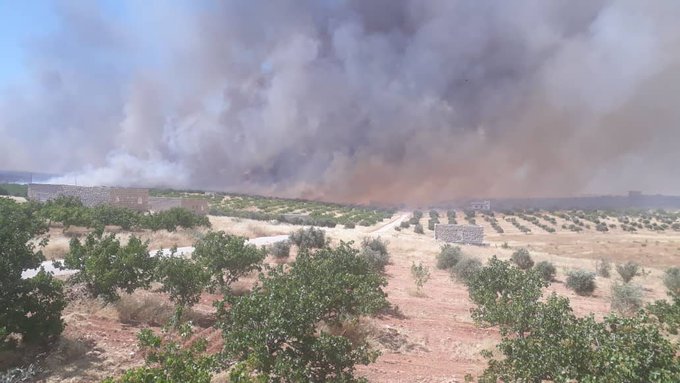
Scorched earth policy in newly-recaptured Idlib


 'Before his land was seized by forces loyal to the Syrian régime, pistachio and olive farmer Abu Jaber said he had a story to tell for every grain of sand.

 His farmland was near the northern town of Kafr Zita, which was among those captured during an aggressive offensive to reclaim territory in the northern provinces of Hama and Idlib last year.

 Almost a year later, much of the agricultural land in the area has either been plundered or burned.

 “Years of work have gone to waste,” said Mr Jaber. “I had to leave and will never be able to return back after the crops were stolen and land burnt.”

 “Every day I receive dozens of photos and videos … They burn our lands so we can’t return to cultivate for even just ourselves to live off the produce.”


 Together with his six brothers, Mr Jaber grew enough food across 450 acres to feed 79 members of the family, as well as providing enough funds to keep them going. They say they have lost crops worth $250,000.

 The family have now fled to Batbo in western Aleppo, where they are looking for jobs. Mr Jaber’s sons risk dropping out of university as he can no longer afford to keep them there, and finding work in a country ravaged by almost a decade of civil war is no easy feat.


 Syrians are also contending with a collapsing economy and sharp fall in the value of their currency, compounded by the spread of the global coronavirus pandemic.

 According to a Facebook statement by the local branch of President Bashar Al Assad's ruling Baath Party in Mahrada, northern Hama, proceeds from this year’s pistachio crop will be put towards a fund to assist the families of the régime forces' dead. Yet there is no system to compensate the farmers for the loss of their land or their income.

 According to Abdulnasser Hoshan, a lawyer from Kafr Zita, the proceeds from seized crops were likely to go to intelligence services officers rather than the “martyrs” fund.

 “The number of civilians affected is more than 50,000,” said Mr Hoshan.


 “It is not currently possible for civilians to claim compensation for their losses because the Assad régime’s judiciary is corrupt, and rights cannot be restored to its people.”

 This year’s fires began appearing at the beginning of June and were started by volunteers for state-funded militias. Mr Hoshan said that between 9,000 and 15,000 acres of land that hosted various crops, including pistachios, olives, wheat and lentils, have so far been burned.

 “These crimes must be documented for justice after the fall of the Syrian régime,” said Mr Hosham.


 Attacking crops in opposition-affiliated areas is a tactic the régime has used before, notably in 2018 and 2019 when huge areas of barley were incinerated. Critics say the attacks are designed to starve civilians, and the loss of food and income makes life very difficult, especially during the hot summer months.

 Extremist group ISIS also chose to burn crops in areas they retreated from or where they had recently been defeated.

 Idlib is the last rebel stronghold in Syria, with around half of the three million population having already been displaced at least once from other parts of Syria. Food and shelter is already scarce, with even the displacement camps are too full to take people.

 Mr Ghassan Aboud, engineer and head of Hama’s opposition agriculture department, said the burning of the fields could also impact the area’s chances of recovery.

 As well as killing the soil’s micro-organisms and exposing it to the damaging effects of the sun, the fires damage the ecosystem by killing the insects needed for pollination.

 “In the short term, pistachio trees are irreparable agricultural wealth because they need 12 to 15 years to enter the fruit phase,” said Mr Aboud, with olive trees needing between four and five years.


 For Mr Jaber, the future of his farm or his family’s whereabouts now seem uncertain.

 "I’m afraid that the Assad régime will transfer ownership of the land to another person, as he did with many displaced civilians from the rest of Syria,” he said.

 “I’m also afraid of being displaced again from Batabo – the news is spreading that Assad and Russia’s are planning to launch a new military campaign in the region." '

Image

Monday, 20 July 2020

The latest updates on Idlib file


 'A violent explosion targeted a joint military patrol of Turkey and Russia on the international "Aleppo - Latakia" road (M4) last Tuesday, and after investigations it was found that the explosion was caused by a car bomb that penetrated the international road and targeted the twenty-first patrol, which was supposed to arrive in the village of "Ain al-Hoor" in the countryside of Jisr al-Shughour west of Idlib, according to the protocol signed between Turkish President Recep Tayyip Erdogan and his Russian counterpart, Vladimir Putin in Moscow on the 5th of March last year.

 The explosion was not the first on the road since the patrols began, but it was the most violent ever, and the Russian Defense Ministry admitted the wounding of three of its personnel, and a number of vehicles were damaged, and the Russian army was only able to unleash its planes to fire the lava on the heads of civilians In the Idlib countryside, in revenge for what it suffered.


 The file of the joint patrols between Turkey and Russia on the "M4" road in Idlib has passed four months, and just as its beginning was difficult it seems that the end of it will be so. With the first patrol that was to be run on the road, a number of groups in Idlib from hard-line factions threatened to take actions against it.

 The car bomb blast brought fierce attacks primarily on civilians, although such a car bomb did not achieve any significant results, Russia and its militias began a campaign of air and ground bombing of the villages and towns of Jabal al-Zawiya in southern Idlib, and reached the city of "Ariha", which lost two of civilians (father and child) as a result of the shelling, others were wounded.


 After the region's population hoped to live safe in light of the Turkey and Russia agreement that culminated in the joint patrols on the M4 road, they are now afraid of the collapse of the agreement completely, and a return to square one, and of course the return of the battles.

 Russia said after the bombing that the process of patrolling the road had stopped temporarily, while the Turkish Ministry of Defense stressed that it will continue alongside Russia to implement the agreement, and to continue the patrols and address the situation with full determination, which creates a ray of hope that escalation can be halted and calm return, which was relative and basically not permanent.


 Returning to the car bombing incident, a group calling itself "Khattab Chechen", an unknown group whose only previous action was detonating another explosive device on the M4 road, claimed responsibility for the car bomb which raises many questions about its true affiliation and its goals as well as the purpose of such attacks.

 Some observers argue that the beneficiaries of causing chaos and obstructing the implementation of the Turkey and Russia agreement are the militant groups represented by the factions of the operating room "Stand Firm" which in turn includes several organizations, most notably "Guardians of Religion" [Hurras al-Din], because it considers that any stability that Idlib could witness, would enable the Turkish army has expanded more and more in the province, and this will mean in one way or another that these groups will end or decline significantly.

 Others see that Russia, Iran and the Assad régime have an interest in the collapse of the agreement, especially Russia, which wants to evade the upcoming commitments with Turkey, after the success of the joint patrols, which is to ensure the return of the displaced to their homes, and to withdraw the Assad régime to the Sochi borders.

 Others expect that the Headquarters for Hay'at Tahrir Al-Sham would be the mastermind of the bombing, in an attempt later to make it an excuse on the basis of which it would attack the militant factions, and portray itself to the states as the moderate faction committed to international agreements, and the sole controller in Idlib.

 The Syrian researcher, Abdullah al-Mousa, points out that the video broadcast by the agency "Rus vensa" (which accurately showed the moment when the car exploded) confirmed that the explosion actually took place with a car bomb and not an explosive device, which excludes many possibilities that the régime's agents and allies are who designed this play.


 The video itself, according to al-Mousa, was highly unlikely that the Headquarters for Tahrir Al-Sham was responsible for the bombing (the fact that some spoke of this scenario in the sense that [HTS leader] al-Golani wanted to create an argument to complete the attack on extremist organizations).

 Al-Mousa suggested that the organization Guardians of Religion was responsible for this operation, especially that "the organization had a military presence near the area where the bombing occurred before the Moscow agreement on March 5, and members from southern and western countryside of Idlib have joined in, and this process requires local members to plan and implement it."

 The Syrian researcher reinforces his belief by pointing out that the Guardians of Religion members are the most active - albeit in media - in attacking the "Turkish - Russian" agreement, and they have appeared several times with videos threatening to bomb, slaughter and kill.

 Others expect that it was Russia itself that conducted the bombing by its cells, and the spokesperson for the National Liberation Front, Captain Naji Mustafa, said that the biggest beneficiary of the bombing is the Russian occupation, the régime forces and the Iranian militias, since Russia has been seeking since the March 5th agreement to break the ceasefire and rteurn to the escalation in Idlib governorate.

 In turn, the Syrian researcher, Abbas Sharifa, suggests that the party responsible for the car bombing would be one of two, the cells of the Syrian régime and Iran, which are working to push Russia to start military action in Idlib, and the second cells remaining from the organization "Guardians of Religion" and the "operation room", "Stand Firm", to reinforce their position rejecting the international understandings.


 All possibilities remain open regarding the future of the ceasefire agreement in Idlib. During the past days, Russian hints indicating their unease with the current calm have been repeated, sometimes accusing the factions of preparing chemical weapons attacks with the aim of accusing the régime of it, and at times claiming that these factions are attacking the military Hmeimim base in the countryside of Latakia with drones, but on the other hand it can be said that the signs of the return of the battles have not been completed yet, as no media or military propaganda by the Assad régime was noted towards the return of the battles in Idlib as usual, and the National Front spokesman confirmed they "haven't monitored new military build-up of the régime and its militias in the Idlib area, and he indicated that the factions consider the worst possibilities, including the renewed Russian attacks, and continue to prepare their fighters and develop plans to face any possible attack." '


 Note 24/5/25, link broken.