Sunday, 15 March 2020

Demonstrations on 9th. Anniversary of the Revolution


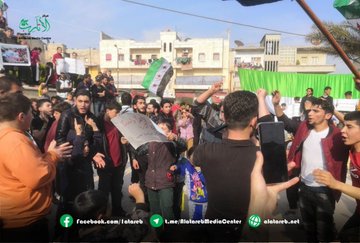
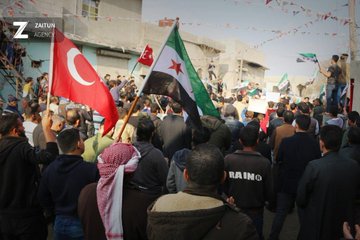
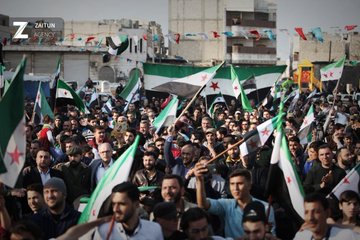
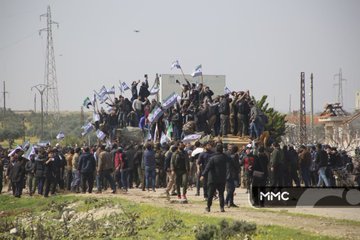
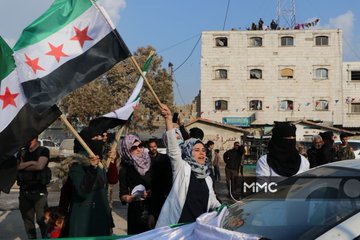
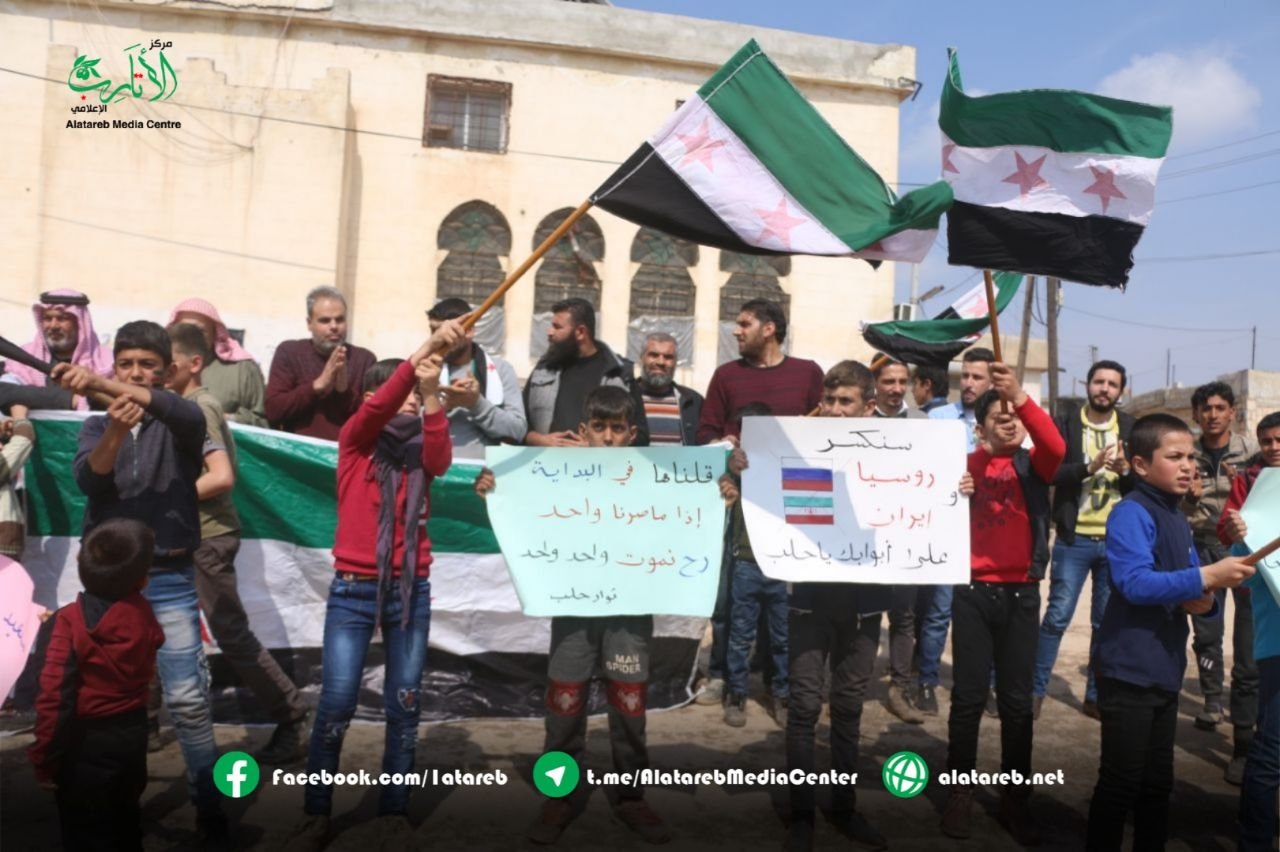
 'Several popular demonstrations took place today, Sunday, on the occasion of the ninth anniversary of the start of the Syrian revolution in the regions of northern Syria.

Syrians set out today on demonstrations in the city of Idlib and Maarat Misrin and on the "M4" road near Ariha in its countryside, along with other demonstrations in Batbu, Afrin and Al-Bab in Aleppo countryside and Saluk in Raqqa countryside and other areas.

The demonstrators stressed the continuation of the Syrian revolution until it fulfilled its demands to expel the forces of aggression and gain freedom.

They chanted revolutionary songs and chants condemning the criminality of Russia, Iran, and the Assad régime, and they paid tribute to the martyrs of the revolution and renewed their solidarity with the detainees.

Today, Sunday, marks the ninth anniversary of the start of the Syrian revolution that erupted on March 15, 2011, calling for freedom and dignity. The Assad régime has responded since the early days with excessive violence and massacres, and it has also brought Russia and Iran in to try to suppress Syrians.'
ImageImageImage
ImageImageImage


 Note 19/8/25, link broken.

The Syrian uprising and the birth of an idea


 Zouhir al-Shimale:

 'Supporters of the revolution against the Assad régime take stock of the toll the war has taken nine years after it started.

 Fared Alhor from Maarat al Nouman is 26 years old and has known nothing but war for the entirety of his adult life.

 He was in high school before the Syrian uprising started, and had a part time job helping out with local publishing companies.

 That experience would later come in handy by photographing the atrocities carried out by the Assad régime and the resulting humanitarian crisis in northern Syria.

 Alhor has more than skin in the game when it comes to the conflict, having had his home destroyed in régime bombardments. He lost his aunt, and was forced to flee for the relative safety of north east Idlib when régime forces took his hometown.

 Maarat al Nouman was recently captured from Syrian opposition fighters by régime forces backed by heavy bombardment from Russian warplanes.


 Despite the toll the war has had, however, Alhor has no regrets about the uprising.

 “Many people won’t understand why I say the Syrian uprising was worth it,” he said.

 “Even though I was young when it kicked off, I am very privileged that I got to live through it. It made us young people understand the meaning of freedom and equality…something that did not exist before.”

 Alhor believes that there will one day be peace in Syria but not in the foreseeable future. He believes the lack of international support for the revolution is the main reason why the régime of Bashar al Assad remains.

 “The international community bears a large responsibility towards what’s happening in our country,” Alhor said. “They turned a blind eye towards the relentless régime attacks against people, schools, hospitals, and even camps for the displaced.”


 While youths like Alhor have no regrets over the uprising, there’s no escaping the impact the war has had on their development.

 Many Syrians have spent their formative years knowing nothing but war, at the expense of experiencing the kind of things other young people around the world get to experience.

 Nazir Abbas, a 27-year-old human rights activist from Kafranbel, which was recently lost to régime forces, rued the years of his life lost to war.

 “I have lost a decade of my life,” he said from a camp for the displaced near the border with Turkey.

 “I should have had a family by now and enjoyed spending my youth with family and friends in our hometown.”

 Unlike Alhor, Abbas is not optimistic about the future, admitting that the future is not ‘very bright’.

 But like his compatriot, Abbas has no regrets about the Syrian revolution.

 “We’ve grown up from within...the seed of freedom is ten years old now and it will continue to grow and thrive within us and in the generations to come. What keeps me strong is the hope that the Baath régime will be dismantled.”


 The war in Syria has left more than 500,000 people dead and led to the displacement of more than 11 million people, including six million as refugees outside of the country.

 Assad’s campaign to keep his régime in place has seen him level civilian neigbourhoods, use chemical weapons on children, and torture tens of thousands to death.

 Nevertheless, Syrians have stressed that while the moment of physical freedom from the Assad régime appears distant at the moment, mentally there will be no return to life under dictatorship.

 Sanaa al Ali, a 30-year-old mother who fled from Ghouta to northern Idlib said the past nine years of revolution have been as if she was born again.

 “After a lifetime of having to chirp praise for the ‘eternal leader’, Syrians have gone out and said no (we won’t),” she said.

 Adding: “The revolution was the first time we heard our own voice, and we will never abandon it or give up our cause, no matter what.”

 To further explain this mindset, Ali described what life was like under Assad’s Syria. She recalled how parents would remind their children not to say anything sensitive too loud for fear of being heard by the state surveillance apparatus.

 “Whisper, the walls have ears,” she remembers her parents warning. Now, however, the “kingdom of fear has crumbled,” she added.


 A theme that ran across the conversations we had with the Syrians was that any notion of Assad winning the conflict were premature and pyrrhic.

 Ali described the notion as an illusion, arguing that Syria had changed forever and would never fully be in control of the régime.

 That - she insisted- was because Assad was fighting for territory while for Syrians it was a battle of ideas.

 “We need to understand and restate that the essence of Assad’s battles against Syrians is a battle against an idea, the idea of freedom that we need to continue spreading,” Ali said.

 “The revolt is an idea, and ideas do not die.” '

Saturday, 14 March 2020

Syrian refugee's plea: 'Stop the river of blood'

Syrian refugee Sahar, 26, was just a teenager when conflict began

 'Close to five million Syrians are now living as refugees beyond the country's borders, but an estimated six million are displaced within their own country, many of whom have had to flee the conflict multiple times.

 Half of those displaced are in the northwest, trapped in a shrinking rebel-held area centred around Idlib, that has been battered by months of deadly bombardments.

 Among them is 26-year-old Sahar, originally from the southern suburbs outside Idlib where her family home was partially destroyed by airstrikes.


 Sahar was just a teenager when the Syrian conflict first began and since then she and her family have had to uproot and flee from the ongoing fighting at least three times.

 "I cannot describe those moments, it was one of the hardest moments because we had to leave the house that I was raised in," she recalled.

 "We had to leave everything in order to save our lives and my family's lives from murders or arrest because if the régime came they would arrest us and I had been arrested before."

 She describes the ongoing fear caused by having to uproot multiple times: "It is a very hard feeling, having to leave everything in order to survive … Now I live in Idlib city centre, which is also not safe because of the air strikes and the bombing towards the civilians."

 Sahar’s family was most recently displaced in mid-February and she is currently stuck in Idlib city, amidst the constant threat of air strikes.

 "The hardest thing right now that I feel is instability. A huge population crisis happened because citizens from the south suburbs of Idlib had to emigrate to the north, toward Idlib city and the borders."

 Sahar is now living with her family in overcrowded conditions near the border with Turkey, uncertain about what the future holds.

 "Most people, after they left their homes didn't have any income. This is really a hard thing. Camps for displaced people have really bad conditions. More than one family has to live in the same tent. Sometimes there are four or five families in the one tent which they use as kitchen, bedroom, bathroom and a living room - all in the same tent."


 A Russian-Turkish ceasefire deal came into effect last Friday, bringing relative calm to Idlib, its skies free of warplanes for the first day in months,

 Like many in the city, Sahar’s main hope is for peace and safety:

 "What I wish for is to live peacefully and safely with my family and all the people here in Idlib city … I hope that Syria will become a safe country and that we could live here with dignity."

 She added: "We need the support from all the countries in the world, we need the international community to stay by our side.

 "Those civilians and children are not involved with anything, we are normal civilians who only want to live in our areas and our homes. Stop the river of blood and get aid to the displacement camps." '

Friday, 13 March 2020

Idlib: Syria's 'forgotten city' targeted for revenge by Assad


 'Locals call Idlib "the forgotten city", still paying the price for one day in the 1970s when the former president was pelted with tomatoes.

 The city and its surroundings have suffered furious bombardments since December at the hands of Syrian forces and Russian jets, leaving hundreds dead and forcing huge numbers to flee towards the Turkish border.

 With a tentative ceasefire announced on March 6, villager Malek Haj Khalil returned to his home in Sarmin, just east of Idlib, hoping to recover a few belongings from the ruins of his house.


 But he found nothing beyond an air conditioning unit and a few broken pans among the twisted iron bars that were once his home.

 "We were hoping to find a few things, some furniture or blankets, but there is nothing," he said.

 Some neighbours had more success, and were loading gas cookers, mattresses and sofas on to trucks.

 "When the army came, it poured out all the hatred it has against us... targeting civilians and their houses," said Khalil.


 Idlib was one of the first provinces to join the uprisings against President Bashar al-Assad, and is now the last to remain in rebel hands, but the roots of that "hatred" predate the revolution in 2011.

 Tucked in the northwest of the country, Idlib's residents have long felt overlooked by their rulers in Damascus.

 Locals and researchers particularly recall the time in the early 1970s when Hafez al-Assad, Bashar's father who ruled from 1971 until his death in 2000, made his first and only visit to Idlib. An angry crowd pelted him with tomatoes and a shoe.

 "After that incident, Hafez al-Assad never returned to the city. It has since been cut off, and that shows in the quality of its infrastructure and schools," said Mohammad Sarmini, head of Syrian research centre Jusoor in Istanbul.

 "It was this marginalisation that pushed Idlib to join the revolution," he added.


 According to Taleb al-Dugheim, a specialist on Syrian history, the slight against Assad senior in Idlib "was never forgotten, and transformed into repression and marginalisation" that continued under his son decades later.

 The régime also remembers Idlib's role in the protests of the 1980s, Dugheim said, when many supported a Muslim Brotherhood uprising in the city of Hama that was brutally suppressed.


 Asaad Falaha knows the hatred well. He leads a charity running a primary school in Binnish, east of Idlib city, that the régime has bombed three times during the recent offensive.

 "Seventy percent of it has been destroyed. To target a school like this shows the hatred of the régime," he said.

 The province shelters three million people -- half of them displaced from other regions.

 Assad has taken a close interest in the battle to retake it.

 "When Bashar al-Assad visited the town of Al-Habit in Idlib province in October, he personally supervised artillery shelling against (the then rebel-held) Maarat al-Numan," said Dugheim.

 "The régime acts as though the inhabitants of the Idlib are not really Syrians," he added.


 Assad's forces retook the town of Kafranbel in the south of the province in February. It was one of the last standing symbols of the revolution, full of darkly ironic slogans against the régime.

 That spirit still shows flickers of life further north in the province: on a partially destroyed school in Binnish, someone has written advice for protecting against the coronavirus, with Assad depicting as the virus.

 On the wall of a gutted-out classroom, someone has offered a history lesson: "Date: the era of dictators. Course: revolution. Lesson: death." '

Fighter's journey from school protests to armed conflict


 'Ahmed Mansour was a schoolboy with dreams of becoming a lawyer when he joined the first protests at his secondary school in Syria’s northern city of Aleppo.

 Nine years later, his studies halted by a war which has ravaged the country his whole adult life, Mansour and fellow fighters are stuck in a shrinking corner of rebel territory which still defies President Bashar al-Assad.

 His journey from schoolboy demonstrator to veteran fighter, from early optimism to last-ditch defense in the towns and farmlands of Idlib province, echoes the dashed hopes of many Syrians who took to the streets to challenge authorities.


 “I expected the régime to fall,” Mansour said, recalling the early protests inspired by uprisings in North Africa which rapidly toppled autocrats in Tunisia and Egypt and then overthrew Libya’s Muammar Gaddafi after Western intervention.

 “It was a corrupt sectarian régime and we had to change it,” he said, flanked by fellow fighters under a canopy of olive trees, hiding them from hostile warplanes and drones in the skies of Idlib.


 Starting in Damascus on March 15, 2011, and then in the southern city of Deraa a few days later, unprecedented protests against decades of rule by Assad and his father before him spread across the country.

 Mansour, then 16 and studying at secondary school in Aleppo, joined 30 other students in a demonstration at their school. “We shouted ‘Freedom, Freedom, Freedom’,” he said. “Security forces came the next day and arrested 11 of my friends.”

 The students were released after mediation. They continued to protest, but in small numbers and in short 15-minute bursts. “We couldn’t do it for longer because security forces came immediately and stormed the demonstration with tear gas and opened fire,” he said.

 The Syrian government cracked down with a determination unmatched in other countries caught up in what was briefly labeled the Arab Spring.

 Despite growing casualties, protests persisted. As demonstrations became funeral marches, confrontation escalated.


 Mansour joined a group to defend the demonstrators, but they could not match the strength of Assad’s security forces. After several months a new force of military defectors and armed rebels was formed, the Free Syrian Army.

 “I joined the Free Army with great pride because I was taking part in protecting civilians, our people, our brothers,” he said. “People who were calling for the most basic rights from a tyrannical, repressive, dictatorial régime.”


 Syria was on the way to becoming the bloodiest and most protracted of the Arab uprisings, but in the first years of conflict rebel confidence was high. Assad’s foreign critics said his remaining days in power were numbered, and a senior U.S. State Department official described him as “a dead man walking”.

 Mansour and the rebels swept into Aleppo in the late summer of 2012, a city they would hold in part for another four years.

 Then he was based in towns around Aleppo, surviving a stomach injury from shelling, and fighting for a variety of rebel factions which jostled for power on Syria’s chaotic battlefield.

 Riven by division - which worsened dramatically with the emergence of the jihadist Islamic State group in 2013 - and lacking the international support they sought, the rebels failed to capitalize on the early gains.

 Islamic State “turned public opinion against us”, leading the outside world to equate the rebel fighters with terrorists.

 “Then the Russians came, and changed the balance,” Mansour said, referring to Moscow’s decisive 2015 intervention which turned the war in Assad’s favor.

 “They put pressure on us in Aleppo, and then they took control,” he said. “They broke us in Ghouta (around Damascus) and in many areas until at last we ended up in Idlib,” he said, the sound of bombardment occasionally punctuating his comments.

 In some of the worst of the fighting in Aleppo’s Khaldiya district, Mansour said one or two fighters died alongside him every day. Another bleak memory was an air strike which killed around 20 of his comrades sheltering in a cave in 2016.

 The last few months, as Assad’s Russia-backed forces launched an offensive across southern Idlib, marked the lowest point yet for rebels who once controlled large parts of Syria and almost encircled Damascus.


 Only a few days ago, Mansour’s forces were driven from his hometown of Kafr Nabl by the advance of Syrian government forces, halted only by Turkish air strikes, artillery and a ceasefire deal agreed by Turkey and Russia last week.

 Turkey’s robust support for the rebels this month has sustained his optimism, despite the string of past military defeats, but also reinforced a sense of betrayal by other international powers.

 “The world watched us and no one helped,” Mansour said. “If the world had helped us, we would have toppled the régime”.'

Wednesday, 4 March 2020

Rallies in support of the Syrian & Turkish National Armies

 'Popular demonstrations took place in separate areas in the north of Syria, in support of the military operations launched by the Syrian and Turkish national armies against the positions of the Assad régime in Idlib, Hama and Aleppo.

 Demonstrations took place in several cities and towns, most notably in the city of Sarmada and the town of Hazano north of Idlib, and the city of Al-Bab in the northern countryside of Aleppo; in support of Turkish intervention against the régime forces.

 The demonstrators thanked the Turkish Army and President Recep Tayyip Erdogan for support providing to the Syrians over the past years in confronting the Assad regime, and they also wished for the safety of Turkish soldiers who had come during the past days to attack the régime in Idlib.

 The Syrian and Turkish national armies launched Operation Spring Shield to force the Assad régime to retreat from the areas it had captured in the countryside of Idlib, Aleppo, and Hama. Over the past few days, the two armies were able to achieve broad progress and control over different cities and towns.'


 Note 19/8/25, link broken.
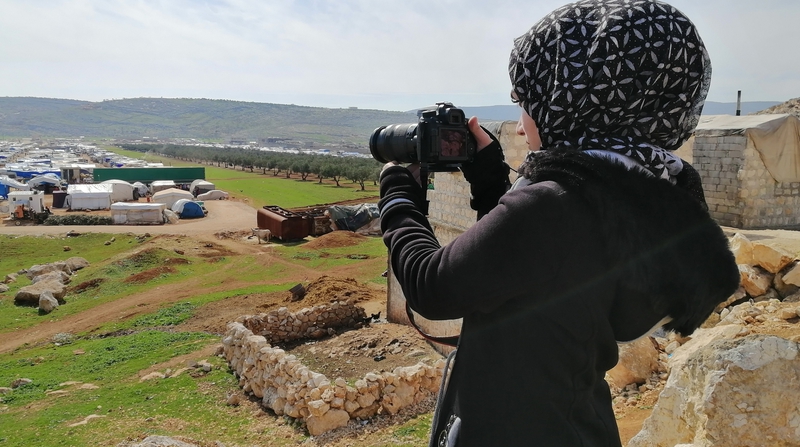
Turkey’s Operation in Syria Exposes Obama’s Weakness


 'Turkey’s devastatingly effective exercise of military power in Syria’s Idlib province has not only provided instant relief to three million Syrian refugees who’ve been bombed mercilessly by Russian warplanes, and stalked by Assad régime forces and Iranian militias on the ground, it has also exposed former US President Barack Obama’s timidity in not enforcing his famed “red line.” Which begs the question: how many lives might have been saved with minimal international military intervention.

 “We have been very clear to the Assad régime,” President Barack Obama said in August 2012, “that a red line for us is we start seeing a whole bunch of chemical weapons moving around or being utilized. That would change my calculus.”

 A year later, Assad called Obama’s bluff in using chemical weapons, specifically sarin gas, to kill more than 1,400 non-combatants in Damascus suburb of Ghouta. Video images of young children, women, and men wreathing on the ground in convulsive fits before eventually choking to death on their own vomit were viewed almost instantaneously by a distraught and shocked global audience.


 If there was ever an ethical justification for the United Nations to invoke a military intervention on the basis of Responsibility-to-Protect (R2P), then the gassing deaths of innocents was most definitively it, but Russia’s seat on the Security Council would never have allowed that to happen. There’s no doubt Syria now ranks as one of the UN’s most humiliating and consequential failures to halt and prevent genocide, war crimes, ethnic cleansing, and crimes against humanity.

 Nevertheless, the leader of the world’s sole military superpower had laid bare his “red line.” In no circumstances would the US accept the use of chemical weapons, according to then President Obama, but when the moment came to deliver on his promised threat, he blinked, took a step back and then deflected responsibility to the opposition party controlled Congress, where he knew the request for military force would be denied. The bill died on the floor of the House without coming to a vote.

 There’s little doubt that it was the American public’s opposition to armed intervention, rather than principled or military considerations that was to blame for Obama allowing the Syrian dictator to get away with genocide-scale mass murder. What the besieged Syrian people received instead was further global apathy in the form of excuses, and more bombs and bullets raining down upon them by Russian warplanes and mercenaries.


 In his book, “The World as It Is,” Ben Rhodes, Obama’s former national security advisor, claims Obama chose against using force to punish Assad, arguing that Syrian air defenses were far too formidable and couldn’t be taken out without a massive US ground force providing support on the ground, and that the Russian military would counter in a way that would risk the outbreak of World War Three.

 Turkey’s successful and punishing military raids in Idlib over the weekend, however, have made a mockery of these assertions and deflections, given Turkish armed drones wiped out a multitude of Syrian air defense systems and fighter jets easily and without cost or consequence within a mere 72-hour period.

 Since the operation began on February 28, Turkey’s military assets have killed 2,212 Assad régime soldiers, and destroyed three Syrian air defense systems, eight helicopters, 103 tanks, and 72 guns/howitzers, according to Turkey’s Defense Minister Hulusi Akar.

 “We have no intention to confront Russia, but we want to stop the Assad régime’s massacre of civilians. Our target is only régime forces and elements attacking our troops,” he added.


 Syrian rebel groups have taken back more than a dozen towns they had surrendered since Assad and Putin stepped up their bombing campaign on Idlib in December. More significantly, Russia has shown no sign whatsoever that it has any desire to confront or even tangle with Turkey’s Air Force, which makes a further mockery of those, including Obama, that thought enforcing a no-fly zone over Idlib would lead to another world war.

 As for the régime’s so-called “formidable defenses,” Turkish drones and jets have so overwhelmed the Syrian Army that it has resorted, out of sheer desperation, to burning car tires in strategic locations to blind Turkish satellite navigation systems and pilots. Car tires! It would be a joke were it not for the catastrophic loss of lives Assad’s war of choice has wrought on his people.

 While one may question Turkey’s actual motives for intervening in Syria, what one cannot do is question its effectiveness in protecting three million mostly Sunni Syrians from being ethnically cleansed by Assad’s death squads and sectarian militias. For the first time in months, Assad-Russian warplanes are not bombing schools, hospitals, bakeries, markets, and mosques in Idlib.


 “Turkish action now offers an opportunity – albeit late in the day – to try to correct mistakes of 2013 to the present, by getting a wider coalition behind an effort to disrupt [the] Assad/Russia military strategy, change calculations and open chance for coerced diplomatic negotiation,” tweeted former British diplomat Reza Afshar.

 Afshar had resigned from his role as coordinator of UK policy on Syria after the British parliament “killed the momentum for action globally,” which he calls the “worst foreign policy decision of our generation.”

 The cost of inaction, and by extension Obama’s pusillanimity, can be measured in upwards of one million dead Syrians, more than six million refugees alongside six million internally displaced people, further chemical weapons attacks, and the rise of the Islamic State (ISIS) and far-right political parties throughout the Western world—both of whom have leveraged Islamophobia for their respective gains.

 That it has taken almost nine years for Assad’s victims to become the beneficiaries of meaningful and effective international intervention should shame us all, including a former US president.'

Monday, 2 March 2020

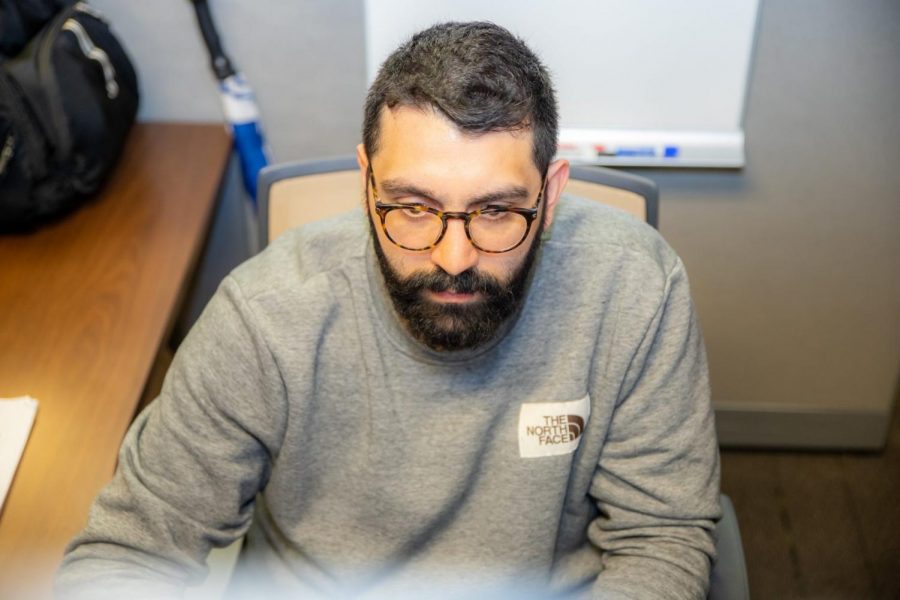
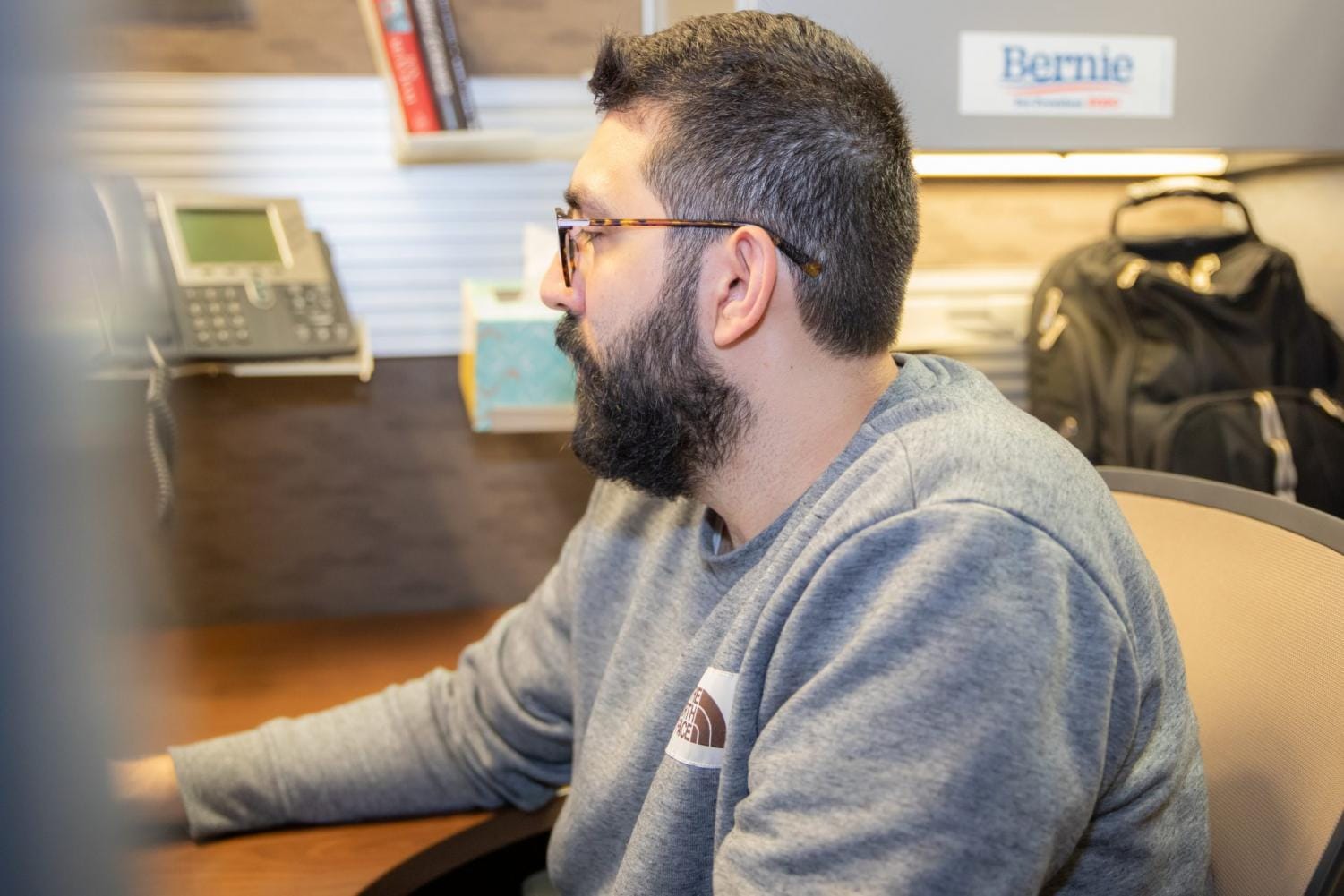
DePaul developer reflects on role in Syrian revolution

Emad+Mahou+at+his+office+at+DePaul+University.

 'Emad Mahou spends his days writing code and building tools for the university’s various digital interfaces as a software engineer at DePaul. But nine years ago this month, he was building something very different.

 In March 2011, Mahou was building a grassroots movement that helped incite the near-decade of civil war in his home country of Syria. Instead of navigating the halls of DePaul’s administrative offices, he was navigating the streets of Damascus while trying to dodge the wrath of President Bashar Al-Assad’s forces.

 “When I was 23, I was fighting in Syria for freedom. I was leading the revolution 2011, but today I have to do a login for a trustee,” he said.


 Mahou was born in Lebanon in 1989 to a Lebanese mother and Syrian father. His family immigrated to Syria when he was 6, settling down just outside of Syria’s capital, Damascus. Though he began studying architecture at the University of Damascus when he was 20, he never got to finish his degree. Civilian results — which would later be known as the Arab Spring — began three years later in Tunisia and Egypt, forcing the countries’ respective leaders to step down.

 As these unprecedented events unfolded, Mahou said he felt it was time to force a change in Syria.

 Hafez Al-Assad ruled Syria from 1970 until 2000 when he was succeeded by his son, Bashar. Hafez had ruled Syria oppressively, and there was hope the younger Al-Assad would be more humane. However, in the 11 years after his tenure began, Bashar cultivated a reputation as an autocrat just as, if not more, unsparing as his late father.

 He impeded any democratic processes that might result in his removal from office and reared brutality by preventing dissidents from leaving the country, torturing and murdering them.


 Dissatisfaction with the authoritarian leadership, mixed with economic tensions exacerbated by climate-induced displacement and lack of resources, bred fertile ground for Syrians to spark a revolution.

 Political dissent has always been one of Mahou’s guiding principles. He said his father originally left Syria for Lebanon after its regime targeted him for his opposition to it.

 Mahou began organizing by creating a Facebook page titled “The Syrian Revolution Against Assad.” He set up a meeting in February; no one showed up. Then another, with the same result. Finally, on March 15, 2011, about 25 men and women joined him at the Umayyad Mosque in Damascus. They chanted tunes of protest in the mosque, then trickled outside and marched down the Ottoman-era bazaar that served as a hub of commerce and socialization in the city.

 “Everybody was silent. You could only hear our voices. Everybody was scared to death,” Mahou said. “That’s the most amazing kind of fear that can be instilled, of just witnessing somebody doing something against the government.”

 Only minutes later, Al-Assad’s military stormed through the market and the protest disbanded, Mahou said. Two days later, he and his father joined a demonstration at the Interior Ministry.

 Mahou was horrified by the bloodbath he saw when, again, the police raided the protest and began beating the participants.


 As the protests spread across the country, Al-Assad began to escalate his counterattacks, which in turn drove the desire to oust him from power.

 “I lost fear when the revolution started. When they killed people, we weren’t scared; it was fuel. They made us more angry,” Mahou said.

 As the conflict grew from weeks into months and from hundreds of people to thousands, Mahou continued to organize. He said he was contacted by the United States government to help them understand and verify the situation and identify rebel groups that weren’t too radical to work on common efforts with.

 Cécil Shea, senior fellow on Global Security and Diplomacy at the Chicago Council on Global Affairs, said this was a frequent measure taken during that time.

 “One of the things the U.S. government was trying to do was bring some of the groups that were not so extreme, that the U.S. would have liked those to come to power, together to have meetings with the leaders and to have them coordinate,” Shea said.

 Mahou pledged to himself to always remain nonviolent.

 “We’re not killing Assad, we’re killing each other,” Mahou said, reflecting on his thoughts at the time. “If I met my maker I wanted to say I tried, I put all my might and power into this without causing more harm.”

 His conviction was compounded by personal loss. During one march, he was walking next to a friend when the man was shot by police.

 “He died in my arms,” Mahou said. “I’ve seen a life be taken away. I cannot put that pain on somebody else.”


 Three thousand miles away in England, foreign news correspondent James Longman’s life was about to be altered by the stirring strife in Syria. Longman has now traveled to countries around the world for his work with ABC and The BBC. But in 2011, he was just a student studying the Middle East.

 Longman went to Syria to do research for his thesis, but began freelancing for British press after realizing that as a student, his presence wouldn’t alert authorities like credentialed reporters would. He was connected with Emad through a Syrian academic living in London. He said the reason he’s a journalist today is because of the work he did in Syria — which he said was made possible by Mahou.

 “Without him, I wouldn’t have been able to do anything,” Longman said. “He was someone who I could trust because in that very hectic environment, you know, you never know who you’re with.”

 Mahou connected Longman with sources and got him from town to town, safehouse to safehouse — all the while making sure they weren’t being trailed by the government.


 As rebellion turned into full-out war, Mahou essentially became a spokesperson for the rebellion. Because he was fluent in English, active online and had information from the ground, he became a source for journalists overseas, giving accounts of the turmoil happening around him. In one such interview with SkyNews, the journalist ended the segment by thanking Mahou, attributing him with his first and last name.

 That mistake gave the regime a face and a name to attach to the movement.

 About a week later, he was apprehended by police. He said he was then imprisoned for over 100 days. He was tortured for many of them.

 “They zip tied me to a small bar and left me standing there for two days,” Mahou said, illustrating one of the more painful stretches of his imprisonment.

 He said he doesn’t know why he was released, but guessed that because he didn’t crack under torture, the police thought he’d provide them more information on the rebels if they let him go and surveilled him.

 Instead, he went into hiding, harbored for two months by a family to whom he said he owes his life. During that time, his father was arrested and four of his cousins were killed. He knew he couldn’t openly organize anymore without risking rearrest or endangering others. He had to leave Syria.


 With aid, he illegally crossed into Jordan, and reached the Zaatari Refugee Camp in Ar-Ramtha. After five days in the camp, he went to Amman, where he stayed for six months until obtaining status as a political asylee, making it possible for him to immigrate to the U.S.

 At the time, Mahou knew of three U.S. cities: New York, Los Angeles and Chicago. He deemed New York too big and Los Angeles too crowded, so he settled on Chicago. He ignored state department officials who warned him that Chicago might be too cold.

 While transitioning into his new life, Mahou was also assisting people in their transition from place to place. His first job was driving people between gates at the airport. In 2014, he went back to school, this time for computer science, knowing it was an education that could make him a living. He was hired at DePaul after graduating.

 “In 2012, I was pushing people from gate to gate in O’Hare Airport,” Mahou said. “Six months before that, I was leading a revolution in the heart of Damascus. Today, I am building sites for the DePaul trustees. In 10 years, I could be a DePaul trustee.

 “You’re the captain of your soul; you shape your future.” '

Sunday, 1 March 2020

Rebels vow to retake Kafranbel


 'For many years, the town of Kafranbel in Idlib province was a centre for displaced Syrians fleeing government forces from different parts of the war-torn country.

 But now the residents of Kafranbel have become displaced once again after President Bashar al-Assad’s forces took control of the small town earlier this week, destroying many of its homes during the fiercest escalation in the northwest of the country.

 Kafranbel was one of the largest revolutionary strongholds where anti-Assad demonstrations began at the start of the Syrian uprising in 2011. Images of its residents holding up witty banners were seen across the world.

 The town's symbolic status has made it more vulnerable to revenge.


 The Syrian army invaded the town with tanks in 2011 seeking to suppress popular unrest and prompting activists and civilians to flee, but Syrian rebels gained control of the town in late 2012.

 Following a series of successive defeats since December, rebels have lost the town of Kafranbel along with other strategic revolutionary areas such as Khan Sheikhoun, Maarat al-Numan and Saraqeb.

 Under Russian air cover and with the help of Iranian, Lebanese and Iraqi militias, Syrian government forces have launched continuous attacks to retake the Idlib province, the last stronghold of the rebels.


 Omar Nuzhat, a displaced activist from the outskirts of Damascus, remembers the moment he arrived in northern Syria in late 2016, when the people of Kafranbel welcomed his family and helped him settle into a furnished home.

 Nuzhat was displaced alongside other civilians and fighters who refused to surrender to Syrian government forces when the latter regained control of various suburbs of Damascus.

 "Kafranbel is my second home. The people of the town greeted us with great generosity, to the point that I did not feel like a stranger or displaced," Nuzhat said.

 "The people told us: ‘Our homes are yours. You can stay in them for years until you return to your cities without paying any rent’," he said.

 "There was no displaced person who entered the town of Kafranbel and stayed in tents. The town received displaced people from all over Syria," Nuzhat added. "Today its people are displaced in tents. They are not treated the same way they treated the displaced."


 The escalation in northern Syria has forced nearly a million civilians out of their homes towards the border with Turkey. Most of them live in the open and in difficult conditions, according to the United Nations.

 As one of the birthplaces of Syrian revolution activists, Kafranbel was home to mass demonstrations for years due to its geographical location.

 The town was the meeting place for demonstrators from northern Hama and the villages of Jabal al-Zawiya, south of Idlib. It was also where banners bearing revolutionary phrases in several languages were created.

 The banners were written by Raed Fares, a student of medicine who became a prominent local activist and a symbol of solidarity for rebels across the country, drawing the attention of the outside world to the violations taking place in Syria.

 Fares also established Kafranbel Radio Fresh, which became the first local Syrian radio station to broadcast from an opposition region. It continues to operate today despite having lost its main office.


 The town’s residents often disagreed with Islamist rebels, who have accused Radio Fresh of letting men and women interact at its headquarters, and argued that broadcasting women's voices on the radio should be prohibited. Fares in retaliation began to broadcast the sounds of birds and animals on the radio.

 Fares and fellow activist Hamoud Jneed were gunned down by unknown assailants in November 2018.

 “Kafranbel promoted the thought of the revolution among the Syrian youth, and was the incubator of all classes of the revolution,” said Mahmoud Fares, Raed's son.

 "It is one of the most important locations of the revolution in Syria," said Mahmoud, who moved from Kafranbel to Turkey and then France after his father was killed. “Kafranbel brought the voice of the revolution to the whole world, but the world has abandoned it, and now Idlib is described as a stronghold of terrorism.”

 "In normal circumstances, people live in cities, but Kafranbel is the compassionate town that lives in the hearts of people and the sons of the revolution," he added.


 During the initial years of the Syrian revolution, a large number of soldiers defected from the Syrian state army, as they rejected the idea of invading cities and arresting protesters.

 In cooperation with the residents of Kafranbel, many former soldiers established the Knights of Justice Battalion, one of the first battalions of the Free Syrian Army (FSA).

 “The Battalion expanded, increased the number of members in its ranks, and participated in the battles of the countryside of Hama, Aleppo and Homs,” said Tariq al-Nahar, one of the battalion’s founders.

 The battalion later became known as the Northern Division.

 "The sons of Kafranbel fought against the Islamic State [group]," Nahar added.

 "The town was the centre of export of national thought for the Syrian revolution, so it has been subjected to continuous air strikes for seven years," he said


 Air strikes destroyed Nahar’s house and the Radio Fresh building before government forces took over the town.

 But the rebel fighter remained determined to fight for Kafranbel.

 "We lost the town previously and then regained control of it, and we will regain control of it again, God willing." '

Friday, 28 February 2020

Syria's economy collapses, how much can people bear?


 Dani Qappani:

 'Speaking during a television interview on a Syrian state TV channel in mid-January, Bouthaina Shaaban, the Political and Media Adviser to the head of the Syrian régime, claimed that the Syrian economy is fifty times better than it was in 2011.

 As usual with Shaaban's speeches, Syrians' reaction was one of disbelief.

 With the Syrian economy in an unprecedented nose-dive, even while Shaaban made this claim, and the value of the Syrian pound reaching 1,000 to one US dollar, all but Assad's super-rich elite are struggling to meet their most basic daily needs, not just in areas controlled by the Syrian régime and its Iranian militia allies, but nationwide.


 Even before Shaaban's ill-conceived claims, the worsening economic conditions, among other factors, had already led to widespread discontent even in traditionally régime loyalist areas.

 In the majority-Druze province of Suweida in south Syria, local people held demonstrations condemning the régime's corruption and incompetence with banners bearing slogans like 'We Want to Live' and 'The Syrian Media is Fake'.


 The economic crisis has further increased the already heavy burden on Syrians still suffering from the consequences of the war that has spanned nine years to date.

 The régime has effectively bankrupted the country to maintain power. Many of those who survived the relentless bombing by Syrian, Russian and Iranian air and ground forces that reduced whole villages, towns and city neighbourhoods to rubble, now have no choice but to return to their destroyed areas.

 They have to accept the régime's 'security agreements' and try to start afresh amid the ruins of their homes, with no sign of hope, improvement or freedom on the horizon.

 "It's been outlawed for people to even carry any dollars in their pockets, so how should someone try to exchange it in an open manner?!" said Mahmoud Al-Ahmad*, the owner of a currency exchange bureau in the city of Damascus.


 "This is due to Bashar al-Assad's decree banning foreign exchange trading – those who do so face security prosecution, possibly imprisonment or heavy fines. This issue wasn't considered important [by the régime] previously with no decree banning it but with the issuance of the decree, it became impossible.

 "We exchange dollars in a private way, not according to the exchange rate from the Central Bank, but rather according to the market price; if the price of one dollar in the central bank is 700 Syrian pounds, and in the market 1,000 pounds, we exchange it at 950 or 900 Syrian pounds," Al-Ahmad added.

 Asked about the reason for the decline in the exchange rate of the Syrian pound against the dollar, he said, "There are many hidden reasons. It seems to me that Russia and Iran have reduced their foreign exchange support for Syria – what is certain is that the movement in Lebanon is a major reason.

 "The Syrian merchants were bringing foreign currency, especially dollars, from the banks of Lebanon, and with these banks lacking cash liquidity, merchants could no longer take their money from there. There is no doubt that the Caesar Act sowed fear in the hearts of merchants and régime supporters, which prevented them from dealing in cash in Syria."


 Although the accelerating pace of events in neighbouring Lebanon constitutes one of the causes of the financial meltdown in Syria – due to the closure of the Lebanese banks used by Assad's régime to transfer money from abroad in order to avoid the sanctions imposed on it – the Syrian régime itself bears the greatest responsibility for this deterioration in economic conditions and in every other aspect of life.

 It is difficult for non-Syrians to conceive the endemic corruption at every level within the Syrian state, where the régime's government and all state institutions work solely under the orders of the security services overseen by Assad and backed by Iran and Russia.

 The sole concern of Assad and his backers and, therefore, of all state bodies, is restoring absolute control over Syria's land and people, who are treated, in effect, as chattels to be subjugated through terror, intimidation and silencing of any dissent.

 Corruption is, thus, an innate part of a system based on exploitation and self-enrichment, with this culture of impunity at every level affecting all aspects of life, further increasing the economic hardships for the vast majority.

 Among the worst affected are the hundreds of thousands of Syrian women who have been left widowed or whose husbands are imprisoned or 'disappeared' by the régime for participating in the revolution.


 With no family breadwinner and with young children to raise, these women have been forced to find any work, usually in menial, low-paid jobs due to the lack of employment opportunities.

 Samar B*, a resident of Damascus whose husband was detained by the régime some years ago, now lives with her two children, her mother, and her sister.

 "The [monthly] salary that I earn from the government job is $60 after the last increase, and my sister's salary from her job is about $50," she says.

 "The rent for the house we live in isn't high compared to other homes, and is around $60 per month. The cost of living for us is about $100 per month, while the bills are $20.

 "I work for 13 hours a day so I can support my family. I think that the deteriorating economic conditions are due to several reasons, the first of which is that the régime has gone bankrupt after it sold the country to foreigners. Also, oil returns aren't used for our benefit, and the ports were sold to Russia. Eastern Ghouta was a major source of currency for the régime, but the state treasury has been depleted for years to come," she adds.

 "I don't think that the situation is going to improve; on the contrary, it's in an accelerating deterioration. But I am happy because the supporters of the murderous régime are also starving today."


 However as much as the situation deteriorates, it's unlikely that the people in Damascus will break their silence or protest in the near future. The situation in Damascus is very different to that in Suweida, which has largely been spared the bombardment, arrests and siege endured for years in Damascus.

 In the traditionally loyal Syrian coastal areas, where a majority still supports the Syrian régime, the situation is a little different.

 Ahmad. N* is a resident of the city of Latakia, where he runs a shop. "Things are worse here than before," he said.

 "My wife and son were forced to work in order to be able to keep us afloat financially. With the rise in prices due to the fall in the price of the Syrian pound compared to the dollar, not everyone is able to secure their needs, or even buy basics.

 Even supporters of the régime, despite Bashar al-Assad's ruling preventing the circulation of the dollar under penalty of punishment, people are still dealing in it more than before, due to the instability of the lira price. Everyone is pessimistic about what will come. The continuation of the war and its cost, the state's failure to assume its responsibilities towards the citizens, and the widespread corruption, in addition to the security services' control of everything, has made our area a treacherous forest that's very difficult to live in. We see death coming to us, and there is nothing we can do!"

 It is no secret to anyone that the Syrian economy began to crumble since the US president signed the Caesar Syria Civilian Protection Act in late December last year.

 Also known as the Caesar Act, it is a United States legislation that sanctions the Syrian régime, including Bashar al-Assad, for war crimes against the Syrian population. However, the bill has not been passed into law yet.


 But even without the Caesar Act, the dire conditions for most Syrians would not have improved.

 The Syrian régime's monopolising and exhausting of all the state's resources to fund its war against its own the people, and the selling or giving away most of these resources to its backers in Russia and Iran to pay for their support, was the final straw for an economy already buckling under the decades-long damage by the Assad régime.

 The war has effectively compounded the existing status quo, wiping out the already precarious middle class, leaving two classes in Syria – the Assad's and their small wealthy elite of family and beneficiaries, and the crushed majority.

 For the Assads, as always, every solution to the problems besetting the nation lies in punishing and extorting this already crushed majority further. Instead of proposing solutions to renovate, rebuild and improve the nation, based on study, research, analysis and a positive vision of Syria's future, the régime is intent on further persecuting the people.

 While the Syrian people are still, as always, expected to endlessly suffer, fight and/or die to protect this status quo, to accept foreign occupation and 'ownership' of their nation, and to view imprisonment torture and 'disappearance' as the natural price of any dissent, the régime elite continues to live in extravagant luxury with a fortune of hundreds of millions of dollars plundered from the Syrian people deposited in offshore accounts around the world.


 For Assad's inner circle, the terrible suffering of the majority of Syrians is a faraway inconvenience that doesn't affect their lives any more than those of any wealthy American or Russian. Assad's children and those of his elite will live in luxury in grace-and-favour homes in Russia, while ordinary Syrians die.

 We don't yet know whether the collapsing Syrian economy, the worthless currency and atrocious living conditions will push Syrians to rise up again against the régime and its bloodthirsty sponsors, or if the régime will perhaps try to win international favour by abandoning its war against the people after the Caesar Act goes into effect.

 But after reducing a nation to rubble and ashes, selling its resources to foreign states, killing or dispossessing over half its population and leaving the survivors in penury in order to cling to power, one thing is near certain, Assad's morally and fiscally bankrupt régime is living on borrowed time.


*False names have been used to protect the identity of those who face persecution for any condemnation of the régime'

Idlib: 'I'd rather suffer bombs than Assad'

Huda Khayti in Idlib

 ' "I'll call you back later," says a hurried Huda Khayti as she cuts short our interview on the situation in Idlib. Then she hangs up. This is the how our communication has been going for days, as bombs — dropped by Syrian government forces — rain down on Idlib. Khayti, the director of the Women Support and Empowerment Center Idlib, promises to find a new place from which to call, one she hopes will be safer.

 This happens repeatedly, several times a day. Finally, hours later, the phone rings again and she tells me she is fine. "That's the way life is in Idlib, in the city but also across the whole region. It has been that way for years. No one is safe here. But I have a good network," says the 40-year-old Syrian. "We have a kind of early warning system for air raids — we can literally smell the bombs and we can pretty well tell where they will hit." She says many residents have developed a sixth sense for attacks over the years.


 Khayti has lived in Idlib since the spring of 2018. At the time, all those opposed to the Syrian government, whether members of the democratic opposition or militant rebels, were brought to Idlib province — controlled by the Islamist group Hayat Tahrir al-Sham — far away from the Assad régime.

 "I had never been to Idlib. I had no idea what to expect," says the women's rights activist. But she knew it was just a matter of time before Syrian President Bashar Assad — bolstered by Russia and Iran — would try to capture the last rebel stronghold in Syria. Neighboring Turkey, on the other hand, has thrown its weight behind Assad's adversaries.

 Since Syrian and Russian forces began their offensive on Idlib last December, some 900,000 people have fled the province, most of them women and children. Today, people continue to abandon their homes and their villages. Roads leading north to neighboring Turkey are jammed with cars full of people forced to flee for their safety, some for the third or fourth time.


 Khayti got a taste of just how gruesome such battles can be back in her hometown of Douma, and then in eastern Ghouta, outside Damascus. "I'm from Douma. I survived one of the régime's poison gas attacks. I know what it's like to live and cower under a hail of bombs," she says. "But every bomb they drop on us here in Idlib only steels my resolve, and confirms to me that it was right to stay here and fight for Syria and for the Women's Center."

 Khayti grew up in Douma before moving to Damascus to study French literature. She says her own personal revolution began in 2011, when she realized Assad's government was restricting women's rights and bullying its own people.

 It was then that she started three women's centers in eastern Ghouta, where women could take workshops on a number of different subjects ranging from gender-based violence and first aid to English and women's rights. She says all of the centers in eastern Ghouta were bombed. One of those bombings killed a colleague and her child. Khayti's brother was also killed, devastating her and her family. Her voice becomes melancholy as she speaks of her family. "We did a lot together — we ate together, we depended on one another — we were all very close."


 Khayti says her parents, six sisters and one surviving brother are spread out across the globe, with some in Turkey and others in Canada. Only a handful of relatives are still in Damascus.

 "I can't go back to Damascus. I'm certain that I'm on one of the régime's blacklists," she says. That is because she was in favor of the revolution from the very start. She is against Assad and for régime change — for a democratic Syria. She says the revolution deepened her understanding of civil rights and women's autonomy. "I truly believe it was right to stand up and protest."

 Khayti was alone when she came to Idlib with others from eastern Ghouta and Douma in 2018. Her parents and her brother had already fled to Turkey. Her voice trembles whenever she speaks of them. But then it grows more confident again: "I wanted to stay in Syria, to go to Idlib. There is a cross section of Syrian society here. Refugees from Homs, Aleppo, eastern Ghouta, but also people from right here in Idlib. I spent three months trying to find out as much as I could about society here — what the people needed. Soon, I was able to win people's trust."

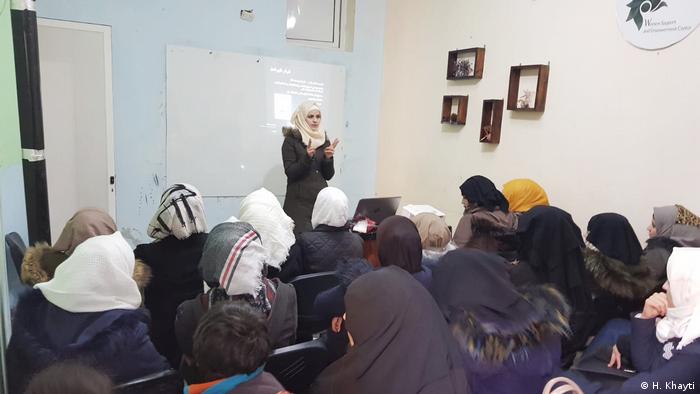
 And Khayti is unshakeable in her mission. With support from the aid group Medico International she quickly built up the Women Support and Empowerment Center Idlib, once again offering courses on a variety of pertinent subjects. She says Islamists in Idlib leave her and the group of regional women she works with alone.

 On the telephone, Khayti explains that the center is in the heart of the city, near the market. She says the location makes it easy for everyone to reach and that she sometimes has as many as 25 visitors a day. Though, she adds, depending on how heavy bombings are on any given day, that number may be as low as three.


 Life is particularly difficult for women during times of war. The economic situation is disastrous, many have experienced violence and others are traumatized. Infrastructure such as medical care and schools are also wholly lacking, forcing many mothers to teach their children at home. Some subjects like English are available to mothers at the center.

 Still, Khayti says they can't plan for the future. "We have to take things as they come each day — whether at home or in the center. There is no such thing as normal everyday life, the bombardments can start at any time."

 Despite her situation, the revolution goes on for Khayti. She says her fight to help improve the situation for women has nothing to do with where she happens to be at any given time: "I'm here because I know it's the right thing to do. I want to stand up for the Syria I want to live in."

 Khayti lives by herself. She never married and she has no children. "I'm only responsible for my own life," she says, "but I really miss my parents." When she decided to relocate to Idlib she had to make a promise to her father. When they parted, he pleaded with her: "Please don't break my heart. I don't want you to suffer the same fate as your brother." Khayti says she thinks of her father's words often.

 "If Assad's troops do eventually take Idlib I'll have to flee to a refugee camp in the north and try to get across the Turkish border. I can live with the bombs, but I can't live with the thought that Assad will be in charge of Idlib and the whole of Syria." '

Huda Khayti decorates a wall with paint in IdlibHuda Khayti speaks in front of a group of people

Saturday, 22 February 2020

The Syrian economy on the verge of collapse


 'A devastating civil war and international sanctions have destroyed Syria’s economy, leaving it with a GDP that is a third of what it was in 2010. The monetary crisis and depreciation of the currency is the latest chapter of the country’s economic meltdown. Despite the lack of accurate statistics, some agencies such as the UN Development Programme estimate that 83 per cent of Syrians live below the poverty line and close to 12 million are in immediate need of humanitarian aid.

 The conflict has also had a drastic impact on economic activity. According to Chatham House researcher Zaki Mehchy, “By 2018, the total accumulated economic loss was estimated at about $428 billion, which equalled six times Syria’s GDP in 2010.”

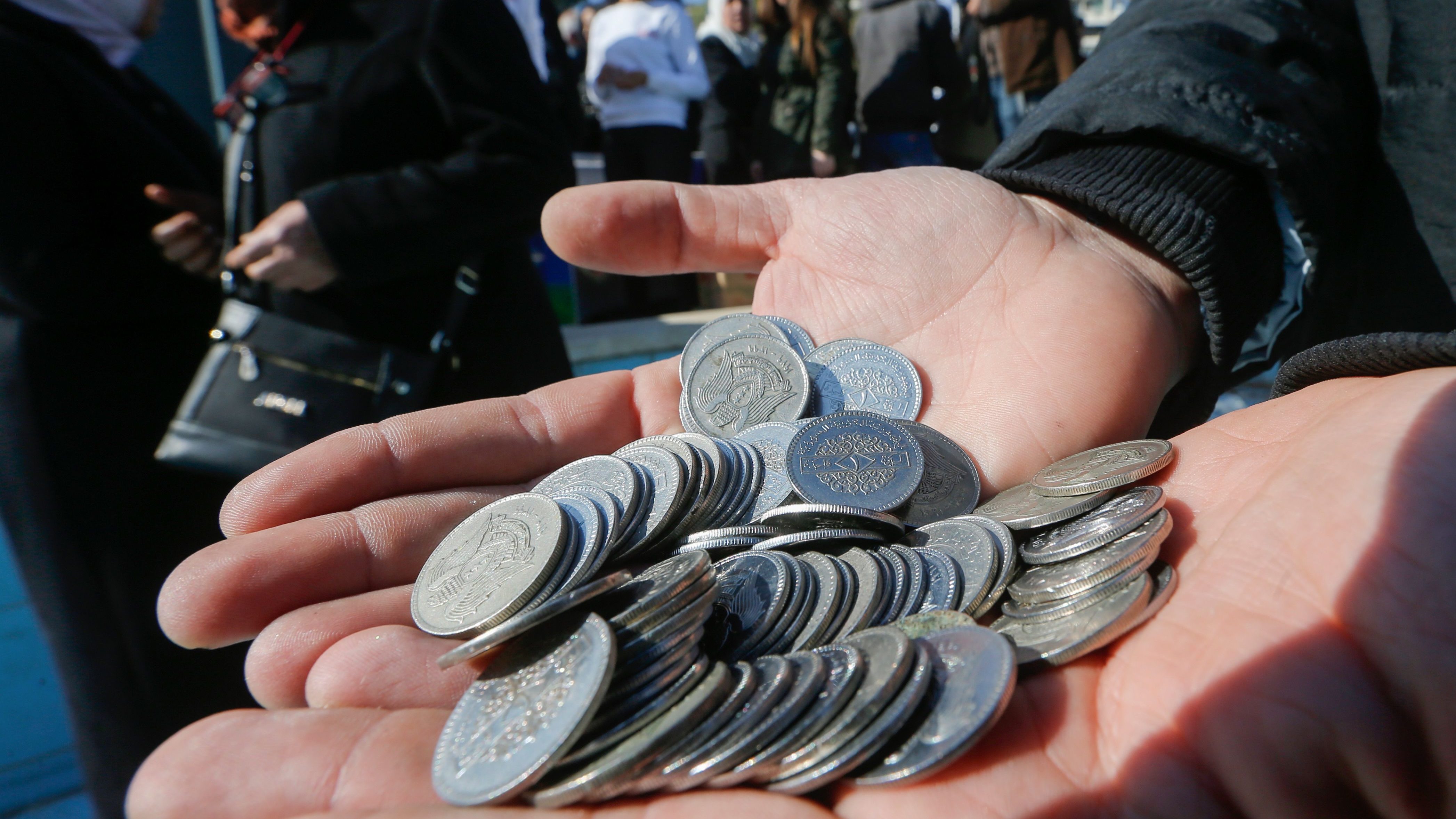
 The reduction in local purchasing power has hit Syrian citizens who are already facing a lack of basic services, such as access to clean drinking water, electricity, gas and fuel. The Syrian pound has nosedived to an all-time low, from 47 pounds to the US dollar in 2011, to almost 1,200 to the dollar last month.

 Most of this can be attributed to the depletion of the country’s foreign currency reserves, which stood at $16 to 18 billion before the war. By supporting the regime’s war efforts, the Syrian Central Bank now has between just $700 million to $1.2 billion of foreign reserves left. This prevents the bank from taking any meaningful action against the falling currency.


 According to Souhail Belhadj-Klaz, a researcher on the transition process in Syria at the Geneva-based Graduate Institute, the country cannot reverse this trend if its regional and international isolation persists or increases. However, despite numerous obstacles, he said that Syria is not yet at the stage of hyperinflation. “This means that inflation in Syria is not out of control, and Lebanon and Russia are still providing stabilising support,” he told me.

 Economic turmoil in neighbouring Lebanon, though, means that a vital source of hard currency from Syrians living there has been cut off. Syria’s economy has, in fact, depended on banking ties to Lebanon to keep business and commerce running. Lebanese banks imposed tight controls on hard currency transfers abroad and cash withdrawals, leaving many Syrians unable to access their accounts. The Syrian diaspora has been using Lebanon’s financial system as a conduit for sending funds to their relatives in Syria estimated at hundreds of millions per year. Cutting this off may be an existential blow to many individuals as well as to numerous Syrian importers, with a corresponding effect on the Syrian economy. Lebanon’s crisis has also affected the value of the Syrian pound, which has depreciated rapidly since mid-October when the protests broke out in Beirut and other major cities.

 Syria’s President Bashar Al-Assad has taken some emergency steps to try to halt the dramatic fall of the pound. He has banned the use of foreign currencies, for example, and violators face a prison sentence with hard labour.

 It is not clear, however, how Assad’s decree would apply to importers, as the government has stopped granting import licences for all but basic commodities. Since the beginning of the civil war, Damascus has become very dependent on external trade partners and almost all import payments are made in foreign currency, which increases the pressure on the Syrian pound.

 In order to improve living standards, Assad’s regime announced an increase in monthly salaries for public servants of around $28 dollars last November. Many analysts, though, suggest that the government covered the cost by simply printing more money, further reducing the currency’s value.

 In Belhadj-Klaz’s opinion, one of the ways to slow down currency depreciation and the destruction of the Syrian economy is to stabilise conflict at the national and regional levels — with Turkey — as a complete resolution is not possible at the moment, something of which the Syrian authorities are well aware. This would depend only partially on the will and capacity of the Assad regime.

 What’s more, in the absence of direct foreign investments and ever-declining exports, the Assad regime’s space to manoeuvre is limited. The regime knows that Western states will not participate in the reconstruction process without a negotiated political transition, leaving Damascus with few options.


 Assad has far better chances for negotiating economic support from the Gulf countries, said Belhadj-Klaz. Saudi Arabia and the UAE supported the late President Hafez Al-Assad in terms of grants, loans and investments, enabling the Syrian government to overcome several crises throughout the 70s, 80s, early 90s and later. Indeed, for the past two years, his son Bashar’s regime has been trying to set conditions for the re-establishment of relations with the Gulf States. However, any breakthrough would also require Assad to cut his links with Tehran, a precondition that he is unlikely to accept.

 However, support from his fellow Arab regimes, if any at all, may be too late if accumulated economic problems spiral out of control as the recent protests suggest. After a decade of economic and existential despair, citizens of Shahba in Sweida province have lost their patience and gone out onto the streets to express their anger over rising prices, sanctions and the dire economic situation. While the protests have been anything but frequent, such public displays of dissatisfaction could spill over to the rest of the country, as has happened in Iraq, and perhaps lead to another Arab Spring and the overthrow of Assad.

 According to Belhadj-Klaz, this is not likely, as the Syrian regime has managed to break up and isolate urban and village communities creating thousands of micro-territorial units with which it has negotiated micro-agreements of “non-aggression” or “support”. Hence, the spillover effect to other parts of the country is not very likely, with large parts of the country still insecure. Furthermore, the demography in Syria is against another popular uprising. As he pointed out, most of the younger generation have either left the country or are internally displaced and struggling for survival.

 Nevertheless, Assad may barely survive the civil war. He may have retaken most of Syrian territory, but how long can he survive the economic crisis? Long term currency stability requires a healthy economy and a development strategy that at the moment seems like mission impossible.'

Image result for With the Syrian economy on the verge of collapse

Saturday, 15 February 2020

Ariha: An ancient Syrian town emptied and destroyed


 'On both sides of Ariha’s Market Street stand dozens of shops selling sweets. Their windows display the full range for which the city is famous: mushabbak; awwama; halawat al-jibn. Most important of all is shuaybiyyat, the town’s great pride and trademark, with which it’s practically synonymous, such that the name Ariha can hardly be mentioned without adding shuaybiyyat. The sweet traveled with the city’s people throughout their displacement and exile—it’s enough for a shop anywhere in the world to write “Ariha shuaybiyyat” on its façade to draw the attention of Syrians.

 The town’s cardamom market, meanwhile, is the last of its kind in the surrounding region, popular especially with people from the nearby towns and villages of Jabal al-Zawiya, for whom Ariha is a marketplace in which to sell their produce, and a center for shopping, studying, healthcare, and work.

 Like a beehive, the town buzzes each day till the late hours of the night. Or rather, it did, until 2020 brought abrupt changes to the town, in the form of an intense military campaign by the Assad régime and its allies, which grew more intense still after the latter took over the city of Ma’arrat al-Nu’man along with other towns and villages in the environs.


 The images and videos now coming out of Ariha depict widespread destruction across the city. Local activists estimate around 30% of Ariha has been totally leveled, and a further 20% partially damaged. They also believe some 90% of Ariha’s residents have fled in recent weeks to seek refuge in safer areas, as the air and artillery bombardment intensify, and residents fear a ground advance by the régime towards the city.

 During the month of January alone, local civil defense crews documented four direct airstrikes on Ariha’s main market, as well as another market, a hospital, a bakery, and the civil defense staff themselves. A mosque, a kindergarten, a school, and numerous civilian houses were also hit. At least 25 civilians were killed, including seven children and numerous medical staff, most recently Zakwan Tammaa, the administrative director of al-Shami Hospital, who died of wounds sustained in the strikes. Dozens more have been injured.

 The bombardment has rendered most medical services inoperative in the town, according to an announcement by the Idlib health directorate, which said the attack on al-Shami Hospital left no more health centers operational across the entirety of southern Idlib province. In recent months, Ariha had taken in large numbers of people displaced from elsewhere in the province, who were forced to live in harsh conditions due to the suspension of aid from humanitarian organizations, according to Muhammad Khalid al-Attar, an engineer and member of the “Youths for Syria” organization, which was active in and around Ariha before suspending its work recently. “Today, the town is practically empty,” he says. “Most Internet towers have been dismantled and transported. The same goes for bakeries, most of which have been taken apart and moved, while others were destroyed by bombardment.” Al-Attar describes one recent night in Ariha as having been “pitch-black,” with residents too afraid of being targeted to light up so much as a lamp.

 “Only a small minority remained in the city. Electricity generators and water containers have stopped, as have all Internet networks, except one working at a specific location,” says media activist Sulayman Abd al-Qadir. A local woman who requested anonymity said the city was “completely shut down, with no activity except the work of the civil defense teams.”


 It was a “miracle,” says Layla Saeed, a humanitarian activist from Ariha, that she and her children survived the strike on al-Shami Hospital, which happened to be located near her home. They woke to the sound of a blast that smashed the windows and doors of the house.

 “There was thick dust, and dirt and shrapnel everywhere. We took cover in a side room away from the main street, only for another rocket to land, punching a hole in the wall of the room. I ran with my children toward the bomb shelter underneath the building. The sound of crying and screaming filled the air, until it was overpowered by a third blast, and then the sirens of the ambulances and civil defense crews looking for survivors under the rubble. When I came out, I was carrying a bag containing my ID papers. I took one last look at the wreckage of my house, and left.”

 The days and sleepless nights leading up to this attack, on the night of 29 January, had already seen numerous families depart the town. When the attack came, almost everyone remaining decided to leave. “The streets filled with buses waiting to take them away,” says Layla. “This time there was no Ariha to greet them. Most headed for the camps in the north, while others wandered aimlessly, not knowing where their feet were taking them.”

 “Will the city fall?” This, says Layla, is the question that has haunted her ever since, and was etched on the frightened faces of all the residents that joined her on the journey of mass displacement.

 Abu Ahmad, another Ariha resident, describes the events of that day as “apocalyptic:” people shouting through walkie-talkies at the civil defense and ambulances to arrive; others searching for survivors after the first raid, soon followed by the others on the same target to kill the greatest number possible of civilians and rescue workers; collapsed buildings with women and children fumbling for exits in the darkness. Most of those killed were displaced people from elsewhere, who had fled to Ariha from battles in their own towns and villages, only to find death waiting for them once again. “Nowhere is safe anymore,” says Abu Ahmad, “Death is everywhere.”


 Ariha is located to the south of Idlib City. In official administrative terms, the greater Ariha area comprises 55 smaller towns and villages, as well as 44 farms. The town of Ariha itself has great geographic significance within Idlib Governorate, in that it sits in the middle of four major cities: Jisr al-Shughur to the west; Ma’arrat al-Nu’man to the south; Saraqeb to the east; and Idlib to the north.

 The Ariha area also contains the Arba’een mountain, part of the Jabal al-Zawiya series of mountains, reaching a height of around 1,000 meters above sea level. This strategic highland overlooks the national M4 highway connecting Saraqeb to Latakia on the Mediterranean coast, as well as the road from Ariha to Idlib, and a number of towns and villages in Jabal al-Zawiya and even southern Aleppo Province. Whoever controls Mount Arba’een, therefore, enjoys the ability to cut their opponents’ supply routes and monitor their movements or incoming assaults.

 For this reason, the Assad régime had fought hard to keep hold of Ariha in the early years of the revolution, which had seen three attempts by opposition factions to liberate the town by the end of 2014. Local residents paid dearly for their eventual release from the régime’s rule, with around 1,300 killed as of the start of 2015. On 28 May, 2015, the jihadist-led “Army of Conquest” coalition succeeded in taking control of the town after driving out the régime.

 Ariha represents a mid-point between Aleppo and the Mediterranean, on the one hand, and between Idlib and Ma’arrat al-Nu’man, on the other. In addition, the road leading to it from Jisr al-Shughur hems in all the towns and villages of Jabal al-Zawiya, which is one reason so many of their residents fled, fearing besiegement.


 Ariha today contains local fighters from the town itself as well as the surrounding villages. Some spoke said they first moved their families to safe locations and then returned to defend the area. They were reluctant to divulge details about their preparations, saying only that they would do what they could to keep the town out of the régime’s hands.

 Al-Attar, the engineer and activist, does not downplay the significance of the local resistance, though he recognizes the disparity between the scale of the air and ground bombardment pounding the town and the ability of the lightly-armed locals to combat them. For their part, fighters encountered by al-Jumhuriya said the régime’s forces were heading for the city of Saraqeb, east of Ariha, and would be concentrating the bulk of their firepower there. The fighters asserted the military map would change in the coming days, since the régime had been sustaining large losses in men and materiel, while new fronts had been opened in the Aleppo countryside as opposition factions mounted counter-attacks.

 Subhi al-Khalid, a local activist from Jabal al-Zawiya, says that regional and international factors may prevent the régime from succeeding in its ambition to control all of the M4 and M5 highways in their entirety; an aim that, if accomplished, would inevitably mean the capture of Ariha. By way of evidence, al-Khalid points to an intensifying dispute between Russia and Turkey, made manifest in Turkey’s deployment of five observation posts around Saraqeb. One such post has faced direct fire from Assad régime forces, killing Turkish troops in the process, and prompting a wide-ranging response from the Turkish army against régime positions. These developments, al-Khalid argues, indicate Turkey aims to prevent the régime from taking the highways in full.


 Since antiquity, Ariha has been bound to the city of Aleppo. In his 13th-century Encyclopedia of Countries, the geographer Yaqut al-Hamawi described it as “a small town on the outskirts of Aleppo; the most verdant and luscious on God’s earth; endowed with green fields, trees, and rivers.” Indeed, as well its famous sweets, Ariha is also renowned for cherry trees. It was a breathing space for the surrounding region’s residents, especially Aleppans, with its touristic sites and ancient archaeological monuments. As for its name itself—which it shares with the biblical Jericho—it is thought to hail from Aramaic roots, meaning “the sweet fragrance of flowers.” '

Thursday, 13 February 2020

A doctor in Idlib: 'It cannot get more evil than this'


 'My name is Dr Tarraf. I was born in Al-Mash'had, one of the urban slums of Aleppo, on February 1, 1982 - the day the terrifying Hama Massacre began. Over 27 days, Syrian soldiers razed the city, killing 20,000 people, to put down a rebellion against the rule of President Hafez al-Assad, the father of current President Bashar al-Assad.

 My family is originally from a small village in Idlib province called Haas, about 10 kilometres (six miles) west of Maaret al-Numan. We moved back there in 1995 because our small apartment was not large enough for our growing family.

 I was the second child in a large household of six boys and two girls. One of my brothers, Mustafa, has managed to move to Germany to start a new life. I call him the only survivor of the family.

 Of the remaining five boys, two have been lost to Syria's war, two have had their lives and studies put on hold because of the fighting and detentions, and I no longer make plans for the future.

 My work as a doctor has become unbearably exhausting - both physically and mentally - since the régime launched its Idlib operation last spring. At the time, I worked at two hospitals, Kafr Nabl surgery hospital and Maaret al-Numan central hospital. These facilities were the closest to the régime's front line, and came under intense bombing for a long period of time. There was a constant stream of casualties coming to the hospital. The medics literally did not get a chance to rest.


 I remember one of the worst days, August 28, 2019, when the main vegetable market in Maaret al-Numan was targeted by an air raid from a Syrian army jet. We had six operating rooms in the hospital, and only eight doctors. Soon after the air raid, injured people began streaming in, along with dead bodies. Within five minutes all the operating rooms were full. I was the last surgeon to get there.

 I walked in to find two patients, both needing immediate help. As a doctor, I had to choose which one to treat and which to transfer to another hospital some 30 minutes away - something we do when there are limited resources and many cases to attend to. The first patient was a man in his thirties who was in hemorrhagic shock. The other was a three-year-old-boy who was bleeding from shrapnel in his chest; he was also in shock.

 It was a terrifying moment in which I had to make a choice; one which would help one patient but might lead to another dying on the way to the referral hospital. I had no other choice but to choose, so I chose the child.

 It was a difficult choice. But I thought about my two-year-old son. I saw that child as if he were my own, and so I chose to help him. I started treating him, I opened his abdomen, tried to stitch blood vessels. But after 15 minutes we, unfortunately, could not save him, and the anesthesiologist declared him dead. I went out of the operating room to find that the man was still there, still waiting for an ambulance, as they were in high demand.

 I got back to work, trying to save him as well. I started a blood transfusion in the waiting room; I opened his abdomen and made thoracentesis. But unfortunately, the man also died after 30 minutes of trying to help him.

 I had just left the operating room, frustrated and exhausted, when a local man asked me about the patient. I told him he had died. He then asked me about the child, and I told him he was dead, too. He then told me: "You know, doctor. The two were a man and his son."

 It was one of the worst, most traumatising, moments of my life. I will never forget it because I failed to save both the man and his son.


 At the hospital, there were so many critical cases in urgent need of help. So I would always be under pressure and suffer from insomnia.

 More than a month before that August day was another horrifying moment. It was after sunset on July 10 when Maaret al-Numan hospital came under attack. The facility was badly affected and the electricity generator was damaged.

 I was the doctor on duty and, along with other colleagues, decided we needed to evacuate the hospital and all the patients. But the most worrying part was when we had to evacuate the newborn incubators. The hospital had six of them. All those babies needed to remain there; but we knew the régime might target the hospital again, so they had to be moved. We continued with the evacuation, but some of the babies died along the way.

 Some of the patients, about 10 percent, refused to be evacuated. It was a very difficult moment. But as medics we decided to stay with them, accepting the potential risk of being hit a second time by the air raids. Two hours later, régime helicopters dropped barrel bombs on the town of Maaret al-Numan. The hospital received dozens of injuries. We managed to save most of them because we stayed.

 After the régime's latest campaign in Idlib, I sent my family to the Turkey-Syria border where it is safer, while I remained working in hospitals in Idlib.

 But for months before, every time I went to the hospital, I would say goodbye to my family as if I would never see them again. There was always the thought that I would go to the hospital and never come back.

 It was mentally exhausting, because we had to work under constant bombing. Whenever I heard jets in the sky, I would think the hospital would be the next target. That put those of us in the medical field under enormous psychological pressure. And it made my family and loved ones worry constantly. They contact me every once in a while to make sure I am not hurt. Especially my parents, who have already lost two sons, Yusuf and Huzaifa.


 When we were young, our family did not have much. But my parents tried their best to provide a decent life for my siblings and I.

 Although all eight of us were very good at school, life began to get harder when my brothers and I started college. My father's salary was hardly enough to cover basic family needs. My eldest brother, Yusuf, went to medical school in 1999 and I did the same in 2000. My father started to borrow money, and those debts began to accumulate. With more college bills as the years continued, my family remained in debt until my brother and I graduated from college and started to work overtime shifts in hospitals in addition to our specialisation internships.

 In 2011 the Syrian revolution started. Yusuf was by then a doctor at the Tishreen Military Hospital, near Damascus. He was a resident doctor specialising in general surgery and I was in my last year of a urology specialisation at the Al-Muwasat Hospital in Damascus. Our brother Huzaifa was in his last year at medical school.

 Soon after, Yusuf left Damascus and moved to Idlib. Then he left his government job and started to help people in our hometown, where people were being shot during protests and later killed by régime bombardment. I remained in Damascus until I finished my thesis and got my degree.

 Then, Huzaifa was arrested in late 2012 at the university campus in Damascus. I did my best to get him out and paid huge amounts of money to get him released. I reached out to an intermediary involved in these types of transactions. However, when he found out Huzaifa was a doctor he said he could not help.

 "It is easier to secure the release of a [opposition] militant or a protester from prison than doctors," he told me.

 We found out two months later that Huzaifa had been tortured and killed in custody.

 I moved back to Haas, our village, and the revolution had by then become militarised. Yusuf and I remained firm in our commitment to revolutionary principles by helping people in the field hospitals. Another one of our brothers, Qutaiba, was arrested during his last year of civil engineering college but later released, after which he decided to go back to the village and never dared to return to university.

 Our youngest brother, Ubayda, finished high school and got into computer engineering college, but he did not dare to continue after his first year because he was afraid of being arrested. So we all remained in the village. All besides Mustafa, who went to college, where he started to study communication engineering, and then managed to move to Germany to continue his studies.


 In 2016, Haas was bombed. The régime targeted a complex of schools on October 26 in what later came to be called "the Massacre of Pens", since the régime deliberately targeted the schools complex and all the roads nearby. Most of the victims were children in elementary school.

 Many medics were killed, too. My brother Yusuf was in the village and rushed to the place that had been targeted because he wanted to help those in need of medical assistance. The régime planes targeted the same place deliberately and he was among the victims.

 Régime forces always do that. They would target a location with air raids and when people come to help any survivors, they would target the place again several minutes later. And a third time as well.

 Our house had been targeted repeatedly throughout the entire revolution, but with the help of my brothers we had always managed to fix it. The last time it was targeted it was destroyed completely, as was my house.

 Now, I have no plans for the future. We live day by day, here. I cannot even think of tomorrow. Just today another battle started a few hours ago, with non-stop air raids and artillery shelling, injuries constantly coming to the hospital in the city of Idlib, where I now work.

 My worst fear is for the future of Syria. Syria is turning into the worst possible thing a state can be: A failed state plus a dictatorship, combined under occupation. It cannot get any more evil than that.'