Dani Qappani:
'Speaking during a television interview on a Syrian state TV channel in mid-January, Bouthaina Shaaban, the Political and Media Adviser to the head of the Syrian régime, claimed that the Syrian economy is fifty times better than it was in 2011.
As usual with Shaaban's speeches, Syrians' reaction was one of disbelief.
With the Syrian economy in an unprecedented nose-dive, even while Shaaban made this claim, and the value of the Syrian pound reaching 1,000 to one US dollar, all but Assad's super-rich elite are struggling to meet their most basic daily needs, not just in areas controlled by the Syrian régime and its Iranian militia allies, but nationwide.
Even before Shaaban's ill-conceived claims, the worsening economic conditions, among other factors, had already led to widespread discontent even in traditionally régime loyalist areas.
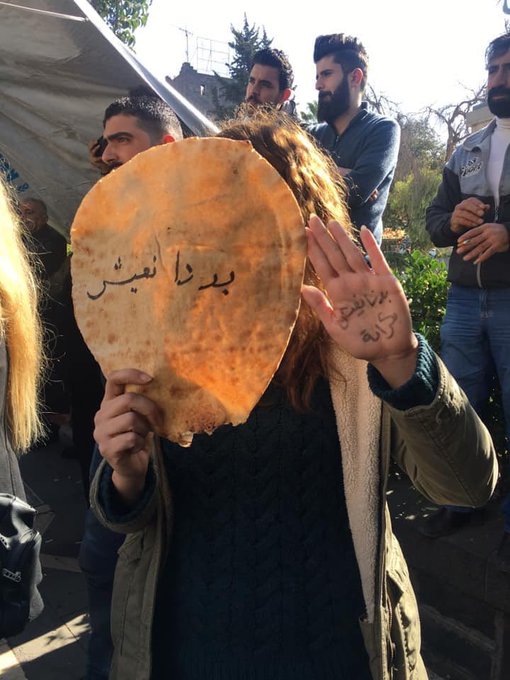
In the majority-Druze province of Suweida in south Syria, local people held demonstrations condemning the régime's corruption and incompetence with banners bearing slogans like 'We Want to Live' and 'The Syrian Media is Fake'.
The economic crisis has further increased the already heavy burden on Syrians still suffering from the consequences of the war that has spanned nine years to date.
The régime has effectively bankrupted the country to maintain power. Many of those who survived the relentless bombing by Syrian, Russian and Iranian air and ground forces that reduced whole villages, towns and city neighbourhoods to rubble, now have no choice but to return to their destroyed areas.
They have to accept the régime's 'security agreements' and try to start afresh amid the ruins of their homes, with no sign of hope, improvement or freedom on the horizon.
"It's been outlawed for people to even carry any dollars in their pockets, so how should someone try to exchange it in an open manner?!" said Mahmoud Al-Ahmad*, the owner of a currency exchange bureau in the city of Damascus.
"This is due to Bashar al-Assad's decree banning foreign exchange trading – those who do so face security prosecution, possibly imprisonment or heavy fines. This issue wasn't considered important [by the régime] previously with no decree banning it but with the issuance of the decree, it became impossible.
"We exchange dollars in a private way, not according to the exchange rate from the Central Bank, but rather according to the market price; if the price of one dollar in the central bank is 700 Syrian pounds, and in the market 1,000 pounds, we exchange it at 950 or 900 Syrian pounds," Al-Ahmad added.
Asked about the reason for the decline in the exchange rate of the Syrian pound against the dollar, he said, "There are many hidden reasons. It seems to me that Russia and Iran have reduced their foreign exchange support for Syria – what is certain is that the movement in Lebanon is a major reason.
"The Syrian merchants were bringing foreign currency, especially dollars, from the banks of Lebanon, and with these banks lacking cash liquidity, merchants could no longer take their money from there. There is no doubt that the Caesar Act sowed fear in the hearts of merchants and régime supporters, which prevented them from dealing in cash in Syria."
Although the accelerating pace of events in neighbouring Lebanon constitutes one of the causes of the financial meltdown in Syria – due to the closure of the Lebanese banks used by Assad's régime to transfer money from abroad in order to avoid the sanctions imposed on it – the Syrian régime itself bears the greatest responsibility for this deterioration in economic conditions and in every other aspect of life.
It is difficult for non-Syrians to conceive the endemic corruption at every level within the Syrian state, where the régime's government and all state institutions work solely under the orders of the security services overseen by Assad and backed by Iran and Russia.
The sole concern of Assad and his backers and, therefore, of all state bodies, is restoring absolute control over Syria's land and people, who are treated, in effect, as chattels to be subjugated through terror, intimidation and silencing of any dissent.
Corruption is, thus, an innate part of a system based on exploitation and self-enrichment, with this culture of impunity at every level affecting all aspects of life, further increasing the economic hardships for the vast majority.
Among the worst affected are the hundreds of thousands of Syrian women who have been left widowed or whose husbands are imprisoned or 'disappeared' by the régime for participating in the revolution.
With no family breadwinner and with young children to raise, these women have been forced to find any work, usually in menial, low-paid jobs due to the lack of employment opportunities.
Samar B*, a resident of Damascus whose husband was detained by the régime some years ago, now lives with her two children, her mother, and her sister.
"The [monthly] salary that I earn from the government job is $60 after the last increase, and my sister's salary from her job is about $50," she says.
"The rent for the house we live in isn't high compared to other homes, and is around $60 per month. The cost of living for us is about $100 per month, while the bills are $20.
"I work for 13 hours a day so I can support my family. I think that the deteriorating economic conditions are due to several reasons, the first of which is that the régime has gone bankrupt after it sold the country to foreigners. Also, oil returns aren't used for our benefit, and the ports were sold to Russia. Eastern Ghouta was a major source of currency for the régime, but the state treasury has been depleted for years to come," she adds.
"I don't think that the situation is going to improve; on the contrary, it's in an accelerating deterioration. But I am happy because the supporters of the murderous régime are also starving today."
However as much as the situation deteriorates, it's unlikely that the people in Damascus will break their silence or protest in the near future. The situation in Damascus is very different to that in Suweida, which has largely been spared the bombardment, arrests and siege endured for years in Damascus.
In the traditionally loyal Syrian coastal areas, where a majority still supports the Syrian régime, the situation is a little different.
Ahmad. N* is a resident of the city of Latakia, where he runs a shop. "Things are worse here than before," he said.
"My wife and son were forced to work in order to be able to keep us afloat financially. With the rise in prices due to the fall in the price of the Syrian pound compared to the dollar, not everyone is able to secure their needs, or even buy basics.
Even supporters of the régime, despite Bashar al-Assad's ruling preventing the circulation of the dollar under penalty of punishment, people are still dealing in it more than before, due to the instability of the lira price. Everyone is pessimistic about what will come. The continuation of the war and its cost, the state's failure to assume its responsibilities towards the citizens, and the widespread corruption, in addition to the security services' control of everything, has made our area a treacherous forest that's very difficult to live in. We see death coming to us, and there is nothing we can do!"
It is no secret to anyone that the Syrian economy began to crumble since the US president signed the Caesar Syria Civilian Protection Act in late December last year.
Also known as the Caesar Act, it is a United States legislation that sanctions the Syrian régime, including Bashar al-Assad, for war crimes against the Syrian population. However, the bill has not been passed into law yet.
But even without the Caesar Act, the dire conditions for most Syrians would not have improved.
The Syrian régime's monopolising and exhausting of all the state's resources to fund its war against its own the people, and the selling or giving away most of these resources to its backers in Russia and Iran to pay for their support, was the final straw for an economy already buckling under the decades-long damage by the Assad régime.
The war has effectively compounded the existing status quo, wiping out the already precarious middle class, leaving two classes in Syria – the Assad's and their small wealthy elite of family and beneficiaries, and the crushed majority.
For the Assads, as always, every solution to the problems besetting the nation lies in punishing and extorting this already crushed majority further. Instead of proposing solutions to renovate, rebuild and improve the nation, based on study, research, analysis and a positive vision of Syria's future, the régime is intent on further persecuting the people.
While the Syrian people are still, as always, expected to endlessly suffer, fight and/or die to protect this status quo, to accept foreign occupation and 'ownership' of their nation, and to view imprisonment torture and 'disappearance' as the natural price of any dissent, the régime elite continues to live in extravagant luxury with a fortune of hundreds of millions of dollars plundered from the Syrian people deposited in offshore accounts around the world.
For Assad's inner circle, the terrible suffering of the majority of Syrians is a faraway inconvenience that doesn't affect their lives any more than those of any wealthy American or Russian. Assad's children and those of his elite will live in luxury in grace-and-favour homes in Russia, while ordinary Syrians die.
We don't yet know whether the collapsing Syrian economy, the worthless currency and atrocious living conditions will push Syrians to rise up again against the régime and its bloodthirsty sponsors, or if the régime will perhaps try to win international favour by abandoning its war against the people after the Caesar Act goes into effect.
But after reducing a nation to rubble and ashes, selling its resources to foreign states, killing or dispossessing over half its population and leaving the survivors in penury in order to cling to power, one thing is near certain, Assad's morally and fiscally bankrupt régime is living on borrowed time.
*False names have been used to protect the identity of those who face persecution for any condemnation of the régime'


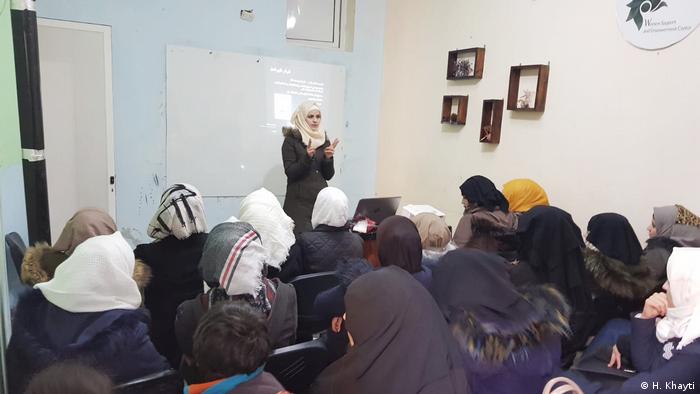
' "I'll call you back later," says a hurried Huda Khayti as she cuts short our interview on the situation in Idlib. Then she hangs up. This is the how our communication has been going for days, as bombs — dropped by Syrian government forces — rain down on Idlib. Khayti, the director of the Women Support and Empowerment Center Idlib, promises to find a new place from which to call, one she hopes will be safer.
This happens repeatedly, several times a day. Finally, hours later, the phone rings again and she tells me she is fine. "That's the way life is in Idlib, in the city but also across the whole region. It has been that way for years. No one is safe here. But I have a good network," says the 40-year-old Syrian. "We have a kind of early warning system for air raids — we can literally smell the bombs and we can pretty well tell where they will hit." She says many residents have developed a sixth sense for attacks over the years.
Khayti has lived in Idlib since the spring of 2018. At the time, all those opposed to the Syrian government, whether members of the democratic opposition or militant rebels, were brought to Idlib province — controlled by the Islamist group Hayat Tahrir al-Sham — far away from the Assad régime.
"I had never been to Idlib. I had no idea what to expect," says the women's rights activist. But she knew it was just a matter of time before Syrian President Bashar Assad — bolstered by Russia and Iran — would try to capture the last rebel stronghold in Syria. Neighboring Turkey, on the other hand, has thrown its weight behind Assad's adversaries.
Since Syrian and Russian forces began their offensive on Idlib last December, some 900,000 people have fled the province, most of them women and children. Today, people continue to abandon their homes and their villages. Roads leading north to neighboring Turkey are jammed with cars full of people forced to flee for their safety, some for the third or fourth time.
Khayti got a taste of just how gruesome such battles can be back in her hometown of Douma, and then in eastern Ghouta, outside Damascus. "I'm from Douma. I survived one of the régime's poison gas attacks. I know what it's like to live and cower under a hail of bombs," she says. "But every bomb they drop on us here in Idlib only steels my resolve, and confirms to me that it was right to stay here and fight for Syria and for the Women's Center."
Khayti grew up in Douma before moving to Damascus to study French literature. She says her own personal revolution began in 2011, when she realized Assad's government was restricting women's rights and bullying its own people.
It was then that she started three women's centers in eastern Ghouta, where women could take workshops on a number of different subjects ranging from gender-based violence and first aid to English and women's rights. She says all of the centers in eastern Ghouta were bombed. One of those bombings killed a colleague and her child. Khayti's brother was also killed, devastating her and her family. Her voice becomes melancholy as she speaks of her family. "We did a lot together — we ate together, we depended on one another — we were all very close."
Khayti says her parents, six sisters and one surviving brother are spread out across the globe, with some in Turkey and others in Canada. Only a handful of relatives are still in Damascus.
"I can't go back to Damascus. I'm certain that I'm on one of the régime's blacklists," she says. That is because she was in favor of the revolution from the very start. She is against Assad and for régime change — for a democratic Syria. She says the revolution deepened her understanding of civil rights and women's autonomy. "I truly believe it was right to stand up and protest."
Khayti was alone when she came to Idlib with others from eastern Ghouta and Douma in 2018. Her parents and her brother had already fled to Turkey. Her voice trembles whenever she speaks of them. But then it grows more confident again: "I wanted to stay in Syria, to go to Idlib. There is a cross section of Syrian society here. Refugees from Homs, Aleppo, eastern Ghouta, but also people from right here in Idlib. I spent three months trying to find out as much as I could about society here — what the people needed. Soon, I was able to win people's trust."
And Khayti is unshakeable in her mission. With support from the aid group Medico International she quickly built up the Women Support and Empowerment Center Idlib, once again offering courses on a variety of pertinent subjects. She says Islamists in Idlib leave her and the group of regional women she works with alone.
On the telephone, Khayti explains that the center is in the heart of the city, near the market. She says the location makes it easy for everyone to reach and that she sometimes has as many as 25 visitors a day. Though, she adds, depending on how heavy bombings are on any given day, that number may be as low as three.
Life is particularly difficult for women during times of war. The economic situation is disastrous, many have experienced violence and others are traumatized. Infrastructure such as medical care and schools are also wholly lacking, forcing many mothers to teach their children at home. Some subjects like English are available to mothers at the center.
Still, Khayti says they can't plan for the future. "We have to take things as they come each day — whether at home or in the center. There is no such thing as normal everyday life, the bombardments can start at any time."
Despite her situation, the revolution goes on for Khayti. She says her fight to help improve the situation for women has nothing to do with where she happens to be at any given time: "I'm here because I know it's the right thing to do. I want to stand up for the Syria I want to live in."
Khayti lives by herself. She never married and she has no children. "I'm only responsible for my own life," she says, "but I really miss my parents." When she decided to relocate to Idlib she had to make a promise to her father. When they parted, he pleaded with her: "Please don't break my heart. I don't want you to suffer the same fate as your brother." Khayti says she thinks of her father's words often.
"If Assad's troops do eventually take Idlib I'll have to flee to a refugee camp in the north and try to get across the Turkish border. I can live with the bombs, but I can't live with the thought that Assad will be in charge of Idlib and the whole of Syria." '

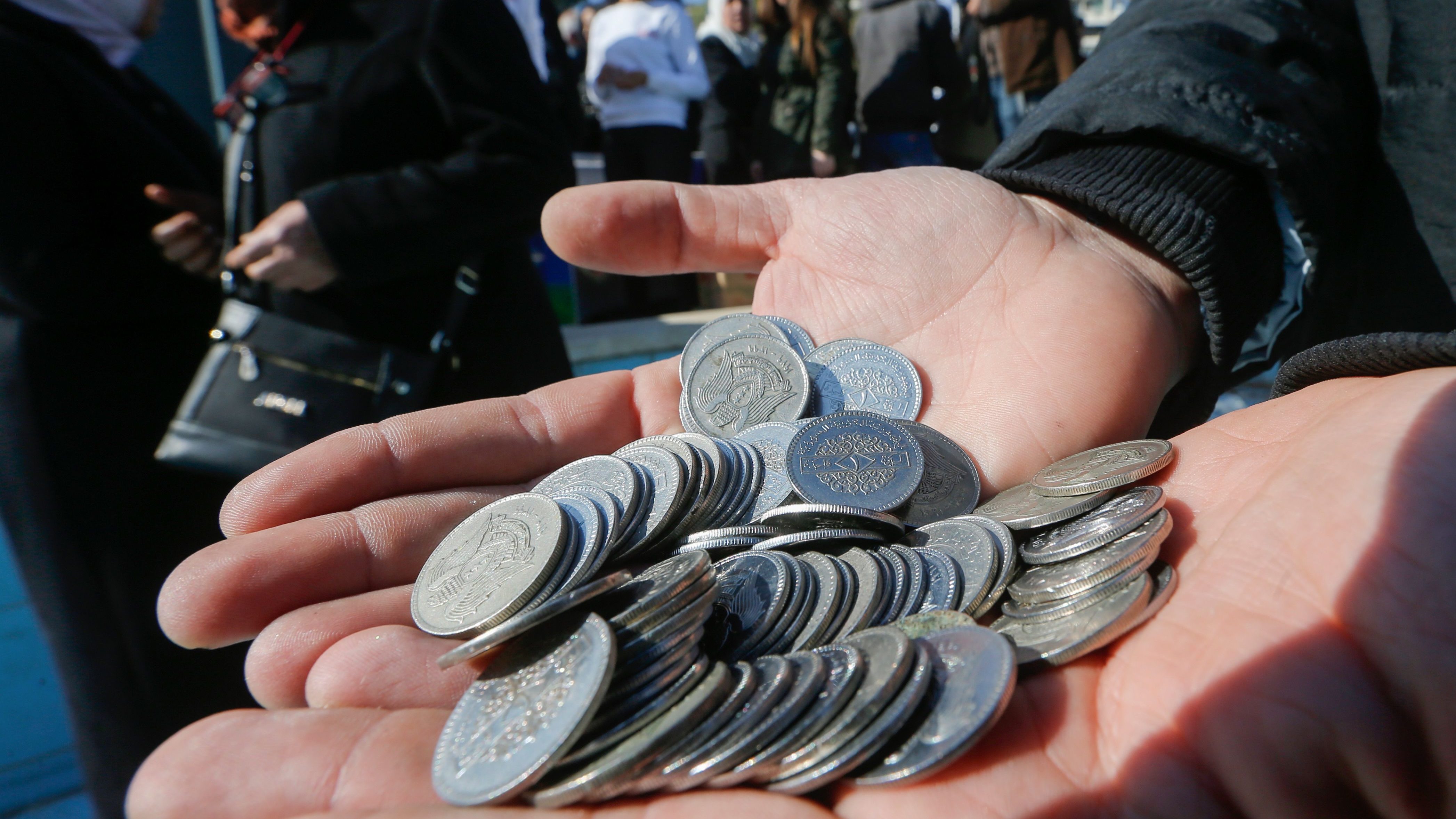
 'A devastating civil war and international sanctions have destroyed Syria’s economy, leaving it with a GDP that is a third of what it was in 2010. The monetary crisis and depreciation of the currency is the latest chapter of the country’s economic meltdown. Despite the lack of accurate statistics, some agencies such as the UN Development Programme estimate that 83 per cent of Syrians live below the poverty line and close to 12 million are in immediate need of humanitarian aid.
The conflict has also had a drastic impact on economic activity. According to Chatham House researcher Zaki Mehchy, “By 2018, the total accumulated economic loss was estimated at about $428 billion, which equalled six times Syria’s GDP in 2010.”
The reduction in local purchasing power has hit Syrian citizens who are already facing a lack of basic services, such as access to clean drinking water, electricity, gas and fuel. The Syrian pound has nosedived to an all-time low, from 47 pounds to the US dollar in 2011, to almost 1,200 to the dollar last month.
Most of this can be attributed to the depletion of the country’s foreign currency reserves, which stood at $16 to 18 billion before the war. By supporting the regime’s war efforts, the Syrian Central Bank now has between just $700 million to $1.2 billion of foreign reserves left. This prevents the bank from taking any meaningful action against the falling currency.
According to Souhail Belhadj-Klaz, a researcher on the transition process in Syria at the Geneva-based Graduate Institute, the country cannot reverse this trend if its regional and international isolation persists or increases. However, despite numerous obstacles, he said that Syria is not yet at the stage of hyperinflation. “This means that inflation in Syria is not out of control, and Lebanon and Russia are still providing stabilising support,” he told me.
Economic turmoil in neighbouring Lebanon, though, means that a vital source of hard currency from Syrians living there has been cut off. Syria’s economy has, in fact, depended on banking ties to Lebanon to keep business and commerce running. Lebanese banks imposed tight controls on hard currency transfers abroad and cash withdrawals, leaving many Syrians unable to access their accounts. The Syrian diaspora has been using Lebanon’s financial system as a conduit for sending funds to their relatives in Syria estimated at hundreds of millions per year. Cutting this off may be an existential blow to many individuals as well as to numerous Syrian importers, with a corresponding effect on the Syrian economy. Lebanon’s crisis has also affected the value of the Syrian pound, which has depreciated rapidly since mid-October when the protests broke out in Beirut and other major cities.
Syria’s President Bashar Al-Assad has taken some emergency steps to try to halt the dramatic fall of the pound. He has banned the use of foreign currencies, for example, and violators face a prison sentence with hard labour.
It is not clear, however, how Assad’s decree would apply to importers, as the government has stopped granting import licences for all but basic commodities. Since the beginning of the civil war, Damascus has become very dependent on external trade partners and almost all import payments are made in foreign currency, which increases the pressure on the Syrian pound.
In order to improve living standards, Assad’s regime announced an increase in monthly salaries for public servants of around $28 dollars last November. Many analysts, though, suggest that the government covered the cost by simply printing more money, further reducing the currency’s value.
In Belhadj-Klaz’s opinion, one of the ways to slow down currency depreciation and the destruction of the Syrian economy is to stabilise conflict at the national and regional levels — with Turkey — as a complete resolution is not possible at the moment, something of which the Syrian authorities are well aware. This would depend only partially on the will and capacity of the Assad regime.
What’s more, in the absence of direct foreign investments and ever-declining exports, the Assad regime’s space to manoeuvre is limited. The regime knows that Western states will not participate in the reconstruction process without a negotiated political transition, leaving Damascus with few options.
Assad has far better chances for negotiating economic support from the Gulf countries, said Belhadj-Klaz. Saudi Arabia and the UAE supported the late President Hafez Al-Assad in terms of grants, loans and investments, enabling the Syrian government to overcome several crises throughout the 70s, 80s, early 90s and later. Indeed, for the past two years, his son Bashar’s regime has been trying to set conditions for the re-establishment of relations with the Gulf States. However, any breakthrough would also require Assad to cut his links with Tehran, a precondition that he is unlikely to accept.
However, support from his fellow Arab regimes, if any at all, may be too late if accumulated economic problems spiral out of control as the recent protests suggest. After a decade of economic and existential despair, citizens of Shahba in Sweida province have lost their patience and gone out onto the streets to express their anger over rising prices, sanctions and the dire economic situation. While the protests have been anything but frequent, such public displays of dissatisfaction could spill over to the rest of the country, as has happened in Iraq, and perhaps lead to another Arab Spring and the overthrow of Assad.
According to Belhadj-Klaz, this is not likely, as the Syrian regime has managed to break up and isolate urban and village communities creating thousands of micro-territorial units with which it has negotiated micro-agreements of “non-aggression” or “support”. Hence, the spillover effect to other parts of the country is not very likely, with large parts of the country still insecure. Furthermore, the demography in Syria is against another popular uprising. As he pointed out, most of the younger generation have either left the country or are internally displaced and struggling for survival.
Nevertheless, Assad may barely survive the civil war. He may have retaken most of Syrian territory, but how long can he survive the economic crisis? Long term currency stability requires a healthy economy and a development strategy that at the moment seems like mission impossible.'

'On both sides of Ariha’s Market Street stand dozens of shops selling sweets. Their windows display the full range for which the city is famous: mushabbak; awwama; halawat al-jibn. Most important of all is shuaybiyyat, the town’s great pride and trademark, with which it’s practically synonymous, such that the name Ariha can hardly be mentioned without adding shuaybiyyat. The sweet traveled with the city’s people throughout their displacement and exile—it’s enough for a shop anywhere in the world to write “Ariha shuaybiyyat” on its façade to draw the attention of Syrians.
The town’s cardamom market, meanwhile, is the last of its kind in the surrounding region, popular especially with people from the nearby towns and villages of Jabal al-Zawiya, for whom Ariha is a marketplace in which to sell their produce, and a center for shopping, studying, healthcare, and work.
Like a beehive, the town buzzes each day till the late hours of the night. Or rather, it did, until 2020 brought abrupt changes to the town, in the form of an intense military campaign by the Assad régime and its allies, which grew more intense still after the latter took over the city of Ma’arrat al-Nu’man along with other towns and villages in the environs.
The images and videos now coming out of Ariha depict widespread destruction across the city. Local activists estimate around 30% of Ariha has been totally leveled, and a further 20% partially damaged. They also believe some 90% of Ariha’s residents have fled in recent weeks to seek refuge in safer areas, as the air and artillery bombardment intensify, and residents fear a ground advance by the régime towards the city.
During the month of January alone, local civil defense crews documented four direct airstrikes on Ariha’s main market, as well as another market, a hospital, a bakery, and the civil defense staff themselves. A mosque, a kindergarten, a school, and numerous civilian houses were also hit. At least 25 civilians were killed, including seven children and numerous medical staff, most recently Zakwan Tammaa, the administrative director of al-Shami Hospital, who died of wounds sustained in the strikes. Dozens more have been injured.
The bombardment has rendered most medical services inoperative in the town, according to an announcement by the Idlib health directorate, which said the attack on al-Shami Hospital left no more health centers operational across the entirety of southern Idlib province. In recent months, Ariha had taken in large numbers of people displaced from elsewhere in the province, who were forced to live in harsh conditions due to the suspension of aid from humanitarian organizations, according to Muhammad Khalid al-Attar, an engineer and member of the “Youths for Syria” organization, which was active in and around Ariha before suspending its work recently. “Today, the town is practically empty,” he says. “Most Internet towers have been dismantled and transported. The same goes for bakeries, most of which have been taken apart and moved, while others were destroyed by bombardment.” Al-Attar describes one recent night in Ariha as having been “pitch-black,” with residents too afraid of being targeted to light up so much as a lamp.
“Only a small minority remained in the city. Electricity generators and water containers have stopped, as have all Internet networks, except one working at a specific location,” says media activist Sulayman Abd al-Qadir. A local woman who requested anonymity said the city was “completely shut down, with no activity except the work of the civil defense teams.”
It was a “miracle,” says Layla Saeed, a humanitarian activist from Ariha, that she and her children survived the strike on al-Shami Hospital, which happened to be located near her home. They woke to the sound of a blast that smashed the windows and doors of the house.
“There was thick dust, and dirt and shrapnel everywhere. We took cover in a side room away from the main street, only for another rocket to land, punching a hole in the wall of the room. I ran with my children toward the bomb shelter underneath the building. The sound of crying and screaming filled the air, until it was overpowered by a third blast, and then the sirens of the ambulances and civil defense crews looking for survivors under the rubble. When I came out, I was carrying a bag containing my ID papers. I took one last look at the wreckage of my house, and left.”
The days and sleepless nights leading up to this attack, on the night of 29 January, had already seen numerous families depart the town. When the attack came, almost everyone remaining decided to leave. “The streets filled with buses waiting to take them away,” says Layla. “This time there was no Ariha to greet them. Most headed for the camps in the north, while others wandered aimlessly, not knowing where their feet were taking them.”
“Will the city fall?” This, says Layla, is the question that has haunted her ever since, and was etched on the frightened faces of all the residents that joined her on the journey of mass displacement.
Abu Ahmad, another Ariha resident, describes the events of that day as “apocalyptic:” people shouting through walkie-talkies at the civil defense and ambulances to arrive; others searching for survivors after the first raid, soon followed by the others on the same target to kill the greatest number possible of civilians and rescue workers; collapsed buildings with women and children fumbling for exits in the darkness. Most of those killed were displaced people from elsewhere, who had fled to Ariha from battles in their own towns and villages, only to find death waiting for them once again. “Nowhere is safe anymore,” says Abu Ahmad, “Death is everywhere.”
Ariha is located to the south of Idlib City. In official administrative terms, the greater Ariha area comprises 55 smaller towns and villages, as well as 44 farms. The town of Ariha itself has great geographic significance within Idlib Governorate, in that it sits in the middle of four major cities: Jisr al-Shughur to the west; Ma’arrat al-Nu’man to the south; Saraqeb to the east; and Idlib to the north.
The Ariha area also contains the Arba’een mountain, part of the Jabal al-Zawiya series of mountains, reaching a height of around 1,000 meters above sea level. This strategic highland overlooks the national M4 highway connecting Saraqeb to Latakia on the Mediterranean coast, as well as the road from Ariha to Idlib, and a number of towns and villages in Jabal al-Zawiya and even southern Aleppo Province. Whoever controls Mount Arba’een, therefore, enjoys the ability to cut their opponents’ supply routes and monitor their movements or incoming assaults.
For this reason, the Assad régime had fought hard to keep hold of Ariha in the early years of the revolution, which had seen three attempts by opposition factions to liberate the town by the end of 2014. Local residents paid dearly for their eventual release from the régime’s rule, with around 1,300 killed as of the start of 2015. On 28 May, 2015, the jihadist-led “Army of Conquest” coalition succeeded in taking control of the town after driving out the régime.
Ariha represents a mid-point between Aleppo and the Mediterranean, on the one hand, and between Idlib and Ma’arrat al-Nu’man, on the other. In addition, the road leading to it from Jisr al-Shughur hems in all the towns and villages of Jabal al-Zawiya, which is one reason so many of their residents fled, fearing besiegement.
Ariha today contains local fighters from the town itself as well as the surrounding villages. Some spoke said they first moved their families to safe locations and then returned to defend the area. They were reluctant to divulge details about their preparations, saying only that they would do what they could to keep the town out of the régime’s hands.
Al-Attar, the engineer and activist, does not downplay the significance of the local resistance, though he recognizes the disparity between the scale of the air and ground bombardment pounding the town and the ability of the lightly-armed locals to combat them. For their part, fighters encountered by al-Jumhuriya said the régime’s forces were heading for the city of Saraqeb, east of Ariha, and would be concentrating the bulk of their firepower there. The fighters asserted the military map would change in the coming days, since the régime had been sustaining large losses in men and materiel, while new fronts had been opened in the Aleppo countryside as opposition factions mounted counter-attacks.
Subhi al-Khalid, a local activist from Jabal al-Zawiya, says that regional and international factors may prevent the régime from succeeding in its ambition to control all of the M4 and M5 highways in their entirety; an aim that, if accomplished, would inevitably mean the capture of Ariha. By way of evidence, al-Khalid points to an intensifying dispute between Russia and Turkey, made manifest in Turkey’s deployment of five observation posts around Saraqeb. One such post has faced direct fire from Assad régime forces, killing Turkish troops in the process, and prompting a wide-ranging response from the Turkish army against régime positions. These developments, al-Khalid argues, indicate Turkey aims to prevent the régime from taking the highways in full.
Since antiquity, Ariha has been bound to the city of Aleppo. In his 13th-century Encyclopedia of Countries, the geographer Yaqut al-Hamawi described it as “a small town on the outskirts of Aleppo; the most verdant and luscious on God’s earth; endowed with green fields, trees, and rivers.” Indeed, as well its famous sweets, Ariha is also renowned for cherry trees. It was a breathing space for the surrounding region’s residents, especially Aleppans, with its touristic sites and ancient archaeological monuments. As for its name itself—which it shares with the biblical Jericho—it is thought to hail from Aramaic roots, meaning “the sweet fragrance of flowers.” '


'My name is Dr Tarraf. I was born in Al-Mash'had, one of the urban slums of Aleppo, on February 1, 1982 - the day the terrifying Hama Massacre began. Over 27 days, Syrian soldiers razed the city, killing 20,000 people, to put down a rebellion against the rule of President Hafez al-Assad, the father of current President Bashar al-Assad. My family is originally from a small village in Idlib province called Haas, about 10 kilometres (six miles) west of Maaret al-Numan. We moved back there in 1995 because our small apartment was not large enough for our growing family. I was the second child in a large household of six boys and two girls. One of my brothers, Mustafa, has managed to move to Germany to start a new life. I call him the only survivor of the family. Of the remaining five boys, two have been lost to Syria's war, two have had their lives and studies put on hold because of the fighting and detentions, and I no longer make plans for the future. My work as a doctor has become unbearably exhausting - both physically and mentally - since the régime launched its Idlib operation last spring. At the time, I worked at two hospitals, Kafr Nabl surgery hospital and Maaret al-Numan central hospital. These facilities were the closest to the régime's front line, and came under intense bombing for a long period of time. There was a constant stream of casualties coming to the hospital. The medics literally did not get a chance to rest. I remember one of the worst days, August 28, 2019, when the main vegetable market in Maaret al-Numan was targeted by an air raid from a Syrian army jet. We had six operating rooms in the hospital, and only eight doctors. Soon after the air raid, injured people began streaming in, along with dead bodies. Within five minutes all the operating rooms were full. I was the last surgeon to get there. I walked in to find two patients, both needing immediate help. As a doctor, I had to choose which one to treat and which to transfer to another hospital some 30 minutes away - something we do when there are limited resources and many cases to attend to. The first patient was a man in his thirties who was in hemorrhagic shock. The other was a three-year-old-boy who was bleeding from shrapnel in his chest; he was also in shock. It was a terrifying moment in which I had to make a choice; one which would help one patient but might lead to another dying on the way to the referral hospital. I had no other choice but to choose, so I chose the child. It was a difficult choice. But I thought about my two-year-old son. I saw that child as if he were my own, and so I chose to help him. I started treating him, I opened his abdomen, tried to stitch blood vessels. But after 15 minutes we, unfortunately, could not save him, and the anesthesiologist declared him dead. I went out of the operating room to find that the man was still there, still waiting for an ambulance, as they were in high demand. I got back to work, trying to save him as well. I started a blood transfusion in the waiting room; I opened his abdomen and made thoracentesis. But unfortunately, the man also died after 30 minutes of trying to help him. I had just left the operating room, frustrated and exhausted, when a local man asked me about the patient. I told him he had died. He then asked me about the child, and I told him he was dead, too. He then told me: "You know, doctor. The two were a man and his son." It was one of the worst, most traumatising, moments of my life. I will never forget it because I failed to save both the man and his son. At the hospital, there were so many critical cases in urgent need of help. So I would always be under pressure and suffer from insomnia. More than a month before that August day was another horrifying moment. It was after sunset on July 10 when Maaret al-Numan hospital came under attack. The facility was badly affected and the electricity generator was damaged. I was the doctor on duty and, along with other colleagues, decided we needed to evacuate the hospital and all the patients. But the most worrying part was when we had to evacuate the newborn incubators. The hospital had six of them. All those babies needed to remain there; but we knew the régime might target the hospital again, so they had to be moved. We continued with the evacuation, but some of the babies died along the way. Some of the patients, about 10 percent, refused to be evacuated. It was a very difficult moment. But as medics we decided to stay with them, accepting the potential risk of being hit a second time by the air raids. Two hours later, régime helicopters dropped barrel bombs on the town of Maaret al-Numan. The hospital received dozens of injuries. We managed to save most of them because we stayed. After the régime's latest campaign in Idlib, I sent my family to the Turkey-Syria border where it is safer, while I remained working in hospitals in Idlib. But for months before, every time I went to the hospital, I would say goodbye to my family as if I would never see them again. There was always the thought that I would go to the hospital and never come back. It was mentally exhausting, because we had to work under constant bombing. Whenever I heard jets in the sky, I would think the hospital would be the next target. That put those of us in the medical field under enormous psychological pressure. And it made my family and loved ones worry constantly. They contact me every once in a while to make sure I am not hurt. Especially my parents, who have already lost two sons, Yusuf and Huzaifa. When we were young, our family did not have much. But my parents tried their best to provide a decent life for my siblings and I. Although all eight of us were very good at school, life began to get harder when my brothers and I started college. My father's salary was hardly enough to cover basic family needs. My eldest brother, Yusuf, went to medical school in 1999 and I did the same in 2000. My father started to borrow money, and those debts began to accumulate. With more college bills as the years continued, my family remained in debt until my brother and I graduated from college and started to work overtime shifts in hospitals in addition to our specialisation internships. In 2011 the Syrian revolution started. Yusuf was by then a doctor at the Tishreen Military Hospital, near Damascus. He was a resident doctor specialising in general surgery and I was in my last year of a urology specialisation at the Al-Muwasat Hospital in Damascus. Our brother Huzaifa was in his last year at medical school. Soon after, Yusuf left Damascus and moved to Idlib. Then he left his government job and started to help people in our hometown, where people were being shot during protests and later killed by régime bombardment. I remained in Damascus until I finished my thesis and got my degree. Then, Huzaifa was arrested in late 2012 at the university campus in Damascus. I did my best to get him out and paid huge amounts of money to get him released. I reached out to an intermediary involved in these types of transactions. However, when he found out Huzaifa was a doctor he said he could not help. "It is easier to secure the release of a [opposition] militant or a protester from prison than doctors," he told me. We found out two months later that Huzaifa had been tortured and killed in custody. I moved back to Haas, our village, and the revolution had by then become militarised. Yusuf and I remained firm in our commitment to revolutionary principles by helping people in the field hospitals. Another one of our brothers, Qutaiba, was arrested during his last year of civil engineering college but later released, after which he decided to go back to the village and never dared to return to university. Our youngest brother, Ubayda, finished high school and got into computer engineering college, but he did not dare to continue after his first year because he was afraid of being arrested. So we all remained in the village. All besides Mustafa, who went to college, where he started to study communication engineering, and then managed to move to Germany to continue his studies. In 2016, Haas was bombed. The régime targeted a complex of schools on October 26 in what later came to be called "the Massacre of Pens", since the régime deliberately targeted the schools complex and all the roads nearby. Most of the victims were children in elementary school. Many medics were killed, too. My brother Yusuf was in the village and rushed to the place that had been targeted because he wanted to help those in need of medical assistance. The régime planes targeted the same place deliberately and he was among the victims. Régime forces always do that. They would target a location with air raids and when people come to help any survivors, they would target the place again several minutes later. And a third time as well. Our house had been targeted repeatedly throughout the entire revolution, but with the help of my brothers we had always managed to fix it. The last time it was targeted it was destroyed completely, as was my house. Now, I have no plans for the future. We live day by day, here. I cannot even think of tomorrow. Just today another battle started a few hours ago, with non-stop air raids and artillery shelling, injuries constantly coming to the hospital in the city of Idlib, where I now work. My worst fear is for the future of Syria. Syria is turning into the worst possible thing a state can be: A failed state plus a dictatorship, combined under occupation. It cannot get any more evil than that.'


'Fahad Aswad hasn't slept in two days. An anaesthetist at a maternity and paediatric hospital in Idlib city, Aswad has been working around-the-clock to treat patients injured in the mounting violence that's gripped Syria's last rebel stronghold.
"As I talk to you, the sound of warplanes fills the air," Aswad says.
The Syrian army has advanced to within eight kilometres of Idlib city, the heavily populated provincial capital home to scores of civilians already uprooted from fighting elsewhere in the country. But even as pro-government forces inch closer to the city, Aswad is determined to stay put.
"We will continue to work until our last breath. If Bashar al-Assad's forces decide to storm the city, we will be displaced to the camps," he said.
In what amounts to one of the largest displacements since Syria's war erupted in 2011, a deadly régime offensive in northwest Syria has forced more than half a million people to flee their homes since December, the United Nations estimates.
Videos posted to social media showed bumper-to-bumper traffic as thousands poured out of Idlib city and the surrounding towns this week.
Desperate families packed their cars and trucks to the brim and headed north toward the relative safety of towns near the locked Turkish border.
The civilian exodus began in late April when the government launched its push to retake Idlib and parts of neighbouring Aleppo and Hama provinces – the last swath of the country still in the hands of the opposition.
According to the UN human rights agency, at least 1,500 civilians have been killed in the past nine months of fighting.
Bashar al-Assad, whose forces now control roughly two-thirds of the country, has long vowed to capture every inch of Syria.
Supported by Russian airpower and Iran-backed militia forces on the ground, the Syrian army has retaken several key towns and villages in the past two months, including the opposition stronghold of Maaret al-Numan.
Under the cover of airstrikes, Syrian forces seized parts of the major highway town of Saraqeb on Thursday, some 15 kilometres east of Idlib city.
"They are trying to advance from several axes in southern Idlib and Aleppo countryside," said Captain Naji Mustafa, spokesperson for the Turkey-backed National Liberation Front.
"[The régime] suffered heavy losses, but Russia is using all of its military power and practicing a scorched-earth policy," he said.
Turkey, which backs the opposition, called for an end to the bombing campaign after shelling by Syrian forces killed eight of its military personnel.
Turkish President Recip Tayipp Erdogan warned his country would not allow Syrian forces to advance further and accused them of pushing "innocent and grieving people" toward Turkey's southern border, which is currently closed to new refugee arrivals.
He added that Turkey would retaliate if pro-government forces did not retreat from Turkey's 12 observation posts in Idlib, two of which have been encircled by Syrian troops and were set up as part of a 2017 agreement with Russia designed to de-escalate the fighting.
With an estimated 150,000 people displaced in the past two weeks alone, aid agencies are warning of a potential humanitarian catastrophe unlike anything seen in the past nine years of war.
The UN has appealed for $336 million to assist with the latest wave of displaced people, 80 percent of whom it says are women and children.
Freezing winter temperatures and rising fuel costs have compounded an already miserable situation for Syrians on the move.
With skyrocketing rental prices for houses in the towns along the Turkish border, many of the displaced have resorted to sleeping in the open air or makeshift tents. Some have found space in crowded displacement camps, which are currently hosting five times their intended capacity.
"Living in camps would be very difficult. As a woman, I cannot imagine," said Afaf Jakmour, a 29-year-old journalist living in Idlib city.
If the régime gets much closer to her home, Jakmour and her family plan to drive north toward the border and from there look for shelter. It's a painful decision Jakmour says she's putting off as long as possible.
"If the régime storms the area, I will definitely leave. But I plan to stay until the last minute," she said.'


Ragip Soylu:
'A day after Syrian government forces killed eight Turkish soldiers, Russian state media published a series of anti-Turkey reports, the kind not seen since relations between Ankara and Moscow hit a nadir in 2016.
Russian state news agencies Rossiya Segodnya and TASS claimed in separate articles on Tuesday that Turkey had played a role in the creation of the Nusra Front, al-Qaeda's former Syrian arm that has now rebranded itself as Hay'at Tahrir al-Sham.
The articles included the testimonies of two Syrian fighters, who claimed Ankara gave $100 salary to the Nusra militants. Zvezda TV, operated by the Russian defence ministry, ran a similar report that put Turkey under the suspicion of aiding the militant group.
Turkish relations with Russia have been tense since last week, when President Recep Tayyip Erdogan declared that Moscow wasn't abiding by the de-escalation agreements it had promised to uphold in Syria's rebel-held Idlib province.
Multiple ceasfires have collapsed in Idlib, a province in northwest Syria bordering Turkey, and Syrian government advances have displaced 500,000 people since December, according to the UN.
Russia is a major ally of Syrian President Bashar al-Assad, and its forces have decisively swung Syria's war in his favour.
“A million Syrians are on the move to the Turkish border,” Erdogan said on Monday.
Turkey, which backs some of the Syrian rebel groups, has for months had a military presence in Idlib, centred around a series of observation posts.
In an effort to stop the Syrian government offensive, however, Turkey deployed about 100 trucks carrying armoured vehicles and tanks to Saraqeb, a strategically important town where the M4 and M5 highways cross over. And then the deadly Syrian shelling came.
For many in the Turkish media, the Syrian government attack on Sunday night wasn’t surprising. Cumhuriyet daily, a secularist opposition newspaper, noted on its front page that the raid occurred days after Erdogan’s severe criticism of Russia.
Sabah, a staunchly pro-government newspaper, highlighted comments by Erdogan ally Devlet Bahceli, chairman of the nationalist MHP party, who said Russia had incited the Syrian government to attack.
“The Moscow administration, which focuses on regional and historical ambitions rather than achieving stability in Syria, is untrustworthy and two-faced,” Bahceli was quoted as saying.
Burhaneddin Duran, an advisor to Erdogan, has used his column in Sabah to repeatedly call on the US and EU to help stop the humanitarian catastrophe playing out in Idlib, where more than three million people are trapped in the fighting.
In his column on Tuesday, Duran said Turkey hadn't been left with many options other than changing the balance on the ground.
“Ankara is reinforcing the observation stations in Idlib. And moving to the stage of territorial control rather than just observing,” he wrote.
Erdogan, in remarks released to the media on Tuesday, said that Turkey had completed the first stage of addressing the issue by deploying reinforcements, and signalled that something resembling a full-scale military operation might be needed next, following through on previous threats.
“They believe we have been joking. Our military response to [Syrian government forces] was a good lesson to them. But we won’t stop, we will continue,” he said.
Erdogan’s visit to Ukraine on Monday also seemed to have rattled the Russians.
Before leaving for Kiev, Erdogan repeated the official Turkish policy that Ankara would never recognise Russia's unilateral annexation of Crimea.
On top of that, a video showing that Erdogan greeting Ukranian soldiers during the official welcoming ceremony with a “glory to Ukraine” salute created a social media sensation.
In Russia, the slogan is linked to Ukranian nationalists aligned with the Nazis against the Russians during the Second World War.
“It had a really negative impact on Russians,” said Kerim Has, an independent analyst on Turkish Russian affairs based on Moscow.
However both sides tried to calm the waters with new statements on Tuesday.
Following a phone call between Russian Foreign Minister Sergei Lavrov and his Turkish counterpart Mevlut Cavusoglu, Russia's foreign ministry said that “there was no alternative to a comprehensive resolution of the Syrian crisis by political and diplomatic means”.
Erdogan, too, underlined that Turkey doesn’t need to clash with Moscow.
“We don’t need to be in confrontation with Russia. We have many strategic initiatives with Russia" other than Syria, he said. “We will talk about everything. We shouldn’t act on our anger.” '


Sam Hamad:
'In the almost nine years of the war in Syria, the sight of tens or sometimes hundreds of thousands civilians fleeing their homes and neighbourhoods has become a disturbingly familiar sight.
Since the conflict began, the lowest estimate of those
"displaced" stands at 13.5 million, equating to over one million people per year being made into refugees.
The other familiar sight is the destruction of homes, hospitals, schools and markets turned to rubble by Russian or Baathist bombers. In the past 10 days, tens of thousands of people in Idlib - the last rebel-held province of Syria - have been forced towards the Turkish border under the threat of annihilation from a veritable blitzkrieg of Russian airstrikes, and the capture of left-behind ghost towns by Assad-Iran's militias.
An estimated 6,500 children have fled Syria every day since the offensive began on 1 December last year, with 300,000 children becoming refugees in that time span. Seven hundred thousand people have been cleansed in a mere two months, with 80 percent of those women and children.
None of this is accidental. The chaos of the destruction wrought by Assad masks the terrifying reality that every element of such destruction is methodical - from the deliberate targeting of civil infrastructure, to the carefully planned evacuations of entire populations.
Though even I describe the cause of this mass exodus from Idlib as a result of "war", this language only tells a small part of the story. The true story can be summed with two words that the world seems reluctant to use: ethnic cleansing.
Make no mistake, ethnic cleansing is both the aim and the effect of Assad-Iran-Russia's war effort. Many people have claimed over the years that ethnic cleansing cannot apply to Syria, since Assad is the same ethnicity as his victims.
However, even if you momentarily set aside the fact that Assad's forces are as much as 80 percent foreign, or that he is himself largely now a puppet of Russia and Iran, ethnic cleansing is defined by UN Security Council Resolution 780 as "a purposeful policy designed by one ethnic or religious group to remove by violent and terror-inspiring means the civilian population of another ethnic or religious group from certain geographic areas".
This perfectly describes precisely what Assad, Iran and Russia have set out to do since the popular revolution gripped the country. Assad, under the growing guidance of Iran, recognised that the protests were so widespread and deeply embedded in the Sunni population of the country.
The solution was never for him to rule over Syria as it was before the revolution and war.
The plan was to sectarianise the conflict, using mostly Alawite militias (Shabiha) and Alawite-led ultra-loyal units of the Syrian Arab Army. Assad had to demobilise two thirds of this national army due to its overwhelmingly Sunni composition and the high risk of defections as it was ordered to massacre Sunni Syrians.
These Alawite militias eventually became, with the training and financial backing of Iran, the 'National Defence Forces' (NDF), joined by Hezbollah, the IRGC and Iranian-backed foreign Shia militias. Assad would utilise his, Iran and latterly Russia's extensive war machine to cleanse the mostly Sunni hotspots of the revolution.
The end result would be a Baathist rump state, heavily under the control of Iran and Russia, where reduced and more ideologically compliant populations would be easier to rule over than the demographics who had initiated the revolution and tasted freedom. In the valleys between Damascus and the Lebanese border, Iran even infamously began the process of resettling cleansed Sunni towns and villages with loyalist Shia populations.
This is precisely why during every conquest of any "liberated" area of Syria by Assad-Iran-Russia, we have seen the targeting of civilians and civil infrastructure. Normal life in liberated areas has been made almost impossible by the constant targeting of schools, hospitals and markets.
When populations have resisted initial aerial bombardments, we've seen Assad's forces use chemical weapons on multiple occasions to escalate the terror and reach into the embedded populations and choke them to death - to burn the images of such cruel and traumatic images of death into the mind's eye of populations so that they will endeavour to get as far away from Syria as possible. Resistance among conquered populations is met with genocidal viciousness, including a network of prisons where tens of thousands of Syrian prisoners have been starved and tortured to death.
After the brutality of the fall of Free Aleppo, who could forget the famous white buses that turned up to literally cleanse the remaining population? The same "evacuations" took place in Deraa, Homs, Ghouta and in most other parts of Syria reconquered by Assad. The slogan used by the regime has been "Leave or die".
Though "evacuations" is the term preferred by the media, let's call it for what it is: ethnic cleansing. Of course, the destination then was Idlib, whose population swelled by millions as it became the primary location of Syrians cleansed from other parts of the country.
And this is why it's time we began to use this term to describe the reality engulfing Syria. To understand this aspect of Assad-Iran-Russia's war in Syria not only exposes yet another dimension of criminality to their actions, but it opens up the reality that what was already the worst refugee crisis since WWII is only going to get worse.
Those Syrians fleeing Idlib have found themselves trapped at a Turkish border that will not let them pass. Turkey has taken in more refugees than any nation on earth, with at least 4 million Syrians settling in the country. Europe, the so-called bastion of liberalism, which contains the world's richest nations, is mired in overtly racist policies of rebuking the refugees. Turkey doesn't have the necessary resources in isolation, which has led to ugly incidents at the border and protests from desperate refugees.
On Monday, Turkish forces in Idlib were shelled by Assad, prompting Turkey to swiftly retaliate. Assad-Iran-Russia, it seems, is determined to cleanse Idlib, with Russia probably counting on Turkey eventually relenting to the refugees, thus prompting another so-called refugee crisis in Europe. As with the last time, perhaps it's only a coincidence that the fascist parties that gain ground due to the racist backlash against Syrian refugees tend to be largely pro-Russia.
We live in a world where many cannot even bring themselves to face up to the nature of the savagery being perpetrated against Syrians by Assad-Iran-Russia, namely the interrelated crimes of genocide and ethnic cleansing. Only a few voices use these terms to describe the situation in Syria.
This failure of language of is part of the general failure of the world that allowed genocide in Syria to triumph.
The situation for Syrians in Idlib is now a tightrope between barbarism or survival. It seems like the former is the most likely outcome.'


'Syrian demonstrators took to the streets on Friday (January 31) in Idlib city center and al-Bab city in Aleppo countryside, chanting anti-Russia and Assad militia slogans and calling the international community to stop Russia’s slaughtering of civilians in Syria.
The demonstrators confirmed the continuity of the Syrian revolution and condemned Assad and Russian bombardment on Idlib.
They also expressed their sympathy and support to the forcibly displaced persons from Idlib and Aleppo countryside.
They asked International community to press Russia and Assad régime and Russia to stop killing civilians and to release the detainees.
On Wednesday midnight Russian warplanes bombed al-Shami Hospital, a bakery and civilian homes in the city of Ariha in Idlib countryside, killing 12 civilians, including four children and six women and injuring 68 others, including 13 children and 15 women.
Assad-Russian warplanes have committed dozens of massacres in Idlib and Hama countryside since they launched their bombing campaign on the 30th of April, largely violating the de-escalation zone deal reached between Russia and Turkey.'

 Mirna Barq, George Stifo and Bahnan Yamin:
'As Syrian Christians who grew up in Syria, we are concerned at the ongoing instability in the north. Situated between the Tigris and Euphrates rivers, this area is home to a rich diversity of Syrians: Kurds, Arabs, Assyrians, Muslims, Christians, Yazidis and others. It’s unconscionable that, after surviving genocidal rampages by ISIS, Christians and other civilians yet again are caught in the crosshairs.
But our Christian brothers and sisters in Syria face much worse, more long-term threats than this latest chaos. Targeted violence against Syrians of all faiths, including Christians, is a daily occurrence in the other two-thirds of the country controlled by a man whose unique sadistic tendencies have shocked the world: Syrian President Bashar al-Assad. A member of a minority community himself, Assad has used his status to garner sympathy and set himself up as the “protector of Christians.” We know better.
In September, the Syrian Network for Human Rights, relied upon for civilian death tolls by the UN since it stopped counting in 2014, released a report counting the number of Christian houses of worship targeted by all parties to the conflict — régime, opposition, ISIS, al-Qaeda and others. The results were damning: of the 124 churches targeted for shelling, bombing or military use since 2011, nearly two-thirds were at the hands of Assad’s forces, backed up by Russian air power and Iranian militias.
For Assad’s purposes, minority identity is a useful tool, until it’s not.
To wit, the ranks of peaceful protesters who took to the streets in 2011 demanding freedom, dignity and an end to corruption and injustice reflected the diversity of Syria. And all were equally targeted by the régime for demanding freedom — facing detention, torture, rape and death — including Christians.
Khalil Maatouk, a Christian human rights lawyer, represented many activists in Syrian courts. He was “disappeared” into a régime prison in October 2012. Saeed Malki, president of the Syriac Cultural Association, was taken into custody in 2013. Their statuses remain unknown. Bassam Ghaith, who led the Syrian Democratic People’s Party, was abducted in 2014 and months later the régime told his family he had died of cardiac arrest — the régime’s blanket explanation for those whose hearts stop under torture.
Christians likewise are among victims documented in the “Caesar” photos taken by a régime defector. His 55,000 images present bodies of protesters grotesquely mutilated and tortured almost beyond recognition, if not for the carefully cataloguing practices of Assad’s machinery of death that include identifying numbers for each victim. The photos are the strongest evidence of war crimes since the Nuremberg trials of the Nazis, according to the former U.S. Ambassador for War Crimes Stephen Rapp. Christians are among those whose eyes were gouged out, bodies electrocuted, stomachs starved and throats slit. Assad’s leash of “protection” runs as long as his desire for control, and no further.
It hasn’t always been this way for Christians in Syria. Few remember that a Protestant Christian Fares al-Khouri was democratically elected as prime minister of Syria in 1954. Since the rise of the Assad family to power in the 1970 coup d’état, however, Christian freedoms have declined. Even after the so-called reforms of 2012, Christians have still been barred from becoming president since the elder Assad took power. Free exercise of religion is restricted under Assad’s rule: church leaders are controlled and congregations infiltrated with spies to prevent dissent. Resistance to intimidation leads to arrests and execution, even nearby in Lebanon. Syriac Orthodox Archbishop Yohanna Ibrahim and Greek Orthodox Archbishop Boulos Yazigi, both of Aleppo, were abducted in 2013 only days after Bishop Ibrahim, a previous Assad supporter, criticized the régime’s brutality against Syrian citizens. The two remain missing. It’s no wonder that, as shepherds of their flocks, clergy are under extreme pressure to repeat régime talking points, even in the face of egregious human rights abuses like chemical attacks.
Further, Assad has purposely created escalating extremist dangers to Syria’s Christians in the cynical expectation they would have nowhere else to turn than his government for safe harbor. When the United States invaded Iraq in 2003, Assad’s strategy was simple: send violent extremists across the border to kill U.S. troops as a punishment and warning for toppling a fellow dictator. Immediately following the peaceful protests in March 2011, he employed the same strategy to dilute and poison legitimate, moderate voices for freedom and democracy. According to a former member of Syria’s Military Intelligence Directorate, “The régime did not just open the door to the prisons and let these extremists out, it facilitated them in their work, in their creation of armed brigades. The régime wanted to tell the world it was fighting al-Qaeda, but the revolution was peaceful in the beginning so it had to build an armed Islamic revolt. It was a specific, deliberate plan and it was easy to carry out.” Before he defected from the régime, Affaq Ahmad, the right hand of the head of the notorious Syrian Air Force Intelligence, testified that the régime found the al-Qaeda and ISIS-linked groups who made their way into Syria “very useful.” How? By allowing jidahist groups to kill minorities, the régime could “use that to convince these minorities to rally around the régime.”
The ploy’s results are plain: beheadings, enslavement, rape and genocide of Christians and Yazidis by ISIS, and destruction of churches, torture and death by Assad.
Backed up by Iranian-sponsored proxy militias and Russian warplanes and targeting assistance, Assad has waged a bloody campaign against all Syrian civilians, including Christians. Every day we pray with the psalmist: “Arise, O LORD; O God, lift up Your hand. Do not forget the afflicted” (Psalm 10:12). Our Christian faith demands we speak up for our Muslim, Alawite, Kurdish, Druze, Assyrian, Arab and Christian brothers and sisters throughout Syria, from the Tigris River to the Mediterranean Sea.
But it must be stated clearly: the United States is flailing in its approach toward Syria. It must take stock of its entire Syria policy, and fix it.
First, the United States must maintain a strong troop presence. A modest military force has essentially created a No Fly Zone in the northeast for years, and is the best bang for our buck in leverage for eventual peace negotiations. Foreign powers know the consequences of attacking U.S. troops and our partners nearby.
Second, the administration must restart $200 million in stabilization aid throughout the country to provide alternatives to both Assad and extremism. Christians and other ethnic and religious minorities throughout the country need assurances that they can live lives free from both hazards and from Iran, which is pursuing its well-trod policy of discrimination and demographic change in Syria as it has in Lebanon and historically Christian areas in Iraq. The State Department should realize the mandate for international religious freedom doesn’t stop at Iraq’s border — Syria must be a part of the picture.
Finally, stop the slow-motion civilian massacre in Idlib province, where men, women and children — including hundreds of Christians still holding on — are caught between extremists, Russian bombs, Assad’s troops and a closed Turkish border. While Turkey threatens to unleash the 3.5 million refugees it’s hosting into Europe, a similar number of internally displaced people are crammed into an area the size of Connecticut. It’s a humanitarian disaster already — we cannot let it become the worst catastrophe since the conflict began. President Trump must follow-up on his promise a year ago to stop the killing.
One sign of hope arrived in time for Christmas last year, as Congress and the President came together to sanction war criminals by passing the Caesar Syria Civilian Protection Act into law. We must build on this bipartisan momentum.
While division, war, oppression and hatred are Assad’s weapons of choice, Christ teaches unity, peace, freedom and love. Americans and officials in Washington must not ignore the torture of Christians in Assad’s prisons, the destruction of their churches by régime and Russian bombs, and the general horrors perpetrated on Syrians of all faiths.'
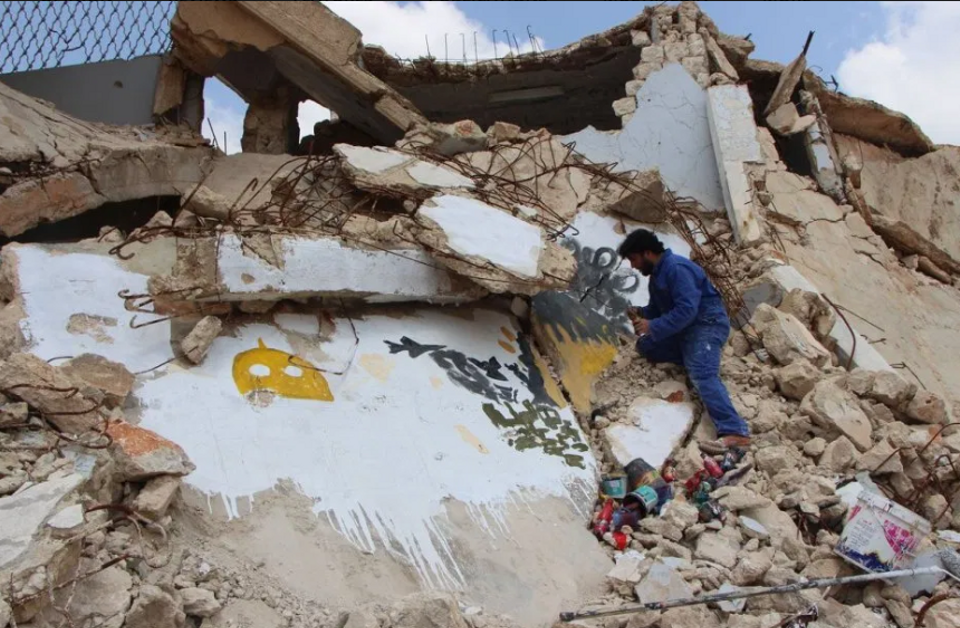
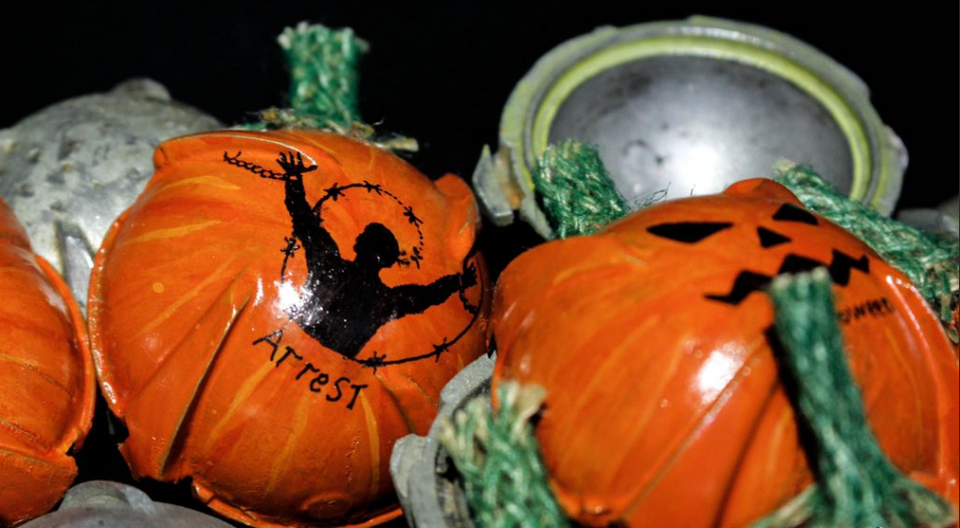
'The nine-year campaign of bombing in Syria led by Bashar al Assad and his main backer, Russia, has inspired a wave of war artists to produce artwork with one common feature— remnants of war. They are using spent rocket casings, missile debris, empty bullet cartridges and other exhausted weapons that targeted their towns, cities and villages, and turning them into a diverse range of artwork.
Akram Sweidan, who was born and raised in Douma in the countryside of Damascus, describes his work as the "painting on death". During pre-war years, he painted on glass. Since the war broke out and continued, Sweidan goes out on the streets of Douma to collect the spent ammunition.
"The eastern Ghouta suffered from a lot of killings and destruction. Thousands of shells, missiles and barrel bombs were fired by the Assad régime and its ally Russia. So I collect the remains, paint and decorate them with colours, turn these killer tools into life-like graphics," Sweidan said.
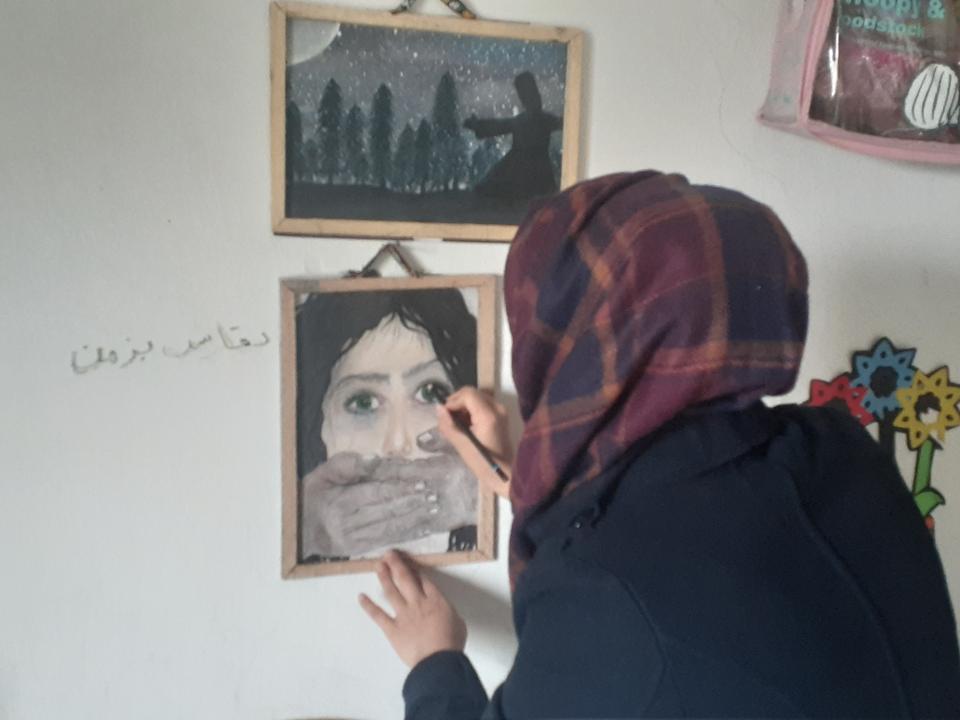
Another Syrian artist, Amani Zankeh, from Idlib province, doesn't use spent ammunition for her artistic expression but her drawings depict the human cost of the Syrian war. Her work also touches upon the oppression of women and violence against them in Syria. Despite surviving one of the most brutal wars of the 21st cCentury, she says her art sends the “message of life, despite the darkness of death" overshadowing everything.
While the Assad régime and Russia have showed no mercy to civilian areas and hit them repeatedly, violating human rights and almost all ceasefire deals, it has failed to break the will of rebellious population and the surviving artists on the ground.
Aziz al Asamar has replaced his canvas with bombed out walls and buildings. Before the Arab Spring-inspired Syrian revolution in 2011, 35-year-old Samar, who hails from Idlib province, drew caricatures of Assad and other senior members of his régime.
He began drawing on the walls in the following years of war and destruction and said he wanted to send a clear message to the world that “under this rubble there were families, people with dreams and memories”.
In February last year, when a baby girl was killed and her mother fatally wounded by Assad's bombing on Maarrat al Nouman, a town in Idlib, Asmar painted the portrait of the dead toddler with the caption: The war against terrorism in Syria.
"These are the drawings I prefer. It hurts, crushes my heart, but I must keep on painting the martyrs,” Asmar said.
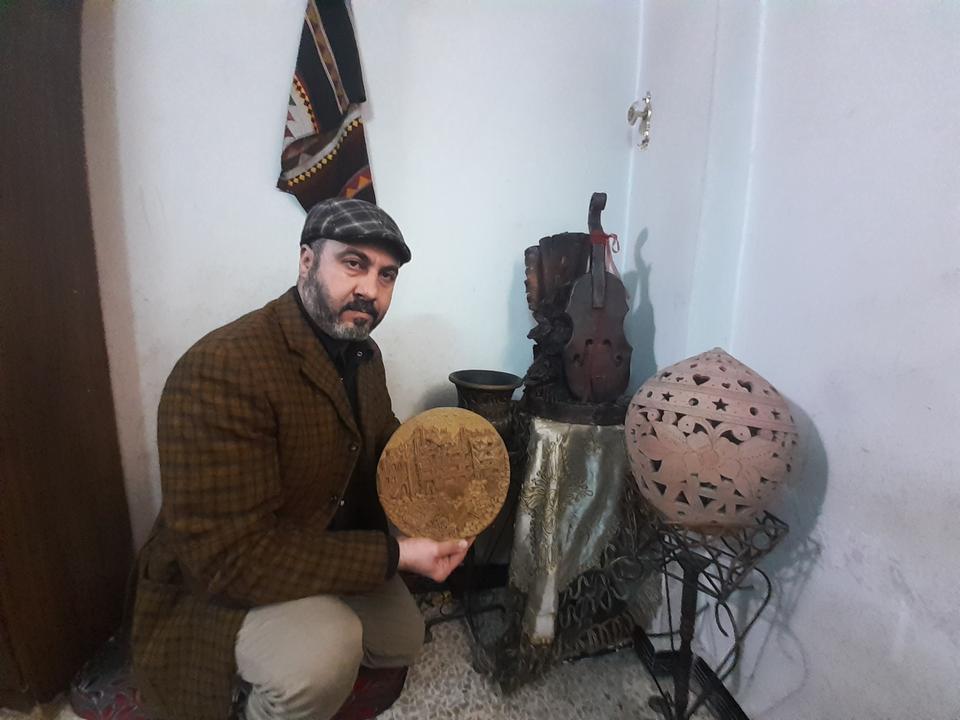
Another artist, Mustafa Deeb, finds clay-based art therapeutic. “When I make a piece with clay, touching mud with my hands, I feel like all the negative energy in my body is gone. I feel my trauma is treated,” Deeb said. Deeb has been training Syrian children to make artwork with clay in the hope of helping them deal with their own war-related trauma.'

'Protests were held on Friday in southern Syria’s Sweida governorate for the third consecutive day over deteriorating economic conditions and a drop in the value of the Syrian pound. According to local sources, protests “against corrupt officials, who are still insisting on ignoring the chaos in the governorate, will continue.” They said weapons have proliferated and the rate of kidnappings and murders for money has become very high.
On Thursday, two men were killed in separate incidents in the countryside of Sweida for unknown reasons, they noted, stressing that such incidents have occurred on a daily basis. Nearly 12 people were killed in the past year, in addition to high inflation which has increased poverty, hunger and diseases.
On Friday, demonstrators swarmed the streets of Shahba city, north of Sweida, raising loaves of bread and shouting “We want to live.” Videos broadcast by local news sites showed protesters gathered in Shahba’s square, chanting slogans against the corruption of regime officials and accusing them of ignoring the people’s suffering. Protesters demanded a peaceful revolution and the restoration of the value of the Syrian pound.
A group of people, including children, raised banners and denounced the collapse of the pound, and demanded an improvement in living conditions, price control and accountability of the corrupt, Suwayda 24 official Facebook page reported on Friday. Photos published on the page also showed demonstrators raising banners slamming Bouthaina Shaaban, the political and media adviser to head of the Syrian regime Bashar al-Assad. Shaaban has been facing a campaign of widespread criticism by loyalists and opponents after the release of a video recording her stating that “the Syrian economy today is 50 times better than it was in 2011.”
The Syrian pound in the black market in Damascus was on Thursday at SYP1,300 compared to the US dollar. Specialized websites, however, stated that the exchange rate of the US dollar ranges between SYP1,230 and 1,210, while the official rate is SYP514. UN reports affirm that 83 percent of Syrians live below the poverty line.'