Friday, 8 March 2019

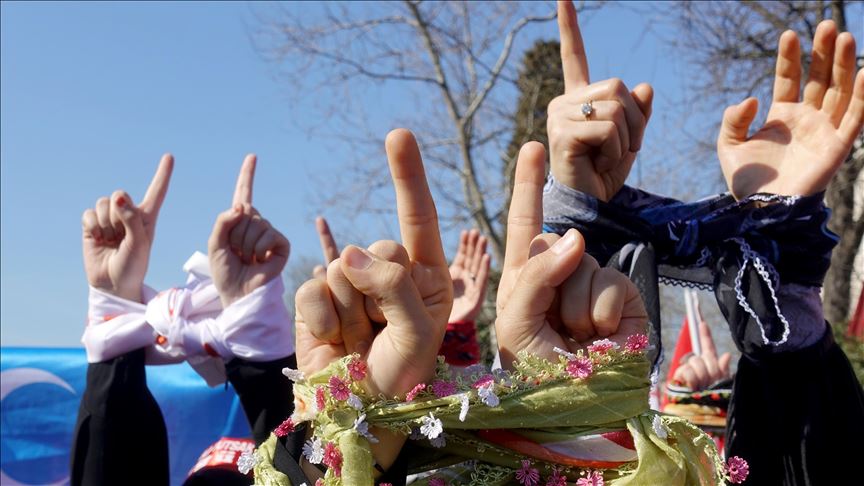
Syria rallies demand release of jailed women, children

Syria rallies demand release of jailed women, children

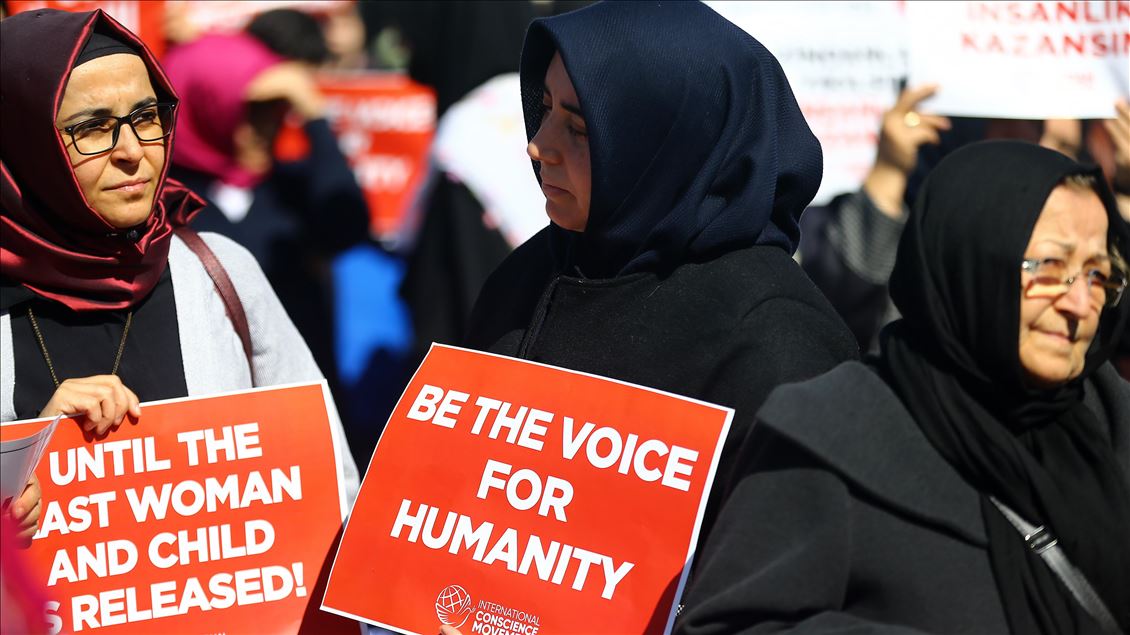
 'As the world marks International Women’s Day, demonstrators in northwestern Syria are urging the international community to take immediate action to secure the release of women and children still languishing in Syrian prisons.

 Friday’s demonstrations were organized in support of the Conscience Movement, an alliance of individuals, rights groups and organizations who demand the release of women and children from the jails of Syria’s Assad régime.

 Rallies were held in the towns of Azaz, Al-Bab, Cobanbey and Bizaah in Syria’s northeastern Aleppo province.


 According to the Conscience Movement, more than 13,500 women have been incarcerated since the Syrian conflict began in 2011, while more than 7,000 women remain in detention where they are reportedly subjected to torture, rape and sexual violence.

 Marwa -- a female Syrian engineer who did not give her full name due to security concerns -- called for the immediate release of jailed Syrian women and children.

 “As relatives of those who are still behind bars, we came here today to demand their release,” Marwa said. “We hope these rallies will help achieve that objective.”


 Maryam al-Ali, a young girl who attended the rally in Bizaah, said her father had once been jailed by the régime.

 “My father was held in an Assad régime prison for a year and a half. He was finally released two years ago,” she said.

 “But his friends still remain in prison and we are demanding that they be freed without delay,” she added.

 The Conscience Movement was founded last year after an all-female international convoy made global headlines by raising awareness about the abuses suffered by female prisoners of the Assad regime.

 In March of last year, the 55-bus convoy made a three-day journey from Istanbul to Turkey’s southern Hatay province near the Syrian border, where 10,000 women staged a massive rally marking International Women's Day.'

Fleeing régime fire, Syrians desert northwestern town


 'During a lull in régime bombardment, Abu Abdo al-Sarmani drove a pickup hurtling into his wrecked hometown in Syria’s Idlib province to grab his family’s belongings a day after they fled. The northwestern town of Khan Sheikhoun is supposed to be protected by an internationally brokered cease-fire deal, but increased shelling and airstrikes by régime forces last month have left its streets near empty.

 “There was a truce and everything quietened down, and then suddenly the bombardment picked up again and we could no longer stay,” Sarmani said, wearing a maroon bomber jacket.

 “The bombardment was so close ... I spent two hours hiding in the bathroom,” the 36-year-old said, describing the events that pushed his family to flee last week.

 Khan Sheikhoun lies in the Idlib region, the last major bastion of opposition to President Bashar Assad in Syria.

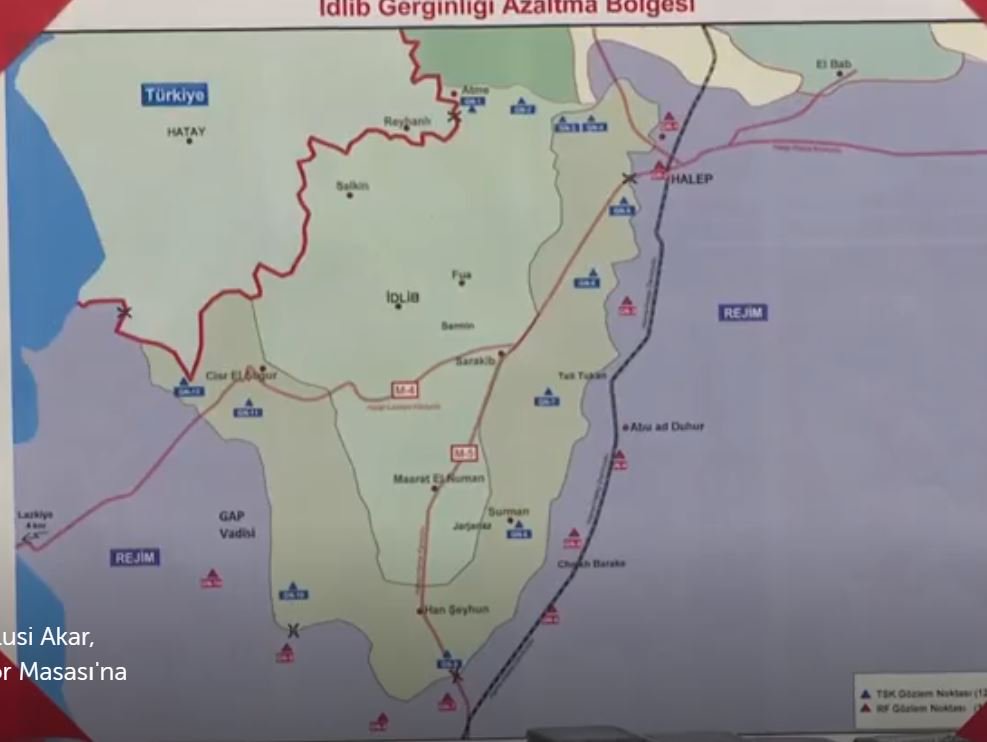
 In September, rebel backer Turkey and régime ally Russia inked a deal to set up a buffer zone around the region, part of which runs just south of Khan Sheikhoun.


 Sarmani said he, his wife and three daughters escaped Khan Sheikhoun last week because of the bombardment, but also because the town has become unlivable.

 “There’s no work, no more people about, no hospitals, no doctors, no pharmacies, no basic infrastructure for living,” said the accountant, whose family has relocated to Sarmada, 100 kilometers north.

 Outside Khan Sheikhoun, two lone donkeys stood in a field of bright green grass, as shelling sent a grey cloud billowing up into the sky.

 “We hope we won’t be displaced for long,” Sarmani said, standing by a pickup truck loaded with a large plastic rug, pillows, and a cooking gas canister.


 Eight years into Syria’s civil war, the Damascus régime has gained ground against rebels and militants with Russian military backing since 2015. It now controls nearly two thirds of the country and has taken back control of most of the main commercial arteries.

 But a section of the highway linking the capital to the northern city of Aleppo remains out of its reach as it runs through Idlib, including through Khan Sheikhoun.

 At least 46 civilians including 18 children have been killed in bombardment on the town since the start of February, the civil defense says.

 Elsewhere in Khan Sheikhoun, 29-year-old Ahmad Faraj and his family brought out what remained of their belongings from a temporary home shot through with rocket fire.


 In their pickup, the farmer from the nearby village of Zaka piled blue plastic chairs, and bags of pistachio husks his family would later burn for heating.

 “When we came here about three months ago, the town was safe,” Faraj said, dressed in a zipped dark blue hoodie.

 But “for a month, there has been violent bombardment ... The war planes have started up again,” he said.

 In order to stay close to his land, Faraj, his wife and child had headed to Morek, a town in the nearby buffer zone.

 They hoped Turkish observers deployed there under the September deal would earn them some protection, but said conditions were likely to be tough. “Running water, sewers, electricity - there’s absolutely none of that,” he said.'


 "Turkey begins patrolling with armoured vehicles the countryside of Aleppo, Hama and Idlib (part of the de-escalation zone) in order to stop the SAA shelling on civilian areas."
[https://twitter.com/Kyruer/status/1103927692292837379]

 "Turkish army convoy patrolling in Southern Idlib today to prevent régime shelling on civilians. There was no régime shelling today."
[https://twitter.com/worldonalert/status/1104029455935332353]


 Note 11/8/25, worldonalert link broken.

How one Syrian is saving lives in the Greek island camps


 'Omar Alshakal is 24 years old, but when he speaks it seems like he's a hundred.

 "When I was in Germany I sometimes stopped looking at the boys with backpacks in front of the high school," he said. "Or those who crowded at the entrance to the university. I looked them and I suffered. Not just because they could study and I could not, but because they were my age and lived like 20-year-olds. And I lost my light heartedness, forever, eight years ago, when the Syrian war began."

 He carries the burden of war on his shoulders; a wounded body and an indelible memory, the loss of loved ones, the failure of revolutionary expectations, the escape.


 He speaks while drinking a hot coffee on the island of Samos, after a morning spent distributing winter clothes to the thousands of migrants in the main facility here, as well as those living in informal arrangements in a field and forest that surrounds the facility.

 Thousands of women and children are here. Even when the temperature drops below zero, many walk in the mud without shoes; the lucky ones have slippers.

 Omar has a tired face, worn out from smiling to all the children in the camp. His smiles mask his despair.

 "Eight years ago I lost my life," he said. "After being a year in Germany I realised that I had to help others. In Germany I was not doing anything that was not for me, but for the ones in need. I felt useless. So I returned to Greece and founded Refugee for Refugees. I feel more useful; people here have nothing. The hardest thing to explain when talking about migrants is that these people - like me - were not born like that. They were not born poor and dirty. The war and the escape made them poor and dirty. I, like them, up until eight years ago had a house, some friends, a school. Then suddenly we did not have anything any more. That's what brought us here, asking for help, asylum."


 Omar was born and raised in Deir ez-Zour; he left Syria for Lebanon in 2010 to work as a lifeguard. When the uprising began, he returned home and was arrested by Assad's army in the early days of the protests. When he recalls that time, he remembers prisoners beaten to death.

 After the prisons of Assad, he says, you no longer distinguish between life and death.

 He became a volunteer, driving ambulances for the rebels. As an activist, he believed in the revolution, he wanted a new, free Syria.

 In 2013, his ambulance was hit by a bomb. The paramedics and the six wounded in his vehicle were all killed. Omar escaped with his life, his leg seriously injured.

 After using a wheelchair for a few months, Omar travelled to Turkey, where a doctor recommended he venture onwards to Europe for treatment.

 To 20-year-old Omar, "Europe" was the Greek coast. Thousands of people were attempting the same journey, so one day Omar and two of his friends tried their luck - but not in rubber boats, like the others. Omar and his friends started swimming. It was a 14-hour swim from Turkey to Kalymnos.

 "I realised I was still the good swimmer I was when I was a lifeguard in Lebanon. And then I was not afraid to die. A piece of me had already died forever."


 Once he arrived in Greece he realised his onward path would be hard: he was repeatedly turned back at the Macedonian border, he slept on the street in Athens, with other Syrians like him. Then, finally, he found transport to Germany, and waited eight months for his documents to be ready. It was now May 2015.

 Omar lived in Rostock for a while. The government had provided him with a place to live and he volunteered at a local NGO that cooked food for the refugees.

 One night he woke up to the sound of the police breaking down his door. He was arrested and held at the local police station. They suspected he was linked with the Islamic State group.

 It was a farcical situation. The very man who had risked everything to escape from Deir ez-Zour, who carried both the physical and invisible scars of a fierce war, was arrested on suspicion of being an IS supporter.

 "I felt like going crazy," he says.

 After a few weeks he received a letter of apology: we were wrong, we received false indications. Two months later, Omar left Germany. He wanted to help his people.

 At the beginning of 2016, he returned to Greece, at the peak of the migration crisis. The EU and Turkey were about to sign the pact that created holding facilities on the Greek islands, turning them into de facto prisons. Thousands of people would be held in humiliating conditions awaiting the assessment of their asylum application.

 Omar started to help those in need, to help those who crossed the sea. He volunteered for several organisations. Then he decided to build his own.


 He began to collect clothes, toys and shoes and help migrants, first on the island of Lesbos and now also on Samos, where he is building a warehouse for shoes and basic necessities with other volunteers.

 "This cold [weather] is an emergency, we do our best to give everyone clothes for the winter," he said.

 "There are thousands of people in tents, for them living outside or inside is the same. The situation is terrible, they have no electricity, water, toilets, showers. Their conditions are not safe, at night it is very dangerous for women especially, when they need to go out to urinate they are not safe at all. And for children it's the same, there are hundreds of children with summer clothes and there's a lot of wind. The night is terrible."


 Omar is affectionate with all the children who line up in the early morning. He wears a hat shaped like a bear, tells jokes, teaches the youngsters a few words of English - but at the same time remains strict: one piece each, everyone has the right to be clothed.

 "No one can understand how living in a tent is," he said. "It is a loss of dignity to live in a place where you feel you are worth less than nothing. I believe that Europe cares more for animals than for these people. And I strongly believe that children and families will never forget the time spent here. Before the war, we had normal lives, schools, houses, friends. And then we lost everything. We had only a dream, to be welcomed and helped. But once here people don't even receive a tent."


 Omar helps a woman who has just escaped from Syria with her two sons. She arrived on the island with $150. She found no space in the official detention facility, and bought a tent with the little savings she had. For two days she did not eat, she told Omar. "When you have a house, you do not imagine how your life could be in a tent, in the middle of winter," he said.

 "I am pretty sure that the Greek government has prepared an emergency plan for the cold, for their streets, for their schools. But they did not think about the emergency for migrants living in the cold. I say this because last year we had the snow in Lesbos and someone died because of the snow, guys died, freezing. And despite that, this year there are no winter plans. Winter is not an emergency, it is not difficult to predict. It depends only on the calendar."

 Omar does not know what his future holds, but every day he wakes up to help those in need.

 "If you let people live like this for months or years, you can not talk about humanity," he said. "I do not think this Europe is human." '

Monday, 4 March 2019

The teachers of Idlib on the impossible struggle to educate

Teacher Abdulkafi Alhamdo, in front of a bombed-out school in Aleppo

 'Abdulkafi Alhamdo is an English teacher in Syria. He loves Coleridge and Shakespeare and is currently teaching his students Joseph Conrad’s Heart of Darkness. In 2016, he was evacuated from Syria’s very own heart of darkness – Aleppo – where he taught traumatised school children in cellars and bombed-out buildings throughout the siege, even as they starved. Now he lives and works in the rebel-held north-west province of Idlib, where he and fellow teachers are struggling with few resources and little support to educate the next generation, those who will shape the future of Syria.

 Idlib, the largest province in Syria to remain outside the control of Bashar al-Assad’s régime, has seen a steady increase in bombing raids by Russian and Syrian jets and the arrival of refugees fleeing from other war-ravaged zones, which – according to Alhamdo – makes the ongoing work of Syria’s teachers all the more vital. “We want education to continue because we don’t want these young children or students to think of guns,” he says. “Without schools, they would carry guns but, because of their attendance at school, they are students.”

 According to Anna Nolan, director of the human rights group The Syria Campaign, at least 2.5 million locals and refugees are now packed into Idlib, which has been described as “a kill box”. There is great humanitarian need and no state education, but Nolan says that remarkable efforts are afoot on the ground to preserve civil society, with teachers organising their own schools and university classes, often working voluntarily without pay to build an extraordinary patchwork of DIY education.

 Some have set up their own after-school clubs offering formal lessons, creative arts and vocational training, while others forced out of buildings by armed rebel groups are teaching classes in the open air and on WhatsApp. “There’s a real determination,” says Nolan. “What we hear again and again is that they know that education is the key to the future and this is the generation that will rebuild Syria. The depth and creativity of the services being provided is incredible.”


 Many of the teachers now working in Idlib are themselves displaced, among them Alhamdo, who fled Aleppo with his wife and young daughter and nothing else. In Idlib, the bombs are still falling – “There’s always bombing. This is our life,” says Alhamdo – but it’s nothing like his experience in Aleppo. “Aleppo was something unusual,” he says. “Every day when I went to school to see my students – they are like my children – I just check who is absent, who is alive and who is not, and then I start teaching them. We would stop many times because there were bombings. For one or two hours, we go to a cellar then, after the bombing stops, we go back again to our class and teach. If the bombing was heavy, we let our students go home.”

 In April 2015, Saad Al-Ansari school, where Alhamdo was teaching, was hit by a rocket. He was returning from the playground when an explosion ripped through the building, killing four teachers and three students and injuring dozens more. “My heart jumped out of my body,” he recalls. “I saw the students running out, blood on their faces. They were in trauma, crying: ‘Did you see my little brother? Did you see my sister?’ They did not know what to do. Most of them were running out without shoes, without their books. I went inside and saw blood everywhere.”

 From that point on, the large-scale schools were abandoned and teachers organised their classes in small, makeshift schools in local neighbourhoods, so that the children did not have so far to travel to school and – should another rocket hit – the number of potential victims would be fewer.

 “When you teach in such circumstances, you are more psychologist than teacher,” says Alhamdo. “You have to be so careful about their trauma and their personal stories. When there’s heavy bombing, you tell the children they are heroes because they are still learning. It was a very, very difficult job.”

 The children, traumatised by their experiences, found it hard to concentrate, but their teachers tried to preserve some normality for them. They still sat their public exams, hidden in cellars away from the shelling. “The conditions were very, very bad, but we could not let the war or their situation affect their progress. They are the future of Syria for us.”


 Now in Idlib, he is teaching linguistics and the modern novel at the Free Aleppo University in the Idlib countryside to students who have fled from regime-held areas. The university opened in 2016 as one of the country’s few remaining centres of higher education. On days when shelling is intense and the danger is too great, students have lessons via WhatsApp, and some medical students have lectures online from doctors in the US. “I am proud of my students and I’m proud of teaching … My students are my heroes,” says Alhamdo.

 In one recent incident, students and teachers resisted an attempted takeover of the university by the armed military faction Hay’at Tahrir al-Sham (HTS). When they refused to sign the university over, HTS threatened the university and prevented them from using the building for lectures, so Alhamdo and his colleagues took their lessons outside. “It might not be safe for me as a teacher but we cannot surrender.”

 In Atmeh, a village in the north of Idlib near the Turkish border, Sawsan Abbar has opened the “Read and Rise” primary school for girls. Her husband is the headteacher. The school is attended by 120 girls, all of whom have been displaced from their home towns and cities by the war. There are few teaching resources so Abbar and her colleagues have to be creative, sourcing materials from the internet and printing them out for their students.

 In the absence of so much else, the school has taken on a central nurturing role in the children’s lives. “Some of the kids call me and other teachers Mama or Auntie,” says Abbar, adding: “What keeps me awake at night is aerial bombardment. We have to skip school sometimes and it’s very worrying.”


 Meanwhile, in the city of Maarat al-Nu’man, also in Idlib province, teacher Mariam Shirout has set up her own after-school provision for children in the area. In the morning she teaches in the city schools that are still functioning – they were once state schools but have been taken over by non-governmental organisations (NGOs) – and in the afternoon she opens the doors to her own school for children aged four to 15. It is called Bilelem Nartaqi, which means “with education, we advance”. It started small in 2013 but has grown and now educates between 150 and 200 children from all over the city.
Advertisement

 “Education is the backbone of the area,” she says. “No matter what happens, I will be working until the last minute. When I see the children coming to the centre under the bombardment because they want to spend time with their friends and me, I can’t think about stopping anything, ever.”

 Shirout and five colleagues teach reading, writing, mathematics, English and Arabic. They also provide extracurricular activities including drama and singing and vocational training such as sewing. “My school also provides psychological and social support to the children to help them deal with the traumatic experiences they are going through.


 “The shelling can really affect their work,” she says. “They are trying to be ambitious and believe they can continue with their work, but sometimes they have to stop for a few days because the shelling is unbearable. They are really afraid. Sometimes the schools stop for around 10 days or a month because of the intensive shelling.”

 Shirout, who is single and has no children of her own, says her pupils are becoming adults prematurely. “They just want to survive. They are always distracted, always thinking of something else. Their minds are always busy. They love school. They want to come, but they are still really distracted and that makes it hard to learn.

 “I worry about my students all the time – not just about their physical safety but their mental health and their future. The education services available are not enough – it’s like a sticking plaster. If the situation continues as it is, the future of most of the students will be lost.

 “My students are not children any more. We can’t ask them what they want to be in the future. The future is not clear.” '

Rebels attack Syrian army posts to avenge civilian deaths


 'Fighters of the Ansar al-Tawheed rebel group launched attacks against Syrian army posts in northwestern Syria, which they said killed at least 25 soldiers to avenge civilian deaths during recent army shelling. Dozens of rebels belonging to Ansar al-Tawheed attacked two major army checkpoints near the village of Masasneh in northern Hama province in a dawn attack on Sunday.

 Syrian state television showed several corpses, which Ansar al-Tawheed rebels said were the bodies of their suicide squads who had caught army troops off guard in an area close to the opposition-held territory.

 Stepped up missile and rocket attacks on villages and towns in northern Hama and adjoining Idlib province have been blamed by residents for dozens of civilian deaths and injuries since the latest army campaign began early last month.

 The recent escalation has targeted schools, mosques and bakeries and caused widespread damage to infrastructure, civil defence workers and hospital sources in opposition areas say.

 Both civilian-run opposition bodies and residents say the attacks have prompted thousands to flee from a number of front-line villages and towns, and have threatened a new exodus towards the Turkish border.

 Khan Sheikhoun, which has borne the brunt of the recent rocket and missile attacks, has become a ghost town as most of its inhabitants fled to the safety of makeshift camps housing tens of thousands of people displaced after previous Russian and Syrian army air raids.'


 "Taking advantage of bad weather, battle moved tonight to Jebal Turkman (NE. Latakia Mountains). HTS raided several positions killing most in those positions and the inghimasis returned safely with several wounded."[https://web.archive.org/web/20190313180759/https://twitter.com/AlKhali72189230/]

Saturday, 2 March 2019

This girl survived an airstrike in Syria. Her siblings didn't.


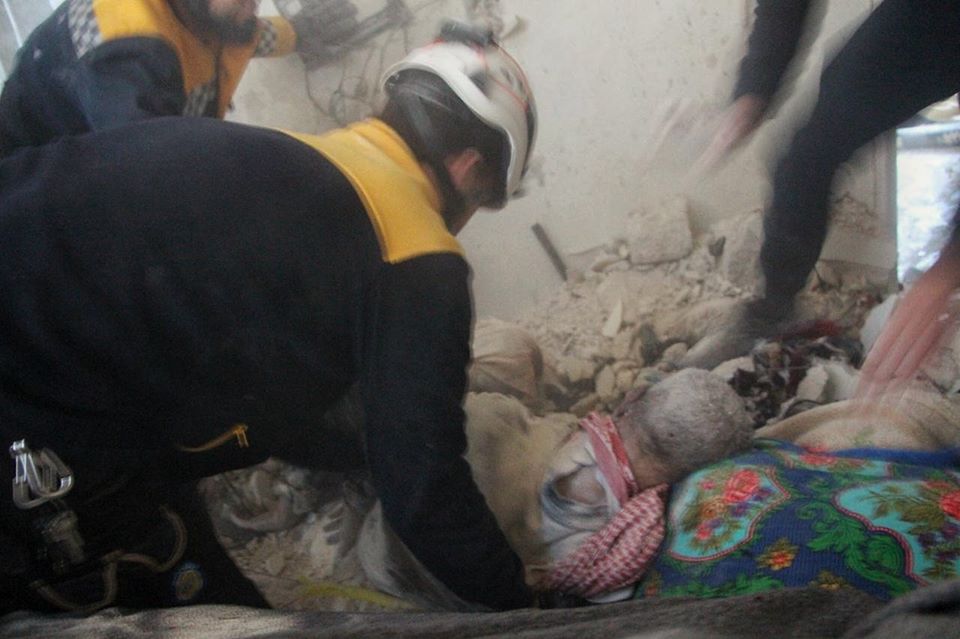
 'The heartbreaking photo shows a 6-year-old girl, blood smeared all over her face, as she waits to be rescued from the rubble of a bombed-out building in northwestern Syria.

 Looking past her shell-shocked face, you can see a lifeless hand under her knee.

 It's the hand of her 3-year-old sister, who didn't survive the airstrike. Her 1-year-old brother also died in the attack, as did a cousin, according to Anas al-Dyab, a White Helmets volunteer who took the photo of her and others at the scene.

 The incident took place Tuesday in Khan Sheikhoun, which is in the rebel-held province of Idlib.

 The rocket hit several residential buildings that led to deaths and injuries among two different families, al-Dyab said.


 In recent weeks, Syrian and Russian planes have conducted scores of airstrikes in Idlib, where a large-scale military campaign is looming. Some 3 million civilians have been scrambling to find safety in the province.

 The girl who was rescued Tuesday is Hasna'a Qatran, al-Dyab said, and it took nearly two hours for the White Helmets to pull her out of the rubble. She was released from the hospital on Thursday, he said.

 Al-Dyab's dramatic photos also show the father, Abdul Razzak Qatran, clutching his dead daughter, Elaf, close to him while he cries. He kisses her feet as one of the White Helmets carries her away.

 The attack happened around 12:30 in the afternoon, said al-Dyab, who has filmed dozens of airstrikes and was himself injured in one last year.

 Al-Dyab said he's been injured several times while covering these rescue missions, but he keeps going because he believes strongly in his work with the White Helmets.
"We want to rescue the biggest number of lives in the shortest time," he said.'

Friday, 1 March 2019

Syrian National Coalition calls for aid to Rukban camp


 'The Bashar Assad régime in Syria has been toughening the blockade on the Rukban refugee camp along the border with Jordan in order to force out the 60,000 residents of the camp, the chairman of the National Coalition for Syrian Revolutionary and Opposition said in a statement Tuesday.

 In a statement released on the coalition's website, Chairman Abdurrahman Mustafa said that the regime forces have blocked the routes used for the humanitarian aid transfer, aggravating the already worsened conditions in the camp.

 "The siege will lead to a genocide before the eyes of the silent world," Mustafa said.

 The camp, located in a remote area of the Syrian desert near the Jordanian border, is home to some 60,000 refugees living under harsh conditions.

 The Russian Defense Ministry announced last week it would open two "humanitarian corridors" near Jleighem and Jebel al-Gurab settlements, with the help of the United Nations, to "allow Syrian refugees to leave voluntarily for places of residence they choose."

 However, Jens Laerke, spokesman for the United Nations Office for the Coordination of Humanitarian Affairs, said that the U.N. was not involved in the opening of the corridors.


 Udey Selame, a civilian living in the Rukban camp, said that he fled from the regime offensive and does not want to return without security.

 Selame called for much-needed humanitarian aid to be provided to those at the camp who have nothing.

 He said that while Syrians living along the northern border with Turkey are safe, displaced persons in the south "have nothing but the mercy of God."

 Muhammad Elasura, another civilian living in Rukban, said that they have all been asked to leave the camp. However, since they have no security of life and livelihood, they do not know where to go.

 Elasura said the refugees do not want to return to the territories controlled by the Assad régime, and would prefer to go to the areas which were cleared of PKK-affiliated People's Protection Units (YPG) in Turkey's Operation Euphrates Shield.

 Turkey conducted two successful cross-border operations into Syria – Operation Euphrates Shield launched in August 2016, which cleared Syria's Al-Bab and Jarablus from Daesh terrorists and Operation Olive Branch launched in January 2018 to clear northern Afrin from YPG terrorists.


 Most of the refugees in Rukban camp fled areas in eastern Syria that had once fallen to the Daesh terror group, and were trapped after Jordanian authorities closed the border.

 Last year, at least 20 people died inside the camp, faced with starvation, disease and lack of medicine.

 The Syrian Network for Human Rights (SNHR) has blamed the Assad regime for the humanitarian crisis in the desert camp and accused the Jordanian government of banning the entry of humanitarian aid into the camp.'

Syrian National Coalition Chairman Abdurrahman Mustafa (AA Photo)

Tuesday, 26 February 2019

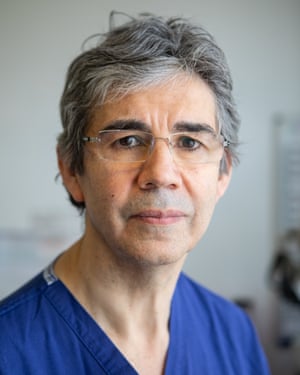
David Nott: ‘Chances of leaving Aleppo alive were 50/50’

People look for survivors after an airstrike in eastern Aleppo, Syria, 2013.

 'It was in Syria that I began to get seriously angry about the inability of the major powers to prevent hospitals and medical staff being targeted in war zones; in Syria that I realised I must begin seriously to collate and share the knowledge I had acquired over my career to help other doctors; and after Syria that post-traumatic stress disorder finally tipped me over the edge.

 By the time I first arrived in east Aleppo with Syria Relief in August 2013, many of the more senior doctors and surgeons had already left. As many as 95% of the city’s physicians had found a route out. Those who remained were brave and committed, but there were very few of them and the risks were considerable. Clinics were assigned codenames to disguise how many there really were. Ambulances carried no sirens or insignia and at night drove with their headlights off. Anything that looked like help for the injured was seen as aiding the rebels, and so a legitimate target for the regime.

 The hospital where I was based was close to the frontline, codenamed M1. The majority of injuries we saw were gunshot wounds. There were as many as 70 individual snipers dotted around east Aleppo at that time. They simply picked people off as they were crossing the street, going to work or going to the shops. From babies to pensioners, no one was immune.

 On that first day alone in M1, 11 civilians shot by snipers were brought in. The doctors told me they had been losing a lot of patients with wounds to the major arteries; they needed significant training. I immediately agreed to give evening lectures, plus hands-on instruction for any surgeons who wanted it, where I could show my “best moves” – introducing them to new techniques, or little tricks such as how to hold their hands or instruments to save time on the table.


 On that first day, all 11 patients who had been shot survived – but only after a solid 18-hour shift at the end of which I fell on to my bed absolutely exhausted. As the days went by, I noticed there was a weird consistency to the injuries we saw coming in – the patients all seemed to have been shot in the same part of the body. One day we would receive patients who had all been shot in the left groin area; on other days six or seven would arrive shot in the right groin. The same thing was happening with patients shot in the upper limbs and chest – the injuries all seemed to be on the same side, in clusters. Also, despite the snipers having telescopic sights, we rarely saw the head shots that would have resulted in an instant kill. Another surgeon told me that he’d heard that the snipers were playing a game: they were being given rewards, such as packs of cigarettes, for scoring hits on specific parts of the anatomy.

 This sick competition reached its nadir towards the end of my time there when it appeared that one particularly vicious and inhumane sniper had a new target of choice: pregnant women. One such casualty arrived shot in the abdomen. The bullet had missed the baby but gone through the placenta. The woman was on the operating table only a few minutes after being shot and we delivered her baby boy via caesarian. I quickly clamped the cord and gave the infant to one of the nurses to resuscitate, but sadly she was unable to do so. We carefully sewed up the mother’s uterus in the hope that she would be able to have another baby; we weren’t going to let the sniper take that away from her.

 The same day another sniper’s victim came into the hospital. She was a first-time mother, almost at full term. She was very beautiful, wearing an immaculate white headscarf and a long, elegant coat that now had a large red stain on the front. An abdominal X-ray showed that the bullet was still inside her abdomen, but appeared also to show, horrifically, that it was lodged in her unborn baby’s head. In the operating theatre, we performed a midline incision as quickly as possible and pulled the baby out. It was handed to a nurse as usual but it was pointless: the poor thing had a massive head wound and was obviously dead. The uterus was in tatters and we ended up having to give the mother a hysterectomy as well. This was probably the most upsetting and shocking act of violence I had ever witnessed against another human being.


 A few days later, Ammar [a Syrian doctor who became a close friend] and I were grabbing an afternoon nap between operations when there was a knock on the door. Abu Abdullah [a Syrian surgeon] wanted to know whether I could help him with a thoracotomy. I dragged myself out of my slippery plastic bed and put on my operating shoes, which by this time were caked in dried blood – the floor was often awash with it. Once I got to the theatre I heard the patient had been shot in the back just below his shoulder blade. He was very pale under his thick beard and it was obvious that he was bleeding significantly.

 Just as I was about to suture the pulmonary vein, the doors of the operating theatre burst open. I looked up and saw six fully armed men wearing black combat fatigues and headscarves storm into the room. They were Isis fighters, and the patient on the table was one of them. My heart lurched and I froze stock still. I felt a rush of adrenalin. The leader of the group came forward with his gun levelled at us.

 “This is my brother!” he said aggressively, in English but with a very strong, Russian-sounding accent. Not just Isis, but Chechen Isis. “What are you doing to him?”

 In English, Abu Abdullah told him that we were trying to save the man’s life.

 “You should have asked us before taking our brother to surgery!” was the reply. “Who are these people?” he went on, indicating Ammar and me.

 It was vital that I kept a low profile – I was almost certainly the only westerner in Aleppo at the time, and it would have been a major coup if I had been kidnapped. Ammar piped up in his strongest Syrian accent to say that we were all surgeons simply trying to save the man’s life. By this time I had begun to shake. It was all I could do to keep my legs from buckling under me.

 “Who’s this?” he said, pointing to me. Abu Abdullah whispered in my ear, “Don’t say a word,” before turning back to the Isis leader and saying, “This is the senior surgeon. If you disturb him he will not be able to save your brother’s life.”

 The leader came up to the operating table and peered into the man’s wound to see what we were doing. The rest of the group milled around the room menacingly – a few sat on the floor while others leaned on equipment and made themselves comfortable. It took us another hour to finish the operation. Usually, there is a lot of banter in the operating theatre but today we were silent. As we neared the end they all left, apart from the leader, who stayed until the last suture was in place. Afterwards, I found myself feeling confused and lost. I had saved the life of someone who might go on to commit terrible crimes. Did that make me complicit, somehow? Perhaps it did. And yet, I still firmly believe that it was my duty to save his life.


 I promised to go back to Syria. When we reached the outskirts of Aleppo, the difference from the previous year was immediately visible. Where in 2013 there had been shops, markets and people, now there was only destruction on an industrial scale. We could see dozens of cars, trucks and lorries on the side of the road, some completely destroyed and others bearing the scars of rocket attacks. I was certain bodies must still be inside the wreckage of the vehicles. It was like something out of a Mad Max movie.

 I noticed the atmosphere in the hospitals and among my colleagues was quite different: tense, charged. It felt altogether edgier and more dangerous than my previous trip. The doctors looked drained, hollow. They were under constant barrage from barrel bombs, rockets and machine guns. Simply getting around the city had become exceptionally dangerous. The chance of being killed simply moving from one hospital to another was something like one in four. One of the new doctors helpfully told me my chances of leaving Aleppo alive were 50/50.

 I had a near-constant pain in the middle of my chest, which I could ignore only when I was immersed in an operation. Day after day we saw entire families brought in to the hospital, their homes destroyed by barrel bombs. Most of the children we saw were under 10. Some were dead on arrival, from the effects of the shockwave or from inhaling pulverised concrete. One particular day will stay with me for the rest of my life. Following a colossal bang, a family of seven children came in with their dead mother. The first child was just a toddler, and had lost both her feet. Her brother on the next trolley was about seven – he had a massive pelvic injury. Another boy, about the same age, had blood streaming from his face. I still have nightmares about what happened next. A little boy, about five years old, was brought in, face down on the trolley. Both his buttocks and the backs of his thighs had been completely blown off. He was still alive but completely silent as he gazed around the room. One of the nurses pulled his hair back from his face and started to comb it gently with her fingers. That was all we could do for him; we had run out of morphine. A few minutes later another child was brought in, his sister. Half of her head and brain were missing.

 On our last day, we heard the sound of heavy gunfire outside the house. I peered through a crack in the window and could see about 20 armed men coming towards us, some walking and firing their weapons, others with heavy-calibre machine guns on the back of pickup trucks. I began to panic. I was cold and clammy and began shaking uncontrollably. Had Isis finally caught up with me? We hit the deck, hiding under our beds. I closed my eyes and lay there, in despair – for myself, and for this poor country that had been overwhelmed by darkness. The shooting lasted around an hour. At some point the hospital administrator told me not to worry – the fighting was just between two rival Free Syrian Army factions. It turned out later he had hidden the reality of the situation to protect me. The fighters were Isis, and it was their last chance to take me hostage.'

David Nott photographed at Chelsea and Westminster hospital.

Inside HTS' takeover of northwestern Syria


 'In a conference hall adorned with the flags of Hay’at Tahrir a-Sham, the Free Syrian Army and National Liberation Front, a banner read overhead, “Hand in hand, we win our revolution.”

 Syria’s remaining rebel factions—diverse, and at odds with one another almost as often as they are with the Assad régime—came together at a General Conference of the Syrian Revolution in Bab al-Hawa in rural Idlib province at the beginning of this month.

 Meant as a show of unity, the meeting produced a 12-point statement promising to “unify revolutionary efforts socially, economically, and militarily” through a new government for the rebel-held northwest, a joint military council and the creation of new civilian institutions purportedly aimed at improving the lives of civilians.

 The last similar conference, more than a year ago, resulted in the formation of the Syrian Salvation Government (SSG)—a governance body largely considered a puppet of Hay’at Tahrir a-Sham (HTS).


 Much has changed since then.

 Through a combination of military force and negotiated settlements, HTS has asserted effective control over the majority of Syria’s rebel-held northwest following a lightning campaign against rival rebel factions launched at the beginning of this year. HTS now maintains control over Idlib and outlying opposition areas of neighboring Aleppo and Hama provinces.

 In response, international organizations pulled funding for key healthcare infrastructure and opposition-era structures, including the Free Syrian Police, dissolved. Private universities have closed and residents have little choice but to navigate new taxes and checkpoint fees imposed by the hardline group.

 And while international funders announced Monday that funding for health directorates would be reinstated according to “strict conditions,” the true impact of HTS’ takeover may not be known quite yet—with civilians increasingly fearful of what may come next.

 HTS’ rapid military expansion has paved the way for the expansion of the SSG in step—and the hardline group’s leader Abu Mohammad al-Jolani insisted last month that the group intends to “hand over all our areas to a civilian government.”


 Following an outbreak of rebel infighting last month with longstanding rivals Harakat Nour a-Din a-Zinki, part of the Turkish-backed National Liberation Front (NLF) rebel coalition that was present across the northwest, HTS suddenly made its move.

 Zinki all but collapsed within a matter of days. A January 10 ceasefire agreement between HTS and the NLF saw factions from the Ankara-backed coalition agree to evacuate north to Turkish-controlled Afrin, in neighboring Aleppo province, while the SSG would take over administrative control of the region.


 In territories newly acquired by HTS, the hardline group is now absorbing local councils previously under the administration of the opposition-affiliated Syrian Interim Government (SIG), based out of the southeastern Turkish city of Gaziantep. Those councils are falling under the umbrella of the SSG, which is using the annual January 1 expiration of the tenure of all local councils as a pretense to recreate them in its image.

 HTS has historically used the SSG to control civil society in the territories it holds—overseeing aid efforts and local councils while collecting taxes, policing local communities and controlling water and electricity stations. Its apparatus has embedded HTS into civilian life.

 In the past, local councils that came under SSG control were mostly dissolved and reformed with HTS-approved cadres from the top down.

 In Saraqib, a city in eastern Idlib province that HTS seized by force in July 2017, the local council was later dissolved and reformed without elections and now “completely abides by the specifications of the...SSG,” according to the city’s former local council head Muthanna Mohammad.

 Last month’s military advances have allowed HTS to repeat the process across the northwest, by absorbing several new council bodies while using a semblance of bureaucratic procedure to do so.


 SSG officials talk up what they describe as an efficient, legitimate government infrastructure that comprises much more than local councils—with so-called ministries, and even a prime minister. Meanwhile, the SSG has developed seven directorates and other province-level institutions for running local infrastructure—water, electricity, transportation, sanitation and telecommunications—and administering services.

 Observers and residents meanwhile question whether these SSG-affiliated authorities can even properly distribute basic services to the communities they purportedly now serve.

 At the same time, taxation and royalties have become key to SSG’s strategy of control, but also its own stability.

 “Most of the [SSG’s] resources come from taxes and royalties on citizens and organizations, as well as entry and exit fees at the Bab al-Hawa crossing,” says an SSG employee, speaking on condition of anonymity because he is not authorized to speak to press.

 SSG Minister of Local Governance Muaed al-Hasan claims that taxes allow the SSG to provide key services across the northwest.

 However, he admits, enforcing taxation and service fees remains a problem for the SSG—not least because of a “lack of compliance among some people with paying the duties, even though they are low.”

 The SSG has reportedly not yet introduced taxation in areas acquired during recent advances—according to some observers, because of concerns over the response from local communities.

 The SSG has also started imposing additional taxes in Idlib city—the epicenter of its civil control in the province—on car registrations, shops and street vendors.


 In response to HTS’ recent expansion, German development agency GIZ pulled funding last month from over 50 health directorates across the northwest—although the GIZ reportedly reinstated support to health directorates in Aleppo, Hama and Idlib provinces albeit with strict conditions on where that money ends up.

 Still, civilians and local aid organizations are bracing for more cuts in the future.

 “It will definitely stop. I have no doubt about this,” Mohammad Halaj, director of the Response Coordination Group NGO that documents service provision in Syria’s northwest, tells Syria Direct.

 “There is an international consensus that these areas are categorized as ‘terrorist,’ so funding will stop.”

 However, according to al-Bakour from Maarat a-Numan’s United Council for Local Councils, ongoing bombardments by pro-government forces across southern Idlib province—and not HTS advances—have led to NGO closures.

 “Some NGOs are stopping their operations, but it’s because of regime [military] campaigns and not because of the entrance of the SSG,” he says.

 David Swanson, an Amman-based spokesperson for the UN Office for the Coordination of Humanitarian Affairs (OCHA), says that “despite a difficult operating environment, both the United Nations and [NGOs] continue to operate in the area,” by providing “critical life-saving assistance through cross-border operations out of Turkey.”

 There is one possible scenario that could upturn all that—the looming threat of a possible pro-régime offensive on the rebel-held northwest.'

Saturday, 23 February 2019

Abu Hamza's son tries to appeal passport revocation

Abu Hamza's son Sufyan Mustafa

 'The son of Britain's Abu Hamza is reportedly trying to appeal the decision to revoke his British passport amid the furore of the case of ISIS bride Shamima Begum.

 Sufyan Mustafa, 23, was stripped of his UK passport in 2017 after travelling to Syria to fight.

 But at the end of last year he was said to have been stopped from boarding a flight to the UK from Turkey when his name was flagged as being on the terror watch list.


 In his 2017 interview with al-Quds, the Arabic newspaper, Mustafa spoke of his irritation at being accused by the Government of being a terrorist. He also told of his “surprise” at his passport being revoked.

 He said he would return to Britain when the régime of President Bashar al-Assad has fallen and the fighting has stopped.

 He also questioned the Home Office decision, insisting he was fighting with a moderate group which was supported with British and American weapons.

 He said: "Britain is the place where I was born and lived. I have never been a threat to national security in Britain and will not commit aggression on its population because our religion does not allow attacks on unarmed innocents."

 Talking in 2017, Mustafa admitted his father, a 59-year-old cleric jailed for life after a trial in New York in 2015, had made mistakes, but added by way of explanation: "Who hasn’t when they believe in a cause?"


 Mustafa said he had taken part in battles in Aleppo and on his Twitter feed he has written about the killing of regime forces.

 He said: "I am a believer that the real battle will be after the fall of the régime, in the construction of Syria again and reform of the political and economic affairs and construction of public schools to study. The victory of the revolution will be when we see the people elect a representative government and take the country to a better future than it was."

 In March 2017, Mustafa appeared in a jihadist propaganda video in which he both denounced Assad but also criticised ISIS for giving Islam a bad name.'

 Sufyan Mustafa, son of Abu Hamza

Friday, 22 February 2019

Idlib peace talks mean little to Syrians still being bombed


 Zouhir al-Shimale:

 'Ever since Assad's régime recaptured the majority of opposition territories across the country, Idlib has provided a haven for the majority of displaced families once involved in the uprising, unable to return home and forced to stay displaced in domestic exile.

 Idlib has been one of the main issues at the international negotiations in Russia aiming to resolve what Moscow calls "the last rebel pocket".

 The Sochi agreement, launched in September 2018, established a buffer zone with Russia and Turkey running joint patrols in the area between rebel-held and Assad-held territory.

 But despite the agreement, Syrian troops have been bolstered by Iranian militants recently removed from Damascus - reportedly after Russian orders - and moved towards the infamous T-4 airbase and Idlib's frontlines.

 The largest bakery in Khan Shaykhoun has been devastated after it was deliberately targeted in a recent bombing, which killed four civilians.

 "This bakery is the only one of its kind in the area," local activist Bahr Shaheen said. "People from inside and outside the town come in the morning and all day to buy their bread supply - it was deliberately targeted by Assad's militants, he's done it before. Assad's militants are targeting vital facilities, now they've devastated our bakeries, later they'll attack hospitals and schools."


 Khan Shaikhoun, along with other towns in the Idlib countryside, has been pounded with mortars, explosive rockets and cluster bombs.

 "We're very frustrated and letdown, even though Russia and Turkey have agreed to set up the demilitarised zone here. There is no application whatsoever, or commitment. It's worse [than before Sochi]," added Shaheen.


 Thousands of families who have already fled from Aleppo, Homs, Ghouta and Dara'a have had no choice but to leave their shelters under fire and become displaced for a second or third time.

 Fawaz Haj Alo is a father-of-three who fled from Arbin in East Gouta last April and settled in Al-Teh, a town in the Idlib area with his family.

 But the local council has announced an emergency situation after declaring "catastrophic status" on the majority of Idlib's southern countryside.


 "Since we arrived in this town we've been trying to establish a way to earn a living and resume our lives. We were, despite the desperate circumstances, able to survive," Fawaz said.

 "However, we were forced to leave the town. The bombing has always been random and sudden; it hasn't stopped since last year, but massively increased in the past few months. Our house and our neighbours' one got hit by the attacks. My son was already wounded with shrapnel in his legs. As a result, we had to move to the Salqen camp near the border. I call on everyone to help us, it's unbearable here in these camps, there is nothing to survive with, no NGOs, no food. Just stop the bombing, so we go back to our town."


 However, many civilians remain in Idlib's towns under fire, maintaining their shelters and unwilling to leave their homes, taking daily risks out of a sense of despair and a lack of alternatives.

 "Where would we go to? The borders and camps are full of refugees, we can't find an empty tent or shelter," said Salem Obayda, an Arabic teacher living in Maratnomn.

 The town has come under daily artillery fire, with many families forced to leave the southern part of the city, heading towards the camps on the border.

 "Education here was fully halted because of the attacks and a lack of underground schools," says Salem. "I prefer to stay rather than undergoing the dilemma in the border camps. "Everything is under attack, the peace talks have brought only blood and grief to us. All of us can see a large scale insurgency looming in the close future. We have no military existence in the city, all the factions left as part of the peace talks, but it has changed nothing, we've been under ruthless attacks since the start. We've been displaced many times, from Dara'a to Ghouta then to Idlib and within the cities. Where else would we go? Turkey has closed its border, camps are the only option. We are not willing to go anywhere, and we'd rather stay - regardless of the consequences."


 Amid the devastation and rubble, volunteers from Syria's Civil Defence Corps, known as The White Helmets, have been doing what they can to save lives.

 "The White Helmets have been carrying out non-stop rescue efforts to help civilians affected by Assad's relentless offensive," Mohammad Abdoullah, a White Helmet volunteer in northern Syria said. Our teams have been at full capacity across northern Syria's towns. There have been indiscriminate attacks against civilian residential areas, killing unarmed people - nevertheless, our medical and rescue teams are working on the ground, day and night. Most of the deaths and injuries have been women and children. We've been taking risks and pulling dead and severely injured and burned bodies from beneath the collapsed buildings."

 Hospitals and makeshift medical centres across northern Syria have been over-crowded with patients. Many have been moved to Turkish hospitals due to a lack of equipment.

 "In spite of the medical fund's recent cut, we're still able to function and run the hospitals to treat the large numbers of patients we've been receiving so far," said D.Feras al-Jonde, the health minister in the Azaz-based Syrian Interim Government formed by the National Coalition for Syrian Revolutionary and Opposition Forces. On the other hand, the medical support available isn't sustainable and [treatment] won't be carried out as efficiently as it is at the moment [for long], we're running low on medical resources. We put the responsibility for the catastrophic consequences of the medical fund's cut on the international community - who must as soon as possible understand the upcoming shut-down of our medical facilities. The donors must be conscious of putting more than 3.5 million civilians at risk of losing even their rights to medical treatment." '


 "For the second time this week people in in Al-Bab protest in solidarity with the people who are suffering under government shelling."
[https://syria.liveuamap.com/en/2019/22-february-for-the-second-time-this-week-people-in-in-albab]

Image result for saraqib

Wednesday, 20 February 2019

How the régime has managed former rebel communities


 'It was not so long ago that the notion of negotiating with the Syrian régime was considered an untenable prospect to the residents of areas formerly under the control of the armed opposition.

 Whether the aim of such negotiations was allowing the entry of food supplies to besieged residents, opening closed crossings or reaching certain local agreements, such calls were often considered insufferable, and the fate of those who proposed such negotiations was sometimes assassination.

 However, when the régime’s sieges started to tighten on one opposition area after another, compounded in 2015 with the start of the Russian air force’s intensive bombardments of rebel-held areas - the increasingly-exhausted locals of the besieged areas started to soften their stance towards negotiations. In time a clear shift started to transpire, whereby “Local Reconciliation Truces” (and later full-blown “settlement agreements”) started to become a demand of some in rebel-held areas.

 One official involved in negotiating such a reconciliation agreement on behalf of former rebel-held areas in Southern Damascus, describe the change in attitude: “A few months before signing the agreement with the régime, we distributed 3,000 paper questionnaires to the population to find out whether they were indeed leaning towards negotiating with the régime. The result was that 76% of them wanted to negotiate – and that was before the last bombardments by the Russian air force in the area. After the bombardments, the proportion surpassed 90%.”

 Dozens of such agreements were signed in the countryside of Homs, Eastern Ghouta, Southern Damascus, Dara’a and other areas across the country. They were distinguished in form by only minor differences, and the key clauses and general template remained the same: evacuating those who refused to subjugate themselves to régime authority; surrendering heavy weaponry; and offering guarantees of safety to those who decided to stay.

 These agreements were signed by committees that represented the populations of the besieged areas. Yet following the implementation of the agreements, many of the very same committee members could be found amongst the first contingents of displaced residents to Syria’s north, arriving in the now-infamous “green buses” to the remaining areas still under rebel control.

 Others remained to share the fate of the residents on whose behalf they negotiated. Whilst some of these were sometimes targeted and intermittently subjected to accusations of “treachery”, they are today faced with a new and far more perilous reality. At a rate that has markedly intensified in recent times, many are being arrested by régime security forces - especially in the southern province of Dara’a, once the cradle of Syria’s revolt.


 In general, the opposition-held areas that signed “reconciliation” settlements all underwent a similar scenario. First, communication channels would be opened with the régime, to be followed with the formation of a negotiations committee and the commencement of meetings with régime representatives. The drafts of the agreements would then be presented to the civil and armed local authorities in the area, before being signed and subsequently implemented.

 Abdullah al-Hariri, one of the members of the negotiations committee for Southern Damascus as a representative of the Free Syrian Army (FSA), recounted: “The committees, particularly with their first representatives, did not include the notable religious, academic, or public opinion leaders in the areas they were negotiating for. Instead, they encompassed those who had the ability to reach influential individuals within régime circles - and those who had contacts on the opposing side who they could communicate with to try and obtain food supplies in the first stage [of implementation]”.

 He adds that the committees became more organised at a later stage, transforming into “negotiation sittings, in which [the aim would be] to surrender the areas with the least possible losses”.

 Delineating how the makeup of the negotiation committees would evolve, al-Hariri said: “When the idea of negotiation was still in its early days, the original proponent of the concept in Southern Damascus, Shaikh Abu Omar Khalifa, was assassinated. After the siege tightened however, every segment began looking for a representative to negotiate on its behalf - leading to the increase in prominence of negotiators as intermediaries with connections to the régime, which in turn allowed them to occupy a social and political status in their areas since they were responsible for the entry of aid supplies to civilians and fighters. Thus, negotiators with the régime at a certain stage became leaders in their areas.”

 In Dara’a however, the situation was different, Hariri noted. On the one hand, negotiations were rapid and did not follow a period of prolonged siege, as took place in Southern Damascus and Eastern Ghouta. Omar al-Khateeb, a journalist who was forcibly displaced from Dara’a following the signing of a reconciliation settlement in his area, said that the negotiation committees in Dara’a were initially founded by groups locally known as “the men of reconciliation” - individuals who negotiated with the régime after its latest military offensive there. On who constituted their membership, Al-Khateeb said: “Some of them were cooperative [even] originally with the régime and this was discovered afterwards; they had a large role in inciting the population against the [armed] factions, as well as spreading rumours”.

 Al-Khateeb marks the Russian entry into the negotiation process - and its request of the rebel factions to form a negotiations committee – as the moment which crystallised a split between the opponents and supporters of reconciliation. “Popular pressure was moving towards negotiation in order to cease the continued bombardment and destruction of the areas,” he said. “Subsequently meetings began and a settlement was reached”.

 Soon, the emergent situation in the northern countryside of Homs, which would be subject to threats of a pro-régime offensive, before agreeing to a settlement, would be replicated in Dara’a.

 Mahmoud, a member of the negotiation committee that represented areas of the Northern Homs countryside, who requested anonymity for security purposes, said that among the members of the committee were representatives of the armed and civil factions.

 “Some of whom had an intimate relationship with the régime, and indeed counted amongst them individuals who would leak the private deliberations of these committees before [even] sitting on the negotiation table with the régime,” he said. “Most of these committees were infiltrated, with each negotiating with the régime individually to try and attain the best conditions for its own area, whereas the régime was negotiating professionally as a single body, knowing how to impose what it wanted and how to infiltrate one committee or another.”


 The Syrian régime has lately begun to implement a new stage of the settlement agreements – one naturally absent from its provisions, but considered implicit by many who preferred displacement – namely, the stage of nullifying the settlement.

 Beyond the forcible displacement of those who refused to subsume themselves to régime authority to Northern Syria, along with the surrendering of heavy weaponry, the terms of the reconciliation agreements also entailed granting “settlement [identification] cards” to former rebels who surrendered themselves. Under these terms, former rebels were guaranteed that they would not be transferred to military fronts outside of their local areas – indeed, going further to even provision for their retention as a strong local security force.

 Furthermore, conscripts required for military service would not be taken to frontlines before a certain period had elapsed - granting some of them the right to obtain a deferral of service or choose to travel. Finally, the terms of the agreed settlement offered the guarantee that civilians would not again be subject to arbitrary arrest.

 Ultimately however, the aforementioned promises which would serve as the main basis of “guarantees” within the reconciliation settlements - in which Russia would play the role of “guarantor” - have collapsed one after the other in all the “reconciliated” areas following the entry of the régime into them.

 Symbolising this de facto reality, a group of women arrested almost two months ago by régime security forces would include the wife of a member of the negotiation committee, then representing Dara’a.

 Indeed, activists and journalists have documented dozens of cases of arbitrary detention - which have not only targeted former activists, but have also expanded to include dozens of former members of negotiation committees, as well as former rebels who have been granted “settlement cards”. Recently, these cards have mutated into what could perhaps be more accurately described as “condemnation identifiers” - serving as witness to their holder’s past as a fighter in an opposition faction, and expediting the arrest of its carrier.

 One local journalist in Dara’a, Emad al-Ahmed, has documented the arrest of dozens of former negotiation committee members and holders of settlement cards.

 “The current number of detainees from the negotiation committees exceeds twenty, whereas the number of settlement card carriers in Dara’a who have been detained has surpassed hundreds”, he said. “The régime is arresting those that it granted settlement cards on a daily basis and under various pretexts. Additionally, it has arrested those who have not yet enlisted in military service before the passing of the six-month period that was granted them as part of the settlement agreement.”

 Various charges are invoked under which former negotiation committee members are taken to detention camps: ranging from the theft and smuggling of antiques; working in unlicensed money transfer bureaus; possession of unlicensed weapons and building violations, among others. Some of those detained are released after a few days, only to be eventually re-arrested – a common occurrence according to local sources. Others remain in detention today.


 These events serve as testimony to the easy manipulation of the agreed settlement clauses, which some say was a reality known to the Russian “mediators” themselves from the start.

 Abdullah al-Hariri said: “In our last session with the Russian officers, they told us: ‘the régime will impose its conditions, and will not accept except what it wants, and will not abide by its promises’. They used to indirectly communicate to us that none of us should stay in the area after signing the agreement.”

 He added: “They offered us, as a negotiation committee, to travel to Moscow to continue our lives there, which we rejected. We signed [the settlement] and went to Idlib knowing what the régime would do, and praying that those who remained can endure the upcoming injustice as they endured the hunger, deprivation and bombardments before”.

 Al-Hariri arrived at his evaluation after closely following the trajectory of the negotiation process. “It is laughable to call them negotiations,” he said. “We were only trying to guarantee our exit, and reduce the level of suffering that those who remained would live under, nothing more.”

 Evoking an incident that took place during the negotiation process, he said: “I remember that we submitted a paper [in the negotiations] asking that the régime does not enter our areas, and that they give us the right to govern our localities; the paper returned to us torn up via the Russians.”. The goal of the “negotiations”, he concluded, was obvious, and it was “evacuating those who did not want to stay, and ruling the rest by iron and fire.”

 Expounding on the likely fate of others who, like him, had also been members of the negotiation committees, following the implementation of the “reconciliation settlements”, Al-Hariri said he had no illusions.

 “Most of the committee members in Southern Damascus left the area, because they knew that the régime would not take it easy with anyone,” he said. The régime knows exactly who we were, knows that we are his enemies that were forced to sign reconciliations with it, knows that we utterly hated negotiating with it, but did so because we were negotiating to safeguard the safety of people. Of course, [it was clear that] it [the régime] would not be lax with anyone, especially the committee members, and it will arrest them, as has transpired recently in the countryside of Homs, Dara’a and elsewhere.”


 Al-Hariri left Southern Damascus after the signing of the reconciliation settlement and was displaced to Northern Syria and then Turkey, following eight years as a field doctor and political activist in an area that witnessed the harshest siege in Syria.

 It is still nonetheless the case that some committee members have not left their areas following the réegime’s entry, and have also not turned into agents of the régime. Absent any political solution however, Al-Hariri’s prediction for their fate is a somber, morbid one.

 “Of course, their fate will be death or detention,” he said. “The régime entered these areas to implement its law, and will find a thousand excuses to arrest whoever it wants - whether it be those who sat with it to sign the “reconciliation” settlement, or those [former fighters] who hold settlement cards”.'

Sunday, 17 February 2019

My heart almost stopped from fear


 'Under this fire and flames there are 2 bodies, the siblings Mohammed and Amenah. Near them under the rubble there are the bodies of brothers who have physical disabilities. Khan Sheikhoun massacre yesterday.

 What is the guilt of this children? In the eyes of this child who was wounded today by Assad's shelling on Khan Sheikhoun in Idlib is one question for us all... What did we do to deserve all this? What did we do to be killed in such a horrific way?!

 Since the morning, Assad’s forces have started shelling cluster bombs on the southern Idlib countryside.

 The first city was Khan Sheikhoun. At 1:20 the shelling began on the city of Ma’arat al-Nu’man.

 When the first rocket landed on my city, I was very afraid. My heart almost stopped from fear.

 People started running down the streets to hide from the shelling.

 My sisters and children in school — I was very afraid for them.


 The ambulance began to rush to the bombing sites to save children and civilians. I went to the bombing site to document and photograph the location of the shelling.

 When I was there, an observer said there is a rocket in the sky. I ran and ran away.

 The rocket landed 500 meters away from me. My legs no longer carry me with fear.

 Finally I went to my workplace and took a break. There were many dead and wounded civilians and children.

 We were afraid of cluster bombs falling on us.


 This is our life — when you live in the most dangerous country in the world.

 Now I am very tired. Today was very difficult from the severity of the bombing. I’m going to sleep for comfort

 Please everyone pray for us.'

Under Assad Regime Attack: A 1st-Hand Account from Idlib Province

Tuesday, 5 February 2019

A play written 2,500 years ago is giving hope to Syrians


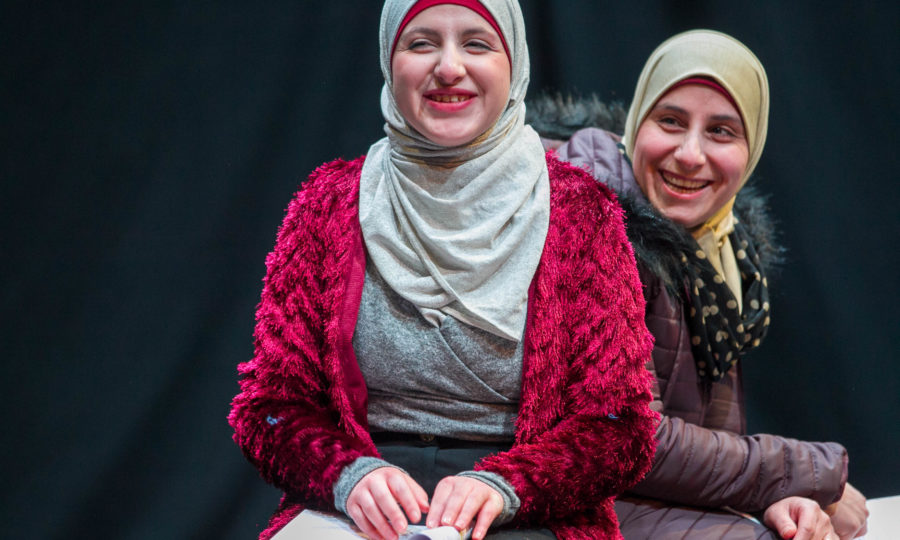
 'A new production of Greek tragedy The Trojan Women, by Euripides, is being staged by an Edinburgh-based theatre company, with cast comprising amateur actors and a story adapted to incorporate their experiences of fleeing Syria with millions of others.

 The play, written in 415BC, tells of the women of Troy after their city has fallen to Greece, their husbands have been killed, and a life of slavery beckons.

 More than two millennia later, it is being staged at an arts venue next to a fast-food drive-through and a bookies in Easterhouse, Glasgow.

 For producer William Stirling, who with his wife Charlotte Eagar has mounted several previous productions of the play around the world, the process is about much more than storytelling.

 He said: “A lot of women we have worked with in the past say they have lost their identities, crossing borders, losing their homes. If you are from Syria or the Middle Eastern countries, you typically live as part of an extended family of 30 or 40 aunts, uncles, cousins, like a big support group. You have to have a big family in order to survive. That’s something they lose. What we hope we have created is a bigger support group, a wider family for the people who have taken part. When we first did it in Jordan, we were told that theatre wasn’t big in the Arab world, that wives, daughters and mothers would not be allowed to go on stage. The opposite was true. We’ve found this helps give them back some of their identity.”


 Heba, 19, said her family fled Syria in 2013 when Bashar Assad’s forces targeted schools.

 “It was very bad, the village I lived in was very dangerous, the army started shooting in our schools, the people who were supposed to protect us. My dad had been taken to prison in Syria but he got to Jordan and we went to meet him there. When they started shooting at the school we hid at my teacher’s house. It was so dangerous to move in the streets, we had to hide in the trees and then in the evening I left for Jordan in a van with my brother and sisters and mother. Before this, I had a perfect life as a child, my family protected me. But when the war started, I couldn’t understand why the army were shooting us. They aimed for schools and hospitals. Can you imagine this? I don’t always tell people these things here, I worry about their feelings. Not everyone has the flexibility to listen to these stories and I don’t want to make people feel sad.”

 Heba is a social science student at Motherwell College, living in Milton of Campsie, and plans to become a clinical psychologist.

 She said: “The people I have met through the play I think of as my wider Syrian family now. When you speak your suffering for the first time, you cry. But when you say it twice, three times, you control your feelings. For three months I don’t think about Syria. This has been very positive for me.”


 Alaa, 27, works as a translator and interpreter and lives in Glasgow. She secured a scholarship to study literature in Edinburgh and left her home in the suburbs of Damascus in 2016. She doesn’t know when she will ever see her parents again.

 “My village was under siege when I left. We had to pay a large amount of money at the checkpoint to get to Lebanon. My parents are still there. I feel sadness, anger but worst of all hopeless, because it feels like things are getting worse since the revolution, and now the regime is gaining control again. All the people who died, everything that has been done, is for nothing. I can’t go back to Syria, and I have not seen my parents since I left. It is very hard, especially when you know they are suffering, and they have no hope of seeing their children again. Taking part in the play has meant a lot to me, to see people from your country every week. Many had no purpose when we first started and this has given them something.

 Life here is different in ways I couldn’t imagine. Syria has technology, but it doesn’t have humanity. The main differences I see are happiness on the faces of children, how humans treat each other. People are downtrodden in Syria, trying just to get gas, electricity, money to feed their children. If you’d lived in another country which has no consideration for humanity, you’d see it every day.”


 Essam fled Syria after receiving a terrified phonecall from his daughter.

 “I was working in Egypt and my daughter phoned me. She said she wanted to come to where I was because there were bombs. She was three years old, she was scared. I realised we had to go away if we wanted to be safe.”

 Having successfully mobilised his family from Syria to Egypt in 2012, he arrived in Scotland in 2016 and now works as a delivery driver.

 “It is very hard for us, it is not easy to start again from below-zero in your 40s. This play sends a strong message from Syrian refugees in Scotland. We have to say who we are, why we are here. We are here for safety. We have to tell people that we are not Isis, that is so important. Syrian people have a massive civilisation and history.” '

Image result for How a play written 2,500 years ago is giving hope to Syrian refugees in Scotland

Monday, 4 February 2019

Change is possible in Syria

Image of Syrian President Bashar Assad on 14 April 2017 [Inform the world/Twitter]

 Yvonne Ridley:

 'Bashar al-Assad must be buoyed by the support that he has these days across the Arab world. Such support includes the Palestinian Broadcasting Corporation (PBC), the Palestinian Authority’s official news channel, opening a new bureau in Damascus. The campaign to rehabilitate Assad’s brutal regime continues more or less unchallenged.

 There seems to be very little political will within the international community, let alone the Arab world, to stand up and question the Syrian dictator’s continued leadership, despite him presiding over one of the most devastating wars and humanitarian disasters on the planet. Nor does there seem to be much appetite at the UN to view Assad as one of the key obstacles to a peaceful solution in the brutal Syrian civil war which began in March 2011.

 This war has cost the lives of between 500,000 and one million people (we will probably never know for certain); displaced more than half of the country’s 22 million population; and involved countless atrocities and crimes against humanity. Shocking images smuggled out of Syria in 2014 provided clear evidence of the genocidal intent of the regime in Damascus, but they are conveniently ignored, or even forgotten.

 Moreover, while Qatar is adamant that it will not reopen its embassy in Damascus, both the United Arab Emirates and Bahrain opened theirs last month, claiming that they are seeking to counter Iranian influence. Such claims are largely dismissed by Middle East analysts.

 Even as the repeated cries of “Never Again” from last month’s Holocaust Memorial Day events still echo around the world, the Assad regime rolls on relentlessly like an out-of-control juggernaut targeting its own people. I am still haunted by the Syrian women who told me of their horrific experiences as prisoners of the regime in Aleppo, Homs, Damascus and other cities. I despair at the lack of will and moral backbone of presidents and prime ministers from East to West to make real efforts to end this war, not least because of the alarming signs that the main effort at the moment is to bring Assad back into the fold and normalise his behaviour. This will include, we are told, a visit by PA leader Mahmoud Abbas very soon. This is appalling news; if any nation knows the pain of brutality and violence at the hands of a repressive regime, it’s the Palestinians. What is Abbas playing at?


 Despite what conspiracy theorists will have you believe, the democratic uprising against the Assad regime began over the arrest, detention and torture of a group of schoolboys in Daraa, as MEMO revealed back in 2014. It did not begin with CIA interference, nor an influx of foreign fighters, Al-Qaida, rebranded weapons from the West, NATO or a global call across the Muslim world for jihad. This was a reluctant revolution which was forced upon the people by the murderous response of an evil, malevolent regime to their call for justice and reform.

 Mercifully, while politicians with very short attention spans and an eye on the poll ratings have grown weary at the very mention of Syria, ordinary people are standing up to and taking action against the Assad regime. For this very reason, there is concern among the privileged elite surrounding the Syrian President. While state leaders and the UN seem powerless to do anything constructive, extraordinary individual efforts fuelled by exceptional determination can possibly bring about change.

 I have seen two examples of these in the past 48 hours, herculean efforts which could force a change in direction of the Syrian war if only the international community will show similar courage and leadership to bring an end to Assad’s brutal rule and the sectarian strife which has ripped the region apart.


 The first was when a US court ruled that American journalist Marie Colvin was murdered by the Assad regime during an artillery attack on Homs in 2012. She was not just another random casualty of war; following an exhaustive inquiry, Judge Amy Jackson ruled that she was targeted deliberately as part of the regime’s policy of violence against independent journalists, whom it considers to be “enemies of the state”. The court in Washington was told that this violence is ongoing.

 “Officials at the highest level of the Syrian government,” explained Judge Jackson, “carefully planned and executed the artillery assault on the Baba Amr media centre [in Homs] for the specific purpose of killing the journalists inside.” Colvin and a French photojournalist, Rémi Ochlik, who was also killed, were “specifically targeted” in order to silence their reporting of the growing opposition to Assad’s dictatorship and atrocities committed by regime forces.

 While it is unlikely that Colvin’s family will ever benefit from the court’s award of $302 million in punitive damages against Assad, his brother Maher Al-Assad and their associates, the verdict opens the way for the seizure of some or all of an estimated $1 billion in Assad family assets salted away around the world, some of which have already been identified and frozen. The premeditated murder of Colvin should now also form a part of the ongoing UN-led criminal investigation of Assad, which seems to have stalled of late.

 Make no mistake, though, this has only come about through the determination of Colvin’s family to get justice for this incredibly brave journalist who in death may just yet achieve as much for the innocents of war as she did in her amazing life. Colvin was a former colleague of mine at the Sunday Times and she was fearless in her determination to get to the truth; her defence of vulnerable people in conflict zones was breathtaking.


 As the verdict was returned in the US court, another group of equally courageous and determined individuals held a press conference in Idlib, in rebel-held Syria. This seemingly inauspicious occasion looks set to be a thorn in the side of the Assad regime with the unveiling of a civil society initiative called the Unity Project.

 Around 350 “ex-pats” from the West have come together in Idlib to help Syrians rebuild and develop their country. Using a variety of professional skills — including medical, education, engineering, science and media — the group has networked extensively with Syrians on the ground, charities back home and each other to rebuild and open schools, hospitals, playgrounds and community hubs to help widows and orphans.

 Most of the ex-pats — or foreigners as the Syrians call them — arrived in the war-torn country more than five years ago “for humanitarian purposes”. Their decision to stay has cost some of them their British citizenship because of the simple but toxic narrative that anyone leaving Britain to go to Syria can only be fighters or Daesh brides.

 I met some of the founders of the Unity Project during my visit to Idlib last month and was told by one that there are no fighters in the group: “Our only motivation is to help Syrian people rebuild their own country.” Sadly, rather than being applauded for their work which has convinced many Syrians to stay in their country, some individuals have been punished by the British government, which has cancelled their passports.

 Undeterred, and arguably more determined than ever, the ex-pats came together on Thursday and unveiled the project. Far from seeing Idlib as “the last stand”, this group sees the tide turning in the fortunes of the Assad regime despite its powerful Russian and Iranian allies which are counting on the West’s growing fatigue and general political malaise with regard to Syria.


 To this end, it is worth remembering the poignant words of the late theoretical physicist and cosmologist Professor Stephen Hawking, who said about human beings and our place in the universe, “We are very, very small, but we are profoundly capable of very, very big things.”

 Perhaps self-serving politicians who are growing tired of Syria would do well to remember this and the millions of ordinary Syrians holding out in the rebel territories. With that eye on the poll ratings and public opinion, do they really want to be remembered as the lawmakers who allowed genocide, torture, suffering and abuse to become the accepted norm in the world? Surely not.'