Saturday, 10 June 2017

America's Strikes Are Leaving Syrians Confused


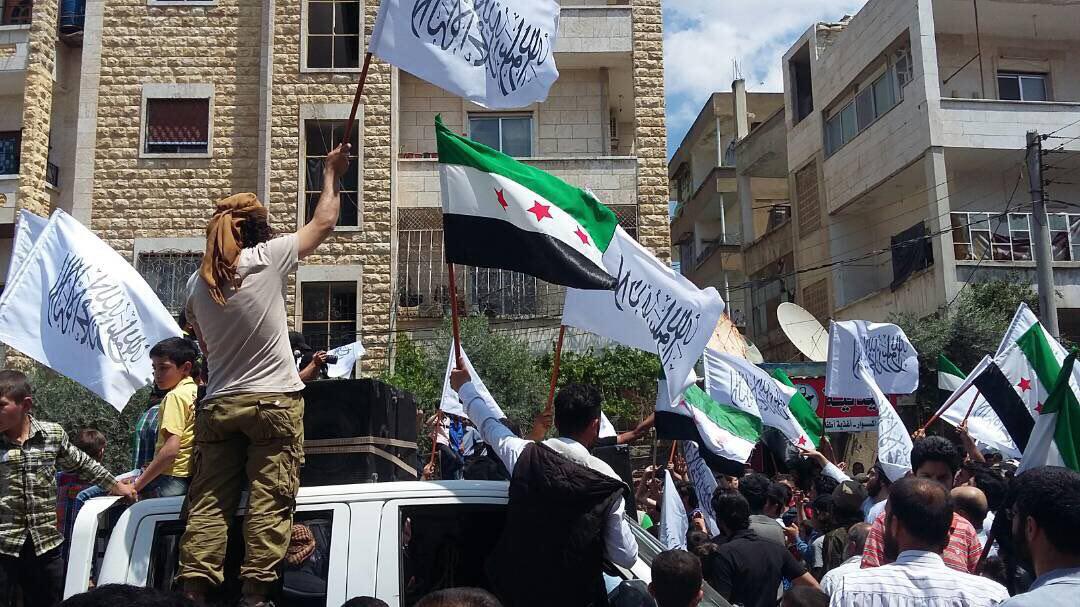
 'The US-led coalition against ISIS struck pro-Syrian government forces for the third time in recent weeks, prompting speculation among Syrians about what it means for their civil war, even as the US military tries to downplay its significance.

 “We certainly welcome any strike against the regime, but we want the real efforts to support the Syrian people and not to increase division in the region,” said Mustafa Serjari, a spokesperson for the Al-Mutasem brigade, a Syrian rebel group backed by the United States.

 US forces have been stationed at a base in Al Tanf, in southeastern Syria, for over six months now as part of a mission to train members of the Syrian opposition meant to aid in the fight against ISIS. In each instance where the US has fired on pro-Syrian forces, the US military has said, armed vehicles have entered an area that Russia, who backs the regime, and the US had agreed to be neutral ground. The strikes, which have destroyed several vehicles, were meant to push the pro-regime forces to fall back across the line.

 “What is happening in Syria is a genuine conflict of influence,” Serjari said. “These strikes only began when the regime and the Iranian militia decided to move into forbidden areas. The question here is why aren’t the Iranian regime and militias not being targeted in other areas?”


 The nature of the strikes — both in their focus in one location and gaining tempo — is prompting some activists to have hope that the war will broaden into a true US intervention against Syrian President Bashar al-Assad. But the clashes are opening the door to rampant speculation among the opposition about the true goals of the US.

 “I think there is a plan to divide Syria under US supervision, which explains the aerial bombing of foreign militias who support the Syrian regime near Al Tanf crossing,” said Ahmad Abdulazez, a Syrian activist based in Idlib. “Why didn’t they bomb them in other parts of Syria? There are a lot of groups trained and supported by the US government who have been attacked, but the US hasn’t defended them and has, in fact, rejected any request from US-backed rebel leaders to push back the Syrian regime and their militias.”

 “We welcome any US intervention to save the Syrian people, even if it is too late, but we do not accept any goals to divide the country,” Abdulazez said. “The United States must protect all factions it backs throughout the country, not only in Tanf.”


 But the Pentagon has sought to make clear that Tanf is a special case and that the US isn’t spoiling for a fight against the regime. “The Coalition's mission is to defeat ISIS in Iraq and Syria,” the Pentagon’s statement on the strike released Thursday read. “The Coalition does not seek to fight Syrian regime, Russian or pro-regime forces partnered with them. The demonstrated hostile intent and actions of pro-regime forces near Coalition and partner forces in southern Syria, however, continue to concern us and the Coalition will take appropriate measures to protect our forces.”

 That hasn’t kept members of the opposition from holding out hope that a wider intervention is still coming.

 “The American intervention in Syria is in the interest of the Syrian revolution because US is a superpower and it doesn’t have ambitions in Syria the way Russia, Turkey or Iran do,” said Muzakhim al-Sallum, a news manager for Hamurabi’s Justice Agency, a publication with close ties to US-backed rebel groups. “The Americans in particular need to take a serious step to deter the [Iranian and Assad] militias because every group that gets supports from the US and other allies are under heavy and violent attack from forces loyal to the Syrian regime.”

 Meanwhile, the Syrian government is using the strikes to label the US’s motives as not what they’ve claimed publicly. Syrian news website Al-Mayadeen, quoting an unnamed military source, said the attack exposes the falsehood of the international coalition’s claims that it is fighting terrorism. “The Syrian Arab Army is fighting terrorism on its own territory and no other group has the right to determine the course and direction of its operations,” the military source told the website.'

Tuesday, 6 June 2017

Assad Mobilizes at the Gates of Daraa Ahead of Assault


 'The last days of May saw the dispatch of Assad forces military columns to Daraa province, concentrated in the regime-held the areas of Izra and Sherbet Ghazala in the northern countryside. The deployment involved hundreds of fighters from the Fourth Division led by Gen. Maher al-Assad, brother of the regime's president, amid reports indicating the this step is preceeding a wide military campaign targeting Daraa’s rebel groups.

 Enab Baladi learned from sources on the ground that preparations are underway by rebel groups to repel any potential attack in the area, and the battle for the Al-Manshiyah neighborhood was continuing, resulting in full control over the Sajana district.

 The regime mobilization extended from May 28–31, accompanied by additional reports confirming that the Fourth Division leader had visited the city of Izra in on Tuesday May 30. Sources said that a number of officers of the Fourth Division accompanied Gen. Assad in the surprise visit, with him departing within hours and the officers remaining in Izra.

 On social media, images spread of “Ghaith Forces” convoys in the Fourth Division under the leadership of Gen. Ghaith Della, heading from Damascus to Daraa. A post on the “Ghaith Forces” page said that “after the operation to clear Qaboun and Barzeh and settle the status of the remaining armed men to incorporate them into the ranks of our glorious forces after sterilizing and drying the settlement, the men of God and the men of victory are heading to Daraa, cradle of the outburst – Daraa is nearly in the grip of the nation and the Syrian flag.” (The first demonstrations against the Assad regime in 2011 began in Daraa and quickly spread throughout the country)


 The mobilization comes “in the context of a broad assault against the opposition,” according to the page, which quoted sources as saying that the attack will be “a major one to regain positions in the Al-Manshiyah district in preparation for taking full control over Daraa city, the main base of the opposition in the province.”

 According to opposition military sources in the province, Assad forces and allied militias may attempt to seize control over the eastern environs of Daraa city and then cut supply routes to the opposition there.

 The sources pointed to the air raids which targeted the town of Naameh (neighboring Daraa on the eastern side) without any direct reason, giving the impression that the town will soon be in a battle extending to the strategic Gharaz area which includes grain silos and the Gharaz prison, the main headquarters of the Dar al-Adel (House of Justice) in Houran.

 The sources told Enab Baladi that the Dar al-Adel court had been effectively cleared in the Gharaz area at the start of June and turned into a “military zone.”


 Assad forces aim to take control over this area to split the districts under opposition control off from the eastern Daraa countryside, by cutting the road connecting the city and the town of Umm al-Methan through the Gharaz area. Once that is done there will no longer be any route connecting Daraa city with the eastern countryside except a singe road along the border up to the town of Naseem.

 The targeting of this axis means that Assad forces aim to surround Daraa city as an alternative plan to igniting the battle in its districts which contain the opposition forces represented by the Al-Bunyan al-Marsous Operations Room. If this reading is correct, the eastern front of Daraa will not be the only one, and the attacking forces may intend to open the front from the west, parallel with the town of Al-Yadooda and the village of Khirab al-Shaham, to cut off the military route connecting Daraa town and the western countryside.

 Meanwhile, rebels have continued with their operations against the Syrian regime despite knowing of the regime’s intention to retake the city, as happened in the eastern districts of Aleppo at the end of last year. The groups of Al-Banyan al-Marsous have pushed with the “Death Rather Than Humiliation” battle toward taking control over the Sajana district and most of the Al-Manshiyah district in the city.'

Saturday, 3 June 2017

No New Parties in “Liberated” Idlib

No New Parties in “Liberated” Idlib

 'Saadeddin Al-Khatib (52) felt free for the first time in his life in 2011. The Syrian revolution had sparked on March 15, and he was among the first peaceful demonstrators to call for freedom and the overthrow of the Asad dictatorship, which had ruled the country for over four decades.

 Al-Khatib is a local of Kafranbel, Idlib. One of hundreds of members of the formerly banned Syrian Muslim Brotherhood, he has been detained and tortured for several years in the notorious Tadmur Prison.

 It has been two years since Idlib governorate fell entirely outside of regime control. However, due to the prevailing state of war and the multitude of jihadist organizations on the ground, new political parties have yet to take shape here. Apart from the Muslim Brotherhood, which resumed its activities through political conferences and relief efforts, party-based political life is nearly non-existent.


 Al-Khatib, who now works in the Brotherhood’s relief sector, explained to SyriaUntold: “Most members of the party live in exile. Despite not being on the ground, they nonetheless provide us with material relief assistance, whether or not we are affiliated with the party. Their support has also benefited the displaced, the poor, and those in need, as well as some military factions.” Al-Khatib declined to name these factions, but there has been ample evidence of Brotherhood support for the Shields of the Revolution Council (2013-14), in addition to other militant groups engaged in the ongoing conflict.

 Al-Khatib pointed out that the Islamist group occasionally holds party meetings, and has established many associations to connect the Brotherhood members abroad with those inside Syria. Such associations include the Wafa Association, Ensar Mazlumlar, and the Free Tadmur Prisoner Association.

 These associations are concerned with handling Brotherhood affairs at home, as well as providing humanitarian aid and implementing developmental and service projects in opposition-controlled areas.


 The Brotherhood strives to recruit new members, but according to Al-Khatib it follows certain criteria, notably having engaged in either intellectual, revolutionary, civil or media activity, in an emphasis on those who can be effective contributors. Nabih Othman (69), the executive director of Ensar Mazlumlar, said the door is also open to all former Tadmur prisoners.

 As for the Brotherhood’s political role during the Syrian revolution, the party has been a major bloc in the Syrian National Council, which remained the most important opposition group in exile until November 2012, when it joined the National Coalition for Syrian Revolutionary and Opposition Forces.

 However, the Muslim Brotherhood remains a single party in the midst of numerous Syrian political movements. It is true that it is a disciplined and effective political actor, but it lacks manpower inside Syria. Power has become monopolized by other Islamist militant factions with whom the Brotherhood avoids confrontation. This is not a battle the party wishes to engage in for the time being, says Al-Khatib, as the priority is rather to “overthrow the regime.”


 As for leftist and nationalist currents, where are they in Idlib today?

 Istanbul-based journalist Manhal Barish (37), who hails from Saraqib and was a member of the dissenting leftist Syrian Democratic People’s Party, suggests an answer. “Basically there are no currents in the political sense. There are only individuals and small groups who have failed to create a broad social base in Syria. We are talking about political opponents, not an opposition.

 “This is the case of hundreds, if not thousands, of people who found no united platform to join, except for the Damascus Declaration [which did include nationalists and leftists]. This platform was nonetheless neutralized by the regime by way of detaining and exiling its members, which ultimately resulted in its dissolution.”

 In short, Barish adds, in the context of an armed conflict, a mixture of sectarian strife and a “regime’s war against its people,” not to mention the complex geopolitical dynamics, there is little chance for a leftist movement to be effective in the foreseeable future. Political activity, even the sort bound by democratic principles, is still subject to repression and persecution in areas the regime has forgone, to no lesser extent than in regime-controlled areas.

 As for the People’s Party, Barish believes that it has distinguished itself from other parties in the vast political ecosystem in which it operates. That is, it has included intellectuals, veteran political dissidents and young activists. However, the party fell short of garnering significance presence in Idlib, which is also the case of the Nasserite current (the Democratic Arab Socialist Union). Furthermore, Barish emphasizes that, as far as the Syrian rebellion’s support base is concerned, the majority of political figures operate on a local rather than national level.


 Concerning the lack of political parties in Idlib today, Ahmad Jalal (38), a member of the Union of Revolutionary Bureaus in Kafranbel, suggests that political parties emerge as a result of a transition of power. However, due to the war, governance in rebel-held areas is exercised by militant factions in a manner similar to the “emergency law” mandate. This, Jalal argues, is an environment “unsuitable for the emergence of any political parties, especially with the polarization which has impacted most segments of the population, dividing them into supporters and opponents of this or that faction. This polarization led to the rise of belligerent movements competing over power.” Consequently, no political parties have been formed in the opposition-held north for fear of confrontations with rebel armed groups or jihadist organizations.

 “The Syrian north, especially Idlib and its countryside, is rife with multiple affiliations that have even divided households,” said Abu Amjad (40), a member of the Kafranbel Local Council. On the fragmentation, he explained that “there remain loyalists and supporters of both Daesh [a derogative Arabic acronym for the self-declared Islamic State, IS] and the Asad regime, even if they do not express their political views.”

 Abu Amjad attributed the affiliation of young people with the factions to their need for material support, their inclination towards jihad, or their conviction that their factions fight for freedom and overthrowing the regime. He also added that the human capital flight towards asylum countries contributed to the absence of political parties, despite the total withdrawal of regime forces from Idlib governorate in 2015.


 Amran Al-Hamawi (28) has been a fighter with Jabhat Fath al-Sham (JFS, formerly known as Al-Qaeda-linked Jabhat Al-Nusra) for two years. He is fully convinced that the organization is “the most honest and diligent, with no political or material ambitions. Its only goal is to defend oppressed and persecuted Syrians,” as he explained to SyriaUntold.

 On the other hand, Said Habash (56), who is also from Kafranbel, voiced his grievances about the confiscation of his house by JFS, on the grounds that his son is still serving in the regime’s military. “What are we guilty of, to be punished for our children’s decisions?” he wondered. “The children parted ways according to the ruling powers on the ground, without our consent, and without even consulting us.”

 For its part, according to Al-Hamawi, JFS considers that “confiscating the houses of those people is normal, so that they know that, by maintaining loyalty to the Asad regime and assisting it in killing their countrymen, they are expelling their parents and themselves from the liberated areas.”

 This demonstrates the dominion of these factions over people’s lives, as well as their reckless retribution against their ‘political adversaries’ which is quite indicative of the rocky terrain ahead for political action under such circumstances.

 Given the fragmentation and the multiplicity of powers on the ground, the likelihood that new political parties will emerge remains low. Furthermore, the Muslim Brotherhood, which is the only one that is still operating, is far from being the dominant power it is said to be. However, it is thanks to its political aptitude, as well as its proven track record of resilience, that this party might continue to play an active role in Syrian politics for years to come.'

Thursday, 1 June 2017

Short of allies, Syria’s rebels are down but not out


 ' “We have become political dwarfs, fragmented groups which hardly have control over the closest checkpoint, let alone each other,” said Tarek Muharram, who quit his banking job in the Gulf to return home and join the rebellion in 2011.

 Over the years he fought alongside several different rebel groups, including ones backed by the United States. Now he has joined the alliance led by the al-Qaida-linked Hayat Tahrir al-Sham.

 Nothing blurs Muharram’s vision and determination to fight Assad. Not the loss of his beloved Aleppo. Not the hours he and his comrades now spend in a small apartment in the southern Turkish city of Gaziantep, watching TV and smoking, waiting for the next battle.


 The fall of Aleppo was a watershed moment. It cost the rebels there their strongest base, their resources, their homes. Uprooted, they needed new allies.

 “We had reached a dead end,” said the 39-year-old Muharram. So he and his group, Noureddine el-Zinki, which was once backed by the U.S., joined al-Qaida’s alliance.

 The move caused many of his group to break away. But for Muharram, anything else would have required too many concessions. Turning to Turkey or US would mean becoming “a mercenary fighting whomever the sponsor wants, whatever the dollar dictates.” He would have had to take part in Russian-backed negotiations, “giving up the revolution’s principles ... and accepting Assad for a longer period,” he said.

 Muharram said he has his personal differences with al-Qaida. He pointed out that he doesn’t always pray, for example, and he smokes. He sports a wolf-head tattoo on his arm, something militants frown on.

 But he said the al-Qaida-led alliance has kept its weapons pointed in the right direction, against Assad. He and the 50 men he commands would drop their guns rather than be pushed to fight it.


 The alliance has financial clout and can provide services in its territory. It has the resources of Idlib’s and neighboring rural parts of Aleppo province to sustain the fight without relying on outsiders — farmland, water wells, supplies of fuel and weapons. Its fighters are mainly locals and well-disciplined, and the few foreign fighters including Afghans and Chinese don’t interfere in residents’ affairs, unlike the foreign jihadis of IS.

 Both Turkey and the Kurds so far avoid a fight with al-Qaida-linked militants. But if Turkey is tempted to move against the alliance, Muharram said, it has pressure cards, including a border crossing with Turkey and territory near a Kurdish enclave, a potential thorn in Ankara’s side.

 The fight to remove Assad is far from over, he said.

 “The revolution will end with a ballot box. There is no legitimacy for a new Syria without elections.”

*****

 Saeed al-Nokrashi defended his hometown of Daraya outside Damascus for years under a bloody, destructive siege by Assad’s troops. But finally resistance collapsed, and last summer he and his fellow fighters were forcibly displaced north to Idlib.

 It was a humiliating and disorienting move for Capt. al-Nokrashi and the 700 men in his faction, Shuhada al-Islam, part of the U.S-backed Free Syrian Army umbrella.

 Idlib was strange territory, and dangerous — not because of Assad’s forces or airstrikes, but because of Idlib’s overlords, the al-Qaida-linked group.

 The militants immediately kidnapped some of his best fighters.

 “This was to pressure us to join them, and if we do, they will protect us,” al-Nokrashi said, speaking at his home in the southern Turkish town of Reyhanli and holding his 6-year-old son, born during the Daraya fighting.

 The fighters were eventually freed. But the incident highlighted the more complicated world they were in.

 “Our confrontation was only with the regime. Now the choices are many.”

 The threats are, too. The Islamic State group is a concern, as are the Syrian Kurdish forces, who he said are trying to “create a separate state in the north.” Then there are pro-Assad Iran and Shiite militias.


 Al-Nokrashi’s fighters are languishing in Idlib. They struggle to make ends meet and are focused on their families, reunited after long separations during the siege. Some have opened food shops, bringing the Damascus area’s cuisine to Idlib.

 A few of his fighters joined al-Qaida-linked group. The others have to deal with its pervasive security agencies that monitor all factions closely — “just like the regime’s security agencies,” said al-Nokrashi, a former Syrian army officer.

 Al-Nokrashi tried turning to diplomacy. He attended one session of the Russia-backed talks in the Kazakhstan capital Astana, where rebel commanders were received with much fanfare and sat briefly in the same room as the government delegation. He became disillusioned and boycotted the following meeting.

 But he may have found his refuge. In recent weeks, the U.S., Turkey and Western and Gulf countries backed a new attempt at a coalition against Assad known as the Northern Front Operation Room. So far, 17 factions have joined but there has been no battles yet, al-Nokrashi said.

*****

 Lt. Col. Ahmed al-Saoud, drives around the Turkish seaside city of Iskenderun with another car of Syrian bodyguards and aides behind, fearing attack even here.

 The commander of the U.S.-backed Division 13, he has been living almost permanently in Turkey since al-Qaida’s affiliate attacked him and his group in Syria last year. When he tried to return home in April, an ambush by the group’s fighters was waiting for him. He survived, but one of his commanders was killed.

 Al-Saoud’s claim to fame has been his relentless fight against the radical group, which has tried to gain a foothold in his hometown, Maaret Numan, in Idlib. His anti-extremist stance got him arrested by IS in 2013, until protests forced the militants to release him — a sign of his support base in the area.


 Al-Saoud, a defector from Assad’s military, has received Western aid from the start. He feels let down that the U.S. is throwing its weight behind Kurdish militias.

 “We can’t be temporary allies for a certain stage and then they drop or back me as they please,” al-Saoud said.

 What particularly miffed him, he said, is when U.S. troops deployed to create a buffer between Kurdish fighters and Turkish troops in northern Syria. “Aren’t we worthy of defending?” he said.

 He fears U.S. support will only deepen the Kurds’ determination for self-rule, leading to the division of Syria, in the process boosting support among Sunni Arabs for al-Qaida.


 During a recent AP visit to his home in Turkey, al-Saoud was constantly on the phone with his commanders back home, who in his absence are trying to understand shifting alliances and battlegrounds.

 Al-Saoud also has joined the Northern Front Operation Room. But he is skeptical.

 It is led by Islamist factions, minimizing the role of more secular groups like his. He fears the coalition will cost him his direct contact with the Americans and his independence, pull him from the fight against al-Qaida and diminish his prestige — his “charisma,” as he puts it.

 “My aim is a Syria free of Assad and of terrorism,” he said. “We will remain the popular face of this fight.” '

Tuesday, 30 May 2017

Syrians roll back extremism in Idlib

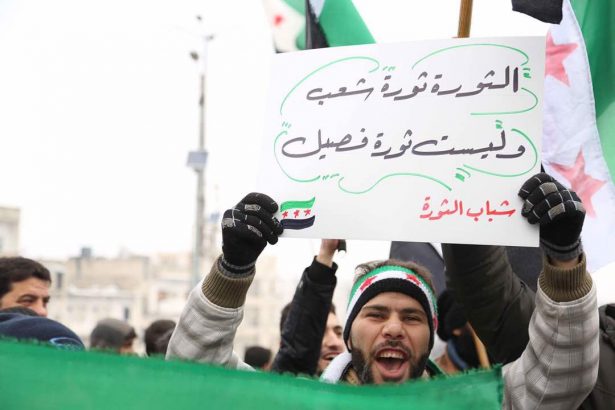
Syrian women protest extremists in Idlib City

 'The U.S. airstrikes in response to the chemical weapons attack in Idlib province last month triggered calls for greater outside military force against the Assad regime by some of the Syrian opposition. Yet, in a country exhausted by armed struggle and the presence of extremist groups, local civil initiatives have proven to be more effective at building peace than increased military involvement. In Idlib City, ordinary citizens have shown that they are capable of managing their civil affairs, alleviating suffering at the local level and rolling back extremism by themselves.

 On March 3, 2015, an umbrella group of Islamic armed factions called Jeish al-Fateh expelled the Syrian government from Idlib City, sparking an ongoing struggle by citizens and civil resistance groups to gain control of the city’s administration. After it took control of the city, Jeish al-Fateh — which includes Jabhat Fateh al-Sham, formally known as al-Nusra Front, a group affiliated with al-Qaeda — formed a Shura Council to manage the city’s military and civil affairs. The armed group appointed its members and loyalists to administer the city without paying attention to qualifications or proper recruitment procedures. A state of repression was imposed, and there were continuous violations of basic human rights and freedoms under the pretext of applying proper Islamic Sharia law.

 This brought activists and civil organizations into direct confrontation with the armed group, which assumed the administration of all public services, including education, health, security and justice. In response, residents and civil resistance groups have been working to establish a local council of qualified civilians to prevent military factions from interfering in civil affairs and protect peoples’ rights and freedom.

 “We wanted to prove our commitment to our initial goal of revolting against all type of corruption and injustice,” said Sakhr Baath, a lawyer and member of Idlib Youth Group, which was established by activists at the early stages of the Syrian uprising in 2011 to galvanize citizens against the regime and now the inhuman practices of Jeish al-Fateh’s leadership. The group also initiated relief and humanitarian projects, including the rehabilitation of schools and the formation of volunteer teams to direct traffic and crowds. “These activities helped them [the civil organizations] gain a great reputation and the community’s support,” Baath added.


 Idlib City was one of the first cities after the uprising began to show open and organized civil resistance, even in the presence of the government. The city’s professionals established the National Opposition for Idlib Intellectuals in August 2011 to find solutions to sectarian divisions that plague Syrian society. According to Baath, the group used to host meetings and invite government figures and supporters to discuss their views with the community. At that time, activists — with the support of Syrian expatriates — began to self-manage areas outside of the government’s control, provide humanitarian assistance, guard the city at night and control traffic.

 Established six months after Jeish al-Fateh took control of the city, Al-Idlibi House became the largest civil organization in Idlib, with more than 400 activists and members. They met every Thursday to discuss the city’s affairs and decide on the best tactics to pressure armed factions to hand over civil administration to the community. They organized media campaigns, public demonstrations and sit-ins to demand civil rights and express their opposition to the control of the city by extremist groups.

 “We established Al-Idlibi House to unite the voices of the people and have a body to negotiate with the Shura Council on behalf of the community,” said Abd al-Latif Rahabi, the head of Al-Idlibi House management.

 The security forces of Jeish al-Fateh worked hard to disperse demonstrations and damage their reputation by calling them secular or anti-Islam. “However, as the number of protesters increased and reached the main squares of the city,” Baath explained, “it was impossible for them [Jeish al-Fateh] to control public frustration or ignore their demands.”


 Women were also active in this struggle and established many groups and humanitarian organizations, including Women’s Fingerprints, Glimmer of Hope, and the Association of Educated Women. These organizations raised awareness of women’s role in building society, and provided educational and vocational courses. They also established orphanages and care centers for people with special needs, and initiated projects involving sewing and producing homemade food for women who could not leave their homes.

 Women also challenged female preachers recruited by armed factions to impose strict Sharia law, which prohibits women from walking outside without men or showing their faces. “Last year, when a preacher harassed my cousin for wearing makeup and not covering her face, more than 200 men gathered in less than 20 minutes and began protesting against the preacher and armed factions’ oppression,” said Shadi Zidani, a member of Idlib Local Council. “Repeated incidents like this and women’s resistance have always triggered demonstrations and by the end of last year, we were able to expel all female preachers from the community.”

 Female preachers were also reaching out to poor and vulnerable women to convince them to comply with Sharia law. “We formed volunteer groups of female psychologists and sociologists to visit vulnerable women and raise their awareness of basic rights and freedoms to counter the extremists’ views,” Zidani said.


 Local civil efforts persisted for about a year and a half, using all possible means and tactics. In August 2016, Al-Idlibi House, with the support of other civil organizations, formed a committee to represent the community in their negotiation with Jeish al-Fateh. “With our continuous pressure, they [Jeish al-Fateh] had to give in to the public’s demand that they elect a local council.”

 According to Rahabi, Al-Idlibi House’s committee nominated a group of lawyers and judges to establish rules and regulations to manage the electoral process, protect the right of voters to freely choose their representatives, and ensure candidates’ rights to monitor the election. Al-Idlibi House, with the support of the community’s members, established and equipped an electoral center with ballot boxes and private rooms for those wishing to vote secretly. On January 17, about 900 people voted, including 43 women. Eighty-four people were nominated for 25 spots on the council. All stages of the electoral process on election day were filmed and documented — by the media, community activists, and groups of lawyers and judges — to ensure that the process was legitimate, Zidani said.

 Those organizing civil activities faced many challenges, including regime airstrikes on the city, continuous fighting between armed factions and regime forces, and pressure from Islamists who tried to disrupt and discredit their efforts. “Despite all of the hardships, we continued with our regular meetings, demonstrations, sit-ins and media campaigns until we got what we wanted,” Zidani said.


 Three month after its establishment, the local council is managing most services, including water, electricity, bakeries, civil defense, firefighting, and the directorates of transportation, communications, agriculture and environment. With their vibrant activities, women’s organizations are participating in the council’s activities, voicing their concerns and suggesting solutions.

 The tale of civil resistance in Idlib has not ended. “Our next goal is to pressure armed factions to abandon the courts and security services and hand them over to civil entities, along with the rest of the directorates, including the civil and private land registries,” Rahabi said. “We are working on uniting all local groups and organizations under one body to make our voice even stronger.”

 While many international organizations and donors refuse to work in places under the control of Islamic armed factions — fearing that funds could end up in the hands of extremists — one of the most important tactics to fight extremism is to support civil organizations and initiatives. As evidenced by these civilian efforts, such initiatives are effective, and they are bringing peaceful and constructive changes into their communities.'


Protester carries sign in Idlib for people's revolution.

Saturday, 27 May 2017

A Syrian violinist's journey 'from brutality to hope'


 'Syrian violinist and composer Alaa Arsheed plays the violin with his eyes closed, following the rhythm and moving slightly to the notes. When he reopens them, he smiles widely at his friend and fellow composer, Isaac de Martin, who smiles back at him.

 Music is their passion, and they aim to use it to send a message of peace. After being invited to perform with their band, the Adovabadan Jazz Orchestra, at a journalism festival in Italy last month, the duo opted to launch a crowdfunding campaign to play their music along a route well-travelled by Syrian refugees.

 "The idea is that of a music tour by camper through the Balkans, driving from Italy to Greece, walking [along] the refugees' route, meeting artists and recording an album, as well as providing music sessions and workshops for refugees," said Arsheed, a Syrian refugee who has lived in Italy since 2015.

 Although he misses his family, who are split between Syria and Lebanon, Arsheed decided to seek asylum in Europe after he was granted a music scholarship by the Italian organisation Fabrica. In the meantime, he holds regular jamming sessions over Skype with some of his family members who are also musicians.


 Playing the violin takes Arsheed back to his memories of his home city, Sweida, in southern Syria. In 2006, his father founded an art space and library called Alpha, where artworks were exhibited monthly and young musicians used to gather, listen and play music.

 To Arsheed, this represented the beginning of a broader cultural revolution in the Arab world, culminating in the 2011 uprising.

 "If you entered this art space, you could see someone painting while another was playing an instrument, and a lot of people were coming in and sharing," Arsheed recalled. "Every week, we had a different cultural event: fine arts exhibitions, poetry nights and music concerts. And so, every week, we had also a man from the [Syrian] intelligence, sitting at the table, watching and listening to our talks.

 "But I felt his human side," Arsheed added. "When he was looking at paintings and listening to music, he was touched by that."


 During the uprisings that spread across the Arab world in 2011, Sweida's citizens also began to demonstrate peacefully in the streets, expressing a sincere desire for change. The state's reaction, however, was swift and harsh.

 "Men of pro-government militias came to destroy and attack our space, burning books and musical instruments," Arsheed said. "When these violent men see art, they see freedom; this is the reason why they arrived there to steal our dreams. They were afraid of change, and they wanted everyone to be like them. On the contrary, in that period, someone wrote in a cafe [the famous phrase]: 'I disapprove of what you say, but I will defend to the death your right to say it.'"

 The art space was forcibly closed by police and Arsheed's father was jailed for a month. At that point, Arsheed and his sisters realised that it was no longer safe for them to remain in Syria.

 Arsheed left with his violin and a few belongings, and moved to Beirut to finish his studies in music. He also taught music in the Palestinian refugee camps of Sabra andShatila, worked in television, radio and theatre, and had the chance to play violin for a performance of Majnoon Yehki alongside Lebanese playwright Ziad Rahbani in 2013.


 But only after he arrived in Italy was he finally able to produce his debut, Sham, an eight-song album inspired by his life and musical journey. Along with de Martin, Arsheed later founded Alpha Art to pursue the construction of a new international art gallery based on the one founded by his family in Sweida.

 After many concerts and a festival in Italy, the duo are now focusing their energies on the next big project: their tour through the Balkans route.

 "The journey will take approximately one month," de Martin estimated. "The camper will serve us to move, to sleep and to record. In fact, we want to transfer our studio in there: speakers, mixers, PC, microphones, cables, musical instruments. At each stage of our journey from Italy to Greece - crossing Slovenia, Austria, Hungary, Romania, Serbia, Bulgaria, Macedonia - we will interact with talented artists and with people and register a track for the album Seeds."

 At the same time, the music tour will become a documentary film, with a director and crew joining them along the route.

 "I hope this project also produces seeds of hope for Syria," Arsheed said. "Music has to become the turning point from brutality to hope." '

'Throw him in the room of death'


 ' “I remember being caught by tear gas used by the security forces. It burned your eyes and throat and we were scared that it was chemical weapons.”

 Words that no teenager should have to utter but the harsh reality of Yassine Alharaisi’s terrifying childhood in Syria. Yassine, Nazira and three other refugees – husband and wife Chadi and Mariam Amiri and Mona Al Dafan, who were among those provided with homes through North Lanarkshire’s Syrian refugee resettlement programme, took to the stage at Airdrie town hall last Thursday to share their memories of life in Syria – and thanked the people of Monklands for “making them feel welcome”.

 Mariam spoke of Syria being “a river of blood filled from women, the elderly and children” and highlighted that children “get killed every day from bombings and a lack of nutrition and medical care”.

 The sound of helicopter blades still fills Mariam with dread as every time she hears them “it says to my family and I, ‘I’m here to kill you all’.”

 But in a wonderfully upbeat conclusion to her story Mariam said: “In two months’ time I will be giving birth to my third child. I have a birthing plan already set up.”


 Mona shared her horrendous experience of finding out over the phone that her husband had been captured and killed, and how this made her lose “all hope and life”.

 For Coatbridge-based Nazira, bringing up sons Yassine and Badr in Syria meant every day was potentially their last.

 The terrified trio’s family home was bombed twice and Nazira and Yassine were both poisoned by chemicals, “escaping death miraculously”.

 A typical school day at St Andrew’s High is a far cry from Yassine’s early teenage years:

 “I could not afford school because I had to work to pay for rent and food. Between the ages of 12 and 16 I had many different jobs. When I first started work I got paid very little. I usually worked 12 hours a day, sometimes longer.”

 Yassine also described some of the “very frightening” experiences he endured during his time in Syria:

 “I remember one night being in a shelter with many other people while bombs dropped by jet aeroplanes exploded outside. I have watched from a distance as buildings were blown up by missiles fired by heavy artillery. It is different from watching it in the movies.”


 The final speaker of the night was Chadi, who spoke with loud passion about his heart-breaking experience as a prisoner.

 Chadi was preparing to travel to Lebanon when he was captured at a security checkpoint and severely beaten.

 He said: “The beatings started to come faster; the voice said, ‘throw him in the room of death’. Then they started to taser me. When my family came to visit they weren’t allowed to see me until they paid money and I had to stay behind bars. I thought I was never going to leave this prison or get the opportunity to hug my unborn son. I was eventually released after payments were made and I couldn’t believe I was free. It was like I was born again. I cried happy tears for days until I met my family once more.

 The media and human rights groups are not allowed into the detention facilities so nobody can know the real story. The only window into this world is the stories of the lucky ones like me who get out to tell the tale.” '

Friday, 26 May 2017

People's power in combatting those in the way is profound


 'Several months ago there was the video* showing a JFS fighter taking a protester's revolutionary flag. He was surrounded by protesters and was forced to return it. Consequentially, today the flags of the revolution were flying freely in demonstrations in the heart of Idlib city.'

*[https://www.youtube.com/watch?v=OfoboXoXlg0]

 ' "Freedom Generation" school ceremony for outstanding students held today in N. Idlib village of Aqrabat.'
[https://twitter.com/HernyTheOne/status/867392156851253253]


Note 30/6/25, both Twitter links broken.

Thursday, 25 May 2017

A showdown in the desert is imminent


 'Syrian Desert : A showdown in the desert is imminent as Iranian militia advance against the FSA forcing the US to decide who they support.'

Revival in Idlib City?


 'Idlib city in northwest Syria is facing political, economic, and security challenges — but activists says there are signs of revival in one of the centers of the Syrian opposition in the 74-month conflict.

 Although bombing has eased since Russia’s announcement of a “de-escalation zone” earlier this month, local authorities are struggling to provide water and electricity amid the influx of displaced Syrians and the ongoing attempt of the Assad regime to restrict any provision of essential goods. Four hours of water is provided every ten days to each of the ten sectors of the city, and electricity is available for about three to four hours per day.

 But on Tuesday, local groups highlighted the positive in the city, circulating photographs of the inauguration of a Clock Tower, surrounded by the creation of an urban garden and fountain, and a store distributing free goods for women and children.


 Writing for Waging Nonviolence, Julia Taleb portrays a city in which civilians have successfully challenged rebels for political and legal space:

 "A state of repression was imposed, and there were continuous violations of basic human rights and freedoms under the pretext of applying proper Islamic Sharia law.

 This brought activists and civil organizations into direct confrontation with the armed group, which assumed the administration of all public services, including education, health, security and justice. In response, residents and civil resistance groups have been working to establish a local council of qualified civilians to prevent military factions from interfering in civil affairs and protect peoples’ rights and freedom."


 Quoting local activists, Taleb cites groups such as al-Idlibi House, with more than 400 members and weekly meetings on tactic to pursue the handover of civil administration to the community. She portrays demonstrators pushing back the efforts of the rebel bloc Jaish al-Fateh to put down the protests.

 Women have established organization such as Women’s Fingerprints, Glimmer of Hope, and the Association of Educated Women. They have provided educational and vocational courses, set up orphanages and care centers for people with special needs, and initiated projects for women who cannot leave their homes.

 Taleb says the women have also challenged the attempts by female preachers, recruited by rebels, to impose a strict Sharia law which prohibits women from walking outside without men or showing their faces. “We formed volunteer groups of female psychologists and sociologists to visit vulnerable women and raise their awareness of basic rights and freedoms to counter the extremists’ views,” says Shadi Zidani, a member of the Idlib Local Council.


 Having held elections in January to establish the local council, managing most services in the city, activists are looking for further advances. Abd al-Latif Rahabi, the head of al-Idlibi House, says:

 "Our next goal is to pressure armed factions to abandon the courts and security services and hand them over to civil entities, along with the rest of the directorates, including the civil and private land registries. We are working on uniting all local groups and organizations under one body to make our voice even stronger." '

IDLIB GREEN SPACE 2

Sunday, 21 May 2017

The Revolution Began

Image result for we crossed a bridge and it trembles

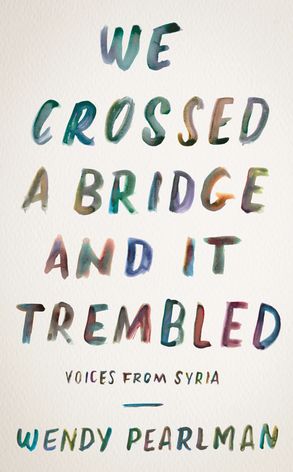
 'From We Crossed a Bridge and It Trembled, a collection of interviews with Syrian refugees that were conducted and edited by Wendy Pearlman between 2012 and 2016.


 Iliyas, dentist, Rural Hama

 "Syria looked like a stable country. But it wasn’t real stability. It was a state of terror. Every citizen in Syria was terrified. The regime and the authorities were also terrified. The more responsibility anyone had in the state, the more terrified he was. Brother didn’t trust brother. Children didn’t trust their fathers. If anyone said anything out of the ordinary, others would suspect that he was a government informant trying to test people’s reactions.

 Every state institution re-created the same kind of power. The president had absolute power in the country. The principal of a school had absolute power in the school. At the same time, the principal was terrified. Of whom? Of the janitors sweeping the floor, because they were all government informants."


 Adam, media organizer, Latakia

 "Tunisians had mass demonstrations and Syrians were like, “Hmm, interesting.” And then Egypt started. People were like, “Resign already!” And then Mubarak resigned. We thought, “Holy shit. We have power.”

 Then Libya got in line, and that’s when Syrians really got interested. Because Qaddafi was going to let the Army loose on his people straightaway. We knew that and the Libyans knew that. The Libyans started calling for help, and we thought, “Exactly. This is us.” The international community intervened, saying, “We’ll protect the Libyans.” And everybody in Syria got the message: If shit hits the fan, people will back us up.

 Of course we would make sacrifices. Some people would die. But we never thought that we’d have the Army attacking us, because the world would protect us. We believed that the minute international forces set foot in Syria, the whole Army would defect."


 Walid, poet, Damascus suburbs

 "We started talking about the situation in Syria. We agreed that Egypt was ready for an uprising. We figured that we needed at least five more years of political mobilization and activity before we could reach the stage that Egypt had reached. And then there was a call for the revolution to begin on March 15. And we went out. Just like that: The revolution began. Were we going to say, “Wait, we’re not ready, we need five more years”?"


 Abu Thair, engineer, Daraa

 "The first protest was on a Friday. Then there were funerals and demonstrations. On Tuesday night, a sit-in began at al-Omari Mosque. Around three in the morning, regime forces stormed the mosque from all sides. They killed dozens and injured more. They burned holy books and wrote things on the wall like "Do not kneel for God. Kneel for Assad."

 People in the surrounding villages heard about the massacre in al-Omari Mosque and started coming to Daraa. They entered, calling, “Peaceful, peaceful, peaceful.” Security forces opened fire on them.

 This is how the revolution exploded in the entire province. The government sent the bodies of dead civilians to every village. The funerals began. Each funeral became a demonstration."


 Mahmoud, actor, Homs

 "I was too scared to protest. I went only once, because my girlfriend wanted to go. In the taxi and then at the demonstration, I thought that everyone was a security agent about to arrest me.

 A guy I know got arrested that way. They brought him in for interrogation, but he wouldn’t confess that he’d gone to a protest. Then they showed him a video and asked, “If you didn’t go, who is this?” He turned yellow. In the video, he was in the middle of a demonstration, sitting on someone’s shoulders. It turned out to be the interrogator."


 Jamal, doctor, Hama

"It was impossible to get big numbers to demonstrate in Damascus. People were enormously afraid. So we’d mount “airplane demonstrations”: We’d chant for five minutes, then run away.

 People came up with alternative ways of showing that they were against the regime. We would agree on a time and place, and then everyone would show up wearing the same color. For example, everyone would come to the same café wearing black. Nobody would say a thing; it was just a way of showing the size of the opposition. Eventually the security forces figured out what was happening and came after people dressed in the designated color.

 If we’d listened to our parents, we never would have gone out at all. That generation lived through the Hama massacre of 1982. My generation is afraid — but not like them. I now say to my father, “Why were you silent all those years?” We say this to their entire generation."


 Sana, graphic designer, Damascus

 "I was very scared on my way to the demonstration. It was night. We put scarves over our faces so the security forces couldn’t recognize us and walked through narrow streets to the square. The square was lit and people were playing music, with drums and flute. I don’t know who grabbed my hands, but we started singing and dancing and jumping. It was a party to overthrow the regime. At that moment I didn’t care about anything else. I was so happy. It was a moment that I will never forget for the rest of my life: standing together with strangers, shouting to overthrow Bashar al-Assad.

 My husband and I agreed that only one of us would go protest at a time. The other would stay home, just in case something happened. He went before I did, and came home crying: “Anyone who doesn’t live this moment cannot consider himself alive.” When I came back from my first demonstration, he asked me how it was. I told him that he was right."


 Ayham, web developer, Damascus

 "There was a systematic effort to give the movement a bad image. Every time a demonstration passed by a street, the police would run after it and break windows and lights or sometimes spray-paint graffiti. On YouTube you can find a lot of videos of them doing this. The regime would show these images of destroyed property on TV and say, “This is the freedom they want. The freedom to destroy the country, the freedom to disrespect religions, etc.”

 We always faced this question: What is the freedom you’re calling for? So we tried to define it. We wanted freedom of speech. We wanted release of political prisoners because we knew that they were potential leaders. The regime puts all the leaders in prison, and then comes and says the movement has none. How do you expect there to be leaders when you arrest them all?"


 Ashraf, artist, Qamishli

 "The problem is not that the world did nothing. It’s that everyone told us, “Rise up! We are with you. Revolt!” The Turkish president, Recep Tayyip Erdo gan, declared that the bombing of Homs was a red line, and President Obama said that the use of chemical weapons was a red line. And when the regime crossed these lines and no one intervened, the population was left in a state of desperation. It understood that it could count only on itself."


 Khalil, defected officer, Deir Ezzor

 "I was a colonel serving in the 4th Brigade. We were sent to put down demonstrations in Darayya and Moadamiyeh, in the suburbs of Damascus. The commanders told us that we were fighting armed gangs. I knew this was false, but these were military orders, and you don’t debate military orders.

 For the first two weeks, we used batons, and Air Force Intelligence officers and snipers would shoot from behind us. By the third week, they gave us orders to open fire at demonstrators’ legs. If they approached within two hundred meters, we were supposed to shoot to kill.

 The first time I saw a demonstration was like ecstasy. My heart was with the people from the beginning, but if the Army knew you were going to defect, they’d kill you. Before I could defect, I needed to ensure the safety of my wife and children. Once I did that, I fabricated a scenario to make it seem as though I’d been kidnapped, and then I disappeared. For a while, it wasn’t clear to the Army whether I’d been captured or had defected. Then the regime came to my house in Damascus. They stole what they could and burned the rest. They did the same thing to my family home in Deir al-Zor. I’m not crying over the loss of the houses. The point is that I have nowhere to go back to."


 Amin, physical therapist, Aleppo

 "I found myself working in a camp for the internally displaced. I had the idea that I was going to help people. But I realized that, three years after the start of the revolution, people didn’t care anymore. We’d approach a patient, saying, “We want to treat you so you can walk again.” He’d say, “I’m finished. I just want to die.” Or there would be kids, and we’d tell them, “You need to get an education.” And the children would say, “I don’t want to be dragged around in a wheelchair anymore. The other boys make fun of me.” There was one child from the camp with polio. He used to come and say to me, “When I was a little kid . . . ” He was only ten years old.

 Every time someone dies, we say we need to continue, we need to continue. But continue what? We’re coming to a dead end. I saw so many of my friends die in the revolution, and friends in my Army unit when I was still doing my compulsory service. They were so young. I’d open my phone and look at my contacts and only one or two were still alive. They told us, “If someone dies, don’t delete his number. Just change his name to Martyr. ” That way, if you got a text from that number, you knew that someone else had gotten hold of the phone and might be using it to entrap you.

 I’d open my contact list and it was all Martyr, Martyr, Martyr."


 Um Naji, mother, Yarmouk camp

 "We should have left when the blockade was partial, but we never expected it to become complete. I lived under the siege for nine months. We had food stored at home, but time passed and we ate all of it. Armed men or regime agents raided the shops and there was nothing left for civilians. We had money, but there was nothing to buy. Instead, my husband would collect grass and leaves and we’d fry them in olive oil. Later we couldn’t even find grass. My four kids would lie on the floor without the energy to speak. They were starving to death in front of me, and I couldn’t do anything about it."


 Yousef, former student, rural Hasakah

 "I was arrested in my second year of medical school and spent five months in prison. I was home recovering when the Islamic State showed up.

 Syria’s oil is located in our area, in the eastern part of the country, and the Islamic State recognized how valuable it was. They took over our village and regime planes backed them up. The regime bombed the rebels and the people, not the Islamic State. Now the Islamic State has all the oil in the area. It has the weapons, the wheat, everything.

 Islamic State militants aren’t aliens, as some people describe them. They’re regular people. They’re an organization like other organizations. There were many men ready to fight the Islamic State. Women, too. We could have beaten them, but we didn’t have enough weapons. No one supported us. Instead the U.S.-led coalition started bombing. Two months ago, twenty-seven people in my village were killed by coalition planes while waiting in line for bread. Air strikes have destroyed the country. Planes do the most damage, and the Islamic State doesn’t have planes."


 Sham, relief worker, Douma

 "The Army wasn’t supposed to bother the Red Crescent. But some days they’d take an injured person right out of our ambulance. We couldn’t open our mouths.

 Once, soldiers detained my friend’s team. They lined them up against the wall and shot my friend in the head. We followed him to the hospital and waited. When a person came and told us my friend was dead, I fainted. Another friend carried me away and a third treated me. The two of them were later killed.

 When the intelligence officers arrested my husband, Munir, for the third time, they said, “Everything is fine. We’ll keep him for only an hour.”

 That hour lasted a year and a month. For the first five months, I didn’t know if Munir was alive or dead. He disappeared and that was it. Every lawyer told me, “We’ll get him out.” But they were lying so I would keep paying them.

 That August was the Ghouta chemical weapons attack. In the streets you saw people frozen in their cars, suffocated to death. My colleagues told me this was the first time that when they picked up corpses, there was no blood. I got news that the gas had spread to the prison. I was so scared for Munir that I thought I would die.

 Meanwhile, someone connected to the regime told me that if I paid enough, he’d get Munir out of prison. I paid, so Munir was released.

 Everything we’ve experienced has killed us. We’re the living dead. Sometimes I joke to Munir that someone should gather all of us Syrians in one place and kill us so we can be done with this whole thing already. Then we’ll all go to heaven and leave Bashar al-Assad to rule over an empty country." '
Image result for we crossed a bridge and it trembles wendy pearlman

Saturday, 20 May 2017

Those with the regime are in living coffins

Image result for Syrians seek release of prisoners from 'crematorium' jail

 'Standing outside the UN's headquarters in Geneva, Amina Kholani chokes back tears as she relives the nightmare of visiting relatives in Saydnaya, one of Syria's most notorious prisons.

 The infamous centre was back in the spotlight this week after US claims that Damascus built a crematorium there to cover up thousands of prisoner deaths.

 The charges, based on satellite imagery released by the US State Department, have cast a shadow over peace talks hosted by the United Nations in Geneva.

 Relatives of detainees in Saydnaya and other government prisons protested outside the UN headquarters on Wednesday, demanding that the negotiations prioritise prisoner releases.

 Holding portraits of detained friends and relatives, they tearfully scribbled their names on two long strips of paper in brightly-coloured markers.


 "Those on the outside think a Syrian detainee is just living in a locked room with a bed and food -- but he's living in a coffin. He's a corpse, but he's breathing," Kholani, 42, said.

 The plump woman in a white headscarf is lobbying to free three relatives still held in Saydnaya, and her husband was held there for a year before Syria's uprising started in 2011.

 Squinting in the sun, she described the exhausting month-long process of paying bribes and calling in favours before finally getting authorisation to visit Saydnaya.

 "Even when you are inside, it's not a direct visit. There's a metal fence, and you stand on one side with a guard," she said.


 Her voice broke as she described the two occasions she saw her husband during his time in prison, dragged into the visiting room by two prison guards.

 "Sometimes he'd come out unable to walk from the lack of food, or from the torture and the blows," Kholani said.

 "You don't recognise him until the last minute. You don't believe that the person coming is your husband, or your son or brother," Kholani said.

 Conversations that extended beyond simple "how are yous" were immediately met with beatings, so instead, "you just stop asking. You just each sit there and cry."


 Thousands of prisoners are held at the military-run complex, 30 kilometres (18 miles) north of Damascus and it is one of Syria's largest detention centres.

 Amnesty International has accused Syria's government of carrying out a "policy of extermination" there by repeatedly torturing detainees and withholding food, water and medical care.

 In February, it said Syria's government had killed up to 13,000 people over five years in gruesome weekly hangings.

 And on Monday, the US said its satellite images showed melting snow on a rooftop and heavy-duty ventilation systems attached to the military complex, apparently supporting claims by rights groups that Saydnaya is an execution center.


 Syria's opposition has long called for the release of all prisoners held by the regime, a demand they made again as they met UN special envoy Staffan de Mistura in Geneva this week.

 De Mistura has said a deal on detainees was "almost finalised" without giving details.

 But Kholani was not very optimistic.

 "We don't have a lot of hope left in politicians or statements. A prisoner is worse off than a corpse," she told AFP.

 And HNC spokesman Yehya al-Aridi, who bent down to write the name of one of his own relatives outside the UN, said progress on the issue was being blocked by Russia.

 "The Russians are still talking about this as a prisoner swap. How can you swap? You have between 5 and 10,000 prisoners (held by non-regime groups) compared to 80,000 detainees with the regime," he said.

 "Those with the regime are in living coffins -- and the definitive proof is the presence of crematoriums for the prisoners," Aridi added.'


Obama Backed Off Syria Chemical Weapons Plan

Image result for EXCLUSIVE To Assuage Russia, Obama Administration Backed Off Syria Chemical Weapons Plan

 'Throughout most of his presidency, Barack Obama and his top advisors professed a desire to see President Bashar al-Assad’s regime held accountable for its crimes against the Syrian people.

 But the State Department’s top brass balked when staff at the U.S. mission to the United Nations drafted a plan in the fall of 2014 to point the finger at the regime for a series of chlorine attacks in Syria, fearing it might upend efforts to secure Russia’s support for peace in Syria and jeopardize an Iran nuclear pact, according to former State Department officials.

 In the following months, the State Department batted down repeated appeals from Wa’el Alzayat, a senior policy advisor to U.S. Ambassador to the United Nations Samantha Power, to endorse the proposal laying out a set of options for holding the Syrian regime responsible for its ongoing use of chlorine weapons. “My sense is we were being slow-rolled,” Alzayat said.

 In the end, Alzayat and a group of like-minded officials would prevail in a long and highly acrimonious internal State Department skirmish, but not before several months had passed. It would be nearly a year after Syrians first dropped a chlorine bomb before the administration agreed to press for a U.N. resolution aimed at holding the perpetrators accountable — and four more months before it would be adopted by the Security Council.


 The administration’s reluctance reflected concern that the initiative would place it on a collision course with Russian President Vladimir Putin, a staunch ally of Assad, when U.S. Secretary of State John Kerry was hoping to kick-start stalled peace talks in Syria and pursuing separate negotiations on a nuclear deal with Iran, according to former U.S. officials. The Russians, some of the skeptics argued, would never support the plan, so why pick a fight over a lost cause?

 “The questions that kept coming back to me and others was: Why are you pushing this? Russia will veto,” said a former State Department official in Washington, who recalled pressing senior officials to confront the Russians at the United Nations on Syria’s ongoing use of chemical weapons with the Russians.

 “They would say, ‘What would happen if we did something and it imploded the relationship we have right now with Russia — tank something else we have going on and to what end?’” the official, who spoke on condition of anonymity, told FP.


 The Obama administration’s handling of the Syrian chemical weapons file has come under renewed scrutiny since April 4, when a Syrian Sukhoi-22 jet fired a sarin-filled rocket on the town of Khan Sheikhoun, killing more than 85 people, many of them children, and provided the most compelling proof that the regime preserved a remnant of its chemical weapons program.

 The episode highlighted the limits of American diplomacy in dealing with a regime that had agreed to eliminate its chemical weapons program only under the threat of military action — and that flouted its obligations when the threat was removed. But the Obama administration’s caution fits a broader pattern of conflict avoidance with Russia over Syria’s use of chlorine as a chemical weapon. In contrast with its previous efforts to isolate Moscow economically with sanctions following it annexation of Crimea, the Obama White House depended on Russia’s cooperation in ending the civil war in Syria and containing the regime’s chemical weapons program.

 A former White House official recalled that Obama’s national security advisor, Susan Rice, generally favored any diplomatic efforts at the U.N. designed to hold Syria accountable for its use of chlorine. But she was reluctant to maneuver the United States into a showdown with Moscow.

 “I never had Susan Rice tell me to ratchet back on that initiative,” said a former White House official. That said, “Susan’s attitude was, ‘We’re not going to throw up veto bait. If we think an agreement can be gotten, then let’s get it.’ But she had no interest in having a U.S.-Russian battle if the only purpose is to make the Russians look bad by vetoing something.” Rice declined through a representative to comment.


 The Syrian government began developing its chemical weapons program in the early 1970s to deter a possible attack by its militarily superior neighbor and enemy, Israel. By the mid-1980s it was believed to have the capacity to produce eight tons of sarin each month, according to a declassified CIA assessment in 1985. It was just a matter of time before they would develop the capacity to produce the deadlier VX, the CIA predicted.

 But until recently, the United States never felt the need to confront Syria. That changed on Aug. 21, 2013, when Syria launched a sarin attack in the Damascus suburb of Ghouta, killing more than 1,400 people, according to a U.S. intelligence assessment, and triggering the threat of U.S. missile strikes.

 The strike was averted after Syria agreed in September 2013 to a U.S.- and Russian-brokered agreement that required Damascus to destroy a vast declared chemical weapons program, including production facilities, munitions, and tons of chemical precursors for sarin and mustard gas, and join the Chemical Weapons Convention.

 In the years following that agreement, U.S. officials vigorously defended the pact against charges that the president had squandered U.S. credibility by failing to carry out its threat to respond militarily to the Ghouta attack.

 Kerry, a frustrated proponent of military action against Syria, nevertheless boasted to NBC: “We struck a deal where we got 100 percent of the chemical weapons out” of Syria. But he later acknowledged that Washington had “questions” about whether Syria had fully abided by its obligation to destroy its entire program.

 In a recent interview, Obama strenuously defended the chemical weapons pact, asserting that “99 percent of huge chemical weapons stockpiled were removed without having to fire a shot.” But he conceded that it was “an imperfect solution” because “now we know subsequently that some [chemical weapons] remained.”


 In hindsight, several former U.S. officials defended the pact, contending that it did more to neutralize Syria’s strategic chemical weapons program than U.S. military strikes would have achieved.

 “It was extremely effective,” said Andrew Weber, who served as U.S. assistant secretary of defense for nuclear, chemical, and biological defense programs until October 2014. “We destroyed 1,300 tons of Syria’s chemical weapons stockpile. That’s 1,300 tons they can’t use. It won’t fall into the hands of ISIS or other bad actors.”

 But critics inside and outside the Obama administration believe that the United States dropped the ball after it secured Russian cooperation in implementing the chemical weapons pact.

 Syria’s chemical weapons “dropped several rungs on the Obama administration’s priority list” after the Organization for the Prohibition of Chemical Weapons (OPCW) destroyed the bulk of Syria’s declared program,” said Gregory Koblentz, an expert on the Syrian chemical weapons program and director of the biodefense graduate program at George Mason University.

 “I think their reasoning was that if we could end the civil war then the chemical weapon attacks will stop,” he said. “So why take steps that focus on the symptoms at the risk of allowing the disease to continue or spread?”


 The deal did not, however, mark an end to Syria’s chemical weapons activities. On April 10, 2014 — months before the destruction of Syria’s declared program was complete — Damascus carried out the first of many attacks using chlorine-filled bombs in the town of Kafr Zita.

 In a midnight attack, a Syrian helicopter carried out the first of 17 chlorine attacks over a four-month period, killing two people and sending scores of choking and vomiting people to a hospital. Livestock, chickens, and pigeons also died. The leaves of exposed trees turned yellow.

 The initial response from Washington was measured.

 Kerry said that Syria would have to face unspecified consequences if it were found to have used chlorine. But there would be no threats of military retaliation. Chlorine, a common industrial cleaner, is far less deadly than sarin.

 Chlorine is not illegal for Syria to possess, though its use as a weapon is prohibited.

 The United States turned to the Hague-based chemical weapons watchdog to get to the bottom of it. Within weeks, the OPCW established a fact-finding mission to determine whether chlorine was used. The OPCW concluded that chlorine was employed. But it had no authority to say who it thought was responsible.


 Frustrated by the inability to blame Damascus, U.S., British, and French diplomats brainstormed about setting up a forum to assign responsibility for the crimes. But they knew they would have to get the proposal through the U.N. Security Council, where the Russians could veto it.

 Still, the White House tasked the U.S. mission in October 2014 to draft a concept paper outlining a strategy to confront Syria.

 But Power, Alzayat, and a group of other mid-level advocates scattered throughout the White House and State Department still struggled to get Foggy Bottom’s leadership to sign off on it, according to former U.S. officials.

 In February 2015, Bob Mikulak, then the U.S. ambassador to the OPCW, met with representatives from Britain, Germany, and France at the Hague. There, they refined the plan for what would be called the Joint Investigation Mechanism, which would empower experts from the United Nations and the chemical weapons watchdog to name those responsible for the attacks.

 Power and Mikulak did not respond to requests for comment.


 The Hague meeting gave the initiative momentum and broadened institutional support within the State Department. Meanwhile, America’s closest allies, Britain and France, began to openly press the administration to pursue a push for a U.N.-sanctioned team with the authority to assign blame.

 But the push for accountability remained stuck.

 “The paramount objective was to avoid any confrontation with the Russians,” said a second former State Department official who worked on the Syrian chemical weapons file. “Kerry did not want these things to spoil his effort to reach a diplomatic settlement with the Russians.”

 Efforts to reach Kerry through a former aide were unsuccessful. But a former senior State Department official familiar with his thinking said any suggestion that Kerry tried to thwart action on Syria’s chemical weapons “is simply inaccurate.”

 “Secretary Kerry favored doing more, not less, to hold the Syrian regime accountable, including for using chemical weapons,” the former official said. “At no time did he seek to de-emphasize that objective.”


 Meanwhile, staffers in the offices of Anthony Blinken, then deputy secretary of state, and Wendy Sherman, the undersecretary of state for political affairs, refused to approve the plan.

 The second State Department official recalled conversations with Blinken’s and Sherman’s staffers warning that the push for accountability would “undermine the political process in Syria, and that we have to take into account the nuclear negotiations with Iran.”

 “We fought tooth and nail and beat our heads against this immovable object,” the official said. “They basically refused to clear the paper and refused to engage constructively with the different stakeholders in the interagency process.”

 Other former officials argued that it made no sense for Kerry and his top advisors to suppress any effort to hold Assad’s regime accountable. The formal peace process, they noted, remained effectively frozen in late 2014 and most of 2015.

 But the second State Department official countered that Kerry was keen throughout the period to restart the peace process and reduce the violence in Syria. Russia’s cooperation was seen as crucial.


 Blinken declined a request for comment. But Sherman said any suggestion that she and Blinken were slow-rolling efforts at the United Nations to hold Syria accountable for chlorine use is “a little perplexing.”

 “I remember vividly our strong denunciations of the chlorine attack and our constant efforts to press Russia to denounce the attacks,” she said.

 There may have been differences over tactics, she added, and whether it made more sense to force the Russians into a veto or to pursue other means toward holding the regime accountable. “I don’t believe there was any stonewalling at all,” she said.

 Sherman challenged the “mythology” that U.S. diplomatic efforts in Syria were dependent on the potential impact it might have on the negotiations on Iran’s nuclear program. “Nothing could be further from the truth,” she said.


 Among the arguments marshaled against the initiative was that punishing the regime for weaponizing chlorine, which was not classified as a weapon of mass destruction, was less urgent than ending a war that has left more than 400,000 dead. Indeed, the number of Syrians killed by chemical weapons — more than nearly 1,500 by the end of 2015, according to the Syrian American Medical Society — amounts to only a fraction of the country’s dead.

 But proponents countered that there were no signs that Syria would agree to a political transition, and that turning a blind eye to Assad’s use of chlorine would send a signal that the international ban on the use of chemical weapons would be undermined.

 “I’m not saying the Obama administration could have prevented” the sarin attack on Khan Sheikhoun, according to the second State Department official. “But by never taking a strong position against the regime, never curbing its use of chemical weapons and other attacks against civilians, it has emboldened the regime to do whatever they want.”


 As reports of chlorine attacks increased, international inspectors suspected that Syria was cheating on its claims to have destroyed its chemical weapons arsenal. In its declaration to the chemical weapons watchdog, Syria denied it had weaponized sarin or had the kind of short-range rockets used in the Ghouta attack. Syria also denied that its premier center for weapons of mass destruction and missile technology, the Syrian Scientific Studies and Research Center, played any role in the country’s chemical weapons.

 Behind closed doors, the United States urged the OPCW to establish an elite team of chemical weapons inspectors — known as the Declarations Assessment Team, or DAT — to poke holes in the Syrian declaration. They quickly discovered the presence of warfare agents, including sarin, Soman, and VX, at two of the Syrian research center’s facilities in Barzah and Jamraya, where Syria had initially insisted no chemical weapons activity had occurred.

 But the findings only hardened Russian opposition.

 Russia and Iran effectively blocked the adoption of a measure that would have required greater access to those research facilities and placed controls on Syria’s access to chlorine stocks. At the Security Council, Russia threatened to veto any attempts by the United States and its allies to punish Syria.

 “They knew we weren’t going to enforce this in a military way,” a former White House official said. “They gambled, and appropriately so, that we were not going to send Tomahawk missiles in defense of the DAT.”


 In the end, the State Department and the White House gave Power the green light in the spring of 2015 to begin negotiations with Russia on a resolution establishing the new investigation team. At that point, the Obama administration had secured its landmark nuclear pact with Iran, easing concerns that the president’s crowning diplomatic achievement could get sidetracked.

 After months of negotiations with Russia, the U.N. Security Council adopted a resolution in August 2015 that established the new investigation team, some 16 months after reports of chlorine’s use emerged.

 “Pointing the finger matters,” Power said after the vote, arguing that it would deter attacks and ensure accountability for criminals.

 But holding Syria accountable for its crimes was another matter.

 Nearly a year after its creation, the joint body issued two reports in June and October 2016, saying that the Syrian government was responsible for three chlorine attacks and accusing the Islamic State of firing mustard gas rockets at the opposition-controlled town of Marea.

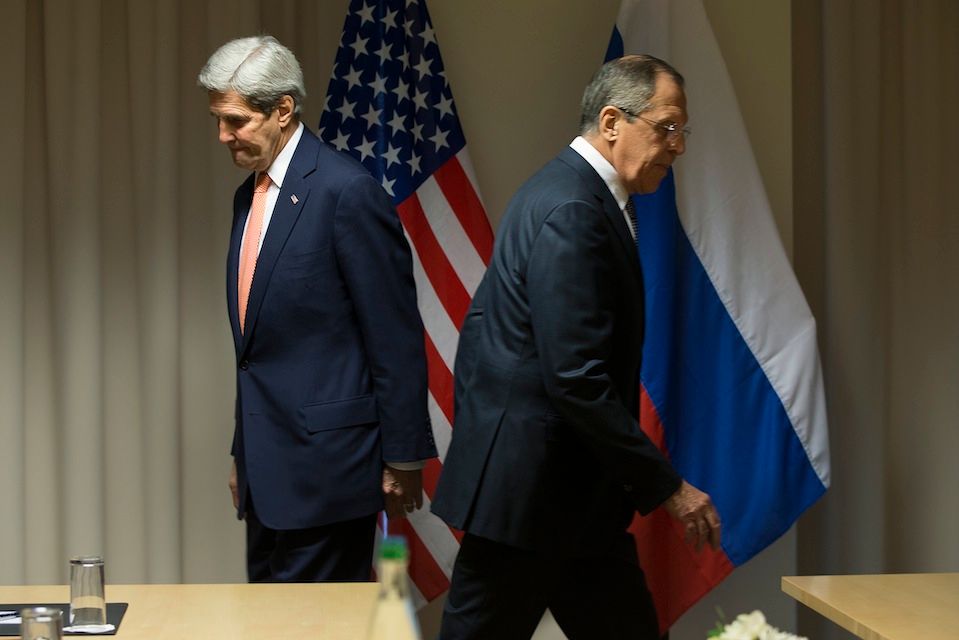
 Britain and France pressed the United States to move ahead with a follow-up resolution sanctioning Syria for using chlorine. But Power put on the brakes. This time around, Kerry was in the thick of talks with his Russian counterpart, Sergei Lavrov, aimed at ending the siege of Aleppo.

 “There was always a reason to delay,” a former U.S. official said.


 It was not until the following year that the resolution, largely written by the Obama administration, was put to a vote by the Trump administration. Russia quickly vetoed it, potentially sending a signal to Syria that it could carry out chemical attacks with impunity.

 Within weeks, Syria upped the stakes, reintroducing sarin to the battlefield at Khan Sheikhoun. Only this time, President Donald Trump ordered the U.S. military to fire 59 Tomahawk missiles at the air base where the chemical weapons bomber was launched, and warned that he would use force if it happened again. The strike inflicted limited damage to the air base, which continued to serve as a center for strikes against opposition-controlled towns. It has done little to stem the violence in Syria, but there have been no confirmed reports of Syria using chemical weapons since then.'