Thursday, 16 March 2017

There is always hope


 ' "Freedom!" was the first chant Lina Shamy shouted against the Syrian regime in April 2011. She remembers her eyes tearing when the word left her throat. She was only 21 when she joined students of Aleppo University during a protest.

 Anti-regime demonstrations had started in Daraa in mid-March and spread across the country.

 "[The first protest I joined] was 20 April 2011," says Lina's husband, Youssef Moussa. As he tries to describe it, a lump in his throat muffles his words. His eyes tear and he pauses.

 "The first protest is about breaking your personal fears," says Youssef. He was 25 years old when the revolution broke out. Like Lina, he was studying architecture at Aleppo University.

 "The people want the fall of the regime!" was the first chant he uttered that broke his fear of the regime.


 Living under a regime that seemed omniscient and everlasting, constantly suppressing political dissent, many Syrians would not talk about politics or even think about it, Lina and Youssef say. Those first chants against the regime transformed their lives.

 Sitting in a cafe in the southern Turkish city of Antakya, both are overwhelmed with emotion as they reminisce about the Syrian revolution and the events of the spring and summer of 2011 they lived through just 100km away, in Aleppo.

 "The revolution is life in all its aspects. It is the future," says Lina.


 In the first days of the revolution, as videos of protests across the country started appearing - from Daraa to Raqqa - Youssef would lock himself in his dorm room and download each one of them in a hidden folder on his computer. He says he would watch these videos and cry.

 He remembers vividly one video he saw in April 2011: A man by the name of Ahmed Beyasi standing in front of the camera with his ID describing the crackdown on a protest in the village of Beyda near the southern Syrian city of Baniyas (Tartous province). Ahmed spoke out after Syrian state media claimed that a video of soldiers kicking and humiliating protesters in his village was fake.

 "He was the first one in Syria to have the courage to show his face in front of the camera and speak," Youssef says.


 Around the same time, Lina stopped going to the Faculty of Engineering to do school work. She says she couldn't stand listening to some of the students supporting Bashar al-Assad saying that the protesters deserved to die. Instead, she would stay at home and work to the sound of the revolutionary songs that were coming out of protests across the country.

 She says her favourite one was by Tariq al-Aswad, a protester who started singing during protests in Homs. He died in 2012 during a bombing by regime forces.

 Before the revolution, Lina and Youssef say they were both busy studying and planning how to leave Syria, where they saw no future for themselves.

 "[Hafez al-Assad] built a strong military and security structure in Syria. People were even afraid of uttering his name," recalls Youssef.

 Lina says young people felt that the country did not belong to them.

 "In school, we had to salute Hafez al-Assad every morning. He was a sacred omnipresent symbol: His image was in classrooms, in universities, in shops, all public buildings, everywhere we'd go. Everything belonged to Assad," Lina adds.

 She says it was her greatest fear that she would graduate and get employed in a bureaucratic state institution and live a routine life regulated to the minutia by the regime.


 The revolution not only wiped out this nightmarish scenario, but it also set her on a completely different life path. Taking up the revolution as her calling, Lina started living a precarious new life as an activist. But it was this new life that brought her together with her husband, Youssef.

 Although they both studied at Aleppo University at the same time, they did not meet until 2013.

 "I was against marriage, to be honest," admits Youssef. He says he did not want to marry because he thought that the institution of marriage was burdened by "bureaucratic" customs and materialism.

 Meeting Lina and getting to know her while working with her on a project to improve housing in a refugee camp in northern Syria changed his mind.

 "I started thinking to myself, what do you want? And suddenly decided that I want to marry Lina," recalls Youssef. He proposed on WhatsApp. He sweated for half an hour before Lina responded with a "yes". They were married within a month, without the usual Syrian wedding pomp, but with a healthy dose of revolutionary spirit.

 "The revolution created this marriage," says Youssef with conviction. "I love him because he loves the revolution," adds Lina. The revolution got them together but it also separated them from many loved ones. They have lost a lot of friends and family members since 2011.

 "In May 2011, a university friend went to his hometown Binnish [in Idlib province] on a Friday. On Sunday, he did not come back," recalls Youssef. His friend had joined a Friday protest which regime forces broke down, firing live rounds at the people. "We received a video of him dying - red stains around the heart as he was taking his last breaths. It was our friend, who had been with us just the day before," says Youssef. That same year, he also lost his brother, who died after regime forces arrested him.

 "Some people say that we got fed up after six years and it's enough. I disagree, after six years of all these people giving up their lives for us to live in freedom and dignity; I cannot leave," says Lina.


 Lina and Youssef lived in Aleppo throughout the months-long siege on the eastern part of the city. They say there were many moments in which they thought they would not see each other. They were some of the last people to leave the city. The loss of Aleppo was a big shock and put many supporters of the Syrian revolution into despair.

 "We passed through the loss of Aleppo, the loss of a lot of territory, through psychological and physical illness. But the revolution is bigger than all this. It's bigger than losing an area or a battle," says Youssef.

 Neither are thinking of giving up on their activism. After a few weeks in Turkey, they are planning on going back to northern Syria to continue with their work.

 "There is still hope. There is always hope," says Lina.'

What I Smuggled From a Syrian Prison


 ' “The colonel told me he wouldn’t accuse me of gun possession,” my cellmate Nabil Shurbaji told me happily one evening in June 2012. We were sitting in a dark, damp corner, in our torn clothes. Our bodies were covered with blisters and open wounds. Some were caused by daily beatings and electric shocks, some by scabies. Bed bugs swarmed over everything.

 We cleaned our bodies and clothes twice a day, under a faint lamp. We took turns, in groups of four or five, but there were always more bugs. They were among our worst nightmares, in addition to the jailers above us.


 The bug-infested cell where we were held was part of an air force intelligence center near the Mezzah military airport in Damascus. The center was under the supervision of Maher al-Assad, the brother of President Bashar al-Assad and one of the most feared men in Syria’s security services. After the revolution broke out in March 2011, the airport became the site of interrogations of members of the opposition.

 Nabil was thrilled about not being falsely accused of gun possession, a charge that was being leveled against many of those held alongside us. Gun possession charges, we believed at the time, could lead to a life sentence, or worse, a death sentence. (I later discovered, while investigating Syria’s prisons, that being accused of using a gun can often be better than being a peaceful activist, doctor or journalist. One former jailer cited a twist on a clichĂ©: “The pen is more dangerous than a gun.”)

 Nabil and I had gotten to know each other well. Being stuck in a hellish cell with someone means you must often place your leg over his, or let your shoulder or back rest on his. There were 57 of us.


 The colonel, who was a senior interrogator in the infamous Air Force Intelligence Investigation Department, didn’t know Nabil as well as I did, but he surely knew he couldn’t accuse him of possessing a gun. Nabil was famous in his city, Daraya, for defending peaceful protest, and for condemning violence.

 Nevertheless, Nabil was referred for trial in a military field court on charges of contacting “enemy” news media and spreading false information for the purpose of inciting violence. The judge sentenced him to nine years in prison. He didn’t make it that long. He died in May 2015, after only a little more than three years in prison.


 I was lucky enough to survive. Before I was arrested in February 2012 and sent to the cell with Nabil, I had been the supervisor of the detainees section of the Violation Documentation Center, an independent organization that has monitored human rights violations in Syria since April 2011.

 I couldn’t bear being inside one of the jails that I used to report on as a human-rights activist without documenting the detention of those whose names I used to type while sitting at my computer safely in the center of Damascus.

 I decided I needed to write the names and contact information of all those who were with me in that cell. When I told my cellmates about this plan, they wanted to help.

 We had no pens or paper. I figured out I could write on torn scraps of shirts and pants, and use chicken bones as a quill. But we needed to figure out what to use for the ink.

 We tried soup and the liquid from the few tomatoes we received as rations, but they didn’t work. We were about to give up when one of my fellow inmates us stood up and said, “Give me a piece of a plastic bag.” We used to keep one or two plastic bags filled with salt to treat our wounds and blisters.

 He took the plastic piece and went to the toilet area. He came out after a couple of minutes holding a tied-up piece of plastic with red liquid inside it. He had squeezed blood from his gums and put it into the plastic. All of our gums bled because of malnutrition.

 The blood left a trace on the cloth when we wrote on it with the chicken bone, but it wasn’t solid enough. We scratched flakes of rust from the iron bars in our cell and mixed it with the blood. It worked.


 We split the tasks among five of us. Three of us gathered the names of our cellmates. Among them was Manaf Abazid, who was detained for 27 months for training his friends on how to photograph and film demonstrations and upload the footage to be published online and in media outlets. Manaf and I were the only two who survived among this group of five. He now lives in Paris, and I am in Sweden.

 Nabil had the best handwriting, so he took responsibility for using the chicken bones and blood to write out the names on the pieces of shirt. We hid the pieces inside the cuffs and collar of Nabil’s shirt, which he kept folded and clean, ready to wear when he would be released. We agreed that the first one to make it out of the cell would wear Nabil’s shirt and smuggle the names to be documented, and to contact their families.

 On Nov. 14, 2012, the jailer called my name, and shouted through the hole in the steel door: “Get your stuff ready, and wait by the door, bastard!” I knew that meant I would be released for good. I put on Nabil’s shirt. A few minutes later, the cell door was opened, and I went out with the names of my cellmates, and their pleas to not be forgotten. I was taken to a military police center, where I spent 13 days, wearing Nabil’s shirt, stuffed with our makeshift notes, the whole time. Then I was sent to another prison on the outskirts of Damascus. On Feb. 5, 2013, I was released.

 Once I got out of prison, I started contacting the families of the men with whom I’d been detained. I added their names to the database at the Violation Documentation Center.


 Among the people I contacted was Nabil’s fiancĂ©e. Nabil had talked to me about her almost every day while we were imprisoned together. “She was the only girl who understood me,” he used to say. He dreamed of her almost every day, and thought of the family they would build together when he was finally freed.

 I told her that Nabil was alive. She asked me questions, but I tried to spare her some of the painful details of his situation. I told her that I had read his palm, and had told him that he would not die before 15 years had passed. Of course, neither believed in such methods, but they clung to this prophecy. They didn’t have any other hope.

 After two years, Nabil died. He died in the Saydnaya military prison after a jailer kicked him in the chest, sending his soul to heaven and body to some mass grave or, perhaps, an incinerator.'

Wednesday, 15 March 2017

A woman's unborn baby was cut in half

Credit: Photo Unit via Flickr (CC BY-NC 2.0).

 'As the Syrian Civil War begins its seventh year, Syrian doctors told members of Congress of the “unspeakable horrors” they have witnessed while serving patients in Aleppo.

 “In the month leading up to our displacement, I can only describe the events as hell,” said Dr. Farida, an OB/GYN who formerly worked in Aleppo.

 Speaking to members of the Senate Foreign Relations Committee on Wednesday, she explained that her hospital “treated many women with severe injuries.” One pregnant woman survived, with the medical efforts of the staff, but shrapnel in her body from an explosion cut her unborn baby in half.

 Many other women died because they were not able to make the trip to the hospital due to “the lack of ambulances and fuel,” she continued, and they “bled to death in their home, along with their unborn children.”


 Three doctors from the Syrian American Medical Society testified before the Senate Foreign Affairs Committee on Wednesday about the human toll of Syria’s Civil War which began on March 15, 2011. Two of them wore breathing masks and withheld their full names to avoid any hostile detection.

 In six years, 400,000 have died in the conflict between government forces and rebel groups, and over 11 million have been displaced from their homes, according to the U.S. Commission on International Religious Freedom (USCIRF). Five million registered refugees have fled the country and 6.6 million displaced are still residing within Syria.

 Also, “at least 13.5 million are in dire need of humanitarian assistance,” USCIRF noted.

 “The al-Assad regime continues to indiscriminately target and forcibly displace Sunni Muslims. In 2016 alone, the Syrian government forcibly displaced 125,000 Sunni Arab civilians from the Damascus suburbs, as well as another 250,000 from Eastern Aleppo,” they stated, adding that the regime was reportedly “repopulating” those areas with Shi’a Muslims “and government sympathizers.”

 “In addition, the regime since 2011 has detained or killed prominent Christian civil rights activists, humanitarian workers, and religious leaders,” USCIRF added.


 The doctors told of how, despite their efforts to move hospitals underground to avoid destruction, pro-government forces waged a total war on health care in Aleppo, from dropping bunker-busting bombs to using chemical attacks to force patients and medical staff to flee. Two doctors alleged that the scale of the attacks on hospitals escalated when Russia involved itself in the conflict.

 “Throughout the last six years, I have witnessed unspeakable horrors,” Dr. Farida said. The “hospital was the most dangerous place in Aleppo.” With the danger continuing to rise, she left Aleppo, with her husband and eight year-old daughter, in December.

 Other doctors echoed her testimony of the lack of medical supplies and transport due to the conflict. Besieged cities like Aleppo and Homs have not been able to receive the humanitarian aid patients so desperately need, and airstrikes on hospitals destroy the only access they may have to life-saving health care.


 Dr. Abdulkhalek, another doctor who testified at the hearing, pleaded with the senators. “Do not let these acts continue,” he implored. “Do not let more innocent civilians suffer. Do not forgot the human toll of this war, the refugees, the education gap.”

 “The UN system is clearly broken, as it has no means to enforce its mandates and hold perpetrators accountable for these crimes,” Dr. Abdulkhalek said in his testimony. He told of how he had to negotiate an evacuation plan for hospital patients with the UN and the World Health Organization, but “as the regime and its allies began to take more territory, the cooperation disappeared” and the “evacuation never occurred.”

 “We need sustained humanitarian access,” he insisted.

 In the Syrian city of Homs, he said, medical supplies including blood and serum bags and antibiotics couldn’t reach the people from the outside amidst the three year-long siege, and in the last six months there has been a “complete lack of movement for all materials and medications.”

 In another city besieged by pro-government forces, Dr. Abdulkhalek said, over 30 patients needed kidney dialysis medication. After the supply evaporated, “we pleaded with the UN to deliver the life-saving medication,” he said. It came – but not by a UN convoy – only after three patients died.


 Hospitals were bombed with no regard to the vulnerable civilians that lay within. There have been three hospitals bombed in the last two weeks, Dr. Farida said.

 While she worked at the hospital in Aleppo, she was in the middle of performing a caesarian section when a bombing collapsed the ceiling. She had to stay in the dangerous situation to clean debris from the collapse “out of the patient’s abdominal cavity,” she said.

 Amidst all the violence, her eight year-old daughter once fled into the room where she was performing an operation, crying and unable to breathe.

 “How I’m supposed to explain all of this to an eight year old who has known nothing about violence, killing, and destruction? How am I supposed to protect her?” she asked. “This broke my heart. That feeling of powerlessness to protect my child has broken me to this day.”


 Dr. Abdulkhalek described how the hospital he was working in was the target of a chlorine bomb “after repeated attempts” by regime forces and their allies to drop barrel bombs on it.

 Staff were able to save the lives of three men suffocating from gas where they were hiding, but many others died in the attack, he said.

 After that, “many hospital staff had to leave, fearing for their lives,” he said. A second chlorine bomb hit the hospital later, claiming many child victims. There was “only one unit of oxygen” available, he said, and the oxygen mask had to be passed around to the children present one at a time.

 When asked if there was “more frequent targeting of your hospitals when Russia got involved” in the Syrian conflict, Dr. Abdulkhalek replied “Yes.”

 “They are locating the hospital position,” he said, and they “start targeting it many times” until civilians flee.


 There were reportedly 600,000 people in Syria living under siege last year, and in February the UN warned of a “looming humanitarian catastrophe” in four besieged towns that had not been reached by a UN convoy since November.

 The perpetrators of these atrocities must be held accountable, the doctors and human rights advocates insisted.

 USCIRF on Thursday called for the U.S. to push for the International Criminal Court to investigate the crimes committed by the Assad regime and by ISIS in Syria.

 “An entire generation has been lost. The world failed Aleppo,” Dr. Abdulkhalek concluded his testimony, begging the international community not to leave other Syrians to the same fate.'

Collusion between Assad Regime & ISIS


 'The Islamic State has recently sold its grain stocks to the Assad regime, filling the terrorist group's coffers with much needed funds, a report revealed on Tuesday.

 Deir Ezzor 24 News Network said that ISIS has sold the grain stocks in the Ashra silos located near Hasaka-Deir Ezzor road to an intermediary, Hossam Qatirji, who took on the transportation of the gain loads to regime-held areas.

 The Syrian Coalition said that the deal provides further evidence on the continued business dealings between the Assad regime and the extremist group in violation of the UN Security Council resolutions calling for drying up the sources of funding for terrorist groups.

 Member of the Syrian Coalition political committee Yasser Farhan said that the new revelation should prompt the UN Security Council to take further measures to enforce its resolutions to prosecute those who finance terror groups.

 Qatirji, who is a member of the Assad regime’s so-called People’s Assembly, was also involved in many sale deals of crude oil extracted by ISIS from Deir Ezzor oil fields to the Assad regime. He is also involved in business dealings with the Democratic Union Party (PYD).


 In April 2016, documents recovered from a US and British raid targeting a key ISIS commander revealed that the Assad regime cut deals with the extremist group to earn more than $40 million a month from the sale of oil.

 Thousands of spreadsheets and account books kept by the group’s oil boss Abu Sayyaf revealed how the two sides forged a mutually beneficial arrangement despite the regime’s repeated pronouncements that it is fighting the extremist group.

 Several reports indicated that the Assad regime had been purchasing oil from ISIS, but the documents, seen by the Wall Street Journal, showed the scale of the collusion.

 In January 2017, the Wall Street Journal revealed that ISIS had shored up its oil and gas sales to the Assad regime. The sales represent the militant group's largest source of revenue, overtaking funds made by imposing tolls and tax levies on those residing in its claimed territory.'

Syrian-Americans to Commemorate Anniversary


 'Hundreds of Syrians from across America will descend on the nation's capital Thursday to lobby, plan for the future and rally to commemorate the sixth anniversary of the start of Syrians' protests against the regime of Bashar al-Assad.

The Syrians -- including U.S. citizens, refugees and asylum seekers -- will participate in "The Revolution Unites Us," a three-day event that includes meetings with members of Congress, panel discussions related to Syria's conflict, a fundraising dinner, a Saturday rally and a celebration of Syrian food and culture, according to organizers.

 "It's a commemoration of the six years since the start of the revolution," said Sam Shaguj of the Syrian Cultural House, one of the groups organizing the event. "Syria is being ruled by a ruthless dictator, and the fact that Syrians broke their fear and went down to the streets to demand their freedom and human rights—that's something to celebrate."

 The event's name was inspired by the name Syrian civilians gave to their protests in December after Turkey and Russia negotiated a temporary ceasefire, Shaguj said.

 "People went down to the streets with one slogan: 'The revolution unites us,'" he said. "That was a clear message to the international community: As soon as you stop the military campaigns, people will continue their civil resistance."


 On March 15, 2011, Syrians joined a wave of protests sweeping the Arab world and called on Assad, whose family has ruled Syria since 1970, for reform. Their early demands included the release of political prisoners and an end to the 1963 law creating a state of emergency in country. The Assad regime's military met the protesters with live ammunition, and Syria has since spiraled into a regional war that has claimed hundreds of thousands of lives and displaced half the country's population.

 "Though it's been a difficult time and a very sad time, the anniversary is really of an event that took 50 years for people to be able to arrive to," said Suzanne Meriden, event organizer and director of operations at the Syrian American Council. "In the past, they were completely shut out and unable to express themselves because of the fear of being disappeared and of being tortured."

 The event will kick off with an advocacy day on Thursday. Dozens of Syrians from 12 states, including large contingents from California, Illinois and Arizona, will meet with members of Congress to push for "bringing freedom and democracy to Syria," Meriden said.

 Their requests include the creation of safe zones to protect Syrian civilians, U.S. sanctions against Russia and Iran for their financial and military support for Assad, and the reintroduction of a bill that would impose sanctions on supporters of the Assad regime. The House passed an identical measure with bipartisan support last year, but it did not come to a vote in the Senate.

 On Friday, they will host a full-day "Syrian-American General Assembly," an event meant to allow Syrians to discuss challenges they face, Shaguj said.

 Participants will discuss the representation of the Syrian conflict in the media, priorities for Syria advocacy during the Trump administration, and support for humanitarian relief efforts and for Syrian civil society.


 Too often, news stories frame the Syrian war as a conflict between the Assad regime and terrorist groups, such as the Islamic State group, Meriden said.

 "This is actually something the Assad regime and his allies have backed and promoted through propaganda in the media, and unfortunately they stole the narrative of people looking for freedom and democracy," she explained. "We need to talk to the media to figure out how to bring back the root of the problem to the narrative." '

Assad is secure, but Syria's war shows no sign of ending

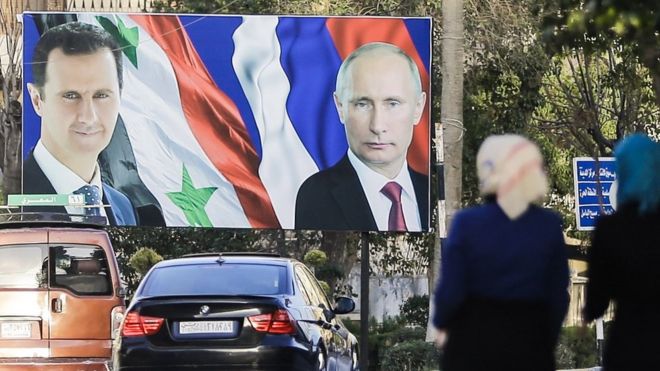
Syrian women walk past a giant poster of President Bashar al-Assad (L) and his Russian counterpart Vladimir Putin (R) in Aleppo (9 March 2017)

 Jeremy Bowen once again shows all the ways the BBC has taken its narrative from the rĂ©gime.

 'The view from the presidential palace in Damascus is the brightest it has been since the war in Syria started.'

 Brighter than when the Free Syrian Army was just getting going? Brighter than when Assad hadn't put the country in hock to Iran and Russia? Brighter than when he hadn't committed war crimes that he will be chased for the rest of his life? Brighter than when he held all the provincial capitals? Not really.

 Bowen has never said that Assad was weak, when Jaish al-Fateh chased him out of Idlib in 2015, and it looked like he would fall without Russian intervention, Bowen¹ relied on his sources in Assad's forces to proclaim the opposite:


 'Predictions of the imminent, or even medium-term fall of Damascus are wrong.

 It does not feel like the capital of a regime that is about to crumble.

 The government-held areas that I have visited seem calm and functional. The ministry of defence, behind heavy layers of security, moves at a stately pace.'

 And the description of the conflict as a war rather than as a genocide or revolution gives us the same view as the man in Damascus.


 'President Assad has not won the war. But it is hard to see now how he can lose it, without an equally decisive intervention against him by an outside power.'

 This is the position President Obama held, the only choices are Assad staying or the US deploying tens of thousands of troops against him. It ignores the instability that means Assad cannot rebuild his domestic support, and indeed relies on those responsible for crimes against humanity, and so the crimes against humanity must continue so they survive and profit. It ignores that given no significant pressure has been placed on Assad and his allies, so it would be more reasonable to think that a reasonable degree of support to the Free Syrian Army would change the equation decisively.


 'Syria has been caught up in the tide of sectarianism that has ripped across the Middle East since the US-led invasion of Iraq in 2003.

 Most of the rebels were Sunnis: Sunni governments in Turkey, Saudi Arabia and Qatar supported different groups.

 The dominant Alawite minority in Syria is a branch of Shia Islam; the regime's biggest supporters outside Russia are the Shia regime in Iran and Hezbollah, the Lebanese Shia movement.'

 The rebels are predominantly Sunni, that doesn't mean they have a sectarian agenda. As Bowen admits later, they didn't receive significant support from outside. It is only recently that it has been suggested that Alawites are Shia, mostly in order to put a sectarian face on Iran's political support for Assad.


 'The first generation of rebels begged Western powers, and sympathetic Saudis and Qataris, for military support. It arrived, but not on the scale that Russia gave President Assad later in the war.'

 Not what Bowen had been saying back in 2015¹, 'Iran and Saudi Arabia are effectively fighting a proxy war in Syria.' And he ignores the US role in stopping weapons get to the rebels, and ensuring the Southern Front has been inactive against Assad since 2015.

 'The crucial turning point came in August and September of 2013, after an attack using chemical weapons on rebel-held areas in the suburbs of Damascus.

 President Obama first threatened force against the regime, then changed his mind.

 In wars, hard power is decisive. Without it, Western countries could only huff and puff against President Assad.

 Western countries never decided what they wanted in Syria, beyond saying that Mr Assad had to go.'

 Again the Obama-centred view, there was a policy that kept Assad in power, and the calls for him to go were mere rhetoric. That President Obama never said what action he would take against Assad, and that he had only promised action if Assad used a whole bunch of chemical weapons rather than his other war crimes, were clear signs that the US President never wanted to take action against Assad at all.


 'From the very beginning, President Assad and his people have presented the war as a foreign conspiracy intended to destroy secular, multi-cultural Syria.

 The choice, he said, was stark - the regime or Islamist, terrorist extremists, and he made no distinction between different kinds of armed opposition.

 They were all terrorists, all enemies of the Syrian people and therefore were legitimate targets.

 The Syrian armed forces, President Assad has said throughout, are the protectors of the people.'

 A picture Jeremy Bowen has done his part to promote. In 2014, he wrote²:

 'Islamist fighters of different levels of radicalism dominate the rebel side in Aleppo. In rural Aleppo, east towards Iraq, Isis territory begins.'

 Reading this, you could be completely ignorant of the expulsion of ISIS³ from Aleppo city in 2014, and indeed the rebels have been fighting against ISIS ever since.


 'Early in the war, if you crossed the line from regime held areas to ones controlled by rebels, as I was able to do several times, the message was very different.

 Fighters denied foreign conspirators inspired them.

 Many said they were local men who had taken up arms against a cruel dictator. Some were migrants from the countryside who had suffered badly during years of drought that had been handled badly by corrupt and inept administrators.

 But that relative simplicity became muddled as the war developed layers of conflict, as rebel groups changed, sometimes self-destructed, fought each other as well as the regime, and were kept under constant pressure by the Syrian military.'

 Like the Stop the War Coalition, Bowen damns the opposition to the past. He doesn't say offer any specifics as to how the composition or the mentality of revolutionaries has changed, and the fight against ISIS is reduced to rebel-infighting.


 'The Syrian armed forces used siege tactics against enclaves controlled by rebels, sealing them off, stopping food deliveries, and shelling and bombing from the air.

 Civilians died in huge numbers.

 All the available statistics, denied by the regime, say that the biggest killer of civilians has been the Syrian armed forces.'

 And yet the policy of the BBC has been to suggest that everyone is as bad.⁴


 'I have interviewed the president, and had many conversations with Syrian officers about the scale of killing by the military.

 They deny it has happened, and speak passionately about their desire to protect Syrians from religious extremists.

 But the tactics they have used against areas controlled by rebels and with large civilian populations guarantee that many will die.'

 So their statements don't fit the reality, but the impression can be left that they are honest in their beliefs and statements about their motivations, rather than that they are serial liars to hide their serial killing.


 'So many foreign powers, Western as well as Middle Eastern, have intervened in Syria that it became a mini world war.

 The regime is secure, but it does not control large areas of the country. Civilians continue to suffer.

 More people are going to die in a war that has changed but not ended.'

 So the foreign intervention is again important, when the anti-Assad forces have barely been aided. Civilians are not suffering due to an unseen power, but because Assad and Russia are murdering them.

 On the bright side, this does show the collapse of the BBC line that agreement between the Great Powers will lead to peace in Syria. But while Jeremy Bowen continues to hide the opposition to Assad, and present him as secure, he continues to present him as something we have to accept.

 1. [http://www.bbc.co.uk/news/world-middle-east-34241256]
 2. [http://www.bbc.co.uk/news/world-middle-east-27866021]
 3. [http://www.telegraph.co.uk/news/worldnews/middleeast/syria/10561857/Syrian-Al-Qaeda-group-ISIS-expelled-from-second-city-Aleppo.html]
 4. "All parties committed war crimes in Aleppo - UN" [http://www.bbc.co.uk/news/world-middle-east-39126653]

Six years on: The price of saying 'no' to Assad


 Diala Brisly:

 'When the protests first started in 2011, we were very romantic, it was so dreamy for us - Syrians - to do this. But I never went to a protest without feeling scared. The Syrian troops were very, very violent. It was not easy. Sometimes protests would only last five minutes before we had to disperse, but it was important for us to do this, to keep up the pressure.

 We wanted to make trouble for the government all the time. They were arresting people and torturing people all the time, putting some areas under siege, shelling, just because the residents had protested. We didn't want them to think they could get away with it.

 We thought if we protested, and after the regime had reacted in such a violent way, that the UN and everyone would say Assad was a criminal. But we were shocked … no one cared. The English language media kept talking about "sectarian strife", but we had no idea what they were talking about.

 I began buying medical supplies to be distributed around the country, but it became increasingly dangerous to do so. The security forces were throwing people in jail for doing this, claiming they were assisting "terrorists."

 I lost hope the day I decided to leave Syria.


 I first went to Istanbul, where I soon became very depressed. I questioned the entire point of political activism, and everything we had done. I also felt so guilty. Other people were stuck in Syria, or they had chosen to stay, to keep resisting.

 I felt guilty because I was still alive, because I didn't resist more. I always had friends who were arrested, and I had never been. I felt guilty because I had an easy life. I needed to break out of this mood, so after a while, I went to visit Syrian friends in Lebanon. There I began painting murals for children in refugee camps, and teaching art workshops.

 We really can't change their lives or take them out of these camps. But we can help them imagine their own world and live it. When children see colours, on their face, on their clothes, they always tell me, "put more colours, more colours", because they have no colour in their lives.


 Now I am in France, where I applied for asylum. I needed stability. I have been granted 10 years of protection here.I am still sending murals to the camps in Lebanon, and I have been working with the White Helmets on an educational booklet for children, about safety and landmines - 95 percent of the work I do is still focused on Syria.

 When you look at things in a rational way, I don't know how you can be hopeful about the future of Syria. But I look at the Palestinian people as an inspiration - they still resist, they focus on education. They do not give up.'


 Mohammad Shbeeb:

 'I will not talk of a war, but of a revolution.

 For anyone who lived in Syria before 2011, it was impossible to think that any revolution or uprising would ever happen in our country. The idea of a revolution seemed like a fiction. The regime was so strong and controlled everything in the country through military rule.

 But then after the Egyptian revolution started in January 2011, and protests in Tahrir Square ended the rule of Hosni Mubarak, suddenly there was hope in Syria. There were some initial attempts to protest in February 2011 - not even against the regime, but just asking for some reforms - but they were unsuccessful.

 Everything in Syria was bad. The education was poor, and our universities could not compete with the universities of the world. Assad's family controlled everything. We had no freedom or any space to do what we wanted, or even to say whatever we wanted to say.


 After protests in Deraa on March 15, when schoolchildren were arrested and tortured in prison, we had the first real protest in Aleppo, on March 18. One of the people arrested on that first day was my friend. He was later killed by a regime sniper in late 2013.

 But initially we really felt that our revolution would soon reach victory, maybe in days, or weeks, or months. We were only seeking our freedom, our dignity and our rights. We were expecting that the world - that the US, EU and other countries - would help us end Assad's rule. But unfortunately, the opposite happened.

 I started to lose hope when the regime began killing peaceful protesters, and the whole world kept watching. And I completely lost all hope when the regime used chemical weapons in Ghouta in 2013, killing thousands.

 The whole world just kept silent and just took the chemical weapons and didn't even punish the regime. Like when you arrest a criminal who has killed someone, and you take his gun and then just let him free to kill someone else with a different gun. At that time, I totally lost any hope that help would come to us from outside. I remained in Aleppo until the regime retook the whole city in late 2016.


 It's really hard to describe the feeling of being forced to leave. I really felt like I was losing my soul. I felt like the whole world was against me and my revolution. I felt broken, like I was losing myself. I was totally broken.

 If you look at what is happening on the ground, the regime and its allied militias are advancing. But for some reason, I still think that, eventually, the revolution will be victorious. I don't really know why I think that. Perhaps it's because it is the right thing. Or maybe it has something to do with my faith.'


 Rafif Jouejati:

 'In March 2011, I was running my thriving management consultancy business and raising two young boys. I was quite unconnected from the Syrian American community and did not maintain much of a Syrian identity. My family visits to Syria were limited to once every year or two.

 But when the revolution began, I was overcome with pride in the activists for daring to stand up to the Assad regime's corruption, tyranny, and dictatorship. I finally realised that I had a Syrian identity, and I felt compelled to join the movement for freedom, dignity, and democracy.

 At first, I was terrified to become involved. I had family members in Damascus and the horrors of Hama were still in my memory. As the daughter of a Syrian career diplomat, I knew very well that my involvement would be perceived by the Assad regime as outright treason.

 I began translating news for the LCC, along with other team members, and gradually took on more responsibilities to support the secular, nonviolent opposition. We were positive that the regime would collapse within months. First, we thought three months, then six, then surely it would not last more than a year? And then the stark reality began to sink in as we realised that Assad supporters truly meant it when they said, "Either Assad or we burn the country."

 I worked with a large team of activists and experts to develop the Syrian Freedom Charter - a statement of what the Syrian people want in their future country. It was a way to attempt to combat the creeping desperation and maintain a forward-looking outlook.


 I am now writing a book about the original goals of the revolution: freedom, dignity, and democracy. It's a story that has largely been ignored by the media, and the larger narrative.

 I felt that by writing a book and focusing on the Freedom Charter, I could impart the sense of hope Syrians had, and continue to maintain, that one day we will experience a transition away from the Assad regime (and other dictatorships that might try to replace it) to achieve freedom for all.

 I, and many other like-minded Syrians, are stunned by the international community's utter paralysis in the face of Assad's genocidal regime. I have no idea how far the regime and its backers will go to wipe out every single person who opposed Assad. But having said "no" to Assad, having broken that wall of fear, having seen my fellow Syrians suffer the greatest humanitarian disaster since World War II, I do know one thing: we will not go away.

 The dream of freedom is too powerful, even for barrel bombs, chemical weapons, and rampant torture to break. You see, with more than half of Syria's population displaced or refugees, new generations of free Syrians are beginning to take the lead in the opposition, and they will never forget.'

“Without revolution there can be no progress.”


 'It’s been six years since graffiti sprayed on a wall in the southern Syrian city of Deraa sparked a civil war that has since taken hundreds of thousands of lives and forced millions to flee the country. The boys who wrote the words, “Your turn next Doctor”, were inspired by the Arab Spring uprisings in neighbouring countries — they had no idea their bit of graffiti would change the country.

 “We saw the riots in Tunisia and Egypt and it encouraged us to spray the message,” Mouawiya Syasneh said by phone from Deraa.

 The arrest and detainment of then-14-year-old Syasneh and his friends prompted weeks of protest.

 “They beat me with cables, poured freezing cold water on me and electrocuted me many times,” Syasneh said. “They hanged me by the wrists from the ceiling of the cell and left me there for a day until I confessed to it and gave them the names of the other boys.”

 The teens were eventually released, but their bruised and bloody conditions only prompted further outrage. The Deraa protests were one of the first major acts of defiance against President Bashar Assad. In response, government forces sent snipers to the city’s rooftops, cut off power and raided food stores. Other cities joined in the protests, and as the demonstrations grew so did Assad’s bloody crackdown.


 Now 20, Syasneh still lives in the country and fights with the Free Syrian Army. His father’s death in 2013, when he was “hit by a rocket,” prompted Syasneh to take up the fight. While Syasneh regrets the suffering, he holds hope that the future will be brighter.

 “Without revolution there can be no progress,” he said. “The path is not always easy, but inshallah [God willing] it will be better for our children.” '


 A Faceless Teenage Refugee Who Helped Ignite Syria’s War*

 'Some of the boys from Dara’a are refugees, like the teenager in Jordan, now 17, who agreed, along with his father, to speak as long as his name was not revealed. They said they were protecting relatives left behind in Syria, but their reluctance also came from shame: the boy’s father had given him up to the police, to spare a second son, and the teenager informed on three of his friends to try to avoid the torture he suffered anyway.

 Given all that has happened, to his family and his country, the teenager said he had no regrets. “Why should I? It’s good that it happened,” he said during a meeting arranged by other refugees from Dara’a. Speaking of Mr. Assad, he said, “We found out who he really is.”

 Recounting those days, the teenager said he passed a sleepless night after his cousin’s acts of defiance. It was not just the graffiti: the cousin had set fire to a new police kiosk the same day in another act of lashing out. The teenager and his friends did not talk much about politics, but the language of dissent was everywhere on satellite television. Small protests had begun to flare in Damascus. “It was the right time,” the teenager said.

 The next morning, he noticed intelligence agents at a school and had little doubt about why they were there. “We knew what we did,” he said.


 Over the next few days, the police, the military and the military police roamed the city “day and night,” storming the homes of suspects. The teenager said he went into hiding. “I thought it would pass,” he said. But it did not.

 When the police finally knocked on the family’s door, the officers threatened to take a different son. If the father gave up the teenager, the agents promised, he would be held for only a few days. The father complied and took his son to the local security headquarters. The boy started crying, and begging to be taken home. But the father left his son behind. “You are to blame for anything that happens to him,” his wife said when he returned home.

 The abuse began as soon as the teenager arrived at a prison in the town of Suwayda, where he was beaten during his interrogations. “Are you the one who wrote it?” the interrogator asked, more a demand than a question.

 The teenager said he dropped out of school when he was 8. “I don’t know how to write,” he told the interrogators for three days until, desperate for the abuse to stop, he confessed to spray-painting the phrase, though he had not. He also gave up the names of three other boys who were there that day. Within two weeks of the arrest, the father received a call to go to Dara’a Omari Mosque for a protest, in part to demand the release of the boys. About 10 people had already gathered there. The father said he and the other parents were convinced that if they did not protest, “they would have taken more children.” The demonstration grew, and soon he saw most everyone he knew in the city.


 It is impossible to say how things might have turned out had the Assad government taken a more accommodating stance toward the protest. Activists from Dara’a still insist that the pressures could have been contained, compromises reached, even after years of violent repression. Any such hope quickly passed as the deaths began to mount.

 “People became uncontrollable,” the father said.'

*[http://www.nytimes.com/2013/02/09/world/middleeast/a-faceless-teenage-refugee-who-helped-ignite-syrias-war.html]

Monday, 13 March 2017

The heroic Syrian doctor who lost his entire family


 'Hasan al-Hariri, the doctor who lost seven of his children in Syria, after the regime dropped barrel bombs on his home back in 2014, was killed on Sunday in an airstrikes that struck Daraa province. The 46-year-old Hasan was known for his defiant nature and refused to leave his hometown Busra al-Hariri. He was among the first to join the revolution that sparked in Daraa where peaceful protests broke out in the city in March 2011. The Syrian doctor realized the dire need for doctors as the number of those injured by violence increased. Hasan, along with other doctors from the area, established field hospitals to treat wounded civilians and FSA fighters under brutal attack by the Assad army.

 In 2014, Dr. al-Hariri reached home after treating injured fighters only to find heartbreaking scenes of the bodies of his seven children wrapped in blankets laid on the ground. Fortunately, his youngest daughter and eighth child survived the horrendous attack. A couple of days later, Dr. Hasan was himself seriously injured in the head when he went to his house to collect his children's items and was hit by a missile. After undergoing medical treatment in Jordan, Dr. al-Harriri insisted on returning to Syria to continue treating the injured.

 “I can still see their school bags, clothes, and toys. This makes me feel more determined to follow my dream in achieving justice and fighting Assad brutal regime,” said Dr. Hasan during an interview with Al Jazeera in 2014.


 On Tuesday March 12, 2017, the doctor from Daraa died in an airstrike on the city. He was struck by the airstrike as he rushed to al Minshiye district to treat an injured FSA soldier. According to reports, he received injuries in his stomach and heart. People worldwide took to social media to offer their condolences and express their admiration for a person who did not stop working to save and rescue people around him, even after losing his entire family.

 According to those close to him, Dr. Hasan was dedicated to his work and did his best to help everyone around him. “Since the beginning of the revolution he contributed with everything he had, particularly in terms of medical support. After the revolution was armed he chose to become a field doctor, even as the regime vandalized his clinic, razed his home, and killed his children,” Ibrahim al-Hariri, a relative of Dr. Hasan told Al Arabiya English.

 Ibrahim said that people in Daraa were very attached to the doctor and considered him a revolutionary icon. “Dr. Hasan al-Hariri lived many heroic moments as he saved many lives in Syria,” he said.'

Saturday, 11 March 2017

Rebels vow to defy Assad in Homs, Syria

636247323806492594-AX127-6A9B-9.JPG

 'Bombs rained down on the Al-Waer neighborhood in western Homs in Syria six times one recent day. As they fell, Abu Mahmoud remembered how his 13-year-old son, Mahmoud, and brother-in-law, Hotheifah, 22, died in a similar barrage.

 "I was next to them in the house," said Mahmoud, 35, a farmer. "They didn’t have time to run away."


 Al-Waer is the last rebel holdout in Syria’s third-largest city. It became a battlefield last month when Syrian President Bashar Assad launched an assault, hoping to score another victory like the fall of rebel-held east Aleppo in December. According to UNICEF, as of January, there were 15 rebel holdouts — enclaves of people living in besieged areas. Mahmoud lives in one of those 15. He moved from his home in southern Homs to Al-Waer when war broke out. In the wake of anti-regime uprisings, Assad’s Shiite Muslim forces brutally repressed the area's largely Sunni community. Mahmoud and his family were part of that community. Mahmoud's youngest child escaped harm in the airstrike in February that killed his 13-year-old. His wife and middle son were injured.

 "We needed a big wasta to let them out," he said. "Wasta" is an Arabic term meaning an inside connection.

 A friend spirited them through government lines to a hospital elsewhere in the city. They were released three days ago and live in a regime-controlled part of Homs.

 Mahmoud vows to defy Assad until death. "We are not leaving," he said. "We will stay a thorn in the regime’s throat. God gives, and God takes."


 Al-Waer was under siege long before the latest assault. United Nations humanitarian aid convoys have kept residents alive for more than three years. The regime blocked the last U.N. convoy from entering Al-Waer late last month, threatening 75,000 people with starvation. Similar blockades have gone up in other rebel-held pockets around Homs.

 "What has changed in recent weeks is the intensity of the siege and bombing," said Ayoub Shabil, 47, an agricultural engineer in Ar Rastan, a small town 15 miles north of Homs. "You can’t imagine how small these houses are compared to the size of the rockets hitting them. Three rockets destroyed 12 homes here on Monday. The siege is getting worse."

 Mouhannad al-Khaled, 25, a photographer and activist in Al-Waer for three years, said that when he arrived in the neighborhood, it was almost empty and full of new buildings. Today, those streets are mostly lined with rubble or buildings severely damaged after years of airstrikes and fighting. Residents who remain share the few habitable buildings still standing. Mohammad al-Hosami, a former Red Crescent activist living in Al-Waer for five years, said rebels and the regime signed a cease-fire March 6 set to last 10 days. The two sides have begun negotiations on evacuating the neighborhood. Those who stay must give up their weapons. The Russians are there to ensure the agreement. It's anyone's guess if it happens, residents said. Al-Hosami said he expects most to evacuate because the conditions are becoming unbearable and people are losing hope.

 "Sadness is prevailing in the streets," he said. "Al-Waer was the last holdout for rebels in Homs. If its residents leave, it’s the end for the revolution in the city." '

Meet the women risking their lives to save civilians


 "Amidst all the death and destruction in Syria, there is one organisation which exists solely to protect civilians. They call themselves the White Helmets and they’re made up of over 3,000 volunteers, 100 of whom are women. Before the war they were in normal civilian jobs – teachers, bakers and tailors. Now, they specialise in saving lives, every day.

 Gardenia, 33, was studying English in Damascus when war broke out. She joined a network of humanitarian volunteers that crossed between the regime and opposition areas to help people – each time risking arrest. Now she is a full-time volunteer with the White Helmets. ‘When bombs strike, most of the victims lose their clothes,’ she says. ‘One of our roles is to keep the dignity of the human being.’ Training even extends to midwifery: ‘Even in a war zone, life goes on. Women are still having babies, and there are no doctors to help them – someone has to.’

 Manal, 45, was an accountant in her former life. She volunteers as a White Helmets in Daraa, the site of anti-Assad graffiti by teenage boys in 2011, which is often said to have sparked the Syrian revolution. Daraa has suffered siege and heavy aerial attacks since: ‘All the medical staff and doctors in Syria have either been injured, killed, detained or had to flee. Someone had to bridge that gap and act to protect civilians, so we had to do it.’


 The White Helmets have rescued over 85,000 people since the war broke out. Their work led to a nomination for the Nobel Peace Prize in 2016. An eponymous Netflix documentary about them won Best Documentary Short at this year’s Oscars.

 How do they feel, risking their lives on a daily basis?

 ‘We live in a war zone,’ Manal tells us. ‘We are risking our lives whether we choose to rescue people or not – so it’s better to help people.’

 ‘Syrians are exposed to death on a daily basis,’ Gardenia adds. ‘It’s an indiscriminate bombardment – you’re danger just being in your home.’


 The White Helmets are supported by a mixture of international government and private funding, including the Jo Cox foundation – the late MP was a champion of the organisation during her career.

 New volunteers first attend training sessions in either Turkey or Syria where they are introduced to ‘urban search and rescue’ techniques. They are also trained to deal with trauma injuries and removal of UXO’s (unexploded ordinances). In addition to this, they conduct emergency burials, repair roads, and provide warnings and advice to civilians.

 Yet as well as all this, the female White Helmets are helping to change the perception of women in their country. ‘Just by being a part of the civil defence, it shows what women can do,’ says Manal. ‘If women can face this, they can face anything. It turns the role of a woman from victim to someone with power.’


 However even with their extensive training, they can still find themselves out of their depth.

 ‘A bomb fell near my house, and I didn’t have my equipment with me.’ says Manal. ‘I was with my family at the time. I looked outside and I saw that my neighbour was lying in the street – heavily wounded. I rushed out and tried to stop the bleeding. I screamed for help but no one could hear me – all the defence teams were scattered around, responding to different attacks. I kept on talking to my neighbour, asking him to stay conscious. Finally a car came and transferred us to the hospital. It was only when I came back home that I realised my one-year-old niece, who I was holding in my arms when the bomb fell, had also been injured – I was holding her and I didn’t even see that she was bleeding.’

 Thankfully, both Manal’s niece and neighbour survived the attack, but there are many who haven’t, and won’t, if the war goes on.

 ‘There is no international will to end this war,’ says Manal, ‘everyday we are losing friends, neighbours and loved ones.’

 Gardenia nods, ‘We don’t want to pull people from under the rubble any more.’ "

Friday, 10 March 2017

Education remains a casualty


 'Imad Barq has a doctoral degree in education and was a professor at Al-Baath University in Homs. In 2013, he was detained by the Assad regime and forced to leave the country to Turkey. The Syrian interim government formed its “Ministry of Education” in 2013 as a “national committee for education” that was under the supervision of the Syrian opposition coalition. In May 2014, the ministry was officially established in Turkey, and Barq was elected to oversee the operation out of Gaziantep. But in May 2015 he shifted the headquarters back to Syria, and despite ongoing unrest decided to manage the education crisis inside the opposition-held areas. For him, the only way to monitor the volatile education landscape was to be in his ravaged country. Barq was able to return by road to opposition-held areas. He currently resides in western Aleppo.


 "As the minister of education, my duty is not to speak about the politics within the coalition, but to put all focus on education matters. We work independently of all of that. I am working in my technical capacity and as the education minister, I am not involved in the politics of the coalition. As a technocrat, I don’t belong to any political party and am only focusing to work on this huge challenge — the education challenge that is an incredibly difficult task. I don’t even draw a salary as a minister and take my salary from my work teaching at the University of Aleppo. This is a duty to my country.

 You have to understand that inside Syria we have areas held by the Kurds, we have areas under the control of IS, areas controlled by the opposition and then areas under the control of the regime. We control the opposition and neutral areas across nine provinces. Today, there are around 4.5 million school-aged children inside Syria. Over 1.5 million of them live in the opposition areas and out of that number only 750,000 children are in school.

 One may think that expanding the regime-held areas helps stabilize the situation for families, but it is actually hurting the situation. Because when the regime comes to any area, the people in that area leave and become IDPs. They will move to another place; so when the regime expands into an area — like eastern Aleppo — that area automatically becomes empty. Until now, eastern Aleppo remains empty; even the supporters of Assad are gone. After Assad got control of eastern Aleppo, most of those people moved to northern Aleppo.

 The targeting of schools is a tragedy. We have the majority of the attacks against our schools. The regime and its supporters deliberately attack schools. Today — even now as we are speaking — one attack happened in Homs, but no one is reporting on it. No one reports on these issues anymore. It has become normal for the world and that is a shame.


 The West knows what’s going on in Syria. They have their satellites, their people on the ground, so they can see what’s going on, but there is no willingness to support the people. When the Assad regime attacks our schools, he does it with a big intention. He wants to displace these children and leave them in a hopeless and vulnerable position so that they would be forced to join radical groups. He wants to show people that if he is gone this is what will happen. He wants to show the rest of the world that Syrians are terrorists — but we’re not. There are close to 5,000 schools in the opposition-held areas, and the regime systematically attacks them. They never shell the schools in the IS-controlled areas. Why? Why is it that they only shell our schools?

 There are a total of 17,000 schools inside Syria and 5,000 of them are in the opposition areas. Almost 2,800 schools have been shelled and are completely destroyed. The schools that are left are all targets. So due to these fears we are providing informal schooling in private homes, basements and areas that we think the children are safe in. In many areas where shelling is frequent and heavy, we have the kids stay inside and the teachers go to them. No child should endure this — to get education under the fear of dying.

 Before the war, 5% of students were disabled, today we have over 15% of children with disabilities and special needs. In total, we have around 275,000 teachers in all of Syria, and in the opposition areas there are only 75,000 teachers left. Out of that number, only 13,000 of them are getting a salary and the rest don’t work or are volunteers — there is no funding to pay these teachers and that is a tragedy. From the 25,000 teachers that are available in our system [work under the umbrella of the Education Ministry] now 14,000 of them don’t have a degree in higher education and only have a secondary education degree. Because of that, these teachers themselves need some support. We are fighting this fight because we are not just fighting to save education for these children — we are fighting the regime’s intentions of destroying our future generation.There is no budget! There are NGOs supporting us, but the whole system is losing funding. The ministry has no budget. Even the University of Aleppo is getting its support from other NGOs.


 The world does not care because the regime is still being supported. The world has no heart and we are losing an entire generation. The Syrian people know that they are alone. Even our supporters and friends are reducing their support. Funds are decreasing and their backing is weakening. Our team works under shelling and everyday we are facing death. Even I, myself, have escaped death and continue to face it every day.

 We need funding to be sustained — all in an effort to build upon what we are doing. Those remaining in Syria will never leave — we will stay — even if we are working voluntarily. If we leave, there will be a demographic change in our country and we can’t let that happen. That change is what the regime wants. We prefer to die inside Syria than to leave.

 It is so difficult for me to see Syrian children live without education and have their future and potential wasted. I can’t see them just sit while being left behind doing nothing. I have to work to serve this community and my country. If I were to leave, and if people like me continue to leave, Syria will be left with no qualified person and that will be an irrecoverable disaster. This is especially critical in the field of education. I have no plans to leave Syria. Syria is my home, my country, I will never leave. We will work inside Syria until the last breath." '

Demonstrations across Syria: Revolution until Victory


"Here in Douma."


 Maarat al-Numan:
[https://twitter.com/CombatChris1/status/840233902878949377]


 Azaz:
[https://twitter.com/CombatChris1/status/840234470150160392]


Thursday, 9 March 2017

Assad is a long way from victory in Syrian conflict

Image result for assad is a long way from victory in syria reuters palmyra

 'The destruction of Syria, which began six years ago this month, shows limited signs of abating, even though Bashar-al Assad’s Russia and Iran-backed regime recaptured the rebels’ last urban stronghold of eastern Aleppo in December.

 A partial ceasefire is very patchy. A bewildering assortment of forces — including Russian, American, Iranian and Turkish as well as Kurdish militia and Iran-backed Shia paramilitaries — crowd the battlefield and episodically combine against Isis. Al-Qaeda can still strike at the heart of the regime, as it showed with a deadly attack on military intelligence in Homs last month. Mainstream rebels are regrouping to protect themselves. Talks about a transition out of war are going nowhere. President Vladimir Putin’s Russia, whose air force was decisive in salvaging the Assads and which helped pound Aleppo into rubble, has decided this is the time to tell Europe to finance the reconstruction of Syria.


 No doubt the Kremlin sees signs the US under President Donald Trump has ditched any idea of toppling President Assad. In Europe, moreover, political panic about any further surge of migrants and refugees from the region seems paramount. Yet the confidence of Moscow — and Tehran — should not hide the fact that they have a real and costly dilemma on their hands in Syria. First, the extent to which the Assad government controls the roughly 35 per cent of Syrian territory it holds is moot. The manpower shortages of a minority regime have made it dependent on Russia, Iran and powerful paramilitaries such as Lebanon’s Hizbollah. Damascus has had to subcontract local control to a mosaic of warlords and militias, private armies and racketeers — all invested in the lucrative distortions of a war economy characterised by penury for the mass of Syrians, roughly half of whom have been uprooted. There is nothing stable about that.

 Second, to what extent are Russia and Iran willing to assist the Assads in breaking out of their mini-state and reconquering the rest of Syria? The Syrian state almost certainly does not have the numbers to retake and garrison eastern Syria. Look at how Palmyra in central Syria keeps changing hands — the regime has only just recaptured this Graeco-Roman jewel after it fell to Isis for a second time in December while the focus was on Aleppo. Palmyra, moreover, was taken back after US air strikes on Isis there. The Syrian conflict is protean and shape-changing, but President Assad would be unwise to bet the palace on the recurrence of such a weird coalition.

 Third, ostensible control of “useful Syria” is false comfort. Aside from the security fact that much of the rest is jihadi-infested, this implies the east is almost all “useless” desert. It is not. The resilience of the almost 50-year-old Assad regime required the energy resources and crops of the east. Raqqa, Hasaka and Deir Ezzor provinces produced 60 per cent of the country’s cereals, 75 per cent of its cotton, and all its oil and gas in 2010, before the rebellion. Far from useless, the east is essential to a regime recovering minimal self-sufficiency. Syria’s power-generating capacity, dependent on gasfields in the east, is about a quarter of what it was before the war.


 Russia and Iran would have to fight to retake all of Syria. That would be costly, in blood and cash. It would greatly increase the autonomy of Mr Assad, now a ward of two states. Yet their Syrian rump protectorate is already very costly. Arab securocrats say Iran alone had to spend $8bn a year in 2013-14. Russia and Iran are dependent on oil and gas at a time of depressed prices and both subject to international sanctions.

 True, Moscow has taken out long leases on Mediterranean port facilities at Tartus that it intends to expand, and an air base near Latakia. Tehran’s revolutionary guard — a business empire as well as expeditionary force — has secured potentially valuable mobile telecoms, phosphate mining, port and power-generation contracts.

 But the sort of money needed to reconstruct Syria is likely to be at least $250bn and maybe eventually double that. There will be no international queues to do it without basic stability and agreement on power-sharing. The “realism” taking hold in Brussels and Washington needs more input from reality. Europeans, in particular, desperate for anything that turns the tide of refugees back into Syria, should be clear that some of the demographic changes there are intended by the regime to be permanent. The regime’s patrons, too, will have time to reflect on the mess they own.'

Wednesday, 8 March 2017

Assad's Control Erodes as Warlords Gain Upper Hand


 'On a cool morning, an elderly man is standing at his espresso machine on a street in eastern Aleppo. It's shortly after 8 a.m., and this part of the city -- destroyed in the war and reconquered by the regime in December -- is waking up. Green grocers arrive and set out their boxes of produce on the rubble piled in front of their stores. Others are shoveling debris from the roads.

 The name of the man with the espresso machine must go unmentioned, otherwise he would soon be dead. A fire is burning in a metal drum next to his improvised coffee counter, and he is using it to periodically warm his hands. Several weeks ago, just after the neighborhood was retaken, he returned to the small workshop where he had run a motorcycle repair shop -- but it was already too late. He immediately saw that someone had shot open the lock.

 Inside, he found uniformed fighters from a militia affiliated with the regime. They were in the process, he says, of removing a motorcycle, his German tools and all replacement parts from the garage. Two of the militia members, he says, silently threatened him with their Kalashnikovs, leaving him no choice but to leave as the men loaded his belonging into a pick-up truck.

 As he relates his story, other civilians approach the fire and begin nodding. One of them, the owner of a general store, says that regular army soldiers had hardly left before militia members began emptying out his store. Another relates the story of how militia members murdered his brother. The brother had been lying wounded in bed when five fighters forced their way into his apartment. "Bring him out," the fighters ordered before claiming the apartment as their own. The man protested, saying his brother was unable to walk -- whereupon one of the militia members pulled out his gun and shot the brother in the head. Then the fighters looted the apartment.

 More and more men from the neighborhood assemble at the coffee machine and tell their own stories of looting, but suddenly, the men at the fire fall silent. A militia fighter can be seen walking down the street with a golden hawk on his uniform, the emblem of the Desert Hawks, one of the two most powerful militias in the territory controlled by Syrian President Bashar Assad.


 For months, Assad's army has been on the advance across Syria. But its military success has only been possible due to the significant assistance the dictators' troops have received from Iran and Russia -- and from local Syrian militias. Now, these fighters are taking over control in many areas, committing murder, looting and harassing civilians. And nobody can stop them, not even Assad himself. Indeed, the militias are now more powerful than even the country's dictator and have become the real holders of power in Syria.

 Even long before the Syrian revolt of 2011, Assad depended primarily on the loyalty of his fellow Alawites in the top ranks of the armed forces and intelligence services. But the religious group only makes up between 12 and 15 percent of the Syrian population. In 2012, Assad's position became even more tenuous as the army began shrinking rapidly: Tens of thousands of soldiers deserted, conscripts failed to show up for duty and many of those who did fight ended up dead. In September 2015, when the Russians joined the war, the Syrian army only had 6,000 soldiers who were fit for active duty, according to Charles Lister of the Middle East Institute in Washington. He bases his estimate on confidential testimony of Russian officials.

 To preserve its regular troops, the regime was forced to make a Faustian bargain, allowing armed loyalists to form their own militias. In many cases, the leaders of smuggling rings or criminal gangs became local kingpins, who were then able to expand their business empires unimpeded in exchange for loyalty to Assad. The two largest militias, the Desert Hawks, headquartered in the northern port city of Latakia, and the Tiger Forces from Hama, each have between 3,000 and 6,000 armed fighters. Additionally, there are hundreds of smaller pro-regime militias.

 Bread, gasoline, medication -- there are shortages across the entire country. And those who control the distribution of these goods can profit handsomely, enabling them to purchase more weapons and hire more fighters. As a result, the warlords have replaced the state security apparatus in cities and in entire regions.


 While the Syrian army, in its desperation, has been forced to combs jails for recruits, fighters join the militias of their own free will. Some of them, after all, pay up to three times the salary earned by regular soldiers and they have a lot more freedom. They can, for example, extort duties at checkpoints, sell drugs of their own accord, smuggle gasoline and loot conquered towns and villages.

 Assad is nevertheless dependent on them. When his troops, supported by Russian units, took eastern Aleppo in December 2016, the Syrian soldiers featured prominently in front of the television cameras. But the actual fighting was conducted by Iraqi, Afghan and Lebanese mercenaries under Iranian senior leadership -- and by the pro-regime militias, who also secured the conquered territory once the fighting had ceased. And they plundered it.


 Hama is a veritable warlords' el Dorado. In 1982, troops loyal to Hafis Assad, the founder of the Assad dynasty, brutally crushed an uprising, killing more than 10,000 people in just three weeks. More recently, the city is where the Tiger Forces were founded, formed out of a loose network of officials from the feared air force secret service, local tribal leaders and criminals. They gathered around an Alawite officer and helped crush the anti-regime rebellion in the province of Hama in 2011. Now, the militia has bases and networks in several parts of Syria.

 The two most important sub-commanders in Hama are Ali Shelly, a well-known criminal, and Talal Dakkak, who keeps a pet lion. It is said that Dakkak enjoys feeding his victims to animals. The two of them have people arbitrarily kidnapped, they steal, and they smuggle oil and gasoline, which they even sell to Islamic State (IS), against which Assad's army is officially fighting.

 In summer 2016, for example, an army unit intercepted several tanker trucks filled with gasoline. The column was travelling on behalf of Dakkak and the fuel they contained was apparently meant for IS units. The soldiers didn't dare confiscate it for fear of Dakkak's revenge and the gasoline was turned over to the local air-force secret service -- which is closely linked with the Tiger Forces. It didn't take long before the tankers could continue their journey.


 In a village in Assad-controlled territory, a doctor and his wife are sitting on their living-room sofa staring into the smartphone they are using. The woman's voice trembles in fear as she speaks: "It was here in our village. Uniformed men forced their way into a woman's house. They tied her up, stole her money and tortured her until she revealed where her husband's money was hidden. When the men had the money, they disappeared again."

 Her husband adds: "Two days ago, a merchant was kidnapped here." And several weeks ago, he says, friends of his were robbed on a highway. They were stopped at an improvised checkpoint and dragged out of their car before militia members climbed in and sped away.

 Farmers wanting to pass such checkpoints must pay a levy on their harvest. If they don't, the entire harvest may be confiscated. In several villages, citizen defense leagues have formed, patrolling at night to scare off plundering militiamen. The doctor says that the division of labor between the two Tiger leaders is clear: Most of the kidnappings can be traced back to Talal Dalakk, he claims, while the smuggling is more likely to be the work of Ali Shelly.


 At times, the army or the military intelligence service has tried to come down on the warlords. But such attempts have always ended in fiasco. In March 2016, Assad units arrested the leader of a powerful Christian militia from the north of the province following an exchange of gunfire. But his followers violently protested and the man was soon freed.

 "Yes, we have problems," says Hussein Dayoub, head of the Assad's Baath Party in Hama. Sitting in his wood-paneled office beneath a portrait of the president, he admits that militia members have set up checkpoints and extorted tolls. He also says that smuggling and kidnapping is a problem, but adds that he doesn't know who is behind it.

 In theory, Dayoub is a powerful man, head of the local chapter of the governing party. But even he is apparently afraid of falling into disfavor with the militias, the true rulers of Hama.


 The largest rivals of the Hama-based Tiger Forces in the battle for smuggling profits and power can be found in Latakia, the coastal city in the Alawite heartland. Rain is beating down as low clouds move in from the sea. The steel factory belonging to Mohamed Jaber is located among the fields south of the city. Where T-beams were once manufactured for building construction, rockets are now soldered together and armor is mounted on pick-ups. This is where the Desert Hawks have one of their bases and their weapons factory.

 Mohamed Jaber and his brother initially became rich from smuggling. In the 1990s, they began by spiriting oil into the country from Iraq before investing their millions in the steel industry. When the Syrian civil war began in 2011 and international sanctions isolated the Assad regime, they were asked to use their smuggling contacts to bring in badly needed oil and gasoline.

 To protect their convoys as they drove through the desert, the Jabers recruited hundreds of former soldiers -- and criminals. In August 2013, Assad signed a decree allowing private businesspeople to maintain their own security forces, thus paving the way for kleptocrats in his favor to become warlords.

 Jaber, though, says he isn't interested in either power or money, claiming he already has enough of both. Rather, he only wants to help the great President Bashar Assad. When the war is over, he'll lay down his weapons he says, before adding a bit later: "We could control over 60 percent of the country, if we were allowed to."


 The Russians have a pragmatic approach to the militias: Depending on the situation, the local warlords are given weapons, medals and selfies with Russian officers. But privately the Russian generals complain about the shocking state of the army and about the militias.

 If the warlords become more powerful, Assad may soon become little more than a figurehead, surrounded by a coterie of robbers and smugglers. And the militias are also gaining political influence: In parliamentary elections last spring, candidates from the old ruling class didn't do as well as they had in the past. Instead, candidates affiliated with the warlords emerged victorious.

 Elections in Syria, of course, don't reflect the will of the electorate. They only show who has the power to get his candidates elected. It is often said that, while Assad might be dreadful, he is the last remaining state authority in the country. But the strength of the militias shows that he lost even that authority long ago.'