Tuesday, 18 October 2016

Are You Silent Because There Are Muslims?


 'Last week was the worst yet for the besieged neighborhoods of eastern Aleppo. Russian and Syrian government warplanes launched a new campaign of indiscriminate bombing Tuesday, terrorizing the city and causing a wave of casualties. On Friday, the warplanes targeted the area’s food supply, destroying a bread distribution facility and attacking a flour mill.

 A staggering 174 airstrikes were launched over the course of the week on eastern Aleppo, the rebel-controlled portion of the city, and 159 deaths were reported through mid-afternoon Friday.


 For one resident of eastern Aleppo, the silence of the United States and its allies — which have not taken any military steps to stop the onslaught — has made an already intolerable situation even worse.

 “I want to ask the Western world, which has laws to protect animals: Where are you when it comes to protecting women, children, the elderly, and the disabled?” said Fatima Kaddour, “Are you silent because there are Muslims in our country and they should be exterminated?”

 Kaddour, a 56-year-old housewife and mother of 11 children, lives in a one-room apartment, along with her son and two daughters, close to the front lines with government forces. It is not her flat. Like so many of their neighbors, her family was internally displaced, forced to move from their old home in the Salahuddin district of eastern Aleppo when their house was destroyed in January.

 She railed at the ruling regime for attacking Syrians but said she’s ready to leave the rebel-held areas if given a chance. Like many other Syrians, she is perplexed by the U.S. fixation on destroying Jabhat Fateh al-Sham, the al Qaeda affiliate formerly known as the Nusra Front, rather than acting to stop the regime’s assault on civilians. Jabhat Fatah al Sham is a relatively small player in Aleppo and runs the areas under its control in an orderly, nonabusive fashion, she said.

 Although she and her children have tried to fix up their new home, the bombing campaign has broken the windows and damaged the doors. It is full of sunlight, and there is room for the children to study, she said. But when they hear warplanes overhead, usually once or twice a day, “We run to the bathroom or the hall.”


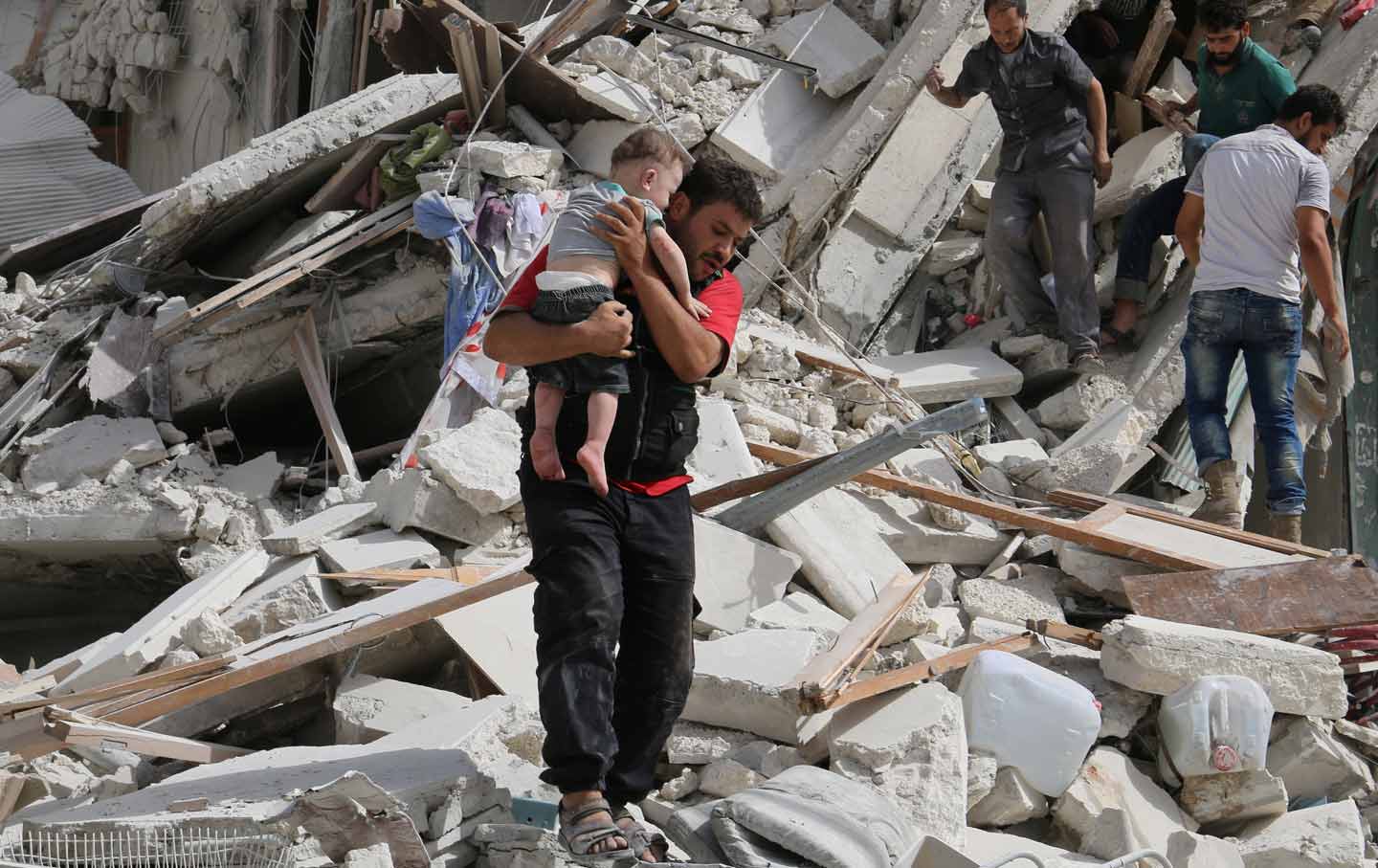
 Compared with some other residents of eastern Aleppo, they are lucky. Not long ago, the Russian or Syrian air force bombed a building nearby that had housed five families, reducing it to a heap of rubble. All 20 inhabitants were killed, and most are still under the debris, she said.

 The sole survivor from one of the families was a girl of 10, who had not been in the building. For a full week, she slept in the street, waiting for the civil defense volunteers to dig out her relatives, Kaddour said. But the volunteers lacked the equipment to recover the bodies, and the ruins have become their grave. The girl was so traumatized that she would not speak to a family that offered to informally adopt her, and in frustration they took her to an orphanage in the Shaar neighborhood of Aleppo.

 “She never laughs. She never cries. She never asks for anything, even food,” Kaddour said. “The other children feed her.”

 Meals for those living in besieged Aleppo are spartan, consisting of Syrian flat bread, which humanitarian aid groups distribute every other day, rice, lentils, and bulgur, a local grain that can be cooked or consumed raw when mixed with water. The grains are distributed in food packets every second or third month. Residents obtain water from a water delivery service, which provides 250 gallons to fill a tank for $10 — as long as the purchaser can supply the fuel to power the delivery truck. But fuel is almost impossible to find.

 Because of the cost of cooking fuel, residents comb destroyed buildings for scrap wood, which they use for a fire to boil water, Kaddour said.


 The situation in Aleppo is at the edge of a still bigger disaster, with the main vulnerabilities in the area being fuel and water, according to the top official in rebel-held parts of the province. The city had built up supplies in anticipation of a siege of up to six months, said the official, Mohammad Fadelah, in a phone call Friday. But it cannot use them all due to a fuel shortage.

 “We brought in substantial amounts of wheat, but the problem is we don’t have the fuel to run the mills to make the flour,” said Fadelah, the president of the provincial council.

 The fuel shortage also threatens to paralyze water filtration systems, which make the area’s well water fit for human consumption. The enclave also suffers from a growing crisis in health care, as two of the 10 hospitals in the area were recently destroyed, and a shortage of medicine grows worse.

 “We had our strategic plan before the siege to keep functioning for six months,” he said. “But with the recent escalation, I don’t think we would be able to serve that long.”


 The children of eastern Aleppo, however, are forced to take on tasks that would terrify even the bravest adults. Kaddour is both proud of and worried for her teenage son, Amir, who volunteers at a local hospital, helping rescue people pinned down when buildings collapse. He got involved in the job after enrolling in a first-aid course without telling her, using his pocket money to buy a first-aid kit.

 “I don’t want him to leave the house when there is bombing,” she said. “Sometimes he listens to me. Other times he sneaks out and leaves without telling me.”

 On one occasion, when Amir was working, two missiles struck the building next door to her and set it on fire. Neighbors told her that they’d seen her son and he was safe. But when she began searching for him, she came upon the bodies of two young men who’d died in the attack.

 “I lost consciousness. I didn’t feel anything for six hours. Even when I was awake, I couldn’t remember anything for a week,” she said.


 Now she and her family live in fear for their future. Bashar al-Assad’s regime and Russia appear determined to reconquer all of Aleppo, which was once the country’s largest city. Kaddour believes they want to expel the people of eastern Aleppo, as they have the population of Darayya and other towns near Damascus.

 “They have destroyed us, expelled us, and killed us only because a group of youths protested and asked for freedom, the freedom of opinion, of education, and to live as you like,” she said. “They took away everything from us, even the air, which they polluted with chlorine gas, with phosphorus and the smell of ruin.”

 “Now after all the suffering, we are worried they will take us out in the green buses,” she said — referring to the state-owned fleet used to deport Darayya residents from their hometown to rebel-held areas. She said she’d go willingly to Gaziantep, Turkey, where she has a married daughter, and others would go to rebel-held Idlib or even to the regime-held areas.

 “The international community has ignored us,” she said. “We are unarmed. And we are fed up.” '

Monday, 17 October 2016

Aleppo to the Ivy League


 'Khaled Almilaji coordinated a campaign that vaccinated 1.4 million Syrian children and risked his life to provide medical care. He is one of three Syrian scholars studying at Brown University, which said last year it would welcome Syrians after dozens of governors attempted to block refugees.

 He said he feels lucky because many other Syrian doctors have had to give up their work after sacrificing for five years, watching their families suffer and seeing their children go without an education.

 "Every time I go inside Syria, I see the smile on the face of families and people. They say, 'We will stay here. We will never go out, and we will still fight this regime,'" he said. "You cannot go out with less energy, just to continue supporting those people."


 Almilaji was born in Aleppo, now the epicenter of Syria's conflict. He studied in the coastal city of Latakia to treat disorders of the ear, nose and throat. He was preparing to go to Stuttgart, Germany, for a residency in March 2011 when anti-government protests sparked the conflict.

 He treated protesters who likely would have been arrested or killed if they went to government-run hospitals, he said, and he set up field hospitals.

 "They accept to be killed if this is the way to show the world we are in a revolution here," he said. "But I cannot accept that those people will never go to a protest because they don't have any hospitals to receive them in case they are injured."

 Almilaji said he was arrested in September 2011 in Damascus, interrogated and tortured. The savagery he witnessed during six months in prison convinced him he was "one thousand percent correct" in opposing the regime, he added.

 Almilaji returned to Aleppo after his release and cared for protesters' families, considered a crime. A friend who was helping those families was arrested in April 2012. Almilaji escaped to Gaziantep, Turkey, and his parents soon followed.


 A U.N. commission found government forces in Syria deliberately target medical personnel to gain a military advantage, by depriving the opposition and those perceived to support them of medical assistance. The commission called the targeting of medical personnel one of the most insidious trends of the war.

 Almilaji translated for Syrians in Turkish hospitals and worked to equip Turkey with ambulances to transfer Syrians from the border. He made trips into Syria to work in a medical clinic in Aleppo and deliver medical supplies. He successfully pushed for the building of underground hospitals because he expected health facilities to come under increasing attack, a fear that proved true.

 He said he joined the humanitarian arm of the opposition and began monitoring the spread of communicable diseases in northern Syria by setting up an early warning response and alert network.

 The first case of polio was discovered through the network in October 2013 in eastern Syria, he said. Almilaji planned the vaccination campaign as the administrative director. Teams went house to house and vaccinated 1.4 million Syrian children.

 He is working with Canadian doctors to establish safe health facilities in Syria, train medical workers and connect hospitals. The group formed the Canadian International Medical Relief Organization, and Almilaji reviews the projects from Providence.


 If insurgents are still fighting President Bashar Assad's forces when he graduates in two years, Almilaji plans to work from Turkey on relief efforts that can later facilitate redevelopment. When Syria is stable enough, he wants to return and work on preventing diseases and other health problems, since resources for treating ailments will continue to be scarce.'

Sunday, 16 October 2016

First video footage of FSA rebels in Syria's Dabiq


 'In this video footage filmed by a Rudaw news partner in Syria, rebel fighters of the Free Syrian Army (FSA) are seen in the town of Dabiq in northern Aleppo on Sunday morning.

 The Turkish-backed Free Syrian Army (FSA) said its forces captured Dabiq from ISIS after violent clashes.

 “Free Syrian Army forces have taken control of the strategic town of Dabiq in the northern Aleppo countryside after violent clashes with Daesh (ISIS),” the FSA said in a tweet.

 Backed by Turkish air strikes the FSA launched an offensive against ISIS in Dabiq on Saturday as part of their drive against the extremist group.

 According to the US-based Syrian Observatory for Human Rights ISIS had stationed 1,200 of its fighters in Dabiq, to protect a town so important to ISIS that it gives its name to the militants' main magazine.'

Saturday, 15 October 2016

'We need deeds, not words'

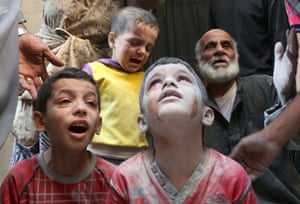
Syrian boys cry following Russian air strikes on the rebel-held Fardous neighbourhood of the northern embattled Syrian city of Aleppo

 ' “At the moment we have an aircraft in the sky above the hospital, so we are hoping that we won’t get hit,” said Hamza Khatib, one of the handful of medics still working in rebel-held Aleppo, who lost two patients on Tuesday morning alone.

 As MPs debated the risks and benefits of a no-fly zone, he said it was the only hope for about a quarter of a million people in rebel-held Aleppo.

 “The only thing that we really need is to stop the main source of the violence and killing: Russia and the regime aircraft. We don’t want medical aid, we don’t want food – that will make us last longer, but if there is still bombing, it will not save our lives.”


 Monther Etaky, a journalist, stayed home with his wife and baby son during the debate. He had raced back to comfort them after the bombardment began and, with a surveillance plane circling overhead, said he was worried the jets would return. “Even the small children in Aleppo can recognise every plane by its sound now,” he said.

 Like many in Aleppo, he is frustrated by the international attention focused on a proposal from the UN special envoy to Syria. Staffan de Mistura has offered to personally escort the most radical rebel faction out of Aleppo if doing so would bring a halt to the bombardment.

 “I wonder if he is really interested in our situation and saving Syrian blood and life? If so, I invite him to deliver aid here personally,” Etaky said. “I invite him to escort the prisoners out of Assad’s jails, I invite him to escort out the sectarian groups fighting for Assad.”


 For many in Aleppo, the debate was just another day of talking that will bring no change in their suffering.

 “There are debates and speeches outside Aleppo, and Assad and Russians are killing us inside,” said activist Abdulkafi Alhamdo. “We need deeds, not words.” '

Friday, 14 October 2016

Young filmmaker aims to tell besieged Syrians' story


 'A Syrian filmmaker whose harrowing footage of sarin gas victims in 2013 was seen around the world is using his experience of the attack and conflict to make a drama looking at why people take up arms in a war which began as a peaceful revolution. Humam Husari's self-financed short film explores the chemical attack near Damascus through the eyes of a rebel fighter who lost his wife and child but was denied time to bury them. Instead, he is called to defend his town from a government offensive. The story is based on real-life events, he said.

 "We need to understand how people were pushed into this war and to be part of it," said Husari, 30. "I am talking about a story that I lived with. They are real characters."

 Making the film was an emotional but necessary experience for Husari and his performers, who were witnesses to and victims of the attack, and not trained actors.

 "The most difficult thing was the casting and auditions," said Husari, who took about two months to write, produce and direct the 15-minute film and is currently editing it. "A 70-year-old man said to me: I want to be part of this movie because I lost 13 of my family ... I want the world to know what we've been through. And all I wanted from him is just to be a dead body," he said.

 "I was amazed with how much those people were able to express their tragedy and to cooperate with me on this movie."


 Mohamed Demashki, a business student and professional bodybuilder before the war who plays the main character, said he took part in the film because of its message.

 "It tries to convey to the world that the people who live here are not just fighters, they are not terrorists. They are people with a life. The war conditions them to become fighters," he said.

 When the sarin attack happened, Husari took his camera to the makeshift hospitals that sprang up to cope with thousands of victims and sent the footage to international media.

 "I wasn't filming because I am a cameraman, I was filming because this is the only thing I could do for the victims," he said.

 "During it, you can't feel anything, you just feel shock ... After, when you just think about what you have witnessed, you rethink how big and real and really tragic this was. It is not easy for me to watch my footage."


 Husari, who studied film at the Brighton Film School in Britain, now makes a living covering the Syrian conflict for international news organizations, but still hopes to make filmmaking his career. Husari said that living the daily reality of war will equip him to tell the story of the conflict when the war ends and films can start to be made.

 "Let's just think about how I reacted to those war jets in the sky. It has become something very normal to me, and this is something it is really hard to understand from the outside," he said.

 He has acquired the tools to direct actors to accurately respond to events in a conflict setting, he said.

 "I feel I have a responsibility in the future to tell this story, these stories, through cinema and drama. That's usually what happens after every war," he said.

 With parts of Damascus's Ghouta under opposition control from the beginning of the conflict, a number of areas have come under siege by Syrian government and allied forces. Making cinema in a place where there is no free passage of food, people and other supplies is tough. Husari made his lighting equipment and camera track himself, but had the good fortune to have access to a good quality camera.

 "It is an irony that in a besieged area you can find the best cameras you need," he said.'

Saturday, 8 October 2016

"Singing and dancing, asking for freedom and dignity"


 Robin Yassin-Kassab:

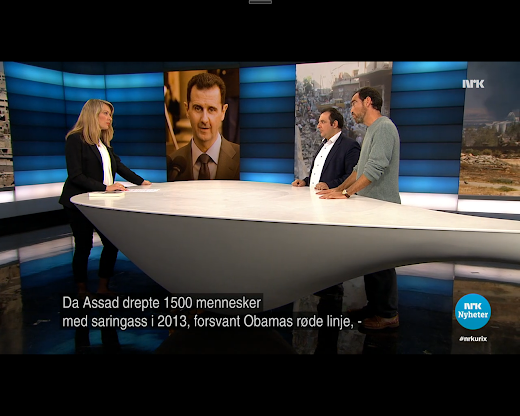
 "I don't think there is a play between the superpowers. I don't think there is a battle between Russia and America. On the ground in Syria, the perception is that they are more or less on the same side. America wants Bashar al-Assad to go, but the régime to stay in place. Russia wants Bashar al-Assad to stay as well, and they're trying very hard to work together. When Assad killed 1500 people with sarin gas in 2013, Obama's red line disappeared, and he very publicly handed the Syria file to Russia. He's just done a deal with Iran over the nuclear issue, which is a good thing, but precisely at the moment when Iran has got tens of thousands of occupation troops, including Shia jihadists, in Syria. He's not talking about that. So the Syrians think Russia and America are, more or less, on the same side, the whole world is betraying them."

 Mazen Darwish:

 "This is our life for more than four years. This is daily Syrian life in many places. And they ask why are there all these refugees, why do people become extreme and turn to terrorism? This is the result."

 Robin Yassin-Kassab:

 "We have to remember that as well as the horrors of war, and the extremists, the jihadists, the fascist régime, the foreign occupation, there is also remarkable stuff happening in Syria, in the revolutionary areas, which nobody talks about, which is part of the solution. There are over 400 local councils in Syria, many of them democratically elected; and these are the people who are representative Syrians, they are keeping life together in the most difficult of circumstances. That's what's under threat in Aleppo. Aleppo is the biggest concentration of civil society activists and groups, education services, the White Helmets, everybody else, in the country. If they manage to destroy that in Syria, then in a year or two we will be facing just jihadism."

 Mazen Darwish:

 "Nobody can win in the end through military means. We are talking about 300,000 civilians in this area. If they want to kill all of them, this is the only way to have a victory."

 Robin Yassin-Kassab:

 "I must dispute that the Syrian government forces are trying to invade eastern Aleppo. It's not really the Syrian government forces. The Syrian Army is more or less finished. It hasn't won a battle by itself since 2012. It's Russian bombs, Iranian and international Shia jihadist ground troops. It's a foreign occupation as much as it's a civil war at this point."

 Mazen Darwish:

 "From the beginning, the régime pushed for this solution -for the extremism. While we were arrested, the human rights defenders and civil society leaders, Assad released more than a thousand jihadists from al-Qaeda from prison. So from the beginning they have had this strategy, to push the country towards violence. And because they get support, not just from Russia and Iran, but from the West in general. They see what happens in Syria, and they don't care, or don't think we will reach this level. Only now after the refugee crisis has Syria become important, but what has happened is systematic, and this is the result."

 Robin Yassin-Kassab:

 "The revolution survives, remarkably, despite the fact that the régime has made it into a war, and done everything it can to bring extremists into the country so that the West will be scared of the alternative. Nevertheless, there are hundreds of democratically elected councils, there are tens of Free radio stations, Free newspapers, Free TV stations, women's centres."

 Mazen Darwish:

 "Each time you have a ceasefire, like you had in February, thousands of people come out in civil protests again. Singing and dancing, asking for the same goals - freedom and dignity."

Tuesday, 4 October 2016

Russian Plan Targeting Idlib, Hama following Aleppo


 'Head of the Syrian opposition delegation to Geneva, Asaad al-Zoghbi revealed a Russian-Iranian plan in coordination with the Assad regime to move the systematic destructive battle from Aleppo to the city of Idlib and later to Hama.

 In remarks to Asharq Al-Awsat published on Monday, al-Zoghbi said that a meeting of the opposition held in Istanbul two days ago agreed on uniting all military opposition factions under one brigade and one leadership capable of facing the Russian destructive forces that are supported by the Syrian regime and Iranian militias.

 The position will have two parts: Enhance the military operations and ask for the help of the international community without relying on Washington,” he said.


 Commenting on the latest developments in Aleppo, al-Zoghbi said: “Currently, there is a complete systematic destruction of Aleppo, and this destruction is on its way to devastate Idlib and later Hama. The attention in Syria is not directed anymore to a revolution against the Assad regime, but rather towards the Aleppo battle. This is what the Russians and the Americans want.

 “After this phase, an agreement will be reached supported by a decision from the U.N. Security Council. Then everybody will forget about what Assad controls from Lattakia to Damascus.”


 The head of the Syrian negotiating team said scores of Russian warplanes are currently bombing Aleppo. “There was a Russian plan that the Russian Defense Minister and Iran had agreed on during a meeting held three months ago in Tehran to either totally control Aleppo, or completely destroy the city.”

 He said that since the announcement of the alleged seven-day ceasefire during the Eid al-Adha, the Russians, the Iranians and the regime were mobilizing their forces and more than 8,300 soldiers to prepare for the battle of Aleppo.

 Al-Zoghbi said that Saudi Arabia and other brotherly countries, which are helping the Syrian opposition, have decided to back the armed opposition and provide them with weapons.

 He said Turkey also supports arming the opposition, adding he expected a similar position from Gulf countries soon.'

'The Country Is a Devastated Graveyard'

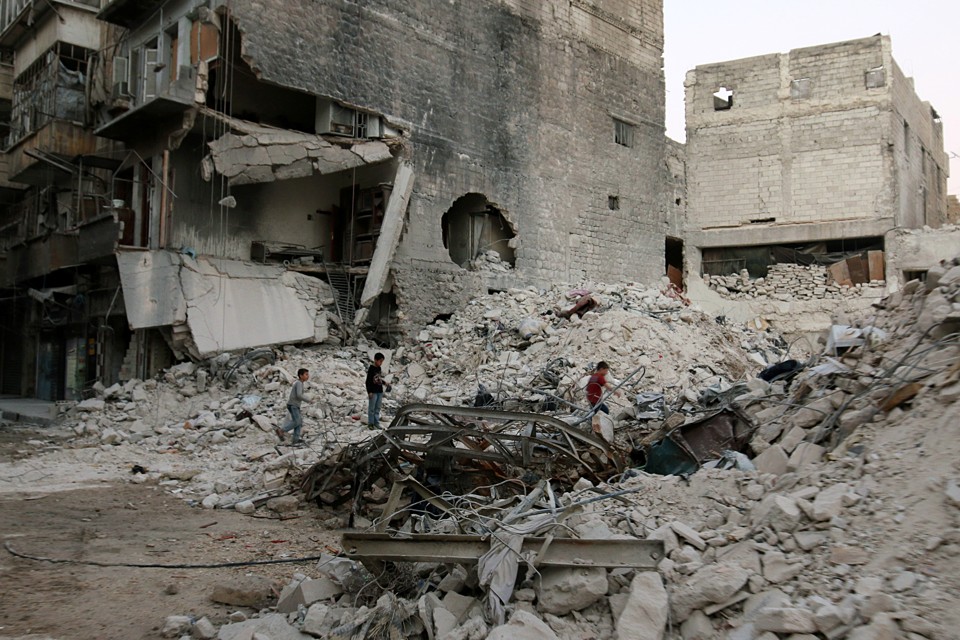
Boys climb over rubble

 'For at least a year before the summer of 2016, civilians and fighters in rebel-held East Aleppo prepared for a siege they believed was both avoidable and inevitable. Correctly, it turns out, they calculated that the opposition’s bankrollers and arms suppliers—the United States, Turkey, Saudi Arabia, and other “friends of Syria”—cared little for the well-being of civilians in rebel-held areas. Through the spring, contacts inside Aleppo prepared for the siege, expending minimal effort on appeals to the international community, which they assumed would be futile.

 For all the world-weary resignation of the opposition fighters and other residents of rebel Aleppo, they have a well-earned pride in what they’ve done. They’ve maintained their hold on half of the jewel of Syria, and under withering assault, have cobbled together an alternative to Bashar al-Assad’s rule. “From the beginning of the revolution, we held Aleppo as the role model of the liberated city, that holds free elections, has an elected city council, and elected local committees that truly represent the people,” Osama Taljo, a member of the rebel city council in East Aleppo, explained over the phone after the siege began in earnest. “We insisted to make out of Aleppo an exemplar of the free Syria that we aspire to.”

 Unfortunately, Aleppo has become an exemplar of something else: Western indifference to human suffering and, perhaps more surprisingly, fecklessness in the face of a swelling strategic threat that transcends one catastrophic war.


 Now that Russia, determined to reestablish its status after the humiliating collapse of the Soviet Union, has pushed the United States into a humiliating corner and weakened that international order, it is raising the stakes. Either the United States will push back, or the disequilibrium will spread even further. In either case, many thousands more Syrians will perish. As Bassam Hajji Mustafa, a spokesman for the Nour al-Din al-Zinki Movement, one of the more effective, if violent, rebel militias influential around Aleppo, put it, “People have adapted to death, so scaring them with this siege is not going to work.” Those who remain in Aleppo echo this refrain again and again: The last holdouts have stayed out of conviction. It’s hard to imagine anything but death driving them out. “If Aleppo falls and the world stays silent, then that will be the end of the revolution,” Hajji Mustafa said.

 In the end, Aleppo is not a story about the West; it is a cornerstone of Syria and an engine of wealth and culture for the entire Levant. Aleppo is the story of the willful destruction of a pivotal Arab state, a center of gravity in a tumultuous region in sore need of anchors. It’s a story of entirely avoidable human misery: the murder of babies, the destruction of homes, the dismantling of a powerful industrial and craft economy.

 Perhaps, finally, Assad and his backers have gone far enough to provoke an American defense of that indispensable order that America helped construct.'

Saturday, 1 October 2016

Activist Keeps Basement Schools Running In Aleppo


 ' "Bombing a school in 2016 shouldn't be normal, shouldn't be OK," insists Marcell Shehwaro, a 32-year-old Syrian activist, who runs a network of informal schools out of basements in the devastated city. Classrooms, bakeries, hospitals and even rescue workers are targeted in her hometown during the most merciless airstrikes of a war now five years old.

 "Stopping the bombing is what I need right now," she says in an interview in New York. Shehwaro was part of a delegation of Syrian civil society workers at the United Nations. They came to confront world leaders over the Russian and Syrian offensive in Syria after a short-lived ceasefire collapsed. She is from a Christian family, and President Bashar Assad's regime and Islamist militants have targeted her. Syria's Christian community shuns her, blaming the revolt she supported for ushering in militant Islamists that target Christians.

 "I can't quit. I speak English. I have two degrees and I'm privileged. Quitting means that I lost," she says. "When I am tired and I want to quit, I say, 'OK, 100 girls went back to school [last month] so I will keep going,'" says Shehwaro. She runs Kesh Malek, which means "checkmate" in English, and the defeat of the king in chess.

 Her group has opened seven schools in rebel-held Aleppo, serving up to 3,000 pupils in basement classrooms to shield students from the bombs. But the war has taken an immense personal toll.

 "Maybe I didn't leave because I'm guilty that I survived," she says. "I'm without a family, without a country, without dreams, but I'm more determined, more realistic."


 In July 2011, the Syrian government held a "national dialogue," a gathering of establishment and moderate opposition figures. The meeting was a gesture by Assad's government to address the nationwide demonstrations that had erupted four months earlier, in March. After the gathering, the protests continued and the government responded ever more harshly. Shehwaro paid a heavy price as a blogger who was openly critical of the government.

 "I lost my job," she said. "I went to a weekly interrogation [by security officials] that lasted for hours."

 She eventually joined the street protests in Aleppo, in the north of the country. By the summer of 2012, half of Aleppo was under rebel control.


 "I don't know if I want to remember who I was in 2011. It was a peaceful revolution. It was a cry for help for something beautiful," she says about those heady days of promise. What followed was something she never imagined five years ago: protesters were met with brutal force, peaceful activists were arrested and tortured, thousands of deaths were cataloged and photographed by the regime. Rape was used as punishment in Assad's jails, according to activists. Rebel factions, increasingly radicalized, adopted an extremist ideology hostile to those advocating democracy. When her mother was killed at a military checkpoint in Aleppo in 2012, Shehwaro accused the regime of murder on her Facebook page.

 "As an activist I had a responsibility to tell the truth," she says.

 Later, when she went to the hospital with her sister to identify her mother's body, a police officer told her not to overreact.

 "I told him, 'You killed her, it's not a mistake.'" Her sister urged her to leave Aleppo for her own safety.


 Islamist militants arrested her in 2014 because she refused to wear a veil in an ISIS-controlled neighborhood.

 "I survived the regime and I survived ISIS. It's an amazing story," she says. Referring to Sunni Muslim activists who sheltered her, she adds, "I have been around really good people who protected me along the way. Many of them weren't Christians. Actually, 90 percent of them were not Christians."

 When she moved from Syria to southern Turkey last year because the dangers had become too great, she wrote about it as another defeat, "A year of denial, guilt, grief, and surrender. Nothing of the hero left for me."

 Shehwaro says she's still committed to a democratic Syria but most of her idealism has been ravaged by the barbarity of the war.


 As the ceasefire collapsed in Aleppo last week, the regime launched a new military offensive with Russian allies against rebel neighborhoods where Shehwaro runs some schools. Shehwaro's team often closes classrooms to preserve fuel for hospitals overwhelmed with civilian casualties.

 "I'm 32 years old and I don't want to take those kinds of decisions," she says. "I don't want to decide whether fuel should go to schools or to save lives." '

Tuesday, 27 September 2016

Gulf may arm rebels now Syria truce is dead

A rebel fighter of 'Al-Sultan Murad' brigade arranges weapons inside a warehouse in the northern Syrian rebel-controlled town of al-Rai, in Aleppo Governorate, Syria, September 26, 2016. REUTERS/Khalil Ashawi

 'The collapse of the latest Syria ceasefire has heightened the possibility that Gulf states might arm Syrian rebels with shoulder-fired missiles to defend themselves against Syrian and Russian warplanes, U.S. officials said on Monday.

 One U.S. official, speaking on the condition of anonymity to discuss American policy, said Washington has kept large numbers of such man-portable air defence systems, or MANPADS, out of Syria by uniting Western and Arab allies behind channelling training and infantry weapons to moderate opposition groups while it pursued talks with Moscow.

 But frustration with Washington has intensified, raising the possibility that Gulf allies or Turkey will no longer continue to follow the U.S. lead or will turn a blind eye to wealthy individuals looking to supply MANPADS to opposition groups.

 "The Saudis have always thought that the way to get the Russians to back off is what worked in Afghanistan 30 years ago – negating their air power by giving MANPADS to the mujahideen," said a second U.S. official.

 "So far, we’ve been able to convince them that the risks of that are much higher today because we’re not dealing with a Soviet Union in retreat, but a Russian leader who’s bent on rebuilding Russian power and less likely to flinch," this official said, referring to Russian President Vladimir Putin.


 Asked if the United States was willing to do anything beyond negotiations to try to stop the violence, State Department spokesman Mark Toner did not outline other steps, but stressed that Washington does not want to see anyone pouring more weapons into the conflict.

 Another administration official, however, said, “The opposition has a right to defend itself and they will not be left defenceless in the face of this indiscriminate bombardment.”


 Critics of U.S. President Barack Obama, argued that U.S. diplomacy has been hamstrung by the White House's reluctance to use force.

 "Diplomacy in the absence of leverage is a recipe for failure," Senators John McCain and Lindsey Graham, Republican critics of the Democratic White House, said in a statement. "Putin and Assad will not do what we ask of them out of the goodness of their hearts, or out of concern for our interests, or the suffering of others. They must be compelled, and that requires power," they added. "Until the United States is willing to take steps to change the conditions on the ground in Syria, the war, the terror, the refugees, and the instability will all continue."


 White House spokesman Josh Earnest accused the Russians of targeting the civilian water supply of eastern Aleppo used by refugee camps, aid convoys, and the White Helmets, a civilian group that seeks to rescue victims of air strikes.

 "The idea of weaponising access to a clean water supply for civilians; it’s beyond the pale," Earnest told reporters.

 Sarah Margon, director of Human Rights Watch’s Washington office, said the actions alleged by Earnest "all constitute war crimes under international law."

 "The U.S. has treated Putin as a partner in peace instead of an accomplice and perpetrator of war crimes," Margon said. "The question is now what steps the U.S. will take to compel Russia to refrain from further abuse and from facilitating Assad’s atrocities."

 The White House did not immediately respond to an emailed question on whether the United States believed that Russia has committed war crimes, a charged made by Britain.'

Sunday, 25 September 2016

Russia is a partner to the régime in crimes against our people


Aleppo residents plead for help as Syria fighting rages


 'Residents of rebel-held eastern Aleppo said "ferocious bombardment" by Syrian and Russian jets on Saturday had levelled neighbourhoods and killed at least 91 civilians.

 "We don't have the equipment to pull the corpses out," a resident said, standing on the rubble of a destroyed building in the city's al-Bab district.

 Describing the horror around him, he said an entire family was killed in a strike, with several people still lying under the debris.

 "We are trying to help the injured, those who survived ... but the situation is catastrophic. Destruction and death, everywhere around us. It seems that the Russians and the regime have been given a green light to slaughter us all. As if starving the people here was not enough - it's now mass murder."


 Abdulkafi al-Hamdo, a professor at the University of Aleppo, said that residents were expecting another night of horror.

 "What we are suffering can't be expressed by words in any language. We don't have water to give our children … [Rescuers] can't help people anymore and the roads have been cut off by rubble. In the hospitals, there are three-four people on one bed, even in the intensive care units."

 Another resident from the al-Mashhad district pleaded with the international community to save the more than 250,000 civilians stuck in besieged areas as air raids continued to flatten civilian areas.

 "We urge all honourable people around the world, please, we beg you, come to our aid; save us," he said.'

Friday, 23 September 2016

Aleppo residents tell of onslaught

A still image from a video posted on social media shows a baby being rescued from rubble in a collapsed building in Aleppo.

 'Activists posted images of massive craters from the city that they alleged were the first instances of warplanes dropping bunker buster bombs.

 “Are we in the era of technology and civilisation?” said a resident of eastern Aleppo. “Is this Russian civilisation and democracy? The killing of children, women and elderly people?”

 Bara’a, a nurse at a hospital which doctors in Aleppo refer to with the codename M2 to conceal its location, said she had witnessed several children brought in with severe injuries on Friday.

 “It is so saddening,” she said. “The strikes and massacres do not stop. Bombings, siege, homelessness, exhaustion, fear, manpower shortage. The silence of the world is killing us.”
Graphic photographs from the bombed-out streets and homes of Aleppo showed rescuers attempting to dig out bodies – many of them children’s – from the debris.

 “Anger has filled everyone who remains in this city of rubble,” said Bara’a. “Many of the wounded are children, and when you look in their eyes they weep and say we have nothing left. Curse this justice. They lose their limbs and become disabled for life and their only sin is that they are the children of Syria. They have burned their childhood and their innocence and made them homeless in their country and all we get in return are words and promises from outside. God curse humanity if this is what it has become.”

 One western diplomat said he did not believe that the rebel-held districts were in immediate danger of a ground incursion. “It seems highly improbable that there would be a quick defeat of eastern Aleppo,” the diplomat said. “The only way to take it is with such a monstrous atrocity that it would be remembered for decades or generations. To take it quickly, much of Aleppo would be destroyed.” '

Obama’s Syria Policy Striptease


 I don't entirely agree with Tony Badran's conclusion that the US administration is fundamentally realigning its alliances in the Middle East towards Iran and away from Saudi Arabia and the Gulf states, but this is a brilliant dissection of its Syria deceptions.


 'America’s settled policy of standing by while half a million Syrians have been killed, millions have become refugees, and large swaths of their country have been reduced to rubble is not a simple “mistake,” as critics like Nicholas D. Kristof and Roger Cohen have lately claimed. Nor is it the product of any deeper-seated American impotence or of Vladimir Putin’s more recent aggressions. Rather, it is a byproduct of America’s overriding desire to clinch a nuclear deal with Iran, which was meant to allow America to permanently remove itself from a war footing with that country and to shed its old allies and entanglements in the Middle East, which might also draw us into war. By allowing Iran and its allies to kill Syrians with impunity, America could demonstrate the corresponding firmness of its resolve to let Iran protect what President Barack Obama called its “equities” in Syria, which are every bit as important to Iran as pallets of cash.

 America’s Syria policy can, therefore, be best understood not in the terms most familiar to Mideast analysts, such as “getting Assad to step aside” or “supporting the moderate opposition” or “paving the way to a peaceful transition and elections.” Rather, it is a strategic-communications campaign tightly run from the White House, whose purpose was and is to serve as a smokescreen for an entirely coherent and purposeful policy that comes directly from the president himself, but which he and his aides did not wish to publicly own. The goal of the president and his closest aides is to convince the Iranians that we would meet our commitments to them while confusing and obscuring the real reasons behind the president’s set decision of nonintervention in Syria from American legislators and the public alike.

 In a recent interview, Wall Street Journal reporter Jay Solomon revealed that in 2013, Iran told President Obama that if he were to strike the regime of Bashar Assad following the latter’s chemical-weapons attack, the Iranians would collapse the talks over their nuclear program. Obama canceled the strike, of course, and later reassured Iran that the United States would not touch Assad. Solomon’s reporting confirms a critical fact about Obama’s Iran and Syria policies: They are one and the same. Or, stated differently, Syria is part of the price for the president’s deal with Iran.

 The White House reaction to Solomon’s assertion was a predictably swift denial. After all, the Obama administration would not want to associate the president’s signature foreign-policy initiative with the indiscriminate slaughter of half a million people and the worst refugee crisis of the new century. In doing so, it followed a well-worn playbook: At key junctures over the previous five years, the administration put out various talking points in the press, often sourced to anonymous officials, whose lines were then validated by allies and surrogates, including officials who had left government and resumed their positions in the think-tank world.


 Obama showed his cards on Syria literally from day one of the uprising against Assad. Unlike his nonnegotiable demand that longtime U.S. ally Hosni Mubarak, Egypt’s former president, step down immediately—not today, but “yesterday”—Obama very visibly and deliberately refused to call for Assad’s removal from power. In the White House, this call was contemptuously dubbed the “magic words,” and the belief was that saying those words would raise expectations of an active U.S. policy to see it through. This view—espoused by officials such as Steven Simon, then-National Security Council senior director for the Middle East and Africa—one of the linchpins of the White House communications strategy both from inside and then outside the White House, was put out in the media through favored surrogates, like George Washington University’s Marc Lynch, who reiterated the White House’s case and derided critics of the president’s refusal to utter the “magic words.”

 One of the initial go-to lines was that the administration wanted to avoid further “militarization” of the situation. “We do not believe that militarization, further militarization of the situation in Syria at this point is the right course of action,” said then-White House press secretary Jay Carney. “We believe that it would lead to greater chaos, greater carnage.”

 Again, White House surrogates faithfully disseminated its talking points and policy preferences. In an article in February of 2012, Washington Post columnist David Ignatius quoted an unnamed senior official who derided the rebel Free Syrian Army, then regurgitated the administration’s view that “shoveling weapons to this disorganized opposition now is likely only to increase civilian deaths.” Marc Lynch likewise repeated the administration’s position, often using its own stock lines verbatim, in several articles for Foreign Policy and in a paper for the Center for a New American Security.


 To shore up the noninterventionist position it had already guaranteed the Iranians, the White House introduced the enduring fixture of its Syria policy: bringing in Russia as a principal partner. The move coincided with the creation of the Friends of Syria group —intended to bypass Russian obstructionism at the U.N. Security Council. Obama then undercut this group of U.S. allies by instead drawing closer to Russia.

 Working to accelerate Assad’s fall, the White House messaged, “could undercut U.S. efforts to persuade Russia to halt military aid to the Syrian regime.” Marc Lynch echoed the line in his CNAS paper: “It would also be very difficult to stop Russia, Iran, or others from supplying fresh arms and aid to Assad once the opposition’s backers are openly doing so.” Meanwhile, the Washington Post’s David Ignatius seconded the administration’s move “to make Moscow part of the solution,” and give “Russian leader Vladimir Putin a role in brokering the transition.” If people wanted a solution to the Syrian problem, the White House argued, they should go and talk to the Russians. “So the question shouldn’t be how to turn up the heat on Assad,” Ignatius wrote. Rather, U.S. regional allies should do “the heavy-lifting,” and go to Moscow. Having established the principle of nonintervention and set the role of Russia as principal interlocutor for the region, the White House set the contours of America’s actual Syria policy, which endure unchanged to this day.

 The partnership with Russia became a public fact in 2013. Following Assad’s chemical-weapons strikes, Obama reached a deal with Putin that allowed the U.S. president to continue his policy of nonintervention against Assad. At this point, White House messaging made a 180-degree shift. Obama’s decision, administration officials readily acknowledged, meant Assad—who, a year before, they said was about to fall at the hands of the people or as the result of a coup—now had “considerable staying power.” It was, therefore, too bad, other administration officials said, that “the window of opportunity for strengthening the moderate opposition may have closed.”


 Instead, administration officials started telling reporters on background that no outside support would have mattered, anyway, as the gap between America and the Syrian regime and its allies was simply too big to ever have been bridged. The president himself would publicly voice this position, declaring the notion that supporting the rebels—“former doctors, farmers, and pharmacists,” as the president disparagingly referred to them—would have made a difference against a regime backed by Russia and Iran, has “always been a fantasy.” To suggest otherwise, the president said, was “horseshit.”

 Like the assertions of 2012, these claims, presented as serious assessments of the situation on the ground in Syria, were simply part of a White House messaging campaign, whose purpose was to support a policy that was already set—but which the public was judged not to be ready for. That the arguments the administration was making were paradoxical and contradictory didn’t matter, so long as the point was the same: America wouldn’t and couldn’t intervene against Assad. Naturally, surrogates like Lynch echoed the administration’s arguments, even when they changed, and also felt at home in the contradictions of their positions. “There’s no way to know for sure” whether U.S. support in 2012 would have made a difference, Lynch would later write. In fact, he asserted, things would’ve played out exactly as they have, with the only difference that the United States would’ve been in the middle of the fighting.


 By the end of 2013, the White House began to mainstream its open disregard for even the pretense of removing Assad, thereby circling back to its initial position in 2011. Unnamed senior administration officials were cited as talking privately about Assad “staying for the foreseeable future” and “voic[ing] regret about the decision, in August 2011, to call for him to step aside.” In early 2014, Frank Wisner of The Iran Project and Leslie Gelb, both veterans of the realist foreign-policy establishment, were chosen to carry this White House message to members of the Council on Foreign Relations and other thumb-sucking senior types. The president and officials at the White House, Wisner and Gelb wrote, realized “it was too quick off the mark and too absolute” in calling for Assad’s departure. “Perhaps now,” they added, “administration officials are prepared to entertain a transitional working arrangement with Assad.” The new focus for U.S. policy, the authors wrote, should be on combating Sunni terrorism and on providing humanitarian aid to Syrians. Amazingly, much like the expert advice not to intervene militarily in 2012, what Wisner and Gelb were “recommending” was the actual substance of White House policy, which the communications effort had formerly been designed to obscure.

 The form of Wisner and Gelb’s article became the preferred genre for the White House’s Syria echo chamber: the striptease. Hand-picked experts offer fresh policy advice to the president. The authors demonstrate their independence by criticizing the supposed current policy and propose a new course of action. Within weeks, the new course of action is acknowledged as policy, thus flattering the importance of the experts. Only, what the experts suggested was already the policy—and what they were “criticizing”—was the fan that the messaging campaign had manufactured to obscure, for a time, what the White House was actually doing in Syria.

 The success of this dance was great enough that many more proposals for “new” policy, all recycling the White House’s latest set of talking points, were floated, each with the aim of revealing another few inches of actual policy. Simon, who was now out of government, put forward a “new plan for Syria,” in which he called for “containing extremist violence” and “reducing the number of noncombatant deaths.” One month later, Lynch published another paper with CNAS, in which he reproduced all the key White House talking points used to describe its policy to this day, debuting terminology, like “de-escalation” and “protecting Iranian equities,” which was then promptly adopted by the White House.

 Both Simon and Lynch floated the idea of promoting local cease-fires—now a mainstay of the White House’s declared policy—as the way to go in Syria. Again, they were not so much promoting views that were original to them but promoting a pre-existing conceit, whose actual sponsor, Robert Malley, was appointed in February 2014 as a senior director at the National Security Council, where he worked alongside Phillip Gordon, who came in the year before as coordinator for Middle East policy.

 By following in Malley’s footprints, it is easy to see where specific ideas came from, and the corrupted nature of the policy debates that were used by the White House to promote its set agenda. For example, Malley met in Washington with journalist Nir Rosen, who has a close relationship with the Assad regime. Following his meeting with Malley, Rosen authored an unpublished pro-Assad report making the case for local cease-fires—which have been an instrument of warfare for the regime camp. Malley distributed Rosen’s report, which, naturally, was also leaked to David Ignatius. Simon’s and Lynch’s pieces floated the approach favored by Malley and the White House in much cleaner form and venues than the tarnished Rosen.


 The emergence of ISIS presented an opportunity for the White House to advance the president’s vision of a regional realignment. Under the rubric of a new war on Sunni jihadism, the president elevated Russia and Iran to senior partners, and privileged their position, while shelving all discussion about Assad. What had been secret and a cause for strenuous denials was now palatable state policy, which the White House could therefore publicly own.

 Hence, Simon, reflecting the direction of White House policy in the guise of fresh advice, proclaimed the United States should start discussing Syria with Iran in order to have “the best chance of long-term success.” Similarly, Marc Lynch proposed the White House adopt “an alternative Iran-centric approach, one built upon seeking a working accord with Iran rooted in common interests in … stabilizing Iraq and Syria, and fighting jihadist groups.” In addition, like Wisner, Gelb, and Simon had all written earlier, Lynch echoed the White House by calling for sacrificing the “goal of ‘near-term’ regime change” in Syria.

 Following the White House’s standard operating procedure, anonymous administration officials had already been leaking all these talking points to the press during the course of 2014. For instance, in July of that year, it was reported that administration officials were proposing setting aside the removal of Assad from power. “Anyone calling for regime change in Syria is, frankly, blind to the past decade,” one unnamed senior official told The Daily Beast. Other officials were “suggesting that Iran could be a partner in a postwar Syria.” When Lynch spoke of “us[ing] the ISIS crisis to create a sustainable regional accord,” he was therefore merely putting his own name to statements that the White House had already publicly vetted.


 Obama’s Syria policy once again came under criticism following the Kremlin’s move to intervene directly in Syria. The president looked weak in the face of Russian assertiveness on behalf of its ally. The White House’s initial messaging was therefore to paint the Russian intervention as an idiotic decision that would inevitably backfire on Moscow. Putin’s intervention reflected weakness, not strength, the president maintained. As such, the preferred White House talking point was that Russia was only getting itself trapped in a quagmire. “An attempt by Russia and Iran to prop up Assad and try to pacify the population is just going to get them stuck in a quagmire, and it won’t work,” Obama said in early October.

 These lines were quickly put out in friendly media outlets. The Brookings Institution’s Jeremy Shapiro, who had worked for Philip Gordon at the State Department before the latter moved to the White House, enthusiastically regurgitated the administration’s approved talking points in an interview with Vox also in early October. Shapiro repeated the claim that the Russian intervention was “incredibly stupid stuff,” a “serious mistake,” and, naturally, that it would get Moscow into a “quagmire.” The Russians, Shapiro declared, were “banking on this idea that they’re going to bring us around” on Syria. But, he asserted, “I don’t think they are.”

 As the White House pushed these talking points about how dumb Putin was, it also continued to stress the president’s unshakable principle of nonintervention. “We’re not going to make Syria into a proxy war between the United States and Russia,” Obama made clear. “This is not some superpower chessboard contest.” Anyone suggesting military options, the president continued, was simply “offering up half-baked ideas” and “a bunch of mumbo-jumbo.”

 Philip Gordon, now also out of government, was a notable conduit for the main talking points: de-escalation, cease-fires, humanitarian aid, and shelving the question of Assad. “The White House,” one senior administration official—the point man for Syria at the time, and now, is Robert Malley — told Bloomberg View in early October, “thinks we can de-escalate the conflict while keeping Assad in power.” Gordon, Malley’s recent colleague at the NSC, and now a freshly minted fellow at the Council on Foreign Relations, then laid out this White House position in an essay and a paper for the CFR, which fall into the familiar genre of validating current policy in the guise of “rethinking” it. He also echoed the White House’s direction of bringing Iran formally to the Syria table as a major stakeholder. More aid to the rebels, he opined, would only add to the violence and would harm prospects of a deal with Russia. Escalating the war, Gordon wrote, wouldn’t succeed. In fact, it was counterproductive. However much we escalate, the Russians would only counter-escalate. When would the bloodshed ever cease?

 Through Gordon, the White House laid out where it wanted to go, and where it is today: a bilateral process with the Russians, cutting out all those annoying U.S. allies pushing us to escalate and insisting on Assad’s departure. Hence, Steven Simon, now also a freshly-minted objective policy expert and not an NSC operative, would express “satisfaction” at the presence in Syria “of a powerful military player” like Russia, which he described as “really the only tacit partner” of the United States. The Russian presence, Simon wrote in a Foreign Affairs essay that October, makes it “no longer feasible for the United States to establish a safe haven or no-fly zone”—steps the administration had strongly opposed years before the Russians were anywhere near Syria. Critics of Obama’s policy who were calling for any consideration of military action, the message went, could take a hike.


 None of this is conjecture. Partnership with Russia is what the White House has sought after since late 2015 and throughout 2016—with Malley as the point man, negotiating directly with the Kremlin’s special envoy. By early 2016, Shapiro, who had parroted the White House’s misguiding spin on the incredible stupidity of the Russians’ intervention, was now saying the Russians actually held all the cards in Syria, and the only option for the U.S. is to work with them, on their terms. What’s more, echoing Malley, Shapiro laid out the White House position on the need to finally take military action—against the group then known as Jabhat al-Nusra, and to push (meaning, to threaten) the opposition and its backers to stop all cooperation with it, if the killing was to stop in Aleppo. This was, in fact, the deal that Malley negotiated for the White House, and which Secretary of State John Kerry announced several days ago.

 For five-and-a-half years, Obama has maintained an unwavering position against intervention on the side of Assad’s enemies in order to set the stage for a U.S. realignment in the Middle East. To shield this ambition from view, and therefore from criticism, the White House launched an elaborate spin campaign whose purpose was to deflect and manage domestic and allied criticism while the president pursued his objective. In partnership with Russia, Obama has directly shaped the course of the Syrian war while single-mindedly working to actualize his vision of a new American alliance with Russia and Iran that will allow America to take a permanent vacation from the Middle East. While the end result of this effort may not be what Obama and his closest advisers hope, his actions are clear, and their consequences now appear to be locked in, no matter who comes after him in the White House.'

Thursday, 22 September 2016

 Syrian Writers Speak Out Against US and Russian Policy

Airstrikes in Syria

 'We the undersigned are democratic and secular Syrian writers, artists, and journalists who have opposed the tyrannical Assad regime for years, even decades. We are participants in the struggle for democracy and justice in our country, our region and in the world. We unreservedly, and in the strongest language, condemn the Russian and US approach of intervening in our internal Syrian affairs. At least since 2013, these two powers have been working to co-opt the Syrian liberation struggle under the rubric of the “war against terror.” This is a war that has failed to score a single success since its outset, and has led instead to the destruction of a number of countries.

 Three years ago the two imperialist nations signed a reprehensible deal on chemical weapons that resolved a problem for the United States, Israel, and Russia, and even for the Assad regime, which had just murdered 1,466 of its subjects. The deal however did not resolve any of the problems facing the Syrian people. Rather it gave free rein to an extremely criminal regime that kills Syrians, destroys their villages and communities, and drives them into exile. The deal has also proved to be a priceless gift to Islamist nihilistic groups like Daesh and Jabhat an-Nusra. Three years into this contemptible deal—with the death count now at around half a million Syrians—Russians and Americans have agreed to freeze the current situation so that the two military powers can carry on their endless war against terror. The agreement remains silent on the untold number of detainees held in brutal conditions, and includes no call for lifting the blockade on besieged areas, or the withdrawal of Iran, the Hezbollah militia, or any other sectarian militia. It is also devoid of any reference to the concept of a new and democratic Syria. Nor are the warplanes of Bashar al-Assad restrained from bombing areas that will ultimately be the subject of a later agreement between Russia and the United States. Not only does this show complete lack of a moral sense of justice on the part of the Russian and American negotiating teams, it also exposes the degradation of politics and the lowly level of officials in the two most powerful nations in the world today.

 Our feelings of anger over these agreements and their authors know no bounds. And we reject them absolutely. We are also disappointed in the United Nations, angered that, as was recently revealed, it has been financing the criminal oligarchy of Assad and his cronies throughout their war against the Syrians.


 As Syrian writers, artists, and journalists, we see the world today heading toward an unprecedented numbing of ethics. Levels of fear and hatred escalate in parallel with the increasing visibility of politicians who invest in the same feelings of fear, hatred, and isolationism. We see democracy in retreat around the world, while surveillance, control, and fear are rife and advancing. We do not believe that our fate is defined by these conditions, but rather that these are a result of dangerous choices taken by dangerous political elites, and that we must work together to voice our opposition to them, right now and wherever we may be.

 A destroyed Syria is the symbol of the state of the world today. The Syrian revolution was broken against the solid wall of the international community, and not only against the wall of the forces aligned with Assadist fascism. This international community allows politicians like Obama and Putin, along with their agents and clones—people lacking all sense of humanity—to take decisions that violate our right to self-determination, as individuals and groups but also as a nation. We have not elected them, and we have no access to any mechanism that can call them to account. This is an unfair system that fiercely opposes democracy. Therefore it must change.

 Unfortunately, there seems to be too little awareness of how hazardous reality has become. Many, especially in the West, prefer to hide behind fatalistic theories steeped in religion or culture—when they do not attribute events to climate change. This explains why a bad situation has become much worse, but it also absolves the powerful elite, including Bashar al-Assad and his gang, of their political responsibilities.

 This world must change. In just five and a half years, it has allowed the destruction of one of the most ancient cradles of civilization. The world today is a Syrian problem, just like Syria today is a world problem. And for the sake of this world, for all our sakes, we call for the condemnation of the politicians responsible for this disaster and for their exposure as nihilistic murderers and terrorists, similar to their arch-rivals in the Islamist nihilistic camp.'

Sunday, 18 September 2016

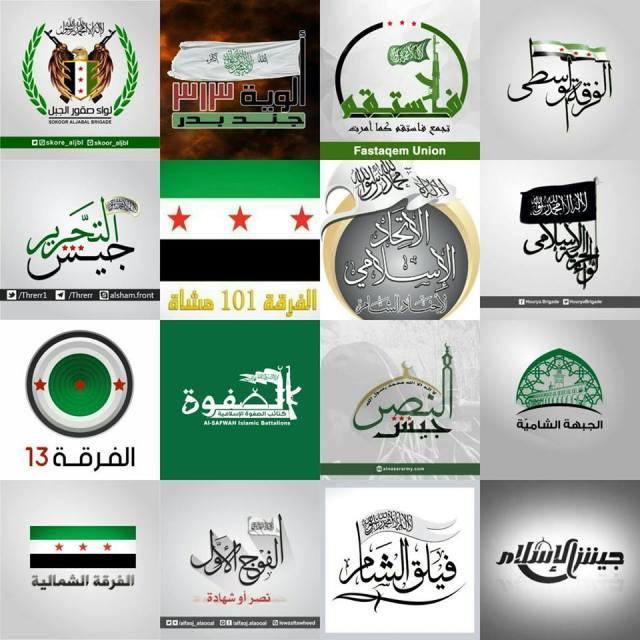
The Free Syrian Army rejects the US-Russian deal

14364752_1186034518135788_5539454607277129300_n.jpg

 'The false proponents of justice and freedom and the ‘guardians’ of human rights and democracy continue to insist on trading with the tragedy of the Syrian people and their corpses, taking from the Nakba [catastrophe] and ordeal of this poor population an arena for their competition and struggles for influence and interests, and a tinged road on whose sides drip the blood of the innocents in order to achieve some gains and ambitions, laying beneath their feet all of the meanings of justice and humanity and leaving behind their backs the demands for dignity and freedom.

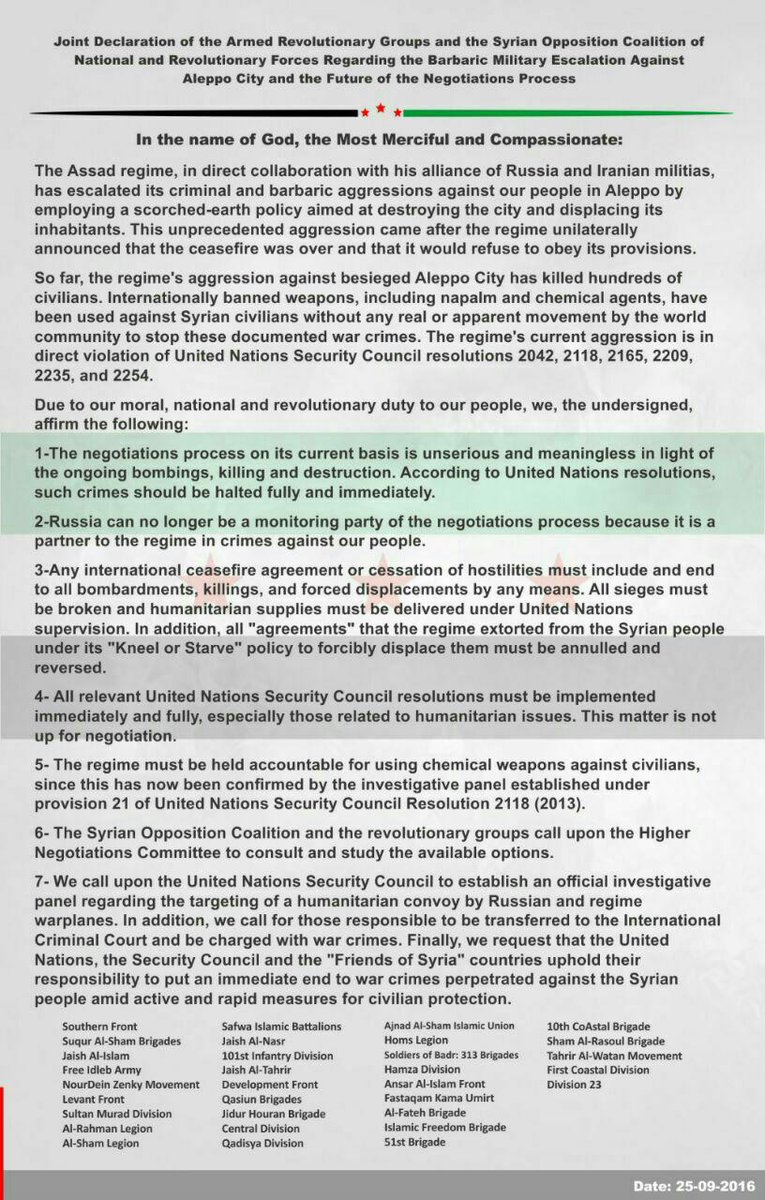
 Subsequently, a few days ago we received details of the /US-Russian/ agreement concerning a ceasefire to hostilities and a general truce in Syria accompanied by the entering of humanitarian assistance into the besieged neighbourhoods of the city of Aleppo, and after a careful study of those clauses and an in-depth reading of the whole of the internal and external challenges and the humanitarian and military realities on the ground and the complex political scene, the factions of the Syrian revolution view it as necessary upon itself to clarify to its people before anyone else the host of reservations it has with regards to this dry and unjust agreement:


 – Firstly: The incredible humanitarian tragedy that our people and families are subjected to have always placed at the head of our priorities the necessity to improve the humanitarian situation of the rebelling Syrian people and especially in the liberated areas, and proceeding from this feeling of responsibility we have always taken care to evaluate international initiatives and truce proposals that are presented to us so long as they do not compromise any of the revolution’s fundamentals and its higher interests.

 – Secondly: With our assiduous commitment to alleviate the burdens off our families we are nonetheless also assiduous in avoiding quick and temporary gains which are faced with certain dangers which will have a negative effect in the long run, such as some of the truces that may stop the bombardment and barrel bombs for a few days or allow the entry of limited quantities of food and medicine in exchange for hazarding the future of the revolution and losing strategic points and locations to the regime of criminality and its allies.

 – Thirdly: The international unwillingness and indeed impotence to take any effective measures that can stop this massacre or ease the weight of the bombardment and siege of our people is no longer a secret, meaning that the only option remaining to us is to rely on our lord first and then on our self-capacities and the justice of our cause second, and to proceed in our battle against the regime and its allies until the last bullet in our rifles and the last fighter from our heroes.

 – Fourthly: We welcome the decision to allow the entry of humanitarian aid to the besieged areas of Aleppo and we declare our full co-operation in the achievement of this, and the safeguarding of protection for the workers in international and humanitarian organisations; however at the same time we categorically refuse tying these assistances (which are a right for Syrians) with any locational truce or alleged political solution from which we have gained nothing until this hour but additional killing, destruction, displacement and overlooking of the killers and criminals; likewise we cannot ever accept any exceptions in the agreement’s clauses to the rest of the besieged ares exhausted by bombardment and siege, and whose people are being pressured by the “starve or kneel policy” pursued by the regime of criminality and terrorism to deliver these areas [to new settlers] and expel its local population as occurred in Daraya and is occurring now in Homs and the countryside of Damascus; this ethnic cleansing which it has become entirely evident is being conducted on sectarian bases which aim to create demographic changes in these areas, the matter which we will not accept under any circumstance and will resist with all means and ways available.

 – Fifthly: The ceasefire terms in its current form leaves open the field for the regime and its allies to exploit it and commit more massacres against civilians and achieve strategic military gains that it was impotent to previously achieve which raises for us serious fears and doubts about the timing and clauses of this truce, for prevailing the long-term interest of the revolution is placed before momentary or temporary gains with our full trust that the regime and its Russian and Iranian allies and the rest of the terrorist border-crossing militias will never abide by them and will circumvent them with every means and methods.

 – Sixthly: The ceasefire terms were vacant from any reference to real guarantees, monitoring mechanisms or clear and injunctive punishments in the event that the regime and its allies break this ceasefire; which will encourage them to break it and utilise it to achieve political and military gains (as in the previous occasions).

 – Seventhly: The ceasefire clauses declared that the prohibition on regime warplanes sorties won’t occur except after 48 hours of truce have been completed, to be followed by another 5-day truce after which a “Joint Execution Group” will be formed to adopt monitoring mechanisms which we see as plenty opportunity for the regime to engage in more killing, destruction and [sectarian/ethnic] expulsion.

 – Eighthly: The terms of the ceasefire have excluded Jabhat Fath al-Sham [The Front for the Conquest of the Levant] whilst it has completely turned a blind eye to the foreign sectarian militias that fight with the regime, and which have been committing its crimes since years in Syria with absolute freedom and without accountability or monitoring, and we consider this matter a dubious and rejected double standard. Accordingly we refuse the targeting of Jabhat Fath al-Sham or any other faction which fights the regime which could weaken the military strength of the revolution and strengthen the Assad regime and its allies.

 – Concluding: We affirm that the Syrian people and its factions will never forget who killed them and who bombed them and who besieged them and who burned their cities and villages, and on the other hand they will not forget who supported them and stood with them in their plight and sacrificed in defence of their blood and honoured possessions.


 Have trust that we will never settle for disgrace in the principles of our revolution and we will not give in to the pressures and cheap political and humanitarian blackmail that is being practiced against us, and we are are fully aware of the malicious traps that are set up for us in order to sink us in a swamp of concessions or lead us to infighting that tears the ranks and disperses the common word.

 On the oath we remain, to the rope of God we hold fast and with his strength and might we seek recourse, not damaged by those who failed us, until we perish without [attaining] our right and freedom and dignity, or God writes for us victory and the prevailing of our revolution.'


 [Commonly-known name in bold]
 Faylaq al-Sham [Levant Legion]
 Harakat Nour al-Deen al-Zinki [Nour al-Deen al-Zinki Movement]
 Al-Fawj al-Awal [First Corps]
 Al-Ferqa 101 Mushah [101st Infantry Division]
 Faylaq Homs [Homs Legion]
 Jaish al-Islam [Army of Islam]
 Al-Itihad al-Islami ly Ajnad al-Sham [Islamic Union of the Soldiers of the Levant]
 Jabhat Ansar al-Islam [Supports of Islam Front]
 Al-Ferqa 13 [13th Division]
 Liwa’ al-Fath [Conquest Brigade]
 Al-Ferqa al-Shamalia [Northern Division]
 Al-Jabha al-Shamia [Levant Front]
 Kata’ib al-Safwa al-Islamia [Al-Safwa Islamic Battalions]
 Al-Feraq al-Westa [Central Division]
 Tajamu’ Fastaqim Kama Umert [‘Be Upright as Ordered’ Union]
 Jaish al-Nasr [Victory Army]
 Jaish al-Tahreer [Liberation Army]
 Liwa’ Suqoor al-Jabal [Hawks of the Mountain Brigade]
 Liwa’ al-Horiya al-Islami [Islamic Freedom Brigade]
 Jabhat al-Asala wal Tanmiya [Authenticity and Development Front]
 Jond Badr 313 [Soldiers of Badr 313]

In Aleppo, besieged residents convinced truce will not last


 'Residents in the rebel-held districts of Aleppo now have a reprieve from the incessant bombings by Syrian government warplanes. They have a promise of an end to the crippling siege that has left produce stalls bare. For nearly a week under the cease-fire brokered by the U.S. and Russia, families have been able to leave their homes and visit each other. Children play on swing-sets in the streets. Hospitals have gone to a normal routine of treating the sick and helping pregnant mothers, rather than struggling with those wounded by war.

 Still, war-hardened residents of Aleppo's eastern districts — one of the last large urban centers defying President Bashar Assad — are skeptical the cease-fire will hold. Many of them say the truce, which began last Monday, is a trap aimed at forcing them and rebel fighters to surrender. Some urge rebel fighters to rest and regroup, then resume fighting that they say is the only way to freedom.

 Ibrahim Alhaj doesn't have to wake up to the sound of barrel bombs that jolted him out of bed almost every day. The 26-year-old was always one of the first on the scene whenever the crude but devastating bombs hit. He is a member of the Syrian Civil Defense, a group of volunteer first responders also known as the White Helmets. He films rescue efforts and documents any "double-tap" attacks — a common government tactic of striking a target again shortly after the first hit to cause more casualties.

 "In the last few days, we rested for a large part. We hope it lasts. On the sixth anniversary of the revolution, we are tired."

 His group is nominated for the Nobel Peace Prize. But he sees its role as bigger: In the future, civil defense will be needed to help rebuild — after Assad's fall, he hopes.

 "We will be honored to build the new Syria and get rid of this sectarian regime," he said.


 Dr. Farida, the only female gynecologist in eastern Aleppo, now has the small luxury of working in a hospital that is not packed with war wounded and without the fear of being shelled as she operates. On a single day this week, she delivered a baby and had two back-to-back emergency operations, including one to save an unborn baby. Then she returned home in the afternoon in time to receive guests for the holiday, took her daughter out to play in the park, and — she noted happily — she had a coffee outdoors in the park. But she has little faith in this cease-fire.

 "If they don't open a corridor to come and go and let out humanitarian cases, what good is it?" she said. She spoke on condition she be identified only by her first name to protect family members who live in government-controlled areas.

 What makes Farida more skeptical is that the truce allows for continued airstrikes against the Fatah al-Sham Front, the affiliate of al-Qaida in Syria formerly known as the Nusra Front.

 It is one of the most powerful Syrian rebel factions and has been crucial on Aleppo's front lines defending opposition areas. Rebels say that if they break ranks with Fatah al-Sham or stand idly by while airstrikes hit the group, that will allow Assad's forces to retake the city. For Farida and other residents, the plan to keep striking it simply aims to crush the resistance against Assad in the city and will spell the end of the cease-fire.

 "Fatah al-Sham is the faction that defended us most," she said. "If it weren't for them, Aleppo would have been handed in long ago."


 On the fourth day of the cease-fire, Wissam Zarqa started a new term teaching English and creative writing to adults.

 It's part of a parallel education system that has sprung up in rebel-held areas, where volunteer teachers like the 34-year-old Zarqa hold classes using their own curricula.

 Zarqa said the truce is doomed to fail because rebels don't accept that one faction will still be hit. He and other activists want the rebels to keep fighting. On Thursday, he joined a demonstration against letting in aid.

 "We don't want aid to come through. We want (rebels) to fight to break the siege," he said. "We need this uprising to go on. The worst thing that can happen is to have a half-finished uprising."


 Mohammed Zein Khandakani, a 28-year old attorney, says the relief of a truce is incredible, given the months of horror.

 "It is an unexplainable feeling to wake up and sleep to the sound and smell of bloodshed," he said. "Those killed are friends, families, innocent people who want to live only in peace, dignity and safety."

 His greatest joy of the past week has been to take his two children and his widowed sister's children to the amusement park after four months locked inside.

 His own father is in Germany, his mother and brother in Turkey, one sister in government-controlled areas, and the widowed sister with him in Aleppo, where her husband was killed in fighting.

 "Imagine if it lasts," he said of the truce. "Imagine if the door opens, and the prison is no more."

 The haggling over the humanitarian convoys offends him.

 "Are we locked-up animals that need food and drinks?" he said. Aleppo's people want to be free to come and go, not be penned in and dependent on convoys. And ultimately, Aleppans won't accept surrender, he said.

 "We don't want to leave our city and in the meantime, we don't want the return of Assad's rule to our city." '