'Assad has so far been able to keep his head above water with financial support from top ally Iran, he noted. "The question is whether this is sustainable in the longer term and I don't think it is," Skinner said. "What Assad is counting on at present is a bare-bones economy that is able to fuel his armed forces." '
Wednesday, 17 October 2012
Syria Business Squeeze
'Assad has so far been able to keep his head above water with financial support from top ally Iran, he noted. "The question is whether this is sustainable in the longer term and I don't think it is," Skinner said. "What Assad is counting on at present is a bare-bones economy that is able to fuel his armed forces." '
Syrian Rebels Burn Down a Marijuana Field on Facebook
Not helping.
'The incineration of the weed underscores a basic problem for the U.S.’s approach to Syria’s bloody civil war. No, not because the U.S. suddenly decriminalized marijuana. It’s because the Farouq Brigades, generally considered a competent and media-savvy rebel militia, is promoting its willingness to destroy a drug crop. That’s an action usually identified more with Islamic militant groups than secular ones.'
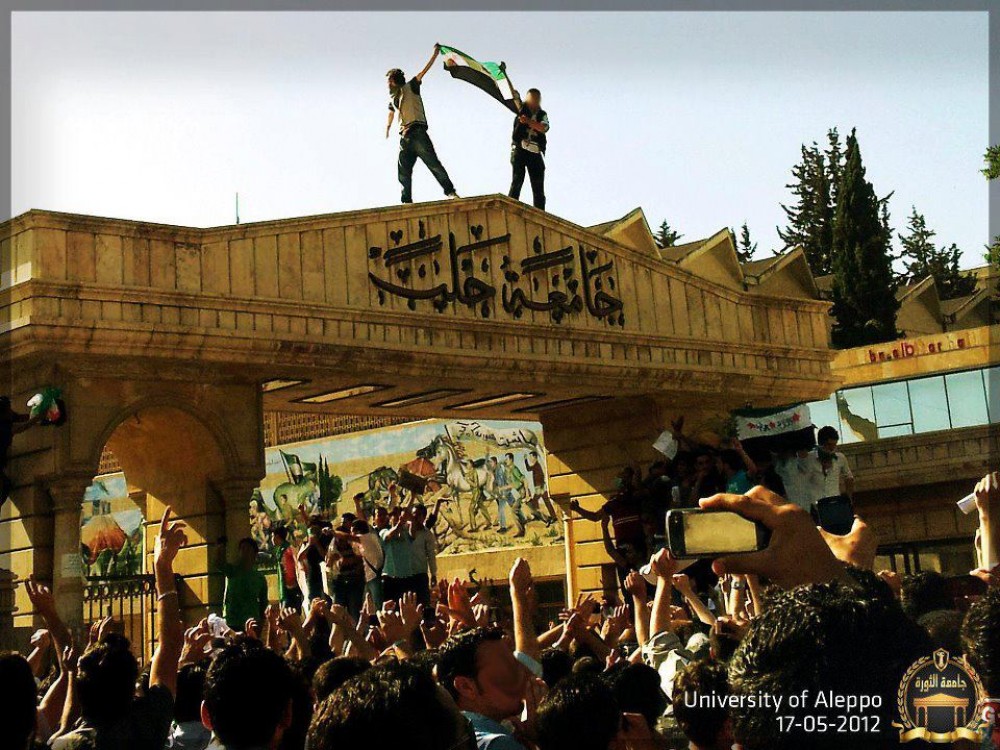
From books to bullets: Syria students on front lines
'Abu Abdu Sahari, 20, studying electrical engineering at Aleppo University, at first only engaged in non-violent protests against Assad's regime.
But after he was arrested and detained for a month he joined the armed rebellion.'
Syrian rebels in Aleppo mostly poor, pious, rural
'The blend of poverty, religious piety and anger could define the future of Aleppo, and perhaps the rest of Syria, if the rebels take over the country's largest city, which is also its economic engine. They may be tempted to push their own version of Islam, which is more fundamentalist than what is found in the city. Their bitterness at the business class may prompt them to seek ways of redistributing the wealth.
"Those who have money in Aleppo only worry about their wealth and interests when we have long lived in poverty," said Osama Abu Mohammed, a rebel commander who was a car mechanic in the nearby town of Beyanon before he joined the fight.'
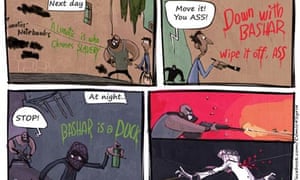
Syria's revolutionary cartoons

'A group of artists, Comic4Syria, are producing comic strips on Facebook in response to the brutality in their country'
Sunday, 14 October 2012
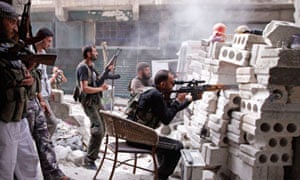
Rebel fighters capture historical town of Azmarin in 3-day battle

' “This was Captain Shardi, a three star commander in Assad’s army,” said the town's rebel commander Dr Hassan Ghnnam as he pointed at the body of a hefty man in a blood stained army uniform that lay in a side street. “He burned many houses in this town. The people were so afraid of him.”
Dr Ghnnam worked as a urologist in Azmarin before taking command of rebel forces in the town.'
Gunmen kill 4 on factory bus in Homs

'Syria's state news agency says a suicide bomber crashed an explosives-laden sedan into a coffee shop at a Damascus residential neighborhood, causing damage but no fatalities.'
They hate our freedom, they hate our coffeeshops.
Very similar to this tale from August, 'SANA says that an explosive device detonated in a car in Jaramana on Monday killed its driver. It says the device was attached to the car by an armed "terrorist" group. Another car blew up in the area overnight, also killing the driver. No further details were immediately available.'
Cluster Bomb Usage Rises Significantly Across Syria
'Over the last few days there's been a marked increase in the number of cluster bomb remains being filmed in Syria, and until today most were filmed around Maarrat al-Numan, along the main highway that connects central Syria (Hama, Homs, then Damascus and Daraa) to northern Syria (Idlib, Aleppo), which has recently come under opposition control. The concentration of reports from that area suggested at first that the use of cluster bombs was related to attempts to regain an important supply route to Aleppo.'
You've got it all wrong, says Salafi Sheikh with the 'moderate' views
To get a balanced view on Hezbollah, you have to go to the Salafists.
' “Let Hezbollah explain this strange coincidence: Nobody supports the Syrian regime except the Shia of Iraq, Iran and Lebanon. Explain this coincidence to me. If the Syrian regime considers itself secular, why has it become sectarian in the eyes of political Shiism and Hezbollah?“
Despite his antipathy to “political Shiism,” the sheikh stresses he supports Hezbollah’s resistance against Israel. “Anyone who resists Israel is honorable, and we support anyone who resists this enemy regardless of their beliefs, even if they are Marxist,” he says. “We wish the Lebanese would unite against this common enemy.” '
Free soldiers and controlled minds
'Neither the West nor oil has anything to do with the chaos that Syria is in, except what allows all external teams — Arab or Iranian or Western — to support the side that concurs with them politically. It is not strange that the regime promotes its conspiratorial explanations for the conflict. But when senior officers and young soldiers defect, after crossing the border, we hear them repeating the same arguments they read in newspapers such as Tishreen.'
Saturday, 13 October 2012
BBC Radio 4 - From Our Own Correspondent, Tough Cats
'The men joked and chuckled while telling the most horrific stories.'
The Aleppo segment has men describing their torture by the Syrian régime. But I was struck in the first segment the way the MDC has been tamed having been seen to save Zimbabwe from civil war by power-sharing with Mugabe: that is much like what what those who refuse support for a revolution in Syria seem to wish on that country. And there are some tough cats in Jerusalem apparently.
Al Jazeera speaks with PKK rebel leader
I think he may be a bit disingenuous about the PKK's links to the Syrian government, but does seem to be genuinely distancing from them now, probably because he doesn't think Assad can last much longer.
Friday, 12 October 2012
Self-government takes shape in the land of the Free Syrian Army
'The youth group has proudly emphasized unity among different sects and ethnicities in Syria – including Alawites – through a biweekly publication and with public demonstrations, but the fact is there is pressure from conservative members of the community.'
Thursday, 11 October 2012
Syria: who's backing who?

'Regime can rely on supply of weapons from Russia, while material support for rebels is mostly fragmented and scarce'
Despite the point made in the subtitle, that it is the Syrian government that is well-armed in this conflict, the first four comments don't seem to care about reality.
Wednesday, 10 October 2012
FSA threatens to take fight to Hezbollah stronghold in Beirut
I don't think the leader of Hezbollah has been shown to be anti-semitic, but that doesn't mean I can't understand why the FSA would feel justified in taking him out.
Monday, 8 October 2012
Syria Conflict: FSA on the Attack - Bdama
'Alex Crawford reports from the north of Syria where the Free Syrian Army is pushing back government forces.
- via Sky News.'
"The rebel fighters are on the move, and on the up. They're taking towns and villages in the north at a pace not seen before in the Syrian revolution."
Good for Murdoch's minions.
Masasit Mati-Top Goon
"To Gayath Matar and all our martyrs, to all our brave detainees... Free Syria"
Syria: Despite the war 'creative resistance' thrives
'In Syria you die, and prisons are full. But this revolution was started by a group of peaceful young people and it is a revolution that defends human rights. If people have chosen to take to arms then it is an act of defence, against a brutal regime", says 27 year old Orwa Al Mokdad, author of 'Top Goon, Diary of a Little Dictator,' which parodies Syrian president Assad. Orwa spoke of the dilemma faced by himself and other co-authors between peaceful protest and violent struggle.
"We have tried to overcome fear with irony", said Orwa, who was himself imprisoned and tortured in Damascus without being identified as one of the series authors.'
[http://www.ansamed.info/…/Syria-Despite-war-creative-resist…]
[http://www.ansamed.info/…/Syria-Despite-war-creative-resist…]
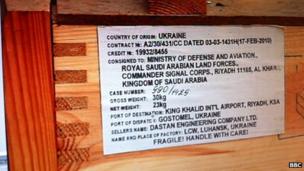
'Saudi weapons' seen at Syria rebel base

Hooray for Ukrainian merchants of death, and Saudis or someone who has read Frederick Forsyth and knows how to forge an end-user certificate.
'What was in the crates is unknown, as is how they ended up there. But their presence clearly suggests that someone in the Gulf is actively helping the rebels fighting to overthrow President Bashar al-Assad.'
Sunday, 7 October 2012
Citing US Fears, Arab Allies Limit Aid to Syrian Rebels

'While they have publicly called for arming the rebels, they have held back, officials in both countries said, in part because they have been discouraged by the United States, which fears the heavier weapons could end up in the hands of terrorists.
As a result, the rebels have just enough weapons to maintain a stalemate, the war grinds on and more jihadist militants join the fray every month.'
Saturday, 6 October 2012
Learning To Fly
I still don't think a No Fly Zone will help in Syria, but many Syrians disagree.
'Alon Ben-Meir of New York University's Center for Global Affairs argued in a recent Turkish press interview that direct action was becoming both unavoidable and desirable, and that the best way forward was a no-fly zone. He said:
"Now that Turkey is asking for this, if Nato goes along with it and the United States goes along with it, that's a change in attitude. Turkey did not have the legal legitimacy to intervene. But now they also realise that everybody is intervening.
Iran is intervening by sending military advisors. Russia is intervening by sending weapons on a regular basis. Saudi Arabia and Qatar are intervening by sending money and some weapons. And the United States is intervening by sending communications gear and some weapons and money indirectly. So everyone is interfering, but they talk about no interference, which is cynical …
The Assad regime is finished. When it might happen depends on what other powers do and when they do it. If after the [US presidential] election the United States along with Turkey, in particular these two countries, decide that the time has come, then they will be able to accelerate his demise." '
Friday, 5 October 2012
Syria's Revolution: bloodied but unbowed
'Since its outbreak the revolution has faced many dangers: the scale of the repression and bloodletting, the fear of sectarianism, the meddling of Western powers and the collapse of the country. Yet this revolution has proved to be remarkably resilient and has maintained its independence.'
Syrians are standing strong
"Syrians are standing strong. When we started this revolution we said we’d finish it by ourselves. Now 32,000 have died and millions have been displaced inside and outside the country. So there are no more shades of grey.People have picked a side and many have picked the revolution—and that is our most powerful weapon."
Wednesday, 3 October 2012
Up In Smoke
The British based Syrian Observatory for Human Rights reported four bomb attacks - three in the Saadallah al-Jabri Square and a fourth at the nearby Chamber of Commerce, a few blocks to the south-east. Most of the dead and wounded were soldiers from an officers club and a security branch that were targeted.
[https://pbs.twimg.com/media/A4RM5InCcAAmBed.jpg]
The Manbij Experiment: Rebels Make a Go of Governing in Liberated City
'In the space of a week, we see more Che Guevara T-shirts (two) than al-Qaida flags (one). Even the handful of hardened Islamists talk about elections.
Manbij has made the most progress among Syrian cities, but it isn't an exception. In the embattled major city Aleppo, the leaders of the largest units consisting of more than 4,000 troops have come together to form a military council.'
As civil war rages across Syria, Assad's own community may pose new challenge for regime
'Some commentators say a local dispute may mark the beginning of a new front against the president – one launched by his own Alawite brethren.'
Sunday, 30 September 2012
American influence on the Middle East is past its peak – someone should tell them
'There is something deceptive about David Cameron implying that Russia and China are responsible for the slaughter of Syrian children.'
Cameron may be deceptive about a lot of things*, but the liar here is Patrick Cockburn.
There might be some value in his analysis, but after reading the above I don't care.
*His speech at the UN was weaselly, saying the UN to blame, but especially some countries, was to claim he was a righteous man who would save the situation if only it wasn't for the Russians and Chinese, and has a slimy 'I say us, but I mean you' structure. But he isn't denying the murder of Syrian children.
Saturday, 29 September 2012
Our World - Syria - Descent into Hell
'The more enthusiastic parts of the crowd started singing the winds of change have blown.'
The Syrian people will not submit, nor the permanent popular revolution
'The big Western imperialist powers, other global imperialist powers such as Russia and China, and regional powers like Iran, as a whole, and without exception, continue to implement in Syria a Yemeni-type solution, in other words, cut off the head of the regime.'
When people on the Left say, "the ongoing war in Syria, which is likely to worsen unless the protagonists step back and search for a diplomatic solution"*, they echo this desire to keep the structure of the régime intact. The more outspoken supporters of official intervention are propbably sincere in their desire to see a real change, but a foreign-imposed solution is a recipe for an even less accountable administration.
I see the author of this article, Joseph Daher, member of the Syrian revolutionary Left, is a PhD student and assistant at the University of Lausanne in Switzerland. Co-founder of the blog Cafe Thawra and founder of the Syria Freedom blog, he is co-author (with John Rees) of “The People Demand. A short history of the Arab revolutions”. He doesn't share Mr.Rees' views on Syria.
Babylon Is Falling
'Kurds Prepare to Pursue More Autonomy in a Fallen Syria'
[http://www.nytimes.com/…/kurds-to-pursue-more-autonomy-in-a…]
[http://www.nytimes.com/…/kurds-to-pursue-more-autonomy-in-a…]
Thursday, 27 September 2012
Revolutionary press blooms underground in Syria
"Our goal is to run an objective paper that is open to every Syrian's views," he said. "Right now, while we're being shelled, it's a little hard not to take sides."
Dope For Guns
They're not having to retreat every time the government forces advance now, so victory may be much closer.
'For commanders assembled at the headquarters of Aleppo's main rebel unit, the Liwa al-Tawhid Brigade, the current stalemate in Syria's second city boils down to a lack of ammunition. Their current depleted supply, used sparingly by snipers, is just enough to defend the positions they hold but not to advance, as regime forces and rebels remain holed up either side of the front line.'
Wednesday, 26 September 2012
Libyan fighters 'return favor' in Syria battles
' "It is not jihad, it is a revolution," Abu Abdo insisted, adding that "in Syria there are many foreign fighters as we no longer believe in promises coming from the West."
Firas has his own explanation for why the West is not interfering in the Syrian conflict as it did in Libya.
"In Libya there is oil and gas and the West is still looking for wars from which it can derive economic benefits even if it is at the cost of thousands of lives, as was the case in Iraq," he said.
"The second reason is that Libya is far from Israel, a war out there does not affect Israel as here a large-scale conflict would be devastating." '
West complicit in Syria 'massacres': rebel leader
'A Syrian rebel commander has accused the West of being complicit in the "unprecedented massacres" committed by President Bashar Assad's forces by refusing to arm the rebels with anti-aircraft weapons.
Rebel officer Ahmad al-Fajj, a brigadier-general in the regular Syrian army before his defection "in the first days of the revolution," spoke in the rebel Free Syrian Army-held village of Atmeh on the Turkish border.
"The free peoples of the world -- Europeans, Americans -- must understand that their governments are indirectly responsible for the killings in our country," Fajj, 64, said on Tuesday.
"We asked all the arms dealers and traffickers in the region to sell us anti-aircraft missiles. They told us they needed the green light from the CIA and Mossad, and the light was red," he said.
"They won't sell us anti-tank weapons for the same reason. All we have to defeat Bashar's tanks are the RPGs we manage to retrieve from the enemy."
He claimed that with surface-to-air missiles the rebels would be able to defeat the regime forces "in a week, a month at most."
General Fajj, who bore an odd resemblance to the late Hafez al-Assad, former president and father of Bashar, said he could not fathom the West's reluctance to supply the rebels with the necessary anti-aircraft equipment.
Western nations fear that such weapons may fall into the hands of militant Islamists operating in the country.
"There aren't many Islamists, less than a thousand in the whole of Syria. They have no power," he asserted. "We control the liberated areas and I can guarantee you there is no chance they'd get hold of missiles.
"If Western countries had helped us from the beginning, they wouldn't even be here as we wouldn't need them. I assure you that after our victory they will not pose a problem. If they do we'll deal with them. The Syrian people don't support them, they're on our side.
"I can promise the free peoples of the world that if surface-to-air missiles are given to us, they will not fall into the hands of Islamist groups," he said.
General Fajj, who bore an odd resemblance to the late Hafez al-Assad, former president and father of Bashar, said he could not fathom the West's reluctance to supply the rebels with the necessary anti-aircraft equipment.
Western nations fear that such weapons may fall into the hands of militant Islamists operating in the country.
"There aren't many Islamists, less than a thousand in the whole of Syria. They have no power," he asserted. "We control the liberated areas and I can guarantee you there is no chance they'd get hold of missiles.
"If Western countries had helped us from the beginning, they wouldn't even be here as we wouldn't need them. I assure you that after our victory they will not pose a problem. If they do we'll deal with them. The Syrian people don't support them, they're on our side.
"I can promise the free peoples of the world that if surface-to-air missiles are given to us, they will not fall into the hands of Islamist groups," he said.
As the U.N. General Assembly opened in New York Tuesday, Fajj complained: "Democratic countries only support us with words. This is shameful for the world. They can see what's happening, buildings being destroyed by air strikes, and they do nothing."
Fajj, commander of the rebels on the front line in western Aleppo, had been leading a four-day-old FSA assault on a crucial army post, "base 46," which lies on the main road between the northern city and Turkey.
"We are surrounding them. Yesterday a helicopter flew past to drop them bread. They can't get reinforcements because we hold all the roads.
"This base is the only obstacle on the road to Aleppo. If we take it, we can join up with our fighters in the city, which would be a key victory," he said.
"We have time anyway," he concluded. "We will defeat them by ourselves. It'll take longer and many people, civilians in particular, will die as a result. The French revolution didn't get any outside help. This is our revolution." '
Fajj, commander of the rebels on the front line in western Aleppo, had been leading a four-day-old FSA assault on a crucial army post, "base 46," which lies on the main road between the northern city and Turkey.
"We are surrounding them. Yesterday a helicopter flew past to drop them bread. They can't get reinforcements because we hold all the roads.
"This base is the only obstacle on the road to Aleppo. If we take it, we can join up with our fighters in the city, which would be a key victory," he said.
"We have time anyway," he concluded. "We will defeat them by ourselves. It'll take longer and many people, civilians in particular, will die as a result. The French revolution didn't get any outside help. This is our revolution." '
Sectarianism of the Syrian revolution
'The young man was perplexed and said that it was a banner that called for God’s oneness. The older fighter scolded the young man and said, “This is an Al-Qaeda banner; are you Al-Qaeda? Haven’t we had enough of these rumors? Do you like the media to depict us as radical villagers? And that we slaughter people?”
The argument was over in no time. The banner was left behind in the village.'
Women Combat an Oppressive Regime Online, On the Ground, and Sometimes Armed
'Zara and her friend, Rasha (not her real name), were both activists who saw the revolution as an opportunity for social as well as political reform. Having begun to attend protests and to connect to networks of activists locally, Rasha, in particular, found that she wanted her involvement to be personal as well as political. “I stopped wearing the hijab, I cut my hair, and I moved out of home,” she says, sipping lemon and mint juice in a café in Amman.'
Tuesday, 25 September 2012
Prophet film diverts gaze from Syria
Often they are. I was going to make the opposite comment on a League For The Fifth International article that Marcus Halaby linked to, which seemed to promote a slightly simplistic, anti-imperialists good, salafists bad, view.
Monday, 24 September 2012
Front line Syria rebels hostile to command move
"We don't follow any religious or political ideology. Not the Muslim Brotherhood, Al-Qaeda, or any other foreign movement. We are the FSA on the ground," he said. The commanders on the ground share one goal: "That (President) Bashar Assad falls as soon as possible."
Open letter of the Syrian Revolutionary left to support the Syrian popular revolution!

Via Bassem Chit, but his link only seems to come in French.
'The Syrian revolutionary process is a real popular and democratic movement that mobilizes the exploited and the oppressed classes against the capitalist elite linked to the global order – very similar to their counterparts across the Arab world. The movement began peacefully calling for reform, but the regime has responded with violence and repression in all directions. Some sections of the Syrian population then decided to organize armed resistance to defend themselves against attacks from security services and thugs, known as the shabihas of the regime.
The Syrian people’s armed resistance expresses their right to defend themselves against the repression of the regime and has allowed for the continuation of the popular resistance in some regions faced with the attacks of the regime. Some revolutionary councils were formed throughout Syria, as well as coordinating committees and armed political action. A code of good conduct, which calls for the respect for international law and against sectarianism, has also been signed by a large number of armed groups belonging to the armed popular resistance against the regime.
Composed of deserters and civilians who took up arms, the armed popular resistance has real roots in the popular insurrection.'
Eyewitness account of war crimes in Syrian conflict
syriastrugglel: "Assad people saying opposition killed them but some have shackles on their wrists. Where we normal people get shackles? Democracy fighters have trouble getting guns and bullets."
Subscribe to:
Posts (Atom)