Friday, 28 December 2018

Syrian opposition reacts to US withdrawal


 'On Dec. 19, U.S. officials stated that the Pentagon had an order to move troops out of Syria as quickly as possible. Later on, they started to inform their partners in northeastern Syria about their plans regarding the immediate pullback of American forces from the region, where they have been trying to wrap up the campaign against Daesh. This surprising decision by the Donald Trump administration not only has the potential to change the dynamics of Syria, but also has the capacity to change the position of the Syrian opposition. In this regard, the Syrian opposition took the U.S.' decision to withdraw with a grain of salt at first. However, the follow-up tweets of Trump and the events following the declaration caused euphoria among the Syrian opposition as they hope to seize control of all the People's Protection Units-held (YPG) territories in Syria.

 The decision by the Trump administration makes the opposition believe in a new process in Syria where they will strengthen their position as Yusuf Hamoud, the spokesman of the Turkey-trained National Army, claimed: "We, as the National Army, alongside the Turkish army, consider us the biggest gainers of this decision, and we will move the battle east of the Euphrates soon to liberate the region from terrorist gangs such as [the Democratic Union Party] PYD."

 Hamoud also stated that: "We read Trump's decision as political diplomacy, and Turkish politicians are able to achieve understanding of American aims on the Syrian issue. So we consider this decision as a partial withdrawal from the northern part of the Syrian-Turkish border area toward the Syrian depth region."


 Also the former spokesman of the National Army, Abu Riyad Hamadin, formulated his skepticism by questioning the U.S. withdrawal; whether they will withdraw entirely from Syria or only from the region located in the Syrian-Turkish border. To this end, they will be able to prevent direct confrontation with Turkey by opening up a way for Turkey and the National Army to launch a military operation against the YPG.

 Later on Dec. 24, Hamadin expressed that all of the territories currently held by the YPG will be controlled by the National Army together with the Turkish Armed Forces (TSK) without the interference of any other, so the U.S. presence in Syria will be handed over to the TSK.

 Explaining the reasons behind the U.S. decision to withdraw, the spokesman alleged that the establishment of the National Army in clear coordination with the Turkish political and military leadership, will strengthen the position of Turkey on the political level.

 Also Muhammed Bassoun, a commander of Liwa al-Shamal, a faction belonging to the National Army, talked about his expectations that the most of Syria's north will come under the Turkish umbrella until the formulation of final political solution in Syria in which Iran will "pack their belongings and leave Syria."

 In this regard, according to Hamoud, the Syrian opposition has always demanded that foreign forces should leave Syria.


 As the declaration of the U.S. withdrawal was first skeptically received by the Syrian opposition, Wael Alwan, the spokesman of Faylaq al-Rahman, a faction which was located in eastern Ghouta previously but had to be evacuated to northern Syria after the Russian-backed regime military assault, said on the day of the declaration: "American promises cannot be trusted as the withdrawal declaration is likely to be similar to [Russian President Vladimir] Putin's previous withdrawal declaration of the Russian troops from Syria, which was made for media consumption and was not implemented on the ground." On the other side, Alwan furthered that: "Through the statements of Trump and the political battle within the U.S. administration, it is expected that the American declaration is serious and will be implemented, unlike the other examples, such as Putin's announcement."

 At the beginning, Othman Millo, the chief of the Istanbul office of the Kurdish National Council, said the U.S. withdrawal decision was made to pressure the Syrian Democratic Forces (SDF) to accept other actors' participation in the administration, to ease Turkey's security concerns and to dismantle the administrative system of the YPG.

 In this regard, the YPG rejected the deployment of Syrian peshmerga in the border region with Turkey. But later on, Millo's view evolved as he said he fears Russia and Iran will fill the void of a U.S. withdrawal, but he also pointed out that the U.S. presence inside Syria had negative aspects as well, like negatively affecting Turkey, who bravely stands with the Syrian people. Millo criticized that the U.S.' presence in Syria had no clear and supportive vision for the Syrian people and the Syrian revolution.

 Alwan's words sum up the reaction of the Syrian opposition: "Indeed, the decision announced by the American president is very important and surprising to all, because it is contrary to previous U.S. statements as they stated that the U.S. forces will stay in northeastern Syria."


 Dima Moussa, the vice president of the Syrian National Council, focused on the political impact of the U.S. withdrawal and said: "Generally, anything that would contribute to ensuring minimal U.S.-Turkey tension will likely have positive effects on Turkey's position in support of the opposition and in the Astana process, which would also have a positive effect on advancing the Syrian political process."

 All of this, of course, depends on the details of the withdrawal and the level of coordination with the Syrian opposition represented by the Syrian National Coalition and of course coordination with the Turkish side. I personally see this move as a tactical move as opposed to strategic; I think that the U.S. may pull out military personnel so that they will not have boots on the ground. However, it is unlikely that they will completely leave the area. We have seen this scenario several times in different areas of the multiple regions.'
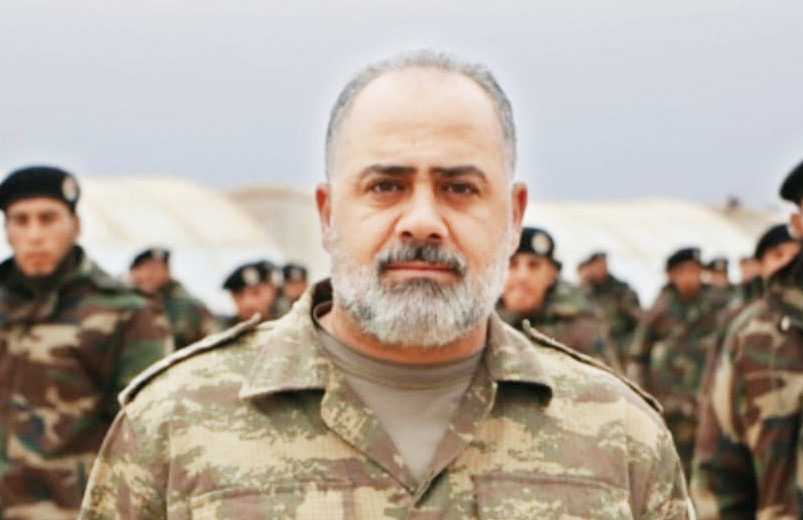
Image result for Yusuf Hamoud sna

Thursday, 27 December 2018

Nonsense about the US withdrawal from Syria


 Michael Neumann:

 'This attempts to counter some of the foolish comments made about Trump's withdrawal from Syria.


 The least foolish of these is that the battle against ISIS is not won. No it isn't, and Trump's claim that it is, is plainly false. But to harp on this is absurd.

 For one thing, there isn't the slightest possibility that keeping US troops in Syria would win the battle, or prevent an ISIS resurgence. ISIS' ultimate strength lies, not in its Syrian or Iraqi enclaves, but in what the West and Arab authoritarian governments have done to the peoples of the region, and in the conditions in Muslim countries worldwide. These conditions guarantee a literally unending stream of militants seeking justice and revenge. The notion that 2000 US troops would affect this dynamic is ludicrous. Equally foolish are the tiresome recommendations that the underlying conditions be addressed. The sage pundits who say these things know perfectly well that the West will never, ever address these conditions: it can't, because they occur in sovereign states. It would take a Western occupation of those states, involving hundreds of thousands of troops for decades, to cure the injustices of the region, and even then it's not clear that the economic basis for healthy societies exists. In other words, whatever the West is going to do, whatever leadership it has, ISIS won't be defeated. What then is the point of warning us that Trump's withdrawal will not defeat ISIS?

 For another, forget the mantra about how effective the Kurds have been against ISIS. Their victories are almost entirely the result of overwhelming US air and artillery support. Their actual capabilities are better assessed by looking at how even a much-weakened ISIS can rout Kurdish forces with attacks during storms and under other conditions inimical to air operations. The Syrian rebels, not to mention the Turkish army, would be at least as effective as the Kurds in combating ISIS, and they wouldn't need a US ground presence to do it.


 There is more foolishness.

 It is said that withdrawal shows the US to be an unreliable ally, and that this is a dire mistake.

 In the first place, nothing says you're unreliable like supporting, with weapons, troops and air power, the armed, active enemy of your ally. That's what the US did when it backed the Syrian arm of the Kurdish PKK against its NATO ally, Turkey. So Trump's withdrawal of this support could well be seen as a return to reliability, not the abandonment of it.

 Second, it's unclear that appearing unreliable in this instance would make much difference to the US position in the world. Nations are allied to the US, not because they have touching faith in America, but because they have little choice. They don't want to fall under Russian or Chinese domination. The idea that alliances are made and preserved on trust runs contrary to all historical precedent. It's childish.


 It is said that US withdrawal is a gift to Putin.

 This carries absurdity into insanity. The unspoken truth about the US' Kurdish 'allies' is that they are also allies of Russia and Assad. In the 2015 campaigns against rebel Aleppo, Russia and Assad even provided air support to the Kurds. Later, Assad secured for the Kurds a road whereby they could move between their Northeastern and Northwestern territories. He also pays for much of the infrastructure in the Northeastern provinces. This means that, in allying with the PKK/YPG, the US is allied to Assad, Russia... and Iran. It's true that Putin probably enjoys seeing the US leave; he doesn't want a US presence in Syria. But it's also true that Obama, and until now Trump, have been fighting on Putin's side. He now faces an expanded Turkish presence in Northern Syria, which threatens and complicates his relations with Assad and Iran. Because Turkey backs the rebels, it even threatens the security of Russian bases in Latakia and Tartous. Trump's withdrawal means the US will mend relations with Turkey. That in turn means Putin can't expect to pry that country - a real strategic prize that until recently seemed almost within his grasp - away from its Western alliance. Finally, the US retains its air bases and naval presence in the region, so that US withdrawal of 2000 troops from Syria makes not the slightest difference to the regional balance of power. Some gift.


 It is said, with feeling, that the Kurds have been betrayed.

 Even if there is some truth to this, it is foolish. For one thing, the Kurds have been supremely opportunistic in their choice of allies. They feigned neutrality when the rebels were strong, yet with increasing frankness came out on Assad's side when the rebels faltered. For another, the morality of betrayal depends on circumstances. The Kurds chose to ally with a régime so monstrous that adjectives like 'brutal' can't begin to capture the extent of its atrocities. When the King of Italy abandoned Mussolini in 1943 he betrayed Hitler. Was that reprehensible?

 The criticism of Trump's withdrawal, though couched in the language of morality and even honour, is curiously oblivious to the sort of humanitarian considerations that you'd think would belong to those values. The most likely consequence of US withdrawal - should it really occur - is that Northern Syria will become a refuge for perhaps millions of Syrians, under Turkish protection. Meanwhile in the rest of Syria, as widely predicted, Syrians in formerly rebel areas are subjected to arbitrary imprisonment, torture, and murder. But sure, pontificate some more about the US withdrawal.'

Monday, 24 December 2018

Daraa’s resurgent resistance has lessons for the régime


 'Anti-régime activities in southern Syrian areas formerly held by rebels have flared up again, including both peaceful expressions, such as graffiti and demonstrations, but also violent incidents.

 More than a dozen pro-government fighters and intermediaries have been killed in a series of hit-and-run attacks since November. These attacks are especially significant in a region that the government just captured a few months ago, emphasizing that the country is very much still in a state of war.

 While abuses and bad-faith negotiations by Damascus are largely to blame for provoking renewed violence, the example of Daraa makes it clear that peace will remain elusive in the absence of a comprehensive and fair political solution.

 After the government’s capture of the south in July, achieved largely through negotiations, its intermediaries and intelligence agencies started opening regional offices to process local residents’ plea for clemency. The process theoretically provided the signatories with general amnesties, which typically was supposed to exempt them for six months from the obligatory military conscription required of men of fighting age.

 Despite those guarantees, however, the government has continued to arrest local residents, including civilians as well as former rebel fighters, even when they were in the process of turning themselves in. Reports show that authorities detained at least 68 people in October alone, while more than 30,000 men have been called up for enlistment, including both new recruits and reserves, before the six-month grace period expired.


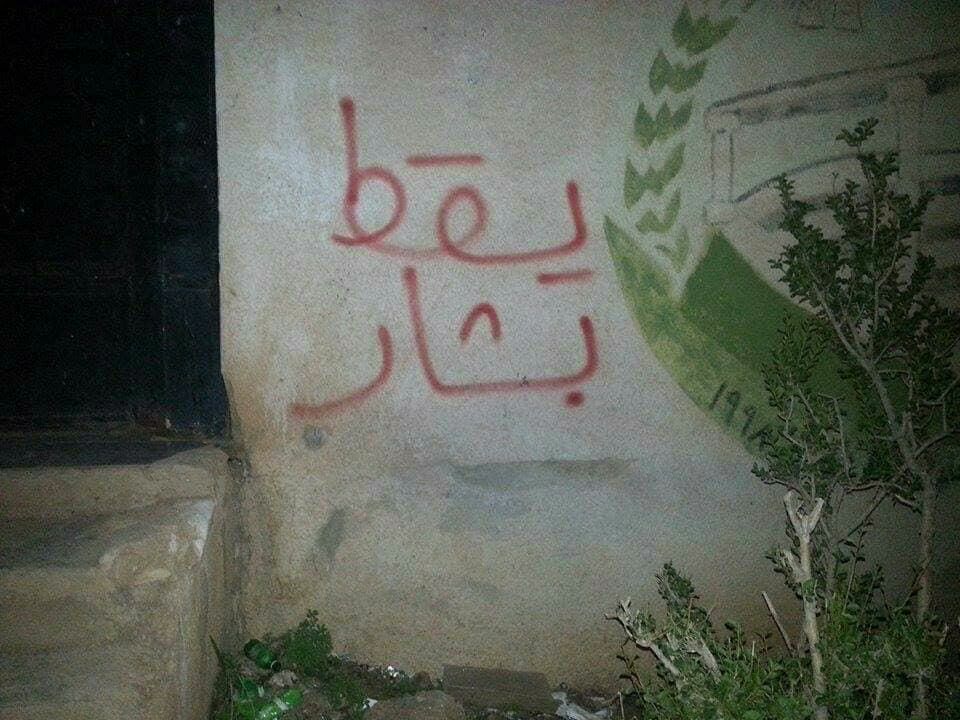
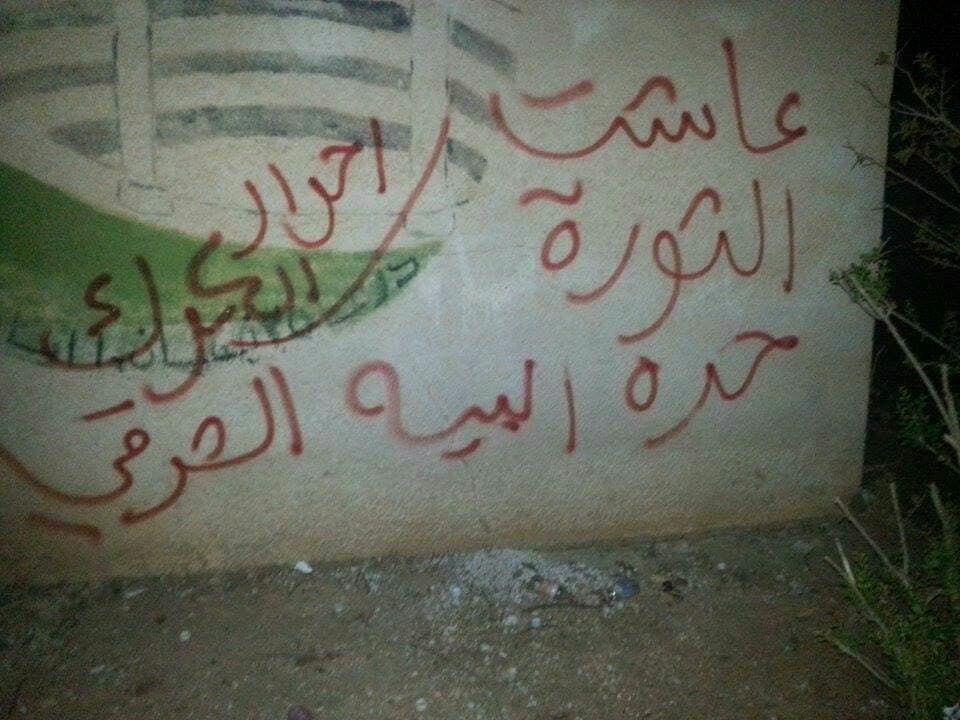
 Every indication is that the gradual increase of violations by the régime of President Bashar al-Assad is what motivated the renewed resistance after months of relative calm. In a trend similar to the early months of the uprising in 2011, anti-régime sentiment has been expressed through non-violent acts, with familiar slogans such as “down with Bashar” and “the revolution is ongoing” painted on the walls of government buildings in towns such as al-Karek, al-Mazyrb, Nawa and al-Sanamayn.

 On the other hand, guerrilla tactics such as hit-and-run attacks and ambushes have also targeted various pro-government forces in the region. One early attack hit a government checkpoint in the city of Jasmin on November 24, killing two members of the national intelligence agency. A day later, a larger coordinated operation resulted in attacks on multiple checkpoints in the city centre of al-Sanamayn, killing more than six fighters.

 While some checkpoints appear to have been targeted randomly or for operational reasons, others seem to have been prioritized because of their reputations. For example, a military-intelligence checkpoint between the towns of al-Karek and al-Gharieh was apparently attacked because of the practices of its personnel, including arresting local residents as well as soliciting bribes.


 At the same time, a group calling itself “the popular resistance in the south” has emerged, in the media at least, claiming credit for the attacks and announcing a new phase in the fight against pro-government forces.

 The “popular resistance” made its first public statement to the Arabic news website Geiroon in November by declaring war against the Assad régime, its local intermediaries and Iranian-backed militias operating in the southern region. A spokesman of the group, identified by the pseudonym Al-Sief al-Horani, or the Sword of the Horan region, claimed that the group of former rebel fighters and other men facing obligatory conscription was continuing the rebellion.

 The secrecy surrounding the group and its members makes it difficult to verify whether it actually has operational capability, or is just taking credit for attacks carried out by unidentified individuals who are staying out of the spotlight. Given the multiple threats of infiltration, leaks and capture, it makes a great deal of sense that those behind the attacks might want to operate covertly.


 The Assad régime has applied a mixture of incentives and coercion to counter this new resistance and to ferret out the people behind it. Government delegations, including parliamentary members, intelligence officials and even the Grand Mufti of Syria, Ahmad Badreddin Hassoun, have visited Daraa recently in an attempt to ease tensions and defuse local resentment.

 The overtures, however, have been combined with the stick as the régime’s agents step up arrests of suspects in the attacks and those believed to be supporting them, including former activists and rebel fighters. So far, the strategy has failed, as the detentions further fuel local resentment already simmering because of the lack of public services.

 It is difficult to predict whether anti-régime activities will increase and destabilize Daraa, where the Syrian uprising first began in March 2011. But the situation shows all the conditions needed for stiffer local resistance to re-emerge: residents resent the régime, have little hope for the future and are equipped with the military experience and weapons to fight back.'

Image result for daraa resistance revolution

Syrians Say Late Paddy Ashdown Friend of Revolution


 'Syrian activists are remembering former Liberal Democrat leader Paddy Ashdown who died on Saturday aged 77, a British politician who opposed Bashar al-Assad's regime since the outbreak of revolution in Syria in 2011.

 Ashdown was an advocate of international law and calling war criminals to account, from the Bosnia war in the 1990s to the regime's brutal suppression of the Syria revolution recently.

 In 2016, he called for the UK and its allies to drop food and aid on opposition areas in Syria, which had been put under crippling starvation sieges by the Assad regime.


 On Saturday, after the surprise announcement of Ashdown's death, Syrian activists turned to Twitter to commemorate the former Lib Dem leader.

 "Paddy Ashdown was a friend of the Syrian Revolution. He supported us in bringing the Assad regime to justice, he supported us in humanitarian aid and vouched for aid drops in Syria - and openly berated those who didn't care for Syrian lives. RIP Lord Ashdown," said Razan Saffour on Twitter.

 Other Syria activist groups also remembered Ashdown as a supporter of their cause.

 Ashdown wrote an op-ed in January 2016 with Jo Cox - an MP who was shot dead by a British fascist the same year - calling for the Royal Air Force to drop food on the encircled Damascus suburb of Madaya, which had seen children die from starvation due to a regime siege.

 "If we could do it for the starving in besieged Srebrenica and again for the besieged [Yazidis] in northern Iraq, there should be no reason it cannot be done for those suffering and dying, in besieged Madaya," they wrote.

 Paddy Ashdown also said: "If we can drop bombs in Syria, we can drop food in Syria."


 Following the chemical gas attack on the opposition suburb of Douma in 2013, he also called for intervention against Bashar al-Assad's regime.

 When parliament voted against a military response to the chemical massacre, Ashdown warned that by allowing Assad to get away with gas his own people, it would give the regime the green light to continue its atrocities.

 "Call me an old war horse if you wish, but I think our country is greatly diminished this morning," he said after the vote in 2013. "MPs cheered last night, just recognise the people who will be cheering this morning are President Putin, President Assad... [after 50 years] I've never felt more depressed and ashamed this morning now that I have to wake up and see children burning on the television sets, as they were last night, and say the answer from my country is 'it's nothing to do with me' ".

 A former military man, he argued that the UK should not engage in isolationism and had a moral duty to act following the suspected sarin chemical attack in Eastern Ghouta in 2013, which killed hundreds, for the sake of international law and to protect civilians.

 "Last night we took a vote that we were not going to stand up to protect international law that stops the use of chemical weapons. They will now be more broadly used unless this is changed," he added in an interview.


 Assad launched two further major chemical attacks since then, and used chlorine dozens of other times on civilians in Syria.

 In April 2018, he reminded the country of continued war regime war crimes.

 "After the last major chemical attack by Assad in Aug 2013 I described Parliament's decision not to use force as the most shameful of my life, adding that chemical weapons 'will become more commonplace and we will feel the effects of that'. Terrible to say, so it has become..." he tweeted.'

Sunday, 23 December 2018

Syria’s prison cells being emptied by mass murder


 'Bashar al-Assad’s army is doubling down on executions of political prisoners, with military judges accelerating the pace they issue death sentences, according to survivors of the country’s most notorious prison.

 In interviews, dozens of Syrians recently released from the Sednaya military prison in Damascus described a government campaign to clear the decks of political detainees. The former inmates said prisoners are being transferred from jails across Syria to join death-row detainees in Sednaya’s basement and then be executed in pre-dawn hangings.

 Yet despite these transfers, the population of Sednaya’s once-packed cells — which at their peak held an estimated 10,000 to 20,000 inmates — has dwindled largely because of the unyielding executions, and at least one section of the prison is now almost entirely empty, the former detainees said.

 Some of the former prisoners had themselves been sentenced to hang, escaping that fate only after relatives paid tens of thousands of dollars to secure their freedom. Others described overhearing conversations between guards relating to the transfer of prisoners to their death. The men all spoke on the condition that their full names not be disclosed out of fear for their families’ safety.


 According to two former detainees who have passed through the Damascus field court, located inside the capital’s military police headquarters, the rate of death sentences has accelerated over the past year as the attitudes of court officials hardened. These two men had each appeared twice before a military field court judge, once earlier in the war and once this year, and were able to compare the way this secretive court operates.

 “There was no room for leniency on my second visit,” one man said. “Almost everyone in that room was sentenced to death. They were reading the sentences aloud.”

 Even before they reach the gallows, many prisoners die of malnutrition, medical neglect or physical abuse, often after a psychological breakdown, the former detainees said.

 One former prisoner said guards had forced a metal pipe down the throat of a cellmate from the Damascus suburb of Darayya. “They pinned him to the wall with it and then left him to die. His body lay among us all night,” said Abu Hussein, 30, a mechanic from the western province of Homs. Another described how prisoners in his own cell had been forced to kick to death a man from the southern city of Daraa.


 Satellite imagery of the Sednaya prison grounds taken in March shows an accumulation of dozens of dark objects that experts said were consistent with human bodies.

 “Present in the imagery from March 1st and March 4th of the prison, there are dark elongated objects, similar to each other, measuring approximately five to six feet in length,” said Isaac Baker, imagery analysis manager at the Harvard Humanitarian Initiative’s Signal Program on Human Security and Technology. “While analysis and available data does not prove, it does corroborate, and is consistent with, eyewitness accounts of mass executions at this facility.”
Two former detainees held in cells nearest to the guardroom in their prison wing describe overhearing conversations between their jailers regarding executions in early March. “They were talking about a set of prisoners’ bodies that had been moved to the yard,” one man said.

 Other satellite imagery of military land near Damascus, previously identified by Amnesty International as a location of mass graves, appears to show an increase in the number of burial pits and headstones in at least one cemetery there since the start of the year. Defectors who worked in the military prison system said this area, located south of the capital, is the likely location for the mass burial of Sednaya prisoners.

 In the cemetery on the road running south from Damascus, dozens of new burial pits and headstones have appeared since the winter.


 More than 100,000 Syrian detainees remain unaccounted for. According to the United Nations and human rights groups, thousands, if not tens of thousands, are probably dead.

 Although all sides in the conflict have arrested, disappeared and killed prisoners, the Syrian Network for Human Rights monitoring group estimates that as many as 90 percent have been held across a network of government jails, where torture, starvation and other forms of lethal neglect are used systematically and to kill. At one point, Sednaya alone held as many as 20,000 inmates, according to Amnesty International.

 Former detainees recently released from Sednaya — interviewed in the Turkish cities of Istanbul, Gaziantep, Antakya and Siverek, as well as on the phone — say that guards enforced near-total silence among the prisoners, who sleep under blankets infested with mites and ticks on stone floors sticky with bodily fluids. “When you are in Sednaya, you cannot think of anything, you can’t even speak to yourself. The beatings are torture. The silence is torture,” said Mohamed, 28.

 He described the cellmates he had left behind as “caged animals.”

 “Some had their spirits completely broken, and others just became manic and crazed,” he said. “Death would be a mercy for them. It’s all they’re waiting for.”

 Although execution days vary, Sednaya’s former prisoners say the guards most commonly tour the cells on Tuesday afternoons, calling out names from lists.

 “You knew they were coming when they banged on the metal door and started screaming at us to turn around. Everyone would scramble to the wall and stand as still as they could,” one former inmate said. “Then you just stood there and prayed they didn’t pull you away.”


 In Mohamed’s case, that is exactly what they did. With a T-shirt pulled over his head, the former student was yanked out of his cell and taken to the basement death row, being beaten as he stumbled downstairs. He recalled being surrounded by the screams of others.

 He and other inmates were pushed into a cramped cell and stripped naked before the guards left, slamming the metal door behind them. The prisoners were kept there for a week.

 Even more prisoners were jammed into an adjacent cell. They included Hassan, 29, a farmer who had been transferred to Sednaya from a civilian prison in the southern city of Sweida. Sitting up all night and waiting for death, the men talked in low whispers, sharing their life stories, as well as their regrets.

 “It was dark in there, but what I could see of their faces was pure terror,” Hassan said. “Eventually everyone stopped talking.”

 Yet when guards came to take prisoners, neither Mohamed nor Hassan had their names called. They would later learn that their families had paid tens of thousands of dollars to a government-connected middleman — part of a network that has sprung up during the war to provide families with news of detained relatives and at times help release them in return for vast sums of money.


 The Assad régime has been issuing death notices for political prisoners at an unprecedented rate. The practice began accelerating in January and, in many cases, appears to confirm that detainees had been dead since the early years of the conflict.

 In a report released last month, the U.N. body established to investigate war crimes in Syria said that the mass release of death notices amounts to an admission by the government that it has been responsible for the deaths of prisoners whose detention it had denied for years.

 “We think it must be linked, obviously, to the state beginning to look ahead beyond the conflict — to feeling like ‘our existence is no longer completely under threat and we have to look ahead at how do we deal with the population at large,’ ” said Hanny Megally, a lead investigator with the U.N. Commission of Inquiry on Syria. “People are demanding now more information about what happened, why, where. Where are the bodies?”


 In interviews, former prisoners offered a rare window into the workings of the military field court, where the accused appear without lawyers and charge sheets are often the product of torture. Detainees arrive cuffed and blindfolded. Their trials rarely last longer than three minutes.

 In some cases, the recent executions in Sednaya were based on sentences handed down years ago. What has changed, former detainees say, is the haste with which new ones are being issued.

 Once the prisoners are hanged, their bodies are usually carried straight from the execution room to a waiting truck or car and then transported for registration at a military hospital before being buried in the mass graves on military land, according to Amnesty International.

 Mohamed and Hassan were among those who dodged that fate. After years of what they described as torture and extreme neglect, leaving both with scars and severe health issues, both made it across the border to Turkey earlier this year.

 As Hassan crossed from Syrian-held territory into a final rebel stronghold close to the Turkish border, the smugglers guiding his group mistakenly steered it into a minefield, and his leg was blown off. He still screams in his sleep.

 “The Sednaya memories cannot easily be forgotten,” he said. “Most of my cellmates are dead now. I keep thinking of the people who are still there.” '

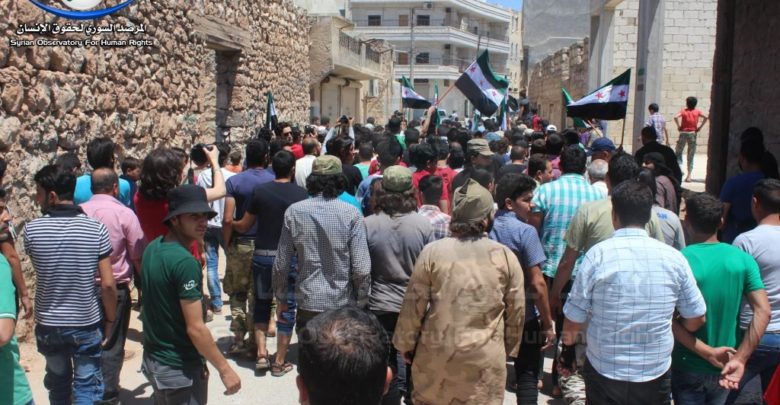
Daraa demonstrators call to topple Assad regime


 'Dozens of Syrian demonstrators took to the streets on Friday (Dec. 21) in Daraa countryside, chanting anti-Assad slogans, and calling to topple the Assad regime.
Peaceful protesters hit the streets in Daraa al-Balad after Friday prayers chanting “The people want to overthrow the Assad regime.”

 They also called for the release the detainees in Assad regime prisons, chanting “free the detainees.”

 The demonstrators expressed their refusal of the reconciliation agreement with the Assad regime, describing the former Free Syrian Army (FSA) fighters who signed reconciliation agreement with the Assad regime as traitors.

 Syrians shared the video of the demonstration on social media, and said that it reminded them of the early weeks of the Syrian revolution.'


 'Protesters chant "no more taswiyeh" (the bureaucratic process "reconciled" adults must undergo post-surrender) & "we want the release of detainees" '
[https://twitter.com/Elizrael/status/1076127630313824256]


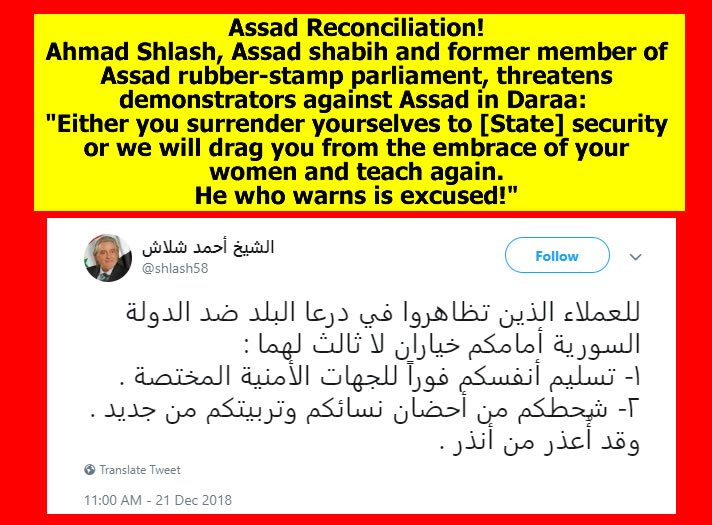
 'Ahmad Shlash, Assad shabih & former member of Assad rubber-stamp parliament, threatens demonstrators in against Assad in Daraa: Surrender yourselves to Assad security or we will teach again.'
[https://twitter.com/EagleSyrian1/status/1076468763615248384]


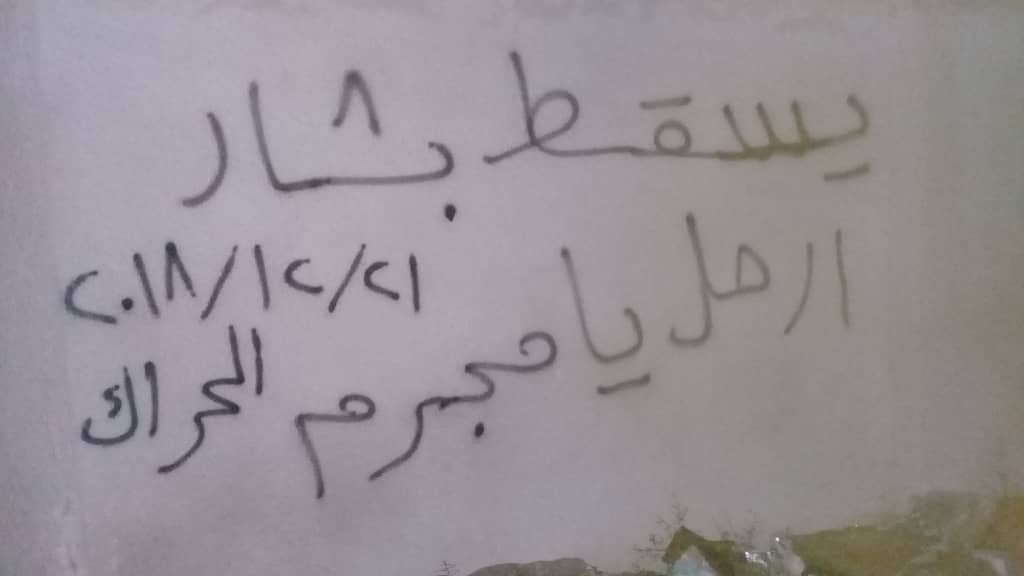
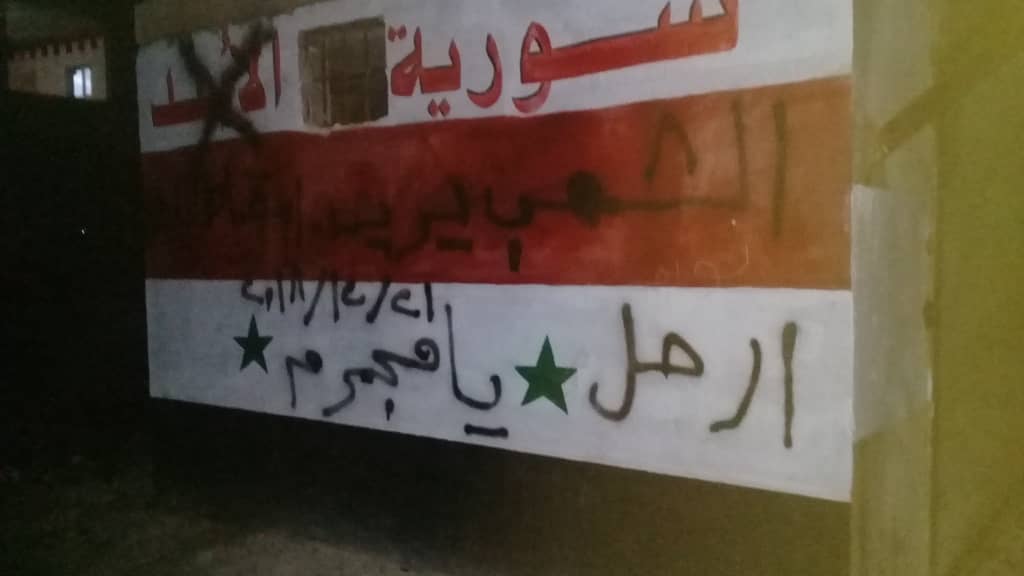
 'Assad regime forces are reportedly combing al-Herak, Daraa, after graffiti appeared on the walls of the local Air Force Intelligence branch calling for Assad's downfall. Similar graffiti appeared in eastern Daraa towns a month ago. '
[https://twitter.com/Elizrael/status/1076498378249388032]

Friday, 21 December 2018

Of the people, by the people, for the people


 ' "I’ve come to take part in the free elections. They make us proud." In January 2017, these were the words of a voter in the city of Idlib in north-west Syria, quoted by the news agency Agence France-Presse. The man was pleased about a particular event in the city: the first elections to the local council. It was hoped that this assembly would steer the fortunes of the local community through difficult times. Eighty five candidates were standing for election to the 25 seats. A 10-member executive committee was later chosen from its ranks, the head of which served as mayor for the city with its population of around 2,00,000 at the time. Anyone over 25 years old and born in Idlib was entitled to vote.

 The vote was a small-scale sensation in the last province still in the hands of the opposition. In the year 2015, the Syrian government army withdrew from the region on the Turkish border. Fateh al-Sham jihadists had captured the city and initially governed it. But during the course of 2016, the citizens of Idlib were able to convince the jihadists that the city needed a civilian administration. This resulted in the election and establishment of a city council.

 Since then, Idlib local council has been managing the daily business of the community. It guarantees supplies of drinking water, electricity and fuel, ensures that roads are repaired and debris is cleared following bomb attacks. Rubbish needs to be disposed of and sewers maintained. People are needed to distribute aid and somehow take care of the many sick and injured. The Idlib local council co-ordinated and organised all of this, as well as could be expected amid a humanitarian catastrophe with many internal refugees and conflict damage.


 As the Syrian opposition movement gradually brought large areas of the country under its control from 2012 onwards, public structures initially imploded in many places. Opposition-held territories became a laboratory in which people had to experiment with new forms of self-administration.

 "The local councils arose out of pure necessity," says Leila al-Shami, British-Syrian activist and writer. "They were attempts to establish day-to-day services in local areas from the bottom up."

 Al-Shami believes that the local councils arose spontaneously and were not the expression of a political ideology. At a village, municipal and provincial level, they filled a vacuum that the government had left behind and that no-one was prepared for. Initially, mostly young activists improvised, distributed aid and tried somehow to cope with the emergency. They wanted to develop a democratic alternative to the Assad state, but they lacked clear ideas for this.
Some 600 city and provincial councils were set up primarily in the provinces of Idlib, Aleppo and Daraa, as well as in the Damascus conurbation and Raqqa. They gradually consolidated their structures. After the most pressing humanitarian questions, the councils tackled projects such as school and hospital reconstruction. Local councils conducted negotiations with militias, tried to curb the influence of radical Islamists and mediated between hostile groups.


 The civic representations enjoyed varying levels of success according to region. A 2017 report by the Swiss Peace Foundation appraising five case studies from all parts of the country found that local councils had certainly succeeded in guaranteeing a minimum level of services and supplies for day-to-day life. To a certain extent, they had also created a regulatory framework for democratic decision-making within the local authority area. According to the study, opportunities for public participation had significantly improved since the councils were first set up in 2012. Whereas initially, a small group of activists drew the local representatives from their own ranks or appointed dignitaries, more and more genuine elections were held between 2013 and 2015.

 Nevertheless, the study critically notes, in many places powerful families exerted a great influence on the composition and decisions of the councils. Despite this, the authors of the study say that in view of the difficult situation and the lack of a democratic tradition in Syria, the councils’ achievements have been remarkable. They report public meetings, opportunities to make complaints and healthy discussions on Facebook.

 This impression is confirmed by Leila al-Shami from her conversations with those involved in the local councils. "Not all areas have managed to overcome undemocratic structures," she says. There were cases of nepotism and corruption in the distribution of aid. Other local authorities struggled with prevailing quarrels between clans, or the overpowering influence of political and religious groups. But they were the only institutions to rightly claim, to a certain degree, that they were representing Syrians’ concerns.

 One major deficit was the lack of female involvement. Only very few women stood for election. Not because of any official sanctions, but "because of social norms", as one anonymous council member put it. The only exception was the city council of eastern Aleppo. Following the area’s recapture by government forces, it now operates in a rebel-held rural enclave. With the 38-year-old teacher Iman Hashem, it elected a woman to chair it in 2018.

 The fair distribution of aid posed a further problem. Primarily in the early years, opposition-held areas did receive food and medicine from foreign donors such as France and the USA. But these shipments were irregular and uncoordinated, says Agnes Favier in a 2016 study of local administration in opposition-held territories. This led to conflict over its distribution, which undermined the legitimacy of the councils.


 Pressure on these councils increased further from mid-2014 onwards. With the rise of the terrorist group ISIS’, local authorities slipped out of public view and lost their international support. In western public view, the Syria conflict was increasingly perceived as a battle between Assad and the Islamists. In any case, Arab donors in the Gulf gained little from the democracy experiments. The idea that compared to the extremists, Assad was the lesser evil, began to prevail. The champions of a democratic alternative were pulverised between dictatorship and jihadists.

 This is one of the biggest failures of western politics — that the local councils did not receive more financial and above all political support. One of Favier’s criticisms back in 2016 was that international donors never had a co-ordinated strategy to bolster the local authorities in the long-term. Because of this, every local authority and every province in opposition-held areas tried to muster as much support as possible from foreign donors and exiled Syrians. This resulted in inter-authority competition which further shattered the already fragmented opposition.

 At the same time, the local councils became the favoured target of the regime. "The regime saw civil organisations and democrats as the greatest threat to its totalitarianism," says Laila al-Shami. After all, it questioned perception of the Syrian conflict as a battle against terrorism.
The example of eastern Aleppo is especially illustrative of this. As observed by Kheder Kaddour, Syria expert at the Carnegie Foundation in Beirut, the notorious barrel bomb attacks on the eastern part of this city of nearly two million began just at the point when the city council in the opposition-held area had established a functioning administration. It was the regime’s aim to destroy any impression that others might be in a position to shape the nation’s future.


 But the councils’ own weaknesses also played a part. "Despite their local prominence, the local councils were not in a position to consolidate their institutions," says Khaddour. "In addition, the Syrian National Council lacked the power to make decisions and the necessary authority. The local assemblies were not adequately represented in the Syrian National Council." This meant they did not succeed in presenting themselves as a legitimate alternative to the Assad system. The opposition not only failed because of the military superiority of Assad and its allies Russia and Iran. It also failed because of the lack of a political concept for a new Syria.

 With Russian support, government forces have been able to recapture large areas of the country since the autumn of 2015. So what has happened to the local councils? "They were mostly dissolved," says Leila al-Shami "once an area was again brought under government control." In some areas, council members were also arrested. The Assad government then installed its own councils, called baladiya. They report directly to the local authority ministry in Damascus. Members of the baladiyas are generally appointed directly by the regime. This has put an end to democratic experiments for the time being. But recollections of such experiments will remain in the collective memory.'

Tuesday, 18 December 2018

The displaced Syrian mothers still fighting for change


 'Seven years in, campaigns and aid are beginning to dry up in Syria. The suffering of those still facing untold hardships fades from public view as the world moves on to the latest crisis.

 Thousands are still displaced, living with limited access to basic necessities such as food, electricity and fuel. Unknown numbers are detained or missing.

 Many of those left behind are women doing what they can to support their families, often mourning the loss of loved ones. Even though there are fewer battlefields, fighting continues, leaving civilians in mortal danger. The message from women in Syria rings clear: “I want you to feel our suffering.”


 Nivin Hotary, a 38-year-old mother of two and former project manager and teacher, was displaced seven months ago to the Aleppo countryside by the Assad regime’s siege of eastern Ghouta.

 Her former life “surrounded by close friends and family” was suddenly uprooted when Ghouta was besieged in 2012.

 She says: “The hardest moment during the conflict was when a bomb would be dropped near my house and I wasn’t able to protect my children, even though I was holding them tight in my arms. I used to wish that my body was bigger and stronger to protect them from harm.”

 Years later, her children now six and 12 years old, Nivin still has memories of “a weird smell in the air”, which she says she “knew was due to chemical weapons”. When the airstrikes hit, Nivin and her family would be forced to hide underground. “I’d have nightmares about my children being unable to breathe,” she adds.


 Her family now lives in Azaz, a town in the northern Aleppo countryside. But her new life is still full of complications and fear is never far away.

 “Although I live in a rented house and not in a camp, which is a privilege here, every night I suffer from feelings of instability like every displaced person,” Nivin says. “There are no guarantees for the safety of those who want to return, and the regime continues to arrest returnees. The number of forcibly disappeared people in its prisons remains high.”

 Nivin adds: “When we were displaced, my daughter would ask me about the different kinds of foods she saw at the market.” That’s because she had lived all her life under siege in Ghouta, and had never seen many of the goods for sale.

 But things are tough. “International aid to local organisations has begun to dry up,” Nivin says. “The cost of living is very expensive here, with few job opportunities.”


 51-year-old Ahlam – who could not give her surname because she fears for the safety of her son, who is detained by the regime – lives in Idlib. The province is now believed to be home to three million people and is one of the last areas of Syria outside the regime’s control. About half of the Idlib population have been displaced there from other parts of the country.

 Ahlam, a former maths teacher, and her husband, a former surgeon, have four children and several grandchildren in Idlib city. They used to live a busy, happy life, but when the fighting began, Ahlam says “no voice was heard but the voice of weapons”.

 Common to many Syrian parents, Ahlam’s sons were taken, a subject she struggles to talk about. “My two sons were kidnapped by the regime’s military intelligence,” she says. Through tears, she adds: “Two days later my third son got arrested too during a protest at his university. Can you imagine losing your three sons within two days and not knowing their whereabouts for days?”

 Two of her sons were released within three months and now live in Idlib, but her oldest has been in detention since February 2012. “I still don’t know his fate,” she says.

 The economic situation is dire in Idlib. There is a lack of jobs, while medical equipment and drugs are scarce. Many are waiting for humanitarian aid – which there is simply not enough of. Ahlam says that this high poverty and desperation has led to a rise in kidnappings for ransom money.

 “The situation in Idlib is still unstable,” she says. “We buy clean water when it’s available and when we can afford it. We also pay a monthly subscription to get electricity for a few hours a day. When there’s electricity, you see people running around so fast to use washing machines, heaters and phone chargers before it’s cut again. When there’s electricity, it’s hard work time for mothers!”


 Muzna Aljundi, 30, was a technical engineer and is now the manager of Women Now for Development in Idlib, a civil society organisation aiming to empower women in the northwest.

 “Of course war has a large effect on women, particularly psychologically in terms of causing depression and anxiety,” Muzna says. “Losing their husbands can make women more vulnerable as they have to provide for their children on their own.” The mother of two adds that women make up 60 to 70 per cent of the population in opposition-held areas, so “empowering women to play their roles and make use of their capabilities is very necessary for the whole community”.

 Muzna’s home village was bombed for days when it was being liberated from the regime. Her family would go out to help distribute food baskets to people in need, despite the risk of bombs.

 “I believe that the revolution is not over,” she says. “Our role as civilians and activists starts now. I look back at the days I had to live under fear of bombing and siege, and although it was the hardest time of my life, it really made me see life differently and definitely made me much stronger. My experience gives me a reason to wake up and go to work everyday because I want to help make positive change.”


 The world may be starting to forget about Syria, but these three women demand to be heard, and they will not wait for change – they will orchestrate it.

 Ahlam, who despite the detention of her son continues in local activism and works with NGOs, says: “My message to women everywhere is: I want you to feel our suffering, and to call your governments to remind them that there are millions of innocent people in Idlib and everywhere in Syria who deserve to live in freedom and dignity.”

 Displaced Nivin is now the director of the Women’s Empowerment Unit, a civil society organisation that helps provide women with the training and tools they need, encouraging them to play bigger roles in decision-making in their communities.


 Communities in Syria have seen high numbers of women continuing to get an education, despite their age or the war. “When the revolution started, there was a lack of expertise and qualifications among women, but then the war pushed them to work harder and improve their skills,” Nivin says. “I’m surrounded by courageous women. We have hope that Syrian women will help build a better Syria, just like German women did after the Second World War.”

 Nivin adds: “I hope you hear our voices. I’m one of many mothers who decided to join the revolution because I didn’t want my kids to live the same way I did, to live under the control of a corrupt regime. I hope that you won’t let the decision makers, who let us down for their own politics and interests, affect the way you think of us.

 “I hope that you will stand in solidarity with us if you do believe in our rights to offer our children a better life, to live in freedom and dignity and to have a Syria for all.” '

Saturday, 15 December 2018

Régime prisons are a ‘real hell’ and inmates prefer death

Zehra recounted the details of the horrors she faced in a regime prison.

 'The Syrian régime has imprisoned thousands of women and children, who are subjected to systematic torture and assault. Some of the women who survived these inhumane Syrian prisons were hosted in Turkey’s Istanbul as part of an event organized by 10 nongovernmental organizations, including the Humanitarian Relief Foundation (IHH).

 Two of these women who use the pseudonyms Zehra and Juri recounted the details of the horrors they faced.

 Zehra said she was attacked by regime troops while she was taking necessities to a family in need. “I spent one year in prison. I was subjected to every kind of cruelty and torture. They electrocuted me after tying my hands behind my back. They took pleasure in rape and violence. It got so bad I wanted to die,” she added.

 “When I got out of the prison, my troubles didn’t end. I was ashamed because of what happened to me. It is especially difficult for Syrian women. They threatened our lives so that we would stay away [from our families and friends]. The hardest part was being rejected by our families and loved ones,” Zehra said.

 “I was arrested in Lattakia and taken to an air force intelligence questioning center. The two months I spent there were the longest two months of my life. I was subjected to the worst abuse and torture. It was a real hell. I love photography and have been taking photos for 17 years. Like everyone else, I too had a normal life. Then all of this happened. I managed to come here, but many of my family members are still in Syria. I can only talk to them on the phone and am constantly worried about them,” Juri said.'

Sunday, 9 December 2018

Assad intelligence uses rape to humiliate victims, families


 'As the Syrian régime arrests hundreds of young men in the eastern and southern suburbs of Damascus despite a reconciliation deal reached in April, another dirty game the intelligence services has been working on related to the values of the conservative society in the Ghouta district - arresting, torturing and raping women of Ghouta with the aim of humiliating them and their families. Osama al-Omari, a Ghouta-based activist, confirmed that members of the Fourth Armored Division, led by Bashar al-Assad’s brother Maher, had arrested four women from the town of Arbin in October.

 As usual, women were taken to an unknown destination, where they remained in detention until this month. They were released without being able to confirm what they were subjected to during the period of detention, because it is like a red line for the residents to talk about so they think they should be completely silent about it.

 This silence could not endure the terrible pain of one of the women who had nervous breakdown due to bad memories and what she suffered in régime’s detention, which prompted her relatives to offer a consultation with a psychologist, but they realized that the details of the treatment sessions are terrifying.

 The doctor who treated the woman confirmed that this breakdown resulted from the continuous psychological trauma caused by multiple rape as well as severe beatings and threatening to kill her entire family if she dared to disclose anything concerning the circumstances of her detention.


 The horror of the victim’s words tells only part of the whole scene.

 The regime is fully aware of its power, which forces silence on the victims of its violations as in the case of the four women, and if one of them had not suffered a nervous breakdown, her story would have been buried, and her killer "secret" would have accompanied her to her final resting place.

 This is a part of the regime and its executioner’s confidence when they commit sexual crimes against women.

 The regime continues to press the "stigma" severely, by arresting women, fabricating charges against them and not distinguishing between whether they remain in their areas or have come back with some returnees from the north.'

Saturday, 8 December 2018

Syria’s hunger strikers fight for justice


 'In the shaky mobile phone video, around a dozen men with grim faces stand in silence, their arms above their heads holding placards. The corridor’s yellow light reveals exposed wires and damp, peeling paint.

 The protesters are detainees at Hama central prison: some were arrested during Syria’s peaceful Arab Spring protests in 2011 and have been held without trial since.

 “We have been imprisoned for many long years in the darkness of detention cells, breathing in and breathing out agony,” one says, reading from a piece of paper explaining the decision for a hunger strike. “We are exhausted. We have the right to live and for our story to be taken seriously.” The powerful message is a rare glimpse into the invisible world of Syria’s hundreds of thousands of political prisoners. In Hama central prison around 200 men have now entered their third week of hunger strike in protest against their continued detention – and a decision to transfer 11 prisoners to Damascus’s infamous Sednaya prison.

 If sent to Sednaya, the 11 are as good as “dead men walking,” said Mustafa, a local activist, who added that relatives have gathered outside Hama police station in solidarity protests. “Please, all human beings, all Syrians, I am not a terrorist. I never held a weapon, I just participated in a demonstration for freedom,” one hunger striking detainee said in a WhatsApp voice note. “We spent years in Sednaya and now they want to send us back to execute us. We did no wrong to the Syrian people, from any background or sects. Listen to our voices. Listen just for once.”


 Hama central prison, a civilian facility supposed to be more humane than notorious intelligence detention centres and Sednaya, has been a hotbed of resistance since 2012, when a riot led to prisoners taking guards and members of the administration hostage. Negotiations for hearings and better conditions have failed time and again, leading to fresh riots and intermittent hunger strikes.

 The new hunger strike is being held in protest at the decision of a military judge last month to send 11 men back to Sednaya and try another 68, including minors, in what detainees feared would lead to lengthy sentences and the death penalty. They are calling for a general amnesty.

 Since the summer Damascus has issued a flurry of hundreds of belated death certificates for the disappeared. Many have taken the official acknowledgement as a sign that at this late stage of the war, Assad no longer fears repercussions – either at home or from the international community – in admitting that so many have died in state custody.

 Damascus, along with neighbouring Turkey, Jordan and Lebanon, tired of shouldering the burden of large refugee populations, is now insisting that it is safe for Syrians to return home to “the nation’s embrace”.

 Despite the strident promises of amnesty and reconciliation, however, new evidence is emerging that in areas recently retaken by the government from rebel forces, dozens of opposition figures and those who defected from the Syrian army are being disappeared. Their numbers add to the thousands who already languish in Assad’s prisons.


 Inside Hama central prison, inmates are weakening from a diet of water, sometimes taken with salt or sugar. Posts in support have flooded Syrian social media. “The Syrian revolution is strong,” one supporter wrote. “May God protect you”.'

Bashar al-Assad at a mosque with worshippers

Thursday, 6 December 2018

Deterioration of services forces people of Ghouta to move

47352522 510923076057841 4051654327779983360 n - Freedom Press Horrya press

 'Hundreds of families who remained in the eastern towns and villages of the Ghouta fled to the neighborhoods of Damascus and its environs after the Assad régime took control of the area amid deteriorating security, living and economic conditions, as well as the massive destruction of their homes and cities.

 "After my family and I refused to go to the north of Syria, we decided to stay and repair what I could from my house. When the Assad régime came in, things became complicated because of blackmail," said Yasin Mohammed, a resident of Douma. Elements of the régime forces threaten civilians by publicly stealing shops and homes."

 He pointed to the negligence of the Assadist public services in the city, targeted to punish the remaining civilians, by not removing the rubble and garbage from the roads, which led to the spread of odors and diseases, and fear of the spread of epidemics among civilians, after the rodent population multiplied.

 "There is no commercial movement in the markets, in addition to the difficulty of securing jobs and continuing arrests campaigns, harassment by elements of the Assad forces and the weakness of the régime's protection of civilians, and the difficulty of restoring homes and shops destroyed by bombing by the régime during the military campaign to control Ghouta."

 He stressed that the cities and towns of the eastern Ghouta were almost ghost towns, when there were about 350,000 people before the invasion by the forces of Assad and the militias supporting them, and a million and a half before the siege, while the streets of the capital Damascus and its environs are crowded 24 hours a day, as he put it.

 Adnan Maikeh, vice president of the municipal council in the city of Douma, said that the population of Douma is now about 200,000. He told the pro-regime daily Al-Watan: "Among the population, more than 100 families came from outside city, and rented homes within it."

 It is noteworthy that the Assad forces and militias supporting them, launched and supported by the aircraft of Russian aggression, a violent military attack on the cities and towns of the eastern Ghouta several months ago, resulting in the control of the area after massive destruction and dozens of massacres that claimed the lives of hundreds of civilians, including children and women, and the displacement of people to the north of Syria and housing centers in the capital Damascus.'

Inside Assad's hellholes: No daylight for Syrian women


 'Twenty-five-year-old Ummu Ala has finally found shelter with her two children in Reyhanlı, a town bordering Syria in southeastern Turkey's Hatay. Ummu Ala fled Syria three years ago. She left her hometown, Homs, in tears; but there was nothing else she could do. First, the Bashar Assad regime officers killed her husband and father in 2012. Then, her 9-year-old brother was shot by a regime sniper while playing on the street in front of their house. At the end of 2012, Ummu Ala was arrested by regime forces and imprisoned for three and a half months after her older brother joined the Free Syrian Army (FSA).

 I was curious about her story. I asked her, "Did they imprison you just because your brother joined FSA?" She said, "Yes … It was for revenge. I was just a housekeeper in Homs." I was overwhelmed and wanted to learn more. I asked her if she had participated in the protests. She responded, "I didn't go out to join the protests even for a day."

 I kept asking and tried to learn about the place that she was held in and what happened to her there. She told me that she was held in a 25 square meter room with 45 or 50 other women. Showing me her teeth, she said they were all broken when they struck her with metal rods.

 "They were torturing us according to a schedule. My turn was on Fridays," Ummu Ala said, "I still hate Fridays." Her toenails were hammered one by one; she was beaten over and over again. Bursting into tears, she said that she was raped many times and all the women there were treated the same way she was. Some of them died as their bodies couldn't withstand the torture anymore.


 Ummu Ala's elder brother managed to find money to get her out of the prison. He gave a $1,300 bribe to one of the guards. As we know, the infamous regime is also known for its corrupt officers and bribe-taking. If you're a lucky person to know a regime officer, it is often a chance to save your family or friends from prison by giving a bribe of anywhere between a thousand to millions of dollars. Ummu Ala was finally out of prison, but her elder brother was going to be arrested soon. She said that she has not heard from him ever since.

 Until she found a way to escape to Turkey to save her children and herself, Ummu Ala was trapped in Homs, which was under a long and heavy siege for months. I asked her, "How were your days in Homs?" It felt like I had opened another page of a memory she would rather forget. She said that one day her cousin shot a cat and a dog, brought them to the house and skinned them; that was supper. They ate wood chips, leaves, grass and so on for a very long time.

 There were no words on earth to make her feel better. I know that talking about Syrians and their struggles is not a hot topic anymore. If you talk "too much" about Syria in the media, you can easily hurt your reputation. After all that has happened, the number of the people who say, "We must compromise with Assad," is growing. Assad is acting like the Hitler of this decade, but there are many who want to bow down in front of him.

 Assad's victims were not only men who decided to fight against his brutal, bloody regime. There were also women and children. Estimates of the number of the deaths in the Syrian civil war, per opposition activist groups, vary between 366,792 and 522,000. However, it is believed that the number is much higher than those as there are many missing and their relatives have not heard from them for a long time.


 Over 600 detainees and prisoners died under torture in Assad's prisons starting from 2012. According to Amnesty International, between 5,000 and 13,000 people have been executed in the Syrian regime's prisons. In August 2013, a military defector, code-named "Caesar," smuggled 53,275 photographs out of Syria. Human Rights Watch received the full set of images from the Syrian National Movement, a Syrian anti-government political group that received them from Caesar. The report focused on 28,707 of the photographs that, based on all available information, show at least 6,786 detainees who died in detention under severe torture. There is no doubt that the numbers are still growing since no one is doing anything to stop this tragedy.

 Today, world leaders are talking about defeating Daesh, finding a political solution to the never-ending war, and even working on a new constitution. But, it looks like the people in Assad's jails, including civilians, women and children are no one's problem except for some humanitarian groups. According to Amnesty International, the majority of female prisoners are held in Adra prison in Damascus. In the early days of the uprising, female detainees were mainly political activists or humanitarian workers. But as the crisis escalated it became more common for other women, often relatives of opposition fighters, to be arrested and used as bargaining chips, sometimes for prisoner swaps; just like Ummu Ala.

 Recent estimates from the activist groups show that 13,581 women have been put into Assad's prisons starting from March 2011 to the end of 2017. At least 6,736 of them are still in jail and 417 of them are teenage girls. Also, at least 55 women were killed during torture. Under non-stop humiliation, horror, beating, torture and rape, I can't imagine how long someone can survive. And disgracefully, it looks like the whole world left them to their fate in Assad's hellholes.'

Merve Şebnem Oruç

Sunday, 25 November 2018

Anti-Assad Slogans Reappear on Walls of Dara’a Schools


 'Dara’a is once again regaining its leading role in opposing the Assad regime as it did during the start of the Syrian revolution in 2011. Anti-regime slogans have recently reappeared on walls of the Basic Education School in the village of Karak in eastern rural Dara’a.
Local activists said that the slogans reaffirmed that the Syrian revolution will continue until the overthrow of the regime.

 Activists pointed out that the graffiti are being scrawled at night by a group calling themselves "The Popular Resistance.” The Assad regime’s security services are erasing the graffiti in the morning for fear of becoming a new norm.

 Similar graffiti begun to appear on the walls in the town of Al-Muzayrib in rural Dara’a. The slogans are reminiscent of the early days of the revolution when anti-regime slogans become ubiquitous on the walls of schools in the province, such as “it’s your turn now Doctor,” and "the people want to overthrow the regime" and "we prefer death to humiliation.”

 In 2011, the Assad regime’s security forces detained schoolchildren who were accused of scrawling anti-regime graffiti on the walls of a school in Dara’a city. The kids were tortured and their nails were removed, sparking peaceful mass demonstrations calling for the overthrow of the Assad regime. The incident was the spark that led to the revolution for freedom and dignity.

Saturday, 24 November 2018

Kfar Nabl rebel writing his last signs with blood


 'Seven years have elapsed since the beginning of the Syrian revolution. During this period of time, the peaceful activist Raed Fares did not stop protesting and demonstrating against the Syrian regime. He wrote the signs that he held during these demonstrations and organized the peaceful movement for which his city in rural Idlib, Kafr Nabl, has become well-known. Despite the threats he was exposed to, in these recent years, he insisted on staying in Syria, calling to overthrow the regime, and to reject the authority of the militant groups.

 Fares was assassinated along with his fellow activist Hammod Junaid by hooded men in the center of Kafr Nabl, and the news of his “martyrdom” became a grim day in Idlib. The way he was linked to the Syrian revolution and his impact throughout the years he spent fighting for peaceful activity give the impression that the revolution ended with the news of his assassination, especially with the attention that was drawn to Idlib recently and the attempts to portray it as a black spot away from any peaceful civilian movement.

 Born in 1972, he was known as the “famous sign designer” in Kafr Nabl. He was one of the prominent activists who committed themselves to taking part in demonstrations against the Syrian regime since the first day of the revolution until today.


 Fares was the director of the local radio station “Fresh,” which criticizes militant groups, including the Hay’at Tahrir al-Sham. He was chosen as information officer for Kafr Nabl signs, and also the director of the Union of Revolutionary Bureaus (URB).

 On the other hand, Junaid works as a photographer and has documented the events of the revolution and bombing over the past years.

 Fares studied at the Faculty of Medicine in Aleppo. He started in 1990 and left after three years for personal reasons. He later moved between Lebanon and Syria, and occupied himself with several things, including trade and handling transactions.

 Raed’s name stood out in March 2011, when he was active with his fellow, lawyer Yasser al-Saleem. Speaking of the spark that ignited the signs of Kafr Nabl, Raed said during an interview with Enab Baladi in July 2012 that the spark of revolutionary movement and the propaganda lies of Addounia TV channel (pro-regime) were both the main reasons behind the emergence of the idea of signs.

 Originally from Kafr Nabl, Raed refused several international offers to leave Syria. Despite being threatened with assassination, he insisted on staying in Idlib. An assassination attempt by unknown people who shot him in 2014 put his life at risk. Back then, he was taken to the hospital and underwent a sensitive chest surgery.

 The assassination attempt coincided with threats from al-Nusra Front, which repeatedly raided the headquarters of Fresh radio station where he worked in the early years of the Syrian revolution.Al-Nusra Front, which has been merged into Hay’at Tahrir al-Sham, has arrested Fares twice, first in 2014 with the photographer Hammod Junaid at a checkpoint in Maarat al-Nu’man, and the second time when he was with activist Hadi al-Abdullah in 2016 while they were at the radio station in Kafr Nabl.

 During a previous interview with Enab Baladi, Fares said that “the pressure exercised by al-Nusra front was overwhelming. Therefore we had to stop.” He also clarified that the girls working in Fresh radio station and the music played during programs were excuses for al-Nusra to shut the radio station down.


 Together with dozens of activists in Kafr Nabl, Fares was able to make it one of the most important cities interested in the affairs of the revolution and distinguished by its civil activity that was characterized by paintings and signs. These have caught the attention and were displayed in the most famous exhibitions, for they reflected a peaceful state aiming to express the Syrians’ point of view.

 He was “modest” and always caught on camera during demonstrations in Idlib, along with his comrades. Some of them were martyred, such as photographer Khalid al-Issa, while others were arrested. The most notable figure was lawyer Yasser al-Saleem, who was arrested by Hay’at Tahrir al-Sham when he was at home in Kafr Nabl in September 2018.

 Since the arrest of al-Saleem, Fares has been calling for his release from the prisons of Hay’at Tahrir al-Sham. In early 2018, he posted on Facebook: “keep going with this hatred and continue igniting the strife, but I warn you that Kafr Nabl (…) is patient but when furious it will defend its children like a lioness and a roaring fire.”

 Fares also stated that his friend al-Saleem was arrested while he was home because he spoke up and expressed his opinion. He is neither a criminal nor a murderer, but was arrested only because he expressed himself.

 During an interview with “al-Ghad al-Arabi” in 2014, in the US, Fares sported the shirt he came wearing from Kafr Nabl, saying that he represents the people. He talked about the media work in the north of Syria, and that “media professionals, activists and journalists have become a target assuming the responsibility of protecting the Syrian revolution.”

 Fares also declared that fulfilling achievements during revolution needs “sacrifices.” He pointed out that “the revolution destroyed al-Assad’s farm, but the homeland will be left for the Syrians to live in.”

Wednesday, 21 November 2018

Syria's Druze reject Assad's call to serve

 
 'Nearly eight years into the Syrian war, Selim still refuses to perform his military service, just like many fellow Druze from Sweida province rejecting the régime's conscription call.

 "I don't want to get involved in the Syrian bloodbath," said the 27-year-old, who gave a pseudonym for fear of reprisals.


 The Sweida region south of Damascus is the Syrian heartland of the country's Druze minority which follows a secretive offshoot of Islam.After the anti-government protests that sparked Syria's war in 2011, the Druze obtained a de facto exemption from military service in exchange for their tacit support of the régime.

 Last week however, Bashar al-Assad urged the minority, which accounted for around three percent of Syria's pre-war population, to send its young men to the army.

 After rotating out some very long-serving conscripts, the régime is looking for fresh blood to beef up its ranks and exercise real control over the swathes of land it reconquered from the opposition.


 Assad's appeal came after the government helped release, earlier this month, a large group of Druze civilians who had been taken hostage by ISIS in Sweida.

 His call appeared to terminate a deal whereby the Druze were allowed to organise their own militia rather than serve in the army, but its implementation could prove tricky.

 "I don't want to have to kill the people of Hama, the people of Homs or any other province, for the sake of keeping one man in power," Selim said by phone from Sweida.

 "The army is your grave," said the young man, explaining that the lack of a time limit on conscription during war means recruits will not be able to know when they can return home.

 To be on the safe side, Selim never leaves Sweida, a province in southern Syria that borders Jordan and where the Syrian security services have a limited presence.


 Young Druze men have in recent years enlisted in local militia to protect their region from jihadists and the régime's interests.

 In July, Selim was among hundreds of other residents who took up arms to pin back ISIS after a series of attacks that left at least 260 people dead.

 During the assault, the deadliest to have hit the Druze community since the start of the war, the jihadists kidnapped about 30 people, mainly women and children.

 The last of the surviving hostages were released on November 8, leading to Assad's demand that the Druze contribute to the national war effort.

 "The régime is trying to tell us: it's Daesh or the military service," said Selim, using a acronym for the Islamic State group.


 Khattar Abu Diab, a Paris-based professor of political science and a specialist in Druze affairs, said Assad was attempting to intimidate the minority.

 "He wants to use the residents of Sweida as cannon fodder for future battles," he said.

 Sweida was mostly spared by the deadly Syrian conflict.

 Residents on several occasions in 2014 besieged detention centres to obtain the release of men who had been rounded up to join the army.

 At the time the central government was at its weakest, stretched very thin on many fronts and had humoured the Druze not to risk opening up another.

 That level of autonomy now comes at a cost for Sweida, where security is all but guaranteed by the presence of the Syrian police.

 Some residents see a deliberate government effort to maintain a level of chaos in the province.

 "The régime uses other means to punish Sweida: the Islamic State instead of barrel bombs, crime and disorder instead of arrests," activist Hamam al-Khatib said.

 Around 30,000 Druze men are liable for military service.


 ISIS fighters who had been holding out in the volcanic area of Tulul al-Safa, between Damascus and Sweida, finally retreated last week after heavy régime bombardment and a government-negotiated deal.

 Regardless of the agreements being cut in Damascus and by their leaders, Druze youngsters willing to serve in the national army are hard to come by.

 "The war just keeps going on ... we are not killing machines," said Uday al-Khatib, a 25-year-old Sweida resident. "Yes, the Sweida youth don't do military service, I'm one of them, but we are the ones who pushed back ISIS and the army didn't help us." '

A Syrian Women Activist Tells It Like It Is


'When the Syrian Revolution started, I couldn’t look anywhere else. And I saw that there were very few women at the forefront or being seen. So a few of my friends and I started talking about how to get more women included in the talks that were happening. This was back in 2011, even before the armed groups had changed the nature of the conflict.

 When the Syrian National Coalition was established, they actually came to me and said that they wanted more women in. And I agreed to join them, with the understanding that I would work on the inclusion of women in the peace process and in all talks about Syria. I thought it would be an easy job, but it’s proven to be very difficult. It’s not just a Syrian issue; it’s a global issue that women are not present at the tables and aren’t part of the political scene. Because of that, I became part of a group of women that wanted to do something different. We started the Syrian Women’s Political Movement last year. It’s a movement that addresses all the issues the general opposition is not addressing: inclusion of women, women’s rights and a feminist foreign policy perspective.


 Being included in bodies that already exist has proven to be very difficult. You’ve got a woman here and a woman there, but we’re not systematically included. For the last six years, we have tried different ways of how to be included. One way was to form our own advisory group within the opposition, following the model the UN created with the Women’s Advisory Board to Staffan de Mistura, the UN special envoy on Syria at the time. But in practice we found that this further marginalized women because they may be consulted, but they’re not sitting at the table. They’re actually not even in the room. They’re only involved in ways men define.

 And as much as I respect the Syrian Negotiation Commission, within it, the military forces were positioned to have the loudest voice. It became very apparent that we, as Syrian women, needed to come together in one front — because the whole of us together is so much stronger and influential than the sum of our parts working separately.

 We are going to get pushback, of course. Let’s say I’m sitting comfortably in a chair. It’s not human nature that I stand up and let someone else sit down. You go in the New York City subway and you see it. There could be a pregnant woman looking for a seat, and most of the time nobody stands up for her. No one’s going to give you their seat. You have to talk to them, and say: “Hey, maybe we can share the seat. Maybe I can take the leading seat here, and you can watch a little bit from the side.”

 There are different tactics that we can use. But it is a fact about the world that it’s difficult for somebody with privileges to give up those privileges. So, we do not ask. We act.


 I need to be honest that at the beginning I thought maybe it was a good thing for women to have a formal advisory role. But it was done, as the UN has done so often in the past — as much as I respect that institution — with the view that women are one single entity who can sit at the same table with different political opinions, and should come up with wonderful solutions by finding the common denominator. But mostly, this was a mistake because it made women just advisers.

 We created a different kind of advisory committee for the opposition, which I was a part of. In hindsight, however, that committee also became a systematic way to marginalize women. So, we dissolved that committee, and now with the Syrian Women’s Political Movement, we work to include more women in the negotiation committees that already exist.


 It’s not about land. The media talks about what the régime has, and what the opposition has, who are the allies to the régime, and who are the allies to the opposition; they focus on this dichotomy. But they leave out the civilians, who started the revolution and continue to be engaged on the ground.

 When Syrians came out to the streets, we had zero land. The conflict originally started with people resisting a régime that imprisoned, tortured and detained with impunity, and had an emergency law in effect. We had zero land, and zero support from the international community. People still came out. Syrian people felt that they actually deserved to be free.

 Civil society groups are still working very actively on the ground. We’re still in the same place, that we want to create democracy, freedom, dignity for all Syrian people, not have a dictator that is just killing and detaining and executing with impunity.


 Syria is destroyed. It’s been destroyed at the hands of the régime and its allies. Because nobody else has the kinds of air power that the régime and Russia have, or the kind of ground power that the régime and the Iranians have. The destruction has affected the Syrian population en masse. There are over three million children that are in school age that are not going to school.

 And Syrian refugees have left a situation on the ground that was not conducive to their livelihood. They could not survive. That has not changed. How are they going to come back to a place where there are no guarantees they won’t be arrested, detained, tortured, or killed?

 One of the very striking statistics that I keep talking about, is that a 17-year-old teenage girl in Syria is more likely to be raped, tortured or detained than to graduate high school.

 A lot of talk is happening about reconstruction — this is what Russians and Iranians are actually trying to push for. But the international community is saying that no reconstruction money should be sent unless there is some kind of transition. How could you give money to a régime, to a government, that has actually destroyed Syria? You’re going to give them money, to rebuild and then destroy again? The reconstruction money has to come in through different means, in order to actually benefit the people.


 When the Syrian revolution started, there were about 700 civil society groups registered in the country. And they were under the auspices of the government. But since the revolution started, over 2,500 organizations have sprung up in Syria and in the surrounding region. When I talk to people on the inside, and organizations on the ground, I get inspired by their resilience, by the ideas they have, by the work that they are doing. Because most people want the same things: respect of human life and human dignity, respect for children, respect for the elderly, respect for education, respect for health care and respect for what makes a better country.

 This has given momentum for Syrian people to make decisions for themselves. Yes, we are coming together as women, but we are coming together because we want a solution for our country. We want to find a way to protect our citizens, our people and create a space that respects everybody equally under the law, where everybody has equal citizenship.'

Image result for mariam jalabi